
A English
Mix Examples-Hydrocarbon Questions in English
Class 11 Chemistry · Hydrocarbons · Mix Examples-Hydrocarbon
317+
Questions
English
Language
100%
With Solutions
Showing 50 of 317 questions in English
201
AdvancedMCQ
Identify the final product $(B)$ in the following reaction sequence:
$1\text{-bromo-}2\text{-methylcyclobutane}$ $\xrightarrow{\text{alc. KOH}} A$ $\xrightarrow{\text{ozonolysis}} B$
$1\text{-bromo-}2\text{-methylcyclobutane}$ $\xrightarrow{\text{alc. KOH}} A$ $\xrightarrow{\text{ozonolysis}} B$
A
$CH_3-CH_2-CH_2-CH_2-CHO$
B
$OHC-CH_2-CH(CH_3)-CHO$
C
$HOOC-CH_2-CH(CH_3)-COOH$
D
$HOOC-CH_2-CH(CH_3)-CHO$
Solution
(B) $1$. The starting material is $1\text{-bromo-}2\text{-methylcyclobutane}$.
$2$. Treatment with alcoholic $KOH$ (alc. $KOH$) causes dehydrohalogenation via an $E2$ mechanism,resulting in the formation of an alkene. The major product $(A)$ is $3\text{-methylcyclobutene}$.
$3$. Ozonolysis of $3\text{-methylcyclobutene}$ involves the cleavage of the double bond. Since it is a cyclic alkene,the ring opens to form a dicarbonyl compound.
$4$. The cleavage of the $C=C$ bond in $3\text{-methylcyclobutene}$ yields $OHC-CH_2-CH(CH_3)-CHO$ ($3$-methylbutanedial).
$2$. Treatment with alcoholic $KOH$ (alc. $KOH$) causes dehydrohalogenation via an $E2$ mechanism,resulting in the formation of an alkene. The major product $(A)$ is $3\text{-methylcyclobutene}$.
$3$. Ozonolysis of $3\text{-methylcyclobutene}$ involves the cleavage of the double bond. Since it is a cyclic alkene,the ring opens to form a dicarbonyl compound.
$4$. The cleavage of the $C=C$ bond in $3\text{-methylcyclobutene}$ yields $OHC-CH_2-CH(CH_3)-CHO$ ($3$-methylbutanedial).
0 likes
View Solution202
DifficultMCQ
Which of the following $C-H$ bond has the least bond dissociation energy?
A
$CH_2=CH-CH_2-H$
B
$CH_3-CH_2-H$
C
$CH_2=CH-CH_2-CH=CH_2$
D
$CH_3-C(CH_3)_2-H$
Solution
(C) Bond dissociation energy $(BDE)$ is inversely proportional to the stability of the free radical formed after the homolytic cleavage of the $C-H$ bond.
In option $(c)$,the radical formed is $CH_2=CH-\dot{C}H-CH=CH_2$,which is a bis-allylic radical.
This radical is highly stabilized by resonance with two adjacent double bonds,making it the most stable radical among the given options.
Therefore,the $C-H$ bond in $CH_2=CH-CH_2-CH=CH_2$ requires the least energy to break.
In option $(c)$,the radical formed is $CH_2=CH-\dot{C}H-CH=CH_2$,which is a bis-allylic radical.
This radical is highly stabilized by resonance with two adjacent double bonds,making it the most stable radical among the given options.
Therefore,the $C-H$ bond in $CH_2=CH-CH_2-CH=CH_2$ requires the least energy to break.
0 likes
View Solution203
AdvancedMCQ
Identify the product $B$ in the following reaction sequence:
$1,4-\text{cyclohexadiene-1,4-dicarboxylic acid}$ $\xrightarrow{NaOH} A$ $\xrightarrow{\text{Kolbe electrolysis}} B$
$1,4-\text{cyclohexadiene-1,4-dicarboxylic acid}$ $\xrightarrow{NaOH} A$ $\xrightarrow{\text{Kolbe electrolysis}} B$
A
$1,4-$cyclohexadiene
B
$1,4-$di($1$,$4$-cyclohexadienyl)cyclohexadiene
C
bicyclohexadiene derivative
D
benzene
Solution
(A) $1$. The starting material is $1,4-\text{cyclohexadiene-1,4-dicarboxylic acid}$.
$2$. Treatment with $NaOH$ converts the carboxylic acid groups into carboxylate ions,forming the disodium salt $A$ $(1,4-\text{cyclohexadiene-1,4-dicarboxylate})$.
$3$. Kolbe electrolysis of the salt of a dicarboxylic acid involves the decarboxylation and the formation of a new carbon-carbon bond between the radical intermediates generated at the anode.
$4$. In this specific case,the decarboxylation of the $1,4-\text{cyclohexadiene-1,4-dicarboxylate}$ dianion leads to the formation of $1,4-\text{cyclohexadiene}$ as the product $B$ after the loss of $CO_2$ and subsequent radical coupling/disproportionation steps.
$2$. Treatment with $NaOH$ converts the carboxylic acid groups into carboxylate ions,forming the disodium salt $A$ $(1,4-\text{cyclohexadiene-1,4-dicarboxylate})$.
$3$. Kolbe electrolysis of the salt of a dicarboxylic acid involves the decarboxylation and the formation of a new carbon-carbon bond between the radical intermediates generated at the anode.
$4$. In this specific case,the decarboxylation of the $1,4-\text{cyclohexadiene-1,4-dicarboxylate}$ dianion leads to the formation of $1,4-\text{cyclohexadiene}$ as the product $B$ after the loss of $CO_2$ and subsequent radical coupling/disproportionation steps.
0 likes
View Solution204
AdvancedMCQ
Arrange the stability of the given gem-diols in decreasing order:
$I$: Cyclopropane$-1,1-$diol
$II$: Cyclobutane$-1,1-$diol
$III$: Cyclopentane$-1,1-$diol
$I$: Cyclopropane$-1,1-$diol
$II$: Cyclobutane$-1,1-$diol
$III$: Cyclopentane$-1,1-$diol
A
$III > II > I$
B
$I > II > III$
C
$III > I > II$
D
$II > III > I$
Solution
(A) The stability of gem-diols is governed by the bond angles within the ring. In small rings,the internal bond angle is constrained (e.g.,$60^{\circ}$ in cyclopropane,$90^{\circ}$ in cyclobutane).
When two hydroxyl $(-OH)$ groups are attached to the same carbon,there is significant steric repulsion between them. This repulsion is minimized when the bond angle between the two $-OH$ groups is larger.
As the ring size increases from cyclopropane $(I)$ to cyclobutane $(II)$ to cyclopentane $(III)$,the internal bond angle increases,which allows the $-OH$ groups to move further apart,reducing steric hindrance and increasing stability.
Therefore,the stability order is $III > II > I$.
When two hydroxyl $(-OH)$ groups are attached to the same carbon,there is significant steric repulsion between them. This repulsion is minimized when the bond angle between the two $-OH$ groups is larger.
As the ring size increases from cyclopropane $(I)$ to cyclobutane $(II)$ to cyclopentane $(III)$,the internal bond angle increases,which allows the $-OH$ groups to move further apart,reducing steric hindrance and increasing stability.
Therefore,the stability order is $III > II > I$.
0 likes
View Solution205
DifficultMCQ
Which of the following hydrocarbons has the lowest dipole moment?
A
$cis-3-methylpent-2-ene$
B
$CH_3C \equiv CCH_3$
C
$CH_3CH_2C \equiv CH$
D
$CH_2 = CH - C \equiv CH$
Solution
(B) The dipole moment of a molecule depends on its symmetry and the polarity of its bonds.
$CH_3C \equiv CCH_3$ (but$-2-$yne) is a symmetrical linear molecule where the dipole moments of the two $C-CH_3$ bonds cancel each other out,resulting in a net dipole moment of $0 \ D$.
$cis-3-methylpent-2-ene$ has a non-zero dipole moment due to its unsymmetrical structure.
$CH_3CH_2C \equiv CH$ and $CH_2 = CH - C \equiv CH$ are terminal alkynes and alkenes,which possess a permanent dipole moment due to the difference in electronegativity between $sp$ and $sp^3$ or $sp^2$ hybridized carbon atoms.
Therefore,$CH_3C \equiv CCH_3$ has the lowest dipole moment.
$CH_3C \equiv CCH_3$ (but$-2-$yne) is a symmetrical linear molecule where the dipole moments of the two $C-CH_3$ bonds cancel each other out,resulting in a net dipole moment of $0 \ D$.
$cis-3-methylpent-2-ene$ has a non-zero dipole moment due to its unsymmetrical structure.
$CH_3CH_2C \equiv CH$ and $CH_2 = CH - C \equiv CH$ are terminal alkynes and alkenes,which possess a permanent dipole moment due to the difference in electronegativity between $sp$ and $sp^3$ or $sp^2$ hybridized carbon atoms.
Therefore,$CH_3C \equiv CCH_3$ has the lowest dipole moment.
0 likes
View Solution206
AdvancedMCQ
The main product of the following reaction is:

A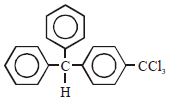
B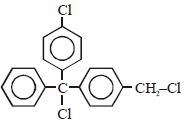
C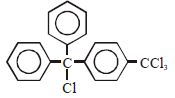
D
None of these
Solution
(C) The reaction involves the radical chlorination of the given compound in the presence of excess $Cl_2$ and $h\nu$.
Both the benzylic positions are reactive.
The $Ph_2CH-$ group has a benzylic hydrogen which is highly reactive and gets substituted by $Cl$ to form $Ph_2CCl-$.
The $-CH_3$ group attached to the phenyl ring is also a benzylic position,which undergoes exhaustive chlorination to form a $-CCl_3$ group.
Thus,the final product is $Ph_2CCl-C_6H_4-CCl_3$.
Both the benzylic positions are reactive.
The $Ph_2CH-$ group has a benzylic hydrogen which is highly reactive and gets substituted by $Cl$ to form $Ph_2CCl-$.
The $-CH_3$ group attached to the phenyl ring is also a benzylic position,which undergoes exhaustive chlorination to form a $-CCl_3$ group.
Thus,the final product is $Ph_2CCl-C_6H_4-CCl_3$.
0 likes
View Solution207
MediumMCQ
Match List-$I$ with List-$II$ and then select the correct answer from the codes given below the lists.
| List-$I$ | List-$II$ |
|---|---|
| $A.$ Butane $\to$ Isobutane | $(a).$ Cracking |
| $B.$ Butane $\to$ Lower hydrocarbons | $(b).$ Isomerisation |
| $C.$ $n-$Heptane $\to$ Toluene | $(c).$ Reed reaction |
| $D.$ Propane $\to CH_3CH_2CH_2SO_2Cl$ | $(d).$ Aromatization |
A
$A-b, B-a, C-d, D-c$
B
$A-b, B-d, C-a, D-c$
C
$A-b, B-c, C-d, D-a$
D
$A-b, B-d, C-c, D-a$
Solution
(A) $A.$ Butane $\to$ Isobutane is an example of Isomerisation $(b)$.
$B.$ Butane $\to$ Lower hydrocarbons is an example of Cracking $(a)$.
$C.$ $n-$Heptane $\to$ Toluene is an example of Aromatization $(d)$.
$D.$ Propane $\to CH_3CH_2CH_2SO_2Cl$ is an example of the Reed reaction $(c)$.
Therefore,the correct matching is $A-b, B-a, C-d, D-c$.
$B.$ Butane $\to$ Lower hydrocarbons is an example of Cracking $(a)$.
$C.$ $n-$Heptane $\to$ Toluene is an example of Aromatization $(d)$.
$D.$ Propane $\to CH_3CH_2CH_2SO_2Cl$ is an example of the Reed reaction $(c)$.
Therefore,the correct matching is $A-b, B-a, C-d, D-c$.
0 likes
View Solution208
MediumMCQ
Which of the following compounds does not react with $Na$ metal?
A
$CH_3OH$
B
$CH_3-C\equiv CH$
C
$C_6H_5OH$
D
cyclohexane
Solution
(D) Sodium $(Na)$ metal reacts with compounds containing acidic hydrogen atoms,such as alcohols,phenols,and terminal alkynes.
$1$. $CH_3OH$ (methanol) has an acidic hydroxyl hydrogen: $2CH_3OH + 2Na \rightarrow 2CH_3ONa + H_2 \uparrow$.
$2$. $CH_3-C\equiv CH$ (propyne) has an acidic terminal alkyne hydrogen: $CH_3-C\equiv CH + Na \rightarrow CH_3-C\equiv C^-Na^+ + \frac{1}{2}H_2 \uparrow$.
$3$. $C_6H_5OH$ (phenol) has an acidic phenolic hydrogen: $2C_6H_5OH + 2Na \rightarrow 2C_6H_5ONa + H_2 \uparrow$.
$4$. Cyclohexane is an alkane and does not contain any acidic hydrogen atoms,so it does not react with $Na$ metal.
$1$. $CH_3OH$ (methanol) has an acidic hydroxyl hydrogen: $2CH_3OH + 2Na \rightarrow 2CH_3ONa + H_2 \uparrow$.
$2$. $CH_3-C\equiv CH$ (propyne) has an acidic terminal alkyne hydrogen: $CH_3-C\equiv CH + Na \rightarrow CH_3-C\equiv C^-Na^+ + \frac{1}{2}H_2 \uparrow$.
$3$. $C_6H_5OH$ (phenol) has an acidic phenolic hydrogen: $2C_6H_5OH + 2Na \rightarrow 2C_6H_5ONa + H_2 \uparrow$.
$4$. Cyclohexane is an alkane and does not contain any acidic hydrogen atoms,so it does not react with $Na$ metal.
0 likes
View Solution209
DifficultMCQ
The octane number is ...........
A
The number of carbon atoms in octane
B
The number of octane molecules obtained from the cracking of $1.0 \ g$ of gasoline
C
The number of hydrogen atoms in octane
D
$A$ number indicating the standard rating of fuel
0 likes
View Solution210
MediumMCQ
Which of the following is not a mixture of hydrocarbons?
A
Candle wax
B
Kerosene
C
Vegetable oil
D
Paraffin oil
Solution
(C) Hydrocarbons are organic compounds consisting entirely of carbon and hydrogen.
$A$. Candle wax is a mixture of long-chain alkanes.
$B$. Kerosene is a mixture of various hydrocarbons obtained from petroleum.
$C$. Vegetable oils are primarily triglycerides,which are esters of glycerol and fatty acids. They contain oxygen in addition to carbon and hydrogen,so they are not hydrocarbons.
$D$. Paraffin oil is a mixture of liquid alkanes.
Therefore,vegetable oil is not a hydrocarbon.
$A$. Candle wax is a mixture of long-chain alkanes.
$B$. Kerosene is a mixture of various hydrocarbons obtained from petroleum.
$C$. Vegetable oils are primarily triglycerides,which are esters of glycerol and fatty acids. They contain oxygen in addition to carbon and hydrogen,so they are not hydrocarbons.
$D$. Paraffin oil is a mixture of liquid alkanes.
Therefore,vegetable oil is not a hydrocarbon.
0 likes
View Solution211
MediumMCQ
The octane number is associated with which petroleum product?
A
Diesel oil
B
Petrol
C
Kerosene
D
Lubricating oil
Solution
(B) The octane number is a standard measure of the performance of an engine or aviation fuel. It represents the anti-knock rating of petrol (gasoline). Higher octane numbers indicate better resistance to knocking during combustion in internal combustion engines.
0 likes
View Solution212
MediumMCQ
The octane number of diesel is increased by adding ..........
A
Decane
B
Hexadecane
C
Pentane
D
Methyl naphthalene
Solution
(D) The quality of diesel fuel is measured by its cetane number,while the quality of gasoline (petrol) is measured by its octane number. However,in the context of fuel additives,$Methyl \ naphthalene$ is known to decrease the cetane number of diesel,whereas compounds like $Amyl \ nitrate$ or $Ethyl \ nitrate$ are used to increase the cetane number. Given the options provided,$Methyl \ naphthalene$ is often discussed in the context of fuel performance indices. Note: The question asks for octane number,which is typically for petrol,but in the context of standard chemistry curriculum questions regarding fuel additives,$Methyl \ naphthalene$ is the intended answer.
0 likes
View Solution213
MediumMCQ
The octane number can be improved by $...............$.
A
Isomerization
B
Alkylation
C
Cyclization
D
All of the above
Solution
(D) The octane number of gasoline is a measure of its resistance to knocking during combustion in an internal combustion engine. $.$
To improve the octane rating,the structure of hydrocarbons is modified through processes such as:
$1.$ Isomerization: Converting straight-chain alkanes into branched-chain isomers.
$2.$ Alkylation: Combining smaller alkenes and alkanes to form higher-octane branched alkanes.
$3.$ Cyclization (or Aromatization): Converting alkanes into cyclic or aromatic compounds,which generally have higher octane numbers.
Therefore,all these processes are used to improve the octane number.
To improve the octane rating,the structure of hydrocarbons is modified through processes such as:
$1.$ Isomerization: Converting straight-chain alkanes into branched-chain isomers.
$2.$ Alkylation: Combining smaller alkenes and alkanes to form higher-octane branched alkanes.
$3.$ Cyclization (or Aromatization): Converting alkanes into cyclic or aromatic compounds,which generally have higher octane numbers.
Therefore,all these processes are used to improve the octane number.
0 likes
View Solution214
DifficultMCQ
Reaction of ethylbenzene with bromine in the presence of $FeBr_3$ yields:
A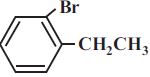
B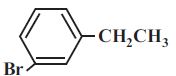
C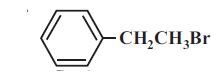
D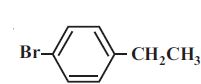
Solution
(D) The reaction of ethylbenzene with bromine in the presence of a Lewis acid catalyst like $FeBr_3$ is an electrophilic aromatic substitution reaction (bromination).
The ethyl group $(-CH_2CH_3)$ is an ortho/para-directing group because it is an electron-donating group by inductive effect and hyperconjugation.
Therefore,the incoming electrophile $(Br^+)$ will attack the ortho and para positions of the benzene ring.
Since the para-isomer is generally more stable due to less steric hindrance compared to the ortho-isomer,the major product formed is $p$-bromoethylbenzene.
The ethyl group $(-CH_2CH_3)$ is an ortho/para-directing group because it is an electron-donating group by inductive effect and hyperconjugation.
Therefore,the incoming electrophile $(Br^+)$ will attack the ortho and para positions of the benzene ring.
Since the para-isomer is generally more stable due to less steric hindrance compared to the ortho-isomer,the major product formed is $p$-bromoethylbenzene.
0 likes
View Solution215
DifficultMCQ
Which of the following is aromatic?
A
Cyclohexadienyl cation
B
Cyclopentadienyl cation
C
Cyclopentadiene
D
Cyclooctatetraene
Solution
(B) compound is aromatic if it follows $H$ückel's rule,which states that the cyclic,planar,fully conjugated system must have $(4n + 2) \pi$ electrons,where $n$ is an integer $(n = 0, 1, 2, ...)$.
$A$: The cyclohexadienyl cation has $4 \pi$ electrons,which is not $(4n + 2)$.
$B$: The cyclopentadienyl cation has $4 \pi$ electrons,which is not $(4n + 2)$.
$C$: Cyclopentadiene is not fully conjugated due to the $sp^3$ hybridized carbon atom.
$D$: Cyclooctatetraene is non-planar (tub-shaped) and has $8 \pi$ electrons,so it is non-aromatic.
Note: Based on standard chemistry problems of this type,if the intended structure for $B$ was the cyclopentadienyl anion $(C_5H_5^-)$,it would have $6 \pi$ electrons and be aromatic. However,given the provided options,none are strictly aromatic. If we re-evaluate the options provided in typical textbooks,the cyclopentadienyl anion is the classic example. Assuming the question implies the cyclopentadienyl anion,$B$ is the intended answer.
$A$: The cyclohexadienyl cation has $4 \pi$ electrons,which is not $(4n + 2)$.
$B$: The cyclopentadienyl cation has $4 \pi$ electrons,which is not $(4n + 2)$.
$C$: Cyclopentadiene is not fully conjugated due to the $sp^3$ hybridized carbon atom.
$D$: Cyclooctatetraene is non-planar (tub-shaped) and has $8 \pi$ electrons,so it is non-aromatic.
Note: Based on standard chemistry problems of this type,if the intended structure for $B$ was the cyclopentadienyl anion $(C_5H_5^-)$,it would have $6 \pi$ electrons and be aromatic. However,given the provided options,none are strictly aromatic. If we re-evaluate the options provided in typical textbooks,the cyclopentadienyl anion is the classic example. Assuming the question implies the cyclopentadienyl anion,$B$ is the intended answer.
0 likes
View Solution216
DifficultMCQ
Identify the aromatic compound.
A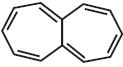
Azulene
B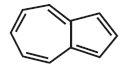
Azulene derivative
C
Pentalene
D
Cyclobutadiene
Solution
(A) An aromatic compound must follow $H$ückel's rule,which states that the compound must be cyclic,planar,fully conjugated,and contain $(4n+2) \pi$ electrons,where $n$ is an integer $(n = 0, 1, 2, ...)$.
$A$. Azulene consists of a seven-membered ring fused to a five-membered ring. It has $10 \pi$ electrons $(n=2)$,is planar,and cyclic,making it aromatic.
$B$. This structure is a derivative of azulene,but the specific structure shown is not the standard aromatic azulene.
$C$. Pentalene has $8 \pi$ electrons ($4n$ system),making it anti-aromatic.
$D$. Cyclobutadiene has $4 \pi$ electrons ($4n$ system),making it anti-aromatic.
Therefore,the correct aromatic compound is Azulene.
$A$. Azulene consists of a seven-membered ring fused to a five-membered ring. It has $10 \pi$ electrons $(n=2)$,is planar,and cyclic,making it aromatic.
$B$. This structure is a derivative of azulene,but the specific structure shown is not the standard aromatic azulene.
$C$. Pentalene has $8 \pi$ electrons ($4n$ system),making it anti-aromatic.
$D$. Cyclobutadiene has $4 \pi$ electrons ($4n$ system),making it anti-aromatic.
Therefore,the correct aromatic compound is Azulene.
0 likes
View Solution217
MediumMCQ
What is the product obtained from the dehydration of glycerol?
A
Propane
B
Propene
C
Acrolein
D
Benzene
Solution
(C) When glycerol $(CH_2OH-CHOH-CH_2OH)$ is heated with a dehydrating agent like potassium bisulphate $(KHSO_4)$,it undergoes dehydration to form acrolein $(CH_2=CH-CHO)$.
The reaction is: $CH_2OH-CHOH-CH_2OH \xrightarrow{KHSO_4, \Delta} CH_2=CH-CHO + 2H_2O$.
The reaction is: $CH_2OH-CHOH-CH_2OH \xrightarrow{KHSO_4, \Delta} CH_2=CH-CHO + 2H_2O$.
0 likes
View Solution218
DifficultMCQ
What is the product of the mild oxidation of glycerol using $H_2O_2/FeSO_4$?
A
Glyceraldehyde
B
Hydroxyacetone
C
Glycerose
D
None of these
Solution
(C) The oxidation of glycerol with $H_2O_2$ in the presence of $FeSO_4$ (Fenton's reagent) is a mild oxidation process.
This reaction produces a mixture of glyceraldehyde and dihydroxyacetone,which is collectively known as glycerose.
Therefore,the correct product is glycerose.
This reaction produces a mixture of glyceraldehyde and dihydroxyacetone,which is collectively known as glycerose.
Therefore,the correct product is glycerose.
0 likes
View Solution219
DifficultMCQ
Which of the following reagents will convert glycerol into acrolein?
A
$P_2O_5$
B
Conc. $H_2SO_4$
C
$KHSO_4$
D
All of the above
Solution
(D) Glycerol $(CH_2OH-CHOH-CH_2OH)$ undergoes dehydration when heated with dehydrating agents like $P_2O_5$,concentrated $H_2SO_4$,or $KHSO_4$.
This process involves the removal of two molecules of water to form acrolein $(CH_2=CH-CHO)$.
This process involves the removal of two molecules of water to form acrolein $(CH_2=CH-CHO)$.
0 likes
View Solution220
DifficultMCQ
Compound $X$ of molecular formula $C_4H_6$ takes up one equivalent of hydrogen in the presence of $Pt$ to form another compound $Y$,which on ozonolysis gives only ethanoic acid. The compound $X$ can be:
A
$CH_2=CH-CH=CH_2$
B
$CH_2=C=CHCH_3$
C
$CH_3C \equiv CCH_3$
D
All the three
Solution
(D) The molecular formula $C_4H_6$ corresponds to the degree of unsaturation $2$.
Ozonolysis of compound $Y$ yields only ethanoic acid $(CH_3COOH)$,which implies that $Y$ is $CH_3CH=CHCH_3$ (but$-2-$ene).
All three given compounds,when treated with one equivalent of $H_2$ in the presence of $Pt$,can form $CH_3CH=CHCH_3$:
$1$. $CH_2=CH-CH=CH_2 + H_2 \xrightarrow{Pt} CH_3CH=CHCH_3$
$2$. $CH_3C \equiv CCH_3 + H_2 \xrightarrow{Pt} CH_3CH=CHCH_3$
$3$. $CH_2=C=CHCH_3 + H_2 \xrightarrow{Pt} CH_3CH=CHCH_3$
Finally,$CH_3CH=CHCH_3 + O_3 \rightarrow 2CH_3COOH$.
Therefore,all three compounds satisfy the given conditions.
Ozonolysis of compound $Y$ yields only ethanoic acid $(CH_3COOH)$,which implies that $Y$ is $CH_3CH=CHCH_3$ (but$-2-$ene).
All three given compounds,when treated with one equivalent of $H_2$ in the presence of $Pt$,can form $CH_3CH=CHCH_3$:
$1$. $CH_2=CH-CH=CH_2 + H_2 \xrightarrow{Pt} CH_3CH=CHCH_3$
$2$. $CH_3C \equiv CCH_3 + H_2 \xrightarrow{Pt} CH_3CH=CHCH_3$
$3$. $CH_2=C=CHCH_3 + H_2 \xrightarrow{Pt} CH_3CH=CHCH_3$
Finally,$CH_3CH=CHCH_3 + O_3 \rightarrow 2CH_3COOH$.
Therefore,all three compounds satisfy the given conditions.
0 likes
View Solution221
AdvancedMCQ
Methylcyclopentane $\xrightarrow{Br_2/hv} \mathop{Major}\limits_{(X)}$ $\xrightarrow[KOH/\Delta]{Alcoholic} \mathop{Major}\limits_{(Y)}$ $\xrightarrow[Peroxide]{HBr} \mathop{Major}\limits_{(Z)}$
Major final product $(Z)$ is
Major final product $(Z)$ is
A
$1-$Bromo$-1-$methylcyclopentane
B
Bromocyclohexane
C
$2-$Bromo$-1-$methylcyclopentane
D
$1-$Bromo$-2-$methylcyclopentane
Solution
(D) $1$. Step $1$: Free radical bromination of methylcyclopentane with $Br_2/hv$ occurs preferentially at the tertiary carbon to form $1-$bromo$-1-$methylcyclopentane $(X)$ as the major product.
$2$. Step $2$: Dehydrohalogenation of $(X)$ with alcoholic $KOH/\Delta$ follows the $E2$ mechanism to form the more substituted alkene,$1$-methylcyclopentene $(Y)$,as the major product.
$3$. Step $3$: Anti-Markovnikov addition of $HBr$ to $1-$methylcyclopentene $(Y)$ in the presence of peroxide yields $1-$bromo$-2-$methylcyclopentane $(Z)$ as the major product.
$2$. Step $2$: Dehydrohalogenation of $(X)$ with alcoholic $KOH/\Delta$ follows the $E2$ mechanism to form the more substituted alkene,$1$-methylcyclopentene $(Y)$,as the major product.
$3$. Step $3$: Anti-Markovnikov addition of $HBr$ to $1-$methylcyclopentene $(Y)$ in the presence of peroxide yields $1-$bromo$-2-$methylcyclopentane $(Z)$ as the major product.
0 likes
View Solution222
MediumMCQ
The number of sigma $(σ)$ and pi $(π)$ bonds in pent$-2-$en$-4-$yne is
A
$10\sigma$ bonds and $3\pi$ bonds
B
$8\sigma$ bonds and $5\pi$ bonds
C
$11\sigma$ bonds and $2\pi$ bonds
D
$13\sigma$ bonds and $1\pi$ bond
Solution
(A) The structural formula of pent$-2-$en$-4-$yne is $CH_3-CH=CH-C \equiv CH$.
Number of $\sigma$ bonds:
$C-H$ bonds = $6$
$C-C$ bonds = $4$
Total $\sigma$ bonds = $6 + 4 = 10$.
Number of $\pi$ bonds:
$1$ (from $C=C$) + $2$ (from $C \equiv C$) = $3$.
Number of $\sigma$ bonds:
$C-H$ bonds = $6$
$C-C$ bonds = $4$
Total $\sigma$ bonds = $6 + 4 = 10$.
Number of $\pi$ bonds:
$1$ (from $C=C$) + $2$ (from $C \equiv C$) = $3$.
0 likes
View Solution223
AdvancedMCQ
An unsaturated hydrocarbon $X$ absorbs two hydrogen molecules on catalytic hydrogenation,and also gives the following reaction: $X$ $\xrightarrow[Zn/H_2O]{O_3} A$ $\xrightarrow{[Ag(NH_3)_2]^{+}} B$ ($3$-oxo-hexane dicarboxylic acid). $X$ will be
A
B
C
D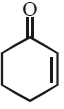
Solution
(A) $1$. The hydrocarbon $X$ absorbs two hydrogen molecules,which indicates it has two degrees of unsaturation (either two double bonds,one triple bond,or one ring and one double bond).
$2$. Ozonolysis $(O_3/Zn/H_2O)$ of $X$ gives product $A$,which upon oxidation with Tollens' reagent $([Ag(NH_3)_2]^{+})$ yields $3$-oxo-hexane dicarboxylic acid $(B)$.
$3$. The structure of $3$-oxo-hexane dicarboxylic acid is $HOOC-CH_2-C(=O)-CH_2-CH_2-COOH$.
$4$. This indicates that $A$ must be the corresponding dialdehyde: $OHC-CH_2-C(=O)-CH_2-CH_2-CHO$.
$5$. Working backwards from the ozonolysis product,the structure of $X$ is $3$-methylenecyclohexene,which has a double bond in the ring and an exocyclic double bond.
$6$. Therefore,the correct structure for $X$ is the one shown in option $A$.
$2$. Ozonolysis $(O_3/Zn/H_2O)$ of $X$ gives product $A$,which upon oxidation with Tollens' reagent $([Ag(NH_3)_2]^{+})$ yields $3$-oxo-hexane dicarboxylic acid $(B)$.
$3$. The structure of $3$-oxo-hexane dicarboxylic acid is $HOOC-CH_2-C(=O)-CH_2-CH_2-COOH$.
$4$. This indicates that $A$ must be the corresponding dialdehyde: $OHC-CH_2-C(=O)-CH_2-CH_2-CHO$.
$5$. Working backwards from the ozonolysis product,the structure of $X$ is $3$-methylenecyclohexene,which has a double bond in the ring and an exocyclic double bond.
$6$. Therefore,the correct structure for $X$ is the one shown in option $A$.
0 likes
View Solution224
Difficult
For the following compounds,write structural formulas and $IUPAC$ names for all possible isomers having the number of double or triple bonds as indicated:
$(a)$ $C_4H_8$ (one double bond)
$(b)$ $C_5H_8$ (one triple bond)
$(a)$ $C_4H_8$ (one double bond)
$(b)$ $C_5H_8$ (one triple bond)
Solution
(N/A) $C_4H_8$ (one double bond):
$1.$ $CH_2=CH-CH_2-CH_3$ $(But-1-ene)$
$2.$ $CH_3-CH=CH-CH_3$ $(But-2-ene)$
$3.$ $CH_2=C(CH_3)-CH_3$ $(2-Methylprop-1-ene)$
$(b)$ $C_5H_8$ (one triple bond):
$1.$ $CH \equiv C-CH_2-CH_2-CH_3$ $(Pent-1-yne)$
$2.$ $CH_3-C \equiv C-CH_2-CH_3$ $(Pent-2-yne)$
$3.$ $CH \equiv C-CH(CH_3)-CH_3$ $(3-Methylbut-1-yne)$
$1.$ $CH_2=CH-CH_2-CH_3$ $(But-1-ene)$
$2.$ $CH_3-CH=CH-CH_3$ $(But-2-ene)$
$3.$ $CH_2=C(CH_3)-CH_3$ $(2-Methylprop-1-ene)$
$(b)$ $C_5H_8$ (one triple bond):
$1.$ $CH \equiv C-CH_2-CH_2-CH_3$ $(Pent-1-yne)$
$2.$ $CH_3-C \equiv C-CH_2-CH_3$ $(Pent-2-yne)$
$3.$ $CH \equiv C-CH(CH_3)-CH_3$ $(3-Methylbut-1-yne)$
0 likes
View Solution225
Medium
Write chemical equations for the combustion reaction of the following hydrocarbons:
$(i)$ Butane $(ii)$ Pentene $(iii)$ Hexyne $(iv)$ Toluene
$(i)$ Butane $(ii)$ Pentene $(iii)$ Hexyne $(iv)$ Toluene
Solution
Combustion is the reaction of a hydrocarbon with oxygen to produce carbon dioxide,water,and heat.
$(i)$ $2C_4H_{10(g)} + 13O_{2(g)} \to 8CO_{2(g)} + 10H_2O_{(g)} + \text{Heat}$
$(ii)$ $2C_5H_{10(g)} + 15O_{2(g)} \to 10CO_{2(g)} + 10H_2O_{(g)} + \text{Heat}$
$(iii)$ $2C_6H_{10(g)} + 17O_{2(g)} \to 12CO_{2(g)} + 10H_2O_{(g)} + \text{Heat}$
$(iv)$ $C_6H_5CH_{3(l)} + 9O_{2(g)} \to 7CO_{2(g)} + 4H_2O_{(g)} + \text{Heat}$
$(i)$ $2C_4H_{10(g)} + 13O_{2(g)} \to 8CO_{2(g)} + 10H_2O_{(g)} + \text{Heat}$
$(ii)$ $2C_5H_{10(g)} + 15O_{2(g)} \to 10CO_{2(g)} + 10H_2O_{(g)} + \text{Heat}$
$(iii)$ $2C_6H_{10(g)} + 17O_{2(g)} \to 12CO_{2(g)} + 10H_2O_{(g)} + \text{Heat}$
$(iv)$ $C_6H_5CH_{3(l)} + 9O_{2(g)} \to 7CO_{2(g)} + 4H_2O_{(g)} + \text{Heat}$
0 likes
View Solution226
Medium
What do you mean by hydrocarbons? Give the names of the hydrocarbons that play a key role in our daily life.
Solution
(N/A) Hydrocarbons are organic compounds consisting entirely of carbon and hydrogen atoms.
Hydrocarbons play a key role in our daily life as fuels:
$1$. $LPG$ (Liquefied Petroleum Gas): Primarily consists of propane and butane.
$2$. $CNG$ (Compressed Natural Gas): Primarily consists of methane.
$3$. $LNG$ (Liquefied Natural Gas): Primarily consists of methane.
Hydrocarbons play a key role in our daily life as fuels:
$1$. $LPG$ (Liquefied Petroleum Gas): Primarily consists of propane and butane.
$2$. $CNG$ (Compressed Natural Gas): Primarily consists of methane.
$3$. $LNG$ (Liquefied Natural Gas): Primarily consists of methane.
0 likes
View Solution227
Medium
Write the names of hydrocarbon fuels used in daily life and their uses.
Solution
(N/A) In our daily life,hydrocarbon fuels are used as energy sources. The common fuels are as follows:
$(i)$ $LPG$ (Liquefied Petroleum Gas): Used primarily as a domestic fuel for cooking.
$(ii)$ $CNG$ (Compressed Natural Gas): Used as a cleaner fuel for automobiles and public transport.
$(iii)$ $LNG$ (Liquefied Natural Gas): Used for power generation and as a fuel for heavy-duty vehicles.
$(iv)$ Petrol,diesel,and kerosene: Obtained by the fractional distillation of petroleum and used in internal combustion engines,heating,and lighting.
$(v)$ Coal gas: Obtained from the destructive distillation of coal and used as an industrial fuel.
$(i)$ $LPG$ (Liquefied Petroleum Gas): Used primarily as a domestic fuel for cooking.
$(ii)$ $CNG$ (Compressed Natural Gas): Used as a cleaner fuel for automobiles and public transport.
$(iii)$ $LNG$ (Liquefied Natural Gas): Used for power generation and as a fuel for heavy-duty vehicles.
$(iv)$ Petrol,diesel,and kerosene: Obtained by the fractional distillation of petroleum and used in internal combustion engines,heating,and lighting.
$(v)$ Coal gas: Obtained from the destructive distillation of coal and used as an industrial fuel.
0 likes
View Solution228
Medium
Give the uses of hydrocarbons with examples.
Solution
(N/A) $1$. Fuel used in our daily life: $LPG$,$CNG$,$LNG$,and kerosene are mixtures of hydrocarbons.
$2$. Manufacture of polymers: Hydrocarbons are used to produce polymers like polyethene,polypropene,and polystyrene.
$3$. Solvents: Higher hydrocarbons like turpentine and kerosene are used as solvents for paints.
$4$. Starting materials: They serve as raw materials for the manufacture of many dyes and drugs.
Thus,hydrocarbon compounds are very important in our routine life.
$2$. Manufacture of polymers: Hydrocarbons are used to produce polymers like polyethene,polypropene,and polystyrene.
$3$. Solvents: Higher hydrocarbons like turpentine and kerosene are used as solvents for paints.
$4$. Starting materials: They serve as raw materials for the manufacture of many dyes and drugs.
Thus,hydrocarbon compounds are very important in our routine life.
0 likes
View Solution229
Medium
What is the importance of hydrocarbons in daily life?
Solution
(N/A) $1$. Fuel: Hydrocarbons like $LPG$,$CNG$,$LNG$,and kerosene are essential fuels used in our daily life.
$2$. Polymers: They serve as raw materials for the manufacture of polymers such as polyethene,polypropene,and polystyrene.
$3$. Solvents: Higher hydrocarbons like turpentine and kerosene are used as solvents in paints.
$4$. Industrial Synthesis: They act as starting materials for the synthesis of various dyes,drugs,and other chemical compounds.
Thus,hydrocarbon compounds are of immense importance in our routine life.
$2$. Polymers: They serve as raw materials for the manufacture of polymers such as polyethene,polypropene,and polystyrene.
$3$. Solvents: Higher hydrocarbons like turpentine and kerosene are used as solvents in paints.
$4$. Industrial Synthesis: They act as starting materials for the synthesis of various dyes,drugs,and other chemical compounds.
Thus,hydrocarbon compounds are of immense importance in our routine life.
0 likes
View Solution230
MediumMCQ
Hydrocarbons used in our daily life are important; explain.
A
They serve as primary sources of energy.
B
They are used as raw materials for polymers.
C
They are used as solvents and lubricants.
D
All of the above.
Solution
(D) Hydrocarbons are essential in daily life for several reasons:
$1$. Energy Source: They are the primary components of fuels like $LPG$,$CNG$,petrol,and diesel,which are used for cooking,transportation,and power generation.
$2$. Industrial Raw Materials: They serve as the building blocks for the synthesis of polymers like polyethylene,polypropylene,and polystyrene,which are used to make plastics,fibers,and rubber.
$3$. Chemical Industry: They are used as solvents,lubricants,and starting materials for the production of various chemicals,pharmaceuticals,and detergents.
Therefore,all the given options are correct.
$1$. Energy Source: They are the primary components of fuels like $LPG$,$CNG$,petrol,and diesel,which are used for cooking,transportation,and power generation.
$2$. Industrial Raw Materials: They serve as the building blocks for the synthesis of polymers like polyethylene,polypropylene,and polystyrene,which are used to make plastics,fibers,and rubber.
$3$. Chemical Industry: They are used as solvents,lubricants,and starting materials for the production of various chemicals,pharmaceuticals,and detergents.
Therefore,all the given options are correct.
0 likes
View Solution231
Medium
Classify hydrocarbon compounds and provide examples.
Solution
(N/A) Hydrocarbons are organic compounds consisting entirely of carbon and hydrogen. They are classified as follows:
$1$. Saturated Hydrocarbons (Alkanes): These contain only carbon-carbon single bonds. All carbons are $sp^3$ hybridized. Examples include methane,ethane,and cyclohexane.
$2$. Unsaturated Hydrocarbons: These contain one or more carbon-carbon double $(-C=C-)$ or triple $(-C\equiv C-)$ bonds. Carbons involved in double bonds are $sp^2$ hybridized,and those in triple bonds are $sp$ hybridized. Examples include ethene,ethyne,and cyclobutene.
$3$. Aromatic Hydrocarbons: These are cyclic compounds containing $(4n+2)$ $\pi$ electrons in the ring,where all ring carbons are $sp^2$ hybridized. Examples include benzene,toluene,and naphthalene.
$1$. Saturated Hydrocarbons (Alkanes): These contain only carbon-carbon single bonds. All carbons are $sp^3$ hybridized. Examples include methane,ethane,and cyclohexane.
$2$. Unsaturated Hydrocarbons: These contain one or more carbon-carbon double $(-C=C-)$ or triple $(-C\equiv C-)$ bonds. Carbons involved in double bonds are $sp^2$ hybridized,and those in triple bonds are $sp$ hybridized. Examples include ethene,ethyne,and cyclobutene.
$3$. Aromatic Hydrocarbons: These are cyclic compounds containing $(4n+2)$ $\pi$ electrons in the ring,where all ring carbons are $sp^2$ hybridized. Examples include benzene,toluene,and naphthalene.
0 likes
View Solution232
Easy
Provide the classification of hydrocarbons.
Solution
(N/A) Hydrocarbons are classified into three main categories based on their structure and bonding:
$1$. Saturated Hydrocarbons: These contain only carbon-carbon single bonds $(C-C)$. All carbon atoms are $sp^3$ hybridized. Examples include alkanes like methane $(CH_4)$,ethane $(C_2H_6)$,and cycloalkanes like methylcyclopropane.
$2$. Unsaturated Hydrocarbons: These contain at least one carbon-carbon double bond $(C=C)$ or triple bond $(C \equiv C)$. The carbon atoms involved in multiple bonds are $sp^2$ or $sp$ hybridized. Examples include alkenes (e.g.,ethene) and alkynes (e.g.,ethyne).
$3$. Aromatic Hydrocarbons: These are cyclic compounds that follow $H$ückel's rule (planar,cyclic,conjugated system with $4n+2$ $\pi$ electrons). All carbon atoms in the ring are typically $sp^2$ hybridized. Examples include benzene,toluene,and naphthalene.
$1$. Saturated Hydrocarbons: These contain only carbon-carbon single bonds $(C-C)$. All carbon atoms are $sp^3$ hybridized. Examples include alkanes like methane $(CH_4)$,ethane $(C_2H_6)$,and cycloalkanes like methylcyclopropane.
$2$. Unsaturated Hydrocarbons: These contain at least one carbon-carbon double bond $(C=C)$ or triple bond $(C \equiv C)$. The carbon atoms involved in multiple bonds are $sp^2$ or $sp$ hybridized. Examples include alkenes (e.g.,ethene) and alkynes (e.g.,ethyne).
$3$. Aromatic Hydrocarbons: These are cyclic compounds that follow $H$ückel's rule (planar,cyclic,conjugated system with $4n+2$ $\pi$ electrons). All carbon atoms in the ring are typically $sp^2$ hybridized. Examples include benzene,toluene,and naphthalene.
0 likes
View Solution233
Easy
How many $\sigma$ and $\pi$ bonds are present in the following?
$(a)$ $But-1-ene-3-yne$
$(b)$ $Buta-1,3-diene$
$(c)$ $CH_2=CH-C\equiv N$
$(d)$ $Propa-1,2-diene$
$(e)$ $1-butyne$ and $2-butane$
$(a)$ $But-1-ene-3-yne$
$(b)$ $Buta-1,3-diene$
$(c)$ $CH_2=CH-C\equiv N$
$(d)$ $Propa-1,2-diene$
$(e)$ $1-butyne$ and $2-butane$
Solution
(N/A) $CH_2=CH-C\equiv CH$: $7 \sigma$ and $3 \pi$ bonds.
$(b)$ $CH_2=CH-CH=CH_2$: $9 \sigma$ and $2 \pi$ bonds.
$(c)$ $CH_2=CH-C\equiv N$: $6 \sigma$ and $3 \pi$ bonds.
$(d)$ $CH_2=C=CH_2$: $6 \sigma$ and $2 \pi$ bonds.
$(e)$ $1-butyne$ $(CH_3-CH_2-C\equiv CH)$: $10 \sigma$ and $2 \pi$ bonds; $2-butane$ $(CH_3-CH_2-CH_2-CH_3)$: $13 \sigma$ and $0 \pi$ bonds.
$(b)$ $CH_2=CH-CH=CH_2$: $9 \sigma$ and $2 \pi$ bonds.
$(c)$ $CH_2=CH-C\equiv N$: $6 \sigma$ and $3 \pi$ bonds.
$(d)$ $CH_2=C=CH_2$: $6 \sigma$ and $2 \pi$ bonds.
$(e)$ $1-butyne$ $(CH_3-CH_2-C\equiv CH)$: $10 \sigma$ and $2 \pi$ bonds; $2-butane$ $(CH_3-CH_2-CH_2-CH_3)$: $13 \sigma$ and $0 \pi$ bonds.
0 likes
View Solution234
Difficult
Write the main product of the given reactions:
$(1)$ $C_6H_5CH = CH_2 \xrightarrow{HBr}$
$(2)$ $C_4H_{10} \xrightarrow{\text{air}, \Delta}$
$(1)$ $C_6H_5CH = CH_2 \xrightarrow{HBr}$
$(2)$ $C_4H_{10} \xrightarrow{\text{air}, \Delta}$
Solution
(N/A) $(1)$ The reaction of styrene $(C_6H_5CH = CH_2)$ with $HBr$ follows Markovnikov's rule,where the electrophile $H $ adds to the carbon with more hydrogen atoms,and the nucleophile $Br^-$ adds to the more substituted carbon,forming $1$-bromo-$1$-phenylethane $(C_6H_5CH(Br)CH_3)$.
$(2)$ The combustion of butane $(C_4H_{10})$ in the presence of air (oxygen) and heat $(\Delta)$ results in complete oxidation to carbon dioxide and water:
$C_4H_{10} \frac{13}{2}O_2 \xrightarrow{\Delta} 4CO_2(g) 5H_2O(g)$
$(2)$ The combustion of butane $(C_4H_{10})$ in the presence of air (oxygen) and heat $(\Delta)$ results in complete oxidation to carbon dioxide and water:
$C_4H_{10} \frac{13}{2}O_2 \xrightarrow{\Delta} 4CO_2(g) 5H_2O(g)$
0 likes
View Solution235
Medium
Give the main product of the following reactions:
$(i)$ $1, 2-$dibromopropane + alcoholic $KOH$
$(ii)$ $1, 1, 2, 2-$tetrabromoethane + zinc powder in methanol
$(i)$ $1, 2-$dibromopropane + alcoholic $KOH$
$(ii)$ $1, 1, 2, 2-$tetrabromoethane + zinc powder in methanol
Solution
(N/A) $(i)$ The reaction of $1, 2-$dibromopropane with alcoholic $KOH$ undergoes dehydrohalogenation to form propene:
$CH_3CHBrCH_2Br + 2KOH \xrightarrow{\text{alcoholic}} CH_3CH=CH_2 + 2KBr + 2H_2O$
$(ii)$ The reaction of $1, 1, 2, 2-$tetrabromoethane with zinc powder in methanol undergoes debromination to form ethyne:
$CHBr_2-CHBr_2 + 2Zn \xrightarrow{CH_3OH, \Delta} CH \equiv CH + 2ZnBr_2$
$CH_3CHBrCH_2Br + 2KOH \xrightarrow{\text{alcoholic}} CH_3CH=CH_2 + 2KBr + 2H_2O$
$(ii)$ The reaction of $1, 1, 2, 2-$tetrabromoethane with zinc powder in methanol undergoes debromination to form ethyne:
$CHBr_2-CHBr_2 + 2Zn \xrightarrow{CH_3OH, \Delta} CH \equiv CH + 2ZnBr_2$
0 likes
View Solution236
Medium
Give distinguishing tests for the following:
$(a)$ Ethane and ethyne (Alkane and Alkyne $RC \equiv CH$)
$(b)$ Ethene and Ethyne (Alkene and Alkyne $RC \equiv CH$)
$(c)$ Dimethyl ethyne and ethyne
$(d)$ Ethane and Ethene (Alkane and alkene)
$(a)$ Ethane and ethyne (Alkane and Alkyne $RC \equiv CH$)
$(b)$ Ethene and Ethyne (Alkene and Alkyne $RC \equiv CH$)
$(c)$ Dimethyl ethyne and ethyne
$(d)$ Ethane and Ethene (Alkane and alkene)
Solution
(N/A) Ethane and ethyne: Ethyne $(HC \equiv CH)$ has acidic hydrogen,so it reacts with $NaNH_2$ or ammoniacal $AgNO_3$ (Tollens' reagent),whereas ethane does not.
$(b)$ Ethene and Ethyne: Ethyne reacts with $NaNH_2$ or ammoniacal $AgNO_3$ due to acidic hydrogen,while ethene does not.
$(c)$ Dimethyl ethyne and ethyne: Ethyne reacts with $NaNH_2$ or ammoniacal $AgNO_3$ due to acidic hydrogen,while dimethyl ethyne $(CH_3C \equiv CCH_3)$ does not have acidic hydrogen.
$(d)$ Ethane and Ethene: Ethene reacts with $Br_2$ water (decolorizes) or Baeyer's reagent $(KMnO_4)$,while ethane does not.
$(b)$ Ethene and Ethyne: Ethyne reacts with $NaNH_2$ or ammoniacal $AgNO_3$ due to acidic hydrogen,while ethene does not.
$(c)$ Dimethyl ethyne and ethyne: Ethyne reacts with $NaNH_2$ or ammoniacal $AgNO_3$ due to acidic hydrogen,while dimethyl ethyne $(CH_3C \equiv CCH_3)$ does not have acidic hydrogen.
$(d)$ Ethane and Ethene: Ethene reacts with $Br_2$ water (decolorizes) or Baeyer's reagent $(KMnO_4)$,while ethane does not.
0 likes
View Solution237
Medium
Give the reaction for the following conversions:
$1$. Ethyne from ethene via bromination
$2$. Bromoethane from ethyne
$1$. Ethyne from ethene via bromination
$2$. Bromoethane from ethyne
Solution
(N/A) $1$. Ethyne from ethene:
$CH_2=CH_2 + Br_2$ $\xrightarrow{CCl_4} CH_2Br-CH_2Br$ $\xrightarrow{alc. KOH, \Delta} CH_2=CHBr$ $\xrightarrow{NaNH_2} CH \equiv CH$
$2$. Bromoethane from ethyne:
$CH \equiv CH + 2H_2$ $\xrightarrow{Ni, \Delta} CH_3-CH_3$ $\xrightarrow{Br_2, h\nu} CH_3CH_2Br + HBr$
$CH_2=CH_2 + Br_2$ $\xrightarrow{CCl_4} CH_2Br-CH_2Br$ $\xrightarrow{alc. KOH, \Delta} CH_2=CHBr$ $\xrightarrow{NaNH_2} CH \equiv CH$
$2$. Bromoethane from ethyne:
$CH \equiv CH + 2H_2$ $\xrightarrow{Ni, \Delta} CH_3-CH_3$ $\xrightarrow{Br_2, h\nu} CH_3CH_2Br + HBr$
0 likes
View Solution238
Medium
Give the reaction for the following transformations:
$1$. Ethanol from ethane
$2$. Benzene from $2-$hexene
$1$. Ethanol from ethane
$2$. Benzene from $2-$hexene
Solution
(N/A) $1$. Ethanol from ethane:
$CH_3-CH_3$ $\xrightarrow{Br_2, h\nu} CH_3CH_2Br$ $\xrightarrow{alc. KOH} CH_2=CH_2$ $\xrightarrow{dil. H_2SO_4, H_2O} CH_3CH_2OH$
$2$. Benzene from $2-$hexene:
$CH_3CH_2CH=CHCH_2CH_3$ $\xrightarrow{Pd, H_2, \Delta} CH_3CH_2CH_2CH_2CH_2CH_3$ $\xrightarrow{Cr_2O_3/V_2O_5/Mo_2O_3, 723K, 10-20 \text{ atm}} C_6H_6$ (Benzene)
$CH_3-CH_3$ $\xrightarrow{Br_2, h\nu} CH_3CH_2Br$ $\xrightarrow{alc. KOH} CH_2=CH_2$ $\xrightarrow{dil. H_2SO_4, H_2O} CH_3CH_2OH$
$2$. Benzene from $2-$hexene:
$CH_3CH_2CH=CHCH_2CH_3$ $\xrightarrow{Pd, H_2, \Delta} CH_3CH_2CH_2CH_2CH_2CH_3$ $\xrightarrow{Cr_2O_3/V_2O_5/Mo_2O_3, 723K, 10-20 \text{ atm}} C_6H_6$ (Benzene)
0 likes
View Solution239
Medium
Give the reactions for the following conversions:
$1$. Polyvinyl chloride from ethyne
$2$. Methane from propyne
$3$. $2,3-$Dimethylbutane from propene
$1$. Polyvinyl chloride from ethyne
$2$. Methane from propyne
$3$. $2,3-$Dimethylbutane from propene
Solution
(N/A) $1$. Polyvinyl chloride from ethyne:
$nHC \equiv CH$ $\xrightarrow{HCl, HgCl_2} nCH_2=CHCl$ $\xrightarrow{\text{Polymerisation}} -(CH_2-CHCl)_n-$
$2$. Methane from propyne:
$CH_3C \equiv CH$ $\xrightarrow{\text{Alkaline } KMnO_4, \Delta} CH_3COOH$ $\xrightarrow{NaOH, CaO, \Delta} CH_4 + Na_2CO_3$
$3$. $2,3-$Dimethylbutane from propene:
$CH_3CH=CH_2$ $\xrightarrow{HBr} CH_3CH(Br)CH_3$ $\xrightarrow{2Na, \text{dry ether}} CH_3-CH(CH_3)-CH(CH_3)-CH_3 + 2NaBr$
$nHC \equiv CH$ $\xrightarrow{HCl, HgCl_2} nCH_2=CHCl$ $\xrightarrow{\text{Polymerisation}} -(CH_2-CHCl)_n-$
$2$. Methane from propyne:
$CH_3C \equiv CH$ $\xrightarrow{\text{Alkaline } KMnO_4, \Delta} CH_3COOH$ $\xrightarrow{NaOH, CaO, \Delta} CH_4 + Na_2CO_3$
$3$. $2,3-$Dimethylbutane from propene:
$CH_3CH=CH_2$ $\xrightarrow{HBr} CH_3CH(Br)CH_3$ $\xrightarrow{2Na, \text{dry ether}} CH_3-CH(CH_3)-CH(CH_3)-CH_3 + 2NaBr$
0 likes
View Solution240
Medium
Write chemical equations for the combustion reaction of the following hydrocarbons:
$(i)$ Pentene
$(ii)$ Hexyne
$(iii)$ Toluene
$(i)$ Pentene
$(ii)$ Hexyne
$(iii)$ Toluene
Solution
(N/A) Combustion is the reaction of a hydrocarbon with oxygen to produce carbon dioxide,water,and heat.
$(i)$ $2C_{5}H_{10(g)} + 15O_{2(g)} \rightarrow 10CO_{2(g)} + 10H_{2}O_{(g)} + \text{Heat}$
$(ii)$ $2C_{6}H_{10(g)} + 17O_{2(g)} \rightarrow 12CO_{2(g)} + 10H_{2}O_{(g)} + \text{Heat}$
$(iii)$ $C_{7}H_{8(l)} + 9O_{2(g)} \rightarrow 7CO_{2(g)} + 4H_{2}O_{(g)} + \text{Heat}$
$(i)$ $2C_{5}H_{10(g)} + 15O_{2(g)} \rightarrow 10CO_{2(g)} + 10H_{2}O_{(g)} + \text{Heat}$
$(ii)$ $2C_{6}H_{10(g)} + 17O_{2(g)} \rightarrow 12CO_{2(g)} + 10H_{2}O_{(g)} + \text{Heat}$
$(iii)$ $C_{7}H_{8(l)} + 9O_{2(g)} \rightarrow 7CO_{2(g)} + 4H_{2}O_{(g)} + \text{Heat}$
0 likes
View Solution241
Difficult
Arrange benzene,$n-$hexane and ethyne in decreasing order of acidic behaviour. Also give reason for this behaviour.
Solution
(D) The acidic character of a hydrocarbon depends on the ease with which it can lose a proton $(H^+)$. This is directly related to the hybridization state of the carbon atom to which the hydrogen is attached.
As the $s-$character of the hybrid orbital increases,the electronegativity of the carbon atom increases. This causes the electron pair of the $C-H$ bond to be held more strongly by the carbon atom,making the hydrogen atom more acidic (easier to release as $H^+$).
The $s-$character increases in the order: $sp^3 < sp^2 < sp$.
Therefore,the decreasing order of acidic behavior is: Ethyne $>$ Benzene $>$ $n-$Hexane.
| Compound | Hybridization of Carbon | $s-$character |
|---|---|---|
| $n-$Hexane $(CH_3CH_2CH_2CH_2CH_2CH_3)$ | $sp^3$ | $25\%$ |
| Benzene $(C_6H_6)$ | $sp^2$ | $33\%$ |
| Ethyne $(HC \equiv CH)$ | $sp$ | $50\%$ |
As the $s-$character of the hybrid orbital increases,the electronegativity of the carbon atom increases. This causes the electron pair of the $C-H$ bond to be held more strongly by the carbon atom,making the hydrogen atom more acidic (easier to release as $H^+$).
The $s-$character increases in the order: $sp^3 < sp^2 < sp$.
Therefore,the decreasing order of acidic behavior is: Ethyne $>$ Benzene $>$ $n-$Hexane.
0 likes
View Solution242
Medium
Classify the following compounds into saturated,unsaturated,and aromatic hydrocarbons: Ethane,Ethene,Ethyne,Propene,Propane,Benzene,Toluene,Anthracene,Cyclopropane.
Solution
(N/A) Saturated hydrocarbons: Ethane,Propane,Cyclopropane
$(b)$ Unsaturated hydrocarbons: Ethene,Ethyne,Propene
$(c)$ Aromatic hydrocarbons: Benzene,Toluene,Anthracene
$(b)$ Unsaturated hydrocarbons: Ethene,Ethyne,Propene
$(c)$ Aromatic hydrocarbons: Benzene,Toluene,Anthracene
0 likes
View Solution243
Medium
Give the isomers of $C_3H_6$ and their names.
Solution
(N/A) The molecular formula $C_3H_6$ corresponds to the general formula $C_nH_{2n}$,which indicates either an alkene or a cycloalkane.
The two isomers are:
$(i)$ $CH_3-CH=CH_2$: Propene (an alkene)
(ii) Cyclopropane (a cycloalkane,represented by a triangle structure)
The two isomers are:
$(i)$ $CH_3-CH=CH_2$: Propene (an alkene)
(ii) Cyclopropane (a cycloalkane,represented by a triangle structure)
0 likes
View Solution244
Medium
Provide the bond lengths for hydrogen, ethane, ethene, and ethyne.
Solution
(N/A)
| Molecule | Bond Lengths |
|---|---|
| Hydrogen $(H_2)$ | $H-H: 74 \, pm$ |
| Ethane $(C_2H_6)$ | $C-C: 154 \, pm, C-H: 109 \, pm$ |
| Ethene $(C_2H_4)$ | $C=C: 134 \, pm, C-H: 108 \, pm$ |
| Ethyne $(C_2H_2)$ | $C\equiv C: 120 \, pm, C-H: 107 \, pm$ |
0 likes
View Solution245
Easy
What are the bond enthalpies and bond lengths between carbon and carbon atoms in alkanes and alkenes?
Solution
(N/A)
| $C-C$ Bond Type | Bond Length | Bond Enthalpy |
|---|---|---|
| $C-C$ (Single bond in alkane) | $154 \ pm$ | $348 \ kJ \ mol^{-1}$ |
| $C=C$ (Double bond in alkene) | $134 \ pm$ | $615 \ kJ \ mol^{-1}$ |
0 likes
View Solution246
MediumMCQ
Which bond is stronger between the single bond $C-C$ of an alkane and the double bond $C=C$ of an alkene?
A
$C-C$ bond
B
$C=C$ bond
C
Both are equal
D
Cannot be determined
Solution
(B) The $C=C$ bond in an alkene is stronger than the $C-C$ bond in an alkane.
This is because the $C=C$ bond consists of one $\sigma$ bond and one $\pi$ bond,resulting in a higher bond enthalpy of approximately $681 \ kJ \ mol^{-1}$ compared to the $C-C$ single bond,which has a bond enthalpy of approximately $348 \ kJ \ mol^{-1}$.
This is because the $C=C$ bond consists of one $\sigma$ bond and one $\pi$ bond,resulting in a higher bond enthalpy of approximately $681 \ kJ \ mol^{-1}$ compared to the $C-C$ single bond,which has a bond enthalpy of approximately $348 \ kJ \ mol^{-1}$.
0 likes
View Solution247
EasyMCQ
Which type of reactions are easily performed by alkane and alkene?
A
Electrophilic substitution and nucleophilic addition
B
Free radical substitution and electrophilic addition
C
Nucleophilic substitution and free radical addition
D
Electrophilic addition and free radical substitution
Solution
(B) Alkanes are saturated hydrocarbons and primarily undergo $Free \ radical \ substitution \ reactions$ due to the presence of strong $C-C$ and $C-H$ sigma bonds.
Alkenes are unsaturated hydrocarbons containing a $C=C$ double bond,which makes them electron-rich. Therefore,they primarily undergo $Electrophilic \ addition \ reactions$.
Alkenes are unsaturated hydrocarbons containing a $C=C$ double bond,which makes them electron-rich. Therefore,they primarily undergo $Electrophilic \ addition \ reactions$.
0 likes
View Solution248
Medium
Provide a chemical test to distinguish between butane and but-$1$-ene and write the corresponding reactions.
Solution
(N/A) To distinguish between butane (an alkane) and but-$1$-ene (an alkene),the Baeyer's test or Bromine water test can be used.
$1$. Baeyer's Test: But-$1$-ene reacts with cold dilute alkaline $KMnO_{4}$ solution (Baeyer's reagent) to form a vicinal diol,causing the purple color of $KMnO_{4}$ to disappear. Butane does not react.
$CH_{3}CH_{2}CH=CH_{2} + H_{2}O + [O] \xrightarrow{\text{Cold, dil. } KMnO_{4}} CH_{3}CH_{2}CH(OH)CH_{2}OH$ (Butane-$1,2$-diol)
$2$. Bromine Water Test: But-$1$-ene reacts with $Br_{2}$ in $CCl_{4}$ to form a colorless addition product,discharging the reddish-brown color of bromine. Butane does not react.
$CH_{3}CH_{2}CH=CH_{2} + Br_{2} \xrightarrow{CCl_{4}} CH_{3}CH_{2}CH(Br)CH_{2}Br$ ($1,2$-Dibromobutane)
$1$. Baeyer's Test: But-$1$-ene reacts with cold dilute alkaline $KMnO_{4}$ solution (Baeyer's reagent) to form a vicinal diol,causing the purple color of $KMnO_{4}$ to disappear. Butane does not react.
$CH_{3}CH_{2}CH=CH_{2} + H_{2}O + [O] \xrightarrow{\text{Cold, dil. } KMnO_{4}} CH_{3}CH_{2}CH(OH)CH_{2}OH$ (Butane-$1,2$-diol)
$2$. Bromine Water Test: But-$1$-ene reacts with $Br_{2}$ in $CCl_{4}$ to form a colorless addition product,discharging the reddish-brown color of bromine. Butane does not react.
$CH_{3}CH_{2}CH=CH_{2} + Br_{2} \xrightarrow{CCl_{4}} CH_{3}CH_{2}CH(Br)CH_{2}Br$ ($1,2$-Dibromobutane)
0 likes
View Solution249
MediumMCQ
Name the distinguishing reaction of an alkane from an alkene.
A
Baeyer's test
B
Reaction with $Br_2$ in $CCl_4$
C
Both $(A)$ and $(B)$
D
None of these
Solution
(C) Alkanes are saturated hydrocarbons and do not react with bromine water or alkaline $KMnO_4$ (Baeyer's reagent).
Alkenes are unsaturated hydrocarbons and undergo addition reactions with $Br_2$ in $CCl_4$ (decolorizing the reddish-brown color) and are oxidized by alkaline $KMnO_4$ (Baeyer's test,resulting in the disappearance of the purple color).
Therefore,both $(i)$ Baeyer's test and $(ii)$ reaction with $Br_2$ in $CCl_4$ are used to distinguish alkanes from alkenes.
Alkenes are unsaturated hydrocarbons and undergo addition reactions with $Br_2$ in $CCl_4$ (decolorizing the reddish-brown color) and are oxidized by alkaline $KMnO_4$ (Baeyer's test,resulting in the disappearance of the purple color).
Therefore,both $(i)$ Baeyer's test and $(ii)$ reaction with $Br_2$ in $CCl_4$ are used to distinguish alkanes from alkenes.
0 likes
View Solution250
Medium
Answer the following questions:
$(i)$ Give hybridization of Carbon atoms in the following compound: $CH_3-CH=CH-CH_2-C\equiv CH$
$(ii)$ Give the number of $\sigma$ and $\pi$ bonds in the above compound.
$(iii)$ Give the $IUPAC$ name of the above compound.
$(iv)$ Draw the geometrical isomers of the above compound.
$(v)$ Why are $cis$ and $trans$ isomers not possible in alkynes?
$(vi)$ Which bond possesses more bond length between $C=C$ and $C\equiv C$?
$(i)$ Give hybridization of Carbon atoms in the following compound: $CH_3-CH=CH-CH_2-C\equiv CH$
$(ii)$ Give the number of $\sigma$ and $\pi$ bonds in the above compound.
$(iii)$ Give the $IUPAC$ name of the above compound.
$(iv)$ Draw the geometrical isomers of the above compound.
$(v)$ Why are $cis$ and $trans$ isomers not possible in alkynes?
$(vi)$ Which bond possesses more bond length between $C=C$ and $C\equiv C$?
Solution
(N/A) $(i)$ Hybridization of carbons in $CH_3-CH=CH-CH_2-C\equiv CH$:
$CH_3$ $(sp^3)$,$-CH=$ $(sp^2)$,$=CH-$ $(sp^2)$,$-CH_2-$ $(sp^3)$,$-C\equiv$ $(sp)$,$\equiv CH$ $(sp)$.
$(ii)$ Total $\sigma$ bonds = $13$,Total $\pi$ bonds = $3$.
$(iii)$ $IUPAC$ name: $Hex-4-en-1-yne$.
$(iv)$ Geometrical isomers exist due to the $C=C$ double bond:
$Cis$-isomer: $H_3C-C(H)=C(H)-CH_2-C\equiv CH$ (with $CH_3$ and $CH_2-C\equiv CH$ on the same side).
$Trans$-isomer: $H_3C-C(H)=C(H)-CH_2-C\equiv CH$ (with $CH_3$ and $CH_2-C\equiv CH$ on opposite sides).
$(v)$ $Cis$ and $trans$ isomers are not possible in alkynes because the carbon atoms involved in the triple bond are $sp$ hybridized and have a linear geometry ($180^\circ$ bond angle),preventing the formation of different steric arrangements around the triple bond.
$(vi)$ Bond length of $C=C$ $(134 \ pm)$ $>$ Bond length of $C\equiv C$ $(120 \ pm)$.
$CH_3$ $(sp^3)$,$-CH=$ $(sp^2)$,$=CH-$ $(sp^2)$,$-CH_2-$ $(sp^3)$,$-C\equiv$ $(sp)$,$\equiv CH$ $(sp)$.
$(ii)$ Total $\sigma$ bonds = $13$,Total $\pi$ bonds = $3$.
$(iii)$ $IUPAC$ name: $Hex-4-en-1-yne$.
$(iv)$ Geometrical isomers exist due to the $C=C$ double bond:
$Cis$-isomer: $H_3C-C(H)=C(H)-CH_2-C\equiv CH$ (with $CH_3$ and $CH_2-C\equiv CH$ on the same side).
$Trans$-isomer: $H_3C-C(H)=C(H)-CH_2-C\equiv CH$ (with $CH_3$ and $CH_2-C\equiv CH$ on opposite sides).
$(v)$ $Cis$ and $trans$ isomers are not possible in alkynes because the carbon atoms involved in the triple bond are $sp$ hybridized and have a linear geometry ($180^\circ$ bond angle),preventing the formation of different steric arrangements around the triple bond.
$(vi)$ Bond length of $C=C$ $(134 \ pm)$ $>$ Bond length of $C\equiv C$ $(120 \ pm)$.
0 likes
View SolutionHydrocarbons — Mix Examples-Hydrocarbon · Frequently Asked Questions
1Are these Hydrocarbons questions useful for JEE and NEET?
Yes. All questions in this section are mapped to JEE Main and NEET exam patterns. Previous year questions from JEE Main, NEET, GUJCET and state-level exams are included with full solutions.
2Can I switch to Hindi or Gujarati for these questions?
Yes. Use the language tabs in the hero section or the sidebar to view the same questions and solutions in English, Hindi or Gujarati.
3How do I generate a question paper from this subtopic?
Use the Vedclass Exam Paper Generator — select the chapter and subtopic, set difficulty, and generate Sets A, B, C, D automatically. First 3 chapters of every subject are free.
Vedclass Products
For Students
Vedclass Test Series
Mock tests in real JEE/NEET style with performance analysis. 5-day free trial.
Start Free TrialFor Teachers
Exam Paper Generator
Generate Set A/B/C/D papers from this chapter in 2 minutes. 3 chapters free.
Try FreeFor Institutes
Online Exam Module
Live online exams with unlimited students, 360° analytics & white-label branding.
See DemoFor Teachers & Institutes
Generate a Hydrocarbons Exam Paper in 2 Minutes
Select subtopic & difficulty — Sets A, B, C, D auto-generated with No Repeat logic.
First 3 chapters of every subject are free — no payment required.