
A English
Aromatic hydrocarbon Questions in English
Class 11 Chemistry · Hydrocarbons · Aromatic hydrocarbon
872+
Questions
English
Language
100%
With Solutions
Showing 38 of 872 questions in English
801
DifficultMCQ
Which of the following statements are correct with respect to benzene?
$(i)$ It forms triozonide with $O_3$.
$(ii)$ It is non-planar.
$(iii)$ It forms only one monosubstituted product with $CH_3COCl$ in the presence of anhydrous $AlCl_3$.
$(iv)$ It forms hexachlorobenzene on heating with $Cl_2$ under photochemical conditions.
$(i)$ It forms triozonide with $O_3$.
$(ii)$ It is non-planar.
$(iii)$ It forms only one monosubstituted product with $CH_3COCl$ in the presence of anhydrous $AlCl_3$.
$(iv)$ It forms hexachlorobenzene on heating with $Cl_2$ under photochemical conditions.
A
$(i)$,$(ii)$
B
$(ii)$,$(iii)$
C
$(i)$,$(iii)$
D
$(iii)$,$(iv)$
Solution
(C) $(i)$ Benzene reacts with $O_3$ to form benzene triozonide. This is a correct statement.
$(ii)$ Benzene is a planar molecule with $sp^2$ hybridized carbon atoms. This is an incorrect statement.
$(iii)$ Benzene undergoes Friedel-Crafts acylation with $CH_3COCl$ in the presence of anhydrous $AlCl_3$ to form acetophenone (phenylethanone),which is a monosubstituted product. This is a correct statement.
$(iv)$ Benzene reacts with $Cl_2$ under photochemical conditions ($UV$ light) via addition reaction to form $1,2,3,4,5,6$-hexachlorocyclohexane (gammexane),not hexachlorobenzene. This is an incorrect statement.
Therefore,statements $(i)$ and $(iii)$ are correct.
$(ii)$ Benzene is a planar molecule with $sp^2$ hybridized carbon atoms. This is an incorrect statement.
$(iii)$ Benzene undergoes Friedel-Crafts acylation with $CH_3COCl$ in the presence of anhydrous $AlCl_3$ to form acetophenone (phenylethanone),which is a monosubstituted product. This is a correct statement.
$(iv)$ Benzene reacts with $Cl_2$ under photochemical conditions ($UV$ light) via addition reaction to form $1,2,3,4,5,6$-hexachlorocyclohexane (gammexane),not hexachlorobenzene. This is an incorrect statement.
Therefore,statements $(i)$ and $(iii)$ are correct.
0 likes
View Solution802
EasyMCQ
The major product of the following reaction is:
$Glucose \xrightarrow[(ii) \ Mo_2O_3, \ 773 \ K, \ 10-20 \ atm]{(i) \ HI, \ \Delta} ?$
$Glucose \xrightarrow[(ii) \ Mo_2O_3, \ 773 \ K, \ 10-20 \ atm]{(i) \ HI, \ \Delta} ?$
A
Cyclohexane
B
Benzene
C
Cyclohexadiene
D
Hexane
Solution
(B) When $Glucose$ is heated with $HI$,it undergoes reduction to form $n-hexane$.
The reaction is: $C_6H_{12}O_6 + HI \xrightarrow{\Delta} CH_3-(CH_2)_4-CH_3$ $(n-hexane)$.
Further,when $n-hexane$ is heated with $Mo_2O_3$ at $773 \ K$ and $10-20 \ atm$ pressure,it undergoes aromatization (dehydrocyclization) to form $Benzene$.
Therefore,the major product is $Benzene$.
The reaction is: $C_6H_{12}O_6 + HI \xrightarrow{\Delta} CH_3-(CH_2)_4-CH_3$ $(n-hexane)$.
Further,when $n-hexane$ is heated with $Mo_2O_3$ at $773 \ K$ and $10-20 \ atm$ pressure,it undergoes aromatization (dehydrocyclization) to form $Benzene$.
Therefore,the major product is $Benzene$.
0 likes
View Solution803
DifficultMCQ
Consider the following reactions:
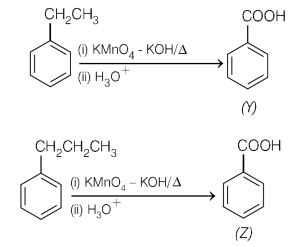
$Ethylbenzene \xrightarrow[(ii) H_3O^{+}]{(i) KMnO_4-KOH/\Delta} Y$
$Propylbenzene \xrightarrow[(ii) H_3O^{+}]{(i) KMnO_4-KOH/\Delta} Z$
What are the structures of $Y$ and $Z$?
$Ethylbenzene \xrightarrow[(ii) H_3O^{+}]{(i) KMnO_4-KOH/\Delta} Y$
$Propylbenzene \xrightarrow[(ii) H_3O^{+}]{(i) KMnO_4-KOH/\Delta} Z$
What are the structures of $Y$ and $Z$?
A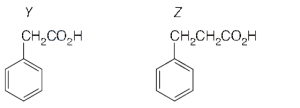
B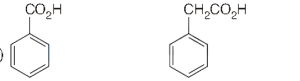
C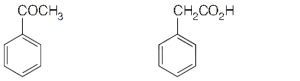
D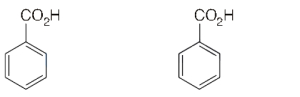
Solution
(D) Alkaline $KMnO_4$ oxidizes any alkyl group directly attached to a benzene ring to a carboxylic acid group $(-COOH)$,provided the alkyl group has at least one $\alpha$-hydrogen atom.
In both ethylbenzene and propylbenzene,the $\alpha$-carbon has hydrogen atoms,so both are oxidized to benzoic acid.
Therefore,both $Y$ and $Z$ are benzoic acid.
In both ethylbenzene and propylbenzene,the $\alpha$-carbon has hydrogen atoms,so both are oxidized to benzoic acid.
Therefore,both $Y$ and $Z$ are benzoic acid.
0 likes
View Solution804
DifficultMCQ
The cyclopentadienyl anion is:
A
benzenoid and aromatic
B
non-benzenoid and aromatic
C
non-benzenoid and non-aromatic
D
non-benzenoid and anti-aromatic
Solution
(B) The cyclopentadienyl anion is a cyclic,planar species with $6 \pi \ e^-$ (where $n=1$ in the $4n+2$ $H$ückel rule).
Since it contains $6 \pi \ e^-$,it follows $H$ückel's rule and is aromatic.
Because it does not contain a benzene ring,it is classified as non-benzenoid.
Therefore,it is non-benzenoid and aromatic.
Since it contains $6 \pi \ e^-$,it follows $H$ückel's rule and is aromatic.
Because it does not contain a benzene ring,it is classified as non-benzenoid.
Therefore,it is non-benzenoid and aromatic.
0 likes
View Solution805
MediumMCQ
The order of decreasing reactivity towards an electrophilic reagent,for the following compounds,is:
$(i) \text{ Benzene} \quad (ii) \text{ Toluene} \quad (iii) \text{ Chlorobenzene} \quad (iv) \text{ Phenol}$
$(i) \text{ Benzene} \quad (ii) \text{ Toluene} \quad (iii) \text{ Chlorobenzene} \quad (iv) \text{ Phenol}$
A
$(i) > (ii) > (iii) > (iv)$
B
$(ii) > (iv) > (i) > (iii)$
C
$(iv) > (iii) > (ii) > (i)$
D
$(iv) > (ii) > (i) > (iii)$
Solution
(D) Reactivity towards an electrophilic aromatic substitution reaction depends on the electron density of the benzene ring. Electron-donating groups $(EDG)$ increase the electron density,making the ring more reactive,while electron-withdrawing groups $(EWG)$ decrease it.
The substituents are:
$(iv) \text{ Phenol } (-OH): \text{ Strong EDG due to } +M \text{ effect.}$
$(ii) \text{ Toluene } (-CH_3): \text{ Weak EDG due to } +I \text{ and hyperconjugation.}$
$(i) \text{ Benzene: Reference compound.}$
$(iii) \text{ Chlorobenzene } (-Cl): \text{ EWG due to strong } -I \text{ effect (despite } +M \text{ effect, the net effect is deactivating).}$
Therefore,the order of decreasing reactivity is: $(iv) > (ii) > (i) > (iii)$.
The substituents are:
$(iv) \text{ Phenol } (-OH): \text{ Strong EDG due to } +M \text{ effect.}$
$(ii) \text{ Toluene } (-CH_3): \text{ Weak EDG due to } +I \text{ and hyperconjugation.}$
$(i) \text{ Benzene: Reference compound.}$
$(iii) \text{ Chlorobenzene } (-Cl): \text{ EWG due to strong } -I \text{ effect (despite } +M \text{ effect, the net effect is deactivating).}$
Therefore,the order of decreasing reactivity is: $(iv) > (ii) > (i) > (iii)$.
0 likes
View Solution806
EasyMCQ
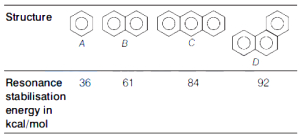
The order of stability of the aromatic hydrocarbons given below is:
A
$C < B < D < A$
B
$C < B < A < D$
C
$A < D < B < C$
D
$C < D < B < A$
Solution
(A) The stability of polycyclic aromatic hydrocarbons is determined by the resonance energy per ring.
Benzene $(A)$: $36 \ kcal/mol$ per ring.
Naphthalene $(B)$: $61 \ kcal/mol$ for $2$ rings,so $61/2 = 30.5 \ kcal/mol$ per ring.
Anthracene $(C)$: $84 \ kcal/mol$ for $3$ rings,so $84/3 = 28 \ kcal/mol$ per ring.
Phenanthrene $(D)$: $92 \ kcal/mol$ for $3$ rings,so $92/3 = 30.67 \ kcal/mol$ per ring.
Comparing the values: $28 (C) < 30.5 (B) < 30.67 (D) < 36 (A)$.
Therefore,the order of stability is $C < B < D < A$.
Benzene $(A)$: $36 \ kcal/mol$ per ring.
Naphthalene $(B)$: $61 \ kcal/mol$ for $2$ rings,so $61/2 = 30.5 \ kcal/mol$ per ring.
Anthracene $(C)$: $84 \ kcal/mol$ for $3$ rings,so $84/3 = 28 \ kcal/mol$ per ring.
Phenanthrene $(D)$: $92 \ kcal/mol$ for $3$ rings,so $92/3 = 30.67 \ kcal/mol$ per ring.
Comparing the values: $28 (C) < 30.5 (B) < 30.67 (D) < 36 (A)$.
Therefore,the order of stability is $C < B < D < A$.
0 likes
View Solution807
MediumMCQ
Which of the following is not an aromatic species?
A
Cyclopentadienyl cation $(C_5H_5^+)$
B
Cyclopentadienyl anion $(C_5H_5^-)$
C
Cycloheptatrienyl cation $(C_7H_7^+)$
D
Naphthalene $(C_{10}H_8)$
Solution
(A) To determine if a species is aromatic,it must follow $H$ückel's rule: it must be cyclic,planar,fully conjugated,and contain $(4n+2) \pi$ electrons,where $n$ is an integer $(0, 1, 2, ...)$.
$A$. Cyclopentadienyl cation $(C_5H_5^+)$: It has $4 \pi$ electrons (anti-aromatic).
$B$. Cyclopentadienyl anion $(C_5H_5^-)$: It has $6 \pi$ electrons $(n=1)$,so it is aromatic.
$C$. Cycloheptatrienyl cation $(C_7H_7^+)$: It has $6 \pi$ electrons $(n=1)$,so it is aromatic.
$D$. Naphthalene $(C_{10}H_8)$: It has $10 \pi$ electrons $(n=2)$,so it is aromatic.
Therefore,the cyclopentadienyl cation is not aromatic.
$A$. Cyclopentadienyl cation $(C_5H_5^+)$: It has $4 \pi$ electrons (anti-aromatic).
$B$. Cyclopentadienyl anion $(C_5H_5^-)$: It has $6 \pi$ electrons $(n=1)$,so it is aromatic.
$C$. Cycloheptatrienyl cation $(C_7H_7^+)$: It has $6 \pi$ electrons $(n=1)$,so it is aromatic.
$D$. Naphthalene $(C_{10}H_8)$: It has $10 \pi$ electrons $(n=2)$,so it is aromatic.
Therefore,the cyclopentadienyl cation is not aromatic.
0 likes
View Solution808
EasyMCQ
The aromatic compound/species with the maximum number of $\pi$-electrons is:
A
Phenanthrene
B
Naphthalene
C
Cyclopentadienyl anion
D
Cycloheptatrienyl cation
Solution
(A) To determine the number of $\pi$-electrons in each species:
$1$. Phenanthrene: It consists of three fused benzene rings. It has $14$ $\pi$-electrons.
$2$. Naphthalene: It consists of two fused benzene rings. It has $10$ $\pi$-electrons.
$3$. Cyclopentadienyl anion: It has two double bonds ($4$ $\pi$-electrons) and one lone pair on the carbon atom involved in resonance,contributing $2$ $\pi$-electrons,totaling $6$ $\pi$-electrons.
$4$. Cycloheptatrienyl cation: It has three double bonds ($6$ $\pi$-electrons) and a vacant $p$-orbital on the positively charged carbon,totaling $6$ $\pi$-electrons.
Comparing these,Phenanthrene has the maximum number of $\pi$-electrons $(14)$.
Therefore,the correct option is $A$.
$1$. Phenanthrene: It consists of three fused benzene rings. It has $14$ $\pi$-electrons.
$2$. Naphthalene: It consists of two fused benzene rings. It has $10$ $\pi$-electrons.
$3$. Cyclopentadienyl anion: It has two double bonds ($4$ $\pi$-electrons) and one lone pair on the carbon atom involved in resonance,contributing $2$ $\pi$-electrons,totaling $6$ $\pi$-electrons.
$4$. Cycloheptatrienyl cation: It has three double bonds ($6$ $\pi$-electrons) and a vacant $p$-orbital on the positively charged carbon,totaling $6$ $\pi$-electrons.
Comparing these,Phenanthrene has the maximum number of $\pi$-electrons $(14)$.
Therefore,the correct option is $A$.
0 likes
View Solution809
MediumMCQ
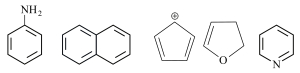
Total number of aromatic compounds from the following is:
A
$2$
B
$3$
C
$4$
D
$5$
Solution
(B) To identify aromatic compounds,we apply $H$ückel's rule,which states that a compound is aromatic if it is cyclic,planar,fully conjugated,and contains $(4n + 2) \pi$ electrons (where $n = 0, 1, 2, \dots$).
$1$. Aniline: It is a benzene derivative,which is cyclic,planar,fully conjugated,and has $6 \pi$ electrons. It is aromatic.
$2$. Naphthalene: It is a polycyclic aromatic hydrocarbon with $10 \pi$ electrons. It is aromatic.
$3$. Cyclopentadienyl cation: It has $4 \pi$ electrons,which follows the $4n$ rule. It is anti-aromatic.
$4$. $2,5-$Dihydrofuran: It is not fully conjugated due to the $sp^3$ hybridized carbon atom. It is non-aromatic.
$5$. Pyridine: It is a heterocyclic compound with $6 \pi$ electrons. It is aromatic.
Thus,the aromatic compounds are Aniline,Naphthalene,and Pyridine. The total number of aromatic compounds is $3$.
$1$. Aniline: It is a benzene derivative,which is cyclic,planar,fully conjugated,and has $6 \pi$ electrons. It is aromatic.
$2$. Naphthalene: It is a polycyclic aromatic hydrocarbon with $10 \pi$ electrons. It is aromatic.
$3$. Cyclopentadienyl cation: It has $4 \pi$ electrons,which follows the $4n$ rule. It is anti-aromatic.
$4$. $2,5-$Dihydrofuran: It is not fully conjugated due to the $sp^3$ hybridized carbon atom. It is non-aromatic.
$5$. Pyridine: It is a heterocyclic compound with $6 \pi$ electrons. It is aromatic.
Thus,the aromatic compounds are Aniline,Naphthalene,and Pyridine. The total number of aromatic compounds is $3$.
0 likes
View Solution810
MediumMCQ
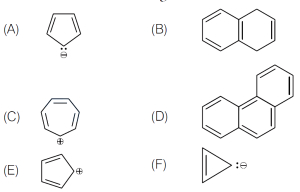
Which of the following are not aromatic?
A
$A, C, E$
B
$B, E, F$
C
$B, C, F$
D
$C, D, E$
Solution
(B) Key Idea: Conditions for a species to be aromatic are:
$(I)$ The structure must follow $H$ückel's rule,i.e.,it must have $(4n+2) \pi$-electrons,where $n$ is an integer $(0, 1, 2, 3, \dots)$.
$(II)$ The structure must be a planar cyclic ring.
$(A)$ Cyclopentadienyl anion: It has $6 \pi$-electrons $(n=1)$ and is planar. Thus,it is aromatic.
$(B)$ $1,2-$dihydronaphthalene: It is not fully conjugated and has $8 \pi$-electrons. Thus,it is not aromatic.
$(C)$ Tropylium cation: It has $6 \pi$-electrons $(n=1)$ and is planar. Thus,it is aromatic.
$(D)$ Phenanthrene: It has $14 \pi$-electrons $(n=3)$ and is planar. Thus,it is aromatic.
$(E)$ Cyclopentadienyl cation: It has $4 \pi$-electrons ($n=1$ for $4n$ rule). Thus,it is anti-aromatic (not aromatic).
$(F)$ Cyclopropenyl anion: It has $4 \pi$-electrons ($n=0$ for $4n$ rule). Thus,it is anti-aromatic (not aromatic).
Therefore,species $(B)$,$(E)$,and $(F)$ are not aromatic. Hence,option $(b)$ is the correct answer.
$(I)$ The structure must follow $H$ückel's rule,i.e.,it must have $(4n+2) \pi$-electrons,where $n$ is an integer $(0, 1, 2, 3, \dots)$.
$(II)$ The structure must be a planar cyclic ring.
$(A)$ Cyclopentadienyl anion: It has $6 \pi$-electrons $(n=1)$ and is planar. Thus,it is aromatic.
$(B)$ $1,2-$dihydronaphthalene: It is not fully conjugated and has $8 \pi$-electrons. Thus,it is not aromatic.
$(C)$ Tropylium cation: It has $6 \pi$-electrons $(n=1)$ and is planar. Thus,it is aromatic.
$(D)$ Phenanthrene: It has $14 \pi$-electrons $(n=3)$ and is planar. Thus,it is aromatic.
$(E)$ Cyclopentadienyl cation: It has $4 \pi$-electrons ($n=1$ for $4n$ rule). Thus,it is anti-aromatic (not aromatic).
$(F)$ Cyclopropenyl anion: It has $4 \pi$-electrons ($n=0$ for $4n$ rule). Thus,it is anti-aromatic (not aromatic).
Therefore,species $(B)$,$(E)$,and $(F)$ are not aromatic. Hence,option $(b)$ is the correct answer.
0 likes
View Solution811
MediumMCQ
Tropolone is
A
benzenoid and aromatic
B
non-benzenoid and not aromatic
C
non-benzenoid and aromatic
D
non-benzenoid and anti-aromatic
Solution
(C) Tropolone is a seven-membered ring compound containing a carbonyl group and a hydroxyl group.
It does not contain a benzene ring,so it is non-benzenoid.
It exhibits aromatic character due to the resonance structure where the seven-membered ring becomes a tropylium cation $(C_7H_7^+)$,which follows $H$ückel's rule ($4n+2$ $\pi$ electrons,where $n=1$).
Thus,tropolone is non-benzenoid and aromatic.
It does not contain a benzene ring,so it is non-benzenoid.
It exhibits aromatic character due to the resonance structure where the seven-membered ring becomes a tropylium cation $(C_7H_7^+)$,which follows $H$ückel's rule ($4n+2$ $\pi$ electrons,where $n=1$).
Thus,tropolone is non-benzenoid and aromatic.
0 likes
View Solution812
EasyMCQ
Which one of the following methods is suitable to generate aromatic compound$(s)$ from linear aliphatic saturated hydrocarbons with at least six carbon atoms?
A
Heating at $773 \ K$
B
$Mo_2O_3, 773 \ K, 10-20 \ atm$
C
Anhyd. $AlCl_3$,conc. $HCl, \Delta$
D
$Cu, 523 \ K, 100 \ atm$
Solution
(B) Linear alkanes containing $6$ or more carbon atoms undergo cyclization and aromatization when heated at $773 \ K$ under $10-20 \ atm$ pressure in the presence of catalysts like $Cr_2O_3$,$V_2O_5$,or $Mo_2O_3$ supported over alumina. This process is known as aromatization or reforming. For example,$n$-hexane gives benzene under these conditions.
0 likes
View Solution813
MediumMCQ
When acetylene is passed through a red hot iron tube,compound $X$ is formed. Which one of the following reactions will yield $X$ as the major product?
A
$C_6H_5OH + Zn \xrightarrow{\text{distillation}} C_6H_6 + ZnO$
B
$C_6H_5SO_3H + NaHCO_3 \longrightarrow C_6H_5SO_3Na + H_2O + CO_2$
C
$C_6H_{12} + 3H_2 \xrightarrow{Ni} C_6H_{12}$ (No reaction)
D
$C_6H_5Cl + H_2O \xrightarrow{\Delta} C_6H_5OH + HCl$
Solution
(A) When acetylene $(C_2H_2)$ is passed through a red hot iron tube,it undergoes cyclic polymerization to form benzene $(C_6H_6)$,which is compound $X$.
$3C_2H_2 \xrightarrow{\text{red hot iron tube}} C_6H_6 (X)$
Option $A$ represents the reduction of phenol using zinc dust,which is a standard laboratory method to produce benzene:
$C_6H_5OH + Zn \xrightarrow{\text{distillation}} C_6H_6 + ZnO$
Thus,reaction $A$ yields $X$ as the major product.
$3C_2H_2 \xrightarrow{\text{red hot iron tube}} C_6H_6 (X)$
Option $A$ represents the reduction of phenol using zinc dust,which is a standard laboratory method to produce benzene:
$C_6H_5OH + Zn \xrightarrow{\text{distillation}} C_6H_6 + ZnO$
Thus,reaction $A$ yields $X$ as the major product.
0 likes
View Solution814
MediumMCQ
Consider the following reactions:
$C_2 H_2 \xrightarrow[500^{\circ}C]{\text{red hot iron tube}} A$
$A \xrightarrow[70^{\circ}C]{\text{conc. } HNO_3, \text{conc. } H_2 SO_4} B$
$B \xrightarrow{LiAlH_4} C_6 H_5-N=N-C_6 H_5$
$A$ and $B$ are:
$C_2 H_2 \xrightarrow[500^{\circ}C]{\text{red hot iron tube}} A$
$A \xrightarrow[70^{\circ}C]{\text{conc. } HNO_3, \text{conc. } H_2 SO_4} B$
$B \xrightarrow{LiAlH_4} C_6 H_5-N=N-C_6 H_5$
$A$ and $B$ are:
A
$A=C_2 H_4, B=C_6 H_6$
B
$A=C_2 H_6, B=C_6 H_5 NH_2$
C
$A=C_2 H_4, B=C_6 H_5 NH_2$
D
$A=C_6 H_6, B=C_6 H_5 NO_2$
Solution
(D) $1$. The reaction of $C_2 H_2$ (acetylene) with a red hot iron tube at $500^{\circ}C$ is a cyclic polymerization reaction that produces $C_6 H_6$ (benzene). Therefore,$A = C_6 H_6$.
$2$. The reaction of benzene $(A)$ with a mixture of concentrated $HNO_3$ and concentrated $H_2 SO_4$ at $70^{\circ}C$ is a nitration reaction,which produces $C_6 H_5 NO_2$ (nitrobenzene). Therefore,$B = C_6 H_5 NO_2$.
$3$. The reduction of nitrobenzene $(B)$ with $LiAlH_4$ can lead to the formation of azobenzene $(C_6 H_5-N=N-C_6 H_5)$ under specific conditions.
$4$. Thus,$A = C_6 H_6$ and $B = C_6 H_5 NO_2$.
$2$. The reaction of benzene $(A)$ with a mixture of concentrated $HNO_3$ and concentrated $H_2 SO_4$ at $70^{\circ}C$ is a nitration reaction,which produces $C_6 H_5 NO_2$ (nitrobenzene). Therefore,$B = C_6 H_5 NO_2$.
$3$. The reduction of nitrobenzene $(B)$ with $LiAlH_4$ can lead to the formation of azobenzene $(C_6 H_5-N=N-C_6 H_5)$ under specific conditions.
$4$. Thus,$A = C_6 H_6$ and $B = C_6 H_5 NO_2$.
0 likes
View Solution815
DifficultMCQ
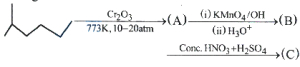
In the following reaction,'$C$' is an aromatic compound having substituents $D$ and $E$. What are $D$ and $E$?
A
$-OH, -SO_3H$
B
$-CHO, -NO_2$
C
$-COOH, -NO_2$
D
$-SO_3H, -NO_2$
Solution
(C) $1$. The starting material is $2$-methylhexane. Upon heating with $Cr_2O_3$ at $773 \ K$ and $10-20 \ atm$,it undergoes aromatization to form $A$ (Toluene).
$2$. Toluene $(A)$ reacts with alkaline $KMnO_4$ followed by acidic workup $(H_3O^+)$ to undergo oxidation of the methyl group to a carboxylic acid group,forming $B$ (Benzoic acid).
$3$. Benzoic acid $(B)$ reacts with concentrated $HNO_3$ and $H_2SO_4$ (nitration). Since the $-COOH$ group is meta-directing,the $-NO_2$ group attaches at the meta position,forming $C$ ($m$-nitrobenzoic acid).
$4$. Compound $C$ has substituents $D = -COOH$ and $E = -NO_2$.
$2$. Toluene $(A)$ reacts with alkaline $KMnO_4$ followed by acidic workup $(H_3O^+)$ to undergo oxidation of the methyl group to a carboxylic acid group,forming $B$ (Benzoic acid).
$3$. Benzoic acid $(B)$ reacts with concentrated $HNO_3$ and $H_2SO_4$ (nitration). Since the $-COOH$ group is meta-directing,the $-NO_2$ group attaches at the meta position,forming $C$ ($m$-nitrobenzoic acid).
$4$. Compound $C$ has substituents $D = -COOH$ and $E = -NO_2$.
0 likes
View Solution816
MediumMCQ
Consider the following sequence of reactions. In $Z$,the number of $sp^3$ carbons is $a$ and $sp^2$ carbons is $b$. The value of $(a+b)$ is:
$CH_3CH_2CH_2CH_2Br$ $\xrightarrow[\text{dry ether}]{Na} X$ $\xrightarrow[\text{10-20 atm}]{\text{Cr}_2\text{O}_3 / 773 \text{ K}} Y$ $\xrightarrow[\text{anhy. AlCl}_3]{\text{CH}_3\text{COCl}} Z$
$CH_3CH_2CH_2CH_2Br$ $\xrightarrow[\text{dry ether}]{Na} X$ $\xrightarrow[\text{10-20 atm}]{\text{Cr}_2\text{O}_3 / 773 \text{ K}} Y$ $\xrightarrow[\text{anhy. AlCl}_3]{\text{CH}_3\text{COCl}} Z$
A
$8$
B
$7$
C
$6$
D
$9$
Solution
(D) $1$. The starting material is $n$-butyl bromide $(CH_3CH_2CH_2CH_2Br)$.
$2$. Reaction with $Na$ in dry ether is the Wurtz reaction,which couples the alkyl group to form $n$-octane $(CH_3(CH_2)_6CH_3)$,so $X$ is $n$-octane.
$3$. Aromatization of $n$-octane using $\text{Cr}_2\text{O}_3$ at $773 \text{ K}$ and $10-20 \text{ atm}$ leads to the formation of ethylbenzene $(Y)$.
$4$. Friedel-Crafts acylation of ethylbenzene with $\text{CH}_3\text{COCl}$ in the presence of anhydrous $\text{AlCl}_3$ gives $p$-methylacetophenone (or $o$-methylacetophenone,but $p$- is major) as $Z$. The structure of $p$-methylacetophenone is $CH_3-C_6H_4-COCH_3$.
$5$. In $p$-methylacetophenone $(CH_3-C_6H_4-COCH_3)$:
- $sp^3$ carbons: The methyl group on the ring $(1)$,the methyl group on the carbonyl $(1)$. Total $a = 2$.
- $sp^2$ carbons: The $6$ carbons of the benzene ring $(6)$ and the carbonyl carbon $(1)$. Total $b = 7$.
$6$. The value of $(a+b) = 2 + 7 = 9$.
$2$. Reaction with $Na$ in dry ether is the Wurtz reaction,which couples the alkyl group to form $n$-octane $(CH_3(CH_2)_6CH_3)$,so $X$ is $n$-octane.
$3$. Aromatization of $n$-octane using $\text{Cr}_2\text{O}_3$ at $773 \text{ K}$ and $10-20 \text{ atm}$ leads to the formation of ethylbenzene $(Y)$.
$4$. Friedel-Crafts acylation of ethylbenzene with $\text{CH}_3\text{COCl}$ in the presence of anhydrous $\text{AlCl}_3$ gives $p$-methylacetophenone (or $o$-methylacetophenone,but $p$- is major) as $Z$. The structure of $p$-methylacetophenone is $CH_3-C_6H_4-COCH_3$.
$5$. In $p$-methylacetophenone $(CH_3-C_6H_4-COCH_3)$:
- $sp^3$ carbons: The methyl group on the ring $(1)$,the methyl group on the carbonyl $(1)$. Total $a = 2$.
- $sp^2$ carbons: The $6$ carbons of the benzene ring $(6)$ and the carbonyl carbon $(1)$. Total $b = 7$.
$6$. The value of $(a+b) = 2 + 7 = 9$.
0 likes
View Solution817
EasyMCQ
Which one of the following gives a sooty flame on combustion?
A
$C_2H_4$
B
$CH_4$
C
$C_2H_6$
D
$C_6H_6$
Solution
(D) Aromatic compounds,such as $C_6H_6$ (benzene),have a high carbon-to-hydrogen ratio.
Due to incomplete combustion,they produce a sooty flame.
Due to incomplete combustion,they produce a sooty flame.
0 likes
View Solution818
MediumMCQ
Which of the following statements is not correct?
A
The six carbons in benzene are $sp^2$ hybridised
B
Benzene has $(4n+2) \pi$ electrons
C
Benzene undergoes substitution reactions
D
Benzene has two carbon-carbon bond lengths,$1.54 \ Å$ and $1.34 \ Å$
Solution
(D) In benzene,all the $C-C$ bond lengths are equal to $1.39 \ Å$ due to resonance. Therefore,the statement that benzene has two different bond lengths of $1.54 \ Å$ and $1.34 \ Å$ is incorrect.
0 likes
View Solution819
MediumMCQ
The empirical formula of the compound '$D$' formed in the given reaction sequence is:
$C_2H_4$ $\xrightarrow{Br_2/CCl_4} A$ $\xrightarrow[(ii) NaNH_2]{(i) alc. KOH} B$ $\xrightarrow{\text{cyclic polymerization}} C$ $\xrightarrow[\text{dry } AlCl_3, \text{dark, cold}]{Cl_2 \text{ (excess)}} D$
$C_2H_4$ $\xrightarrow{Br_2/CCl_4} A$ $\xrightarrow[(ii) NaNH_2]{(i) alc. KOH} B$ $\xrightarrow{\text{cyclic polymerization}} C$ $\xrightarrow[\text{dry } AlCl_3, \text{dark, cold}]{Cl_2 \text{ (excess)}} D$
A
$CHCl$
B
$CCl$
C
$CH_2Cl$
D
$CHCl_2$
Solution
(A) $1$. $C_2H_4 + Br_2/CCl_4 \rightarrow BrCH_2-CH_2Br$ ($A$ is $1,2$-dibromoethane).
$2$. $BrCH_2-CH_2Br \xrightarrow[(ii) NaNH_2]{(i) alc. KOH} HC \equiv CH$ ($B$ is ethyne).
$3$. $3HC \equiv CH \xrightarrow{\text{cyclic polymerization}} C_6H_6$ ($C$ is benzene).
$4$. $C_6H_6 + 3Cl_2 \xrightarrow{\text{dry } AlCl_3, \text{dark, cold}} C_6H_6Cl_6$ ($D$ is benzene hexachloride,also known as gammaxene or lindane).
$5$. The molecular formula of $D$ is $C_6H_6Cl_6$. The empirical formula is the simplest ratio of atoms,which is $CH Cl$.
$2$. $BrCH_2-CH_2Br \xrightarrow[(ii) NaNH_2]{(i) alc. KOH} HC \equiv CH$ ($B$ is ethyne).
$3$. $3HC \equiv CH \xrightarrow{\text{cyclic polymerization}} C_6H_6$ ($C$ is benzene).
$4$. $C_6H_6 + 3Cl_2 \xrightarrow{\text{dry } AlCl_3, \text{dark, cold}} C_6H_6Cl_6$ ($D$ is benzene hexachloride,also known as gammaxene or lindane).
$5$. The molecular formula of $D$ is $C_6H_6Cl_6$. The empirical formula is the simplest ratio of atoms,which is $CH Cl$.
0 likes
View Solution820
MediumMCQ
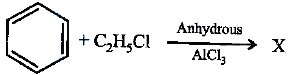
What is the percentage of carbon in the product '$X$' formed in the given reaction (in $.6$)?
A
$85$
B
$80$
C
$90$
D
$70$
Solution
(C) The given reaction is the Friedel-Crafts alkylation of benzene with ethyl chloride $(C_2H_5Cl)$ in the presence of anhydrous $AlCl_3$ to form ethylbenzene $(X)$.
The chemical formula of ethylbenzene $(X)$ is $C_8H_{10}$.
Atomic mass of Carbon $(C)$ $= 12.01 \ g/mol$.
Atomic mass of Hydrogen $(H)$ $= 1.008 \ g/mol$.
Molar mass of $C_8H_{10} = (8 \times 12.01) + (10 \times 1.008) = 96.08 + 10.08 = 106.16 \ g/mol$.
Percentage of carbon in $C_8H_{10} = \frac{\text{Mass of Carbon}}{\text{Total Molar Mass}} \times 100$.
Percentage of carbon $= \frac{96.08}{106.16} \times 100 \approx 90.505 \% \approx 90.6 \%$.
The chemical formula of ethylbenzene $(X)$ is $C_8H_{10}$.
Atomic mass of Carbon $(C)$ $= 12.01 \ g/mol$.
Atomic mass of Hydrogen $(H)$ $= 1.008 \ g/mol$.
Molar mass of $C_8H_{10} = (8 \times 12.01) + (10 \times 1.008) = 96.08 + 10.08 = 106.16 \ g/mol$.
Percentage of carbon in $C_8H_{10} = \frac{\text{Mass of Carbon}}{\text{Total Molar Mass}} \times 100$.
Percentage of carbon $= \frac{96.08}{106.16} \times 100 \approx 90.505 \% \approx 90.6 \%$.
0 likes
View Solution821
EasyMCQ
$C_6H_6 + 3O_3$ $\longrightarrow X \stackrel{Zn / H_2O}{}$ ${\longrightarrow} Y$; $X$ and $Y$ are respectively
A
diozonide,glycol
B
triozonide,glyoxalic acid
C
triozonide,glyoxal
D
monoozonide,oxalic acid
Solution
(C) The reaction of benzene $(C_6H_6)$ with ozone $(O_3)$ is an ozonolysis reaction.
Benzene reacts with three molecules of ozone to form benzene triozonide $(X)$.
Benzene triozonide on reductive hydrolysis with $Zn / H_2O$ yields three molecules of glyoxal $(Y)$ $(CHO-CHO)$.
Therefore,$X$ is triozonide and $Y$ is glyoxal.
Benzene reacts with three molecules of ozone to form benzene triozonide $(X)$.
Benzene triozonide on reductive hydrolysis with $Zn / H_2O$ yields three molecules of glyoxal $(Y)$ $(CHO-CHO)$.
Therefore,$X$ is triozonide and $Y$ is glyoxal.
0 likes
View Solution822
MediumMCQ
Which of the following is an example of an electrophilic substitution reaction?
A
$CH_3CHO + HCN \rightarrow CH_3CH(OH)CN$
B
$(CH_3)_3CX + H_2O \rightarrow (CH_3)_3COH + HX$
C
$C_6H_6 + CH_3COCl \xrightarrow{AlCl_3} C_6H_5(COCH_3) + HCl$
D
$BrCH_2CH_2Br + Zn \xrightarrow[\Delta]{\text{alcohol}} CH_2=CH_2 + ZnBr_2$
Solution
(C) An electrophilic substitution reaction involves the replacement of an atom or group on a molecule by an electrophile.
Option $A$ is a nucleophilic addition reaction.
Option $B$ is a nucleophilic substitution reaction $(S_N1)$.
Option $C$ is a Friedel-Crafts acylation reaction,which is a classic example of electrophilic aromatic substitution where the electrophile is the acylium ion $(CH_3CO^+)$.
Option $D$ is an elimination reaction (dehalogenation).
Option $A$ is a nucleophilic addition reaction.
Option $B$ is a nucleophilic substitution reaction $(S_N1)$.
Option $C$ is a Friedel-Crafts acylation reaction,which is a classic example of electrophilic aromatic substitution where the electrophile is the acylium ion $(CH_3CO^+)$.
Option $D$ is an elimination reaction (dehalogenation).
0 likes
View Solution823
MediumMCQ
What are $X$ and $Y$ respectively in the following reactions?

A
$CH_3Cl, CH_3COCl$
B
$C_2H_5Cl, CH_3COCl$
C
$CH_3COCl, CH_3Cl$
D
$C_2H_5COCl, CH_3Cl$
Solution
(A) The reaction of benzene with $CH_3Cl$ in the presence of anhydrous $AlCl_3$ is a Friedel-Crafts alkylation reaction,which produces toluene. Thus,$X = CH_3Cl$.
The reaction of benzene with $CH_3COCl$ (acetyl chloride) in the presence of anhydrous $AlCl_3$ is a Friedel-Crafts acylation reaction,which produces acetophenone. Thus,$Y = CH_3COCl$.
Therefore,$X$ and $Y$ are $CH_3Cl$ and $CH_3COCl$ respectively.
The reaction of benzene with $CH_3COCl$ (acetyl chloride) in the presence of anhydrous $AlCl_3$ is a Friedel-Crafts acylation reaction,which produces acetophenone. Thus,$Y = CH_3COCl$.
Therefore,$X$ and $Y$ are $CH_3Cl$ and $CH_3COCl$ respectively.
0 likes
View Solution824
DifficultMCQ
Identify the end product $(Z)$ in the sequence of the following reactions:
$C_2H_4Br_2$ $\xrightarrow[(ii) NaNH_2]{(i) Alc. KOH} X$ $\xrightarrow[873 \ K]{\text{Red hot Fe tube}} Y$ $\xrightarrow[\text{Anhy } AlCl_3, \Delta]{CH_3COCl} Z$
$C_2H_4Br_2$ $\xrightarrow[(ii) NaNH_2]{(i) Alc. KOH} X$ $\xrightarrow[873 \ K]{\text{Red hot Fe tube}} Y$ $\xrightarrow[\text{Anhy } AlCl_3, \Delta]{CH_3COCl} Z$
A
$C_6H_5COCl$
B
$C_6H_5COCH_3$
C
$C_6H_5CH_2CH_3$
D
$C_6H_5CONH_2$
Solution
(B) $1$. The reaction of $C_2H_4Br_2$ ($1$,$2$-dibromoethane) with $Alc. KOH$ followed by $NaNH_2$ leads to dehydrohalogenation to form ethyne $(X = HC \equiv CH)$.
$2$. Passing ethyne through a red-hot iron tube at $873 \ K$ results in cyclic polymerization to form benzene $(Y = C_6H_6)$.
$3$. Benzene reacts with acetyl chloride $(CH_3COCl)$ in the presence of anhydrous $AlCl_3$ via Friedel-Crafts acylation to produce acetophenone $(Z = C_6H_5COCH_3)$.
$2$. Passing ethyne through a red-hot iron tube at $873 \ K$ results in cyclic polymerization to form benzene $(Y = C_6H_6)$.
$3$. Benzene reacts with acetyl chloride $(CH_3COCl)$ in the presence of anhydrous $AlCl_3$ via Friedel-Crafts acylation to produce acetophenone $(Z = C_6H_5COCH_3)$.
0 likes
View Solution825
MediumMCQ
Identify '$Z$' in the following reaction sequence:
$2CH_3CH_2CH_2Br$ $\xrightarrow{Na/Ether} X$ $\xrightarrow[10-20 \ atm]{Mo_2O_3, 773K} Y$ $\xrightarrow[CH_3Cl]{Anh. AlCl_3} Z$
$2CH_3CH_2CH_2Br$ $\xrightarrow{Na/Ether} X$ $\xrightarrow[10-20 \ atm]{Mo_2O_3, 773K} Y$ $\xrightarrow[CH_3Cl]{Anh. AlCl_3} Z$
A
Chlorobenzene
B
Benzyl chloride
C
Toluene
D
p-Chlorotoluene
Solution
(C) $1$. The reaction of $2CH_3CH_2CH_2Br$ with $Na/Ether$ is a Wurtz reaction,which produces $n$-hexane $(X = CH_3CH_2CH_2CH_2CH_2CH_3)$.
$2$. The aromatization of $n$-hexane in the presence of $Mo_2O_3$ at $773K$ and $10-20 \ atm$ yields benzene $(Y = C_6H_6)$.
$3$. The reaction of benzene $(Y)$ with $CH_3Cl$ in the presence of anhydrous $AlCl_3$ is a Friedel-Crafts alkylation,which produces toluene $(Z = C_6H_5CH_3)$.
$2$. The aromatization of $n$-hexane in the presence of $Mo_2O_3$ at $773K$ and $10-20 \ atm$ yields benzene $(Y = C_6H_6)$.
$3$. The reaction of benzene $(Y)$ with $CH_3Cl$ in the presence of anhydrous $AlCl_3$ is a Friedel-Crafts alkylation,which produces toluene $(Z = C_6H_5CH_3)$.
0 likes
View Solution826
MediumMCQ
Match the following reactions in List-$I$ with their corresponding products in List-$II$:
List-$I$ (Reaction):
$A$. $\text{Benzene} + Cl_2 \xrightarrow{AlCl_3}$
$B$. $\text{Benzene} + CH_3Cl \xrightarrow{\text{anhyd. } AlCl_3}$
$C$. $\text{Benzene} + R-CO-Cl \xrightarrow{\text{anhyd. } AlCl_3}$
$D$. $\text{Toluene} \xrightarrow{(i) KMnO_4/KOH, (ii) H_3O^+}$
List-$II$ (Product):
$I$. $\text{Benzoic acid}$
$II$. $\text{Alkyl phenyl ketone}$
$III$. $\text{Chlorobenzene}$
$IV$. $\text{Toluene}$
List-$I$ (Reaction):
$A$. $\text{Benzene} + Cl_2 \xrightarrow{AlCl_3}$
$B$. $\text{Benzene} + CH_3Cl \xrightarrow{\text{anhyd. } AlCl_3}$
$C$. $\text{Benzene} + R-CO-Cl \xrightarrow{\text{anhyd. } AlCl_3}$
$D$. $\text{Toluene} \xrightarrow{(i) KMnO_4/KOH, (ii) H_3O^+}$
List-$II$ (Product):
$I$. $\text{Benzoic acid}$
$II$. $\text{Alkyl phenyl ketone}$
$III$. $\text{Chlorobenzene}$
$IV$. $\text{Toluene}$
A
$A-III, B-IV, C-II, D-I$
B
$A-II, B-I, C-IV, D-III$
C
$A-IV, B-III, C-II, D-I$
D
$A-III, B-IV, C-I, D-II$
Solution
(A) The reactions are identified as follows:
$A$. $\text{Benzene} + Cl_2 \xrightarrow{AlCl_3} \text{Chlorobenzene}$ (Electrophilic substitution),so $A-III$.
$B$. $\text{Benzene} + CH_3Cl \xrightarrow{\text{anhyd. } AlCl_3} \text{Toluene}$ (Friedel-Crafts alkylation),so $B-IV$.
$C$. $\text{Benzene} + R-CO-Cl \xrightarrow{\text{anhyd. } AlCl_3} \text{Alkyl phenyl ketone}$ (Friedel-Crafts acylation),so $C-II$.
$D$. $\text{Toluene} \xrightarrow{(i) KMnO_4/KOH, (ii) H_3O^+} \text{Benzoic acid}$ (Oxidation of side chain),so $D-I$.
Thus,the correct matching is $A-III, B-IV, C-II, D-I$.
$A$. $\text{Benzene} + Cl_2 \xrightarrow{AlCl_3} \text{Chlorobenzene}$ (Electrophilic substitution),so $A-III$.
$B$. $\text{Benzene} + CH_3Cl \xrightarrow{\text{anhyd. } AlCl_3} \text{Toluene}$ (Friedel-Crafts alkylation),so $B-IV$.
$C$. $\text{Benzene} + R-CO-Cl \xrightarrow{\text{anhyd. } AlCl_3} \text{Alkyl phenyl ketone}$ (Friedel-Crafts acylation),so $C-II$.
$D$. $\text{Toluene} \xrightarrow{(i) KMnO_4/KOH, (ii) H_3O^+} \text{Benzoic acid}$ (Oxidation of side chain),so $D-I$.
Thus,the correct matching is $A-III, B-IV, C-II, D-I$.
0 likes
View Solution827
EasyMCQ
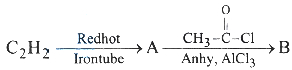
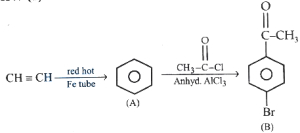
In the conversion of $A$ to $B$,the electrophile involved is:
A
${}^{\oplus}CH_3$
B
$Cl^{\oplus}$
C
$CH_3CO^{\oplus}$
D
$CH_3CH_2^{\oplus}$
Solution
(C) The reaction shown is a Friedel-Crafts acylation of benzene $(A)$ to form acetophenone,which is then further substituted to form $B$. The electrophile in the Friedel-Crafts acylation reaction is the acylium ion,$CH_3-C\equiv O^{\oplus}$ (or $CH_3CO^{\oplus}$),which is generated by the reaction of acetyl chloride $(CH_3COCl)$ with the Lewis acid catalyst $AlCl_3$.
0 likes
View Solution828
DifficultMCQ
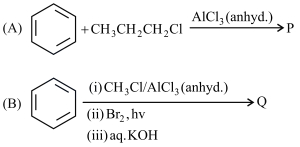
The major products $P$ and $Q$ formed in the following reaction schemes are:
A
$P$ = Isopropylbenzene,$Q$ = Benzyl alcohol
B
$P$ = Propylbenzene,$Q$ = Benzophenone
C
$P$ = Dipropylbenzene,$Q$ = Diphenylmethanol
D
$P$ = $2-$Chloropropylbenzene,$Q$ = Benzoic acid
Solution
(A) In reaction $(A)$,Friedel-Crafts alkylation of benzene with $n$-propyl chloride in the presence of $AlCl_3$ leads to the formation of a carbocation intermediate. The primary propyl carbocation rearranges to a more stable secondary isopropyl carbocation,which then attacks the benzene ring to form isopropylbenzene as the major product $P$.
In reaction $(B)$:
$(i)$ Friedel-Crafts alkylation of benzene with $CH_3Cl$ in the presence of $AlCl_3$ gives toluene.
$(ii)$ Free radical halogenation of toluene with $Br_2$ in the presence of $hv$ (light) gives benzyl bromide $(C_6H_5CH_2Br)$.
$(iii)$ Nucleophilic substitution of benzyl bromide with aqueous $KOH$ gives benzyl alcohol $(C_6H_5CH_2OH)$ as the major product $Q$.
In reaction $(B)$:
$(i)$ Friedel-Crafts alkylation of benzene with $CH_3Cl$ in the presence of $AlCl_3$ gives toluene.
$(ii)$ Free radical halogenation of toluene with $Br_2$ in the presence of $hv$ (light) gives benzyl bromide $(C_6H_5CH_2Br)$.
$(iii)$ Nucleophilic substitution of benzyl bromide with aqueous $KOH$ gives benzyl alcohol $(C_6H_5CH_2OH)$ as the major product $Q$.
0 likes
View Solution829
DifficultMCQ
The major product formed in the following reaction sequence is:
$C_6H_5-CHBr-CH_2Br$ $\xrightarrow[(ii) NaNH_2]{(i) alc. KOH}$ $\xrightarrow[(iii) \text{Red hot iron tube}, 873 K]{}$
$C_6H_5-CHBr-CH_2Br$ $\xrightarrow[(ii) NaNH_2]{(i) alc. KOH}$ $\xrightarrow[(iii) \text{Red hot iron tube}, 873 K]{}$
A
$1,2-$diphenylbenzene
B
$1,2,4-$triphenylbenzene
C
$1,3,5-$triphenylbenzene
D
$1,2,3-$triphenylbenzene
Solution
(C) Step $1$: Dehydrohalogenation of $C_6H_5-CHBr-CH_2Br$ with $alc. KOH$ followed by $NaNH_2$ leads to the formation of phenylacetylene $(C_6H_5-C \equiv CH)$.
Step $2$: The cyclic trimerization of phenylacetylene occurs when passed through a red hot iron tube at $873 \ K$.
Step $3$: The trimerization of $C_6H_5-C \equiv CH$ yields $1,3,5-triphenylbenzene$ as the major product due to steric hindrance,which favors the meta-substituted product.
Step $2$: The cyclic trimerization of phenylacetylene occurs when passed through a red hot iron tube at $873 \ K$.
Step $3$: The trimerization of $C_6H_5-C \equiv CH$ yields $1,3,5-triphenylbenzene$ as the major product due to steric hindrance,which favors the meta-substituted product.
0 likes
View Solution830
EasyMCQ
The molecular formula of the product formed when benzene is reacted with excess of chlorine molecules under ultra-violet light is
A
$C_6Cl_6$
B
$C_6H_3Cl_3$
C
$C_6H_2Cl_4$
D
$C_6H_6Cl_6$
Solution
(D) When benzene $(C_6H_6)$ reacts with excess chlorine $(Cl_2)$ in the presence of ultraviolet light,an addition reaction occurs.
This results in the formation of benzene hexachloride $(C_6H_6Cl_6)$,also known as $BHC$ or Gammaxene.
The reaction is: $C_6H_6 + 3Cl_2 \xrightarrow{uv/hv} C_6H_6Cl_6$.
This results in the formation of benzene hexachloride $(C_6H_6Cl_6)$,also known as $BHC$ or Gammaxene.
The reaction is: $C_6H_6 + 3Cl_2 \xrightarrow{uv/hv} C_6H_6Cl_6$.
0 likes
View Solution831
DifficultMCQ
Benzene reacts with $n-$propyl chloride in the presence of anhydrous $AlCl_3$ to give predominantly
A
$n-$Propyl benzene
B
Isopropyl benzene
C
$3-$Propyl$-1-$chloro benzene
D
$1-$Chloro$-3-n-$propyl benzene
Solution
(B) This reaction is known as Friedel-Crafts alkylation. In the presence of anhydrous $AlCl_3$,$n-$propyl chloride acts as an alkylating agent. It is an electrophilic aromatic substitution reaction.
Step $1$: Generation of electrophile:
$CH_3-CH_2-CH_2-Cl + AlCl_3 \rightarrow CH_3-CH_2-CH_2^+ + AlCl_4^-$
Step $2$: Carbocation rearrangement:
The primary carbocation $(CH_3-CH_2-CH_2^+)$ formed in step $1$ rearranges to form a more stable secondary carbocation $(CH_3-CH^+-CH_3)$ via a $1,2-$hydride shift.
Step $3$: Electrophilic attack:
This secondary carbocation attacks the benzene ring to form the intermediate.
Step $4$: Deprotonation:
The final step is the abstraction of a proton from the intermediate to restore aromaticity,yielding isopropyl benzene (cumene) as the major product.
Step $1$: Generation of electrophile:
$CH_3-CH_2-CH_2-Cl + AlCl_3 \rightarrow CH_3-CH_2-CH_2^+ + AlCl_4^-$
Step $2$: Carbocation rearrangement:
The primary carbocation $(CH_3-CH_2-CH_2^+)$ formed in step $1$ rearranges to form a more stable secondary carbocation $(CH_3-CH^+-CH_3)$ via a $1,2-$hydride shift.
Step $3$: Electrophilic attack:
This secondary carbocation attacks the benzene ring to form the intermediate.
Step $4$: Deprotonation:
The final step is the abstraction of a proton from the intermediate to restore aromaticity,yielding isopropyl benzene (cumene) as the major product.
0 likes
View Solution832
DifficultMCQ
In which of the following reactions,$t$-butyl benzene is formed?
$1.$ Benzene $+ t$-butyl chloride $\xrightarrow{AlCl_3}$
$2.$ Benzene $+ (CH_3)_2C=CH_2 \xrightarrow{BF_3/HF}$
$3.$ Benzene $+ t$-butyl alcohol $\xrightarrow{H_2SO_4}$
$4.$ Benzene $+$ butanoyl chloride $\xrightarrow{AlCl_3}$ $\xrightarrow{Zn/Hg, HCl}$
$1.$ Benzene $+ t$-butyl chloride $\xrightarrow{AlCl_3}$
$2.$ Benzene $+ (CH_3)_2C=CH_2 \xrightarrow{BF_3/HF}$
$3.$ Benzene $+ t$-butyl alcohol $\xrightarrow{H_2SO_4}$
$4.$ Benzene $+$ butanoyl chloride $\xrightarrow{AlCl_3}$ $\xrightarrow{Zn/Hg, HCl}$
A
$1, 2$ and $3$
B
$2, 3$ and $4$
C
$1, 2$ and $4$
D
$1, 3$ and $4$
Solution
(A) The given reactions are analyzed as follows:
$1.$ Friedel-Crafts alkylation of benzene with $t$-butyl chloride in the presence of $AlCl_3$ yields $t$-butyl benzene.
$2.$ Benzene reacts with $2$-methylpropene (isobutylene) in the presence of $BF_3/HF$ to form $t$-butyl benzene via a carbocation intermediate.
$3.$ Benzene reacts with $t$-butyl alcohol in the presence of $H_2SO_4$ to form $t$-butyl benzene through the formation of a $t$-butyl carbocation.
$4.$ Benzene reacts with butanoyl chloride via Friedel-Crafts acylation to form $1$-phenylbutan-$1$-one. Subsequent Clemmensen reduction $(Zn/Hg, HCl)$ yields $n$-butylbenzene,not $t$-butyl benzene.
Thus,reactions $1, 2,$ and $3$ produce $t$-butyl benzene.
$1.$ Friedel-Crafts alkylation of benzene with $t$-butyl chloride in the presence of $AlCl_3$ yields $t$-butyl benzene.
$2.$ Benzene reacts with $2$-methylpropene (isobutylene) in the presence of $BF_3/HF$ to form $t$-butyl benzene via a carbocation intermediate.
$3.$ Benzene reacts with $t$-butyl alcohol in the presence of $H_2SO_4$ to form $t$-butyl benzene through the formation of a $t$-butyl carbocation.
$4.$ Benzene reacts with butanoyl chloride via Friedel-Crafts acylation to form $1$-phenylbutan-$1$-one. Subsequent Clemmensen reduction $(Zn/Hg, HCl)$ yields $n$-butylbenzene,not $t$-butyl benzene.
Thus,reactions $1, 2,$ and $3$ produce $t$-butyl benzene.
0 likes
View Solution833
MediumMCQ
The number of $\pi$-bonds and lone pair$(s)$ present in the major benzenoid product,which is formed when benzene reacts with acetyl chloride in the presence of anhydrous aluminium chloride,are respectively:
A
$5 : 2$
B
$4 : 2$
C
$5 : 4$
D
$6 : 4$
Solution
(B) The reaction of benzene with acetyl chloride in the presence of anhydrous $AlCl_3$ is a Friedel-Crafts acylation reaction,which yields acetophenone $(C_6H_5COCH_3)$ as the major product.
In the structure of acetophenone:
$1$. The benzene ring contains $3$ $\pi$-bonds.
$2$. The carbonyl group $(C=O)$ contains $1$ $\pi$-bond.
Total number of $\pi$-bonds = $3 + 1 = 4$.
$3$. The oxygen atom in the carbonyl group has $2$ lone pairs of electrons.
Total number of lone pairs = $2$.
Thus,the number of $\pi$-bonds and lone pairs are $4$ and $2$ respectively.
In the structure of acetophenone:
$1$. The benzene ring contains $3$ $\pi$-bonds.
$2$. The carbonyl group $(C=O)$ contains $1$ $\pi$-bond.
Total number of $\pi$-bonds = $3 + 1 = 4$.
$3$. The oxygen atom in the carbonyl group has $2$ lone pairs of electrons.
Total number of lone pairs = $2$.
Thus,the number of $\pi$-bonds and lone pairs are $4$ and $2$ respectively.
0 likes
View Solution834
DifficultMCQ
The major product $P$ formed in the following reaction is:
A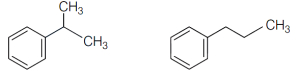
B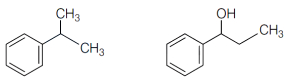
C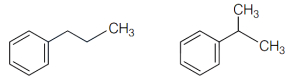
D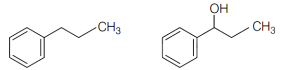
Solution
(A) The reaction of benzene with $n$-propyl chloride $(CH_3CH_2CH_2Cl)$ in the presence of anhydrous $AlCl_3$ is a Friedel-Crafts alkylation reaction.
In this reaction,the primary carbocation $(CH_3CH_2CH_2^+)$ formed initially is unstable and undergoes a $1,2-$hydride shift to form a more stable secondary carbocation $(CH_3CH^+CH_3)$.
This secondary carbocation then attacks the benzene ring to form isopropylbenzene (cumene) as the major product $P$.
In this reaction,the primary carbocation $(CH_3CH_2CH_2^+)$ formed initially is unstable and undergoes a $1,2-$hydride shift to form a more stable secondary carbocation $(CH_3CH^+CH_3)$.
This secondary carbocation then attacks the benzene ring to form isopropylbenzene (cumene) as the major product $P$.
0 likes
View Solution835
MediumMCQ
In the process of formation of nitronium ion,nitric acid acts as
A
$a$ base
B
$an$ acid
C
$a$ catalyst
D
$a$ solvent
Solution
(A) In the process of nitration,the nitronium ion $(NO_2^+)$ is generated by the reaction between sulfuric acid $(H_2SO_4)$ and nitric acid $(HNO_3)$.
$H_2SO_4 + HNO_3 \rightleftharpoons HSO_4^- + H_2NO_3^+$
$H_2NO_3^+ \rightleftharpoons H_2O + NO_2^+$
According to the Brønsted-Lowry acid-base theory,$H_2SO_4$ acts as a proton donor (acid),while $HNO_3$ acts as a proton acceptor (base) because it accepts a proton from $H_2SO_4$ to form $H_2NO_3^+$,which subsequently dehydrates to form the nitronium ion.
$H_2SO_4 + HNO_3 \rightleftharpoons HSO_4^- + H_2NO_3^+$
$H_2NO_3^+ \rightleftharpoons H_2O + NO_2^+$
According to the Brønsted-Lowry acid-base theory,$H_2SO_4$ acts as a proton donor (acid),while $HNO_3$ acts as a proton acceptor (base) because it accepts a proton from $H_2SO_4$ to form $H_2NO_3^+$,which subsequently dehydrates to form the nitronium ion.
0 likes
View Solution836
EasyMCQ
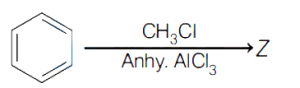
The product $(Z)$ of the following reaction is
A
Chlorobenzene
B
Toluene
C
$2-$Chlorotoluene
D
$1,2-$Dichlorobenzene
Solution
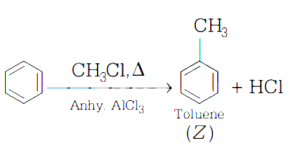
(B) The given reaction is a Friedel-Crafts alkylation reaction. In this reaction,benzene reacts with methyl chloride $(CH_3Cl)$ in the presence of anhydrous aluminum chloride $(Anhy. AlCl_3)$ as a Lewis acid catalyst to form toluene $(C_6H_5CH_3)$ as the product $(Z)$.
The reaction is:
$C_6H_6 + CH_3Cl \xrightarrow{Anhy. AlCl_3} C_6H_5CH_3 + HCl$
Thus,the product $(Z)$ is toluene.
The reaction is:
$C_6H_6 + CH_3Cl \xrightarrow{Anhy. AlCl_3} C_6H_5CH_3 + HCl$
Thus,the product $(Z)$ is toluene.
0 likes
View Solution837
MediumMCQ
Which of the following reacts with benzene in the presence of anhydrous aluminum chloride to form acetophenone?
A
$CH_3Cl$
B
$CH_3COOH$
C
$CH_3CHO$
D
$CH_3COCl$
Solution
(D) Friedel-Crafts Acylation: This reaction involves the treatment of benzene with an acylating agent such as acetyl chloride $(CH_3COCl)$ or acetic anhydride in the presence of a Lewis acid catalyst like anhydrous aluminum chloride $(AlCl_3)$.
The reaction is as follows:
$C_6H_6 + CH_3COCl \xrightarrow{anhydrous \ AlCl_3} C_6H_5COCH_3 + HCl$
Thus,benzene reacts with acetyl chloride $(CH_3COCl)$ to form acetophenone.
The reaction is as follows:
$C_6H_6 + CH_3COCl \xrightarrow{anhydrous \ AlCl_3} C_6H_5COCH_3 + HCl$
Thus,benzene reacts with acetyl chloride $(CH_3COCl)$ to form acetophenone.
0 likes
View Solution838
MediumMCQ
The compound prepared by a substitution reaction of benzene is
A
acetophenone
B
glyoxal
C
cyclohexane
D
hexabromo cyclohexane
Solution
(A) Acetophenone can be prepared from benzene by its electrophilic substitution (Friedel-Crafts acylation) reaction as follows:
$C_6H_6 + CH_3COCl \xrightarrow{Anhyd. AlCl_3} C_6H_5COCH_3 + HCl$
In this reaction,the hydrogen atom of the benzene ring is replaced by an acetyl group $(-COCH_3)$,which is a characteristic electrophilic substitution reaction.
$C_6H_6 + CH_3COCl \xrightarrow{Anhyd. AlCl_3} C_6H_5COCH_3 + HCl$
In this reaction,the hydrogen atom of the benzene ring is replaced by an acetyl group $(-COCH_3)$,which is a characteristic electrophilic substitution reaction.
0 likes
View SolutionHydrocarbons — Aromatic hydrocarbon · Frequently Asked Questions
1Are these Hydrocarbons questions useful for JEE and NEET?
Yes. All questions in this section are mapped to JEE Main and NEET exam patterns. Previous year questions from JEE Main, NEET, GUJCET and state-level exams are included with full solutions.
2Can I switch to Hindi or Gujarati for these questions?
Yes. Use the language tabs in the hero section or the sidebar to view the same questions and solutions in English, Hindi or Gujarati.
3How do I generate a question paper from this subtopic?
Use the Vedclass Exam Paper Generator — select the chapter and subtopic, set difficulty, and generate Sets A, B, C, D automatically. First 3 chapters of every subject are free.
Vedclass Products
For Students
Vedclass Test Series
Mock tests in real JEE/NEET style with performance analysis. 5-day free trial.
Start Free TrialFor Teachers
Exam Paper Generator
Generate Set A/B/C/D papers from this chapter in 2 minutes. 3 chapters free.
Try FreeFor Institutes
Online Exam Module
Live online exams with unlimited students, 360° analytics & white-label branding.
See DemoFor Teachers & Institutes
Generate a Hydrocarbons Exam Paper in 2 Minutes
Select subtopic & difficulty — Sets A, B, C, D auto-generated with No Repeat logic.
First 3 chapters of every subject are free — no payment required.