
A English
Dipole moment Questions in English
Class 11 Chemistry · Chemical Bonding and Molecular Structure · Dipole moment
317+
Questions
English
Language
100%
With Solutions
Showing 50 of 317 questions in English
101
DifficultMCQ
Which has maximum dipole moment?
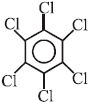
A
Hexachlorobenzene
B
Hexachlorobenzene
C
$1,2-$Dichlorobenzene
D
$1,3,5-$Trichlorobenzene
Solution
(C) The dipole moment of a molecule depends on the vector sum of the individual bond dipoles.
$1$. Hexachlorobenzene $(C_6Cl_6)$ is a highly symmetrical molecule where all the individual $C-Cl$ bond dipoles cancel each other out,resulting in a net dipole moment of $0 \ D$.
$2$. $1,3,5$-Trichlorobenzene is also highly symmetrical,and the vector sum of the three $C-Cl$ bond dipoles is $0$.
$3$. $1,2$-Dichlorobenzene has two $Cl$ atoms at adjacent positions. The resultant dipole moment is given by $\mu = \sqrt{\mu_1^2 + \mu_2^2 + 2\mu_1\mu_2 \cos \theta}$,where $\theta = 60^\circ$. Since $\cos 60^\circ = 0.5$,the dipole moment is non-zero and significant.
$4$. $1,4$-Dichlorobenzene (implied by the last structure) has two $Cl$ atoms at opposite positions,so their dipoles cancel out,resulting in a net dipole moment of $0 \ D$.
Therefore,$1,2$-Dichlorobenzene has the maximum dipole moment.
$1$. Hexachlorobenzene $(C_6Cl_6)$ is a highly symmetrical molecule where all the individual $C-Cl$ bond dipoles cancel each other out,resulting in a net dipole moment of $0 \ D$.
$2$. $1,3,5$-Trichlorobenzene is also highly symmetrical,and the vector sum of the three $C-Cl$ bond dipoles is $0$.
$3$. $1,2$-Dichlorobenzene has two $Cl$ atoms at adjacent positions. The resultant dipole moment is given by $\mu = \sqrt{\mu_1^2 + \mu_2^2 + 2\mu_1\mu_2 \cos \theta}$,where $\theta = 60^\circ$. Since $\cos 60^\circ = 0.5$,the dipole moment is non-zero and significant.
$4$. $1,4$-Dichlorobenzene (implied by the last structure) has two $Cl$ atoms at opposite positions,so their dipoles cancel out,resulting in a net dipole moment of $0 \ D$.
Therefore,$1,2$-Dichlorobenzene has the maximum dipole moment.
0 likes
View Solution102
MediumMCQ
Which of the following is polar?
A
Hydroquinone (benzene$-1,4-$diol)
B
$1,4-$dichlorobenzene
C
Terephthalonitrile (benzene$-1,4-$dicarbonitrile)
D
All
Solution
(A) molecule is polar if its net dipole moment $(\mu)$ is non-zero.
$1$. Hydroquinone (benzene$-1,4-$diol): The two $-OH$ groups are at the para position. Due to the rotation of the $-OH$ bonds,the dipole moments do not cancel out completely,resulting in a net dipole moment $(\mu \neq 0)$. Thus,it is polar.
$2$. $1,4-$dichlorobenzene: This is a symmetric molecule where the dipole moments of the two $C-Cl$ bonds are equal and opposite,canceling each other out,so $\mu = 0$.
$3$. Terephthalonitrile: This is also a symmetric molecule where the dipole moments of the two $C \equiv N$ groups cancel each other out,so $\mu = 0$.
Therefore,only hydroquinone is polar.
$1$. Hydroquinone (benzene$-1,4-$diol): The two $-OH$ groups are at the para position. Due to the rotation of the $-OH$ bonds,the dipole moments do not cancel out completely,resulting in a net dipole moment $(\mu \neq 0)$. Thus,it is polar.
$2$. $1,4-$dichlorobenzene: This is a symmetric molecule where the dipole moments of the two $C-Cl$ bonds are equal and opposite,canceling each other out,so $\mu = 0$.
$3$. Terephthalonitrile: This is also a symmetric molecule where the dipole moments of the two $C \equiv N$ groups cancel each other out,so $\mu = 0$.
Therefore,only hydroquinone is polar.
0 likes
View Solution103
DifficultMCQ
Consider the following compounds. Which compound possesses the highest dipole moment?
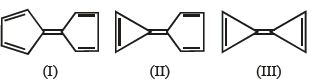
A
$I$
B
$II$
C
Both $I$ and $II$
D
$III$
Solution
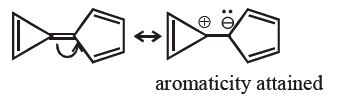
(B) The dipole moment of a molecule is related to its ability to attain aromaticity through charge separation.
Compound $II$ consists of a three-membered ring and a five-membered ring connected by a double bond.
Upon polarization,the three-membered ring becomes a cyclopropenyl cation ($2 \pi$ electrons,aromatic) and the five-membered ring becomes a cyclopentadienyl anion ($6 \pi$ electrons,aromatic).
Since both rings attain aromatic stability in the polar form,compound $II$ exhibits a very high dipole moment compared to the others.
Therefore,compound $II$ possesses the highest dipole moment.
Compound $II$ consists of a three-membered ring and a five-membered ring connected by a double bond.
Upon polarization,the three-membered ring becomes a cyclopropenyl cation ($2 \pi$ electrons,aromatic) and the five-membered ring becomes a cyclopentadienyl anion ($6 \pi$ electrons,aromatic).
Since both rings attain aromatic stability in the polar form,compound $II$ exhibits a very high dipole moment compared to the others.
Therefore,compound $II$ possesses the highest dipole moment.
0 likes
View Solution104
DifficultMCQ
Which molecule has the maximum dipole moment $\mu$? (where $X = -NO_2$)
A
ortho-dinitrobenzene
B
meta-dinitrobenzene
C
para-dinitrobenzene
D
All have the same $\mu$
Solution
(A) The dipole moment $\mu$ of a molecule is given by the vector sum of the individual bond dipoles. For disubstituted benzene derivatives,the resultant dipole moment $\mu_R$ is given by $\mu_R = \sqrt{\mu_1^2 + \mu_2^2 + 2\mu_1\mu_2 \cos \theta}$,where $\theta$ is the angle between the two dipole vectors.
For $o$-dinitrobenzene,$\theta = 60^\circ$.
For $m$-dinitrobenzene,$\theta = 120^\circ$.
For $p$-dinitrobenzene,$\theta = 180^\circ$.
Since $\cos 60^\circ = 0.5$,$\cos 120^\circ = -0.5$,and $\cos 180^\circ = -1$,the value of $\mu_R$ is maximum when $\theta$ is smallest.
Therefore,$o$-dinitrobenzene has the maximum dipole moment.
For $o$-dinitrobenzene,$\theta = 60^\circ$.
For $m$-dinitrobenzene,$\theta = 120^\circ$.
For $p$-dinitrobenzene,$\theta = 180^\circ$.
Since $\cos 60^\circ = 0.5$,$\cos 120^\circ = -0.5$,and $\cos 180^\circ = -1$,the value of $\mu_R$ is maximum when $\theta$ is smallest.
Therefore,$o$-dinitrobenzene has the maximum dipole moment.
0 likes
View Solution105
EasyMCQ
Which of the following is a non-polar solvent?
A
$CH_3-S(=O)-CH_3$
B
$CCl_4$
C
$H-C(=O)-N(CH_3)_2$
D
$ROH$
Solution
(B) $CCl_4$ (Carbon tetrachloride) is a non-polar solvent because it has a symmetrical tetrahedral geometry,which results in a net dipole moment of zero $(\mu = 0)$.
In contrast,$DMSO$ $(CH_3-S(=O)-CH_3)$,$DMF$ $(H-C(=O)-N(CH_3)_2)$,and alcohols $(ROH)$ are polar solvents due to their permanent dipole moments.
In contrast,$DMSO$ $(CH_3-S(=O)-CH_3)$,$DMF$ $(H-C(=O)-N(CH_3)_2)$,and alcohols $(ROH)$ are polar solvents due to their permanent dipole moments.
0 likes
View Solution106
MediumMCQ
Which molecule is polar?
A
$1,4-$dichlorobenzene
B
$1,4-$dicyanobenzene
C
$1,4-$dihydroxybenzene
D
$1,4-$dinitrobenzene
Solution
(C) molecule is polar if it has a non-zero net dipole moment.
In all the given options,the substituents are at the para $(1,4)$ positions of the benzene ring.
For $1,4$-disubstituted benzenes,if the two substituents are identical,the dipole moments of the two $C-X$ bonds are equal in magnitude and opposite in direction,resulting in a net dipole moment of zero (non-polar).
However,if the substituents are not identical,or if the internal structure of the substituent itself contributes to polarity,the molecule may be polar.
Wait,let's re-evaluate:
$1,4$-dichlorobenzene ($p$-dichlorobenzene): The two $C-Cl$ bond dipoles cancel out. $\mu = 0$.
$1,4$-dicyanobenzene ($p$-dicyanobenzene): The two $C-CN$ bond dipoles cancel out. $\mu = 0$.
$1,4$-dihydroxybenzene ($p$-hydroquinone): The two $O-H$ bonds are not linear with the ring axis; the rotation of the $OH$ groups means the individual bond dipoles do not perfectly cancel,making it polar.
$1,4$-dinitrobenzene ($p$-dinitrobenzene): The two $C-NO_2$ bond dipoles cancel out. $\mu = 0$.
Therefore,$1,4$-dihydroxybenzene is the polar molecule.
In all the given options,the substituents are at the para $(1,4)$ positions of the benzene ring.
For $1,4$-disubstituted benzenes,if the two substituents are identical,the dipole moments of the two $C-X$ bonds are equal in magnitude and opposite in direction,resulting in a net dipole moment of zero (non-polar).
However,if the substituents are not identical,or if the internal structure of the substituent itself contributes to polarity,the molecule may be polar.
Wait,let's re-evaluate:
$1,4$-dichlorobenzene ($p$-dichlorobenzene): The two $C-Cl$ bond dipoles cancel out. $\mu = 0$.
$1,4$-dicyanobenzene ($p$-dicyanobenzene): The two $C-CN$ bond dipoles cancel out. $\mu = 0$.
$1,4$-dihydroxybenzene ($p$-hydroquinone): The two $O-H$ bonds are not linear with the ring axis; the rotation of the $OH$ groups means the individual bond dipoles do not perfectly cancel,making it polar.
$1,4$-dinitrobenzene ($p$-dinitrobenzene): The two $C-NO_2$ bond dipoles cancel out. $\mu = 0$.
Therefore,$1,4$-dihydroxybenzene is the polar molecule.
0 likes
View Solution107
MediumMCQ
Which bond angle $\theta$ gives maximum dipole moment for a triatomic molecule $XY_2$?
A
$\theta = 90^{\circ}$
B
$\theta = 120^{\circ}$
C
$\theta = 180^{\circ}$
D
Both $(B)$ and $(C)$
Solution
(A) The resultant dipole moment $\mu$ of a triatomic molecule $XY_2$ is given by the formula: $\mu = \sqrt{\mu_1^2 + \mu_2^2 + 2\mu_1\mu_2 \cos \theta}$,where $\mu_1$ and $\mu_2$ are the bond dipole moments and $\theta$ is the bond angle.
Assuming $\mu_1 = \mu_2 = \mu_0$,the formula becomes $\mu = \sqrt{2\mu_0^2(1 + \cos \theta)} = 2\mu_0 \cos(\theta/2)$.
For $\theta = 180^{\circ}$,$\mu = 2\mu_0 \cos(90^{\circ}) = 0$.
For $\theta = 120^{\circ}$,$\mu = 2\mu_0 \cos(60^{\circ}) = \mu_0$.
For $\theta = 90^{\circ}$,$\mu = 2\mu_0 \cos(45^{\circ}) = \sqrt{2}\mu_0 \approx 1.414\mu_0$.
Comparing the values,the dipole moment is maximum when the bond angle is smallest among the given options,which is $90^{\circ}$.
Assuming $\mu_1 = \mu_2 = \mu_0$,the formula becomes $\mu = \sqrt{2\mu_0^2(1 + \cos \theta)} = 2\mu_0 \cos(\theta/2)$.
For $\theta = 180^{\circ}$,$\mu = 2\mu_0 \cos(90^{\circ}) = 0$.
For $\theta = 120^{\circ}$,$\mu = 2\mu_0 \cos(60^{\circ}) = \mu_0$.
For $\theta = 90^{\circ}$,$\mu = 2\mu_0 \cos(45^{\circ}) = \sqrt{2}\mu_0 \approx 1.414\mu_0$.
Comparing the values,the dipole moment is maximum when the bond angle is smallest among the given options,which is $90^{\circ}$.
0 likes
View Solution108
MediumMCQ
Which of the following are arranged in the decreasing order of dipole moment?
A
$CH_3I > CH_3Br > CH_3Cl > CH_3F$
B
$CH_3Cl > CH_3F > CH_3Br > CH_3I$
C
$CH_3Br > CH_3Cl > CH_3F > CH_3I$
D
$CH_3F > CH_3Cl > CH_3Br > CH_3I$
Solution
(B) The dipole moment $(\mu)$ depends on both the electronegativity difference and the bond length between the carbon and the halogen atom.
While fluorine is the most electronegative,the $C-F$ bond length is very short,which reduces the dipole moment.
In the case of $CH_3Cl$,the combination of high electronegativity and a relatively longer bond length results in the highest dipole moment.
The order of dipole moments for methyl halides is $CH_3Cl > CH_3F > CH_3Br > CH_3I$.
While fluorine is the most electronegative,the $C-F$ bond length is very short,which reduces the dipole moment.
In the case of $CH_3Cl$,the combination of high electronegativity and a relatively longer bond length results in the highest dipole moment.
The order of dipole moments for methyl halides is $CH_3Cl > CH_3F > CH_3Br > CH_3I$.
0 likes
View Solution109
EasyMCQ
The most polar bond is
A
$C-F$
B
$C-O$
C
$C-N$
D
$C-C$
Solution
(A) The polarity of a covalent bond is directly proportional to the electronegativity difference between the bonded atoms.
In the given options,carbon is common to all bonds.
The electronegativity values of the atoms are: $F (4.0) > O (3.5) > N (3.0) > C (2.5)$.
The electronegativity difference for $C-F$ is $4.0 - 2.5 = 1.5$,which is the highest among the given options.
Therefore,the $C-F$ bond is the most polar.
In the given options,carbon is common to all bonds.
The electronegativity values of the atoms are: $F (4.0) > O (3.5) > N (3.0) > C (2.5)$.
The electronegativity difference for $C-F$ is $4.0 - 2.5 = 1.5$,which is the highest among the given options.
Therefore,the $C-F$ bond is the most polar.
0 likes
View Solution110
MediumMCQ
Which has a permanent dipole moment?
A
$CO_3^{2-}$
B
$SO_4^{2-}$
C
$CS_2$
D
$NH_3$
Solution
(D) molecule has a permanent dipole moment if its net dipole moment $\mu \neq 0$.
$1$. $CO_3^{2-}$ has a trigonal planar geometry,and the bond dipoles cancel each other out,so $\mu = 0$.
$2$. $SO_4^{2-}$ has a tetrahedral geometry,and the bond dipoles cancel each other out,so $\mu = 0$.
$3$. $CS_2$ has a linear geometry $(S=C=S)$,and the bond dipoles cancel each other out,so $\mu = 0$.
$4$. $NH_3$ has a trigonal pyramidal geometry with a lone pair on the nitrogen atom. The bond dipoles of the $N-H$ bonds and the lone pair do not cancel each other,resulting in a net dipole moment $\mu \neq 0$. Thus,$NH_3$ has a permanent dipole moment.
$1$. $CO_3^{2-}$ has a trigonal planar geometry,and the bond dipoles cancel each other out,so $\mu = 0$.
$2$. $SO_4^{2-}$ has a tetrahedral geometry,and the bond dipoles cancel each other out,so $\mu = 0$.
$3$. $CS_2$ has a linear geometry $(S=C=S)$,and the bond dipoles cancel each other out,so $\mu = 0$.
$4$. $NH_3$ has a trigonal pyramidal geometry with a lone pair on the nitrogen atom. The bond dipoles of the $N-H$ bonds and the lone pair do not cancel each other,resulting in a net dipole moment $\mu \neq 0$. Thus,$NH_3$ has a permanent dipole moment.
0 likes
View Solution111
MediumMCQ
Which of the following are arranged in the decreasing order of dipole moment?
A
$CH_3Cl, CH_3Br, CH_3F$
B
$CH_3Cl, CH_3F, CH_3Br$
C
$CH_3Br, CH_3Cl, CH_3F$
D
$CH_3Br, CH_3F, CH_3Cl$
Solution
(B) The dipole moment $(\mu)$ depends on the electronegativity difference and the bond length.
For methyl halides $(CH_3X)$,the order of dipole moment is $CH_3Cl > CH_3F > CH_3Br$.
Although fluorine is more electronegative than chlorine,the $C-F$ bond length is significantly smaller than the $C-Cl$ bond length.
This smaller bond length in $CH_3F$ reduces the dipole moment compared to $CH_3Cl$.
Therefore,the correct decreasing order is $CH_3Cl > CH_3F > CH_3Br$.
For methyl halides $(CH_3X)$,the order of dipole moment is $CH_3Cl > CH_3F > CH_3Br$.
Although fluorine is more electronegative than chlorine,the $C-F$ bond length is significantly smaller than the $C-Cl$ bond length.
This smaller bond length in $CH_3F$ reduces the dipole moment compared to $CH_3Cl$.
Therefore,the correct decreasing order is $CH_3Cl > CH_3F > CH_3Br$.
0 likes
View Solution112
AdvancedMCQ
Which set contains molecules with $\mu = 0$?
A
$SF_4, \text{p-dichlorobenzene}, \text{benzene}$
B
$\text{Borazine}, \text{p-dihydroxybenzene}, BF_3$
C
$ClF_3, SiF_4, SO_3$
D
$\text{Borazine}, \text{1,3,5-trichlorobenzene}, SO_3$
Solution
(D) molecule has a dipole moment of $\mu = 0$ if it is non-polar,which typically occurs in highly symmetrical molecules where individual bond dipoles cancel each other out.
$1$. $\text{Borazine} (B_3N_3H_6)$ is a planar,symmetrical molecule with $\mu = 0$.
$2$. $1,3,5-\text{trichlorobenzene}$ is highly symmetrical,and the bond dipoles cancel out,resulting in $\mu = 0$.
$3$. $SO_3$ has a trigonal planar geometry,and the bond dipoles cancel out,resulting in $\mu = 0$.
Therefore,the set containing molecules with $\mu = 0$ is $\text{Borazine}, 1,3,5-\text{trichlorobenzene}, SO_3$.
$1$. $\text{Borazine} (B_3N_3H_6)$ is a planar,symmetrical molecule with $\mu = 0$.
$2$. $1,3,5-\text{trichlorobenzene}$ is highly symmetrical,and the bond dipoles cancel out,resulting in $\mu = 0$.
$3$. $SO_3$ has a trigonal planar geometry,and the bond dipoles cancel out,resulting in $\mu = 0$.
Therefore,the set containing molecules with $\mu = 0$ is $\text{Borazine}, 1,3,5-\text{trichlorobenzene}, SO_3$.
0 likes
View Solution113
MediumMCQ
If compound $MX_4$ has $\mu = 0$,then the most probable geometry will be:
A
Trigonal bipyramidal
B
Square planar
C
Pentagonal bipyramidal
D
Distorted tetrahedral
Solution
(B) For a compound $MX_4$ to have a dipole moment $\mu = 0$,the molecule must be highly symmetric such that the individual bond dipoles cancel each other out.
In a square planar geometry,the four $X$ atoms are arranged at the corners of a square around the central atom $M$,with bond angles of $90^{\circ}$. The dipole moments of opposite bonds cancel each other,resulting in a net dipole moment of $\mu = 0$.
While a regular tetrahedral geometry also has $\mu = 0$,it is not listed as an option. Among the given choices,square planar is the correct geometry that allows for a net dipole moment of zero.
In a square planar geometry,the four $X$ atoms are arranged at the corners of a square around the central atom $M$,with bond angles of $90^{\circ}$. The dipole moments of opposite bonds cancel each other,resulting in a net dipole moment of $\mu = 0$.
While a regular tetrahedral geometry also has $\mu = 0$,it is not listed as an option. Among the given choices,square planar is the correct geometry that allows for a net dipole moment of zero.
0 likes
View Solution114
MediumMCQ
Which one of the following compounds has a non-zero dipole moment?
A
cis-cyclobutane$-1,3-$diol
B
$1,3,5-$tricyanobenzene
C
tetrakis(chloromethyl)methane
D
piperazine
Solution
(A) The dipole moment of a molecule is the vector sum of the dipole moments of its individual bonds.
$A$. $cis$-cyclobutane$-1,3-$diol has a non-zero dipole moment because the two $OH$ groups are on the same side of the ring,and their bond dipoles do not cancel out.
$B$. $1,3,5$-tricyanobenzene is a symmetric molecule where the three $CN$ group dipoles cancel each other out,resulting in a net dipole moment of zero.
$C$. Tetrakis(chloromethyl)methane is a highly symmetric molecule (tetrahedral geometry) where the individual $C-Cl$ bond dipoles cancel out,resulting in a net dipole moment of zero.
$D$. Piperazine in its chair conformation has a center of inversion,making it non-polar (dipole moment = $0$).
Therefore,the correct option is $A$.
$A$. $cis$-cyclobutane$-1,3-$diol has a non-zero dipole moment because the two $OH$ groups are on the same side of the ring,and their bond dipoles do not cancel out.
$B$. $1,3,5$-tricyanobenzene is a symmetric molecule where the three $CN$ group dipoles cancel each other out,resulting in a net dipole moment of zero.
$C$. Tetrakis(chloromethyl)methane is a highly symmetric molecule (tetrahedral geometry) where the individual $C-Cl$ bond dipoles cancel out,resulting in a net dipole moment of zero.
$D$. Piperazine in its chair conformation has a center of inversion,making it non-polar (dipole moment = $0$).
Therefore,the correct option is $A$.
0 likes
View Solution115
DifficultMCQ
Which of the following is most polar?
A
Azulene
B
Naphthalene
C
Cyclooctatetraene
D
Fulvene
Solution
(A) Azulene is the most polar among the given options.
It consists of a seven-membered ring fused to a five-membered ring.
Due to the electronic displacement,the five-membered ring gains a negative charge (becoming a $6\pi$ aromatic cyclopentadienyl anion) and the seven-membered ring gains a positive charge (becoming a $6\pi$ aromatic cycloheptatrienyl cation).
This creates a significant dipole moment,making it highly polar.
It consists of a seven-membered ring fused to a five-membered ring.
Due to the electronic displacement,the five-membered ring gains a negative charge (becoming a $6\pi$ aromatic cyclopentadienyl anion) and the seven-membered ring gains a positive charge (becoming a $6\pi$ aromatic cycloheptatrienyl cation).
This creates a significant dipole moment,making it highly polar.
0 likes
View Solution116
AdvancedMCQ
The dipole moments of the given compounds are:
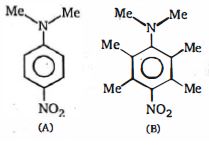
A
$A = 6.87 \ D, B = 4.11 \ D$
B
$A = 4.11 \ D, B = 6.87 \ D$
C
$A = 4.11 \ D, B = 4.11 \ D$
D
$A = 6.87 \ D, B = 6.87 \ D$
Solution
(A) In compound $A$ ($N,N$-dimethyl-$p$-nitroaniline),the $-N(CH_3)_2$ group and $-NO_2$ group are in the para position. The lone pair on the nitrogen atom can effectively participate in resonance with the benzene ring,leading to a strong charge-transfer interaction with the $-NO_2$ group. This results in a higher dipole moment of $6.87 \ D$.
In compound $B$ ($N,N,2,3,5,6$-hexamethyl-$4$-nitroaniline),the presence of four methyl groups at the ortho positions relative to the $-N(CH_3)_2$ group causes significant steric hindrance (Steric Inhibition of Resonance or $SIR$).
This $SIR$ forces the $-N(CH_3)_2$ group out of the plane of the benzene ring,which inhibits the resonance of the nitrogen lone pair with the ring.
Due to less effective resonance,the charge-transfer interaction is reduced,resulting in a lower dipole moment of $4.11 \ D$.
Therefore,the dipole moment of $A$ is $6.87 \ D$ and $B$ is $4.11 \ D$.
In compound $B$ ($N,N,2,3,5,6$-hexamethyl-$4$-nitroaniline),the presence of four methyl groups at the ortho positions relative to the $-N(CH_3)_2$ group causes significant steric hindrance (Steric Inhibition of Resonance or $SIR$).
This $SIR$ forces the $-N(CH_3)_2$ group out of the plane of the benzene ring,which inhibits the resonance of the nitrogen lone pair with the ring.
Due to less effective resonance,the charge-transfer interaction is reduced,resulting in a lower dipole moment of $4.11 \ D$.
Therefore,the dipole moment of $A$ is $6.87 \ D$ and $B$ is $4.11 \ D$.
0 likes
View Solution117
DifficultMCQ
Which of the following has the maximum dipole moment?
A
Benzene
B
Naphthalene
C
Diphenylcyclopropenone
D
Benzophenone
Solution
(C) The dipole moment of a molecule depends on the separation of charge.
In $Diphenylcyclopropenone$,the carbonyl group $(C=O)$ can undergo polarization such that the oxygen atom acquires a negative charge and the three-membered ring acquires a positive charge.
The resulting structure has a $2\pi$ electron system in the ring,which makes it aromatic according to $H$ückel's rule ($4n+2$ electrons,where $n=0$).
Because this resonance-stabilized structure is highly stable,the molecule exhibits a very high degree of charge separation,leading to a maximum dipole moment compared to the other options.
In $Diphenylcyclopropenone$,the carbonyl group $(C=O)$ can undergo polarization such that the oxygen atom acquires a negative charge and the three-membered ring acquires a positive charge.
The resulting structure has a $2\pi$ electron system in the ring,which makes it aromatic according to $H$ückel's rule ($4n+2$ electrons,where $n=0$).
Because this resonance-stabilized structure is highly stable,the molecule exhibits a very high degree of charge separation,leading to a maximum dipole moment compared to the other options.
0 likes
View Solution118
MediumMCQ
The correct order of dipole moment for the following molecules is:
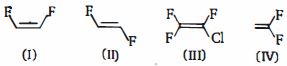
A
$IV > I > III > II$
B
$I > IV > III > II$
C
$III > I > II > IV$
D
$II > III > IV > I$
Solution
(B) The dipole moment depends on the vector sum of individual bond dipoles.
$(I)$ $cis-1,2-difluoroethene$: The dipoles of $C-F$ bonds reinforce each other,resulting in a significant net dipole moment.
$(II)$ $trans-1,2-difluoroethene$: The dipoles of the two $C-F$ bonds are in opposite directions and cancel each other out,resulting in a net dipole moment of $0$.
$(III)$ $1-chloro-1,2,2-trifluoroethene$: The presence of three $F$ atoms and one $Cl$ atom creates a strong net dipole moment due to the high electronegativity of $F$.
$(IV)$ $1,1-difluoroethene$: The two $C-F$ bond dipoles add up to give a net dipole moment.
Comparing these,the order is $III > I > IV > II$. However,based on standard experimental values for these specific haloalkenes,the order is $I > IV > III > II$ (where $I$ is $cis-difluoroethene$,$IV$ is $1,1-difluoroethene$,$III$ is $trifluorochloroethene$,and $II$ is $trans-difluoroethene$). Thus,the correct option is $B$.
$(I)$ $cis-1,2-difluoroethene$: The dipoles of $C-F$ bonds reinforce each other,resulting in a significant net dipole moment.
$(II)$ $trans-1,2-difluoroethene$: The dipoles of the two $C-F$ bonds are in opposite directions and cancel each other out,resulting in a net dipole moment of $0$.
$(III)$ $1-chloro-1,2,2-trifluoroethene$: The presence of three $F$ atoms and one $Cl$ atom creates a strong net dipole moment due to the high electronegativity of $F$.
$(IV)$ $1,1-difluoroethene$: The two $C-F$ bond dipoles add up to give a net dipole moment.
Comparing these,the order is $III > I > IV > II$. However,based on standard experimental values for these specific haloalkenes,the order is $I > IV > III > II$ (where $I$ is $cis-difluoroethene$,$IV$ is $1,1-difluoroethene$,$III$ is $trifluorochloroethene$,and $II$ is $trans-difluoroethene$). Thus,the correct option is $B$.
1 likes
View Solution119
DifficultMCQ
Which of the following compounds has a zero dipole moment?
A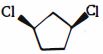
B
C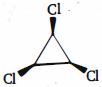
D
Solution
(D) molecule has a zero dipole moment if its individual bond dipoles cancel each other out due to symmetry.
In $trans-1,3-dichlorocyclobutane$,the two $C-Cl$ bond dipoles are oriented in opposite directions relative to the center of the molecule,effectively canceling each other out.
Therefore,$trans-1,3-dichlorocyclobutane$ has a net dipole moment of $0 \ D$.
In $trans-1,3-dichlorocyclobutane$,the two $C-Cl$ bond dipoles are oriented in opposite directions relative to the center of the molecule,effectively canceling each other out.
Therefore,$trans-1,3-dichlorocyclobutane$ has a net dipole moment of $0 \ D$.
0 likes
View Solution120
MediumMCQ
Which of the following molecules have non-zero dipole moments?
$I$. Gauche conformation of $1, 2$-dibromoethane
$II$. Anti conformation of $1, 2$-dibromoethane
$III$. Trans-$1, 4$-dibromocyclohexane
$IV$. Cis-$1, 4$-dibromocyclohexane
$V$. Tetrabromomethane
$VI$. $1, 1$-dibromocyclohexane
$I$. Gauche conformation of $1, 2$-dibromoethane
$II$. Anti conformation of $1, 2$-dibromoethane
$III$. Trans-$1, 4$-dibromocyclohexane
$IV$. Cis-$1, 4$-dibromocyclohexane
$V$. Tetrabromomethane
$VI$. $1, 1$-dibromocyclohexane
A
$I$ and $II$
B
$I$ and $IV$
C
$II$ and $V$
D
$I, IV$ and $VI$
Solution
(D) To determine which molecules have a non-zero dipole moment,we analyze the symmetry of each:
$I$. Gauche conformation of $1, 2$-dibromoethane: Due to the gauche arrangement,the dipole moments of the $C-Br$ bonds do not cancel out,resulting in a non-zero net dipole moment.
$II$. Anti conformation of $1, 2$-dibromoethane: The $C-Br$ bond dipoles are equal and opposite,canceling each other out. The net dipole moment is zero.
$III$. Trans-$1, 4$-dibromocyclohexane: In the chair conformation,the two $Br$ atoms are in equatorial positions or axial positions such that the dipoles cancel out due to the center of inversion. The net dipole moment is zero.
$IV$. Cis-$1, 4$-dibromocyclohexane: The molecule lacks a center of inversion,and the dipoles of the $C-Br$ bonds do not cancel out. The net dipole moment is non-zero.
$V$. Tetrabromomethane $(CBr_4)$: This molecule has a tetrahedral geometry ($T_d$ symmetry),where the four $C-Br$ bond dipoles cancel each other out. The net dipole moment is zero.
$VI$. $1, 1$-dibromocyclohexane: The two $C-Br$ bonds are on the same carbon atom,and their dipoles do not cancel out. The net dipole moment is non-zero.
Therefore,molecules $I, IV,$ and $VI$ have non-zero dipole moments. The correct option is $D$.
$I$. Gauche conformation of $1, 2$-dibromoethane: Due to the gauche arrangement,the dipole moments of the $C-Br$ bonds do not cancel out,resulting in a non-zero net dipole moment.
$II$. Anti conformation of $1, 2$-dibromoethane: The $C-Br$ bond dipoles are equal and opposite,canceling each other out. The net dipole moment is zero.
$III$. Trans-$1, 4$-dibromocyclohexane: In the chair conformation,the two $Br$ atoms are in equatorial positions or axial positions such that the dipoles cancel out due to the center of inversion. The net dipole moment is zero.
$IV$. Cis-$1, 4$-dibromocyclohexane: The molecule lacks a center of inversion,and the dipoles of the $C-Br$ bonds do not cancel out. The net dipole moment is non-zero.
$V$. Tetrabromomethane $(CBr_4)$: This molecule has a tetrahedral geometry ($T_d$ symmetry),where the four $C-Br$ bond dipoles cancel each other out. The net dipole moment is zero.
$VI$. $1, 1$-dibromocyclohexane: The two $C-Br$ bonds are on the same carbon atom,and their dipoles do not cancel out. The net dipole moment is non-zero.
Therefore,molecules $I, IV,$ and $VI$ have non-zero dipole moments. The correct option is $D$.
0 likes
View Solution121
DifficultMCQ
The most polar compound among the following is
A
B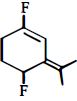
C
D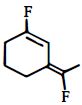
Solution
(C) The polarity of a molecule depends on its net dipole moment,which is determined by the vector sum of individual bond dipoles.
Fluorine is the most electronegative element,so $C-F$ bonds have significant dipole moments.
In option $(a)$,there are no $F$ atoms,so it is the least polar.
In option $(b)$,the two $F$ atoms are attached to the ring in a way that their dipole moments partially cancel each other out due to their relative orientation.
In option $(c)$,the two $F$ atoms are attached such that their dipole moments are oriented in a similar direction,leading to a larger net dipole moment.
In option $(d)$,the $F$ atoms are oriented such that their dipole moments are at a wider angle,resulting in a smaller net dipole moment compared to $(c)$.
Therefore,the compound in option $(c)$ has the maximum net dipole moment and is the most polar.
Fluorine is the most electronegative element,so $C-F$ bonds have significant dipole moments.
In option $(a)$,there are no $F$ atoms,so it is the least polar.
In option $(b)$,the two $F$ atoms are attached to the ring in a way that their dipole moments partially cancel each other out due to their relative orientation.
In option $(c)$,the two $F$ atoms are attached such that their dipole moments are oriented in a similar direction,leading to a larger net dipole moment.
In option $(d)$,the $F$ atoms are oriented such that their dipole moments are at a wider angle,resulting in a smaller net dipole moment compared to $(c)$.
Therefore,the compound in option $(c)$ has the maximum net dipole moment and is the most polar.
0 likes
View Solution122
DifficultMCQ
Which of the following compounds will show the highest dipole moment?

A
$I$
B
$II$
C
$III$
D
$IV$
Solution
(A) The dipole moment of a molecule is directly related to the polarity of its bonds and the contribution of its resonance structures.
For compound $I$ (cyclopropenone),the resonance structure involves the transfer of electrons from the $C=O$ bond to the oxygen atom,resulting in a positive charge on the three-membered ring.
This resonance structure is aromatic because the ring contains $2 \pi$ electrons ($H$ückel's rule,$4n+2$ where $n=0$),which provides significant stability.
Due to this aromatic character,the dipolar resonance structure makes a major contribution to the overall electronic structure,leading to a very high dipole moment compared to the other compounds where such aromatic stabilization of the dipolar form is not present.
For compound $I$ (cyclopropenone),the resonance structure involves the transfer of electrons from the $C=O$ bond to the oxygen atom,resulting in a positive charge on the three-membered ring.
This resonance structure is aromatic because the ring contains $2 \pi$ electrons ($H$ückel's rule,$4n+2$ where $n=0$),which provides significant stability.
Due to this aromatic character,the dipolar resonance structure makes a major contribution to the overall electronic structure,leading to a very high dipole moment compared to the other compounds where such aromatic stabilization of the dipolar form is not present.
0 likes
View Solution123
DifficultMCQ
Which compound exhibits the maximum dipole moment among the following?
A
o-Nitroaniline
B
Nitrobenzene
C
p-Nitroaniline
D
m-Nitroaniline
Solution
(C) The dipole moment $(\mu)$ is defined as the product of the magnitude of the charge $(q)$ and the distance $(d)$ between the centers of positive and negative charges,i.e.,$\mu = q \times d$.
In $p$-nitroaniline,the electron-donating $-NH_2$ group and the electron-withdrawing $-NO_2$ group are at the para positions.
Due to resonance,there is a significant charge separation where the lone pair on the nitrogen of the $-NH_2$ group is delocalized towards the $-NO_2$ group,creating a strong polar structure with a large distance between the partial positive and negative charges.
This resonance effect is most pronounced in the para isomer due to its linear geometry,leading to the maximum dipole moment compared to the ortho and meta isomers.
In $p$-nitroaniline,the electron-donating $-NH_2$ group and the electron-withdrawing $-NO_2$ group are at the para positions.
Due to resonance,there is a significant charge separation where the lone pair on the nitrogen of the $-NH_2$ group is delocalized towards the $-NO_2$ group,creating a strong polar structure with a large distance between the partial positive and negative charges.
This resonance effect is most pronounced in the para isomer due to its linear geometry,leading to the maximum dipole moment compared to the ortho and meta isomers.
0 likes
View Solution124
AdvancedMCQ
Molecular $AB$ has a bond length of $1.61\,\mathring{A}$ and a dipole moment of $0.38\,D$. The fractional charge on each atom (absolute magnitude) is $(e_0 = 4.802 \times 10^{-10}\,esu)$
A
$0.5$
B
$0.05$
C
$0$
D
$1.0$
Solution
(B) The dipole moment $\mu$ is given by the formula $\mu = q \times d$,where $q$ is the charge and $d$ is the bond length.
Given $\mu = 0.38\,D = 0.38 \times 10^{-18}\,esu\,cm$ and $d = 1.61\,\mathring{A} = 1.61 \times 10^{-8}\,cm$.
Calculating the actual charge $q$ in $esu$: $q = \frac{\mu}{d} = \frac{0.38 \times 10^{-18}\,esu\,cm}{1.61 \times 10^{-8}\,cm} \approx 2.36 \times 10^{-11}\,esu$.
The fractional charge is the ratio of the actual charge $q$ to the electronic charge $e_0 = 4.802 \times 10^{-10}\,esu$.
Fractional charge $= \frac{q}{e_0} = \frac{2.36 \times 10^{-11}\,esu}{4.802 \times 10^{-10}\,esu} \approx 0.049 \approx 0.05$.
Given $\mu = 0.38\,D = 0.38 \times 10^{-18}\,esu\,cm$ and $d = 1.61\,\mathring{A} = 1.61 \times 10^{-8}\,cm$.
Calculating the actual charge $q$ in $esu$: $q = \frac{\mu}{d} = \frac{0.38 \times 10^{-18}\,esu\,cm}{1.61 \times 10^{-8}\,cm} \approx 2.36 \times 10^{-11}\,esu$.
The fractional charge is the ratio of the actual charge $q$ to the electronic charge $e_0 = 4.802 \times 10^{-10}\,esu$.
Fractional charge $= \frac{q}{e_0} = \frac{2.36 \times 10^{-11}\,esu}{4.802 \times 10^{-10}\,esu} \approx 0.049 \approx 0.05$.
0 likes
View Solution125
DifficultMCQ
Which one of the following molecules is polar?
A
$XeF_4$
B
$IF_5$
C
$SbF_5$
D
$CF_4$
Solution
(B) To determine the polarity of a molecule,we look at its molecular geometry and dipole moment.
$XeF_4$ has a square planar geometry,which is symmetric,resulting in a net dipole moment of zero (non-polar).
$IF_5$ has a square pyramidal geometry with one lone pair on the central iodine atom. This unsymmetric distribution of charge leads to a non-zero net dipole moment,making it polar.
$SbF_5$ has a trigonal bipyramidal geometry,which is symmetric,resulting in a net dipole moment of zero (non-polar).
$CF_4$ has a tetrahedral geometry,which is symmetric,resulting in a net dipole moment of zero (non-polar).
Therefore,$IF_5$ is the polar molecule.
$XeF_4$ has a square planar geometry,which is symmetric,resulting in a net dipole moment of zero (non-polar).
$IF_5$ has a square pyramidal geometry with one lone pair on the central iodine atom. This unsymmetric distribution of charge leads to a non-zero net dipole moment,making it polar.
$SbF_5$ has a trigonal bipyramidal geometry,which is symmetric,resulting in a net dipole moment of zero (non-polar).
$CF_4$ has a tetrahedral geometry,which is symmetric,resulting in a net dipole moment of zero (non-polar).
Therefore,$IF_5$ is the polar molecule.
0 likes
View Solution126
DifficultMCQ
Bond distance in $HF$ is $9.17 \times 10^{-11} \ m$. Dipole moment of $HF$ is $6.104 \times 10^{-30} \ Cm$. The percentage ionic character in $HF$ will be : .............. $\%$
(electron charge $= 1.60 \times 10^{-19} \ C$)
(electron charge $= 1.60 \times 10^{-19} \ C$)
A
$61$
B
$38$
C
$35.5$
D
$41.5$
Solution
(D) Given:
Charge $e = 1.60 \times 10^{-19} \ C$
Bond distance $d = 9.17 \times 10^{-11} \ m$
Observed dipole moment $\mu_{obs} = 6.104 \times 10^{-30} \ Cm$
Calculate theoretical dipole moment for $100\%$ ionic character $(\mu_{theo})$:
$\mu_{theo} = e \times d$
$\mu_{theo} = 1.60 \times 10^{-19} \times 9.17 \times 10^{-11} = 14.672 \times 10^{-30} \ Cm$
Calculate percentage ionic character:
$\text{Percentage ionic character} = \frac{\mu_{obs}}{\mu_{theo}} \times 100$
$= \frac{6.104 \times 10^{-30}}{14.672 \times 10^{-30}} \times 100$
$= 0.416 \times 100 \approx 41.5\%$
Charge $e = 1.60 \times 10^{-19} \ C$
Bond distance $d = 9.17 \times 10^{-11} \ m$
Observed dipole moment $\mu_{obs} = 6.104 \times 10^{-30} \ Cm$
Calculate theoretical dipole moment for $100\%$ ionic character $(\mu_{theo})$:
$\mu_{theo} = e \times d$
$\mu_{theo} = 1.60 \times 10^{-19} \times 9.17 \times 10^{-11} = 14.672 \times 10^{-30} \ Cm$
Calculate percentage ionic character:
$\text{Percentage ionic character} = \frac{\mu_{obs}}{\mu_{theo}} \times 100$
$= \frac{6.104 \times 10^{-30}}{14.672 \times 10^{-30}} \times 100$
$= 0.416 \times 100 \approx 41.5\%$
0 likes
View Solution127
MediumMCQ
Among the following,the molecule with the lowest dipole moment is
A
$CHCl_3$
B
$CH_3Cl$
C
$CH_2Cl_2$
D
$CCl_4$
Solution
(D) $CCl_4$ has the lowest (zero) dipole moment.
This is due to its symmetrical tetrahedral structure.
In this molecule,the individual bond dipole moments cancel each other out due to the symmetrical arrangement of the four $C-Cl$ bonds.
This is due to its symmetrical tetrahedral structure.
In this molecule,the individual bond dipole moments cancel each other out due to the symmetrical arrangement of the four $C-Cl$ bonds.
0 likes
View Solution128
MediumMCQ
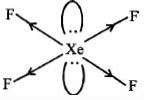
The compound of xenon with zero dipole moment is
A
$XeO_3$
B
$XeF_4$
C
$XeOF_4$
D
$XeO_2$
Solution
(B) $XeF_4$ has a zero dipole moment.
It has a square planar structure due to which the bond moments of $Xe-F$ bonds cancel each other out.
It has a square planar structure due to which the bond moments of $Xe-F$ bonds cancel each other out.
0 likes
View Solution129
MediumMCQ
Which of the following compounds exhibits a dipole moment?
A
$1, 2-$ dichlorobenzene
B
trans-$2, 3-$ dichloro$-2-$butene
C
$1, 4-$ dichlorobenzene
D
trans$-1, 2-$ dinitroethene
Solution
(A) molecule exhibits a dipole moment if its net dipole moment is non-zero.
In $1, 2-$ dichlorobenzene,the two $C-Cl$ bonds are at an angle of $60^\circ$ to each other,making the molecule unsymmetrical and resulting in a net dipole moment.
In contrast,$1, 4-$ dichlorobenzene,trans-$2, 3-$ dichloro$-2-$butene,and trans$-1, 2-$ dinitroethene are centrosymmetric molecules where the individual bond dipoles cancel each other out,resulting in a net dipole moment of zero.
In $1, 2-$ dichlorobenzene,the two $C-Cl$ bonds are at an angle of $60^\circ$ to each other,making the molecule unsymmetrical and resulting in a net dipole moment.
In contrast,$1, 4-$ dichlorobenzene,trans-$2, 3-$ dichloro$-2-$butene,and trans$-1, 2-$ dinitroethene are centrosymmetric molecules where the individual bond dipoles cancel each other out,resulting in a net dipole moment of zero.
0 likes
View Solution130
MediumMCQ
$CO_2$ is a non-polar molecule $(\mu = 0)$ whereas $SO_2$ is polar $(\mu = 1.62 \ D)$. This difference is due to the fact that:
A
$C$ and $O$ have approximately the same electronegativity while $S$ and $O$ have different electronegativities
B
$CO_2$ has an even number of double bonds whereas $SO_2$ has an odd number of double bonds
C
$C$ and $O$ are in different groups whereas $S$ and $O$ are in the same group
D
$CO_2$ is linear whereas $SO_2$ is not linear.
Solution
(D) $CO_2$ has a linear geometry $(O=C=O)$ due to $sp$ hybridization,where the two bond dipoles cancel each other out,resulting in a net dipole moment of $\mu = 0$.
$SO_2$ has a bent (angular) geometry due to $sp^2$ hybridization and the presence of a lone pair on the sulfur atom.
Because the molecule is not linear,the bond dipoles do not cancel out,resulting in a net dipole moment of $\mu = 1.62 \ D$.
Therefore,the difference in polarity is due to the difference in their molecular shapes (geometry).
$SO_2$ has a bent (angular) geometry due to $sp^2$ hybridization and the presence of a lone pair on the sulfur atom.
Because the molecule is not linear,the bond dipoles do not cancel out,resulting in a net dipole moment of $\mu = 1.62 \ D$.
Therefore,the difference in polarity is due to the difference in their molecular shapes (geometry).
0 likes
View Solution131
MediumMCQ
Which one of the following has the highest dipole moment?
A
$CH_3F$
B
$CH_3Br$
C
$CH_3Cl$
D
$CH_3I$
Solution
(C) The dipole moment $(\mu)$ depends on both the electronegativity difference and the bond length between the carbon and the halogen atom.
Although $F$ is the most electronegative element,the $C-Cl$ bond length is significantly larger than the $C-F$ bond length,which results in a higher dipole moment for $CH_3Cl$ compared to $CH_3F$.
The experimental order of dipole moments for methyl halides is: $\mu_{CH_3Cl} (1.86 \ D) > \mu_{CH_3F} (1.85 \ D) > \mu_{CH_3Br} (1.82 \ D) > \mu_{CH_3I} (1.64 \ D)$.
Therefore,$CH_3Cl$ has the highest dipole moment.
Although $F$ is the most electronegative element,the $C-Cl$ bond length is significantly larger than the $C-F$ bond length,which results in a higher dipole moment for $CH_3Cl$ compared to $CH_3F$.
The experimental order of dipole moments for methyl halides is: $\mu_{CH_3Cl} (1.86 \ D) > \mu_{CH_3F} (1.85 \ D) > \mu_{CH_3Br} (1.82 \ D) > \mu_{CH_3I} (1.64 \ D)$.
Therefore,$CH_3Cl$ has the highest dipole moment.
0 likes
View Solution132
AdvancedMCQ
Which of the following diagrams shows the correct change in the polarity of the bond?
A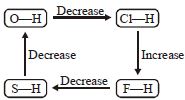
B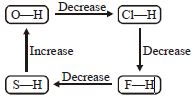
C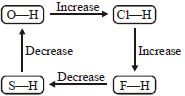
D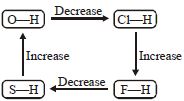
Solution
(D) The polarity of a bond is directly proportional to the difference in electronegativity $(\Delta EN)$ between the bonded atoms.
Electronegativity values are: $F = 4.0$,$O = 3.5$,$Cl = 3.0$,$S = 2.5$,$H = 2.1$.
Calculating $\Delta EN$ for each bond:
$F-H: 4.0 - 2.1 = 1.9$
$O-H: 3.5 - 2.1 = 1.4$
$Cl-H: 3.0 - 2.1 = 0.9$
$S-H: 2.5 - 2.1 = 0.4$
Comparing the polarities: $F-H > O-H > Cl-H > S-H$.
Looking at the cycle in the diagrams:
$O-H (1.4) \rightarrow Cl-H (0.9)$ (Decrease)
$Cl-H (0.9) \rightarrow F-H (1.9)$ (Increase)
$F-H (1.9) \rightarrow S-H (0.4)$ (Decrease)
$S-H (0.4) \rightarrow O-H (1.4)$ (Increase)
This sequence matches Diagram $D$.
Electronegativity values are: $F = 4.0$,$O = 3.5$,$Cl = 3.0$,$S = 2.5$,$H = 2.1$.
Calculating $\Delta EN$ for each bond:
$F-H: 4.0 - 2.1 = 1.9$
$O-H: 3.5 - 2.1 = 1.4$
$Cl-H: 3.0 - 2.1 = 0.9$
$S-H: 2.5 - 2.1 = 0.4$
Comparing the polarities: $F-H > O-H > Cl-H > S-H$.
Looking at the cycle in the diagrams:
$O-H (1.4) \rightarrow Cl-H (0.9)$ (Decrease)
$Cl-H (0.9) \rightarrow F-H (1.9)$ (Increase)
$F-H (1.9) \rightarrow S-H (0.4)$ (Decrease)
$S-H (0.4) \rightarrow O-H (1.4)$ (Increase)
This sequence matches Diagram $D$.
0 likes
View Solution133
MediumMCQ
Arrange the following in order of increasing dipole moment: $H_2O, H_2S, BF_3$.
A
$BF_3 < H_2S < H_2O$
B
$H_2S < BF_3 < H_2O$
C
$H_2O < H_2S < BF_3$
D
$BF_3 < H_2O < H_2S$
Solution
(A) $BF_3$ has a symmetrical trigonal planar structure,so its net dipole moment is $0 \ D$.
Both $H_2O$ and $H_2S$ have a bent structure,which results in a non-zero net dipole moment.
Oxygen is more electronegative than sulfur,which makes the $O-H$ bond more polar than the $S-H$ bond. Consequently,$H_2O$ has a higher dipole moment than $H_2S$.
Thus,the order of increasing dipole moment is $BF_3 < H_2S < H_2O$.
Both $H_2O$ and $H_2S$ have a bent structure,which results in a non-zero net dipole moment.
Oxygen is more electronegative than sulfur,which makes the $O-H$ bond more polar than the $S-H$ bond. Consequently,$H_2O$ has a higher dipole moment than $H_2S$.
Thus,the order of increasing dipole moment is $BF_3 < H_2S < H_2O$.
0 likes
View Solution134
MediumMCQ
Among the following mixtures,in which is dipole-dipole attraction present?
A
$CH_2Cl_2$ and $CCl_4$
B
$He$ and $He$
C
$CHCl_3$ and $CH_2Cl_2$
D
$C_6H_6$ and $CH_4$
Solution
(C) Dipole-dipole attraction occurs between polar molecules that possess a permanent dipole moment.
$CH_2Cl_2$ (dichloromethane) is a polar molecule due to the electronegativity difference between $C$ and $Cl$ and its asymmetric geometry.
$CHCl_3$ (trichloromethane) is also a polar molecule.
Since both $CHCl_3$ and $CH_2Cl_2$ are polar,they exhibit dipole-dipole interactions when mixed.
$CCl_4$ is non-polar due to its symmetric tetrahedral structure.
$He$ is an inert gas (London dispersion forces only).
$C_6H_6$ and $CH_4$ are non-polar molecules.
$CH_2Cl_2$ (dichloromethane) is a polar molecule due to the electronegativity difference between $C$ and $Cl$ and its asymmetric geometry.
$CHCl_3$ (trichloromethane) is also a polar molecule.
Since both $CHCl_3$ and $CH_2Cl_2$ are polar,they exhibit dipole-dipole interactions when mixed.
$CCl_4$ is non-polar due to its symmetric tetrahedral structure.
$He$ is an inert gas (London dispersion forces only).
$C_6H_6$ and $CH_4$ are non-polar molecules.
0 likes
View Solution135
DifficultMCQ
Which molecule is polar?
A
$1,4-$dichlorobenzene
B
$1,4-$dicyanobenzene
C
$1,4-$dihydroxybenzene
D
$1,4-$dinitrobenzene
Solution
(C) molecule is polar if its net dipole moment is non-zero $(\mu \neq 0)$.
In $1,4$-dichlorobenzene,$1,4$-dicyanobenzene,and $1,4$-dinitrobenzene,the substituents are identical and placed at para positions,leading to a symmetric structure where the dipole moments cancel out,resulting in $\mu = 0$ (non-polar).
In $1,4$-dihydroxybenzene (hydroquinone),the molecule is non-planar due to the orientation of the $-OH$ groups,which prevents the dipole moments from cancelling out completely,resulting in a non-zero net dipole moment $(\mu \neq 0)$. Thus,it is polar.
In $1,4$-dichlorobenzene,$1,4$-dicyanobenzene,and $1,4$-dinitrobenzene,the substituents are identical and placed at para positions,leading to a symmetric structure where the dipole moments cancel out,resulting in $\mu = 0$ (non-polar).
In $1,4$-dihydroxybenzene (hydroquinone),the molecule is non-planar due to the orientation of the $-OH$ groups,which prevents the dipole moments from cancelling out completely,resulting in a non-zero net dipole moment $(\mu \neq 0)$. Thus,it is polar.
0 likes
View Solution136
AdvancedMCQ
Which of the following molecules has the maximum dipole moment?
A
$1,2,4$-trichlorobenzene
B
$1,2,3$-trichlorobenzene
C
$1,3,5$-trichlorobenzene
D
$1,4$-dichlorobenzene
Solution
(A) The dipole moment of a molecule depends on the vector sum of the individual bond dipoles.
For $1,4$-dichlorobenzene $(D)$,the two $C-Cl$ bond dipoles are equal and opposite,so they cancel each other out,resulting in a net dipole moment of $0 \ D$.
For $1,3,5$-trichlorobenzene $(C)$,the three $C-Cl$ bond dipoles are oriented at $120^\circ$ to each other,and their vector sum is also $0$.
For $1,2,3$-trichlorobenzene $(B)$,the dipole moments of the two outer $Cl$ atoms partially cancel the dipole of the middle $Cl$ atom,but they do not cancel completely.
For $1,2,4$-trichlorobenzene $(A)$,the arrangement of the three $Cl$ atoms results in a significant net dipole moment because the vectors do not cancel each other out as effectively as in the other isomers.
Therefore,$1,2,4$-trichlorobenzene has the maximum dipole moment.
For $1,4$-dichlorobenzene $(D)$,the two $C-Cl$ bond dipoles are equal and opposite,so they cancel each other out,resulting in a net dipole moment of $0 \ D$.
For $1,3,5$-trichlorobenzene $(C)$,the three $C-Cl$ bond dipoles are oriented at $120^\circ$ to each other,and their vector sum is also $0$.
For $1,2,3$-trichlorobenzene $(B)$,the dipole moments of the two outer $Cl$ atoms partially cancel the dipole of the middle $Cl$ atom,but they do not cancel completely.
For $1,2,4$-trichlorobenzene $(A)$,the arrangement of the three $Cl$ atoms results in a significant net dipole moment because the vectors do not cancel each other out as effectively as in the other isomers.
Therefore,$1,2,4$-trichlorobenzene has the maximum dipole moment.
0 likes
View Solution137
MediumMCQ
$BF_3$ and $NF_3$ both are covalent compounds but $NF_3$ is polar whereas $BF_3$ is non-polar. This is because
A
Nitrogen atom is smaller than boron atom
B
$N-F$ bond is more polar than $B-F$ bond
C
$NF_3$ is pyramidal whereas $BF_3$ is planar triangular
D
$BF_3$ is electron deficient whereas $NF_3$ is not
Solution
(C) $BF_3$ has a trigonal planar geometry with $sp^2$ hybridization. Due to its symmetric shape,the individual bond dipoles cancel each other out,resulting in a net dipole moment of zero (non-polar).
$NF_3$ has a trigonal pyramidal geometry with $sp^3$ hybridization and a lone pair on the nitrogen atom. The bond dipoles and the lone pair dipole do not cancel each other out,resulting in a net dipole moment (polar).
$NF_3$ has a trigonal pyramidal geometry with $sp^3$ hybridization and a lone pair on the nitrogen atom. The bond dipoles and the lone pair dipole do not cancel each other out,resulting in a net dipole moment (polar).
0 likes
View Solution138
MediumMCQ
The dipole moment of $NF_3$ is smaller than
A
$NH_3$
B
$CO_2$
C
$BF_3$
D
$CCl_4$
Solution
(A) Both $NH_3$ and $NF_3$ molecules have a pyramidal shape with a lone pair of electrons on the nitrogen atom.
In $NH_3$,the orbital dipole due to the lone pair is in the same direction as the resultant dipole moment of the $N-H$ bonds,leading to a higher dipole moment $(\mu = 1.46 \ D)$.
In $NF_3$,the orbital dipole due to the lone pair is in the direction opposite to the resultant dipole moment of the three $N-F$ bonds,which decreases the overall dipole moment $(\mu = 0.24 \ D)$.
Therefore,the dipole moment of $NF_3$ is smaller than that of $NH_3$.
In $NH_3$,the orbital dipole due to the lone pair is in the same direction as the resultant dipole moment of the $N-H$ bonds,leading to a higher dipole moment $(\mu = 1.46 \ D)$.
In $NF_3$,the orbital dipole due to the lone pair is in the direction opposite to the resultant dipole moment of the three $N-F$ bonds,which decreases the overall dipole moment $(\mu = 0.24 \ D)$.
Therefore,the dipole moment of $NF_3$ is smaller than that of $NH_3$.
0 likes
View Solution139
MediumMCQ
Which of the following molecules will have polar bonds but zero dipole moment?
A
$O_2$
B
$CHCl_3$
C
$CF_4$
D
none of these
Solution
(C) $CF_4$ has a tetrahedral structure with $C-F$ polar bonds.
Due to its symmetric shape,the individual bond dipole moments cancel out,resulting in a net dipole moment of zero.
$CHCl_3$ is a non-symmetric molecule,so it has a non-zero dipole moment.
$O_2$ has a non-polar bond because both oxygen atoms have the same electronegativity.
Due to its symmetric shape,the individual bond dipole moments cancel out,resulting in a net dipole moment of zero.
$CHCl_3$ is a non-symmetric molecule,so it has a non-zero dipole moment.
$O_2$ has a non-polar bond because both oxygen atoms have the same electronegativity.
0 likes
View Solution140
MediumMCQ
$H_2O$ has a net dipole moment while $BeF_2$ has zero dipole moment because
A
$F$ is more electronegative than oxygen
B
$Be$ is more electronegative than oxygen
C
$H_2O$ molecule is linear and $BeF_2$ is bent
D
$BeF_2$ molecule is linear and $H_2O$ is bent
Solution
(D) The dipole moment of a molecule depends on its geometry and the polarity of its bonds.
$H_2O$ has a bent geometry due to the presence of two lone pairs on the oxygen atom,which results in a net dipole moment $(\mu \neq 0)$.
$BeF_2$ has a linear geometry with a bond angle of $180^{\circ}$,where the two $Be-F$ bond dipoles are equal in magnitude and opposite in direction,canceling each other out to result in a zero net dipole moment $(\mu = 0)$.
$H_2O$ has a bent geometry due to the presence of two lone pairs on the oxygen atom,which results in a net dipole moment $(\mu \neq 0)$.
$BeF_2$ has a linear geometry with a bond angle of $180^{\circ}$,where the two $Be-F$ bond dipoles are equal in magnitude and opposite in direction,canceling each other out to result in a zero net dipole moment $(\mu = 0)$.
0 likes
View Solution141
DifficultMCQ
The correct set of species with zero dipole moment is:
$(i) \, CO_2, \, (ii) \, COCl_2, \, (iii) \, CH_2Cl_2, \, (iv) \, BCl_3$
$(i) \, CO_2, \, (ii) \, COCl_2, \, (iii) \, CH_2Cl_2, \, (iv) \, BCl_3$
A
$(i)$ and $(iv)$
B
$(ii)$ and $(iv)$
C
$(iii)$ and $(iv)$
D
$(i)$,$(iii)$ and $(iv)$
Solution
(A) $CO_2$ is a linear molecule with symmetric charge distribution,so its net dipole moment is zero.
$COCl_2$ (phosgene) has a trigonal planar geometry but the bond dipoles do not cancel out due to different electronegativities of $O$ and $Cl$ atoms,so it has a non-zero dipole moment.
$CH_2Cl_2$ (dichloromethane) is tetrahedral and asymmetric,resulting in a non-zero net dipole moment.
$BCl_3$ is a trigonal planar molecule with symmetric charge distribution,so its net dipole moment is zero.
Therefore,the species with zero dipole moment are $(i)$ and $(iv)$.
$COCl_2$ (phosgene) has a trigonal planar geometry but the bond dipoles do not cancel out due to different electronegativities of $O$ and $Cl$ atoms,so it has a non-zero dipole moment.
$CH_2Cl_2$ (dichloromethane) is tetrahedral and asymmetric,resulting in a non-zero net dipole moment.
$BCl_3$ is a trigonal planar molecule with symmetric charge distribution,so its net dipole moment is zero.
Therefore,the species with zero dipole moment are $(i)$ and $(iv)$.
0 likes
View Solution142
DifficultMCQ
Which pair of molecules are polar species?
A
$CO_2$ and $H_2O$
B
$BF_3$ and $PCl_3$
C
$SO_2$ and $SCl_2$
D
$CS_2$ and $SO_3$
Solution
(C) molecule is polar if its net dipole moment is non-zero $(\mu \neq 0)$.
$CO_2$ (linear),$BF_3$ (trigonal planar),$CS_2$ (linear),and $SO_3$ (trigonal planar) are non-polar due to their symmetric shapes.
$SO_2$ and $SCl_2$ have bent (angular) geometries with lone pairs on the central atom,resulting in a net dipole moment.
Therefore,the pair of polar species is $SO_2$ and $SCl_2$.
$CO_2$ (linear),$BF_3$ (trigonal planar),$CS_2$ (linear),and $SO_3$ (trigonal planar) are non-polar due to their symmetric shapes.
$SO_2$ and $SCl_2$ have bent (angular) geometries with lone pairs on the central atom,resulting in a net dipole moment.
Therefore,the pair of polar species is $SO_2$ and $SCl_2$.
0 likes
View Solution143
AdvancedMCQ
The molecular size of $ICl$ and $Br_2$ is approximately the same,but the $b.p.$ of $ICl$ is about $40 \ ^oC$ higher than that of $Br_2$. This is because:
A
$ICl$ bond is stronger than $Br-Br$ bond
B
$IE$ of iodine $< IE$ of bromine
C
$ICl$ is polar while $Br_2$ is nonpolar
D
$I$ has a larger size than $Br$
Solution
(C) $ICl$ is a polar molecule due to the electronegativity difference between $I$ and $Cl$ atoms,which leads to dipole-dipole interactions between its molecules.
In contrast,$Br_2$ is a nonpolar molecule,and its intermolecular forces are limited to weak London dispersion forces.
Therefore,the stronger intermolecular forces in $ICl$ result in a significantly higher boiling point compared to $Br_2$.
In contrast,$Br_2$ is a nonpolar molecule,and its intermolecular forces are limited to weak London dispersion forces.
Therefore,the stronger intermolecular forces in $ICl$ result in a significantly higher boiling point compared to $Br_2$.
0 likes
View Solution144
MediumMCQ
Which bond is expected to be the least polar?
A
$O-F$
B
$P-F$
C
$Si-N$
D
$B-F$
Solution
(A) Bond polarity is determined by the difference in electronegativity $(EN)$ between the bonded atoms. The greater the difference,the more polar the bond.
Using the Pauling scale for electronegativity:
$1.$ $O-F$: $|3.44 - 3.98| = 0.54$
$2.$ $P-F$: $|2.19 - 3.98| = 1.79$
$3.$ $Si-N$: $|1.90 - 3.04| = 1.14$
$4.$ $B-F$: $|2.04 - 3.98| = 1.94$
Comparing the values,the $O-F$ bond has the smallest electronegativity difference $(0.54)$,making it the least polar bond.
Using the Pauling scale for electronegativity:
$1.$ $O-F$: $|3.44 - 3.98| = 0.54$
$2.$ $P-F$: $|2.19 - 3.98| = 1.79$
$3.$ $Si-N$: $|1.90 - 3.04| = 1.14$
$4.$ $B-F$: $|2.04 - 3.98| = 1.94$
Comparing the values,the $O-F$ bond has the smallest electronegativity difference $(0.54)$,making it the least polar bond.
0 likes
View Solution145
DifficultMCQ
Choose the correct option for the following molecule in view of chemical bonding:
$Cl-CH=C=C=CH-Cl$
$Cl-CH=C=C=CH-Cl$
A
non-planar
B
$\mu \neq 0$
C
both $(a)$ and $(b)$
D
$\mu = 0$
Solution
(C) The given molecule is $1,4-dichlorobuta-1,2,3-triene$.
In cumulenes with an even number of double bonds,the terminal groups lie in perpendicular planes.
Since the molecule has three double bonds (an odd number of $\pi$ bonds between the terminal carbons),the terminal $CH-Cl$ groups lie in perpendicular planes.
This makes the molecule non-planar.
Due to the perpendicular arrangement of the terminal groups,the dipole moments of the two $C-Cl$ bonds do not cancel each other out,resulting in a non-zero net dipole moment $(\mu \neq 0)$.
Therefore,the molecule is non-planar and has a non-zero dipole moment.
In cumulenes with an even number of double bonds,the terminal groups lie in perpendicular planes.
Since the molecule has three double bonds (an odd number of $\pi$ bonds between the terminal carbons),the terminal $CH-Cl$ groups lie in perpendicular planes.
This makes the molecule non-planar.
Due to the perpendicular arrangement of the terminal groups,the dipole moments of the two $C-Cl$ bonds do not cancel each other out,resulting in a non-zero net dipole moment $(\mu \neq 0)$.
Therefore,the molecule is non-planar and has a non-zero dipole moment.
0 likes
View Solution146
DifficultMCQ
Which of the following pairs of molecules will have a permanent dipole moment?
A
$NO_2$ and $CO_2$
B
$NO_2$ and $O_3$
C
$SiF_4$ and $CO_2$
D
$SiF_4$ and $NO_2$
Solution
(B) molecule has a permanent dipole moment if it is polar,meaning the vector sum of its individual bond dipoles is non-zero.
$CO_2$ is a linear molecule with a symmetric structure,so its bond dipoles cancel out,resulting in a net dipole moment of $0$.
$SiF_4$ has a tetrahedral geometry,which is highly symmetric,leading to a net dipole moment of $0$.
$NO_2$ is a bent molecule due to the presence of an unpaired electron on the nitrogen atom,which results in a non-zero net dipole moment.
$O_3$ (ozone) is also a bent molecule with a non-zero net dipole moment due to its angular structure.
Therefore,the pair $NO_2$ and $O_3$ both possess a permanent dipole moment.
$CO_2$ is a linear molecule with a symmetric structure,so its bond dipoles cancel out,resulting in a net dipole moment of $0$.
$SiF_4$ has a tetrahedral geometry,which is highly symmetric,leading to a net dipole moment of $0$.
$NO_2$ is a bent molecule due to the presence of an unpaired electron on the nitrogen atom,which results in a non-zero net dipole moment.
$O_3$ (ozone) is also a bent molecule with a non-zero net dipole moment due to its angular structure.
Therefore,the pair $NO_2$ and $O_3$ both possess a permanent dipole moment.
0 likes
View Solution147
AdvancedMCQ
The dipole moment of $HCl$ is $1.03 \ D$. If the $H-Cl$ bond distance is $1.26 \ \mathring{A}$,what is the percentage of ionic character in the $H-Cl$ bond? ............. $\%$
A
$60$
B
$39$
C
$29$
D
$17$
Solution
(D) Dipole moment is the product of the magnitude of charge and the separation between charges.
$P = q \times d$
For a fully ionic bond,one electron is transferred from hydrogen to chlorine.
Magnitude of charge,$q = 1.6 \times 10^{-19} \ C$.
Bond length,$d = 1.26 \ \mathring{A} = 1.26 \times 10^{-10} \ m$.
Theoretical dipole moment,$P_{theoretical} = 1.6 \times 10^{-19} \ C \times 1.26 \times 10^{-10} \ m = 2.016 \times 10^{-29} \ Cm$.
Since $1 \ D = 3.335 \times 10^{-30} \ Cm$,
$P_{theoretical} = \frac{2.016 \times 10^{-29}}{3.335 \times 10^{-30}} \ D \approx 6.045 \ D$.
Percentage ionic character = $\frac{\text{Experimental dipole moment}}{\text{Theoretical dipole moment}} \times 100$
$= \frac{1.03 \ D}{6.045 \ D} \times 100 \approx 17.04 \ \%$.
Thus,the percentage of ionic character is approximately $17 \ \%$.
$P = q \times d$
For a fully ionic bond,one electron is transferred from hydrogen to chlorine.
Magnitude of charge,$q = 1.6 \times 10^{-19} \ C$.
Bond length,$d = 1.26 \ \mathring{A} = 1.26 \times 10^{-10} \ m$.
Theoretical dipole moment,$P_{theoretical} = 1.6 \times 10^{-19} \ C \times 1.26 \times 10^{-10} \ m = 2.016 \times 10^{-29} \ Cm$.
Since $1 \ D = 3.335 \times 10^{-30} \ Cm$,
$P_{theoretical} = \frac{2.016 \times 10^{-29}}{3.335 \times 10^{-30}} \ D \approx 6.045 \ D$.
Percentage ionic character = $\frac{\text{Experimental dipole moment}}{\text{Theoretical dipole moment}} \times 100$
$= \frac{1.03 \ D}{6.045 \ D} \times 100 \approx 17.04 \ \%$.
Thus,the percentage of ionic character is approximately $17 \ \%$.
0 likes
View Solution148
DifficultMCQ
The dipole moment of $o-$,$p-$ and $m-$dichlorobenzene will be in the order:
A
$o > p > m$
B
$p > o > m$
C
$m > o > p$
D
$o > m > p$
Solution
(D) The dipole moment of $p-$dichlorobenzene is $0$ because of its symmetrical structure,where the bond dipoles cancel each other out.
In $o-$dichlorobenzene,the angle between the $C-Cl$ bonds is $60^\circ$,resulting in a large resultant dipole moment.
In $m-$dichlorobenzene,the angle between the $C-Cl$ bonds is $120^\circ$,which results in a smaller resultant dipole moment compared to the $o-$isomer.
Therefore,the order of decreasing dipole moment is: $o-dichlorobenzene > m-dichlorobenzene > p-dichlorobenzene$.
In $o-$dichlorobenzene,the angle between the $C-Cl$ bonds is $60^\circ$,resulting in a large resultant dipole moment.
In $m-$dichlorobenzene,the angle between the $C-Cl$ bonds is $120^\circ$,which results in a smaller resultant dipole moment compared to the $o-$isomer.
Therefore,the order of decreasing dipole moment is: $o-dichlorobenzene > m-dichlorobenzene > p-dichlorobenzene$.
0 likes
View Solution149
DifficultMCQ
In terms of polar character,which of the following orders is correct?
A
$NH_3 < H_2O < PH_3 < H_2S$
B
$H_2S < NH_3 < H_2O < HF$
C
$H_2O < NH_3 < H_2S < HF$
D
$HF < H_2O < NH_3 < H_2S$
Solution
(B) The polar character of a bond depends on the electronegativity difference between the bonded atoms. The greater the electronegativity difference,the higher the polarity of the bond.
Comparing the electronegativity differences: $H-S$ $(2.58 - 2.20 = 0.38)$,$H-N$ $(3.04 - 2.20 = 0.84)$,$H-O$ $(3.44 - 2.20 = 1.24)$,and $H-F$ $(3.98 - 2.20 = 1.78)$.
Thus,the correct order of increasing polar character is $H_2S < NH_3 < H_2O < HF$.
Comparing the electronegativity differences: $H-S$ $(2.58 - 2.20 = 0.38)$,$H-N$ $(3.04 - 2.20 = 0.84)$,$H-O$ $(3.44 - 2.20 = 1.24)$,and $H-F$ $(3.98 - 2.20 = 1.78)$.
Thus,the correct order of increasing polar character is $H_2S < NH_3 < H_2O < HF$.
0 likes
View Solution150
AdvancedMCQ
Which molecule has both non-polar and polar bonds,but the molecule as a whole is polar?
A
$S_2F_2$
B
$N_2O_4$
C
$Si_2H_6$
D
$I_2Cl_6$
Solution
(A) To determine the correct answer,we analyze the bonding and polarity of each molecule:
$1$. $S_2F_2$: It contains a non-polar $S-S$ bond and polar $S-F$ bonds. Due to its bent structure,the dipole moments do not cancel out,making the molecule polar $(\mu_D \neq 0)$.
$2$. $N_2O_4$: It contains a non-polar $N-N$ bond and polar $N-O$ bonds. Due to its planar symmetric structure,the dipole moments cancel out,making the molecule non-polar $(\mu_D = 0)$.
$3$. $Si_2H_6$: It contains a non-polar $Si-Si$ bond and polar $Si-H$ bonds. Due to its symmetric staggered conformation,the net dipole moment is zero $(\mu_D = 0)$.
$4$. $I_2Cl_6$: It contains only polar $I-Cl$ bonds. The molecule is planar and symmetric,resulting in a net dipole moment of zero $(\mu_D = 0)$.
Therefore,$S_2F_2$ is the only molecule that satisfies the given conditions.
$1$. $S_2F_2$: It contains a non-polar $S-S$ bond and polar $S-F$ bonds. Due to its bent structure,the dipole moments do not cancel out,making the molecule polar $(\mu_D \neq 0)$.
$2$. $N_2O_4$: It contains a non-polar $N-N$ bond and polar $N-O$ bonds. Due to its planar symmetric structure,the dipole moments cancel out,making the molecule non-polar $(\mu_D = 0)$.
$3$. $Si_2H_6$: It contains a non-polar $Si-Si$ bond and polar $Si-H$ bonds. Due to its symmetric staggered conformation,the net dipole moment is zero $(\mu_D = 0)$.
$4$. $I_2Cl_6$: It contains only polar $I-Cl$ bonds. The molecule is planar and symmetric,resulting in a net dipole moment of zero $(\mu_D = 0)$.
Therefore,$S_2F_2$ is the only molecule that satisfies the given conditions.
0 likes
View SolutionChemical Bonding and Molecular Structure — Dipole moment · Frequently Asked Questions
1Are these Chemical Bonding and Molecular Structure questions useful for JEE and NEET?
Yes. All questions in this section are mapped to JEE Main and NEET exam patterns. Previous year questions from JEE Main, NEET, GUJCET and state-level exams are included with full solutions.
2Can I switch to Hindi or Gujarati for these questions?
Yes. Use the language tabs in the hero section or the sidebar to view the same questions and solutions in English, Hindi or Gujarati.
3How do I generate a question paper from this subtopic?
Use the Vedclass Exam Paper Generator — select the chapter and subtopic, set difficulty, and generate Sets A, B, C, D automatically. First 3 chapters of every subject are free.
Vedclass Products
For Students
Vedclass Test Series
Mock tests in real JEE/NEET style with performance analysis. 5-day free trial.
Start Free TrialFor Teachers
Exam Paper Generator
Generate Set A/B/C/D papers from this chapter in 2 minutes. 3 chapters free.
Try FreeFor Institutes
Online Exam Module
Live online exams with unlimited students, 360° analytics & white-label branding.
See DemoFor Teachers & Institutes
Generate a Chemical Bonding and Molecular Structure Exam Paper in 2 Minutes
Select subtopic & difficulty — Sets A, B, C, D auto-generated with No Repeat logic.
First 3 chapters of every subject are free — no payment required.