
A English
Dipole moment Questions in English
Class 11 Chemistry · Chemical Bonding and Molecular Structure · Dipole moment
317+
Questions
English
Language
100%
With Solutions
Showing 50 of 317 questions in English
201
MediumMCQ
Which of the following has the lowest dipole moment?
A
cis-but$-2-$ene
B
$CH_3-C \equiv C-CH_3$
C
$CH_3-CH_2-C \equiv CH$
D
$CH_2=CH-C \equiv CH$
Solution
(B) The dipole moment depends on the molecular symmetry and the polarity of bonds.
$1$. $CH_3-C \equiv C-CH_3$ (but$-2-$yne) is a linear and symmetrical molecule. Due to its high symmetry,the dipole moments of the $C-CH_3$ bonds cancel each other out,resulting in a net dipole moment of zero.
$2$. $CH_3-CH_2-C \equiv CH$ (but$-1-$yne) and $CH_2=CH-C \equiv CH$ (but$-1-$en$-3-$yne) are asymmetric,leading to a non-zero net dipole moment.
$3$. cis-but$-2-$ene has a non-zero dipole moment due to its polar nature and lack of center of symmetry.
Therefore,$CH_3-C \equiv C-CH_3$ has the lowest dipole moment.
$1$. $CH_3-C \equiv C-CH_3$ (but$-2-$yne) is a linear and symmetrical molecule. Due to its high symmetry,the dipole moments of the $C-CH_3$ bonds cancel each other out,resulting in a net dipole moment of zero.
$2$. $CH_3-CH_2-C \equiv CH$ (but$-1-$yne) and $CH_2=CH-C \equiv CH$ (but$-1-$en$-3-$yne) are asymmetric,leading to a non-zero net dipole moment.
$3$. cis-but$-2-$ene has a non-zero dipole moment due to its polar nature and lack of center of symmetry.
Therefore,$CH_3-C \equiv C-CH_3$ has the lowest dipole moment.
0 likes
View Solution202
DifficultMCQ
Which of the following is the correct order of dipole moment?
A
$BF_{3} < NF_{3} < NH_{3} < H_{2}O$
B
$BF_{3} < NF_{3} < H_{2}O < NH_{3}$
C
$BF_{3} < NF_{3} < NH_{3} < H_{2}O$
D
$H_{2}O < NF_{3} < NH_{3} < BF_{3}$
Solution
(A) The dipole moment $(\mu)$ depends on the polarity of bonds and the geometry of the molecule.
$1$. $BF_{3}$ is a planar molecule with a symmetric structure,so its net dipole moment is $\mu = 0$.
$2$. $NF_{3}$ has a pyramidal structure with a lone pair. The bond dipoles of $N-F$ bonds are in the opposite direction to the lone pair dipole,resulting in a small net dipole moment $(\mu \approx 0.24 \ D)$.
$3$. $NH_{3}$ has a pyramidal structure where the bond dipoles of $N-H$ bonds and the lone pair dipole are in the same direction,resulting in a higher net dipole moment $(\mu \approx 1.47 \ D)$.
$4$. $H_{2}O$ has a bent structure with two $O-H$ bonds and two lone pairs,resulting in a high net dipole moment $(\mu \approx 1.85 \ D)$.
Therefore,the correct order is $BF_{3} < NF_{3} < NH_{3} < H_{2}O$.
$1$. $BF_{3}$ is a planar molecule with a symmetric structure,so its net dipole moment is $\mu = 0$.
$2$. $NF_{3}$ has a pyramidal structure with a lone pair. The bond dipoles of $N-F$ bonds are in the opposite direction to the lone pair dipole,resulting in a small net dipole moment $(\mu \approx 0.24 \ D)$.
$3$. $NH_{3}$ has a pyramidal structure where the bond dipoles of $N-H$ bonds and the lone pair dipole are in the same direction,resulting in a higher net dipole moment $(\mu \approx 1.47 \ D)$.
$4$. $H_{2}O$ has a bent structure with two $O-H$ bonds and two lone pairs,resulting in a high net dipole moment $(\mu \approx 1.85 \ D)$.
Therefore,the correct order is $BF_{3} < NF_{3} < NH_{3} < H_{2}O$.
0 likes
View Solution203
MediumMCQ
The dipole moments of $CCl_{4}$,$CHCl_{3}$ and $CH_{4}$ are in the order:
A
$CH_{4} = CCl_{4} < CHCl_{3}$
B
$CH_{4} < CCl_{4} < CHCl_{3}$
C
$CCl_{4} < CH_{4} < CHCl_{3}$
D
$CHCl_{3} < CH_{4} = CCl_{4}$
Solution
(A) $CH_{4}$ is a symmetrical tetrahedral molecule with four identical $C-H$ bonds,so its net dipole moment $\mu_{net} = 0$.
$CCl_{4}$ is also a symmetrical tetrahedral molecule with four identical $C-Cl$ bonds,so its net dipole moment $\mu_{net} = 0$.
$CHCl_{3}$ is an asymmetrical molecule where the dipole moments of the $C-Cl$ bonds and $C-H$ bond do not cancel each other out,resulting in a non-zero net dipole moment $(\mu_{net} \neq 0)$.
Therefore,the order of dipole moments is $CH_{4} = CCl_{4} < CHCl_{3}$.
$CCl_{4}$ is also a symmetrical tetrahedral molecule with four identical $C-Cl$ bonds,so its net dipole moment $\mu_{net} = 0$.
$CHCl_{3}$ is an asymmetrical molecule where the dipole moments of the $C-Cl$ bonds and $C-H$ bond do not cancel each other out,resulting in a non-zero net dipole moment $(\mu_{net} \neq 0)$.
Therefore,the order of dipole moments is $CH_{4} = CCl_{4} < CHCl_{3}$.
0 likes
View Solution204
Medium
Although both $CO_{2}$ and $H_{2}O$ are triatomic molecules,the shape of $H_{2}O$ molecule is bent while that of $CO_{2}$ is linear. Explain this on the basis of dipole moment.
Solution
(N/A) According to experimental results,the dipole moment of carbon dioxide $(CO_{2})$ is zero. This is possible only if the molecule is linear,so that the dipole moments of the two $C=O$ bonds are equal in magnitude and opposite in direction,thereby nullifying each other. Resultant $\mu = 0 \, D$.
On the other hand,$H_{2}O$ has a dipole moment of $1.84 \, D$. This non-zero value indicates that the $H_{2}O$ molecule is bent. In this structure,the dipole moments of the two $O-H$ bonds do not cancel each other out,and the presence of lone pairs on the oxygen atom further contributes to the net dipole moment.
On the other hand,$H_{2}O$ has a dipole moment of $1.84 \, D$. This non-zero value indicates that the $H_{2}O$ molecule is bent. In this structure,the dipole moments of the two $O-H$ bonds do not cancel each other out,and the presence of lone pairs on the oxygen atom further contributes to the net dipole moment.
0 likes
View Solution205
Medium
Write the significance and applications of dipole moment.
Solution
(N/A) The significance and applications of dipole moment $(\mu)$ are as follows:
$1$. Predicting Polarity: It is a measure of the polarity of a bond. $A$ molecule with a non-zero dipole moment is polar,while a molecule with a zero dipole moment is non-polar (e.g.,$H_2, O_2, CO_2$).
$2$. Determining Molecular Geometry: Dipole moment helps in predicting the shape of molecules. For example,$H_2O$ has a bent structure with $\mu = 1.84 \ D$,whereas $CO_2$ has a linear structure with $\mu = 0$.
$3$. Calculating Ionic Character: It is used to calculate the percentage ionic character of a covalent bond using the formula: $\text{Percentage ionic character} = (\frac{\mu_{obs}}{\mu_{calc}}) \times 100$,where $\mu_{obs}$ is the observed dipole moment and $\mu_{calc}$ is the calculated dipole moment assuming $100$% ionic character.
$4$. Distinguishing Isomers: It helps in distinguishing between cis and trans isomers. Generally,the cis-isomer has a higher dipole moment than the trans-isomer.
$1$. Predicting Polarity: It is a measure of the polarity of a bond. $A$ molecule with a non-zero dipole moment is polar,while a molecule with a zero dipole moment is non-polar (e.g.,$H_2, O_2, CO_2$).
$2$. Determining Molecular Geometry: Dipole moment helps in predicting the shape of molecules. For example,$H_2O$ has a bent structure with $\mu = 1.84 \ D$,whereas $CO_2$ has a linear structure with $\mu = 0$.
$3$. Calculating Ionic Character: It is used to calculate the percentage ionic character of a covalent bond using the formula: $\text{Percentage ionic character} = (\frac{\mu_{obs}}{\mu_{calc}}) \times 100$,where $\mu_{obs}$ is the observed dipole moment and $\mu_{calc}$ is the calculated dipole moment assuming $100$% ionic character.
$4$. Distinguishing Isomers: It helps in distinguishing between cis and trans isomers. Generally,the cis-isomer has a higher dipole moment than the trans-isomer.
1 likes
View Solution206
Medium
Which out of $NH_3$ and $NF_3$ has higher dipole moment and why?
Solution
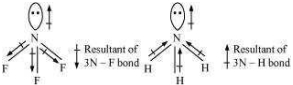
(A) In both molecules,i.e.,$NH_3$ and $NF_3$,the central atom $(N)$ has one lone pair of electrons and three bond pairs. Hence,both molecules have a pyramidal shape.
Since fluorine is more electronegative than hydrogen,it is expected that the net dipole moment of $NF_3$ is greater than $NH_3$. However,the net dipole moment of $NH_3$ $(1.46 \ D)$ is greater than that of $NF_3$ $(0.24 \ D)$.
This can be explained by the directions of the dipole moments of each individual bond in $NF_3$ and $NH_3$.
In $NH_3$,the resultant moment of the three $N-H$ bonds adds up to the bond moment of the lone pair (both are in the same direction).
In $NF_3$,the resultant moment of the three $N-F$ bonds is in the opposite direction to the moment of the lone pair,which partially cancels it out.
Therefore,the net dipole moment of $NH_3$ is higher than that of $NF_3$.
Since fluorine is more electronegative than hydrogen,it is expected that the net dipole moment of $NF_3$ is greater than $NH_3$. However,the net dipole moment of $NH_3$ $(1.46 \ D)$ is greater than that of $NF_3$ $(0.24 \ D)$.
This can be explained by the directions of the dipole moments of each individual bond in $NF_3$ and $NH_3$.
In $NH_3$,the resultant moment of the three $N-H$ bonds adds up to the bond moment of the lone pair (both are in the same direction).
In $NF_3$,the resultant moment of the three $N-F$ bonds is in the opposite direction to the moment of the lone pair,which partially cancels it out.
Therefore,the net dipole moment of $NH_3$ is higher than that of $NF_3$.
0 likes
View Solution207
Medium
Explain dipole-dipole forces and their characteristics.
Solution
(N/A) Dipole-dipole forces act between molecules possessing a permanent dipole. For example,$HCl$,$HF$,$CO$,$NO$,and $NH_{3}$ exhibit dipole-dipole forces.
Ends of the dipoles possess partial charges,denoted by the Greek letter delta $(\delta)$. These partial charges are always less than the unit electronic charge $(1.6 \times 10^{-19} \ C)$.
Formation of dipole-dipole forces: Neighbouring polar molecules interact with each other. Figure $(a)$ shows the electron cloud distribution in a hydrogen chloride dipole,and Figure $(b)$ shows the dipole-dipole interaction between two $HCl$ molecules.
Characteristics:
- This interaction is stronger than London dispersion forces but weaker than ion-ion interaction because only partial charges are involved.
- The attractive force decreases as the distance between the dipoles increases.
- The interaction energy is inversely proportional to the distance between polar molecules.
- Dipole-dipole interaction energy between stationary polar molecules (as in solids) is proportional to $1/r^{3}$,and that between rotating polar molecules is proportional to $1/r^{6}$,where $r$ is the distance between the polar molecules.
Ends of the dipoles possess partial charges,denoted by the Greek letter delta $(\delta)$. These partial charges are always less than the unit electronic charge $(1.6 \times 10^{-19} \ C)$.
Formation of dipole-dipole forces: Neighbouring polar molecules interact with each other. Figure $(a)$ shows the electron cloud distribution in a hydrogen chloride dipole,and Figure $(b)$ shows the dipole-dipole interaction between two $HCl$ molecules.
Characteristics:
- This interaction is stronger than London dispersion forces but weaker than ion-ion interaction because only partial charges are involved.
- The attractive force decreases as the distance between the dipoles increases.
- The interaction energy is inversely proportional to the distance between polar molecules.
- Dipole-dipole interaction energy between stationary polar molecules (as in solids) is proportional to $1/r^{3}$,and that between rotating polar molecules is proportional to $1/r^{6}$,where $r$ is the distance between the polar molecules.
0 likes
View Solution208
Easy
If $B-Cl$ bond has a dipole moment,explain why $BCl_3$ molecule has zero dipole moment.
Solution
(N/A) Due to the difference in electronegativity between $B$ and $Cl$,the $B-Cl$ bond is polar in nature.
However,the $BCl_3$ molecule is non-polar.
This is because $BCl_3$ has a trigonal planar geometry,which is a symmetrical shape.
In this structure,the individual dipole moments of the three $B-Cl$ bonds are oriented at an angle of $120^{\circ}$ to each other.
These dipole moments cancel each other out,resulting in a net dipole moment of zero.
However,the $BCl_3$ molecule is non-polar.
This is because $BCl_3$ has a trigonal planar geometry,which is a symmetrical shape.
In this structure,the individual dipole moments of the three $B-Cl$ bonds are oriented at an angle of $120^{\circ}$ to each other.
These dipole moments cancel each other out,resulting in a net dipole moment of zero.
0 likes
View Solution209
Medium
Which bond is more polar in the following pairs of molecules: $(a)$ $H_3C-H, H_3C-Br$ $(b)$ $H_3C-NH_2, H_3C-OH$ $(c)$ $H_3C-OH, H_3C-SH$
Solution
(N/A) $C-Br$ is more polar than $C-H$ because the electronegativity difference between $C$ $(2.5)$ and $Br$ $(2.8)$ is greater than that between $C$ $(2.5)$ and $H$ $(2.1)$.
$(b)$ $C-O$ is more polar than $C-N$ because the electronegativity of $O$ $(3.5)$ is greater than that of $N$ $(3.0)$,leading to a larger dipole moment.
$(c)$ $C-O$ is more polar than $C-S$ because the electronegativity of $O$ $(3.5)$ is significantly higher than that of $S$ $(2.5)$,resulting in a larger electronegativity difference with carbon.
$(b)$ $C-O$ is more polar than $C-N$ because the electronegativity of $O$ $(3.5)$ is greater than that of $N$ $(3.0)$,leading to a larger dipole moment.
$(c)$ $C-O$ is more polar than $C-S$ because the electronegativity of $O$ $(3.5)$ is significantly higher than that of $S$ $(2.5)$,resulting in a larger electronegativity difference with carbon.
0 likes
View Solution210
EasyMCQ
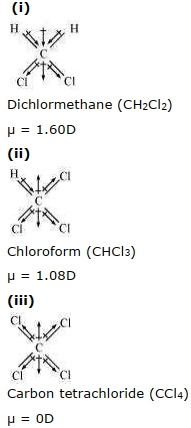
Which one of the following has the highest dipole moment?
$(i)$ $CH_2Cl_2$
$(ii)$ $CHCl_3$
$(iii)$ $CCl_4$
$(i)$ $CH_2Cl_2$
$(ii)$ $CHCl_3$
$(iii)$ $CCl_4$
A
$(i)$
B
$(ii)$
C
$(iii)$
D
All have equal dipole moments
Solution
(A) $CCl_4$ is a symmetrical molecule. Therefore,the dipole moments of all four $C-Cl$ bonds cancel each other. Hence,its resultant dipole moment is zero.
In $CHCl_3$,the resultant of dipole moments of two $C-Cl$ bonds is opposed by the resultant of dipole moments of one $C-H$ bond and one $C-Cl$ bond. Since the resultant of one $C-H$ bond and one $C-Cl$ bond dipole moments is smaller than two $C-Cl$ bonds,the opposition is to a small extent. As a result,$CHCl_3$ has a small dipole moment of $1.08 \ D$.
On the other hand,in case of $CH_2Cl_2$,the resultant of the dipole moments of two $C-Cl$ bonds is strengthened by the resultant of the dipole moments of two $C-H$ bonds. As a result,$CH_2Cl_2$ has a higher dipole moment of $1.60 \ D$ than $CHCl_3$. Thus,$CH_2Cl_2$ has the highest dipole moment.
The increasing order of their dipole moments is: $CCl_4 < CHCl_3 < CH_2Cl_2$.
In $CHCl_3$,the resultant of dipole moments of two $C-Cl$ bonds is opposed by the resultant of dipole moments of one $C-H$ bond and one $C-Cl$ bond. Since the resultant of one $C-H$ bond and one $C-Cl$ bond dipole moments is smaller than two $C-Cl$ bonds,the opposition is to a small extent. As a result,$CHCl_3$ has a small dipole moment of $1.08 \ D$.
On the other hand,in case of $CH_2Cl_2$,the resultant of the dipole moments of two $C-Cl$ bonds is strengthened by the resultant of the dipole moments of two $C-H$ bonds. As a result,$CH_2Cl_2$ has a higher dipole moment of $1.60 \ D$ than $CHCl_3$. Thus,$CH_2Cl_2$ has the highest dipole moment.
The increasing order of their dipole moments is: $CCl_4 < CHCl_3 < CH_2Cl_2$.
0 likes
View Solution211
Medium
What is the dipole moment $(\mu)$ of a bond? Explain with an example.
Solution
(N/A) Polar bonding: As a result of polarization,a molecule possesses a dipole moment.
Definition: The dipole moment is defined as the product of the magnitude of the charge $(Q)$ and the distance $(r)$ between the centers of positive and negative charge.
Mathematical expression: $\mu = Q \times r$
Where:
$Q = \text{magnitude of charge on the atom in Coulomb (C)}$
$r = \text{distance between the centers in meters (m)}$
$\mu = \text{dipole moment in Debye (D) units}$
Conversion factor: $1 \ D = 3.33564 \times 10^{-30} \ C \ m$
Representation: Dipole moment is a vector quantity. By convention,it is depicted by an arrow $(\rightarrow)$ pointing from the positive center to the negative center. In chemistry,it is represented by a crossed arrow $(\mapsto)$ placed on the Lewis structure of the molecule,where the cross is on the positive end and the arrowhead is on the negative end.
Example: For the $HF$ molecule,the dipole moment is represented as:
$H^{\delta+} - F^{\delta-} \quad \text{or} \quad H \xrightarrow{\quad} \ddot{F}:$
Definition: The dipole moment is defined as the product of the magnitude of the charge $(Q)$ and the distance $(r)$ between the centers of positive and negative charge.
Mathematical expression: $\mu = Q \times r$
Where:
$Q = \text{magnitude of charge on the atom in Coulomb (C)}$
$r = \text{distance between the centers in meters (m)}$
$\mu = \text{dipole moment in Debye (D) units}$
Conversion factor: $1 \ D = 3.33564 \times 10^{-30} \ C \ m$
Representation: Dipole moment is a vector quantity. By convention,it is depicted by an arrow $(\rightarrow)$ pointing from the positive center to the negative center. In chemistry,it is represented by a crossed arrow $(\mapsto)$ placed on the Lewis structure of the molecule,where the cross is on the positive end and the arrowhead is on the negative end.
Example: For the $HF$ molecule,the dipole moment is represented as:
$H^{\delta+} - F^{\delta-} \quad \text{or} \quad H \xrightarrow{\quad} \ddot{F}:$
0 likes
View Solution212
Advanced
What is the dipole moment in a molecule? Describe the dipole moment of diatomic molecules.
Solution
(N/A) The dipole moment of a molecule is the resultant dipole moment of all individual bonds. Its magnitude depends on the individual bond dipole moments and their spatial arrangement.
Dipole moment of diatomic molecules: All diatomic molecules are linear. They are classified into two types:
$(i)$ Homonuclear molecules $(A_2)$
$(ii)$ Heteronuclear molecules $(AB)$
$(iii)$ As the electronegativity difference between two atoms increases,ionic character increases and covalent character decreases.
Dipole moment of diatomic molecules: All diatomic molecules are linear. They are classified into two types:
$(i)$ Homonuclear molecules $(A_2)$
$(ii)$ Heteronuclear molecules $(AB)$
| Homonuclear $(A_2)$ | Heteronuclear $(AB)$ |
| e.g.,$H_2, F_2, Cl_2, Br_2, I_2, O_2, N_2$ | e.g.,$HF, HCl, HBr, HI, CO, NO$ |
| $\mu = 0 \ D$ (Non-polar) | $\mu \neq 0$ (Polar) |
| Bonding electron pair is shared equally between atoms. | Bonding pair is localized towards the more electronegative atom $(A^{+\delta}-B^{-\delta})$. |
$(iii)$ As the electronegativity difference between two atoms increases,ionic character increases and covalent character decreases.
| Molecule | $HF$ | $HCl$ | $HBr$ | $HI$ | $H_2$ |
| $\mu \ (D)$ | $1.78$ | $1.07$ | $0.79$ | $0.38$ | $0.00$ |
0 likes
View Solution213
Difficult
Explain the dipole moment of a triatomic molecule $(AB_2)$.
Solution
(N/A) Triatomic molecules $(AB_2)$ can be classified into two types based on their geometry and dipole moment:
| Feature | Linear $AB_2$ molecules | Angular $AB_2$ molecules |
| :--- | :--- | :--- |
| $(i)$ Structure | $B-A-B$ | $A$ with lone pairs bonded to two $B$ atoms |
| $(ii)$ Lone pair on $A$ | Not present | Present |
| $(iii)$ Examples | $CO_2, CS_2, BeH_2, BeCl_2, BeF_2$ | $H_2O, NO_2, H_2S, F_2O$ |
| $(iv)$ Dipole moment | $\mu = 0$ $D$ (Non-polar) | $\mu \neq 0$ $D$ (Polar) |
In linear $AB_2$ molecules,the two equal bond dipoles point in opposite directions and cancel each other's effect,resulting in a net dipole moment of zero. In angular $AB_2$ molecules,the presence of lone pairs on the central atom $A$ results in a bent geometry,preventing the bond dipoles from cancelling out,thus making the molecule polar.
| Feature | Linear $AB_2$ molecules | Angular $AB_2$ molecules |
| :--- | :--- | :--- |
| $(i)$ Structure | $B-A-B$ | $A$ with lone pairs bonded to two $B$ atoms |
| $(ii)$ Lone pair on $A$ | Not present | Present |
| $(iii)$ Examples | $CO_2, CS_2, BeH_2, BeCl_2, BeF_2$ | $H_2O, NO_2, H_2S, F_2O$ |
| $(iv)$ Dipole moment | $\mu = 0$ $D$ (Non-polar) | $\mu \neq 0$ $D$ (Polar) |
In linear $AB_2$ molecules,the two equal bond dipoles point in opposite directions and cancel each other's effect,resulting in a net dipole moment of zero. In angular $AB_2$ molecules,the presence of lone pairs on the central atom $A$ results in a bent geometry,preventing the bond dipoles from cancelling out,thus making the molecule polar.
0 likes
View Solution214
Difficult
Explain the dipole moment of $AB_2$ linear molecules (e.g.,$BeF_2$) and $AB_2$ angular molecules (e.g.,$H_2O$).
Solution
(N/A) The dipole moment of triatomic $AB_2$ molecules depends on their geometry and the presence of lone pairs on the central atom $A$:
$1$. Linear $AB_2$ molecules:
- These molecules have no lone pairs on the central atom $A$.
- Examples include $CO_2$,$CS_2$,$BeH_2$,$BeCl_2$,and $BeF_2$.
- The bond dipoles are equal in magnitude and point in opposite directions,thus canceling each other out. Consequently,the net dipole moment $(\mu)$ is $0 \ D$.
$2$. Angular $AB_2$ molecules:
- These molecules have lone pairs on the central atom $A$,which causes the molecule to adopt a bent or angular shape.
- Examples include $H_2O$,$NO_2$,$H_2S$,and $F_2O$.
- Due to the angular geometry,the bond dipoles do not cancel each other out. As a result,the net dipole moment $(\mu)$ is not equal to zero $(\mu \neq 0)$. For instance,$H_2O$ has a dipole moment of $1.85 \ D$ and $H_2S$ has $0.95 \ D$.
$1$. Linear $AB_2$ molecules:
- These molecules have no lone pairs on the central atom $A$.
- Examples include $CO_2$,$CS_2$,$BeH_2$,$BeCl_2$,and $BeF_2$.
- The bond dipoles are equal in magnitude and point in opposite directions,thus canceling each other out. Consequently,the net dipole moment $(\mu)$ is $0 \ D$.
$2$. Angular $AB_2$ molecules:
- These molecules have lone pairs on the central atom $A$,which causes the molecule to adopt a bent or angular shape.
- Examples include $H_2O$,$NO_2$,$H_2S$,and $F_2O$.
- Due to the angular geometry,the bond dipoles do not cancel each other out. As a result,the net dipole moment $(\mu)$ is not equal to zero $(\mu \neq 0)$. For instance,$H_2O$ has a dipole moment of $1.85 \ D$ and $H_2S$ has $0.95 \ D$.
0 likes
View Solution215
Difficult
Although both $CO_2$ and $H_2O$ are triatomic molecules,the shape of $H_2O$ molecule is bent while that of $CO_2$ is linear. Explain this on the basis of dipole moment.
Solution
(N/A) The polarity of a molecule is determined by the vector sum of the dipole moments of its individual bonds.
$CO_2$ is a linear molecule $(O=C=O)$. The two $C=O$ bonds have equal dipole moments but act in exactly opposite directions. As a result,they cancel each other out,leading to a net dipole moment of $\mu = 0 \ D$. Thus,$CO_2$ is nonpolar.
$H_2O$ has a bent (angular) geometry due to the presence of two lone pairs on the oxygen atom. In $H_2O$,the $O-H$ bonds are polar because oxygen is more electronegative than hydrogen. Due to the bent shape (bond angle $104.5^{\circ}$),the bond dipoles do not cancel each other out. Instead,they add up to a resultant dipole moment of $\mu = 1.85 \ D$. Therefore,$H_2O$ is a polar molecule.
$CO_2$ is a linear molecule $(O=C=O)$. The two $C=O$ bonds have equal dipole moments but act in exactly opposite directions. As a result,they cancel each other out,leading to a net dipole moment of $\mu = 0 \ D$. Thus,$CO_2$ is nonpolar.
$H_2O$ has a bent (angular) geometry due to the presence of two lone pairs on the oxygen atom. In $H_2O$,the $O-H$ bonds are polar because oxygen is more electronegative than hydrogen. Due to the bent shape (bond angle $104.5^{\circ}$),the bond dipoles do not cancel each other out. Instead,they add up to a resultant dipole moment of $\mu = 1.85 \ D$. Therefore,$H_2O$ is a polar molecule.
0 likes
View Solution216
Medium
Explain why $BeH_{2}$ molecule has a zero dipole moment although the $Be-H$ bonds are polar.
Solution
(N/A) $BeH_{2}$ molecule has a linear geometry with a bond angle of $180^{\circ}$.
In a $Be-H$ bond,the electronegativity of $Be$ is $1.57$ and $H$ is $2.20$. Due to this difference,the bonding electron pair is shifted towards the $H$ atom,making the $Be-H$ bond polar.
However,in the linear $BeH_{2}$ molecule,the two $Be-H$ bond dipoles are equal in magnitude and point in exactly opposite directions.
As a result,the two bond dipoles cancel each other out,leading to a net dipole moment of zero.
Therefore,$BeH_{2}$ is a non-polar molecule: $H^{\delta-} \leftarrow Be^{2+} \rightarrow H^{\delta-}$.
In a $Be-H$ bond,the electronegativity of $Be$ is $1.57$ and $H$ is $2.20$. Due to this difference,the bonding electron pair is shifted towards the $H$ atom,making the $Be-H$ bond polar.
However,in the linear $BeH_{2}$ molecule,the two $Be-H$ bond dipoles are equal in magnitude and point in exactly opposite directions.
As a result,the two bond dipoles cancel each other out,leading to a net dipole moment of zero.
Therefore,$BeH_{2}$ is a non-polar molecule: $H^{\delta-} \leftarrow Be^{2+} \rightarrow H^{\delta-}$.
0 likes
View Solution217
Medium
Which out of $NH_{3}$ and $NF_{3}$ has a higher dipole moment and why?
Solution
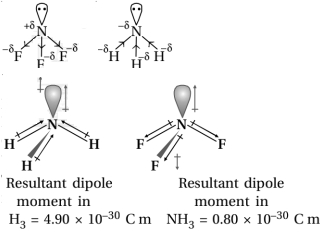
(N/A) The dipole moment of $NH_{3}$ is higher than that of $NF_{3}$.
Dipole moment of $NH_{3} = 1.47 \ D = 4.9 \times 10^{-30} \ Cm$
Dipole moment of $NF_{3} = 0.23 \ D = 0.8 \times 10^{-30} \ Cm$
$\mu(NH_{3}) > \mu(NF_{3})$: Both molecules have a pyramidal shape with a lone pair of electrons on the nitrogen atom.
Electronegativity values are: $H(2.1)$,$N(3.0)$,and $F(4.0)$. Nitrogen is partially negative in $NH_{3}$ but partially positive in $NF_{3}$ due to the high electronegativity of fluorine.
In $NH_{3}$,the orbital dipole due to the lone pair is in the same direction as the resultant dipole moment of the $N-H$ bonds,which adds up to a larger total dipole moment.
In $NF_{3}$,the orbital dipole due to the lone pair is in the direction opposite to the resultant dipole moment of the three $N-F$ bonds. This opposes the bond moments,resulting in a significantly lower net dipole moment.
Dipole moment of $NH_{3} = 1.47 \ D = 4.9 \times 10^{-30} \ Cm$
Dipole moment of $NF_{3} = 0.23 \ D = 0.8 \times 10^{-30} \ Cm$
$\mu(NH_{3}) > \mu(NF_{3})$: Both molecules have a pyramidal shape with a lone pair of electrons on the nitrogen atom.
Electronegativity values are: $H(2.1)$,$N(3.0)$,and $F(4.0)$. Nitrogen is partially negative in $NH_{3}$ but partially positive in $NF_{3}$ due to the high electronegativity of fluorine.
In $NH_{3}$,the orbital dipole due to the lone pair is in the same direction as the resultant dipole moment of the $N-H$ bonds,which adds up to a larger total dipole moment.
In $NF_{3}$,the orbital dipole due to the lone pair is in the direction opposite to the resultant dipole moment of the three $N-F$ bonds. This opposes the bond moments,resulting in a significantly lower net dipole moment.
0 likes
View Solution218
Difficult
Write the significance/applications of dipole moment.
Solution
(N/A) $1$. Determining the polarity of a bond: As $\mu = q \times d$,a greater magnitude of dipole moment indicates higher bond polarity. For a polar bond in an $A-B$ type molecule,the order is $HF > HCl > HBr > HI$. If $\mu = 0$,the molecule is non-polar (e.g.,$O_2, N_2, F_2, Cl_2, Br_2, I_2, H_2$).
$2$. Determining the shape (symmetry) of a molecule: Molecules like $BeF_2, CO_2, BeCl_2$ have $\mu = 0$ and are linear. Molecules like $H_2O, SO_2$ have $\mu \neq 0$ and are angular. Similarly,$BF_3, CH_4, CCl_4$ are non-polar,while $NF_3, NH_3, CH_3Cl$ are polar.
$3$. Calculation of ionic or covalent character: Ionic character is proportional to the difference in electronegativity. In $HI, HBr, HCl, HF$,the ionic character increases.
$4$. Distinguishing between cis and trans isomers: For cis isomers,$\mu \neq 0$,whereas for trans isomers,$\mu = 0$.
$5$. Distinguishing between ortho,meta,and para isomers: For para isomers,$\mu = 0$,and the dipole moment of ortho isomers is generally greater than that of meta isomers.
$2$. Determining the shape (symmetry) of a molecule: Molecules like $BeF_2, CO_2, BeCl_2$ have $\mu = 0$ and are linear. Molecules like $H_2O, SO_2$ have $\mu \neq 0$ and are angular. Similarly,$BF_3, CH_4, CCl_4$ are non-polar,while $NF_3, NH_3, CH_3Cl$ are polar.
$3$. Calculation of ionic or covalent character: Ionic character is proportional to the difference in electronegativity. In $HI, HBr, HCl, HF$,the ionic character increases.
$4$. Distinguishing between cis and trans isomers: For cis isomers,$\mu \neq 0$,whereas for trans isomers,$\mu = 0$.
$5$. Distinguishing between ortho,meta,and para isomers: For para isomers,$\mu = 0$,and the dipole moment of ortho isomers is generally greater than that of meta isomers.
0 likes
View Solution219
Medium
If $B-Cl$ bond has a dipole moment,explain why $BCl_3$ molecule has zero dipole moment.
Solution
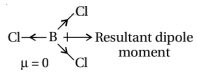
(N/A) Due to the difference in electronegativities of $B$ and $Cl$ atoms,the $B-Cl$ bond is polar in nature.
However,the $BCl_3$ molecule is non-polar. This is because $BCl_3$ has a trigonal planar geometry,which is a highly symmetrical shape.
In this structure,the three $B-Cl$ bond dipoles are oriented at an angle of $120^{\circ}$ to each other. The resultant dipole moment of any two $B-Cl$ bonds is equal and opposite to the third $B-Cl$ bond dipole.
Consequently,the individual bond dipoles cancel each other out,resulting in a net dipole moment of $\mu = 0$ for the $BCl_3$ molecule.
However,the $BCl_3$ molecule is non-polar. This is because $BCl_3$ has a trigonal planar geometry,which is a highly symmetrical shape.
In this structure,the three $B-Cl$ bond dipoles are oriented at an angle of $120^{\circ}$ to each other. The resultant dipole moment of any two $B-Cl$ bonds is equal and opposite to the third $B-Cl$ bond dipole.
Consequently,the individual bond dipoles cancel each other out,resulting in a net dipole moment of $\mu = 0$ for the $BCl_3$ molecule.
0 likes
View Solution220
Difficult
$Cis$-but$-2$-ene is polar and $trans$-but$-2$-ene is non-polar. Explain.
Solution
(N/A) $CH_3CH=CHCH_3$ exhibits $2$ geometrical isomers:
$(i)$ $Cis$-but$-2$-ene
$(ii)$ $Trans$-but$-2$-ene
In $cis$-but$-2$-ene,the two $CH_3$ groups are on the same side of the double bond. The bond dipoles of the $C-CH_3$ bonds do not cancel each other,resulting in a net dipole moment $(\mu = 0.33 \ D)$,making it polar.
In $trans$-but$-2$-ene,the two $CH_3$ groups are on opposite sides of the double bond. The bond dipoles of the $C-CH_3$ bonds are equal in magnitude and opposite in direction,thus cancelling each other out. This results in a net dipole moment of zero $(\mu = 0)$,making it non-polar.
$(i)$ $Cis$-but$-2$-ene
$(ii)$ $Trans$-but$-2$-ene
In $cis$-but$-2$-ene,the two $CH_3$ groups are on the same side of the double bond. The bond dipoles of the $C-CH_3$ bonds do not cancel each other,resulting in a net dipole moment $(\mu = 0.33 \ D)$,making it polar.
In $trans$-but$-2$-ene,the two $CH_3$ groups are on opposite sides of the double bond. The bond dipoles of the $C-CH_3$ bonds are equal in magnitude and opposite in direction,thus cancelling each other out. This results in a net dipole moment of zero $(\mu = 0)$,making it non-polar.
0 likes
View Solution221
Medium
Explain why $O=C=O$ is non-polar while $R-O-R$ is polar?
Solution
(N/A) This can be explained by molecular geometry.
The $CO_2$ molecule is linear,which results in the two $C=O$ bond dipoles being equal in magnitude and oriented in exactly opposite directions.
Consequently,they cancel each other out,leading to a net dipole moment of $\mu = 0$,making the molecule non-polar.
In contrast,the $R-O-R$ (ether) molecule has a bent or angular geometry due to the presence of two lone pairs on the oxygen atom.
As a result,the bond moments do not cancel each other,and the molecule possesses a net dipole moment $(\mu > 0)$,making it polar.
The $CO_2$ molecule is linear,which results in the two $C=O$ bond dipoles being equal in magnitude and oriented in exactly opposite directions.
Consequently,they cancel each other out,leading to a net dipole moment of $\mu = 0$,making the molecule non-polar.
In contrast,the $R-O-R$ (ether) molecule has a bent or angular geometry due to the presence of two lone pairs on the oxygen atom.
As a result,the bond moments do not cancel each other,and the molecule possesses a net dipole moment $(\mu > 0)$,making it polar.
0 likes
View Solution222
MediumMCQ
Arrange the following compounds in increasing order of dipole moment:
$CH_3CH_2CH_3$,$CH_3CH_2NH_2$,$CH_3CH_2OH$
$CH_3CH_2CH_3$,$CH_3CH_2NH_2$,$CH_3CH_2OH$
A
$CH_3CH_2CH_3 < CH_3CH_2NH_2 < CH_3CH_2OH$
B
$CH_3CH_2CH_3 < CH_3CH_2OH < CH_3CH_2NH_2$
C
$CH_3CH_2NH_2 < CH_3CH_2CH_3 < CH_3CH_2OH$
D
$CH_3CH_2OH < CH_3CH_2NH_2 < CH_3CH_2CH_3$
Solution
(A) The dipole moment depends on the electronegativity difference between the atoms bonded to carbon.
$1$. $CH_3CH_2CH_3$ (Propane) is a non-polar hydrocarbon with a very low dipole moment.
$2$. $CH_3CH_2NH_2$ (Ethylamine) has a $C-N$ bond,where $N$ is more electronegative than $C$,resulting in a moderate dipole moment.
$3$. $CH_3CH_2OH$ (Ethanol) has a $C-O$ bond,where $O$ is more electronegative than $N$,resulting in a higher dipole moment.
Therefore,the increasing order of dipole moment is: $CH_3CH_2CH_3 < CH_3CH_2NH_2 < CH_3CH_2OH$.
$1$. $CH_3CH_2CH_3$ (Propane) is a non-polar hydrocarbon with a very low dipole moment.
$2$. $CH_3CH_2NH_2$ (Ethylamine) has a $C-N$ bond,where $N$ is more electronegative than $C$,resulting in a moderate dipole moment.
$3$. $CH_3CH_2OH$ (Ethanol) has a $C-O$ bond,where $O$ is more electronegative than $N$,resulting in a higher dipole moment.
Therefore,the increasing order of dipole moment is: $CH_3CH_2CH_3 < CH_3CH_2NH_2 < CH_3CH_2OH$.
0 likes
View Solution223
Medium
Elements $X, Y$ and $Z$ have $4, 5$ and $7$ valence electrons respectively.
$(a)$ Write the molecular formula of the compounds formed by these elements individually with hydrogen.
$(b)$ Which of these compounds will have the highest dipole moment?
$(a)$ Write the molecular formula of the compounds formed by these elements individually with hydrogen.
$(b)$ Which of these compounds will have the highest dipole moment?
Solution
(B) The valency of an element is determined by its valence electrons. For $X$ (valence electrons = $4$),the valency is $4$,so it forms $XH_4$. For $Y$ (valence electrons = $5$),the valency is $3$,so it forms $YH_3$. For $Z$ (valence electrons = $7$),the valency is $1$,so it forms $ZH$.
$(b)$ Dipole moment depends on the electronegativity difference between the bonded atoms. $Z$ is a halogen (group $17$) and is the most electronegative among the three. Therefore,the bond $H-Z$ has the highest polarity,resulting in the highest dipole moment for $ZH$.
$(b)$ Dipole moment depends on the electronegativity difference between the bonded atoms. $Z$ is a halogen (group $17$) and is the most electronegative among the three. Therefore,the bond $H-Z$ has the highest polarity,resulting in the highest dipole moment for $ZH$.
0 likes
View Solution224
Difficult
$(a)$ Discuss the significance/applications of dipole moment.
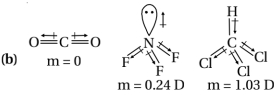
$(b)$ Represent diagrammatically the bond moments and the resultant dipole moment in $CO_2, NF_3$ and $CHCl_3$.
$(b)$ Represent diagrammatically the bond moments and the resultant dipole moment in $CO_2, NF_3$ and $CHCl_3$.
Solution
(N/A) The applications of dipole moment are:
$(i)$ The dipole moment helps to predict whether a molecule is polar or non-polar. As $\mu = q \times d$,greater is the magnitude of dipole moment,higher will be the polarity of the bond. For nonpolar molecules,the dipole moment is zero.
$(ii)$ The percentage of ionic character can be calculated as: $\text{Percentage of ionic character} = \frac{\mu_{\text{observed}}}{\mu_{\text{ionic}}} \times 100$.
$(iii)$ Symmetrical molecules have zero dipole moment although they have two or more polar bonds (in determination of symmetry).
$(iv)$ It helps to distinguish between $cis$ and $trans$ isomers. Usually $cis$-isomer has higher dipole moment than $trans$ isomer.
$(v)$ It helps to distinguish between $ortho$,$meta$ and $para$ isomers. Dipole moment of $para$ isomer is zero. Dipole moment of $ortho$ isomer is greater than that of $meta$ isomer.
$(b)$ The diagrammatic representation is as follows:
$O=C=O$ $(m=0)$
$NF_3$ $(m=0.24 \ D)$
$CHCl_3$ $(m=1.03 \ D)$
$(i)$ The dipole moment helps to predict whether a molecule is polar or non-polar. As $\mu = q \times d$,greater is the magnitude of dipole moment,higher will be the polarity of the bond. For nonpolar molecules,the dipole moment is zero.
$(ii)$ The percentage of ionic character can be calculated as: $\text{Percentage of ionic character} = \frac{\mu_{\text{observed}}}{\mu_{\text{ionic}}} \times 100$.
$(iii)$ Symmetrical molecules have zero dipole moment although they have two or more polar bonds (in determination of symmetry).
$(iv)$ It helps to distinguish between $cis$ and $trans$ isomers. Usually $cis$-isomer has higher dipole moment than $trans$ isomer.
$(v)$ It helps to distinguish between $ortho$,$meta$ and $para$ isomers. Dipole moment of $para$ isomer is zero. Dipole moment of $ortho$ isomer is greater than that of $meta$ isomer.
$(b)$ The diagrammatic representation is as follows:
$O=C=O$ $(m=0)$
$NF_3$ $(m=0.24 \ D)$
$CHCl_3$ $(m=1.03 \ D)$
0 likes
View Solution225
Easy
What is the unit of dipole moment? Also,write the formula for dipole moment.
Solution
(N/A) The practical unit of dipole moment is Debye,denoted by $D$.
$1 \ D = 3.33564 \times 10^{-30} \ C \cdot m$
Dipole moment $(\mu)$ = Magnitude of charge $(Q)$ $\times$ Distance of separation $(r)$
$\mu = Q \times r$
Where $Q$ is in Coulombs $(C)$ and $r$ is in meters $(m)$. The $SI$ unit is $C \cdot m$.
$1 \ D = 3.33564 \times 10^{-30} \ C \cdot m$
Dipole moment $(\mu)$ = Magnitude of charge $(Q)$ $\times$ Distance of separation $(r)$
$\mu = Q \times r$
Where $Q$ is in Coulombs $(C)$ and $r$ is in meters $(m)$. The $SI$ unit is $C \cdot m$.
0 likes
View Solution226
Medium
"Dipole moment is a vector quantity." What does this mean? How is it represented?
Solution
(N/A) dipole moment is a vector quantity,which means it has both magnitude and a specific direction.
It is represented by a small arrow with a tail on the positive center and the head pointing towards the negative center. The symbol used is $\longmapsto$.
It is represented by a small arrow with a tail on the positive center and the head pointing towards the negative center. The symbol used is $\longmapsto$.
0 likes
View Solution227
Easy
Indicate the dipole moment arrow for the following molecules:
$(i)$ $HF$
$(ii)$ $CO$
$(iii)$ $Cl_2$
$(i)$ $HF$
$(ii)$ $CO$
$(iii)$ $Cl_2$
Solution
(N/A) The dipole moment arrow points from the less electronegative atom to the more electronegative atom.
$(i)$ $H \xrightarrow{\quad} F$ (Since $F$ is more electronegative than $H$)
$(ii)$ $C \xrightarrow{\quad} O$ (Since $O$ is more electronegative than $C$)
$(iii)$ $Cl-Cl$ (No dipole moment as both atoms have the same electronegativity,so the net dipole moment is $0$)
$(i)$ $H \xrightarrow{\quad} F$ (Since $F$ is more electronegative than $H$)
$(ii)$ $C \xrightarrow{\quad} O$ (Since $O$ is more electronegative than $C$)
$(iii)$ $Cl-Cl$ (No dipole moment as both atoms have the same electronegativity,so the net dipole moment is $0$)
0 likes
View Solution228
MediumMCQ
Explain the relationship between the polarity of a polyatomic molecule and the polarity of its bonds.
A
The polarity of a molecule is the sum of the bond polarities.
B
The polarity of a molecule is the vector sum of the dipole moments of its bonds,considering the molecular geometry.
C
The polarity of a molecule is independent of its geometry.
D
The polarity of a molecule is always zero if it contains polar bonds.
Solution
(B) The polarity of a polyatomic molecule is determined by the vector sum of the dipole moments of all its individual bonds.
This sum depends on the molecular geometry (shape) of the molecule.
If the vector sum of the dipole moments is non-zero,the molecule is polar.
If the vector sum is zero,the molecule is non-polar.
This sum depends on the molecular geometry (shape) of the molecule.
If the vector sum of the dipole moments is non-zero,the molecule is polar.
If the vector sum is zero,the molecule is non-polar.
0 likes
View Solution229
Medium
Show the dipole moment of $H_2O$ and $BeH_2$ with diagrams.
Solution
(N/A) $H_2O$ molecule is angular with a bond angle of $H-O-H$ equal to $104.5^{\circ}$.
$BeH_2$ molecule is linear with a bond angle of $H-Be-H$ equal to $180^{\circ}$.
In $H_2O$,the individual bond dipoles do not cancel each other,resulting in a net dipole moment of $\mu = 1.85 \ D$.
In $BeH_2$,the two $Be-H$ bond dipoles are equal in magnitude and opposite in direction,so they cancel each other out,resulting in a net dipole moment of $\mu = 0$.
$BeH_2$ molecule is linear with a bond angle of $H-Be-H$ equal to $180^{\circ}$.
In $H_2O$,the individual bond dipoles do not cancel each other,resulting in a net dipole moment of $\mu = 1.85 \ D$.
In $BeH_2$,the two $Be-H$ bond dipoles are equal in magnitude and opposite in direction,so they cancel each other out,resulting in a net dipole moment of $\mu = 0$.
0 likes
View Solution230
EasyMCQ
What is the difference in the dipole moment of $NH_3$ and $NF_3$ molecules?
A
$NH_3$ has a higher dipole moment than $NF_3$.
B
$NF_3$ has a higher dipole moment than $NH_3$.
C
Both have the same dipole moment.
D
Both have zero dipole moment.
Solution
(A) In $NH_3$,the orbital dipole due to the lone pair is in the same direction as the resultant dipole moment of the three $N-H$ bonds. This leads to a higher dipole moment of $4.90 \times 10^{-30} \ C \ m$.
In $NF_3$,the orbital dipole due to the lone pair is in the opposite direction to the resultant dipole moment of the three $N-F$ bonds. This leads to a lower dipole moment of $0.80 \times 10^{-30} \ C \ m$.
In $NF_3$,the orbital dipole due to the lone pair is in the opposite direction to the resultant dipole moment of the three $N-F$ bonds. This leads to a lower dipole moment of $0.80 \times 10^{-30} \ C \ m$.
0 likes
View Solution231
EasyMCQ
If an $AB_3$ molecule (containing four atoms) has a dipole moment of zero and another has a non-zero dipole moment,what does this indicate about their shapes?
A
Zero dipole moment indicates a trigonal planar shape; non-zero indicates a trigonal pyramidal shape.
B
Zero dipole moment indicates a trigonal pyramidal shape; non-zero indicates a trigonal planar shape.
C
Both indicate a trigonal planar shape.
D
Both indicate a trigonal pyramidal shape.
Solution
(A) For an $AB_3$ molecule,if the dipole moment $\mu = 0$,the molecule must have a symmetric trigonal planar geometry where the bond dipoles cancel each other out.
If the dipole moment $\mu \neq 0$,the molecule possesses a lone pair on the central atom,resulting in a trigonal pyramidal geometry.
If the dipole moment $\mu \neq 0$,the molecule possesses a lone pair on the central atom,resulting in a trigonal pyramidal geometry.
0 likes
View Solution232
EasyMCQ
Which of the following molecules has a dipole moment of zero: $NH_3, PH_3, BH_3, AlH_3$?
A
$NH_3$
B
$PH_3$
C
$BH_3$
D
$AlH_3$
Solution
(C) The dipole moment $(\mu)$ of a molecule is zero if it has a symmetric geometry where the bond dipoles cancel each other out.
$BH_3$ and $AlH_3$ have a trigonal planar geometry ($sp^2$ hybridization),which is symmetric,resulting in a net dipole moment of $\mu = 0$.
$NH_3$ and $PH_3$ have a trigonal pyramidal geometry with a lone pair on the central atom,which is asymmetric,resulting in a non-zero dipole moment $(\mu \neq 0)$.
Therefore,both $BH_3$ and $AlH_3$ have a dipole moment of zero. Given the options,$BH_3$ is the standard answer.
$BH_3$ and $AlH_3$ have a trigonal planar geometry ($sp^2$ hybridization),which is symmetric,resulting in a net dipole moment of $\mu = 0$.
$NH_3$ and $PH_3$ have a trigonal pyramidal geometry with a lone pair on the central atom,which is asymmetric,resulting in a non-zero dipole moment $(\mu \neq 0)$.
Therefore,both $BH_3$ and $AlH_3$ have a dipole moment of zero. Given the options,$BH_3$ is the standard answer.
0 likes
View Solution233
Medium
Match the compounds given in List-$I$ with their dipole moments given in List-$II$.
| List-$I$ | List-$II$ |
| $(1)$ ${\rm{HBr}}$ | $(A)$ $0.23$ |
| $(2)$ ${{\rm{H}}_2}{\rm{S}}$ | $(B)$ $1.04$ |
| $(3)$ ${\rm{N}}{{\rm{F}}_3}$ | $(C)$ $1.07$ |
| $(4)$ ${\rm{CC}}{{\rm{l}}_4}$ | $(D)$ $0.79$ |
| $(5)$ ${\rm{CHC}}{{\rm{l}}_3}$ | $(E)$ $0.00$ |
| $(F)$ $0.95$ |
Solution
(A) The dipole moments ($\mu$ in $D$) for the given compounds are as follows:
$(1)$ ${\rm{HBr}}$: $0.79 \ D$ $(1-D)$
$(2)$ ${{\rm{H}}_2}{\rm{S}}$: $0.95 \ D$ $(2-F)$
$(3)$ ${\rm{N}}{{\rm{F}}_3}$: $0.23 \ D$ $(3-A)$
$(4)$ ${\rm{CC}}{{\rm{l}}_4}$: $0.00 \ D$ $(4-E)$
$(5)$ ${\rm{CHC}}{{\rm{l}}_3}$: $1.04 \ D$ $(5-B)$
Therefore, the correct matching is $(1-D, 2-F, 3-A, 4-E, 5-B)$.
$(1)$ ${\rm{HBr}}$: $0.79 \ D$ $(1-D)$
$(2)$ ${{\rm{H}}_2}{\rm{S}}$: $0.95 \ D$ $(2-F)$
$(3)$ ${\rm{N}}{{\rm{F}}_3}$: $0.23 \ D$ $(3-A)$
$(4)$ ${\rm{CC}}{{\rm{l}}_4}$: $0.00 \ D$ $(4-E)$
$(5)$ ${\rm{CHC}}{{\rm{l}}_3}$: $1.04 \ D$ $(5-B)$
Therefore, the correct matching is $(1-D, 2-F, 3-A, 4-E, 5-B)$.
0 likes
View Solution234
Medium
State the magnitude of dipole-dipole forces and the value of interaction energy with examples.
Solution
(N/A) Dipole-dipole forces: $1$ to $3 \, kcal \, mol^{-1}$.
Examples: $SO_2, NO, HCl$.
For rotating molecules, the interaction energy is proportional to $\frac{1}{r^6}$.
For stationary molecules, the interaction energy is proportional to $\frac{1}{r^3}$.
These forces exist only when the distance between molecules is less than $500 \, pm$.
Examples: $SO_2, NO, HCl$.
For rotating molecules, the interaction energy is proportional to $\frac{1}{r^6}$.
For stationary molecules, the interaction energy is proportional to $\frac{1}{r^3}$.
These forces exist only when the distance between molecules is less than $500 \, pm$.
0 likes
View Solution235
EasyMCQ
Why is the water molecule polar?
A
Due to its linear shape.
B
Due to the difference in electronegativity between oxygen and hydrogen atoms and its bent geometry.
C
Because oxygen is less electronegative than hydrogen.
D
Because it has zero dipole moment.
Solution
(B) Oxygen is more electronegative than hydrogen,which creates a polar $O-H$ bond.
In a water molecule,there are two such polar $O-H$ bonds.
These bonds are arranged at a bond angle of $104.5^{\circ}$ due to the presence of two lone pairs on the oxygen atom.
Because of this bent geometry,the bond dipoles do not cancel each other out,resulting in a net dipole moment of $1.84 \ D$.
Therefore,the water molecule is polar.
In a water molecule,there are two such polar $O-H$ bonds.
These bonds are arranged at a bond angle of $104.5^{\circ}$ due to the presence of two lone pairs on the oxygen atom.
Because of this bent geometry,the bond dipoles do not cancel each other out,resulting in a net dipole moment of $1.84 \ D$.
Therefore,the water molecule is polar.
0 likes
View Solution236
MediumMCQ
Which of the following sets of molecules will have a zero dipole moment?
A
Boron trifluoride,beryllium difluoride,carbon dioxide,$1,4-$dichlorobenzene
B
Ammonia,beryllium difluoride,water,$1,4-$dichlorobenzene
C
Boron trifluoride,hydrogen fluoride,carbon dioxide,$1,3-$dichlorobenzene
D
Nitrogen trifluoride,beryllium difluoride,water,$1,3-$dichlorobenzene
Solution
(A) molecule has a zero dipole moment if it is symmetrical and the bond dipoles cancel each other out.
$BF_3$ (trigonal planar) has a net dipole moment of $0$.
$BeF_2$ (linear) has a net dipole moment of $0$.
$CO_2$ (linear) has a net dipole moment of $0$.
$1,4-$dichlorobenzene (para-substituted) has a net dipole moment of $0$ due to symmetry.
Therefore,the set containing $BF_3, BeF_2, CO_2,$ and $1,4-$dichlorobenzene has a zero dipole moment.
$BF_3$ (trigonal planar) has a net dipole moment of $0$.
$BeF_2$ (linear) has a net dipole moment of $0$.
$CO_2$ (linear) has a net dipole moment of $0$.
$1,4-$dichlorobenzene (para-substituted) has a net dipole moment of $0$ due to symmetry.
Therefore,the set containing $BF_3, BeF_2, CO_2,$ and $1,4-$dichlorobenzene has a zero dipole moment.
0 likes
View Solution237
EasyMCQ
Which of the following molecules is non-polar in nature?
A
$POCl_3$
B
$CH_2O$
C
$SbCl_5$
D
$NO_2$
Solution
(C) molecule is non-polar if its net dipole moment is zero.
$SbCl_5$ has a trigonal bipyramidal geometry where the three equatorial $Sb-Cl$ bonds cancel each other out,and the two axial $Sb-Cl$ bonds also cancel each other out,resulting in a net dipole moment of zero.
$POCl_3$,$CH_2O$,and $NO_2$ are polar molecules due to their asymmetric structures and the presence of different atoms or lone pairs leading to a non-zero net dipole moment.
$SbCl_5$ has a trigonal bipyramidal geometry where the three equatorial $Sb-Cl$ bonds cancel each other out,and the two axial $Sb-Cl$ bonds also cancel each other out,resulting in a net dipole moment of zero.
$POCl_3$,$CH_2O$,and $NO_2$ are polar molecules due to their asymmetric structures and the presence of different atoms or lone pairs leading to a non-zero net dipole moment.
0 likes
View Solution238
EasyMCQ
Amongst $BeF_{2}$,$BF_{3}$,$H_{2}O$,$NH_{3}$,$CCl_{4}$ and $HCl$,the number of molecules with non-zero net dipole moment is ...... .
A
$3$
B
$2$
C
$1$
D
$4$
Solution
(A) The net dipole moment $(\mu_{net})$ depends on the molecular geometry and the electronegativity difference between atoms.
$BeF_{2}$ is linear,$BF_{3}$ is trigonal planar,and $CCl_{4}$ is tetrahedral. These molecules have symmetric structures where individual bond dipoles cancel each other out,resulting in $\mu_{net} = 0$.
$H_{2}O$ (bent),$NH_{3}$ (trigonal pyramidal),and $HCl$ (heteronuclear diatomic) have asymmetric charge distributions,resulting in $\mu_{net} \neq 0$.
Therefore,the molecules with non-zero net dipole moment are $H_{2}O$,$NH_{3}$,and $HCl$.
The total count is $3$.
$BeF_{2}$ is linear,$BF_{3}$ is trigonal planar,and $CCl_{4}$ is tetrahedral. These molecules have symmetric structures where individual bond dipoles cancel each other out,resulting in $\mu_{net} = 0$.
$H_{2}O$ (bent),$NH_{3}$ (trigonal pyramidal),and $HCl$ (heteronuclear diatomic) have asymmetric charge distributions,resulting in $\mu_{net} \neq 0$.
Therefore,the molecules with non-zero net dipole moment are $H_{2}O$,$NH_{3}$,and $HCl$.
The total count is $3$.
0 likes
View Solution239
MediumMCQ
The molecule with the highest dipole moment among the following is
A
$NH_{3}$
B
$NF_{3}$
C
$CO$
D
$HF$
Solution
(D) The dipole moment of a molecule depends upon the electronegativity difference between the bonded atoms and the molecular geometry.
$NH_{3}$ has a dipole moment of $1.47 \ D$.
$NF_{3}$ has a dipole moment of $0.23 \ D$.
$CO$ has a dipole moment of $0.122 \ D$.
$HF$ has a dipole moment of $1.78 \ D$.
Comparing these values,$HF$ has the highest dipole moment due to the large electronegativity difference between $H$ and $F$ atoms.
Therefore,the correct option is $(D)$.
$NH_{3}$ has a dipole moment of $1.47 \ D$.
$NF_{3}$ has a dipole moment of $0.23 \ D$.
$CO$ has a dipole moment of $0.122 \ D$.
$HF$ has a dipole moment of $1.78 \ D$.
Comparing these values,$HF$ has the highest dipole moment due to the large electronegativity difference between $H$ and $F$ atoms.
Therefore,the correct option is $(D)$.
0 likes
View Solution240
MediumMCQ
The molecule with non-zero dipole moment is
A
$BCl_3$
B
$BeCl_2$
C
$CCl_4$
D
$NCl_3$
Solution
(D) The dipole moment $(\mu)$ of a molecule depends on its geometry and the polarity of its bonds.
$BCl_3$ has a trigonal planar geometry,$BeCl_2$ has a linear geometry,and $CCl_4$ has a tetrahedral geometry. These are highly symmetrical molecules where the individual bond dipoles cancel each other out,resulting in a net dipole moment of $\mu = 0$.
$NCl_3$ has a trigonal pyramidal geometry with a lone pair on the nitrogen atom. Due to the presence of the lone pair and the unsymmetrical arrangement of $N-Cl$ bonds,the bond dipoles do not cancel out,resulting in a non-zero net dipole moment $(\mu \neq 0)$.
$BCl_3$ has a trigonal planar geometry,$BeCl_2$ has a linear geometry,and $CCl_4$ has a tetrahedral geometry. These are highly symmetrical molecules where the individual bond dipoles cancel each other out,resulting in a net dipole moment of $\mu = 0$.
$NCl_3$ has a trigonal pyramidal geometry with a lone pair on the nitrogen atom. Due to the presence of the lone pair and the unsymmetrical arrangement of $N-Cl$ bonds,the bond dipoles do not cancel out,resulting in a non-zero net dipole moment $(\mu \neq 0)$.
0 likes
View Solution241
MediumMCQ
Among the following,the most polar molecule is
A
$AlCl_3$
B
$CCl_4$
C
$SeCl_6$
D
$AsCl_3$
Solution
(D) The correct answer is $(d)$.
$AsCl_3$ has a trigonal pyramidal geometry with a lone pair on the $As$ atom,which results in a non-zero net dipole moment,making it a polar molecule.
In contrast,$AlCl_3$ (trigonal planar),$CCl_4$ (tetrahedral),and $SeCl_6$ (octahedral) are highly symmetrical molecules where the individual bond dipoles cancel each other out,resulting in a net dipole moment of zero $(\mu = 0)$.
$AsCl_3$ has a trigonal pyramidal geometry with a lone pair on the $As$ atom,which results in a non-zero net dipole moment,making it a polar molecule.
In contrast,$AlCl_3$ (trigonal planar),$CCl_4$ (tetrahedral),and $SeCl_6$ (octahedral) are highly symmetrical molecules where the individual bond dipoles cancel each other out,resulting in a net dipole moment of zero $(\mu = 0)$.
0 likes
View Solution242
EasyMCQ
Which of the following molecules has no dipole moment?
A
$CH_3Cl$
B
$CHCl_3$
C
$CH_2Cl_2$
D
$CCl_4$
Solution
(D) .
$A$ molecule with a perfectly symmetrical geometry has a net dipole moment of zero because the individual bond dipole moments cancel each other out.
$CH_3Cl$,$CHCl_3$,and $CH_2Cl_2$ are asymmetrical molecules and possess a net dipole moment.
$CCl_4$ has a tetrahedral geometry where all four $C-Cl$ bonds are identical and arranged symmetrically around the central carbon atom. As a result,the vector sum of the bond dipoles is zero,making the molecule non-polar.
$A$ molecule with a perfectly symmetrical geometry has a net dipole moment of zero because the individual bond dipole moments cancel each other out.
$CH_3Cl$,$CHCl_3$,and $CH_2Cl_2$ are asymmetrical molecules and possess a net dipole moment.
$CCl_4$ has a tetrahedral geometry where all four $C-Cl$ bonds are identical and arranged symmetrically around the central carbon atom. As a result,the vector sum of the bond dipoles is zero,making the molecule non-polar.
0 likes
View Solution243
MediumMCQ
Statement $I$: Dipole moment is a vector quantity and by convention it is depicted by a small arrow with tail on the positive centre and head pointing towards the negative centre.
Statement $II$: The crossed arrow of the dipole moment symbolizes the direction of the shift of charges in the molecules.
In the light of the above statements,choose the most appropriate answer from the options given below :-
Statement $II$: The crossed arrow of the dipole moment symbolizes the direction of the shift of charges in the molecules.
In the light of the above statements,choose the most appropriate answer from the options given below :-
A
Both Statement $I$ and Statement $II$ are correct.
B
Statement $I$ is incorrect but Statement $II$ is correct.
C
Both Statement $I$ and Statement $II$ are incorrect.
D
Statement $I$ is correct but Statement $II$ is incorrect.
Solution
(A) Statement $I$ is correct. By convention,the dipole moment is a vector quantity represented by an arrow with its tail at the positive center and its head pointing towards the negative center.
Statement $II$ is correct. The crossed arrow symbolises the direction of the shift of electron density (charges) in the molecule.
Statement $II$ is correct. The crossed arrow symbolises the direction of the shift of electron density (charges) in the molecule.
0 likes
View Solution244
MediumMCQ
The pair from the following pairs having both compounds with net non-zero dipole moment is
A
Benzene,anisidine
B
$1,4-$Dichlorobenzene,$1,3-$Dichlorobenzene
C
$CH_2Cl_2, CHCl_3$
D
cis-butene,trans-butene
Solution
(C) molecule has a non-zero dipole moment if it is polar.
$(1)$ Benzene is non-polar $(\mu = 0)$,while anisidine is polar $(\mu \neq 0)$.
$(2)$ $1,4-$Dichlorobenzene is non-polar due to symmetry $(\mu = 0)$,while $1,3-$Dichlorobenzene is polar $(\mu \neq 0)$.
$(3)$ $CH_2Cl_2$ has a non-zero dipole moment $(\mu \neq 0)$ because the bond dipoles do not cancel out. Similarly,$CHCl_3$ has a non-zero dipole moment $(\mu \neq 0)$. Thus,both compounds in this pair are polar.
$(4)$ cis-butene is polar $(\mu \neq 0)$,while trans-butene is non-polar $(\mu = 0)$.
Therefore,the correct pair is $CH_2Cl_2, CHCl_3$.
$(1)$ Benzene is non-polar $(\mu = 0)$,while anisidine is polar $(\mu \neq 0)$.
$(2)$ $1,4-$Dichlorobenzene is non-polar due to symmetry $(\mu = 0)$,while $1,3-$Dichlorobenzene is polar $(\mu \neq 0)$.
$(3)$ $CH_2Cl_2$ has a non-zero dipole moment $(\mu \neq 0)$ because the bond dipoles do not cancel out. Similarly,$CHCl_3$ has a non-zero dipole moment $(\mu \neq 0)$. Thus,both compounds in this pair are polar.
$(4)$ cis-butene is polar $(\mu \neq 0)$,while trans-butene is non-polar $(\mu = 0)$.
Therefore,the correct pair is $CH_2Cl_2, CHCl_3$.
0 likes
View Solution245
DifficultMCQ
Among the following compounds,the one which shows the highest dipole moment is
A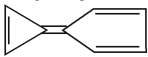
B
C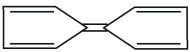
D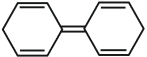
Solution
(A) The compound in option $A$ shows the highest dipole moment.
This is because the molecule undergoes charge separation where the three-membered ring acquires a positive charge ($2 \pi$ electrons,$H$ückel's rule $4n+2$ with $n=0$,aromatic) and the five-membered ring acquires a negative charge ($6 \pi$ electrons,$H$ückel's rule $4n+2$ with $n=1$,aromatic).
Since both rings become aromatic upon charge separation,the resonance contributor with separated charges is highly stable,leading to a very large dipole moment.
This is because the molecule undergoes charge separation where the three-membered ring acquires a positive charge ($2 \pi$ electrons,$H$ückel's rule $4n+2$ with $n=0$,aromatic) and the five-membered ring acquires a negative charge ($6 \pi$ electrons,$H$ückel's rule $4n+2$ with $n=1$,aromatic).
Since both rings become aromatic upon charge separation,the resonance contributor with separated charges is highly stable,leading to a very large dipole moment.
0 likes
View Solution246
DifficultMCQ
Choose the polar molecule from the following:
A
$CCl_4$
B
$CO_2$
C
$CH_2=CH_2$
D
$CHCl_3$
Solution
(D) molecule is polar if it has a net dipole moment,i.e.,$\mu \neq 0$.
$1$. $CCl_4$ has a tetrahedral geometry where the bond dipoles of four $C-Cl$ bonds cancel each other out,making it non-polar $(\mu = 0)$.
$2$. $CO_2$ is a linear molecule where the two $C=O$ bond dipoles are equal and opposite,canceling each other out,making it non-polar $(\mu = 0)$.
$3$. $CH_2=CH_2$ (ethene) is a planar molecule with a symmetric distribution of charge,making it non-polar $(\mu = 0)$.
$4$. $CHCl_3$ (chloroform) has a tetrahedral geometry,but due to the presence of three $Cl$ atoms and one $H$ atom,the bond dipoles do not cancel each other out. Thus,it has a net dipole moment $(\mu \neq 0)$ and is a polar molecule.
$1$. $CCl_4$ has a tetrahedral geometry where the bond dipoles of four $C-Cl$ bonds cancel each other out,making it non-polar $(\mu = 0)$.
$2$. $CO_2$ is a linear molecule where the two $C=O$ bond dipoles are equal and opposite,canceling each other out,making it non-polar $(\mu = 0)$.
$3$. $CH_2=CH_2$ (ethene) is a planar molecule with a symmetric distribution of charge,making it non-polar $(\mu = 0)$.
$4$. $CHCl_3$ (chloroform) has a tetrahedral geometry,but due to the presence of three $Cl$ atoms and one $H$ atom,the bond dipoles do not cancel each other out. Thus,it has a net dipole moment $(\mu \neq 0)$ and is a polar molecule.
0 likes
View Solution247
DifficultMCQ
The number of non-polar molecules from the following is . . . . . . $HF, H_2O, SO_2, H_2, CO_2, CH_4, NH_3, HCl, CHCl_3, BF_3$
A
$8$
B
$4$
C
$9$
D
$2$
Solution
(B) molecule is non-polar if its net dipole moment is zero.
$1$. $H_2$: Homonuclear diatomic molecule,dipole moment = $0$.
$2$. $CO_2$: Linear geometry,dipole moments of $C=O$ bonds cancel each other,net dipole moment = $0$.
$3$. $CH_4$: Tetrahedral geometry,bond dipoles cancel each other,net dipole moment = $0$.
$4$. $BF_3$: Trigonal planar geometry,bond dipoles cancel each other,net dipole moment = $0$.
Other molecules like $HF, H_2O, SO_2, NH_3, HCl,$ and $CHCl_3$ have a net dipole moment greater than zero.
Therefore,the non-polar molecules are $H_2, CO_2, CH_4,$ and $BF_3$.
The total count is $4$.
$1$. $H_2$: Homonuclear diatomic molecule,dipole moment = $0$.
$2$. $CO_2$: Linear geometry,dipole moments of $C=O$ bonds cancel each other,net dipole moment = $0$.
$3$. $CH_4$: Tetrahedral geometry,bond dipoles cancel each other,net dipole moment = $0$.
$4$. $BF_3$: Trigonal planar geometry,bond dipoles cancel each other,net dipole moment = $0$.
Other molecules like $HF, H_2O, SO_2, NH_3, HCl,$ and $CHCl_3$ have a net dipole moment greater than zero.
Therefore,the non-polar molecules are $H_2, CO_2, CH_4,$ and $BF_3$.
The total count is $4$.
0 likes
View Solution248
DifficultMCQ
The total number of molecules with zero dipole moment among $CH_4$,$BF_3$,$H_2O$,$HF$,$NH_3$,$CO_2$,and $SO_2$ is $ . . . . . . $.
A
$1$
B
$3$
C
$5$
D
$6$
Solution
(B) To determine the dipole moment,we analyze the molecular geometry:
$1$. $CH_4$: Tetrahedral geometry,symmetrical,dipole moment $= 0$.
$2$. $BF_3$: Trigonal planar geometry,symmetrical,dipole moment $= 0$.
$3$. $H_2O$: Bent geometry,asymmetrical,dipole moment $\neq 0$.
$4$. $HF$: Linear,polar bond,dipole moment $\neq 0$.
$5$. $NH_3$: Trigonal pyramidal,asymmetrical,dipole moment $\neq 0$.
$6$. $CO_2$: Linear geometry,symmetrical,dipole moment $= 0$.
$7$. $SO_2$: Bent geometry,asymmetrical,dipole moment $\neq 0$.
Thus,the molecules with zero dipole moment are $CH_4$,$BF_3$,and $CO_2$.
The total number is $3$.
$1$. $CH_4$: Tetrahedral geometry,symmetrical,dipole moment $= 0$.
$2$. $BF_3$: Trigonal planar geometry,symmetrical,dipole moment $= 0$.
$3$. $H_2O$: Bent geometry,asymmetrical,dipole moment $\neq 0$.
$4$. $HF$: Linear,polar bond,dipole moment $\neq 0$.
$5$. $NH_3$: Trigonal pyramidal,asymmetrical,dipole moment $\neq 0$.
$6$. $CO_2$: Linear geometry,symmetrical,dipole moment $= 0$.
$7$. $SO_2$: Bent geometry,asymmetrical,dipole moment $\neq 0$.
Thus,the molecules with zero dipole moment are $CH_4$,$BF_3$,and $CO_2$.
The total number is $3$.
0 likes
View Solution249
DifficultMCQ
Given below are two statements:
Statement-$I$: Since fluorine is more electronegative than nitrogen,the net dipole moment of $NF_3$ is greater than $NH_3$.
Statement-$II$: In $NH_3$,the orbital dipole due to lone pair and the dipole moment of $N-H$ bonds are in opposite direction,but in $NF_3$ the orbital dipole due to lone pair and dipole moments of $N-F$ bonds are in same direction.
In the light of the above statements,choose the most appropriate from the options given below.
Statement-$I$: Since fluorine is more electronegative than nitrogen,the net dipole moment of $NF_3$ is greater than $NH_3$.
Statement-$II$: In $NH_3$,the orbital dipole due to lone pair and the dipole moment of $N-H$ bonds are in opposite direction,but in $NF_3$ the orbital dipole due to lone pair and dipole moments of $N-F$ bonds are in same direction.
In the light of the above statements,choose the most appropriate from the options given below.
A
Statement $I$ is true but Statement $II$ is false.
B
Both Statement $I$ and Statement $II$ are false.
C
Both statement $I$ and Statement $II$ are true.
D
Statement $I$ is false but Statement $II$ is true.
Solution
(B) In $NH_3$,the nitrogen atom is more electronegative than hydrogen,so the dipole moments of the three $N-H$ bonds point towards the nitrogen atom. The lone pair on nitrogen also has a dipole moment pointing away from the nitrogen atom. Thus,the bond dipoles and the lone pair dipole are in the same direction,resulting in a large net dipole moment $(1.46 \ D)$.
In $NF_3$,fluorine is more electronegative than nitrogen,so the dipole moments of the three $N-F$ bonds point away from the nitrogen atom. The lone pair on nitrogen has a dipole moment pointing away from the nitrogen atom. Thus,the bond dipoles and the lone pair dipole are in opposite directions,which partially cancel each other out,resulting in a smaller net dipole moment $(0.24 \ D)$.
Therefore,Statement-$I$ is false because the net dipole moment of $NF_3$ is actually less than that of $NH_3$.
Statement-$II$ is false because it incorrectly describes the directions of the dipoles in $NH_3$ and $NF_3$ relative to each other.
In $NF_3$,fluorine is more electronegative than nitrogen,so the dipole moments of the three $N-F$ bonds point away from the nitrogen atom. The lone pair on nitrogen has a dipole moment pointing away from the nitrogen atom. Thus,the bond dipoles and the lone pair dipole are in opposite directions,which partially cancel each other out,resulting in a smaller net dipole moment $(0.24 \ D)$.
Therefore,Statement-$I$ is false because the net dipole moment of $NF_3$ is actually less than that of $NH_3$.
Statement-$II$ is false because it incorrectly describes the directions of the dipoles in $NH_3$ and $NF_3$ relative to each other.
0 likes
View Solution250
DifficultMCQ
$A$ diatomic molecule has a dipole moment of $1.2 \ D$. If the bond distance is $1 \ \mathring{A}$,then fractional charge on each atom is.........$\times 10^{-2}$ (Given $1 \ D = 10^{-18} \ esu \ cm$ )
A
$25$
B
$50$
C
$75$
D
$12.5$
Solution
(A) The fractional charge is calculated as the ratio of experimental dipole moment to the theoretical dipole moment (assuming $100\%$ ionic character).
$\text{Fractional charge} = \frac{\mu_{\text{exp.}}}{\mu_{\text{cal.}}}$
Given $\mu_{\text{exp.}} = 1.2 \ D = 1.2 \times 10^{-18} \ esu \ cm$.
The bond distance $d = 1 \ \mathring{A} = 10^{-8} \ cm$.
The theoretical dipole moment $\mu_{\text{cal.}}$ for a full electronic charge $(e = 4.8 \times 10^{-10} \ esu)$ is:
$\mu_{\text{cal.}} = q \times d = (4.8 \times 10^{-10} \ esu) \times (10^{-8} \ cm) = 4.8 \times 10^{-18} \ esu \ cm$.
$\text{Fractional charge} = \frac{1.2 \times 10^{-18}}{4.8 \times 10^{-18}} = 0.25$.
Expressing this as $\times 10^{-2}$:
$0.25 = 25 \times 10^{-2}$.
$\text{Fractional charge} = \frac{\mu_{\text{exp.}}}{\mu_{\text{cal.}}}$
Given $\mu_{\text{exp.}} = 1.2 \ D = 1.2 \times 10^{-18} \ esu \ cm$.
The bond distance $d = 1 \ \mathring{A} = 10^{-8} \ cm$.
The theoretical dipole moment $\mu_{\text{cal.}}$ for a full electronic charge $(e = 4.8 \times 10^{-10} \ esu)$ is:
$\mu_{\text{cal.}} = q \times d = (4.8 \times 10^{-10} \ esu) \times (10^{-8} \ cm) = 4.8 \times 10^{-18} \ esu \ cm$.
$\text{Fractional charge} = \frac{1.2 \times 10^{-18}}{4.8 \times 10^{-18}} = 0.25$.
Expressing this as $\times 10^{-2}$:
$0.25 = 25 \times 10^{-2}$.
0 likes
View SolutionChemical Bonding and Molecular Structure — Dipole moment · Frequently Asked Questions
1Are these Chemical Bonding and Molecular Structure questions useful for JEE and NEET?
Yes. All questions in this section are mapped to JEE Main and NEET exam patterns. Previous year questions from JEE Main, NEET, GUJCET and state-level exams are included with full solutions.
2Can I switch to Hindi or Gujarati for these questions?
Yes. Use the language tabs in the hero section or the sidebar to view the same questions and solutions in English, Hindi or Gujarati.
3How do I generate a question paper from this subtopic?
Use the Vedclass Exam Paper Generator — select the chapter and subtopic, set difficulty, and generate Sets A, B, C, D automatically. First 3 chapters of every subject are free.
Vedclass Products
For Students
Vedclass Test Series
Mock tests in real JEE/NEET style with performance analysis. 5-day free trial.
Start Free TrialFor Teachers
Exam Paper Generator
Generate Set A/B/C/D papers from this chapter in 2 minutes. 3 chapters free.
Try FreeFor Institutes
Online Exam Module
Live online exams with unlimited students, 360° analytics & white-label branding.
See DemoFor Teachers & Institutes
Generate a Chemical Bonding and Molecular Structure Exam Paper in 2 Minutes
Select subtopic & difficulty — Sets A, B, C, D auto-generated with No Repeat logic.
First 3 chapters of every subject are free — no payment required.