
A English
Dipole moment Questions in English
Class 11 Chemistry · Chemical Bonding and Molecular Structure · Dipole moment
317+
Questions
English
Language
100%
With Solutions
Showing 50 of 317 questions in English
51
MediumMCQ
$H_2O$ is dipolar,whereas $BeF_2$ is not. It is because
A
$H_2O$ is linear and $BeF_2$ is angular
B
$H_2O$ is angular and $BeF_2$ is linear
C
The electronegativity of $F$ is greater than that of $O$
D
$H_2O$ involves hydrogen bonding whereas $BeF_2$ is a discrete molecule
Solution
(B) The overall value of the dipole moment of a polar molecule depends on its geometry and shape,i.e.,the vectorial addition of the dipole moments of the constituent bonds.
Water $(H_2O)$ has an angular structure with a bond angle of $105^{\circ}$,which results in a net dipole moment.
However,$BeF_2$ is a linear molecule where the dipole moments of the two $Be-F$ bonds are equal in magnitude and opposite in direction,thus canceling each other out,resulting in a net dipole moment of zero.
Water $(H_2O)$ has an angular structure with a bond angle of $105^{\circ}$,which results in a net dipole moment.
However,$BeF_2$ is a linear molecule where the dipole moments of the two $Be-F$ bonds are equal in magnitude and opposite in direction,thus canceling each other out,resulting in a net dipole moment of zero.
1 likes
View Solution52
MediumMCQ
The correct order of dipole moment is
A
$CH_4 < NF_3 < NH_3 < H_2O$
B
$NF_3 < CH_4 < NH_3 < H_2O$
C
$NH_3 < NF_3 < CH_4 < H_2O$
D
$H_2O < NH_3 < NF_3 < CH_4$
Solution
(A) The dipole moment of $CH_4$ is $0 \ D$ because it is a non-polar tetrahedral molecule.
The dipole moment of $NF_3$ is $0.2 \ D$ due to the opposing directions of the lone pair and $N-F$ bond dipoles.
The dipole moment of $NH_3$ is $1.47 \ D$ because the lone pair and $N-H$ bond dipoles reinforce each other.
The dipole moment of $H_2O$ is $1.85 \ D$ due to its bent geometry and high electronegativity difference.
Therefore,the correct order of increasing dipole moment is $CH_4 < NF_3 < NH_3 < H_2O$.
The dipole moment of $NF_3$ is $0.2 \ D$ due to the opposing directions of the lone pair and $N-F$ bond dipoles.
The dipole moment of $NH_3$ is $1.47 \ D$ because the lone pair and $N-H$ bond dipoles reinforce each other.
The dipole moment of $H_2O$ is $1.85 \ D$ due to its bent geometry and high electronegativity difference.
Therefore,the correct order of increasing dipole moment is $CH_4 < NF_3 < NH_3 < H_2O$.
0 likes
View Solution53
MediumMCQ
Which of the following has the highest dipole moment?
A
$H_2C=O$
B
$CH_3-CH=CH-CH_3$ (trans)
C
$(CH_3)_2C=CH_2$
D
$CH_3-C(Cl)=C(Cl)-CH_3$ (trans)
Solution
(A) $H_2C=O$ (formaldehyde) has the highest dipole moment due to the presence of a highly polar $C=O$ bond.
Oxygen is significantly more electronegative than carbon,leading to a large bond dipole.
In trans-isomers like trans-but$-2-$ene and trans$-2,3-$dichloro$-2-$butene,the bond dipoles cancel each other out due to molecular symmetry,resulting in a net dipole moment of approximately zero.
$2$-Methylpropene has a small dipole moment,but it is much lower than that of formaldehyde.
Oxygen is significantly more electronegative than carbon,leading to a large bond dipole.
In trans-isomers like trans-but$-2-$ene and trans$-2,3-$dichloro$-2-$butene,the bond dipoles cancel each other out due to molecular symmetry,resulting in a net dipole moment of approximately zero.
$2$-Methylpropene has a small dipole moment,but it is much lower than that of formaldehyde.
0 likes
View Solution54
MediumMCQ
Which of the following arrangements of molecules is correct on the basis of their dipole moments?
A
$BF_3 < NF_3 < NH_3$
B
$BF_3 < NH_3 < NF_3$
C
$NF_3 < BF_3 < NH_3$
D
$NH_3 < NF_3 < BF_3$
Solution
(A) $BF_3$ has a trigonal planar structure,making it non-polar with a dipole moment of $0 \ D$.
In $NH_3$,the orbital dipole due to the lone pair and the bond dipoles of $N-H$ bonds are in the same direction,resulting in a large net dipole moment of $1.47 \ D$.
In $NF_3$,the orbital dipole due to the lone pair and the bond dipoles of $N-F$ bonds are in opposite directions,resulting in a smaller net dipole moment of $0.24 \ D$.
Therefore,the correct order of increasing dipole moments is $BF_3 < NF_3 < NH_3$.
In $NH_3$,the orbital dipole due to the lone pair and the bond dipoles of $N-H$ bonds are in the same direction,resulting in a large net dipole moment of $1.47 \ D$.
In $NF_3$,the orbital dipole due to the lone pair and the bond dipoles of $N-F$ bonds are in opposite directions,resulting in a smaller net dipole moment of $0.24 \ D$.
Therefore,the correct order of increasing dipole moments is $BF_3 < NF_3 < NH_3$.
0 likes
View Solution55
MediumMCQ
The critical temperature of water is higher than that of $O_2$ because $H_2O$ molecule has
A
Fewer electrons than oxygen
B
Two covalent bonds
C
$V$-shape
D
Dipole moment
Solution
(D) The critical temperature of a substance depends on the strength of intermolecular forces.
$H_2O$ is a polar molecule with a permanent dipole moment $(1.84 \ D)$,which leads to strong dipole-dipole interactions and hydrogen bonding.
In contrast,$O_2$ is a non-polar molecule with a dipole moment of $0 \ D$,exhibiting only weak London dispersion forces.
Therefore,$H_2O$ has a higher critical temperature than $O_2$.
$H_2O$ is a polar molecule with a permanent dipole moment $(1.84 \ D)$,which leads to strong dipole-dipole interactions and hydrogen bonding.
In contrast,$O_2$ is a non-polar molecule with a dipole moment of $0 \ D$,exhibiting only weak London dispersion forces.
Therefore,$H_2O$ has a higher critical temperature than $O_2$.
0 likes
View Solution56
MediumMCQ
The cyanide ion,$CN^{-}$ and $N_2$ are isoelectronic. But in contrast to $CN^{-}$,$N_2$ is chemically inert because of
A
Low bond energy
B
Absence of bond polarity
C
Unsymmetrical electron distribution
D
Presence of more number of electrons in bonding orbitals
Solution
(B) Both $CN^{-}$ and $N_2$ are isoelectronic,having $14$ electrons each and a triple bond between the atoms.
However,$N_2$ is a homonuclear diatomic molecule,meaning it has no bond polarity (the electronegativity difference is zero).
In contrast,$CN^{-}$ is a heteronuclear ion with a significant difference in electronegativity between $C$ and $N$,resulting in a polar bond.
The absence of bond polarity in $N_2$ makes it chemically inert compared to $CN^{-}$.
However,$N_2$ is a homonuclear diatomic molecule,meaning it has no bond polarity (the electronegativity difference is zero).
In contrast,$CN^{-}$ is a heteronuclear ion with a significant difference in electronegativity between $C$ and $N$,resulting in a polar bond.
The absence of bond polarity in $N_2$ makes it chemically inert compared to $CN^{-}$.
0 likes
View Solution57
DifficultMCQ
Which of the following has the highest dipole moment?
A
$NH_3$
B
$PH_3$
C
$SbH_3$
D
$AsH_3$
Solution
(A) As we move from top to bottom in a group,the dipole moment of hydrides of the elements of that particular group decreases due to an increase in the size of the central atom and a decrease in electronegativity.
$NH_3$ has the highest dipole moment because nitrogen is the most electronegative element in the group,leading to a greater polarity of the $N-H$ bond.
The order of dipole moment for the given hydrides is:
$NH_3 > PH_3 > AsH_3 > SbH_3$
$NH_3$ has the highest dipole moment because nitrogen is the most electronegative element in the group,leading to a greater polarity of the $N-H$ bond.
The order of dipole moment for the given hydrides is:
$NH_3 > PH_3 > AsH_3 > SbH_3$
0 likes
View Solution58
MediumMCQ
Which has zero dipole moment?
A
cis-$2$-butene
B
trans-$2$-butene
C
$1$-butene
D
$2$-methyl-$1$-propene
Solution
(B) The dipole moment $(\mu)$ of a molecule depends on its molecular geometry and the polarity of its bonds.
In $trans-2-butene$, the two methyl groups are on opposite sides of the $C=C$ double bond, which makes the molecule centrosymmetric.
Due to this symmetry, the bond dipoles of the two $C-CH_3$ bonds cancel each other out, resulting in a net dipole moment of $\mu = 0$.
In $trans-2-butene$, the two methyl groups are on opposite sides of the $C=C$ double bond, which makes the molecule centrosymmetric.
Due to this symmetry, the bond dipoles of the two $C-CH_3$ bonds cancel each other out, resulting in a net dipole moment of $\mu = 0$.
0 likes
View Solution59
MediumMCQ
Which of the following compounds exhibits a net dipole moment?
A
$1, 4-$dichlorobenzene
B
$Cis-1, 2-$dichloroethene
C
$Trans-1, 2-$dichloro$-2-$pentene
D
$Trans-1, 2-$dichloroethene
Solution
(B) The dipole moment of a molecule depends on its geometry and the polarity of its bonds.
In $Cis-1, 2-$dichloroethene,the two chlorine atoms are on the same side of the double bond,resulting in a non-zero net dipole moment due to the vector addition of the bond dipoles.
In $1, 4-$dichlorobenzene and $Trans-1, 2-$dichloroethene,the bond dipoles cancel each other out due to symmetry,resulting in a net dipole moment of zero.
Therefore,$Cis-1, 2-$dichloroethene shows a dipole moment.
In $Cis-1, 2-$dichloroethene,the two chlorine atoms are on the same side of the double bond,resulting in a non-zero net dipole moment due to the vector addition of the bond dipoles.
In $1, 4-$dichlorobenzene and $Trans-1, 2-$dichloroethene,the bond dipoles cancel each other out due to symmetry,resulting in a net dipole moment of zero.
Therefore,$Cis-1, 2-$dichloroethene shows a dipole moment.
0 likes
View Solution60
MediumMCQ
Which of the following compounds exhibits a non-zero dipole moment?
A
$1,4-$dichlorobenzene
B
$1,2-$dichlorobenzene
C
$trans-1,2-$dichloroethene
D
$trans-2-$butene
Solution
(B) molecule exhibits a non-zero dipole moment if it is polar,meaning the vector sum of its bond dipoles is not zero.
$1$. $1,4-$dichlorobenzene is a symmetric molecule where the two $C-Cl$ bond dipoles are equal and opposite,canceling each other out (dipole moment = $0 \ D$).
$2$. $1,2-$dichlorobenzene has the two $Cl$ atoms on adjacent carbons,resulting in a net dipole moment due to the angular arrangement of the bonds.
$3$. $trans-1,2-$dichloroethene is a centrosymmetric molecule where the bond dipoles cancel each other out (dipole moment = $0 \ D$).
$4$. $trans-2-$butene is a non-polar hydrocarbon with negligible dipole moment.
Therefore,$1,2-$dichlorobenzene is the correct answer.
$1$. $1,4-$dichlorobenzene is a symmetric molecule where the two $C-Cl$ bond dipoles are equal and opposite,canceling each other out (dipole moment = $0 \ D$).
$2$. $1,2-$dichlorobenzene has the two $Cl$ atoms on adjacent carbons,resulting in a net dipole moment due to the angular arrangement of the bonds.
$3$. $trans-1,2-$dichloroethene is a centrosymmetric molecule where the bond dipoles cancel each other out (dipole moment = $0 \ D$).
$4$. $trans-2-$butene is a non-polar hydrocarbon with negligible dipole moment.
Therefore,$1,2-$dichlorobenzene is the correct answer.
0 likes
View Solution61
EasyMCQ
Which of the following is a polar compound?
A
$C_2H_6$
B
$CCl_4$
C
$HCl$
D
$CH_4$
Solution
(C) polar compound is one that possesses a net dipole moment due to the difference in electronegativity between the bonded atoms.
In $HCl$,the chlorine atom is significantly more electronegative than the hydrogen atom,leading to a partial negative charge on $Cl$ and a partial positive charge on $H$.
Thus,$HCl$ is a polar molecule.
In contrast,$C_2H_6$,$CCl_4$,and $CH_4$ are non-polar due to their symmetrical structures which cause the individual bond dipoles to cancel out.
In $HCl$,the chlorine atom is significantly more electronegative than the hydrogen atom,leading to a partial negative charge on $Cl$ and a partial positive charge on $H$.
Thus,$HCl$ is a polar molecule.
In contrast,$C_2H_6$,$CCl_4$,and $CH_4$ are non-polar due to their symmetrical structures which cause the individual bond dipoles to cancel out.
0 likes
View Solution62
MediumMCQ
Among the following,the molecule with the highest dipole moment is
A
$CH_3Cl$
B
$CH_2Cl_2$
C
$CHCl_3$
D
$CCl_4$
Solution
(A) The dipole moment of a molecule depends on the vector sum of individual bond dipoles and the molecular geometry.
$CCl_4$ is a tetrahedral molecule with a symmetric structure,resulting in a net dipole moment of $0 \ D$.
In $CH_3Cl$,$CH_2Cl_2$,and $CHCl_3$,the $C-Cl$ bond is polar due to the high electronegativity of chlorine.
$CH_3Cl$ has the highest dipole moment $(1.86 \ D)$ because the bond dipoles of the $C-H$ bonds and the $C-Cl$ bond reinforce each other in the same direction.
As more $Cl$ atoms are substituted,the vector sum of the bond dipoles decreases due to the opposing directions of the $C-Cl$ bond moments.
Therefore,the correct order of dipole moment is $CH_3Cl > CH_2Cl_2 > CHCl_3 > CCl_4$.
$CCl_4$ is a tetrahedral molecule with a symmetric structure,resulting in a net dipole moment of $0 \ D$.
In $CH_3Cl$,$CH_2Cl_2$,and $CHCl_3$,the $C-Cl$ bond is polar due to the high electronegativity of chlorine.
$CH_3Cl$ has the highest dipole moment $(1.86 \ D)$ because the bond dipoles of the $C-H$ bonds and the $C-Cl$ bond reinforce each other in the same direction.
As more $Cl$ atoms are substituted,the vector sum of the bond dipoles decreases due to the opposing directions of the $C-Cl$ bond moments.
Therefore,the correct order of dipole moment is $CH_3Cl > CH_2Cl_2 > CHCl_3 > CCl_4$.
0 likes
View Solution63
EasyMCQ
Which of the following bonds will have the highest polarity?
A
$C - O$
B
$C - Br$
C
$C - S$
D
$C - F$
Solution
(D) The polarity of a bond depends on the electronegativity difference between the bonded atoms.
Fluorine $(F)$ is the most electronegative element in the periodic table.
The electronegativity difference between $C$ $(2.5)$ and $F$ $(4.0)$ is $1.5$,which is the highest among the given options.
Therefore,the $C - F$ bond is the most polar.
Fluorine $(F)$ is the most electronegative element in the periodic table.
The electronegativity difference between $C$ $(2.5)$ and $F$ $(4.0)$ is $1.5$,which is the highest among the given options.
Therefore,the $C - F$ bond is the most polar.
0 likes
View Solution64
MediumMCQ
Statement-$1$: $CCl_4$ and $H_2O$ are immiscible with each other. Statement-$2$: $CCl_4$ is a polar solvent.
A
Statement-$1$ is true. Statement-$2$ is true,Statement-$2$ is the correct explanation for Statement-$1$.
B
Statement-$1$ is true. Statement-$2$ is true,Statement-$2$ is not the correct explanation for Statement-$1$.
C
Statement-$1$ and Statement-$2$ are false.
D
Statement-$1$ is true,Statement-$2$ is false.
Solution
(D) Statement-$1$ is true because $CCl_4$ is a non-polar covalent compound and $H_2O$ is a polar solvent. According to the principle of 'like dissolves like',non-polar solutes do not dissolve in polar solvents.
Statement-$2$ is false because $CCl_4$ is a non-polar molecule due to its symmetrical tetrahedral geometry,which causes the individual $C-Cl$ bond dipoles to cancel each other out.
Statement-$2$ is false because $CCl_4$ is a non-polar molecule due to its symmetrical tetrahedral geometry,which causes the individual $C-Cl$ bond dipoles to cancel each other out.
0 likes
View Solution65
MediumMCQ
The critical temperature of water is higher than that of $O_2$ because $H_2O$ molecules ......
A
have fewer electrons than $O_2$.
B
have two covalent bonds.
C
have a $V$-shape.
D
possess a dipole moment.
Solution
(D) The critical temperature of a gas is directly related to the strength of intermolecular forces of attraction.
$H_2O$ is a polar molecule and possesses a permanent dipole moment,which leads to strong dipole-dipole interactions (hydrogen bonding).
$O_2$ is a non-polar molecule and only exhibits weak London dispersion forces.
Therefore,due to the presence of a dipole moment and stronger intermolecular forces,water has a higher critical temperature than $O_2$.
$H_2O$ is a polar molecule and possesses a permanent dipole moment,which leads to strong dipole-dipole interactions (hydrogen bonding).
$O_2$ is a non-polar molecule and only exhibits weak London dispersion forces.
Therefore,due to the presence of a dipole moment and stronger intermolecular forces,water has a higher critical temperature than $O_2$.
0 likes
View Solution66
EasyMCQ
The critical temperature of water is higher than that of $O_2$ because the $H_2O$ molecule has -
A
fewer electrons than oxygen.
B
two covalent bonds.
C
a $V$-shape.
D
a dipole moment.
Solution
(D) Water is a polar molecule with a dipole moment $\mu = 1.84 \ D$,whereas $O_2$ is a non-polar molecule with $\mu = 0$.
Due to the presence of a permanent dipole moment,water molecules experience stronger intermolecular dipole-dipole forces (and hydrogen bonding) compared to the weak London dispersion forces in $O_2$.
Stronger intermolecular forces lead to a higher critical temperature.
Due to the presence of a permanent dipole moment,water molecules experience stronger intermolecular dipole-dipole forces (and hydrogen bonding) compared to the weak London dispersion forces in $O_2$.
Stronger intermolecular forces lead to a higher critical temperature.
0 likes
View Solution67
MediumMCQ
Experiments show that the $H_2O$ molecule has a dipole moment,while $CO_2$ does not. Which of the following structures best represents this fact?
A
$O=C=O; H-O-H$
B
$O=C=O; H-O-H$ (linear water)
C
$O=C=O; H-O-H$ (bent water)
D
None of these
Solution
(C) The dipole moment of a molecule depends on its geometry.
$CO_2$ has a linear geometry $(O=C=O)$,where the two $C=O$ bond dipoles are equal in magnitude and opposite in direction,canceling each other out,resulting in a net dipole moment of $\mu = 0$.
$H_2O$ has a bent (angular) geometry. The two $O-H$ bond dipoles do not cancel each other out due to the bent shape and the presence of lone pairs on the oxygen atom,resulting in a net dipole moment of $\mu \neq 0$.
$CO_2$ has a linear geometry $(O=C=O)$,where the two $C=O$ bond dipoles are equal in magnitude and opposite in direction,canceling each other out,resulting in a net dipole moment of $\mu = 0$.
$H_2O$ has a bent (angular) geometry. The two $O-H$ bond dipoles do not cancel each other out due to the bent shape and the presence of lone pairs on the oxygen atom,resulting in a net dipole moment of $\mu \neq 0$.
0 likes
View Solution68
MediumMCQ
Both $BF_3$ and $NH_3$ are covalent molecules. However,$BF_3$ is non-polar while $NH_3$ is polar. What is the reason for this?
A
Boron is a metal and nitrogen is a gas in its uncombined state.
B
$BF$ bonds are not dipolar while $NH$ bonds are dipolar.
C
The atomic size of boron is smaller than that of nitrogen.
D
$BF_3$ is planar while $NH_3$ is pyramidal.
Solution
(D) $BF_3$ has a trigonal planar geometry with $sp^2$ hybridization. Due to its symmetric shape,the individual bond dipoles cancel each other out,resulting in a net dipole moment of $\mu = 0$.
$NH_3$ has a trigonal pyramidal geometry with $sp^3$ hybridization,including one lone pair on the nitrogen atom. The lone pair and the three $N-H$ bonds do not cancel each other's dipole moments,resulting in a net dipole moment of $\mu \neq 0$.
Therefore,the difference in polarity arises from their molecular shapes: $BF_3$ is planar and $NH_3$ is pyramidal.
$NH_3$ has a trigonal pyramidal geometry with $sp^3$ hybridization,including one lone pair on the nitrogen atom. The lone pair and the three $N-H$ bonds do not cancel each other's dipole moments,resulting in a net dipole moment of $\mu \neq 0$.
Therefore,the difference in polarity arises from their molecular shapes: $BF_3$ is planar and $NH_3$ is pyramidal.
0 likes
View Solution69
MediumMCQ
Which of the following bonds is the most polar?
A
$C - O$
B
$C - F$
C
$O - F$
D
$N - F$
Solution
(B) The polarity of a bond depends on the difference in electronegativity between the bonded atoms. The greater the electronegativity difference,the more polar the bond.
Electronegativity values (Pauling scale): $C = 2.55$,$N = 3.04$,$O = 3.44$,$F = 3.98$.
Differences:
$C - O = |3.44 - 2.55| = 0.89$
$C - F = |3.98 - 2.55| = 1.43$
$O - F = |3.98 - 3.44| = 0.54$
$N - F = |3.98 - 3.04| = 0.94$
Since the difference is largest for $C - F$,it is the most polar bond.
Electronegativity values (Pauling scale): $C = 2.55$,$N = 3.04$,$O = 3.44$,$F = 3.98$.
Differences:
$C - O = |3.44 - 2.55| = 0.89$
$C - F = |3.98 - 2.55| = 1.43$
$O - F = |3.98 - 3.44| = 0.54$
$N - F = |3.98 - 3.04| = 0.94$
Since the difference is largest for $C - F$,it is the most polar bond.
0 likes
View Solution70
MediumMCQ
$H_2O$ is polar while $BeF_2$ is not. The reason for this is ...
A
$H_2O$ is angular while $BeF_2$ is linear.
B
The electronegativity of $F$ is higher than that of $O$.
C
$H_2O$ has hydrogen bonding while $BeF_2$ is an independent molecule.
D
$H_2O$ is linear while $BeF_2$ is angular.
Solution
(A) The polarity of a molecule is determined by its dipole moment $(\mu)$.
$H_2O$ has a bent (angular) geometry due to the presence of two lone pairs on the oxygen atom,which results in a net dipole moment $(\mu \neq 0)$,making it polar.
$BeF_2$ has a linear geometry ($F-Be-F$ bond angle is $180^{\circ}$),where the two bond dipoles are equal in magnitude and opposite in direction,canceling each other out,resulting in a net dipole moment of zero $(\mu = 0)$,making it non-polar.
$H_2O$ has a bent (angular) geometry due to the presence of two lone pairs on the oxygen atom,which results in a net dipole moment $(\mu \neq 0)$,making it polar.
$BeF_2$ has a linear geometry ($F-Be-F$ bond angle is $180^{\circ}$),where the two bond dipoles are equal in magnitude and opposite in direction,canceling each other out,resulting in a net dipole moment of zero $(\mu = 0)$,making it non-polar.
0 likes
View Solution71
EasyMCQ
Which of the following statements is correct?
A
The dipole moment of $NF_3$ is zero.
B
The dipole moment of $NF_3$ is less than that of $NH_3$.
C
The dipole moment of $NF_3$ is greater than that of $NH_3$.
D
The dipole moment of $NH_3$ is zero.
Solution
(B) The dipole moment of $NH_3$ is $1.46 \ D$ and that of $NF_3$ is $0.24 \ D$.
In $NH_3$,the orbital dipole moment due to the lone pair is in the same direction as the resultant dipole moment of the $N-H$ bonds.
In $NF_3$,the orbital dipole moment due to the lone pair is in the opposite direction to the resultant dipole moment of the $N-F$ bonds,leading to a smaller net dipole moment.
Therefore,$\mu_{NF_3} < \mu_{NH_3}$.
In $NH_3$,the orbital dipole moment due to the lone pair is in the same direction as the resultant dipole moment of the $N-H$ bonds.
In $NF_3$,the orbital dipole moment due to the lone pair is in the opposite direction to the resultant dipole moment of the $N-F$ bonds,leading to a smaller net dipole moment.
Therefore,$\mu_{NF_3} < \mu_{NH_3}$.
0 likes
View Solution72
MediumMCQ
Which of the following has a dipole moment of zero?
A
$ClF$
B
$PCl_3$
C
$SiF_4$
D
$CFCl_3$
Solution
(C) $SiF_4$ has a tetrahedral geometry and is highly symmetrical.
Due to this symmetry,the individual bond dipole moments cancel each other out,resulting in a net dipole moment of $\mu = 0$.
Due to this symmetry,the individual bond dipole moments cancel each other out,resulting in a net dipole moment of $\mu = 0$.
0 likes
View Solution73
MediumMCQ
Which of the following compounds is polar?
A
$BF_3$
B
$C_2H_5-F$
C
$CO_2$
D
$CH_4$
Solution
(B) molecule is polar if its net dipole moment $(\mu)$ is not equal to zero $(\mu \neq 0)$.
In $BF_3$,$CO_2$,and $CH_4$,the molecules are highly symmetrical,leading to the cancellation of individual bond dipoles,resulting in $\mu = 0$.
In $C_2H_5-F$ (fluoroethane),the molecule is asymmetrical due to the presence of the electronegative fluorine atom attached to the ethyl group,which creates a permanent dipole moment. Therefore,$\mu \neq 0$ and the compound is polar.
In $BF_3$,$CO_2$,and $CH_4$,the molecules are highly symmetrical,leading to the cancellation of individual bond dipoles,resulting in $\mu = 0$.
In $C_2H_5-F$ (fluoroethane),the molecule is asymmetrical due to the presence of the electronegative fluorine atom attached to the ethyl group,which creates a permanent dipole moment. Therefore,$\mu \neq 0$ and the compound is polar.
0 likes
View Solution74
EasyMCQ
Which of the following compounds does not possess a dipole moment?
A
$ClO_2$
B
$CO_2$
C
$NO_2$
D
$SO_2$
Solution
(B) $CO_2$ has a linear geometry with $O=C=O$ bond angles of $180^{\circ}$.
Due to its symmetric structure,the bond dipoles of the two $C=O$ bonds are equal in magnitude and opposite in direction,canceling each other out.
Therefore,the net dipole moment of $CO_2$ is $0 \ D$,making it a non-polar molecule.
Due to its symmetric structure,the bond dipoles of the two $C=O$ bonds are equal in magnitude and opposite in direction,canceling each other out.
Therefore,the net dipole moment of $CO_2$ is $0 \ D$,making it a non-polar molecule.
0 likes
View Solution75
MediumMCQ
Which of the following compounds is non-polar?
A
$HCl$
B
$CH_2Cl_2$
C
$CHCl_3$
D
$CCl_4$
Solution
(D) $CCl_4$ has a perfectly symmetrical tetrahedral geometry.
Due to this symmetry,the individual bond dipoles cancel each other out,resulting in a net dipole moment of $\mu = 0$.
Therefore,$CCl_4$ is a non-polar molecule.
Due to this symmetry,the individual bond dipoles cancel each other out,resulting in a net dipole moment of $\mu = 0$.
Therefore,$CCl_4$ is a non-polar molecule.
0 likes
View Solution76
EasyMCQ
Which of the following compounds possesses a dipole moment?
A
$CCl_4$
B
$C_6H_6$
C
$BF_3$
D
$HF$
Solution
(D) molecule possesses a dipole moment if it has a net polarity.
$CCl_4$,$C_6H_6$,and $BF_3$ are symmetric molecules with a net dipole moment of $0 \ D$.
$HF$ is a heteronuclear diatomic molecule with a polar $H-F$ bond,resulting in a non-zero dipole moment.
$CCl_4$,$C_6H_6$,and $BF_3$ are symmetric molecules with a net dipole moment of $0 \ D$.
$HF$ is a heteronuclear diatomic molecule with a polar $H-F$ bond,resulting in a non-zero dipole moment.
0 likes
View Solution77
DifficultMCQ
Which of the following compounds has the highest dipole moment?
A
trans-$2$-butene
B
$1,3$-dimethylbenzene
C
Acetophenone
D
Ethanol
Solution
(C) The dipole moment of acetophenone is the highest among the given options due to the strong polarity of the carbonyl group $(C=O)$ and the resonance effect that enhances charge separation.
The resonance structures of acetophenone contribute to its significant dipole moment.
$trans-2-butene$ has a dipole moment of $\mu = 0$ due to symmetry.
$1,3-dimethylbenzene$ has a small dipole moment.
$Ethanol$ has a dipole moment,but it is lower than that of acetophenone.
The resonance structures of acetophenone contribute to its significant dipole moment.
$trans-2-butene$ has a dipole moment of $\mu = 0$ due to symmetry.
$1,3-dimethylbenzene$ has a small dipole moment.
$Ethanol$ has a dipole moment,but it is lower than that of acetophenone.
0 likes
View Solution78
MediumMCQ
If the $HCl$ molecule were completely polar,the expected dipole moment would be $6.12 \ D$,but the experimental value of the dipole moment is $1.03 \ D$. What is the percentage of ionic character (in $\%$)?
A
$17$
B
$83$
C
$50$
D
$0$
Solution
(A) The percentage of ionic character is calculated using the formula:
$\text{Percentage of ionic character} = \frac{\mu_{\text{observed}}}{\mu_{\text{theoretical}}} \times 100$
Given:
$\mu_{\text{observed}} = 1.03 \ D$
$\mu_{\text{theoretical}} = 6.12 \ D$
Substituting the values:
$\text{Percentage of ionic character} = \frac{1.03}{6.12} \times 100 \approx 16.83\% \approx 17\%$
Thus,the correct option is $A$.
$\text{Percentage of ionic character} = \frac{\mu_{\text{observed}}}{\mu_{\text{theoretical}}} \times 100$
Given:
$\mu_{\text{observed}} = 1.03 \ D$
$\mu_{\text{theoretical}} = 6.12 \ D$
Substituting the values:
$\text{Percentage of ionic character} = \frac{1.03}{6.12} \times 100 \approx 16.83\% \approx 17\%$
Thus,the correct option is $A$.
0 likes
View Solution79
MediumMCQ
Which of the following is the correct order of dipole moment for the given molecules?
A
$BF_3 > NF_3 > NH_3$
B
$NF_3 > BF_3 > NH_3$
C
$NH_3 = NF_3 > BF_3$
D
$NH_3 > NF_3 > BF_3$
Solution
(D) $BF_3$ has a trigonal planar geometry and is symmetric,so its net dipole moment is $\mu = 0$.
$NH_3$ and $NF_3$ both have a trigonal pyramidal geometry with one lone pair on the nitrogen atom.
In $NH_3$,the dipole moments of the $N-H$ bonds and the lone pair are in the same direction,reinforcing each other,resulting in a high dipole moment $(\mu \approx 1.46 \ D)$.
In $NF_3$,the dipole moments of the $N-F$ bonds are in the opposite direction to the lone pair's dipole moment,partially canceling each other out,resulting in a lower dipole moment $(\mu \approx 0.24 \ D)$.
Therefore,the correct order of dipole moment is $NH_3 > NF_3 > BF_3$.
$NH_3$ and $NF_3$ both have a trigonal pyramidal geometry with one lone pair on the nitrogen atom.
In $NH_3$,the dipole moments of the $N-H$ bonds and the lone pair are in the same direction,reinforcing each other,resulting in a high dipole moment $(\mu \approx 1.46 \ D)$.
In $NF_3$,the dipole moments of the $N-F$ bonds are in the opposite direction to the lone pair's dipole moment,partially canceling each other out,resulting in a lower dipole moment $(\mu \approx 0.24 \ D)$.
Therefore,the correct order of dipole moment is $NH_3 > NF_3 > BF_3$.
0 likes
View Solution80
MediumMCQ
Which of the following compounds has a permanent dipole moment?
A
$BF_3$
B
$SiF_4$
C
$SF_4$
D
$XeF_4$
Solution
(C) molecule has a permanent dipole moment if it is polar,meaning it has a non-zero net dipole moment $(\mu \neq 0)$.
$BF_3$ has a trigonal planar geometry and is symmetric,so $\mu = 0$.
$SiF_4$ has a tetrahedral geometry and is symmetric,so $\mu = 0$.
$XeF_4$ has a square planar geometry and is symmetric,so $\mu = 0$.
$SF_4$ has a see-saw geometry due to the presence of one lone pair on the sulfur atom. This asymmetry results in a non-zero net dipole moment $(\mu \neq 0)$.
$BF_3$ has a trigonal planar geometry and is symmetric,so $\mu = 0$.
$SiF_4$ has a tetrahedral geometry and is symmetric,so $\mu = 0$.
$XeF_4$ has a square planar geometry and is symmetric,so $\mu = 0$.
$SF_4$ has a see-saw geometry due to the presence of one lone pair on the sulfur atom. This asymmetry results in a non-zero net dipole moment $(\mu \neq 0)$.
0 likes
View Solution81
MediumMCQ
Which of the following compounds will show a dipole moment?
A
$1,4$-Dichlorobenzene
B
$cis$-$1,2$-Dichloroethene
C
$trans$-$1,2$-Dichloroethene
D
$trans$-$2,3$-Dichlorobut$-2-$ene
Solution
(B) The dipole moment of a molecule depends on its geometry and the polarity of its bonds.
$1,4$-Dichlorobenzene,$trans$-$1,2$-dichloroethene,and $trans$-$2,3$-dichlorobut$-2-$ene are symmetric molecules where the bond dipoles cancel each other out,resulting in a net dipole moment of zero.
$cis$-$1,2$-Dichloroethene is an asymmetric molecule where the bond dipoles do not cancel,resulting in a non-zero net dipole moment.
$1,4$-Dichlorobenzene,$trans$-$1,2$-dichloroethene,and $trans$-$2,3$-dichlorobut$-2-$ene are symmetric molecules where the bond dipoles cancel each other out,resulting in a net dipole moment of zero.
$cis$-$1,2$-Dichloroethene is an asymmetric molecule where the bond dipoles do not cancel,resulting in a non-zero net dipole moment.
0 likes
View Solution82
MediumMCQ
Which of the following compounds has the highest dipole moment?
A
$CH_3Cl$
B
$CH_2Cl_2$
C
$CHCl_3$
D
$CCl_4$
Solution
(A) The dipole moment depends on the vector sum of individual bond dipoles.
In $CH_3Cl$,the bond dipoles of $C-Cl$ and $C-H$ bonds reinforce each other,leading to a high net dipole moment.
In $CH_2Cl_2$,the bond dipoles partially cancel out.
In $CHCl_3$,the three $C-Cl$ bond dipoles partially cancel the $C-H$ bond dipole.
In $CCl_4$,the molecule is tetrahedral and symmetrical,so the four $C-Cl$ bond dipoles cancel each other out,resulting in a net dipole moment of zero.
Therefore,$CH_3Cl$ has the highest dipole moment.
In $CH_3Cl$,the bond dipoles of $C-Cl$ and $C-H$ bonds reinforce each other,leading to a high net dipole moment.
In $CH_2Cl_2$,the bond dipoles partially cancel out.
In $CHCl_3$,the three $C-Cl$ bond dipoles partially cancel the $C-H$ bond dipole.
In $CCl_4$,the molecule is tetrahedral and symmetrical,so the four $C-Cl$ bond dipoles cancel each other out,resulting in a net dipole moment of zero.
Therefore,$CH_3Cl$ has the highest dipole moment.
0 likes
View Solution83
MediumMCQ
Which of the following has the maximum dipole moment?
A
p-dichlorobenzene
B
o-dinitrobenzene
C
o-dichlorobenzene
D
p-dinitrobenzene
Solution
(B) The dipole moment depends on the vector sum of individual bond dipoles.
$p$-dichlorobenzene and $p$-dinitrobenzene have dipole moments close to zero because the bond dipoles are in opposite directions and cancel each other out.
In $o$-dichlorobenzene and $o$-dinitrobenzene,the dipoles are at an angle of $60^{\circ}$,resulting in a non-zero net dipole moment.
Comparing $o$-dichlorobenzene and $o$-dinitrobenzene,the $-NO_2$ group is a much stronger electron-withdrawing group than the $-Cl$ atom,leading to a larger individual bond dipole for the $C-NO_2$ bond compared to the $C-Cl$ bond.
Therefore,$o$-dinitrobenzene has the maximum dipole moment among the given options.
$p$-dichlorobenzene and $p$-dinitrobenzene have dipole moments close to zero because the bond dipoles are in opposite directions and cancel each other out.
In $o$-dichlorobenzene and $o$-dinitrobenzene,the dipoles are at an angle of $60^{\circ}$,resulting in a non-zero net dipole moment.
Comparing $o$-dichlorobenzene and $o$-dinitrobenzene,the $-NO_2$ group is a much stronger electron-withdrawing group than the $-Cl$ atom,leading to a larger individual bond dipole for the $C-NO_2$ bond compared to the $C-Cl$ bond.
Therefore,$o$-dinitrobenzene has the maximum dipole moment among the given options.
0 likes
View Solution84
EasyMCQ
Which of the following molecules has the highest dipole moment?
A
$CH_3Cl$
B
$CH_2Cl_2$
C
$CHCl_3$
D
$CCl_4$
Solution
(A) The dipole moment depends on the vector sum of individual bond dipoles.
In $CH_3Cl$,the bond dipoles of $C-H$ and $C-Cl$ bonds reinforce each other,resulting in a high net dipole moment.
In $CH_2Cl_2$ and $CHCl_3$,the bond dipoles partially cancel each other out.
In $CCl_4$,the molecule is perfectly tetrahedral,and the four $C-Cl$ bond dipoles cancel each other out completely,resulting in a net dipole moment of $0 \ D$.
Therefore,$CH_3Cl$ has the highest dipole moment.
In $CH_3Cl$,the bond dipoles of $C-H$ and $C-Cl$ bonds reinforce each other,resulting in a high net dipole moment.
In $CH_2Cl_2$ and $CHCl_3$,the bond dipoles partially cancel each other out.
In $CCl_4$,the molecule is perfectly tetrahedral,and the four $C-Cl$ bond dipoles cancel each other out completely,resulting in a net dipole moment of $0 \ D$.
Therefore,$CH_3Cl$ has the highest dipole moment.
0 likes
View Solution85
DifficultMCQ
What is the increasing order of dipole moment for the following compounds? $(i)$ Toluene $(ii)$ $m$-dichlorobenzene $(iii)$ $o$-dichlorobenzene $(iv)$ $p$-dichlorobenzene
A
$IV < I < II < III$
B
$IV < I < III < II$
C
$I < IV < II < III$
D
$IV < II < I < III$
Solution
(A) The dipole moment $(\mu)$ depends on the polarity of bonds and the bond angle.
$(iv)$ $p$-dichlorobenzene: The two $C-Cl$ bonds are at $180^{\circ}$, so their dipole moments cancel out, $\mu = 0$.
$(i)$ Toluene: It has a small dipole moment due to the electron-donating methyl group, $\mu \approx 0.4 \ D$.
$(ii)$ $m$-dichlorobenzene: The bond angle is $120^{\circ}$, resulting in a net dipole moment.
$(iii)$ $o$-dichlorobenzene: The bond angle is $60^{\circ}$, which results in the highest dipole moment among the isomers due to the vector addition of the two $C-Cl$ bond dipoles.
Thus, the increasing order is $IV < I < II < III$.
$(iv)$ $p$-dichlorobenzene: The two $C-Cl$ bonds are at $180^{\circ}$, so their dipole moments cancel out, $\mu = 0$.
$(i)$ Toluene: It has a small dipole moment due to the electron-donating methyl group, $\mu \approx 0.4 \ D$.
$(ii)$ $m$-dichlorobenzene: The bond angle is $120^{\circ}$, resulting in a net dipole moment.
$(iii)$ $o$-dichlorobenzene: The bond angle is $60^{\circ}$, which results in the highest dipole moment among the isomers due to the vector addition of the two $C-Cl$ bond dipoles.
Thus, the increasing order is $IV < I < II < III$.
0 likes
View Solution86
MediumMCQ
Which of the following molecules possesses a permanent dipole moment?
A
$2, 2$-Dimethylpropane
B
trans-$2$-Pentene
C
trans-$3$-Hexene
D
$2, 2, 3, 3$-Tetramethylbutane
Solution
(B) molecule possesses a permanent dipole moment if it is polar,meaning it has an asymmetric distribution of charge.
$2, 2$-Dimethylpropane (neopentane) is highly symmetric ($T_d$ point group),resulting in a net dipole moment of $0$.
$2, 2, 3, 3$-Tetramethylbutane is also highly symmetric,resulting in a net dipole moment of $0$.
trans-$3$-Hexene is symmetric across the double bond,so the dipole moments of the alkyl groups cancel out,resulting in a net dipole moment of $0$.
trans-$2$-Pentene is asymmetric because the alkyl groups attached to the double-bonded carbons are different (one is a methyl group and the other is an ethyl group). Therefore,the dipole moments do not cancel out,and it possesses a permanent dipole moment.
$2, 2$-Dimethylpropane (neopentane) is highly symmetric ($T_d$ point group),resulting in a net dipole moment of $0$.
$2, 2, 3, 3$-Tetramethylbutane is also highly symmetric,resulting in a net dipole moment of $0$.
trans-$3$-Hexene is symmetric across the double bond,so the dipole moments of the alkyl groups cancel out,resulting in a net dipole moment of $0$.
trans-$2$-Pentene is asymmetric because the alkyl groups attached to the double-bonded carbons are different (one is a methyl group and the other is an ethyl group). Therefore,the dipole moments do not cancel out,and it possesses a permanent dipole moment.
0 likes
View Solution87
MediumMCQ
If the dipole moment of chlorobenzene is $\mu$,what is the dipole moment of $1,3,5$-trichlorobenzene?
A
$1.5\mu$
B
$2\mu$
C
$3\mu$
D
$0$
Solution
(D) The structure of $1,3,5$-trichlorobenzene is highly symmetrical.
In this molecule,the dipole moments of the three $C-Cl$ bonds are oriented at $120^{\circ}$ to each other.
The resultant dipole moment of any two $C-Cl$ bonds is equal in magnitude to the dipole moment of the third $C-Cl$ bond but acts in the opposite direction.
Therefore,the vector sum of the dipole moments is zero.
Hence,the net dipole moment of $1,3,5$-trichlorobenzene is $0$.
In this molecule,the dipole moments of the three $C-Cl$ bonds are oriented at $120^{\circ}$ to each other.
The resultant dipole moment of any two $C-Cl$ bonds is equal in magnitude to the dipole moment of the third $C-Cl$ bond but acts in the opposite direction.
Therefore,the vector sum of the dipole moments is zero.
Hence,the net dipole moment of $1,3,5$-trichlorobenzene is $0$.
0 likes
View Solution88
MediumMCQ
Which of the following substances does not possess a dipole moment?
A
$CHCl_3$
B
$CH_2Cl_2$
C
$CCl_4$
D
$CH_3Cl$
Solution
(C) The dipole moment of a molecule depends on its molecular geometry and the polarity of its bonds.
$CCl_4$ has a tetrahedral geometry where all four $C-Cl$ bonds are identical.
The individual bond dipoles cancel each other out due to the symmetric arrangement,resulting in a net dipole moment of $0 \ D$.
In contrast,$CHCl_3$,$CH_2Cl_2$,and $CH_3Cl$ are asymmetric molecules where the bond dipoles do not cancel out,resulting in a non-zero dipole moment.
$CCl_4$ has a tetrahedral geometry where all four $C-Cl$ bonds are identical.
The individual bond dipoles cancel each other out due to the symmetric arrangement,resulting in a net dipole moment of $0 \ D$.
In contrast,$CHCl_3$,$CH_2Cl_2$,and $CH_3Cl$ are asymmetric molecules where the bond dipoles do not cancel out,resulting in a non-zero dipole moment.
0 likes
View Solution89
EasyMCQ
Which of the following substances has the lowest dipole moment?
A
$cis-but-2-ene$
B
$CH_3-C \equiv C-CH_3$
C
$CH_3CH_2C \equiv CH$
D
$CH_2=CH-C \equiv CH$
Solution
(B) The dipole moment of a molecule depends on its symmetry and the polarity of its bonds.
$A$. $cis-but-2-ene$ has a non-zero dipole moment due to its $cis$ configuration.
$B$. $but-2-yne$ $(CH_3-C \equiv C-CH_3)$ is a linear,symmetric molecule where the bond dipoles cancel each other out,resulting in a net dipole moment of $0 \ D$.
$C$. $but-1-yne$ $(CH_3CH_2C \equiv CH)$ has a terminal alkyne group,which possesses a small dipole moment.
$D$. $but-1-en-3-yne$ $(CH_2=CH-C \equiv CH)$ has both double and triple bonds,creating a polar structure with a significant dipole moment.
Therefore,$but-2-yne$ has the lowest dipole moment.
$A$. $cis-but-2-ene$ has a non-zero dipole moment due to its $cis$ configuration.
$B$. $but-2-yne$ $(CH_3-C \equiv C-CH_3)$ is a linear,symmetric molecule where the bond dipoles cancel each other out,resulting in a net dipole moment of $0 \ D$.
$C$. $but-1-yne$ $(CH_3CH_2C \equiv CH)$ has a terminal alkyne group,which possesses a small dipole moment.
$D$. $but-1-en-3-yne$ $(CH_2=CH-C \equiv CH)$ has both double and triple bonds,creating a polar structure with a significant dipole moment.
Therefore,$but-2-yne$ has the lowest dipole moment.
0 likes
View Solution90
MediumMCQ
The dipole moment of chlorobenzene is $1.73 \, D$. The dipole moment of $p-$dichlorobenzene is expected to be $............ \, D$.
A
$3.46$
B
$0$
C
$1.73$
D
$1$
Solution
(B) In $p-$dichlorobenzene,the two $C-Cl$ bonds are oriented in opposite directions at an angle of $180^{\circ}$.
Since the bond moments are equal in magnitude and opposite in direction,they cancel each other out.
Therefore,the net dipole moment of $p-$dichlorobenzene is $0 \, D$.
Since the bond moments are equal in magnitude and opposite in direction,they cancel each other out.
Therefore,the net dipole moment of $p-$dichlorobenzene is $0 \, D$.
0 likes
View Solution91
MediumMCQ
The order of dipole moments of the following molecules is
A
$CHCl_3 > CH_2Cl_2 > CH_3Cl > CCl_4$
B
$CH_2Cl_2 > CH_3Cl > CHCl_3 > CCl_4$
C
$CH_3Cl > CH_2Cl_2 > CHCl_3 > CCl_4$
D
$CH_2Cl_2 > CH_3Cl > CHCl_3 > CCl_4$
Solution
(C) $CCl_4$ has a dipole moment of $0 \ D$ due to its symmetric tetrahedral geometry,where the bond dipoles cancel each other out.
For the chloromethanes,the dipole moment depends on the vector sum of the $C-Cl$ bond dipoles.
The experimental values are:
$CH_3Cl = 1.86 \ D$
$CH_2Cl_2 = 1.60 \ D$
$CHCl_3 = 1.01 \ D$
$CCl_4 = 0 \ D$
Therefore,the correct order is $CH_3Cl > CH_2Cl_2 > CHCl_3 > CCl_4$.
For the chloromethanes,the dipole moment depends on the vector sum of the $C-Cl$ bond dipoles.
The experimental values are:
$CH_3Cl = 1.86 \ D$
$CH_2Cl_2 = 1.60 \ D$
$CHCl_3 = 1.01 \ D$
$CCl_4 = 0 \ D$
Therefore,the correct order is $CH_3Cl > CH_2Cl_2 > CHCl_3 > CCl_4$.
0 likes
View Solution92
MediumMCQ
Which of the following molecules has the maximum dipole moment?
A
$CO_2$
B
$CH_4$
C
$NH_3$
D
$NF_3$
Solution
(C) $CO_2$ and $CH_4$ have zero dipole moment as these are symmetrical in nature.
Between $NH_3$ and $NF_3$,$NH_3$ has a greater dipole moment than $NF_3$. In both $NH_3$ and $NF_3$,the nitrogen atom possesses one lone pair of electrons.
In $NH_3$,the net $N-H$ bond dipole is in the same direction as the dipole of the lone pair,leading to their addition. However,in $NF_3$,the net bond dipole of the three $N-F$ bonds is in the opposite direction to that of the lone pair dipole,leading to partial cancellation. Thus,$NH_3$ has the maximum dipole moment.
Between $NH_3$ and $NF_3$,$NH_3$ has a greater dipole moment than $NF_3$. In both $NH_3$ and $NF_3$,the nitrogen atom possesses one lone pair of electrons.
In $NH_3$,the net $N-H$ bond dipole is in the same direction as the dipole of the lone pair,leading to their addition. However,in $NF_3$,the net bond dipole of the three $N-F$ bonds is in the opposite direction to that of the lone pair dipole,leading to partial cancellation. Thus,$NH_3$ has the maximum dipole moment.
0 likes
View Solution93
MediumMCQ
Which of the following is a polar molecule?
A
$SiF_4$
B
$XeF_4$
C
$BF_3$
D
$SF_4$
Solution
(D) molecule is polar if it has a net dipole moment $(\mu \neq 0)$.
$SiF_4$ has a tetrahedral geometry with $\mu = 0$.
$XeF_4$ has a square planar geometry with $\mu = 0$.
$BF_3$ has a trigonal planar geometry with $\mu = 0$.
$SF_4$ has a see-saw geometry due to the presence of one lone pair on the central $S$ atom,which results in an unsymmetrical distribution of charge,making it a polar molecule with $\mu \neq 0$.
$SiF_4$ has a tetrahedral geometry with $\mu = 0$.
$XeF_4$ has a square planar geometry with $\mu = 0$.
$BF_3$ has a trigonal planar geometry with $\mu = 0$.
$SF_4$ has a see-saw geometry due to the presence of one lone pair on the central $S$ atom,which results in an unsymmetrical distribution of charge,making it a polar molecule with $\mu \neq 0$.
0 likes
View Solution94
DifficultMCQ
The electronegativity difference between $N$ and $F$ is greater than that between $N$ and $H$,yet the dipole moment of $NH_3$ $(1.5 \ D)$ is larger than that of $NF_3$ $(0.2 \ D)$. This is because
A
in $NH_3$ the atomic dipole and bond dipole are in the opposite directions whereas in $NF_3$ these are in the same direction
B
in $NH_3$ as well as in $NF_3$ the atomic dipole and bond dipole are in the same direction
C
in $NH_3$ the atomic dipole and bond dipole are in the same direction whereas in $NF_3$ these are in opposite directions
D
in $NH_3$ as well as in $NF_3$ the atomic dipole and bond dipole are in opposite directions.
Solution
(C) The electronegativity of $N$ $(3.04)$ is greater than that of $H$ $(2.20)$,so the bond dipoles $(N-H)$ and the lone pair dipole on $N$ point in the same direction,reinforcing each other.
In $NF_3$,the electronegativity of $F$ $(3.98)$ is greater than that of $N$ $(3.04)$,so the bond dipoles $(N-F)$ point away from $N$,which is opposite to the direction of the lone pair dipole on $N$. This causes the bond dipoles to partially cancel the lone pair dipole,resulting in a much smaller net dipole moment.
In $NF_3$,the electronegativity of $F$ $(3.98)$ is greater than that of $N$ $(3.04)$,so the bond dipoles $(N-F)$ point away from $N$,which is opposite to the direction of the lone pair dipole on $N$. This causes the bond dipoles to partially cancel the lone pair dipole,resulting in a much smaller net dipole moment.
0 likes
View Solution95
MediumMCQ
For which of the following molecules is the dipole moment $\mu \ne 0$?
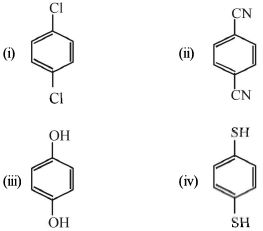
A
Only $(i)$
B
$(i)$ and $(ii)$
C
Only $(iii)$
D
$(iii)$ and $(iv)$
Solution
(D) For $p$-dichlorobenzene $(i)$ and $p$-dicyanobenzene $(ii)$,the dipole moments of the individual bonds cancel each other out because they are equal in magnitude and opposite in direction. Hence,the resultant dipole moment of these molecules is zero.
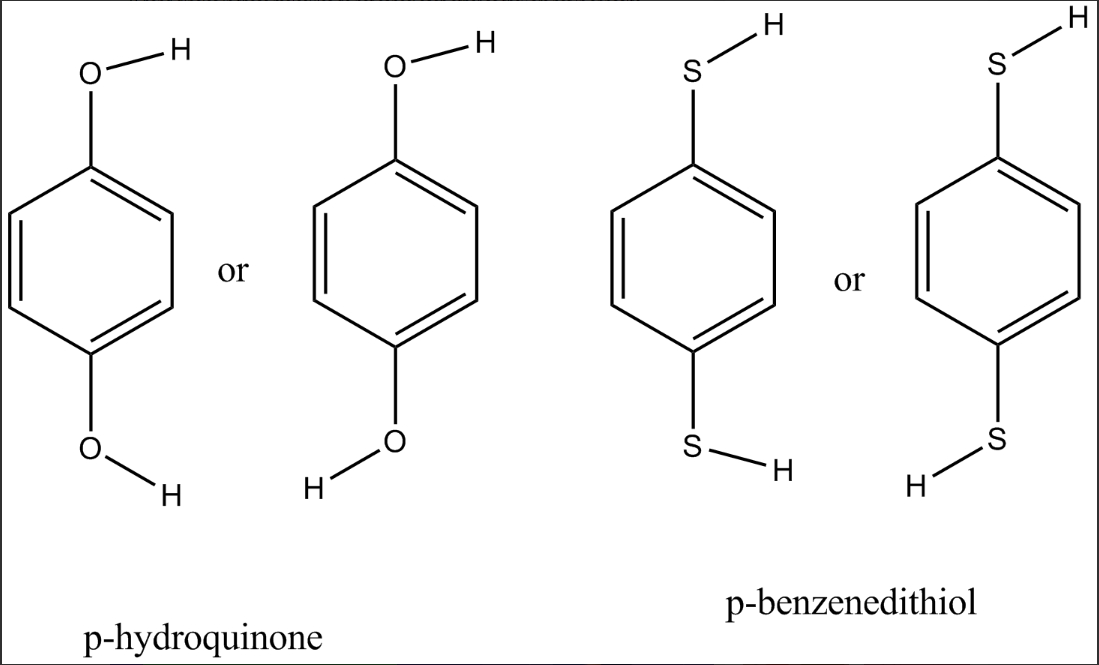
For $p$-hydroquinone $(iii)$ and $p$-benzenedithiol $(iv)$,the $O-H$ and $S-H$ bond dipoles do not cancel each other out because they are not in opposite directions due to the existence of different conformations. Hence,the resultant dipole moment of these molecules is non-zero $(\mu \ne 0)$.
For $p$-hydroquinone $(iii)$ and $p$-benzenedithiol $(iv)$,the $O-H$ and $S-H$ bond dipoles do not cancel each other out because they are not in opposite directions due to the existence of different conformations. Hence,the resultant dipole moment of these molecules is non-zero $(\mu \ne 0)$.
0 likes
View Solution96
DifficultMCQ
Among the following mixtures,dipole-dipole as the major interaction is present in
A
$KCl$ and water
B
benzene and carbon tetrachloride
C
benzene and ethanol
D
acetonitrile and acetone
Solution
(D) Dipole-dipole interactions occur between polar molecules that possess permanent dipoles.
In this interaction,the positive end of one polar molecule is attracted to the negative end of another polar molecule.
$KCl$ and water involve ion-dipole interactions.
Benzene and carbon tetrachloride are non-polar,involving London dispersion forces.
Benzene and ethanol involve dipole-induced dipole interactions.
Acetonitrile $(CH_{3}CN)$ and acetone $(CH_{3})_{2}CO$ are both polar molecules,and therefore,the major interaction between them is dipole-dipole interaction.
In this interaction,the positive end of one polar molecule is attracted to the negative end of another polar molecule.
$KCl$ and water involve ion-dipole interactions.
Benzene and carbon tetrachloride are non-polar,involving London dispersion forces.
Benzene and ethanol involve dipole-induced dipole interactions.
Acetonitrile $(CH_{3}CN)$ and acetone $(CH_{3})_{2}CO$ are both polar molecules,and therefore,the major interaction between them is dipole-dipole interaction.
0 likes
View Solution97
MediumMCQ
Which one of the following arrangements of molecules is correct on the basis of their dipole moments?
A
$BF_3 > NF_3 > NH_3$
B
$NF_3 > BF_3 > NH_3$
C
$NH_3 > BF_3 > NF_3$
D
$NH_3 > NF_3 > BF_3$
Solution
(D) The dipole moment of a molecule depends on its geometry and the polarity of its bonds.
$BF_3$ has a trigonal planar geometry,and the bond dipoles cancel each other out,resulting in a net dipole moment of $0 \ D$.
$NH_3$ has a pyramidal geometry with a lone pair on the $N$ atom. The bond dipoles of $N-H$ bonds and the lone pair dipole point in the same direction,resulting in a high dipole moment of approximately $1.47 \ D$.
$NF_3$ also has a pyramidal geometry,but the $N-F$ bond dipoles point in the opposite direction to the lone pair dipole,which partially cancels the net dipole moment,resulting in a value of approximately $0.24 \ D$.
Therefore,the correct order of dipole moments is $NH_3 > NF_3 > BF_3$.
$BF_3$ has a trigonal planar geometry,and the bond dipoles cancel each other out,resulting in a net dipole moment of $0 \ D$.
$NH_3$ has a pyramidal geometry with a lone pair on the $N$ atom. The bond dipoles of $N-H$ bonds and the lone pair dipole point in the same direction,resulting in a high dipole moment of approximately $1.47 \ D$.
$NF_3$ also has a pyramidal geometry,but the $N-F$ bond dipoles point in the opposite direction to the lone pair dipole,which partially cancels the net dipole moment,resulting in a value of approximately $0.24 \ D$.
Therefore,the correct order of dipole moments is $NH_3 > NF_3 > BF_3$.
0 likes
View Solution98
MediumMCQ
Which of the following molecules has a zero dipole moment?
A
$1,4-$dihydroxybenzene
B
$1,4-$dichlorobenzene
C
$4-$nitrophenol
D
All of these
Solution
(B) The dipole moment of a molecule is zero if the vector sum of the individual bond dipoles is zero. This typically occurs in symmetric molecules where the bond dipoles cancel each other out.
$1.$ In $1,4$-dihydroxybenzene,the two $-OH$ groups are at the para positions. Due to the rotation of the $-OH$ groups,the bond dipoles do not perfectly cancel out,resulting in a non-zero dipole moment.
$2.$ In $1,4$-dichlorobenzene,the two $C-Cl$ bonds are at $180^{\circ}$ to each other. Since the $C-Cl$ bond dipoles are equal in magnitude and opposite in direction,they cancel each other out,resulting in a net dipole moment of zero.
$3.$ In $4$-nitrophenol,the $-OH$ and $-NO_2$ groups are at the para positions. Since these groups have different electronic effects and different bond dipole magnitudes,they do not cancel out,resulting in a non-zero dipole moment.
Therefore,only $1,4$-dichlorobenzene has a zero dipole moment.
$1.$ In $1,4$-dihydroxybenzene,the two $-OH$ groups are at the para positions. Due to the rotation of the $-OH$ groups,the bond dipoles do not perfectly cancel out,resulting in a non-zero dipole moment.
$2.$ In $1,4$-dichlorobenzene,the two $C-Cl$ bonds are at $180^{\circ}$ to each other. Since the $C-Cl$ bond dipoles are equal in magnitude and opposite in direction,they cancel each other out,resulting in a net dipole moment of zero.
$3.$ In $4$-nitrophenol,the $-OH$ and $-NO_2$ groups are at the para positions. Since these groups have different electronic effects and different bond dipole magnitudes,they do not cancel out,resulting in a non-zero dipole moment.
Therefore,only $1,4$-dichlorobenzene has a zero dipole moment.
0 likes
View Solution99
MediumMCQ
Fluorine is more electronegative than either boron or phosphorus. What conclusion can be drawn from the fact that $BF_3$ has no dipole moment but $PF_3$ does?
A
$BF_3$ is not spherically symmetrical,$PF_3$ is not.
B
$BF_3$ molecule must be linear.
C
The atomic radius of $P$ is larger than the atomic radius of $B.$
D
The $BF_3$ molecule must be planar triangular.
Solution
(D) The $BF_3$ molecule must be planar triangular.
$BF_3$ has a planar triangular geometry where the three $B-F$ bond dipoles cancel each other out due to symmetry,resulting in a net dipole moment of $0$.
$PF_3$ has a pyramidal geometry with a lone pair on the phosphorus atom,which prevents the bond dipoles from canceling out,resulting in a non-zero dipole moment.
$BF_3$ has a planar triangular geometry where the three $B-F$ bond dipoles cancel each other out due to symmetry,resulting in a net dipole moment of $0$.
$PF_3$ has a pyramidal geometry with a lone pair on the phosphorus atom,which prevents the bond dipoles from canceling out,resulting in a non-zero dipole moment.
0 likes
View Solution100
DifficultMCQ
Identify the correct order of average molecular dipole moment for the following species: $PCl_3F_2$, $N_2O_{4(g)}$, and $N_2O_{4(s)}$.
A
$PCl_3F_2 > N_2O_{4(g)} > N_2O_{4(s)}$
B
$PCl_3F_2 < N_2O_{4(g)} = N_2O_{4(s)}$
C
$PCl_3F_2 < N_2O_{4(g)} < N_2O_{4(s)}$
D
$PCl_3F_2 = N_2O_{4(g)} < N_2O_{4(s)}$
Solution
(A) $1$. For $PCl_3F_2$: It has a trigonal bipyramidal geometry. The more electronegative $F$ atoms occupy the axial positions, while $Cl$ atoms occupy the equatorial positions. Due to the difference in electronegativity between $P-F$ and $P-Cl$ bonds, the dipole moments do not cancel out completely, resulting in a non-zero dipole moment.
$2$. For $N_2O_{4(g)}$: $N_2O_{4}$ in the gas phase exists as a planar molecule with $D_{2h}$ symmetry. The two $NO_2$ groups are connected, and due to rotation and symmetry, the net dipole moment is zero.
$3$. For $N_2O_{4(s)}$: In the solid state, $N_2O_{4}$ exists as a planar molecule, but due to crystal packing and intermolecular interactions, it maintains a zero dipole moment similar to the gas phase, or effectively zero due to symmetry.
$4$. However, comparing the specific molecular structures: $PCl_3F_2$ has a permanent dipole moment $(\mu \neq 0)$, whereas $N_2O_{4}$ is non-polar $(\mu = 0)$ in both gas and solid states due to its centrosymmetric structure.
$5$. Therefore, the correct order is $N_2O_{4(g)} = N_2O_{4(s)} < PCl_3F_2$, which corresponds to $PCl_3F_2 > N_2O_{4(g)} = N_2O_{4(s)}$. Since this is not explicitly listed, we re-evaluate: $N_2O_{4}$ is non-polar, so $\mu = 0$. $PCl_3F_2$ is polar. Thus, $PCl_3F_2 > N_2O_{4(g)} = N_2O_{4(s)}$.
$2$. For $N_2O_{4(g)}$: $N_2O_{4}$ in the gas phase exists as a planar molecule with $D_{2h}$ symmetry. The two $NO_2$ groups are connected, and due to rotation and symmetry, the net dipole moment is zero.
$3$. For $N_2O_{4(s)}$: In the solid state, $N_2O_{4}$ exists as a planar molecule, but due to crystal packing and intermolecular interactions, it maintains a zero dipole moment similar to the gas phase, or effectively zero due to symmetry.
$4$. However, comparing the specific molecular structures: $PCl_3F_2$ has a permanent dipole moment $(\mu \neq 0)$, whereas $N_2O_{4}$ is non-polar $(\mu = 0)$ in both gas and solid states due to its centrosymmetric structure.
$5$. Therefore, the correct order is $N_2O_{4(g)} = N_2O_{4(s)} < PCl_3F_2$, which corresponds to $PCl_3F_2 > N_2O_{4(g)} = N_2O_{4(s)}$. Since this is not explicitly listed, we re-evaluate: $N_2O_{4}$ is non-polar, so $\mu = 0$. $PCl_3F_2$ is polar. Thus, $PCl_3F_2 > N_2O_{4(g)} = N_2O_{4(s)}$.
0 likes
View SolutionChemical Bonding and Molecular Structure — Dipole moment · Frequently Asked Questions
1Are these Chemical Bonding and Molecular Structure questions useful for JEE and NEET?
Yes. All questions in this section are mapped to JEE Main and NEET exam patterns. Previous year questions from JEE Main, NEET, GUJCET and state-level exams are included with full solutions.
2Can I switch to Hindi or Gujarati for these questions?
Yes. Use the language tabs in the hero section or the sidebar to view the same questions and solutions in English, Hindi or Gujarati.
3How do I generate a question paper from this subtopic?
Use the Vedclass Exam Paper Generator — select the chapter and subtopic, set difficulty, and generate Sets A, B, C, D automatically. First 3 chapters of every subject are free.
Vedclass Products
For Students
Vedclass Test Series
Mock tests in real JEE/NEET style with performance analysis. 5-day free trial.
Start Free TrialFor Teachers
Exam Paper Generator
Generate Set A/B/C/D papers from this chapter in 2 minutes. 3 chapters free.
Try FreeFor Institutes
Online Exam Module
Live online exams with unlimited students, 360° analytics & white-label branding.
See DemoFor Teachers & Institutes
Generate a Chemical Bonding and Molecular Structure Exam Paper in 2 Minutes
Select subtopic & difficulty — Sets A, B, C, D auto-generated with No Repeat logic.
First 3 chapters of every subject are free — no payment required.