
A English
Dipole moment Questions in English
Class 11 Chemistry · Chemical Bonding and Molecular Structure · Dipole moment
317+
Questions
English
Language
100%
With Solutions
Showing 50 of 317 questions in English
151
AdvancedMCQ
Give the correct order of initials $T$ or $F$ for the following statements. Use $T$ if the statement is true and $F$ if it is false.
$I. \, (CH_3)_2P(CF_3)_3$ is non-polar and $(CH_3)_3P(CF_3)_2$ is a polar molecule.
$II. \, CH_3 \widehat{P} CH_3$ bond angles are equal in the $(CH_3)_3P(CF_3)_2$ molecule.
$III. \, PF_3$ will be more soluble in a polar solvent than $SiF_4$.
$I. \, (CH_3)_2P(CF_3)_3$ is non-polar and $(CH_3)_3P(CF_3)_2$ is a polar molecule.
$II. \, CH_3 \widehat{P} CH_3$ bond angles are equal in the $(CH_3)_3P(CF_3)_2$ molecule.
$III. \, PF_3$ will be more soluble in a polar solvent than $SiF_4$.
A
$TTF$
B
$FFT$
C
$FFF$
D
$FTT$
Solution
(B) Statement $I$: According to Bent's rule,more electronegative groups prefer equatorial positions in trigonal bipyramidal geometry. In $(CH_3)_2P(CF_3)_3$,the three $CF_3$ groups occupy equatorial positions,making the molecule non-polar $(\mu = 0)$. In $(CH_3)_3P(CF_3)_2$,the two $CF_3$ groups occupy axial positions,resulting in a polar molecule $(\mu \neq 0)$. Thus,statement $I$ is false.
Statement $II$: In $(CH_3)_3P(CF_3)_2$,the $CH_3$ groups are in equatorial positions. Due to the repulsion between the bulky $CF_3$ groups and the $CH_3$ groups,the $CH_3-P-CH_3$ bond angles are not equal. Thus,statement $II$ is false.
Statement $III$: $PF_3$ has a pyramidal geometry with a lone pair on $P$,resulting in a net dipole moment $(\mu \neq 0)$,making it polar. $SiF_4$ has a tetrahedral geometry,making it non-polar $(\mu = 0)$. Polar substances are more soluble in polar solvents. Thus,statement $III$ is true.
The correct order is $FFT$.
Statement $II$: In $(CH_3)_3P(CF_3)_2$,the $CH_3$ groups are in equatorial positions. Due to the repulsion between the bulky $CF_3$ groups and the $CH_3$ groups,the $CH_3-P-CH_3$ bond angles are not equal. Thus,statement $II$ is false.
Statement $III$: $PF_3$ has a pyramidal geometry with a lone pair on $P$,resulting in a net dipole moment $(\mu \neq 0)$,making it polar. $SiF_4$ has a tetrahedral geometry,making it non-polar $(\mu = 0)$. Polar substances are more soluble in polar solvents. Thus,statement $III$ is true.
The correct order is $FFT$.
0 likes
View Solution152
AdvancedMCQ
Determine the correct sequence of polarity for the following molecules:
$(1)$ Benzene
$(2)$ Inorganic Benzene $(B_3N_3H_6)$
$(3)$ $PCl_3F_2$
$(4)$ $PCl_2F_3$
(Where $P = \text{polar}$,$NP = \text{non-polar}$)
$(1)$ Benzene
$(2)$ Inorganic Benzene $(B_3N_3H_6)$
$(3)$ $PCl_3F_2$
$(4)$ $PCl_2F_3$
(Where $P = \text{polar}$,$NP = \text{non-polar}$)
A
$NP-NP-NP-P$
B
$NP-NP-P-NP$
C
$NP-P-NP-P$
D
$P-NP-NP-P$
Solution
(A) $(1)$ Benzene $(C_6H_6)$ is a symmetric planar molecule with a net dipole moment of zero,so it is $NP$.
$(2)$ Inorganic Benzene $(B_3N_3H_6)$ is also a symmetric planar molecule with a net dipole moment of zero,so it is $NP$.
$(3)$ $PCl_3F_2$: According to Bent's rule,more electronegative atoms occupy axial positions in a trigonal bipyramidal geometry. Here,$F$ atoms occupy axial positions and $Cl$ atoms occupy equatorial positions. The dipole moments cancel out,so it is $NP$.
$(4)$ $PCl_2F_3$: In this case,the arrangement of $F$ and $Cl$ atoms leads to an asymmetric distribution of dipole moments,resulting in a net dipole moment,so it is $P$.
Thus,the sequence is $NP-NP-NP-P$.
$(2)$ Inorganic Benzene $(B_3N_3H_6)$ is also a symmetric planar molecule with a net dipole moment of zero,so it is $NP$.
$(3)$ $PCl_3F_2$: According to Bent's rule,more electronegative atoms occupy axial positions in a trigonal bipyramidal geometry. Here,$F$ atoms occupy axial positions and $Cl$ atoms occupy equatorial positions. The dipole moments cancel out,so it is $NP$.
$(4)$ $PCl_2F_3$: In this case,the arrangement of $F$ and $Cl$ atoms leads to an asymmetric distribution of dipole moments,resulting in a net dipole moment,so it is $P$.
Thus,the sequence is $NP-NP-NP-P$.
0 likes
View Solution153
DifficultMCQ
In which of the following molecules is $\mu$ (observed) found to be greater than $\mu$ (theoretical)?
A
$CHCl_3$
B
o-dichlorobenzene
C
o-dinitrobenzene
D
o-chlorophenol
Solution
(D) The dipole moment $\mu$ (observed) is greater than $\mu$ (theoretical) when the bond angle between the polar bonds decreases due to factors like intramolecular hydrogen bonding.
In $o$-chlorophenol,the presence of intramolecular hydrogen bonding between the $-OH$ group and the $-Cl$ atom pulls the groups closer,reducing the bond angle between the $C-O$ and $C-Cl$ bonds to less than $60^\circ$.
Since $\mu = \sqrt{\mu_1^2 + \mu_2^2 + 2\mu_1\mu_2 \cos \theta}$,a decrease in the angle $\theta$ leads to an increase in the resultant dipole moment.
Therefore,$\mu$ (observed) > $\mu$ (theoretical) for $o$-chlorophenol.
In $o$-chlorophenol,the presence of intramolecular hydrogen bonding between the $-OH$ group and the $-Cl$ atom pulls the groups closer,reducing the bond angle between the $C-O$ and $C-Cl$ bonds to less than $60^\circ$.
Since $\mu = \sqrt{\mu_1^2 + \mu_2^2 + 2\mu_1\mu_2 \cos \theta}$,a decrease in the angle $\theta$ leads to an increase in the resultant dipole moment.
Therefore,$\mu$ (observed) > $\mu$ (theoretical) for $o$-chlorophenol.
0 likes
View Solution154
AdvancedMCQ
Select the correct statement$(s)$.
A
Acidic strength of $HBr > HCl$ but the reverse is true for their reducing property.
B
Basic strength of $PH_3 > AsH_3$ but the reverse is true for their bond angle.
C
Dipole moment of $CH_3Cl > CH_3F$ but the reverse is true for their $H\hat{C}H$ bond angle.
D
$K_{a_1}$ of fumaric acid is higher than maleic acid but the reverse is true for their $K_{a_2}$.
Solution
(C) : Acidic strength increases down the group $(HCl < HBr < HI)$ due to decreasing bond dissociation energy. Reducing property also follows the same order $(HCl < HBr < HI)$. Thus,the statement is incorrect.
$B$: Basic strength depends on the availability of the lone pair. As the size of the central atom increases $(P < As)$,the lone pair becomes more diffuse,decreasing basicity $(PH_3 > AsH_3)$. Bond angle decreases as the electronegativity of the central atom decreases $(PH_3 > AsH_3)$. Thus,the statement is incorrect.
$C$: Dipole moment of $CH_3Cl$ $(1.86 \ D)$ is greater than $CH_3F$ $(1.85 \ D)$ due to the larger bond length in $C-Cl$. The $H\hat{C}H$ bond angle in $CH_3F$ is larger than in $CH_3Cl$ because $F$ is more electronegative,pulling electron density and increasing $s$-character in $C-H$ bonds. Thus,the statement is correct.
$D$: Maleic acid (cis-isomer) has higher $K_{a_1}$ due to intramolecular hydrogen bonding in the monoanion,but lower $K_{a_2}$ due to electrostatic repulsion between carboxylate groups. Fumaric acid (trans-isomer) shows the reverse. Thus,the statement is incorrect.
$B$: Basic strength depends on the availability of the lone pair. As the size of the central atom increases $(P < As)$,the lone pair becomes more diffuse,decreasing basicity $(PH_3 > AsH_3)$. Bond angle decreases as the electronegativity of the central atom decreases $(PH_3 > AsH_3)$. Thus,the statement is incorrect.
$C$: Dipole moment of $CH_3Cl$ $(1.86 \ D)$ is greater than $CH_3F$ $(1.85 \ D)$ due to the larger bond length in $C-Cl$. The $H\hat{C}H$ bond angle in $CH_3F$ is larger than in $CH_3Cl$ because $F$ is more electronegative,pulling electron density and increasing $s$-character in $C-H$ bonds. Thus,the statement is correct.
$D$: Maleic acid (cis-isomer) has higher $K_{a_1}$ due to intramolecular hydrogen bonding in the monoanion,but lower $K_{a_2}$ due to electrostatic repulsion between carboxylate groups. Fumaric acid (trans-isomer) shows the reverse. Thus,the statement is incorrect.
0 likes
View Solution155
AdvancedMCQ
Which molecule has both non-polar and polar bonds,but the molecule as a whole is polar?
A
$(SCN)_2$
B
$Cl_2O_8$
C
$B_2Cl_4$
D
Both $(A)$ and $(B)$
Solution
(A) The $(SCN)_2$ molecule contains a non-polar $S-S$ bond and polar $S-C$ and $C-N$ bonds.
Due to its non-linear,open-book-like structure (similar to $H_2O_2$),the dipole moments do not cancel out,making the molecule polar $(\mu \neq 0)$.
Due to its non-linear,open-book-like structure (similar to $H_2O_2$),the dipole moments do not cancel out,making the molecule polar $(\mu \neq 0)$.
0 likes
View Solution156
MediumMCQ
Which of the following is the correct order of dipole moment for the given molecules?
A
$BF_3 > NF_3 > NH_3$
B
$NF_3 > BF_3 > NH_3$
C
$NH_3 > BF_3 > NF_3$
D
$NH_3 > NF_3 > BF_3$
Solution
(D) $1$. The dipole moment of $BF_3$ is $0 \ D$ because it has a planar trigonal geometry where the bond dipoles cancel each other out.
$2$. Both $NH_3$ and $NF_3$ have a pyramidal geometry with a lone pair on the nitrogen atom.
$3$. In $NH_3$,the direction of the dipole moment of the $N-H$ bonds and the lone pair are in the same direction,leading to a high dipole moment $(1.46 \ D)$.
$4$. In $NF_3$,the $N-F$ bond dipoles are in the opposite direction to the lone pair dipole,which reduces the net dipole moment $(0.24 \ D)$.
$5$. Therefore,the correct order is $NH_3 > NF_3 > BF_3$.
$2$. Both $NH_3$ and $NF_3$ have a pyramidal geometry with a lone pair on the nitrogen atom.
$3$. In $NH_3$,the direction of the dipole moment of the $N-H$ bonds and the lone pair are in the same direction,leading to a high dipole moment $(1.46 \ D)$.
$4$. In $NF_3$,the $N-F$ bond dipoles are in the opposite direction to the lone pair dipole,which reduces the net dipole moment $(0.24 \ D)$.
$5$. Therefore,the correct order is $NH_3 > NF_3 > BF_3$.
0 likes
View Solution157
EasyMCQ
Which of the following substances has the highest dipole moment?
A
$CO_2$
B
$F_2$
C
$H_2O$
D
$BeF_2$
Solution
(C) The dipole moment is a vector quantity that depends on the polarity of bonds and the molecular geometry.
$CO_2$ $(O=C=O)$ is linear,so its dipole moment is $0 \ D$.
$F_2$ $(F-F)$ is a homonuclear diatomic molecule,so its dipole moment is $0 \ D$.
$BeF_2$ $(F-Be-F)$ is linear,so its dipole moment is $0 \ D$.
$H_2O$ has a bent geometry with two polar $O-H$ bonds,resulting in a net dipole moment of $1.85 \ D$.
Therefore,$H_2O$ has the highest dipole moment.
$CO_2$ $(O=C=O)$ is linear,so its dipole moment is $0 \ D$.
$F_2$ $(F-F)$ is a homonuclear diatomic molecule,so its dipole moment is $0 \ D$.
$BeF_2$ $(F-Be-F)$ is linear,so its dipole moment is $0 \ D$.
$H_2O$ has a bent geometry with two polar $O-H$ bonds,resulting in a net dipole moment of $1.85 \ D$.
Therefore,$H_2O$ has the highest dipole moment.
0 likes
View Solution158
EasyMCQ
What is the physical shape and dipole moment of $H_2S$?
A
Angular and non-zero
B
Angular and zero
C
Linear and non-zero
D
Linear and zero
Solution
(A) The molecule $H_2S$ has a bent or angular geometry due to the presence of two lone pairs on the sulfur atom.
Because of this angular shape and the difference in electronegativity between sulfur and hydrogen,the bond dipoles do not cancel out.
Therefore,$H_2S$ has a non-zero dipole moment.
Because of this angular shape and the difference in electronegativity between sulfur and hydrogen,the bond dipoles do not cancel out.
Therefore,$H_2S$ has a non-zero dipole moment.
0 likes
View Solution159
MediumMCQ
Which of the following best represents the charge distribution in iodine monochloride $(ICl)$?
A
$I^+Cl^-$
B
$I^{\delta+}Cl^{\delta-}$
C
$I^-Cl^+$
D
$I^{\delta-}Cl^{\delta+}$
Solution
(B) Interhalogen compounds are covalent in nature.
Since the electronegativity of chlorine $(3.16)$ is higher than that of iodine $(2.66)$,the shared pair of electrons is shifted towards the chlorine atom.
Therefore,the charge distribution is best represented as $I^{\delta+}Cl^{\delta-}$.
Since the electronegativity of chlorine $(3.16)$ is higher than that of iodine $(2.66)$,the shared pair of electrons is shifted towards the chlorine atom.
Therefore,the charge distribution is best represented as $I^{\delta+}Cl^{\delta-}$.
0 likes
View Solution160
EasyMCQ
Which of the following bonds is the most polar?
A
$Cl - F$
B
$Br - F$
C
$I - F$
D
$F - F$
Solution
(C) The polarity of a bond depends on the difference in electronegativity between the bonded atoms.
Electronegativity values are: $F = 4.0$,$Cl = 3.0$,$Br = 2.8$,$I = 2.5$.
The electronegativity difference is maximum for the $I - F$ bond $(4.0 - 2.5 = 1.5)$.
Therefore,the $I - F$ bond is the most polar.
Electronegativity values are: $F = 4.0$,$Cl = 3.0$,$Br = 2.8$,$I = 2.5$.
The electronegativity difference is maximum for the $I - F$ bond $(4.0 - 2.5 = 1.5)$.
Therefore,the $I - F$ bond is the most polar.
0 likes
View Solution161
DifficultMCQ
Which bond angle $\theta$ would result in the maximum dipole moment for the triatomic molecule $XY_2$ shown below?
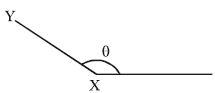
A
$\theta = 90^{\circ}$
B
$\theta = 120^{\circ}$
C
$\theta = 150^{\circ}$
D
$\theta = 180^{\circ}$
Solution
(A) The resultant dipole moment $\mu$ of two bond dipoles $\mu_1$ and $\mu_2$ inclined at an angle $\theta$ is given by the formula $\mu = \sqrt{\mu_1^2 + \mu_2^2 + 2\mu_1\mu_2 \cos \theta}$.
For a molecule $XY_2$,the bond dipoles are equal,so $\mu_1 = \mu_2 = \mu_0$. The formula becomes $\mu = \sqrt{2\mu_0^2(1 + \cos \theta)}$.
Using the trigonometric identity $1 + \cos \theta = 2 \cos^2(\theta/2)$,we get $\mu = \sqrt{4\mu_0^2 \cos^2(\theta/2)} = 2\mu_0 \cos(\theta/2)$.
As the angle $\theta$ increases from $0^{\circ}$ to $180^{\circ}$,the value of $\cos(\theta/2)$ decreases.
Therefore,the dipole moment is maximum when the angle $\theta$ is smallest among the given options,which is $90^{\circ}$.
For a molecule $XY_2$,the bond dipoles are equal,so $\mu_1 = \mu_2 = \mu_0$. The formula becomes $\mu = \sqrt{2\mu_0^2(1 + \cos \theta)}$.
Using the trigonometric identity $1 + \cos \theta = 2 \cos^2(\theta/2)$,we get $\mu = \sqrt{4\mu_0^2 \cos^2(\theta/2)} = 2\mu_0 \cos(\theta/2)$.
As the angle $\theta$ increases from $0^{\circ}$ to $180^{\circ}$,the value of $\cos(\theta/2)$ decreases.
Therefore,the dipole moment is maximum when the angle $\theta$ is smallest among the given options,which is $90^{\circ}$.
0 likes
View Solution162
MediumMCQ
Among the following molecules,the highest dipole moment is
A
$CH_3Cl$
B
$CH_2Cl_2$
C
$CHCl_3$
D
$CCl_4$
Solution
(A) The dipole moment of a molecule depends on the vector sum of individual bond dipoles and the molecular geometry.
$CCl_4$ is a symmetric tetrahedral molecule with a net dipole moment of $0 \ D$.
For the chloromethanes,the dipole moment is determined by the number of $Cl$ atoms and their spatial arrangement.
The dipole moments are approximately: $CH_3Cl$ $(1.86 \ D)$,$CH_2Cl_2$ $(1.60 \ D)$,$CHCl_3$ $(1.01 \ D)$,and $CCl_4$ $(0 \ D)$.
Thus,$CH_3Cl$ has the highest dipole moment among the given options.
$CCl_4$ is a symmetric tetrahedral molecule with a net dipole moment of $0 \ D$.
For the chloromethanes,the dipole moment is determined by the number of $Cl$ atoms and their spatial arrangement.
The dipole moments are approximately: $CH_3Cl$ $(1.86 \ D)$,$CH_2Cl_2$ $(1.60 \ D)$,$CHCl_3$ $(1.01 \ D)$,and $CCl_4$ $(0 \ D)$.
Thus,$CH_3Cl$ has the highest dipole moment among the given options.
0 likes
View Solution163
DifficultMCQ
Which of the following species represents a dipole-induced dipole interaction?
A
$CO_2 + SO_3$
B
$He + Ne$
C
$CO_2 + SO_2$
D
$Cl_2 + Ne$
Solution
(C) dipole-induced dipole interaction occurs between a polar molecule (permanent dipole) and a non-polar molecule (induced dipole).
$CO_2$ is a non-polar molecule due to its linear geometry.
$SO_2$ is a polar molecule due to its bent geometry.
Therefore,the interaction between $CO_2$ (non-polar) and $SO_2$ (polar) is a dipole-induced dipole interaction.
$He + Ne$ represents London dispersion forces (non-polar + non-polar).
$Cl_2 + Ne$ represents London dispersion forces (non-polar + non-polar).
$CO_2 + SO_3$ represents London dispersion forces (non-polar + non-polar).
$CO_2$ is a non-polar molecule due to its linear geometry.
$SO_2$ is a polar molecule due to its bent geometry.
Therefore,the interaction between $CO_2$ (non-polar) and $SO_2$ (polar) is a dipole-induced dipole interaction.
$He + Ne$ represents London dispersion forces (non-polar + non-polar).
$Cl_2 + Ne$ represents London dispersion forces (non-polar + non-polar).
$CO_2 + SO_3$ represents London dispersion forces (non-polar + non-polar).
0 likes
View Solution164
MediumMCQ
How many ions are non-polar ions?
$XeF_5^-, SO_3^{2-}, SO_4^{2-}, ClO_4^-, PO_4^{3-}, NO_2^+$
$XeF_5^-, SO_3^{2-}, SO_4^{2-}, ClO_4^-, PO_4^{3-}, NO_2^+$
A
$5$
B
$4$
C
$3$
D
$2$
Solution
(B) To determine if an ion is non-polar,we must check if its net dipole moment is zero.
$1$. $XeF_5^-$: It has a pentagonal planar geometry with a lone pair,resulting in a non-zero dipole moment (polar).
$2$. $SO_3^{2-}$: It has a trigonal pyramidal geometry,resulting in a non-zero dipole moment (polar).
$3$. $SO_4^{2-}$: It has a tetrahedral geometry $(T_d)$,which is highly symmetrical,so the net dipole moment is $0$ (non-polar).
$4$. $ClO_4^-$: It has a tetrahedral geometry $(T_d)$,which is highly symmetrical,so the net dipole moment is $0$ (non-polar).
$5$. $PO_4^{3-}$: It has a tetrahedral geometry $(T_d)$,which is highly symmetrical,so the net dipole moment is $0$ (non-polar).
$6$. $NO_2^+$: It has a linear geometry ($sp$ hybridization),so the net dipole moment is $0$ (non-polar).
Therefore,the non-polar ions are $SO_4^{2-}, ClO_4^-, PO_4^{3-},$ and $NO_2^+$. There are $4$ such ions.
$1$. $XeF_5^-$: It has a pentagonal planar geometry with a lone pair,resulting in a non-zero dipole moment (polar).
$2$. $SO_3^{2-}$: It has a trigonal pyramidal geometry,resulting in a non-zero dipole moment (polar).
$3$. $SO_4^{2-}$: It has a tetrahedral geometry $(T_d)$,which is highly symmetrical,so the net dipole moment is $0$ (non-polar).
$4$. $ClO_4^-$: It has a tetrahedral geometry $(T_d)$,which is highly symmetrical,so the net dipole moment is $0$ (non-polar).
$5$. $PO_4^{3-}$: It has a tetrahedral geometry $(T_d)$,which is highly symmetrical,so the net dipole moment is $0$ (non-polar).
$6$. $NO_2^+$: It has a linear geometry ($sp$ hybridization),so the net dipole moment is $0$ (non-polar).
Therefore,the non-polar ions are $SO_4^{2-}, ClO_4^-, PO_4^{3-},$ and $NO_2^+$. There are $4$ such ions.
0 likes
View Solution165
DifficultMCQ
$A$ diatomic molecule has a dipole moment of $1.2 \, D$. If its bond length is equal to $10^{-10} \, m$,then the fraction of an electronic charge on each atom will be .............. $\%$
A
$42$
B
$52$
C
$37$
D
$25$
Solution
(D) The dipole moment $(\mu)$ is given by the formula $\mu = q \times d$,where $q$ is the charge and $d$ is the bond length.
Given: $\mu = 1.2 \, D = 1.2 \times 10^{-18} \, esu \cdot cm$ and $d = 10^{-10} \, m = 10^{-8} \, cm$.
Substituting the values: $1.2 \times 10^{-18} = q \times 10^{-8}$.
Solving for $q$: $q = \frac{1.2 \times 10^{-18}}{10^{-8}} = 1.2 \times 10^{-10} \, esu$.
The electronic charge $e$ is approximately $4.8 \times 10^{-10} \, esu$.
The fraction of electronic charge is $\frac{q}{e} \times 100 = \frac{1.2 \times 10^{-10}}{4.8 \times 10^{-10}} \times 100 = 0.25 \times 100 = 25 \%$.
Thus,the correct option is $D$.
Given: $\mu = 1.2 \, D = 1.2 \times 10^{-18} \, esu \cdot cm$ and $d = 10^{-10} \, m = 10^{-8} \, cm$.
Substituting the values: $1.2 \times 10^{-18} = q \times 10^{-8}$.
Solving for $q$: $q = \frac{1.2 \times 10^{-18}}{10^{-8}} = 1.2 \times 10^{-10} \, esu$.
The electronic charge $e$ is approximately $4.8 \times 10^{-10} \, esu$.
The fraction of electronic charge is $\frac{q}{e} \times 100 = \frac{1.2 \times 10^{-10}}{4.8 \times 10^{-10}} \times 100 = 0.25 \times 100 = 25 \%$.
Thus,the correct option is $D$.
0 likes
View Solution166
MediumMCQ
Arrange the following molecules from most to least polar ($I$,$II$,$III$,$IV$,$V$ respectively): $CH_4$,$CF_2Cl_2$,$CF_2H_2$,$CCl_4$,$CCl_2H_2$.
A
$II > III > V > IV = I$
B
$II > V > III > IV > I$
C
$III > II > V > IV > I$
D
$V > III > II > IV = I$
Solution
(A) The polarity of a molecule depends on the net dipole moment.
$I$ $(CH_4)$ and $IV$ $(CCl_4)$ are symmetric tetrahedral molecules with a net dipole moment of $0$,making them non-polar.
For the remaining molecules,the polarity depends on the electronegativity difference between the substituents and the central carbon atom.
Fluorine is more electronegative than Chlorine,and Chlorine is more electronegative than Hydrogen.
Comparing $II$ $(CF_2Cl_2)$,$III$ $(CF_2H_2)$,and $V$ $(CCl_2H_2)$:
$II$ $(CF_2Cl_2)$ has the highest dipole moment due to the strong electronegativity of $F$ atoms and the asymmetry.
$III$ $(CF_2H_2)$ is more polar than $V$ $(CCl_2H_2)$ because the $C-F$ bond is more polar than the $C-Cl$ bond.
Thus,the order of decreasing polarity is $II > III > V > IV = I$.
$I$ $(CH_4)$ and $IV$ $(CCl_4)$ are symmetric tetrahedral molecules with a net dipole moment of $0$,making them non-polar.
For the remaining molecules,the polarity depends on the electronegativity difference between the substituents and the central carbon atom.
Fluorine is more electronegative than Chlorine,and Chlorine is more electronegative than Hydrogen.
Comparing $II$ $(CF_2Cl_2)$,$III$ $(CF_2H_2)$,and $V$ $(CCl_2H_2)$:
$II$ $(CF_2Cl_2)$ has the highest dipole moment due to the strong electronegativity of $F$ atoms and the asymmetry.
$III$ $(CF_2H_2)$ is more polar than $V$ $(CCl_2H_2)$ because the $C-F$ bond is more polar than the $C-Cl$ bond.
Thus,the order of decreasing polarity is $II > III > V > IV = I$.
0 likes
View Solution167
MediumMCQ
Which carbonyl compound has the maximum dipole moment?
A
Cyclopropanone
B
Cyclopentadienone
C
$2-$Bromocyclopropanone
D
Cyclopropenone
Solution
(D) The dipole moment of a carbonyl compound is significantly influenced by the resonance structure that contributes to its stability.
In the case of cyclopropenone,the molecule can exist in a resonance form where the ring becomes aromatic ($H$ückel's rule: $4n+2$ $\pi$ electrons,where $n=0$,giving $2$ $\pi$ electrons).
The resonance structure involves a positive charge on the ring and a negative charge on the oxygen atom $(C_3H_2O \leftrightarrow C_3H_2^+ - O^-)$.
This aromatic character provides extra stability to the dipolar resonance structure,leading to a very high dipole moment compared to the other options where such aromatic stabilization is not possible.
In the case of cyclopropenone,the molecule can exist in a resonance form where the ring becomes aromatic ($H$ückel's rule: $4n+2$ $\pi$ electrons,where $n=0$,giving $2$ $\pi$ electrons).
The resonance structure involves a positive charge on the ring and a negative charge on the oxygen atom $(C_3H_2O \leftrightarrow C_3H_2^+ - O^-)$.
This aromatic character provides extra stability to the dipolar resonance structure,leading to a very high dipole moment compared to the other options where such aromatic stabilization is not possible.
0 likes
View Solution168
DifficultMCQ
If the dipole moment of $HI$ is $0.38 \, D$ and the bond length is $1.61 \, \mathring{A}$,what is the percentage ionic character of the $H^{\delta +} - I^{\delta -}$ covalent bond (in $\%$)?
A
$5$
B
$16$
C
$33$
D
$79$
Solution
(A) The observed dipole moment $(\mu_{obs})$ is $0.38 \, D$.
The bond length $(d)$ is $1.61 \, \mathring{A} = 1.61 \times 10^{-10} \, m$.
The theoretical dipole moment $(\mu_{theo})$ for $100 \%$ ionic character is calculated as $q \times d$,where $q = 1.602 \times 10^{-19} \, C$.
$\mu_{theo} = (1.602 \times 10^{-19} \, C) \times (1.61 \times 10^{-10} \, m) = 2.579 \times 10^{-29} \, C \cdot m$.
Converting to Debye $(1 \, D = 3.336 \times 10^{-30} \, C \cdot m)$:
$\mu_{theo} = \frac{2.579 \times 10^{-29}}{3.336 \times 10^{-30}} \approx 7.73 \, D$.
The percentage ionic character is given by $\frac{\mu_{obs}}{\mu_{theo}} \times 100$.
$\text{Percentage ionic character} = \frac{0.38}{7.73} \times 100 \approx 4.91 \% \approx 5 \%$.
Thus,the correct option is $A$.
The bond length $(d)$ is $1.61 \, \mathring{A} = 1.61 \times 10^{-10} \, m$.
The theoretical dipole moment $(\mu_{theo})$ for $100 \%$ ionic character is calculated as $q \times d$,where $q = 1.602 \times 10^{-19} \, C$.
$\mu_{theo} = (1.602 \times 10^{-19} \, C) \times (1.61 \times 10^{-10} \, m) = 2.579 \times 10^{-29} \, C \cdot m$.
Converting to Debye $(1 \, D = 3.336 \times 10^{-30} \, C \cdot m)$:
$\mu_{theo} = \frac{2.579 \times 10^{-29}}{3.336 \times 10^{-30}} \approx 7.73 \, D$.
The percentage ionic character is given by $\frac{\mu_{obs}}{\mu_{theo}} \times 100$.
$\text{Percentage ionic character} = \frac{0.38}{7.73} \times 100 \approx 4.91 \% \approx 5 \%$.
Thus,the correct option is $A$.
0 likes
View Solution169
MediumMCQ
Which of the following molecules has the most polar covalent bond?
A
$HI$
B
$HBr$
C
$HCl$
D
$H_2$
Solution
(C) The polarity of a covalent bond depends on the difference in electronegativity between the bonded atoms.
Greater the difference in electronegativity,the more polar the bond.
The electronegativity values of halogens are: $F > Cl > Br > I$.
Since hydrogen $(H)$ is common in all,the polarity depends on the electronegativity of the halogen.
The electronegativity difference is maximum for $H-Cl$ compared to $H-Br$ and $H-I$,while $H-H$ is non-polar.
Therefore,$HCl$ has the most polar covalent bond among the given options.
Greater the difference in electronegativity,the more polar the bond.
The electronegativity values of halogens are: $F > Cl > Br > I$.
Since hydrogen $(H)$ is common in all,the polarity depends on the electronegativity of the halogen.
The electronegativity difference is maximum for $H-Cl$ compared to $H-Br$ and $H-I$,while $H-H$ is non-polar.
Therefore,$HCl$ has the most polar covalent bond among the given options.
0 likes
View Solution170
MediumMCQ
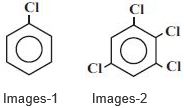
If the dipole moment of $Images-1$ is $1.5 \ D$,then the dipole moment of $Images-2$ will be .................. $D$.
A
$0$
B
$1.5$
C
$3$
D
$2.25$
Solution
(C) The dipole moment of chlorobenzene $(Images-1)$ is given as $1.5 \ D$.
In $Images-2$ ($1$,$2$,$3$-trichlorobenzene),the molecule has three $C-Cl$ bonds.
The dipole moment of $1,2,3-$trichlorobenzene can be calculated by vector addition of the individual $C-Cl$ bond moments.
The resultant dipole moment of the two $Cl$ atoms at the $1$ and $3$ positions is equal to the dipole moment of chlorobenzene $(1.5 \ D)$ because the angle between them is $120^{\circ}$ (vector sum of two equal vectors at $120^{\circ}$ is equal to the magnitude of one vector).
This resultant vector is directed along the same axis as the $C-Cl$ bond at the $2$ position.
Therefore,the total dipole moment is the sum of the resultant of the $1,3-Cl$ atoms and the $2-Cl$ atom,which is $1.5 \ D + 1.5 \ D = 3.0 \ D$.
In $Images-2$ ($1$,$2$,$3$-trichlorobenzene),the molecule has three $C-Cl$ bonds.
The dipole moment of $1,2,3-$trichlorobenzene can be calculated by vector addition of the individual $C-Cl$ bond moments.
The resultant dipole moment of the two $Cl$ atoms at the $1$ and $3$ positions is equal to the dipole moment of chlorobenzene $(1.5 \ D)$ because the angle between them is $120^{\circ}$ (vector sum of two equal vectors at $120^{\circ}$ is equal to the magnitude of one vector).
This resultant vector is directed along the same axis as the $C-Cl$ bond at the $2$ position.
Therefore,the total dipole moment is the sum of the resultant of the $1,3-Cl$ atoms and the $2-Cl$ atom,which is $1.5 \ D + 1.5 \ D = 3.0 \ D$.
0 likes
View Solution171
DifficultMCQ
Which of the following molecules is the most polar?
A
$CH_3NH_2$
B
$(CH_3)_3CCl$
C
$CH_3NO_2$
D
$(CH_3)_3CH$
Solution
(C) Polarity depends on the net dipole moment of the molecule.
$CH_3NO_2$ (nitromethane) contains a highly polar nitro group $(-NO_2)$ where the electronegativity difference between $N$ and $O$ is significant,and the resonance structure contributes to a large dipole moment.
$CH_3NH_2$ has a dipole moment due to the $N-H$ bonds and lone pair,but it is less polar than $CH_3NO_2$.
$(CH_3)_3CCl$ has a $C-Cl$ bond,but the overall symmetry and the inductive effect of methyl groups reduce its polarity.
$(CH_3)_3CH$ is essentially non-polar.
Therefore,$CH_3NO_2$ is the most polar molecule among the given options.
$CH_3NO_2$ (nitromethane) contains a highly polar nitro group $(-NO_2)$ where the electronegativity difference between $N$ and $O$ is significant,and the resonance structure contributes to a large dipole moment.
$CH_3NH_2$ has a dipole moment due to the $N-H$ bonds and lone pair,but it is less polar than $CH_3NO_2$.
$(CH_3)_3CCl$ has a $C-Cl$ bond,but the overall symmetry and the inductive effect of methyl groups reduce its polarity.
$(CH_3)_3CH$ is essentially non-polar.
Therefore,$CH_3NO_2$ is the most polar molecule among the given options.
0 likes
View Solution172
MediumMCQ
The cyanide ion $(CN^{-})$ and $N_2$ are isoelectronic. However,in contrast to $CN^{-}$,the $N_2$ molecule is chemically inert due to:
A
$\pi$ bonding
B
Absence of bond polarity
C
Unequal distribution of electrons
D
Presence of more electrons in bonding orbitals
Solution
(B) Both $CN^{-}$ and $N_2$ are isoelectronic,having $14$ electrons each.
$CN^{-}$ is a polar ion with a net negative charge,which makes it reactive.
$N_2$ is a non-polar molecule with a very high bond dissociation energy $(941 \ kJ/mol)$ due to the strong triple bond between the two nitrogen atoms.
Because $N_2$ is non-polar and has a very stable electronic configuration,it is chemically inert compared to the reactive $CN^{-}$ ion.
$CN^{-}$ is a polar ion with a net negative charge,which makes it reactive.
$N_2$ is a non-polar molecule with a very high bond dissociation energy $(941 \ kJ/mol)$ due to the strong triple bond between the two nitrogen atoms.
Because $N_2$ is non-polar and has a very stable electronic configuration,it is chemically inert compared to the reactive $CN^{-}$ ion.
0 likes
View Solution173
MediumMCQ
The correct order of dipole moment for $o$-nitrophenol $(I)$ and $o$-dichlorobenzene $(II)$ is ......
A
$I = II$
B
$I < II$
C
$I > II$
D
$I << II$
Solution
(C) The dipole moment $(\mu)$ depends on the vector sum of individual bond dipoles and the angle between them.
In $o$-nitrophenol $(I)$,the $-OH$ and $-NO_2$ groups are present at the ortho position. The $-OH$ group has a dipole moment directed towards the oxygen atom,and the $-NO_2$ group has a strong dipole moment directed away from the ring.
Due to intramolecular hydrogen bonding in $o$-nitrophenol,the effective dipole moment is significantly enhanced.
In $o$-dichlorobenzene $(II)$,the two $C-Cl$ bonds are at an angle of $60^{\circ}$. The resultant dipole moment is $\mu = \sqrt{\mu_1^2 + \mu_2^2 + 2\mu_1\mu_2 \cos(60^{\circ})}$.
Comparing the two,the strong polar nature of the $-NO_2$ group combined with the $-OH$ group results in a higher dipole moment for $o$-nitrophenol compared to $o$-dichlorobenzene.
Therefore,the correct order is $I > II$.
In $o$-nitrophenol $(I)$,the $-OH$ and $-NO_2$ groups are present at the ortho position. The $-OH$ group has a dipole moment directed towards the oxygen atom,and the $-NO_2$ group has a strong dipole moment directed away from the ring.
Due to intramolecular hydrogen bonding in $o$-nitrophenol,the effective dipole moment is significantly enhanced.
In $o$-dichlorobenzene $(II)$,the two $C-Cl$ bonds are at an angle of $60^{\circ}$. The resultant dipole moment is $\mu = \sqrt{\mu_1^2 + \mu_2^2 + 2\mu_1\mu_2 \cos(60^{\circ})}$.
Comparing the two,the strong polar nature of the $-NO_2$ group combined with the $-OH$ group results in a higher dipole moment for $o$-nitrophenol compared to $o$-dichlorobenzene.
Therefore,the correct order is $I > II$.
0 likes
View Solution174
MediumMCQ
Which of the following exhibits a dipole moment?
A
$1,4-$dichlorobenzene
B
$cis-1,2-$dichloroethene
C
$trans-1,2-$dichloroethene
D
$trans-2,3-$dichloro$-2-$butene
Solution
(B) The dipole moment of a molecule depends on its geometry and the polarity of its bonds.
$1,4-$dichlorobenzene is a symmetric molecule where the two $C-Cl$ bond dipoles cancel each other out,resulting in a net dipole moment of $0$.
$trans-1,2-$dichloroethene is also symmetric,and the two $C-Cl$ bond dipoles cancel each other out,resulting in a net dipole moment of $0$.
$trans-2,3-$dichloro$-2-$butene is symmetric,leading to a net dipole moment of $0$.
$cis-1,2-$dichloroethene has a non-zero dipole moment because the two $C-Cl$ bonds are on the same side of the double bond,so their dipoles do not cancel out.
$1,4-$dichlorobenzene is a symmetric molecule where the two $C-Cl$ bond dipoles cancel each other out,resulting in a net dipole moment of $0$.
$trans-1,2-$dichloroethene is also symmetric,and the two $C-Cl$ bond dipoles cancel each other out,resulting in a net dipole moment of $0$.
$trans-2,3-$dichloro$-2-$butene is symmetric,leading to a net dipole moment of $0$.
$cis-1,2-$dichloroethene has a non-zero dipole moment because the two $C-Cl$ bonds are on the same side of the double bond,so their dipoles do not cancel out.
0 likes
View Solution175
MediumMCQ
Which of the following molecules has a zero dipole moment?
A
$CH_2Cl_2$
B
$BF_3$
C
$NF_3$
D
$ClO_2$
Solution
(B) The dipole moment of a molecule is zero if the vector sum of all individual bond dipoles is zero.
$BF_3$ has a trigonal planar geometry with three $B-F$ bonds at $120^{\circ}$ to each other. The resultant dipole moment of two $B-F$ bonds is equal and opposite to the third $B-F$ bond,resulting in a net dipole moment of $0$.
$CH_2Cl_2$ is tetrahedral with a net dipole moment due to different electronegativities of $H$ and $Cl$.
$NF_3$ has a pyramidal geometry with a lone pair on $N$,leading to a non-zero dipole moment.
$ClO_2$ is bent and has a non-zero dipole moment.
$BF_3$ has a trigonal planar geometry with three $B-F$ bonds at $120^{\circ}$ to each other. The resultant dipole moment of two $B-F$ bonds is equal and opposite to the third $B-F$ bond,resulting in a net dipole moment of $0$.
$CH_2Cl_2$ is tetrahedral with a net dipole moment due to different electronegativities of $H$ and $Cl$.
$NF_3$ has a pyramidal geometry with a lone pair on $N$,leading to a non-zero dipole moment.
$ClO_2$ is bent and has a non-zero dipole moment.
0 likes
View Solution176
DifficultMCQ
Which of the following does not possess a permanent dipole moment?
A
$CH_3OCH_3$
B
$CHCl_3$
C
$C_2Cl_4$
D
$CF_2Cl_2$
Solution
(C) molecule has a permanent dipole moment if its net dipole moment is non-zero.
$CH_3OCH_3$ (dimethyl ether) has a bent geometry and a net dipole moment.
$CHCl_3$ (chloroform) is tetrahedral with unequal bond polarities,resulting in a net dipole moment.
$CF_2Cl_2$ (dichlorodifluoromethane) is tetrahedral with unequal bond polarities,resulting in a net dipole moment.
$C_2Cl_4$ (tetrachloroethene) has a planar structure where the individual bond dipoles cancel each other out due to symmetry,resulting in a net dipole moment of zero.
$CH_3OCH_3$ (dimethyl ether) has a bent geometry and a net dipole moment.
$CHCl_3$ (chloroform) is tetrahedral with unequal bond polarities,resulting in a net dipole moment.
$CF_2Cl_2$ (dichlorodifluoromethane) is tetrahedral with unequal bond polarities,resulting in a net dipole moment.
$C_2Cl_4$ (tetrachloroethene) has a planar structure where the individual bond dipoles cancel each other out due to symmetry,resulting in a net dipole moment of zero.
0 likes
View Solution177
DifficultMCQ
The observed dipole moment of $HCl$ is $1.303 \ D$. This indicates that $HCl$ has $17 \%$ ionic and $83 \%$ covalent character. The bond length of $HCl$ is $1.26 \ \mathring{A}$ and the charges on $H$ and $Cl$ ions are $+e$ and $-e$. Calculate the theoretical dipole moment in $D$.
A
$1.303$
B
$7.66$
C
$3.303$
D
$5.602$
0 likes
View Solution178
MediumMCQ
$BF_3$ and $NF_3$ are both covalent compounds. However,$BF_3$ is non-polar,while $NF_3$ is polar because .....
A
Boron is a non-metal and nitrogen is a gas in its uncombined state
B
$B-F$ bonds do not have dipole moments,whereas $N-F$ bonds have dipole moments
C
The atomic size of boron is smaller than that of nitrogen
D
$BF_3$ is planar,whereas $NF_3$ has a pyramidal shape
Solution
(D) $BF_3$ has a trigonal planar geometry with $sp^2$ hybridization. Due to its symmetry,the individual bond dipole moments cancel each other out,resulting in a net dipole moment of $0$ (non-polar).
$NF_3$ has a trigonal pyramidal geometry with $sp^3$ hybridization and one lone pair on the nitrogen atom. Due to the presence of the lone pair and the difference in electronegativity,the bond dipoles do not cancel out,resulting in a net dipole moment (polar).
$NF_3$ has a trigonal pyramidal geometry with $sp^3$ hybridization and one lone pair on the nitrogen atom. Due to the presence of the lone pair and the difference in electronegativity,the bond dipoles do not cancel out,resulting in a net dipole moment (polar).
0 likes
View Solution179
MediumMCQ
$H_2O$ is polar,whereas $BeF_2$ is not. This is because ........
A
$H_2O$ is angular,while $BeF_2$ is linear
B
The electronegativity of $F$ is greater than that of $O$
C
$H_2O$ has hydrogen bonding,while $BeF_2$ is a discrete molecule
D
$H_2O$ is linear,while $BeF_2$ is angular
Solution
(A) $H_2O$ has a bent (angular) geometry due to the presence of two lone pairs on the central oxygen atom,resulting in a non-zero net dipole moment.
$BeF_2$ has a linear geometry ($sp$ hybridization) where the two $Be-F$ bond dipoles are equal in magnitude and opposite in direction,canceling each other out to result in a net dipole moment of zero.
$BeF_2$ has a linear geometry ($sp$ hybridization) where the two $Be-F$ bond dipoles are equal in magnitude and opposite in direction,canceling each other out to result in a net dipole moment of zero.
1 likes
View Solution180
DifficultMCQ
Which of the following is polar?
A
$BF_3$
B
$C_2H_5F$
C
$CO_2$
D
$CH_4$
Solution
(B) molecule is polar if it has a net dipole moment.
$BF_3$ has a trigonal planar geometry,so its net dipole moment is $0$.
$CO_2$ has a linear geometry,so its net dipole moment is $0$.
$CH_4$ has a tetrahedral geometry,so its net dipole moment is $0$.
$C_2H_5F$ (fluoroethane) has an asymmetric structure due to the electronegativity difference between $C$ and $F$,resulting in a net dipole moment.
Therefore,$C_2H_5F$ is polar.
$BF_3$ has a trigonal planar geometry,so its net dipole moment is $0$.
$CO_2$ has a linear geometry,so its net dipole moment is $0$.
$CH_4$ has a tetrahedral geometry,so its net dipole moment is $0$.
$C_2H_5F$ (fluoroethane) has an asymmetric structure due to the electronegativity difference between $C$ and $F$,resulting in a net dipole moment.
Therefore,$C_2H_5F$ is polar.
0 likes
View Solution181
MediumMCQ
Which of the following molecules does not possess a dipole moment?
A
$ClO_2$
B
$CO_2$
C
$NO_2$
D
$SO_2$
Solution
(B) The dipole moment of a molecule depends on its geometry and the polarity of its bonds.
$CO_2$ has a linear geometry $(O=C=O)$. The two $C=O$ bond dipoles are equal in magnitude and opposite in direction,canceling each other out. Thus,the net dipole moment is $0$.
$ClO_2$,$NO_2$,and $SO_2$ are bent molecules with lone pairs on the central atom,resulting in a non-zero net dipole moment.
$CO_2$ has a linear geometry $(O=C=O)$. The two $C=O$ bond dipoles are equal in magnitude and opposite in direction,canceling each other out. Thus,the net dipole moment is $0$.
$ClO_2$,$NO_2$,and $SO_2$ are bent molecules with lone pairs on the central atom,resulting in a non-zero net dipole moment.
0 likes
View Solution182
MediumMCQ
Which of the following has the highest dipole moment?
A
$trans-2-butene$
B
$1,3-dimethylbenzene$
C
$acetophenone$
D
$ethanol$
Solution
(C) The dipole moment $(\mu)$ depends on the polarity of bonds and the molecular geometry.
$trans-2-butene$ is a non-polar molecule due to symmetry,so $\mu = 0 \ D$.
$1,3-dimethylbenzene$ $(m-xylene)$ has a non-zero dipole moment due to the vector sum of two methyl groups on the benzene ring.
$acetophenone$ $(C_6H_5COCH_3)$ has a highly polar carbonyl group $(C=O)$,resulting in a significant dipole moment.
$ethanol$ $(C_2H_5OH)$ has a polar $O-H$ bond,but its dipole moment is lower than that of $acetophenone$ due to the specific electronic distribution.
Comparing the values,$acetophenone$ exhibits the highest dipole moment among the given options.
$trans-2-butene$ is a non-polar molecule due to symmetry,so $\mu = 0 \ D$.
$1,3-dimethylbenzene$ $(m-xylene)$ has a non-zero dipole moment due to the vector sum of two methyl groups on the benzene ring.
$acetophenone$ $(C_6H_5COCH_3)$ has a highly polar carbonyl group $(C=O)$,resulting in a significant dipole moment.
$ethanol$ $(C_2H_5OH)$ has a polar $O-H$ bond,but its dipole moment is lower than that of $acetophenone$ due to the specific electronic distribution.
Comparing the values,$acetophenone$ exhibits the highest dipole moment among the given options.
0 likes
View Solution183
DifficultMCQ
If $HCl$ were purely ionic,its expected dipole moment would be $6.12 \, D$. However,the experimental dipole moment is $1.03 \, D$. Calculate the percentage ionic character. (in $\%$)
A
$17$
B
$83$
C
$50$
D
$0$
Solution
(A) The percentage ionic character is calculated using the formula:
$\text{Percentage ionic character} = \left( \frac{\text{Experimental dipole moment}}{\text{Theoretical dipole moment}} \right) \times 100$
Given:
$\text{Experimental dipole moment} = 1.03 \, D$
$\text{Theoretical dipole moment} = 6.12 \, D$
Substituting the values:
$\text{Percentage ionic character} = \left( \frac{1.03}{6.12} \right) \times 100 \approx 16.83\% \approx 17\%$
Therefore,the correct option is $A$.
$\text{Percentage ionic character} = \left( \frac{\text{Experimental dipole moment}}{\text{Theoretical dipole moment}} \right) \times 100$
Given:
$\text{Experimental dipole moment} = 1.03 \, D$
$\text{Theoretical dipole moment} = 6.12 \, D$
Substituting the values:
$\text{Percentage ionic character} = \left( \frac{1.03}{6.12} \right) \times 100 \approx 16.83\% \approx 17\%$
Therefore,the correct option is $A$.
0 likes
View Solution184
MediumMCQ
Which of the following molecules is polar?
A
$IF_7$
B
$SF_6$
C
$PCl_3$
D
$PCl_5$
Solution
(C) molecule is polar if it has a non-zero net dipole moment.
$IF_7$ has a pentagonal bipyramidal geometry with a net dipole moment of $0$.
$SF_6$ has an octahedral geometry with a net dipole moment of $0$.
$PCl_5$ has a trigonal bipyramidal geometry with a net dipole moment of $0$.
$PCl_3$ has a trigonal pyramidal geometry due to the presence of one lone pair on the phosphorus atom,which results in a non-zero net dipole moment.
Therefore,$PCl_3$ is a polar molecule.
$IF_7$ has a pentagonal bipyramidal geometry with a net dipole moment of $0$.
$SF_6$ has an octahedral geometry with a net dipole moment of $0$.
$PCl_5$ has a trigonal bipyramidal geometry with a net dipole moment of $0$.
$PCl_3$ has a trigonal pyramidal geometry due to the presence of one lone pair on the phosphorus atom,which results in a non-zero net dipole moment.
Therefore,$PCl_3$ is a polar molecule.
0 likes
View Solution185
DifficultMCQ
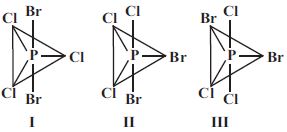
$PCl_3Br_2$ exhibits geometric isomerism,and its geometric isomers are shown below. Which of these does not have a dipole moment?
A
$I$ and $III$
B
Only $III$
C
$I$ and $II$
D
Only $I$
Solution
(D) The molecule $PCl_3Br_2$ has a trigonal bipyramidal geometry.
For a molecule to have a zero dipole moment,it must be non-polar,meaning the individual bond dipoles must cancel each other out.
In structure $I$,the two $Br$ atoms are in the axial positions,and the three $Cl$ atoms are in the equatorial positions. The axial $P-Br$ bonds cancel each other,and the three equatorial $P-Cl$ bonds are arranged at $120^{\circ}$ to each other,resulting in a net dipole moment of zero.
In structure $II$ and $III$,the arrangement of $Cl$ and $Br$ atoms is such that the bond dipoles do not cancel out,resulting in a non-zero net dipole moment.
Therefore,only structure $I$ has a dipole moment of zero.
For a molecule to have a zero dipole moment,it must be non-polar,meaning the individual bond dipoles must cancel each other out.
In structure $I$,the two $Br$ atoms are in the axial positions,and the three $Cl$ atoms are in the equatorial positions. The axial $P-Br$ bonds cancel each other,and the three equatorial $P-Cl$ bonds are arranged at $120^{\circ}$ to each other,resulting in a net dipole moment of zero.
In structure $II$ and $III$,the arrangement of $Cl$ and $Br$ atoms is such that the bond dipoles do not cancel out,resulting in a non-zero net dipole moment.
Therefore,only structure $I$ has a dipole moment of zero.
0 likes
View Solution186
MediumMCQ
Which of the following molecules has the highest dipole moment?
A
$BCl_3$
B
$NH_3$
C
$PCl_5$
D
$H_2O$
Solution
(D) The dipole moment of a molecule depends on its geometry and the electronegativity difference between the bonded atoms.
$1$. $BCl_3$ is a trigonal planar molecule with a symmetric structure,resulting in a net dipole moment of $0$.
$2$. $PCl_5$ is a trigonal bipyramidal molecule with a symmetric structure,resulting in a net dipole moment of $0$.
$3$. $NH_3$ has a pyramidal geometry with a lone pair on the nitrogen atom. Its dipole moment is approximately $1.47 \ D$.
$4$. $H_2O$ has a bent geometry. The bond dipoles of the two $O-H$ bonds and the lone pairs on the oxygen atom reinforce each other,resulting in a higher net dipole moment of approximately $1.85 \ D$.
Therefore,$H_2O$ has the highest dipole moment among the given options.
$1$. $BCl_3$ is a trigonal planar molecule with a symmetric structure,resulting in a net dipole moment of $0$.
$2$. $PCl_5$ is a trigonal bipyramidal molecule with a symmetric structure,resulting in a net dipole moment of $0$.
$3$. $NH_3$ has a pyramidal geometry with a lone pair on the nitrogen atom. Its dipole moment is approximately $1.47 \ D$.
$4$. $H_2O$ has a bent geometry. The bond dipoles of the two $O-H$ bonds and the lone pairs on the oxygen atom reinforce each other,resulting in a higher net dipole moment of approximately $1.85 \ D$.
Therefore,$H_2O$ has the highest dipole moment among the given options.
0 likes
View Solution187
MediumMCQ
Which one of the following molecules is polar?
A
$I_3^{-}$
B
$CO_3^{2-}$
C
$XeF_4$
D
$PH_3$
Solution
(D) To determine polarity,we look at the molecular geometry and the net dipole moment.
$I_3^{-}$ is linear with a net dipole moment of $0$.
$CO_3^{2-}$ is trigonal planar with a net dipole moment of $0$.
$XeF_4$ is square planar with a net dipole moment of $0$.
$PH_3$ has a pyramidal geometry due to the presence of one lone pair on the phosphorus atom,which results in a non-zero net dipole moment.
Therefore,$PH_3$ is a polar molecule.
$I_3^{-}$ is linear with a net dipole moment of $0$.
$CO_3^{2-}$ is trigonal planar with a net dipole moment of $0$.
$XeF_4$ is square planar with a net dipole moment of $0$.
$PH_3$ has a pyramidal geometry due to the presence of one lone pair on the phosphorus atom,which results in a non-zero net dipole moment.
Therefore,$PH_3$ is a polar molecule.
0 likes
View Solution188
MediumMCQ
If $H-X$ bond length is $2 \ \mathring{A}$ and $H-X$ has dipole moment $5.12 \times 10^{-30} \ C \cdot m$,the $\%$ of covalent character of the molecule is ............. $\%$
A
$10$
B
$16$
C
$18$
D
$84$
Solution
(D) The theoretical dipole moment $(\mu_{Cal})$ for a $100 \%$ ionic bond is calculated as: $\mu_{Cal} = q \times d = (1.6 \times 10^{-19} \ C) \times (2 \times 10^{-10} \ m) = 3.2 \times 10^{-29} \ C \cdot m$.
The percentage of ionic character is given by: $\% \text{ ionic character} = (\mu_{exp} / \mu_{Cal}) \times 100 = (5.12 \times 10^{-30} / 3.2 \times 10^{-29}) \times 100 = 16 \%$.
The percentage of covalent character is: $\% \text{ covalent character} = 100 - \% \text{ ionic character} = 100 - 16 = 84 \%$.
The percentage of ionic character is given by: $\% \text{ ionic character} = (\mu_{exp} / \mu_{Cal}) \times 100 = (5.12 \times 10^{-30} / 3.2 \times 10^{-29}) \times 100 = 16 \%$.
The percentage of covalent character is: $\% \text{ covalent character} = 100 - \% \text{ ionic character} = 100 - 16 = 84 \%$.
0 likes
View Solution189
MediumMCQ
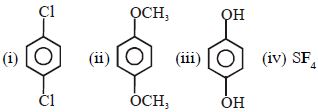
In which of the following species is the dipole moment non-zero?
A
$i, ii, iii$
B
Only $iv$
C
$ii, iii$ and $iv$
D
All
Solution
(C) The dipole moment of a molecule is non-zero if the vector sum of the individual bond dipoles is not zero.
$(i)$ $p$-dichlorobenzene: The two $C-Cl$ bonds are in opposite directions,so their dipole moments cancel out. $\mu = 0$.
(ii) $p$-dimethoxybenzene: Due to the rotation of the $-OCH_3$ groups,the molecule can exist in conformations where the dipole moments do not cancel out. Thus,$\mu \neq 0$.
(iii) $p$-dihydroxybenzene (hydroquinone): Similar to $p$-dimethoxybenzene,the rotation of the $-OH$ groups results in a non-zero net dipole moment. $\mu \neq 0$.
(iv) $SF_4$: It has a see-saw geometry with a lone pair on the sulfur atom. The molecule is asymmetric,so the dipole moments do not cancel out. $\mu \neq 0$.
Therefore,species (ii),(iii),and (iv) have non-zero dipole moments.
$(i)$ $p$-dichlorobenzene: The two $C-Cl$ bonds are in opposite directions,so their dipole moments cancel out. $\mu = 0$.
(ii) $p$-dimethoxybenzene: Due to the rotation of the $-OCH_3$ groups,the molecule can exist in conformations where the dipole moments do not cancel out. Thus,$\mu \neq 0$.
(iii) $p$-dihydroxybenzene (hydroquinone): Similar to $p$-dimethoxybenzene,the rotation of the $-OH$ groups results in a non-zero net dipole moment. $\mu \neq 0$.
(iv) $SF_4$: It has a see-saw geometry with a lone pair on the sulfur atom. The molecule is asymmetric,so the dipole moments do not cancel out. $\mu \neq 0$.
Therefore,species (ii),(iii),and (iv) have non-zero dipole moments.
0 likes
View Solution190
DifficultMCQ
Which of the following molecules has a net dipole moment of zero?
A
$1, 1-$ Dichloroethylene
B
$cis-1, 2-$ Dichloroethylene
C
$trans-1, 2-$ Dichloroethylene
D
None of these
Solution
(C) The dipole moment of a molecule is a vector quantity. For a molecule to have a net dipole moment of zero,the individual bond dipoles must cancel each other out due to the symmetry of the molecule.
In $trans-1, 2-$ Dichloroethylene,the two $C-Cl$ bonds are oriented in opposite directions at an angle of $180^{\circ}$ to each other.
Since the electronegativity of $Cl$ is greater than $C$,the bond dipoles point towards the $Cl$ atoms.
Because the molecule is centrosymmetric,these two equal and opposite bond dipoles cancel each other out,resulting in a net dipole moment of $\mu = 0$.
In $trans-1, 2-$ Dichloroethylene,the two $C-Cl$ bonds are oriented in opposite directions at an angle of $180^{\circ}$ to each other.
Since the electronegativity of $Cl$ is greater than $C$,the bond dipoles point towards the $Cl$ atoms.
Because the molecule is centrosymmetric,these two equal and opposite bond dipoles cancel each other out,resulting in a net dipole moment of $\mu = 0$.
0 likes
View Solution191
MediumMCQ
Which of the following represents the correct decreasing order of dipole moment?
A
$CH_3Cl > CH_3F > CH_3Br$
B
$CH_3Cl > CH_3Br > CH_3F$
C
$CH_3F > CH_3Cl > CH_3Br$
D
$CH_3Br > CH_3Cl > CH_3F$
Solution
(A) The dipole moment $(\mu)$ depends on both the electronegativity difference and the bond length.
For methyl halides $(CH_3X)$, the electronegativity decreases in the order $F > Cl > Br > I$.
However, the bond length increases in the order $C-F < C-Cl < C-Br < C-I$.
In $CH_3Cl$, the effect of the larger bond length of $C-Cl$ compared to $C-F$ outweighs the higher electronegativity of $F$.
Thus, the dipole moment order is $CH_3Cl > CH_3F > CH_3Br$.
For methyl halides $(CH_3X)$, the electronegativity decreases in the order $F > Cl > Br > I$.
However, the bond length increases in the order $C-F < C-Cl < C-Br < C-I$.
In $CH_3Cl$, the effect of the larger bond length of $C-Cl$ compared to $C-F$ outweighs the higher electronegativity of $F$.
Thus, the dipole moment order is $CH_3Cl > CH_3F > CH_3Br$.
0 likes
View Solution192
AdvancedMCQ
The percentage ionic character of the $HBr$ molecule, if the dipole moment is $0.63 \ D$ and $HBr$ bond length is $187.5 \ pm$, is:
A
$17$
B
$7$
C
$27$
D
$47$
Solution
(B) The theoretical dipole moment $(\mu_{calc})$ for $100 \%$ ionic character is calculated using the formula $\mu = q \times d$.
Given $q = 4.8 \times 10^{-10} \ esu$ (charge of an electron) and $d = 187.5 \ pm = 187.5 \times 10^{-10} \ cm$.
$\mu_{calc} = 4.8 \times 10^{-10} \ esu \times 187.5 \times 10^{-10} \ cm = 900 \times 10^{-20} \ esu \ cm = 9 \times 10^{-18} \ esu \ cm = 9 \ D$.
Given observed dipole moment $\mu_{obs} = 0.63 \ D$.
Percentage ionic character $= (\mu_{obs} / \mu_{calc}) \times 100$.
Percentage ionic character $= (0.63 / 9) \times 100 = 7 \%$.
Given $q = 4.8 \times 10^{-10} \ esu$ (charge of an electron) and $d = 187.5 \ pm = 187.5 \times 10^{-10} \ cm$.
$\mu_{calc} = 4.8 \times 10^{-10} \ esu \times 187.5 \times 10^{-10} \ cm = 900 \times 10^{-20} \ esu \ cm = 9 \times 10^{-18} \ esu \ cm = 9 \ D$.
Given observed dipole moment $\mu_{obs} = 0.63 \ D$.
Percentage ionic character $= (\mu_{obs} / \mu_{calc}) \times 100$.
Percentage ionic character $= (0.63 / 9) \times 100 = 7 \%$.
0 likes
View Solution193
MediumMCQ
Which of the following has been arranged in order of decreasing dipole moment?
A
$CH_3Cl > CH_3F > CH_3Br > CH_3I$
B
$CH_3F > CH_3Cl > CH_3Br > CH_3I$
C
$CH_3Cl > CH_3Br > CH_3I > CH_3F$
D
$CH_3F > CH_3Cl > CH_3I > CH_3Br$
Solution
(A) The dipole moment $(\mu)$ is defined as the product of the magnitude of the charge $(q)$ and the distance $(d)$ between the charges,given by the formula $\mu = q \times d$.
Although fluorine is more electronegative than chlorine,the $C-Cl$ bond length is significantly larger than the $C-F$ bond length.
This larger bond distance in $CH_3Cl$ outweighs the higher electronegativity of fluorine in $CH_3F$,resulting in a higher dipole moment for $CH_3Cl$ compared to $CH_3F$.
Therefore,the correct order of decreasing dipole moment is $CH_3Cl > CH_3F > CH_3Br > CH_3I$.
Although fluorine is more electronegative than chlorine,the $C-Cl$ bond length is significantly larger than the $C-F$ bond length.
This larger bond distance in $CH_3Cl$ outweighs the higher electronegativity of fluorine in $CH_3F$,resulting in a higher dipole moment for $CH_3Cl$ compared to $CH_3F$.
Therefore,the correct order of decreasing dipole moment is $CH_3Cl > CH_3F > CH_3Br > CH_3I$.
0 likes
View Solution194
MediumMCQ
The critical temperature of water is higher than that of $O_2$ because $H_2O$ molecules have ......
A
fewer electrons than oxygen
B
two covalent bonds
C
$V$-shape
D
dipole moment
Solution
(D) The critical temperature of a gas depends on the magnitude of intermolecular forces of attraction.
$H_2O$ is a polar molecule with a significant dipole moment,which leads to strong intermolecular hydrogen bonding.
In contrast,$O_2$ is a non-polar molecule with only weak London dispersion forces.
Stronger intermolecular forces in $H_2O$ result in a higher critical temperature compared to $O_2$.
$H_2O$ is a polar molecule with a significant dipole moment,which leads to strong intermolecular hydrogen bonding.
In contrast,$O_2$ is a non-polar molecule with only weak London dispersion forces.
Stronger intermolecular forces in $H_2O$ result in a higher critical temperature compared to $O_2$.
0 likes
View Solution195
MediumMCQ
Which of the following bonds has the highest polarity?
A
$C-O$
B
$C-Br$
C
$C-S$
D
$C-F$
Solution
(D) The polarity of a covalent bond depends on the difference in electronegativity between the two bonded atoms. The greater the electronegativity difference,the higher the polarity of the bond. The electronegativity values of the atoms involved are: $C = 2.55$,$O = 3.44$,$Br = 2.96$,$S = 2.58$,and $F = 3.98$. The electronegativity differences are:
$C-O: |3.44 - 2.55| = 0.89$
$C-Br: |2.96 - 2.55| = 0.41$
$C-S: |2.58 - 2.55| = 0.03$
$C-F: |3.98 - 2.55| = 1.43$
Since the difference is highest for the $C-F$ bond,it is the most polar bond.
$C-O: |3.44 - 2.55| = 0.89$
$C-Br: |2.96 - 2.55| = 0.41$
$C-S: |2.58 - 2.55| = 0.03$
$C-F: |3.98 - 2.55| = 1.43$
Since the difference is highest for the $C-F$ bond,it is the most polar bond.
0 likes
View Solution196
EasyMCQ
Which of the following arrangements of molecules is correct with respect to their dipole moment?
A
$BF_3 < NF_3 < NH_3$
B
$NF_3 < BF_3 < NH_3$
C
$NH_3 < BF_3 < NF_3$
D
$NH_3 < NF_3 < BF_3$
Solution
(A) $1$. $BF_3$ is a planar molecule with a trigonal planar geometry. The bond moments of the three $B-F$ bonds cancel each other out,resulting in a net dipole moment of $0 \ D$.
$2$. In $NH_3$ and $NF_3$,both have a pyramidal geometry with a lone pair on the nitrogen atom.
$3$. In $NH_3$,the direction of the dipole moment of the $N-H$ bonds and the lone pair are in the same direction,which adds up to a higher value $(1.46 \ D)$.
$4$. In $NF_3$,the $N-F$ bond moments are in the opposite direction to the lone pair moment,which partially cancels out,resulting in a lower value $(0.24 \ D)$.
$5$. Therefore,the correct order of dipole moment is $BF_3 (0 \ D) < NF_3 (0.24 \ D) < NH_3 (1.46 \ D)$.
$2$. In $NH_3$ and $NF_3$,both have a pyramidal geometry with a lone pair on the nitrogen atom.
$3$. In $NH_3$,the direction of the dipole moment of the $N-H$ bonds and the lone pair are in the same direction,which adds up to a higher value $(1.46 \ D)$.
$4$. In $NF_3$,the $N-F$ bond moments are in the opposite direction to the lone pair moment,which partially cancels out,resulting in a lower value $(0.24 \ D)$.
$5$. Therefore,the correct order of dipole moment is $BF_3 (0 \ D) < NF_3 (0.24 \ D) < NH_3 (1.46 \ D)$.
0 likes
View Solution197
EasyMCQ
How can the charge distribution in iodine monochloride $(ICl)$ be represented?
A
$I^+Cl^-$
B
$I^{\delta+}Cl^{\delta-}$
C
$I^-Cl^+$
D
$I^{\delta-}Cl^{\delta+}$
Solution
(B) Iodine $(I)$ has a lower electronegativity $(2.66)$ compared to Chlorine ($Cl$,$3.16$).
Due to this difference in electronegativity,the shared pair of electrons in the $I-Cl$ bond is shifted towards the more electronegative Chlorine atom.
This results in the development of a partial negative charge $(\delta-)$ on the Chlorine atom and a partial positive charge $(\delta+)$ on the Iodine atom.
Therefore,the charge distribution is represented as $I^{\delta+}Cl^{\delta-}$.
Due to this difference in electronegativity,the shared pair of electrons in the $I-Cl$ bond is shifted towards the more electronegative Chlorine atom.
This results in the development of a partial negative charge $(\delta-)$ on the Chlorine atom and a partial positive charge $(\delta+)$ on the Iodine atom.
Therefore,the charge distribution is represented as $I^{\delta+}Cl^{\delta-}$.
0 likes
View Solution198
MediumMCQ
Which of the following molecules has the highest dipole moment?
A
$B_2H_6$
B
$NF_3$
C
$NH_3$
D
$BF_3$
Solution
(C) $BF_3$ and $B_2H_6$ are non-polar molecules and have a net dipole moment of $0 \ D$.
In $NF_3$,the highly electronegative $F$ atoms pull the electron density away from the $N$ atom,such that the resultant dipole moment of the three $N-F$ bonds opposes the dipole moment of the lone pair on the $N$ atom.
In $NH_3$,the dipole moments of the three $N-H$ bonds are in the same direction as the dipole moment of the lone pair on the $N$ atom.
Therefore,the bond moments add up in $NH_3$,resulting in the highest dipole moment among the given options.
In $NF_3$,the highly electronegative $F$ atoms pull the electron density away from the $N$ atom,such that the resultant dipole moment of the three $N-F$ bonds opposes the dipole moment of the lone pair on the $N$ atom.
In $NH_3$,the dipole moments of the three $N-H$ bonds are in the same direction as the dipole moment of the lone pair on the $N$ atom.
Therefore,the bond moments add up in $NH_3$,resulting in the highest dipole moment among the given options.
0 likes
View Solution199
DifficultMCQ
Assertion : Molecules of larger size have higher polarizability.
Reason : Polarizability is observed only in those molecules which have a permanent dipole moment.
Reason : Polarizability is observed only in those molecules which have a permanent dipole moment.
A
If both Assertion and Reason are correct and the Reason is a correct explanation of the Assertion.
B
If both Assertion and Reason are correct but Reason is not a correct explanation of the Assertion.
C
If the Assertion is correct but Reason is incorrect.
D
If both the Assertion and Reason are incorrect.
Solution
(C) The Assertion is correct because larger molecules have more loosely held electrons,making them more polarizable.
The Reason is incorrect because polarizability is a property of all molecules,regardless of whether they have a permanent dipole moment or not.
Non-polar molecules (like $H_2$,$O_2$,or $CH_4$) also exhibit polarizability due to induced dipoles.
The Reason is incorrect because polarizability is a property of all molecules,regardless of whether they have a permanent dipole moment or not.
Non-polar molecules (like $H_2$,$O_2$,or $CH_4$) also exhibit polarizability due to induced dipoles.
0 likes
View Solution200
EasyMCQ
$A$ neutral molecule $XF_3$ has a zero dipole moment. The element $X$ is most likely
A
chlorine
B
boron
C
nitrogen
D
carbon
Solution
(B) $BF_3$ has a planar trigonal structure with bond angles of $120^{\circ}$.
Due to its symmetrical geometry,the resultant dipole moment of two $B-F$ bonds is equal and opposite to the third $B-F$ bond.
Therefore,the net dipole moment of the $BF_3$ molecule is zero.
Due to its symmetrical geometry,the resultant dipole moment of two $B-F$ bonds is equal and opposite to the third $B-F$ bond.
Therefore,the net dipole moment of the $BF_3$ molecule is zero.
0 likes
View SolutionChemical Bonding and Molecular Structure — Dipole moment · Frequently Asked Questions
1Are these Chemical Bonding and Molecular Structure questions useful for JEE and NEET?
Yes. All questions in this section are mapped to JEE Main and NEET exam patterns. Previous year questions from JEE Main, NEET, GUJCET and state-level exams are included with full solutions.
2Can I switch to Hindi or Gujarati for these questions?
Yes. Use the language tabs in the hero section or the sidebar to view the same questions and solutions in English, Hindi or Gujarati.
3How do I generate a question paper from this subtopic?
Use the Vedclass Exam Paper Generator — select the chapter and subtopic, set difficulty, and generate Sets A, B, C, D automatically. First 3 chapters of every subject are free.
Vedclass Products
For Students
Vedclass Test Series
Mock tests in real JEE/NEET style with performance analysis. 5-day free trial.
Start Free TrialFor Teachers
Exam Paper Generator
Generate Set A/B/C/D papers from this chapter in 2 minutes. 3 chapters free.
Try FreeFor Institutes
Online Exam Module
Live online exams with unlimited students, 360° analytics & white-label branding.
See DemoFor Teachers & Institutes
Generate a Chemical Bonding and Molecular Structure Exam Paper in 2 Minutes
Select subtopic & difficulty — Sets A, B, C, D auto-generated with No Repeat logic.
First 3 chapters of every subject are free — no payment required.