
An electrophile $E^{\oplus}$ attacks the benzene ring to form an intermediate $\sigma$-complex. Which of the following $\sigma$-complexes has the lowest energy?
- A
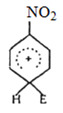
- B

- C
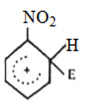
- D
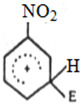
Explore More
Similar Questions
If heterolytic and homolytic cleavage of a bond occurs,then which types of reactions occur?
Medium
View SolutionConsider the above reaction,the major product $P$ formed is:
DifficultJEE MAIN 2021
View SolutionIn the following reaction,compound $Q$ is obtained from compound $P$ via an ionic intermediate. What is the degree of unsaturation of $Q$?
DifficultIIT 2020
View SolutionThe major product in the following reaction is
DifficultJEE MAIN 2019
View SolutionMatch the reactions in Column-$(I)$ with the type of reaction mechanism in Column-$(II)$.
Column-$(I)$ (Reaction) Column-$(II)$ (Type of Reaction) $(A)$ $\text{Cyclohexene} + Br_2 \xrightarrow{\Delta, uv} \text{3-Bromocyclohexene}$ $(i)$ $\text{Nucleophilic substitution}$ $(B)$ $\text{4-Hydroxybenzyl alcohol} + HCl \xrightarrow{\Delta} \text{4-Hydroxybenzyl chloride}$ $(ii)$ $\text{Electrophilic addition}$ $(C)$ $\text{Cyclohexene} + Br_2 \xrightarrow{CCl_4} \text{1,2-Dibromocyclohexane}$ $(iii)$ $\text{Free radical substitution}$ $(D)$ $\text{Toluene} + Cl_2 \xrightarrow{Fe, \text{dark}} \text{o/p-Chlorotoluene}$ $(iv)$ $\text{Electrophilic aromatic substitution}$
| Column-$(I)$ (Reaction) | Column-$(II)$ (Type of Reaction) |
|---|---|
| $(A)$ $\text{Cyclohexene} + Br_2 \xrightarrow{\Delta, uv} \text{3-Bromocyclohexene}$ | $(i)$ $\text{Nucleophilic substitution}$ |
| $(B)$ $\text{4-Hydroxybenzyl alcohol} + HCl \xrightarrow{\Delta} \text{4-Hydroxybenzyl chloride}$ | $(ii)$ $\text{Electrophilic addition}$ |
| $(C)$ $\text{Cyclohexene} + Br_2 \xrightarrow{CCl_4} \text{1,2-Dibromocyclohexane}$ | $(iii)$ $\text{Free radical substitution}$ |
| $(D)$ $\text{Toluene} + Cl_2 \xrightarrow{Fe, \text{dark}} \text{o/p-Chlorotoluene}$ | $(iv)$ $\text{Electrophilic aromatic substitution}$ |
Medium
View SolutionVedclass Products
For Students
Vedclass Test Series
Mock tests in real JEE/NEET style with performance analysis. 5-day free trial.
Start Free TrialFor Teachers
Exam Paper Generator
Generate Set A/B/C/D exam papers from 7.5L+ questions in 2 minutes. 3 chapters free.
Try FreeFor Institutes
Online Exam Module
Live online exams with unlimited students, 360° analytics & white-label branding.
See Demo