
A English
Electronic Displacement in covalent bond Questions in English
Class 11 Chemistry · 8-4.Organic Chemistry : Reaction mechanism · Electronic Displacement in covalent bond
210+
Questions
English
Language
100%
With Solutions
Showing 50 of 210 questions in English
151
DifficultMCQ
The total number of contributing structures showing hyperconjugation (involving $C-H$ bonds) for the following carbocation is
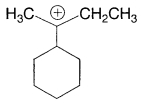
A
$4$
B
$5$
C
$6$
D
$7$
Solution
(C) The carbon atom directly attached to the positively charged carbon is called the $\alpha$-carbon,and the hydrogen atoms attached to these $\alpha$-carbons are called $\alpha$-hydrogens.
In the given carbocation,the central carbocation is attached to:
$1$. $A$ methyl group $(-CH_3)$,which has $3$ $\alpha$-hydrogens.
$2$. An ethyl group $(-CH_2CH_3)$,which has $2$ $\alpha$-hydrogens.
$3$. $A$ cyclohexyl group,which has $1$ $\alpha$-hydrogen (at the bridgehead position attached to the carbocation).
Total number of $\alpha$-hydrogens = $3 + 2 + 1 = 6$.
The number of hyperconjugative structures is equal to the number of $\alpha$-hydrogens,which is $6$.
In the given carbocation,the central carbocation is attached to:
$1$. $A$ methyl group $(-CH_3)$,which has $3$ $\alpha$-hydrogens.
$2$. An ethyl group $(-CH_2CH_3)$,which has $2$ $\alpha$-hydrogens.
$3$. $A$ cyclohexyl group,which has $1$ $\alpha$-hydrogen (at the bridgehead position attached to the carbocation).
Total number of $\alpha$-hydrogens = $3 + 2 + 1 = 6$.
The number of hyperconjugative structures is equal to the number of $\alpha$-hydrogens,which is $6$.
0 likes
View Solution152
MediumMCQ
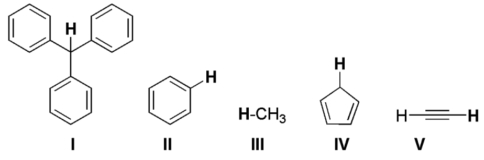
With respect to the compounds $I-V$,choose the correct statement$(s)$.
$(A)$ The acidity of compound $I$ is due to delocalization in the conjugate base.
$(B)$ The conjugate base of compound $IV$ is aromatic.
$(C)$ Compound $II$ becomes more acidic,when it has a $-NO_2$ substituent.
$(D)$ The acidity of compounds follows the order $IV > V > I > II > III$.
$(A)$ The acidity of compound $I$ is due to delocalization in the conjugate base.
$(B)$ The conjugate base of compound $IV$ is aromatic.
$(C)$ Compound $II$ becomes more acidic,when it has a $-NO_2$ substituent.
$(D)$ The acidity of compounds follows the order $IV > V > I > II > III$.
A
$B, C, D$
B
$B, C$
C
$A, B, C$
D
$B, D$
Solution
(C) The acidity of a compound depends on the stability of its conjugate base.
$(A)$ The conjugate base of compound $I$ (triphenylmethane) is a triphenylmethyl carbanion,which is resonance-stabilized by three phenyl rings. Thus,statement $(A)$ is correct.
$(B)$ The conjugate base of compound $IV$ (cyclopentadiene) is the cyclopentadienyl anion,which has $6\pi$ electrons and is aromatic. Thus,statement $(B)$ is correct.
$(C)$ The $-NO_2$ group is a strong electron-withdrawing group ($-I$ and $-M$ effect). When attached to benzene (compound $II$),it stabilizes the conjugate base (phenyl anion) by withdrawing electron density,thereby increasing the acidity. Thus,statement $(C)$ is correct.
$(D)$ Based on $pK_a$ values: $IV$ $(16)$ > $V$ $(25)$ > $I$ $(33.3)$ > $II$ $(43)$ > $III$ $(50)$. The order of acidity is $IV > V > I > II > III$. Thus,statement $(D)$ is correct.
Therefore,statements $(A), (B), (C),$ and $(D)$ are all correct. However,given the options,the most appropriate choice is $(C)$.
$(A)$ The conjugate base of compound $I$ (triphenylmethane) is a triphenylmethyl carbanion,which is resonance-stabilized by three phenyl rings. Thus,statement $(A)$ is correct.
$(B)$ The conjugate base of compound $IV$ (cyclopentadiene) is the cyclopentadienyl anion,which has $6\pi$ electrons and is aromatic. Thus,statement $(B)$ is correct.
$(C)$ The $-NO_2$ group is a strong electron-withdrawing group ($-I$ and $-M$ effect). When attached to benzene (compound $II$),it stabilizes the conjugate base (phenyl anion) by withdrawing electron density,thereby increasing the acidity. Thus,statement $(C)$ is correct.
$(D)$ Based on $pK_a$ values: $IV$ $(16)$ > $V$ $(25)$ > $I$ $(33.3)$ > $II$ $(43)$ > $III$ $(50)$. The order of acidity is $IV > V > I > II > III$. Thus,statement $(D)$ is correct.
Therefore,statements $(A), (B), (C),$ and $(D)$ are all correct. However,given the options,the most appropriate choice is $(C)$.
0 likes
View Solution153
MediumMCQ
The hyperconjugative stabilities of tert-butyl cation and $2-$butene,respectively,are due to
A
$\sigma \rightarrow p$ (empty) and $\sigma \rightarrow \pi^{\star}$ electron delocalisations.
B
$\sigma \rightarrow \sigma^{\star}$ and $\sigma \rightarrow \pi$ electron delocalisations.
C
$\sigma \rightarrow p$ (filled) and $\sigma \rightarrow \pi$ electron delocalisations.
D
$p$ (filled) $\rightarrow \sigma^{\star}$ and $\sigma \rightarrow \pi^{\star}$ electron delocalisations.
Solution
(A) In the tert-butyl cation,the carbon atom bearing the positive charge has one vacant $p$ orbital. Therefore,the stability is due to $\sigma \rightarrow p$ (empty) orbital delocalization,which is a form of hyperconjugation.
In $2-$butene,the stability is due to hyperconjugation involving the delocalization of electrons from a $\sigma$ bond ($C$-$H$) into the $\pi^{\star}$ antibonding molecular orbital of the double bond,represented as $\sigma \rightarrow \pi^{\star}$ delocalization.
In $2-$butene,the stability is due to hyperconjugation involving the delocalization of electrons from a $\sigma$ bond ($C$-$H$) into the $\pi^{\star}$ antibonding molecular orbital of the double bond,represented as $\sigma \rightarrow \pi^{\star}$ delocalization.
0 likes
View Solution154
DifficultMCQ
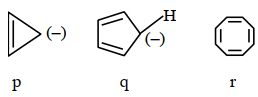
The correct stability order of the following species/molecules is:
A
$q > r > p$
B
$r > q > p$
C
$q > p > r$
D
$p > q > r$
Solution
(A) To determine the stability,we analyze the aromaticity of each species:
$1$. Species $p$ is the cyclopropenyl anion. It has $4n$ $\pi$ electrons ($4$ $\pi$ electrons),making it antiaromatic,which is highly unstable.
$2$. Species $q$ is the cyclopentadienyl anion. It has $4n+2$ $\pi$ electrons ($6$ $\pi$ electrons),making it aromatic,which is highly stable.
$3$. Species $r$ is cyclooctatetraene. It is non-aromatic because it adopts a non-planar tub-shaped conformation to avoid antiaromaticity,making it more stable than antiaromatic species but less stable than aromatic ones.
Therefore,the stability order is $q$ (aromatic) $> r$ (non-aromatic) $> p$ (antiaromatic).
The correct option is $A$.
$1$. Species $p$ is the cyclopropenyl anion. It has $4n$ $\pi$ electrons ($4$ $\pi$ electrons),making it antiaromatic,which is highly unstable.
$2$. Species $q$ is the cyclopentadienyl anion. It has $4n+2$ $\pi$ electrons ($6$ $\pi$ electrons),making it aromatic,which is highly stable.
$3$. Species $r$ is cyclooctatetraene. It is non-aromatic because it adopts a non-planar tub-shaped conformation to avoid antiaromaticity,making it more stable than antiaromatic species but less stable than aromatic ones.
Therefore,the stability order is $q$ (aromatic) $> r$ (non-aromatic) $> p$ (antiaromatic).
The correct option is $A$.
0 likes
View Solution155
MediumMCQ
Given below are two statements $:$
Statement $I :$ Hyperconjugation is not a permanent effect.
Statement $II :$ In general,greater the number of alkyl groups attached to a positively charged $C$ atom,greater is the hyperconjugation interaction and stabilization of the cation.
In the light of the above statements,choose the correct answer from the options given below
Statement $I :$ Hyperconjugation is not a permanent effect.
Statement $II :$ In general,greater the number of alkyl groups attached to a positively charged $C$ atom,greater is the hyperconjugation interaction and stabilization of the cation.
In the light of the above statements,choose the correct answer from the options given below
A
Statement $I$ is true but Statement $II$ is false
B
Both Statement $I$ and Statement $II$ are false
C
Statement $I$ is false but Statement $II$ is true
D
Both Statement $I$ and Statement $II$ are true
Solution
(C) Hyperconjugation is a permanent electronic effect because it involves the delocalization of $\sigma$-electrons of a $C-H$ bond into an adjacent empty $p$-orbital,and it does not require an external reagent. Therefore,Statement-$I$ is false.
Statement-$II$ is true because the presence of more alkyl groups attached to a positively charged $C$ atom increases the number of $\alpha-H$ atoms available for hyperconjugation,which leads to greater stabilization of the carbocation.
Statement-$II$ is true because the presence of more alkyl groups attached to a positively charged $C$ atom increases the number of $\alpha-H$ atoms available for hyperconjugation,which leads to greater stabilization of the carbocation.
0 likes
View Solution156
MediumMCQ
In which of the following does the hyperconjugation effect operate?
A
$CH_2=CH-CH_2^+$
B
$CH_3-CH=CH-CH_2^+$
C
$CH_2=CH-CH(C_6H_5)^+$
D
None of these
Solution
(D) Hyperconjugation requires the presence of an $\alpha$-hydrogen atom on a carbon atom adjacent to an unsaturated system (like a double bond or a carbocation).
In option $A$,$CH_2=CH-CH_2^+$,the carbocation is adjacent to a double bond,but there are no $\alpha$-hydrogens on the $sp^2$ hybridized carbons attached to the positive charge.
In option $B$,$CH_3-CH=CH-CH_2^+$,the carbocation is adjacent to a double bond,but the adjacent carbon $(CH)$ has only one hydrogen. However,hyperconjugation typically refers to the interaction of $\sigma$-electrons of a $C-H$ bond with an adjacent empty $p$-orbital.
Actually,in $CH_3-CH=CH-CH_2^+$,the $CH_3$ group is not directly attached to the carbocationic center.
However,looking at the standard definition,hyperconjugation occurs in alkyl carbocations like $CH_3-CH_2^+$.
None of the provided structures represent a simple alkyl carbocation with $\alpha$-hydrogens directly attached to the cationic carbon.
Therefore,the correct answer is $D$.
In option $A$,$CH_2=CH-CH_2^+$,the carbocation is adjacent to a double bond,but there are no $\alpha$-hydrogens on the $sp^2$ hybridized carbons attached to the positive charge.
In option $B$,$CH_3-CH=CH-CH_2^+$,the carbocation is adjacent to a double bond,but the adjacent carbon $(CH)$ has only one hydrogen. However,hyperconjugation typically refers to the interaction of $\sigma$-electrons of a $C-H$ bond with an adjacent empty $p$-orbital.
Actually,in $CH_3-CH=CH-CH_2^+$,the $CH_3$ group is not directly attached to the carbocationic center.
However,looking at the standard definition,hyperconjugation occurs in alkyl carbocations like $CH_3-CH_2^+$.
None of the provided structures represent a simple alkyl carbocation with $\alpha$-hydrogens directly attached to the cationic carbon.
Therefore,the correct answer is $D$.
0 likes
View Solution157
MediumMCQ
Which of the following electromeric effect representations is incorrect?
A
$>C=O \rightarrow >\stackrel{\oplus}{C}-\stackrel{\ominus}{O}$
B
$CH_3-CH=CH_2 \rightarrow CH_3-\stackrel{\oplus}{CH}-\stackrel{\ominus}{CH_2}$
C
$CH_3-C\equiv N \rightarrow CH_3-\stackrel{\ominus}{C}=\stackrel{\oplus}{N}$
D
$CH\equiv CH \rightarrow \stackrel{\oplus}{C}H=\stackrel{\ominus}{C}H$
Solution
(C) The electromeric effect ($E$-effect) is a temporary effect involving the complete transfer of a shared pair of $\pi$-electrons to one of the atoms joined by a multiple bond at the request of an attacking reagent.
In option $C$,the structure $CH_3-C\equiv N \rightarrow CH_3-\stackrel{\ominus}{C}=\stackrel{\oplus}{N}$ is incorrect because nitrogen is more electronegative than carbon.
When the $\pi$-electrons of the $C\equiv N$ bond shift,they should shift towards the more electronegative nitrogen atom,resulting in $CH_3-\stackrel{\oplus}{C}=\stackrel{\ominus}{N}$.
Therefore,the representation in option $C$ is wrong.
In option $C$,the structure $CH_3-C\equiv N \rightarrow CH_3-\stackrel{\ominus}{C}=\stackrel{\oplus}{N}$ is incorrect because nitrogen is more electronegative than carbon.
When the $\pi$-electrons of the $C\equiv N$ bond shift,they should shift towards the more electronegative nitrogen atom,resulting in $CH_3-\stackrel{\oplus}{C}=\stackrel{\ominus}{N}$.
Therefore,the representation in option $C$ is wrong.
0 likes
View Solution158
MediumMCQ
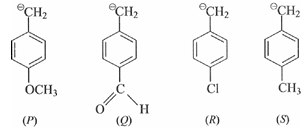
Arrange the following carbanions in decreasing order of stability $:$
A
$Q > R > P > S$
B
$R > Q > P > S$
C
$Q > R > S > P$
D
$P > Q > R > S$
Solution
(C) The stability of carbanions is increased by electron-withdrawing groups ($-I$ or $-M$ effect) and decreased by electron-donating groups ($+I$ or $+M$ effect).
$1.$ In $(Q)$,the $-CHO$ group is a strong electron-withdrawing group ($-I$ and $-M$ effect),which stabilizes the negative charge significantly.
$2.$ In $(R)$,the $-Cl$ group has a $-I$ effect (electron-withdrawing) but a $+M$ effect (electron-donating). The $-I$ effect dominates,providing some stabilization.
$3.$ In $(P)$,the $-OCH_3$ group has a strong $+M$ effect (electron-donating),which destabilizes the carbanion.
$4.$ In $(S)$,the $-CH_3$ group has a $+I$ effect (electron-donating) and hyperconjugation,which also destabilizes the carbanion.
Comparing the effects:
$(Q)$ is most stable due to strong $-M$ effect.
$(R)$ is next due to $-I$ effect.
$(P)$ is less stable than $(S)$ because the $+M$ effect of $-OCH_3$ is stronger than the $+I$ effect of $-CH_3$ in destabilizing the carbanion.
Therefore,the order of stability is $Q > R > S > P$.
$1.$ In $(Q)$,the $-CHO$ group is a strong electron-withdrawing group ($-I$ and $-M$ effect),which stabilizes the negative charge significantly.
$2.$ In $(R)$,the $-Cl$ group has a $-I$ effect (electron-withdrawing) but a $+M$ effect (electron-donating). The $-I$ effect dominates,providing some stabilization.
$3.$ In $(P)$,the $-OCH_3$ group has a strong $+M$ effect (electron-donating),which destabilizes the carbanion.
$4.$ In $(S)$,the $-CH_3$ group has a $+I$ effect (electron-donating) and hyperconjugation,which also destabilizes the carbanion.
Comparing the effects:
$(Q)$ is most stable due to strong $-M$ effect.
$(R)$ is next due to $-I$ effect.
$(P)$ is less stable than $(S)$ because the $+M$ effect of $-OCH_3$ is stronger than the $+I$ effect of $-CH_3$ in destabilizing the carbanion.
Therefore,the order of stability is $Q > R > S > P$.
0 likes
View Solution159
MediumMCQ
Choose the correct order $:-$
A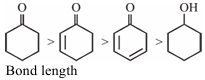
B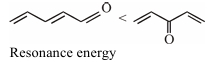
C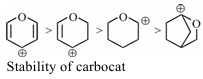
D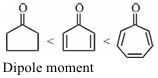
Solution
(C) Let us analyze each option:
$A$. Bond length of $C=O$ depends on the extent of resonance. More resonance means more single bond character,hence higher bond length. Cyclohexanone has no resonance,while the others have increasing conjugation,so the order is incorrect.
$B$. Resonance energy is higher for more conjugated systems. The second molecule is a cross-conjugated system,which is generally less stable than the extended conjugated system in the first molecule. Thus,the order is incorrect.
$C$. The stability of carbocations is governed by resonance and aromaticity. The pyrylium ion is aromatic and highly stable,followed by resonance-stabilized allylic cations. This order is correct.
$D$. Dipole moment increases with the contribution of polar resonance structures that achieve aromaticity. Cyclohepta$-2,4,6-$trienone (tropone) has a highly polar aromatic resonance structure,making it have a very high dipole moment. The order is correct.
$A$. Bond length of $C=O$ depends on the extent of resonance. More resonance means more single bond character,hence higher bond length. Cyclohexanone has no resonance,while the others have increasing conjugation,so the order is incorrect.
$B$. Resonance energy is higher for more conjugated systems. The second molecule is a cross-conjugated system,which is generally less stable than the extended conjugated system in the first molecule. Thus,the order is incorrect.
$C$. The stability of carbocations is governed by resonance and aromaticity. The pyrylium ion is aromatic and highly stable,followed by resonance-stabilized allylic cations. This order is correct.
$D$. Dipole moment increases with the contribution of polar resonance structures that achieve aromaticity. Cyclohepta$-2,4,6-$trienone (tropone) has a highly polar aromatic resonance structure,making it have a very high dipole moment. The order is correct.
0 likes
View Solution160
EasyMCQ
Which of the following statements is $NOT$ correct?
A
Homolytic cleavage of $C-C$ bond gives free radicals.
B
Resonance structures are represented by drawing $\leftrightarrow$ arrows between them.
C
Carbocation,carbanions and free radicals are reaction intermediates.
D
Chlorine is said to exert $+I$ effect in the carbon chain.
Solution
(D) Chlorine is an electronegative atom and exerts an $-I$ (inductive) effect,not a $+I$ effect,due to its ability to withdraw electron density from the carbon chain.
Therefore,the statement in option $D$ is incorrect.
Therefore,the statement in option $D$ is incorrect.
0 likes
View Solution161
EasyMCQ
Identify the group that exerts electron withdrawing resonance effect.
A
$-COOH$
B
$-OH$
C
$-OR$
D
$-NHR$
Solution
(A) The $-COOH$ group contains a carbonyl group $(C=O)$ attached to the carbon chain,which acts as an electron-withdrawing group via resonance ($-R$ effect).
In contrast,$-OH$,$-OR$,and $-NHR$ groups contain atoms with lone pairs of electrons that donate electron density into the ring or system via resonance ($+R$ effect).
In contrast,$-OH$,$-OR$,and $-NHR$ groups contain atoms with lone pairs of electrons that donate electron density into the ring or system via resonance ($+R$ effect).
0 likes
View Solution162
MediumMCQ
Identify the $-I$ effect causing group from the following.
A
$-COOR$
B
$-CH_3$
C
$-C_2H_5$
D
$-C_3H_7$
Solution
(A) The inductive effect ($-I$ effect) is the permanent displacement of shared electron pairs along a carbon chain due to the difference in electronegativity of the atoms or groups attached to it.
Groups that are more electronegative than carbon exert an electron-withdrawing effect,known as the $-I$ effect.
In the given options,$-COOR$ contains an electronegative oxygen atom attached to a carbonyl carbon,which makes it an electron-withdrawing group ($-I$ effect).
Conversely,alkyl groups like $-CH_3$,$-C_2H_5$,and $-C_3H_7$ exhibit a $+I$ (electron-donating) effect.
Therefore,the correct option is $A$.
Groups that are more electronegative than carbon exert an electron-withdrawing effect,known as the $-I$ effect.
In the given options,$-COOR$ contains an electronegative oxygen atom attached to a carbonyl carbon,which makes it an electron-withdrawing group ($-I$ effect).
Conversely,alkyl groups like $-CH_3$,$-C_2H_5$,and $-C_3H_7$ exhibit a $+I$ (electron-donating) effect.
Therefore,the correct option is $A$.
0 likes
View Solution163
MediumMCQ
Identify the lowest positive charge developed (indicated by $\delta, \delta_1, \delta_2, \delta_3$) due to the inductive effect in the following compound: $CH_3-CH_2-CH_2-CH_2-Cl$.
A
$\delta_2$
B
$\delta_3$
C
$\delta$
D
$\delta_1$
Solution
(B) The inductive effect is a distance-dependent phenomenon where the electron-withdrawing group $(-Cl)$ pulls electron density towards itself,creating a partial positive charge on the adjacent carbon atoms.
As the distance from the source of the inductive effect (the electronegative atom) increases,the magnitude of the induced partial positive charge decreases.
The order of magnitude of the positive charge is $\delta > \delta_1 > \delta_2 > \delta_3$.
Therefore,the lowest positive charge is $\delta_3$.
As the distance from the source of the inductive effect (the electronegative atom) increases,the magnitude of the induced partial positive charge decreases.
The order of magnitude of the positive charge is $\delta > \delta_1 > \delta_2 > \delta_3$.
Therefore,the lowest positive charge is $\delta_3$.
0 likes
View Solution164
EasyMCQ
Which group from the following is responsible for the $(-R)$ effect?
A
$-COOR$
B
$-OR$
C
$-OH$
D
$-NHR$
Solution
(A) The $(-R)$ effect or negative resonance effect occurs when a group withdraws electron density from the conjugated system through resonance.
Groups like $-OR$,$-OH$,and $-NHR$ have lone pairs on the atom directly attached to the conjugated system,which they donate,thus exhibiting a $(+R)$ effect.
The group $-COOR$ contains a carbonyl group $(C=O)$ conjugated with the rest of the molecule. The oxygen atom of the carbonyl group is more electronegative,pulling electron density away from the conjugated system,which results in a $(-R)$ effect.
Groups like $-OR$,$-OH$,and $-NHR$ have lone pairs on the atom directly attached to the conjugated system,which they donate,thus exhibiting a $(+R)$ effect.
The group $-COOR$ contains a carbonyl group $(C=O)$ conjugated with the rest of the molecule. The oxygen atom of the carbonyl group is more electronegative,pulling electron density away from the conjugated system,which results in a $(-R)$ effect.
0 likes
View Solution165
EasyMCQ
Which of the following groups does not show $(+R)$ effect?
A
$-NH_2$
B
$-NHCOR$
C
$-CN$
D
$-NR_2$
Solution
(C) The $(+R)$ effect (positive resonance effect) is shown by groups that donate electrons through resonance,typically having a lone pair of electrons on the atom directly attached to the conjugated system.
$-NH_2$,$-NHCOR$,and $-NR_2$ all possess a lone pair on the nitrogen atom and thus exhibit the $(+R)$ effect.
$-CN$ contains a multiple bond between carbon and nitrogen,which acts as an electron-withdrawing group via resonance,thus showing the $(-R)$ effect.
$-NH_2$,$-NHCOR$,and $-NR_2$ all possess a lone pair on the nitrogen atom and thus exhibit the $(+R)$ effect.
$-CN$ contains a multiple bond between carbon and nitrogen,which acts as an electron-withdrawing group via resonance,thus showing the $(-R)$ effect.
0 likes
View Solution166
EasyMCQ
Which of the following groups does not show $(-R)$ effect?
A
$I$. $-CHO$
B
$II$. $-COOH$
C
$III$. $-CN$
D
$IV$. $-OH$
Solution
(D) The resonance effect ($R$ effect) is the polarity produced in a molecule by the interaction of two $\pi$-bonds or between a $\pi$-bond and a lone pair of electrons present on an adjacent atom.
Groups like $-CHO$,$-COOH$,and $-CN$ contain multiple bonds with electronegative atoms,which withdraw electron density from the conjugated system,thus showing a $(-R)$ effect.
Conversely,the $-OH$ group possesses lone pairs of electrons on the oxygen atom that can be donated into the conjugated system,thereby exhibiting a $(+R)$ effect.
Groups like $-CHO$,$-COOH$,and $-CN$ contain multiple bonds with electronegative atoms,which withdraw electron density from the conjugated system,thus showing a $(-R)$ effect.
Conversely,the $-OH$ group possesses lone pairs of electrons on the oxygen atom that can be donated into the conjugated system,thereby exhibiting a $(+R)$ effect.
0 likes
View Solution167
EasyMCQ
Identify the functional group that has electron donating inductive effect.
A
$-COOH$
B
$-CN$
C
$-CH_3$
D
$-NO_2$
Solution
(C) The $-CH_3$ group is an electron-donating group that exhibits a $+I$ (positive inductive) effect due to hyperconjugation and the lower electronegativity of carbon compared to the attached atoms in other groups.
Conversely,$-COOH$,$-CN$,and $-NO_2$ contain highly electronegative atoms or groups that withdraw electron density,thereby exhibiting a $-I$ (negative inductive) effect.
Conversely,$-COOH$,$-CN$,and $-NO_2$ contain highly electronegative atoms or groups that withdraw electron density,thereby exhibiting a $-I$ (negative inductive) effect.
0 likes
View Solution168
EasyMCQ
Negative inductive effect ($-I$ effect) is shown by:
A
$-CH_3$
B
$-CH_2-CH_3$
C
$-NH_2$
D
$-(CH_3)_2-CH^{-}$
Solution
(C) The inductive effect is the permanent displacement of sigma electrons along a carbon chain due to the presence of an atom or group with a different electronegativity.
Groups that are electron-withdrawing exhibit a negative inductive effect ($-I$ effect).
Among the given options,$-CH_3$,$-CH_2-CH_3$,and $-(CH_3)_2-CH^{-}$ are electron-donating groups (alkyl groups or anions),which exhibit a positive inductive effect ($+I$ effect).
$-NH_2$ contains a highly electronegative nitrogen atom,which withdraws electron density from the carbon chain,thus exhibiting a negative inductive effect ($-I$ effect).
Groups that are electron-withdrawing exhibit a negative inductive effect ($-I$ effect).
Among the given options,$-CH_3$,$-CH_2-CH_3$,and $-(CH_3)_2-CH^{-}$ are electron-donating groups (alkyl groups or anions),which exhibit a positive inductive effect ($+I$ effect).
$-NH_2$ contains a highly electronegative nitrogen atom,which withdraws electron density from the carbon chain,thus exhibiting a negative inductive effect ($-I$ effect).
0 likes
View Solution169
MediumMCQ
Which of the following groups exhibits $(+)R$ effect?
A
$-NHR$
B
$-CN$
C
$-NO_2$
D
$-COOR$
Solution
(A) The $(+)R$ effect (positive resonance effect) is shown by groups that donate electron density to the conjugated system through resonance.
This typically occurs when the atom directly attached to the conjugated system possesses at least one lone pair of electrons.
Among the given options,the $-NHR$ group has a lone pair on the nitrogen atom,which it can donate to the conjugated system,thus exhibiting the $(+)R$ effect.
The other groups ($-CN$,$-NO_2$,and $-COOR$) are electron-withdrawing groups that exhibit the $(-)R$ effect.
This typically occurs when the atom directly attached to the conjugated system possesses at least one lone pair of electrons.
Among the given options,the $-NHR$ group has a lone pair on the nitrogen atom,which it can donate to the conjugated system,thus exhibiting the $(+)R$ effect.
The other groups ($-CN$,$-NO_2$,and $-COOR$) are electron-withdrawing groups that exhibit the $(-)R$ effect.
0 likes
View Solution170
MediumMCQ
Hyperconjugation is not observed in
A
$CH_3-CH=CH_2$
B
$CH_3-C(CH_3)=C(CH_3)-CH_3$
C
$(CH_3)_3C^+$
D
$CH_2=CH_2$
Solution
(D) Hyperconjugation requires the presence of at least one $\alpha-H$ atom on a carbon atom adjacent to a double bond or a carbocation.
$A) \ CH_3-CH=CH_2$: Has $3 \ \alpha-H$ atoms.
$B) \ CH_3-C(CH_3)=C(CH_3)-CH_3$: Has $12 \ \alpha-H$ atoms.
$C) \ (CH_3)_3C^+$: Has $9 \ \alpha-H$ atoms.
$D) \ CH_2=CH_2$: Has $0 \ \alpha-H$ atoms.
Since $CH_2=CH_2$ has no $\alpha-H$ atoms,hyperconjugation is not observed.
$A) \ CH_3-CH=CH_2$: Has $3 \ \alpha-H$ atoms.
$B) \ CH_3-C(CH_3)=C(CH_3)-CH_3$: Has $12 \ \alpha-H$ atoms.
$C) \ (CH_3)_3C^+$: Has $9 \ \alpha-H$ atoms.
$D) \ CH_2=CH_2$: Has $0 \ \alpha-H$ atoms.
Since $CH_2=CH_2$ has no $\alpha-H$ atoms,hyperconjugation is not observed.
0 likes
View Solution171
MediumMCQ
Which among the following functional groups exhibits $-R$ effect?
A
$-CHO$
B
$-Br$
C
$-OR$
D
$-NHR$
Solution
(A) The $-R$ effect (negative resonance effect) is shown by groups that withdraw electron density from the conjugated system through resonance.
Among the given options,the aldehyde group $(-CHO)$ contains a $\pi$-bond between carbon and oxygen,where oxygen is more electronegative,allowing it to withdraw electrons via resonance.
Therefore,$-CHO$ exhibits the $-R$ effect.
Groups like $-Br$,$-OR$,and $-NHR$ possess lone pairs of electrons and typically exhibit the $+R$ effect.
Among the given options,the aldehyde group $(-CHO)$ contains a $\pi$-bond between carbon and oxygen,where oxygen is more electronegative,allowing it to withdraw electrons via resonance.
Therefore,$-CHO$ exhibits the $-R$ effect.
Groups like $-Br$,$-OR$,and $-NHR$ possess lone pairs of electrons and typically exhibit the $+R$ effect.
0 likes
View Solution172
EasyMCQ
Identify the species from the following that exhibits no-bond resonance.
A
$CH_3 CH_2 Br$
B
$CH_3 CH_2^{(+)}$
C
$CH_3 CH_2 NO_2$
D
$C_6 H_6$
Solution
(A) No-bond resonance is another term for hyperconjugation.
Hyperconjugation occurs in species having $\alpha$-hydrogen atoms attached to an $sp^2$ hybridized carbon atom (such as in carbocations,free radicals,or alkenes).
$1$. $CH_3 CH_2^{(+)}$ (Ethyl carbocation): It has three $\alpha$-hydrogen atoms on the adjacent carbon,so it exhibits hyperconjugation (no-bond resonance).
$2$. $CH_3 CH_2 Br$: This is an alkyl halide and does not possess the necessary electronic structure for hyperconjugation.
$3$. $CH_3 CH_2 NO_2$: This molecule does not exhibit hyperconjugation.
$4$. $C_6 H_6$ (Benzene): It exhibits resonance,but not hyperconjugation.
However,in the context of standard chemistry problems,$CH_3 CH_2 Br$ is the most appropriate choice as it is a saturated alkane derivative lacking the $\alpha$-hydrogen requirement for hyperconjugation.
Hyperconjugation occurs in species having $\alpha$-hydrogen atoms attached to an $sp^2$ hybridized carbon atom (such as in carbocations,free radicals,or alkenes).
$1$. $CH_3 CH_2^{(+)}$ (Ethyl carbocation): It has three $\alpha$-hydrogen atoms on the adjacent carbon,so it exhibits hyperconjugation (no-bond resonance).
$2$. $CH_3 CH_2 Br$: This is an alkyl halide and does not possess the necessary electronic structure for hyperconjugation.
$3$. $CH_3 CH_2 NO_2$: This molecule does not exhibit hyperconjugation.
$4$. $C_6 H_6$ (Benzene): It exhibits resonance,but not hyperconjugation.
However,in the context of standard chemistry problems,$CH_3 CH_2 Br$ is the most appropriate choice as it is a saturated alkane derivative lacking the $\alpha$-hydrogen requirement for hyperconjugation.
0 likes
View Solution173
MediumMCQ
Which among the following pairs of electronic effect and its example is $NOT$ correct?
A
Hyperconjugation: Propene
B
Resonance: Nitromethane
C
$(-)$ $R$ effect: $C_6H_5NH_2$
D
Electromeric effect: Acetone
Solution
(C) In $C_6H_5NH_2$,the $-NH_2$ group has a lone pair of electrons on the nitrogen atom,which it donates to the benzene ring through resonance.
Therefore,it exhibits a $+R$ (or $+M$) effect,not a $-R$ effect.
Thus,the pair given in option $C$ is incorrect.
Therefore,it exhibits a $+R$ (or $+M$) effect,not a $-R$ effect.
Thus,the pair given in option $C$ is incorrect.
0 likes
View Solution174
EasyMCQ
Chloroacetic acid is a stronger acid than acetic acid. This can be explained using
A
$-M$ effect
B
$-I$ effect
C
$+M$ effect
D
$+I$ effect
Solution
(B) The $-Cl$ atom is an electron-withdrawing group that exhibits a negative inductive effect ($-I$ effect).
When attached to the $\alpha$-carbon of acetic acid,it withdraws electron density through the sigma bond network.
This withdrawal decreases the electron density on the oxygen atom of the $-OH$ group,which increases the polarity of the $O-H$ bond.
Consequently,the release of the $H^{+}$ ion becomes easier,thereby increasing the acidity of chloroacetic acid compared to acetic acid.
When attached to the $\alpha$-carbon of acetic acid,it withdraws electron density through the sigma bond network.
This withdrawal decreases the electron density on the oxygen atom of the $-OH$ group,which increases the polarity of the $O-H$ bond.
Consequently,the release of the $H^{+}$ ion becomes easier,thereby increasing the acidity of chloroacetic acid compared to acetic acid.
0 likes
View Solution175
EasyMCQ
Mesomeric effect involves
A
delocalisation of $\pi$-electrons
B
delocalisation of $\sigma$-electrons
C
partial displacement of electrons
D
delocalisation of $\pi$ and $\sigma$-electrons
Solution
(A) Resonance or mesomeric effect is defined as the polarity produced in a molecule by the interaction of two $\pi$-bonds or between a $\pi$-bond and a lone pair of electrons present on an adjacent atom.
It involves the complete delocalisation of $\pi$-electrons through the conjugated system.
There are two types of mesomeric effect:
$1$. $+M$ effect: Observed when the direction of electron displacement is away from an atom or substituent group attached to the conjugated system,e.g.,$-halogen$,$-OH$,$-NH_2$.
$2$. $-M$ effect: Observed when the transfer of electrons is towards the atom or substituent group attached to the conjugated system,e.g.,$-NO_2$,$-COOH$.
It involves the complete delocalisation of $\pi$-electrons through the conjugated system.
There are two types of mesomeric effect:
$1$. $+M$ effect: Observed when the direction of electron displacement is away from an atom or substituent group attached to the conjugated system,e.g.,$-halogen$,$-OH$,$-NH_2$.
$2$. $-M$ effect: Observed when the transfer of electrons is towards the atom or substituent group attached to the conjugated system,e.g.,$-NO_2$,$-COOH$.
0 likes
View Solution176
EasyMCQ
Which one of the following is not true regarding electromeric effect?
A
It is a temporary effect
B
It operates on multiple bonds
C
It requires an attacking reagent
D
It results in the appearance of partial charges on the carbon atoms
Solution
(D) In the electromeric effect,there is a complete transfer of $\pi$-electrons from one atom to another to produce temporary full charges on the atoms joined by multiple bonds.
Therefore,the statement that it results in the appearance of partial charges is incorrect,as it produces full charges (formal charges) on the atoms.
Therefore,the statement that it results in the appearance of partial charges is incorrect,as it produces full charges (formal charges) on the atoms.
0 likes
View Solution177
MediumMCQ
Formic acid is a stronger acid than acetic acid. This can be explained using
A
$+M$ effect
B
$-I$ effect
C
$+I$ effect
D
$-M$ effect
Solution
(C) In acetic acid $(CH_3COOH)$,the methyl group $(-CH_3)$ releases electrons due to the $+I$ effect,which increases the electron density on the carboxylate group and destabilizes the conjugate base,thereby decreasing its acidic character.
Formic acid $(HCOOH)$ does not contain any such electron-donating group attached to the carboxyl group.
Hence,due to the $+I$ effect of the methyl group in acetic acid,formic acid is a stronger acid than acetic acid.
Formic acid $(HCOOH)$ does not contain any such electron-donating group attached to the carboxyl group.
Hence,due to the $+I$ effect of the methyl group in acetic acid,formic acid is a stronger acid than acetic acid.
0 likes
View Solution178
EasyMCQ
Mesomeric effect involves delocalisation of
A
$\pi$ electrons
B
$\sigma$ electrons
C
protons
D
None of these
Solution
(A) The mesomeric effect involves the permanent transfer of $\pi$ electrons or lone pair of electrons through a conjugated system to an adjacent atom or covalent bond. Therefore, it involves the delocalisation of $\pi$ electrons.
0 likes
View Solution179
EasyMCQ
$+I$ effect is shown by:
A
$-CH_3$
B
$-Br$
C
$-Cl$
D
$-NO_2$
Solution
(A) The inductive effect ($I$-effect) is the permanent displacement of sigma electrons along a carbon chain due to the presence of an electron-withdrawing or electron-donating group.
Groups that donate electron density towards the carbon chain exhibit the $+I$ effect (e.g.,alkyl groups like $-CH_3$).
Groups that withdraw electron density from the carbon chain exhibit the $-I$ effect (e.g.,halogens like $-Br$,$-Cl$,and electron-withdrawing groups like $-NO_2$).
Therefore,$-CH_3$ shows the $+I$ effect.
Groups that donate electron density towards the carbon chain exhibit the $+I$ effect (e.g.,alkyl groups like $-CH_3$).
Groups that withdraw electron density from the carbon chain exhibit the $-I$ effect (e.g.,halogens like $-Br$,$-Cl$,and electron-withdrawing groups like $-NO_2$).
Therefore,$-CH_3$ shows the $+I$ effect.
0 likes
View Solution180
EasyMCQ
Which one of the nitrogen atoms in $H_2N-NH-CO-NH_2$ (where the atoms are labeled $I, II, III$ as shown in the structure) is the most nucleophilic?
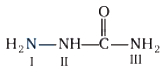
A
$III$
B
$I$
C
$II$
D
All three nitrogen atoms are equally strong nucleophilic centres
Solution
(B) The nucleophilicity of a nitrogen atom depends on the availability of its lone pair of electrons for donation.
In the given molecule,$H_2N-NH-CO-NH_2$ (semicarbazide/urea derivative structure):
- The nitrogen atom labeled $III$ has its lone pair involved in resonance with the adjacent carbonyl group $(C=O)$,making it less available.
- The nitrogen atom labeled $II$ has its lone pair involved in resonance with the carbonyl group,and it is also attached to another nitrogen atom,which further reduces its availability.
- The nitrogen atom labeled $I$ has its lone pair available for donation because it is not directly involved in resonance with the carbonyl group. Although it is attached to another nitrogen atom,its lone pair is the most available among the three for acting as a nucleophile.
Therefore,the nitrogen atom labeled $I$ is the most nucleophilic.
In the given molecule,$H_2N-NH-CO-NH_2$ (semicarbazide/urea derivative structure):
- The nitrogen atom labeled $III$ has its lone pair involved in resonance with the adjacent carbonyl group $(C=O)$,making it less available.
- The nitrogen atom labeled $II$ has its lone pair involved in resonance with the carbonyl group,and it is also attached to another nitrogen atom,which further reduces its availability.
- The nitrogen atom labeled $I$ has its lone pair available for donation because it is not directly involved in resonance with the carbonyl group. Although it is attached to another nitrogen atom,its lone pair is the most available among the three for acting as a nucleophile.
Therefore,the nitrogen atom labeled $I$ is the most nucleophilic.
0 likes
View Solution181
MediumMCQ
Identify the correct statements from the following :
a) Change in hybridisation affects the electronegativity of carbon
b) The $p$ orbitals in ethene are mutually parallel
c) The number of $\sigma$ bonds in propyne is $6$
d) Electromeric effect is a permanent effect
a) Change in hybridisation affects the electronegativity of carbon
b) The $p$ orbitals in ethene are mutually parallel
c) The number of $\sigma$ bonds in propyne is $6$
d) Electromeric effect is a permanent effect
A
$a, c$
B
$a, c, d$
C
$a, b, c$
D
$b, d$
Solution
(C) Statement $a$ is correct: Electronegativity of carbon increases with increasing $s$-character $(sp > sp^2 > sp^3)$.
Statement $b$ is correct: In ethene $(CH_2=CH_2)$,the unhybridized $p$-orbitals on both carbon atoms are parallel to each other to facilitate $\pi$-bond formation.
Statement $c$ is correct: Propyne $(CH_3-C\equiv CH)$ has $3$ $C-H$ $\sigma$ bonds,$1$ $C-C$ $\sigma$ bond,and $2$ $C-C$ $\sigma$ bonds (one from triple bond),totaling $6$ $\sigma$ bonds.
Statement $d$ is incorrect: The electromeric effect is a temporary effect that occurs only in the presence of an attacking reagent.
Statement $b$ is correct: In ethene $(CH_2=CH_2)$,the unhybridized $p$-orbitals on both carbon atoms are parallel to each other to facilitate $\pi$-bond formation.
Statement $c$ is correct: Propyne $(CH_3-C\equiv CH)$ has $3$ $C-H$ $\sigma$ bonds,$1$ $C-C$ $\sigma$ bond,and $2$ $C-C$ $\sigma$ bonds (one from triple bond),totaling $6$ $\sigma$ bonds.
Statement $d$ is incorrect: The electromeric effect is a temporary effect that occurs only in the presence of an attacking reagent.
0 likes
View Solution182
EasyMCQ
The following effect is known as . . . . . .
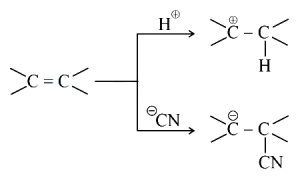
A
Inductive effect
B
Electromeric effect
C
Resonance effect
D
Hyperconjugation
Solution
(B) The Electromeric effect is a temporary effect in which a shared pair of $\pi$ electrons is completely transferred from a double or a triple bond to one of the atoms joined by the bond at the requirement of an attacking species.
It is represented by the symbol $E$.
It is said to be $+E$ when the displacement of $\pi$ electrons is away from the atom or group,and $-E$ when the displacement of $\pi$ electrons is towards the atom or group.
In the given image,the complete transfer of the $\pi$ bond occurs due to the presence of an attacking reagent ($H^+$ or $CN^-$),which is the characteristic feature of the Electromeric effect.
Hence,the correct option is $B$.
It is represented by the symbol $E$.
It is said to be $+E$ when the displacement of $\pi$ electrons is away from the atom or group,and $-E$ when the displacement of $\pi$ electrons is towards the atom or group.
In the given image,the complete transfer of the $\pi$ bond occurs due to the presence of an attacking reagent ($H^+$ or $CN^-$),which is the characteristic feature of the Electromeric effect.
Hence,the correct option is $B$.
0 likes
View Solution183
MediumMCQ
In compound $(X)$,hyperconjugation is present and in $(Y)$,resonance effect is present. What are $X$ and $Y$,respectively?
A
Toluene,prop$-2-$en$-1-$ol
B
Aniline,$2-$propenal
C
Toluene,nitrobenzene
D
$1-$Bromopropane,phenol
Solution
(C) Hyperconjugation requires an $\alpha-$hydrogen atom attached to an $sp^2$ hybridized carbon atom. In Toluene $(C_6H_5CH_3)$,the methyl group has three $\alpha-$hydrogens attached to the benzene ring,exhibiting hyperconjugation.
Resonance effect involves the delocalization of $\pi-$electrons or lone pairs. In nitrobenzene $(C_6H_5NO_2)$,the nitro group is in conjugation with the benzene ring,exhibiting a strong resonance effect ($-M$ effect).
Therefore,$X$ is Toluene and $Y$ is nitrobenzene.
Resonance effect involves the delocalization of $\pi-$electrons or lone pairs. In nitrobenzene $(C_6H_5NO_2)$,the nitro group is in conjugation with the benzene ring,exhibiting a strong resonance effect ($-M$ effect).
Therefore,$X$ is Toluene and $Y$ is nitrobenzene.
0 likes
View Solution184
EasyMCQ
From the following,identify the groups that exhibit negative resonance $(-R)$ effect when attached to a conjugated system: $(A)$ formyl,$(B)$ amino,$(C)$ alkoxy,$(D)$ cyano,$(E)$ nitro
A
$A, C, E$ only
B
$B, C, D$ only
C
$A, D, E$ only
D
$B, D, E$ only
Solution
(C) Groups that exhibit the negative resonance $(-R)$ effect are those that withdraw electron density from the conjugated system. These groups typically contain multiple bonds with electronegative atoms.
$(A)$ Formyl $(-CHO)$: $-C(=O)H$ ($-R$ effect)
$(B)$ Amino $(-NH_2)$: $+R$ effect due to lone pair on $N$.
$(C)$ Alkoxy $(-OR)$: $+R$ effect due to lone pair on $O$.
$(D)$ Cyano $(-CN)$: $-C \equiv N$ ($-R$ effect)
$(E)$ Nitro $(-NO_2)$: $-NO_2$ ($-R$ effect)
Therefore,$A, D,$ and $E$ exhibit the $-R$ effect.
$(A)$ Formyl $(-CHO)$: $-C(=O)H$ ($-R$ effect)
$(B)$ Amino $(-NH_2)$: $+R$ effect due to lone pair on $N$.
$(C)$ Alkoxy $(-OR)$: $+R$ effect due to lone pair on $O$.
$(D)$ Cyano $(-CN)$: $-C \equiv N$ ($-R$ effect)
$(E)$ Nitro $(-NO_2)$: $-NO_2$ ($-R$ effect)
Therefore,$A, D,$ and $E$ exhibit the $-R$ effect.
0 likes
View Solution185
MediumMCQ
Which of the following statements are correct?
$(i)$ Inductive effect and resonance effect are possible in chlorobenzene.
$(ii)$ Resonance effect dominates over inductive effect in anisole.
$(iii)$ $p-$nitrobenzoic acid is less acidic than $m-$nitrobenzoic acid.
$(iv)$ Diphenylamine is more basic than aniline.
$(i)$ Inductive effect and resonance effect are possible in chlorobenzene.
$(ii)$ Resonance effect dominates over inductive effect in anisole.
$(iii)$ $p-$nitrobenzoic acid is less acidic than $m-$nitrobenzoic acid.
$(iv)$ Diphenylamine is more basic than aniline.
A
$(i)$,$(ii)$,$(iii)$ and $(iv)$
B
$(i)$ and $(ii)$
C
$(iii)$ and $(iv)$
D
$(i)$ and $(iii)$
Solution
(B) $(i)$ In chlorobenzene,the $Cl$ atom has lone pairs,allowing for resonance ($+R$ effect),and it is also electronegative,exerting an inductive effect ($-I$ effect). Both are possible. Statement $(i)$ is correct.
$(ii)$ In anisole $(C_6H_5OCH_3)$,the oxygen atom donates electron density to the ring via resonance ($+R$ effect),which is stronger than its electron-withdrawing inductive effect ($-I$ effect). Statement $(ii)$ is correct.
$(iii)$ $p-$nitrobenzoic acid is more acidic than $m-$nitrobenzoic acid because the nitro group at the para position exerts a strong $-R$ effect,which significantly stabilizes the carboxylate anion compared to the meta position where only the $-I$ effect operates. Statement $(iii)$ is incorrect.
$(iv)$ Diphenylamine is less basic than aniline because the lone pair on the nitrogen atom is delocalized over two benzene rings,making it less available for protonation. Statement $(iv)$ is incorrect.
Therefore,only $(i)$ and $(ii)$ are correct.
$(ii)$ In anisole $(C_6H_5OCH_3)$,the oxygen atom donates electron density to the ring via resonance ($+R$ effect),which is stronger than its electron-withdrawing inductive effect ($-I$ effect). Statement $(ii)$ is correct.
$(iii)$ $p-$nitrobenzoic acid is more acidic than $m-$nitrobenzoic acid because the nitro group at the para position exerts a strong $-R$ effect,which significantly stabilizes the carboxylate anion compared to the meta position where only the $-I$ effect operates. Statement $(iii)$ is incorrect.
$(iv)$ Diphenylamine is less basic than aniline because the lone pair on the nitrogen atom is delocalized over two benzene rings,making it less available for protonation. Statement $(iv)$ is incorrect.
Therefore,only $(i)$ and $(ii)$ are correct.
0 likes
View Solution186
EasyMCQ
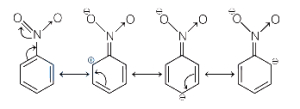
The $-NO_2$ group in the following conjugated system shows:
A
$-R$ effect
B
$-I$ effect
C
$+R$ effect
D
$+I$ effect
Solution
(A) The $-NO_2$ group is a strong electron-withdrawing group due to both its inductive effect $(-I)$ and its resonance effect $(-R)$.
In a conjugated system,such as nitrobenzene,the $-NO_2$ group pulls electron density away from the aromatic ring through resonance.
This delocalization of $\pi$-electrons towards the $-NO_2$ group is characteristic of the $-R$ (or $-M$) effect.
Therefore,the $-NO_2$ group shows the $-R$ effect.
In a conjugated system,such as nitrobenzene,the $-NO_2$ group pulls electron density away from the aromatic ring through resonance.
This delocalization of $\pi$-electrons towards the $-NO_2$ group is characteristic of the $-R$ (or $-M$) effect.
Therefore,the $-NO_2$ group shows the $-R$ effect.
0 likes
View Solution187
MediumMCQ
Identify the compound which has the maximum number of no-bond resonance (hyperconjugation) structures.
A
tert-Butylbenzene $(C_6H_5-C(CH_3)_3)$
B
Ethylbenzene $(C_6H_5-CH_2CH_3)$
C
Isopropylbenzene $(C_6H_5-CH(CH_3)_2)$
D
Toluene $(C_6H_5-CH_3)$
Solution
(D) Key Idea: The number of no-bond resonance (hyperconjugation) structures is equal to the number of $\alpha$-hydrogen atoms present on the carbon atom directly attached to the benzene ring.
$(a)$ tert-Butylbenzene: The $\alpha$-carbon has $0$ $H$-atoms. Number of hyperconjugation structures = $0$.
$(b)$ Ethylbenzene: The $\alpha$-carbon $(CH_2)$ has $2$ $H$-atoms. Number of hyperconjugation structures = $2$.
$(c)$ Isopropylbenzene: The $\alpha$-carbon $(CH)$ has $1$ $H$-atom. Number of hyperconjugation structures = $1$.
$(d)$ Toluene: The $\alpha$-carbon $(CH_3)$ has $3$ $H$-atoms. Number of hyperconjugation structures = $3$.
Since toluene has the maximum number of $\alpha$-hydrogen atoms $(3)$,it has the maximum number of no-bond resonance structures. Hence,option $(d)$ is the correct answer.
$(a)$ tert-Butylbenzene: The $\alpha$-carbon has $0$ $H$-atoms. Number of hyperconjugation structures = $0$.
$(b)$ Ethylbenzene: The $\alpha$-carbon $(CH_2)$ has $2$ $H$-atoms. Number of hyperconjugation structures = $2$.
$(c)$ Isopropylbenzene: The $\alpha$-carbon $(CH)$ has $1$ $H$-atom. Number of hyperconjugation structures = $1$.
$(d)$ Toluene: The $\alpha$-carbon $(CH_3)$ has $3$ $H$-atoms. Number of hyperconjugation structures = $3$.
Since toluene has the maximum number of $\alpha$-hydrogen atoms $(3)$,it has the maximum number of no-bond resonance structures. Hence,option $(d)$ is the correct answer.
0 likes
View Solution188
EasyMCQ
In the following resonance structures,the curved arrow indicates that electrons are shifted from:
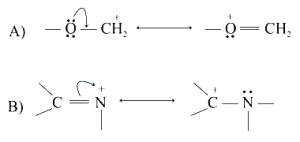
A
Atom to adjacent bond in both $(A)$ and $(B)$.
B
$\pi$ bond to adjacent atom in both $(A)$ and $(B)$.
C
$\pi$ bond to adjacent atom in $(A)$ and atom to adjacent bond in $(B)$.
D
Atom to adjacent bond in $(A)$ and $\pi$ bond to adjacent atom in $(B)$.
Solution
(D) In structure $(A)$,the curved arrow shows the movement of a lone pair of electrons from the oxygen atom to the adjacent bond position to form a $\pi$ bond between oxygen and carbon.
In structure $(B)$,the curved arrow shows the movement of electrons from the $\pi$ bond between the carbon and nitrogen atoms to the adjacent nitrogen atom.
In structure $(B)$,the curved arrow shows the movement of electrons from the $\pi$ bond between the carbon and nitrogen atoms to the adjacent nitrogen atom.
0 likes
View Solution189
MediumMCQ
Which of the following represents the hyperconjugation effect?
A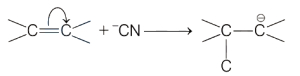
B
$CH_3-CH_2-CH_2 \longrightarrow Cl$
C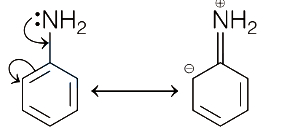
D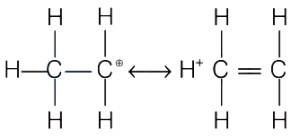
Solution
(D) Hyperconjugation is the interaction of the electrons in a $\sigma$ orbital (usually $C-H$ bond) with an adjacent empty non-bonding or antibonding $p$-orbital or $\pi$-orbital to give an extended molecular orbital. Option $D$ shows the delocalization of electrons from a $C-H$ $\sigma$ bond into the empty $p$-orbital of an adjacent carbocation,which is the definition of hyperconjugation.
0 likes
View Solution190
MediumMCQ
Match the following electronic effects in List-$I$ with their corresponding examples or representations in List-$II$.
| List-$I$ | List-$II$ |
| $(A)$ Resonance | $(I)$ $C=C + H^+ \rightarrow C^+-C-H$ |
| $(B)$ Inductive effect | $(II)$ $H-CH_2-CH_2^+ \leftrightarrow H-CH_2=CH_2^+$ |
| $(C)$ Electromeric effect | $(III)$ $C_6H_6$ |
| $(D)$ Hyperconjugation | $(IV)$ $CH_3-Z \rightarrow CH_3^- + Z^+$ |
| $(V)$ $CH_3-CH_2-CH_2Cl$ |
A
$A-III, B-V, C-I, D-II$
B
$A-III, B-V, C-II, D-I$
C
$A-I, B-III, C-II, D-V$
D
$A-III, B-II, C-I, D-IV$
Solution
(A) The correct matches are:
$(A)$ Resonance: $C_6H_6$ (Benzene) exhibits resonance stabilization $(III)$.
$(B)$ Inductive effect: $CH_3-CH_2-CH_2Cl$ shows the inductive effect due to the electronegative chlorine atom $(V)$.
$(C)$ Electromeric effect: The addition of $H^+$ to an alkene involves the complete transfer of $\pi$-electrons,which is the electromeric effect $(I)$.
$(D)$ Hyperconjugation: The delocalization of $\sigma$-electrons of a $C-H$ bond into an adjacent empty $p$-orbital (as seen in the ethyl cation) is hyperconjugation $(II)$.
Therefore,the correct sequence is $A-III, B-V, C-I, D-II$.
$(A)$ Resonance: $C_6H_6$ (Benzene) exhibits resonance stabilization $(III)$.
$(B)$ Inductive effect: $CH_3-CH_2-CH_2Cl$ shows the inductive effect due to the electronegative chlorine atom $(V)$.
$(C)$ Electromeric effect: The addition of $H^+$ to an alkene involves the complete transfer of $\pi$-electrons,which is the electromeric effect $(I)$.
$(D)$ Hyperconjugation: The delocalization of $\sigma$-electrons of a $C-H$ bond into an adjacent empty $p$-orbital (as seen in the ethyl cation) is hyperconjugation $(II)$.
Therefore,the correct sequence is $A-III, B-V, C-I, D-II$.
0 likes
View Solution191
MediumMCQ
Which of the following represents the hyperconjugation effect?
A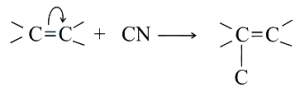
B
C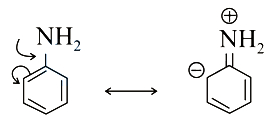
D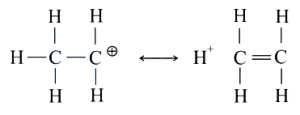
Solution
(D) Hyperconjugation effect: When $\sigma$ electrons are transferred through $\sigma-p$ overlapping towards a $\pi$ bond,a carbocation $(C^{\oplus})$,or a carbon radical $(C^{\bullet})$,this is called hyperconjugation.
Condition for hyperconjugation: $A$ saturated carbon atom containing at least one hydrogen atom must be directly attached to a $\pi$-bond,a carbocation $(C^{\oplus})$,or a carbon radical $(C^{\bullet})$.
Option $D$ shows the delocalization of electrons from a $C-H$ $\sigma$-bond into the empty $p$-orbital of an adjacent carbocation,which is the classic representation of the hyperconjugation effect.
Condition for hyperconjugation: $A$ saturated carbon atom containing at least one hydrogen atom must be directly attached to a $\pi$-bond,a carbocation $(C^{\oplus})$,or a carbon radical $(C^{\bullet})$.
Option $D$ shows the delocalization of electrons from a $C-H$ $\sigma$-bond into the empty $p$-orbital of an adjacent carbocation,which is the classic representation of the hyperconjugation effect.
0 likes
View Solution192
EasyMCQ
Which of the following is not explained by hyperconjugation?
A
stability order of carbanions
B
stability order of free radicals
C
stability order of carbocations
D
stability of alkenes
Solution
(A) Hyperconjugation involves the delocalization of electrons from a $\sigma$ $C-H$ bond of an $sp^3$ hybridized carbon into an adjacent vacant $p$-orbital (in carbocations),a half-filled $p$-orbital (in free radicals),or a $\pi$-bond (in alkenes).
This interaction provides stability to these species.
Carbanions possess a lone pair of electrons on a carbon atom and do not have a vacant or half-filled $p$-orbital adjacent to the $C-H$ bond to facilitate this type of electron delocalization.
Therefore,the stability order of carbanions is not explained by hyperconjugation.
This interaction provides stability to these species.
Carbanions possess a lone pair of electrons on a carbon atom and do not have a vacant or half-filled $p$-orbital adjacent to the $C-H$ bond to facilitate this type of electron delocalization.
Therefore,the stability order of carbanions is not explained by hyperconjugation.
0 likes
View Solution193
MediumMCQ
Which of the following statements are not correct?
$a$. The energy of resonance hybrid structure is higher than that of the possible canonical structures of the molecule.
$b$. When inductive effect and electromeric effect operate in opposite directions,electromeric effect predominates.
$c$. When the $\pi$ electrons of the multiple bond are transferred to that atom to which the attacking reagent does not get attached,it is known as $+E$ effect.
$d$. The resonance structures with separation of opposite charges are more stable.
$a$. The energy of resonance hybrid structure is higher than that of the possible canonical structures of the molecule.
$b$. When inductive effect and electromeric effect operate in opposite directions,electromeric effect predominates.
$c$. When the $\pi$ electrons of the multiple bond are transferred to that atom to which the attacking reagent does not get attached,it is known as $+E$ effect.
$d$. The resonance structures with separation of opposite charges are more stable.
A
$a, c, d$
B
$c, d$
C
$b, c, d$
D
$a, b, c$
Solution
(A) . Incorrect. The resonance hybrid is always more stable and has lower energy than any of the individual canonical structures.
$b$. Correct. The electromeric effect is a temporary effect and generally predominates over the permanent inductive effect when they oppose each other.
$c$. Incorrect. The $+E$ effect occurs when $\pi$ electrons are transferred to the atom to which the attacking reagent gets attached. If they are transferred to the other atom,it is the $-E$ effect.
$d$. Incorrect. Resonance structures with separation of opposite charges are less stable than those without charge separation,as they require energy to separate the charges.
$b$. Correct. The electromeric effect is a temporary effect and generally predominates over the permanent inductive effect when they oppose each other.
$c$. Incorrect. The $+E$ effect occurs when $\pi$ electrons are transferred to the atom to which the attacking reagent gets attached. If they are transferred to the other atom,it is the $-E$ effect.
$d$. Incorrect. Resonance structures with separation of opposite charges are less stable than those without charge separation,as they require energy to separate the charges.
0 likes
View Solution194
EasyMCQ
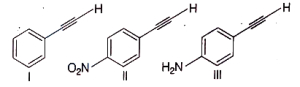
The decreasing order of acidic nature of the following compounds is
A
$III > II > I$
B
$II > III > I$
C
$II > I > III$
D
$I > II > III$
Solution
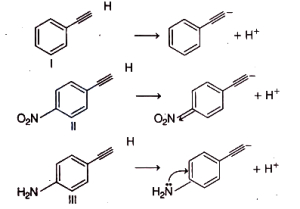
(C) Terminal alkynes contain an $sp$ hybridized $C-H$ group that is acidic in nature. The acidity of these compounds depends on the stability of the conjugate base formed after the removal of a proton $(H^+)$.
$1.$ The $-NO_2$ group is a strong electron-withdrawing group ($-I$ and $-M$ effect). It decreases the electron density on the ring and the carbanion,thereby stabilizing the conjugate base. Thus,compound $II$ is the most acidic.
$2.$ The $-NH_2$ group is an electron-donating group ($+M$ effect). It increases the electron density on the ring and the carbanion,thereby destabilizing the conjugate base. Thus,compound $III$ is the least acidic.
$3.$ Compound $I$ has no substituent on the benzene ring.
Therefore,the decreasing order of acidity is $II > I > III$.
$1.$ The $-NO_2$ group is a strong electron-withdrawing group ($-I$ and $-M$ effect). It decreases the electron density on the ring and the carbanion,thereby stabilizing the conjugate base. Thus,compound $II$ is the most acidic.
$2.$ The $-NH_2$ group is an electron-donating group ($+M$ effect). It increases the electron density on the ring and the carbanion,thereby destabilizing the conjugate base. Thus,compound $III$ is the least acidic.
$3.$ Compound $I$ has no substituent on the benzene ring.
Therefore,the decreasing order of acidity is $II > I > III$.
0 likes
View Solution195
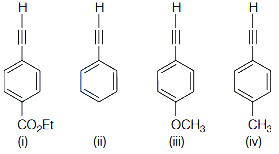
MediumMCQ
The decreasing order of acidity of the following terminal acetylenes is:
A
$(i) > (iii) > (ii) > (iv)$
B
$(i) > (ii) > (iv) > (iii)$
C
$(i) > (iv) > (ii) > (iii)$
D
$(i) > (iii) > (iv) > (ii)$
Solution
(B) The acidity of terminal acetylenes depends on the stability of the conjugate base (carbanion) formed after the removal of the acidic proton.
Electron-withdrawing groups $(EWG)$ stabilize the carbanion through $-R$ or $-I$ effects,thereby increasing acidity.
Electron-donating groups $(EDG)$ destabilize the carbanion through $+R$ or $+I$ effects,thereby decreasing acidity.
In the given compounds:
$(i)$ has a $-CO_2Et$ group,which is a strong $EWG$ ($-R$ effect),making it the most acidic.
$(ii)$ is phenylacetylene with no substituent.
$(iv)$ has a $-CH_3$ group,which is an $EDG$ ($+I$ effect),making it less acidic than $(ii)$.
$(iii)$ has a $-OCH_3$ group,which is a strong $EDG$ ($+R$ effect),making it the least acidic.
Thus,the decreasing order of acidity is $(i) > (ii) > (iv) > (iii)$.
Electron-withdrawing groups $(EWG)$ stabilize the carbanion through $-R$ or $-I$ effects,thereby increasing acidity.
Electron-donating groups $(EDG)$ destabilize the carbanion through $+R$ or $+I$ effects,thereby decreasing acidity.
In the given compounds:
$(i)$ has a $-CO_2Et$ group,which is a strong $EWG$ ($-R$ effect),making it the most acidic.
$(ii)$ is phenylacetylene with no substituent.
$(iv)$ has a $-CH_3$ group,which is an $EDG$ ($+I$ effect),making it less acidic than $(ii)$.
$(iii)$ has a $-OCH_3$ group,which is a strong $EDG$ ($+R$ effect),making it the least acidic.
Thus,the decreasing order of acidity is $(i) > (ii) > (iv) > (iii)$.
0 likes
View Solution196
MediumMCQ
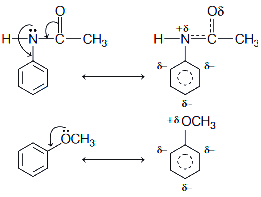
Identify ortho and para directing groups from the following: $I. -CHO$,$II. -NHCOCH_3$,$III. -OCH_3$,$IV. -SO_3H$.
A
$III, IV$
B
$II, III$
C
$II, IV$
D
$I, IV$
Solution
(B) Ortho and para directing groups are electron-donating groups that increase electron density at the ortho and para positions of the benzene ring.
Groups like $-NHCOCH_3$ $(II)$ and $-OCH_3$ $(III)$ have lone pairs on the atom directly attached to the benzene ring,exhibiting a $+M$ effect. Therefore,they are ortho/para directing.
In contrast,$-CHO$ $(I)$ and $-SO_3H$ $(IV)$ are electron-withdrawing groups and are meta-directing.
Thus,the correct option is $(b)$.
Groups like $-NHCOCH_3$ $(II)$ and $-OCH_3$ $(III)$ have lone pairs on the atom directly attached to the benzene ring,exhibiting a $+M$ effect. Therefore,they are ortho/para directing.
In contrast,$-CHO$ $(I)$ and $-SO_3H$ $(IV)$ are electron-withdrawing groups and are meta-directing.
Thus,the correct option is $(b)$.
0 likes
View Solution197
MediumMCQ
Which one of the following represents the hyperconjugation effect?
A
$CH_3-CH=CH_2 \rightarrow H^+ + CH_2=CH-CH_2^-$
B
$CH_2=CH-Cl: \rightarrow :CH_2-CH=Cl^+$
C
$CH_3-CH_2$ $\rightarrow NO_2$ $\rightarrow CH_3-\stackrel{\delta+}{CH_2}-\stackrel{\delta-}{NO_2}$
D
$CH_3-CH=CH_2 + H^+ \rightarrow CH_3-CH^+-CH_3$
Solution
(A) Hyperconjugation is the interaction of electrons in a sigma bond (usually $C-H$ or $C-C$) with an adjacent empty or partially filled $p$-orbital or a $\pi$-orbital to give an extended molecular orbital that increases the stability of the system.
In option $A$,the delocalization of electrons from the $C-H$ sigma bond into the adjacent $\pi$-system is shown,which is the characteristic representation of the hyperconjugation effect (also known as no-bond resonance).
Option $B$ represents the resonance effect (mesomeric effect).
Option $C$ represents the inductive effect.
Option $D$ represents an electrophilic addition reaction.
Therefore,the correct representation of hyperconjugation is given in option $A$.
In option $A$,the delocalization of electrons from the $C-H$ sigma bond into the adjacent $\pi$-system is shown,which is the characteristic representation of the hyperconjugation effect (also known as no-bond resonance).
Option $B$ represents the resonance effect (mesomeric effect).
Option $C$ represents the inductive effect.
Option $D$ represents an electrophilic addition reaction.
Therefore,the correct representation of hyperconjugation is given in option $A$.
0 likes
View Solution198
EasyMCQ
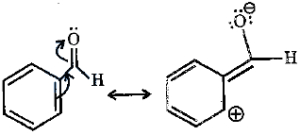
The electron displacement effect observed in the given structures is known as
A
$+R$ effect
B
$-R$ effect
C
Electromeric effect
D
$-I$ effect
Solution
(B) The $CHO$ (aldehyde) group attached to the benzene ring is an electron-withdrawing group.
In the given structures,the $\pi$-electrons of the benzene ring are delocalized towards the oxygen atom of the $CHO$ group.
This type of electron displacement,where the substituent withdraws electron density from the conjugated system through resonance,is known as the $-R$ effect (or $-M$ effect).
In the given structures,the $\pi$-electrons of the benzene ring are delocalized towards the oxygen atom of the $CHO$ group.
This type of electron displacement,where the substituent withdraws electron density from the conjugated system through resonance,is known as the $-R$ effect (or $-M$ effect).
0 likes
View Solution199
Difficult
Identify the atoms or groups from the following that exhibit $-R$ effect and $+R$ effect when present on a benzene ring:
$-OR, -NHCOR, -CN, -X, -NO_2, -NH_2, -CHO$
$-OR, -NHCOR, -CN, -X, -NO_2, -NH_2, -CHO$
Solution
(A) Groups that exhibit $-R$ effect (electron-withdrawing groups) decrease the electron density on the benzene ring. These include: $-CN, -NO_2, -CHO$.
Groups that exhibit $+R$ effect (electron-donating groups) increase the electron density on the benzene ring. These include: $-OR, -NHCOR, -X, -NH_2$ (Note: Halogens like $-X$ exhibit $-I$ effect but $+R$ effect).
Groups that exhibit $+R$ effect (electron-donating groups) increase the electron density on the benzene ring. These include: $-OR, -NHCOR, -X, -NH_2$ (Note: Halogens like $-X$ exhibit $-I$ effect but $+R$ effect).
0 likes
View Solution200
MediumMCQ
The number of no bond resonance structures possible for but$-1-$ene and a $3^{\circ}$ carbocation having methyl,ethyl,and isobutyl groups on the cationic carbon,respectively,are:
A
$3, 7$
B
$4, 6$
C
$2, 7$
D
$5, 6$
Solution
(C) No bond resonance (hyperconjugation) depends on the number of $\alpha-H$ atoms.
For but$-1-$ene $(CH_3-CH_2-CH=CH_2)$,the $\alpha$-carbon is the $CH_2$ group attached to the double bond. It has $2$ $\alpha-H$ atoms. Therefore,it gives $2$ no bond resonating structures.
For a $3^{\circ}$ carbocation with methyl $(-CH_3)$,ethyl $(-CH_2CH_3)$,and isobutyl $(-CH_2CH(CH_3)_2)$ groups attached to the cationic carbon,the total number of $\alpha-H$ atoms is calculated as follows:
- From methyl group: $3$ $\alpha-H$
- From ethyl group: $2$ $\alpha-H$
- From isobutyl group: $2$ $\alpha-H$
Total $\alpha-H = 3 + 2 + 2 = 7$.
Thus,it forms $7$ no bond resonating structures.
Hence,option $(C)$ is correct.
For but$-1-$ene $(CH_3-CH_2-CH=CH_2)$,the $\alpha$-carbon is the $CH_2$ group attached to the double bond. It has $2$ $\alpha-H$ atoms. Therefore,it gives $2$ no bond resonating structures.
For a $3^{\circ}$ carbocation with methyl $(-CH_3)$,ethyl $(-CH_2CH_3)$,and isobutyl $(-CH_2CH(CH_3)_2)$ groups attached to the cationic carbon,the total number of $\alpha-H$ atoms is calculated as follows:
- From methyl group: $3$ $\alpha-H$
- From ethyl group: $2$ $\alpha-H$
- From isobutyl group: $2$ $\alpha-H$
Total $\alpha-H = 3 + 2 + 2 = 7$.
Thus,it forms $7$ no bond resonating structures.
Hence,option $(C)$ is correct.
0 likes
View Solution8-4.Organic Chemistry : Reaction mechanism — Electronic Displacement in covalent bond · Frequently Asked Questions
1Are these 8-4.Organic Chemistry : Reaction mechanism questions useful for JEE and NEET?
Yes. All questions in this section are mapped to JEE Main and NEET exam patterns. Previous year questions from JEE Main, NEET, GUJCET and state-level exams are included with full solutions.
2Can I switch to Hindi or Gujarati for these questions?
Yes. Use the language tabs in the hero section or the sidebar to view the same questions and solutions in English, Hindi or Gujarati.
3How do I generate a question paper from this subtopic?
Use the Vedclass Exam Paper Generator — select the chapter and subtopic, set difficulty, and generate Sets A, B, C, D automatically. First 3 chapters of every subject are free.
Vedclass Products
For Students
Vedclass Test Series
Mock tests in real JEE/NEET style with performance analysis. 5-day free trial.
Start Free TrialFor Teachers
Exam Paper Generator
Generate Set A/B/C/D papers from this chapter in 2 minutes. 3 chapters free.
Try FreeFor Institutes
Online Exam Module
Live online exams with unlimited students, 360° analytics & white-label branding.
See DemoFor Teachers & Institutes
Generate a 8-4.Organic Chemistry : Reaction mechanism Exam Paper in 2 Minutes
Select subtopic & difficulty — Sets A, B, C, D auto-generated with No Repeat logic.
First 3 chapters of every subject are free — no payment required.