
A English
Electronic Displacement in covalent bond Questions in English
Class 11 Chemistry · 8-4.Organic Chemistry : Reaction mechanism · Electronic Displacement in covalent bond
210+
Questions
English
Language
100%
With Solutions
Showing 10 of 210 questions in English
201
EasyMCQ
In which of the following is hyperconjugation not possible?
A
$C_6H_5-C(CH_3)_3$
B
$C_6H_5-CH(CH_3)_2$
C
$C_6H_5-CH_2-CH_3$
D
$C_6H_5-CH_3$
Solution
(A) Hyperconjugation requires the presence of at least one $\alpha$-hydrogen atom on a carbon atom adjacent to an unsaturated system (like a double bond or a benzene ring) or a carbocation.
In the given options:
$A$) $C_6H_5-C(CH_3)_3$: The $\alpha$-carbon is attached to three methyl groups and the benzene ring. It has no $\alpha$-hydrogen atoms,so hyperconjugation is not possible.
$B$) $C_6H_5-CH(CH_3)_2$: The $\alpha$-carbon has one $\alpha$-hydrogen atom.
$C$) $C_6H_5-CH_2-CH_3$: The $\alpha$-carbon has two $\alpha$-hydrogen atoms.
$D$) $C_6H_5-CH_3$: The $\alpha$-carbon has three $\alpha$-hydrogen atoms.
Therefore,the correct option is $(A)$.
In the given options:
$A$) $C_6H_5-C(CH_3)_3$: The $\alpha$-carbon is attached to three methyl groups and the benzene ring. It has no $\alpha$-hydrogen atoms,so hyperconjugation is not possible.
$B$) $C_6H_5-CH(CH_3)_2$: The $\alpha$-carbon has one $\alpha$-hydrogen atom.
$C$) $C_6H_5-CH_2-CH_3$: The $\alpha$-carbon has two $\alpha$-hydrogen atoms.
$D$) $C_6H_5-CH_3$: The $\alpha$-carbon has three $\alpha$-hydrogen atoms.
Therefore,the correct option is $(A)$.
0 likes
View Solution202
EasyMCQ
The delocalization of $\sigma$ electrons of $C-H$ bond of an alkyl group with the $\pi$ electrons of benzene is observed in
A
Inductive effect
B
Hyperconjugation effect
C
Resonance effect
D
Electromeric effect
Solution
(B) The phenomenon involving the delocalization of $\sigma$ electrons of a $C-H$ bond of an alkyl group attached to an unsaturated system (like benzene) or a vacant $p$-orbital is known as hyperconjugation.
This effect is also referred to as 'no-bond resonance' or the Baker-Nathan effect.
This effect is also referred to as 'no-bond resonance' or the Baker-Nathan effect.
0 likes
View Solution203
DifficultMCQ
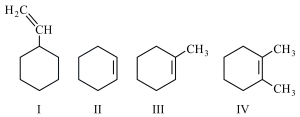
The correct order of the stability of the following compounds based on hyperconjugation is
A
$IV > III > II > I$
B
$IV > II > I > III$
C
$IV > II > III > I$
D
$IV > I > III > II$
Solution
(A) The stability of alkenes is directly proportional to the number of hyperconjugating structures,which in turn depends on the number of $\alpha$-hydrogen atoms attached to the $sp^2$ hybridized carbon atoms of the double bond.Counting the $\alpha$-hydrogen atoms for each compound:$I$: Vinylcyclohexane has $1$ $\alpha$-hydrogen atom.$II$: Cyclohexene has $4$ $\alpha$-hydrogen atoms.$III$: $1$-Methylcyclohexene has $7$ $\alpha$-hydrogen atoms.$IV$: $1,2$-Dimethylcyclohexene has $10$ $\alpha$-hydrogen atoms.Since the number of $\alpha$-hydrogen atoms follows the order $IV (10) > III (7) > II (4) > I (1)$,the stability order is $IV > III > II > I$.
0 likes
View Solution204
EasyMCQ
The number of activating and deactivating groups among the following are respectively: $-OCH_2CH_3, -COCH_3, -NHCOCH_3, -COOCH_3, -SO_3H$
A
$2, 3$
B
$3, 2$
C
$1, 4$
D
$4, 1$
Solution
(A) Activating groups are those that donate electron density to the benzene ring,typically via resonance (e.g.,lone pairs). Deactivating groups are those that withdraw electron density from the benzene ring,typically via inductive or resonance effects.
$1$. $-OCH_2CH_3$: Activating (due to lone pair on oxygen).
$2$. $-COCH_3$: Deactivating (electron-withdrawing carbonyl group).
$3$. $-NHCOCH_3$: Activating (due to lone pair on nitrogen).
$4$. $-COOCH_3$: Deactivating (electron-withdrawing ester group).
$5$. $-SO_3H$: Deactivating (electron-withdrawing sulfonic acid group).
Thus,there are $2$ activating groups $(-OCH_2CH_3, -NHCOCH_3)$ and $3$ deactivating groups $(-COCH_3, -COOCH_3, -SO_3H)$.
Therefore,the correct answer is $2, 3$.
$1$. $-OCH_2CH_3$: Activating (due to lone pair on oxygen).
$2$. $-COCH_3$: Deactivating (electron-withdrawing carbonyl group).
$3$. $-NHCOCH_3$: Activating (due to lone pair on nitrogen).
$4$. $-COOCH_3$: Deactivating (electron-withdrawing ester group).
$5$. $-SO_3H$: Deactivating (electron-withdrawing sulfonic acid group).
Thus,there are $2$ activating groups $(-OCH_2CH_3, -NHCOCH_3)$ and $3$ deactivating groups $(-COCH_3, -COOCH_3, -SO_3H)$.
Therefore,the correct answer is $2, 3$.
0 likes
View Solution205
EasyMCQ
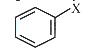
The rate of attack of an electrophile is least when $X$ in the given compound is
A
$-NO_2$
B
$-CH_3$
C
$-OH$
D
$-NH_2$
Solution
(A) Electrophilic aromatic substitution is favored by electron-donating groups (activating groups) and disfavored by electron-withdrawing groups (deactivating groups).
$-OH$,$-NH_2$,and $-CH_3$ are electron-donating groups that increase the electron density of the benzene ring,thereby facilitating the electrophilic attack.
$-NO_2$ is a strong electron-withdrawing group due to both its $-I$ (inductive) and $-M$ (mesomeric) effects.
It significantly reduces the electron density of the benzene ring,making it the least reactive towards electrophilic attack.
$-OH$,$-NH_2$,and $-CH_3$ are electron-donating groups that increase the electron density of the benzene ring,thereby facilitating the electrophilic attack.
$-NO_2$ is a strong electron-withdrawing group due to both its $-I$ (inductive) and $-M$ (mesomeric) effects.
It significantly reduces the electron density of the benzene ring,making it the least reactive towards electrophilic attack.
0 likes
View Solution206
MediumMCQ
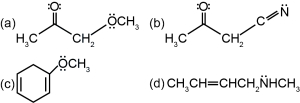
Which of the following molecule$(s)$ has/have delocalised lone pair$(s)$ of electrons?
A
$ CH_3COCH_2OCH_3$
B
$CH_3COCH_2CN$
C
$C_6H_7OCH_3$
D
$CH_3CH=CHCH_2NHCH_3$
Solution
(C) lone pair of electrons is considered delocalised if it is in conjugation with a $\pi$-bond (i.e.,separated by one single bond).
In option $(a)$,the oxygen lone pair is separated from the carbonyl group by a $-CH_2-$ group,so it is localised.
In option $(b)$,the nitrogen lone pair is separated from the carbonyl group by a $-CH_2-$ group,so it is localised.
In option $(c)$,the oxygen atom is directly attached to the double bond of the ring. The lone pair on oxygen is in conjugation with the $\pi$-electrons of the double bond,making it delocalised.
In option $(d)$,the nitrogen lone pair is separated from the double bond by a $-CH_2-$ group,so it is localised.
Therefore,only the molecule in option $(c)$ has a delocalised lone pair.
In option $(a)$,the oxygen lone pair is separated from the carbonyl group by a $-CH_2-$ group,so it is localised.
In option $(b)$,the nitrogen lone pair is separated from the carbonyl group by a $-CH_2-$ group,so it is localised.
In option $(c)$,the oxygen atom is directly attached to the double bond of the ring. The lone pair on oxygen is in conjugation with the $\pi$-electrons of the double bond,making it delocalised.
In option $(d)$,the nitrogen lone pair is separated from the double bond by a $-CH_2-$ group,so it is localised.
Therefore,only the molecule in option $(c)$ has a delocalised lone pair.
0 likes
View Solution207
DifficultMCQ
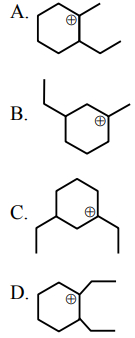
The cyclic cations having the same number of hyperconjugation are: Choose the correct answer from the options given below:
A
$A$ and $C$ Only
B
$B$ and $C$ Only
C
$A$ and $B$ Only
D
$A, C$ and $D$ only
Solution
(A) Hyperconjugation is determined by the number of $\alpha$-hydrogens attached to the carbon atoms directly bonded to the positively charged carbocation center.
$A$: The carbocation is bonded to two ring carbons and one methyl group. The $\alpha$-hydrogens are: $2$ (from $CH_2$ of ring) + $2$ (from $CH_2$ of ring) + $2$ (from $CH_3$) = $6 \alpha H$.
$B$: The carbocation is bonded to two ring carbons and one methyl group. The $\alpha$-hydrogens are: $2$ (from $CH_2$ of ring) + $2$ (from $CH_2$ of ring) + $3$ (from $CH_3$) = $7 \alpha H$.
$C$: The carbocation is bonded to two ring carbons. The $\alpha$-hydrogens are: $2$ (from $CH_2$ of ring) + $2$ (from $CH_2$ of ring) + $2$ (from $CH_2$ of ethyl group) = $6 \alpha H$.
$D$: The carbocation is bonded to two ring carbons and one ethyl group. The $\alpha$-hydrogens are: $2$ (from $CH_2$ of ring) + $2$ (from $CH_2$ of ring) + $1$ (from $CH$ of ethyl group) = $5 \alpha H$.
Thus,structures $A$ and $C$ have the same number of hyperconjugation ($6 \alpha H$ each).
$A$: The carbocation is bonded to two ring carbons and one methyl group. The $\alpha$-hydrogens are: $2$ (from $CH_2$ of ring) + $2$ (from $CH_2$ of ring) + $2$ (from $CH_3$) = $6 \alpha H$.
$B$: The carbocation is bonded to two ring carbons and one methyl group. The $\alpha$-hydrogens are: $2$ (from $CH_2$ of ring) + $2$ (from $CH_2$ of ring) + $3$ (from $CH_3$) = $7 \alpha H$.
$C$: The carbocation is bonded to two ring carbons. The $\alpha$-hydrogens are: $2$ (from $CH_2$ of ring) + $2$ (from $CH_2$ of ring) + $2$ (from $CH_2$ of ethyl group) = $6 \alpha H$.
$D$: The carbocation is bonded to two ring carbons and one ethyl group. The $\alpha$-hydrogens are: $2$ (from $CH_2$ of ring) + $2$ (from $CH_2$ of ring) + $1$ (from $CH$ of ethyl group) = $5 \alpha H$.
Thus,structures $A$ and $C$ have the same number of hyperconjugation ($6 \alpha H$ each).
0 likes
View Solution208
MediumMCQ
The increasing order of the electron-withdrawing power of the following functional groups is:
a. $-CN$
b. $-COOH$
c. $-NO_2$
d. $-I$
a. $-CN$
b. $-COOH$
c. $-NO_2$
d. $-I$
A
$c < b < d < a$
B
$c < a < b < d$
C
$d < b < a < c$
D
$a < b < c < d$
Solution
(C) The electron-withdrawing power of functional groups is determined by their inductive effect ($-I$ effect) and electronegativity.
Comparing the given groups:
$1$. The $-I$ group has the weakest electron-withdrawing effect among the options provided.
$2$. The $-COOH$ group is more electron-withdrawing than $-I$.
$3$. The $-CN$ group is more electron-withdrawing than $-COOH$ due to the higher electronegativity of the nitrogen atom and the $sp$ hybridized carbon.
$4$. The $-NO_2$ group is the strongest electron-withdrawing group among these due to the presence of two highly electronegative oxygen atoms attached to a positively charged nitrogen atom.
Therefore,the increasing order is: $d < b < a < c$.
Comparing the given groups:
$1$. The $-I$ group has the weakest electron-withdrawing effect among the options provided.
$2$. The $-COOH$ group is more electron-withdrawing than $-I$.
$3$. The $-CN$ group is more electron-withdrawing than $-COOH$ due to the higher electronegativity of the nitrogen atom and the $sp$ hybridized carbon.
$4$. The $-NO_2$ group is the strongest electron-withdrawing group among these due to the presence of two highly electronegative oxygen atoms attached to a positively charged nitrogen atom.
Therefore,the increasing order is: $d < b < a < c$.
0 likes
View Solution209
MediumMCQ
Given below are two statements:
Statement $I$: In $O_2N-C_6H_4-CH^+-C_6H_4-OCH_3$,the carbocation is stabilised by $+R$ effect of $-OCH_3$ group.
Statement $II$: In $O_2N-C_6H_4-CH^--C_6H_4-OCH_3$,the carbanion is stabilised by $-R$ effect of $-NO_2$ group.
In the light of the above statements,choose the correct answer from the options given below:
Statement $I$: In $O_2N-C_6H_4-CH^+-C_6H_4-OCH_3$,the carbocation is stabilised by $+R$ effect of $-OCH_3$ group.
Statement $II$: In $O_2N-C_6H_4-CH^--C_6H_4-OCH_3$,the carbanion is stabilised by $-R$ effect of $-NO_2$ group.
In the light of the above statements,choose the correct answer from the options given below:
A
Both Statement $I$ and Statement $II$ are true
B
Both Statement $I$ and Statement $II$ are false
C
Statement $I$ is true but Statement $II$ is false
D
Statement $I$ is false but Statement $II$ is true
Solution
(A) Statement $I$ is true: The carbocation is electron-deficient. The $-OCH_3$ group exerts a $+R$ (resonance) effect,which donates electron density into the ring and stabilizes the adjacent positive charge.
Statement $II$ is true: The carbanion is electron-rich. The $-NO_2$ group exerts a $-R$ (resonance) effect,which withdraws electron density from the ring and stabilizes the adjacent negative charge.
Statement $II$ is true: The carbanion is electron-rich. The $-NO_2$ group exerts a $-R$ (resonance) effect,which withdraws electron density from the ring and stabilizes the adjacent negative charge.
0 likes
View Solution210
MediumMCQ
Given below are two statements:
Statement $I$: On the basis of inductive effect,the order of stability of alkyl carbanions is $CH_3^- > CH_3CH_2^- > (CH_3)_2CH^- > (CH_3)_3C^-$.
Statement $II$: Allyl and benzyl carbanions are more stabilised by inductive effect and not by resonance effect.
Statement $I$: On the basis of inductive effect,the order of stability of alkyl carbanions is $CH_3^- > CH_3CH_2^- > (CH_3)_2CH^- > (CH_3)_3C^-$.
Statement $II$: Allyl and benzyl carbanions are more stabilised by inductive effect and not by resonance effect.
A
Both Statement $I$ and Statement $II$ are correct
B
Both Statement $I$ and Statement $II$ are incorrect
C
Statement $I$ is correct but Statement $II$ is incorrect
D
Statement $I$ is incorrect but Statement $II$ is correct
Solution
(C) Statement $I$: Alkyl groups exhibit an electron-donating effect ($+I$ effect). Since carbanions are electron-rich species,the presence of electron-donating groups destabilizes them. As the number of alkyl groups increases,the $+I$ effect increases,leading to decreased stability. Thus,the order of stability is $CH_3^- > 1^\circ > 2^\circ > 3^\circ$. Statement $I$ is correct.
Statement $II$: Allyl and benzyl carbanions are primarily stabilized by the delocalization of the negative charge through resonance. The inductive effect plays a minor role compared to resonance. Therefore,Statement $II$ is incorrect.
Statement $II$: Allyl and benzyl carbanions are primarily stabilized by the delocalization of the negative charge through resonance. The inductive effect plays a minor role compared to resonance. Therefore,Statement $II$ is incorrect.
0 likes
View Solution8-4.Organic Chemistry : Reaction mechanism — Electronic Displacement in covalent bond · Frequently Asked Questions
1Are these 8-4.Organic Chemistry : Reaction mechanism questions useful for JEE and NEET?
Yes. All questions in this section are mapped to JEE Main and NEET exam patterns. Previous year questions from JEE Main, NEET, GUJCET and state-level exams are included with full solutions.
2Can I switch to Hindi or Gujarati for these questions?
Yes. Use the language tabs in the hero section or the sidebar to view the same questions and solutions in English, Hindi or Gujarati.
3How do I generate a question paper from this subtopic?
Use the Vedclass Exam Paper Generator — select the chapter and subtopic, set difficulty, and generate Sets A, B, C, D automatically. First 3 chapters of every subject are free.
Vedclass Products
For Students
Vedclass Test Series
Mock tests in real JEE/NEET style with performance analysis. 5-day free trial.
Start Free TrialFor Teachers
Exam Paper Generator
Generate Set A/B/C/D papers from this chapter in 2 minutes. 3 chapters free.
Try FreeFor Institutes
Online Exam Module
Live online exams with unlimited students, 360° analytics & white-label branding.
See DemoFor Teachers & Institutes
Generate a 8-4.Organic Chemistry : Reaction mechanism Exam Paper in 2 Minutes
Select subtopic & difficulty — Sets A, B, C, D auto-generated with No Repeat logic.
First 3 chapters of every subject are free — no payment required.