
A English
Electronic Displacement in covalent bond Questions in English
Class 11 Chemistry · 8-4.Organic Chemistry : Reaction mechanism · Electronic Displacement in covalent bond
210+
Questions
English
Language
100%
With Solutions
Showing 50 of 210 questions in English
51
MediumMCQ
Rank the hydrogen atoms $(H_a, H_b, H_c)$ present in the following molecule in decreasing order of their acidic strength.
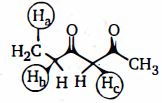
A
$c > b > a$
B
$b > a > c$
C
$b > c > a$
D
$a > b > c$
Solution
(A) The acidic strength is directly proportional to the stability of the resulting conjugate base (anion).
$1$. $H_c$ is located on the $\alpha$-carbon between two carbonyl groups (a $\beta$-dicarbonyl compound). The resulting anion is stabilized by resonance with both carbonyl groups.
$2$. $H_b$ is on an $\alpha$-carbon adjacent to one carbonyl group. The resulting anion is stabilized by resonance with one carbonyl group.
$3$. $H_a$ is on a terminal methyl group. The resulting anion has no resonance stabilization.
Therefore,the order of acidic strength is $H_c > H_b > H_a$.
$1$. $H_c$ is located on the $\alpha$-carbon between two carbonyl groups (a $\beta$-dicarbonyl compound). The resulting anion is stabilized by resonance with both carbonyl groups.
$2$. $H_b$ is on an $\alpha$-carbon adjacent to one carbonyl group. The resulting anion is stabilized by resonance with one carbonyl group.
$3$. $H_a$ is on a terminal methyl group. The resulting anion has no resonance stabilization.
Therefore,the order of acidic strength is $H_c > H_b > H_a$.
0 likes
View Solution52
MediumMCQ
Arrange the following compounds in increasing order of their acidic strength:

A
$III < I < IV < II$
B
$II < I < IV < III$
C
$I < III < IV < II$
D
$II < III < I < IV$
Solution
(D) The acidic strength is directly proportional to the stability of the resulting conjugate base (anion) formed after the removal of an $\alpha$-hydrogen.
$(I)$ Cyclohexane$-1,3-$dione: The $\alpha$-hydrogens are between two carbonyl groups,making the resulting anion highly stabilized by resonance.
$(II)$ $\delta$-Valerolactone: The $\alpha$-hydrogens are adjacent to one carbonyl group and an oxygen atom,which is less acidic than a $\beta$-dicarbonyl system.
$(III)$ Tetrahydropyran$-4-$one: The $\alpha$-hydrogens are adjacent to only one carbonyl group.
$(IV)$ Methyl $2,6-$dioxocyclohexanecarboxylate: This compound has a highly acidic hydrogen between two carbonyl groups,and the presence of the ester group further enhances the acidity due to the electron-withdrawing effect.
Comparing the stability of the anions:
- Compound $(II)$ has the least acidic $\alpha$-hydrogens.
- Compound $(III)$ is more acidic than $(II)$ due to the inductive effect of the oxygen.
- Compound $(I)$ is a $\beta$-diketone,which is significantly more acidic.
- Compound $(IV)$ is the most acidic due to the presence of an additional ester group,which provides extra resonance and inductive stabilization to the anion.
Thus,the increasing order of acidic strength is: $II < III < I < IV$.
$(I)$ Cyclohexane$-1,3-$dione: The $\alpha$-hydrogens are between two carbonyl groups,making the resulting anion highly stabilized by resonance.
$(II)$ $\delta$-Valerolactone: The $\alpha$-hydrogens are adjacent to one carbonyl group and an oxygen atom,which is less acidic than a $\beta$-dicarbonyl system.
$(III)$ Tetrahydropyran$-4-$one: The $\alpha$-hydrogens are adjacent to only one carbonyl group.
$(IV)$ Methyl $2,6-$dioxocyclohexanecarboxylate: This compound has a highly acidic hydrogen between two carbonyl groups,and the presence of the ester group further enhances the acidity due to the electron-withdrawing effect.
Comparing the stability of the anions:
- Compound $(II)$ has the least acidic $\alpha$-hydrogens.
- Compound $(III)$ is more acidic than $(II)$ due to the inductive effect of the oxygen.
- Compound $(I)$ is a $\beta$-diketone,which is significantly more acidic.
- Compound $(IV)$ is the most acidic due to the presence of an additional ester group,which provides extra resonance and inductive stabilization to the anion.
Thus,the increasing order of acidic strength is: $II < III < I < IV$.
0 likes
View Solution53
DifficultMCQ
Which of the following $\sigma$-bonds participate in hyperconjugation?
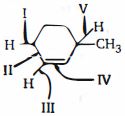
A
$I$ and $II$
B
$I$ and $V$
C
$II$ and $V$
D
$III$ and $IV$
Solution
(B) Hyperconjugation occurs due to the interaction of $\sigma$-electrons of a $C-H$ bond attached to an $\alpha$-carbon (a carbon atom directly attached to an $sp^2$ hybridized carbon atom) with the adjacent empty or partially filled $p$-orbital or $\pi$-orbital.
In the given structure,the $\alpha$-carbons are the carbons adjacent to the $C=C$ double bond.
Bond $I$ is a $C-H$ bond on an $\alpha$-carbon.
Bond $V$ is a $C-H$ bond on an $\alpha$-carbon.
Bonds $II$,$III$,and $IV$ are not $C-H$ bonds on $\alpha$-carbons.
Therefore,the $\sigma$-bonds $I$ and $V$ participate in hyperconjugation.
In the given structure,the $\alpha$-carbons are the carbons adjacent to the $C=C$ double bond.
Bond $I$ is a $C-H$ bond on an $\alpha$-carbon.
Bond $V$ is a $C-H$ bond on an $\alpha$-carbon.
Bonds $II$,$III$,and $IV$ are not $C-H$ bonds on $\alpha$-carbons.
Therefore,the $\sigma$-bonds $I$ and $V$ participate in hyperconjugation.
0 likes
View Solution54
DifficultMCQ
The decreasing order of acidic strengths of the following compounds is:

A
$x > y > z$
B
$y > x > z$
C
$z > y > x$
D
$z > x > y$
Solution
(D) The acidic strength of a compound depends on the stability of its conjugate base formed after the removal of a proton $(H^+)$.
$(x)$ Cyclopentadiene: Upon losing a proton,it forms a cyclopentadienyl anion,which is aromatic ($6 \pi$ electrons,Huckel's rule).
$(y)$ Cycloheptatriene: Upon losing a proton,it forms a cycloheptatrienyl anion,which is anti-aromatic ($8 \pi$ electrons,unstable).
$(z)$ $5-$cyanocyclopentadiene: Upon losing a proton,it forms a cyclopentadienyl anion substituted with a $-CN$ group. The $-CN$ group is a strong electron-withdrawing group ($-I$ and $-M$ effect),which further stabilizes the already aromatic anion through resonance and inductive effects.
Comparing the stabilities of the conjugate bases:
$1$. The anion of $(z)$ is the most stable due to the $-CN$ group.
$2$. The anion of $(x)$ is aromatic and stable.
$3$. The anion of $(y)$ is anti-aromatic and highly unstable.
Therefore,the order of acidic strength is $z > x > y$.
$(x)$ Cyclopentadiene: Upon losing a proton,it forms a cyclopentadienyl anion,which is aromatic ($6 \pi$ electrons,Huckel's rule).
$(y)$ Cycloheptatriene: Upon losing a proton,it forms a cycloheptatrienyl anion,which is anti-aromatic ($8 \pi$ electrons,unstable).
$(z)$ $5-$cyanocyclopentadiene: Upon losing a proton,it forms a cyclopentadienyl anion substituted with a $-CN$ group. The $-CN$ group is a strong electron-withdrawing group ($-I$ and $-M$ effect),which further stabilizes the already aromatic anion through resonance and inductive effects.
Comparing the stabilities of the conjugate bases:
$1$. The anion of $(z)$ is the most stable due to the $-CN$ group.
$2$. The anion of $(x)$ is aromatic and stable.
$3$. The anion of $(y)$ is anti-aromatic and highly unstable.
Therefore,the order of acidic strength is $z > x > y$.
0 likes
View Solution55
DifficultMCQ
Rank the following compounds in order of increasing acidity (weakest acid first).
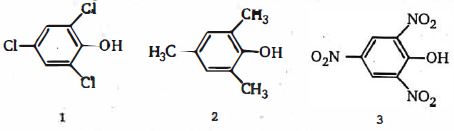
A
$2 < 1 < 3$
B
$3 < 1 < 2$
C
$1 < 2 < 3$
D
$2 < 3 < 1$
Solution
(A) Acidic strength is directly proportional to the electron-withdrawing effect of the substituents attached to the benzene ring.
Compound $2$ has three electron-donating methyl groups $(-CH_3)$,which decrease the acidity.
Compound $1$ has three electron-withdrawing chlorine atoms $(-Cl)$,which increase the acidity.
Compound $3$ has three strongly electron-withdrawing nitro groups $(-NO_2)$,which increase the acidity significantly more than chlorine atoms.
Therefore,the order of increasing acidity is $2 < 1 < 3$.
Compound $2$ has three electron-donating methyl groups $(-CH_3)$,which decrease the acidity.
Compound $1$ has three electron-withdrawing chlorine atoms $(-Cl)$,which increase the acidity.
Compound $3$ has three strongly electron-withdrawing nitro groups $(-NO_2)$,which increase the acidity significantly more than chlorine atoms.
Therefore,the order of increasing acidity is $2 < 1 < 3$.
0 likes
View Solution56
DifficultMCQ
The basic strength of $1,8-$bis(dimethylamino)naphthalene is $10^{10}$ times more than $1-$dimethylaminonaphthalene. The reason for this high basic strength is:
A
resonance
B
steric inhibition of resonance
C
ortho effect
D
hyperconjugation
Solution
(B) The correct answer is $(b)$.
$1,8-$bis(dimethylamino)naphthalene,also known as a 'proton sponge',exhibits exceptionally high basicity.
In $1-$dimethylaminonaphthalene,the lone pair on the nitrogen atom is involved in resonance with the naphthalene ring,which decreases its availability for protonation.
In $1,8-$bis(dimethylamino)naphthalene,the two bulky $-N(CH_3)_2$ groups are forced into close proximity at the $1$ and $8$ positions. This causes steric crowding,which forces the lone pairs out of the plane of the naphthalene ring,thereby inhibiting resonance.
Since the lone pairs cannot participate in resonance,they are more available for protonation,making the molecule a much stronger base.
$1,8-$bis(dimethylamino)naphthalene,also known as a 'proton sponge',exhibits exceptionally high basicity.
In $1-$dimethylaminonaphthalene,the lone pair on the nitrogen atom is involved in resonance with the naphthalene ring,which decreases its availability for protonation.
In $1,8-$bis(dimethylamino)naphthalene,the two bulky $-N(CH_3)_2$ groups are forced into close proximity at the $1$ and $8$ positions. This causes steric crowding,which forces the lone pairs out of the plane of the naphthalene ring,thereby inhibiting resonance.
Since the lone pairs cannot participate in resonance,they are more available for protonation,making the molecule a much stronger base.
0 likes
View Solution57
MediumMCQ
Rank the following compounds in the order of increasing acidic strength:
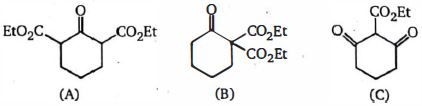
A
$A < B < C$
B
$A < C < B$
C
$B < A < C$
D
$B < C < A$
Solution
(C) The acidic strength of these compounds depends on the stability of the conjugate base formed after the removal of the $\alpha$-hydrogen. The stability of the conjugate base is increased by the electron-withdrawing $-I$ effect of the substituent groups.
In compound $C$,the $\alpha$-hydrogen is flanked by two carbonyl groups (ketones),which exert a strong $-I$ effect,making the conjugate base highly stable.
In compound $A$,the $\alpha$-hydrogen is between a ketone and an ester group. The ester group is less electron-withdrawing than the ketone group.
In compound $B$,the two ester groups are on the same carbon. While there are two groups,the steric hindrance and the specific electronic environment make the $\alpha$-hydrogen less acidic compared to the structure in $A$ where the electron-withdrawing groups are better positioned to stabilize the negative charge.
Thus,the order of increasing acidic strength is $B < A < C$.
In compound $C$,the $\alpha$-hydrogen is flanked by two carbonyl groups (ketones),which exert a strong $-I$ effect,making the conjugate base highly stable.
In compound $A$,the $\alpha$-hydrogen is between a ketone and an ester group. The ester group is less electron-withdrawing than the ketone group.
In compound $B$,the two ester groups are on the same carbon. While there are two groups,the steric hindrance and the specific electronic environment make the $\alpha$-hydrogen less acidic compared to the structure in $A$ where the electron-withdrawing groups are better positioned to stabilize the negative charge.
Thus,the order of increasing acidic strength is $B < A < C$.
0 likes
View Solution58
MediumMCQ
Rank the hydrogen atoms $(H_a, H_b, H_c)$ in the following molecule according to their acidic strengths.
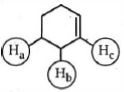
A
$a > b > c$
B
$b > a > c$
C
$b > c > a$
D
$a > c > b$
Solution
(C) The acidic strength of hydrogen atoms depends on the stability of the conjugate base (carbanion) formed after the removal of the proton.
Removing $H_a$ creates a carbanion at the $sp^3$ carbon.
Removing $H_b$ creates a carbanion at the $sp^3$ carbon adjacent to the double bond (allylic position),which is stabilized by resonance.
Removing $H_c$ creates a carbanion at the $sp^2$ carbon of the double bond (vinylic position).
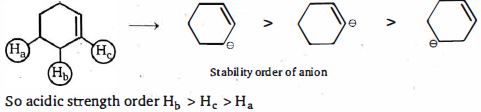
The stability order of the resulting anions is:
Allylic carbanion $>$ Vinylic carbanion $>$ Alkyl carbanion.
Therefore,the acidic strength order is $H_b > H_c > H_a$.
Removing $H_a$ creates a carbanion at the $sp^3$ carbon.
Removing $H_b$ creates a carbanion at the $sp^3$ carbon adjacent to the double bond (allylic position),which is stabilized by resonance.
Removing $H_c$ creates a carbanion at the $sp^2$ carbon of the double bond (vinylic position).
The stability order of the resulting anions is:
Allylic carbanion $>$ Vinylic carbanion $>$ Alkyl carbanion.
Therefore,the acidic strength order is $H_b > H_c > H_a$.
0 likes
View Solution59
MediumMCQ
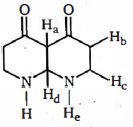
Identify the most acidic hydrogen present in the given compound.
A
$H_a$
B
$H_b$
C
$H_c$
D
$H_d$
Solution
(A) The acidity of a hydrogen atom depends on the stability of the conjugate base formed after the removal of the proton.
In the given structure,$H_a$ is located between two carbonyl groups (a $\beta$-dicarbonyl system).
The removal of $H_a$ generates a carbanion that is stabilized by resonance with both carbonyl groups,making it an active methylene group.
Therefore,$H_a$ is the most acidic hydrogen in the molecule.
In the given structure,$H_a$ is located between two carbonyl groups (a $\beta$-dicarbonyl system).
The removal of $H_a$ generates a carbanion that is stabilized by resonance with both carbonyl groups,making it an active methylene group.
Therefore,$H_a$ is the most acidic hydrogen in the molecule.
0 likes
View Solution60
DifficultMCQ
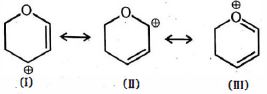
The most stable canonical structure among the given structures is:
A
$I$
B
$II$
C
$III$
D
all are equally stable
Solution
(C) In structure $III$,the oxygen atom has a positive charge but it has a complete octet because it forms three bonds (two single and one double bond) and has one lone pair.
In structures $I$ and $II$,the carbon atom with the positive charge has an incomplete octet (only $6$ electrons).
Since structure $III$ has a complete octet for all atoms,it is the most stable canonical structure.
In structures $I$ and $II$,the carbon atom with the positive charge has an incomplete octet (only $6$ electrons).
Since structure $III$ has a complete octet for all atoms,it is the most stable canonical structure.
0 likes
View Solution61
MediumMCQ
Which of the following orders of rotation barrier about the $C=C$ bond,as indicated in the structures below,is correct?
$(I)$ $CH_2=CH_2$
$(II)$ $CH_3O-CH=CH_2$
$(III)$ $CH_3O-CH=CH-COOEt$
$(I)$ $CH_2=CH_2$
$(II)$ $CH_3O-CH=CH_2$
$(III)$ $CH_3O-CH=CH-COOEt$
A
$I > II > III$
B
$III > II > I$
C
$III > I > II$
D
$II > I > III$
Solution
(A) The rotational barrier about a $C=C$ bond is directly proportional to the double bond character of that bond.
$(I)$ $CH_2=CH_2$: This is a pure alkene with no resonance,so it has the highest double bond character.
$(II)$ $CH_3O-CH=CH_2$: The lone pair on the oxygen atom participates in resonance with the $C=C$ bond $(CH_3O^+=CH-CH_2^-)$,which introduces some single bond character to the $C=C$ bond,reducing the rotational barrier compared to $(I)$.
$(III)$ $CH_3O-CH=CH-COOEt$: This molecule exhibits push-pull resonance. The electron-donating $CH_3O$ group and the electron-withdrawing $COOEt$ group significantly increase the resonance contribution,leading to even more single bond character in the $C=C$ bond compared to $(II)$.
Therefore,the order of double bond character (and thus rotational barrier) is $I > II > III$.
$(I)$ $CH_2=CH_2$: This is a pure alkene with no resonance,so it has the highest double bond character.
$(II)$ $CH_3O-CH=CH_2$: The lone pair on the oxygen atom participates in resonance with the $C=C$ bond $(CH_3O^+=CH-CH_2^-)$,which introduces some single bond character to the $C=C$ bond,reducing the rotational barrier compared to $(I)$.
$(III)$ $CH_3O-CH=CH-COOEt$: This molecule exhibits push-pull resonance. The electron-donating $CH_3O$ group and the electron-withdrawing $COOEt$ group significantly increase the resonance contribution,leading to even more single bond character in the $C=C$ bond compared to $(II)$.
Therefore,the order of double bond character (and thus rotational barrier) is $I > II > III$.
0 likes
View Solution62
AdvancedMCQ
Which of the following orders of rotation barrier about the $C=C$ bond,as indicated in the structures $(I)$,$(II)$,and $(III)$,is correct?
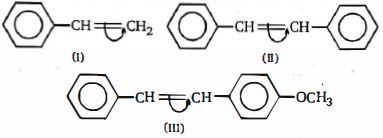
A
$I > II > III$
B
$III > II > I$
C
$III > I > II$
D
$II > I > III$
Solution
(A) The rotation barrier about a $C=C$ bond is directly proportional to the double bond character of that bond.
Resonance reduces the double bond character by introducing single bond character.
In $(I)$,the phenyl group is conjugated with the $C=C$ bond.
In $(II)$,both phenyl groups are conjugated with the $C=C$ bond,leading to more resonance and thus more single bond character than in $(I)$.
In $(III)$,the presence of the $-OCH_3$ group (a strong electron-donating group) on one of the phenyl rings further increases the resonance contribution,leading to the highest single bond character and the lowest rotation barrier.
Therefore,the order of double bond character (and thus rotation barrier) is $(I) > (II) > (III)$.
Resonance reduces the double bond character by introducing single bond character.
In $(I)$,the phenyl group is conjugated with the $C=C$ bond.
In $(II)$,both phenyl groups are conjugated with the $C=C$ bond,leading to more resonance and thus more single bond character than in $(I)$.
In $(III)$,the presence of the $-OCH_3$ group (a strong electron-donating group) on one of the phenyl rings further increases the resonance contribution,leading to the highest single bond character and the lowest rotation barrier.
Therefore,the order of double bond character (and thus rotation barrier) is $(I) > (II) > (III)$.
0 likes
View Solution63
MediumMCQ
Which of the following structures possesses a cross-conjugated system?
A
$CH_2=CH-CH=CH-CH_3$
B
$CH_2=CH-C(CH_2CH_3)=CH_2$
C
$CH_2=CH-CH(CH=CH_2)-CH=CH_2$
D
$CH_2=CH-C(=CH_2)-CH=CH_2$
Solution
(D) The correct answer is $(d)$.
Cross-conjugation occurs when two $\pi$-electron systems are conjugated with a third $\pi$-electron system,but not with each other.
In $CH_2=CH-C(=CH_2)-CH=CH_2$,the two terminal vinyl groups $(CH_2=CH-)$ are conjugated with the central $C=CH_2$ group,but they are not in a continuous linear conjugation with each other.
Cross-conjugation occurs when two $\pi$-electron systems are conjugated with a third $\pi$-electron system,but not with each other.
In $CH_2=CH-C(=CH_2)-CH=CH_2$,the two terminal vinyl groups $(CH_2=CH-)$ are conjugated with the central $C=CH_2$ group,but they are not in a continuous linear conjugation with each other.
0 likes
View Solution64
MediumMCQ
The migratory aptitude of the following groups in decreasing order is:
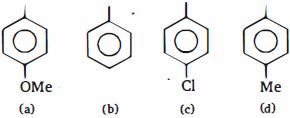
A
$a > c > b > d$
B
$a > d > b > c$
C
$a > d > c > b$
D
$b > c > a > d$
Solution
(B) The migratory aptitude of an aryl group is directly proportional to the electron density in the benzene ring.
Groups that donate electrons to the ring increase the migratory aptitude,while groups that withdraw electrons decrease it.
The order of electron-donating/withdrawing effects is:
$-OCH_3$ (strong $+M$ effect) > $-CH_3$ (hyperconjugation and $+I$ effect) > $-H$ (reference) > $-Cl$ ($-I$ effect dominates over $+M$ effect).
Therefore,the decreasing order of migratory aptitude is: $(a) > (d) > (b) > (c)$.
Groups that donate electrons to the ring increase the migratory aptitude,while groups that withdraw electrons decrease it.
The order of electron-donating/withdrawing effects is:
$-OCH_3$ (strong $+M$ effect) > $-CH_3$ (hyperconjugation and $+I$ effect) > $-H$ (reference) > $-Cl$ ($-I$ effect dominates over $+M$ effect).
Therefore,the decreasing order of migratory aptitude is: $(a) > (d) > (b) > (c)$.
0 likes
View Solution65
DifficultMCQ
$x =$ number of compounds that are better hydride donors than $Ph-CH(O^{\Theta})_2$.
A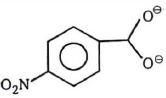
B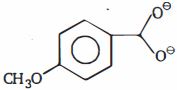
C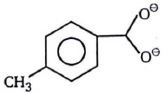
D
Both $(b)$ and $(c)$.
Solution
(D) The ability to act as a hydride donor depends on the stability of the resulting carbonyl compound. $A$ better hydride donor is one that forms a more stable carbonyl compound upon losing a hydride ion. Electron-donating groups (EDGs) destabilize the carbonyl group by increasing electron density,while electron-withdrawing groups (EWGs) stabilize it. However,in the context of the Cannizzaro-like mechanism or hydride transfer,the species that is more electron-rich (due to EDGs) is a better hydride donor because the negative charge is less stabilized by the ring,making the hydride more 'available' to be transferred. The $-OCH_3$ and $-CH_3$ groups are electron-donating groups ($+M$ and $+I$ effects respectively),which increase the electron density on the benzene ring and the carbon atom,making the hydride transfer easier compared to the unsubstituted or $p-NO_2$ substituted species. Thus,both $(b)$ and $(c)$ are better hydride donors than the reference compound.
0 likes
View Solution66
MediumMCQ
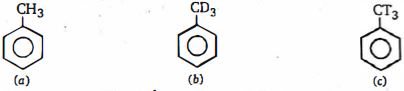
Arrange the following compounds in decreasing order of reactivity towards $EAS$ (electrophilic aromatic substitution).
A
$a > b > c$
B
$c > b > a$
C
$a > c > b$
D
$c > a > b$
Solution
(A) The reactivity towards $EAS$ depends on the electron-donating ability of the substituent group attached to the benzene ring.
All three groups ($-CH_3$,$-CD_3$,$-CT_3$) exhibit hyperconjugation.
The strength of the $C-H$,$C-D$,and $C-T$ bonds follows the order: $C-H < C-D < C-T$ due to the isotope effect (heavier isotopes form stronger bonds).
Since the $C-H$ bond is the weakest,it is easiest to break,leading to the strongest hyperconjugative effect.
Therefore,the electron-donating power via hyperconjugation follows the order: $-CH_3 > -CD_3 > -CT_3$.
Consequently,the reactivity towards $EAS$ follows the order: $a > b > c$.
All three groups ($-CH_3$,$-CD_3$,$-CT_3$) exhibit hyperconjugation.
The strength of the $C-H$,$C-D$,and $C-T$ bonds follows the order: $C-H < C-D < C-T$ due to the isotope effect (heavier isotopes form stronger bonds).
Since the $C-H$ bond is the weakest,it is easiest to break,leading to the strongest hyperconjugative effect.
Therefore,the electron-donating power via hyperconjugation follows the order: $-CH_3 > -CD_3 > -CT_3$.
Consequently,the reactivity towards $EAS$ follows the order: $a > b > c$.
0 likes
View Solution67
MediumMCQ
Which amongst the following is the strongest acid?
A
$CHBr_3$
B
$CHI_3$
C
$CH(CN)_3$
D
$CHCl_3$
Solution
(C) The acidity of a compound depends on the stability of its conjugate base.
For $CH(CN)_3$,the conjugate base is $C^{-}(CN)_3$.
The negative charge on the carbon atom in $C^{-}(CN)_3$ is stabilized by the strong electron-withdrawing effect of three $-CN$ groups through resonance and inductive effects.
This extensive delocalization makes the conjugate base $C^{-}(CN)_3$ much more stable compared to the conjugate bases of the other haloforms $(CX_3^-)$.
Therefore,$CH(CN)_3$ is the strongest acid among the given options.
For $CH(CN)_3$,the conjugate base is $C^{-}(CN)_3$.
The negative charge on the carbon atom in $C^{-}(CN)_3$ is stabilized by the strong electron-withdrawing effect of three $-CN$ groups through resonance and inductive effects.
This extensive delocalization makes the conjugate base $C^{-}(CN)_3$ much more stable compared to the conjugate bases of the other haloforms $(CX_3^-)$.
Therefore,$CH(CN)_3$ is the strongest acid among the given options.
0 likes
View Solution68
DifficultMCQ
In which of the following molecules is the electron density on the oxygen atom $NOT$ correctly mentioned?
A
$CH_3-C(=O)OH$ where $II > I$
B
Cyclohexyl-$NH$-$C$(=$O$)CH_3 $(I)$ and Phenyl-$NH$-$C$(=$O$)CH_3 $(II)$ where $I > II$
C
$CH_3-NO_2$ where $II > I$
D
Lactone $(I)$ and Carbonate $(II)$ where $II > I$
Solution
(D) Let us analyze each option:
$A$. In $CH_3COOH$,the carbonyl oxygen $(II)$ has higher electron density than the hydroxyl oxygen $(I)$ because the hydroxyl oxygen donates its lone pair into the carbonyl group via resonance,making the carbonyl oxygen more electron-rich. Thus,$II > I$ is correct.
$B$. In $N$-cyclohexylacetamide $(I)$,the lone pair on nitrogen is delocalized into the carbonyl group. In $N$-phenylacetamide $(II)$,the lone pair on nitrogen is delocalized into both the carbonyl group and the benzene ring. Thus,the electron density on the nitrogen (and consequently the oxygen) is higher in $I$ than in $II$. Thus,$I > II$ is correct.
$C$. In $CH_3NO_2$,the nitro group has one $N=O$ bond and one $N-O^-$ bond. The oxygen with the negative charge $(II)$ has significantly higher electron density than the neutral carbonyl-like oxygen $(I)$. Thus,$II > I$ is correct.
$D$. In the lactone $(I)$,the oxygen is part of a cyclic ester. In the carbonate $(II)$,there are two oxygen atoms attached to the central carbon,both donating lone pairs via resonance. The electron density on the oxygen atoms in the carbonate is lower due to the increased delocalization compared to the lactone. Thus,$I > II$ is the correct relationship,making $II > I$ incorrect.
$A$. In $CH_3COOH$,the carbonyl oxygen $(II)$ has higher electron density than the hydroxyl oxygen $(I)$ because the hydroxyl oxygen donates its lone pair into the carbonyl group via resonance,making the carbonyl oxygen more electron-rich. Thus,$II > I$ is correct.
$B$. In $N$-cyclohexylacetamide $(I)$,the lone pair on nitrogen is delocalized into the carbonyl group. In $N$-phenylacetamide $(II)$,the lone pair on nitrogen is delocalized into both the carbonyl group and the benzene ring. Thus,the electron density on the nitrogen (and consequently the oxygen) is higher in $I$ than in $II$. Thus,$I > II$ is correct.
$C$. In $CH_3NO_2$,the nitro group has one $N=O$ bond and one $N-O^-$ bond. The oxygen with the negative charge $(II)$ has significantly higher electron density than the neutral carbonyl-like oxygen $(I)$. Thus,$II > I$ is correct.
$D$. In the lactone $(I)$,the oxygen is part of a cyclic ester. In the carbonate $(II)$,there are two oxygen atoms attached to the central carbon,both donating lone pairs via resonance. The electron density on the oxygen atoms in the carbonate is lower due to the increased delocalization compared to the lactone. Thus,$I > II$ is the correct relationship,making $II > I$ incorrect.
0 likes
View Solution69
MediumMCQ
In which of the following are the curved arrows not correctly mentioned to show the movement of electrons in drawing resonating structures?
A
B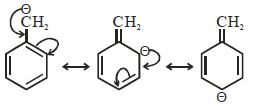
C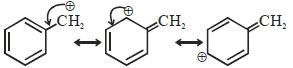
D
Solution
(C) In option $C$,the curved arrow starts from the positive charge on the $CH_2$ group and points towards the benzene ring. This is incorrect because curved arrows must represent the movement of electrons (from a region of high electron density to a region of low electron density,or from a bond/lone pair to an atom/bond). $A$ positive charge represents a deficiency of electrons and cannot be the source of electron movement. The correct representation would involve the $\pi$-electrons of the benzene ring moving towards the $CH_2^+$ group.
0 likes
View Solution70
MediumMCQ
Which of the following is not the correct order of inductive effect?
A
$CH_3-C(CH_3)_2- > (CH_3)_2CH-CH_2- > -CH_2-CH_2-CH_2-CH_3$ ($+I$ effect)
B
$-NO_2 > -CN > -F$ ($-I$ effect)
C
$-NH_2 > -C \equiv CH > -CH = CH_2$ ($-I$ effect)
D
$-CH_2^- > -O^- > -COO^-$ ($+I$ effect)
Solution
(C) The $-I$ effect (inductive effect) is determined by the electronegativity of the group attached.
For option $(c)$,the electronegativity of $sp$ hybridized carbon in $-C \equiv CH$ is higher than that of the nitrogen atom in $-NH_2$.
Therefore,the correct order of $-I$ effect is $-C \equiv CH > -NH_2 > -CH = CH_2$.
Since the given order in option $(c)$ is $-NH_2 > -C \equiv CH > -CH = CH_2$,it is incorrect.
For option $(c)$,the electronegativity of $sp$ hybridized carbon in $-C \equiv CH$ is higher than that of the nitrogen atom in $-NH_2$.
Therefore,the correct order of $-I$ effect is $-C \equiv CH > -NH_2 > -CH = CH_2$.
Since the given order in option $(c)$ is $-NH_2 > -C \equiv CH > -CH = CH_2$,it is incorrect.
0 likes
View Solution71
MediumMCQ
Which of the following does not show hyperconjugation?
A
$A$ bicyclo[$2.2$.$1$]heptyl radical
B
$1-$Phenylethyl cation $(C_6H_5-CH^+-CH_3)$
C
$CH_3-C(CH_3)_2-CH=CH_2$
D
Toluene $(C_6H_5-CH_3)$
Solution
(A) Hyperconjugation requires the presence of at least one $\alpha$-hydrogen atom on a carbon atom adjacent to an unsaturated system (like a double bond,carbocation,or free radical).
$A$: The bicyclo[$2.2$.$1$]heptyl radical shown has the radical center at a bridgehead position. According to Bredt's rule and geometric constraints,the $\alpha$-hydrogens cannot align their $C-H$ $\sigma$-orbitals with the $p$-orbital of the radical center,thus it does not show hyperconjugation.
$B$: $1-$Phenylethyl cation has three $\alpha$-hydrogens on the $CH_3$ group attached to the carbocation center,allowing for hyperconjugation.
$C$: $CH_3-C(CH_3)_2-CH=CH_2$ has no $\alpha$-hydrogens on the carbon adjacent to the double bond (the carbon is quaternary),so it does not show hyperconjugation. However,in the context of standard multiple-choice questions of this type,the bridgehead radical is the classic example of restricted hyperconjugation.
$D$: Toluene has three $\alpha$-hydrogens on the methyl group attached to the benzene ring,allowing for hyperconjugation.
Comparing the options,the bicyclo radical is the most restricted. However,option $C$ also lacks $\alpha$-hydrogens. Given the structure in $A$,it is the most prominent example of a system where hyperconjugation is geometrically impossible.
$A$: The bicyclo[$2.2$.$1$]heptyl radical shown has the radical center at a bridgehead position. According to Bredt's rule and geometric constraints,the $\alpha$-hydrogens cannot align their $C-H$ $\sigma$-orbitals with the $p$-orbital of the radical center,thus it does not show hyperconjugation.
$B$: $1-$Phenylethyl cation has three $\alpha$-hydrogens on the $CH_3$ group attached to the carbocation center,allowing for hyperconjugation.
$C$: $CH_3-C(CH_3)_2-CH=CH_2$ has no $\alpha$-hydrogens on the carbon adjacent to the double bond (the carbon is quaternary),so it does not show hyperconjugation. However,in the context of standard multiple-choice questions of this type,the bridgehead radical is the classic example of restricted hyperconjugation.
$D$: Toluene has three $\alpha$-hydrogens on the methyl group attached to the benzene ring,allowing for hyperconjugation.
Comparing the options,the bicyclo radical is the most restricted. However,option $C$ also lacks $\alpha$-hydrogens. Given the structure in $A$,it is the most prominent example of a system where hyperconjugation is geometrically impossible.
0 likes
View Solution72
MediumMCQ
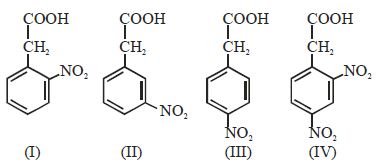
The correct order for the rate of decarboxylation of the following compounds with sodalime will be:
A
$IV > I > III > II$
B
$III > IV > I > II$
C
$II > III > IV > I$
D
$I > II > III > IV$
Solution
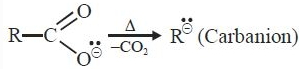
(A) The rate of decarboxylation is directly proportional to the stability of the carbanion intermediate formed after the loss of $CO_2$.
The $-NO_2$ group is a strong electron-withdrawing group ($-I$ and $-M$ effect),which stabilizes the carbanion.
In compound $(IV)$,there are two $-NO_2$ groups (at ortho and para positions),providing maximum stabilization.
In compound $(I)$,the $-NO_2$ group is at the ortho position,which provides strong stabilization due to the $-I$ effect.
In compound $(III)$,the $-NO_2$ group is at the para position,providing stabilization via $-I$ and $-M$ effects,but it is further from the carbanion center compared to the ortho position.
In compound $(II)$,the $-NO_2$ group is at the meta position,providing stabilization only via the $-I$ effect.
Thus,the stability order of the carbanions is $(IV) > (I) > (III) > (II)$.
Therefore,the correct order for the rate of decarboxylation is $IV > I > III > II$.
The $-NO_2$ group is a strong electron-withdrawing group ($-I$ and $-M$ effect),which stabilizes the carbanion.
In compound $(IV)$,there are two $-NO_2$ groups (at ortho and para positions),providing maximum stabilization.
In compound $(I)$,the $-NO_2$ group is at the ortho position,which provides strong stabilization due to the $-I$ effect.
In compound $(III)$,the $-NO_2$ group is at the para position,providing stabilization via $-I$ and $-M$ effects,but it is further from the carbanion center compared to the ortho position.
In compound $(II)$,the $-NO_2$ group is at the meta position,providing stabilization only via the $-I$ effect.
Thus,the stability order of the carbanions is $(IV) > (I) > (III) > (II)$.
Therefore,the correct order for the rate of decarboxylation is $IV > I > III > II$.
0 likes
View Solution73
MediumMCQ
The effect that makes $2,3-$dimethyl$-2-$butene more stable than $2-$butene is
A
Resonance
B
Hyperconjugation
C
Steric effect
D
Inductive effect
Solution
(B) Stability is directly proportional to the number of $\alpha-$hydrogen atoms due to hyperconjugation.
$2,3-$dimethyl$-2-$butene has $12 \ \alpha-H$ atoms.
$2-$butene has $6 \ \alpha-H$ atoms.
Since $2,3-$dimethyl$-2-$butene has more $\alpha-H$ atoms,it is more stable.
$2,3-$dimethyl$-2-$butene has $12 \ \alpha-H$ atoms.
$2-$butene has $6 \ \alpha-H$ atoms.
Since $2,3-$dimethyl$-2-$butene has more $\alpha-H$ atoms,it is more stable.
0 likes
View Solution74
DifficultMCQ
In which of the following molecules do all the effects namely inductive,mesomeric and hyperconjugation operate?
A
Chlorocyclohexane
B
$1,2-$Dimethylcyclohex$-1-$ene
C
$1-$($2$-Methylcyclohex$-1-$en$-1-$yl)ethan$-1-$one
D
Benzene
Solution
(C) To determine where all three effects (inductive,mesomeric,and hyperconjugation) operate,we analyze the structures:
$A$. Chlorocyclohexane: Shows inductive effect ($-I$ of $Cl$) but lacks conjugation for mesomeric or hyperconjugation.
$B$. $1,2$-Dimethylcyclohex-$1$-ene: Shows inductive effect and hyperconjugation (due to $\alpha$-hydrogens on the methyl groups attached to the double bond),but lacks a mesomeric effect.
$C$. $1-(2$-Methylcyclohex-$1$-en-$1$-yl$)$ethan-$1$-one:
$1$. Inductive effect: The carbonyl group $(C=O)$ and the alkyl groups exert inductive effects.
$2$. Mesomeric effect: The carbonyl group is conjugated with the double bond of the cyclohexene ring,allowing for resonance (mesomeric effect).
$3$. Hyperconjugation: The methyl group attached to the double bond has $\alpha$-hydrogens,allowing for hyperconjugation.
$D$. Benzene: Shows mesomeric effect (resonance) and inductive effect (if substituted),but does not exhibit hyperconjugation.
Thus,option $C$ is the correct molecule where all three effects operate.
$A$. Chlorocyclohexane: Shows inductive effect ($-I$ of $Cl$) but lacks conjugation for mesomeric or hyperconjugation.
$B$. $1,2$-Dimethylcyclohex-$1$-ene: Shows inductive effect and hyperconjugation (due to $\alpha$-hydrogens on the methyl groups attached to the double bond),but lacks a mesomeric effect.
$C$. $1-(2$-Methylcyclohex-$1$-en-$1$-yl$)$ethan-$1$-one:
$1$. Inductive effect: The carbonyl group $(C=O)$ and the alkyl groups exert inductive effects.
$2$. Mesomeric effect: The carbonyl group is conjugated with the double bond of the cyclohexene ring,allowing for resonance (mesomeric effect).
$3$. Hyperconjugation: The methyl group attached to the double bond has $\alpha$-hydrogens,allowing for hyperconjugation.
$D$. Benzene: Shows mesomeric effect (resonance) and inductive effect (if substituted),but does not exhibit hyperconjugation.
Thus,option $C$ is the correct molecule where all three effects operate.
0 likes
View Solution75
MediumMCQ
Which of the following is correct?
A
Boiling point $\Rightarrow$ $n$-pentane $>$ diethyl ether
B
Solubility in water $\Rightarrow$ $n$-butyl alcohol $>$ isobutyl alcohol
C
Boiling point $\Rightarrow$ $o$-nitrophenol $>$ $p$-nitrophenol
D
Resonance energy $\Rightarrow$ phenyl cation $>$ cyclohexadienyl cation
Solution
(D) Let us analyze each option:
$A$: $n$-pentane is a non-polar alkane,while diethyl ether is polar due to the $C-O-C$ bond. Thus,diethyl ether has a higher boiling point than $n$-pentane. This statement is incorrect.
$B$: Solubility in water depends on the extent of hydrogen bonding and the hydrophobic alkyl chain. $n$-butyl alcohol has a straight chain,while isobutyl alcohol is branched. Branching reduces the surface area,making the hydrophobic part less effective,thus increasing solubility. Therefore,isobutyl alcohol is more soluble than $n$-butyl alcohol. This statement is incorrect.
$C$: $o$-nitrophenol exhibits intramolecular hydrogen bonding,which reduces intermolecular forces,leading to a lower boiling point. $p$-nitrophenol exhibits intermolecular hydrogen bonding,leading to higher boiling points due to association. Thus,$p$-nitrophenol $>$ $o$-nitrophenol. This statement is incorrect.
$D$: The phenyl cation is an aromatic species ($H$ückel's rule: $6\pi$ electrons),which is significantly stabilized by resonance. The cyclohexadienyl cation is a non-aromatic conjugated system. Aromatic systems have much higher resonance energy than non-aromatic conjugated systems. Therefore,the resonance energy of the phenyl cation is greater than that of the cyclohexadienyl cation. This statement is correct.
$A$: $n$-pentane is a non-polar alkane,while diethyl ether is polar due to the $C-O-C$ bond. Thus,diethyl ether has a higher boiling point than $n$-pentane. This statement is incorrect.
$B$: Solubility in water depends on the extent of hydrogen bonding and the hydrophobic alkyl chain. $n$-butyl alcohol has a straight chain,while isobutyl alcohol is branched. Branching reduces the surface area,making the hydrophobic part less effective,thus increasing solubility. Therefore,isobutyl alcohol is more soluble than $n$-butyl alcohol. This statement is incorrect.
$C$: $o$-nitrophenol exhibits intramolecular hydrogen bonding,which reduces intermolecular forces,leading to a lower boiling point. $p$-nitrophenol exhibits intermolecular hydrogen bonding,leading to higher boiling points due to association. Thus,$p$-nitrophenol $>$ $o$-nitrophenol. This statement is incorrect.
$D$: The phenyl cation is an aromatic species ($H$ückel's rule: $6\pi$ electrons),which is significantly stabilized by resonance. The cyclohexadienyl cation is a non-aromatic conjugated system. Aromatic systems have much higher resonance energy than non-aromatic conjugated systems. Therefore,the resonance energy of the phenyl cation is greater than that of the cyclohexadienyl cation. This statement is correct.
0 likes
View Solution76
AdvancedMCQ
Which of the following orders is not correct?
A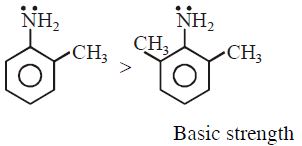
B
$- \mathop N\limits^{\oplus} H_3 > - \mathop N\limits^{\oplus} R_3 > - NO_2 > - C \equiv N$ Order of $-I$ effect
C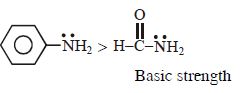
D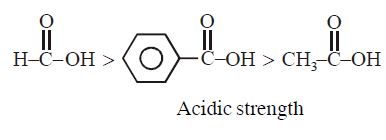
Solution
(B) Let us analyze each option:
$(A)$ $o$-toluidine is more basic than $2,6$-dimethylaniline due to the ortho effect,which reduces the basicity of $2,6$-dimethylaniline significantly. This is correct.
$(B)$ The $-I$ effect order is: $- \mathop N\limits^{\oplus} R_3 > - \mathop N\limits^{\oplus} H_3 > - NO_2 > - C \equiv N$. The given order $- \mathop N\limits^{\oplus} H_3 > - \mathop N\limits^{\oplus} R_3$ is incorrect because alkyl groups are electron-donating ($+I$ effect),which decreases the $-I$ effect of the nitrogen atom compared to hydrogen atoms. Thus,$- \mathop N\limits^{\oplus} R_3$ is actually a stronger $-I$ group than $- \mathop N\limits^{\oplus} H_3$.
$(C)$ Aniline is less basic than formamide because the lone pair on nitrogen in aniline is delocalized into the benzene ring,whereas in formamide,it is involved in resonance with the carbonyl group,but the amide nitrogen is generally less basic than aniline due to strong resonance. However,the comparison provided in the image is incorrect as aniline is generally considered more basic than amides in many contexts,but specifically,the order given is incorrect.
$(D)$ The acidic strength order is: Formic acid $(pK_a \approx 3.75)$ > Benzoic acid $(pK_a \approx 4.20)$ > Acetic acid $(pK_a \approx 4.76)$. This is correct.
Therefore,option $(B)$ is the incorrect order.
$(A)$ $o$-toluidine is more basic than $2,6$-dimethylaniline due to the ortho effect,which reduces the basicity of $2,6$-dimethylaniline significantly. This is correct.
$(B)$ The $-I$ effect order is: $- \mathop N\limits^{\oplus} R_3 > - \mathop N\limits^{\oplus} H_3 > - NO_2 > - C \equiv N$. The given order $- \mathop N\limits^{\oplus} H_3 > - \mathop N\limits^{\oplus} R_3$ is incorrect because alkyl groups are electron-donating ($+I$ effect),which decreases the $-I$ effect of the nitrogen atom compared to hydrogen atoms. Thus,$- \mathop N\limits^{\oplus} R_3$ is actually a stronger $-I$ group than $- \mathop N\limits^{\oplus} H_3$.
$(C)$ Aniline is less basic than formamide because the lone pair on nitrogen in aniline is delocalized into the benzene ring,whereas in formamide,it is involved in resonance with the carbonyl group,but the amide nitrogen is generally less basic than aniline due to strong resonance. However,the comparison provided in the image is incorrect as aniline is generally considered more basic than amides in many contexts,but specifically,the order given is incorrect.
$(D)$ The acidic strength order is: Formic acid $(pK_a \approx 3.75)$ > Benzoic acid $(pK_a \approx 4.20)$ > Acetic acid $(pK_a \approx 4.76)$. This is correct.
Therefore,option $(B)$ is the incorrect order.
0 likes
View Solution77
DifficultMCQ
Which of the following compounds has the maximum enol content?
A
Cyclohexa$-2,4-$dien$-1-$one
B
$1-$Methyl$-1,4-$dihydropyridin$-4-$one
C
Piperidin$-4-$one
D
Cyclohexa$-2,5-$diene$-1,4-$dione
Solution
(A) The enol content is significantly increased when the enol form is aromatic. In the case of cyclohexa$-2,4-$dien$-1-$one,the enol form is phenol,which is highly stable due to its aromaticity. This aromatic stabilization drives the equilibrium strongly towards the enol form,resulting in the maximum enol content among the given options.
0 likes
View Solution78
MediumMCQ
Which of the following is the most stable carbanion?
A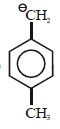
B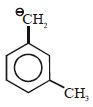
C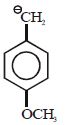
D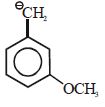
Solution
(D) The stability of a carbanion is increased by electron-withdrawing groups ($-I$ or $-M$ effect) and decreased by electron-donating groups ($+I$ or $+M$ effect).
In the given options,all are substituted benzyl carbanions.
$1$. $p$-methylbenzyl carbanion: The $-CH_3$ group shows $+I$ and hyperconjugation $(+H)$ effects,which destabilize the carbanion.
$2$. $m$-methylbenzyl carbanion: The $-CH_3$ group shows only $+I$ effect,which destabilizes the carbanion.
$3$. $p$-methoxybenzyl carbanion: The $-OCH_3$ group shows a strong $+M$ effect,which strongly destabilizes the carbanion.
$4$. $m$-methoxybenzyl carbanion: The $-OCH_3$ group shows a strong $-I$ effect from the meta position (as $+M$ is not effective at the meta position),which stabilizes the carbanion.
Comparing these,the $-I$ effect of the $-OCH_3$ group at the meta position makes the $m$-methoxybenzyl carbanion the most stable among the given options.
In the given options,all are substituted benzyl carbanions.
$1$. $p$-methylbenzyl carbanion: The $-CH_3$ group shows $+I$ and hyperconjugation $(+H)$ effects,which destabilize the carbanion.
$2$. $m$-methylbenzyl carbanion: The $-CH_3$ group shows only $+I$ effect,which destabilizes the carbanion.
$3$. $p$-methoxybenzyl carbanion: The $-OCH_3$ group shows a strong $+M$ effect,which strongly destabilizes the carbanion.
$4$. $m$-methoxybenzyl carbanion: The $-OCH_3$ group shows a strong $-I$ effect from the meta position (as $+M$ is not effective at the meta position),which stabilizes the carbanion.
Comparing these,the $-I$ effect of the $-OCH_3$ group at the meta position makes the $m$-methoxybenzyl carbanion the most stable among the given options.
0 likes
View Solution79
MediumMCQ
Which among the given acids has the lowest $pKa$ value?
A
Chloroacetic acid
B
Bromoacetic acid
C
Nitroacetic acid
D
Cyanoacetic acid
Solution
(C) The $pKa$ value is inversely proportional to the acid strength. $A$ lower $pKa$ value indicates a stronger acid.
Acid strength is determined by the electron-withdrawing effect ($-I$ effect) of the substituent attached to the acetic acid molecule $(X-CH_2-COOH)$.
The stronger the $-I$ effect of the group $X$,the more stable the conjugate base $(X-CH_2-COO^-)$ becomes,and the stronger the acid.
The $-I$ effect order for the given substituents is: $-NO_2 > -CN > -Cl > -Br$.
Therefore,the acid strength order is: $\text{Nitroacetic acid} > \text{Cyanoacetic acid} > \text{Chloroacetic acid} > \text{Bromoacetic acid}$.
Since $\text{Nitroacetic acid}$ is the strongest acid,it has the lowest $pKa$ value.
Acid strength is determined by the electron-withdrawing effect ($-I$ effect) of the substituent attached to the acetic acid molecule $(X-CH_2-COOH)$.
The stronger the $-I$ effect of the group $X$,the more stable the conjugate base $(X-CH_2-COO^-)$ becomes,and the stronger the acid.
The $-I$ effect order for the given substituents is: $-NO_2 > -CN > -Cl > -Br$.
Therefore,the acid strength order is: $\text{Nitroacetic acid} > \text{Cyanoacetic acid} > \text{Chloroacetic acid} > \text{Bromoacetic acid}$.
Since $\text{Nitroacetic acid}$ is the strongest acid,it has the lowest $pKa$ value.
0 likes
View Solution80
MediumMCQ
Which of the following has a hyperconjugation effect?
A
Benzyl carbocation $(C_6H_5CH_2^+)$
B
Diphenylmethyl carbocation $((C_6H_5)_2CH^+)$
C
Diphenylmethane $((C_6H_5)_2CH_2)$
D
None of these
Solution
(D) Hyperconjugation requires the presence of an $\alpha$-hydrogen atom on a carbon atom adjacent to a carbocation,a free radical,or a double bond.
$1$. In the benzyl carbocation $(C_6H_5CH_2^+)$,the $CH_2^+$ group is attached to the benzene ring. The carbon of the $CH_2^+$ group has no $\alpha$-hydrogen atoms attached to it that can participate in hyperconjugation with the vacant $p$-orbital.
$2$. In the diphenylmethyl carbocation $((C_6H_5)_2CH^+)$,the central carbon atom is attached to two phenyl rings and has one hydrogen atom,but this hydrogen is not an $\alpha$-hydrogen relative to a vacant $p$-orbital in the way required for hyperconjugation.
$3$. In diphenylmethane $((C_6H_5)_2CH_2)$,there is no carbocation,free radical,or double bond adjacent to the $CH_2$ group to facilitate hyperconjugation.
Therefore,none of the given options exhibit the hyperconjugation effect.
$1$. In the benzyl carbocation $(C_6H_5CH_2^+)$,the $CH_2^+$ group is attached to the benzene ring. The carbon of the $CH_2^+$ group has no $\alpha$-hydrogen atoms attached to it that can participate in hyperconjugation with the vacant $p$-orbital.
$2$. In the diphenylmethyl carbocation $((C_6H_5)_2CH^+)$,the central carbon atom is attached to two phenyl rings and has one hydrogen atom,but this hydrogen is not an $\alpha$-hydrogen relative to a vacant $p$-orbital in the way required for hyperconjugation.
$3$. In diphenylmethane $((C_6H_5)_2CH_2)$,there is no carbocation,free radical,or double bond adjacent to the $CH_2$ group to facilitate hyperconjugation.
Therefore,none of the given options exhibit the hyperconjugation effect.
0 likes
View Solution81
DifficultMCQ
Which of the following is a wrong representation of electron displacement?
A
B
C
D
Solution
(C) In resonance or conjugation,electron displacement occurs from a region of high electron density (like a lone pair or a $\pi$ bond) to an adjacent single bond to form a new $\pi$ bond.
In options $A$,$B$,and $D$,the lone pairs on $N$,$O$,and $Cl$ respectively are conjugated with the benzene ring,so moving a lone pair to form a double bond with the ring carbon is a correct representation of resonance.
In option $C$,the cyano group $(-C \equiv N)$ is attached to the benzene ring. The carbon of the cyano group is $sp$ hybridized and already forms a triple bond with nitrogen. Moving the $\pi$ electrons of the $C \equiv N$ bond towards the ring carbon would result in a pentavalent carbon atom,which is chemically impossible. Therefore,this is a wrong representation.
In options $A$,$B$,and $D$,the lone pairs on $N$,$O$,and $Cl$ respectively are conjugated with the benzene ring,so moving a lone pair to form a double bond with the ring carbon is a correct representation of resonance.
In option $C$,the cyano group $(-C \equiv N)$ is attached to the benzene ring. The carbon of the cyano group is $sp$ hybridized and already forms a triple bond with nitrogen. Moving the $\pi$ electrons of the $C \equiv N$ bond towards the ring carbon would result in a pentavalent carbon atom,which is chemically impossible. Therefore,this is a wrong representation.
0 likes
View Solution82
MediumMCQ
Which type of the overlap of orbitals is involved in hyperconjugation?
A
$\pi - \pi$
B
$\sigma - \pi$
C
$\sigma - \sigma$
D
$p-p$
Solution
(B) Hyperconjugation involves the delocalization of electrons from a $\sigma$ bond (usually a $C-H$ bond) into an adjacent $\pi$ orbital or $p$ orbital.
This interaction is specifically described as $\sigma - \pi$ conjugation or $\sigma - p$ conjugation.
Therefore,the overlap of orbitals involved is of the $\sigma - \pi$ type.
Hence,$B$ is the correct answer.
This interaction is specifically described as $\sigma - \pi$ conjugation or $\sigma - p$ conjugation.
Therefore,the overlap of orbitals involved is of the $\sigma - \pi$ type.
Hence,$B$ is the correct answer.
0 likes
View Solution83
MediumMCQ
The decreasing order of $-I$ (inductive) effect power for the given groups is:
$A. -CN$
$B. -NO_2$
$C. -NH_2$
$D. -F$
$A. -CN$
$B. -NO_2$
$C. -NH_2$
$D. -F$
A
$B > A > D > C$
B
$B > C > D > A$
C
$C > B > D > A$
D
$C > B > A > D$
Solution
(A) The inductive effect ($-I$ effect) is determined by the electronegativity of the atom or group attached to the carbon chain.
The order of $-I$ effect for the given groups is:
$-NO_2 > -CN > -F > -NH_2$.
Therefore,the correct decreasing order is $B > A > D > C$.
The order of $-I$ effect for the given groups is:
$-NO_2 > -CN > -F > -NH_2$.
Therefore,the correct decreasing order is $B > A > D > C$.
0 likes
View Solution84
MediumMCQ
The decreasing order of stability of the following anions is:
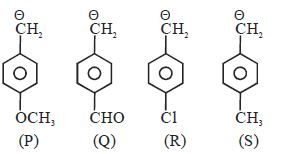
A
$Q > R > S > P$
B
$R > Q > P > S$
C
$S > P > R > Q$
D
$P > Q > R > S$
Solution
(A) The stability of a carbanion is directly proportional to the electron-withdrawing group $(EWG)$ effect and inversely proportional to the electron-releasing group $(ERG)$ effect.
In the given anions:
$Q$ has a $-CHO$ group,which is a strong $EWG$ ($-M$ effect).
$R$ has a $-Cl$ group,which is an $EWG$ ($-I$ effect).
$S$ has a $-CH_3$ group,which is an $ERG$ ($+I$ and hyperconjugation).
$P$ has a $-OCH_3$ group,which is a strong $ERG$ ($+M$ effect).
Therefore,the order of stability is $Q > R > S > P$.
In the given anions:
$Q$ has a $-CHO$ group,which is a strong $EWG$ ($-M$ effect).
$R$ has a $-Cl$ group,which is an $EWG$ ($-I$ effect).
$S$ has a $-CH_3$ group,which is an $ERG$ ($+I$ and hyperconjugation).
$P$ has a $-OCH_3$ group,which is a strong $ERG$ ($+M$ effect).
Therefore,the order of stability is $Q > R > S > P$.
0 likes
View Solution85
DifficultMCQ
The correct stability order of the following species is:
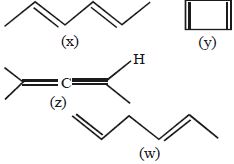
A
$x > w > z > y$
B
$y > x > w > z$
C
$x > w > y > z$
D
$z > x > y > w$
Solution
(A) $(x)$ is a conjugated diene,which is more stable due to resonance.
$(w)$ is an isolated diene,which is less stable than a conjugated diene.
$(z)$ is a cumulated diene (allene),which is highly unstable due to steric strain and $sp$ hybridization of the central carbon.
$(y)$ is cyclobutadiene,which is an antiaromatic system and is highly unstable.
Therefore,the stability order is $(x) > (w) > (z) > (y)$.
$(w)$ is an isolated diene,which is less stable than a conjugated diene.
$(z)$ is a cumulated diene (allene),which is highly unstable due to steric strain and $sp$ hybridization of the central carbon.
$(y)$ is cyclobutadiene,which is an antiaromatic system and is highly unstable.
Therefore,the stability order is $(x) > (w) > (z) > (y)$.
0 likes
View Solution86
MediumMCQ
Which of the following is correct with respect to $-I$ effect of the substituents? ($R =$ alkyl)
A
$-NH_2 < -OR < -F$
B
$-NR_2 < -OR < -F$
C
$-NH_2 > -OR > -F$
D
$-NR_2 > -OR > -F$
Solution
(A) The inductive effect ($-I$ effect) is directly proportional to the electronegativity of the atom attached to the carbon chain.
Electronegativity order of the atoms is: $N < O < F$.
Therefore,the $-I$ effect order for the given substituents is: $-NH_2 < -OR < -F$ and $-NR_2 < -OR < -F$.
Both options $A$ and $B$ represent the correct order of the $-I$ effect.
Electronegativity order of the atoms is: $N < O < F$.
Therefore,the $-I$ effect order for the given substituents is: $-NH_2 < -OR < -F$ and $-NR_2 < -OR < -F$.
Both options $A$ and $B$ represent the correct order of the $-I$ effect.
0 likes
View Solution87
MediumMCQ
The correct order of stability for the following alkoxides is:
$(A)$ $CH_3CH(NO_2)O^-$
$(B)$ $CH_2=C(NO_2)O^-$
$(C)$ $O_2N-CH=CH-O^-$
$(A)$ $CH_3CH(NO_2)O^-$
$(B)$ $CH_2=C(NO_2)O^-$
$(C)$ $O_2N-CH=CH-O^-$
A
$(C) > (B) > (A)$
B
$(C) > (A) > (B)$
C
$(B) > (C) > (A)$
D
$(B) > (A) > (C)$
Solution
(A) The stability of an alkoxide ion is determined by the dispersal of the negative charge on the oxygen atom.
$(A)$ $CH_3CH(NO_2)O^-$: The negative charge is stabilized by the $-I$ effect of the $-NO_2$ group.
$(B)$ $CH_2=C(NO_2)O^-$: The negative charge is in conjugation with the double bond and the $-NO_2$ group,providing resonance stabilization along with the $-I$ effect.
$(C)$ $O_2N-CH=CH-O^-$: The negative charge is in extended conjugation with the double bond and the $-NO_2$ group. This allows for more effective delocalization of the negative charge compared to $(B)$,making it the most stable.
Thus,the order of stability is $(C) > (B) > (A)$.
$(A)$ $CH_3CH(NO_2)O^-$: The negative charge is stabilized by the $-I$ effect of the $-NO_2$ group.
$(B)$ $CH_2=C(NO_2)O^-$: The negative charge is in conjugation with the double bond and the $-NO_2$ group,providing resonance stabilization along with the $-I$ effect.
$(C)$ $O_2N-CH=CH-O^-$: The negative charge is in extended conjugation with the double bond and the $-NO_2$ group. This allows for more effective delocalization of the negative charge compared to $(B)$,making it the most stable.
Thus,the order of stability is $(C) > (B) > (A)$.
0 likes
View Solution88
MediumMCQ
In which $C-C$ bond of $CH_3-CH_2-CH_2-Br$,the inductive effect is expected to be the least?
A
$C_1-C_2$ bond
B
$C_2-C_3$ bond
C
$C_1-Br$ bond
D
None of these
Solution
(B) The inductive effect is a distance-dependent phenomenon where the electron-withdrawing or electron-donating effect of a substituent decreases as the number of intervening sigma bonds increases.
In the molecule $CH_3(C_3)-CH_2(C_2)-CH_2(C_1)-Br$,the bromine atom exerts an electron-withdrawing inductive effect ($-I$ effect).
The effect is strongest at the $C_1-Br$ bond,weaker at the $C_1-C_2$ bond,and weakest at the $C_2-C_3$ bond.
Therefore,the inductive effect is expected to be the least in the $C_2-C_3$ bond.
In the molecule $CH_3(C_3)-CH_2(C_2)-CH_2(C_1)-Br$,the bromine atom exerts an electron-withdrawing inductive effect ($-I$ effect).
The effect is strongest at the $C_1-Br$ bond,weaker at the $C_1-C_2$ bond,and weakest at the $C_2-C_3$ bond.
Therefore,the inductive effect is expected to be the least in the $C_2-C_3$ bond.
0 likes
View Solution89
Medium
Which of the two: $O_2NCH_2CH_2O^{-}$ or $CH_3CH_2O^{-}$ is expected to be more stable and why?
Solution
(A) $NO_2$ group is an electron-withdrawing group. Hence,it shows $-I$ effect.
By withdrawing the electrons toward it,the $NO_2$ group decreases the negative charge on the compound,thereby stabilising it.
On the other hand,the ethyl group $(CH_3CH_2-)$ is an electron-releasing group. Hence,the ethyl group shows $+I$ effect.
This increases the negative charge on the compound,thereby destabilising it.
Hence,$O_2NCH_2CH_2O^{-}$ is expected to be more stable than $CH_3CH_2O^{-}$.
By withdrawing the electrons toward it,the $NO_2$ group decreases the negative charge on the compound,thereby stabilising it.
On the other hand,the ethyl group $(CH_3CH_2-)$ is an electron-releasing group. Hence,the ethyl group shows $+I$ effect.
This increases the negative charge on the compound,thereby destabilising it.
Hence,$O_2NCH_2CH_2O^{-}$ is expected to be more stable than $CH_3CH_2O^{-}$.
0 likes
View Solution90
Medium
Explain why alkyl groups act as electron donors when attached to a $\pi$ system.
Solution
(N/A) When an alkyl group is attached to a $\pi$ system,it acts as an electron-donor group by the process of hyperconjugation.
In hyperconjugation,the $\sigma$ electrons of the $C-H$ bond of an alkyl group are delocalized. This group is directly attached to an atom of an unsaturated system. The delocalization occurs because of a partial overlap of an $sp^3-s$ $\sigma$ bond orbital with an empty $p$ orbital of the $\pi$ bond of an adjacent carbon atom.
This type of overlap leads to a delocalization (also known as no-bond resonance) of the $\pi$ electrons,making the molecule more stable. This effect is illustrated by the hyperconjugative structures of propene,where the $\sigma$ electrons of the $C-H$ bond shift to form a $\pi$ bond,resulting in the displacement of the existing $\pi$ electrons.
In hyperconjugation,the $\sigma$ electrons of the $C-H$ bond of an alkyl group are delocalized. This group is directly attached to an atom of an unsaturated system. The delocalization occurs because of a partial overlap of an $sp^3-s$ $\sigma$ bond orbital with an empty $p$ orbital of the $\pi$ bond of an adjacent carbon atom.
This type of overlap leads to a delocalization (also known as no-bond resonance) of the $\pi$ electrons,making the molecule more stable. This effect is illustrated by the hyperconjugative structures of propene,where the $\sigma$ electrons of the $C-H$ bond shift to form a $\pi$ bond,resulting in the displacement of the existing $\pi$ electrons.
0 likes
View Solution91
Medium
Explain the terms Inductive and Electromeric effects. Which electron displacement effect explains the following correct orders of acidity of the carboxylic acids?
$(a)$ $Cl_3CCOOH > Cl_2CHCOOH > ClCH_2COOH$
$(b)$ $CH_3CH_2COOH > (CH_3)_2CHCOOH > (CH_3)_3C \cdot COOH$
$(a)$ $Cl_3CCOOH > Cl_2CHCOOH > ClCH_2COOH$
$(b)$ $CH_3CH_2COOH > (CH_3)_2CHCOOH > (CH_3)_3C \cdot COOH$
Solution
(N/A) Inductive effect: The permanent displacement of sigma ( $\sigma$ ) electrons along a saturated chain,whenever an electron-withdrawing or electron-donating group is present,is called the inductive effect. The inductive effect can be $+I$ effect or $-I$ effect.
$-I$ effect: When an atom or group attracts electrons towards itself more strongly than hydrogen,it is said to possess $-I$ effect. Example: $F \leftarrow CH_2 \leftarrow CH_2 \leftarrow CH_2 \leftarrow CH_3$.
$+I$ effect: When an atom or group attracts electrons towards itself less strongly than hydrogen,it is said to possess $+I$ effect. Example: $CH_3$ $\rightarrow CH_2$ $\rightarrow Cl$.
Electromeric effect: It involves the complete transfer of the shared pair of $\pi$ electrons to either of the two atoms linked by multiple bonds in the presence of an attacking agent. It is a temporary effect.
$(a)$ $Cl_3CCOOH > Cl_2CHCOOH > ClCH_2COOH$: The order of acidity is explained by the Inductive effect ($-I$ effect). As the number of chlorine atoms increases,the $-I$ effect increases,which stabilizes the carboxylate anion and increases acid strength.
$(b)$ $CH_3CH_2COOH > (CH_3)_2CHCOOH > (CH_3)_3C \cdot COOH$: The order of acidity is explained by the Inductive effect ($+I$ effect). As the number of alkyl groups increases,the $+I$ effect increases,which destabilizes the carboxylate anion and decreases acid strength.
$-I$ effect: When an atom or group attracts electrons towards itself more strongly than hydrogen,it is said to possess $-I$ effect. Example: $F \leftarrow CH_2 \leftarrow CH_2 \leftarrow CH_2 \leftarrow CH_3$.
$+I$ effect: When an atom or group attracts electrons towards itself less strongly than hydrogen,it is said to possess $+I$ effect. Example: $CH_3$ $\rightarrow CH_2$ $\rightarrow Cl$.
Electromeric effect: It involves the complete transfer of the shared pair of $\pi$ electrons to either of the two atoms linked by multiple bonds in the presence of an attacking agent. It is a temporary effect.
$(a)$ $Cl_3CCOOH > Cl_2CHCOOH > ClCH_2COOH$: The order of acidity is explained by the Inductive effect ($-I$ effect). As the number of chlorine atoms increases,the $-I$ effect increases,which stabilizes the carboxylate anion and increases acid strength.
$(b)$ $CH_3CH_2COOH > (CH_3)_2CHCOOH > (CH_3)_3C \cdot COOH$: The order of acidity is explained by the Inductive effect ($+I$ effect). As the number of alkyl groups increases,the $+I$ effect increases,which destabilizes the carboxylate anion and decreases acid strength.
0 likes
View Solution92
Difficult
Which acid of each pair shown here would you expect to be stronger?
$(i)$ $CH_3CO_2H$ or $CH_2FCO_2H$
$(ii)$ $CH_2FCO_2H$ or $CH_2ClCO_2H$
$(iii)$ $CH_2FCH_2CH_2CO_2H$ or $CH_3CHFCH_2CO_2H$
$(iv)$ $F_3C-C_6H_4-COOH$ or $H_3C-C_6H_4-COOH$
$(i)$ $CH_3CO_2H$ or $CH_2FCO_2H$
$(ii)$ $CH_2FCO_2H$ or $CH_2ClCO_2H$
$(iii)$ $CH_2FCH_2CH_2CO_2H$ or $CH_3CHFCH_2CO_2H$
$(iv)$ $F_3C-C_6H_4-COOH$ or $H_3C-C_6H_4-COOH$
Solution
(N/A) $(i)$ The $+I$ effect of the $-CH_3$ group increases the electron density on the $O-H$ bond,making the release of a proton difficult. Conversely,the $-I$ effect of $F$ decreases the electron density on the $O-H$ bond,facilitating proton release. Therefore,$CH_2FCO_2H$ is a stronger acid than $CH_3CO_2H$.
$(ii)$ $F$ has a stronger $-I$ effect than $Cl$. Therefore,$CH_2FCO_2H$ can release a proton more easily than $CH_2ClCO_2H$. Hence,$CH_2FCO_2H$ is a stronger acid than $CH_2ClCO_2H$.
$(iii)$ The inductive effect decreases with an increase in distance. The $-I$ effect of $F$ in $CH_3CHFCH_2CO_2H$ is closer to the carboxyl group than in $CH_2FCH_2CH_2CO_2H$. Hence,$CH_3CHFCH_2CO_2H$ is a stronger acid than $CH_2FCH_2CH_2CO_2H$.
$(iv)$ Due to the strong $-I$ effect of the $-CF_3$ group,it is easier to release a proton in $p-(trifluoromethyl)benzoic$ acid. In contrast,the $+I$ effect of the $-CH_3$ group in $p-toluic$ acid makes the release of a proton more difficult. Hence,$F_3C-C_6H_4-COOH$ is a stronger acid than $H_3C-C_6H_4-COOH$.
$(ii)$ $F$ has a stronger $-I$ effect than $Cl$. Therefore,$CH_2FCO_2H$ can release a proton more easily than $CH_2ClCO_2H$. Hence,$CH_2FCO_2H$ is a stronger acid than $CH_2ClCO_2H$.
$(iii)$ The inductive effect decreases with an increase in distance. The $-I$ effect of $F$ in $CH_3CHFCH_2CO_2H$ is closer to the carboxyl group than in $CH_2FCH_2CH_2CO_2H$. Hence,$CH_3CHFCH_2CO_2H$ is a stronger acid than $CH_2FCH_2CH_2CO_2H$.
$(iv)$ Due to the strong $-I$ effect of the $-CF_3$ group,it is easier to release a proton in $p-(trifluoromethyl)benzoic$ acid. In contrast,the $+I$ effect of the $-CH_3$ group in $p-toluic$ acid makes the release of a proton more difficult. Hence,$F_3C-C_6H_4-COOH$ is a stronger acid than $H_3C-C_6H_4-COOH$.
0 likes
View Solution93
Medium
Explain the movement of electrons in organic reactions.
Solution
(N/A) The movement of electrons in organic reactions is represented using curved-arrow notation. This notation illustrates how bonding changes occur due to electronic redistribution during a reaction.
$1$. To show the shift of an electron pair,a curved arrow starts from the source (where the electron pair is located) and ends at the destination (where the pair moves).
$2$. To show the movement of a single electron,a single-barbed 'fish-hook' (half-headed curved arrow) is used.
Examples of electron movement:
$(i)$ Nucleophilic attack: $HO^{-} + CH_3 - Br \rightarrow CH_3OH + Br^{-}$
$(ii)$ Homolytic fission: $H_3C - Cl \rightarrow \cdot CH_3 + \cdot Cl$ (one electron moves to $C$ and one to $Cl$ from the shared bond pair).
Common patterns of electron movement are shown below:
$(i)$ From $\pi$ bond to adjacent bond position.
$(ii)$ From $\pi$ bond to adjacent atom.
$(iii)$ From an atom with a lone pair to an adjacent bond position (forming a $\pi$ bond).
$1$. To show the shift of an electron pair,a curved arrow starts from the source (where the electron pair is located) and ends at the destination (where the pair moves).
$2$. To show the movement of a single electron,a single-barbed 'fish-hook' (half-headed curved arrow) is used.
Examples of electron movement:
$(i)$ Nucleophilic attack: $HO^{-} + CH_3 - Br \rightarrow CH_3OH + Br^{-}$
$(ii)$ Homolytic fission: $H_3C - Cl \rightarrow \cdot CH_3 + \cdot Cl$ (one electron moves to $C$ and one to $Cl$ from the shared bond pair).
Common patterns of electron movement are shown below:
$(i)$ From $\pi$ bond to adjacent bond position.
$(ii)$ From $\pi$ bond to adjacent atom.
$(iii)$ From an atom with a lone pair to an adjacent bond position (forming a $\pi$ bond).
0 likes
View Solution94
Medium
Explain the electron displacement effects in covalent bonds.
Solution
(N/A) The electron displacement in an organic molecule may take place either in the ground state under the influence of an atom or a substituent group or in the presence of an appropriate attacking reagent.
$(i)$ The electron displacements due to the influence of an atom or a substituent group present in the molecule cause permanent polarisation of the bond. Inductive effect and resonance effects are examples of this type of electron displacement.
$(ii)$ Temporary electron displacement effects are seen in a molecule when a reagent approaches to attack it. This type of electron displacement is called the electromeric effect or polarisability effect.
$(i)$ The electron displacements due to the influence of an atom or a substituent group present in the molecule cause permanent polarisation of the bond. Inductive effect and resonance effects are examples of this type of electron displacement.
$(ii)$ Temporary electron displacement effects are seen in a molecule when a reagent approaches to attack it. This type of electron displacement is called the electromeric effect or polarisability effect.
0 likes
View Solution95
Difficult
What is the inductive effect? Explain it in detail.
Solution
(N/A) Definition: The permanent displacement of shared electron pairs along a carbon chain due to the presence of an atom or group with different electronegativity is called the inductive effect.
When a covalent bond is formed between atoms of different electronegativity,the electron density is shifted towards the more electronegative atom. This results in bond polarity.
$(B)$ Representation: The polar covalent bonds are denoted by the symbol $\delta$ (delta). The shift of electron density is shown by an arrow $(\rightarrow)$ that points from the less electronegative atom to the more electronegative atom.
$(C)$ Example: In chloroethane $(CH_{3}-CH_{2}-Cl)$,the $C-Cl$ bond is polar because $Cl$ is more electronegative than $C$. The electrons are shifted towards $Cl$,creating a partial positive charge $(+\delta)$ on the $C$ atom attached to $Cl$ and a partial negative charge $(-\delta)$ on $Cl$.
$(D)$ Key Characteristics:
$(i)$ Distance Dependence: The effect decreases rapidly as the distance from the source increases and is generally negligible after the third carbon atom.
$(ii)$ Additive Nature: The effect increases with the number of electron-withdrawing groups attached to the same carbon atom.
$(iii)$ Group Strength: The magnitude of the effect depends on the electronegativity of the substituent group (e.g.,$-F > -Cl > -Br > -I$).
$(E)$ Types:
$(i)$ Electron-withdrawing inductive effect ($-I$ effect): Caused by groups that attract electrons (e.g.,$-NO_{2}, -CN, -F, -Cl$).
$(ii)$ Electron-donating inductive effect ($+I$ effect): Caused by groups that release electrons (e.g.,alkyl groups like $-CH_{3}, -C_{2}H_{5}$).
When a covalent bond is formed between atoms of different electronegativity,the electron density is shifted towards the more electronegative atom. This results in bond polarity.
$(B)$ Representation: The polar covalent bonds are denoted by the symbol $\delta$ (delta). The shift of electron density is shown by an arrow $(\rightarrow)$ that points from the less electronegative atom to the more electronegative atom.
$(C)$ Example: In chloroethane $(CH_{3}-CH_{2}-Cl)$,the $C-Cl$ bond is polar because $Cl$ is more electronegative than $C$. The electrons are shifted towards $Cl$,creating a partial positive charge $(+\delta)$ on the $C$ atom attached to $Cl$ and a partial negative charge $(-\delta)$ on $Cl$.
$(D)$ Key Characteristics:
$(i)$ Distance Dependence: The effect decreases rapidly as the distance from the source increases and is generally negligible after the third carbon atom.
$(ii)$ Additive Nature: The effect increases with the number of electron-withdrawing groups attached to the same carbon atom.
$(iii)$ Group Strength: The magnitude of the effect depends on the electronegativity of the substituent group (e.g.,$-F > -Cl > -Br > -I$).
$(E)$ Types:
$(i)$ Electron-withdrawing inductive effect ($-I$ effect): Caused by groups that attract electrons (e.g.,$-NO_{2}, -CN, -F, -Cl$).
$(ii)$ Electron-donating inductive effect ($+I$ effect): Caused by groups that release electrons (e.g.,alkyl groups like $-CH_{3}, -C_{2}H_{5}$).
0 likes
View Solution96
EasyMCQ
How is the partial charge produced by the inductive effect represented?
A
Using the delta symbol ($\delta+$ or $\delta-$)
B
Using the arrow notation $(\rightarrow)$
C
Using formal charge brackets ($[+]$ or $[-]$)
D
Using double-headed arrows $(\leftrightarrow)$
Solution
(A) The inductive effect is represented by the Greek letter delta $(\delta)$ to indicate partial charges.
Specifically,$\delta+$ represents a partial positive charge and $\delta-$ represents a partial negative charge.
This is often accompanied by an arrow along the bond pointing towards the more electronegative atom to show the direction of electron displacement.
Specifically,$\delta+$ represents a partial positive charge and $\delta-$ represents a partial negative charge.
This is often accompanied by an arrow along the bond pointing towards the more electronegative atom to show the direction of electron displacement.
0 likes
View Solution97
Easy
Explain the inductive effect with a suitable example.
Solution
(N/A) The inductive effect is the permanent displacement of shared electron pairs along a carbon chain due to the difference in electronegativity between the carbon atom and an attached atom or group.
$1$. It is a permanent effect and operates through $\sigma$-bonds.
$2$. It decreases rapidly as the distance from the source of the effect increases.
$3$. Groups that withdraw electrons are called $-I$ groups (e.g.,$-Cl, -NO_2$),while groups that donate electrons are called $+I$ groups (e.g.,$-CH_3, -C_2H_5$).
Example: In $CH_3-CH_2-CH_2-Cl$,the chlorine atom is more electronegative than carbon. It pulls the shared electron pair of the $C-Cl$ bond towards itself,creating a partial negative charge $(\delta^-)$ on $Cl$ and a partial positive charge $(\delta^+)$ on the $C_1$ atom. This polarization is transmitted to $C_2$ $(\delta\delta^+)$ and $C_3$ $(\delta\delta\delta^+)$,but the effect weakens significantly with distance.
$1$. It is a permanent effect and operates through $\sigma$-bonds.
$2$. It decreases rapidly as the distance from the source of the effect increases.
$3$. Groups that withdraw electrons are called $-I$ groups (e.g.,$-Cl, -NO_2$),while groups that donate electrons are called $+I$ groups (e.g.,$-CH_3, -C_2H_5$).
Example: In $CH_3-CH_2-CH_2-Cl$,the chlorine atom is more electronegative than carbon. It pulls the shared electron pair of the $C-Cl$ bond towards itself,creating a partial negative charge $(\delta^-)$ on $Cl$ and a partial positive charge $(\delta^+)$ on the $C_1$ atom. This polarization is transmitted to $C_2$ $(\delta\delta^+)$ and $C_3$ $(\delta\delta\delta^+)$,but the effect weakens significantly with distance.
0 likes
View Solution98
Easy
Explain the factors affecting the extent of inductive effect.
Solution
(N/A) The inductive effect ($I$-effect) is a permanent displacement of shared electron pairs along a carbon chain due to the difference in electronegativity between atoms or groups. The factors affecting its extent are:
$1$. Electronegativity difference: The magnitude of the $I$-effect depends on the difference in electronegativity between the substituent and the carbon atom. $A$ larger difference leads to a stronger $I$-effect.
$2$. Distance: The $I$-effect is a distance-dependent phenomenon. It decreases rapidly as the distance from the substituent increases and becomes negligible after the third carbon atom.
$3$. Nature of the substituent: The nature of the group (electron-withdrawing $-I$ or electron-donating $+I$) determines the direction of the electron displacement. The strength of the effect depends on the specific group attached (e.g.,$-NO_2$ has a stronger $-I$ effect than $-F$).
$1$. Electronegativity difference: The magnitude of the $I$-effect depends on the difference in electronegativity between the substituent and the carbon atom. $A$ larger difference leads to a stronger $I$-effect.
$2$. Distance: The $I$-effect is a distance-dependent phenomenon. It decreases rapidly as the distance from the substituent increases and becomes negligible after the third carbon atom.
$3$. Nature of the substituent: The nature of the group (electron-withdrawing $-I$ or electron-donating $+I$) determines the direction of the electron displacement. The strength of the effect depends on the specific group attached (e.g.,$-NO_2$ has a stronger $-I$ effect than $-F$).
0 likes
View Solution99
Medium
Explain the types of inductive effect.
Solution
(N/A) The inductive effect is the permanent displacement of shared electron pairs along a carbon chain due to the difference in electronegativity of the atoms or groups attached to the chain.
It is classified into two types:
$1$. Negative Inductive Effect ($-I$ effect): When an atom or group attached to the carbon chain is more electronegative than carbon,it attracts the shared pair of electrons towards itself. Examples include $-NO_2$,$-CN$,$-COOH$,$-F$,$-Cl$,$-Br$,and $-I$.
$2$. Positive Inductive Effect ($+I$ effect): When an atom or group attached to the carbon chain is less electronegative (or electron-donating) compared to carbon,it pushes the electron density away from itself towards the carbon chain. Examples include alkyl groups like $-CH_3$,$-C_2H_5$,and $-CH(CH_3)_2$.
It is classified into two types:
$1$. Negative Inductive Effect ($-I$ effect): When an atom or group attached to the carbon chain is more electronegative than carbon,it attracts the shared pair of electrons towards itself. Examples include $-NO_2$,$-CN$,$-COOH$,$-F$,$-Cl$,$-Br$,and $-I$.
$2$. Positive Inductive Effect ($+I$ effect): When an atom or group attached to the carbon chain is less electronegative (or electron-donating) compared to carbon,it pushes the electron density away from itself towards the carbon chain. Examples include alkyl groups like $-CH_3$,$-C_2H_5$,and $-CH(CH_3)_2$.
0 likes
View Solution100
Advanced
What is the resonance effect? Write about its types. Or,what is the positive and negative resonance effect? Explain with examples.
Solution
(N/A) The resonance effect is defined as the polarity produced in a molecule by the interaction of two $\pi$-bonds or between a $\pi$-bond and a lone pair of electrons present on an adjacent atom. The effect is transmitted through the conjugated system. There are two types of resonance or mesomeric effect,designated as the $R$ or $M$ effect.
$(a)$ Positive resonance $(+R)$ or mesomeric $(+M)$ effect:
$(i)$ Definition: When the transfer of electrons is away from an atom or substituent group attached to the conjugated system,this electron displacement increases electron density at certain positions in the molecule. This is called the positive resonance $(+R)$ effect.
$(ii)$ Example: In aniline,the $-NH_2$ group exhibits a $(+R)$ or $(+M)$ effect. The lone pair of electrons on the nitrogen atom is transferred into the benzene ring,making the molecule polar and increasing electron density at the ortho and para positions.
$(iii)$ Other examples of groups exhibiting $(+R)$ or $(+M)$ effects include: $-X, -OH, -OR, -OCOR, -NH_2, -NHR, -NR_2, -NHCOR$.
$(b)$ Negative resonance effect $(-R)$ or negative mesomeric effect $(-M)$:
$(i)$ Definition: When the transfer of electrons is towards the atom or substituent group attached to the conjugated system,these groups are said to exert a $(-R)$ or $(-M)$ effect.
$(ii)$ Example: In nitrobenzene,the $-NO_2$ group exhibits a $(-R)$ or $(-M)$ effect. The $\pi$-electrons of the ring are shifted towards the nitrogen atom of the $-NO_2$ group,causing the ring to become polar and decreasing electron density at certain positions,making them electron-deficient (positive).
$(a)$ Positive resonance $(+R)$ or mesomeric $(+M)$ effect:
$(i)$ Definition: When the transfer of electrons is away from an atom or substituent group attached to the conjugated system,this electron displacement increases electron density at certain positions in the molecule. This is called the positive resonance $(+R)$ effect.
$(ii)$ Example: In aniline,the $-NH_2$ group exhibits a $(+R)$ or $(+M)$ effect. The lone pair of electrons on the nitrogen atom is transferred into the benzene ring,making the molecule polar and increasing electron density at the ortho and para positions.
$(iii)$ Other examples of groups exhibiting $(+R)$ or $(+M)$ effects include: $-X, -OH, -OR, -OCOR, -NH_2, -NHR, -NR_2, -NHCOR$.
$(b)$ Negative resonance effect $(-R)$ or negative mesomeric effect $(-M)$:
$(i)$ Definition: When the transfer of electrons is towards the atom or substituent group attached to the conjugated system,these groups are said to exert a $(-R)$ or $(-M)$ effect.
$(ii)$ Example: In nitrobenzene,the $-NO_2$ group exhibits a $(-R)$ or $(-M)$ effect. The $\pi$-electrons of the ring are shifted towards the nitrogen atom of the $-NO_2$ group,causing the ring to become polar and decreasing electron density at certain positions,making them electron-deficient (positive).
0 likes
View Solution8-4.Organic Chemistry : Reaction mechanism — Electronic Displacement in covalent bond · Frequently Asked Questions
1Are these 8-4.Organic Chemistry : Reaction mechanism questions useful for JEE and NEET?
Yes. All questions in this section are mapped to JEE Main and NEET exam patterns. Previous year questions from JEE Main, NEET, GUJCET and state-level exams are included with full solutions.
2Can I switch to Hindi or Gujarati for these questions?
Yes. Use the language tabs in the hero section or the sidebar to view the same questions and solutions in English, Hindi or Gujarati.
3How do I generate a question paper from this subtopic?
Use the Vedclass Exam Paper Generator — select the chapter and subtopic, set difficulty, and generate Sets A, B, C, D automatically. First 3 chapters of every subject are free.
Vedclass Products
For Students
Vedclass Test Series
Mock tests in real JEE/NEET style with performance analysis. 5-day free trial.
Start Free TrialFor Teachers
Exam Paper Generator
Generate Set A/B/C/D papers from this chapter in 2 minutes. 3 chapters free.
Try FreeFor Institutes
Online Exam Module
Live online exams with unlimited students, 360° analytics & white-label branding.
See DemoFor Teachers & Institutes
Generate a 8-4.Organic Chemistry : Reaction mechanism Exam Paper in 2 Minutes
Select subtopic & difficulty — Sets A, B, C, D auto-generated with No Repeat logic.
First 3 chapters of every subject are free — no payment required.