
A English
Anatomy of Cockroach Questions in English
Class 11 Biology · Structural Organisation In Animals · Anatomy of Cockroach
199+
Questions
English
Language
100%
With Solutions
Showing 50 of 199 questions in English
101
MediumMCQ
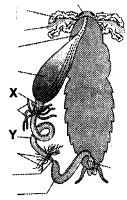
Identify $X$ and $Y$ in the given diagram of the alimentary canal of a cockroach.
A
$X$ - Hepatic caeca,$Y$ - Ileum
B
$X$ - Colon,$Y$ - Malpighian tubules
C
$X$ - Gizzard,$Y$ - Midgut
D
$X$ - Hepatic caeca,$Y$ - Malpighian tubules
Solution
(D) The alimentary canal of a cockroach is divided into three regions: foregut,midgut,and hindgut.
At the junction of the foregut and midgut,a ring of $6-8$ blind tubules called hepatic caeca $(X)$ is present,which secretes digestive juice.
At the junction of the midgut and hindgut,a ring of $100-150$ yellow-colored,thin,filamentous structures called Malpighian tubules $(Y)$ is present,which helps in the removal of excretory products from the haemolymph.
At the junction of the foregut and midgut,a ring of $6-8$ blind tubules called hepatic caeca $(X)$ is present,which secretes digestive juice.
At the junction of the midgut and hindgut,a ring of $100-150$ yellow-colored,thin,filamentous structures called Malpighian tubules $(Y)$ is present,which helps in the removal of excretory products from the haemolymph.
0 likes
View Solution102
MediumMCQ
In cockroach,nephrocytes are concerned with
A
Digestion
B
Reproduction
C
Transport of nerve impulse
D
Excretion
Solution
(D) In cockroaches,nephrocytes are specialized cells associated with the excretory system.
They are also known as pericardial cells.
These cells are responsible for the accumulation and storage of metabolic waste products,thereby playing a significant role in the process of excretion.
Therefore,the correct option is $D$.
They are also known as pericardial cells.
These cells are responsible for the accumulation and storage of metabolic waste products,thereby playing a significant role in the process of excretion.
Therefore,the correct option is $D$.
0 likes
View Solution103
MediumMCQ
Which of the following does not take part in excretion in a cockroach?
A
Nephrocytes
B
Filiform antennae
C
Urecose gland
D
Fat body
Solution
(B) In cockroaches,the primary excretory organs are the Malpighian tubules.
Other structures that assist in excretion or storage of nitrogenous wastes include:
$1$. Nephrocytes: These are specialized cells that accumulate excretory products.
$2$. Urecose glands: These are found in male cockroaches and store uric acid.
$3$. Fat body: This structure stores fat,glycogen,and nitrogenous wastes,playing a role in excretion.
$4$. Filiform antennae: These are sensory organs used for touch and smell and do not participate in the excretory process.
Therefore,the correct answer is $B$.
Other structures that assist in excretion or storage of nitrogenous wastes include:
$1$. Nephrocytes: These are specialized cells that accumulate excretory products.
$2$. Urecose glands: These are found in male cockroaches and store uric acid.
$3$. Fat body: This structure stores fat,glycogen,and nitrogenous wastes,playing a role in excretion.
$4$. Filiform antennae: These are sensory organs used for touch and smell and do not participate in the excretory process.
Therefore,the correct answer is $B$.
0 likes
View Solution104
MediumMCQ
Which of the following structures in a cockroach are made up of chitin?
A
Mouthparts,tergites,Alimentary canal
B
Anal cerci,crop,testis
C
Phallomere,teeth in gizzard,tergites
D
Sternites,anal style,Malpighian tubules
Solution
(C) The exoskeleton of a cockroach is composed of hardened plates called sclerites (tergites dorsally and sternites ventrally),which are made of chitin.
Additionally,the mouthparts,the teeth present in the gizzard (proventriculus) for grinding food,and the male external genitalia known as phallomeres are also chitinous structures.
Therefore,the correct combination is phallomeres,teeth in the gizzard,and tergites.
Additionally,the mouthparts,the teeth present in the gizzard (proventriculus) for grinding food,and the male external genitalia known as phallomeres are also chitinous structures.
Therefore,the correct combination is phallomeres,teeth in the gizzard,and tergites.
0 likes
View Solution105
MediumMCQ
Which of the following statements is false regarding the heart of a cockroach?
A
It lies along the mid-dorsal line of the thorax and abdomen.
B
The anterior part is open,while the posterior part is closed.
C
It consists of funnel-shaped chambers with ostia.
D
The anterior aorta is divided and reaches every cell of the body.
Solution
(D) The heart of a cockroach consists of an elongated muscular tube lying along the mid-dorsal line of the thorax and abdomen.
It is differentiated into $13$ funnel-shaped chambers with ostia on either side.
Blood from the sinuses enters the heart through these ostia and is pumped anteriorly to the sinuses by contraction.
Option $D$ is false because the cockroach has an open circulatory system.
The blood (hemolymph) does not reach every cell of the body through vessels; instead,it bathes the tissues directly in the body cavity (hemocoel).
It is differentiated into $13$ funnel-shaped chambers with ostia on either side.
Blood from the sinuses enters the heart through these ostia and is pumped anteriorly to the sinuses by contraction.
Option $D$ is false because the cockroach has an open circulatory system.
The blood (hemolymph) does not reach every cell of the body through vessels; instead,it bathes the tissues directly in the body cavity (hemocoel).
0 likes
View Solution106
MediumMCQ
The heart of a cockroach is........
A
Four chambered
B
Having ostia
C
Open on both sides
D
Absent
Solution
(B) The heart of a cockroach is an elongated,tubular structure located along the mid-dorsal line of the thorax and abdomen.
It consists of $13$ funnel-shaped chambers.
Each chamber has a pair of lateral openings called $ostia$ on either side,which allow blood (hemolymph) to enter the heart from the body cavity (sinuses) but prevent it from flowing back out.
Therefore,the correct characteristic is that it has $ostia$.
It consists of $13$ funnel-shaped chambers.
Each chamber has a pair of lateral openings called $ostia$ on either side,which allow blood (hemolymph) to enter the heart from the body cavity (sinuses) but prevent it from flowing back out.
Therefore,the correct characteristic is that it has $ostia$.
0 likes
View Solution107
MediumMCQ
The trachea in mammals and the trachea in cockroaches are similar in that they both have:
A
paired structures
B
non-collapsible walls
C
ciliated inner lining
D
origin from the head
Solution
(B) In mammals,the trachea is supported by cartilaginous rings that prevent it from collapsing,ensuring a continuous airway. Similarly,the trachea in cockroaches is supported by spiral thickenings of the cuticle called intima (taenidia),which also prevent the tracheal tubes from collapsing. Therefore,both structures share the characteristic of having non-collapsible walls.
0 likes
View Solution108
MediumMCQ
Which of the following is correctly described for a common cockroach $(Periplaneta \text{ } americana)$?
A
Oxygen is transported in the blood by hemoglobin.
B
The nitrogenous excretory product is urea.
C
Food is ground by the mandibles and gizzard.
D
Malpighian tubules are excretory organs that arise from the rectum.
Solution
(C) In a common cockroach $(Periplaneta \text{ } americana)$:
$1$. Oxygen is not transported by hemoglobin because the blood (hemolymph) lacks respiratory pigments.
$2$. The nitrogenous excretory product is uric acid, not urea (it is uricotelic).
$3$. Food is ground by the mandibles (for cutting) and the gizzard (proventriculus), which has chitinous teeth for grinding.
$4$. Malpighian tubules are excretory organs that arise at the junction of the midgut and hindgut, not from the rectum.
$1$. Oxygen is not transported by hemoglobin because the blood (hemolymph) lacks respiratory pigments.
$2$. The nitrogenous excretory product is uric acid, not urea (it is uricotelic).
$3$. Food is ground by the mandibles (for cutting) and the gizzard (proventriculus), which has chitinous teeth for grinding.
$4$. Malpighian tubules are excretory organs that arise at the junction of the midgut and hindgut, not from the rectum.
0 likes
View Solution109
EasyMCQ
In cockroaches,in what form do the body cells primarily discharge their nitrogenous waste into the hemolymph?
A
Calcium carbonate
B
Ammonia
C
Potassium urate
D
Urea
Solution
(C) Cockroaches are uricotelic animals. The fat body,nephrocytes,and urecose glands are involved in the excretion of nitrogenous waste. The body cells primarily discharge their nitrogenous waste into the hemolymph in the form of potassium urate. This is then absorbed by the Malpighian tubules and converted into uric acid,which is excreted through the hindgut.
0 likes
View Solution110
MediumMCQ
In the male cockroach,in which part of the reproductive system are the sperms stored?
A
Testis
B
Vas deferens
C
Seminal vesicle
D
Conglobate gland
Solution
(C) In the male reproductive system of the cockroach,the sperms are produced in the testes and are carried through the vasa deferentia to the seminal vesicles.
The seminal vesicles are the structures where the sperms are stored and glued together in the form of bundles called spermatophores.
Therefore,the correct answer is $C$ (Seminal vesicle).
The seminal vesicles are the structures where the sperms are stored and glued together in the form of bundles called spermatophores.
Therefore,the correct answer is $C$ (Seminal vesicle).
0 likes
View Solution111
MediumMCQ
Select the correct sequence of organs in the alimentary canal of a cockroach starting from the mouth.
A
Pharynx $\rightarrow$ Oesophagus $\rightarrow$ Crop $\rightarrow$ Gizzard $\rightarrow$ Ileum $\rightarrow$ Colon $\rightarrow$ Rectum
B
Pharynx $\rightarrow$ Oesophagus $\rightarrow$ Gizzard $\rightarrow$ Crop $\rightarrow$ Ileum $\rightarrow$ Colon $\rightarrow$ Rectum
C
Pharynx $\rightarrow$ Oesophagus $\rightarrow$ Gizzard $\rightarrow$ Ileum $\rightarrow$ Crop $\rightarrow$ Colon $\rightarrow$ Rectum
D
Pharynx $\rightarrow$ Oesophagus $\rightarrow$ Ileum $\rightarrow$ Crop $\rightarrow$ Gizzard $\rightarrow$ Colon $\rightarrow$ Rectum
Solution
(A) The alimentary canal of a cockroach is divided into three regions: foregut,midgut,and hindgut.
$1$. The foregut includes the mouth,pharynx,oesophagus,crop (for food storage),and gizzard (for grinding food).
$2$. The midgut is the site of digestion and absorption.
$3$. The hindgut includes the ileum,colon,and rectum.
Therefore,the correct sequence starting from the mouth is: Pharynx $\rightarrow$ Oesophagus $\rightarrow$ Crop $\rightarrow$ Gizzard $\rightarrow$ Ileum $\rightarrow$ Colon $\rightarrow$ Rectum.
$1$. The foregut includes the mouth,pharynx,oesophagus,crop (for food storage),and gizzard (for grinding food).
$2$. The midgut is the site of digestion and absorption.
$3$. The hindgut includes the ileum,colon,and rectum.
Therefore,the correct sequence starting from the mouth is: Pharynx $\rightarrow$ Oesophagus $\rightarrow$ Crop $\rightarrow$ Gizzard $\rightarrow$ Ileum $\rightarrow$ Colon $\rightarrow$ Rectum.
0 likes
View Solution112
MediumMCQ
Which of the following statements is incorrect?
A
Cockroaches exhibit mosaic vision with less sensitivity and more resolution.
B
$A$ mushroom-shaped gland is present in the $6^{th}-7^{th}$ abdominal segments of male cockroach.
C
$A$ pair of spermatheca is present in the $6^{th}$ segment of female cockroach.
D
Female cockroach possesses sixteen ovarioles in the ovaries.
Solution
(A) Let us analyze each statement:
$1$. Cockroaches exhibit mosaic vision,which is characterized by high sensitivity but low resolution. Therefore,the statement in option $A$ is incorrect.
$2$. In male cockroaches,a mushroom-shaped gland is indeed present in the $6^{th}-7^{th}$ abdominal segments.
$3$. In female cockroaches,a pair of spermatheca is present in the $6^{th}$ segment.
$4$. Each ovary of a female cockroach consists of $8$ ovarioles,totaling $16$ ovarioles in the entire reproductive system. This statement is correct.
Since option $A$ claims mosaic vision has 'less sensitivity and more resolution',which is the opposite of the truth,it is the incorrect statement.
$1$. Cockroaches exhibit mosaic vision,which is characterized by high sensitivity but low resolution. Therefore,the statement in option $A$ is incorrect.
$2$. In male cockroaches,a mushroom-shaped gland is indeed present in the $6^{th}-7^{th}$ abdominal segments.
$3$. In female cockroaches,a pair of spermatheca is present in the $6^{th}$ segment.
$4$. Each ovary of a female cockroach consists of $8$ ovarioles,totaling $16$ ovarioles in the entire reproductive system. This statement is correct.
Since option $A$ claims mosaic vision has 'less sensitivity and more resolution',which is the opposite of the truth,it is the incorrect statement.
0 likes
View Solution113
Medium
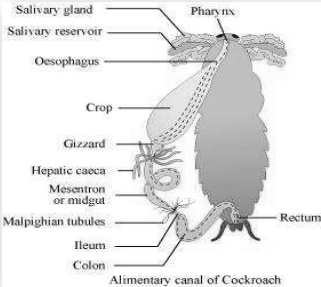
Draw a labelled diagram of the alimentary canal of a cockroach.
Solution
(N/A) The alimentary canal of a cockroach is divided into three regions: foregut,midgut,and hindgut.
$1$. Foregut: It includes the pharynx,oesophagus,crop (for storing food),and gizzard (for grinding food).
$2$. Midgut (Mesenteron): It is a short,narrow tube where digestion and absorption occur. At the junction of the foregut and midgut,there are $6-8$ blind tubules called hepatic caeca,which secrete digestive juices.
$3$. Hindgut: It is broader than the midgut and includes the ileum,colon,and rectum. At the junction of the midgut and hindgut,there are $100-150$ yellow-coloured,thin,filamentous Malpighian tubules,which help in the removal of excretory products from the haemolymph.
$1$. Foregut: It includes the pharynx,oesophagus,crop (for storing food),and gizzard (for grinding food).
$2$. Midgut (Mesenteron): It is a short,narrow tube where digestion and absorption occur. At the junction of the foregut and midgut,there are $6-8$ blind tubules called hepatic caeca,which secrete digestive juices.
$3$. Hindgut: It is broader than the midgut and includes the ileum,colon,and rectum. At the junction of the midgut and hindgut,there are $100-150$ yellow-coloured,thin,filamentous Malpighian tubules,which help in the removal of excretory products from the haemolymph.
0 likes
View Solution114
Easy
Answer in one word or one line. What is the position of ovaries in the cockroach?
Solution
(N/A) In a cockroach,the pair of ovaries is located laterally in the $2^{nd}$ to $6^{th}$ abdominal segments.
0 likes
View Solution115
Easy
Answer in one word or one line. Where do you find Malpighian tubules?
Solution
(N/A) Malpighian tubules are the main excretory organs of cockroaches. They are found attached to the junction of the midgut and hindgut of the alimentary canal.
0 likes
View Solution116
EasyMCQ
Mark the odd one in each series:
Protonema; mesothorax; metathorax; coxa
Protonema; mesothorax; metathorax; coxa
A
Protonema
B
Mesothorax
C
Metathorax
D
Coxa
Solution
(A) Protonema is a thread-like chain of cells that forms the earliest stage in the life cycle of a moss (a bryophyte).
Mesothorax,metathorax,and coxa are all structural components related to the anatomy of a cockroach. Specifically,the thorax of a cockroach consists of three segments: prothorax,mesothorax,and metathorax,while the coxa is the basal segment of the insect leg.
Mesothorax,metathorax,and coxa are all structural components related to the anatomy of a cockroach. Specifically,the thorax of a cockroach consists of three segments: prothorax,mesothorax,and metathorax,while the coxa is the basal segment of the insect leg.
0 likes
View Solution117
Medium
Mention the function of the following:
Malpighian tubules
Malpighian tubules
Solution
(N/A) Malpighian tubules are the primary excretory organs in insects,such as cockroaches.
They help in the removal of nitrogenous wastes from the haemolymph and convert them into uric acid,which is then excreted through the digestive tract.
They help in the removal of nitrogenous wastes from the haemolymph and convert them into uric acid,which is then excreted through the digestive tract.
0 likes
View Solution118
Medium
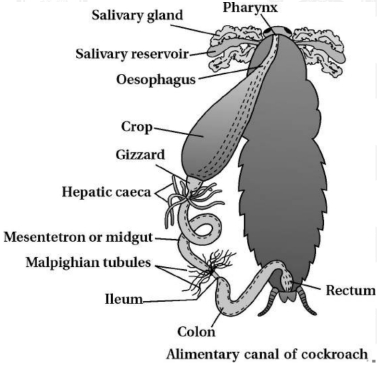
Describe the digestive tract or alimentary canal of a cockroach with a diagram.
Solution
(N/A) The alimentary canal of a cockroach is complex and is divided into three regions: Foregut,Midgut,and Hindgut.
$1$. Foregut: The mouth opens into a short tubular pharynx,which leads to a narrow tubular passage called the oesophagus. This opens into a sac-like structure called the crop,used for storing food. The crop is followed by the gizzard or proventriculus. It has an outer layer of thick circular muscles and a thick inner cuticle forming six highly chitinous plates called teeth,which help in grinding food particles. The entire foregut is lined with a cuticle.
$2$. Midgut: The gizzard opens into the midgut. At the junction of the foregut and midgut,a ring of $6-8$ blind tubules called hepatic or gastric caecae is present,which secretes digestive juices.
$3$. Hindgut: The midgut opens into the hindgut. At the junction of the midgut and hindgut,another ring of $100-150$ yellow-coloured,thin,filamentous Malpighian tubules is present. They help in the removal of excretory products from the haemolymph. The hindgut is broader than the midgut and is differentiated into the ileum,colon,and rectum. The rectum opens out through the anus.
$1$. Foregut: The mouth opens into a short tubular pharynx,which leads to a narrow tubular passage called the oesophagus. This opens into a sac-like structure called the crop,used for storing food. The crop is followed by the gizzard or proventriculus. It has an outer layer of thick circular muscles and a thick inner cuticle forming six highly chitinous plates called teeth,which help in grinding food particles. The entire foregut is lined with a cuticle.
$2$. Midgut: The gizzard opens into the midgut. At the junction of the foregut and midgut,a ring of $6-8$ blind tubules called hepatic or gastric caecae is present,which secretes digestive juices.
$3$. Hindgut: The midgut opens into the hindgut. At the junction of the midgut and hindgut,another ring of $100-150$ yellow-coloured,thin,filamentous Malpighian tubules is present. They help in the removal of excretory products from the haemolymph. The hindgut is broader than the midgut and is differentiated into the ileum,colon,and rectum. The rectum opens out through the anus.
0 likes
View Solution119
Medium
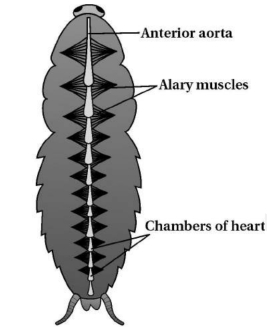
Describe the circulatory system of a cockroach.
Solution
(N/A) $\rightarrow$ The blood vascular system of a cockroach is of the open type. This means that during circulation,blood enters into spaces called hemocoel instead of passing through capillaries. Thus,body organs and tissues are in direct contact with the blood.
$\rightarrow$ The blood is mainly composed of blood plasma and hemocytes.
$\rightarrow$ The blood lacks respiratory pigments,so it is colourless. It is called hemolymph. The hemolymph consists of blood plasma and hemocytes.
$\rightarrow$ The heart of a cockroach consists of an elongated muscular tube lying along the mid-dorsal line of the thorax and abdomen. It is differentiated into funnel-shaped chambers with ostia on either side.
$\rightarrow$ The blood cells are of two types: small-sized proleucocytes and large-sized phagocytes. Blood enters the heart from sinuses through ostia and is pumped anteriorly back into the sinuses.
$\rightarrow$ The blood is mainly composed of blood plasma and hemocytes.
$\rightarrow$ The blood lacks respiratory pigments,so it is colourless. It is called hemolymph. The hemolymph consists of blood plasma and hemocytes.
$\rightarrow$ The heart of a cockroach consists of an elongated muscular tube lying along the mid-dorsal line of the thorax and abdomen. It is differentiated into funnel-shaped chambers with ostia on either side.
$\rightarrow$ The blood cells are of two types: small-sized proleucocytes and large-sized phagocytes. Blood enters the heart from sinuses through ostia and is pumped anteriorly back into the sinuses.
0 likes
View Solution120
Medium
Describe the respiratory system of a cockroach.
Solution
(N/A) $\rightarrow$ The respiratory system consists of a network of trachea,which are the main elements of the respiratory system.
$\rightarrow$ Many branches of the trachea are spread throughout the body. Their terminal branches are called tracheoles,which transport $O_{2}$ to all parts of the body.
$\rightarrow$ The trachea maintains direct contact with atmospheric air through openings called spiracles.
$\rightarrow$ There are $10$ pairs of spiracles present on the lateral sides of the body. Among these,$2$ pairs are located in the thorax region and $8$ pairs are located in the abdomen region.
$\rightarrow$ The walls of the spiracles are formed of funnel-like structures.
$\rightarrow$ These funnel-like structures prevent dust and foreign substances from entering the respiratory system. Valves control the opening and closing of the spiracles.
$\rightarrow$ During respiration,oxygen enters the trachea through the spiracles,reaches the tissue fluid via tracheoles,and dissolves in it. Body tissues use this dissolved oxygen to produce energy. Carbon dioxide produced during metabolism also dissolves in the tissue fluid and is expelled during exhalation.
$\rightarrow$ Many branches of the trachea are spread throughout the body. Their terminal branches are called tracheoles,which transport $O_{2}$ to all parts of the body.
$\rightarrow$ The trachea maintains direct contact with atmospheric air through openings called spiracles.
$\rightarrow$ There are $10$ pairs of spiracles present on the lateral sides of the body. Among these,$2$ pairs are located in the thorax region and $8$ pairs are located in the abdomen region.
$\rightarrow$ The walls of the spiracles are formed of funnel-like structures.
$\rightarrow$ These funnel-like structures prevent dust and foreign substances from entering the respiratory system. Valves control the opening and closing of the spiracles.
$\rightarrow$ During respiration,oxygen enters the trachea through the spiracles,reaches the tissue fluid via tracheoles,and dissolves in it. Body tissues use this dissolved oxygen to produce energy. Carbon dioxide produced during metabolism also dissolves in the tissue fluid and is expelled during exhalation.
0 likes
View Solution121
Medium
Explain how excretion takes place in a cockroach.
Solution
(N/A) $\rightarrow$ In cockroaches,excretion is carried out by Malpighian tubules. Each tubule is lined with glandular and ciliated cells. They absorb nitrogenous waste products from the hemolymph and convert them into uric acid,which is then excreted out through the hindgut. Therefore,this insect is called uricotelic.
$\rightarrow$ In addition to Malpighian tubules,the fat body,nephrocytes,and urecose glands also assist in the process of excretion.
$\rightarrow$ Some excretory substances are stored in the chitinous exoskeleton and are removed from the body during the process of moulting (ecdysis).
$\rightarrow$ In addition to Malpighian tubules,the fat body,nephrocytes,and urecose glands also assist in the process of excretion.
$\rightarrow$ Some excretory substances are stored in the chitinous exoskeleton and are removed from the body during the process of moulting (ecdysis).
0 likes
View Solution122
Easy
Explain the nervous system of a cockroach.
Solution
(N/A) $\rightarrow$ The nervous system of a cockroach consists of a series of fused,segmentally arranged ganglia joined by paired longitudinal connectives on the ventral side. Three ganglia lie in the thorax and six in the abdomen.
$\rightarrow$ The upper part of the oesophagus possesses the brain,also known as the supra-oesophageal ganglion. It is formed by the fusion of three ganglia.
$\rightarrow$ Two perioesophageal connectives arise from the brain. They pass along the lateral sides of the oesophagus and connect to the sub-oesophageal ganglion arranged on the ventral side of the body,forming a nerve ring.
$\rightarrow$ The nervous system is spread throughout the body. The head holds only a small part of the nervous system,while the rest is situated along the ventral part of the body. Therefore,if the head of a cockroach is cut off,it can still live for as long as one week.
$\rightarrow$ In the head region,the supra-oesophageal ganglion supplies nerves to the antennae and compound eyes.
$\rightarrow$ Sensory organs of the cockroach include antennae,eyes,maxillary palps,labial palps,and anal cerci.
$\rightarrow$ The compound eyes are situated on the dorsal surface of the head. Each eye consists of about $2000$ hexagonal ommatidia. With the help of these ommatidia,a cockroach receives several images of an object. This kind of vision is known as mosaic vision,which has more sensitivity but less resolution,and is common during the night (hence called nocturnal vision).
$\rightarrow$ The upper part of the oesophagus possesses the brain,also known as the supra-oesophageal ganglion. It is formed by the fusion of three ganglia.
$\rightarrow$ Two perioesophageal connectives arise from the brain. They pass along the lateral sides of the oesophagus and connect to the sub-oesophageal ganglion arranged on the ventral side of the body,forming a nerve ring.
$\rightarrow$ The nervous system is spread throughout the body. The head holds only a small part of the nervous system,while the rest is situated along the ventral part of the body. Therefore,if the head of a cockroach is cut off,it can still live for as long as one week.
$\rightarrow$ In the head region,the supra-oesophageal ganglion supplies nerves to the antennae and compound eyes.
$\rightarrow$ Sensory organs of the cockroach include antennae,eyes,maxillary palps,labial palps,and anal cerci.
$\rightarrow$ The compound eyes are situated on the dorsal surface of the head. Each eye consists of about $2000$ hexagonal ommatidia. With the help of these ommatidia,a cockroach receives several images of an object. This kind of vision is known as mosaic vision,which has more sensitivity but less resolution,and is common during the night (hence called nocturnal vision).
0 likes
View Solution123
Medium
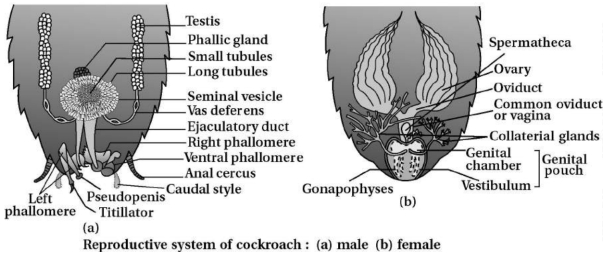
Describe the reproductive system of a cockroach in detail.
Solution
(N/A) Cockroaches are dioecious,and both sexes have well-developed reproductive organs.
$(i)$ Male reproductive system: The male reproductive system consists of a pair of testes,one lying on each lateral side in the $4^{th}-6^{th}$ abdominal segments.
From each testis,a thin vas deferens arises,which opens into the ejaculatory duct through the seminal vesicle. The ejaculatory duct opens into the male gonopore situated ventrally to the anus.
$A$ characteristic mushroom-shaped gland is present in the $6^{th}-7^{th}$ abdominal segments,which functions as an accessory reproductive gland. Another long and flat gland,the conglobate gland,is located on the ventral side of the ejaculatory duct and acts as an accessory reproductive gland. Its secretion forms a hard coating around the sperm bag.
The external genitalia are represented by male gonapophysis or phallomeres (chitinous asymmetrical structures surrounding the male gonopore).
The sperms are stored in the seminal vesicles and are glued together in the form of bundles called spermatophores,which are discharged during copulation.
$(ii)$ Female reproductive system:
The female reproductive system consists of two large ovaries lying laterally in the $2^{nd}-6^{th}$ abdominal segments.
Each ovary is formed of a group of eight ovarian tubules or ovarioles containing a chain of developing ova.
Oviducts of each ovary unite into a single median oviduct (also called vagina) which opens into the genital chamber. $A$ pair of spermatheca is present in the $6^{th}$ segment,which opens into the genital chamber.
Egg cells enter the genital chamber during mating and are fertilized by sperm cells.
Collateral glands present in the female cockroach secrete substances that form the ootheca.
Fertilized egg cells are encased in capsules called oothecae. An ootheca is a dark reddish to blackish-brown capsule,about $8 \ mm$ long. They are dropped or glued to a suitable surface,usually in a crack or crevice of high relative humidity near a food source.
On average,females produce $9-10$ oothecae,each containing $14-16$ eggs.
The development of $P. \ americana$ is indirect,meaning it proceeds through a nymphal stage.
The nymph resembles the adult insect. The nymph grows by moulting about $13$ times to reach the adult form. The next-to-last nymphal stage has wing pads,but only adult cockroaches have wings.
$(i)$ Male reproductive system: The male reproductive system consists of a pair of testes,one lying on each lateral side in the $4^{th}-6^{th}$ abdominal segments.
From each testis,a thin vas deferens arises,which opens into the ejaculatory duct through the seminal vesicle. The ejaculatory duct opens into the male gonopore situated ventrally to the anus.
$A$ characteristic mushroom-shaped gland is present in the $6^{th}-7^{th}$ abdominal segments,which functions as an accessory reproductive gland. Another long and flat gland,the conglobate gland,is located on the ventral side of the ejaculatory duct and acts as an accessory reproductive gland. Its secretion forms a hard coating around the sperm bag.
The external genitalia are represented by male gonapophysis or phallomeres (chitinous asymmetrical structures surrounding the male gonopore).
The sperms are stored in the seminal vesicles and are glued together in the form of bundles called spermatophores,which are discharged during copulation.
$(ii)$ Female reproductive system:
The female reproductive system consists of two large ovaries lying laterally in the $2^{nd}-6^{th}$ abdominal segments.
Each ovary is formed of a group of eight ovarian tubules or ovarioles containing a chain of developing ova.
Oviducts of each ovary unite into a single median oviduct (also called vagina) which opens into the genital chamber. $A$ pair of spermatheca is present in the $6^{th}$ segment,which opens into the genital chamber.
Egg cells enter the genital chamber during mating and are fertilized by sperm cells.
Collateral glands present in the female cockroach secrete substances that form the ootheca.
Fertilized egg cells are encased in capsules called oothecae. An ootheca is a dark reddish to blackish-brown capsule,about $8 \ mm$ long. They are dropped or glued to a suitable surface,usually in a crack or crevice of high relative humidity near a food source.
On average,females produce $9-10$ oothecae,each containing $14-16$ eggs.
The development of $P. \ americana$ is indirect,meaning it proceeds through a nymphal stage.
The nymph resembles the adult insect. The nymph grows by moulting about $13$ times to reach the adult form. The next-to-last nymphal stage has wing pads,but only adult cockroaches have wings.
0 likes
View Solution124
Easy
Give names of female and male organs located in the abdomen of a cockroach.
Solution
(N/A) In both male and female cockroaches,the $10^{\text{th}}$ segment bears a pair of jointed filamentous structures called anal cerci.
In male cockroaches,a pair of short,thread-like anal styles is present,which is absent in females.
In females,the $7^{\text{th}}$ sternum is boat-shaped and,together with the $8^{\text{th}}$ and $9^{\text{th}}$ sterna,forms a brood or genital pouch. The anterior part of this pouch contains the female gonopore,spermathecal pores,and collateral glands.
In males,the genital pouch or chamber lies at the hind end of the abdomen,bounded dorsally by the $9^{\text{th}}$ and $10^{\text{th}}$ terga and ventrally by the $9^{\text{th}}$ sternum. It contains the dorsal anus,the ventral male genital pore,and gonapophyses.
In male cockroaches,a pair of short,thread-like anal styles is present,which is absent in females.
In females,the $7^{\text{th}}$ sternum is boat-shaped and,together with the $8^{\text{th}}$ and $9^{\text{th}}$ sterna,forms a brood or genital pouch. The anterior part of this pouch contains the female gonopore,spermathecal pores,and collateral glands.
In males,the genital pouch or chamber lies at the hind end of the abdomen,bounded dorsally by the $9^{\text{th}}$ and $10^{\text{th}}$ terga and ventrally by the $9^{\text{th}}$ sternum. It contains the dorsal anus,the ventral male genital pore,and gonapophyses.
0 likes
View Solution125
Easy
Describe the structure of the heart and the path of blood circulation in a cockroach.
Solution
(N/A) $\rightarrow$ The heart of a cockroach consists of an elongated,muscular tube lying along the mid-dorsal line of the thorax and abdomen.
$\rightarrow$ It is differentiated into $13$ funnel-shaped chambers,each with a pair of ostia on either side,which allow blood to enter the heart from the sinuses.
$\rightarrow$ The blood (hemolymph) is pumped anteriorly from the heart into the sinuses by the rhythmic contraction of these chambers.
$\rightarrow$ The blood cells,or hemocytes,are of two types: small proleucocytes and large phagocytes.
$\rightarrow$ It is differentiated into $13$ funnel-shaped chambers,each with a pair of ostia on either side,which allow blood to enter the heart from the sinuses.
$\rightarrow$ The blood (hemolymph) is pumped anteriorly from the heart into the sinuses by the rhythmic contraction of these chambers.
$\rightarrow$ The blood cells,or hemocytes,are of two types: small proleucocytes and large phagocytes.
0 likes
View Solution126
MediumMCQ
Describe the respiratory system of a cockroach.
A
It consists of a network of tracheae that open through $10$ pairs of small holes called spiracles.
B
It consists of a network of tracheae that open through $8$ pairs of small holes called spiracles.
C
It consists of a network of tracheae that open through $12$ pairs of small holes called spiracles.
D
It consists of a network of tracheae that open through $6$ pairs of small holes called spiracles.
Solution
(A) The respiratory system of a cockroach consists of a network of tracheae that open through $10$ pairs of small holes called spiracles present on the lateral side of the body.
Thin branching tubes (tracheal tubes subdivided into tracheoles) carry oxygen from the air to all the parts.
The opening of the spiracles is regulated by sphincters.
Exchange of gases takes place at the tracheoles by diffusion.
Thin branching tubes (tracheal tubes subdivided into tracheoles) carry oxygen from the air to all the parts.
The opening of the spiracles is regulated by sphincters.
Exchange of gases takes place at the tracheoles by diffusion.
0 likes
View Solution127
Easy
Explain the structure of the brain and neurons in a cockroach.
Solution
(N/A) The nervous system of a cockroach consists of a series of fused,segmentally arranged ganglia joined by paired longitudinal connectives on the ventral side.
Three ganglia lie in the thorax,and six in the abdomen.
The nervous system of the cockroach is spread throughout the body.
The head holds a bit of the nervous system,while the rest is situated along the ventral (belly-side) part of the body.
So,if you cut the head of a cockroach,it will still live for as long as one week.
In the head region,the brain is represented by the supra-oesophageal ganglion,which supplies nerves to antennae and compound eyes.
In addition to the brain,the nervous system consists of a sub-oesophageal ganglion,a circum-oesophageal connective,and a ventral nerve cord.
Neurons in the cockroach are part of this segmental ganglion system,which coordinates sensory input and motor output for various body segments.
Three ganglia lie in the thorax,and six in the abdomen.
The nervous system of the cockroach is spread throughout the body.
The head holds a bit of the nervous system,while the rest is situated along the ventral (belly-side) part of the body.
So,if you cut the head of a cockroach,it will still live for as long as one week.
In the head region,the brain is represented by the supra-oesophageal ganglion,which supplies nerves to antennae and compound eyes.
In addition to the brain,the nervous system consists of a sub-oesophageal ganglion,a circum-oesophageal connective,and a ventral nerve cord.
Neurons in the cockroach are part of this segmental ganglion system,which coordinates sensory input and motor output for various body segments.
0 likes
View Solution128
Medium
Explain the nervous system of a cockroach.
Solution
(N/A) The nervous system of a cockroach consists of a series of fused,segmentally arranged ganglia joined by paired longitudinal connectives on the ventral side.
Three ganglia lie in the thorax,and six in the abdomen.
The nervous system of the cockroach is spread throughout the body.
The head holds a bit of the nervous system,while the rest is situated along the ventral (belly-side) part of the body.
Therefore,if you cut the head of a cockroach,it will still live for as long as one week.
In the head region,the brain is represented by the supra-oesophageal ganglion,which supplies nerves to antennae and compound eyes.
Three ganglia lie in the thorax,and six in the abdomen.
The nervous system of the cockroach is spread throughout the body.
The head holds a bit of the nervous system,while the rest is situated along the ventral (belly-side) part of the body.
Therefore,if you cut the head of a cockroach,it will still live for as long as one week.
In the head region,the brain is represented by the supra-oesophageal ganglion,which supplies nerves to antennae and compound eyes.
0 likes
View Solution129
Easy
Explain the reproductive system of a male cockroach.
Solution
(N/A) The male reproductive system of a cockroach consists of a pair of testes,vasa deferentia,an ejaculatory duct,seminal vesicles,the accessory glands,and external genitalia.
$1$. Testes: $A$ pair of testes is located in the $4^{th}$ to $6^{th}$ abdominal segments.
$2$. Vasa Deferentia: From each testis,a thin vas deferens arises,which opens into the ejaculatory duct through the seminal vesicles.
$3$. Seminal Vesicles: These store the sperms in the form of bundles called spermatophores.
$4$. Ejaculatory Duct: This duct opens into the male gonopore situated ventral to the anus.
$5$. Accessory Glands: $A$ characteristic mushroom-shaped gland is present in the $6^{th}-7^{th}$ abdominal segments,which functions as an accessory reproductive gland.
$6$. External Genitalia: These are represented by male gonapophysis or phallomeres (chitinous asymmetrical structures) surrounding the male gonopore.
$1$. Testes: $A$ pair of testes is located in the $4^{th}$ to $6^{th}$ abdominal segments.
$2$. Vasa Deferentia: From each testis,a thin vas deferens arises,which opens into the ejaculatory duct through the seminal vesicles.
$3$. Seminal Vesicles: These store the sperms in the form of bundles called spermatophores.
$4$. Ejaculatory Duct: This duct opens into the male gonopore situated ventral to the anus.
$5$. Accessory Glands: $A$ characteristic mushroom-shaped gland is present in the $6^{th}-7^{th}$ abdominal segments,which functions as an accessory reproductive gland.
$6$. External Genitalia: These are represented by male gonapophysis or phallomeres (chitinous asymmetrical structures) surrounding the male gonopore.
0 likes
View Solution130
Medium
Explain the reproductive system of a female cockroach.
Solution
(N/A) The female reproductive system of a cockroach consists of two large ovaries,lying laterally in the $2^{nd}$ to $6^{th}$ abdominal segments.
Each ovary is formed of a group of $8$ ovarian tubules or ovarioles,containing a chain of developing ova.
Oviducts of each ovary unite into a single median oviduct (also called vagina) which opens into the genital chamber.
$A$ pair of spermathecae is present in the $6^{th}$ segment which opens into the genital chamber.
Sperm are transferred through spermatophores.
The female genital pore,spermathecal pores,and collateral glands are all associated with the genital pouch or brood pouch,which is formed by the $7^{th}, 8^{th},$ and $9^{th}$ abdominal sterna.
Each ovary is formed of a group of $8$ ovarian tubules or ovarioles,containing a chain of developing ova.
Oviducts of each ovary unite into a single median oviduct (also called vagina) which opens into the genital chamber.
$A$ pair of spermathecae is present in the $6^{th}$ segment which opens into the genital chamber.
Sperm are transferred through spermatophores.
The female genital pore,spermathecal pores,and collateral glands are all associated with the genital pouch or brood pouch,which is formed by the $7^{th}, 8^{th},$ and $9^{th}$ abdominal sterna.
0 likes
View Solution131
Medium
Describe the digestive system of a cockroach.
Solution
(N/A) The alimentary canal of a cockroach is divided into three regions: foregut,midgut,and hindgut.
$1$. Foregut: It includes the pharynx,esophagus,crop (for food storage),and gizzard (for grinding food).
$2$. Midgut: It is a narrow tube where digestion and absorption occur. At the junction of the foregut and midgut,there are $6-8$ blind tubules called hepatic caecae,which secrete digestive juices.
$3$. Hindgut: It is broader than the midgut and consists of the ileum,colon,and rectum. Malpighian tubules are present at the junction of the midgut and hindgut,which help in excretion.
$1$. Foregut: It includes the pharynx,esophagus,crop (for food storage),and gizzard (for grinding food).
$2$. Midgut: It is a narrow tube where digestion and absorption occur. At the junction of the foregut and midgut,there are $6-8$ blind tubules called hepatic caecae,which secrete digestive juices.
$3$. Hindgut: It is broader than the midgut and consists of the ileum,colon,and rectum. Malpighian tubules are present at the junction of the midgut and hindgut,which help in excretion.
0 likes
View Solution132
Easy
Give scientific reasons: In cockroach,a well-developed respiratory system is seen.
Solution
(N/A) $\Rightarrow$ The blood of a cockroach lacks hemoglobin,which is the respiratory pigment responsible for oxygen transport in many animals.
As a result,the blood cannot transport $O_{2}$ and $CO_{2}$.
To overcome this,the cockroach possesses a highly branched network of tubes called the tracheal system that spreads throughout the entire body.
This system ensures that each cell is directly supplied with respiratory gases $(O_{2})$ and that $CO_{2}$ is removed efficiently.
Therefore,the respiratory system is well-developed in the cockroach to compensate for the absence of a respiratory pigment in its blood.
As a result,the blood cannot transport $O_{2}$ and $CO_{2}$.
To overcome this,the cockroach possesses a highly branched network of tubes called the tracheal system that spreads throughout the entire body.
This system ensures that each cell is directly supplied with respiratory gases $(O_{2})$ and that $CO_{2}$ is removed efficiently.
Therefore,the respiratory system is well-developed in the cockroach to compensate for the absence of a respiratory pigment in its blood.
0 likes
View Solution133
Easy
Define the following terms:
$(i)$ Vermicomposting
$(ii)$ Haemolymph
$(i)$ Vermicomposting
$(ii)$ Haemolymph
Solution
(N/A) $(i)$ Vermicomposting: It is the process of using earthworms to decompose organic waste into nutrient-rich fertilizer,thereby increasing the fertility of the soil.
$(ii)$ Haemolymph: In cockroaches,the blood lacks respiratory pigments like haemoglobin,making it colourless. This fluid is known as haemolymph.
$(ii)$ Haemolymph: In cockroaches,the blood lacks respiratory pigments like haemoglobin,making it colourless. This fluid is known as haemolymph.
0 likes
View Solution134
MediumMCQ
Identify the location and function of the following structures in a cockroach:
$(i)$ Gizzard
$(ii)$ Hepatic caecum
$(i)$ Gizzard
$(ii)$ Hepatic caecum
A
Gizzard: Foregut,grinding food; Hepatic caecum: Midgut,secreting digestive enzymes.
B
Gizzard: Midgut,absorbing nutrients; Hepatic caecum: Hindgut,water absorption.
C
Gizzard: Hindgut,waste storage; Hepatic caecum: Foregut,food storage.
D
Gizzard: Foregut,secreting enzymes; Hepatic caecum: Midgut,grinding food.
Solution
(A) $(i)$ Gizzard:
Location: It is a part of the foregut in the digestive tract of a cockroach.
Function: It is lined with chitinous plates and is used for grinding the food particles.
$(ii)$ Hepatic caecum:
Location: These are $6$ to $8$ blind tubules located at the junction of the foregut and midgut.
Function: They secrete digestive juices that aid in the digestion of food.
Location: It is a part of the foregut in the digestive tract of a cockroach.
Function: It is lined with chitinous plates and is used for grinding the food particles.
$(ii)$ Hepatic caecum:
Location: These are $6$ to $8$ blind tubules located at the junction of the foregut and midgut.
Function: They secrete digestive juices that aid in the digestion of food.
0 likes
View Solution135
Medium
Describe the location and function of the following structures in a cockroach:
$(i)$ Malpighian Tubules
$(ii)$ Compound eyes
$(i)$ Malpighian Tubules
$(ii)$ Compound eyes
Solution
(N/A) $(i)$ Location: In a cockroach,at the junction of the midgut and hindgut,a ring of $100-150$ yellow-coloured,thin,filamentous Malpighian tubules is present.
$\Rightarrow$ Function: They absorb excretory wastes from the body cavity (haemolymph) and discharge them into the hindgut for excretion.
$(ii)$ Location: These are paired structures composed of many hexagonal ommatidia,located on the dorsal surface of the head in a cockroach.
$\Rightarrow$ Function: They are responsible for mosaic vision,which provides more sensitivity but less resolution.
$\Rightarrow$ Function: They absorb excretory wastes from the body cavity (haemolymph) and discharge them into the hindgut for excretion.
$(ii)$ Location: These are paired structures composed of many hexagonal ommatidia,located on the dorsal surface of the head in a cockroach.
$\Rightarrow$ Function: They are responsible for mosaic vision,which provides more sensitivity but less resolution.
0 likes
View Solution136
Medium
Identify the location and function of the following glands in cockroaches:
$(i)$ Conglobate gland
$(ii)$ Collateral gland
$(i)$ Conglobate gland
$(ii)$ Collateral gland
Solution
(N/A) $(i)$ Conglobate gland:
Location: It is an accessory reproductive gland in the male cockroach,located at the ventral side of the ejaculatory duct.
Function: Its secretion forms a hard coating around the spermatophore (sperm cell bag).
$(ii)$ Collateral gland:
Location: It is an accessory reproductive gland in the female cockroach.
Function: Its secretion is responsible for the formation of the ootheca (cocoon).
Location: It is an accessory reproductive gland in the male cockroach,located at the ventral side of the ejaculatory duct.
Function: Its secretion forms a hard coating around the spermatophore (sperm cell bag).
$(ii)$ Collateral gland:
Location: It is an accessory reproductive gland in the female cockroach.
Function: Its secretion is responsible for the formation of the ootheca (cocoon).
0 likes
View Solution137
Medium
Give the location of hepatic caeca in a cockroach. What is their function?
Solution
(N/A) Hepatic caeca are $6-8$ narrow,hollow,and blind-ended tubules.
They are located at the junction of the foregut and the midgut in the cockroach.
Their primary function is to secrete digestive juices,which aid in the digestion of food.
They are analogous to the liver in vertebrates,hence the name 'hepatic' caeca.
They are located at the junction of the foregut and the midgut in the cockroach.
Their primary function is to secrete digestive juices,which aid in the digestion of food.
They are analogous to the liver in vertebrates,hence the name 'hepatic' caeca.
0 likes
View Solution138
Medium
Complete the following statement :
$(a)$ In cockroach,grinding of food particles is performed by ........ .
$(b)$ Malpighian tubules help in the removal of ........ .
$(c)$ The hindgut of the cockroach is differentiated into ........ .
$(d)$ In the cockroach,blood vessels open into spaces called ........ .
$(a)$ In cockroach,grinding of food particles is performed by ........ .
$(b)$ Malpighian tubules help in the removal of ........ .
$(c)$ The hindgut of the cockroach is differentiated into ........ .
$(d)$ In the cockroach,blood vessels open into spaces called ........ .
Solution
(A) Gizzard: It is a muscular structure with many folds,located after the foregut,and possesses $6$ highly chitinous plates called teeth which grind the food.
$(b)$ Excretory products: Malpighian tubules help in removing nitrogenous excretory materials from the haemolymph. Thus,they function as excretory organs.
$(c)$ Ileum,colon,and rectum: The hindgut is broader than the midgut and is differentiated into these three parts,where the rectum opens outside through the anus.
$(d)$ Haemocoel: The blood vessels are poorly developed and open into spaces called the haemocoel,where the internal organs are bathed in haemolymph.
$(b)$ Excretory products: Malpighian tubules help in removing nitrogenous excretory materials from the haemolymph. Thus,they function as excretory organs.
$(c)$ Ileum,colon,and rectum: The hindgut is broader than the midgut and is differentiated into these three parts,where the rectum opens outside through the anus.
$(d)$ Haemocoel: The blood vessels are poorly developed and open into spaces called the haemocoel,where the internal organs are bathed in haemolymph.
0 likes
View Solution139
Medium
Explain the digestive system of cockroach with the help of a labelled sketch.
Solution
(N/A) The digestive system of a cockroach consists of an alimentary canal divided into three regions: $Foregut$,$Midgut$,and $Hindgut$.
$1$. $Foregut$: It includes the mouth,pharynx,esophagus,crop (for food storage),and gizzard (for grinding food).
$2$. $Midgut$: It is a narrow,tubular structure lined with glandular epithelium. At the junction of the foregut and midgut,there are $6-8$ blind tubules called hepatic caeca that secrete digestive juices.
$3$. $Hindgut$: It is broader than the midgut and consists of the ileum,colon,and rectum. At the junction of the midgut and hindgut,there are $100-150$ yellow-colored,thin,filamentous Malpighian tubules which help in the excretion of excretory products from the hemolymph.
$1$. $Foregut$: It includes the mouth,pharynx,esophagus,crop (for food storage),and gizzard (for grinding food).
$2$. $Midgut$: It is a narrow,tubular structure lined with glandular epithelium. At the junction of the foregut and midgut,there are $6-8$ blind tubules called hepatic caeca that secrete digestive juices.
$3$. $Hindgut$: It is broader than the midgut and consists of the ileum,colon,and rectum. At the junction of the midgut and hindgut,there are $100-150$ yellow-colored,thin,filamentous Malpighian tubules which help in the excretion of excretory products from the hemolymph.
0 likes
View Solution140
Medium
Explain the nervous system of the cockroach.
Solution
(N/A) $\Rightarrow$ The nervous system of the cockroach consists of a series of fused,segmentally arranged ganglia joined by paired longitudinal connectives on the ventral side.
$\Rightarrow$ Three ganglia lie in the thorax,and six in the abdomen.
$\Rightarrow$ The nervous system of the cockroach is spread throughout the body. The head holds a small part of the nervous system,while the rest is situated along the ventral part of the body. Therefore,if the head of a cockroach is cut off,it will still live for as long as one week.
$\Rightarrow$ In the head region,the brain is represented by the supra-oesophageal ganglion,which supplies nerves to the antennae and compound eyes.
$\Rightarrow$ Three ganglia lie in the thorax,and six in the abdomen.
$\Rightarrow$ The nervous system of the cockroach is spread throughout the body. The head holds a small part of the nervous system,while the rest is situated along the ventral part of the body. Therefore,if the head of a cockroach is cut off,it will still live for as long as one week.
$\Rightarrow$ In the head region,the brain is represented by the supra-oesophageal ganglion,which supplies nerves to the antennae and compound eyes.
0 likes
View Solution141
Medium
Describe the male reproductive system of a cockroach.
Solution
(N/A) $\Rightarrow$ The male reproductive system consists of a pair of testes,one lying on each lateral side in the $4^{th}-6^{th}$ abdominal segments.
$\Rightarrow$ From each testis,a thin vas deferens arises,which opens into the ejaculatory duct through the seminal vesicle. The ejaculatory duct opens into the male gonopore,which is situated ventrally to the anus.
$\Rightarrow$ $A$ characteristic mushroom-shaped gland is present in the $6^{th}-7^{th}$ abdominal segments,which functions as an accessory reproductive gland. Another long and flat gland,the conglobate gland,is located on the ventral side of the ejaculatory duct and also acts as an accessory reproductive gland. Its secretion forms a hard coating around the sperm cell bags.
$\Rightarrow$ The external genitalia are represented by male gonapophyses or phallomeres,which are chitinous,asymmetrical structures surrounding the male gonopore.
$\Rightarrow$ The sperms are stored in the seminal vesicles and are glued together in the form of bundles called spermatophores,which are discharged during copulation.
$\Rightarrow$ From each testis,a thin vas deferens arises,which opens into the ejaculatory duct through the seminal vesicle. The ejaculatory duct opens into the male gonopore,which is situated ventrally to the anus.
$\Rightarrow$ $A$ characteristic mushroom-shaped gland is present in the $6^{th}-7^{th}$ abdominal segments,which functions as an accessory reproductive gland. Another long and flat gland,the conglobate gland,is located on the ventral side of the ejaculatory duct and also acts as an accessory reproductive gland. Its secretion forms a hard coating around the sperm cell bags.
$\Rightarrow$ The external genitalia are represented by male gonapophyses or phallomeres,which are chitinous,asymmetrical structures surrounding the male gonopore.
$\Rightarrow$ The sperms are stored in the seminal vesicles and are glued together in the form of bundles called spermatophores,which are discharged during copulation.
0 likes
View Solution142
Medium
Describe the female reproductive system of a cockroach.
Solution
(A) $\Rightarrow$ The female reproductive system consists of two large ovaries lying laterally in the $2^{nd}-6^{th}$ abdominal segments.
$\Rightarrow$ Each ovary is formed of a group of eight ovarian tubules or ovarioles containing a chain of developing ova.
$\Rightarrow$ Oviducts of each ovary unite into a single median oviduct (also called vagina) which opens into the genital chamber.
$\Rightarrow$ $A$ pair of spermatheca is present in the $6^{th}$ segment which opens into the genital chamber.
$\Rightarrow$ During mating,sperm are transferred to the spermatheca. Fertilization occurs as eggs pass through the genital chamber.
$\Rightarrow$ Collateral glands present in the female cockroach secrete a substance that forms the ootheca.
$\Rightarrow$ Fertilized eggs are encased in capsules called oothecae. An ootheca is a dark reddish to blackish brown capsule,about $8 \ mm$ long. They are dropped or glued to a suitable surface,usually in a crack or crevice with high relative humidity near a food source.
$\Rightarrow$ Each ovary is formed of a group of eight ovarian tubules or ovarioles containing a chain of developing ova.
$\Rightarrow$ Oviducts of each ovary unite into a single median oviduct (also called vagina) which opens into the genital chamber.
$\Rightarrow$ $A$ pair of spermatheca is present in the $6^{th}$ segment which opens into the genital chamber.
$\Rightarrow$ During mating,sperm are transferred to the spermatheca. Fertilization occurs as eggs pass through the genital chamber.
$\Rightarrow$ Collateral glands present in the female cockroach secrete a substance that forms the ootheca.
$\Rightarrow$ Fertilized eggs are encased in capsules called oothecae. An ootheca is a dark reddish to blackish brown capsule,about $8 \ mm$ long. They are dropped or glued to a suitable surface,usually in a crack or crevice with high relative humidity near a food source.
0 likes
View Solution143
MediumMCQ
If the head of a cockroach is removed,it may live for a few days because:
A
the head holds a $1/3^{\text{rd}}$ of a nervous system while the rest is situated along the dorsal part of its body.
B
the supra-oesophageal ganglia of the cockroach are situated in the ventral part of the abdomen.
C
the cockroach does not have a nervous system.
D
the head holds a small proportion of a nervous system while the rest is situated along the ventral part of its body.
Solution
(D) In a cockroach,the nervous system consists of a series of fused,segmentally arranged ganglia joined by paired longitudinal connectives on the ventral side. The head holds only a small proportion of the nervous system (supra-oesophageal ganglia,which act as the brain),while the rest of the nervous system is situated along the ventral part of its body. Therefore,if the head is removed,the cockroach can still survive for a few days because the major part of its nervous system remains intact in the body.
0 likes
View Solution144
MediumMCQ
If the head of a cockroach is removed,it may live for a few days because:
A
The supra-oesophageal ganglion of the cockroach is located in the ventral part of the abdomen.
B
The cockroach does not have a nervous system.
C
The head holds a small portion of the nervous system,while the rest is situated along the ventral part of its body.
D
The head contains $1/3$ of the nervous system,while the rest is located on the dorsal part of its body.
Solution
(C) In cockroaches,the nervous system is segmentally arranged and consists of a series of fused ganglia joined by paired longitudinal connectives on the ventral side. The head holds only a small portion of the nervous system (supra-oesophageal ganglion),while the majority of the nervous system is located in the ventral part of the thorax and abdomen. Therefore,if the head is removed,the cockroach can survive for a few days because its vital life-sustaining functions are controlled by the ventral nerve cord,not just the brain.
0 likes
View Solution145
MediumMCQ
Match the following columns with reference to cockroach and select the correct option:
| Column $I$ | Column $II$ |
| $(a)$ Grinding of the food particles | $(i)$ Hepatic caecae |
| $(b)$ Secrete gastric juice | $(ii)$ $10^{\text{th}}$ segment |
| $(c)$ $10$ pairs | $(iii)$ Proventriculus |
| $(d)$ Anal cerci | $(iv)$ Spiracles |
A
$(a)-(ii), (b)-(iii), (c)-(i), (d)-(iv)$
B
$(a)-(iii), (b)-(i), (c)-(iv), (d)-(ii)$
C
$(a)-(iv), (b)-(iii), (c)-(v), (d)-(ii)$
D
$(a)-(i), (b)-(iv), (c)-(iii), (d)-(ii)$
Solution
(B) The correct matching is as follows:
$(a)$ Grinding of food particles is performed by the gizzard or $Proventriculus$ $(iii)$.
$(b)$ Hepatic caecae secrete digestive enzymes (gastric juice) $(i)$.
$(c)$ Cockroaches have $10$ pairs of spiracles for respiration $(iv)$.
$(d)$ Anal cerci are present on the $10^{\text{th}}$ abdominal segment in both sexes $(ii)$.
Thus, the correct sequence is $(a)-(iii), (b)-(i), (c)-(iv), (d)-(ii)$.
$(a)$ Grinding of food particles is performed by the gizzard or $Proventriculus$ $(iii)$.
$(b)$ Hepatic caecae secrete digestive enzymes (gastric juice) $(i)$.
$(c)$ Cockroaches have $10$ pairs of spiracles for respiration $(iv)$.
$(d)$ Anal cerci are present on the $10^{\text{th}}$ abdominal segment in both sexes $(ii)$.
Thus, the correct sequence is $(a)-(iii), (b)-(i), (c)-(iv), (d)-(ii)$.
0 likes
View Solution146
EasyMCQ
In cockroach,identify the parts of the foregut in correct sequence.
A
Mouth $\rightarrow$ Pharynx $\rightarrow$ Oesophagus $\rightarrow$ Crop $\rightarrow$ Gizzard
B
Mouth $\rightarrow$ Oesophagus $\rightarrow$ Pharynx $\rightarrow$ Crop $\rightarrow$ Gizzard
C
Mouth $\rightarrow$ Crop $\rightarrow$ Pharynx $\rightarrow$ Oesophagus $\rightarrow$ Gizzard
D
Mouth $\rightarrow$ Gizzard $\rightarrow$ Crop $\rightarrow$ Pharynx $\rightarrow$ Oesophagus
Solution
(A) The alimentary canal of the cockroach is divided into three regions: foregut,midgut,and hindgut.
The foregut includes the mouth,pharynx,oesophagus,crop,and gizzard.
The food enters through the mouth,passes through the pharynx into the oesophagus,which leads to the crop (used for storing food),and finally reaches the gizzard (used for grinding food).
Therefore,the correct sequence is: Mouth $\rightarrow$ Pharynx $\rightarrow$ Oesophagus $\rightarrow$ Crop $\rightarrow$ Gizzard.
The foregut includes the mouth,pharynx,oesophagus,crop,and gizzard.
The food enters through the mouth,passes through the pharynx into the oesophagus,which leads to the crop (used for storing food),and finally reaches the gizzard (used for grinding food).
Therefore,the correct sequence is: Mouth $\rightarrow$ Pharynx $\rightarrow$ Oesophagus $\rightarrow$ Crop $\rightarrow$ Gizzard.
0 likes
View Solution147
MediumMCQ
In cockroach,which of the following statements is correct regarding the phallic gland?
A
Ejaculatory duct opens in phallic gland
B
Phallic gland stores sperms
C
Vas deferens opens in phallic gland
D
Phallic gland opens in left phallomere
Solution
(D) In male cockroaches,the reproductive system includes a mushroom-shaped gland (also known as the utricular gland). The phallic gland (or conglobate gland) is a long,sac-like structure that opens into the genital chamber through a separate aperture located near the left phallomere. Therefore,the phallic gland opens in the left phallomere.
0 likes
View Solution148
MediumMCQ
What is the position of the testis in Periplaneta americana?
A
$7^{\text{th}}, 8^{\text{th}}, 9^{\text{th}}$ abdominal segments
B
$5^{\text{th}}, 6^{\text{th}}$ abdominal segments
C
$8^{\text{th}}, 9^{\text{th}}, 10^{\text{th}}$ abdominal segments
D
$4^{\text{th}}, 5^{\text{th}}, 6^{\text{th}}$ abdominal segments
Solution
(D) Periplaneta americana,commonly known as the American cockroach,is a well-studied insect.
In the male reproductive system of Periplaneta americana,a pair of testes is present.
These testes are located on the lateral sides in the $4^{\text{th}}$ to $6^{\text{th}}$ abdominal segments.
Therefore,the correct position is the $4^{\text{th}}, 5^{\text{th}},$ and $6^{\text{th}}$ abdominal segments.
In the male reproductive system of Periplaneta americana,a pair of testes is present.
These testes are located on the lateral sides in the $4^{\text{th}}$ to $6^{\text{th}}$ abdominal segments.
Therefore,the correct position is the $4^{\text{th}}, 5^{\text{th}},$ and $6^{\text{th}}$ abdominal segments.
0 likes
View Solution149
MediumMCQ
Which of the following is a characteristic of a female cockroach?
A
Presence of anal styles
B
Each ovary is made up of $8$ ovarioles
C
One pair of spermatheca is present and opens into the genital chamber
D
Genital pouch is made up of the $9^{th}, 10^{th}$ terga and $9^{th}$ sternum
Solution
(C) In female cockroaches,the reproductive system includes a pair of ovaries,each consisting of $8$ ovarioles. $A$ pair of spermatheca is present in the $6^{th}$ segment,which opens into the genital chamber. Anal styles are present only in males. The female genital pouch consists of the $7^{th}, 8^{th},$ and $9^{th}$ sterna.
0 likes
View Solution150
MediumMCQ
$Periplaneta$ has no respiratory pigment in its blood because
A
Air is conducted directly to the body tissues
B
It has haemocoelom
C
It has anaerobic respiration
D
It lacks blood cells in the blood
Solution
(A) In $Periplaneta$ (cockroach),the respiratory system consists of a network of trachea that open through $10$ pairs of small holes called spiracles present on the lateral side of the body.
These thin branching tubes (tracheal tubes) carry oxygen from the air directly to all the tissues of the body.
Since the oxygen is supplied directly to the tissues via the tracheal system,the blood does not need to transport respiratory gases.
Therefore,the blood of $Periplaneta$ lacks any respiratory pigment like haemoglobin.
These thin branching tubes (tracheal tubes) carry oxygen from the air directly to all the tissues of the body.
Since the oxygen is supplied directly to the tissues via the tracheal system,the blood does not need to transport respiratory gases.
Therefore,the blood of $Periplaneta$ lacks any respiratory pigment like haemoglobin.
0 likes
View SolutionStructural Organisation In Animals — Anatomy of Cockroach · Frequently Asked Questions
1Are these Structural Organisation In Animals questions useful for JEE and NEET?
Yes. All questions in this section are mapped to JEE Main and NEET exam patterns. Previous year questions from JEE Main, NEET, GUJCET and state-level exams are included with full solutions.
2Can I switch to Hindi or Gujarati for these questions?
Yes. Use the language tabs in the hero section or the sidebar to view the same questions and solutions in English, Hindi or Gujarati.
3How do I generate a question paper from this subtopic?
Use the Vedclass Exam Paper Generator — select the chapter and subtopic, set difficulty, and generate Sets A, B, C, D automatically. First 3 chapters of every subject are free.
Vedclass Products
For Students
Vedclass Test Series
Mock tests in real JEE/NEET style with performance analysis. 5-day free trial.
Start Free TrialFor Teachers
Exam Paper Generator
Generate Set A/B/C/D papers from this chapter in 2 minutes. 3 chapters free.
Try FreeFor Institutes
Online Exam Module
Live online exams with unlimited students, 360° analytics & white-label branding.
See DemoFor Teachers & Institutes
Generate a Structural Organisation In Animals Exam Paper in 2 Minutes
Select subtopic & difficulty — Sets A, B, C, D auto-generated with No Repeat logic.
First 3 chapters of every subject are free — no payment required.