
A English
Anatomy of Cockroach Questions in English
Class 11 Biology · Structural Organisation In Animals · Anatomy of Cockroach
199+
Questions
English
Language
100%
With Solutions
Showing 49 of 199 questions in English
151
EasyMCQ
In cockroach,which of the following is the principal motor centre?
A
Supraoesophageal ganglia
B
Suboesophageal ganglia
C
Metathoracic ganglia
D
Abdominal ganglia
Solution
(B) The suboesophageal ganglia is connected to the mandibular,maxillary,and labial nerves. It acts as the principal motor centre in the cockroach,controlling the movements of the mouthparts.
0 likes
View Solution152
MediumMCQ
The blood of a cockroach contains no respiratory pigment. This means that:
A
the cockroach does not respire.
B
respiration is anaerobic.
C
oxygen goes directly into tissues by diffusion via the skin.
D
oxygen reaches the tissues via the tracheal system, not the blood.
Solution
(D) All living organisms require respiration to survive. The cockroach does not rely on its blood (haemolymph) for oxygen transport because it lacks respiratory pigments like haemoglobin. Instead, the cockroach possesses a specialized network of tubes called the $tracheal \text{ } system$. Air enters through openings called spiracles and travels through tracheae and tracheoles, delivering oxygen directly to the tissues. Therefore, the blood does not play a role in the transport of respiratory gases.
0 likes
View Solution153
MediumMCQ
If the head of a cockroach is cut off,it will still be alive for as long as one week. This is because
A
the body is covered with a hard chitinous exoskeleton.
B
the head holds only a small portion of the nervous system,while the rest is situated along the ventral part of the body.
C
the head is of no use to the cockroach.
D
the food-capturing apparatus is found elsewhere in the body.
Solution
(B) If the head of a cockroach is cut off,it will still remain alive for as long as one week. This is because the nervous system of the cockroach is decentralized. The head holds only a small portion of the nervous system (supraoesophageal ganglia),while the majority of the nervous system,including the ventral nerve cord and segmental ganglia,is situated along the ventral part of the body. Therefore,the cockroach does not die immediately upon decapitation.
0 likes
View Solution154
EasyMCQ
Choose the correct sequence of the alimentary canal of a cockroach.
A
$Gizzard \rightarrow Hepatic \ caeca \rightarrow Crop \rightarrow Rectum \rightarrow Malpighian \ tubules$.
B
$Crop \rightarrow Hepatic \ caeca \rightarrow Gizzard \rightarrow Rectum \rightarrow Malpighian \ tubules$.
C
$Gizzard \rightarrow Crop \rightarrow Malpighian \ tubules \rightarrow Hepatic \ caeca \rightarrow Rectum$.
D
$Crop \rightarrow Gizzard \rightarrow Hepatic \ caeca \rightarrow Malpighian \ tubules \rightarrow Rectum$.
Solution
(D) In a cockroach,the oesophagus opens into a sac-like structure called the crop,which is used for storing food.
Following the crop is the gizzard,which helps in grinding the food particles.
$A$ ring of $6-8$ blind tubules,called hepatic or gastric caecae,is present at the junction of the foregut and midgut,which secretes digestive juices.
Malpighian tubules,present at the junction of the midgut and hindgut,help in the removal of excretory products.
The hindgut is differentiated into the ileum,colon,and rectum.
The rectum finally opens out through the anus.
Following the crop is the gizzard,which helps in grinding the food particles.
$A$ ring of $6-8$ blind tubules,called hepatic or gastric caecae,is present at the junction of the foregut and midgut,which secretes digestive juices.
Malpighian tubules,present at the junction of the midgut and hindgut,help in the removal of excretory products.
The hindgut is differentiated into the ileum,colon,and rectum.
The rectum finally opens out through the anus.
0 likes
View Solution155
MediumMCQ
The given figure shows the digestive system of a cockroach with a few structures marked as $A, B, C$ and $D$. Identify structures $A$ to $D$.
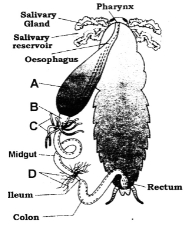
A
$A$-Gizzard,$B$-Crop,$C$-Hepatic caecae,$D$-Malpighian tubules
B
$A$-Crop,$B$-Gizzard,$C$-Hepatic caecae,$D$-Malpighian tubules
C
$A$-Crop,$B$-Gizzard,$C$-Malpighian tubules,$D$-Hepatic caecae
D
$A$-Gizzard,$B$-Crop,$C$-Malpighian tubules,$D$-Hepatic caecae
Solution
(B) - Crop; $B$ - Gizzard; $C$ - Hepatic caecae; $D$ - Malpighian tubules.
$1$. The crop is a large,sac-like structure used for storing food.
$2$. The crop is followed by the gizzard (proventriculus),which has thick circular muscles and an inner cuticle forming six highly chitinous plates called teeth,used for grinding food particles.
$3$. At the junction of the foregut and midgut,a ring of $6-8$ blind tubules is present,called hepatic or gastric caecae,which secrete digestive juices.
$4$. Malpighian tubules are yellow-colored,thin,filamentous structures located at the junction of the midgut and hindgut. They are the primary excretory organs that absorb nitrogenous wastes from the hemolymph and convert them into uric acid,which is then excreted through the hindgut.
$1$. The crop is a large,sac-like structure used for storing food.
$2$. The crop is followed by the gizzard (proventriculus),which has thick circular muscles and an inner cuticle forming six highly chitinous plates called teeth,used for grinding food particles.
$3$. At the junction of the foregut and midgut,a ring of $6-8$ blind tubules is present,called hepatic or gastric caecae,which secrete digestive juices.
$4$. Malpighian tubules are yellow-colored,thin,filamentous structures located at the junction of the midgut and hindgut. They are the primary excretory organs that absorb nitrogenous wastes from the hemolymph and convert them into uric acid,which is then excreted through the hindgut.
0 likes
View Solution156
MediumMCQ
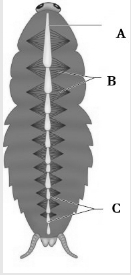
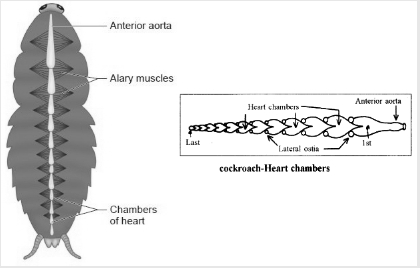
The given figure shows the open circulatory system of a cockroach. Identify the structure that facilitates the flow of haemolymph by its contraction and relaxation.
A
$A$
B
$B$
C
$C$
D
All of these
Solution
(B) Alary muscles (the structure marked as $B$) are located in pairs in the chambers of the cockroach heart.
They consist of $13$ pairs of wing-shaped involuntary muscles which expand and contract to facilitate the flow of haemolymph through the heart.
They consist of $13$ pairs of wing-shaped involuntary muscles which expand and contract to facilitate the flow of haemolymph through the heart.
0 likes
View Solution157
MediumMCQ
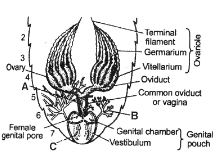
The figure given below shows the reproductive system of a female cockroach. The correct labellings indicated by alphabets $(A, B, C)$ are respectively:
A
$A$-Spermatheca,$B$-Collaterial glands,$C$-Gonapophyses
B
$A$-Phallic gland,$B$-Collaterial glands,$C$-Gonapophyses
C
$A$-Spermatheca,$B$-Seminal vesicle,$C$-Gonapophyses
D
$A$-Spermatheca,$B$-Collateral glands,$C$-Tegmina
Solution
(A) Based on the anatomy of the female reproductive system of a cockroach:
$A$ represents the Spermatheca,which is a pair of sac-like structures used for storing sperm.
$B$ represents the Collaterial glands,which are branched glands that secrete the material for the egg case (ootheca).
$C$ represents the Gonapophyses,which are chitinous structures that help in copulation and egg-laying.
Therefore,the correct sequence is $A$-Spermatheca,$B$-Collaterial glands,$C$-Gonapophyses.
$A$ represents the Spermatheca,which is a pair of sac-like structures used for storing sperm.
$B$ represents the Collaterial glands,which are branched glands that secrete the material for the egg case (ootheca).
$C$ represents the Gonapophyses,which are chitinous structures that help in copulation and egg-laying.
Therefore,the correct sequence is $A$-Spermatheca,$B$-Collaterial glands,$C$-Gonapophyses.
0 likes
View Solution158
MediumMCQ
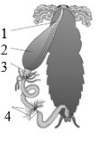
The figure given below shows the alimentary canal of a cockroach with a few structures labelled as $1, 2, 3$ and $4$. Identify the structure which is also called proventriculus and helps in grinding the food particles.
A
$1$
B
$2$
C
$3$
D
$4$
Solution
(C) In the given figure,the labels $1, 2, 3$ and $4$ represent the following structures:
$1$: Oesophagus
$2$: Crop
$3$: Gizzard (Proventriculus)
$4$: Malpighian tubules
The gizzard (proventriculus) is a short,muscular organ located after the crop. It contains thick chitinous plates that help in grinding the food particles. Therefore,the correct structure is $3$.
$1$: Oesophagus
$2$: Crop
$3$: Gizzard (Proventriculus)
$4$: Malpighian tubules
The gizzard (proventriculus) is a short,muscular organ located after the crop. It contains thick chitinous plates that help in grinding the food particles. Therefore,the correct structure is $3$.
0 likes
View Solution159
MediumMCQ
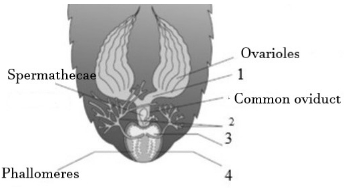
Refer to the given figure of the female reproductive system of a cockroach and identify the correct labels (marked as $1, 2, 3$ and $4$) which are collectively called the genital pouch.
A
$1$ and $2$
B
$1$ and $3$
C
$2$ and $4$
D
$3$ and $4$
Solution
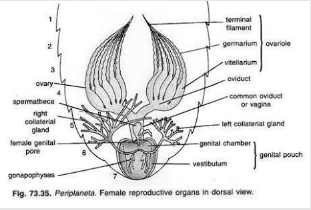
(D) In the female reproductive system of a cockroach,the female genital pouch consists of two parts: the genital chamber and the vestibulum.
Based on the provided diagram,label $3$ represents the genital chamber and label $4$ represents the vestibulum.
Together,these two structures form the genital pouch.
Based on the provided diagram,label $3$ represents the genital chamber and label $4$ represents the vestibulum.
Together,these two structures form the genital pouch.
0 likes
View Solution160
EasyMCQ
About how many times does the nymph of the Periplaneta americana undergo moulting before becoming an adult?
A
$4$
B
$2$
C
$17$
D
$13$
Solution
(D) In cockroaches,the development is paurometabolous,which means development occurs through nymphal stages.
The nymph grows by moulting approximately $13$ times to reach the adult form.
The nymph grows by moulting approximately $13$ times to reach the adult form.
0 likes
View Solution161
MediumMCQ
In cockroach,the testes are present in
A
$3, 4, 5$ abdominal segments
B
$4, 5, 6$ abdominal segments
C
$5, 6, 7$ abdominal segments
D
$6, 7, 8$ abdominal segments
Solution
(B) In the male reproductive system of a cockroach,the testes are paired structures. Each testis is $3-4$ lobed and is located dorsolaterally in the $4^{th}, 5^{th},$ and $6^{th}$ abdominal segments.
0 likes
View Solution162
MediumMCQ
Phallic organs in cockroach are related to
A
male excretory system.
B
male reproductive system.
C
female excretory system.
D
female reproductive system.
Solution
(B) The phallic organs (also known as the conglobate gland) are part of the male reproductive system of the cockroach.
These organs are located below the utricular gland in the $6$th abdominal segment.
They communicate with the exterior through a pore situated close to the gonophore and assist in the formation of the spermatophore.
These organs are located below the utricular gland in the $6$th abdominal segment.
They communicate with the exterior through a pore situated close to the gonophore and assist in the formation of the spermatophore.
0 likes
View Solution163
EasyMCQ
Gizzard (proventriculus) in cockroach lies between
A
oesophagus and stomach
B
crop and mesenteron
C
mesenteron and ileum
D
oesophagus and crop
Solution
(B) In the digestive system of a cockroach,the gizzard (proventriculus) is situated between the crop and the mesenteron (midgut).
It consists of an outer layer of thick circular muscles and a thick inner cuticle that forms six highly chitinous plates called teeth.
These teeth help in grinding the food particles before they enter the midgut for digestion.
It consists of an outer layer of thick circular muscles and a thick inner cuticle that forms six highly chitinous plates called teeth.
These teeth help in grinding the food particles before they enter the midgut for digestion.
0 likes
View Solution164
MediumMCQ
Match column-$I$ with column-$II$ and choose the correct option.
| Column $I$ | Column $II$ |
| $A$. Periplaneta americana | $I$. Hepatic caecae |
| $B$. $A$ ring of $6-8$ blind tubules | $II$. Phylum Arthropoda |
| $C$. Vascular system | $III$. Spiracles |
| $D$. $10$ pairs of small holes | $IV$. Malpighian tubules |
| $E$. Excretion | $V$. Open type |
A
$A-I, B-II, C-III, D-IV, E-V$
B
$A-II, B-I, C-V, D-III, E-IV$
C
$A-II, B-I, C-III, D-V, E-V$
D
$A-III, B-IV, C-II, D-V, E-I$
Solution
(B) The correct matching is as follows:
$A$. Periplaneta americana belongs to the Phylum Arthropoda $(A-II)$.
$B$. $A$ ring of $6-8$ blind tubules refers to the hepatic caecae present at the junction of the foregut and midgut $(B-I)$.
$C$. The vascular system in cockroaches is of the open type $(C-V)$.
$D$. $10$ pairs of small holes on the lateral sides of the body are called spiracles, which are used for respiration $(D-III)$.
$E$. Excretion in cockroaches is performed by Malpighian tubules $(E-IV)$.
Thus, the correct sequence is $A-II, B-I, C-V, D-III, E-IV$.
$A$. Periplaneta americana belongs to the Phylum Arthropoda $(A-II)$.
$B$. $A$ ring of $6-8$ blind tubules refers to the hepatic caecae present at the junction of the foregut and midgut $(B-I)$.
$C$. The vascular system in cockroaches is of the open type $(C-V)$.
$D$. $10$ pairs of small holes on the lateral sides of the body are called spiracles, which are used for respiration $(D-III)$.
$E$. Excretion in cockroaches is performed by Malpighian tubules $(E-IV)$.
Thus, the correct sequence is $A-II, B-I, C-V, D-III, E-IV$.
0 likes
View Solution165
MediumMCQ
Consider the following statements regarding cockroach and mark the correct option.
$(i)$ Head is formed by the fusion of $6$ segments.
$(ii)$ Mouth parts are biting and chewing type.
$(iii)$ Crop is the part of midgut.
$(i)$ Head is formed by the fusion of $6$ segments.
$(ii)$ Mouth parts are biting and chewing type.
$(iii)$ Crop is the part of midgut.
A
Only $(ii)$ is correct
B
$(ii)$ and $(iii)$ are correct
C
$(i)$ and $(ii)$ are correct
D
Only $(iii)$ is correct
Solution
(C) Statement $(i)$ is correct: The head of a cockroach is formed by the fusion of $6$ embryonic segments.
Statement $(ii)$ is correct: Cockroaches possess mouthparts of the biting and chewing type.
Statement $(iii)$ is incorrect: The crop is a sac-like structure located in the foregut,which is used for the storage of food. The midgut is primarily involved in digestion and absorption.
Statement $(ii)$ is correct: Cockroaches possess mouthparts of the biting and chewing type.
Statement $(iii)$ is incorrect: The crop is a sac-like structure located in the foregut,which is used for the storage of food. The midgut is primarily involved in digestion and absorption.
0 likes
View Solution166
MediumMCQ
Which of the following statement$(s)$ is/are correct about the nervous system of a cockroach?
$(i)$ It consists of a series of fused segmentally arranged ganglia joined by paired longitudinal connectives on the ventral side.
$(ii)$ There are six ganglia lie in the thorax,and three in the abdomen.
$(iii)$ The sense organs are antennae,eyes,maxillary palps,labial palps,and anal cerci,etc.
$(iv)$ Each eye consists of about $5000$ hexagonal ommatidia.
$(i)$ It consists of a series of fused segmentally arranged ganglia joined by paired longitudinal connectives on the ventral side.
$(ii)$ There are six ganglia lie in the thorax,and three in the abdomen.
$(iii)$ The sense organs are antennae,eyes,maxillary palps,labial palps,and anal cerci,etc.
$(iv)$ Each eye consists of about $5000$ hexagonal ommatidia.
A
Both $(i)$ and $(iii)$
B
Only $(ii)$
C
Both $(i)$ and $(iv)$
D
All of these
Solution
(A) Statement $(i)$ is correct: The nervous system of the cockroach consists of a series of fused,segmentally arranged ganglia joined by paired longitudinal connectives on the ventral side.
Statement $(ii)$ is incorrect: There are three ganglia in the thorax and six in the abdomen.
Statement $(iii)$ is correct: The sense organs include antennae,eyes,maxillary palps,labial palps,and anal cerci.
Statement $(iv)$ is incorrect: Each eye consists of about $2000$ hexagonal ommatidia,not $5000$.
Statement $(ii)$ is incorrect: There are three ganglia in the thorax and six in the abdomen.
Statement $(iii)$ is correct: The sense organs include antennae,eyes,maxillary palps,labial palps,and anal cerci.
Statement $(iv)$ is incorrect: Each eye consists of about $2000$ hexagonal ommatidia,not $5000$.
0 likes
View Solution167
MediumMCQ
Which of the following statement$(s)$ is/are correct regarding the respiratory system of a cockroach?
$(i)$ It consists of a network of trachea that open through $12$ pairs of small holes called spiracles present on the lateral side of the body.
$(ii)$ Thin branching tubes carry oxygen from the air to all the parts.
$(iii)$ The opening of the spiracles is regulated by sphincters.
$(iv)$ Exchange of gases takes place at the tracheoles by diffusion.
$(i)$ It consists of a network of trachea that open through $12$ pairs of small holes called spiracles present on the lateral side of the body.
$(ii)$ Thin branching tubes carry oxygen from the air to all the parts.
$(iii)$ The opening of the spiracles is regulated by sphincters.
$(iv)$ Exchange of gases takes place at the tracheoles by diffusion.
A
Only $(i)$
B
$(i)$,$(ii)$ and $(iii)$
C
$(ii)$,$(iii)$ and $(iv)$
D
All of these
Solution
(C) The respiratory system of a cockroach consists of a network of trachea that open through $10$ pairs of small holes called spiracles present on the lateral side of the body. Thus,statement $(i)$ is incorrect because it mentions $12$ pairs instead of $10$ pairs.
Statement $(ii)$ is correct as thin branching tubes (tracheoles) carry oxygen from the air to all parts of the body.
Statement $(iii)$ is correct as the opening of the spiracles is regulated by sphincters.
Statement $(iv)$ is correct as the exchange of gases takes place at the tracheoles by diffusion.
Statement $(ii)$ is correct as thin branching tubes (tracheoles) carry oxygen from the air to all parts of the body.
Statement $(iii)$ is correct as the opening of the spiracles is regulated by sphincters.
Statement $(iv)$ is correct as the exchange of gases takes place at the tracheoles by diffusion.
0 likes
View Solution168
MediumMCQ
Which of the following statement$(s)$ is/are correct regarding the digestive system of cockroach?
$(i)$ Mouth opens into a short tubular pharynx,leading to a narrow tubular passage called oesophagus.
$(ii)$ Gizzard helps in grinding the food particles.
$(iii)$ $A$ ring of $6-8$ blind tubules called hepatic or gastric caecae is present at the junction of foregut and midgut,which secrete digestive juice.
$(iv)$ At the junction of midgut and hindgut is present another ring of $100-150$ yellow coloured thin filamentous Malpighian tubules which help in removal of excretory products from haemolymph.
$(i)$ Mouth opens into a short tubular pharynx,leading to a narrow tubular passage called oesophagus.
$(ii)$ Gizzard helps in grinding the food particles.
$(iii)$ $A$ ring of $6-8$ blind tubules called hepatic or gastric caecae is present at the junction of foregut and midgut,which secrete digestive juice.
$(iv)$ At the junction of midgut and hindgut is present another ring of $100-150$ yellow coloured thin filamentous Malpighian tubules which help in removal of excretory products from haemolymph.
A
Only $(i)$
B
Both $(ii)$ and $(iii)$
C
Both $(i)$ and $(iv)$
D
All of these
Solution
(D) The digestive system of a cockroach is divided into three parts: foregut,midgut,and hindgut.
Statement $(i)$ is correct: The mouth opens into a short tubular pharynx,which leads to a narrow tubular passage called the oesophagus.
Statement $(ii)$ is correct: The gizzard (proventriculus) has thick chitinous plates that help in grinding the food particles.
Statement $(iii)$ is correct: At the junction of the foregut and midgut,a ring of $6-8$ blind tubules called hepatic or gastric caecae is present,which secretes digestive juices.
Statement $(iv)$ is correct: At the junction of the midgut and hindgut,a ring of $100-150$ yellow-coloured,thin,filamentous Malpighian tubules is present,which helps in the removal of excretory products from the haemolymph.
Since all statements are correct,the correct option is $(D)$.
Statement $(i)$ is correct: The mouth opens into a short tubular pharynx,which leads to a narrow tubular passage called the oesophagus.
Statement $(ii)$ is correct: The gizzard (proventriculus) has thick chitinous plates that help in grinding the food particles.
Statement $(iii)$ is correct: At the junction of the foregut and midgut,a ring of $6-8$ blind tubules called hepatic or gastric caecae is present,which secretes digestive juices.
Statement $(iv)$ is correct: At the junction of the midgut and hindgut,a ring of $100-150$ yellow-coloured,thin,filamentous Malpighian tubules is present,which helps in the removal of excretory products from the haemolymph.
Since all statements are correct,the correct option is $(D)$.
0 likes
View Solution169
MediumMCQ
Which of the following statement$(s)$ is/are correct regarding the excretory system of a cockroach?
$(i)$ Excretion is performed by Malpighian tubules.
$(ii)$ They absorb nitrogenous waste products and convert them into uric acid,which is excreted out through the hindgut.
$(iii)$ In addition,fat body,nephrocytes,and urecose glands also help in excretion.
$(i)$ Excretion is performed by Malpighian tubules.
$(ii)$ They absorb nitrogenous waste products and convert them into uric acid,which is excreted out through the hindgut.
$(iii)$ In addition,fat body,nephrocytes,and urecose glands also help in excretion.
A
Only $(i)$
B
Both $(ii)$ and $(iii)$
C
Both $(i)$ and $(iii)$
D
All of these
Solution
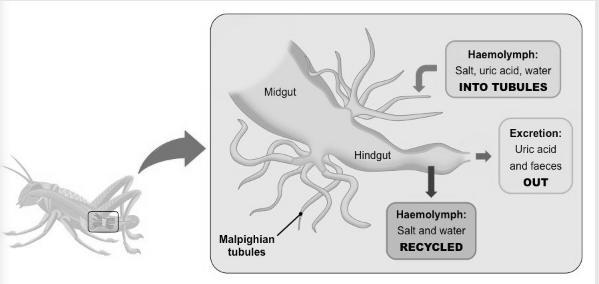
(D) The excretory system of a cockroach consists of Malpighian tubules,which are the primary excretory organs. Statement $(i)$ is correct.
Malpighian tubules absorb nitrogenous waste products from the haemolymph and convert them into uric acid. This uric acid is then excreted out through the hindgut. Statement $(ii)$ is correct.
Besides Malpighian tubules,other structures like the fat body,nephrocytes,and urecose glands also assist in the process of excretion in cockroaches. Statement $(iii)$ is correct.
Since all three statements are correct,the correct option is $(D)$.
Malpighian tubules absorb nitrogenous waste products from the haemolymph and convert them into uric acid. This uric acid is then excreted out through the hindgut. Statement $(ii)$ is correct.
Besides Malpighian tubules,other structures like the fat body,nephrocytes,and urecose glands also assist in the process of excretion in cockroaches. Statement $(iii)$ is correct.
Since all three statements are correct,the correct option is $(D)$.
0 likes
View Solution170
MediumMCQ
Which of the following does not participate in excretion in cockroach?
A
Fat body
B
Phallic gland
C
Urecose gland
D
Malpighian tubules
Solution
(B) The correct answer is $B$.
$1$. The $Phallic$ $gland$ is a component of the male reproductive system in cockroaches,not the excretory system.
$2$. Its duct opens into the left phallomere,and its secretion contributes to the formation of the outermost layer of the spermatophore.
$3$. In contrast,the $Fat$ $body$,$Urecose$ $gland$,and $Malpighian$ $tubules$ are all involved in the storage or excretion of nitrogenous wastes in the cockroach.
$1$. The $Phallic$ $gland$ is a component of the male reproductive system in cockroaches,not the excretory system.
$2$. Its duct opens into the left phallomere,and its secretion contributes to the formation of the outermost layer of the spermatophore.
$3$. In contrast,the $Fat$ $body$,$Urecose$ $gland$,and $Malpighian$ $tubules$ are all involved in the storage or excretion of nitrogenous wastes in the cockroach.
0 likes
View Solution171
MediumMCQ
$A$: In cockroach,inspiration is a passive process.
$R$: Expansion of abdominal cavity allows the space for expansion of the tracheal trunk,as a result,air enters through the spiracle.
$R$: Expansion of abdominal cavity allows the space for expansion of the tracheal trunk,as a result,air enters through the spiracle.
A
Assertion and Reason both are correct and Reason is the correct explanation of Assertion.
B
Assertion and Reason both are correct but Reason is not the correct explanation of Assertion.
C
Assertion is correct,but Reason is incorrect.
D
Both Assertion and Reason are incorrect.
Solution
(A) In cockroach,respiration occurs through a system of air tubes called tracheae.
Inspiration (intake of air) in cockroaches is primarily a passive process.
When the abdominal muscles relax,the abdominal cavity expands.
This expansion creates space for the tracheal trunks to expand,which reduces the internal pressure within the tracheal system.
Due to this pressure gradient,atmospheric air rushes into the tracheae through the spiracles.
Therefore,both the Assertion and the Reason are correct,and the Reason provides the correct explanation for the Assertion.
Inspiration (intake of air) in cockroaches is primarily a passive process.
When the abdominal muscles relax,the abdominal cavity expands.
This expansion creates space for the tracheal trunks to expand,which reduces the internal pressure within the tracheal system.
Due to this pressure gradient,atmospheric air rushes into the tracheae through the spiracles.
Therefore,both the Assertion and the Reason are correct,and the Reason provides the correct explanation for the Assertion.
0 likes
View Solution172
MediumMCQ
Haemolymph is the term used for the blood of the organism having
A
Water circulatory system
B
Closed circulatory system
C
Open circulatory system
D
Blood circulatory system
Solution
(C) In an open circulatory system,instead of capillaries,blood vessels open directly into spaces called sinuses.
The fluid present in these organisms is a mixture of blood and interstitial fluid,which is known as haemolymph.
This fluid is pumped from the blood vessels into large sinuses,where it directly bathes the internal organs.
The fluid present in these organisms is a mixture of blood and interstitial fluid,which is known as haemolymph.
This fluid is pumped from the blood vessels into large sinuses,where it directly bathes the internal organs.
0 likes
View Solution173
MediumMCQ
Match the following columns regarding the anatomy of a cockroach:
| Column-$I$ | Column-$II$ |
|---|---|
| $P$. Seventh sternum | $I$. Boat-shaped |
| $Q$. Eighth and ninth sterna | $II$. Anal styles |
| $R$. $10$th segment | $III$. Genital pouch |
A
$P-III, Q-II, R-I$
B
$P-I, Q-II, R-III$
C
$P-I, Q-III, R-II$
D
$P-II, Q-III, R-I$
Solution
(C) In female cockroaches,the $7$th sternum is boat-shaped and together with the $8$th and $9$th sterna forms a brood or genital pouch $(P-I, Q-III)$.
In both sexes,the $10$th segment bears a pair of jointed filamentous structures called anal styles ($R-II$ is incorrect in the provided options,but based on standard anatomy,the $10$th segment bears anal cerci,while anal styles are present only in males on the $9$th sternum. Re-evaluating the provided options: $P-I$ (7th sternum is boat-shaped),$Q-III$ (8th and 9th sterna form the genital pouch),and $R-II$ (10th segment is associated with anal structures). Thus,the correct match is $P-I, Q-III, R-II$).
In both sexes,the $10$th segment bears a pair of jointed filamentous structures called anal styles ($R-II$ is incorrect in the provided options,but based on standard anatomy,the $10$th segment bears anal cerci,while anal styles are present only in males on the $9$th sternum. Re-evaluating the provided options: $P-I$ (7th sternum is boat-shaped),$Q-III$ (8th and 9th sterna form the genital pouch),and $R-II$ (10th segment is associated with anal structures). Thus,the correct match is $P-I, Q-III, R-II$).
0 likes
View Solution174
MediumMCQ
Identify the location of hepatic or gastric caeca in a cockroach.
A
At the junction of midgut and hindgut
B
At the junction of foregut and midgut
C
At the junction of crop and midgut
D
At the junction of foregut and hindgut
Solution
(B) In a cockroach,the alimentary canal is divided into three regions: foregut,midgut,and hindgut.
At the junction of the foregut and midgut,a ring of $6-8$ blind tubules called hepatic or gastric caeca is present.
These caeca secrete digestive juices that aid in the process of digestion.
Therefore,the correct location is the junction of the foregut and midgut.
At the junction of the foregut and midgut,a ring of $6-8$ blind tubules called hepatic or gastric caeca is present.
These caeca secrete digestive juices that aid in the process of digestion.
Therefore,the correct location is the junction of the foregut and midgut.
0 likes
View Solution175
MediumMCQ
In cockroaches,at the junction of $............$ and $............$,about $............$ yellow-colored,thin,thread-like Malpighian tubules are present.
A
midgut and hindgut,$50 - 100$
B
midgut and hindgut,$100 - 150$
C
foregut and midgut,$50 - 100$
D
foregut and midgut,$100 - 150$
Solution
(B) In cockroaches,the alimentary canal is divided into three regions: foregut,midgut,and hindgut.
At the junction of the midgut and hindgut,there are about $100 - 150$ yellow-colored,thin,thread-like structures called Malpighian tubules.
These tubules help in the removal of excretory products from the haemolymph.
At the junction of the midgut and hindgut,there are about $100 - 150$ yellow-colored,thin,thread-like structures called Malpighian tubules.
These tubules help in the removal of excretory products from the haemolymph.
0 likes
View Solution176
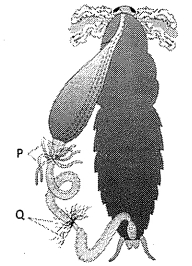
MediumMCQ
The figure below shows the digestive system of a cockroach. What are $P$ and $Q$?
A
Gizzard,Hepatic caecae
B
Malpighian tubules,Hepatic caecae
C
Hepatic caecae,Malpighian tubules
D
Gizzard,Malpighian tubules
Solution
(C) In the digestive system of a cockroach:
$P$ represents the hepatic caecae,which are a ring of $6-8$ blind tubules present at the junction of the foregut and midgut.
$Q$ represents the Malpighian tubules,which are a ring of $100-150$ yellow-colored,thin,filamentous structures present at the junction of the midgut and hindgut,responsible for excretion.
$P$ represents the hepatic caecae,which are a ring of $6-8$ blind tubules present at the junction of the foregut and midgut.
$Q$ represents the Malpighian tubules,which are a ring of $100-150$ yellow-colored,thin,filamentous structures present at the junction of the midgut and hindgut,responsible for excretion.
0 likes
View Solution177
MediumMCQ
Identify the correct sequence of organs in the digestive system of a cockroach.
A
Mouth $\rightarrow$ Pharynx $\rightarrow$ Oesophagus $\rightarrow$ Crop $\rightarrow$ Midgut $\rightarrow$ Gizzard $\rightarrow$ Ileum $\rightarrow$ Colon $\rightarrow$ Rectum $\rightarrow$ Anus
B
Mouth $\rightarrow$ Pharynx $\rightarrow$ Oesophagus $\rightarrow$ Crop $\rightarrow$ Gizzard $\rightarrow$ Midgut $\rightarrow$ Colon $\rightarrow$ Ileum $\rightarrow$ Rectum $\rightarrow$ Anus
C
Mouth $\rightarrow$ Pharynx $\rightarrow$ Oesophagus $\rightarrow$ Crop $\rightarrow$ Gizzard $\rightarrow$ Ileum $\rightarrow$ Colon $\rightarrow$ Midgut $\rightarrow$ Rectum $\rightarrow$ Anus
D
Mouth $\rightarrow$ Pharynx $\rightarrow$ Oesophagus $\rightarrow$ Crop $\rightarrow$ Gizzard $\rightarrow$ Midgut $\rightarrow$ Ileum $\rightarrow$ Colon $\rightarrow$ Rectum $\rightarrow$ Anus
Solution
(D) The digestive system of a cockroach consists of the alimentary canal divided into three regions: foregut,midgut,and hindgut.
$1$. The foregut includes the Mouth,Pharynx,Oesophagus,Crop (for food storage),and Gizzard (for grinding food).
$2$. The midgut is the site of digestion and absorption.
$3$. The hindgut consists of the Ileum,Colon,and Rectum,which opens to the exterior through the Anus.
Therefore,the correct sequence is: Mouth $\rightarrow$ Pharynx $\rightarrow$ Oesophagus $\rightarrow$ Crop $\rightarrow$ Gizzard $\rightarrow$ Midgut $\rightarrow$ Ileum $\rightarrow$ Colon $\rightarrow$ Rectum $\rightarrow$ Anus.
$1$. The foregut includes the Mouth,Pharynx,Oesophagus,Crop (for food storage),and Gizzard (for grinding food).
$2$. The midgut is the site of digestion and absorption.
$3$. The hindgut consists of the Ileum,Colon,and Rectum,which opens to the exterior through the Anus.
Therefore,the correct sequence is: Mouth $\rightarrow$ Pharynx $\rightarrow$ Oesophagus $\rightarrow$ Crop $\rightarrow$ Gizzard $\rightarrow$ Midgut $\rightarrow$ Ileum $\rightarrow$ Colon $\rightarrow$ Rectum $\rightarrow$ Anus.
0 likes
View Solution178
MediumMCQ
Select the incorrect statement regarding the heart of a cockroach.
A
It is a long muscular tube.
B
It is situated along the mid-dorsal line of the thorax and abdomen.
C
It is differentiated into funnel-shaped chambers.
D
Ostia are present on both sides of the heart chambers.
Solution
(B) The heart of a cockroach consists of an elongated muscular tube lying along the mid-dorsal line of the thorax and abdomen.
It is differentiated into $13$ funnel-shaped chambers with ostia on either side.
Blood from sinuses enters the heart through these ostia and is pumped anteriorly to the sinuses again.
Option $B$ is incorrect because the heart is located along the mid-dorsal line,not the mid-ventral line.
It is differentiated into $13$ funnel-shaped chambers with ostia on either side.
Blood from sinuses enters the heart through these ostia and is pumped anteriorly to the sinuses again.
Option $B$ is incorrect because the heart is located along the mid-dorsal line,not the mid-ventral line.
0 likes
View Solution179
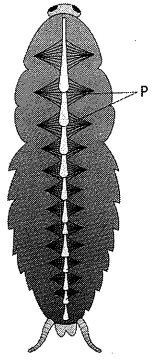
MediumMCQ
In the given diagram of the circulatory system of a cockroach,what does $P$ represent?
A
Blood vessels
B
Cardiac muscles
C
Alary muscles
D
Capillaries
Solution
(C) The diagram shows the circulatory system of a cockroach. The structure labeled $P$ represents the alary muscles. In cockroaches,the heart consists of an elongated tube with funnel-shaped chambers. These chambers are supported by triangular,fan-shaped muscles known as alary muscles,which help in the circulation of hemolymph by contracting and relaxing.
0 likes
View Solution180
EasyMCQ
How many spiracles are present in a cockroach?
A
$10$
B
$20$
C
$30$
D
$40$
Solution
(B) In a cockroach,the respiratory system consists of a network of trachea that open through $10$ pairs of small holes called spiracles present on the lateral side of the body.
These $10$ pairs are distributed as follows: $2$ pairs in the thoracic region and $8$ pairs in the abdominal region.
Therefore,the total number of spiracles is $10$ pairs,which equals $20$ individual spiracles.
These $10$ pairs are distributed as follows: $2$ pairs in the thoracic region and $8$ pairs in the abdominal region.
Therefore,the total number of spiracles is $10$ pairs,which equals $20$ individual spiracles.
0 likes
View Solution181
MediumMCQ
How many of the following structures are associated with excretion in a cockroach? Kidney,Malpighian tubules,Fat bodies,Uricose glands,Nephrocytes,Antennae glands.
A
$1$
B
$2$
C
$3$
D
$4$
Solution
(D) In a cockroach $(Periplaneta \ americana)$,the structures associated with excretion are:
$1$. Malpighian tubules: The primary excretory organs.
$2$. Fat bodies: Store uric acid and perform metabolic functions.
$3$. Nephrocytes: Specialized cells involved in excretion.
$4$. Uricose glands: Present in males,they store uric acid.
Kidneys are absent in cockroaches (they are vertebrate structures). Antennae glands (green glands) are found in crustaceans like prawns,not in cockroaches.
Therefore,there are $4$ structures associated with excretion: Malpighian tubules,Fat bodies,Nephrocytes,and Uricose glands.
$1$. Malpighian tubules: The primary excretory organs.
$2$. Fat bodies: Store uric acid and perform metabolic functions.
$3$. Nephrocytes: Specialized cells involved in excretion.
$4$. Uricose glands: Present in males,they store uric acid.
Kidneys are absent in cockroaches (they are vertebrate structures). Antennae glands (green glands) are found in crustaceans like prawns,not in cockroaches.
Therefore,there are $4$ structures associated with excretion: Malpighian tubules,Fat bodies,Nephrocytes,and Uricose glands.
0 likes
View Solution182
MediumMCQ
Select the incorrect option regarding the nervous system of a cockroach.
A
The ganglia are joined by paired longitudinal connectives on the ventral side.
B
Three ganglia are located in the abdomen and six ganglia are located in the thorax.
C
The head holds a small portion of the nervous system,while the rest is situated along the ventral part of the body.
D
All options are correct.
Solution
(D) In the cockroach,the nervous system consists of a series of fused,segmentally arranged ganglia joined by paired longitudinal connectives on the ventral side.
Three ganglia lie in the thorax,and six ganglia lie in the abdomen.
The nervous system of the cockroach is spread throughout the body.
The head holds a bit of a nervous system while the rest is situated along the ventral (belly-side) part of its body.
Option $B$ is incorrect because the distribution is reversed: there are $3$ thoracic ganglia and $6$ abdominal ganglia,but the statement in the option is factually incorrect regarding the specific arrangement or count if interpreted as a general description of the system's structure. Actually,the nervous system is segmentally arranged,and the statement in $B$ is the standard anatomical fact,making $D$ the correct choice if all are true. However,based on standard $NCERT$,the nervous system is $3$ ganglia in the thorax and $6$ in the abdomen. Thus,all statements provided are technically correct descriptions of the cockroach nervous system.
Three ganglia lie in the thorax,and six ganglia lie in the abdomen.
The nervous system of the cockroach is spread throughout the body.
The head holds a bit of a nervous system while the rest is situated along the ventral (belly-side) part of its body.
Option $B$ is incorrect because the distribution is reversed: there are $3$ thoracic ganglia and $6$ abdominal ganglia,but the statement in the option is factually incorrect regarding the specific arrangement or count if interpreted as a general description of the system's structure. Actually,the nervous system is segmentally arranged,and the statement in $B$ is the standard anatomical fact,making $D$ the correct choice if all are true. However,based on standard $NCERT$,the nervous system is $3$ ganglia in the thorax and $6$ in the abdomen. Thus,all statements provided are technically correct descriptions of the cockroach nervous system.
0 likes
View Solution183
MediumMCQ
Match the following columns regarding the reproductive system of a cockroach:
| Column-$I$ | Column-$II$ |
| $P$. Testes | $I$. $2$nd to $6$th segments |
| $Q$. Mushroom gland | $II$. $6$th to $7$th segments |
| $R$. Ovaries | $III$. $6$th segment |
| $S$. Seminal vesicles | $IV$. $4$th to $6$th segments |
A
$P-I, Q-III, R-IV, S-II$
B
$P-II, Q-IV, R-I, S-III$
C
$P-IV, Q-II, R-I, S-III$
D
$P-III, Q-I, R-IV, S-II$
Solution
(C) In the male reproductive system of a cockroach:
- Testes $(P)$ are located in the $4$th to $6$th abdominal segments $(IV)$.
- Mushroom gland $(Q)$ is located in the $6$th to $7$th abdominal segments $(II)$.
- In the female reproductive system of a cockroach:
- Ovaries $(R)$ are located in the $2$nd to $6$th abdominal segments $(I)$.
- Seminal vesicles $(S)$ are located in the $6$th abdominal segment $(III)$.
Therefore,the correct matching is $P-IV, Q-II, R-I, S-III$.
- Testes $(P)$ are located in the $4$th to $6$th abdominal segments $(IV)$.
- Mushroom gland $(Q)$ is located in the $6$th to $7$th abdominal segments $(II)$.
- In the female reproductive system of a cockroach:
- Ovaries $(R)$ are located in the $2$nd to $6$th abdominal segments $(I)$.
- Seminal vesicles $(S)$ are located in the $6$th abdominal segment $(III)$.
Therefore,the correct matching is $P-IV, Q-II, R-I, S-III$.
0 likes
View Solution184
EasyMCQ
Each ovary in a cockroach is formed by a group of $8$ ovarian tubules or ovarioles,containing a chain of developing ova. Fill in the blank.
A
$2$
B
$4$
C
$6$
D
$8$
Solution
(D) In the female reproductive system of a cockroach,there are two large ovaries lying laterally in the $2^{nd}$ to $6^{th}$ abdominal segments.
Each ovary is composed of a group of $8$ ovarian tubules or ovarioles,which contain a chain of developing ova.
Therefore,the correct number is $8$.
Each ovary is composed of a group of $8$ ovarian tubules or ovarioles,which contain a chain of developing ova.
Therefore,the correct number is $8$.
0 likes
View Solution185
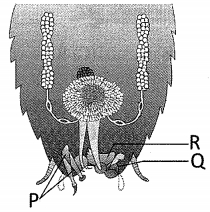
MediumMCQ
The figure given below shows the male reproductive system of a cockroach. Identify $P$,$Q$,and $R$.
A
Left phallomere,Ventral phallomere,Right phallomere
B
Ventral phallomere,Right phallomere,Left phallomere
C
Right phallomere,Ventral phallomere,Left phallomere
D
Left phallomere,Right phallomere,Ventral phallomere
Solution
(A) In the male reproductive system of a cockroach,the male gonapophyses or phallomeres are chitinous asymmetrical structures surrounding the male gonopore.
Based on the standard anatomical diagram of the cockroach male reproductive system:
$P$ represents the Left phallomere.
$Q$ represents the Ventral phallomere.
$R$ represents the Right phallomere.
Therefore,the correct sequence is Left phallomere,Ventral phallomere,and Right phallomere.
Based on the standard anatomical diagram of the cockroach male reproductive system:
$P$ represents the Left phallomere.
$Q$ represents the Ventral phallomere.
$R$ represents the Right phallomere.
Therefore,the correct sequence is Left phallomere,Ventral phallomere,and Right phallomere.
0 likes
View Solution186
MediumMCQ
Identify $P, Q$, and $R$ in the given diagram of the male reproductive system of a cockroach.
A
Testis, Fat body, Rectum
B
Fat body, Kidney, Rectum
C
Fat body, Kidney, Cloaca
D
Testis, Fat body, Ejaculatory duct
Solution
(D) In the male reproductive system of a cockroach $(Periplaneta \text{ } americana)$:
$P$ represents the Testis, which are paired structures located on the $4^{th}$ to $6^{th}$ abdominal segments.
$Q$ represents the Fat body, which is a storage tissue found in the abdominal cavity.
$R$ represents the Ejaculatory duct, which opens into the male gonopore situated ventral to the anus.
Therefore, the correct identification is $P = \text{Testis}, Q = \text{Fat body}, R = \text{Ejaculatory duct}$.
$P$ represents the Testis, which are paired structures located on the $4^{th}$ to $6^{th}$ abdominal segments.
$Q$ represents the Fat body, which is a storage tissue found in the abdominal cavity.
$R$ represents the Ejaculatory duct, which opens into the male gonopore situated ventral to the anus.
Therefore, the correct identification is $P = \text{Testis}, Q = \text{Fat body}, R = \text{Ejaculatory duct}$.
0 likes
View Solution187
DifficultMCQ
Match List-$I$ with List-$II$ regarding the organs of Cockroach:
Choose the correct answer from the options given below:
| List-$I$ | List-$II$ |
|---|---|
| $a$. Crop | $i$. Grinding the food particles |
| $b$. Proventriculus | $ii$. Secretion of digestive juice |
| $c$. Hepatic caecae | $iii$. Removal of nitrogenous waste |
| $d$. Malpighian tubules | $iv$. Storage of food |
Choose the correct answer from the options given below:
A
$(a) - (iv), (b) - (i), (c) - (ii), (d) - (iii)$
B
$(a) - (iii), (b) - (ii), (c) - (i), (d) - (iv)$
C
$(a) - (ii), (b) - (iv), (c) - (i), (d) - (iii)$
D
$(a) - (i), (b) - (iv), (c) - (iii), (d) - (ii)$
Solution
(A) The digestive system of a cockroach consists of the following structures:
$1$. $a$. Crop: It is a thin-walled sac used for the storage of food.
$2$. $b$. Proventriculus (or Gizzard): It has thick muscular walls and chitinous teeth,which help in grinding the food particles.
$3$. $c$. Hepatic caecae: These are $6-8$ blind tubules present at the junction of the foregut and midgut,which secrete digestive juices.
$4$. $d$. Malpighian tubules: These are $100-150$ yellow-colored thin filamentous structures present at the junction of the midgut and hindgut,which help in the removal of nitrogenous waste from the haemolymph.
Therefore,the correct matching is $(a) - (iv), (b) - (i), (c) - (ii), (d) - (iii)$.
$1$. $a$. Crop: It is a thin-walled sac used for the storage of food.
$2$. $b$. Proventriculus (or Gizzard): It has thick muscular walls and chitinous teeth,which help in grinding the food particles.
$3$. $c$. Hepatic caecae: These are $6-8$ blind tubules present at the junction of the foregut and midgut,which secrete digestive juices.
$4$. $d$. Malpighian tubules: These are $100-150$ yellow-colored thin filamentous structures present at the junction of the midgut and hindgut,which help in the removal of nitrogenous waste from the haemolymph.
Therefore,the correct matching is $(a) - (iv), (b) - (i), (c) - (ii), (d) - (iii)$.
0 likes
View Solution188
MediumMCQ
Excretion in cockroach is performed by all,$EXCEPT$ :
A
Urecose glands
B
Malpighian tubules
C
Fat body
D
Hepatic caeca
Solution
(D) In cockroaches,the primary excretory organs are the $Malpighian$ $tubules$.
Other structures involved in the excretion or storage of nitrogenous wastes include the $Fat$ $body$,$Urecose$ $glands$,and $Nephrocytes$.
$Hepatic$ $caeca$ (also known as $Hepatopancreatic$ $caeca$) are blind tubules present at the junction of the foregut and midgut,which are primarily involved in the secretion of digestive juices,not excretion.
Therefore,$Hepatic$ $caeca$ is the correct answer.
Other structures involved in the excretion or storage of nitrogenous wastes include the $Fat$ $body$,$Urecose$ $glands$,and $Nephrocytes$.
$Hepatic$ $caeca$ (also known as $Hepatopancreatic$ $caeca$) are blind tubules present at the junction of the foregut and midgut,which are primarily involved in the secretion of digestive juices,not excretion.
Therefore,$Hepatic$ $caeca$ is the correct answer.
0 likes
View Solution189
MediumMCQ
In cockroach, excretion is brought about by-
$A$. Phallic gland $B$. Urecose gland $C$. Nephrocytes $D$. Fat body $E$. Collaterial glands
Choose the correct answer from the options given below :
A
$B$ and $D$ only
B
$A$ and $E$ only
C
$A,B$ and $E$ only
D
$B,C$ and $D$ only
Solution
Option (4) is the answer because,
In cockroach, excretion is brought about by Malpighian tubules, fat body, nephrocytes and urecose glands.
Urecose glands are present in male cockroach of some species. They synthesise uric acid. Nephrocytes are large, colourless, ovoid, binucleate cells attached to the dorsal diaphragm in the body cavity. Fat body accumulates, produces and stores uric acid.
Phallic gland is the structure of male reproductive system of cockroach and it secretes the outer layer of spermatophore. Collaterial gland is the structure of female reproductive system of cockroach and it secretes the hard egg-case or ootheca around fertilised eggs.
0 likes
View Solution190
MediumMCQ
Match List-$I$ with List-$II$ related to the digestive system of a cockroach.
Choose the correct answer from the options given below:
| List-$I$ | List-$II$ |
| $A$. The structures used for storing of food | $I$. Gizzard |
| $B$. Ring of $6-8$ blind tubules at junction of foregut and midgut. | $II$. Gastric Caeca |
| $C$. Ring of $100-150$ yellow coloured thin filaments at junction of midgut and hindgut. | $III$. Malpighian tubules |
| $D$. The structures used for grinding the food. | $IV$. Crop |
Choose the correct answer from the options given below:
A
$A-I, B-II, C-III, D-IV$
B
$A-IV, B-III, C-II, D-I$
C
$A-III, B-II, C-IV, D-I$
D
$A-IV, B-II, C-III, D-I$
Solution
(D) The correct matching is as follows:
Therefore, the correct sequence is $A-IV, B-II, C-III, D-I$, which corresponds to option $(D)$.
| $A$. Structure used for storing food | $IV$. Crop |
| $B$. Ring of $6-8$ blind tubules at junction of foregut and midgut (secretion of digestive juices) | $II$. Gastric Caeca |
| $C$. Ring of $100-150$ yellow coloured thin filaments at junction of midgut and hindgut (excretion) | $III$. Malpighian tubules |
| $D$. Structure used for grinding food particles | $I$. Gizzard |
Therefore, the correct sequence is $A-IV, B-II, C-III, D-I$, which corresponds to option $(D)$.
0 likes
View Solution191
MediumMCQ
Statement-$I$ :- Heart of cockroach consists of an elongated muscular tube lying along the mid-dorsal line of the thorax and abdomen.
Statement-$II$ :- In cockroach,the opening of the spiracles is regulated by the sphincters.
Statement-$II$ :- In cockroach,the opening of the spiracles is regulated by the sphincters.
A
Both statements are correct
B
Both statements are incorrect
C
Statement-$I$ is correct and statement-$II$ is incorrect.
D
Statement-$I$ is incorrect and Statement-$II$ is correct.
Solution
(D) Statement-$I$ is incorrect because the heart of a cockroach is an elongated muscular tube lying along the mid-dorsal line of the thorax and abdomen,not the mid-ventral line.
Statement-$II$ is correct because the opening and closing of spiracles in cockroaches are regulated by sphincters,which help in controlling the exchange of gases and preventing water loss.
Statement-$II$ is correct because the opening and closing of spiracles in cockroaches are regulated by sphincters,which help in controlling the exchange of gases and preventing water loss.
0 likes
View Solution192
EasyMCQ
Which of the following structures does not help in excretion in the cockroach?
A
Malpighian tubules
B
Fat bodies
C
Nephrocytes
D
Phallic gland
Solution
(D) In cockroaches,the primary excretory organs are the Malpighian tubules.
Fat bodies,nephrocytes,and the urecose glands also assist in the storage and excretion of nitrogenous wastes.
The phallic gland (also known as the conglobate gland) is a part of the male reproductive system in cockroaches.
It is involved in the formation of the spermatophore and does not play any role in the excretory process.
Therefore,the correct option is $D$.
Fat bodies,nephrocytes,and the urecose glands also assist in the storage and excretion of nitrogenous wastes.
The phallic gland (also known as the conglobate gland) is a part of the male reproductive system in cockroaches.
It is involved in the formation of the spermatophore and does not play any role in the excretory process.
Therefore,the correct option is $D$.
0 likes
View Solution193
MediumMCQ
$6-8$ blind tubules are present at the junction of Foregut and Midgut are:
A
Malpighian tubule
B
Hepatic caecae
C
Alary muscles
D
Gizzard
Solution
(B) At the junction of the foregut and midgut in a cockroach, a ring of $6-8$ blind tubules is present, which is known as hepatic caecae or gastric caecae.
These structures secrete digestive juices that aid in the digestion of food.
Malpighian tubules are involved in excretion and are located at the junction of the midgut and hindgut.
Alary muscles are associated with the heart.
Gizzard is a part of the foregut used for grinding food.
These structures secrete digestive juices that aid in the digestion of food.
Malpighian tubules are involved in excretion and are located at the junction of the midgut and hindgut.
Alary muscles are associated with the heart.
Gizzard is a part of the foregut used for grinding food.
0 likes
View Solution194
EasyMCQ
In which segment of the body of the male cockroach is the mushroom-shaped gland found?
A
$2^{nd} - 6^{th}$ abdominal segments
B
$6^{th} - 7^{th}$ abdominal segments
C
$4^{th} - 6^{th}$ abdominal segments
D
$2^{nd} - 4^{th}$ abdominal segments
Solution
(B) The mushroom-shaped gland is an accessory reproductive gland found in the male cockroach.
It is located in the $6^{th} - 7^{th}$ abdominal segments.
This gland functions as an accessory reproductive organ and contributes to the formation of the spermatophore.
It is located in the $6^{th} - 7^{th}$ abdominal segments.
This gland functions as an accessory reproductive organ and contributes to the formation of the spermatophore.
0 likes
View Solution195
MediumMCQ
How many spiracles are present in a cockroach (in $pairs$)?
A
$2$
B
$8$
C
$10$
D
$13$
Solution
(C) In a cockroach, the respiratory system consists of a network of trachea that open to the exterior through small holes called spiracles.
There are a total of $10$ pairs of spiracles present in a cockroach.
These are distributed as follows: $2$ pairs are located in the thoracic region and $8$ pairs are located in the abdominal region.
There are a total of $10$ pairs of spiracles present in a cockroach.
These are distributed as follows: $2$ pairs are located in the thoracic region and $8$ pairs are located in the abdominal region.
0 likes
View Solution196
EasyMCQ
Which of the following is not a part of the male cockroach reproductive system?
A
Titillator
B
Utricular gland
C
Collateral glands
D
Pseudopenis
Solution
(C) The male reproductive system of a cockroach consists of a pair of testes,vasa deferentia,an ejaculatory duct,a seminal vesicle,and accessory glands (such as the utricular gland and phallic gland). The external genitalia are represented by male gonapophysis or phallomeres,which include structures like the titillator and pseudopenis. Collateral glands are accessory glands found in the female cockroach reproductive system,which secrete the egg case (ootheca). Therefore,collateral glands are not part of the male cockroach.
0 likes
View Solution197
MediumMCQ
In which of the following abdominal segments is the mushroom gland present in a cockroach?
A
$6^{\text{th}}-7^{\text{th}}$
B
$8^{\text{th}}-9^{\text{th}}$
C
$5^{\text{th}}-6^{\text{th}}$
D
$9^{\text{th}}-10^{\text{th}}$
Solution
(A) In male cockroaches,the reproductive system consists of a pair of testes,vasa deferentia,an ejaculatory duct,a seminal vesicle,and accessory glands.
The mushroom-shaped gland is a characteristic accessory reproductive gland found in the male cockroach.
This gland is located in the $6^{\text{th}}-7^{\text{th}}$ abdominal segments.
It functions to provide nourishment and form the inner layer of the spermatophore.
The mushroom-shaped gland is a characteristic accessory reproductive gland found in the male cockroach.
This gland is located in the $6^{\text{th}}-7^{\text{th}}$ abdominal segments.
It functions to provide nourishment and form the inner layer of the spermatophore.
0 likes
View Solution198
MediumMCQ
Match the column-$I$ with column-$II$ and select the correct option (in cockroach):-
| Column-$I$ | Column-$II$ |
| $A$. Mushroom gland | $P$. $6^{th}$ segment |
| $B$. Testis | $Q$. $2^{nd}-6^{th}$ segments |
| $C$. Spermatheca | $R$. $4^{th}-6^{th}$ segments |
| $D$. Ovaries | $S$. $6^{th}-7^{th}$ segments |
A
$(A)-S, (B)-R, (C)-P, (D)-Q$
B
$(A)-S, (B)-R, (C)-Q, (D)-P$
C
$(A)-R, (B)-S, (C)-P, (D)-Q$
D
$(A)-S, (B)-P, (C)-R, (D)-Q$
Solution
(A) In male cockroaches, the mushroom gland (accessory reproductive gland) is present in the $6^{th}-7^{th}$ abdominal segments $(A-S)$.
The testes are located in the $4^{th}-6^{th}$ abdominal segments $(B-R)$.
The spermatheca is present in the $6^{th}$ abdominal segment in females $(C-P)$.
The ovaries are located in the $2^{nd}-6^{th}$ abdominal segments $(D-Q)$.
Therefore, the correct matching is $(A)-S, (B)-R, (C)-P, (D)-Q$.
The testes are located in the $4^{th}-6^{th}$ abdominal segments $(B-R)$.
The spermatheca is present in the $6^{th}$ abdominal segment in females $(C-P)$.
The ovaries are located in the $2^{nd}-6^{th}$ abdominal segments $(D-Q)$.
Therefore, the correct matching is $(A)-S, (B)-R, (C)-P, (D)-Q$.
0 likes
View Solution199
DifficultMCQ
Read the following statements and choose the correct option:
$(A)$ The cockroach nervous system consists of a series of fused,segmentally arranged ganglia.
$(B)$ Ganglia are joined in the cockroach by paired longitudinal connectives on the ventral side.
$(C)$ The nervous system is present on the dorsal side of the cockroach.
$(D)$ In the cockroach,the total number of ganglia is nine.
$(A)$ The cockroach nervous system consists of a series of fused,segmentally arranged ganglia.
$(B)$ Ganglia are joined in the cockroach by paired longitudinal connectives on the ventral side.
$(C)$ The nervous system is present on the dorsal side of the cockroach.
$(D)$ In the cockroach,the total number of ganglia is nine.
A
All statements are correct
B
Only $A, B$ and $C$ are correct
C
Only $A, B$ and $D$ are correct
D
Only $B, C$ and $D$ are correct
Solution
(C) Statement $(A)$ is correct: The nervous system of the cockroach consists of a series of fused,segmentally arranged ganglia joined by paired longitudinal connectives on the ventral side.
Statement $(B)$ is correct: These ganglia are indeed connected by paired longitudinal connectives located ventrally.
Statement $(C)$ is incorrect: The nervous system in a cockroach is located on the ventral side,not the dorsal side.
Statement $(D)$ is correct: There are $3$ thoracic ganglia and $6$ abdominal ganglia,making a total of $9$ ganglia.
Therefore,statements $(A), (B),$ and $(D)$ are correct.
Statement $(B)$ is correct: These ganglia are indeed connected by paired longitudinal connectives located ventrally.
Statement $(C)$ is incorrect: The nervous system in a cockroach is located on the ventral side,not the dorsal side.
Statement $(D)$ is correct: There are $3$ thoracic ganglia and $6$ abdominal ganglia,making a total of $9$ ganglia.
Therefore,statements $(A), (B),$ and $(D)$ are correct.
0 likes
View SolutionStructural Organisation In Animals — Anatomy of Cockroach · Frequently Asked Questions
1Are these Structural Organisation In Animals questions useful for JEE and NEET?
Yes. All questions in this section are mapped to JEE Main and NEET exam patterns. Previous year questions from JEE Main, NEET, GUJCET and state-level exams are included with full solutions.
2Can I switch to Hindi or Gujarati for these questions?
Yes. Use the language tabs in the hero section or the sidebar to view the same questions and solutions in English, Hindi or Gujarati.
3How do I generate a question paper from this subtopic?
Use the Vedclass Exam Paper Generator — select the chapter and subtopic, set difficulty, and generate Sets A, B, C, D automatically. First 3 chapters of every subject are free.
Vedclass Products
For Students
Vedclass Test Series
Mock tests in real JEE/NEET style with performance analysis. 5-day free trial.
Start Free TrialFor Teachers
Exam Paper Generator
Generate Set A/B/C/D papers from this chapter in 2 minutes. 3 chapters free.
Try FreeFor Institutes
Online Exam Module
Live online exams with unlimited students, 360° analytics & white-label branding.
See DemoFor Teachers & Institutes
Generate a Structural Organisation In Animals Exam Paper in 2 Minutes
Select subtopic & difficulty — Sets A, B, C, D auto-generated with No Repeat logic.
First 3 chapters of every subject are free — no payment required.