
A English
Anatomy of Cockroach Questions in English
Class 11 Biology · Structural Organisation In Animals · Anatomy of Cockroach
199+
Questions
English
Language
100%
With Solutions
Showing 50 of 199 questions in English
51
MediumMCQ
What is the similarity between the trachea of a cockroach and a rabbit?
A
Both originate from the head region.
B
Both are filled with fluid.
C
Both have non-collapsible walls.
D
None of the above.
Solution
(C) In both cockroaches and rabbits,the trachea (or tracheal tubes) are supported by rings or structures that prevent them from collapsing. In cockroaches,the tracheal tubes are supported by chitinous rings (intima),while in rabbits,the trachea is supported by $C$-shaped cartilaginous rings. This structural adaptation ensures that the airways remain open for efficient gas exchange even under pressure changes. Therefore,both have non-collapsible walls.
0 likes
View Solution52
MediumMCQ
The salivary glands in a cockroach open into the ..........
A
Mandible
B
Hypopharynx
C
Maxilla
D
Labrum
Solution
(B) In a cockroach,the salivary glands are located in the thorax.
They produce saliva which is transported through salivary ducts.
These ducts unite to form a common salivary duct that opens at the base of the $Hypopharynx$.
The $Hypopharynx$ acts as a tongue-like structure lying within the cavity enclosed by the mouthparts.
They produce saliva which is transported through salivary ducts.
These ducts unite to form a common salivary duct that opens at the base of the $Hypopharynx$.
The $Hypopharynx$ acts as a tongue-like structure lying within the cavity enclosed by the mouthparts.
0 likes
View Solution53
MediumMCQ
In cockroaches,the ootheca is formed by the secretion of which gland?
A
Phallic gland
B
Conglobate gland
C
Utricular gland
D
Collaterial gland
Solution
(D) In female cockroaches,the ootheca (egg case) is formed by the secretion of the collaterial glands. These glands are accessory reproductive glands that secrete a proteinaceous substance which hardens to form the protective capsule around the eggs.
0 likes
View Solution54
MediumMCQ
The conglobate gland is present in .........
A
Female cockroach
B
Earthworm
C
Male cockroach
D
Honey bee
Solution
(C) The conglobate gland, also known as the phallic gland, is a characteristic accessory reproductive gland found in the male reproductive system of the cockroach $(Periplaneta \text{ } americana)$.
It is located near the ejaculatory duct and its secretion is believed to help in the formation of the spermatophore.
It is located near the ejaculatory duct and its secretion is believed to help in the formation of the spermatophore.
0 likes
View Solution55
MediumMCQ
The color of the hemolymph found in a cockroach is .....
A
Yellow
B
Red
C
Green
D
Colorless
Solution
(D) The blood of a cockroach is known as hemolymph.
It consists of colorless plasma and hemocytes.
Unlike human blood,it does not contain hemoglobin or any other respiratory pigment,which is why it is colorless.
Therefore,the correct option is $D$.
It consists of colorless plasma and hemocytes.
Unlike human blood,it does not contain hemoglobin or any other respiratory pigment,which is why it is colorless.
Therefore,the correct option is $D$.
0 likes
View Solution56
MediumMCQ
In insects,the circulation of blood is .........
A
confined to arteries and veins.
B
containing blood corpuscles.
C
of the open type.
D
absent.
Solution
(C) Insects,such as the cockroach,possess an open circulatory system.
In an open circulatory system,the blood (hemolymph) is pumped by the heart into blood vessels that open into body cavities called sinuses or lacunae.
There are no capillary networks connecting arteries to veins,and the tissues are directly bathed in the hemolymph.
Therefore,the correct option is $C$.
In an open circulatory system,the blood (hemolymph) is pumped by the heart into blood vessels that open into body cavities called sinuses or lacunae.
There are no capillary networks connecting arteries to veins,and the tissues are directly bathed in the hemolymph.
Therefore,the correct option is $C$.
0 likes
View Solution57
MediumMCQ
The excretory organ present in a cockroach is .....
A
Trachea
B
Kidney
C
Nephridia
D
Malpighian tubules
Solution
(D) In cockroaches,excretion is performed by Malpighian tubules.
These are yellow-colored,thin,filamentous structures attached to the junction of the midgut and hindgut.
Each cockroach possesses about $100-150$ of these tubules.
They absorb nitrogenous waste products and convert them into uric acid,which is excreted out through the hindgut.
Therefore,the correct option is $D$.
These are yellow-colored,thin,filamentous structures attached to the junction of the midgut and hindgut.
Each cockroach possesses about $100-150$ of these tubules.
They absorb nitrogenous waste products and convert them into uric acid,which is excreted out through the hindgut.
Therefore,the correct option is $D$.
0 likes
View Solution58
MediumMCQ
In a cockroach,from where do the hepatic caecae arise?
A
Crop
B
Gizzard
C
Midgut
D
Hindgut
Solution
(C) In the digestive system of a cockroach,the junction between the foregut and the midgut is marked by a ring of $6-8$ blind tubules called hepatic or gastric caecae.
These structures are responsible for the secretion of digestive juices into the midgut.
Therefore,the hepatic caecae arise from the anterior end of the midgut.
These structures are responsible for the secretion of digestive juices into the midgut.
Therefore,the hepatic caecae arise from the anterior end of the midgut.
0 likes
View Solution59
MediumMCQ
The fat body in cockroach contains .........
A
Trophocytes
B
Mycetocytes
C
Urocytes
D
All of the above
Solution
(D) The fat body in cockroach $(Periplaneta \text{ } americana)$ is an adipose tissue that serves as a storage organ. It contains several types of cells:
$1$. Trophocytes: These are the main storage cells that store fat, glycogen, and proteins.
$2$. Mycetocytes: These cells contain symbiotic microorganisms that help in the synthesis of nutrients.
$3$. Urocytes: These cells store excretory products like uric acid until they are eliminated.
Since the fat body contains all these cell types, the correct answer is $D$.
$1$. Trophocytes: These are the main storage cells that store fat, glycogen, and proteins.
$2$. Mycetocytes: These cells contain symbiotic microorganisms that help in the synthesis of nutrients.
$3$. Urocytes: These cells store excretory products like uric acid until they are eliminated.
Since the fat body contains all these cell types, the correct answer is $D$.
0 likes
View Solution60
MediumMCQ
In which part of the alimentary canal of a cockroach are the cuticular invaginations found?
A
Foregut
B
Midgut
C
Hindgut
D
Both foregut and hindgut
Solution
(D) The alimentary canal of a cockroach is divided into three regions: the foregut,midgut,and hindgut.
Both the foregut and the hindgut are lined by an internal cuticle.
These regions are formed by the invagination of the ectoderm during embryonic development,which results in the presence of a cuticular lining.
In contrast,the midgut is lined by endoderm and lacks a cuticular lining.
Both the foregut and the hindgut are lined by an internal cuticle.
These regions are formed by the invagination of the ectoderm during embryonic development,which results in the presence of a cuticular lining.
In contrast,the midgut is lined by endoderm and lacks a cuticular lining.
0 likes
View Solution61
EasyMCQ
The alary muscles are associated with which of the following?
A
Heart and circulation
B
Malpighian tubules and excretion
C
Mandible
D
Maxilla
Solution
(A) In cockroaches,the heart consists of an elongated muscular tube lying along the mid-dorsal line of the thorax and abdomen. The heart is differentiated into funnel-shaped chambers with ostia on either side. The alary muscles are fan-shaped muscles that are attached to the lateral sides of the heart chambers. These muscles help in the circulation of blood (hemolymph) by maintaining the rhythmic contraction and relaxation of the heart chambers.
0 likes
View Solution62
MediumMCQ
In female cockroaches,the $Gynovalvular$ plates are modifications of which of the following?
A
$7^{th}$ tergum
B
$7^{th}$ sternum
C
$8^{th}$ tergum
D
$8^{th}$ sternum
Solution
(B) In female cockroaches,the $7^{th}$ sternum is boat-shaped and together with the $8^{th}$ and $9^{th}$ sterna forms a brood or genital pouch.
The anterior part of this pouch contains the female gonopore,spermathecal pores,and collateral glands.
The $Gynovalvular$ plates (also known as gonapophyses) are associated with the $7^{th}$ and $8^{th}$ sterna,but specifically,the $7^{th}$ sternum is modified to form the female genital pouch,and the $Gynovalvular$ plates are derived from the $7^{th}$ sternum.
The anterior part of this pouch contains the female gonopore,spermathecal pores,and collateral glands.
The $Gynovalvular$ plates (also known as gonapophyses) are associated with the $7^{th}$ and $8^{th}$ sterna,but specifically,the $7^{th}$ sternum is modified to form the female genital pouch,and the $Gynovalvular$ plates are derived from the $7^{th}$ sternum.
0 likes
View Solution63
MediumMCQ
In a cockroach, the open circulatory system does not pose a physiological barrier because ...
A
The heart is of a simple type and segmented.
B
The blood is colorless.
C
The circulatory system and the respiratory system are not connected to each other.
D
Excretion occurs through Malpighian tubules.
Solution
(C) In a cockroach, the respiratory system is completely independent of the circulatory system. Cockroaches have a $(Tracheal system)$ for respiration, which delivers oxygen directly to the tissues. Therefore, the blood does not need to be responsible for the transport of respiratory gases. As a result, despite having an open circulatory system, it does not pose any physiological barrier.
0 likes
View Solution64
MediumMCQ
The nerve cord in a cockroach is: ........
A
Double,ventral,and solid
B
Double,dorsal,and hollow
C
Single,dorsal,and solid
D
Single,ventral,and hollow
Solution
(A) In cockroaches,the nervous system consists of a series of fused,segmentally arranged ganglia joined by paired longitudinal connectives on the ventral side.
Therefore,the nerve cord is double,ventral,and solid.
This is a characteristic feature of the nervous system in arthropods,which differs from the single,dorsal,and hollow nerve cord found in chordates.
Therefore,the nerve cord is double,ventral,and solid.
This is a characteristic feature of the nervous system in arthropods,which differs from the single,dorsal,and hollow nerve cord found in chordates.
0 likes
View Solution65
MediumMCQ
Which organ is responsible for the transport of oxygen to the tissues in a cockroach?
A
Skin
B
Trachea
C
Haemolymph
D
Respiratory pigment
Solution
(B) In cockroaches,the respiratory system consists of a network of tubes called the $Trachea$.
These tubes open to the exterior through small holes called $Spiracles$.
The $Trachea$ further divide into smaller tubes called $Tracheoles$.
Oxygen enters through the $Spiracles$,travels through the $Trachea$ and $Tracheoles$,and diffuses directly into the tissues.
Therefore,the $Trachea$ are responsible for the transport of oxygen to the tissues,and the blood $(Haemolymph)$ does not play a role in oxygen transport.
These tubes open to the exterior through small holes called $Spiracles$.
The $Trachea$ further divide into smaller tubes called $Tracheoles$.
Oxygen enters through the $Spiracles$,travels through the $Trachea$ and $Tracheoles$,and diffuses directly into the tissues.
Therefore,the $Trachea$ are responsible for the transport of oxygen to the tissues,and the blood $(Haemolymph)$ does not play a role in oxygen transport.
0 likes
View Solution66
MediumMCQ
In which part of the cockroach is the maximum digestion observed?
A
Crop
B
Gizzard
C
Midgut
D
Oesophagus
Solution
(C) The digestive system of a cockroach consists of the alimentary canal and digestive glands.
$1$. The alimentary canal is divided into three regions: foregut,midgut,and hindgut.
$2$. The foregut includes the crop (for food storage) and the gizzard (for grinding food).
$3$. The midgut (mesenteron) is the primary site for digestion and absorption of nutrients.
$4$. At the junction of the foregut and midgut,there are six to eight blind tubules called hepatic caecae,which secrete digestive juices,further facilitating digestion in the midgut.
$1$. The alimentary canal is divided into three regions: foregut,midgut,and hindgut.
$2$. The foregut includes the crop (for food storage) and the gizzard (for grinding food).
$3$. The midgut (mesenteron) is the primary site for digestion and absorption of nutrients.
$4$. At the junction of the foregut and midgut,there are six to eight blind tubules called hepatic caecae,which secrete digestive juices,further facilitating digestion in the midgut.
0 likes
View Solution67
MediumMCQ
The primary excretory product in a cockroach is .....
A
Urea
B
Ammonia
C
Uric acid
D
Amino acid
Solution
(C) Cockroaches are uricotelic animals,meaning they excrete nitrogenous waste primarily in the form of uric acid. This is an adaptation to conserve water,as uric acid is relatively non-toxic and can be excreted as a semi-solid paste or pellet with minimal water loss. The Malpighian tubules are the main excretory organs in cockroaches that extract these wastes from the hemolymph.
0 likes
View Solution68
EasyMCQ
The heart of a cockroach is physiologically .....
A
Neurogenic
B
Myogenic
C
Epigenic
D
Agenic
Solution
(A) The heart of a cockroach is $13$-chambered and is $neurogenic$ in nature.
In a $neurogenic$ heart, the heartbeat is initiated and regulated by nerve impulses generated by the cardiac ganglia.
This is in contrast to the $myogenic$ heart found in vertebrates, where the heartbeat is initiated by specialized muscle cells.
In a $neurogenic$ heart, the heartbeat is initiated and regulated by nerve impulses generated by the cardiac ganglia.
This is in contrast to the $myogenic$ heart found in vertebrates, where the heartbeat is initiated by specialized muscle cells.
0 likes
View Solution69
MediumMCQ
Name the blood vessel that arises from the first chamber of the heart in a cockroach.
A
Excretory pores
B
Ostia
C
Alary muscles
D
Anterior aorta
Solution
(D) The heart of a cockroach consists of $13$ funnel-shaped chambers arranged in a linear series along the mid-dorsal line of the thorax and abdomen.
Each chamber has a pair of ostia on its lateral sides,which allow blood to enter the heart from the perivisceral sinus.
The blood flows from the posterior chambers towards the anterior chambers.
From the first chamber (the most anterior one),the blood is pumped into the head sinus through a blood vessel known as the anterior aorta.
Each chamber has a pair of ostia on its lateral sides,which allow blood to enter the heart from the perivisceral sinus.
The blood flows from the posterior chambers towards the anterior chambers.
From the first chamber (the most anterior one),the blood is pumped into the head sinus through a blood vessel known as the anterior aorta.
0 likes
View Solution70
MediumMCQ
The blood of a cockroach does not contain any respiratory pigment. This means that .........
A
It does not show respiration.
B
The cockroach shows anaerobic respiration.
C
Oxygen reaches all tissues through diffusion.
D
Oxygen reaches the tissues through the tracheal system.
Solution
(D) The circulatory system in a cockroach is of an open type, and its blood (hemolymph) does not contain any respiratory pigment (like hemoglobin), so the blood does not transport oxygen. Cockroaches have a special $(Tracheal system)$ for respiration. This system consists of a network of tracheal tubes that deliver oxygen directly from the environment to the tissues. Therefore, oxygen reaches the tissues through the tracheal system.
0 likes
View Solution71
MediumMCQ
How many ovarioles are found in each ovary of a cockroach?
A
$8$
B
$6$
C
$3$
D
$16$
Solution
(A) The female reproductive system of a cockroach consists of two large ovaries,situated laterally in the $2^{nd}$ to $6^{th}$ abdominal segments.
Each ovary is formed by a group of $8$ ovarian tubules or ovarioles,containing a chain of developing ova.
Therefore,each ovary contains $8$ ovarioles.
Each ovary is formed by a group of $8$ ovarian tubules or ovarioles,containing a chain of developing ova.
Therefore,each ovary contains $8$ ovarioles.
0 likes
View Solution72
MediumMCQ
What does '$a$' represent in the given figure?
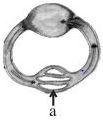
A
Valve
B
Capillaries
C
Haemocoel
D
Ostia
Solution
(D) The provided figure represents the circulatory system of an arthropod (specifically an insect like a cockroach).
In the open circulatory system of insects,the heart is a tubular structure.
The blood enters the heart through small openings called ostia.
In the diagram,'$a$' points to these openings,which are known as ostia.
In the open circulatory system of insects,the heart is a tubular structure.
The blood enters the heart through small openings called ostia.
In the diagram,'$a$' points to these openings,which are known as ostia.
0 likes
View Solution73
MediumMCQ
Which of the following organisms possesses high and regular blood pressure?
A
Cockroach
B
Centipede
C
Earthworm
D
Peripatus
Solution
(A) The correct answer is $A$ (Cockroach).
Cockroaches possess an open circulatory system,but they have a tubular heart that pumps hemolymph through a series of chambers,maintaining a relatively high and regular pressure compared to other invertebrates with open circulatory systems.
Earthworms have a closed circulatory system but generally lower pressure.
Centipedes and Peripatus do not exhibit the same specialized high-pressure mechanism as the cockroach's heart system.
Cockroaches possess an open circulatory system,but they have a tubular heart that pumps hemolymph through a series of chambers,maintaining a relatively high and regular pressure compared to other invertebrates with open circulatory systems.
Earthworms have a closed circulatory system but generally lower pressure.
Centipedes and Peripatus do not exhibit the same specialized high-pressure mechanism as the cockroach's heart system.
0 likes
View Solution74
MediumMCQ
In the given figure,what do $A$ and $B$ represent respectively?
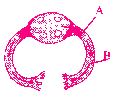
A
Valve,Artery
B
Artery,Valve
C
Valve,Ostia
D
Ostia,Artery
Solution
(C) The provided figure represents the circulatory system of a cockroach,specifically the heart structure.
In the cockroach heart,$A$ points to the valve,which prevents the backflow of hemolymph.
$B$ points to the ostia,which are small openings in the heart wall that allow hemolymph to enter from the perivisceral sinus.
Therefore,$A$ represents the valve and $B$ represents the ostia.
In the cockroach heart,$A$ points to the valve,which prevents the backflow of hemolymph.
$B$ points to the ostia,which are small openings in the heart wall that allow hemolymph to enter from the perivisceral sinus.
Therefore,$A$ represents the valve and $B$ represents the ostia.
0 likes
View Solution75
MediumMCQ
Which of the following statements is correct regarding the cockroach?
A
Ventral nerve cord
B
Spiracles help in excretion.
C
Female cockroach possesses anal styles.
D
Kidneys are present as excretory organs.
Solution
(A) In cockroaches,the nervous system consists of a series of fused,segmentally arranged ganglia joined by paired longitudinal connectives on the ventral side. Thus,the nerve cord is ventral.
Spiracles are involved in respiration,not excretion.
Anal styles are present only in male cockroaches,not females.
Malpighian tubules,not kidneys,are the excretory organs in cockroaches.
Spiracles are involved in respiration,not excretion.
Anal styles are present only in male cockroaches,not females.
Malpighian tubules,not kidneys,are the excretory organs in cockroaches.
0 likes
View Solution76
EasyMCQ
Which of the following is present as an excretory organ in cockroaches?
A
Malpighian tubules
B
Kidneys
C
Excretory tubules
D
Nephridia
Solution
(A) In cockroaches $(Periplaneta \text{ } americana)$, the primary excretory organs are the Malpighian tubules.
These are yellow-colored, thin, filamentous structures attached to the junction of the midgut and hindgut.
They help in the removal of excretory products from the hemolymph, primarily in the form of uric acid, making the cockroach uricotelic.
These are yellow-colored, thin, filamentous structures attached to the junction of the midgut and hindgut.
They help in the removal of excretory products from the hemolymph, primarily in the form of uric acid, making the cockroach uricotelic.
0 likes
View Solution77
MediumMCQ
Which is the correct sequence of labeling for the given figure?
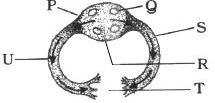
A
$P$ - Valve,$Q$ - Ostia,$R$ - Pump,$S$ - Artery,$T$ - Haemocoel,$U$ - Artery
B
$P$ - Valve,$Q$ - Ostia,$R$ - Pump,$S$ - Artery,$T$ - Haemocoel,$U$ - Artery
C
$P$ - Valve,$Q$ - Ostia,$S$ - Artery,$T$ - Haemocoel,$R$ - Pump,$U$ - Vein
D
$P$ - Valve,$Q$ - Ostia,$S$ - Haemocoel,$T$ - Artery,$R$ - Vein,$U$ - Pump
Solution
(B) The provided figure represents the open circulatory system of an arthropod (like a cockroach).
In this system:
$P$ represents the valve that prevents backflow of blood.
$Q$ represents the ostia (pores) through which blood enters the heart.
$R$ represents the heart (pump) which circulates the blood.
$S$ and $U$ represent the arteries that carry blood away from the heart.
$T$ represents the haemocoel (body cavity) where blood is released.
Therefore,the correct sequence is $P$ - Valve,$Q$ - Ostia,$R$ - Pump,$S$ - Artery,$T$ - Haemocoel,$U$ - Artery.
In this system:
$P$ represents the valve that prevents backflow of blood.
$Q$ represents the ostia (pores) through which blood enters the heart.
$R$ represents the heart (pump) which circulates the blood.
$S$ and $U$ represent the arteries that carry blood away from the heart.
$T$ represents the haemocoel (body cavity) where blood is released.
Therefore,the correct sequence is $P$ - Valve,$Q$ - Ostia,$R$ - Pump,$S$ - Artery,$T$ - Haemocoel,$U$ - Artery.
0 likes
View Solution78
MediumMCQ
What does '$X$' represent in the given figure?
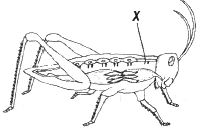
A
Heart
B
Dorsal blood vessel
C
Ventral blood vessel
D
Alimentary canal
Solution
(B) The provided figure shows the internal anatomy of a cockroach (an insect). The structure labeled '$X$' is the dorsal blood vessel,which is a characteristic feature of the open circulatory system in insects. It runs along the dorsal side of the body and is associated with the heart chambers.
0 likes
View Solution79
MediumMCQ
Which one of the following is one of the paths followed by air or $O_2$ during respiration in the adult male $Periplaneta$ $americana$ as it enters the animal body?
A
Spiracle in metathorax,trachea,tracheoles,oxygen diffuses into cells
B
Mouth,bronchial tube,trachea,oxygen enters cells
C
Spiracles in prothorax,tracheoles,trachea,oxygen diffuses into cells
D
Hypopharynx,mouth,pharynx,trachea,tissues
Solution
(A) The correct path for air entry in $Periplaneta$ $americana$ is: Spiracle $\rightarrow$ Trachea $\rightarrow$ Tracheoles $\rightarrow$ Cells.
In cockroaches,the respiratory system consists of a network of air tubes called tracheae,which open to the exterior through $10$ pairs of small holes known as spiracles.
These spiracles are segmentally arranged on the lateral sides of the body.
The tracheae branch into finer tubes called tracheoles,which carry oxygen directly to the tissues.
Option $A$ correctly describes the sequence: Spiracle in metathorax (as part of the thoracic spiracles),trachea,tracheoles,and finally oxygen diffusion into cells.
In cockroaches,the respiratory system consists of a network of air tubes called tracheae,which open to the exterior through $10$ pairs of small holes known as spiracles.
These spiracles are segmentally arranged on the lateral sides of the body.
The tracheae branch into finer tubes called tracheoles,which carry oxygen directly to the tissues.
Option $A$ correctly describes the sequence: Spiracle in metathorax (as part of the thoracic spiracles),trachea,tracheoles,and finally oxygen diffusion into cells.
0 likes
View Solution80
MediumMCQ
In male cockroaches,sperms are stored in which part of the reproductive system?
A
Seminal vesicles
B
Mushroom glands
C
Testes
D
Vas deferens
Solution
(A) The correct answer is $A$.
In male cockroaches,the reproductive system includes a pair of testes,vasa deferentia,an ejaculatory duct,and accessory glands.
Seminal vesicles are numerous small sacs located on the ventral surface of the anterior part of the ejaculatory duct.
These structures are responsible for storing sperms in the form of bundles called spermatophores.
In male cockroaches,the reproductive system includes a pair of testes,vasa deferentia,an ejaculatory duct,and accessory glands.
Seminal vesicles are numerous small sacs located on the ventral surface of the anterior part of the ejaculatory duct.
These structures are responsible for storing sperms in the form of bundles called spermatophores.
0 likes
View Solution81
MediumMCQ
The body cells in cockroach discharge their nitrogenous waste in the haemolymph mainly in the form of
A
urea
B
calcium carbonate
C
ammonia
D
potassium urate
Solution
(D) The correct answer is $D$. In cockroaches, the body cells release nitrogenous waste into the haemolymph primarily as $potassium \text{ } urate$. The $Malpighian \text{ } tubules$ then extract these metabolic wastes, including $potassium \text{ } urate$, water, and carbon dioxide from the haemolymph. Within the $Malpighian \text{ } tubules$, these are converted into uric acid. $A$ significant portion of water and salts is reabsorbed by the cells of the $Malpighian \text{ } tubules$ and returned to the haemolymph, while the remaining uric acid is excreted through the alimentary canal.
0 likes
View Solution82
MediumMCQ
Which of the following happens in the common cockroach?
A
Malpighian tubules are excretory organs projecting out from the colon.
B
Oxygen is transported by haemoglobin in blood.
C
Nitrogenous excretory product is urea.
D
The food is ground by mandibles and gizzard.
Solution
(D) : In the common cockroach,the mouthparts include a pair of mandibles that bear teeth for cutting and masticating food.
Additionally,the gizzard,which is a part of the alimentary canal,contains six muscular folds covered with chitinous teeth that further grind the food into smaller particles.
Option $A$ is incorrect because Malpighian tubules arise at the junction of the midgut and hindgut,not the colon.
Option $B$ is incorrect because cockroach blood (haemolymph) lacks haemoglobin and does not transport oxygen.
Option $C$ is incorrect because the primary nitrogenous excretory product in cockroaches is uric acid,not urea.
Additionally,the gizzard,which is a part of the alimentary canal,contains six muscular folds covered with chitinous teeth that further grind the food into smaller particles.
Option $A$ is incorrect because Malpighian tubules arise at the junction of the midgut and hindgut,not the colon.
Option $B$ is incorrect because cockroach blood (haemolymph) lacks haemoglobin and does not transport oxygen.
Option $C$ is incorrect because the primary nitrogenous excretory product in cockroaches is uric acid,not urea.
0 likes
View Solution83
MediumMCQ
Which one of the following is the true description about an animal concerned?
A
Rat - Left kidney is slightly higher in position than the right one
B
Cockroach - $10$ pairs of spiracles ($2$ pairs on thorax and $8$ pairs on abdomen)
C
Earthworm - The alimentary canal consists of a sequence of pharynx,oesophagus,stomach,gizzard and intestine
D
Frog - Body divisible into three regions - head,neck and trunk
Solution
(B) The correct option is $(B)$.
In a cockroach,there are $10$ pairs of spiracles present for respiration.
Two pairs are located on the thorax: the first pair (mesothoracic) lies between the pro- and mesothorax,and the second pair (metathoracic) lies between the meso- and metathorax.
The remaining $8$ pairs are located on the abdomen.
Option $(A)$ is incorrect because in a rat,the right kidney is usually slightly higher or at the same level as the left due to the position of the liver.
Option $(C)$ is incorrect because the earthworm's alimentary canal sequence is pharynx,oesophagus,gizzard,stomach,and intestine.
Option $(D)$ is incorrect because the frog's body is divisible into only two regions: head and trunk (neck is absent).
In a cockroach,there are $10$ pairs of spiracles present for respiration.
Two pairs are located on the thorax: the first pair (mesothoracic) lies between the pro- and mesothorax,and the second pair (metathoracic) lies between the meso- and metathorax.
The remaining $8$ pairs are located on the abdomen.
Option $(A)$ is incorrect because in a rat,the right kidney is usually slightly higher or at the same level as the left due to the position of the liver.
Option $(C)$ is incorrect because the earthworm's alimentary canal sequence is pharynx,oesophagus,gizzard,stomach,and intestine.
Option $(D)$ is incorrect because the frog's body is divisible into only two regions: head and trunk (neck is absent).
0 likes
View Solution84
MediumMCQ
Which one of the following has an open circulatory system?
A
Octopus
B
Pheretima
C
Periplaneta
D
Hirudinaria
Solution
(C) The correct answer is $C$.
$Periplaneta$ (cockroach) possesses an open circulatory system,meaning the blood does not flow exclusively within blood vessels but circulates through a body cavity known as the haemocoel.
In contrast,vertebrates,annelids (such as $Pheretima$ and $Hirudinaria$),and cephalopods (such as $Octopus$) possess a closed circulatory system,where blood is confined within a network of vessels including arteries,veins,and capillaries.
$Periplaneta$ (cockroach) possesses an open circulatory system,meaning the blood does not flow exclusively within blood vessels but circulates through a body cavity known as the haemocoel.
In contrast,vertebrates,annelids (such as $Pheretima$ and $Hirudinaria$),and cephalopods (such as $Octopus$) possess a closed circulatory system,where blood is confined within a network of vessels including arteries,veins,and capillaries.
0 likes
View Solution85
MediumMCQ
Which of the following is a part of the male cockroach reproductive system?
A
Anterior aorta
B
Mouth parts
C
Vas deferens
D
All of the above
Solution
(C) The male reproductive system of a cockroach consists of a pair of testes,vas deferens,ejaculatory duct,seminal vesicles,and accessory glands.
$A$. Anterior aorta is a part of the circulatory system.
$B$. Mouth parts are part of the digestive system.
$C$. Vas deferens is a specific duct that transports sperm from the testes to the ejaculatory duct,making it a part of the male reproductive system.
Therefore,the correct option is $C$.
$A$. Anterior aorta is a part of the circulatory system.
$B$. Mouth parts are part of the digestive system.
$C$. Vas deferens is a specific duct that transports sperm from the testes to the ejaculatory duct,making it a part of the male reproductive system.
Therefore,the correct option is $C$.
0 likes
View Solution86
MediumMCQ
Which accessory digestive gland is found in a cockroach?
A
Liver
B
Pancreas
C
Salivary gland
D
All of the above
Solution
(C) In a cockroach $(Periplaneta \text{ } americana)$, the digestive system consists of the alimentary canal and digestive glands.
The accessory digestive glands associated with the digestive system of a cockroach are the salivary glands.
There is a pair of salivary glands present in the thorax, which secrete saliva containing enzymes for digestion.
Liver and pancreas are digestive glands found in vertebrates, not in insects like cockroaches.
The accessory digestive glands associated with the digestive system of a cockroach are the salivary glands.
There is a pair of salivary glands present in the thorax, which secrete saliva containing enzymes for digestion.
Liver and pancreas are digestive glands found in vertebrates, not in insects like cockroaches.
0 likes
View Solution87
MediumMCQ
Which of the following parts is not associated with the nerve ring in a cockroach?
A
Supraoesophageal ganglion
B
Suboesophageal ganglion
C
Circum-oesophageal commissure
D
Abdominal ganglia
Solution
(D) The nervous system of a cockroach consists of a series of fused segmental ganglia joined by paired longitudinal connectives on the ventral side.
Three ganglia lie in the thorax and six in the abdomen.
The nervous system is spread throughout the body.
The head holds a bit of a nervous system while the rest is situated along the ventral (belly-side) part of its body.
So,now you understand that the supraoesophageal ganglion (also called the brain),the suboesophageal ganglion,and the circum-oesophageal commissures together form the nerve ring around the oesophagus.
The abdominal ganglia are located in the abdomen and are part of the ventral nerve cord,not the nerve ring.
Three ganglia lie in the thorax and six in the abdomen.
The nervous system is spread throughout the body.
The head holds a bit of a nervous system while the rest is situated along the ventral (belly-side) part of its body.
So,now you understand that the supraoesophageal ganglion (also called the brain),the suboesophageal ganglion,and the circum-oesophageal commissures together form the nerve ring around the oesophagus.
The abdominal ganglia are located in the abdomen and are part of the ventral nerve cord,not the nerve ring.
0 likes
View Solution88
MediumMCQ
What is the function of Malpighian tubules in a cockroach?
A
Conduction of nerve impulse
B
Absorption of food
C
Digestion of food
D
Excretion
Solution
(D) Malpighian tubules are the primary excretory organs in insects like cockroaches.
They are yellow-colored,thin,filamentous structures attached at the junction of the midgut and hindgut.
They help in the removal of nitrogenous waste products from the hemolymph and convert them into uric acid,which is then excreted through the hindgut.
Therefore,the primary function of Malpighian tubules is excretion.
They are yellow-colored,thin,filamentous structures attached at the junction of the midgut and hindgut.
They help in the removal of nitrogenous waste products from the hemolymph and convert them into uric acid,which is then excreted through the hindgut.
Therefore,the primary function of Malpighian tubules is excretion.
0 likes
View Solution89
MediumMCQ
The body cavity in a cockroach is also known as ........
A
Haemocoel
B
Ostia
C
Ommatidium
D
Ootheca
Solution
(A) In cockroaches,the body cavity is not a true coelom but is filled with blood. This type of body cavity is called a $Haemocoel$. The blood-filled spaces are known as sinuses. $Ostia$ are the openings in the heart,$Ommatidium$ is the structural unit of the compound eye,and $Ootheca$ is the egg case.
0 likes
View Solution90
MediumMCQ
Identify the odd one out.
A
Labrum
B
Phallomere
C
Mandible
D
Maxilla
Solution
(B) The mouthparts of a cockroach consist of a labrum (upper lip),a pair of mandibles,a pair of maxillae,and a labium (lower lip).
$A$,$C$,and $D$ are components of the mouthparts of a cockroach.
$B$ (Phallomere) is a part of the male reproductive system of a cockroach,not a mouthpart.
Therefore,$B$ is the odd one out.
$A$,$C$,and $D$ are components of the mouthparts of a cockroach.
$B$ (Phallomere) is a part of the male reproductive system of a cockroach,not a mouthpart.
Therefore,$B$ is the odd one out.
0 likes
View Solution91
MediumMCQ
What is the location of hepatic caeca in a cockroach?
A
Junction of midgut and hindgut
B
Junction of foregut and midgut
C
Junction of ileum and colon
D
Junction of pharynx and oesophagus
Solution
(B) In a cockroach,the alimentary canal is divided into three regions: foregut,midgut,and hindgut.
At the junction of the foregut and the midgut,a ring of $6-8$ blind tubules called hepatic or gastric caeca is present.
These caeca secrete digestive juices that aid in the process of digestion.
Therefore,the correct location is the junction of the foregut and the midgut.
At the junction of the foregut and the midgut,a ring of $6-8$ blind tubules called hepatic or gastric caeca is present.
These caeca secrete digestive juices that aid in the process of digestion.
Therefore,the correct location is the junction of the foregut and the midgut.
0 likes
View Solution92
MediumMCQ
What opens into the ejaculatory duct of a cockroach?
A
Vas deferens
B
Oesophagus
C
Salivary duct
D
Oviduct
Solution
(A) In the male reproductive system of a cockroach,the testes are located on the lateral sides of the $4^{th}-6^{th}$ abdominal segments.
From each testis,a thin vas deferens arises,which runs posteriorly and opens into the ejaculatory duct through the seminal vesicle.
The ejaculatory duct then opens to the outside via the male gonopore situated ventral to the anus.
Therefore,the vas deferens opens into the ejaculatory duct.
From each testis,a thin vas deferens arises,which runs posteriorly and opens into the ejaculatory duct through the seminal vesicle.
The ejaculatory duct then opens to the outside via the male gonopore situated ventral to the anus.
Therefore,the vas deferens opens into the ejaculatory duct.
0 likes
View Solution93
MediumMCQ
....... is the function of nephrocytes and urecose glands.
A
Reproduction
B
Digestion
C
Excretion
D
None
Solution
(C) In cockroaches,the excretory system consists of Malpighian tubules,fat bodies,nephrocytes,and urecose glands.
Nephrocytes are specialized cells that help in the removal of nitrogenous waste products from the hemolymph.
Urecose glands are also associated with the excretion of uric acid.
Therefore,the primary function of both nephrocytes and urecose glands is excretion.
Nephrocytes are specialized cells that help in the removal of nitrogenous waste products from the hemolymph.
Urecose glands are also associated with the excretion of uric acid.
Therefore,the primary function of both nephrocytes and urecose glands is excretion.
0 likes
View Solution94
MediumMCQ
Identify $X, Y$ and $Z$ in the given figure of the male reproductive system of a cockroach.
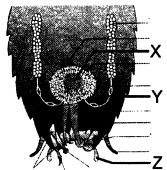
A
Anal cercus - Caudal style - Small tubules
B
Small tubules - Vas deferens - Caudal style
C
Vas deferens - Phallic gland - Caudal style
D
Caudal style - Small tubules - Phallic gland
Solution
(B) The provided figure represents the male reproductive system of a cockroach.
In this diagram:
$X$ points to the mushroom-shaped gland, which consists of small tubules.
$Y$ points to the vas deferens, which carries sperm from the testes.
$Z$ points to the caudal style (also known as anal style), which is a pair of short, thread-like structures present only in male cockroaches.
Therefore, the correct identification is $X = \text{Small tubules}, Y = \text{Vas deferens}, Z = \text{Caudal style}$.
In this diagram:
$X$ points to the mushroom-shaped gland, which consists of small tubules.
$Y$ points to the vas deferens, which carries sperm from the testes.
$Z$ points to the caudal style (also known as anal style), which is a pair of short, thread-like structures present only in male cockroaches.
Therefore, the correct identification is $X = \text{Small tubules}, Y = \text{Vas deferens}, Z = \text{Caudal style}$.
0 likes
View Solution95
MediumMCQ
Match the correct pairs regarding the anatomy of a cockroach:
| Column-$I$ | Column-$II$ |
| $1$. Exoskeleton | $p$. Thorax |
| $2$. Three ganglia | $q$. Chitin |
| $3$. One pair of seminal vesicles | $r$. $6^{th}-7^{th}$ segments of abdomen |
| $4$. Mushroom-shaped gland | $s$. $6^{th}$ segment |
A
$(1-p), (2-q), (3-r), (4-s)$
B
$(1-q), (2-p), (3-s), (4-r)$
C
$(1-q), (2-s), (3-p), (4-r)$
D
$(1-p), (2-r), (3-q), (4-s)$
Solution
(B) The correct matching is as follows:
$1$. Exoskeleton: The body of a cockroach is covered by a hard,chitinous exoskeleton $(q)$.
$2$. Three ganglia: In the thorax region of the cockroach,there are three thoracic ganglia $(p)$.
$3$. One pair of seminal vesicles: These are present in the $6^{th}$ segment of the male cockroach $(s)$.
$4$. Mushroom-shaped gland: This is an accessory reproductive gland found in the $6^{th}-7^{th}$ abdominal segments of the male cockroach $(r)$.
Thus,the correct sequence is $(1-q), (2-p), (3-s), (4-r)$.
$1$. Exoskeleton: The body of a cockroach is covered by a hard,chitinous exoskeleton $(q)$.
$2$. Three ganglia: In the thorax region of the cockroach,there are three thoracic ganglia $(p)$.
$3$. One pair of seminal vesicles: These are present in the $6^{th}$ segment of the male cockroach $(s)$.
$4$. Mushroom-shaped gland: This is an accessory reproductive gland found in the $6^{th}-7^{th}$ abdominal segments of the male cockroach $(r)$.
Thus,the correct sequence is $(1-q), (2-p), (3-s), (4-r)$.
0 likes
View Solution96
MediumMCQ
Which is correct for mosaic vision?
A
More sensitivity and less resolution
B
Less sensitivity and more resolution
C
More sensitivity and more resolution
D
Less sensitivity and less resolution
Solution
(A) Mosaic vision is characteristic of the compound eyes found in insects like cockroaches.
In this type of vision,each ommatidium receives a small part of the object,resulting in multiple images.
This mechanism provides high sensitivity to light,which is advantageous for nocturnal or crepuscular activity.
However,because each ommatidium captures only a fraction of the total image,the overall resolution (sharpness) of the image is low.
Therefore,mosaic vision is characterized by more sensitivity and less resolution.
In this type of vision,each ommatidium receives a small part of the object,resulting in multiple images.
This mechanism provides high sensitivity to light,which is advantageous for nocturnal or crepuscular activity.
However,because each ommatidium captures only a fraction of the total image,the overall resolution (sharpness) of the image is low.
Therefore,mosaic vision is characterized by more sensitivity and less resolution.
0 likes
View Solution97
MediumMCQ
The body cavity of a cockroach is also called:
A
Haemocoel
B
Genital chamber
C
Heart chamber
D
Cloaca
Solution
(A) The body cavity of a cockroach is not a true coelom because it is filled with blood. This type of body cavity is known as a $Haemocoel$. The blood in the cockroach is called $Haemolymph$,which flows freely within this cavity,bathing the internal organs. Therefore,the correct answer is $Haemocoel$.
0 likes
View Solution98
EasyMCQ
How many Malpighian tubules are present at the junction of midgut and hindgut in a cockroach?
A
$100-150$
B
$80-100$
C
$150-200$
D
$80-90$
Solution
(A) In a cockroach,the digestive system includes Malpighian tubules which are the main excretory organs.
These are thin,filamentous,yellow-colored structures.
They are located at the junction of the midgut and the hindgut.
There are approximately $100-150$ Malpighian tubules present in a cockroach.
These are thin,filamentous,yellow-colored structures.
They are located at the junction of the midgut and the hindgut.
There are approximately $100-150$ Malpighian tubules present in a cockroach.
0 likes
View Solution99
MediumMCQ
Which of the following is not a part of the digestive system of a cockroach?
A
Midgut
B
Rectum
C
Gizzard
D
Felice gland
Solution
(D) The digestive system of a cockroach consists of the alimentary canal and digestive glands.
$1$. The alimentary canal is divided into three regions: foregut,midgut,and hindgut.
$2$. The foregut includes the pharynx,esophagus,crop,and gizzard.
$3$. The midgut is the site of digestion and absorption.
$4$. The hindgut includes the ileum,colon,and rectum.
$5$. The 'Felice gland' is not a biological term associated with the digestive system of a cockroach. It is likely a misspelling or an irrelevant term. Therefore,it is not part of the digestive system.
$1$. The alimentary canal is divided into three regions: foregut,midgut,and hindgut.
$2$. The foregut includes the pharynx,esophagus,crop,and gizzard.
$3$. The midgut is the site of digestion and absorption.
$4$. The hindgut includes the ileum,colon,and rectum.
$5$. The 'Felice gland' is not a biological term associated with the digestive system of a cockroach. It is likely a misspelling or an irrelevant term. Therefore,it is not part of the digestive system.
0 likes
View Solution100
MediumMCQ
In female cockroach,the $7^{th}$,$8^{th}$,and $9^{th}$ sterna form a genital pouch. Which of the following pairs of sterna are primarily involved in forming the brood or genital pouch?
A
$7^{th}$ and $9^{th}$
B
$8^{th}$ and $9^{th}$
C
$9^{th}$ and $10^{th}$
D
$6^{th}$ and $7^{th}$
Solution
(B) In female cockroaches,the genital pouch or brood pouch is formed by the $7^{th}$,$8^{th}$,and $9^{th}$ abdominal sterna.
Specifically,the $7^{th}$ sternum is boat-shaped and together with the $8^{th}$ and $9^{th}$ sterna,it forms a brood or genital pouch.
The anterior part of this pouch contains the female gonopore,spermathecal pores,and collateral glands.
Therefore,the combination of $7^{th}$,$8^{th}$,and $9^{th}$ sterna is responsible for this structure.
Specifically,the $7^{th}$ sternum is boat-shaped and together with the $8^{th}$ and $9^{th}$ sterna,it forms a brood or genital pouch.
The anterior part of this pouch contains the female gonopore,spermathecal pores,and collateral glands.
Therefore,the combination of $7^{th}$,$8^{th}$,and $9^{th}$ sterna is responsible for this structure.
0 likes
View SolutionStructural Organisation In Animals — Anatomy of Cockroach · Frequently Asked Questions
1Are these Structural Organisation In Animals questions useful for JEE and NEET?
Yes. All questions in this section are mapped to JEE Main and NEET exam patterns. Previous year questions from JEE Main, NEET, GUJCET and state-level exams are included with full solutions.
2Can I switch to Hindi or Gujarati for these questions?
Yes. Use the language tabs in the hero section or the sidebar to view the same questions and solutions in English, Hindi or Gujarati.
3How do I generate a question paper from this subtopic?
Use the Vedclass Exam Paper Generator — select the chapter and subtopic, set difficulty, and generate Sets A, B, C, D automatically. First 3 chapters of every subject are free.
Vedclass Products
For Students
Vedclass Test Series
Mock tests in real JEE/NEET style with performance analysis. 5-day free trial.
Start Free TrialFor Teachers
Exam Paper Generator
Generate Set A/B/C/D papers from this chapter in 2 minutes. 3 chapters free.
Try FreeFor Institutes
Online Exam Module
Live online exams with unlimited students, 360° analytics & white-label branding.
See DemoFor Teachers & Institutes
Generate a Structural Organisation In Animals Exam Paper in 2 Minutes
Select subtopic & difficulty — Sets A, B, C, D auto-generated with No Repeat logic.
First 3 chapters of every subject are free — no payment required.