
A English
Muscular tissue Questions in English
Class 11 Biology · Structural Organisation In Animals · Muscular tissue
73+
Questions
English
Language
100%
With Solutions
Showing 50 of 73 questions in English
1
MediumMCQ
Smooth muscles are not:
A
Spindle shaped
B
Under control of autonomic nervous system
C
Very simple in structure
D
Multinucleated
Solution
(D) Smooth muscle fibers are spindle-shaped,thick in the middle,and thin at both ends.
They are uninucleated (contain a single nucleus) and lack striations.
They are involuntary and under the control of the $ANS$ (Autonomic Nervous System).
Therefore,the statement that they are multinucleated is incorrect,as they are uninucleated.
They are uninucleated (contain a single nucleus) and lack striations.
They are involuntary and under the control of the $ANS$ (Autonomic Nervous System).
Therefore,the statement that they are multinucleated is incorrect,as they are uninucleated.
0 likes
View Solution2
MediumMCQ
Cardiac muscles possess the characteristics of
A
Striated muscle
B
Unstriated muscle
C
Both $(a)$ and $(b)$
D
None of these
Solution
(C) Cardiac muscles exhibit a combination of properties found in both striated and unstriated (smooth) muscles.
$1$. Like striated (skeletal) muscles,cardiac muscles show cross-striations due to the arrangement of thick and thin protein filaments ($actin$ and $myosin$).
$2$. Like unstriated (smooth) muscles,cardiac muscles are involuntary in nature,meaning they are not under conscious control.
$3$. These muscles perform rhythmic contractions throughout life under the regulation of the $ANS$ (Autonomic Nervous System).
$1$. Like striated (skeletal) muscles,cardiac muscles show cross-striations due to the arrangement of thick and thin protein filaments ($actin$ and $myosin$).
$2$. Like unstriated (smooth) muscles,cardiac muscles are involuntary in nature,meaning they are not under conscious control.
$3$. These muscles perform rhythmic contractions throughout life under the regulation of the $ANS$ (Autonomic Nervous System).
0 likes
View Solution3
MediumMCQ
Striped muscles have
A
One nucleus
B
Many nuclei
C
Two nuclei
D
No nuclei
Solution
(B) Striped (skeletal) muscle fibres are cylindrical and multinucleated. The presence of many nuclei in a single cell is known as a syncytium or coenocyte. Therefore,the correct option is $(b)$.
0 likes
View Solution4
MediumMCQ
Smooth muscle fibres are:
A
Cylindrical,unbranched,striated,multinucleate and voluntary
B
Spindle-shaped,unbranched,non-striated,uninucleate and involuntary
C
Cylindrical,unbranched,non-striated,multinucleate and involuntary
D
Spindle-shaped,unbranched,striated,uninucleate and voluntary
Solution
(B) Smooth muscle fibres are characterized by the following features:
$1$. Shape: They are spindle-shaped (fusiform) with tapered ends.
$2$. Striations: They are non-striated,meaning they lack the alternating light and dark bands seen in skeletal or cardiac muscles.
$3$. Nucleus: They are uninucleate,containing a single nucleus located in the center of the cell.
$4$. Control: They are involuntary,meaning their contraction is not under conscious control.
$5$. Branching: They are unbranched.
Therefore,the correct description is spindle-shaped,unbranched,non-striated,uninucleate,and involuntary.
$1$. Shape: They are spindle-shaped (fusiform) with tapered ends.
$2$. Striations: They are non-striated,meaning they lack the alternating light and dark bands seen in skeletal or cardiac muscles.
$3$. Nucleus: They are uninucleate,containing a single nucleus located in the center of the cell.
$4$. Control: They are involuntary,meaning their contraction is not under conscious control.
$5$. Branching: They are unbranched.
Therefore,the correct description is spindle-shaped,unbranched,non-striated,uninucleate,and involuntary.
0 likes
View Solution5
MediumMCQ
The most abundant tissue in the body is
A
Nervous
B
Muscular
C
Vascular
D
Epithelial
Solution
(B) The correct answer is $B$.
Muscular tissue is considered the most abundant tissue in the human body.
There are approximately $639$ muscles in the body,which constitute the bulk of the body mass.
Muscles account for about $40\%$ of the total body weight and $50\%$ of the soft parts of the body.
Muscular tissue is considered the most abundant tissue in the human body.
There are approximately $639$ muscles in the body,which constitute the bulk of the body mass.
Muscles account for about $40\%$ of the total body weight and $50\%$ of the soft parts of the body.
0 likes
View Solution6
MediumMCQ
Smooth muscle fibres differ from striated muscle fibres in their external covering by:
A
Presence of sarcolemma
B
Presence of plasma membrane
C
Absence of covering
D
None of the above
Solution
(A) Smooth muscle fibres are covered by a plasma membrane,but they lack the specialized,distinct connective tissue sheath known as the sarcolemma that is characteristic of striated muscle fibres. While both have a plasma membrane,the term $sarcolemma$ is specifically used to describe the plasma membrane of striated muscle fibres. Therefore,in the context of comparative histology,smooth muscle fibres are often described as lacking the specialized $sarcolemma$ found in striated muscles.
0 likes
View Solution7
MediumMCQ
Unstriated muscles are found in:
A
Veins
B
Arteries
C
Uterus
D
All the above
Solution
(D) Unstriated muscles,also known as smooth muscles or involuntary muscles,are found in the walls of hollow visceral organs.
$1$. They are present in the walls of blood vessels like veins and arteries to regulate blood flow.
$2$. They are also found in the walls of the uterus,where they play a crucial role during childbirth.
$3$. Since they are present in all the mentioned structures,the correct answer is $D$.
$1$. They are present in the walls of blood vessels like veins and arteries to regulate blood flow.
$2$. They are also found in the walls of the uterus,where they play a crucial role during childbirth.
$3$. Since they are present in all the mentioned structures,the correct answer is $D$.
0 likes
View Solution8
MediumMCQ
Which set clearly identifies striated muscles?
A
Cylindrical,syncytial and unbranched
B
Spindle,unbranched and uninucleated
C
Cylindrical,striped and nucleated
D
Cylindrical,striped and branched
Solution
(A) Striated muscles are skeletal muscles,which appear striped under the microscope due to the arrangement of actin and myosin filaments.
These muscle fibers are cylindrical in shape,unbranched,and multinucleated (syncytial).
Therefore,the set that clearly identifies striated muscles is cylindrical,syncytial,and unbranched.
These muscle fibers are cylindrical in shape,unbranched,and multinucleated (syncytial).
Therefore,the set that clearly identifies striated muscles is cylindrical,syncytial,and unbranched.
0 likes
View Solution9
MediumMCQ
Muscular tissue is differentiated into:
A
Unstriped,striped
B
Striped,cardiac
C
Cardiac muscle,unstriped
D
Unstriped,striated and cardiac
Solution
(D) Muscular tissue is primarily classified into three types based on their structure and function:
$1$. Skeletal muscle (Striated/Striped muscle): These are attached to bones and are under voluntary control.
$2$. Smooth muscle (Unstriated/Unstriped muscle): These are found in the walls of internal organs and are under involuntary control.
$3$. Cardiac muscle: These are specialized muscles found only in the heart,which are involuntary and striated.
$1$. Skeletal muscle (Striated/Striped muscle): These are attached to bones and are under voluntary control.
$2$. Smooth muscle (Unstriated/Unstriped muscle): These are found in the walls of internal organs and are under involuntary control.
$3$. Cardiac muscle: These are specialized muscles found only in the heart,which are involuntary and striated.
0 likes
View Solution10
MediumMCQ
Which of the following is not syncytial?
A
Cardiac muscle
B
Skeletal muscle
C
Smooth muscle
D
Interstitial muscle
Solution
(C) syncytium is a single cell or cytoplasmic mass containing several nuclei,formed by fusion of cells or by division of nuclei.
$1$. Skeletal muscle fibers are multinucleated (syncytial) because they are formed by the fusion of many myoblasts.
$2$. Cardiac muscle fibers are branched and connected by intercalated discs,which allow them to function as a functional syncytium.
$3$. Smooth muscle cells are uninucleated and do not form a syncytium.
$4$. Therefore,smooth muscle is not syncytial.
$1$. Skeletal muscle fibers are multinucleated (syncytial) because they are formed by the fusion of many myoblasts.
$2$. Cardiac muscle fibers are branched and connected by intercalated discs,which allow them to function as a functional syncytium.
$3$. Smooth muscle cells are uninucleated and do not form a syncytium.
$4$. Therefore,smooth muscle is not syncytial.
0 likes
View Solution11
MediumMCQ
In metazoa,which of the following is responsible for the locomotion and movement of organs?
A
Nervous tissues
B
Epithelial tissues
C
Connective tissues
D
Muscular tissues
Solution
(D) Muscular tissues are specialized tissues in animals that possess the unique property of contractility.
These tissues are composed of muscle fibers that can shorten and relax,which generates the force required for the locomotion of the organism and the movement of various internal organs.
Therefore,muscular tissues are primarily responsible for all types of movements in metazoans.
These tissues are composed of muscle fibers that can shorten and relax,which generates the force required for the locomotion of the organism and the movement of various internal organs.
Therefore,muscular tissues are primarily responsible for all types of movements in metazoans.
0 likes
View Solution12
MediumMCQ
Cardiac muscle is composed of
A
Striated,branched and voluntary muscle fibres
B
Unstriated (smooth),spindle shaped and voluntary muscle fibres
C
Unstriated (smooth),spindle shaped and involuntary muscle fibres
D
Striated,branched and involuntary muscle fibres
Solution
(D) Cardiac muscle tissue is a contractile tissue present only in the heart.
These muscle fibres are striated due to the presence of alternating light and dark bands.
They are branched,which allows the muscle fibres to form a network,facilitating coordinated contraction of the heart.
They are involuntary in nature,meaning their contraction is not under the conscious control of the individual.
Therefore,cardiac muscle is composed of striated,branched,and involuntary muscle fibres.
These muscle fibres are striated due to the presence of alternating light and dark bands.
They are branched,which allows the muscle fibres to form a network,facilitating coordinated contraction of the heart.
They are involuntary in nature,meaning their contraction is not under the conscious control of the individual.
Therefore,cardiac muscle is composed of striated,branched,and involuntary muscle fibres.
0 likes
View Solution13
EasyMCQ
Muscles responsible for the movement of food in the stomach are
A
Unstriated
B
Striated
C
Cardiac
D
None of the above
Solution
(A) The movement of food in the stomach is controlled by involuntary actions.
These movements are mediated by smooth muscles,which are also known as unstriated or visceral muscles.
Unlike striated muscles,which are under voluntary control,unstriated muscles function automatically to facilitate peristalsis in the digestive tract.
These movements are mediated by smooth muscles,which are also known as unstriated or visceral muscles.
Unlike striated muscles,which are under voluntary control,unstriated muscles function automatically to facilitate peristalsis in the digestive tract.
0 likes
View Solution14
MediumMCQ
An example of unstriated (smooth) muscles,which are entirely involuntary,is located in:
A
The diaphragm
B
The eyelid
C
The pylorus
D
The base of the external ear
Solution
(C) Unstriated or smooth muscles are involuntary muscles that do not show striations under a microscope.
They are found in the walls of hollow visceral organs such as the alimentary canal,blood vessels,and the urinary bladder.
The pylorus is the opening from the stomach into the small intestine,which is guarded by a sphincter made of smooth muscle.
Therefore,the pylorus is the correct location for unstriated involuntary muscles.
The diaphragm and eyelid contain skeletal muscles (voluntary),and the external ear is composed of cartilage.
They are found in the walls of hollow visceral organs such as the alimentary canal,blood vessels,and the urinary bladder.
The pylorus is the opening from the stomach into the small intestine,which is guarded by a sphincter made of smooth muscle.
Therefore,the pylorus is the correct location for unstriated involuntary muscles.
The diaphragm and eyelid contain skeletal muscles (voluntary),and the external ear is composed of cartilage.
0 likes
View Solution15
MediumMCQ
The ensheathing of muscles is called:
A
Fascia
B
Peritoneum
C
Ligament
D
Tendon
Solution
(A) The correct answer is $A$.
Fascia is a thin layer of connective tissue that surrounds and holds muscles,blood vessels,nerves,and organs in place.
It provides structural support and allows for the smooth movement of muscles against each other.
Peritoneum is the serous membrane lining the abdominal cavity.
Ligaments connect bone to bone.
Tendons connect muscle to bone.
Fascia is a thin layer of connective tissue that surrounds and holds muscles,blood vessels,nerves,and organs in place.
It provides structural support and allows for the smooth movement of muscles against each other.
Peritoneum is the serous membrane lining the abdominal cavity.
Ligaments connect bone to bone.
Tendons connect muscle to bone.
0 likes
View Solution16
EasyMCQ
Skeletal muscle develops from
A
Ectoderm
B
Mesoderm
C
Endoderm
D
All of the above
Solution
(B) During embryonic development,the three germ layers are formed: Ectoderm,Mesoderm,and Endoderm.
Skeletal muscles,along with the circulatory system,bones,and dermis of the skin,are derived from the Mesoderm germ layer.
Therefore,the correct answer is Mesoderm.
Skeletal muscles,along with the circulatory system,bones,and dermis of the skin,are derived from the Mesoderm germ layer.
Therefore,the correct answer is Mesoderm.
0 likes
View Solution17
MediumMCQ
The condition of low blood supply is found in which of the following?
A
Skeletal muscle
B
Cardiac muscle
C
Smooth muscle
D
All of the above
Solution
(C) The term 'low blood supply' or 'hypovascularity' refers to tissues that have a relatively lower density of blood capillaries compared to highly metabolic tissues like the heart.
$1$. Cardiac muscles are highly vascularized to meet their constant demand for oxygen and nutrients.
$2$. Skeletal muscles have a moderate to high blood supply depending on their activity.
$3$. Smooth muscles,which are found in the walls of hollow organs (like the digestive tract or blood vessels),generally have a lower blood supply compared to cardiac or skeletal muscles.
Therefore,smooth muscle is the correct answer.
$1$. Cardiac muscles are highly vascularized to meet their constant demand for oxygen and nutrients.
$2$. Skeletal muscles have a moderate to high blood supply depending on their activity.
$3$. Smooth muscles,which are found in the walls of hollow organs (like the digestive tract or blood vessels),generally have a lower blood supply compared to cardiac or skeletal muscles.
Therefore,smooth muscle is the correct answer.
0 likes
View Solution18
EasyMCQ
Smooth muscle fibers are $...$.
A
Fusiform
B
Unbranched and involuntary
C
Uninucleate
D
All of the above
Solution
(D) Smooth muscle fibers are characterized by the following features:
$1$. They are fusiform (spindle-shaped) in structure,tapering at both ends.
$2$. They are unbranched and involuntary,meaning they are not under conscious control.
$3$. Each fiber contains a single,centrally located nucleus (uninucleate).
Therefore,all the given options are correct.
$1$. They are fusiform (spindle-shaped) in structure,tapering at both ends.
$2$. They are unbranched and involuntary,meaning they are not under conscious control.
$3$. Each fiber contains a single,centrally located nucleus (uninucleate).
Therefore,all the given options are correct.
0 likes
View Solution19
MediumMCQ
Long smooth muscles are found in the....
A
Intestine
B
Stomach
C
Uterus
D
Urinary bladder
Solution
(C) Smooth muscles,also known as involuntary or non-striated muscles,are found in the walls of hollow visceral organs. While they are present in the intestine,stomach,and urinary bladder,the uterus is specifically noted for containing the longest smooth muscle fibers in the human body,especially during pregnancy where they undergo significant hypertrophy and hyperplasia. Therefore,among the given options,the uterus is the most appropriate answer for the location of 'long' smooth muscles.
0 likes
View Solution20
EasyMCQ
From which embryonic germ layer is skeletal muscle derived?
A
Ectoderm
B
Mesoderm
C
Endoderm
D
All of the above
Solution
(B) Skeletal muscles are derived from the embryonic mesoderm.
During embryonic development,the mesoderm differentiates into various tissues,including muscles,bones,and the circulatory system.
Therefore,the correct option is $B$.
During embryonic development,the mesoderm differentiates into various tissues,including muscles,bones,and the circulatory system.
Therefore,the correct option is $B$.
0 likes
View Solution21
EasyMCQ
Which germ layer forms the skeletal muscles in vertebrates?
A
Ectoderm
B
Endoderm
C
Mesoderm
D
Both $(A)$ and $(B)$
Solution
(C) In vertebrates,the development of the embryo involves three primary germ layers: the ectoderm,the mesoderm,and the endoderm.
$1$. The ectoderm gives rise to the nervous system,epidermis,and associated structures.
$2$. The endoderm forms the epithelial lining of the digestive tract and respiratory system.
$3$. The mesoderm is responsible for the formation of the skeletal system,muscular system (including skeletal muscles),circulatory system,and excretory system.
Therefore,skeletal muscles are derived from the mesoderm.
$1$. The ectoderm gives rise to the nervous system,epidermis,and associated structures.
$2$. The endoderm forms the epithelial lining of the digestive tract and respiratory system.
$3$. The mesoderm is responsible for the formation of the skeletal system,muscular system (including skeletal muscles),circulatory system,and excretory system.
Therefore,skeletal muscles are derived from the mesoderm.
0 likes
View Solution22
MediumMCQ
Smooth muscles are
A
involuntary,fusiform,non-striated
B
voluntary,multinucleate,cylindrical
C
involuntary,cylindrical,striated
D
voluntary,spindle-shaped,uninucleate
Solution
(A) : Smooth muscle fibres are elongated and spindle-shaped (fusiform).
Each fibre contains a single oval nucleus surrounded by cytoplasm (sarcoplasm).
In the cytoplasm,myofibrils are arranged longitudinally.
These fibres lack striations and are involuntary in nature,meaning they are not under conscious control.
Each fibre contains a single oval nucleus surrounded by cytoplasm (sarcoplasm).
In the cytoplasm,myofibrils are arranged longitudinally.
These fibres lack striations and are involuntary in nature,meaning they are not under conscious control.
0 likes
View Solution23
MediumMCQ
Which type of tissue correctly matches with its location?
| Tissue | Location |
| $(a)$ Transitional epithelium | Tip of nose |
| $(b)$ Cuboidal epithelium | Lining of stomach |
| $(c)$ Smooth muscle | Wall of intestine |
| $(d)$ Areolar tissue | Tendons |
A
$(a)$
B
$(b)$
C
$(c)$
D
$(d)$
Solution
(C) The correct match is $(c)$ Smooth muscle - Wall of intestine.
$1$. Transitional epithelium is found in the urinary bladder and ureters, not the tip of the nose. The tip of the nose consists of elastic cartilage.
$2$. The lining of the stomach is composed of simple columnar epithelium, not cuboidal epithelium.
$3$. Smooth muscles are found in the walls of internal organs like the stomach, intestine, and blood vessels. They are responsible for involuntary movements like peristalsis in the intestine.
$4$. Tendons are composed of dense regular connective tissue, specifically white fibrous connective tissue, not areolar tissue.
$1$. Transitional epithelium is found in the urinary bladder and ureters, not the tip of the nose. The tip of the nose consists of elastic cartilage.
$2$. The lining of the stomach is composed of simple columnar epithelium, not cuboidal epithelium.
$3$. Smooth muscles are found in the walls of internal organs like the stomach, intestine, and blood vessels. They are responsible for involuntary movements like peristalsis in the intestine.
$4$. Tendons are composed of dense regular connective tissue, specifically white fibrous connective tissue, not areolar tissue.
0 likes
View Solution24
MediumMCQ
Which one of the following is the correct pairing of a body part and the kind of muscle tissue that moves it?
A
Biceps of upper arm - Smooth muscle fibres
B
Abdominal wall - Smooth muscle
C
Iris - Involuntary smooth muscle
D
Heart wall - Involuntary unstriated muscle
Solution
(C) is the correct answer. Smooth muscles are known as involuntary muscles because their action is controlled by the autonomic nervous system,meaning they are not under the conscious control of the organism. The iris of the eye consists of involuntary smooth muscles. While the abdominal wall also contains smooth muscles,the biceps of the upper arm are composed of skeletal muscles,and the heart wall consists of specialized cardiac muscles.
0 likes
View Solution25
MediumMCQ
The given characteristics are observed in .......
$-$ They are located in the inner wall of the alimentary canal.
$-$ They do not show any striations.
$-$ They are non-striated and spindle-shaped.
$-$ They are involuntary and innervated by the autonomic nervous system.
$-$ They are located in the inner wall of the alimentary canal.
$-$ They do not show any striations.
$-$ They are non-striated and spindle-shaped.
$-$ They are involuntary and innervated by the autonomic nervous system.
A
Skeletal muscles
B
Cardiac muscles
C
Voluntary muscles
D
Visceral muscles
Solution
(D) The characteristics described are as follows:
$1$. Location: They are found in the inner walls of hollow visceral organs like the alimentary canal.
$2$. Appearance: They are non-striated (smooth) and spindle-shaped (fusiform).
$3$. Control: They are involuntary,meaning they are not under conscious control.
$4$. Innervation: They are controlled by the autonomic nervous system.
These features are characteristic of smooth muscles,which are also known as visceral muscles. Therefore,the correct option is $D$.
$1$. Location: They are found in the inner walls of hollow visceral organs like the alimentary canal.
$2$. Appearance: They are non-striated (smooth) and spindle-shaped (fusiform).
$3$. Control: They are involuntary,meaning they are not under conscious control.
$4$. Innervation: They are controlled by the autonomic nervous system.
These features are characteristic of smooth muscles,which are also known as visceral muscles. Therefore,the correct option is $D$.
0 likes
View Solution26
MediumMCQ
...... fibers taper at both ends and do not show striations.
A
Smooth muscle
B
Cardiac muscle
C
Skeletal muscle
D
None of them
Solution
(A) Smooth muscle fibers are fusiform or spindle-shaped,meaning they taper at both ends.
They do not possess striations (light and dark bands),which is why they are called non-striated or smooth muscles.
In contrast,skeletal and cardiac muscles are striated.
They do not possess striations (light and dark bands),which is why they are called non-striated or smooth muscles.
In contrast,skeletal and cardiac muscles are striated.
0 likes
View Solution27
MediumMCQ
Their action moves the body to adjust to the changes in the environment and to maintain the positions of the various parts of the body.
A
Muscle tissue
B
Squamous epithelium
C
Connective tissue
D
Adipose tissue
Solution
(A) Muscle tissue is responsible for movement and locomotion in the body.
It consists of specialized cells called muscle fibers that have the ability to contract and relax.
This contractile property allows the body to adjust to environmental changes and maintain posture by keeping various body parts in their correct positions.
It consists of specialized cells called muscle fibers that have the ability to contract and relax.
This contractile property allows the body to adjust to environmental changes and maintain posture by keeping various body parts in their correct positions.
0 likes
View Solution28
MediumMCQ
The characteristic features of smooth muscle tissue are ..........
A
Fusiform,unbranched,non-striated,uninucleate,and involuntary
B
Fusiform,unbranched,non-striated,multinucleate,and involuntary
C
Cylindrical,unbranched,non-striated,multinucleate,and involuntary
D
Cylindrical,unbranched,striated,multinucleate,and involuntary
Solution
(A) Smooth muscle tissue,also known as involuntary or non-striated muscle,consists of cells that are fusiform (spindle-shaped) in structure.
These cells are unbranched and possess a single central nucleus (uninucleate).
They lack the striations (light and dark bands) found in skeletal or cardiac muscles.
Their contraction is controlled by the autonomic nervous system,making them involuntary in nature.
Therefore,the correct characteristics are fusiform,unbranched,non-striated,uninucleate,and involuntary.
These cells are unbranched and possess a single central nucleus (uninucleate).
They lack the striations (light and dark bands) found in skeletal or cardiac muscles.
Their contraction is controlled by the autonomic nervous system,making them involuntary in nature.
Therefore,the correct characteristics are fusiform,unbranched,non-striated,uninucleate,and involuntary.
0 likes
View Solution29
MediumMCQ
Which type of tissue is correctly matched with its location?
Tissue $-$ Location
Tissue $-$ Location
A
Areolar tissue $-$ Tendon
B
Pseudostratified epithelium $-$ Surface of the nose
C
Cuboidal epithelium $-$ Lining of the stomach
D
Smooth muscle $-$ Wall of the intestine
Solution
(D) $1$. Areolar tissue is a loose connective tissue found beneath the skin,not in tendons (tendons consist of dense regular connective tissue).
$2$. Pseudostratified epithelium is typically found in the trachea and bronchi,not the surface of the nose.
$3$. Cuboidal epithelium is found in kidney tubules and ducts of glands,whereas the stomach lining consists of columnar epithelium.
$4$. Smooth muscle tissue is involuntary and is found in the walls of hollow internal organs such as the stomach,blood vessels,and the intestine. Thus,$D$ is the correct match.
$2$. Pseudostratified epithelium is typically found in the trachea and bronchi,not the surface of the nose.
$3$. Cuboidal epithelium is found in kidney tubules and ducts of glands,whereas the stomach lining consists of columnar epithelium.
$4$. Smooth muscle tissue is involuntary and is found in the walls of hollow internal organs such as the stomach,blood vessels,and the intestine. Thus,$D$ is the correct match.
0 likes
View Solution30
MediumMCQ
Which of the following is correctly matched with the body part and the muscle tissue responsible for its movement?
A
Heart wall - Involuntary unstriated muscle
B
Biceps of upper arm - Smooth muscle fiber
C
Abdominal wall - Smooth muscle
D
Iris - Involuntary smooth muscle
Solution
(D) The human body contains three types of muscle tissues: skeletal,smooth,and cardiac.
$1$. The heart wall is composed of cardiac muscle,which is striated and involuntary.
$2$. The biceps of the upper arm are skeletal muscles,which are striated and voluntary.
$3$. The abdominal wall contains skeletal muscles for voluntary movement and support.
$4$. The iris of the eye contains smooth muscles,which are involuntary and responsible for controlling the size of the pupil.
$1$. The heart wall is composed of cardiac muscle,which is striated and involuntary.
$2$. The biceps of the upper arm are skeletal muscles,which are striated and voluntary.
$3$. The abdominal wall contains skeletal muscles for voluntary movement and support.
$4$. The iris of the eye contains smooth muscles,which are involuntary and responsible for controlling the size of the pupil.
0 likes
View Solution31
MediumMCQ
Smooth muscle tissue is ...
A
Involuntary,cylindrical,and striated.
B
Voluntary,fusiform,and uninucleate.
C
Involuntary,fusiform,and non-striated.
D
Voluntary,multinucleate,and cylindrical.
Solution
(C) Smooth muscle tissue (also known as visceral muscle) is characterized by the following features:
$1$. It is involuntary,meaning it is not under conscious control.
$2$. The cells are fusiform (spindle-shaped) in structure.
$3$. It is non-striated (smooth) because it lacks the regular arrangement of actin and myosin filaments found in skeletal muscle.
$4$. Each cell contains a single nucleus (uninucleate).
Therefore,the correct description is involuntary,fusiform,and non-striated.
$1$. It is involuntary,meaning it is not under conscious control.
$2$. The cells are fusiform (spindle-shaped) in structure.
$3$. It is non-striated (smooth) because it lacks the regular arrangement of actin and myosin filaments found in skeletal muscle.
$4$. Each cell contains a single nucleus (uninucleate).
Therefore,the correct description is involuntary,fusiform,and non-striated.
0 likes
View Solution32
MediumMCQ
Assertion : Intercalated discs are important regions of cardiac muscle cells.
Reason : Intercalated discs function as boosters for muscle contraction waves.
Reason : Intercalated discs function as boosters for muscle contraction waves.
A
If both Assertion and Reason are correct and the Reason is a correct explanation of the Assertion.
B
If both Assertion and Reason are correct but Reason is not a correct explanation of the Assertion.
C
If the Assertion is correct but Reason is incorrect.
D
If both the Assertion and Reason are incorrect.
Solution
(A) Cardiac muscle cells are short,cylindrical cells joined end-to-end and by side branching to form a network.
Intercalated discs are the dense junctions formed between cardiac muscle cells where they meet each other.
These discs are specialized regions of the cell membranes that allow the rapid transmission of electrical impulses.
Since cardiac muscle possesses considerable rhythmicity and generates its own wave of excitation,these discs function as boosters for the muscle contraction wave,ensuring that the heart contracts as a single unit (syncytium).
Intercalated discs are the dense junctions formed between cardiac muscle cells where they meet each other.
These discs are specialized regions of the cell membranes that allow the rapid transmission of electrical impulses.
Since cardiac muscle possesses considerable rhythmicity and generates its own wave of excitation,these discs function as boosters for the muscle contraction wave,ensuring that the heart contracts as a single unit (syncytium).
0 likes
View Solution33
Medium
Distinguish between Cardiac muscle and Striated muscle.
Solution
(N/A)
| Cardiac muscles | Striated muscles |
|---|---|
| $(1)$ They are involuntary in function. | $(1)$ They are voluntary in function. |
| $(2)$ They are uninucleate and branched. | $(2)$ They are multinucleate and unbranched. |
| $(3)$ They are found only in the heart. | $(3)$ They are found attached to bones in limbs. |
0 likes
View Solution34
Medium
Write a note on muscle tissue.
Solution
(N/A) $ \Rightarrow $ Muscle tissue is associated with the movements of the organs of the body.
$ \Rightarrow $ Each muscle is made of many long, cylindrical fibres arranged in parallel arrays.
$ \Rightarrow $ These fibres are composed of numerous fine fibrils called myofibrils.
$ \Rightarrow $ All muscle fibres contract (shorten) in response to stimulation, then relax and return to their uncontracted state in a coordinated fashion.
$ \Rightarrow $ Their action moves the body to adjust to the changes in the environment and to maintain the positions of the various parts of the body.
$ \Rightarrow $ In general, muscles play an active role in all the movements of the body.
$ \Rightarrow $ Types of muscle tissue:
Muscles are of three types:
$ (i) $ Skeletal muscle tissue
$ (ii) $ Smooth muscle tissue
$ (iii) $ Cardiac muscle tissue
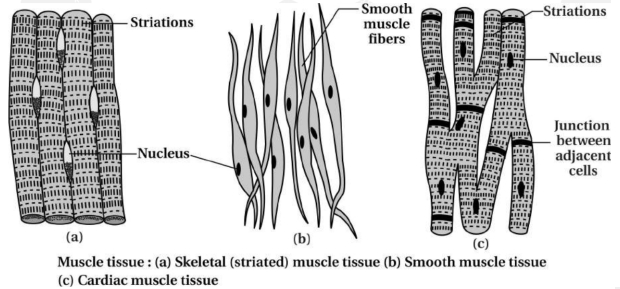
$ (i) $ Skeletal muscle tissue: These are closely attached to skeletal bones. In a typical muscle such as the biceps, striated (striped) skeletal muscle fibres are bundled together in a parallel fashion. $ A $ sheath of tough connective tissue encloses several bundles of muscle fibres.
$ (ii) $ Smooth muscle tissue:
$ \Rightarrow $ Location: The wall of internal organs such as the blood vessels, stomach, and intestine contains this type of muscle tissue.
$ \Rightarrow $ Structure: Each cell is spindle-shaped and has a nucleus in its central broader part. Dark and light bands are not seen in it.
$ \Rightarrow $ They are involuntary in action.
$ (iii) $ Cardiac muscle tissue:
$ \Rightarrow $ Location: This muscle is present only in the wall of the heart.
$ \Rightarrow $ Structure: Cardiac muscle cells are branched and cylindrical. They contain one or two nuclei arranged in the centre.
$ \Rightarrow $ They possess intercalated discs at the ends of the cells, which function as communication junctions. They are involuntary and show rhythmic contraction.
$ \Rightarrow $ Each muscle is made of many long, cylindrical fibres arranged in parallel arrays.
$ \Rightarrow $ These fibres are composed of numerous fine fibrils called myofibrils.
$ \Rightarrow $ All muscle fibres contract (shorten) in response to stimulation, then relax and return to their uncontracted state in a coordinated fashion.
$ \Rightarrow $ Their action moves the body to adjust to the changes in the environment and to maintain the positions of the various parts of the body.
$ \Rightarrow $ In general, muscles play an active role in all the movements of the body.
$ \Rightarrow $ Types of muscle tissue:
Muscles are of three types:
$ (i) $ Skeletal muscle tissue
$ (ii) $ Smooth muscle tissue
$ (iii) $ Cardiac muscle tissue
$ (i) $ Skeletal muscle tissue: These are closely attached to skeletal bones. In a typical muscle such as the biceps, striated (striped) skeletal muscle fibres are bundled together in a parallel fashion. $ A $ sheath of tough connective tissue encloses several bundles of muscle fibres.
$ (ii) $ Smooth muscle tissue:
$ \Rightarrow $ Location: The wall of internal organs such as the blood vessels, stomach, and intestine contains this type of muscle tissue.
$ \Rightarrow $ Structure: Each cell is spindle-shaped and has a nucleus in its central broader part. Dark and light bands are not seen in it.
$ \Rightarrow $ They are involuntary in action.
$ (iii) $ Cardiac muscle tissue:
$ \Rightarrow $ Location: This muscle is present only in the wall of the heart.
$ \Rightarrow $ Structure: Cardiac muscle cells are branched and cylindrical. They contain one or two nuclei arranged in the centre.
$ \Rightarrow $ They possess intercalated discs at the ends of the cells, which function as communication junctions. They are involuntary and show rhythmic contraction.
0 likes
View Solution35
Difficult
How do you distinguish between a skeletal muscle and a cardiac muscle?
Solution
(N/A)
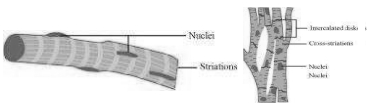
| Skeletal muscle | Cardiac muscle |
|---|---|
| $(1)$ The cells are unbranched. | $(1)$ The cells are branched. |
| $(2)$ Intercalated disks are absent. | $(2)$ Intercalated disks are present,which help in the synchronization of heartbeats. |
| $(3)$ Alternate light and dark bands are prominent. | $(3)$ Faint bands are present. |
| $(4)$ They are voluntary muscles. | $(4)$ They are involuntary muscles. |
| $(5)$ They contract rapidly and get fatigued easily. | $(5)$ They contract rhythmically and do not get fatigued. |
| $(6)$ They are attached to bones. | $(6)$ They are present only in the heart. |
0 likes
View Solution36
Easy
Describe the function of muscle tissue.
Solution
(N/A) Muscle tissue is primarily responsible for movement in the body. Its key functions include:
$1$. Movement: Muscle tissue enables voluntary movements (like walking or lifting objects) and involuntary movements (like the beating of the heart or peristalsis in the digestive tract).
$2$. Posture Maintenance: Muscles maintain body posture and stabilize joints by providing constant tension.
$3$. Heat Production: Muscle contraction generates heat,which is essential for maintaining body temperature ($37^{\circ}C$ in humans).
$4$. Protection: Muscles provide a protective layer for internal organs and bones.
$1$. Movement: Muscle tissue enables voluntary movements (like walking or lifting objects) and involuntary movements (like the beating of the heart or peristalsis in the digestive tract).
$2$. Posture Maintenance: Muscles maintain body posture and stabilize joints by providing constant tension.
$3$. Heat Production: Muscle contraction generates heat,which is essential for maintaining body temperature ($37^{\circ}C$ in humans).
$4$. Protection: Muscles provide a protective layer for internal organs and bones.
0 likes
View Solution37
Medium
Explain smooth muscle tissue.
Solution
(N/A) Smooth muscle tissue is a type of non-striated,involuntary muscle found in the walls of hollow internal organs such as the stomach,intestines,blood vessels,and urinary bladder.
$1$. Structure: The cells are fusiform (spindle-shaped) and taper at both ends. They do not show striations,hence the name 'smooth'. Each cell contains a single,centrally located nucleus.
$2$. Function: These muscles are involuntary,meaning they are controlled by the autonomic nervous system and are not under conscious control.
$3$. Characteristics: They contract slowly and can remain contracted for long periods without fatigue. They are held together by cell junctions and bundled together in a connective tissue sheath.
$1$. Structure: The cells are fusiform (spindle-shaped) and taper at both ends. They do not show striations,hence the name 'smooth'. Each cell contains a single,centrally located nucleus.
$2$. Function: These muscles are involuntary,meaning they are controlled by the autonomic nervous system and are not under conscious control.
$3$. Characteristics: They contract slowly and can remain contracted for long periods without fatigue. They are held together by cell junctions and bundled together in a connective tissue sheath.
0 likes
View Solution38
Medium
Give differences: Non-striated muscle and striated muscle.
Solution
(N/A)
| Non-striated muscle | Striated muscle |
| $(1)$ It is also called smooth muscle. | $(1)$ It is also called skeletal muscle. |
| $(2)$ They are composed of spindle-shaped cells having a single nucleus. | $(2)$ It is made up of multinucleated,long,cylindrical cells. |
| $(3)$ They are involuntary. | $(3)$ They are voluntary. |
| $(4)$ They are located in internal organs. | $(4)$ They are connected to bones. |
| $(5)$ They do not get tired quickly. | $(5)$ They get tired quickly. |
0 likes
View Solution39
EasyMCQ
Identify the location and function of the following structures:
$(i)$ Intercalated discs
$(ii)$ Haemoglobin
$(i)$ Intercalated discs
$(ii)$ Haemoglobin
A
Cardiac muscle; Contraction and RBCs; Oxygen transport
B
Smooth muscle; Digestion and Plasma; Nutrient transport
C
Skeletal muscle; Movement and Platelets; Clotting
D
Nervous tissue; Impulse and WBCs; Immunity
Solution
(A) $(i)$ Location: Cardiac muscular tissue.
$\Rightarrow$ Function: These are communication junctions that allow the cells to contract as a unit by transmitting signals for contraction.
$(ii)$ Location: Inside Red Blood Cells $(RBCs)$.
$\Rightarrow$ Function: It acts as a respiratory pigment responsible for the transport of $O_{2}$ and $CO_{2}$ in the blood.
$\Rightarrow$ Function: These are communication junctions that allow the cells to contract as a unit by transmitting signals for contraction.
$(ii)$ Location: Inside Red Blood Cells $(RBCs)$.
$\Rightarrow$ Function: It acts as a respiratory pigment responsible for the transport of $O_{2}$ and $CO_{2}$ in the blood.
0 likes
View Solution40
Medium
What is special about the tissue present in the heart?
Solution
(N/A) The cardiac muscle tissue present in the heart has the following special characteristics:
$(1)$ Cardiac muscle fibers are involuntary,meaning they do not function according to our will.
$(2)$ These muscles are fatigue-resistant and exhibit rhythmicity.
$(3)$ They have a rich blood supply.
$(4)$ They are myogenic,meaning they can generate their own electrical impulses for contraction even when removed from the body. They possess properties of both muscle and nerve tissue.
$(1)$ Cardiac muscle fibers are involuntary,meaning they do not function according to our will.
$(2)$ These muscles are fatigue-resistant and exhibit rhythmicity.
$(3)$ They have a rich blood supply.
$(4)$ They are myogenic,meaning they can generate their own electrical impulses for contraction even when removed from the body. They possess properties of both muscle and nerve tissue.
0 likes
View Solution41
Medium
Explain the characteristics of smooth muscle tissue.
Solution
(N/A) $\Rightarrow$ Location: The walls of internal organs such as blood vessels,stomach,and intestine contain this type of muscle tissue.
$\Rightarrow$ Structure: Each cell is spindle-shaped and has a nucleus in its central broader part.
$\Rightarrow$ Sarcolemma: The sarcolemma is indistinct. Dark and light bands (striations) are not observed.
$\Rightarrow$ Myofibrils: There is no regular arrangement of myofibrils.
$\Rightarrow$ Sarcoplasm: Granular sarcoplasm surrounds the nucleus,while the remaining cytoplasm contains a large number of minute myofibrils.
$\Rightarrow$ Organization: They are bundled together in a connective tissue sheath.
$\Rightarrow$ Function: The contraction and relaxation of smooth muscle tissue are not rapid. They are involuntary in action; hence,they are called involuntary muscles.
$\Rightarrow$ Fatigue: Their contraction and relaxation occur at a very slow speed and persist for a longer period,so they do not get fatigued easily.
$\Rightarrow$ Structure: Each cell is spindle-shaped and has a nucleus in its central broader part.
$\Rightarrow$ Sarcolemma: The sarcolemma is indistinct. Dark and light bands (striations) are not observed.
$\Rightarrow$ Myofibrils: There is no regular arrangement of myofibrils.
$\Rightarrow$ Sarcoplasm: Granular sarcoplasm surrounds the nucleus,while the remaining cytoplasm contains a large number of minute myofibrils.
$\Rightarrow$ Organization: They are bundled together in a connective tissue sheath.
$\Rightarrow$ Function: The contraction and relaxation of smooth muscle tissue are not rapid. They are involuntary in action; hence,they are called involuntary muscles.
$\Rightarrow$ Fatigue: Their contraction and relaxation occur at a very slow speed and persist for a longer period,so they do not get fatigued easily.
0 likes
View Solution42
Medium
Describe the structure of cardiac muscle tissue.
Solution
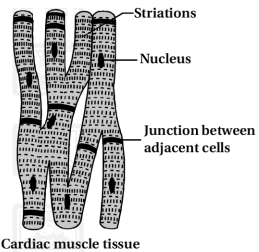
(N/A) Cardiac muscle tissue is a contractile tissue present only in the heart.
$1$. Structure: Cardiac muscle cells are cylindrical,branched,and uninucleated (or sometimes binucleated),with the nucleus located centrally.
$2$. Striations: These muscles are striated,meaning they possess alternating dark and light bands ($A$ and $I$ bands) similar to skeletal muscles.
$3$. Intercalated Discs: $A$ unique feature of cardiac muscle is the presence of intercalated discs at the junctions between adjacent cells. These are specialized cell junctions that allow the cells to contract as a single unit by facilitating rapid communication through gap junctions.
$4$. Connective Tissue: The intercellular spaces are filled with loose connective tissue (endomysium) containing a network of collagen fibers.
$5$. Function: They are involuntary in nature and contract rhythmically throughout life without fatigue.
$1$. Structure: Cardiac muscle cells are cylindrical,branched,and uninucleated (or sometimes binucleated),with the nucleus located centrally.
$2$. Striations: These muscles are striated,meaning they possess alternating dark and light bands ($A$ and $I$ bands) similar to skeletal muscles.
$3$. Intercalated Discs: $A$ unique feature of cardiac muscle is the presence of intercalated discs at the junctions between adjacent cells. These are specialized cell junctions that allow the cells to contract as a single unit by facilitating rapid communication through gap junctions.
$4$. Connective Tissue: The intercellular spaces are filled with loose connective tissue (endomysium) containing a network of collagen fibers.
$5$. Function: They are involuntary in nature and contract rhythmically throughout life without fatigue.
0 likes
View Solution43
MediumMCQ
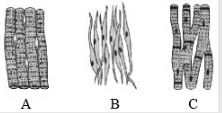
The following figures $A, B$ and $C$ are types of muscle tissue. Identify $A, B$ and $C$.
A
$A$ - Smooth muscle,$B$ - Cardiac muscle,$C$ - Skeletal muscle
B
$A$ - Skeletal muscle,$B$ - Smooth muscle,$C$ - Cardiac muscle
C
$A$ - Cardiac muscle,$B$ - Smooth muscle,$C$ - Skeletal muscle
D
$A$ - Smooth muscle,$B$ - Skeletal muscle,$C$ - Cardiac muscle
Solution
(B) Based on the provided figures:
$A$ represents skeletal muscle,which is characterized by long,cylindrical,multinucleated,and striated fibres.
$B$ represents smooth muscle,which consists of spindle-shaped,uninucleated,and non-striated fibres.
$C$ represents cardiac muscle,which consists of branched,striated,and uninucleated fibres with intercalated discs.
Therefore,the correct identification is $A$ - Skeletal muscle,$B$ - Smooth muscle,$C$ - Cardiac muscle.
$A$ represents skeletal muscle,which is characterized by long,cylindrical,multinucleated,and striated fibres.
$B$ represents smooth muscle,which consists of spindle-shaped,uninucleated,and non-striated fibres.
$C$ represents cardiac muscle,which consists of branched,striated,and uninucleated fibres with intercalated discs.
Therefore,the correct identification is $A$ - Skeletal muscle,$B$ - Smooth muscle,$C$ - Cardiac muscle.
0 likes
View Solution44
EasyMCQ
Muscle tissue cells are contractile,which means they
A
are responsible for the production and secretion of enzymes.
B
are specialized in contraction and relaxation.
C
help in the movement of involuntary organs only.
D
all of the above
Solution
(B) Muscle tissue plays a vital role in providing movement and heat generation to the organs of the body.
Muscle cells are specialized for contractility,which is the ability to shorten,and relaxation,which is the ability to return to their original length.
Therefore,muscle cells are specialized in contraction and relaxation.
Muscle cells are specialized for contractility,which is the ability to shorten,and relaxation,which is the ability to return to their original length.
Therefore,muscle cells are specialized in contraction and relaxation.
0 likes
View Solution45
MediumMCQ
The fibres of which of the following muscles are fusiform and do not show striations?
A
Skeletal muscles
B
Cardiac muscles
C
Both $(a)$ and $(b)$
D
Smooth muscles
Solution
(D) The cells of smooth muscle tissue are fusiform (spindle-shaped) and pointed at their ends.
Striations are absent in these muscles because the actin and myosin filaments are not arranged in a regular,repeating pattern as they are in striated muscles.
Smooth muscles are involuntary and are found in the walls of internal organs.
Striations are absent in these muscles because the actin and myosin filaments are not arranged in a regular,repeating pattern as they are in striated muscles.
Smooth muscles are involuntary and are found in the walls of internal organs.
0 likes
View Solution46
MediumMCQ
Intercalated discs are the communication junctions between the cells of
A
cardiac muscles
B
striped muscles
C
adipose tissue
D
nerve and striated muscles
Solution
(A) Cardiac muscles are involuntary,cross-striated,and non-fatigued fibers.
Cell junctions fuse the plasma membranes of cardiac muscle cells and make them stick together.
Communication junctions,known as intercalated discs,are present at some fusion points.
These discs allow the cells to contract as a single unit; when one cell receives a signal to contract,its neighboring cells are also stimulated to contract.
Cell junctions fuse the plasma membranes of cardiac muscle cells and make them stick together.
Communication junctions,known as intercalated discs,are present at some fusion points.
These discs allow the cells to contract as a single unit; when one cell receives a signal to contract,its neighboring cells are also stimulated to contract.
0 likes
View Solution47
MediumMCQ
Smooth muscles are_
A
voluntary,branched,uninucleate
B
voluntary,multinucleate,cylindrical
C
involuntary,cylindrical,multinucleate
D
involuntary,spindle shaped,uninucleated,tapering
Solution
(D) Smooth muscle is an involuntary,spindle-shaped,uninucleated,tapering,and non-striated muscle.
Smooth muscles are responsible for the contractility of hollow organs,such as blood vessels,the gastrointestinal tract,the bladder,or the uterus.
Their structure differs significantly from that of skeletal muscle,although they can develop isometric force per cross-sectional area equal to that of skeletal muscle.
Smooth muscles are responsible for the contractility of hollow organs,such as blood vessels,the gastrointestinal tract,the bladder,or the uterus.
Their structure differs significantly from that of skeletal muscle,although they can develop isometric force per cross-sectional area equal to that of skeletal muscle.
0 likes
View Solution48
MediumMCQ
Which of the following types of muscle tissue is being described on the basis of the given statements?
$(i)$ These muscle fibres taper at both ends and do not show striations.
$(ii)$ The wall of internal organs such as the blood vessels,stomach,and intestine contain this type of muscle tissue.
$(iii)$ They are 'involuntary' as their function cannot be directly controlled.
$(i)$ These muscle fibres taper at both ends and do not show striations.
$(ii)$ The wall of internal organs such as the blood vessels,stomach,and intestine contain this type of muscle tissue.
$(iii)$ They are 'involuntary' as their function cannot be directly controlled.
A
Skeletal muscle
B
Smooth muscle
C
Cardiac muscle
D
All of these
Solution
(B) The smooth muscle fibres are involuntary,taper at both ends (fusiform shape),and do not show striations under a microscope.
They are found in the walls of internal organs such as the blood vessels,stomach,and intestine.
Since their function cannot be directly controlled by our will,they are termed 'involuntary' muscles.
They are found in the walls of internal organs such as the blood vessels,stomach,and intestine.
Since their function cannot be directly controlled by our will,they are termed 'involuntary' muscles.
0 likes
View Solution49
MediumMCQ
Read the following statements.
$(i)$ It is a contractile tissue present only in the heart.
$(ii)$ Cell junctions fuse the plasma membranes of these cells and make them stick together.
$(iii)$ Communication junctions at some fusion points allow the cells to contract as a unit,i.e.,when one cell receives a signal to contract,its neighbours are also stimulated to contract.
Which of the following type of tissue is being described by the above statements?
$(i)$ It is a contractile tissue present only in the heart.
$(ii)$ Cell junctions fuse the plasma membranes of these cells and make them stick together.
$(iii)$ Communication junctions at some fusion points allow the cells to contract as a unit,i.e.,when one cell receives a signal to contract,its neighbours are also stimulated to contract.
Which of the following type of tissue is being described by the above statements?
A
Skeletal muscle
B
Cardiac muscle
C
Smooth muscle
D
Cartilage
Solution
(B) The statements describe the characteristics of cardiac muscle tissue.
$(i)$ Cardiac muscle is a contractile tissue present exclusively in the heart.
$(ii)$ Cell junctions (intercalated discs) fuse the plasma membranes of cardiac muscle cells,ensuring they remain firmly attached.
$(iii)$ Communication junctions (gap junctions) at these fusion points allow the cells to contract as a single unit (syncytium). When one cell receives a signal to contract,the electrical impulse spreads rapidly to neighboring cells,stimulating them to contract simultaneously.
Therefore,the correct option is $B$.
$(i)$ Cardiac muscle is a contractile tissue present exclusively in the heart.
$(ii)$ Cell junctions (intercalated discs) fuse the plasma membranes of cardiac muscle cells,ensuring they remain firmly attached.
$(iii)$ Communication junctions (gap junctions) at these fusion points allow the cells to contract as a single unit (syncytium). When one cell receives a signal to contract,the electrical impulse spreads rapidly to neighboring cells,stimulating them to contract simultaneously.
Therefore,the correct option is $B$.
0 likes
View Solution50
MediumMCQ
Intercalated discs are present in
A
Striated muscles
B
Unstriated muscles
C
Cardiac muscles
D
Neurons
Solution
(C) Intercalated discs are a unique and distinguishing feature of cardiac muscle. They are dark,irregular,zig-zag partitions found between adjacent cardiac muscle cells. They consist of both transverse and lateral portions. Intercalated discs provide firm adhesions between adjacent cells and facilitate electrical coupling for the rapid spread of excitation,which allows the heart muscle to contract as a single unit.
0 likes
View SolutionStructural Organisation In Animals — Muscular tissue · Frequently Asked Questions
1Are these Structural Organisation In Animals questions useful for JEE and NEET?
Yes. All questions in this section are mapped to JEE Main and NEET exam patterns. Previous year questions from JEE Main, NEET, GUJCET and state-level exams are included with full solutions.
2Can I switch to Hindi or Gujarati for these questions?
Yes. Use the language tabs in the hero section or the sidebar to view the same questions and solutions in English, Hindi or Gujarati.
3How do I generate a question paper from this subtopic?
Use the Vedclass Exam Paper Generator — select the chapter and subtopic, set difficulty, and generate Sets A, B, C, D automatically. First 3 chapters of every subject are free.
Vedclass Products
For Students
Vedclass Test Series
Mock tests in real JEE/NEET style with performance analysis. 5-day free trial.
Start Free TrialFor Teachers
Exam Paper Generator
Generate Set A/B/C/D papers from this chapter in 2 minutes. 3 chapters free.
Try FreeFor Institutes
Online Exam Module
Live online exams with unlimited students, 360° analytics & white-label branding.
See DemoFor Teachers & Institutes
Generate a Structural Organisation In Animals Exam Paper in 2 Minutes
Select subtopic & difficulty — Sets A, B, C, D auto-generated with No Repeat logic.
First 3 chapters of every subject are free — no payment required.