
A English
Morphology of Frog Questions in English
Class 11 Biology · Structural Organisation In Animals · Morphology of Frog
60+
Questions
English
Language
100%
With Solutions
Showing 50 of 60 questions in English
1
MediumMCQ
Neck is absent in a frog. This helps the frog in:
A
Catching prey
B
Respiration
C
Swimming in water
D
Jumping on ground
Solution
(D) The absence of a neck in a frog is an evolutionary adaptation that provides a streamlined body shape. This structural feature reduces air resistance and provides stability during the powerful leaps required for jumping on the ground. Therefore,the correct option is $D$.
0 likes
View Solution2
MediumMCQ
The forelimbs and hindlimbs of a frog have how many digits respectively?
A
Five fingers and four toes
B
Four fingers and five toes
C
Five fingers and five toes
D
Four fingers and four toes
Solution
(B) The forelimbs of a frog are shorter and consist of four digits (fingers).
The hindlimbs are longer and consist of five digits (toes),which are webbed to help in swimming.
Therefore,a frog has four fingers on its forelimbs and five toes on its hindlimbs.
The hindlimbs are longer and consist of five digits (toes),which are webbed to help in swimming.
Therefore,a frog has four fingers on its forelimbs and five toes on its hindlimbs.
0 likes
View Solution3
EasyMCQ
The glands present in the skin of frog are
A
Mucous and poisonous
B
Sweat and mammary
C
Sweat and sebaceous
D
Mucous and sweat
Solution
(A) The skin of a frog is moist,smooth,and slippery due to the presence of mucous glands.
Additionally,the skin contains poisonous glands that secrete toxins to protect the frog from predators.
Therefore,the correct answer is $A$.
Additionally,the skin contains poisonous glands that secrete toxins to protect the frog from predators.
Therefore,the correct answer is $A$.
0 likes
View Solution4
MediumMCQ
$Rana \text{ } tigrina$ is the zoological name of
A
Frog
B
Garden lizard
C
Tiger
D
Krait
Solution
(A) The zoological name of the common Indian bullfrog is $Rana \text{ } tigrina$.
It belongs to the class $Amphibia$ and the order $Anura$.
Therefore, the correct option is $A$.
It belongs to the class $Amphibia$ and the order $Anura$.
Therefore, the correct option is $A$.
0 likes
View Solution5
MediumMCQ
The frog is:
A
Arboreal
B
Terrestrial
C
Fully aquatic
D
Both aquatic and terrestrial
Solution
(D) The correct answer is $(d)$. Frogs are amphibians,meaning they are capable of living both in water and on land.
They are typically found in or near freshwater bodies such as ponds,lakes,ditches,marshes,and slow-moving streams.
Their dual habitat allows them to utilize both environments for different life stages and activities.
They are typically found in or near freshwater bodies such as ponds,lakes,ditches,marshes,and slow-moving streams.
Their dual habitat allows them to utilize both environments for different life stages and activities.
0 likes
View Solution6
EasyMCQ
The Indian bullfrog is found in:
A
Ponds
B
Streams
C
Shallow lakes
D
All of these
Solution
(D) The Indian bullfrog,scientifically known as $Hoplobatrachus \ tigerinus$,is an amphibian.
It is commonly found in freshwater habitats such as ponds,streams,and shallow lakes.
These environments provide the necessary moisture and aquatic conditions required for their survival and reproduction.
Therefore,all the given options are correct habitats for the Indian bullfrog.
It is commonly found in freshwater habitats such as ponds,streams,and shallow lakes.
These environments provide the necessary moisture and aquatic conditions required for their survival and reproduction.
Therefore,all the given options are correct habitats for the Indian bullfrog.
0 likes
View Solution7
MediumMCQ
Which of the following characteristics are possessed by the toad?
A
Bifid tongue,slippery skin and mucous glands
B
Salivary glands,mucous glands and parotid glands
C
Parotid glands,warty skin and semicircular snout
D
Slippery skin,yellow pigment and abundant mucous glands
Solution
(C) Toads belong to the family $Bufonidae$.
Unlike frogs,which typically have smooth,moist skin,toads are characterized by having dry,warty skin.
They possess prominent parotid glands behind their eyes,which secrete toxins as a defense mechanism.
Additionally,they generally have a more rounded or semicircular snout compared to the pointed snout of many frogs.
Therefore,option $C$ is the correct description.
Unlike frogs,which typically have smooth,moist skin,toads are characterized by having dry,warty skin.
They possess prominent parotid glands behind their eyes,which secrete toxins as a defense mechanism.
Additionally,they generally have a more rounded or semicircular snout compared to the pointed snout of many frogs.
Therefore,option $C$ is the correct description.
0 likes
View Solution8
MediumMCQ
Parotid glands are found in
A
Bufo
B
Hyla
C
Rana
D
Alytes
Solution
(A) The elevated poison-secreting glands,known as parotid glands,are present behind each tympanum in the genus $Bufo$.
0 likes
View Solution9
MediumMCQ
The summer sleep of frog is termed as
A
Neoteny
B
Aestivation
C
Paedogenesis
D
Hibernation
Solution
(B) Frogs are cold-blooded animals (poikilotherms) that cannot regulate their internal body temperature.
To survive extreme environmental conditions,they undergo periods of dormancy.
$1$. Aestivation is the state of dormancy or 'summer sleep' that frogs enter during hot and dry summer months to prevent desiccation.
$2$. Hibernation is the state of 'winter sleep' that they enter during cold winter months to conserve energy.
Therefore,the summer sleep of a frog is termed as Aestivation.
To survive extreme environmental conditions,they undergo periods of dormancy.
$1$. Aestivation is the state of dormancy or 'summer sleep' that frogs enter during hot and dry summer months to prevent desiccation.
$2$. Hibernation is the state of 'winter sleep' that they enter during cold winter months to conserve energy.
Therefore,the summer sleep of a frog is termed as Aestivation.
0 likes
View Solution10
EasyMCQ
Why is the frog considered suitable for classroom studies?
A
It is easy to collect and inexpensive.
B
Its size is convenient for dissection.
C
It is non-poisonous.
D
All of the above.
Solution
(D) The frog $(Rana \, tigrina)$ is widely used in educational institutions for the following reasons:
$1$. They are easily available in nature and are inexpensive to procure.
$2$. Their body size is appropriate for performing dissections to study internal organ systems.
$3$. They are non-poisonous, making them safe for students to handle during laboratory sessions.
Therefore, all the given options are correct.
$1$. They are easily available in nature and are inexpensive to procure.
$2$. Their body size is appropriate for performing dissections to study internal organ systems.
$3$. They are non-poisonous, making them safe for students to handle during laboratory sessions.
Therefore, all the given options are correct.
0 likes
View Solution11
EasyMCQ
Which of the following statements is true regarding a female frog?
A
Does not croak
B
Croaks slower and rarer
C
Croaks hoarser,deeper and louder
D
None of the above
Solution
(A) In frogs,the male possesses a pair of vocal sacs that act as resonators to amplify sound,allowing them to produce a loud croaking call to attract females during the breeding season.
Female frogs lack these vocal sacs and therefore do not produce the characteristic croaking sound associated with males.
Female frogs lack these vocal sacs and therefore do not produce the characteristic croaking sound associated with males.
0 likes
View Solution12
EasyMCQ
The croaking of a frog is:
A
Hunger call
B
Danger call
C
Musical tone
D
Sex call for female
Solution
(D) The croaking sound produced by male frogs is a mating call or a sex call.
This sound is produced to attract females for the purpose of reproduction.
Male frogs have vocal sacs that amplify this sound,making it audible over long distances.
This sound is produced to attract females for the purpose of reproduction.
Male frogs have vocal sacs that amplify this sound,making it audible over long distances.
0 likes
View Solution13
MediumMCQ
The body of a frog is divisible into:
A
Head and trunk
B
Head,neck and trunk
C
Head,neck,trunk and tail
D
Head,neck,thorax,abdomen and tail
Solution
(A) The body of a frog is divisible into two main parts: the head and the trunk.
Unlike many other vertebrates,frogs do not possess a distinct neck or a tail in their adult stage.
Therefore,the correct division is head and trunk.
Unlike many other vertebrates,frogs do not possess a distinct neck or a tail in their adult stage.
Therefore,the correct division is head and trunk.
0 likes
View Solution14
MediumMCQ
The neck is absent in a frog. This adaptation helps the frog in:
A
Respiration
B
Catching prey
C
Jumping on ground
D
Swimming in water
Solution
(D) The absence of a neck in a frog is an evolutionary adaptation that provides a streamlined body shape.
This streamlined shape reduces resistance while moving through the water,thereby facilitating efficient swimming.
Therefore,the correct option is $D$.
This streamlined shape reduces resistance while moving through the water,thereby facilitating efficient swimming.
Therefore,the correct option is $D$.
0 likes
View Solution15
EasyMCQ
Frogs have the ability to climb because they possess:
A
Claws
B
Adhesive skin
C
Adhesive pads on fingers and toes
D
Glue-like secretion from mucous glands
Solution
(C) Frogs,particularly tree frogs,have the ability to climb surfaces due to the presence of specialized adhesive pads (also known as toe pads) on their fingers and toes.
These pads contain numerous mucous glands that secrete a sticky substance,which,combined with the microscopic structure of the pads,allows them to adhere to smooth surfaces like leaves or tree bark.
These pads contain numerous mucous glands that secrete a sticky substance,which,combined with the microscopic structure of the pads,allows them to adhere to smooth surfaces like leaves or tree bark.
0 likes
View Solution16
EasyMCQ
Mucus helps the frog in making its:
A
Dry skin
B
Moist skin
C
Rough skin
D
Thick skin
Solution
(B) The skin of a frog is smooth and slippery due to the presence of mucus. The mucous glands present in the skin secrete a slimy fluid called mucus,which keeps the skin moist. This moisture is essential for cutaneous respiration,as frogs breathe through their skin in water and on land.
0 likes
View Solution17
MediumMCQ
Which of the following is not found in the skin of a frog?
A
Scales
B
Epidermis
C
Mucous glands
D
Poison glands
Solution
(A) The skin of a frog is smooth and slippery due to the presence of mucous glands.
It is composed of two main layers: the epidermis and the dermis.
Mucous glands and poison glands are present in the dermis and open onto the surface of the skin.
Scales are characteristic of reptiles and are absent in the skin of amphibians like frogs.
It is composed of two main layers: the epidermis and the dermis.
Mucous glands and poison glands are present in the dermis and open onto the surface of the skin.
Scales are characteristic of reptiles and are absent in the skin of amphibians like frogs.
0 likes
View Solution18
MediumMCQ
The adult frog is:
A
Carnivorous
B
Herbivorous
C
Omnivorous
D
None of these
Solution
(A) The adult frog is carnivorous. It is a predator that feeds on insects,spiders,worms,and other small invertebrates.
0 likes
View Solution19
EasyMCQ
Regarding feeding habit,frog usually ignores
A
Insects
B
Worms
C
Molluscs
D
Motionless prey
Solution
(D) Frogs are carnivorous animals that primarily feed on living,moving prey such as insects,worms,molluscs,and tadpoles.
Their visual system is highly sensitive to movement,which triggers their feeding response.
Consequently,any motionless object or dead food is typically ignored by the frog.
Their visual system is highly sensitive to movement,which triggers their feeding response.
Consequently,any motionless object or dead food is typically ignored by the frog.
0 likes
View Solution20
MediumMCQ
What will happen if the eyes of a frog are covered by paper?
A
Frog will soon die
B
Frog will not move
C
Frog will not do anything
D
Frog will move to one side only
Solution
(C) Frogs rely heavily on visual stimuli to initiate movement and respond to their environment. When a frog's eyes are covered,it loses the ability to perceive its surroundings,which leads to a state of inactivity or lack of response to external stimuli. Therefore,the frog will not do anything.
0 likes
View Solution21
EasyMCQ
The croaking sounds made by frogs are:
A
Hunger call
B
Just a musical note
C
Signaling call of danger
D
Sex call for female partner
Solution
(D) The croaking sound produced by male frogs is a vocalization used to attract female partners for mating. This behavior is a form of sexual selection,where the intensity and frequency of the call help females identify suitable mates.
0 likes
View Solution22
EasyMCQ
The brow spot in a frog is a:
A
Vestige of a nose
B
Vestige of a median eye
C
Light-sensitive spot
D
Swimming-sensitive spot
Solution
(B) The brow spot (also known as the frontal organ or parietal spot) in frogs is a vestigial structure located on the dorsal surface of the head. It represents the remnant of the median or pineal eye,which was present in ancestral vertebrates. Therefore,it is considered a vestige of a median eye.
0 likes
View Solution23
EasyMCQ
Where is calcified cartilage found?
A
Femur of frog
B
Diaphysis of long bones
C
Articular surface of long bones
D
None of these
Solution
(A) Calcified cartilage is a type of cartilage where the matrix becomes impregnated with calcium salts,making it hard and rigid.
In frogs,the femur (thigh bone) contains calcified cartilage,which provides structural support.
This is a characteristic feature of the skeletal system in amphibians like frogs.
In frogs,the femur (thigh bone) contains calcified cartilage,which provides structural support.
This is a characteristic feature of the skeletal system in amphibians like frogs.
0 likes
View Solution24
MediumMCQ
In which of the following are nuclei present in mature $RBCs$?
A
Frog
B
Rabbit
C
Both $a$ and $b$
D
Neither frog nor rabbit
Solution
(A) In mammals,including rabbits,mature $RBCs$ (red blood cells) are enucleated (lack a nucleus) to provide more space for hemoglobin,which increases the oxygen-carrying capacity of the blood.
In contrast,amphibians like frogs possess nucleated $RBCs$ even in their mature state.
Therefore,the correct answer is frog.
In contrast,amphibians like frogs possess nucleated $RBCs$ even in their mature state.
Therefore,the correct answer is frog.
0 likes
View Solution25
EasyMCQ
The common Indian bullfrog is $Rana$ $tigrina$.
A
$Rana$ $tigrina$
B
$Rana$ $esculenta$
C
$Rana$ $silvatica$
D
$Rana$ $goliath$
Solution
(A) The common Indian bullfrog belongs to the species $Rana$ $tigrina$.
$Rana$ $esculenta$ is the edible frog found in Europe.
$Rana$ $silvatica$ is the wood frog.
$Rana$ $goliath$ is the largest frog in the world.
$Rana$ $esculenta$ is the edible frog found in Europe.
$Rana$ $silvatica$ is the wood frog.
$Rana$ $goliath$ is the largest frog in the world.
0 likes
View Solution26
MediumMCQ
The dorsal side of the frog is $.......$ and the ventral side is $...........$.
A
Olive green,uniformly pale yellow
B
Olive green,uniformly deep yellow
C
Olive green,non-uniformly pale yellow
D
Olive green,non-uniformly deep yellow
Solution
(A) The skin of the frog is smooth and slippery due to the presence of mucus. The skin is always maintained in a moist condition. The color of the dorsal side of the body is generally olive green with dark spots. On the other hand,the ventral side of the body is uniformly pale yellow in color.
0 likes
View Solution27
EasyMCQ
$Rana \, tigrina$ is the scientific name of which of the following?
A
Frog
B
Leopard
C
Lizard
D
Earthworm
Solution
(A) $Rana \, tigrina$ is the scientific name of the common Indian bullfrog. It belongs to the class $Amphibia$ and the order $Anura$. Therefore, the correct option is $A$.
0 likes
View Solution28
EasyMCQ
The head of a frog is $..........$ and the anterior conical part is called $..........$.
A
Circular,Snout
B
Triangular,Snout
C
Square,Snout
D
Pentagonal,Snout
Solution
(B) The head of a frog is $triangular$ in shape. The anterior conical part of the head is known as the $snout$.
0 likes
View Solution29
MediumMCQ
Frogs lack a neck. This feature helps the frog in:
A
Catching insects
B
Respiration
C
Swimming in water
D
Leaping on land
Solution
(C) The absence of a neck in frogs is an adaptation that helps in streamlining the body. This streamlined shape reduces resistance while swimming in water,allowing the frog to move efficiently through the aquatic environment. Therefore,the correct answer is $C$.
0 likes
View Solution30
MediumMCQ
Identify the correct statement regarding the frog.
A
The frog is a homeothermic animal.
B
The frog drinks approximately $5$ liters of water in a day.
C
Poison glands are not found on the body of the frog.
D
$A$ very long tail is present on the lateral side of the frog's body.
Solution
(C) $1$. Frogs are poikilothermic (cold-blooded) animals, meaning they cannot regulate their body temperature internally. Thus, option $A$ is incorrect.
$2$. Frogs do not drink water; they absorb it through their skin. Thus, option $B$ is incorrect.
$3$. Many species of frogs, especially those in the family $Dendrobatidae$, possess poison glands in their skin to protect themselves from predators. However, in the context of the common frog $(Rana \, tigrina)$ studied in $NCERT$, the skin is moist and slimy due to mucus glands, but the statement 'poison glands are not found' is generally considered a characteristic feature of the common frog compared to toxic species. Thus, option $C$ is the most appropriate statement.
$4$. Adult frogs do not have a tail. Thus, option $D$ is incorrect.
$2$. Frogs do not drink water; they absorb it through their skin. Thus, option $B$ is incorrect.
$3$. Many species of frogs, especially those in the family $Dendrobatidae$, possess poison glands in their skin to protect themselves from predators. However, in the context of the common frog $(Rana \, tigrina)$ studied in $NCERT$, the skin is moist and slimy due to mucus glands, but the statement 'poison glands are not found' is generally considered a characteristic feature of the common frog compared to toxic species. Thus, option $C$ is the most appropriate statement.
$4$. Adult frogs do not have a tail. Thus, option $D$ is incorrect.
0 likes
View Solution31
EasyMCQ
Which of the following is observed in the forelimbs of a frog?
A
Four digits
B
Five digits
C
Three digits
D
Six digits
Solution
(A) The forelimbs and hindlimbs of a frog help in swimming,walking,leaping,and burrowing. The forelimbs are shorter than the hindlimbs. Each forelimb of a frog consists of a humerus,radio-ulna,carpals,metacarpals,and phalanges. Specifically,the forelimb of a frog has $4$ digits,whereas the hindlimb has $5$ digits.
0 likes
View Solution32
MediumMCQ
In frogs,the eyes are .....
A
myopic on land
B
hypermetropic in water
C
protruding
D
all of the above
0 likes
View Solution33
EasyMCQ
In frogs,.......
A
There is no external ear.
B
There is no external ear,but there is a tympanum and a canal.
C
There is a canal and an external ear.
D
There is a tympanum,and the internal ear is absent.
Solution
(A) In frogs,the ear is an organ of hearing as well as balancing. The ear consists of only the middle ear and the internal ear. The external ear is absent in frogs. Instead,a membranous structure called the tympanum is present on the surface of the head,which receives sound vibrations.
0 likes
View Solution34
EasyMCQ
What is the genus of the frog?
A
Periplaneta
B
Pheretima
C
Rana
D
Helianthus
Solution
(C) The genus of the common frog is $Rana$.
$Periplaneta$ is the genus of the cockroach.
$Pheretima$ is the genus of the earthworm.
$Helianthus$ is the genus of the sunflower.
$Periplaneta$ is the genus of the cockroach.
$Pheretima$ is the genus of the earthworm.
$Helianthus$ is the genus of the sunflower.
0 likes
View Solution35
EasyMCQ
These are absent in mature frog:
A
Digits and cloaca
B
Neck and tail
C
Exoskeleton and Skin
D
Skin and external ear
Solution
(B) In the anatomy of a mature frog $(Rana \, tigrina)$, the body is divided into head and trunk. Unlike many other vertebrates, frogs lack a neck, which prevents them from turning their heads independently. Additionally, while the tadpole larva possesses a tail for swimming, the tail is completely reabsorbed during the process of metamorphosis into an adult frog. Therefore, both the neck and the tail are absent in a mature frog.
0 likes
View Solution36
EasyMCQ
It is absent in frog.
A
Alimentary canal
B
Internal ear
C
External ear
D
Nostrils
Solution
(C) Frogs do not have an external ear (pinna). Instead,they possess a tympanum,which is a membranous structure that receives sound vibrations. The internal ear is present,as are the alimentary canal and nostrils,which are essential for digestion and respiration,respectively.
0 likes
View Solution37
EasyMCQ
Which of the following structures is not present in a female frog?
A
Digits
B
Exoskeleton
C
Pancreas
D
Ureter
Solution
(B) Frogs are amphibians and do not possess an exoskeleton (like scales,feathers,or hair) on their skin. Their skin is moist and glandular. Digits are present on their limbs. The pancreas is a digestive gland present in both sexes. The ureter is part of the excretory system,present in both male and female frogs.
0 likes
View Solution38
MediumMCQ
Which of the following structures is found only in the male frog?
A
Tympanic membrane
B
Nuptial pad
C
Rectum
D
Cloaca
Solution
(B) The $Nuptial$ $pad$ (also known as the $copulatory$ $pad$) is a specialized structure found on the ventral side of the first digit of the forelimbs in male frogs.
It helps the male to grasp the female during the process of amplexus (mating).
Tympanic membrane,rectum,and cloaca are present in both male and female frogs.
It helps the male to grasp the female during the process of amplexus (mating).
Tympanic membrane,rectum,and cloaca are present in both male and female frogs.
0 likes
View Solution39
MediumMCQ
Which of the following is $NOT$ a function of the skin of a frog?
A
Sensory organ
B
Protection
C
Digestion
D
Respiratory organ
Solution
(C) The skin of a frog serves multiple vital functions:
$1$. It acts as a sensory organ by detecting environmental stimuli.
$2$. It provides protection against mechanical injury and pathogens.
$3$. It serves as a respiratory organ,allowing for cutaneous respiration,which is essential for gas exchange.
$4$. Digestion is a function of the alimentary canal,not the skin. Therefore,digestion is not a function of the skin of a frog.
$1$. It acts as a sensory organ by detecting environmental stimuli.
$2$. It provides protection against mechanical injury and pathogens.
$3$. It serves as a respiratory organ,allowing for cutaneous respiration,which is essential for gas exchange.
$4$. Digestion is a function of the alimentary canal,not the skin. Therefore,digestion is not a function of the skin of a frog.
0 likes
View Solution40
MediumMCQ
This is absent in female frog.
A
Vocal sac
B
Cloaca
C
Oviduct
D
Glottis
Solution
(A) In frogs,the male possesses vocal sacs which act as resonators to amplify their croaking sound to attract females during the breeding season.
Female frogs lack these vocal sacs.
Cloaca is present in both sexes as a common chamber for the digestive,urinary,and reproductive tracts.
Oviduct is a female reproductive organ,so it is present in females.
Glottis is the opening to the respiratory tract,present in both sexes.
Female frogs lack these vocal sacs.
Cloaca is present in both sexes as a common chamber for the digestive,urinary,and reproductive tracts.
Oviduct is a female reproductive organ,so it is present in females.
Glottis is the opening to the respiratory tract,present in both sexes.
0 likes
View Solution41
EasyMCQ
The Indian bullfrog is $..........$.
A
Rana tigrina
B
$R$. sylvatica
C
$R$. catesbeiana
D
$R$. esculenta
Solution
(A) The scientific name of the Indian bullfrog is $Rana \ tigrina$.
It is a species of frog found in India and other parts of South Asia.
$Rana \ catesbeiana$ is the American bullfrog,while $Rana \ sylvatica$ is the wood frog.
It is a species of frog found in India and other parts of South Asia.
$Rana \ catesbeiana$ is the American bullfrog,while $Rana \ sylvatica$ is the wood frog.
0 likes
View Solution42
EasyMCQ
The sensory papillae in frogs are associated with
A
smell
B
hearing
C
respiration
D
touch
Solution
(D) Frogs possess various types of sense organs to interact with their environment.
These include sensory papillae for the sense of touch,taste buds for taste,nasal epithelium for smell,eyes for vision,and the tympanum with internal ears for hearing.
Therefore,sensory papillae are specifically associated with the sense of touch.
These include sensory papillae for the sense of touch,taste buds for taste,nasal epithelium for smell,eyes for vision,and the tympanum with internal ears for hearing.
Therefore,sensory papillae are specifically associated with the sense of touch.
0 likes
View Solution43
Easy
Provide general information about the frog.
Solution
(N/A) $\rightarrow$ Frogs can live both on land and in fresh water and belong to the class $Amphibia$ of the phylum $Chordata$. The most common species of frog found in India is $Rana$ $tigrina$.
$\rightarrow$ They do not have a constant body temperature,i.e.,their body temperature varies with the temperature of the environment. Such animals are called cold-blooded or poikilotherms.
$\rightarrow$ The colour of the frog changes while they are in grasses and on dry land. They have the ability to change their colour to hide from their enemies. This protective coloration is known as camouflage or mimicry.
$\rightarrow$ Frogs take shelter in deep burrows to protect themselves from extreme heat and cold during summer and winter. This is known as summer sleep $(aestivation)$ and winter sleep $(hibernation)$.
$\rightarrow$ They do not have a constant body temperature,i.e.,their body temperature varies with the temperature of the environment. Such animals are called cold-blooded or poikilotherms.
$\rightarrow$ The colour of the frog changes while they are in grasses and on dry land. They have the ability to change their colour to hide from their enemies. This protective coloration is known as camouflage or mimicry.
$\rightarrow$ Frogs take shelter in deep burrows to protect themselves from extreme heat and cold during summer and winter. This is known as summer sleep $(aestivation)$ and winter sleep $(hibernation)$.
0 likes
View Solution44
Medium
Describe the external morphology of a frog.
Solution
(N/A) $\rightarrow$ Skin of frog: The skin of a frog is smooth and slippery due to the presence of mucus. The skin lacks an exoskeleton and is always maintained in a moist condition.
$\rightarrow$ The colour of the dorsal side of the body is generally olive green with dark irregular spots. On the ventral side, the skin is uniformly pale yellow.
$\rightarrow$ A frog does not drink water but absorbs it through the skin.
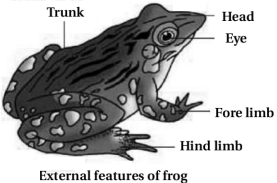
$\rightarrow$ The body of a frog is divisible into head and trunk. A neck and tail are absent.
$\rightarrow$ Above the mouth, a pair of nostrils is present.
$\rightarrow$ Eyes are bulged and covered by a nictitating membrane that protects them while in water.
$\rightarrow$ On either side of the eyes, a membranous tympanum (ear) receives sound signals.
$\rightarrow$ The forelimbs and hind limbs help in swimming, walking, leaping, and burrowing.
$\rightarrow$ Feet have webbed digits that help in swimming.
$\rightarrow$ Sexual dimorphism in frogs: Frogs exhibit sexual dimorphism. Male frogs can be distinguished by the presence of sound-producing vocal sacs and a copulatory pad on the first digit of the forelimbs, which are absent in female frogs.
$\rightarrow$ During the mating period, the skin colour of the male frog becomes dark yellow. No such colour change occurs in females.
$\rightarrow$ In male frogs, the abdomen region is narrow and flat, while during the reproductive season, the abdomen of the female becomes broad and inflated due to the development of numerous egg cells in the ovary.
$\rightarrow$ The colour of the dorsal side of the body is generally olive green with dark irregular spots. On the ventral side, the skin is uniformly pale yellow.
$\rightarrow$ A frog does not drink water but absorbs it through the skin.
$\rightarrow$ The body of a frog is divisible into head and trunk. A neck and tail are absent.
$\rightarrow$ Above the mouth, a pair of nostrils is present.
$\rightarrow$ Eyes are bulged and covered by a nictitating membrane that protects them while in water.
$\rightarrow$ On either side of the eyes, a membranous tympanum (ear) receives sound signals.
$\rightarrow$ The forelimbs and hind limbs help in swimming, walking, leaping, and burrowing.
$\rightarrow$ Feet have webbed digits that help in swimming.
$\rightarrow$ Sexual dimorphism in frogs: Frogs exhibit sexual dimorphism. Male frogs can be distinguished by the presence of sound-producing vocal sacs and a copulatory pad on the first digit of the forelimbs, which are absent in female frogs.
$\rightarrow$ During the mating period, the skin colour of the male frog becomes dark yellow. No such colour change occurs in females.
$\rightarrow$ In male frogs, the abdomen region is narrow and flat, while during the reproductive season, the abdomen of the female becomes broad and inflated due to the development of numerous egg cells in the ovary.
0 likes
View Solution45
Medium
Mention the relation of frogs with human life.
Solution
(N/A) $\rightarrow$ Frogs are beneficial to mankind because they consume insects and protect crops from pests.
$\rightarrow$ Frogs maintain ecological balance by serving as an important link in the food chain and food web within the ecosystem.
$\rightarrow$ In some countries,the muscular legs of the frog are consumed as food by humans.
$\rightarrow$ Frogs maintain ecological balance by serving as an important link in the food chain and food web within the ecosystem.
$\rightarrow$ In some countries,the muscular legs of the frog are consumed as food by humans.
0 likes
View Solution46
Medium
Give the differences between a male frog and a female frog.
Solution
(N/A) The differences between a male frog and a female frog are as follows:
$1$. Vocal sacs: Male frogs possess a pair of vocal sacs,which are absent in female frogs.
$2$. Copulatory pad: Male frogs have a copulatory pad (nuptial pad) on the first digit of each forelimb,which is absent in female frogs.
$3$. Size: Generally,male frogs are smaller in size compared to female frogs.
$4$. Sound: Male frogs can produce a croaking sound using their vocal sacs to attract females during the breeding season,whereas females do not produce such sounds.
$1$. Vocal sacs: Male frogs possess a pair of vocal sacs,which are absent in female frogs.
$2$. Copulatory pad: Male frogs have a copulatory pad (nuptial pad) on the first digit of each forelimb,which is absent in female frogs.
$3$. Size: Generally,male frogs are smaller in size compared to female frogs.
$4$. Sound: Male frogs can produce a croaking sound using their vocal sacs to attract females during the breeding season,whereas females do not produce such sounds.
0 likes
View Solution47
Medium
Give scientific reasons: Frogs are beneficial for human life.
Solution
(N/A) Frogs are considered beneficial for human life due to the following reasons:
$1$. Ecological Balance: Frogs act as important predators in the ecosystem. They feed on insects and pests that damage crops,thereby acting as natural biological control agents.
$2$. Food Chain: They serve as an essential link in the food chain by being both predators (of insects) and prey (for snakes,birds,and other animals),helping to maintain the stability of the ecosystem.
$3$. Scientific Research: Frogs are widely used in biological and medical research,particularly in developmental biology and physiology,due to their relatively simple anatomy and accessible embryos.
$4$. Environmental Indicators: As amphibians,they are highly sensitive to environmental changes and pollution. Their presence or absence serves as an indicator of the health of an ecosystem.
$1$. Ecological Balance: Frogs act as important predators in the ecosystem. They feed on insects and pests that damage crops,thereby acting as natural biological control agents.
$2$. Food Chain: They serve as an essential link in the food chain by being both predators (of insects) and prey (for snakes,birds,and other animals),helping to maintain the stability of the ecosystem.
$3$. Scientific Research: Frogs are widely used in biological and medical research,particularly in developmental biology and physiology,due to their relatively simple anatomy and accessible embryos.
$4$. Environmental Indicators: As amphibians,they are highly sensitive to environmental changes and pollution. Their presence or absence serves as an indicator of the health of an ecosystem.
0 likes
View Solution48
Medium
Give the differences between a male frog and a female frog.
Solution
(N/A)
| Male Frog | Female Frog |
|---|---|
| $(1)$ It has two vocal sacs. | $(1)$ It has no vocal sacs. |
| $(2)$ It has a copulatory pad on the first digit of the forelimb. | $(2)$ It is absent in females. |
| $(3)$ It obtains a dark yellow colour of skin during the reproductive period. | $(3)$ No change in skin colour is observed. |
| $(4)$ Its abdominal region is narrow and flat. | $(4)$ During the reproductive period,the abdomen becomes broad and swollen. |
3 likes
View Solution49
Medium
Frogs are beneficial for mankind,justify the statement.
Solution
(N/A) Frogs are considered beneficial to mankind for the following reasons:
$1$. They are an important link in the food chain and ecosystem. They act as predators of insects and pests,thereby controlling their population.
$2$. They protect crops from damage by feeding on harmful insects.
$3$. Frogs are widely used in biological and medical research as laboratory animals for dissection and physiological studies.
$4$. In some cultures,frog legs are consumed as a source of protein.
$1$. They are an important link in the food chain and ecosystem. They act as predators of insects and pests,thereby controlling their population.
$2$. They protect crops from damage by feeding on harmful insects.
$3$. Frogs are widely used in biological and medical research as laboratory animals for dissection and physiological studies.
$4$. In some cultures,frog legs are consumed as a source of protein.
0 likes
View Solution50
Easy
Give reasons why the frog is beneficial for human life.
Solution
(N/A) $\Rightarrow$ Frogs are beneficial for mankind because they feed on insects and act as natural pest controllers,thereby protecting crops.
$\Rightarrow$ Frogs maintain ecological balance as they serve as an important link in the food chain and food web within the ecosystem.
$\Rightarrow$ In some countries,the muscular legs of the frog are consumed as food by humans.
$\Rightarrow$ Frogs maintain ecological balance as they serve as an important link in the food chain and food web within the ecosystem.
$\Rightarrow$ In some countries,the muscular legs of the frog are consumed as food by humans.
0 likes
View SolutionStructural Organisation In Animals — Morphology of Frog · Frequently Asked Questions
1Are these Structural Organisation In Animals questions useful for JEE and NEET?
Yes. All questions in this section are mapped to JEE Main and NEET exam patterns. Previous year questions from JEE Main, NEET, GUJCET and state-level exams are included with full solutions.
2Can I switch to Hindi or Gujarati for these questions?
Yes. Use the language tabs in the hero section or the sidebar to view the same questions and solutions in English, Hindi or Gujarati.
3How do I generate a question paper from this subtopic?
Use the Vedclass Exam Paper Generator — select the chapter and subtopic, set difficulty, and generate Sets A, B, C, D automatically. First 3 chapters of every subject are free.
Vedclass Products
For Students
Vedclass Test Series
Mock tests in real JEE/NEET style with performance analysis. 5-day free trial.
Start Free TrialFor Teachers
Exam Paper Generator
Generate Set A/B/C/D papers from this chapter in 2 minutes. 3 chapters free.
Try FreeFor Institutes
Online Exam Module
Live online exams with unlimited students, 360° analytics & white-label branding.
See DemoFor Teachers & Institutes
Generate a Structural Organisation In Animals Exam Paper in 2 Minutes
Select subtopic & difficulty — Sets A, B, C, D auto-generated with No Repeat logic.
First 3 chapters of every subject are free — no payment required.