
A English
Morphology of Cockroach Questions in English
Class 11 Biology · Structural Organisation In Animals · Morphology of Cockroach
195+
Questions
English
Language
100%
With Solutions
Showing 50 of 195 questions in English
1
MediumMCQ
Spiracles found in cockroach are
A
$2$ pairs in thorax and $10$ pairs in abdomen
B
$2$ pairs in thorax and $6$ pairs in abdomen
C
$2$ pairs in thorax and $8$ pairs in abdomen
D
$2$ pairs in thorax and $4$ pairs in abdomen
Solution
(C) In cockroaches,there are $10$ pairs of spiracles in total.
$2$ pairs of spiracles are located in the thoracic region (one pair in the mesothorax and one pair in the metathorax).
$8$ pairs of spiracles are located in the abdominal region (one pair on each of the first $8$ abdominal segments).
Therefore,the correct distribution is $2$ pairs in the thorax and $8$ pairs in the abdomen.
$2$ pairs of spiracles are located in the thoracic region (one pair in the mesothorax and one pair in the metathorax).
$8$ pairs of spiracles are located in the abdominal region (one pair on each of the first $8$ abdominal segments).
Therefore,the correct distribution is $2$ pairs in the thorax and $8$ pairs in the abdomen.
0 likes
View Solution2
EasyMCQ
The process of conversion of a small cockroach into an adult cockroach is called as
A
Moulting
B
Metamorphosis
C
Ecdysis
D
Transformation
Solution
(B) The process of development of a cockroach from the nymph stage to the adult stage is known as $Metamorphosis$.
Cockroaches undergo $paurometabolous$ development,meaning that development is through the nymphal stage.
The nymphs look very much like adults and undergo $13$ moults before reaching the adult form.
Cockroaches undergo $paurometabolous$ development,meaning that development is through the nymphal stage.
The nymphs look very much like adults and undergo $13$ moults before reaching the adult form.
0 likes
View Solution3
EasyMCQ
The image formed in the eyes of a cockroach is:
A
Apposition
B
Superposition
C
Both $(a)$ and $(b)$
D
None of these
Solution
(A) The compound eyes of a cockroach consist of several ommatidia,which are the units of vision.
These eyes form an image known as mosaic vision or apposition image.
In this type of vision,each ommatidium receives only a small part of the object,and the final image is formed by the combination of these parts.
Cockroaches do not exhibit superposition vision,which is typically found in some nocturnal insects.
These eyes form an image known as mosaic vision or apposition image.
In this type of vision,each ommatidium receives only a small part of the object,and the final image is formed by the combination of these parts.
Cockroaches do not exhibit superposition vision,which is typically found in some nocturnal insects.
0 likes
View Solution4
EasyMCQ
Cockroach belongs to the class
A
Arthropoda
B
Insecta
C
Crustacea
D
Arachnida
Solution
(B) The cockroach belongs to the Phylum $Arthropoda$ and the Class $Insecta$.
$Arthropoda$ is the phylum,while $Insecta$ is the specific class within that phylum to which cockroaches belong.
$Arthropoda$ is the phylum,while $Insecta$ is the specific class within that phylum to which cockroaches belong.
0 likes
View Solution5
EasyMCQ
To which order does $Periplaneta$ $americana$ belong?
A
Diptera
B
Orthoptera
C
Hemiptera
D
None of the above
Solution
(D) The scientific name $Periplaneta$ $americana$ refers to the American cockroach.
Cockroaches belong to the class $Insecta$ and the order $Blattodea$.
Since $Blattodea$ is not listed among the given options,the correct choice is $D$.
Cockroaches belong to the class $Insecta$ and the order $Blattodea$.
Since $Blattodea$ is not listed among the given options,the correct choice is $D$.
0 likes
View Solution6
EasyMCQ
The basic unit in the eye of a cockroach/insect is:
A
Retina
B
Rhabdome
C
Corneal facet
D
Ommatidium
Solution
(D) Each compound eye of a cockroach is composed of approximately $2000$ visual units called ommatidia. These ommatidia act as the functional units of the compound eye,allowing the insect to perceive images.
0 likes
View Solution7
EasyMCQ
Mouth parts of a butterfly are of which type?
A
Sponging
B
Siphoning
C
Piercing and sucking
D
Chewing and sucking
Solution
(B) The mouth parts of a butterfly are modified into a long,coiled tube known as a proboscis.
This structure is specifically adapted for sucking nectar from flowers.
This type of mouth part is known as the siphoning type.
Therefore,the correct option is $B$.
This structure is specifically adapted for sucking nectar from flowers.
This type of mouth part is known as the siphoning type.
Therefore,the correct option is $B$.
0 likes
View Solution8
EasyMCQ
Cockroach is:
A
Carnivorous
B
Herbivorous
C
Omnivorous
D
Sanguivorous
Solution
(C) The cockroach is an omnivorous organism. It feeds on all types of organic debris,including plant matter,animal remains,and household waste.
0 likes
View Solution9
EasyMCQ
Johnston's organ is found in
A
Antenna of Mosquito
B
Head of Cockroach
C
Abdomen of Housefly
D
Abdomen of Spider
Solution
(A) Johnston's organ is a chordotonal sensory organ located within the second segment (pedicel) of the antennae in insects.
In male mosquitoes,this organ is highly developed and functions as an auditory receptor,which helps them to locate females by detecting the frequency of their wing beats (flight tone).
In male mosquitoes,this organ is highly developed and functions as an auditory receptor,which helps them to locate females by detecting the frequency of their wing beats (flight tone).
0 likes
View Solution10
EasyMCQ
Halteres in mosquitoes and houseflies develop from:
A
Prothorax
B
Metathorax
C
Mesothorax
D
Head
Solution
(B) In mosquitoes and houseflies,halteres develop from the $Metathorax$.
These are modified hindwings that act as balancing organs during flight and also function as sensory organs to receive sound stimuli.
These are modified hindwings that act as balancing organs during flight and also function as sensory organs to receive sound stimuli.
0 likes
View Solution11
EasyMCQ
The mouthparts of a $Cockroach$ are of which type?
A
Piercing and sucking
B
Sucking and siphoning
C
Cutting and biting type
D
Sucking and rasping
Solution
(C) The mouthparts of a $Cockroach$ $(Periplaneta \text{ } americana)$ are adapted for feeding on solid food.
These mouthparts consist of a labrum (upper lip),a pair of mandibles,a pair of maxillae,a labium (lower lip),and a hypopharynx (tongue).
The mandibles are strong,hard,and possess teeth-like structures used for cutting and grinding food.
Therefore,the mouthparts of a $Cockroach$ are classified as the $Cutting \text{ } and \text{ } biting$ type.
These mouthparts consist of a labrum (upper lip),a pair of mandibles,a pair of maxillae,a labium (lower lip),and a hypopharynx (tongue).
The mandibles are strong,hard,and possess teeth-like structures used for cutting and grinding food.
Therefore,the mouthparts of a $Cockroach$ are classified as the $Cutting \text{ } and \text{ } biting$ type.
0 likes
View Solution12
MediumMCQ
In which of the following is the wings vestigial?
A
Female $Blatta \text{ } orientalis$
B
Male $Blatta \text{ } orientalis$
C
Male $Periplaneta \text{ } americana$
D
Female $Periplaneta \text{ } americana$
Solution
(A) In $Blatta \text{ } orientalis$ (the Oriental cockroach), the wings are vestigial in females, while they are well-developed in males.
In $Periplaneta \text{ } americana$ (the American cockroach), both males and females have fully developed wings that extend beyond the tip of the abdomen.
In $Periplaneta \text{ } americana$ (the American cockroach), both males and females have fully developed wings that extend beyond the tip of the abdomen.
0 likes
View Solution13
EasyMCQ
Anal cerci occur in
A
Both male and female cockroaches
B
Male cockroach
C
Female cockroach
D
Female Ascaris
Solution
(A) In cockroaches,a pair of jointed,filamentous structures called anal cerci are present on the $10^{th}$ abdominal segment in both males and females.
These structures are sensory in nature and help in detecting vibrations in the environment.
These structures are sensory in nature and help in detecting vibrations in the environment.
0 likes
View Solution14
EasyMCQ
The order of metamorphosis in the housefly is
A
Egg,nymph,pupa and adult
B
Egg,larva,nymph and adult
C
Egg,larva,pupa and adult
D
Egg,pupa,larva and adult
Solution
(C) The housefly undergoes complete metamorphosis (holometabolous development).
The life cycle consists of four distinct stages:
$1$. Egg: The female lays eggs in decaying organic matter.
$2$. Larva (Maggot): The egg hatches into a legless larva.
$3$. Pupa: The larva transforms into a pupa within a protective casing.
$4$. Imago (Adult): The final stage where the adult fly emerges from the pupa.
Therefore,the correct order is $Egg \rightarrow Larva \rightarrow Pupa \rightarrow Adult$.
The life cycle consists of four distinct stages:
$1$. Egg: The female lays eggs in decaying organic matter.
$2$. Larva (Maggot): The egg hatches into a legless larva.
$3$. Pupa: The larva transforms into a pupa within a protective casing.
$4$. Imago (Adult): The final stage where the adult fly emerges from the pupa.
Therefore,the correct order is $Egg \rightarrow Larva \rightarrow Pupa \rightarrow Adult$.
0 likes
View Solution15
MediumMCQ
Male and female cockroaches can be distinguished externally through:
A
Anal styles in male
B
Anal cerci in female
C
Anal style and antennae in females
D
Both $(a)$ and $(c)$
Solution
(A) Cockroaches are unisexual and exhibit sexual dimorphism.
In males,the $9^{th}$ abdominal segment bears a pair of short,thread-like anal styles ventrally,which are absent in females.
Anal cerci are present in both sexes,so they cannot be used to distinguish between them.
Therefore,the presence of anal styles is a key external feature to distinguish males from females.
In males,the $9^{th}$ abdominal segment bears a pair of short,thread-like anal styles ventrally,which are absent in females.
Anal cerci are present in both sexes,so they cannot be used to distinguish between them.
Therefore,the presence of anal styles is a key external feature to distinguish males from females.
0 likes
View Solution16
MediumMCQ
$Periplaneta$ shows
A
Complete metamorphosis
B
Incomplete metamorphosis
C
No metamorphosis
D
Gradual metamorphosis
Solution
(D) $Periplaneta$ (cockroach) exhibits paurometabolous development,which is a type of incomplete metamorphosis. In this process,the development is direct,and the young ones,called nymphs,resemble the adults. This is also referred to as gradual metamorphosis,as the nymphs grow by moulting (ecdysis) to reach the adult stage.
0 likes
View Solution17
MediumMCQ
Which part of the cockroach has both an exoskeleton and an endoskeleton?
A
Head
B
Thorax
C
Abdomen
D
All the above
Solution
(A) The cockroach possesses an exoskeleton made of chitinous plates called sclerites.
In the head region,the internal skeletal structures are formed by the invagination of the exoskeleton,which provides attachment points for muscles.
These internal structures are collectively referred to as the endoskeleton (or tentorium) of the head.
Therefore,the head of the cockroach contains both an exoskeleton and an endoskeleton.
In the head region,the internal skeletal structures are formed by the invagination of the exoskeleton,which provides attachment points for muscles.
These internal structures are collectively referred to as the endoskeleton (or tentorium) of the head.
Therefore,the head of the cockroach contains both an exoskeleton and an endoskeleton.
0 likes
View Solution18
EasyMCQ
In $Cockroach$,wings are absent from:
A
Prothorax
B
Mesothorax
C
Metathorax
D
None of the above
Solution
(A) The thorax of a $Cockroach$ consists of three segments: $Prothorax$,$Mesothorax$,and $Metathorax$.
$Cockroach$ has two pairs of wings.
The first pair of wings arises from the $Mesothorax$ and is known as $Tegmina$ or $Elytra$,which are thick,hard,and leathery.
The second pair of wings arises from the $Metathorax$ and is thin,soft,and membranous.
Since wings are attached to the $Mesothorax$ and $Metathorax$,they are absent from the $Prothorax$.
$Cockroach$ has two pairs of wings.
The first pair of wings arises from the $Mesothorax$ and is known as $Tegmina$ or $Elytra$,which are thick,hard,and leathery.
The second pair of wings arises from the $Metathorax$ and is thin,soft,and membranous.
Since wings are attached to the $Mesothorax$ and $Metathorax$,they are absent from the $Prothorax$.
0 likes
View Solution19
EasyMCQ
Male cockroach can be distinguished from female cockroach through:
A
Presence of anal styles
B
Longer abdomen
C
Wingless body
D
Broader abdomen
Solution
(A) Male cockroaches can be distinguished from female cockroaches by the presence of a pair of thread-like anal styles,which are absent in females.
Additionally,the abdomen of the male is narrower and longer,whereas the abdomen of the female is broader and shorter.
Therefore,the presence of anal styles is a primary diagnostic feature.
Additionally,the abdomen of the male is narrower and longer,whereas the abdomen of the female is broader and shorter.
Therefore,the presence of anal styles is a primary diagnostic feature.
0 likes
View Solution20
MediumMCQ
Periplaneta differs from Blatta in
A
Reduced wings in Blatta and developed wings in Periplaneta
B
Reverse of $(a)$
C
Anal styles
D
Anal cerci
Solution
(A) In $Periplaneta$,wings are well-developed in both sexes. In $Blatta$ (specifically the female),the tegmina (forewings) are very short and the hind wings are absent,resulting in reduced wings compared to $Periplaneta$.
0 likes
View Solution21
EasyMCQ
In Cockroach,the longest podomere is:
A
Coxa
B
Trochanter
C
Tibia
D
Tarsus
Solution
(C) The leg of a cockroach consists of five segments or podomeres,which are arranged from the body outward as follows: $Coxa$,$Trochanter$,$Femur$,$Tibia$,and $Tarsus$.
Among these,the $Tibia$ is the longest segment of the leg.
Among these,the $Tibia$ is the longest segment of the leg.
0 likes
View Solution22
EasyMCQ
In butterflies,the long coiled siphoning tube is formed from:
A
Labrum
B
Maxilla
C
Labium
D
Mandibles
Solution
(B) In butterflies,the mouthparts are modified into a long,coiled,tube-like structure known as the proboscis,which is used for siphoning nectar from flowers.
This proboscis is formed by the elongation of the $galea$ of the $maxillae$.
This proboscis is formed by the elongation of the $galea$ of the $maxillae$.
0 likes
View Solution23
EasyMCQ
The pseudotrachea of a housefly is formed by:
A
Labella
B
Rostrum
C
Haustellum
D
Basiproboscis
Solution
(A) The proboscis of a housefly consists of three parts: the rostrum,the haustellum,and the labella. The labella are two oval,fleshy lobes at the distal end of the proboscis. These lobes are traversed by a series of fine,semi-circular channels known as pseudotracheae,which resemble the tracheae of insects in appearance and function to collect liquid food.
0 likes
View Solution24
EasyMCQ
Antennae of $Cockroach$ have:
A
Gustatory receptors
B
Auditory receptors
C
Tactile receptors
D
Tactile and olfactory receptors
Solution
(D) The antennae of a $Cockroach$ are sensory organs that bear both tactile (touch) and olfactory (smell) receptors.
These receptors allow the $Cockroach$ to sense its environment,detect food,and identify potential mates or predators through touch and chemical signals in the air.
These receptors allow the $Cockroach$ to sense its environment,detect food,and identify potential mates or predators through touch and chemical signals in the air.
0 likes
View Solution25
EasyMCQ
The number of fertilized eggs in the ootheca of a cockroach is:
A
$16$ pairs in two rows
B
$16$ in two rows
C
$10$ in one row
D
$8$ in two rows
Solution
(B) The ootheca of a cockroach is a dark reddish to blackish brown capsule,about $8-10 \text{ mm}$ long.
Each ootheca contains $16$ fertilized eggs arranged in two rows.
Each ootheca contains $16$ fertilized eggs arranged in two rows.
0 likes
View Solution26
MediumMCQ
Holometaboly is found in
A
Lady Bird Beetle
B
Bed Bug
C
Cockroach
D
Grasshopper
Solution
(A) Holometaboly,or complete metamorphosis,involves four distinct developmental stages: egg,larva,pupa,and adult.
In this process,the larva is morphologically and ecologically very different from the adult.
Among the given options,the Lady Bird Beetle $(Coccinella)$ undergoes complete metamorphosis (holometaboly).
Bed bugs,cockroaches,and grasshoppers undergo hemimetaboly or paurometaboly (incomplete metamorphosis),where the young stages (nymphs) resemble the adults.
In this process,the larva is morphologically and ecologically very different from the adult.
Among the given options,the Lady Bird Beetle $(Coccinella)$ undergoes complete metamorphosis (holometaboly).
Bed bugs,cockroaches,and grasshoppers undergo hemimetaboly or paurometaboly (incomplete metamorphosis),where the young stages (nymphs) resemble the adults.
0 likes
View Solution27
EasyMCQ
Paurometaboly is
A
Complete metamorphosis
B
Gradual metamorphosis
C
Incomplete metamorphosis
D
Complete metabolism
Solution
(B) In the case of gradual metamorphosis,the newly hatched creature (nymph) resembles the adult in general body form,but it lacks wings and external genital appendages. This type of development is known as paurometabolous development.
0 likes
View Solution28
EasyMCQ
The mouthparts of a housefly are known as:
A
Biting and sucking type
B
Sponging and sucking type
C
Biting and chewing type
D
None of these
Solution
(B) The mouthparts of a housefly $(Musca \text{ } domestica)$ are of the sponging and sucking type.
These mouthparts are specifically adapted to feed on liquid or semi-liquid food sources by sponging up the material.
These mouthparts are specifically adapted to feed on liquid or semi-liquid food sources by sponging up the material.
0 likes
View Solution29
MediumMCQ
Which one of the following does not occur in a cockroach leg?
A
Tibia
B
Femur
C
Fibula
D
Coxa
Solution
(C) The leg of a cockroach consists of five segments. Starting from the base towards the distal end,these segments are: $Coxa$,$Trochanter$,$Femur$,$Tibia$,and $Tarsus$.
$Fibula$ is a bone found in the hindlimb of vertebrates (specifically in the lower leg),not in the leg of an insect like a cockroach.
$Fibula$ is a bone found in the hindlimb of vertebrates (specifically in the lower leg),not in the leg of an insect like a cockroach.
0 likes
View Solution30
EasyMCQ
Hind wings of mosquitoes are termed as
A
Coxa
B
Elytra
C
Halteres
D
Tentorium
Solution
(C) In mosquitoes,the metathoracic or hind wings are modified into $Halteres$. These are small,club-shaped structures that act as sensory organs for balance during flight and are also involved in sound production.
0 likes
View Solution31
MediumMCQ
| $A$. Ommatidia | $i$. For vision |
| $B$. Trochanter | $ii$. Fused with large and stout femur |
| $C$. Coxa | $iii$. Articulation with thorax |
| $D$. Sclerites | $iv$. Forming exoskeleton |
Match the columns and choose the correct combination.
A
$A-iv, B-iii, C-i, D-ii$
B
$A-i, B-ii, C-iii, D-iv$
C
$A-ii, B-iv, C-i, D-iii$
D
$A-i, B-iv, C-iii, D-ii$
Solution
(B) The correct matching is as follows:
$1$. $A$. Ommatidia: These are the visual units of the compound eye in insects,used for vision $(i)$.
$2$. $B$. Trochanter: This is a small segment of the insect leg that is fused with the large and stout femur $(ii)$.
$3$. $C$. Coxa: This is the basal segment of the insect leg that provides articulation with the thorax $(iii)$.
$4$. $D$. Sclerites: These are the hardened plates of the insect's body wall that form the exoskeleton $(iv)$.
Therefore,the correct combination is $A-i, B-ii, C-iii, D-iv$.
$1$. $A$. Ommatidia: These are the visual units of the compound eye in insects,used for vision $(i)$.
$2$. $B$. Trochanter: This is a small segment of the insect leg that is fused with the large and stout femur $(ii)$.
$3$. $C$. Coxa: This is the basal segment of the insect leg that provides articulation with the thorax $(iii)$.
$4$. $D$. Sclerites: These are the hardened plates of the insect's body wall that form the exoskeleton $(iv)$.
Therefore,the correct combination is $A-i, B-ii, C-iii, D-iv$.
0 likes
View Solution32
EasyMCQ
Ommatidia serve the purpose of photoreception in
A
Sunflower
B
Cockroach
C
Frog
D
Humans
Solution
(B) . Arthropods possess compound eyes. Each compound eye is composed of numerous independent visual units called ommatidia. These structures are responsible for photoreception in insects like the cockroach.
0 likes
View Solution33
EasyMCQ
The mouth parts of a mosquito are of which type?
A
Piercing and sucking type
B
Sponging type
C
Biting and chewing type
D
Siphoning type
Solution
(A) The mouth parts of mosquitoes are adapted for piercing the skin of the host and sucking blood. Female mosquitoes possess specialized mouth parts for piercing and sucking,while male mosquitoes primarily feed on nectar using a modified sucking mechanism. Therefore,the most accurate description for the mosquito's feeding apparatus is the piercing and sucking type.
0 likes
View Solution34
EasyMCQ
Vision in cockroach is
A
Monocular
B
Binocular
C
Ultrasonic
D
Mosaic
Solution
(D) In cockroaches,the compound eyes consist of several independent visual units called ommatidia. Each ommatidium forms a separate image of a part of the object. These multiple images combine to form a composite image,which is known as mosaic vision. Since the pigment sheath of the ommatidia is non-contractile,the cockroach is capable of only mosaic vision,even during the night.
0 likes
View Solution35
EasyMCQ
Number of segments found in the body of an adult cockroach is
A
$8$
B
$10$
C
$12$
D
$15$
Solution
(B) The body of an adult cockroach is divided into three distinct regions: head,thorax,and abdomen.
The head is formed by the fusion of $6$ segments.
The thorax consists of $3$ segments (prothorax,mesothorax,and metathorax).
The abdomen of an adult cockroach consists of $10$ segments.
Therefore,the total number of segments in the abdomen is $10$.
The head is formed by the fusion of $6$ segments.
The thorax consists of $3$ segments (prothorax,mesothorax,and metathorax).
The abdomen of an adult cockroach consists of $10$ segments.
Therefore,the total number of segments in the abdomen is $10$.
0 likes
View Solution36
EasyMCQ
The peculiar pungent smell of a cockroach is produced by the secretions of:
A
Pheromones
B
Flame cells
C
Abdominal glands
D
Cervical glands
Solution
(A) The peculiar pungent smell of a cockroach is produced by the secretions of pheromones.
These pheromones are chemical substances secreted by the cockroach that elicit specific physiological or behavioral responses in other members of the same species.
They are primarily used for communication,such as attracting mates or marking trails.
Flame cells are excretory organs in Platyhelminthes,not cockroaches.
Abdominal and cervical glands are not the primary source of the characteristic pungent odor associated with cockroaches.
These pheromones are chemical substances secreted by the cockroach that elicit specific physiological or behavioral responses in other members of the same species.
They are primarily used for communication,such as attracting mates or marking trails.
Flame cells are excretory organs in Platyhelminthes,not cockroaches.
Abdominal and cervical glands are not the primary source of the characteristic pungent odor associated with cockroaches.
0 likes
View Solution37
EasyMCQ
The cockroach of genus $Blatta$ is also called:
A
German cockroach
B
Australian cockroach
C
Oriental cockroach
D
American cockroach
Solution
(C) The genus $Blatta$ includes the species $Blatta$ $orientalis$,which is commonly known as the Oriental cockroach.
In contrast,the German cockroach is $Blattella$ $germanica$,the American cockroach is $Periplaneta$ $americana$,and the Australian cockroach is $Periplaneta$ $australasiae$.
In contrast,the German cockroach is $Blattella$ $germanica$,the American cockroach is $Periplaneta$ $americana$,and the Australian cockroach is $Periplaneta$ $australasiae$.
0 likes
View Solution38
EasyMCQ
The young one of a cockroach is called.....
A
Caterpillar
B
Nymph
C
Fingerling
D
Maggot
Solution
(B) In a cockroach,the newly hatched young one is called a nymph.
It resembles the adult in its general structure but lacks wings and mature reproductive organs.
The development of a cockroach is paurometabolous,meaning the nymph undergoes several moulting stages to reach the adult form.
It resembles the adult in its general structure but lacks wings and mature reproductive organs.
The development of a cockroach is paurometabolous,meaning the nymph undergoes several moulting stages to reach the adult form.
0 likes
View Solution39
EasyMCQ
The adhesive pads (soft-pads) present in the legs of a cockroach are known as:
A
Galea
B
Lacinea
C
Glossa
D
Plantulae
Solution
(D) The legs of a cockroach consist of five segments: coxa,trochanter,femur,tibia,and tarsus.
The tarsus is further divided into five segments called tarsomeres.
The adhesive pads present on the ventral surface of the tarsomeres are known as $Plantulae$ (or $arolia$ in some contexts).
These pads help the cockroach in climbing smooth surfaces.
The tarsus is further divided into five segments called tarsomeres.
The adhesive pads present on the ventral surface of the tarsomeres are known as $Plantulae$ (or $arolia$ in some contexts).
These pads help the cockroach in climbing smooth surfaces.
0 likes
View Solution40
MediumMCQ
The diagram represents the posterior end of a male cockroach. Choose the correct combination of labelling.
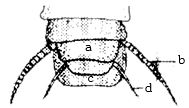
A
$a-8^{th}$ sternum,$b-$ anal cercus,$c-10^{th}$ tergum,$d-$ anal style
B
$a-10^{th}$ tergum,$b-$ anal cercus,$c-$ anal style,$d-8^{th}$ sternum
C
$a-$ anal style,$b-$ anal cercus,$c-10^{th}$ tergum,$d-8^{th}$ sternum
D
$a-8^{th}$ sternum,$b-$ anal style,$c-10^{th}$ tergum,$d-$ anal cercus
Solution
(A) In the male cockroach,the posterior end of the abdomen shows specific structures:
$1$. The $10^{th}$ tergum is the dorsal plate at the end of the abdomen (labeled $c$ in the diagram).
$2$. The anal cerci are paired,jointed,filamentous structures present on the $10^{th}$ segment (labeled $b$).
$3$. The anal styles are a pair of short,thread-like structures present only in males on the $9^{th}$ sternum (labeled $d$).
$4$. The $8^{th}$ sternum is the ventral plate (labeled $a$).
Therefore,the correct labeling is $a-8^{th}$ sternum,$b-$ anal cercus,$c-10^{th}$ tergum,$d-$ anal style.
$1$. The $10^{th}$ tergum is the dorsal plate at the end of the abdomen (labeled $c$ in the diagram).
$2$. The anal cerci are paired,jointed,filamentous structures present on the $10^{th}$ segment (labeled $b$).
$3$. The anal styles are a pair of short,thread-like structures present only in males on the $9^{th}$ sternum (labeled $d$).
$4$. The $8^{th}$ sternum is the ventral plate (labeled $a$).
Therefore,the correct labeling is $a-8^{th}$ sternum,$b-$ anal cercus,$c-10^{th}$ tergum,$d-$ anal style.
0 likes
View Solution41
MediumMCQ
Blood of which of the following is colourless?
A
Earthworm
B
Leech
C
Cockroach
D
Frog
Solution
(C) The blood of a cockroach is colourless because it lacks the respiratory pigment hemoglobin.
It is known as hemolymph.
In contrast,earthworms and leeches have hemoglobin dissolved in their plasma,giving their blood a red colour,and frogs have red blood due to hemoglobin present in their red blood cells.
It is known as hemolymph.
In contrast,earthworms and leeches have hemoglobin dissolved in their plasma,giving their blood a red colour,and frogs have red blood due to hemoglobin present in their red blood cells.
0 likes
View Solution42
MediumMCQ
Which of the following structures helps in distinguishing male cockroaches from female cockroaches?
A
Anal cerci
B
Anal styles
C
Longer antennae
D
Functional wings
Solution
(B) In cockroaches,sexual dimorphism is observed.
Male cockroaches possess a pair of thread-like anal styles on the $9^{th}$ abdominal segment,which are absent in females.
Anal cerci are present in both male and female cockroaches.
Therefore,the presence of anal styles is the key morphological feature used to distinguish males from females.
Male cockroaches possess a pair of thread-like anal styles on the $9^{th}$ abdominal segment,which are absent in females.
Anal cerci are present in both male and female cockroaches.
Therefore,the presence of anal styles is the key morphological feature used to distinguish males from females.
0 likes
View Solution43
MediumMCQ
Complete metamorphosis is present in:
A
House fly and mosquito
B
House fly and cockroach
C
Mosquito and cockroach
D
None of the above
Solution
(A) Complete metamorphosis (holometabolism) involves four distinct stages in the life cycle: egg,larva,pupa,and adult.
Both the house fly ($Musca$ $domestica$) and the mosquito ($Anopheles$ or $Culex$) undergo complete metamorphosis.
In contrast,the cockroach undergoes incomplete metamorphosis (hemimetabolism),where the life cycle consists of egg,nymph,and adult stages,lacking a pupal stage.
Therefore,the correct answer is house fly and mosquito.
Both the house fly ($Musca$ $domestica$) and the mosquito ($Anopheles$ or $Culex$) undergo complete metamorphosis.
In contrast,the cockroach undergoes incomplete metamorphosis (hemimetabolism),where the life cycle consists of egg,nymph,and adult stages,lacking a pupal stage.
Therefore,the correct answer is house fly and mosquito.
0 likes
View Solution44
EasyMCQ
Which of the following is absent in the segments of a cockroach's leg?
A
Fibula
B
Coxa
C
Tibia
D
Femur
Solution
(A) The leg of a cockroach consists of five segments: the basal flat $Coxa$,a small $Trochanter$,a long $Femur$,a slender spiny $Tibia$,and the foot or $Tarsus$. The $Fibula$ is a bone found in the lower leg of vertebrates (like humans) and is absent in the leg segments of a cockroach.
0 likes
View Solution45
MediumMCQ
The unit of photoreception,in a compound eye of a cockroach and other insects,is
A
Ctenidium
B
Osphradium
C
Ommatidium
D
Rhabdome
Solution
(C) The compound eye of a cockroach consists of approximately $2000$ hexagonal units called ommatidia.
Each ommatidium acts as an independent visual unit responsible for photoreception.
Therefore,the ommatidium is the structural and functional unit of the compound eye in insects.
Each ommatidium acts as an independent visual unit responsible for photoreception.
Therefore,the ommatidium is the structural and functional unit of the compound eye in insects.
0 likes
View Solution46
EasyMCQ
Cockroach egg is called as
A
Microlecithal
B
Macrolecithal
C
Isolecithal
D
Centrolecithal
Solution
(D) The egg of a cockroach is of the $Centrolecithal$ type.
In this type of egg,the yolk is concentrated in the central part of the cytoplasm,while the active cytoplasm is restricted to the periphery.
Therefore,the correct option is $D$.
In this type of egg,the yolk is concentrated in the central part of the cytoplasm,while the active cytoplasm is restricted to the periphery.
Therefore,the correct option is $D$.
0 likes
View Solution47
EasyMCQ
Insect metamorphosis having a distinct larval stage is called
A
Retrogressive metamorphosis
B
Complete metamorphosis
C
Incomplete metamorphosis
D
Heteromorphosis
Solution
(B) Complete metamorphosis (also known as holometabolism) involves four distinct stages in the life cycle of an insect: egg $\rightarrow$ larva $\rightarrow$ pupa $\rightarrow$ adult (imago).
In this process,the larva is structurally and functionally very different from the adult.
In this process,the larva is structurally and functionally very different from the adult.
0 likes
View Solution48
EasyMCQ
Piercing and sucking type of mouthparts are found in .........
A
Cockroach
B
Housefly
C
Butterfly
D
Mosquito
Solution
(D) The mouthparts of insects are adapted according to their feeding habits.
$1$. Cockroaches have biting and chewing type mouthparts.
$2$. Houseflies have sponging type mouthparts.
$3$. Butterflies have siphoning type mouthparts.
$4$. Mosquitoes have piercing and sucking type mouthparts,which allow them to penetrate the skin of their host and suck blood.
$1$. Cockroaches have biting and chewing type mouthparts.
$2$. Houseflies have sponging type mouthparts.
$3$. Butterflies have siphoning type mouthparts.
$4$. Mosquitoes have piercing and sucking type mouthparts,which allow them to penetrate the skin of their host and suck blood.
0 likes
View Solution49
MediumMCQ
The visual unit of the compound eye of an insect is known as .....
A
Ommatidium
B
Rod
C
Cone
D
None of these
Solution
(A) The compound eye of an insect is composed of several independent visual units called $Ommatidia$ (singular: $Ommatidium$).
Each $Ommatidium$ acts as a separate photoreceptor unit that captures light and forms a part of the overall image.
Therefore,the correct answer is $Ommatidium$.
Each $Ommatidium$ acts as a separate photoreceptor unit that captures light and forms a part of the overall image.
Therefore,the correct answer is $Ommatidium$.
0 likes
View Solution50
EasyMCQ
The cockroach is an/a ...... .
A
Omnivore
B
Herbivore
C
Carnivore
D
Sanguinivore
Solution
(A) Cockroaches are $Omnivorous$ organisms.
They feed on a wide variety of organic matter, including plant materials, decaying organic matter, and even small insects or food scraps found in human environments.
Therefore, they are classified as $Omnivores$.
They feed on a wide variety of organic matter, including plant materials, decaying organic matter, and even small insects or food scraps found in human environments.
Therefore, they are classified as $Omnivores$.
0 likes
View SolutionStructural Organisation In Animals — Morphology of Cockroach · Frequently Asked Questions
1Are these Structural Organisation In Animals questions useful for JEE and NEET?
Yes. All questions in this section are mapped to JEE Main and NEET exam patterns. Previous year questions from JEE Main, NEET, GUJCET and state-level exams are included with full solutions.
2Can I switch to Hindi or Gujarati for these questions?
Yes. Use the language tabs in the hero section or the sidebar to view the same questions and solutions in English, Hindi or Gujarati.
3How do I generate a question paper from this subtopic?
Use the Vedclass Exam Paper Generator — select the chapter and subtopic, set difficulty, and generate Sets A, B, C, D automatically. First 3 chapters of every subject are free.
Vedclass Products
For Students
Vedclass Test Series
Mock tests in real JEE/NEET style with performance analysis. 5-day free trial.
Start Free TrialFor Teachers
Exam Paper Generator
Generate Set A/B/C/D papers from this chapter in 2 minutes. 3 chapters free.
Try FreeFor Institutes
Online Exam Module
Live online exams with unlimited students, 360° analytics & white-label branding.
See DemoFor Teachers & Institutes
Generate a Structural Organisation In Animals Exam Paper in 2 Minutes
Select subtopic & difficulty — Sets A, B, C, D auto-generated with No Repeat logic.
First 3 chapters of every subject are free — no payment required.