
A English
Stem Questions in English
Class 11 Biology · Morphology of Flowering Plants · Stem
226+
Questions
English
Language
100%
With Solutions
Showing 50 of 226 questions in English
101
MediumMCQ
The stored food in onion is in the form of:
A
Starch
B
Sugar
C
Inulin
D
Glycogen
Solution
(B) In plants, carbohydrates are primarily stored as starch. However, in specific plants like onion $(Allium \text{ cepa})$, the stored food is primarily in the form of soluble sugars (such as glucose and fructose) rather than starch. While starch is the most common storage polysaccharide in plants, onions are known for accumulating high concentrations of sugars in their fleshy leaves (scales).
0 likes
View Solution102
EasyMCQ
What are the 'eyes' of a potato?
A
Axillary buds
B
Accessory buds
C
Adventitious buds
D
Terminal buds
Solution
(A) The 'eyes' of a potato are actually axillary buds located at the nodes on the tuber surface.
These buds are capable of developing into new shoots under favorable conditions.
This is a form of vegetative propagation where the tuber acts as the reproductive unit.
These buds are capable of developing into new shoots under favorable conditions.
This is a form of vegetative propagation where the tuber acts as the reproductive unit.
0 likes
View Solution103
MediumMCQ
Which of the following are considered bast fibers?
A
Jute
B
Flax
C
Hemp
D
All of the above
Solution
(D) Bast fibers are plant fibers collected from the phloem (the inner bark) or the bast surrounding the stem of certain dicotyledonous plants.
These fibers are known for their strength and durability.
Common examples of bast fibers include Jute,Flax,Hemp,and Ramie.
Therefore,all the options provided are correct examples of bast fibers.
These fibers are known for their strength and durability.
Common examples of bast fibers include Jute,Flax,Hemp,and Ramie.
Therefore,all the options provided are correct examples of bast fibers.
0 likes
View Solution104
MediumMCQ
What is most affected in a hollow stem?
A
Conduction of food
B
Conduction of water
C
Storage of food
D
None of the above
Solution
(C) In a hollow stem,the central pith (medulla) is absent or disintegrated.
Since the primary function of the pith is the storage of food,its absence or destruction most significantly affects the storage capacity of the plant.
While vascular tissues (xylem and phloem) are located in the peripheral regions and remain functional for the conduction of water and food,the storage function is the one primarily compromised.
Since the primary function of the pith is the storage of food,its absence or destruction most significantly affects the storage capacity of the plant.
While vascular tissues (xylem and phloem) are located in the peripheral regions and remain functional for the conduction of water and food,the storage function is the one primarily compromised.
0 likes
View Solution105
MediumMCQ
Ginger is a .......
A
Stem
B
Root
C
Leaf
D
Fruit
Solution
(A) Ginger $(Zingiber officinale)$ is a modified underground stem known as a rhizome.
It exhibits characteristics of a stem such as the presence of nodes and internodes,and scale leaves.
It grows horizontally beneath the soil surface and serves as an organ for perennation and vegetative propagation.
It exhibits characteristics of a stem such as the presence of nodes and internodes,and scale leaves.
It grows horizontally beneath the soil surface and serves as an organ for perennation and vegetative propagation.
0 likes
View Solution106
EasyMCQ
The edible part of $Brassica$ $oleracea$ variety $capitata$ is .....
A
Inflorescence
B
Flower bud
C
Vegetative bud
D
Stem
Solution
(C) $Brassica$ $oleracea$ var. $capitata$ is commonly known as cabbage.
In this plant,the leaves are arranged in a compact,spherical structure known as a head.
This head is essentially a large,terminal vegetative bud.
Therefore,the edible part of $Brassica$ $oleracea$ var. $capitata$ is the vegetative bud.
In this plant,the leaves are arranged in a compact,spherical structure known as a head.
This head is essentially a large,terminal vegetative bud.
Therefore,the edible part of $Brassica$ $oleracea$ var. $capitata$ is the vegetative bud.
0 likes
View Solution107
EasyMCQ
Ginger is a ........ .
A
Rhizome
B
Tuber
C
Bulb
D
Corm
Solution
(A) Ginger $(Zingiber officinale)$ is a modified underground stem known as a rhizome.
Rhizomes are characterized by horizontal growth,distinct nodes and internodes,and the presence of scale leaves at the nodes.
They serve as organs of perennation and vegetative propagation.
Therefore,the correct option is $A$.
Rhizomes are characterized by horizontal growth,distinct nodes and internodes,and the presence of scale leaves at the nodes.
They serve as organs of perennation and vegetative propagation.
Therefore,the correct option is $A$.
0 likes
View Solution108
MediumMCQ
Which of the following is an example of a runner?
A
Cynodon dactylon
B
Eichhornia
C
Fragaria
D
Mentha
Solution
(A) runner is a type of sub-aerial stem modification where the stem grows horizontally above the ground.
It develops adventitious roots at the nodes.
$Cynodon\,\,dactylon$ (grass) is a classic example of a runner.
$Eichhornia$ is an example of an offset.
$Fragaria$ (strawberry) is also a runner,but $Cynodon\,\,dactylon$ is the most standard textbook example for this category.
$Mentha$ is an example of a sucker.
It develops adventitious roots at the nodes.
$Cynodon\,\,dactylon$ (grass) is a classic example of a runner.
$Eichhornia$ is an example of an offset.
$Fragaria$ (strawberry) is also a runner,but $Cynodon\,\,dactylon$ is the most standard textbook example for this category.
$Mentha$ is an example of a sucker.
0 likes
View Solution109
MediumMCQ
What is the 'eye' of a potato?
A
Axillary bud
B
Accessory bud
C
Adventitious bud
D
Terminal bud
Solution
(A) The 'eye' of a potato is an axillary bud located at the nodes of the potato tuber.
These buds are capable of sprouting and developing into new potato plants through vegetative propagation.
Since the potato is a modified underground stem,the nodes are represented by these eyes,and the buds present in them are axillary in nature.
These buds are capable of sprouting and developing into new potato plants through vegetative propagation.
Since the potato is a modified underground stem,the nodes are represented by these eyes,and the buds present in them are axillary in nature.
0 likes
View Solution110
MediumMCQ
In which of the following plants does the stem get modified into a leaf-like structure and the leaves get modified into spines?
A
Phylloclade
B
Asparagus
C
Opuntia
D
All of the above
Solution
(C) In plants like $Opuntia$ (prickly pear),the stem becomes flattened and fleshy to perform photosynthesis,a structure known as a $Phylloclade$. To reduce the rate of transpiration in arid conditions,the leaves are modified into spines. Therefore,this specific modification is observed in $Opuntia$.
0 likes
View Solution111
EasyMCQ
The edible part of Knol-Khol is .........
A
Inflorescence
B
Leaves
C
Root
D
Stem
Solution
(D) Knol-Khol, also known as Kohlrabi $(Brassica \text{ } oleracea \text{ } var. \text{ } gongylodes)$, is a vegetable crop where the stem becomes swollen and fleshy due to the storage of food. This swollen, spherical stem is the edible part of the plant.
0 likes
View Solution112
MediumMCQ
Which of the following is the most reduced form of a stem?
A
Rhizome
B
Stolon
C
Runner
D
Corm
Solution
(D) The stem is highly reduced in a $Corm$. $A$ $Corm$ is a short,vertical,swollen underground plant stem that serves as a storage organ used by some plants to survive winter or other adverse conditions. In many plants,such as $Colocasia$ (Arvi),the stem is reduced to a disc-like structure,which is characteristic of a $Corm$.
0 likes
View Solution113
MediumMCQ
The prickles of rose and stem branches are............
A
Modified leaves
B
Modified stipules
C
Exogenous in origin
D
Endogenous in origin
Solution
(C) The prickles of rose are superficial outgrowths of the epidermis and cortex,which makes them exogenous in origin. Similarly,stem branches also arise from the axillary buds located in the axil of leaves,which are also exogenous in origin. Therefore,both prickles and stem branches are exogenous in origin.
0 likes
View Solution114
EasyMCQ
In $Ruscus$,the stem is modified into ........
A
Phyllode
B
Phylloclade
C
Stolon
D
Haustorium
Solution
(B) In $Ruscus$,the stem is modified into a leaf-like structure called a $Phylloclade$ (specifically a $Cladode$).
$Phylloclade$ is a green,flattened,or cylindrical stem that performs photosynthesis.
In $Ruscus$,the $Cladode$ is a modified branch of limited growth that resembles a leaf.
Therefore,the correct option is $B$.
$Phylloclade$ is a green,flattened,or cylindrical stem that performs photosynthesis.
In $Ruscus$,the $Cladode$ is a modified branch of limited growth that resembles a leaf.
Therefore,the correct option is $B$.
0 likes
View Solution115
EasyMCQ
The stem of Opuntia is .........
A
Phyllode
B
Phylloclade
C
Cladode
D
Bulbil
Solution
(B) In $Opuntia$ (prickly pear),the stem is modified into a flattened,fleshy,green structure known as a $Phylloclade$.
This modification allows the plant to perform photosynthesis and store water,which is an adaptation to survive in arid (dry) environments.
The leaves are often reduced to spines to minimize water loss through transpiration.
This modification allows the plant to perform photosynthesis and store water,which is an adaptation to survive in arid (dry) environments.
The leaves are often reduced to spines to minimize water loss through transpiration.
0 likes
View Solution116
EasyMCQ
The stem in turmeric is ........
A
Tuber
B
Bulb
C
Rhizome
D
Corm
Solution
(C) Turmeric $(Curcuma \text{ } longa)$ is a modified underground stem known as a $Rhizome$.
It grows horizontally beneath the soil surface and possesses distinct nodes and internodes, which are characteristic features of stems.
Other examples of rhizomes include ginger $(Zingiber \text{ } officinale)$.
It grows horizontally beneath the soil surface and possesses distinct nodes and internodes, which are characteristic features of stems.
Other examples of rhizomes include ginger $(Zingiber \text{ } officinale)$.
0 likes
View Solution117
EasyMCQ
Phylloclade (leaf-like stem) is found in .........
A
Opuntia
B
Cactus
C
Acacia
D
Both $(A)$ and $(B)$
Solution
(D) phylloclade is a modified stem that is green,flattened or cylindrical,and performs photosynthesis. It is a characteristic adaptation in xerophytic plants to reduce water loss. Both $Opuntia$ (prickly pear) and other members of the Cactaceae family (often referred to as cactus) exhibit this modification. Therefore,both $(A)$ and $(B)$ are correct.
0 likes
View Solution118
EasyMCQ
What is the function of the stem?
A
To bear leaves and branches
B
To conduct water and minerals
C
To store food and conduct nutrients
D
All of the above
Solution
(D) The stem is the ascending part of the axis bearing branches,leaves,flowers,and fruits.
Its primary functions include:
$1$. It supports and bears leaves,flowers,and fruits.
$2$. It conducts water,minerals,and photosynthates between roots and leaves.
$3$. Some stems perform specialized functions like food storage (e.g.,potato),support (e.g.,tendrils),and protection (e.g.,thorns).
Therefore,all the given options are correct functions of the stem.
Its primary functions include:
$1$. It supports and bears leaves,flowers,and fruits.
$2$. It conducts water,minerals,and photosynthates between roots and leaves.
$3$. Some stems perform specialized functions like food storage (e.g.,potato),support (e.g.,tendrils),and protection (e.g.,thorns).
Therefore,all the given options are correct functions of the stem.
0 likes
View Solution119
MediumMCQ
The lateral branches of the stem are . . . . . . in origin.
A
Endogenous
B
Exogenous
C
Both
D
None of the above
Solution
(B) The lateral branches of the stem originate from the axillary buds,which are located in the axils of the leaves. These buds are superficial and arise from the outer layers of the stem,specifically the cortex or epidermis. Therefore,the lateral branches of the stem are exogenous in origin. In contrast,lateral roots are endogenous in origin because they arise from the pericycle,which is an internal layer of the root.
0 likes
View Solution120
MediumMCQ
Ginger is a subterranean stem. For what reason does it differ from a root?
A
It lacks chlorophyll.
B
It stores food.
C
It possesses nodes and internodes.
D
It contains xylem and phloem tissues.
Solution
(C) Ginger is a modified subterranean stem (rhizome).
Stems are morphologically distinct from roots because they possess nodes and internodes.
Nodes are the points where leaves,branches,or buds arise,and internodes are the regions between two nodes.
Roots do not have nodes or internodes; they possess root hairs and a root cap,which are absent in stems.
Stems are morphologically distinct from roots because they possess nodes and internodes.
Nodes are the points where leaves,branches,or buds arise,and internodes are the regions between two nodes.
Roots do not have nodes or internodes; they possess root hairs and a root cap,which are absent in stems.
0 likes
View Solution121
EasyMCQ
Which of the following is a xerophytic plant in which the stem is modified into a flattened,green,and succulent structure?
A
Casuarina
B
Hydrilla
C
Acacia
D
Opuntia
Solution
(D) In xerophytic plants,the stem often undergoes modifications to survive in water-scarce environments. In $Opuntia$ (prickly pear),the stem is modified into a flattened,green,and succulent structure known as a phylloclade. This structure performs photosynthesis and stores water,while the leaves are reduced to spines to minimize transpiration.
0 likes
View Solution122
MediumMCQ
The eyes of the potato tuber are .....
A
Root buds
B
Floral buds
C
Shoot buds
D
Axillary buds
Solution
(D) The potato tuber is a modified underground stem. The 'eyes' on the surface of the potato tuber represent nodes. Each eye consists of an axillary bud protected by a small,scale-like leaf. These axillary buds are capable of growing into new shoots under favorable conditions. Therefore,the eyes of the potato tuber are axillary buds.
0 likes
View Solution123
EasyMCQ
Which of the following is not a modification of the stem?
A
Rhizome of ginger
B
Corm of Colocasia
C
Pitcher of pitcher plant
D
Tuber of potato
Solution
(C) The stem undergoes various modifications to perform functions like storage of food,support,protection,and vegetative propagation.
$1$. Ginger (Rhizome),Colocasia (Corm),and Potato (Tuber) are all examples of underground stem modifications for food storage and perennation.
$2$. The pitcher of a pitcher plant $(Nepenthes)$ is a modification of the leaf,where the leaf lamina is modified into a pitcher-like structure to trap insects for nitrogenous nutrition.
Therefore,the pitcher of a pitcher plant is not a stem modification.
$1$. Ginger (Rhizome),Colocasia (Corm),and Potato (Tuber) are all examples of underground stem modifications for food storage and perennation.
$2$. The pitcher of a pitcher plant $(Nepenthes)$ is a modification of the leaf,where the leaf lamina is modified into a pitcher-like structure to trap insects for nitrogenous nutrition.
Therefore,the pitcher of a pitcher plant is not a stem modification.
0 likes
View Solution124
MediumMCQ
The rhizome of ginger is a modification of the stem because:
A
It produces adventitious roots.
B
It possesses nodes and internodes.
C
It is underground.
D
It stores food materials.
Solution
(B) The stem is characterized by the presence of nodes and internodes. Ginger is a rhizome,which is a modified underground stem. Despite being underground,it retains the fundamental morphological features of a stem,specifically the presence of nodes (where scale leaves are attached) and internodes. Therefore,it is classified as a stem modification.
0 likes
View Solution125
MediumMCQ
In mint,vegetative propagation occurs through ..........
A
Sucker
B
Runner
C
Stolon
D
Rhizome
Solution
(A) In mint $(Mentha)$,vegetative propagation occurs through a specialized underground stem modification known as a $Sucker$.
$Suckers$ are lateral branches that originate from the basal,underground portion of the main stem.
These branches grow horizontally beneath the soil for some distance and then turn upwards to emerge above the ground,developing into a new independent plant.
Therefore,the correct option is $A$.
$Suckers$ are lateral branches that originate from the basal,underground portion of the main stem.
These branches grow horizontally beneath the soil for some distance and then turn upwards to emerge above the ground,developing into a new independent plant.
Therefore,the correct option is $A$.
0 likes
View Solution126
EasyMCQ
The swollen underground structure in an onion is known as .........
A
Root
B
Rhizome
C
Corm
D
Bulb
Solution
(D) The onion is a modified stem known as a $Bulb$.
In a $Bulb$,the stem is highly reduced and disc-like.
The fleshy leaves store food,and the entire structure is covered by dry,membranous scales.
Therefore,the swollen underground structure of an onion is a $Bulb$.
In a $Bulb$,the stem is highly reduced and disc-like.
The fleshy leaves store food,and the entire structure is covered by dry,membranous scales.
Therefore,the swollen underground structure of an onion is a $Bulb$.
0 likes
View Solution127
EasyMCQ
From which of the following is the 'Bhojpatra' (Birch bark) obtained?
A
Leaves of Piper betle
B
Bark of Betula utilis
C
Leaves of Cinchona
D
Bark of Cinchona
Solution
(B) The 'Bhojpatra' is historically known as a writing material used in ancient India. It is obtained from the bark of the Himalayan Birch tree, scientifically known as $Betula \text{ } utilis$. The inner bark of this tree is peeled off and used as a paper-like surface for writing manuscripts.
0 likes
View Solution128
EasyMCQ
Turmeric powder is obtained from which part of the plant?
A
Dried seeds
B
Dried fruits
C
Dried roots
D
Dried rhizomes
Solution
(D) Turmeric $(Curcuma \text{ } longa)$ is a herbaceous perennial plant belonging to the ginger family, $Zingiberaceae$. The part of the plant used as a spice and for medicinal purposes is the rhizome. A rhizome is a modified underground stem that grows horizontally. When harvested, these rhizomes are boiled, dried, and then ground into a fine powder.
0 likes
View Solution129
MediumMCQ
What type of stem does $Zamia$ $pygmaea$ possess?
A
Underground rhizome
B
Aerial filiform
C
Aerial rhizome
D
Climbing rhizome
Solution
(A) $Zamia$ $pygmaea$ is a species of cycad belonging to the family $Zamiaceae$.
It is known for its small,tuberous,and underground stem,which is technically classified as an underground rhizome.
This adaptation helps the plant survive in its environment by storing nutrients and protecting the growing point below the soil surface.
It is known for its small,tuberous,and underground stem,which is technically classified as an underground rhizome.
This adaptation helps the plant survive in its environment by storing nutrients and protecting the growing point below the soil surface.
0 likes
View Solution130
MediumMCQ
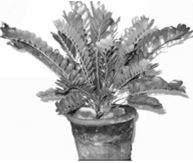
What type of stem does the plant shown in the given figure have?
A
Aerial
B
Underground-Corm
C
Underground-Rhizome
D
Sub-aerial
Solution
(C) The plant shown in the figure is a fern (e.g.,Dryopteris or similar Pteridophyte).
In many ferns,the stem is an underground structure known as a rhizome.
$A$ rhizome is a modified underground stem that grows horizontally and produces roots and leaves.
Therefore,the correct type of stem for this plant is an underground rhizome.
In many ferns,the stem is an underground structure known as a rhizome.
$A$ rhizome is a modified underground stem that grows horizontally and produces roots and leaves.
Therefore,the correct type of stem for this plant is an underground rhizome.
0 likes
View Solution131
MediumMCQ
In $Bougainvillea$,thorns are the modifications of
A
adventitious root
B
stem
C
leaf
D
stipules
Solution
(B) In $Bougainvillea$,the axillary buds of the stem get modified into woody,straight,and pointed structures called thorns. These thorns provide protection to the plant against herbivores. Therefore,thorns in $Bougainvillea$ are modifications of the stem.
0 likes
View Solution132
MediumMCQ
Stems modified into flat green organs performing the functions of leaves are known as
A
phylloclades
B
scales
C
cladodes
D
phyllodes
Solution
(A) : Phylloclades are flattened green stems that have taken over the function of photosynthesis.
Cladodes are branches of the stem that are modified to perform the function of leaves.
Cladodes may not always be flattened; for example, in $Ruscus aculeatus$, cladodes are leaf-like with a spiny tip, whereas in $Asparagus$, they are slightly flattened, fleshy, straight, or curved pointed structures that develop in clusters in the axil of scale leaves.
Phyllodes are modified petioles or rachis of leaves that become green and flattened to perform photosynthesis.
Cladodes are branches of the stem that are modified to perform the function of leaves.
Cladodes may not always be flattened; for example, in $Ruscus aculeatus$, cladodes are leaf-like with a spiny tip, whereas in $Asparagus$, they are slightly flattened, fleshy, straight, or curved pointed structures that develop in clusters in the axil of scale leaves.
Phyllodes are modified petioles or rachis of leaves that become green and flattened to perform photosynthesis.
1 likes
View Solution133
MediumMCQ
An example of an edible underground stem is
A
carrot
B
groundnut
C
sweet potato
D
potato
Solution
(D) : Carrot and sweet potato are root modifications,while the edible part of groundnut is the seed. Potato is an edible underground stem (tuber).
0 likes
View Solution134
MediumMCQ
Which one of the following is a xerophytic plant in which the stem is modified into the flat,green,and succulent structure?
A
Opuntia
B
Casuarina
C
Hydrilla
D
Acacia
Solution
(A) : $Opuntia$ is a xerophytic plant that lives in dry habitats.
It possesses fleshy organs where water and mucilage are stored.
The stem is modified into a flat,green,photosynthetic structure known as a phylloclade,which helps in reducing water loss and performing photosynthesis.
It possesses fleshy organs where water and mucilage are stored.
The stem is modified into a flat,green,photosynthetic structure known as a phylloclade,which helps in reducing water loss and performing photosynthesis.
0 likes
View Solution135
EasyMCQ
In ginger,vegetative propagation occurs through
A
bulbils
B
runners
C
rhizome
D
offsets
Solution
(C) : The rhizome is a thickened,underground,dorsiventral stem that grows horizontally at a particular depth within the soil.
It is brown in colour and shows cymose branching.
It can be distinguished from the modified root by the presence of nodes,internodes,terminal buds,axillary buds,and scale leaves.
The rhizomes are perennial and propagate vegetatively.
They store food materials and appear tuberous.
$E.g.$,$Zingiber$ $officinale$ (ginger),$Curcuma$ $longa$ (turmeric),$Canna$ $indica$.
It is brown in colour and shows cymose branching.
It can be distinguished from the modified root by the presence of nodes,internodes,terminal buds,axillary buds,and scale leaves.
The rhizomes are perennial and propagate vegetatively.
They store food materials and appear tuberous.
$E.g.$,$Zingiber$ $officinale$ (ginger),$Curcuma$ $longa$ (turmeric),$Canna$ $indica$.
0 likes
View Solution136
MediumMCQ
Modification of stem for reproduction is found in.
A
Opuntia and Euphorbia
B
Pineapple and mint
C
Caltrops and Bougainvillaea
D
Cucumber and pumpkins
Solution
(B) In plants like pineapple ($Ananas$ $comosus$),mint $(Mentha)$,and chrysanthemum,the lateral branches originate from the basal and underground portion of the main stem. These branches grow horizontally beneath the soil and then come out obliquely upward,giving rise to leafy shoots. This type of stem modification is known as a sucker,which is a vegetative method of reproduction. Therefore,pineapple and mint exhibit stem modification for reproduction.
0 likes
View Solution137
MediumMCQ
Which of the following is not a modification of the stem for climbing?
A
Citrus
B
Pumpkins
C
Cucumber
D
Watermelon
Solution
(A) In plants,stems can be modified into tendrils to help them climb.
$Pumpkins$,$Cucumber$,and $Watermelon$ are members of the $Cucurbitaceae$ family,where the axillary buds develop into slender,spirally coiled structures called tendrils to support climbing.
In $Citrus$,the axillary buds are modified into woody,straight,and pointed structures called thorns,which provide protection against herbivores rather than aiding in climbing.
Therefore,$Citrus$ is not a modification of the stem for climbing.
$Pumpkins$,$Cucumber$,and $Watermelon$ are members of the $Cucurbitaceae$ family,where the axillary buds develop into slender,spirally coiled structures called tendrils to support climbing.
In $Citrus$,the axillary buds are modified into woody,straight,and pointed structures called thorns,which provide protection against herbivores rather than aiding in climbing.
Therefore,$Citrus$ is not a modification of the stem for climbing.
0 likes
View Solution138
MediumMCQ
It is a fleshy,cylindrical modification of the stem that carries out photosynthesis.
A
Cactus
B
Neem
C
Grapes
D
Euphorbia
Solution
(D) In certain plants,the stem becomes modified into a fleshy,cylindrical,or flattened structure to perform photosynthesis,especially in arid regions where leaves are reduced to spines to minimize water loss.
This modification is known as a phylloclade.
$Euphorbia$ is a classic example of a plant that exhibits a fleshy,cylindrical,photosynthetic stem.
In contrast,$Cactus$ (Opuntia) typically shows a flattened,fleshy,photosynthetic stem.
Therefore,the correct option is $D$.
This modification is known as a phylloclade.
$Euphorbia$ is a classic example of a plant that exhibits a fleshy,cylindrical,photosynthetic stem.
In contrast,$Cactus$ (Opuntia) typically shows a flattened,fleshy,photosynthetic stem.
Therefore,the correct option is $D$.
0 likes
View Solution139
MediumMCQ
The lateral branches originate from the basal and underground portion of the main stem,grow horizontally beneath the soil and then come out obliquely upward giving rise to leafy shoots.
A
Eichhornia
B
Pistia
C
Jasmine
D
Pineapple
Solution
(D) The description provided refers to a type of sub-aerial stem modification known as a $Sucker$.
In plants like $Pineapple$ ($Ananas$ $comosus$),$Chrysanthemum$,and $Banana$,the lateral branches originate from the basal and underground portion of the main stem.
These branches grow horizontally beneath the soil for some distance and then come out obliquely upward,giving rise to leafy shoots.
$Eichhornia$ and $Pistia$ show $Offset$ modification,while $Jasmine$ shows $Stolon$ modification.
In plants like $Pineapple$ ($Ananas$ $comosus$),$Chrysanthemum$,and $Banana$,the lateral branches originate from the basal and underground portion of the main stem.
These branches grow horizontally beneath the soil for some distance and then come out obliquely upward,giving rise to leafy shoots.
$Eichhornia$ and $Pistia$ show $Offset$ modification,while $Jasmine$ shows $Stolon$ modification.
0 likes
View Solution140
MediumMCQ
Identify the odd one out:
A
Cucumber
B
Pumpkins
C
Watermelon
D
Ginger
Solution
(D) The correct answer is $D$ (Ginger).
Cucumber,pumpkins,and watermelon are all examples of plants that possess tendrils,which are modified stems used for climbing.
Ginger is a modified underground stem (rhizome) used for storage and vegetative propagation,not for climbing.
Cucumber,pumpkins,and watermelon are all examples of plants that possess tendrils,which are modified stems used for climbing.
Ginger is a modified underground stem (rhizome) used for storage and vegetative propagation,not for climbing.
0 likes
View Solution141
MediumMCQ
Colocasia is a
A
Modification of root
B
Modification of stem
C
Modification of leaf
D
All of the above
Solution
(B) Colocasia (also known as Taro) is a plant that stores food in an underground stem known as a corm.
Corms are fleshy,swollen,underground stems that serve as organs of perennation and vegetative propagation.
Therefore,Colocasia is considered a modification of the stem.
Corms are fleshy,swollen,underground stems that serve as organs of perennation and vegetative propagation.
Therefore,Colocasia is considered a modification of the stem.
0 likes
View Solution142
MediumMCQ
Choose the correct pair of stem modification and its function/example:
A
Store food - Rhizophora
B
Climbing - Citrus
C
Photosynthesis - Opuntia
D
Protection - Potato
Solution
(C) $1$. $Rhizophora$ exhibits pneumatophores (respiratory roots) for gaseous exchange,not food storage.
$2$. $Citrus$ uses thorns for protection,not climbing. Tendrils are used for climbing.
$3$. $Opuntia$ (prickly pear) has a flattened,fleshy,green stem that performs photosynthesis,a process known as phylloclade.
$4$. $Potato$ is a stem tuber used for food storage,not protection.
$2$. $Citrus$ uses thorns for protection,not climbing. Tendrils are used for climbing.
$3$. $Opuntia$ (prickly pear) has a flattened,fleshy,green stem that performs photosynthesis,a process known as phylloclade.
$4$. $Potato$ is a stem tuber used for food storage,not protection.
1 likes
View Solution143
MediumMCQ
In $Chrysanthemum$,the stem is modified to $.......$.
A
Root,store food
B
Stem,reproduction
C
Root,reproduction
D
Stem,photosynthesis
Solution
(B) In $Chrysanthemum$,the stem exhibits a specific modification known as a sucker.
In this modification,the lateral branch originates from the basal and underground portion of the main stem.
It grows horizontally beneath the soil for some distance and then comes obliquely upward,giving rise to a new leafy shoot.
This modification primarily serves the purpose of vegetative propagation or reproduction.
In this modification,the lateral branch originates from the basal and underground portion of the main stem.
It grows horizontally beneath the soil for some distance and then comes obliquely upward,giving rise to a new leafy shoot.
This modification primarily serves the purpose of vegetative propagation or reproduction.
0 likes
View Solution144
MediumMCQ
Choose the incorrect statement.
A
Stem is modified for climbing in watermelon.
B
Stem thorns are found in Bougainvillea.
C
Stem becomes flat and decreases photosynthesis in Euphorbia.
D
Stem is modified for reproduction in Eichhornia.
Solution
(C) In $C$,the statement claims that the stem becomes flat and decreases photosynthesis in $Euphorbia$. This is incorrect because in $Euphorbia$,the stem becomes fleshy,flat,and green to perform photosynthesis,not to decrease it.
In $A$,watermelon stems are modified into tendrils for climbing,which is correct.
In $B$,$Bougainvillea$ possesses woody,pointed thorns which are modified stems,which is correct.
In $D$,$Eichhornia$ (water hyacinth) has offsets,which are modified stems used for vegetative reproduction,which is correct.
In $A$,watermelon stems are modified into tendrils for climbing,which is correct.
In $B$,$Bougainvillea$ possesses woody,pointed thorns which are modified stems,which is correct.
In $D$,$Eichhornia$ (water hyacinth) has offsets,which are modified stems used for vegetative reproduction,which is correct.
0 likes
View Solution145
MediumMCQ
In Australian acacia, which part performs photosynthesis?
A
Leaf base
B
Petiole
C
Stem
D
Stipules
Solution
(B) In Australian acacia $(Acacia \text{ } auriculiformis)$, the leaves are small and short-lived.
To minimize water loss through transpiration, the petiole expands, becomes green, and synthesizes food.
This modified, flattened, and photosynthetic petiole is known as a phyllode.
To minimize water loss through transpiration, the petiole expands, becomes green, and synthesizes food.
This modified, flattened, and photosynthetic petiole is known as a phyllode.
0 likes
View Solution146
MediumMCQ
Identify the odd one out:
A
Potato
B
Ginger
C
Turmeric
D
Asparagus
Solution
(D) The correct answer is $D$.
Potato,Ginger,and Turmeric are all examples of modified stems (underground stems).
Potato is a tuber,while Ginger and Turmeric are rhizomes.
Asparagus is a plant where the modified stem is a cladode,but in the context of common botanical classification for vegetative propagation and storage,Asparagus is often categorized differently or is the odd one out because it is primarily known for its aerial modified branches or roots,whereas the others are classic examples of underground stem modifications for storage.
Potato,Ginger,and Turmeric are all examples of modified stems (underground stems).
Potato is a tuber,while Ginger and Turmeric are rhizomes.
Asparagus is a plant where the modified stem is a cladode,but in the context of common botanical classification for vegetative propagation and storage,Asparagus is often categorized differently or is the odd one out because it is primarily known for its aerial modified branches or roots,whereas the others are classic examples of underground stem modifications for storage.
0 likes
View Solution147
MediumMCQ
Stem tendril is not present in
A
Cucumber
B
Pumpkins
C
Water melon
D
Citrus
Solution
(D) Stem tendrils are slender, spirally coiled structures that develop from axillary buds and help plants in climbing.
In plants like $Cucumber$, $Pumpkins$, and $Water \text{ } melon$, the axillary buds develop into stem tendrils.
In $Citrus$ and $Bougainvillea$, the axillary buds are modified into thorns, not tendrils.
Therefore, stem tendrils are not present in $Citrus$.
In plants like $Cucumber$, $Pumpkins$, and $Water \text{ } melon$, the axillary buds develop into stem tendrils.
In $Citrus$ and $Bougainvillea$, the axillary buds are modified into thorns, not tendrils.
Therefore, stem tendrils are not present in $Citrus$.
0 likes
View Solution148
MediumMCQ
Euphorbia is an example of the modification of the stem for:
A
Storage
B
Support
C
Protection
D
Photosynthesis
Solution
(D) In $Euphorbia$,the stem becomes fleshy,green,and flattened or cylindrical,performing the function of photosynthesis. This modification is known as a phylloclade. Since the leaves are often reduced to spines or scales to reduce water loss in arid conditions,the stem takes over the role of food production.
0 likes
View Solution149
MediumMCQ
In which of the following plants does the stem perform the function of storage and act as an organ of perennation?
A
Sweet potato
B
Asparagus
C
Ginger
D
Garlic
Solution
(C) The stem in certain plants is modified to perform functions other than the primary ones,such as storage of food and perennation (surviving unfavorable conditions).
Ginger ($Zingiber$ $officinale$) possesses a rhizome,which is a modified underground stem.
This rhizome stores food and acts as an organ of perennation,allowing the plant to survive during unfavorable seasons.
Sweet potato is a root modification (tuberous root),while Asparagus and Garlic have different structural characteristics.
Ginger ($Zingiber$ $officinale$) possesses a rhizome,which is a modified underground stem.
This rhizome stores food and acts as an organ of perennation,allowing the plant to survive during unfavorable seasons.
Sweet potato is a root modification (tuberous root),while Asparagus and Garlic have different structural characteristics.
0 likes
View Solution150
MediumMCQ
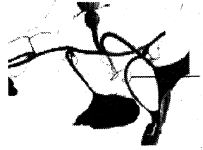
Identify the given figure:
A
Root modified into tendril
B
Stem modified into tendril
C
Leaf modified into tendril
D
None of the above
Solution
(B) The provided figure shows a stem tendril.
Stem tendrils develop from axillary buds.
They are slender and spirally coiled structures that help plants in climbing.
Examples include plants like gourds (cucumber,pumpkins,watermelon) and grapevines.
Therefore,the correct option is $B$.
Stem tendrils develop from axillary buds.
They are slender and spirally coiled structures that help plants in climbing.
Examples include plants like gourds (cucumber,pumpkins,watermelon) and grapevines.
Therefore,the correct option is $B$.
0 likes
View SolutionMorphology of Flowering Plants — Stem · Frequently Asked Questions
1Are these Morphology of Flowering Plants questions useful for JEE and NEET?
Yes. All questions in this section are mapped to JEE Main and NEET exam patterns. Previous year questions from JEE Main, NEET, GUJCET and state-level exams are included with full solutions.
2Can I switch to Hindi or Gujarati for these questions?
Yes. Use the language tabs in the hero section or the sidebar to view the same questions and solutions in English, Hindi or Gujarati.
3How do I generate a question paper from this subtopic?
Use the Vedclass Exam Paper Generator — select the chapter and subtopic, set difficulty, and generate Sets A, B, C, D automatically. First 3 chapters of every subject are free.
Vedclass Products
For Students
Vedclass Test Series
Mock tests in real JEE/NEET style with performance analysis. 5-day free trial.
Start Free TrialFor Teachers
Exam Paper Generator
Generate Set A/B/C/D papers from this chapter in 2 minutes. 3 chapters free.
Try FreeFor Institutes
Online Exam Module
Live online exams with unlimited students, 360° analytics & white-label branding.
See DemoFor Teachers & Institutes
Generate a Morphology of Flowering Plants Exam Paper in 2 Minutes
Select subtopic & difficulty — Sets A, B, C, D auto-generated with No Repeat logic.
First 3 chapters of every subject are free — no payment required.