
A English
Stem Questions in English
Class 11 Biology · Morphology of Flowering Plants · Stem
226+
Questions
English
Language
100%
With Solutions
Showing 49 of 226 questions in English
151
MediumMCQ
Select the correct pair:
A
Banana and pineapple - Branches originate from the basal portion of the stem
B
Mint and jasmine - Modification of leaf
C
Pistia and Eichhornia - Modification of leaf
D
Grass and strawberry - Modification of root
Solution
(A) In $Banana$, $pineapple$, and $Chrysanthemum$, the lateral branches originate from the basal and underground portion of the main stem, grow horizontally beneath the soil, and then come out obliquely upward, giving rise to leafy shoots.
$Mint$ and $jasmine$ show the presence of a slender lateral branch that arises from the base of the main axis; this is a modification of the stem known as a $stolon$.
$Pistia$ and $Eichhornia$ (water hyacinth) are aquatic plants that show a modification of the stem called an $offset$, which is a lateral branch with short internodes.
$Grass$ and $strawberry$ show a modification of the stem known as a $runner$, where the stem runs along the ground surface.
Therefore, the only correct statement regarding the origin of branches is option $A$.
$Mint$ and $jasmine$ show the presence of a slender lateral branch that arises from the base of the main axis; this is a modification of the stem known as a $stolon$.
$Pistia$ and $Eichhornia$ (water hyacinth) are aquatic plants that show a modification of the stem called an $offset$, which is a lateral branch with short internodes.
$Grass$ and $strawberry$ show a modification of the stem known as a $runner$, where the stem runs along the ground surface.
Therefore, the only correct statement regarding the origin of branches is option $A$.
0 likes
View Solution152
EasyMCQ
Vegetative propagation in mint occurs through . . . . . . .
A
Runner
B
Stolon
C
Rhizome
D
Sucker
Solution
(D) In mint $(Mentha)$, vegetative propagation occurs through a specialized underground stem modification known as a $Sucker$. A $Sucker$ is a lateral branch that originates from the basal underground portion of the main stem, grows horizontally beneath the soil for some distance, and then turns upwards to produce a new leafy shoot.
0 likes
View Solution153
EasyMCQ
The 'eyes' of the potato tuber are ..... .
A
Floral buds
B
Shoot buds
C
Axillary buds
D
Root buds
Solution
(C) The potato tuber is a modified underground stem.
On the surface of the potato tuber,there are several small depressions known as 'eyes'.
These 'eyes' represent the nodes of the stem.
Each 'eye' consists of an axillary bud,which is capable of growing into a new shoot under favorable conditions.
On the surface of the potato tuber,there are several small depressions known as 'eyes'.
These 'eyes' represent the nodes of the stem.
Each 'eye' consists of an axillary bud,which is capable of growing into a new shoot under favorable conditions.
0 likes
View Solution154
MediumMCQ
Which of the following is an example of an edible underground stem?
A
Carrot
B
Groundnut
C
Sweet potato
D
Potato
Solution
(D) The potato ($Solanum$ $tuberosum$) is a modified underground stem known as a tuber.
It stores food in the form of starch and possesses 'eyes' which are axillary buds.
In contrast,carrots and sweet potatoes are modified roots (taproot and adventitious root,respectively),and groundnuts are fruits that develop underground.
It stores food in the form of starch and possesses 'eyes' which are axillary buds.
In contrast,carrots and sweet potatoes are modified roots (taproot and adventitious root,respectively),and groundnuts are fruits that develop underground.
0 likes
View Solution155
MediumMCQ
Which of the following is $NOT$ a modification of the stem?
A
Stem thorns of citrus
B
Stem tendrils of cucumber
C
Flattened structure of Opuntia
D
Pitcher of Nepenthes
Solution
(D) The stem undergoes various modifications to perform functions like storage,support,protection,and vegetative propagation.
$1$. Stem thorns of citrus $(A)$ are modified axillary buds,which are stem structures.
$2$. Stem tendrils of cucumber $(B)$ are modified axillary buds,which are stem structures.
$3$. The flattened structure of Opuntia $(C)$ is a modified stem (phylloclade) used for photosynthesis and water storage.
$4$. The pitcher of Nepenthes $(D)$ is a modification of the leaf,not the stem. In pitcher plants,the leaf lamina is modified into a pitcher-like structure to trap insects.
$1$. Stem thorns of citrus $(A)$ are modified axillary buds,which are stem structures.
$2$. Stem tendrils of cucumber $(B)$ are modified axillary buds,which are stem structures.
$3$. The flattened structure of Opuntia $(C)$ is a modified stem (phylloclade) used for photosynthesis and water storage.
$4$. The pitcher of Nepenthes $(D)$ is a modification of the leaf,not the stem. In pitcher plants,the leaf lamina is modified into a pitcher-like structure to trap insects.
0 likes
View Solution156
MediumMCQ
When the stem is modified into a flattened,green structure to perform the function of a leaf,it is called:
A
Phylloclade
B
Phyllode
C
Scales
D
Cladode
Solution
(A) In certain plants,the stem is modified into a flattened,green,succulent structure that performs photosynthesis,similar to a leaf. This structure is known as a $Phylloclade$. Examples include $Opuntia$ and $Euphorbia$. In contrast,a $Phyllode$ is a modification of the petiole or rachis of a leaf into a leaf-like structure.
0 likes
View Solution157
MediumMCQ
The thorns of $Bougainvillea$ are modifications of .........
A
Stipules
B
Adventitious roots
C
Stem
D
Leaves
Solution
(C) In $Bougainvillea$,the axillary buds of the stem get modified into woody,straight,and pointed structures called thorns. These thorns provide protection to the plant against herbivores. Therefore,they are considered modifications of the stem.
0 likes
View Solution158
EasyMCQ
In mint,vegetative propagation occurs by ............ .
A
Stolon
B
Offset
C
Sucker
D
Runner
Solution
(C) In mint $(Mentha)$,vegetative propagation occurs through a specialized underground branch known as a $Sucker$.
$A$ $Sucker$ is a lateral branch that originates from the basal part of the main stem,grows horizontally beneath the soil surface for some distance,and then turns upward to produce a new leafy shoot.
Therefore,the correct option is $C$.
$A$ $Sucker$ is a lateral branch that originates from the basal part of the main stem,grows horizontally beneath the soil surface for some distance,and then turns upward to produce a new leafy shoot.
Therefore,the correct option is $C$.
0 likes
View Solution159
EasyMCQ
Plants of desert regions are generally ..........
A
Viviparous
B
Succulent
C
Herbaceous
D
Heterophyllous
Solution
(B) Desert plants,also known as $Xerophytes$,have evolved specific adaptations to survive in water-scarce environments.
One of the most common adaptations is the presence of $Succulent$ tissues,which store water in their stems,leaves,or roots.
This allows them to survive long periods of drought.
Therefore,the correct option is $B$.
One of the most common adaptations is the presence of $Succulent$ tissues,which store water in their stems,leaves,or roots.
This allows them to survive long periods of drought.
Therefore,the correct option is $B$.
0 likes
View Solution160
MediumMCQ
Prickles of rose are
A
Modified leaves
B
Modified stipules
C
Exogenous in origin
D
Endogenous in origin
Solution
(C) Prickles of rose develop only from the cortex and epidermis and are found at the nodes or internodes.
They help in climbing and protection.
Since they arise from the superficial layers (cortex and epidermis),they are exogenous in origin.
They help in climbing and protection.
Since they arise from the superficial layers (cortex and epidermis),they are exogenous in origin.
0 likes
View Solution161
MediumMCQ
Which of the following is a modified stem for the protection of plants from browsing animals?
A
Tendrils
B
Thorns
C
Rhizome
D
Tuber
Solution
(B) Thorns are hard,woody,and sharp-pointed structures that develop from the axillary buds of the stem. They serve as a defensive mechanism to protect plants from browsing animals. Examples include $Citrus$ and $Bougainvillea$.
0 likes
View Solution162
MediumMCQ
Assertion: Ginger has a prostrate growing rhizome.
Reason: Shoot growth is not affected by gravity.
Reason: Shoot growth is not affected by gravity.
A
If both Assertion and Reason are correct and the Reason is a correct explanation of the Assertion.
B
If both Assertion and Reason are correct but Reason is not a correct explanation of the Assertion.
C
If the Assertion is correct but Reason is incorrect.
D
If both the Assertion and Reason are incorrect.
Solution
(C) Ginger $(Zingiber officinale)$ is a classic example of a rhizome,which is a modified underground stem that grows horizontally (prostrate) under the soil surface.
Therefore,the Assertion is correct.
Regarding the Reason,shoot growth is indeed influenced by gravity (gravitropism/geotropism). Shoots typically exhibit negative geotropism (growing away from gravity),while roots exhibit positive geotropism.
Since the statement 'Shoot growth is not affected by gravity' is scientifically incorrect,the Reason is false.
Thus,the correct option is $C$.
Therefore,the Assertion is correct.
Regarding the Reason,shoot growth is indeed influenced by gravity (gravitropism/geotropism). Shoots typically exhibit negative geotropism (growing away from gravity),while roots exhibit positive geotropism.
Since the statement 'Shoot growth is not affected by gravity' is scientifically incorrect,the Reason is false.
Thus,the correct option is $C$.
0 likes
View Solution163
Difficult
Describe modifications of stem with suitable examples.
Solution
(N/A) Stems of various plants undergo modifications to perform different functions other than their primary role of support and conduction.
$1$. Underground stems (Storage): These stems are modified for food storage and vegetative propagation. Examples include rhizomes (ginger,banana),corms (Colocasia),and tubers (potato). In potatoes,the tips of underground branches swell due to food accumulation,forming 'eyes' which are buds for new plants.
$2$. Supportive stems (Tendrils): In weak-stemmed plants,the stem modifies into thin,slender,and spirally-coiled structures called tendrils. These help the plant climb and attach to supports. Examples include cucumbers,pumpkins,and watermelons (Cucurbitaceae family).
$3$. Protective stems (Thorns): In plants like Bougainvillea and Citrus (lemon,orange),the axillary buds of the stem modify into woody,straight,and pointed structures called thorns. These protect the plant from browsing herbivores.
$4$. Photosynthetic stems (Phylloclades): In some plants like Opuntia (cactus),the stem becomes flattened or fleshy and green to perform photosynthesis,as leaves are often reduced to spines to minimize water loss.
$5$. Vegetative propagation stems: Runners (e.g.,grasses) spread horizontally in the soil to help in perennation. Offsets (e.g.,Eichhornia) are short,thick,lateral branches that produce new plants in aquatic environments.
$1$. Underground stems (Storage): These stems are modified for food storage and vegetative propagation. Examples include rhizomes (ginger,banana),corms (Colocasia),and tubers (potato). In potatoes,the tips of underground branches swell due to food accumulation,forming 'eyes' which are buds for new plants.
$2$. Supportive stems (Tendrils): In weak-stemmed plants,the stem modifies into thin,slender,and spirally-coiled structures called tendrils. These help the plant climb and attach to supports. Examples include cucumbers,pumpkins,and watermelons (Cucurbitaceae family).
$3$. Protective stems (Thorns): In plants like Bougainvillea and Citrus (lemon,orange),the axillary buds of the stem modify into woody,straight,and pointed structures called thorns. These protect the plant from browsing herbivores.
$4$. Photosynthetic stems (Phylloclades): In some plants like Opuntia (cactus),the stem becomes flattened or fleshy and green to perform photosynthesis,as leaves are often reduced to spines to minimize water loss.
$5$. Vegetative propagation stems: Runners (e.g.,grasses) spread horizontally in the soil to help in perennation. Offsets (e.g.,Eichhornia) are short,thick,lateral branches that produce new plants in aquatic environments.
0 likes
View Solution164
Medium
What is a stem? Describe the parts of the stem and its normal functions.
Solution
(N/A) $\rightarrow$ The stem is the ascending part of the plant axis that bears branches, leaves, flowers, and fruits. It develops from the $plumule$ of the embryo of a germinating seed.
$\rightarrow$ The stem is characterized by the presence of $nodes$ and $internodes$. The region of the stem where leaves are born is called a $node$, while $internodes$ are the portions between two nodes.
$\rightarrow$ The stem bears buds, which may be terminal or axillary. It is generally green when young and later often becomes woody and dark brown.
$\rightarrow$ Main functions of the stem:
$(i)$ Spreading out branches bearing leaves, flowers, and fruits.
$(ii)$ It conducts water, minerals, and photosynthates (food) between roots and leaves.
$(iii)$ Some stems perform specialized functions such as storage of food, mechanical support, protection, and vegetative propagation.
$\rightarrow$ The stem is characterized by the presence of $nodes$ and $internodes$. The region of the stem where leaves are born is called a $node$, while $internodes$ are the portions between two nodes.
$\rightarrow$ The stem bears buds, which may be terminal or axillary. It is generally green when young and later often becomes woody and dark brown.
$\rightarrow$ Main functions of the stem:
$(i)$ Spreading out branches bearing leaves, flowers, and fruits.
$(ii)$ It conducts water, minerals, and photosynthates (food) between roots and leaves.
$(iii)$ Some stems perform specialized functions such as storage of food, mechanical support, protection, and vegetative propagation.
0 likes
View Solution165
Easy
Describe modifications of the stem for specific functions.
Solution
(N/A) The stem performs several functions in addition to its primary roles of support and conduction. It undergoes modifications to adapt to these specific functions:
$(A)$ Modification of stems for food storage:
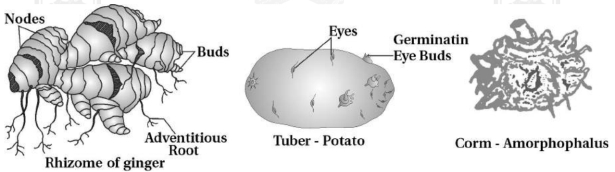
$(i)$ Rhizome: Plants like ginger,turmeric,and Canna have underground stems that grow horizontally. They store food,possess distinct nodes and internodes,and bear scaly leaves and adventitious roots.
$(ii)$ Tuber: In potato,the tips of underground branches swell due to the accumulation of food,forming a tuber. The surface of the tuber has depressions called 'eyes',which represent nodes and contain axillary buds that facilitate vegetative propagation.
$(iii)$ Corm: Amorphophallus (suran) and Colocasia have a condensed,vertically growing underground stem known as a corm,which stores food.
$(B)$ Modifications of stem for climbing:
Stem tendrils develop from axillary buds in plants like gourds (cucumber,pumpkins,watermelon) and grapevines. These are slender,spirally coiled structures that help plants climb.
$(C)$ Modifications of stem for protection:
Axillary buds of the stem may get modified into woody,straight,and pointed thorns in plants like Citrus and Bougainvillea,protecting them from browsing animals.
$(A)$ Modification of stems for food storage:
$(i)$ Rhizome: Plants like ginger,turmeric,and Canna have underground stems that grow horizontally. They store food,possess distinct nodes and internodes,and bear scaly leaves and adventitious roots.
$(ii)$ Tuber: In potato,the tips of underground branches swell due to the accumulation of food,forming a tuber. The surface of the tuber has depressions called 'eyes',which represent nodes and contain axillary buds that facilitate vegetative propagation.
$(iii)$ Corm: Amorphophallus (suran) and Colocasia have a condensed,vertically growing underground stem known as a corm,which stores food.
$(B)$ Modifications of stem for climbing:
Stem tendrils develop from axillary buds in plants like gourds (cucumber,pumpkins,watermelon) and grapevines. These are slender,spirally coiled structures that help plants climb.
$(C)$ Modifications of stem for protection:
Axillary buds of the stem may get modified into woody,straight,and pointed thorns in plants like Citrus and Bougainvillea,protecting them from browsing animals.
0 likes
View Solution166
MediumMCQ
What are the main functions of the stem?
A
Primary support for branches,leaves,flowers,and fruits.
B
Conduction of water,minerals,and photosynthates.
C
Storage of food,vegetative propagation,and protection.
D
All of the above.
Solution
(D) The stem is the ascending part of the axis bearing branches,leaves,flowers,and fruits. Its main functions include:
$1$. Support: It provides structural support to the plant,holding leaves,flowers,and fruits in positions that maximize exposure to sunlight and pollinators.
$2$. Conduction: It acts as a conduit for the transport of water and minerals from the roots to the leaves (via xylem) and the transport of photosynthates from the leaves to other parts of the plant (via phloem).
$3$. Storage: Many stems are modified to store food (e.g.,potato,ginger).
$4$. Propagation: Stems can facilitate vegetative propagation (e.g.,runners,suckers).
$5$. Protection: Some stems are modified into thorns to protect the plant from herbivores.
$1$. Support: It provides structural support to the plant,holding leaves,flowers,and fruits in positions that maximize exposure to sunlight and pollinators.
$2$. Conduction: It acts as a conduit for the transport of water and minerals from the roots to the leaves (via xylem) and the transport of photosynthates from the leaves to other parts of the plant (via phloem).
$3$. Storage: Many stems are modified to store food (e.g.,potato,ginger).
$4$. Propagation: Stems can facilitate vegetative propagation (e.g.,runners,suckers).
$5$. Protection: Some stems are modified into thorns to protect the plant from herbivores.
0 likes
View Solution167
Easy
Describe the modifications of the stem for food storage.
Solution
(N/A) The stem undergoes modifications to perform various functions,including the storage of food. Key examples include:
$(i)$ Rhizome: Found in plants like ginger $(Zingiber officinale)$ and turmeric $(Curcuma longa)$. These are underground stems that store food and grow horizontally. They possess nodes,internodes,scale leaves,and adventitious roots.
$(ii)$ Tuber: Seen in potato $(Solanum tuberosum)$. The tips of underground branches swell due to the accumulation of starch. The surface of the tuber has 'eyes',which are axillary buds capable of vegetative propagation.
$(iii)$ Corm: Seen in $Amorphophallus$ (Elephant foot yam) and $Colocasia$. It is a condensed,vertical form of a rhizome that stores food and helps in perennation.
$(i)$ Rhizome: Found in plants like ginger $(Zingiber officinale)$ and turmeric $(Curcuma longa)$. These are underground stems that store food and grow horizontally. They possess nodes,internodes,scale leaves,and adventitious roots.
$(ii)$ Tuber: Seen in potato $(Solanum tuberosum)$. The tips of underground branches swell due to the accumulation of starch. The surface of the tuber has 'eyes',which are axillary buds capable of vegetative propagation.
$(iii)$ Corm: Seen in $Amorphophallus$ (Elephant foot yam) and $Colocasia$. It is a condensed,vertical form of a rhizome that stores food and helps in perennation.
0 likes
View Solution168
Medium
Describe the modifications of the stem for climbing.
Solution
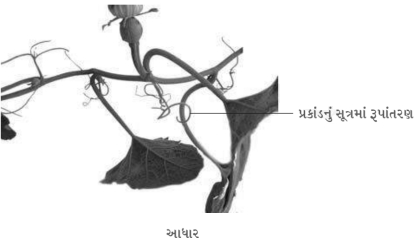
(N/A) In plants like $Passion \text{ } flower$ (Passiflora), $Cucurbita$ (pumpkins), $Bitter \text{ } gourd$, $Gourd$, $Cucumber$, $Watermelon$, and $Grape \text{ } vines$, the axillary bud develops into a thin, slender, and spirally coiled structure called a stem tendril.
These tendrils help the plant to climb by coiling around a support.
Such plants are known as climbers.
These tendrils help the plant to climb by coiling around a support.
Such plants are known as climbers.
0 likes
View Solution169
Medium
Describe the modifications of the stem for protection.
Solution
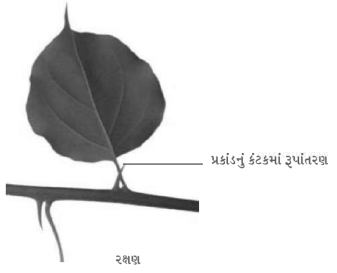
(N/A) The axillary buds of the stem may get modified into woody,straight,and pointed structures called thorns. They protect the plants from browsing animals. Examples include Citrus and Bougainvillea.
0 likes
View Solution170
Easy
Describe the modifications of the stem for photosynthesis.
Solution
(N/A) In some plants of arid regions,the stems become flattened (e.g.,$Opuntia$) or fleshy cylindrical (e.g.,$Euphorbia$) structures. They contain chlorophyll and are capable of performing photosynthesis. These modified stems are known as $Phylloclade$. Examples include $Opuntia$,$Euphorbia$,and $Muehlenbeckia$.
0 likes
View Solution171
Easy
Give scientific reasons: $Opuntia$ has phylloclade.
Solution
(N/A) $\rightarrow$ $Opuntia$ is a xerophytic plant. Due to the dry atmosphere,less water is available from the soil. To prevent the loss of water,leaves are shed,become small,or are converted into spines. In the absence of leaves to perform photosynthesis,the stem becomes broad,flat,green,and contains chlorophyll,acting like a leaf. This modification of the stem into a leaf-like structure is called a phylloclade.
0 likes
View Solution172
MediumMCQ
Give scientific reasons: Although ginger grows under the soil,it is a stem,not a root.
A
It has nodes and internodes.
B
It stores food.
C
It grows horizontally.
D
It lacks root hairs.
Solution
(A) Ginger is an underground modification of a stem known as a rhizome.
$1$. It possesses distinct nodes and internodes,which are characteristic features of a stem.
$2$. It bears scaly leaves at the nodes.
$3$. It contains axillary buds that can develop into new shoots.
$4$. Unlike roots,it does not have a root cap or root hairs.
Therefore,despite growing underground,ginger is classified as a stem.
$1$. It possesses distinct nodes and internodes,which are characteristic features of a stem.
$2$. It bears scaly leaves at the nodes.
$3$. It contains axillary buds that can develop into new shoots.
$4$. Unlike roots,it does not have a root cap or root hairs.
Therefore,despite growing underground,ginger is classified as a stem.
1 likes
View Solution173
Medium
Define/Explain the following terms:
$(i)$ Leaf-like stem (Phylloclade)
$(ii)$ Stolon
$(i)$ Leaf-like stem (Phylloclade)
$(ii)$ Stolon
Solution
(N/A) $(i)$ In plants of arid regions,leaves are often reduced or shed to control transpiration. In the absence of leaves,the stem becomes green,fleshy,and flattened to perform photosynthesis. This modified photosynthetic stem is called a phylloclade (e.g.,Opuntia).
$(ii)$ $A$ stolon is a slender,horizontal branch that arises from the base of the main plant axis. It grows above the ground and produces new daughter plants from buds located at its tips or nodes upon touching the soil (e.g.,Nephrolepis,strawberry).
$(ii)$ $A$ stolon is a slender,horizontal branch that arises from the base of the main plant axis. It grows above the ground and produces new daughter plants from buds located at its tips or nodes upon touching the soil (e.g.,Nephrolepis,strawberry).
0 likes
View Solution174
Medium
Provide definitions/explanations for the following terms:
$(i)$ Spine
$(ii)$ Bulb
$(i)$ Spine
$(ii)$ Bulb
Solution
(N/A) $(i)$ In some plants,the apical bud or axillary bud develops into a pointed,hard,and woody protective structure known as a spine. Examples include Pomegranate and Carissa (Karamdi).
$(ii)$ $A$ bulb is a modified stem structure,such as in an onion,where the stem is reduced and surrounded by fleshy or dry scaly leaves.
$(ii)$ $A$ bulb is a modified stem structure,such as in an onion,where the stem is reduced and surrounded by fleshy or dry scaly leaves.
0 likes
View Solution175
Easy
Define/Explain: Bulb.
Solution
(N/A) $Bulb$ is a modified underground stem that serves as a perennating and storage organ in certain plants.
It consists of a short, disc-like stem (the basal plate) from which fleshy, scale-like leaves emerge.
These scale leaves store food, which helps the plant survive during unfavorable conditions.
Adventitious roots grow from the lower surface of the basal plate.
Examples include $Allium \text{ } cepa$ (onion) and $Allium \text{ } sativum$ (garlic).
It consists of a short, disc-like stem (the basal plate) from which fleshy, scale-like leaves emerge.
These scale leaves store food, which helps the plant survive during unfavorable conditions.
Adventitious roots grow from the lower surface of the basal plate.
Examples include $Allium \text{ } cepa$ (onion) and $Allium \text{ } sativum$ (garlic).
0 likes
View Solution176
Medium
Although potato tuber is an underground part,it is considered as a stem. Give two reasons.
Solution
(N/A) Potato tuber is considered a stem because:
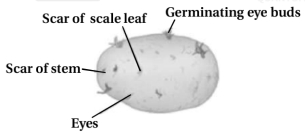
$(a)$ It possesses nodes (known as 'eyes') and internodes,which are characteristic features of a stem.
$(b)$ The 'eyes' contain axillary buds that can sprout into new leafy shoots,demonstrating the vegetative propagation capability typical of stems.
$(a)$ It possesses nodes (known as 'eyes') and internodes,which are characteristic features of a stem.
$(b)$ The 'eyes' contain axillary buds that can sprout into new leafy shoots,demonstrating the vegetative propagation capability typical of stems.
0 likes
View Solution177
Medium
Tendrils are found in the following plants. Identify whether they are stem tendrils or leaf tendrils: $(a)$ Cucumber,$(b)$ Peas,$(c)$ Pumpkins,$(d)$ Grapevine,$(e)$ Watermelon.
Solution
(N/A) Cucumber ($Cucumis$ $sativus$): Modification of axillary bud into stem tendril.
$(b)$ Peas ($Pisum$ $sativum$): Modification of leaves into tendril for climbing.
$(c)$ Pumpkins ($Cucurbita$ $pepo$): Modification of axillary bud into stem tendril.
$(d)$ Grapevine ($Vitis$ $vinifera$): Modification of axillary bud into stem tendril.
$(e)$ Watermelon ($Citrullus$ $lanatus$): Modification of axillary bud into stem tendril.
$(b)$ Peas ($Pisum$ $sativum$): Modification of leaves into tendril for climbing.
$(c)$ Pumpkins ($Cucurbita$ $pepo$): Modification of axillary bud into stem tendril.
$(d)$ Grapevine ($Vitis$ $vinifera$): Modification of axillary bud into stem tendril.
$(e)$ Watermelon ($Citrullus$ $lanatus$): Modification of axillary bud into stem tendril.
0 likes
View Solution178
Medium
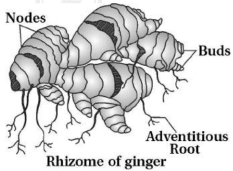
The rhizome of ginger resembles the roots of other plants as it grows underground. Despite this fact,ginger is a stem and not a root. Justify.
Solution
Ginger is considered a stem rather than a root due to the following characteristics:
$1$. Presence of Nodes and Internodes: Ginger possesses distinct nodes and internodes,which are characteristic features of a stem. Roots do not have nodes or internodes.
$2$. Presence of Buds: The nodes of ginger bear buds (axillary buds),which can give rise to new aerial shoots. Roots lack such buds.
$3$. Adventitious Roots: The roots seen growing from the ginger rhizome are adventitious roots,which arise from the nodes of the stem,not from the radicle.
$4$. Function: While roots are primarily involved in anchorage and absorption,the ginger rhizome functions as a storage organ for food,which is a common modification of underground stems.
$1$. Presence of Nodes and Internodes: Ginger possesses distinct nodes and internodes,which are characteristic features of a stem. Roots do not have nodes or internodes.
$2$. Presence of Buds: The nodes of ginger bear buds (axillary buds),which can give rise to new aerial shoots. Roots lack such buds.
$3$. Adventitious Roots: The roots seen growing from the ginger rhizome are adventitious roots,which arise from the nodes of the stem,not from the radicle.
$4$. Function: While roots are primarily involved in anchorage and absorption,the ginger rhizome functions as a storage organ for food,which is a common modification of underground stems.
0 likes
View Solution179
Medium
Describe various stem modifications associated with food storage,climbing,and protection.
Solution
(N/A) The stem performs several specialized functions in addition to its primary roles of support and conduction. It undergoes modifications to adapt to these functions:
$(A)$ Modification of stems for food storage:
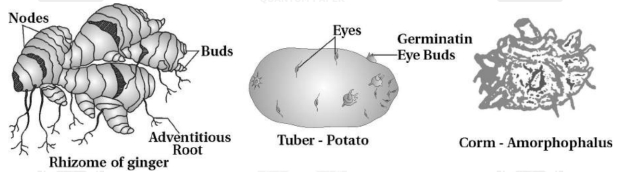
$(i)$ Rhizome: Underground stems like ginger,turmeric,and Colocasia store food and become fleshy. They possess nodes,internodes,scaly leaves,and adventitious roots.
$(ii)$ Tuber: In potato,the tips of underground branches swell due to food storage,forming a round or oval structure called a tuber. The surface has depressions called 'eyes',which contain buds that perform vegetative propagation.
$(iii)$ Corm: Amorphophallus is a condensed,vertical form of a rhizome.
$(B)$ Modifications of stem for climbing:
Stem tendrils: In plants like cucumber,pumpkin,watermelon,and grapevines,axillary buds develop into slender,spirally coiled structures called stem tendrils,which help the plant climb.
$(C)$ Modifications of stem for protection:
Thorns: In plants like Citrus and Bougainvillea,axillary buds are modified into woody,straight,and pointed structures called thorns,which protect the plants from browsing animals.
$(A)$ Modification of stems for food storage:
$(i)$ Rhizome: Underground stems like ginger,turmeric,and Colocasia store food and become fleshy. They possess nodes,internodes,scaly leaves,and adventitious roots.
$(ii)$ Tuber: In potato,the tips of underground branches swell due to food storage,forming a round or oval structure called a tuber. The surface has depressions called 'eyes',which contain buds that perform vegetative propagation.
$(iii)$ Corm: Amorphophallus is a condensed,vertical form of a rhizome.
$(B)$ Modifications of stem for climbing:
Stem tendrils: In plants like cucumber,pumpkin,watermelon,and grapevines,axillary buds develop into slender,spirally coiled structures called stem tendrils,which help the plant climb.
$(C)$ Modifications of stem for protection:
Thorns: In plants like Citrus and Bougainvillea,axillary buds are modified into woody,straight,and pointed structures called thorns,which protect the plants from browsing animals.
0 likes
View Solution180
Easy
Stolon,offset and rhizome are different forms of stem modifications. How can these modified forms of stem be distinguished from each other?
Solution
(N/A) Stem modifications like Stolon,Offset,and Rhizome can be distinguished based on their structure and habitat:
$1$. Stolon: It is a slender lateral branch that arises from the base of the main axis. It grows aerially for some distance,arches downwards,touches the ground,and produces a new plant with the help of a terminal bud. Example: Strawberry,Jasmine.
$2$. Offset: It is a short,thick lateral branch of one internode length. It is found in aquatic plants and produces a rosette of leaves and a tuft of roots at each node. Example: Pistia,Eichhornia.
$3$. Rhizome: It is a fleshy,underground stem that grows horizontally. It possesses nodes,internodes,scale leaves,and axillary buds. It stores food and helps in vegetative propagation. Example: Ginger,Turmeric.
$1$. Stolon: It is a slender lateral branch that arises from the base of the main axis. It grows aerially for some distance,arches downwards,touches the ground,and produces a new plant with the help of a terminal bud. Example: Strawberry,Jasmine.
$2$. Offset: It is a short,thick lateral branch of one internode length. It is found in aquatic plants and produces a rosette of leaves and a tuft of roots at each node. Example: Pistia,Eichhornia.
$3$. Rhizome: It is a fleshy,underground stem that grows horizontally. It possesses nodes,internodes,scale leaves,and axillary buds. It stores food and helps in vegetative propagation. Example: Ginger,Turmeric.
0 likes
View Solution181
Medium
In $Opuntia$,the stem is modified into a flattened green structure to perform the function of leaves (i.e.,photosynthesis). Cite some other examples of modifications of plant parts for the purpose of photosynthesis.
Solution
(N/A) $\rightarrow$ $Opuntia$ is a xerophytic plant,in which leaves are modified into spines to reduce the rate of transpiration,and thus they cannot perform photosynthesis. Therefore,photosynthesis is performed by the stem in $Opuntia$,which is a thick,fleshy,and flat structure. It possesses chlorophyll and stores food. Such a structure is called a phylloclade.
$\rightarrow$ Sometimes,stems are modified into internode-like structures that perform photosynthesis,e.g.,$Asparagus$. These are at the level of scaly leaves,while true leaves are modified into either scaly leaves or spines.
$\rightarrow$ Similarly,in some plants,there are assimilatory roots,e.g.,$Trapa$ and $Tinospora$.
$\rightarrow$ These roots develop outside the soil,contain chloroplasts,and perform the function of photosynthesis.
$\rightarrow$ Sometimes,stems are modified into internode-like structures that perform photosynthesis,e.g.,$Asparagus$. These are at the level of scaly leaves,while true leaves are modified into either scaly leaves or spines.
$\rightarrow$ Similarly,in some plants,there are assimilatory roots,e.g.,$Trapa$ and $Tinospora$.
$\rightarrow$ These roots develop outside the soil,contain chloroplasts,and perform the function of photosynthesis.
0 likes
View Solution182
MediumMCQ
Which of the following adaptations is shown by $Opuntia$ (prickly pear)?
A
Phylloclade (flattened stem)
B
Leaves modified into spines
C
Both $A$ and $B$
D
Thick cuticle on the root system
Solution
(C) $Opuntia$ is a xerophytic plant adapted to survive in water-scarce environments.
$1$. The stem is modified into a flattened,green,succulent structure called a phylloclade,which performs photosynthesis.
$2$. To reduce the rate of transpiration (water loss),the leaves are modified into sharp spines.
$3$. Therefore,both the presence of a phylloclade and the modification of leaves into spines are key adaptations of $Opuntia$.
$1$. The stem is modified into a flattened,green,succulent structure called a phylloclade,which performs photosynthesis.
$2$. To reduce the rate of transpiration (water loss),the leaves are modified into sharp spines.
$3$. Therefore,both the presence of a phylloclade and the modification of leaves into spines are key adaptations of $Opuntia$.
0 likes
View Solution183
MediumMCQ
Stems are
A
Positively phototropic
B
Negatively geotropic
C
Negatively hydrotropic
D
All of the above
Solution
(D) Stems exhibit positive phototropism as they grow towards the light source.
They exhibit negative geotropism (or gravitropism) because they grow away from the pull of gravity.
They exhibit negative hydrotropism because they grow away from water sources.
Therefore,all the given statements are correct characteristics of the stem.
They exhibit negative geotropism (or gravitropism) because they grow away from the pull of gravity.
They exhibit negative hydrotropism because they grow away from water sources.
Therefore,all the given statements are correct characteristics of the stem.
0 likes
View Solution184
MediumMCQ
Flowers and lateral branches arise from the
A
Lateral buds
B
Lenticels
C
Stomata
D
Cuticle
Solution
(A) Flowers and lateral branches typically develop from buds located in the axil of a leaf or a leaf-like structure called a bract. These buds are known as lateral buds or axillary buds. They are responsible for the vegetative and reproductive growth of the plant.
0 likes
View Solution185
MediumMCQ
Ginger is an example of an underground modified stem called:
A
Rhizome
B
Corm
C
Tuber
D
Bulb
Solution
(A) Rhizome is an underground modification of the stem.
It grows horizontally forward under the soil surface.
It possesses distinct nodes and internodes with scaly leaves arising at the nodes.
There are also well-marked apical and axillary buds present,for example,$Canna$,$Zingiber$ (ginger),$Curcuma$,etc.
It grows horizontally forward under the soil surface.
It possesses distinct nodes and internodes with scaly leaves arising at the nodes.
There are also well-marked apical and axillary buds present,for example,$Canna$,$Zingiber$ (ginger),$Curcuma$,etc.
0 likes
View Solution186
MediumMCQ
$A$ horizontal underground stem is a
A
Corm
B
Phylloclade
C
Rhizome
D
Rhizoid
Solution
(C) Rhizome is a perennial,fleshy,dorsiventral,and horizontal underground stem that grows beneath the surface of the soil.
These can be root stock rhizomes,e.g.,$Banana$,or straggling rhizomes,e.g.,$Lotus$,$Ginger$,etc.
These can be root stock rhizomes,e.g.,$Banana$,or straggling rhizomes,e.g.,$Lotus$,$Ginger$,etc.
0 likes
View Solution187
MediumMCQ
Which one of the following is an example of sub-aerial modification of stem?
A
Agave
B
Oxalis
C
Asparagus
D
Tridax
Solution
(B) $Oxalis$ (wood sorrel) is an example of runners,which are a type of sub-aerial weak stem modification.
Runners are creepers that grow horizontally or prostrate in all directions above the ground.
They possess long internodes and nodes bearing scale leaves and adventitious roots on the lower side.
Runners are creepers that grow horizontally or prostrate in all directions above the ground.
They possess long internodes and nodes bearing scale leaves and adventitious roots on the lower side.
0 likes
View Solution188
MediumMCQ
Nodes are the regions of the stem where:
A
Roots are born
B
Leaves are born
C
Both $(a)$ and $(b)$
D
Prop roots are born
Solution
(B) The stem bears nodes and internodes.
The region of the stem where leaves are borne is called a node,while internodes are the portions between two nodes.
The stem also bears buds,which may be terminal or axillary.
Therefore,nodes are the specific sites on the stem where leaves originate.
The region of the stem where leaves are borne is called a node,while internodes are the portions between two nodes.
The stem also bears buds,which may be terminal or axillary.
Therefore,nodes are the specific sites on the stem where leaves originate.
0 likes
View Solution189
MediumMCQ
The expanded green stem of $Opuntia$ is called:
A
Phylloclade
B
Tendril
C
Bulbs
D
Cladode
Solution
(A) $Phylloclade$ is a modified stem or branch that exhibits unlimited growth.
It consists of several nodes and internodes and may be flat or cylindrical,fleshy,and photosynthetic,functioning like a green leaf.
$Opuntia$ is a classic example of a plant possessing a $Phylloclade$.
It consists of several nodes and internodes and may be flat or cylindrical,fleshy,and photosynthetic,functioning like a green leaf.
$Opuntia$ is a classic example of a plant possessing a $Phylloclade$.
0 likes
View Solution190
MediumMCQ
Green stems of unlimited growth,which have taken over the function of photosynthesis,are called:
A
Phylloclades
B
Tendrils
C
Modified shoot
D
Inflorescence
Solution
(A) Some plants in arid regions modify their stems into flattened (e.g.,$Opuntia$) or fleshy cylindrical (e.g.,$Euphorbia$) structures known as phylloclades.
These structures contain chlorophyll and perform the function of photosynthesis,which is typically reserved for leaves.
This adaptation helps the plant survive in dry environments by reducing water loss while maintaining photosynthetic activity.
These structures contain chlorophyll and perform the function of photosynthesis,which is typically reserved for leaves.
This adaptation helps the plant survive in dry environments by reducing water loss while maintaining photosynthetic activity.
0 likes
View Solution191
MediumMCQ
$I.$ Bear leaves and branches. $II.$ Conduction of water and minerals. $III.$ Storage of food. These are the functions of:
A
Root
B
Stem
C
Leaves
D
Root cap
Solution
(B) The functions listed describe the characteristics of the stem.
$(i)$ The stem develops from the $plumule$ of the embryo.
$(ii)$ The stem is the ascending part of the plant axis that bears branches,leaves,flowers,and fruits.
$(iii)$ It is responsible for the conduction of water,minerals,and photosynthates between roots and leaves.
$(iv)$ In many plants,the stem is modified for the storage of food (e.g.,potato,ginger),support (tendrils),and protection (thorns).
$(v)$ Therefore,the correct answer is $B$ (Stem).
$(i)$ The stem develops from the $plumule$ of the embryo.
$(ii)$ The stem is the ascending part of the plant axis that bears branches,leaves,flowers,and fruits.
$(iii)$ It is responsible for the conduction of water,minerals,and photosynthates between roots and leaves.
$(iv)$ In many plants,the stem is modified for the storage of food (e.g.,potato,ginger),support (tendrils),and protection (thorns).
$(v)$ Therefore,the correct answer is $B$ (Stem).
0 likes
View Solution192
MediumMCQ
Thorn is a modified branch because
A
It is hard,straight and pointed
B
It is a part of the plant
C
It arises in the axil of a leaf
D
It is a defensive organ
Solution
(C) thorn is considered a modified branch because it develops from the axillary bud,which is located in the axil of a leaf. This origin distinguishes it from spines (which are modified leaves) and prickles (which are superficial outgrowths of the cortex or epidermis).
0 likes
View Solution193
MediumMCQ
Underground stems of potato,ginger,turmeric,Zaminkand,and Colocasia are examples of modified stems for:
A
Conduction of minerals
B
Conduction of water
C
Both $(a)$ and $(b)$
D
Storage of food
Solution
(D) Stems do not always perform the typical function of support or conduction. They are often modified to perform specialized functions.
Underground stems of potato,ginger,turmeric,Zaminkand,and Colocasia are modified to store food.
These modified stems also act as perennating organs to help the plants survive through unfavorable environmental conditions.
Underground stems of potato,ginger,turmeric,Zaminkand,and Colocasia are modified to store food.
These modified stems also act as perennating organs to help the plants survive through unfavorable environmental conditions.
0 likes
View Solution194
MediumMCQ
Which of the following plants have long,slender,and coiled stem tendrils developed from axillary buds?
A
Grapevine and pumpkins
B
Australian Acacia and watermelon
C
Bougainvillea and cucumber
D
Strawberry and grapevine
Solution
(A) Stem tendrils are modified stems that are long,slender,and spirally coiled. They develop from axillary buds and provide support to climbing plants. These structures are characteristic of plants like gourds (e.g.,cucumber,pumpkins,watermelon) and grapevines.
0 likes
View Solution195
MediumMCQ
Green leaf-like modified aerial stems or branches with a single internode are called:
A
Phylloclades
B
Phyllodes
C
Bulbils
D
Cladodes
Solution
(D) modified aerial stem or branch that is green,leaf-like,and consists of only a single internode is known as a cladode.
Examples include $Asparagus$ and $Ruscus$.
In contrast,phylloclades are modified stems that have multiple internodes,such as in $Opuntia$.
Examples include $Asparagus$ and $Ruscus$.
In contrast,phylloclades are modified stems that have multiple internodes,such as in $Opuntia$.
0 likes
View Solution196
MediumMCQ
In plants like mint and jasmine,a slender lateral branch arises from the base of the main axis and after growing aerially for some time,arches downwards to touch the ground. This slender branch is called:
A
Sucker
B
Stolon
C
Offset
D
Scramblers
Solution
(B) In plants like mint and jasmine,a slender lateral branch arises from the base of the main axis. After growing aerially for some time,it arches downwards to touch the ground. This specific type of vegetative propagation structure is known as a $Stolon$. $Stolons$ are elongated horizontal or arched runners that can cross over small obstacles. Each $Stolon$ has one or more nodes possessing scale leaves and axillary buds.
0 likes
View Solution197
MediumMCQ
Stem develops from . . . . . . of the embryo of a germinating seed.
A
Radicle
B
Plumule
C
Pedicel
D
Pneumatophore
Solution
(B) The stem develops from the $Plumule$ of the embryo of a germinating seed. The $Radicle$ gives rise to the root system,while the $Plumule$ gives rise to the shoot system (stem and leaves).
0 likes
View Solution198
MediumMCQ
Nodes are the regions of the stem that bear leaves.
A
Internode
B
Nodes
C
Foliar bud
D
Radical bud
Solution
(B) The stem is the ascending part of the axis bearing branches,leaves,flowers,and fruits. The stem bears nodes and internodes. Nodes are the regions of the stem where leaves are born,while internodes are the portions between two nodes.
0 likes
View Solution199
MediumMCQ
Stems of potato,ginger and turmeric are modified to
A
Respiration
B
Perform photosynthesis
C
Store food
D
Provide support
Solution
(C) The stems of potato,ginger,and turmeric are modified into underground structures like tubers and rhizomes. These modifications primarily serve the function of storing food reserves,which helps the plant survive during unfavorable conditions and supports vegetative propagation.
0 likes
View SolutionMorphology of Flowering Plants — Stem · Frequently Asked Questions
1Are these Morphology of Flowering Plants questions useful for JEE and NEET?
Yes. All questions in this section are mapped to JEE Main and NEET exam patterns. Previous year questions from JEE Main, NEET, GUJCET and state-level exams are included with full solutions.
2Can I switch to Hindi or Gujarati for these questions?
Yes. Use the language tabs in the hero section or the sidebar to view the same questions and solutions in English, Hindi or Gujarati.
3How do I generate a question paper from this subtopic?
Use the Vedclass Exam Paper Generator — select the chapter and subtopic, set difficulty, and generate Sets A, B, C, D automatically. First 3 chapters of every subject are free.
Vedclass Products
For Students
Vedclass Test Series
Mock tests in real JEE/NEET style with performance analysis. 5-day free trial.
Start Free TrialFor Teachers
Exam Paper Generator
Generate Set A/B/C/D papers from this chapter in 2 minutes. 3 chapters free.
Try FreeFor Institutes
Online Exam Module
Live online exams with unlimited students, 360° analytics & white-label branding.
See DemoFor Teachers & Institutes
Generate a Morphology of Flowering Plants Exam Paper in 2 Minutes
Select subtopic & difficulty — Sets A, B, C, D auto-generated with No Repeat logic.
First 3 chapters of every subject are free — no payment required.