
A English
Stem Questions in English
Class 11 Biology · Morphology of Flowering Plants · Stem
226+
Questions
English
Language
100%
With Solutions
Showing 26 of 226 questions in English
201
MediumMCQ
In gourds,axillary buds develop into spirally coiled structures called:
A
Thorns
B
Tendrils
C
Offsets
D
Suckers
Solution
(B) In plants like gourds (cucumber,pumpkins,watermelons),the axillary buds are modified into slender,spirally coiled,sensitive structures known as tendrils. These structures help the plant in climbing.
0 likes
View Solution202
MediumMCQ
. . . . . . protect $Bougainvillea$ from grazing animals.
A
Tendrils
B
Suckers
C
Offsets
D
Thorns
Solution
(D) In $Bougainvillea$,the axillary buds are modified into woody,straight,and pointed structures known as thorns. These thorns provide protection to the plant against browsing or grazing animals.
0 likes
View Solution203
MediumMCQ
Stems are modified into flattened structures,which carry out photosynthesis in
A
Euphorbia
B
Opuntia
C
Bougainvillea
D
Colocasia
Solution
(B) In $Opuntia$,the stems are modified into flattened,green,succulent structures known as phylloclades,which perform photosynthesis to compensate for the reduction of leaves into spines.
0 likes
View Solution204
MediumMCQ
Chlorophyll-containing fleshy cylindrical structures found in $Euphorbia$ are modified:
A
Roots
B
Fruit
C
Leaves
D
Stem
Solution
(D) In $Euphorbia$,the stem is modified into a green,fleshy,cylindrical,or flattened structure known as a $Phylloclade$.
This modification allows the plant to perform photosynthesis and store water,which is an adaptation to arid environments.
This modification allows the plant to perform photosynthesis and store water,which is an adaptation to arid environments.
0 likes
View Solution205
MediumMCQ
Stem modified into green,flattened branches of unlimited growth for assimilatory function is
A
Phyllode
B
Phylloclade
C
Cladode
D
Bulbil
Solution
(B) Phylloclade is a stem modification where the stem becomes green,flattened,and fleshy,capable of unlimited growth to perform photosynthesis (assimilatory function). Examples include $Opuntia$ and $Euphorbia$.
0 likes
View Solution206
MediumMCQ
Which is not a modification of stem?
A
Tuber of potato
B
Pitcher of Nepenthes
C
Corm of Colocasia
D
Rhizome of ginger
Solution
(B) The $Tuber$ of potato is a modified underground stem.
The $Corm$ of Colocasia is a modified underground stem.
The $Rhizome$ of ginger is a modified underground stem.
The $Pitcher$ of $Nepenthes$ is a modification of the leaf,where the leaf lamina is modified into a pitcher-like structure to trap insects.
The $Corm$ of Colocasia is a modified underground stem.
The $Rhizome$ of ginger is a modified underground stem.
The $Pitcher$ of $Nepenthes$ is a modification of the leaf,where the leaf lamina is modified into a pitcher-like structure to trap insects.
0 likes
View Solution207
MediumMCQ
Select the correct set.
| Plant | Organ | Function |
|---|
A
$Vanda$ $-$ Tap root $-$ Moisture absorption
B
$Jasmine$ $-$ Offset $-$ Photosynthesis
C
$Pineapple$ $-$ Sucker $-$ Propagation
D
$Nepenthes$ $-$ Leaf tip $-$ Photosynthesis
Solution
(C) $Pineapple$ reproduces vegetatively through a modified stem structure known as a $Sucker$.
These suckers grow laterally beneath the soil surface and eventually emerge to form new independent plants,thus aiding in vegetative propagation.
$Vanda$ is an epiphyte with hanging roots that absorb moisture from the atmosphere,not tap roots.
$Jasmine$ propagates via $Stolons$,not offsets.
$Nepenthes$ (Pitcher plant) uses its leaf tip to form a pitcher for trapping insects,not primarily for photosynthesis.
These suckers grow laterally beneath the soil surface and eventually emerge to form new independent plants,thus aiding in vegetative propagation.
$Vanda$ is an epiphyte with hanging roots that absorb moisture from the atmosphere,not tap roots.
$Jasmine$ propagates via $Stolons$,not offsets.
$Nepenthes$ (Pitcher plant) uses its leaf tip to form a pitcher for trapping insects,not primarily for photosynthesis.
0 likes
View Solution208
MediumMCQ
$A$: Corm grows vertically beneath the soil surface.
$R$: It bears nodes,internodes,buds,and green leaves.
$R$: It bears nodes,internodes,buds,and green leaves.
A
Assertion and Reason both are correct and Reason is the correct explanation of Assertion.
B
Assertion and Reason both are correct but Reason is not the correct explanation of Assertion.
C
Assertion is correct,but Reason is incorrect.
D
Both Assertion and Reason are incorrect.
Solution
(C) The Assertion is correct because a corm is a condensed form of a rhizome that grows vertically beneath the soil surface.
The Reason is incorrect because a corm typically bears nodes,internodes,buds,and scaly leaves,not green leaves. Green leaves are usually found on the aerial part of the plant,whereas the corm is an underground stem modification.
The Reason is incorrect because a corm typically bears nodes,internodes,buds,and scaly leaves,not green leaves. Green leaves are usually found on the aerial part of the plant,whereas the corm is an underground stem modification.
0 likes
View Solution209
EasyMCQ
$A$ plant which lives on another plant but does not take food or anything from the plant is called:
A
Endophyte
B
Epiphyte
C
Parasite
D
Host
Solution
(B) Epiphytes are plants that grow on other plants for physical support but do not derive any nutrients or water from them. They are not parasitic. Examples include orchids,mosses,and certain ferns.
0 likes
View Solution210
EasyMCQ
An example of a corm is:
A
Ginger
B
Colocasia
C
Onion
D
Potato
Solution
(B) corm is a short,vertical,swollen,underground plant stem that serves as a storage organ used by some plants to survive winter or other adverse conditions.
It is unbranched and rounded in shape.
Examples of plants that reproduce via corms include Colocasia (also known as taro) and Gladiolus.
In contrast,Ginger is a rhizome,Onion is a bulb,and Potato is a tuber.
It is unbranched and rounded in shape.
Examples of plants that reproduce via corms include Colocasia (also known as taro) and Gladiolus.
In contrast,Ginger is a rhizome,Onion is a bulb,and Potato is a tuber.
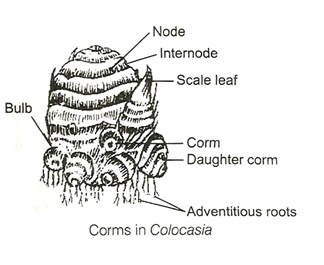
0 likes
View Solution211
EasyMCQ
Corm is a modification of:
A
Root
B
Leaf
C
Stem
D
Bud
Solution
(C) corm is a short,vertical,swollen underground plant stem that serves as a storage organ used by some plants to survive winter or other adverse conditions.
It is a modified stem because it possesses nodes and internodes,and it bears scale leaves and axillary buds,which are characteristic features of a stem.
Examples of plants that reproduce via corms include $Colocasia$ and $Amorphophallus$.
It is a modified stem because it possesses nodes and internodes,and it bears scale leaves and axillary buds,which are characteristic features of a stem.
Examples of plants that reproduce via corms include $Colocasia$ and $Amorphophallus$.
0 likes
View Solution212
MediumMCQ
From the given categories of buds,choose the one which is present on a potato tuber:
Nodal bud,Adventitious bud,Axillary bud,Leaf bud,Extra-axillary bud
Nodal bud,Adventitious bud,Axillary bud,Leaf bud,Extra-axillary bud
A
Adventitious,axillary bud
B
Nodal,axillary bud
C
Leaf,extra-axillary bud
D
Nodal,adventitious bud
Solution
(B) The potato tuber is a modified underground stem. The 'eyes' of the potato represent the nodes of the stem. Each eye contains a small scale leaf with an axillary bud. Because these buds arise from the nodes and are capable of developing into new shoots,they are classified as nodal buds. Additionally,since they arise from a location other than the normal terminal position,they are also referred to as adventitious buds in some contexts,but specifically,they are axillary buds located at the nodes. Given the options,the correct classification for the buds on a potato tuber is nodal and axillary bud.
0 likes
View Solution213
MediumMCQ
Photosynthesis in $Opuntia$ is performed by:
A
Leaves
B
Stem
C
Roots
D
Shoot
Solution
(B) In $Opuntia$,the leaves are modified into spines to reduce water loss through transpiration as an evolutionary adaptation.
Consequently,the stem takes over the function of photosynthesis.
The stem of $Opuntia$ is green,fleshy,and flattened (phylloclade),which allows it to perform photosynthesis efficiently.
Consequently,the stem takes over the function of photosynthesis.
The stem of $Opuntia$ is green,fleshy,and flattened (phylloclade),which allows it to perform photosynthesis efficiently.
0 likes
View Solution214
MediumMCQ
Which parts in ginger and onion are edible?
A
Ginger: Stem,Onion: Leaves
B
Ginger: Root,Onion: Stem
C
Ginger: Stem,Onion: Root
D
Ginger: Leaves,Onion: Stem
Solution
(A) $\rightarrow$ In ginger,the edible part is a modified stem known as a rhizome,which stores food.
$\rightarrow$ In onion,the edible part consists of fleshy,succulent leaves that store food. The stem is reduced to a disc-like structure,and the leaves are arranged in a concentric manner.
$\rightarrow$ In onion,the edible part consists of fleshy,succulent leaves that store food. The stem is reduced to a disc-like structure,and the leaves are arranged in a concentric manner.
0 likes
View Solution215
EasyMCQ
On which part of the plant are nodes and internodes found?
A
Root
B
Stem
C
Leaf
D
Fruit
Solution
(B) The $stem$ is the ascending part of the axis bearing branches,leaves,flowers,and fruits.
It develops from the plumule of the embryo of a germinating seed.
The $stem$ is characterized by the presence of nodes and internodes.
Nodes are the regions of the $stem$ where leaves are born,while internodes are the portions between two nodes.
It develops from the plumule of the embryo of a germinating seed.
The $stem$ is characterized by the presence of nodes and internodes.
Nodes are the regions of the $stem$ where leaves are born,while internodes are the portions between two nodes.
0 likes
View Solution216
MediumMCQ
The stem develops from which part of the embryo?
A
Plumule
B
Radicle
C
Hypocotyl
D
All of the above
Solution
(A) In a developing seed,the embryo consists of a radicle and a plumule.
$1$. The $Radicle$ is the embryonic root that develops into the root system.
$2$. The $Plumule$ is the embryonic shoot that develops into the stem and leaves of the plant.
$3$. Therefore,the stem develops from the $Plumule$.
$1$. The $Radicle$ is the embryonic root that develops into the root system.
$2$. The $Plumule$ is the embryonic shoot that develops into the stem and leaves of the plant.
$3$. Therefore,the stem develops from the $Plumule$.
0 likes
View Solution217
MediumMCQ
Leaves originate from which part of the stem?
A
Axillary bud
B
Terminal bud
C
Node
D
Both $A$ and $B$
Solution
(C) The stem is the ascending part of the axis bearing branches,leaves,flowers,and fruits. The stem bears nodes and internodes. The region of the stem where leaves are born is called nodes,while internodes are the portions between two nodes. Therefore,leaves originate from the nodes of the stem.
0 likes
View Solution218
MediumMCQ
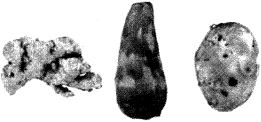
Identify the specific function of the structures shown in the given image.
A
Support
B
Storage of food
C
Vegetative propagation
D
Protection
Solution
(B) The image shows ginger (rhizome),Colocasia (corm),and potato (tuber). These are all modified stems that have evolved to store food materials. While they can also perform vegetative propagation,their primary and most characteristic function as modified stems in this context is the storage of food.
0 likes
View Solution219
MediumMCQ
The potato is considered a stem because ......
A
It stores food.
B
It grows underground.
C
It possesses terminal buds and axillary buds.
D
All of the above.
Solution
(C) potato is a modified underground stem known as a tuber.
It is classified as a stem because it exhibits characteristic stem features such as the presence of nodes and internodes.
The 'eyes' of the potato are actually axillary buds,and it also possesses terminal buds,which are characteristic features of a stem.
While it stores food and grows underground,these features are secondary to the presence of buds,which confirms its identity as a stem.
It is classified as a stem because it exhibits characteristic stem features such as the presence of nodes and internodes.
The 'eyes' of the potato are actually axillary buds,and it also possesses terminal buds,which are characteristic features of a stem.
While it stores food and grows underground,these features are secondary to the presence of buds,which confirms its identity as a stem.
0 likes
View Solution220
MediumMCQ
Which of the following stems performs photosynthesis?
A
Young stem
B
Woody stem
C
Stem of Opuntia
D
Both $A$ and $C$
Solution
(D) In many plants,the young stem is green and contains chlorophyll,allowing it to perform photosynthesis. Additionally,in xerophytic plants like $Opuntia$ (prickly pear),the stem becomes flattened and fleshy,taking over the function of photosynthesis because the leaves are modified into spines to reduce water loss. Therefore,both young stems and the stems of $Opuntia$ perform photosynthesis.
0 likes
View Solution221
MediumMCQ
From which of the following does the stem tendril develop?
A
Node
B
Internode
C
Axillary bud
D
All of the above
Solution
(C) Stem tendrils are slender,spirally coiled structures that help plants in climbing. They develop from the axillary buds of the stem. Examples include plants like gourds (cucumber,pumpkins,watermelons) and grapevines. Therefore,the correct option is $C$.
0 likes
View Solution222
MediumMCQ
In plants like $.......$,each node bears a rosette of leaves and a tuft of roots,with short lateral branches.
A
Grass,Strawberry
B
Pistia,Eichhornia
C
Mint,Jasmine
D
Chrysanthemum,Pineapple
Solution
(B) In plants like $Pistia$ and $Eichhornia$ (water hyacinth),the stem is modified into an offset.
These plants grow in aquatic environments.
The stem is short,and each node bears a rosette of leaves and a tuft of roots,which helps in vegetative propagation.
These plants grow in aquatic environments.
The stem is short,and each node bears a rosette of leaves and a tuft of roots,which helps in vegetative propagation.
0 likes
View Solution223
EasyMCQ
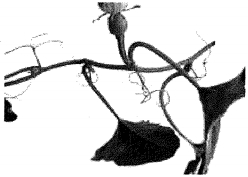
In which plant is the given structure found?
A
Bougainvillea
B
Opuntia
C
Ginger
D
Cucumber
Solution
(D) The image shows a plant with tendrils. Tendrils are slender,spirally coiled structures that help plants in climbing. In plants like cucumbers,pumpkins,and watermelons (members of the Cucurbitaceae family),the axillary buds develop into tendrils. Therefore,the correct option is $D$ (Cucumber).
0 likes
View Solution224
MediumMCQ
The stem is generally $P$ when young and later becomes $Q$ in color.
$P \quad Q$
$P \quad Q$
A
Brown $\quad$ Green
B
Green $\quad$ Brown
C
Green $\quad$ Red
D
Red $\quad$ Green
Solution
(B) The stem of a plant is generally green when it is young because it contains chlorophyll and performs photosynthesis.
As the plant matures and grows older,the stem undergoes secondary growth,develops bark,and turns brown in color due to the deposition of lignin and other substances.
As the plant matures and grows older,the stem undergoes secondary growth,develops bark,and turns brown in color due to the deposition of lignin and other substances.
0 likes
View Solution225
MediumMCQ
Select the correct option for the $Opuntia$ (prickly pear cactus) plant regarding the function of leaves and stems.
A
Protection,Photosynthesis
B
Photosynthesis,Protection
C
Transpiration,Photosynthesis
D
Photosynthesis,Transpiration
Solution
(A) In $Opuntia$ (prickly pear cactus),the leaves are modified into spines to reduce water loss through transpiration and provide protection against herbivores. The stem becomes flattened,fleshy,and green to perform photosynthesis,as it takes over the function of the leaves in arid environments.
0 likes
View Solution226
MediumMCQ
Which of the following statements is not correct?
A
Rhizome is a condensed form of stem
B
The apical bud in rhizome always remains above the ground
C
The rhizome is aerial with no distinct nodes and internodes
D
The rhizome is thick,prostrate and branched
Solution
(B) rhizome is a modified underground stem that grows horizontally (prostrate) beneath the soil surface.
It is characterized by being thick,fleshy,and branched.
It possesses distinct nodes and internodes,where nodes often bear scale leaves and axillary buds.
The apical bud of a rhizome typically remains underground to facilitate continuous horizontal growth,not above the ground.
Therefore,the statement that the apical bud remains above the ground is incorrect.
It is characterized by being thick,fleshy,and branched.
It possesses distinct nodes and internodes,where nodes often bear scale leaves and axillary buds.
The apical bud of a rhizome typically remains underground to facilitate continuous horizontal growth,not above the ground.
Therefore,the statement that the apical bud remains above the ground is incorrect.
0 likes
View SolutionMorphology of Flowering Plants — Stem · Frequently Asked Questions
1Are these Morphology of Flowering Plants questions useful for JEE and NEET?
Yes. All questions in this section are mapped to JEE Main and NEET exam patterns. Previous year questions from JEE Main, NEET, GUJCET and state-level exams are included with full solutions.
2Can I switch to Hindi or Gujarati for these questions?
Yes. Use the language tabs in the hero section or the sidebar to view the same questions and solutions in English, Hindi or Gujarati.
3How do I generate a question paper from this subtopic?
Use the Vedclass Exam Paper Generator — select the chapter and subtopic, set difficulty, and generate Sets A, B, C, D automatically. First 3 chapters of every subject are free.
Vedclass Products
For Students
Vedclass Test Series
Mock tests in real JEE/NEET style with performance analysis. 5-day free trial.
Start Free TrialFor Teachers
Exam Paper Generator
Generate Set A/B/C/D papers from this chapter in 2 minutes. 3 chapters free.
Try FreeFor Institutes
Online Exam Module
Live online exams with unlimited students, 360° analytics & white-label branding.
See DemoFor Teachers & Institutes
Generate a Morphology of Flowering Plants Exam Paper in 2 Minutes
Select subtopic & difficulty — Sets A, B, C, D auto-generated with No Repeat logic.
First 3 chapters of every subject are free — no payment required.