
A English
Leaf Questions in English
Class 11 Biology · Morphology of Flowering Plants · Leaf
232+
Questions
English
Language
100%
With Solutions
Showing 50 of 232 questions in English
101
MediumMCQ
Parkinsonia and Australian Acacia are examples of ..........
A
Phyllode
B
Winged fruit
C
Parachute mechanism
D
Stipule
Solution
(A) In some plants, the petiole expands, becomes green, and synthesizes food. This modified petiole is known as a $Phyllode$.
$Parkinsonia$ and $Australian \text{ } Acacia$ are classic examples where the leaves are small and short-lived, and the petiole performs the function of photosynthesis.
$Parkinsonia$ and $Australian \text{ } Acacia$ are classic examples where the leaves are small and short-lived, and the petiole performs the function of photosynthesis.
0 likes
View Solution102
EasyMCQ
The expanded part of the leaf is called the .......
A
Leaf base
B
Petiole
C
Lamina or leaf blade
D
All of these
Solution
(C) The leaf is a lateral,generally flattened structure borne on the stem. It develops at the node and bears a bud in its axil. The leaf consists of three main parts: the leaf base,the petiole,and the lamina (leaf blade). The lamina or leaf blade is the green,expanded part of the leaf with veins and veinlets. It is the primary site for photosynthesis.
0 likes
View Solution103
EasyMCQ
The largest leaf is associated with ...........
A
$Nerium$
B
$Tobacco$
C
$Victoria$
D
$Rafflesia$
Solution
(C) The largest leaf is found in the genus $Victoria$,specifically the species $Victoria$ $amazonica$ (formerly $Victoria$ $regia$).
This aquatic plant,commonly known as the giant water lily,produces massive circular leaves that can reach up to $3$ meters in diameter.
$Nerium$ is known for its flowers,$Tobacco$ for its leaves (but not the largest),and $Rafflesia$ is famous for having the largest individual flower in the world.
This aquatic plant,commonly known as the giant water lily,produces massive circular leaves that can reach up to $3$ meters in diameter.
$Nerium$ is known for its flowers,$Tobacco$ for its leaves (but not the largest),and $Rafflesia$ is famous for having the largest individual flower in the world.
0 likes
View Solution104
EasyMCQ
In $Opuntia$ (prickly pear),the spines are modified forms of:
A
Leaves
B
Stems
C
Epidermal outgrowths
D
Axillary buds
Solution
(A) In $Opuntia$,the leaves are reduced to spines to minimize water loss through transpiration in arid environments. The stem becomes flattened,fleshy,and green to perform photosynthesis. Therefore,the spines in $Opuntia$ are modified leaves.
0 likes
View Solution105
MediumMCQ
Which of the following is a modification of the leaf?
A
Phyllode
B
Phylloclade
C
Cladode
D
Bulbil
Solution
(A) $Phyllode$ is a modified petiole or rachis of a leaf that becomes flattened and expanded to become photosynthetic. It is a common adaptation in some plants,such as $Acacia$ $auriculiformis$,to reduce water loss in arid environments. Other options like $Phylloclade$ and $Cladode$ are modifications of the stem.
0 likes
View Solution106
EasyMCQ
Parallel venation is found in ..........
A
Liliaceae
B
Solanaceae
C
Malvaceae
D
Papilionaceae
Solution
(A) Parallel venation is a characteristic feature of monocotyledonous plants.
Among the given options,$Liliaceae$ is a family of monocots.
Therefore,parallel venation is observed in $Liliaceae$.
Among the given options,$Liliaceae$ is a family of monocots.
Therefore,parallel venation is observed in $Liliaceae$.
0 likes
View Solution107
MediumMCQ
Monocots can be distinguished from dicots by . . . . . . .
A
Aestivation
B
Venation
C
Both $(A)$ and $(B)$
D
None of the above
Solution
(B) Monocots and dicots are primarily distinguished by their leaf venation patterns.
In dicotyledonous plants,the leaves typically exhibit reticulate venation,where veins form a network.
In monocotyledonous plants,the leaves typically exhibit parallel venation,where veins run parallel to each other.
Aestivation refers to the arrangement of sepals or petals in a floral bud,which is not a primary diagnostic feature for distinguishing between monocots and dicots at the vegetative level.
In dicotyledonous plants,the leaves typically exhibit reticulate venation,where veins form a network.
In monocotyledonous plants,the leaves typically exhibit parallel venation,where veins run parallel to each other.
Aestivation refers to the arrangement of sepals or petals in a floral bud,which is not a primary diagnostic feature for distinguishing between monocots and dicots at the vegetative level.
0 likes
View Solution108
EasyMCQ
Phyllode is present in ...........
A
Australian Acacia
B
Opuntia
C
Asparagus
D
Euphorbia
Solution
(A) $Phyllode$ is a modified petiole or rachis that becomes flattened and leaf-like to perform photosynthesis.
In $Australian$ $Acacia$ ($Acacia$ $auriculiformis$),the initial leaves are small and short-lived.
As the plant matures,the petiole expands,becomes green,and takes over the function of photosynthesis,which is known as a $Phyllode$.
Therefore,the correct option is $A$.
In $Australian$ $Acacia$ ($Acacia$ $auriculiformis$),the initial leaves are small and short-lived.
As the plant matures,the petiole expands,becomes green,and takes over the function of photosynthesis,which is known as a $Phyllode$.
Therefore,the correct option is $A$.
0 likes
View Solution109
EasyMCQ
In $Opuntia$ (prickly pear),the leaf spines are a modification of the .......
A
Leaf
B
Branch
C
Epidermis
D
Flower
Solution
(A) In $Opuntia$ (prickly pear),the leaves are reduced to spines to reduce the rate of transpiration in xeric conditions. These spines are modified leaves. The stem becomes fleshy and green to perform photosynthesis.
0 likes
View Solution110
EasyMCQ
In $........$,the stipules are modified into tendrils.
A
$Smilax$
B
$Asphodelus$
C
$Gloriosa$
D
$Asparagus$
Solution
(A) In $Smilax$,the stipules (leaf-like appendages at the base of the leaf) are modified into tendrils to provide support for climbing.
In $Gloriosa$,the leaf tips are modified into tendrils.
In $Asparagus$,the leaves are modified into spines or scales,and the stem branches become leaf-like structures called phylloclades.
Therefore,the correct answer is $Smilax$.
In $Gloriosa$,the leaf tips are modified into tendrils.
In $Asparagus$,the leaves are modified into spines or scales,and the stem branches become leaf-like structures called phylloclades.
Therefore,the correct answer is $Smilax$.
0 likes
View Solution111
DifficultMCQ
Whorled simple leaves with reticulate venation are found in ...........
A
Alstonia
B
Calotropis
C
Mustard
D
China rose
Solution
(A) In $Alstonia$,the leaves are arranged in a whorled phyllotaxy,meaning more than two leaves arise at a single node. These leaves are simple and exhibit reticulate venation,which is a characteristic feature of dicotyledonous plants. In contrast,$Calotropis$ shows opposite phyllotaxy,while $Mustard$ and $China$ $rose$ exhibit alternate phyllotaxy.
0 likes
View Solution112
EasyMCQ
The pattern of arrangement of leaves on the stem or branch is called .......
A
Venation
B
Phyllotaxy
C
Inflorescence
D
Placentation
Solution
(B) The pattern of arrangement of leaves on the stem or branch is known as $Phyllotaxy$.
$Venation$ refers to the arrangement of veins and veinlets in the lamina of a leaf.
$Inflorescence$ refers to the arrangement of flowers on the floral axis.
$Placentation$ refers to the arrangement of ovules within the ovary.
Therefore,the correct answer is $Phyllotaxy$.
$Venation$ refers to the arrangement of veins and veinlets in the lamina of a leaf.
$Inflorescence$ refers to the arrangement of flowers on the floral axis.
$Placentation$ refers to the arrangement of ovules within the ovary.
Therefore,the correct answer is $Phyllotaxy$.
0 likes
View Solution113
EasyMCQ
Plants with parallel venation are ..........
A
Castor
B
Grass
C
Colocasia
D
Mustard
Solution
(B) Parallel venation is a characteristic feature of monocotyledonous plants.
In parallel venation,the veins run parallel to each other within the lamina.
Among the given options,grass is a monocotyledonous plant and exhibits parallel venation.
Castor,Colocasia,and Mustard are dicotyledonous plants,which typically exhibit reticulate venation.
In parallel venation,the veins run parallel to each other within the lamina.
Among the given options,grass is a monocotyledonous plant and exhibits parallel venation.
Castor,Colocasia,and Mustard are dicotyledonous plants,which typically exhibit reticulate venation.
0 likes
View Solution114
MediumMCQ
Which of the following dicotyledonous plants exhibits parallel venation?
A
Dioscorea
B
Calophyllum
C
Cotton
D
Mango
Solution
(B) In general,dicotyledonous plants exhibit reticulate venation,while monocotyledonous plants exhibit parallel venation. However,there are rare exceptions to this rule. $Calophyllum$ is a genus of dicotyledonous plants that shows parallel venation in its leaves,which is an unusual characteristic for a dicot.
0 likes
View Solution115
MediumMCQ
Almost all leguminous plants possess ........
A
Simple petiolate leaves
B
Simple sessile leaves
C
Pinnately compound leaves
D
Palmately compound leaves
Solution
(C) In the family $Fabaceae$ (leguminous plants),the leaves are typically alternate,stipulate,and pinnately compound. $A$ pinnately compound leaf has leaflets arranged on both sides of a common axis called the rachis,which represents the midrib. Therefore,the characteristic feature of leguminous plants is the presence of pinnately compound leaves.
0 likes
View Solution116
EasyMCQ
Assertion $(A)$: Reticulate venation is observed in the leaves of sunflower.
Reason $(R)$: Sunflower is included in the class Dicotyledonae.
Reason $(R)$: Sunflower is included in the class Dicotyledonae.
A
$A$ and $R$ are both true, and $R$ is the correct explanation of $A$.
B
$A$ and $R$ are both true, but $R$ is not the correct explanation of $A$.
C
$A$ is true, but $R$ is false.
D
$A$ is false, but $R$ is true.
Solution
$(A)$ $1$. Reticulate venation is a characteristic feature of dicotyledonous plants, where veins form a network-like structure.
$2$. Sunflower $(Helianthus \, annuus)$ belongs to the family Asteraceae, which is a member of the class Dicotyledonae.
$3$. Since sunflower is a dicot, its leaves exhibit reticulate venation.
$4$. Therefore, both the assertion and the reason are true, and the reason correctly explains the assertion.
$2$. Sunflower $(Helianthus \, annuus)$ belongs to the family Asteraceae, which is a member of the class Dicotyledonae.
$3$. Since sunflower is a dicot, its leaves exhibit reticulate venation.
$4$. Therefore, both the assertion and the reason are true, and the reason correctly explains the assertion.
0 likes
View Solution117
EasyMCQ
What are scale leaves?
A
Large leaves
B
Green leaves
C
Minute leaves
D
Long leaves
Solution
(C) Scale leaves are small, dry, membranous, or scaly structures that are often brown or colorless. They are typically found in plants like ginger, onion, or gymnosperms like Pinus. They are essentially $minute$ $leaves$ that do not perform photosynthesis and serve to protect the apical bud or store food.
0 likes
View Solution118
MediumMCQ
Leaves become modified into spines in
A
onion
B
silk cotton
C
Opuntia
D
pea
Solution
(C) : In xerophytic plants, the leaves modify into sharp, pointed spines, $e.g.$, $Aloe$, $Solanum$ $surattense$, $Opuntia$, $Asparagus$ etc.
This modification is either for the protection of the plant, to reduce transpiration, or for both.
This modification is either for the protection of the plant, to reduce transpiration, or for both.
0 likes
View Solution119
MediumMCQ
How many plants among China rose,Ocimum,sunflower,mustard,Alstonia,guava,Calotropis and Nerium (oleander) have opposite phyllotaxy?
A
Three
B
Four
C
Five
D
Two
Solution
(A) In opposite phyllotaxy,a pair of leaves arises at each node and lies opposite to each other.
Examples of plants with opposite phyllotaxy include $Ocimum$ (Tulsi),$Guava$ (Psidium),and $Calotropis$.
China rose,sunflower,and mustard exhibit alternate phyllotaxy.
Alstonia and Nerium exhibit whorled phyllotaxy.
Therefore,out of the given list,only $3$ plants ($Ocimum$,$Guava$,and $Calotropis$) show opposite phyllotaxy.
Examples of plants with opposite phyllotaxy include $Ocimum$ (Tulsi),$Guava$ (Psidium),and $Calotropis$.
China rose,sunflower,and mustard exhibit alternate phyllotaxy.
Alstonia and Nerium exhibit whorled phyllotaxy.
Therefore,out of the given list,only $3$ plants ($Ocimum$,$Guava$,and $Calotropis$) show opposite phyllotaxy.
0 likes
View Solution120
MediumMCQ
Phyllode is present in
A
Asparagus
B
Euphorbia
C
Australian Acacia
D
Opuntia
Solution
(C) The correct answer is $(C)$.
In several species of $Acacia$ found in the deserts of Australia,the bipinnate lamina is absent.
Instead,the petiole and part of the rachis become flattened into a sickle-shaped structure to perform the function of photosynthesis.
Such a flattened petiole that carries out the functions of the leaf blade (lamina) is called a phyllode.
The formation of a phyllode is an adaptive mechanism to reduce transpiration because $(i)$ it is vertically placed and $(ii)$ it has fewer stomata.
In several species of $Acacia$ found in the deserts of Australia,the bipinnate lamina is absent.
Instead,the petiole and part of the rachis become flattened into a sickle-shaped structure to perform the function of photosynthesis.
Such a flattened petiole that carries out the functions of the leaf blade (lamina) is called a phyllode.
The formation of a phyllode is an adaptive mechanism to reduce transpiration because $(i)$ it is vertically placed and $(ii)$ it has fewer stomata.
0 likes
View Solution121
MediumMCQ
Whorled,simple leaves with reticulate venation are present in
A
Calotropis
B
Neem
C
China rose
D
Alstonia
Solution
(D) The correct answer is $D$.
In $Alstonia$,multiple leaves arise from a single node,which is known as whorled phyllotaxy.
These leaves are simple,leathery,and exhibit reticulate venation.
In contrast,$Calotropis$ shows opposite phyllotaxy,while $Neem$ and $China$ $rose$ show alternate phyllotaxy.
In $Alstonia$,multiple leaves arise from a single node,which is known as whorled phyllotaxy.
These leaves are simple,leathery,and exhibit reticulate venation.
In contrast,$Calotropis$ shows opposite phyllotaxy,while $Neem$ and $China$ $rose$ show alternate phyllotaxy.
0 likes
View Solution122
EasyMCQ
In land plants,the guard cells differ from other epidermal cells in having
A
cytoskeleton
B
mitochondria
C
endoplasmic reticulum
D
chloroplasts
Solution
(D) : The leaf and stem epidermis is covered with pores called stomata,which are part of a stomatal complex. This complex consists of a pore surrounded on each side by chloroplast-containing guard cells and two to four subsidiary cells that lack chloroplasts.
The guard cells differ from the epidermal cells in the following aspects:
$1$. The guard cells are bean-shaped in surface view,while the epidermal cells are irregular in shape.
$2$. The guard cells contain chloroplasts,allowing them to manufacture food by photosynthesis,whereas the epidermal cells do not contain chloroplasts.
$3$. Guard cells are the only epidermal cells that can synthesize sugar.
The guard cells differ from the epidermal cells in the following aspects:
$1$. The guard cells are bean-shaped in surface view,while the epidermal cells are irregular in shape.
$2$. The guard cells contain chloroplasts,allowing them to manufacture food by photosynthesis,whereas the epidermal cells do not contain chloroplasts.
$3$. Guard cells are the only epidermal cells that can synthesize sugar.
0 likes
View Solution123
MediumMCQ
Plasticity can be observed in the leaf of
A
Larkspur
B
Neem
C
Carrot
D
None
Solution
(A) Plasticity refers to the ability of plants to follow different pathways or produce different structures in response to the environment or phases of life.
In plants like $Larkspur$,$Buttercup$,and $Cotton$,the leaves of the juvenile plant are different in shape from those in mature plants.
This phenomenon of heterophylly due to the environment is an example of plasticity.
Therefore,$Larkspur$ is the correct answer.
In plants like $Larkspur$,$Buttercup$,and $Cotton$,the leaves of the juvenile plant are different in shape from those in mature plants.
This phenomenon of heterophylly due to the environment is an example of plasticity.
Therefore,$Larkspur$ is the correct answer.
0 likes
View Solution124
MediumMCQ
Heterophylly can be observed in
$I.$ Cotton
$II.$ Coriander
$III.$ Larkspur
Select the right option.
$I.$ Cotton
$II.$ Coriander
$III.$ Larkspur
Select the right option.
A
$I, II$ and $III$ only
B
$I$ and $II$ only
C
$II$ and $III$ only
D
$I$ and $III$ only
Solution
(A) Heterophylly is the phenomenon where plants exhibit different forms of leaves at different stages of their life cycle or in response to different environmental conditions.
$1.$ In $Cotton$,$Coriander$,and $Larkspur$,the leaves of the juvenile plant are different in shape from those in mature plants.
$2.$ This is an example of plasticity,where the plant's development is influenced by the environment or developmental stages.
$3.$ Therefore,all three plants ($Cotton$,$Coriander$,and $Larkspur$) exhibit heterophylly.
Thus,the correct option is $A$.
$1.$ In $Cotton$,$Coriander$,and $Larkspur$,the leaves of the juvenile plant are different in shape from those in mature plants.
$2.$ This is an example of plasticity,where the plant's development is influenced by the environment or developmental stages.
$3.$ Therefore,all three plants ($Cotton$,$Coriander$,and $Larkspur$) exhibit heterophylly.
Thus,the correct option is $A$.
0 likes
View Solution125
MediumMCQ
Which of the following is a characteristic feature of a simple leaf?
A
Possesses an axillary bud in the axil of its petiole.
B
The lamina is entire or,when incised,the incisions do not reach the midrib.
C
It does not possess leaflets.
D
All of the above.
0 likes
View Solution126
MediumMCQ
Which of the following statements is true regarding the phyllotaxy of a sunflower plant?
A
Possess alternate phyllotaxy.
B
Possess opposite phyllotaxy.
C
Possess whorled phyllotaxy.
D
Stores food in the leaf.
Solution
(A) Phyllotaxy is the pattern of arrangement of leaves on the stem or branch. In sunflower $(Helianthus \ annuus)$,the leaves are arranged in an alternate manner,meaning a single leaf arises at each node in an alternate fashion. Therefore,sunflower exhibits alternate phyllotaxy.
0 likes
View Solution127
MediumMCQ
Tendrils are found in.
A
Pea
B
Onion
C
Asparagus
D
Carrot
Solution
(A) In plants, tendrils are specialized structures that help in climbing.
In the case of the pea plant $(Pisum \text{ } sativum)$, the leaves or leaflets are modified into thread-like structures called tendrils to provide support for climbing.
Onion leaves are modified for food storage.
Asparagus exhibits phylloclade (modified stem).
Carrot is a modified taproot for food storage.
Therefore, the correct answer is $A$.
In the case of the pea plant $(Pisum \text{ } sativum)$, the leaves or leaflets are modified into thread-like structures called tendrils to provide support for climbing.
Onion leaves are modified for food storage.
Asparagus exhibits phylloclade (modified stem).
Carrot is a modified taproot for food storage.
Therefore, the correct answer is $A$.
0 likes
View Solution128
MediumMCQ
Pulvinus means....
A
Expandable leaf base
B
Contractile leaf base
C
Swollen leaf base
D
Covering leaf base
Solution
(C) In many leguminous plants, the leaf base becomes swollen, which is known as the $Pulvinus$.
This structure plays a crucial role in the movement of leaves, such as the seismonastic movements observed in $Mimosa \, pudica$ (touch-me-not plant).
This structure plays a crucial role in the movement of leaves, such as the seismonastic movements observed in $Mimosa \, pudica$ (touch-me-not plant).
0 likes
View Solution129
MediumMCQ
Which of the following plants stores food in its leaves?
A
Cactus
B
Watermelon
C
Beet
D
Onion
Solution
(D) In plants, leaves are primarily responsible for photosynthesis. However, in some plants, leaves are modified to store food.
$1$. In $Onion$ $(Allium \text{ cepa})$, the fleshy leaves are modified to store food.
$2$. $Cactus$ stores water in its stem, not leaves.
$3$. $Beet$ stores food in its root.
$4$. $Watermelon$ stores food in its fruit.
Therefore, the correct option is $D$.
$1$. In $Onion$ $(Allium \text{ cepa})$, the fleshy leaves are modified to store food.
$2$. $Cactus$ stores water in its stem, not leaves.
$3$. $Beet$ stores food in its root.
$4$. $Watermelon$ stores food in its fruit.
Therefore, the correct option is $D$.
0 likes
View Solution130
MediumMCQ
In which of the following plants does the petiole expand, become green, and synthesize food?
A
Australian Acacia
B
Pea
C
Pitcher plant
D
Calotropis
Solution
(A) In $Australian$ $\text{ } Acacia$, the leaves are small and short-lived. The petioles of these plants expand, become green, and synthesize food to compensate for the reduction in leaf surface area. This modification is an adaptation to survive in arid conditions.
0 likes
View Solution131
MediumMCQ
Which part of the leaf contains veins and veinlets?
A
Petiole
B
Lamina
C
Leaf base
D
All of the above
Solution
(B) The leaf consists of three main parts: the leaf base,the petiole,and the lamina (or leaf blade).
The lamina is the expanded,green,and flat part of the leaf.
It contains veins and veinlets,which provide rigidity to the leaf blade and act as channels for the transport of water,minerals,and food materials.
The lamina is the expanded,green,and flat part of the leaf.
It contains veins and veinlets,which provide rigidity to the leaf blade and act as channels for the transport of water,minerals,and food materials.
0 likes
View Solution132
MediumMCQ
Alstonia shows.
A
Whorled phyllotaxy
B
Alternate phyllotaxy
C
Opposite phyllotaxy
D
Parallel venation
Solution
(A) Phyllotaxy is the pattern of arrangement of leaves on the stem or branch.
In $Alstonia$,more than two leaves arise at a node and form a whorl,which is known as whorled phyllotaxy.
Therefore,the correct option is $A$.
In $Alstonia$,more than two leaves arise at a node and form a whorl,which is known as whorled phyllotaxy.
Therefore,the correct option is $A$.
0 likes
View Solution133
MediumMCQ
Match the following:
| Column-$I$ | Column-$II$ |
| $(1)$ Mustard | $(A)$ Opposite phyllotaxy |
| $(2)$ Guava | $(B)$ Pinnately compound leaf |
| $(3)$ Neem | $(C)$ Alternate phyllotaxy |
| $(D)$ Palmately compound leaf |
A
$1-C, 2-A, 3-D$
B
$1-A, 2-C, 3-B$
C
$1-D, 2-B, 3-C$
D
$1-C, 2-A, 3-B$
Solution
(D) The correct matches are as follows:
$(1)$ Mustard: It exhibits alternate phyllotaxy,where a single leaf arises at each node in an alternate manner. Thus,$1-C$.
$(2)$ Guava: It exhibits opposite phyllotaxy,where a pair of leaves arise at each node and lie opposite to each other. Thus,$2-A$.
$(3)$ Neem: It has pinnately compound leaves,where a number of leaflets are present on a common axis called the rachis. Thus,$3-B$.
Therefore,the correct matching is $1-C, 2-A, 3-B$.
$(1)$ Mustard: It exhibits alternate phyllotaxy,where a single leaf arises at each node in an alternate manner. Thus,$1-C$.
$(2)$ Guava: It exhibits opposite phyllotaxy,where a pair of leaves arise at each node and lie opposite to each other. Thus,$2-A$.
$(3)$ Neem: It has pinnately compound leaves,where a number of leaflets are present on a common axis called the rachis. Thus,$3-B$.
Therefore,the correct matching is $1-C, 2-A, 3-B$.
0 likes
View Solution134
MediumMCQ
In.........,the leaflets are attached at a common point.
A
Silk cotton
B
Neem
C
Calotropis
D
China rose
Solution
(A) In a palmately compound leaf,the leaflets are attached at a common point,i.e.,at the tip of the petiole.
Silk cotton $(Bombax)$ is a classic example of a palmately compound leaf.
In contrast,in a pinnately compound leaf (like Neem),the leaflets are present laterally on a common axis called the rachis.
Silk cotton $(Bombax)$ is a classic example of a palmately compound leaf.
In contrast,in a pinnately compound leaf (like Neem),the leaflets are present laterally on a common axis called the rachis.
0 likes
View Solution135
MediumMCQ
If the ......$X$.... of the lamina reach up to the ... $Y$... breaking it into a number of ......$Z$...... the leaf is called compound leaf.
A
$X$ - incisions,$Y$ - midrib,$Z$ - leaflets
B
$X$ - midrib,$Y$ - leaflets,$Z$ - incisions
C
$X$ - leaf,$Y$ - midrib,$Z$ - incisions
D
$X$ - incisions,$Y$ - midrib,$Z$ - leaf
Solution
(A) In a compound leaf,the lamina (leaf blade) is completely divided into distinct segments called leaflets.
This division occurs when the incisions of the lamina reach up to the midrib (or rachis in pinnately compound leaves),thereby breaking the lamina into a number of leaflets.
Therefore,$X$ represents incisions,$Y$ represents the midrib,and $Z$ represents leaflets.
This division occurs when the incisions of the lamina reach up to the midrib (or rachis in pinnately compound leaves),thereby breaking the lamina into a number of leaflets.
Therefore,$X$ represents incisions,$Y$ represents the midrib,and $Z$ represents leaflets.
0 likes
View Solution136
MediumMCQ
Example of a leaf modified for climbing.
A
Onion
B
Grapes
C
Cucumber
D
Pea
Solution
(D) In certain plants, leaves are modified into slender, coiled, sensitive structures called tendrils to help the plant climb.
In the pea plant $(Pisum \, sativum)$, the terminal leaflets are modified into tendrils to support climbing.
In contrast, in grapes and cucumber, the tendrils are stem modifications, not leaf modifications.
Onion leaves are modified for food storage.
In the pea plant $(Pisum \, sativum)$, the terminal leaflets are modified into tendrils to support climbing.
In contrast, in grapes and cucumber, the tendrils are stem modifications, not leaf modifications.
Onion leaves are modified for food storage.
0 likes
View Solution137
MediumMCQ
$A$-Leaves originate from shoot apical meristem and are arranged in an acropetal order.
$R$-They are the most important vegetative organ for photosynthesis.
$R$-They are the most important vegetative organ for photosynthesis.
A
$A$ and $R$ are both correct.
B
$A$ and $R$ are both incorrect.
C
$A$ is correct and $R$ is incorrect.
D
$A$ is incorrect and $R$ is correct.
Solution
(D) Assertion $(A)$ is incorrect because leaves originate from the shoot apical meristem,not the lateral meristem. Lateral meristems are responsible for secondary growth (increase in girth).
Reason $(R)$ is correct because leaves are the primary sites for photosynthesis,which is essential for the plant's survival and growth.
Reason $(R)$ is correct because leaves are the primary sites for photosynthesis,which is essential for the plant's survival and growth.
0 likes
View Solution138
MediumMCQ
Select the correct pair regarding phyllotaxy:
A
Alternate type - Calotropis
B
Pinnately compound - Neem
C
Opposite type - China rose
D
Whorled - Alstonia
Solution
(D) Phyllotaxy is the pattern of arrangement of leaves on the stem or branch.
$1$. Alternate: $A$ single leaf arises at each node in an alternate manner,e.g.,China rose,mustard,and sunflower.
$2$. Opposite: $A$ pair of leaves arise at each node and lie opposite to each other,e.g.,Calotropis and guava.
$3$. Whorled: If more than two leaves arise at a node and form a whorl,it is called whorled,e.g.,Alstonia.
$4$. Neem has pinnately compound leaves,not palmately compound.
Therefore,the correct pair is Whorled - Alstonia.
$1$. Alternate: $A$ single leaf arises at each node in an alternate manner,e.g.,China rose,mustard,and sunflower.
$2$. Opposite: $A$ pair of leaves arise at each node and lie opposite to each other,e.g.,Calotropis and guava.
$3$. Whorled: If more than two leaves arise at a node and form a whorl,it is called whorled,e.g.,Alstonia.
$4$. Neem has pinnately compound leaves,not palmately compound.
Therefore,the correct pair is Whorled - Alstonia.
0 likes
View Solution139
MediumMCQ
Phyllode is found in $..........$.
A
Asparagus
B
Euphorbia
C
Australian Acacia
D
Opuntia
Solution
(C) $Phyllode$ is a modified petiole or rachis that becomes flattened and leaf-like to perform photosynthesis.
In $Australian \ Acacia$,the leaves are small and short-lived.
To reduce water loss and perform photosynthesis,the petiole expands and becomes green,forming a $Phyllode$.
In $Australian \ Acacia$,the leaves are small and short-lived.
To reduce water loss and perform photosynthesis,the petiole expands and becomes green,forming a $Phyllode$.
0 likes
View Solution140
MediumMCQ
Stomata in grass leaf are
A
Barrel shaped
B
Dumb-bell shaped
C
Rectangular
D
Kidney shaped
Solution
(B) In most dicotyledonous plants,the guard cells of the stomata are kidney-shaped or bean-shaped.
However,in monocotyledonous plants like grasses,the guard cells are dumb-bell shaped.
The outer walls of these guard cells are thin,while the inner walls are highly thickened,which helps in the opening and closing of the stomata.
However,in monocotyledonous plants like grasses,the guard cells are dumb-bell shaped.
The outer walls of these guard cells are thin,while the inner walls are highly thickened,which helps in the opening and closing of the stomata.
0 likes
View Solution141
DifficultMCQ
Leaves of dicotyledonous plants possess . . . . . . venation,while . . . . . . venation is the characteristic of most monocotyledons.
A
reticulate and parallel
B
parallel and reticulate
C
reticulate and perpendicular
D
obliquely and parallel
Solution
(A) Leaves of dicotyledonous plants possess reticulate venation,while parallel venation is the characteristic of most monocotyledons.
In reticulate venation,the veins of the leaf form a network or a net-like arrangement.
This type of venation is commonly found in dicotyledonous plants.
In parallel venation,the veins run parallel to each other within the leaf lamina.
This type of venation is a characteristic feature of most monocotyledonous plants.
In reticulate venation,the veins of the leaf form a network or a net-like arrangement.
This type of venation is commonly found in dicotyledonous plants.
In parallel venation,the veins run parallel to each other within the leaf lamina.
This type of venation is a characteristic feature of most monocotyledonous plants.
0 likes
View Solution142
MediumMCQ
Assertion : $A$ simple leaf has undivided lamina.
Reason : Leaves showing pinnate and palmate venation have various types of incisions.
Reason : Leaves showing pinnate and palmate venation have various types of incisions.
A
If both Assertion and Reason are correct and the Reason is a correct explanation of the Assertion.
B
If both Assertion and Reason are correct but Reason is not a correct explanation of the Assertion.
C
If the Assertion is correct but Reason is incorrect.
D
If both the Assertion and Reason are incorrect.
Solution
(A) leaf is considered simple when its lamina is entire or when the incisions do not reach the midrib or petiole. Even in simple leaves,the lamina can have various types of incisions that may reach up to half,more than half,or near the base or midrib. These incisions are classified based on the venation pattern (pinnate or palmate) as pinnatifid,palmatifid,pinnatipartite,palmatipartite,pinnatisect,or palmatisect. Therefore,both the Assertion and the Reason are correct,and the Reason explains why simple leaves can exhibit various forms of incisions.
0 likes
View Solution143
MediumMCQ
Assertion: Stomata are absent in submerged hydrophytes.
Reason: Respiration occurs by means of air chambers in submerged plants.
Reason: Respiration occurs by means of air chambers in submerged plants.
A
If both Assertion and Reason are correct and the Reason is a correct explanation of the Assertion.
B
If both Assertion and Reason are correct but Reason is not a correct explanation of the Assertion.
C
If the Assertion is correct but Reason is incorrect.
D
If both the Assertion and Reason are incorrect.
Solution
(C) The Assertion is correct because submerged hydrophytes do not have stomata as they are not required for gaseous exchange in an aquatic environment.
The Reason is incorrect because,in submerged plants,respiration and gaseous exchange occur through the general body surface via diffusion,not specifically through air chambers. Air chambers (aerenchyma) are primarily involved in buoyancy and gas storage,not the primary mechanism for respiration.
The Reason is incorrect because,in submerged plants,respiration and gaseous exchange occur through the general body surface via diffusion,not specifically through air chambers. Air chambers (aerenchyma) are primarily involved in buoyancy and gas storage,not the primary mechanism for respiration.
0 likes
View Solution144
MediumMCQ
Which of the following shows whorled phyllotaxy?
A
Mustard
B
China rose
C
Alstonia
D
Calotropis
Solution
(C) Phyllotaxy is the pattern of arrangement of leaves on the stem or branch.
In whorled phyllotaxy, more than two leaves arise at a node and form a whorl.
$Alstonia$ is a classic example of whorled phyllotaxy.
In $Mustard$ and $China \text{ } rose$, alternate phyllotaxy is observed.
In $Calotropis$, opposite phyllotaxy is observed.
In whorled phyllotaxy, more than two leaves arise at a node and form a whorl.
$Alstonia$ is a classic example of whorled phyllotaxy.
In $Mustard$ and $China \text{ } rose$, alternate phyllotaxy is observed.
In $Calotropis$, opposite phyllotaxy is observed.
0 likes
View Solution145
Medium
How is a pinnately compound leaf different from a palmately compound leaf?
Solution
(N/A)
| Pinnately Compound Leaf | Palmately Compound Leaf |
| The leaflets are attached to a common axis, called the $rachis$. | The leaflets are attached at a common point on the leaf stalk (petiole). |
| Examples include $Neem$ and $Cassia$ $fistula$ (also called golden shower plant). | Examples include silk cotton $(Bombax)$ and $Cannabis$. |
0 likes
View Solution146
Difficult
Explain with suitable examples the different types of phyllotaxy.
Solution
(N/A) Phyllotaxy refers to the pattern or arrangement of leaves on the stem or branch of a plant. It is classified into three types: alternate,opposite,and whorled phyllotaxy.
$1$. Alternate phyllotaxy: $A$ single leaf arises at each node in an alternate manner. Examples include sunflower,mustard,and China rose.
$2$. Opposite phyllotaxy: $A$ pair of leaves arises at each node and lies opposite to each other. Examples include guava and Calotropis.
$3$. Whorled phyllotaxy: If more than two leaves arise at a node and form a whorl,it is called whorled phyllotaxy. An example is Alstonia.
$1$. Alternate phyllotaxy: $A$ single leaf arises at each node in an alternate manner. Examples include sunflower,mustard,and China rose.
$2$. Opposite phyllotaxy: $A$ pair of leaves arises at each node and lies opposite to each other. Examples include guava and Calotropis.
$3$. Whorled phyllotaxy: If more than two leaves arise at a node and form a whorl,it is called whorled phyllotaxy. An example is Alstonia.
0 likes
View Solution147
Difficult
How do the various leaf modifications help plants?
Solution
(N/A) The primary function of leaves is photosynthesis. However,in some plants,leaves are modified to perform specialized functions:
$(a)$ Tendrils: In plants like peas,leaves are modified into thread-like structures called tendrils,which provide support and help the plant in climbing.
$(b)$ Spines: In plants like cactus,leaves are modified into sharp spines,which act as a defensive organ against herbivores and reduce water loss.
$(c)$ Phyllode: In some Australian acacia species,the leaves are short-lived and are replaced by flattened,green,leaf-like structures called phyllodes that develop from the petiole. These structures perform photosynthesis.
$(d)$ Pitcher: In insectivorous plants like the pitcher plant,leaves are modified into pitcher-like structures that trap and digest insects to obtain nitrogen.
$(a)$ Tendrils: In plants like peas,leaves are modified into thread-like structures called tendrils,which provide support and help the plant in climbing.
$(b)$ Spines: In plants like cactus,leaves are modified into sharp spines,which act as a defensive organ against herbivores and reduce water loss.
$(c)$ Phyllode: In some Australian acacia species,the leaves are short-lived and are replaced by flattened,green,leaf-like structures called phyllodes that develop from the petiole. These structures perform photosynthesis.
$(d)$ Pitcher: In insectivorous plants like the pitcher plant,leaves are modified into pitcher-like structures that trap and digest insects to obtain nitrogen.
0 likes
View Solution148
Medium
What is a leaf? Give the main parts of a leaf.
Solution
(N/A) $\rightarrow$ Leaf: The leaf is a lateral,generally flattened structure borne on the stem. It develops at the node and bears a bud in its axil.
$\rightarrow$ Leaves originate from shoot apical meristems and are arranged in an acropetal order.
$\rightarrow$ They are the most important vegetative organs for photosynthesis.
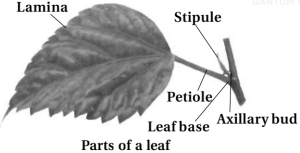
$\rightarrow$ Parts of a leaf: $A$ typical leaf consists of three main parts: Leaf base,petiole,and lamina.
$\rightarrow$ Stipules: The leaf is attached to the stem by the leaf base and may bear two lateral small leaf-like structures called stipules.
$\rightarrow$ In monocotyledons,the leaf base expands into a sheath covering the stem partially or wholly.
$\rightarrow$ Pulvinus: In some leguminous plants,the leaf base may become swollen,which is called the pulvinus.
$\rightarrow$ Petiole: The petiole helps hold the blade to light. Long,thin,flexible petioles allow leaf blades to flutter in the wind,thereby cooling the leaf and bringing fresh air to the leaf surface.
$\rightarrow$ Leaf blade: The lamina or the leaf blade is the green expanded part of the leaf with veins and veinlets. There is,usually,a middle prominent vein,which is known as the midrib. Veins provide rigidity to the leaf blade and act as channels of transport for water,minerals,and food materials.
$\rightarrow$ Leaves originate from shoot apical meristems and are arranged in an acropetal order.
$\rightarrow$ They are the most important vegetative organs for photosynthesis.
$\rightarrow$ Parts of a leaf: $A$ typical leaf consists of three main parts: Leaf base,petiole,and lamina.
$\rightarrow$ Stipules: The leaf is attached to the stem by the leaf base and may bear two lateral small leaf-like structures called stipules.
$\rightarrow$ In monocotyledons,the leaf base expands into a sheath covering the stem partially or wholly.
$\rightarrow$ Pulvinus: In some leguminous plants,the leaf base may become swollen,which is called the pulvinus.
$\rightarrow$ Petiole: The petiole helps hold the blade to light. Long,thin,flexible petioles allow leaf blades to flutter in the wind,thereby cooling the leaf and bringing fresh air to the leaf surface.
$\rightarrow$ Leaf blade: The lamina or the leaf blade is the green expanded part of the leaf with veins and veinlets. There is,usually,a middle prominent vein,which is known as the midrib. Veins provide rigidity to the leaf blade and act as channels of transport for water,minerals,and food materials.
0 likes
View Solution149
Medium
What is called venation? Describe its types.
Solution
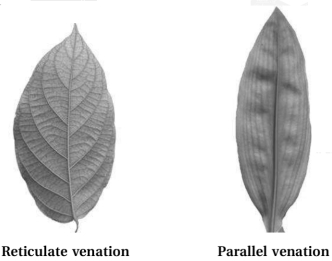
(N/A) $\rightarrow$ Venation: The arrangement of veins and the veinlets in the lamina of a leaf is termed as venation.
$\rightarrow$ Types of Venation:
$1$. Reticulate venation: When the veinlets form a network, the venation is termed as reticulate.
$2$. Parallel venation: When the veins run parallel to each other within a lamina, the venation is termed as parallel.
$\rightarrow$ Leaves of dicotyledonous plants generally possess reticulate venation, while parallel venation is the characteristic of most monocotyledons.
$\rightarrow$ Types of Venation:
$1$. Reticulate venation: When the veinlets form a network, the venation is termed as reticulate.
$2$. Parallel venation: When the veins run parallel to each other within a lamina, the venation is termed as parallel.
$\rightarrow$ Leaves of dicotyledonous plants generally possess reticulate venation, while parallel venation is the characteristic of most monocotyledons.
0 likes
View Solution150
Easy
Describe the types of leaves.
Solution
(N/A) $\rightarrow$ There are two main types of leaves: $(i)$ Simple leaf,$(ii)$ Compound leaf.
$(i)$ Simple leaf: $A$ leaf is said to be simple when its lamina is entire or,when incised,the incisions do not reach the midrib.
$(ii)$ Compound leaf: When the incisions of the lamina reach up to the midrib,breaking it into a number of leaflets,the leaf is called compound. Compound leaves are classified into two types: pinnately compound and palmately compound.
$\rightarrow$ Pinnately compound leaf: In a pinnately compound leaf,a number of leaflets are present on a common axis called the rachis,which represents the midrib of the leaf,as seen in $Neem$.
$\rightarrow$ Palmately compound leaf: In palmately compound leaves,the leaflets are attached at a common point,i.e.,at the tip of the petiole,as seen in silk cotton.
$(i)$ Simple leaf: $A$ leaf is said to be simple when its lamina is entire or,when incised,the incisions do not reach the midrib.
$(ii)$ Compound leaf: When the incisions of the lamina reach up to the midrib,breaking it into a number of leaflets,the leaf is called compound. Compound leaves are classified into two types: pinnately compound and palmately compound.
$\rightarrow$ Pinnately compound leaf: In a pinnately compound leaf,a number of leaflets are present on a common axis called the rachis,which represents the midrib of the leaf,as seen in $Neem$.
$\rightarrow$ Palmately compound leaf: In palmately compound leaves,the leaflets are attached at a common point,i.e.,at the tip of the petiole,as seen in silk cotton.
0 likes
View SolutionMorphology of Flowering Plants — Leaf · Frequently Asked Questions
1Are these Morphology of Flowering Plants questions useful for JEE and NEET?
Yes. All questions in this section are mapped to JEE Main and NEET exam patterns. Previous year questions from JEE Main, NEET, GUJCET and state-level exams are included with full solutions.
2Can I switch to Hindi or Gujarati for these questions?
Yes. Use the language tabs in the hero section or the sidebar to view the same questions and solutions in English, Hindi or Gujarati.
3How do I generate a question paper from this subtopic?
Use the Vedclass Exam Paper Generator — select the chapter and subtopic, set difficulty, and generate Sets A, B, C, D automatically. First 3 chapters of every subject are free.
Vedclass Products
For Students
Vedclass Test Series
Mock tests in real JEE/NEET style with performance analysis. 5-day free trial.
Start Free TrialFor Teachers
Exam Paper Generator
Generate Set A/B/C/D papers from this chapter in 2 minutes. 3 chapters free.
Try FreeFor Institutes
Online Exam Module
Live online exams with unlimited students, 360° analytics & white-label branding.
See DemoFor Teachers & Institutes
Generate a Morphology of Flowering Plants Exam Paper in 2 Minutes
Select subtopic & difficulty — Sets A, B, C, D auto-generated with No Repeat logic.
First 3 chapters of every subject are free — no payment required.