
A English
Leaf Questions in English
Class 11 Biology · Morphology of Flowering Plants · Leaf
232+
Questions
English
Language
100%
With Solutions
Showing 32 of 232 questions in English
201
MediumMCQ
In which of the following plants is the leaf base sheathing, covering the stem partially or wholly?
A
Maize
B
Mustard
C
Polyalthia
D
Mango
Solution
(A) In monocotyledonous plants, the leaf base expands into a sheath covering the stem partially or wholly. This is known as a sheathing leaf base. Among the given options, $Maize$ $(Zea \, mays)$ is a monocotyledonous plant, and therefore, it exhibits a sheathing leaf base. Mustard, Polyalthia, and Mango are dicotyledonous plants, which typically have a swollen leaf base known as the pulvinus.
0 likes
View Solution202
MediumMCQ
Which of the following statements is incorrect regarding a leaf?
A
The leaf is a structure that develops from the node.
B
Leaves are arranged in an acropetal order on the stem.
C
They are the most important photosynthetic organs of the plant.
D
There is an axillary bud in the axil of the leaf.
Solution
(B) The leaf is a lateral,generally flattened structure borne on the stem. It develops at the node and bears a bud in its axil. The axillary bud later develops into a branch. Leaves originate from shoot apical meristems and are arranged in an acropetal order. However,the statement 'Leaves are arranged in an acropetal order on the stem' is often considered incorrect in the context of specific botanical definitions where leaves are described as being arranged in a 'basipetal' order (younger leaves at the apex,older at the base) or simply that the statement provided in option $B$ is the most distinct mismatch compared to the standard anatomical facts of leaf development and arrangement.
0 likes
View Solution203
MediumMCQ
$A$ long, thin, flexible $petiole$ allows leaf blades to flutter in wind, thereby cooling the leaf and bringing fresh air to leaf surfaces.
A
Leaf base
B
Lamina
C
Petiole
D
Stipule
Solution
(C) The $petiole$ is the stalk that attaches the leaf blade (lamina) to the stem. Its long, thin, and flexible structure allows the leaf blade to flutter in the wind. This movement helps in cooling the leaf surface and facilitates the exchange of gases by bringing fresh air to the leaf surfaces.
0 likes
View Solution204
MediumMCQ
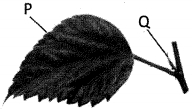
In the given diagram of a leaf,what are $P$ and $Q$?
$P \quad Q$
$P \quad Q$
A
Stipule $\quad$ Petiole
B
Lamina $\quad$ Petiole
C
Lamina $\quad$ Leaf base
D
Lamina $\quad$ Stipule
Solution
(D) In the provided diagram of a leaf:
$P$ represents the expanded green part of the leaf,which is known as the leaf blade or lamina.
$Q$ represents the small,lateral,leaf-like structures present at the base of the petiole,which are known as stipules.
Therefore,$P$ is the lamina and $Q$ is the stipule.
$P$ represents the expanded green part of the leaf,which is known as the leaf blade or lamina.
$Q$ represents the small,lateral,leaf-like structures present at the base of the petiole,which are known as stipules.
Therefore,$P$ is the lamina and $Q$ is the stipule.
0 likes
View Solution205
MediumMCQ
How many of the following plants exhibit parallel venation?
Mustard,Wheat,Banyan,Paddy,Pearl millet,Maize
Mustard,Wheat,Banyan,Paddy,Pearl millet,Maize
A
$2$
B
$3$
C
$4$
D
$5$
Solution
(C) Parallel venation is a characteristic feature of monocotyledonous plants.
$1$. Mustard ($Brassica$ $campestris$): Dicot,shows reticulate venation.
$2$. Wheat ($Triticum$ $aestivum$): Monocot,shows parallel venation.
$3$. Banyan ($Ficus$ $benghalensis$): Dicot,shows reticulate venation.
$4$. Paddy ($Oryza$ $sativa$): Monocot,shows parallel venation.
$5$. Pearl millet ($Pennisetum$ $glaucum$): Monocot,shows parallel venation.
$6$. Maize ($Zea$ $mays$): Monocot,shows parallel venation.
The plants with parallel venation are Wheat,Paddy,Pearl millet,and Maize.
Therefore,there are $4$ such plants.
$1$. Mustard ($Brassica$ $campestris$): Dicot,shows reticulate venation.
$2$. Wheat ($Triticum$ $aestivum$): Monocot,shows parallel venation.
$3$. Banyan ($Ficus$ $benghalensis$): Dicot,shows reticulate venation.
$4$. Paddy ($Oryza$ $sativa$): Monocot,shows parallel venation.
$5$. Pearl millet ($Pennisetum$ $glaucum$): Monocot,shows parallel venation.
$6$. Maize ($Zea$ $mays$): Monocot,shows parallel venation.
The plants with parallel venation are Wheat,Paddy,Pearl millet,and Maize.
Therefore,there are $4$ such plants.
0 likes
View Solution206
MediumMCQ
Select the correct option for the following:
Dicot leaf $\quad$ Monocot leaf
Dicot leaf $\quad$ Monocot leaf
A
Parallel venation $\quad$ Parallel venation
B
Reticulate venation $\quad$ Reticulate venation
C
Parallel venation $\quad$ Reticulate venation
D
Reticulate venation $\quad$ Parallel venation
Solution
(D) The arrangement of veins and veinlets in the lamina of a leaf is known as venation.
In dicotyledonous plants,the veins form a network,which is called reticulate venation.
In monocotyledonous plants,the veins run parallel to each other within the lamina,which is called parallel venation.
Therefore,a dicot leaf exhibits reticulate venation and a monocot leaf exhibits parallel venation.
In dicotyledonous plants,the veins form a network,which is called reticulate venation.
In monocotyledonous plants,the veins run parallel to each other within the lamina,which is called parallel venation.
Therefore,a dicot leaf exhibits reticulate venation and a monocot leaf exhibits parallel venation.
0 likes
View Solution207
MediumMCQ
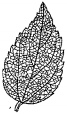
In which type of plants is the leaf shown in the image found?
A
Monocotyledonous plants
B
Dicotyledonous plants
C
Both
D
None of these
Solution
(B) The leaf shown in the image exhibits reticulate venation,where the veins and veinlets form a network-like structure.
Reticulate venation is a characteristic feature of dicotyledonous plants.
In contrast,monocotyledonous plants typically exhibit parallel venation,where the veins run parallel to each other within the lamina.
Reticulate venation is a characteristic feature of dicotyledonous plants.
In contrast,monocotyledonous plants typically exhibit parallel venation,where the veins run parallel to each other within the lamina.
0 likes
View Solution208
MediumMCQ
In which type of leaf is the incision of the lamina found to reach up to the midrib?
A
Pinnately compound leaf
B
Palmately compound leaf
C
Simple leaf
D
All of the above
Solution
(A) leaf is said to be compound when the incisions of the lamina reach up to the midrib,breaking it into a number of leaflets.
In a pinnately compound leaf,a number of leaflets are present on a common axis,the rachis,which represents the midrib.
Therefore,the correct answer is $A$ (Pinnately compound leaf).
In a pinnately compound leaf,a number of leaflets are present on a common axis,the rachis,which represents the midrib.
Therefore,the correct answer is $A$ (Pinnately compound leaf).
0 likes
View Solution209
MediumMCQ
In which type of leaf are all the leaflets attached to a common point?
A
Pinnately compound leaf
B
Palmately compound leaf
C
Simple leaf
D
All of the above
Solution
(B) In a compound leaf, the leaf blade is incised and the incisions reach the midrib, breaking it into a number of leaflets.
In a $Palmately$ $compound$ $leaf$, the leaflets are attached to a common point, i.e., at the tip of the petiole, similar to fingers on a palm.
In a $Pinnately$ $compound$ $leaf$, a number of leaflets are present on a common axis, the rachis, which represents the midrib of the leaf.
Therefore, the correct answer is $B$.
In a $Palmately$ $compound$ $leaf$, the leaflets are attached to a common point, i.e., at the tip of the petiole, similar to fingers on a palm.
In a $Pinnately$ $compound$ $leaf$, a number of leaflets are present on a common axis, the rachis, which represents the midrib of the leaf.
Therefore, the correct answer is $B$.
0 likes
View Solution210
MediumMCQ
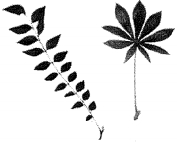
What do the given figures $P$ and $Q$ represent?
A
Opposite phyllotaxy,Whorled phyllotaxy
B
Pinnately compound leaf,Palmately compound leaf
C
Pinnately compound leaf,Palmately compound leaf
D
Whorled phyllotaxy,Opposite phyllotaxy
Solution
(B) In the given figure,$P$ represents a pinnately compound leaf,where a number of leaflets are present on a common axis,the rachis,which represents the midrib of the leaf.
$Q$ represents a palmately compound leaf,where the leaflets are attached at a common point,i.e.,at the tip of the petiole.
Therefore,the correct representation is $P$ as a pinnately compound leaf and $Q$ as a palmately compound leaf.
$Q$ represents a palmately compound leaf,where the leaflets are attached at a common point,i.e.,at the tip of the petiole.
Therefore,the correct representation is $P$ as a pinnately compound leaf and $Q$ as a palmately compound leaf.
0 likes
View Solution211
MediumMCQ
Select the incorrect statement regarding the leaf:
A
In a simple leaf,the leaf lamina is entire.
B
The axil of a leaflet in a compound leaf has an axillary bud.
C
The rachis is known as the midrib of the leaf.
D
$A$ compound leaf consists of many leaflets.
Solution
(B) In a simple leaf,the lamina is entire or when incised,the incisions do not touch the midrib.
In a compound leaf,the incisions of the lamina reach up to the midrib,breaking it into a number of leaflets.
$A$ key diagnostic feature is that the axillary bud is present in the axil of the petiole in both simple and compound leaves,but it is $NOT$ present in the axil of leaflets of a compound leaf.
Therefore,the statement that the axil of a leaflet in a compound leaf has an axillary bud is incorrect.
In a compound leaf,the incisions of the lamina reach up to the midrib,breaking it into a number of leaflets.
$A$ key diagnostic feature is that the axillary bud is present in the axil of the petiole in both simple and compound leaves,but it is $NOT$ present in the axil of leaflets of a compound leaf.
Therefore,the statement that the axil of a leaflet in a compound leaf has an axillary bud is incorrect.
0 likes
View Solution212
MediumMCQ
Match the following columns:
| Column-$I$ (Phyllotaxy) | Column-$II$ (Plants) |
|---|---|
| $P$. Alternate | $I$. Alstonia |
| $Q$. Opposite | $II$. Calotropis |
| $R$. Whorled | $III$. Opuntia |
| $IV$. Mustard |
A
$(P-II), (Q-IV), (R-I)$
B
$(P-IV), (Q-II), (R-I)$
C
$(P-IV), (Q-II), (R-III)$
D
$(P-III), (Q-I), (R-II)$
Solution
(B) The pattern of arrangement of leaves on the stem or branch is called phyllotaxy.
$1$. Alternate phyllotaxy: $A$ single leaf arises at each node in an alternate manner,as seen in Mustard $(IV)$.
$2$. Opposite phyllotaxy: $A$ pair of leaves arise at each node and lie opposite to each other,as seen in Calotropis $(II)$.
$3$. Whorled phyllotaxy: If more than two leaves arise at a node and form a whorl,it is called whorled,as seen in Alstonia $(I)$.
Therefore,the correct matching is $P-IV, Q-II, R-I$.
$1$. Alternate phyllotaxy: $A$ single leaf arises at each node in an alternate manner,as seen in Mustard $(IV)$.
$2$. Opposite phyllotaxy: $A$ pair of leaves arise at each node and lie opposite to each other,as seen in Calotropis $(II)$.
$3$. Whorled phyllotaxy: If more than two leaves arise at a node and form a whorl,it is called whorled,as seen in Alstonia $(I)$.
Therefore,the correct matching is $P-IV, Q-II, R-I$.
0 likes
View Solution213
MediumMCQ
The pattern of arrangement of leaves on the $......$ is known as phyllotaxy.
A
Stem
B
Branch
C
Stem or branch
D
Root
Solution
(C) Phyllotaxy is defined as the pattern of arrangement of leaves on the stem or the branch. This arrangement is usually of three types: alternate,opposite,and whorled,which helps in providing maximum exposure to sunlight for photosynthesis.
0 likes
View Solution214
MediumMCQ
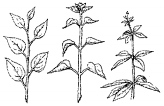
Identify the types of phyllotaxy shown in the given figure.
A
Alternate,Opposite,Whorled
B
Alternate,Whorled,Opposite
C
Whorled,Opposite,Alternate
D
Whorled,Alternate,Opposite
Solution
(A) Phyllotaxy is the pattern of arrangement of leaves on the stem or branch.
$1$. The first figure shows 'Alternate' phyllotaxy,where a single leaf arises at each node in an alternate manner (e.g.,China rose,mustard,sunflower).
$2$. The second figure shows 'Opposite' phyllotaxy,where a pair of leaves arise at each node and lie opposite to each other (e.g.,Calotropis and guava).
$3$. The third figure shows 'Whorled' phyllotaxy,where more than two leaves arise at a node and form a whorl (e.g.,Alstonia).
Therefore,the correct sequence is Alternate,Opposite,Whorled.
$1$. The first figure shows 'Alternate' phyllotaxy,where a single leaf arises at each node in an alternate manner (e.g.,China rose,mustard,sunflower).
$2$. The second figure shows 'Opposite' phyllotaxy,where a pair of leaves arise at each node and lie opposite to each other (e.g.,Calotropis and guava).
$3$. The third figure shows 'Whorled' phyllotaxy,where more than two leaves arise at a node and form a whorl (e.g.,Alstonia).
Therefore,the correct sequence is Alternate,Opposite,Whorled.
0 likes
View Solution215
MediumMCQ
In a Venus flytrap, which plant part is modified to trap insects?
A
Root
B
Stem
C
Leaf
D
Fruit
Solution
(C) The Venus flytrap $(Dionaea \text{ } muscipula)$ is an insectivorous plant.
In this plant, the leaf is modified into a trap-like structure to capture insects.
The leaf consists of two lobes that act like a hinge, which snap shut when an insect touches the sensory hairs on the inner surface of the leaf.
This adaptation allows the plant to obtain nitrogen from the insects, which is essential for its survival in nutrient-poor soil.
In this plant, the leaf is modified into a trap-like structure to capture insects.
The leaf consists of two lobes that act like a hinge, which snap shut when an insect touches the sensory hairs on the inner surface of the leaf.
This adaptation allows the plant to obtain nitrogen from the insects, which is essential for its survival in nutrient-poor soil.
0 likes
View Solution216
MediumMCQ
Identify the plant whose leaf is shown in the image.
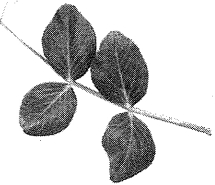
A
Pumpkin
B
Grapevine
C
Pea
D
All of the above
Solution
(C) The image shows a leaf with tendrils,which is a characteristic feature of the pea plant ($Pisum$ $sativum$). In pea plants,the upper leaflets are modified into tendrils to help the plant climb. Pumpkin and grapevine also possess tendrils,but they are modified stems,not leaves. Therefore,the correct option is $C$.
0 likes
View Solution217
MediumMCQ
What is a stipule?
A
Root
B
Stem
C
Leaf
D
Flower
Solution
(C) stipule is a small,leaf-like appendage found at the base of the petiole of a leaf. It is a characteristic feature of many flowering plants. Therefore,it is associated with the leaf.
0 likes
View Solution218
MediumMCQ
Subsidiary cells of stomata are modifications of $..........$.
A
Parenchyma cells
B
Collenchyma cells
C
Sclerenchyma fibers
D
Sclereids
Solution
(A) Subsidiary cells,also known as accessory cells,are specialized epidermal cells that surround the guard cells of the stomata.
These cells are derived from the surrounding epidermal cells,which are typically parenchyma cells.
They provide structural support and assist in the opening and closing mechanism of the stomatal pore.
Therefore,the correct answer is $A$ (Parenchyma cells).
These cells are derived from the surrounding epidermal cells,which are typically parenchyma cells.
They provide structural support and assist in the opening and closing mechanism of the stomatal pore.
Therefore,the correct answer is $A$ (Parenchyma cells).
0 likes
View Solution219
MediumMCQ
In which type of leaf are the vascular bundles of unequal size found on the same leaf blade?
A
Dorsiventral leaf
B
Isobilateral leaf
C
Both
D
None of these
Solution
(A) In a $Dorsiventral$ leaf (typically found in dicots),the vascular bundles are of different sizes depending on the size of the veins. The midrib vein is the largest,while the lateral veins are smaller. In an $Isobilateral$ leaf (typically found in monocots),the vascular bundles are generally of similar size,except for the midrib.
0 likes
View Solution220
MediumMCQ
Select the correct option based on the venation pattern in leaves.
Monocot leaf : Dicot leaf
Monocot leaf : Dicot leaf
A
Reticulate venation,Reticulate venation
B
Parallel venation,Parallel venation
C
Reticulate venation,Parallel venation
D
Parallel venation,Reticulate venation
Solution
(D) The arrangement of veins and veinlets in the lamina of a leaf is known as venation.
$1$. In $Monocot$ leaves, the veins run parallel to each other within the lamina, which is known as $Parallel$ $venation$.
$2$. In $Dicot$ leaves, the veins form a network-like structure, which is known as $Reticulate$ $venation$.
Therefore, the correct sequence for $Monocot$ leaf and $Dicot$ leaf is $Parallel$ $venation$ and $Reticulate$ $venation$ respectively.
$1$. In $Monocot$ leaves, the veins run parallel to each other within the lamina, which is known as $Parallel$ $venation$.
$2$. In $Dicot$ leaves, the veins form a network-like structure, which is known as $Reticulate$ $venation$.
Therefore, the correct sequence for $Monocot$ leaf and $Dicot$ leaf is $Parallel$ $venation$ and $Reticulate$ $venation$ respectively.
0 likes
View Solution221
EasyMCQ
In which type of leaf are stomata equally distributed on both surfaces?
A
Dorsiventral leaf
B
Isobilateral leaf
C
Both
D
None
Solution
(B) In an $Isobilateral$ leaf, which is typically found in monocotyledonous plants, the leaf surfaces are similar in appearance and structure. Consequently, stomata are distributed equally on both the adaxial and abaxial surfaces. In contrast, a $Dorsiventral$ leaf (typically found in dicotyledonous plants) has more stomata on the abaxial surface compared to the adaxial surface.
0 likes
View Solution222
MediumMCQ
Which plant exhibits heterophylly due to its environment?
A
Cotton
B
Coriander
C
Larkspur
D
Buttercup
Solution
(D) Heterophylly is the phenomenon where a plant produces different types of leaves in different environmental conditions.
In $Buttercup$ ($Ranunculus$ $sceleratus$),the leaves produced in the air are different in shape compared to the leaves produced in water.
This adaptation allows the plant to survive in varying habitats,making $Buttercup$ a classic example of environmental heterophylly.
In $Buttercup$ ($Ranunculus$ $sceleratus$),the leaves produced in the air are different in shape compared to the leaves produced in water.
This adaptation allows the plant to survive in varying habitats,making $Buttercup$ a classic example of environmental heterophylly.
0 likes
View Solution223
MediumMCQ
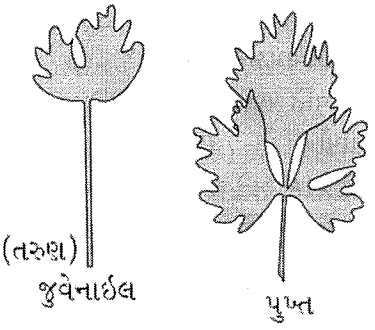
Which plant exhibits the heterophylly shown in the image below?
A
Cotton
B
Coriander
C
Larkspur
D
Buttercup
Solution
(B) The phenomenon of heterophylly refers to the presence of different types of leaves in the same plant at different developmental stages or in different environments.
In the provided image,the juvenile leaves are simple and less lobed,while the mature leaves are highly dissected or compound.
This specific type of developmental heterophylly is characteristic of the plant Coriander (Coriandrum sativum).
Cotton,Larkspur,and Buttercup also exhibit heterophylly,but the specific morphology shown in the image corresponds to Coriander.
In the provided image,the juvenile leaves are simple and less lobed,while the mature leaves are highly dissected or compound.
This specific type of developmental heterophylly is characteristic of the plant Coriander (Coriandrum sativum).
Cotton,Larkspur,and Buttercup also exhibit heterophylly,but the specific morphology shown in the image corresponds to Coriander.
0 likes
View Solution224
MediumMCQ
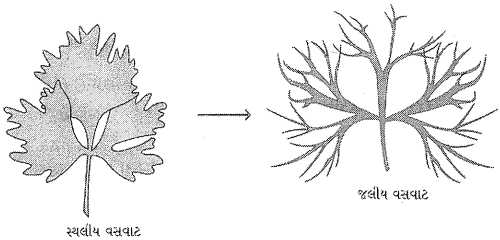
Identify the plant that shows the heterophylly depicted in the image below.
A
Cotton
B
Coriander
C
Larkspur
D
Buttercup
Solution
(D) The image illustrates heterophylly,which is the phenomenon where a plant exhibits different forms of leaves in different environmental conditions.
In the case of $Buttercup$ ($Ranunculus$ $sceleratus$),the leaves produced in the terrestrial habitat are broad and simple,while the leaves produced in the aquatic habitat are finely dissected or filamentous to reduce water resistance and increase surface area for gas exchange.
Therefore,the correct option is $D$.
In the case of $Buttercup$ ($Ranunculus$ $sceleratus$),the leaves produced in the terrestrial habitat are broad and simple,while the leaves produced in the aquatic habitat are finely dissected or filamentous to reduce water resistance and increase surface area for gas exchange.
Therefore,the correct option is $D$.
0 likes
View Solution225
MediumMCQ
Which one of the following is not an example of developmental heterophylly?
A
Cotton
B
Buttercup
C
Coriander
D
Larkspur
Solution
(B) Developmental heterophylly refers to the phenomenon where plants exhibit different leaf shapes at different stages of their life cycle (e.g.,juvenile vs. mature phases).
$Cotton$,$Coriander$,and $Larkspur$ are classic examples of plants that show developmental heterophylly.
$Buttercup$ (Ranunculus),on the other hand,exhibits environmental heterophylly,where the leaf shape changes based on the environment (terrestrial vs. aquatic habitat).
Therefore,$Buttercup$ is not an example of developmental heterophylly.
$Cotton$,$Coriander$,and $Larkspur$ are classic examples of plants that show developmental heterophylly.
$Buttercup$ (Ranunculus),on the other hand,exhibits environmental heterophylly,where the leaf shape changes based on the environment (terrestrial vs. aquatic habitat).
Therefore,$Buttercup$ is not an example of developmental heterophylly.
0 likes
View Solution226
EasyMCQ
The leaf base may become swollen,which is called the pulvinus. It is found in $:-$
A
All dicot plants
B
Some leguminous plants
C
All monocot plants
D
All gymnosperm plants
Solution
(B) In many leguminous plants,the leaf base becomes swollen,which is known as the pulvinus.
The pulvinus plays a crucial role in the movement of leaves,such as the sleep movements observed in plants like Mimosa pudica (touch-me-not plant).
Therefore,the correct option is $B$.
The pulvinus plays a crucial role in the movement of leaves,such as the sleep movements observed in plants like Mimosa pudica (touch-me-not plant).
Therefore,the correct option is $B$.
0 likes
View Solution227
MediumMCQ
Which type of phyllotaxy is found in Alstonia?
A
Alternate
B
Opposite
C
Whorled
D
Marginal
Solution
(C) Phyllotaxy is the pattern of arrangement of leaves on the stem or branch.
In $Alstonia$,more than two leaves arise at a node and form a whorl,which is known as whorled phyllotaxy.
Therefore,the correct option is $C$.
In $Alstonia$,more than two leaves arise at a node and form a whorl,which is known as whorled phyllotaxy.
Therefore,the correct option is $C$.
0 likes
View Solution228
MediumMCQ
Function of petiole is $:-$
A
Hold the blade
B
Allow leaf blades to flutter in wind
C
Bringing fresh air to leaf's surface
D
All of the above
Solution
(D) The petiole is the stalk that attaches the leaf blade to the stem.
Its primary functions include:
$1$. Holding the leaf blade in a position that maximizes exposure to sunlight.
$2$. Allowing the leaf blade to flutter in the wind,which helps in cooling the leaf and bringing fresh air to the leaf's surface for efficient gas exchange.
Therefore,all the given options are correct functions of the petiole.
Its primary functions include:
$1$. Holding the leaf blade in a position that maximizes exposure to sunlight.
$2$. Allowing the leaf blade to flutter in the wind,which helps in cooling the leaf and bringing fresh air to the leaf's surface for efficient gas exchange.
Therefore,all the given options are correct functions of the petiole.
0 likes
View Solution229
MediumMCQ
Which of the following is used to distinguish a monocot from a dicot plant?
A
Venation
B
Aestivation
C
Vernation
D
Phyllotaxy
Solution
(A) The arrangement of veins and veinlets in the lamina of a leaf is known as venation.
Monocot plants typically exhibit parallel venation,where the veins run parallel to each other.
Dicot plants typically exhibit reticulate venation,where the veins form a network-like structure.
Therefore,venation is a key morphological feature used to distinguish between monocot and dicot plants.
Monocot plants typically exhibit parallel venation,where the veins run parallel to each other.
Dicot plants typically exhibit reticulate venation,where the veins form a network-like structure.
Therefore,venation is a key morphological feature used to distinguish between monocot and dicot plants.
0 likes
View Solution230
MediumMCQ
Given below are two statements:
Statement-$I$: Leaves originate from shoot apical meristems.
Statement-$II$: Leaves are arranged in acropetal order.
In the light of the above statements,choose the correct answer from the options given below:
Statement-$I$: Leaves originate from shoot apical meristems.
Statement-$II$: Leaves are arranged in acropetal order.
In the light of the above statements,choose the correct answer from the options given below:
A
Statement-$I$ is true but statement-$II$ is false
B
Statement-$I$ is false but statement-$II$ is true
C
Both statement-$I$ and statement-$II$ are true
D
Both statement-$I$ and statement-$II$ are false
Solution
(C) Statement-$I$ is true: Leaves are lateral appendages of the stem and they originate from the shoot apical meristems.
Statement-$II$ is true: Leaves are arranged in an acropetal order on the stem,meaning the youngest leaves are at the apex and the oldest leaves are at the base.
Statement-$II$ is true: Leaves are arranged in an acropetal order on the stem,meaning the youngest leaves are at the apex and the oldest leaves are at the base.
0 likes
View Solution231
EasyMCQ
Sheathing leaf base is found in $-$
A
Legumes
B
Monocots
C
Dicots
D
Algae
Solution
(B) In flowering plants,the leaf base may become swollen to form a structure called the pulvinus,which is characteristic of legumes.
However,in monocotyledonous plants (monocots),the leaf base expands into a sheath that partially or wholly covers the stem.
This type of leaf base is known as a sheathing leaf base.
Therefore,the correct option is $B$.
However,in monocotyledonous plants (monocots),the leaf base expands into a sheath that partially or wholly covers the stem.
This type of leaf base is known as a sheathing leaf base.
Therefore,the correct option is $B$.
0 likes
View Solution232
EasyMCQ
Environmental heterophylly is observed in the leaves of . . . . . . .
A
cotton
B
coriander
C
butter cup
D
larkspur
Solution
(C) Heterophylly is the phenomenon where plants exhibit different forms of leaves in different phases of their life cycle or in response to different environmental conditions.
Environmental heterophylly occurs when the environment induces changes in leaf shape.
In $Ranunculus$ $sceleratus$ (buttercup),the leaves produced in air are different in shape from those produced in water.
This adaptation allows the plant to survive in varying environmental conditions.
Environmental heterophylly occurs when the environment induces changes in leaf shape.
In $Ranunculus$ $sceleratus$ (buttercup),the leaves produced in air are different in shape from those produced in water.
This adaptation allows the plant to survive in varying environmental conditions.
0 likes
View SolutionMorphology of Flowering Plants — Leaf · Frequently Asked Questions
1Are these Morphology of Flowering Plants questions useful for JEE and NEET?
Yes. All questions in this section are mapped to JEE Main and NEET exam patterns. Previous year questions from JEE Main, NEET, GUJCET and state-level exams are included with full solutions.
2Can I switch to Hindi or Gujarati for these questions?
Yes. Use the language tabs in the hero section or the sidebar to view the same questions and solutions in English, Hindi or Gujarati.
3How do I generate a question paper from this subtopic?
Use the Vedclass Exam Paper Generator — select the chapter and subtopic, set difficulty, and generate Sets A, B, C, D automatically. First 3 chapters of every subject are free.
Vedclass Products
For Students
Vedclass Test Series
Mock tests in real JEE/NEET style with performance analysis. 5-day free trial.
Start Free TrialFor Teachers
Exam Paper Generator
Generate Set A/B/C/D papers from this chapter in 2 minutes. 3 chapters free.
Try FreeFor Institutes
Online Exam Module
Live online exams with unlimited students, 360° analytics & white-label branding.
See DemoFor Teachers & Institutes
Generate a Morphology of Flowering Plants Exam Paper in 2 Minutes
Select subtopic & difficulty — Sets A, B, C, D auto-generated with No Repeat logic.
First 3 chapters of every subject are free — no payment required.