
A English
Leaf Questions in English
Class 11 Biology · Morphology of Flowering Plants · Leaf
232+
Questions
English
Language
100%
With Solutions
Showing 50 of 232 questions in English
151
Medium
What is Phyllotaxy? Explain.
Solution
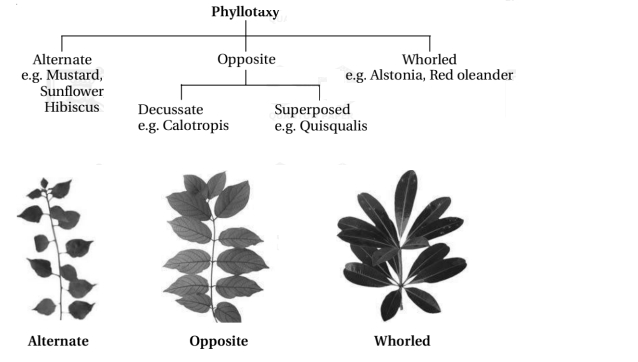
$\rightarrow$ Phyllotaxy is the pattern of arrangement of leaves on the stem or branch.
$\rightarrow$ This is usually of three types: alternate,opposite,and whorled.
$\rightarrow$ Alternate: In this type of phyllotaxy,a single leaf arises at each node in an alternate manner,e.g.,China rose,mustard,and sunflower.
$\rightarrow$ Opposite: In this type,a pair of leaves arise at each node and lie opposite to each other,e.g.,Calotropis and guava.
$\rightarrow$ Whorled: If more than two leaves arise at a node and form a whorl,it is called whorled phyllotaxy,e.g.,Alstonia.
$\rightarrow$ This is usually of three types: alternate,opposite,and whorled.
$\rightarrow$ Alternate: In this type of phyllotaxy,a single leaf arises at each node in an alternate manner,e.g.,China rose,mustard,and sunflower.
$\rightarrow$ Opposite: In this type,a pair of leaves arise at each node and lie opposite to each other,e.g.,Calotropis and guava.
$\rightarrow$ Whorled: If more than two leaves arise at a node and form a whorl,it is called whorled phyllotaxy,e.g.,Alstonia.
0 likes
View Solution152
Easy
Describe the modification of leaves for specific functions with examples.
Solution
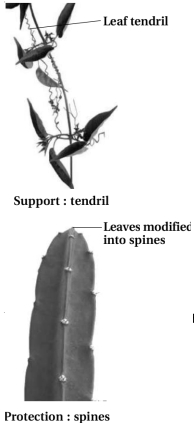
(N/A) Modifications of leaves for specific functions are as follows:
$(a)$ Modifications for support and climbing: In some plants with weak stems,leaves are converted into tendrils to help the plant climb,as seen in peas ($Pisum$ $sativum$).
$(b)$ Modifications of leaves for protection: In some plants,leaves are modified into sharp spines to provide defense against herbivores,as seen in cacti.
$(a)$ Modifications for support and climbing: In some plants with weak stems,leaves are converted into tendrils to help the plant climb,as seen in peas ($Pisum$ $sativum$).
$(b)$ Modifications of leaves for protection: In some plants,leaves are modified into sharp spines to provide defense against herbivores,as seen in cacti.
0 likes
View Solution153
Easy
Explain: $(1)$ Heterophylly
Solution
(N/A) Heterophylly is a phenomenon in plants where the leaves on the same plant exhibit different shapes and sizes at different stages of development or in response to different environmental conditions.
$(1)$ Developmental Heterophylly: In some plants,the juvenile leaves are different in shape from the mature leaves. For example,in $Larkspur$ (Delphinium),the juvenile leaves are simple,while the mature leaves are more complex and lobed.
$(2)$ Environmental Heterophylly: This occurs when the environment influences the leaf shape. $A$ classic example is $Buttercup$ (Ranunculus sceleratus),which grows in both terrestrial and aquatic habitats. The leaves produced in the air (terrestrial) are broad,while those produced in water (aquatic) are finely dissected and thread-like. This is an example of plasticity,where the plant's phenotype changes in response to its environment.
$(1)$ Developmental Heterophylly: In some plants,the juvenile leaves are different in shape from the mature leaves. For example,in $Larkspur$ (Delphinium),the juvenile leaves are simple,while the mature leaves are more complex and lobed.
$(2)$ Environmental Heterophylly: This occurs when the environment influences the leaf shape. $A$ classic example is $Buttercup$ (Ranunculus sceleratus),which grows in both terrestrial and aquatic habitats. The leaves produced in the air (terrestrial) are broad,while those produced in water (aquatic) are finely dissected and thread-like. This is an example of plasticity,where the plant's phenotype changes in response to its environment.
0 likes
View Solution154
Easy
Draw a diagram showing the main parts of a leaf.
Solution
(N/A) typical leaf consists of three main parts: the leaf base,the petiole,and the lamina (leaf blade).
$1$. Leaf base: The part of the leaf attached to the stem. It may bear two lateral small leaf-like structures called stipules.
$2$. Petiole: The stalk that holds the leaf blade to light.
$3$. Lamina (Leaf blade): The green,expanded part of the leaf with veins and veinlets. The middle prominent vein is called the midrib. The veins provide rigidity to the leaf blade and act as channels of transport for water,minerals,and food materials.
Additionally,an axillary bud is often present in the axil of the leaf,which later develops into a branch.
$1$. Leaf base: The part of the leaf attached to the stem. It may bear two lateral small leaf-like structures called stipules.
$2$. Petiole: The stalk that holds the leaf blade to light.
$3$. Lamina (Leaf blade): The green,expanded part of the leaf with veins and veinlets. The middle prominent vein is called the midrib. The veins provide rigidity to the leaf blade and act as channels of transport for water,minerals,and food materials.
Additionally,an axillary bud is often present in the axil of the leaf,which later develops into a branch.
0 likes
View Solution155
Easy
Describe the various parts of a leaf.
Solution
(N/A) typical leaf consists of three main parts:
$1$. Leaf base (Hypopodium): The part by which the leaf is attached to the stem. It may bear two lateral small leaf-like structures called stipules.
$2$. Petiole (Mesopodium): The stalk of the leaf that helps hold the blade to light. Long,thin,flexible petioles allow leaf blades to flutter in wind,thereby cooling the leaf and bringing fresh air to leaf surface.
$3$. Lamina (Epipodium): The green,expanded part of the leaf with veins and veinlets. The middle prominent vein is known as the midrib. Veins provide rigidity to the leaf blade and act as channels of transport for water,minerals,and food materials.
$1$. Leaf base (Hypopodium): The part by which the leaf is attached to the stem. It may bear two lateral small leaf-like structures called stipules.
$2$. Petiole (Mesopodium): The stalk of the leaf that helps hold the blade to light. Long,thin,flexible petioles allow leaf blades to flutter in wind,thereby cooling the leaf and bringing fresh air to leaf surface.
$3$. Lamina (Epipodium): The green,expanded part of the leaf with veins and veinlets. The middle prominent vein is known as the midrib. Veins provide rigidity to the leaf blade and act as channels of transport for water,minerals,and food materials.
0 likes
View Solution156
Medium
Explain the modification of leaves for food storage.
Solution
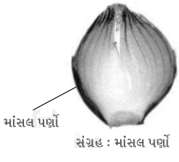
(N/A) In some plants,leaves are modified to store food. These leaves become fleshy and succulent to store nutrients and water.
Example: Onion (Allium cepa) and Garlic (Allium sativum).
Other modifications of leaves include:
$1$. Tendrils: For climbing,e.g.,Peas.
$2$. Spines: For defense,e.g.,Cacti.
$3$. Phyllode: In Australian Acacia,the leaves are small and short-lived. The petiole expands,becomes green,and synthesizes food.
$4$. Insectivorous: Leaves are modified to trap insects,e.g.,Pitcher plant and Venus flytrap.
Example: Onion (Allium cepa) and Garlic (Allium sativum).
Other modifications of leaves include:
$1$. Tendrils: For climbing,e.g.,Peas.
$2$. Spines: For defense,e.g.,Cacti.
$3$. Phyllode: In Australian Acacia,the leaves are small and short-lived. The petiole expands,becomes green,and synthesizes food.
$4$. Insectivorous: Leaves are modified to trap insects,e.g.,Pitcher plant and Venus flytrap.
0 likes
View Solution157
Easy
Give differences: Simple leaf and Compound leaf.
Solution
(N/A)
| Simple leaf | Compound leaf |
|---|---|
| $(1)$ It has only one leaf lamina. | $(1)$ When incisions of the lamina reach the midrib,breaking it into a number of leaflets,it is called a compound leaf. |
| $(2)$ It has an axillary bud in the axil of the petiole. | $(2)$ It has no axillary buds in the axils of the leaflets. |
| $(3)$ The lamina incision,if present,does not reach the midrib. | $(3)$ The lamina incision reaches the midrib,dividing the leaf into leaflets. |
| $(4)$ The leaf is considered entire or simple. | $(4)$ It can be pinnately or palmately compound. |
0 likes
View Solution158
Medium
Draw diagrams of a typical monocot and dicot leaves to show their venation pattern.
Solution
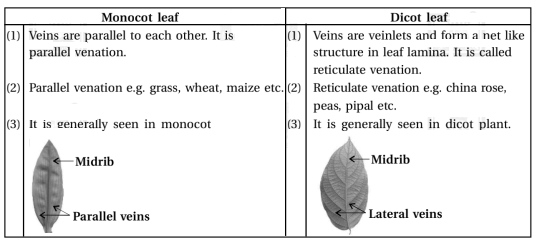
(N/A) Venation is the arrangement of veins and veinlets in the lamina of a leaf. The two main types are:
$1$. Reticulate venation: When the veinlets form a network,as seen in dicot leaves (e.g.,China rose,pea,Pipal).
$2$. Parallel venation: When the veins run parallel to each other within a lamina,as seen in monocot leaves (e.g.,grass,wheat,maize).
| Monocot leaf | Dicot leaf |
| :--- | :--- |
| Veins are parallel to each other. It is parallel venation. | Veins and veinlets form a net-like structure in the leaf lamina. It is called reticulate venation. |
| Generally seen in monocot plants. | Generally seen in dicot plants. |
| Examples: Grass,wheat,maize. | Examples: China rose,pea,Pipal. |
$1$. Reticulate venation: When the veinlets form a network,as seen in dicot leaves (e.g.,China rose,pea,Pipal).
$2$. Parallel venation: When the veins run parallel to each other within a lamina,as seen in monocot leaves (e.g.,grass,wheat,maize).
| Monocot leaf | Dicot leaf |
| :--- | :--- |
| Veins are parallel to each other. It is parallel venation. | Veins and veinlets form a net-like structure in the leaf lamina. It is called reticulate venation. |
| Generally seen in monocot plants. | Generally seen in dicot plants. |
| Examples: Grass,wheat,maize. | Examples: China rose,pea,Pipal. |
0 likes
View Solution159
EasyMCQ
Reticulate venation is found in dicot leaves,while in monocot leaves,venation is of the parallel type. Biology being a 'Science of exceptions',find out any exception to this generalization.
A
Calophyllum
B
Smilax
C
Alocasia
D
All of the above
Solution
(D) $\rightarrow$ Reticulate venation is a characteristic of dicots,and parallel venation is a characteristic of monocots.
However,there are exceptions to this generalization.
In some dicot plants,parallel venation is observed,for example,$Calophyllum$ and $Corymbium$.
In some monocot plants,reticulate venation is observed,for example,$Alocasia$ and $Smilax$.
Therefore,all the given options represent exceptions to the general rule of venation in angiosperms.
However,there are exceptions to this generalization.
In some dicot plants,parallel venation is observed,for example,$Calophyllum$ and $Corymbium$.
In some monocot plants,reticulate venation is observed,for example,$Alocasia$ and $Smilax$.
Therefore,all the given options represent exceptions to the general rule of venation in angiosperms.
0 likes
View Solution160
Easy
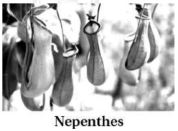
You have heard about several insectivorous plants that feed on insects. Nepenthes or the pitcher plant is one such example,which usually grows in shallow water or in marshy lands. What part of the plant is modified into a pitcher? How does this modification help the plant for food even though it can photosynthesize like any other green plant?
Solution
In insectivorous plants like the pitcher plant $(Nepenthes)$,the leaf is modified into a pitcher-like structure. The leaf apex forms a lid,which can open and close the mouth of the pitcher.
These plants are green and can perform photosynthesis to synthesize carbohydrates. However,they grow in nitrogen-deficient,marshy soils. To overcome this nitrogen deficiency,they trap and digest insects using digestive enzymes secreted within the pitcher. The digestion of insects provides the necessary nitrogenous compounds required for their growth and development.
These plants are green and can perform photosynthesis to synthesize carbohydrates. However,they grow in nitrogen-deficient,marshy soils. To overcome this nitrogen deficiency,they trap and digest insects using digestive enzymes secreted within the pitcher. The digestion of insects provides the necessary nitrogenous compounds required for their growth and development.
0 likes
View Solution161
Medium
Identify the correct terms for the following analogy-based question:
$(i)$ Leaf is attached to the stem by: Leaf base :: The swollen leaf base is called: ............
$(ii)$ In Neem: Pinnately compound leaf :: In Silk cotton: ............
$(i)$ Leaf is attached to the stem by: Leaf base :: The swollen leaf base is called: ............
$(ii)$ In Neem: Pinnately compound leaf :: In Silk cotton: ............
Solution
(A) $(i)$ Pulvinus
$(ii)$ Palmately compound leaf
Explanation:
$(i)$ The leaf base may become swollen in some leguminous plants,which is called the pulvinus.
$(ii)$ In pinnately compound leaves,a number of leaflets are present on a common axis,the rachis,which represents the midrib of the leaf (e.g.,Neem). In palmately compound leaves,the leaflets are attached at a common point,i.e.,at the tip of the petiole (e.g.,Silk cotton).
$(ii)$ Palmately compound leaf
Explanation:
$(i)$ The leaf base may become swollen in some leguminous plants,which is called the pulvinus.
$(ii)$ In pinnately compound leaves,a number of leaflets are present on a common axis,the rachis,which represents the midrib of the leaf (e.g.,Neem). In palmately compound leaves,the leaflets are attached at a common point,i.e.,at the tip of the petiole (e.g.,Silk cotton).
0 likes
View Solution162
MediumMCQ
Leaf tendrils are found in
A
Grapevine
B
Watermelon
C
Cucumber
D
Peas
Solution
(D) Leaf tendrils are specialized, thread-like, sensitive structures that are often modified parts of leaves. In the plant $Pisum \text{ } sativum$ (Pea), the terminal leaflets are modified into tendrils to help the plant climb. In contrast, in Grapevine, Watermelon, and Cucumber, the tendrils are stem modifications.
0 likes
View Solution163
MediumMCQ
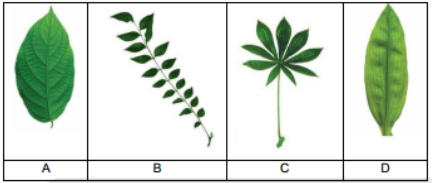
Identify the given diagrams and mark the correct option.
A
$A, D$ are compound while $B, C$ are simple leaves.
B
$A, D$ are simple while $B, C$ are compound leaves.
C
$A, B$ are simple while $C, D$ are compound leaves.
D
$A, B$ are compound while $C, D$ are simple leaves.
Solution
(B) leaf is said to be simple when its lamina is entire or when incised,the incisions do not touch the midrib. In the given diagrams,$A$ and $D$ represent simple leaves as they have a single,undivided leaf blade.
When the incisions of the lamina reach up to the midrib breaking it into a number of leaflets,the leaf is called a compound leaf. In the given diagrams,$B$ (pinnately compound) and $C$ (palmately compound) represent compound leaves as they have separate leaflets.
When the incisions of the lamina reach up to the midrib breaking it into a number of leaflets,the leaf is called a compound leaf. In the given diagrams,$B$ (pinnately compound) and $C$ (palmately compound) represent compound leaves as they have separate leaflets.
0 likes
View Solution164
MediumMCQ
Which of the following is the modification of leaf?
A
Cladode
B
Phyllode
C
Corm
D
Phylloclade
Solution
(B) Phyllode is a modification of the leaf.
In this, the petiole of the leaf becomes expanded, green, and performs the function of photosynthesis.
It resembles a leaf and is commonly seen in plants like $Parkinsonia$ and $Australian \text{ } Acacia$.
In this, the petiole of the leaf becomes expanded, green, and performs the function of photosynthesis.
It resembles a leaf and is commonly seen in plants like $Parkinsonia$ and $Australian \text{ } Acacia$.
0 likes
View Solution165
MediumMCQ
Leaves of dicotyledonous plants generally exhibit:
A
Oblique venation
B
Lateral venation
C
Reticulate venation
D
Parallel venation
Solution
(C) The correct answer is $C$.
Venation is defined as the arrangement of veins and veinlets in the lamina of a leaf.
When the veinlets form a complex network,the venation is termed as reticulate venation.
When the veins run parallel to each other within a lamina,the venation is termed as parallel venation.
Leaves of dicotyledonous plants generally possess reticulate venation,whereas parallel venation is a characteristic feature of most monocotyledonous plants.
Venation is defined as the arrangement of veins and veinlets in the lamina of a leaf.
When the veinlets form a complex network,the venation is termed as reticulate venation.
When the veins run parallel to each other within a lamina,the venation is termed as parallel venation.
Leaves of dicotyledonous plants generally possess reticulate venation,whereas parallel venation is a characteristic feature of most monocotyledonous plants.
0 likes
View Solution166
MediumMCQ
Structure of leaf which provides channels of transport for water,minerals,and food materials is called:
A
Midrib
B
Margin
C
Lamina
D
Veins
Solution
(D) The lamina or the leaf blade is the green expanded part of the leaf with veins and veinlets.
There is usually a middle prominent vein,which is known as the midrib.
Veins provide rigidity to the leaf blade and act as channels of transport for water,minerals,and food materials.
The shape,margin,apex,surface,and extent of incision of the lamina vary in different leaves.
There is usually a middle prominent vein,which is known as the midrib.
Veins provide rigidity to the leaf blade and act as channels of transport for water,minerals,and food materials.
The shape,margin,apex,surface,and extent of incision of the lamina vary in different leaves.
0 likes
View Solution167
MediumMCQ
Generally,the parallel venation is found in
A
Gymnosperm
B
Pteridophytes
C
Monocotyledons
D
Dicotyledons
Solution
(C) Venation is the arrangement of veins and veinlets in the lamina of a leaf.
When the veinlets form a network,the venation is termed as reticulate.
When the veins run parallel to each other within a lamina,the venation is termed as parallel.
Leaves of dicotyledonous plants generally possess reticulate venation,while parallel venation is a characteristic feature of most monocotyledons.
When the veinlets form a network,the venation is termed as reticulate.
When the veins run parallel to each other within a lamina,the venation is termed as parallel.
Leaves of dicotyledonous plants generally possess reticulate venation,while parallel venation is a characteristic feature of most monocotyledons.
0 likes
View Solution168
EasyMCQ
Modification of petiole into a leaf-like structure is called
A
Cladode
B
Phylloclade
C
Phyllode
D
Pistillode
Solution
(C) In some plants,such as $Acacia$ species,the leaf lamina is small or falls off early.
To compensate for this,the petiole becomes green,flattened,and leaf-like to perform photosynthesis.
This modified petiole is known as a $Phyllode$.
To compensate for this,the petiole becomes green,flattened,and leaf-like to perform photosynthesis.
This modified petiole is known as a $Phyllode$.
0 likes
View Solution169
EasyMCQ
The reticulate venation is commonly found in the leaves of
A
Monocot plants
B
Dicot plants
C
Bryophytes
D
Thallophytes
Solution
(B) In reticulate venation,the veins are arranged in a net-like manner. This type of venation is a characteristic feature of most dicotyledonous plants. In contrast,monocotyledonous plants typically exhibit parallel venation,where the veins run parallel to each other within the lamina.
0 likes
View Solution170
MediumMCQ
$A$ compound leaf,which appears as a simple leaf due to the suppression of one or two leaflets,is found in which of the following plants?
A
Hardwickia
B
Parkinsonia
C
Coriandrum
D
Citrus
Solution
(D) compound leaf has a blade that is divided into small,leaf-like structures called leaflets.
In the genus $Citrus$,the leaf is technically a unifoliate compound leaf.
It appears as a simple leaf because the lateral leaflets are suppressed or fail to develop,leaving only the terminal leaflet attached to the petiole by a distinct joint or articulation.
In the genus $Citrus$,the leaf is technically a unifoliate compound leaf.
It appears as a simple leaf because the lateral leaflets are suppressed or fail to develop,leaving only the terminal leaflet attached to the petiole by a distinct joint or articulation.
0 likes
View Solution171
EasyMCQ
The existence of two types of leaves in the same plant is called:
A
Phyllody
B
Phylloclade
C
Heterophylly
D
Heterosis
Solution
(C) Heterophylly is the phenomenon in which morphologically dissimilar leaves are produced on the same plant body.
Many aquatic plants,for example,$Ranunculus$ $sceleratus$,produce very much dissected submerged leaves along with simple and entire floating leaves at the same time on the same plant body.
Many aquatic plants,for example,$Ranunculus$ $sceleratus$,produce very much dissected submerged leaves along with simple and entire floating leaves at the same time on the same plant body.
0 likes
View Solution172
MediumMCQ
The bladder of $Utricularia$ and pitchers of $Nepenthes$ are modifications of
A
Stems
B
Leaves
C
Roots
D
Flowers
Solution
(B) In the insectivorous plant $Nepenthes$,the lamina forms the pitcher,the lid represents the apex,and the petiole is tendrilar,while the leaf base is flattened.
In $Utricularia$,which is a submerged floating hydrophyte,the leaves are dissected and some of the leaf segments are modified into tiny bladders.
In $Utricularia$,which is a submerged floating hydrophyte,the leaves are dissected and some of the leaf segments are modified into tiny bladders.
0 likes
View Solution173
MediumMCQ
Leaf blade is spinous in case of
A
Nerium
B
Ziziphus
C
Argemone
D
Cannabis
Solution
(C) In $Argemone$ $mexicana$ (Mexican poppy),the leaf margins are modified into sharp spines to protect the plant from herbivores and reduce water loss. Therefore,the leaf blade becomes spinous.
0 likes
View Solution174
MediumMCQ
Which pair of the following plants represents the condition of modification of stipules into spines?
A
Euphorbia and Ziziphus
B
Citrus and Euphorbia
C
Ziziphus and Bougainvillea
D
Bougainvillea and Citrus
Solution
(A) In $Euphorbia$ (family $Euphorbiaceae$) and $Ziziphus$ (family $Rhamnaceae$),the stipules are modified into spines.
These spines serve as a protective mechanism for the plant against herbivores.
In contrast,in plants like $Bougainvillea$ and $Citrus$,the spines are modifications of the stem (axillary buds) rather than stipules.
These spines serve as a protective mechanism for the plant against herbivores.
In contrast,in plants like $Bougainvillea$ and $Citrus$,the spines are modifications of the stem (axillary buds) rather than stipules.
0 likes
View Solution175
EasyMCQ
Leaves arise from which part of the plant?
A
Rhizome
B
Stem
C
Internode
D
Node
Solution
(D) The leaf is a green,flat,thin,lateral appendage of the stem containing chlorophyll. Leaves arise from the nodes of the stem and produce organic food for the plant through the process of photosynthesis.
0 likes
View Solution176
MediumMCQ
Identify the order of plants showing alternate,opposite,and whorled phyllotaxy.
A
China rose,Calotropis and Nerium
B
China rose,Nerium and Calotropis
C
Nerium,China rose and Calotropis
D
Nerium,Calotropis and China rose
Solution
(A) Phyllotaxy is the pattern of arrangement of leaves on the stem or branch.
$1$. Alternate phyllotaxy: $A$ single leaf arises at each node in an alternate manner,as seen in China rose (Hibiscus).
$2$. Opposite phyllotaxy: $A$ pair of leaves arise at each node and lie opposite to each other,as seen in Calotropis.
$3$. Whorled phyllotaxy: If more than two leaves arise at a node and form a whorl,it is called whorled phyllotaxy,as seen in Nerium.
Therefore,the correct order is China rose,Calotropis,and Nerium.
$1$. Alternate phyllotaxy: $A$ single leaf arises at each node in an alternate manner,as seen in China rose (Hibiscus).
$2$. Opposite phyllotaxy: $A$ pair of leaves arise at each node and lie opposite to each other,as seen in Calotropis.
$3$. Whorled phyllotaxy: If more than two leaves arise at a node and form a whorl,it is called whorled phyllotaxy,as seen in Nerium.
Therefore,the correct order is China rose,Calotropis,and Nerium.
0 likes
View Solution177
MediumMCQ
Which of the following two are the resultant of stipule modifications?
$I$. Spines in $Ziziphus$.
$II$. Tendrils in $Smilax$.
$III$. Tendrils in $Nepenthes$.
$IV$. Spines in $Argemone$.
$V$. Thorns in $Bougainvillea$.
$I$. Spines in $Ziziphus$.
$II$. Tendrils in $Smilax$.
$III$. Tendrils in $Nepenthes$.
$IV$. Spines in $Argemone$.
$V$. Thorns in $Bougainvillea$.
A
$I$ and $III$
B
$I$ and $II$
C
$II$ and $V$
D
$III$ and $V$
Solution
(B) Stipules are small,leaf-like appendages found at the base of the petiole.
In $Smilax$,the stipules are modified into tendrils to provide support for climbing.
In $Ziziphus$,the stipules are modified into sharp spines to protect the plant from herbivores.
Therefore,$I$ and $II$ are examples of stipule modifications.
In $Smilax$,the stipules are modified into tendrils to provide support for climbing.
In $Ziziphus$,the stipules are modified into sharp spines to protect the plant from herbivores.
Therefore,$I$ and $II$ are examples of stipule modifications.
0 likes
View Solution178
MediumMCQ
The leaf parts get modified into spines in order to
A
Reduce transpiration
B
Reduce surface area
C
Protect the plant from grazing animals
D
All of the above
Solution
(D) In many plants,especially those living in xeric (dry) conditions,leaves are modified into spines.
$1$. Modification into spines reduces the surface area of the leaf,which helps in minimizing the rate of transpiration,thereby conserving water.
$2$. Spines also serve as a defensive mechanism to protect the plant from being eaten by grazing animals.
Therefore,all the given options are correct functions of this modification.
$1$. Modification into spines reduces the surface area of the leaf,which helps in minimizing the rate of transpiration,thereby conserving water.
$2$. Spines also serve as a defensive mechanism to protect the plant from being eaten by grazing animals.
Therefore,all the given options are correct functions of this modification.
0 likes
View Solution179
MediumMCQ
Leaves originate from . . . . . . and are arranged in an . . . . . . order.
A
Root apical meristem,acropetal
B
Floral meristem,basipetal
C
Shoot apical meristem,acropetal
D
Internodes,basipetal
Solution
(C) Leaves are lateral,generally flattened structures that develop at the node of a stem.
They originate from the shoot apical meristem and are arranged in an acropetal order,meaning the younger leaves are at the apex and older leaves are towards the base.
They originate from the shoot apical meristem and are arranged in an acropetal order,meaning the younger leaves are at the apex and older leaves are towards the base.
0 likes
View Solution180
MediumMCQ
Which of the following is not a part of a leaf?
A
Pedicel
B
Leaf base
C
Petiole
D
Lamina
Solution
(A) typical leaf consists of three main parts: the leaf base,the petiole,and the lamina (leaf blade).
$A$ pedicel is the stalk that attaches a single flower to the inflorescence axis,making it a part of the flower,not the leaf.
$A$ pedicel is the stalk that attaches a single flower to the inflorescence axis,making it a part of the flower,not the leaf.
0 likes
View Solution181
MediumMCQ
Leaf base may bear two lateral small leaf-like structures called:
A
Lamina
B
Pulvinus
C
Stipules
D
Sepals
Solution
(C) The leaf base may bear two lateral small leaf-like structures called stipules. These structures provide protection to the young leaf in the bud stage.
0 likes
View Solution182
MediumMCQ
Swollen leaf base found in leguminous plants is called
A
Leaf blade
B
Petiole
C
Stipules
D
Pulvinus
Solution
(D) In many leguminous plants,the leaf base becomes swollen,which is known as the pulvinus. This structure plays a crucial role in the movement of leaves,such as in the case of Mimosa pudica (touch-me-not plant).
0 likes
View Solution183
EasyMCQ
Which one of the following plants shows alternate phyllotaxy?
A
Sunflower
B
Guava
C
Nerium
D
Calotropis
Solution
(A) Phyllotaxy is the pattern of arrangement of leaves on the stem or branch.
In alternate phyllotaxy, a single leaf arises at each node in an alternate manner.
Sunflower $(Helianthus \text{ } annuus)$, mustard, and China rose are examples of plants that exhibit alternate phyllotaxy.
Guava and Calotropis exhibit opposite phyllotaxy, where a pair of leaves arises at each node and lies opposite to each other.
Nerium exhibits whorled phyllotaxy, where more than two leaves arise at a node and form a whorl.
In alternate phyllotaxy, a single leaf arises at each node in an alternate manner.
Sunflower $(Helianthus \text{ } annuus)$, mustard, and China rose are examples of plants that exhibit alternate phyllotaxy.
Guava and Calotropis exhibit opposite phyllotaxy, where a pair of leaves arises at each node and lies opposite to each other.
Nerium exhibits whorled phyllotaxy, where more than two leaves arise at a node and form a whorl.
0 likes
View Solution184
MediumMCQ
In which plant does the petiole expand and become green to synthesize food?
A
$Solanum$
B
$Pisum \text{ } sativum$
C
Venus-fly trap
D
Australian $Acacia$
Solution
(D) In some plants, the petiole expands, becomes green, and takes over the function of photosynthesis. This modified structure is known as a $phyllode$. A classic example of this adaptation is the Australian $Acacia$.
0 likes
View Solution185
MediumMCQ
Reticulate venation is the feature of dicots,but some monocots also exhibit this venation,like:
A
Calophyllum
B
Smilax
C
Eryngium
D
Corymbium
Solution
(B) Reticulate venation is typically a characteristic feature of dicotyledonous plants.
However,there are exceptions among monocotyledonous plants that exhibit reticulate venation.
$Smilax$ is a well-known example of a monocot that displays reticulate venation in its leaves.
However,there are exceptions among monocotyledonous plants that exhibit reticulate venation.
$Smilax$ is a well-known example of a monocot that displays reticulate venation in its leaves.
0 likes
View Solution186
MediumMCQ
Leaflet tendril and entire leaf tendril are found in respectively:
A
$Cucurbita$, $Smilax$
B
$Pisum$, $Lathyrus \text{ } sativus$
C
$Passiflora$, $Vitis$
D
$Luffa$, $Pisum$
Solution
(B) In $Pisum \text{ } sativum$ (pea), the terminal leaflets of the compound leaf are modified into tendrils to help the plant climb; this is known as a leaflet tendril.
In $Lathyrus \text{ } sativus$ (grass pea), the entire leaf is modified into a tendril, which is known as an entire leaf tendril.
Therefore, the correct sequence is $Pisum$ and $Lathyrus \text{ } sativus$.
In $Lathyrus \text{ } sativus$ (grass pea), the entire leaf is modified into a tendril, which is known as an entire leaf tendril.
Therefore, the correct sequence is $Pisum$ and $Lathyrus \text{ } sativus$.
0 likes
View Solution187
MediumMCQ
Which of the following is not a modification of a leaf?
A
Tendril in Antigonon
B
Tendril in Clematis
C
Tendril in Gloriosa
D
Tendril in Nepenthes
Solution
(A) In $Antigonon$,the tendril is a modification of the inflorescence axis,not the leaf.
In $Clematis$,the petiole (part of the leaf) modifies into a tendril.
In $Gloriosa$,the leaf tip modifies into a tendril.
In $Nepenthes$ (pitcher plant),the leaf blade modifies into a pitcher (a type of leaf modification).
Therefore,the correct answer is $A$.
In $Clematis$,the petiole (part of the leaf) modifies into a tendril.
In $Gloriosa$,the leaf tip modifies into a tendril.
In $Nepenthes$ (pitcher plant),the leaf blade modifies into a pitcher (a type of leaf modification).
Therefore,the correct answer is $A$.
0 likes
View Solution188
MediumMCQ
$A$: In $Smilax$,stipules change into tendrils and help in climbing.
$R$: Parallel venation is found in this plant.
$R$: Parallel venation is found in this plant.
A
Assertion and Reason both are correct and Reason is the correct explanation of Assertion.
B
Assertion and Reason both are correct but Reason is not the correct explanation of Assertion.
C
Assertion is correct,but Reason is incorrect.
D
Both Assertion and Reason are incorrect.
Solution
(C) $Smilax$ is a monocotyledonous plant,but it is an exception because it exhibits reticulate venation in its leaves,not parallel venation.
Therefore,the Assertion $(A)$ is correct because the stipules in $Smilax$ are modified into tendrils to support climbing.
The Reason $(R)$ is incorrect because $Smilax$ shows reticulate venation,which is a characteristic feature of dicots,despite being a monocot.
Therefore,the Assertion $(A)$ is correct because the stipules in $Smilax$ are modified into tendrils to support climbing.
The Reason $(R)$ is incorrect because $Smilax$ shows reticulate venation,which is a characteristic feature of dicots,despite being a monocot.
0 likes
View Solution189
EasyMCQ
In the leaf,vascular bundles are found in the
A
Veins
B
Palisade tissues
C
Lower epidermis
D
Upper epidermis
Solution
(A) In leaves,the tissues that constitute the conduction system (i.e.,vascular bundles) are situated within the veins.
These vascular bundles are responsible for the transport of water,minerals,and food materials.
In the midrib and larger veins,the xylem is typically located towards the upper surface (adaxial),while the phloem is located towards the lower surface (abaxial).
The smaller veins contain fewer conducting cells but still maintain the same basic arrangement.
These vascular bundles are responsible for the transport of water,minerals,and food materials.
In the midrib and larger veins,the xylem is typically located towards the upper surface (adaxial),while the phloem is located towards the lower surface (abaxial).
The smaller veins contain fewer conducting cells but still maintain the same basic arrangement.
0 likes
View Solution190
EasyMCQ
The abaxial surface of the leaf generally bears:
A
Less stomata than the adaxial epidermis
B
More stomata than the adaxial epidermis
C
Equal number of stomata as the adaxial epidermis
D
Hairs to absorb minerals
Solution
(B) In a dorsiventral leaf (typical of dicots),the abaxial (lower) surface generally bears more stomata than the adaxial (upper) surface.
In many cases,the adaxial epidermis may even lack stomata entirely.
The tissue located between the upper and lower epidermis is known as the mesophyll.
In many cases,the adaxial epidermis may even lack stomata entirely.
The tissue located between the upper and lower epidermis is known as the mesophyll.
0 likes
View Solution191
EasyMCQ
$A$ leaf with more stomata on the lower surface belongs to which type?
A
Potato type
B
Oat type
C
Apple-mulberry type
D
Nymphaea type
Solution
(A) In $Potato$ type leaves,the number of stomata is significantly higher on the lower surface compared to the upper surface. This is a common characteristic of dorsiventral leaves found in plants like potato,pea,and tomato.
0 likes
View Solution192
EasyMCQ
The shape of guard cells in stomata in sugarcane plant is
A
Dumbbell-shaped
B
Bean-shaped
C
Horse shoe-shaped
D
Irregular-shaped
Solution
(A) In the majority of plants,the guard cells in the stomatal apparatus are kidney-shaped or bean-shaped.
However,in members of the family $Poaceae$ (grasses),such as sugarcane ($Saccharum$ $officinarum$),the guard cells are dumbbell-shaped.
In these cells,the middle portion is thick-walled,while the expanded ends are thin-walled,which facilitates the opening and closing of the stomata.
However,in members of the family $Poaceae$ (grasses),such as sugarcane ($Saccharum$ $officinarum$),the guard cells are dumbbell-shaped.
In these cells,the middle portion is thick-walled,while the expanded ends are thin-walled,which facilitates the opening and closing of the stomata.
0 likes
View Solution193
EasyMCQ
Sunken stomata are usually found in the leaves of
A
Xerophytes
B
Hydrophytes
C
Mesophytes
D
Sciophytes
Solution
(A) Stomata are primarily responsible for transpiration, which is the loss of water from the aerial parts of plants.
Plants growing in xeric (dry) habitats, known as $Xerophytes$, possess sunken stomata located in the lower epidermis of their leaves.
This structural adaptation helps in minimizing water loss by creating a humid microclimate around the stomatal pore, for example, $Nerium$.
Plants growing in xeric (dry) habitats, known as $Xerophytes$, possess sunken stomata located in the lower epidermis of their leaves.
This structural adaptation helps in minimizing water loss by creating a humid microclimate around the stomatal pore, for example, $Nerium$.
0 likes
View Solution194
MediumMCQ
Which of the following is a rootless aquatic plant in which a portion of the leaf forms a tiny sac for trapping insects?
A
Nepenthes
B
Drosera
C
Utricularia
D
Dionaea
Solution
(C) $Utricularia$,commonly known as bladderwort,is an insectivorous submerged aquatic plant. It is a rootless plant where the stem bears highly dissected leaves. $A$ portion of the leaf is modified into a tiny sac-like structure,resembling a bladder,with a diameter of approximately $1.3 \; mm$. Each bladder is equipped with a small valve that opens inwardly. Small aquatic insects are drawn into the bladder along with water,but they are unable to escape due to the trap-door mechanism of the valve.
0 likes
View Solution195
EasyMCQ
The bladder serving as floats for trapping insects is found in
A
Zizyphus
B
Utricularia
C
Nepenthes
D
Acacia
Solution
(B) Utricularia,commonly known as bladderwort,is a submerged aquatic insectivorous plant.
Its rootless,floating stem bears highly dissected leaves.
$A$ portion of the leaf is modified into sac-like bladders of about $1.3 \text{ mm}$ in diameter.
Each bladder is guarded by a small valve,which opens inwardly.
Small insects are drawn into the bladder along with water but are unable to escape due to the pressure of the valve.
Its rootless,floating stem bears highly dissected leaves.
$A$ portion of the leaf is modified into sac-like bladders of about $1.3 \text{ mm}$ in diameter.
Each bladder is guarded by a small valve,which opens inwardly.
Small insects are drawn into the bladder along with water but are unable to escape due to the pressure of the valve.
0 likes
View Solution196
MediumMCQ
Environmental heterophylly with respect to habitat is seen in-
A
Cotton
B
Coriander
C
Larkspur
D
Buttercup
Solution
(D) Heterophylly is defined as the presence of different types of leaves on the same plant.
Environmental heterophylly is an adaptation where the plant changes its leaf morphology in response to different environmental conditions,such as habitat.
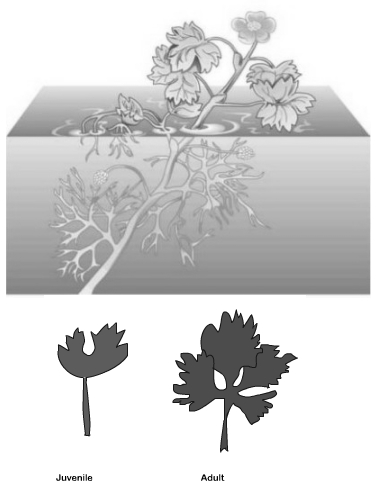
In Buttercup $(Ranunculus \ aquatilis)$,the leaves that develop when the shoot tip is submerged in water are thin and deeply lobed,whereas those that develop in the air are broader and less lobed. This is a classic example of environmental heterophylly.
Plants like Cotton,Coriander,and Larkspur exhibit developmental or intrinsic heterophylly,where the difference in leaf shape is due to the different growth stages (juvenile vs. mature) of the plant,not due to the environment.
Environmental heterophylly is an adaptation where the plant changes its leaf morphology in response to different environmental conditions,such as habitat.
In Buttercup $(Ranunculus \ aquatilis)$,the leaves that develop when the shoot tip is submerged in water are thin and deeply lobed,whereas those that develop in the air are broader and less lobed. This is a classic example of environmental heterophylly.
Plants like Cotton,Coriander,and Larkspur exhibit developmental or intrinsic heterophylly,where the difference in leaf shape is due to the different growth stages (juvenile vs. mature) of the plant,not due to the environment.
0 likes
View Solution197
MediumMCQ
Heterophylly means
A
The appearance of different forms of leaves on the same plant species
B
The appearance of same form of leaves on different plants
C
The appearance of same form of flowers on different plants
D
The appearance of different forms of fruits on the same plant
Solution
(A) Heterophylly is a phenomenon where a single plant species exhibits different shapes or forms of leaves at different stages of its life cycle or in response to different environmental conditions.
For example,in plants like $Buttercup$ ($Ranunculus$ $sceleratus$),the leaves produced in air are different in shape from those produced in water.
For example,in plants like $Buttercup$ ($Ranunculus$ $sceleratus$),the leaves produced in air are different in shape from those produced in water.
0 likes
View Solution198
EasyMCQ
Reticulate and parallel venation are characteristic of $........$ and $......$ respectively.
A
Dicot and Monocot
B
Monocot and Dicot
C
Gymnosperms and Angiosperms
D
Angiosperms and Gymnosperms
Solution
(A) $\rightarrow$ Reticulate venation is a characteristic feature of Dicot plants,where the veins form a network-like structure.
$\rightarrow$ Parallel venation is a characteristic feature of Monocot plants,where the veins run parallel to each other in the leaf lamina.
$\rightarrow$ Therefore,reticulate and parallel venation are characteristic of Dicot and Monocot plants respectively.
$\rightarrow$ Parallel venation is a characteristic feature of Monocot plants,where the veins run parallel to each other in the leaf lamina.
$\rightarrow$ Therefore,reticulate and parallel venation are characteristic of Dicot and Monocot plants respectively.
0 likes
View Solution199
Medium
Define/Explain: Stipules.
Solution
(N/A) $\rightarrow$ The leaf is attached to the stem by the leaf base. In some plants,the leaf base may bear two lateral,small,leaf-like structures called stipules.
0 likes
View Solution200
MediumMCQ
The leaf base is a modified form of .........
A
Petiole
B
Lamina
C
Leaf margin
D
Leaf base
Solution
(D) The leaf is attached to the stem by the leaf base and may bear two lateral small leaf-like structures called stipules. In some leguminous plants,the leaf base may become swollen,which is called the pulvinus. Therefore,the leaf base is a modified form of the leaf base itself,often exhibiting specialized structures like the pulvinus.
0 likes
View SolutionMorphology of Flowering Plants — Leaf · Frequently Asked Questions
1Are these Morphology of Flowering Plants questions useful for JEE and NEET?
Yes. All questions in this section are mapped to JEE Main and NEET exam patterns. Previous year questions from JEE Main, NEET, GUJCET and state-level exams are included with full solutions.
2Can I switch to Hindi or Gujarati for these questions?
Yes. Use the language tabs in the hero section or the sidebar to view the same questions and solutions in English, Hindi or Gujarati.
3How do I generate a question paper from this subtopic?
Use the Vedclass Exam Paper Generator — select the chapter and subtopic, set difficulty, and generate Sets A, B, C, D automatically. First 3 chapters of every subject are free.
Vedclass Products
For Students
Vedclass Test Series
Mock tests in real JEE/NEET style with performance analysis. 5-day free trial.
Start Free TrialFor Teachers
Exam Paper Generator
Generate Set A/B/C/D papers from this chapter in 2 minutes. 3 chapters free.
Try FreeFor Institutes
Online Exam Module
Live online exams with unlimited students, 360° analytics & white-label branding.
See DemoFor Teachers & Institutes
Generate a Morphology of Flowering Plants Exam Paper in 2 Minutes
Select subtopic & difficulty — Sets A, B, C, D auto-generated with No Repeat logic.
First 3 chapters of every subject are free — no payment required.