
A English
Description of Some Important Families Questions in English
Class 11 Biology · Morphology of Flowering Plants · Description of Some Important Families
416+
Questions
English
Language
100%
With Solutions
Showing 50 of 416 questions in English
351
EasyMCQ
Rauwolfia serpentina belongs to which family?
A
Apocynaceae
B
Solanaceae
C
Liliaceae
D
Fabaceae
Solution
(A) Rauwolfia serpentina belongs to the family $Apocynaceae$.
It is a significant medicinal plant known as the source of the alkaloid $reserpine$,which is used to treat high blood pressure.
Other alkaloids found in this plant include $serpentine$,$serpentinine$,and $rauwolfine$.
It is a significant medicinal plant known as the source of the alkaloid $reserpine$,which is used to treat high blood pressure.
Other alkaloids found in this plant include $serpentine$,$serpentinine$,and $rauwolfine$.
0 likes
View Solution352
EasyMCQ
Which of the following members of family-Solanaceae is a rich source of vitamin-$C$?
A
Tomato
B
Guava
C
Gooseberry
D
Strawberry
Solution
(A) Tomato $(Lycopersicon \text{ } esculentum)$ belongs to the family-Solanaceae.
Tomato fruits are a rich source of vitamin-$C$.
Compared to many other vegetables, tomatoes contain significant amounts of ascorbic acid (vitamin-$C$), making them a valuable dietary source.
Tomato fruits are a rich source of vitamin-$C$.
Compared to many other vegetables, tomatoes contain significant amounts of ascorbic acid (vitamin-$C$), making them a valuable dietary source.
0 likes
View Solution353
MediumMCQ
Sunflower belongs to the family
A
Liliaceae
B
Asteraceae
C
Cruciferae
D
Fabaceae
Solution
(B) Sunflower $(Helianthus \ annuus)$ belongs to the family $Asteraceae$ (also known as $Compositae$).
It is characterized by an $involucrate$ head or $capitulum$ type of inflorescence,which consists of two types of florets: ray florets and disc florets.
It is characterized by an $involucrate$ head or $capitulum$ type of inflorescence,which consists of two types of florets: ray florets and disc florets.
0 likes
View Solution354
MediumMCQ
Diadelphous condition is found in
A
Rosaceae
B
Papilionaceae
C
Leguminosae
D
Cucurbitaceae
Solution
(B) The diadelphous condition refers to the arrangement of stamens in two bundles. In this arrangement,nine stamens are fused together to form a single bundle,while the tenth stamen remains free. This characteristic feature is observed in the family $Papilionaceae$ (a subfamily of $Fabaceae$).
0 likes
View Solution355
EasyMCQ
Opium (poppy) is a plant belonging to the family
A
Apocynaceae
B
Papaveraceae
C
Solanaceae
D
Liliaceae
Solution
(B) Opium,also known as poppy,is scientifically known as $Papaver$ $somniferum$.
It belongs to the family $Papaveraceae$.
This family is characterized by the presence of laticifers and showy flowers with $2$ or $3$ sepals that fall off early.
It belongs to the family $Papaveraceae$.
This family is characterized by the presence of laticifers and showy flowers with $2$ or $3$ sepals that fall off early.
0 likes
View Solution356
MediumMCQ
The most advanced family is
A
Cruciferae
B
Cucurbitaceae
C
Compositae
D
Euphorbiaceae
Solution
(C) In plant taxonomy,the family $Compositae$ (also known as $Asteraceae$) is widely considered to be the most advanced or highly evolved family among the dicotyledons.
This is due to several specialized evolutionary features,such as the presence of a capitulum or head-type inflorescence,the reduction of individual flowers into florets,the presence of a pappus for seed dispersal,and a highly efficient pollination mechanism.
This is due to several specialized evolutionary features,such as the presence of a capitulum or head-type inflorescence,the reduction of individual flowers into florets,the presence of a pappus for seed dispersal,and a highly efficient pollination mechanism.
0 likes
View Solution357
EasyMCQ
Amla belongs to which family?
A
Labiatae
B
Fabaceae
C
Solanaceae
D
Euphorbiaceae
Solution
(D) $Emblica$ $\text{officinalis}$ is the botanical name of Amla. It is a member of the family $Euphorbiaceae$.
0 likes
View Solution358
MediumMCQ
Tobacco and Petunia belong to the family
A
Poaceae
B
Fabaceae
C
Solanaceae
D
Brassicaceae
Solution
(C) Tobacco plant $(Nicotiana \, tabacum)$ yields tobacco, while $Petunia \, violacea$ is an ornamental plant. Both these plants are members of the family $Solanaceae$.
0 likes
View Solution359
MediumMCQ
The economically important plant of the family $Malvaceae$ is:
A
$Gossypium$ $hirsutum$
B
$Hibiscus$ $cannabinus$
C
$Abelmoschus$ $esculentus$
D
All the above
Solution
(D) The family $Malvaceae$ includes several plants of high economic value.
$1$. $Gossypium$ $hirsutum$ (Cotton) is a major source of fiber.
$2$. $Hibiscus$ $cannabinus$ (Kenaf) is used for fiber production.
$3$. $Abelmoschus$ $esculentus$ (Okra/Lady's finger) is a widely consumed vegetable.
Since all these plants belong to the family $Malvaceae$ and are economically important,the correct answer is $D$.
$1$. $Gossypium$ $hirsutum$ (Cotton) is a major source of fiber.
$2$. $Hibiscus$ $cannabinus$ (Kenaf) is used for fiber production.
$3$. $Abelmoschus$ $esculentus$ (Okra/Lady's finger) is a widely consumed vegetable.
Since all these plants belong to the family $Malvaceae$ and are economically important,the correct answer is $D$.
0 likes
View Solution360
MediumMCQ
Bicarpellary,syncarpous ovary with axile placentation is seen in
A
Solanaceae
B
Caesalpinaceae
C
Asteraceae
D
Malvaceae
Solution
(A) In the family $Solanaceae$,the gynoecium is bicarpellary and syncarpous.
The ovary is superior,typically bilocular,and exhibits axile placentation.
The placentae are swollen with many ovules in each locule.
The ovary is placed obliquely at an angle of about $45^{\circ}$ from the median plane.
Therefore,the correct answer is $Solanaceae$.
The ovary is superior,typically bilocular,and exhibits axile placentation.
The placentae are swollen with many ovules in each locule.
The ovary is placed obliquely at an angle of about $45^{\circ}$ from the median plane.
Therefore,the correct answer is $Solanaceae$.
0 likes
View Solution361
EasyMCQ
Liliaceae:
A
Is commonly called lily family
B
Is a representative of monocotyledonous plants
C
Is a representative of dicotyledonous plants
D
Both $(a)$ and $(b)$
Solution
(D) Liliaceae is a large family of about $254$ genera and $4075$ species widely distributed all over the world.
It is commonly known as the lily family.
It is a characteristic representative of monocotyledonous plants.
Therefore,both statements $(a)$ and $(b)$ are correct.
It is commonly known as the lily family.
It is a characteristic representative of monocotyledonous plants.
Therefore,both statements $(a)$ and $(b)$ are correct.
0 likes
View Solution362
MediumMCQ
The fruit of $Solanaceae$ is
A
Berry or capsule
B
Pome
C
Legume or pod
D
Drupe
Solution
(A) In the family $Solanaceae$,the fruits are typically a berry or a capsule. $A$ berry is a fleshy fruit with seeds embedded in the pulp,while a capsule is a dry dehiscent fruit. The $Solanaceae$ family is characterized by these fruit types along with persistent calyx.
0 likes
View Solution363
MediumMCQ
In the members of family-Malvaceae,anthers are described as
A
Diadelphous and dithecous
B
Diadelphous and monothecous
C
Monodelphous and monothecous
D
Monadelphous and dithecous
Solution
(C) The androecium of family-Malvaceae consists of indefinite stamens.
The stamens are monodelphous,meaning they are united into a single bundle by their filaments.
The anthers are monothecous,meaning each anther has only one lobe (single-celled).
Therefore,the correct description for the stamens in family-Malvaceae is monodelphous and monothecous.
The stamens are monodelphous,meaning they are united into a single bundle by their filaments.
The anthers are monothecous,meaning each anther has only one lobe (single-celled).
Therefore,the correct description for the stamens in family-Malvaceae is monodelphous and monothecous.
0 likes
View Solution364
EasyMCQ
$Cinchona$ $officinalis$ belongs to the family:
A
Cruciferae
B
Malvaceae
C
Rubiaceae
D
Leguminosae
Solution
(C) The bark of the $Cinchona$ $officinalis$ tree yields the drug 'quinine', which is used for the treatment of malarial fever.
This plant belongs to the family $Rubiaceae$.
This plant belongs to the family $Rubiaceae$.
0 likes
View Solution365
MediumMCQ
Vascular bundles are arranged in a ring in the members of family
A
Orchidaceae
B
Iridaceae
C
Euphorbiaceae
D
Liliaceae
Solution
(C) Vascular bundles arranged in a ring is a characteristic feature of dicotyledonous stems. Among the given options,the family $Euphorbiaceae$ belongs to the dicotyledons. Therefore,members of this family exhibit vascular bundles arranged in a ring.
0 likes
View Solution366
EasyMCQ
$Colchicum$ $autumnale$ belongs to:
A
Solanaceae
B
Fabaceae
C
Liliaceae
D
Malvaceae
Solution
(C) $Colchicum$ $autumnale$ belongs to the family $Liliaceae$.
Colchicine is an alkaloid obtained from the corm of $Colchicum$ $autumnale$.
It is widely used in plant breeding and tissue culture to induce polyploidy by inhibiting spindle fiber formation during cell division.
Colchicine is an alkaloid obtained from the corm of $Colchicum$ $autumnale$.
It is widely used in plant breeding and tissue culture to induce polyploidy by inhibiting spindle fiber formation during cell division.
0 likes
View Solution367
MediumMCQ
$K_{(5)} C_{1+2+(2)} A_{(9)+1} G_{1}$ is the floral formula of the family:
A
Fabaceae
B
Solanaceae
C
Liliaceae
D
Papaveraceae
Solution
(A) The floral formula $K_{(5)} C_{1+2+(2)} A_{(9)+1} G_{1}$ represents the family $Fabaceae$.
- $K_{(5)}$: Calyx consists of $5$ sepals,gamosepalous (fused).
- $C_{1+2+(2)}$: Corolla consists of $5$ petals,polypetalous,papilionaceous arrangement (one standard,two wings,two fused keels).
- $A_{(9)+1}$: Androecium consists of $10$ stamens,diadelphous ($9$ fused,$1$ free).
- $G_{1}$: Gynoecium is monocarpellary with a superior ovary.
- $K_{(5)}$: Calyx consists of $5$ sepals,gamosepalous (fused).
- $C_{1+2+(2)}$: Corolla consists of $5$ petals,polypetalous,papilionaceous arrangement (one standard,two wings,two fused keels).
- $A_{(9)+1}$: Androecium consists of $10$ stamens,diadelphous ($9$ fused,$1$ free).
- $G_{1}$: Gynoecium is monocarpellary with a superior ovary.
0 likes
View Solution368
MediumMCQ
Which of the following represents the floral characters of $Liliaceae$?
A
Six tepals,zygomorphic,six stamens,bilocular ovary,axile placentation
B
Tetramerous,actinomorphic,polyphyllous,unilocular ovary,axile placentation
C
Trimerous,actinomorphic,polyandrous,superior ovary,axile placentation
D
Bisexual,zygomorphic,gamophyllous,inferior ovary,axile placentation
Solution
(C) The flowers in family $Liliaceae$ are complete,actinomorphic,and trimerous.
They are hypogynous,meaning the ovary is superior.
The gynoecium is tricarpellary and syncarpous.
The ovary is trilocular with axile placentation.
They are hypogynous,meaning the ovary is superior.
The gynoecium is tricarpellary and syncarpous.
The ovary is trilocular with axile placentation.
0 likes
View Solution369
MediumMCQ
The ray florets of sunflower have:
A
Superior ovary
B
Half inferior ovary
C
Half superior ovary
D
Inferior ovary
Solution
(D) In the family $Asteraceae$ (Compositae),the sunflower $(Helianthus \ annuus)$ exhibits two types of florets: ray florets and disc florets.
Ray florets are typically pistillate (female) or neutral and are zygomorphic.
The ovary in ray florets is inferior,meaning the other floral parts (sepals,petals,and stamens) are situated above the level of the ovary.
Ray florets are typically pistillate (female) or neutral and are zygomorphic.
The ovary in ray florets is inferior,meaning the other floral parts (sepals,petals,and stamens) are situated above the level of the ovary.
0 likes
View Solution370
MediumMCQ
The floral formula of the plants belonging to the family Fabaceae is
A
$\oplus \,\, \text{♂} \,\, K_{(5)} \,\, C_{1+2+(2)} \,\, A_{(9)+1} \,\, \underline{G}_1$
B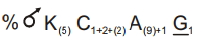
$\% \,\, \text{♂} \,\, K_{(5)} \,\, C_{1+2+(2)} \,\, A_{(9)+1} \,\, \underline{G}_1$
C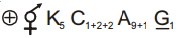
$\oplus \,\, \text{♂} \,\, K_5 \,\, C_{1+2+2} \,\, A_{9+1} \,\, \underline{G}_1$
D
$\% \,\, \text{♀} \,\, K_{(5)} \,\, C_{1+2+(2)} \,\, A_{(9)+1} \,\, \underline{G}_1$
Solution
(D) The family Fabaceae is characterized by zygomorphic flowers, which are represented by the symbol $\%$.
They are bisexual, represented by $\text{♂♀}$.
The calyx consists of $5$ sepals that are gamosepalous (fused), represented as $K_{(5)}$.
The corolla shows vexillary aestivation with $5$ petals ($1$ standard, $2$ wings, and $2$ fused keels), represented as $C_{1+2+(2)}$.
The androecium is diadelphous, with $9$ fused stamens and $1$ free stamen, represented as $A_{(9)+1}$.
The gynoecium is monocarpellary with a superior ovary, represented as $\underline{G}_1$.
Thus, the correct floral formula is $\% \,\, \text{♂♀} \,\, K_{(5)} \,\, C_{1+2+(2)} \,\, A_{(9)+1} \,\, \underline{G}_1$.
Note: Option $D$ is the closest representation of the standard formula, assuming the symbol $\text{♂♀}$ is implied or represented by the male symbol in some contexts.
They are bisexual, represented by $\text{♂♀}$.
The calyx consists of $5$ sepals that are gamosepalous (fused), represented as $K_{(5)}$.
The corolla shows vexillary aestivation with $5$ petals ($1$ standard, $2$ wings, and $2$ fused keels), represented as $C_{1+2+(2)}$.
The androecium is diadelphous, with $9$ fused stamens and $1$ free stamen, represented as $A_{(9)+1}$.
The gynoecium is monocarpellary with a superior ovary, represented as $\underline{G}_1$.
Thus, the correct floral formula is $\% \,\, \text{♂♀} \,\, K_{(5)} \,\, C_{1+2+(2)} \,\, A_{(9)+1} \,\, \underline{G}_1$.
Note: Option $D$ is the closest representation of the standard formula, assuming the symbol $\text{♂♀}$ is implied or represented by the male symbol in some contexts.
0 likes
View Solution371
MediumMCQ
The plants belonging to the family Solanaceae are represented by the floral formula:
A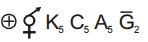
$\oplus \,\, \text{♂} \,\, K_5 \,\, C_5 \,\, A_5 \,\, \overline{G}_2$
B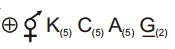
$\oplus \,\, \text{♂} \,\, K_{(5)} \,\, C_{(5)} \,\, A_{(5)} \,\, \underline{G}_{(2)}$
C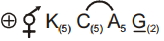
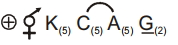
$\oplus \,\, \text{♂} \,\, K_{(5)} \,\, C_{(5)} \,\, A_5 \,\, \underline{G}_{(2)}$
D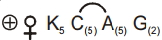
$\oplus \,\, \text{♂} \,\, K_5 \,\, C_{(5)} \,\, A_{(5)} \,\, G_{(2)}$
Solution
(C) The family Solanaceae is characterized by the following floral features:
$1$. Actinomorphic symmetry $(\oplus)$
$2$. Bisexual flowers $(\text{♂})$
$3$. Calyx: $K_{(5)}$,five sepals,gamosepalous (fused)
$4$. Corolla: $C_{(5)}$,five petals,gamopetalous (fused)
$5$. Androecium: $A_5$,five stamens,epipetalous (attached to petals)
$6$. Gynoecium: $\underline{G}_{(2)}$,bicarpellary,syncarpous (fused),and superior ovary.
The correct floral formula is $\oplus \,\, \text{♂} \,\, K_{(5)} \,\, C_{(5)} \,\, A_5 \,\, \underline{G}_{(2)}$.
$1$. Actinomorphic symmetry $(\oplus)$
$2$. Bisexual flowers $(\text{♂})$
$3$. Calyx: $K_{(5)}$,five sepals,gamosepalous (fused)
$4$. Corolla: $C_{(5)}$,five petals,gamopetalous (fused)
$5$. Androecium: $A_5$,five stamens,epipetalous (attached to petals)
$6$. Gynoecium: $\underline{G}_{(2)}$,bicarpellary,syncarpous (fused),and superior ovary.
The correct floral formula is $\oplus \,\, \text{♂} \,\, K_{(5)} \,\, C_{(5)} \,\, A_5 \,\, \underline{G}_{(2)}$.
0 likes
View Solution372
MediumMCQ
Which of the following plants is used to extract the blue dye?
A
Trifolium
B
Lupin
C
Indigofera
D
Cassia
Solution
(C) Indigofera is a genus of flowering plants in the family Fabaceae. It is historically and commercially significant as the primary source of the natural blue dye known as indigo.
0 likes
View Solution373
MediumMCQ
Flowers with monadelphous condition and pentacarpellary ovary are present in
A
China rose family
B
Pea family
C
Potato family
D
Yucca family
Solution
(A) The family $Malvaceae$ (China rose family) is characterized by the following features:
$1$. Monadelphous condition: The filaments of all stamens are united into a single bundle or tube around the style.
$2$. Pentacarpellary ovary: The gynoecium consists of five carpels (syncarpous).
Therefore,the correct option is the China rose family.
$1$. Monadelphous condition: The filaments of all stamens are united into a single bundle or tube around the style.
$2$. Pentacarpellary ovary: The gynoecium consists of five carpels (syncarpous).
Therefore,the correct option is the China rose family.
0 likes
View Solution374
MediumMCQ
Presence of staminode is a characteristic feature of:
A
Caesalpinoideae
B
Mimosoideae
C
Arecaceae
D
Euphorbiaceae
Solution
(A) staminode is a sterile stamen. The presence of staminodes is a characteristic feature of the subfamily $Caesalpinoideae$ (often classified under the family $Fabaceae$). In many members of this subfamily,some of the stamens are reduced to staminodes,which do not produce functional pollen.
0 likes
View Solution375
MediumMCQ
There are given some plants below, select among the options that, to how many families they belong? Plants are - Crotolaria, Atropa, Solanum, Arachis, Bambusa and Chrysanthemum.
A
$4$ families
B
$6$ families
C
$2$ families
D
$3$ families
Solution
(A) The classification of the given plants into their respective families is as follows:
$1$. Solanaceae: Solanum, Atropa
$2$. Leguminaceae (Fabaceae): Crotolaria, Arachis
$3$. Poaceae: Bambusa
$4$. Asteraceae (Compositae): Chrysanthemum
Thus, these plants belong to a total of $4$ different families.
$1$. Solanaceae: Solanum, Atropa
$2$. Leguminaceae (Fabaceae): Crotolaria, Arachis
$3$. Poaceae: Bambusa
$4$. Asteraceae (Compositae): Chrysanthemum
Thus, these plants belong to a total of $4$ different families.
0 likes
View Solution376
MediumMCQ
Find the correct match:
| Column-$I$ | Column-$II$ |
| $(a)$. Sinigrin | $(i)$. Liliaceae |
| $(b)$. Carthamin | $(ii)$. Brassicaceae |
| $(c)$. Atropine | $(iii)$. Solanaceae |
| $(d)$. Aloin | $(iv)$. Asteraceae |
A
$a(ii), b(iv), c(iii), d(i)$
B
$a(ii), b(iv), c(i), d(iii)$
C
$a(i), b(ii), c(iii), d(iv)$
D
$a(i), b(ii), c(iv), d(iii)$
Solution
(A) The correct matches are as follows:
$1$. Sinigrin is a glucosinolate found in the family $Brassicaceae$.
$2$. Carthamin is a red pigment extracted from the safflower plant, which belongs to the family $Asteraceae$.
$3$. Atropine is an alkaloid obtained from plants of the family $Solanaceae$ (e.g., Atropa belladonna).
$4$. Aloin is a bitter compound found in the leaves of Aloe vera, which belongs to the family $Liliaceae$.
Therefore, the correct sequence is $a(ii), b(iv), c(iii), d(i)$.
$1$. Sinigrin is a glucosinolate found in the family $Brassicaceae$.
$2$. Carthamin is a red pigment extracted from the safflower plant, which belongs to the family $Asteraceae$.
$3$. Atropine is an alkaloid obtained from plants of the family $Solanaceae$ (e.g., Atropa belladonna).
$4$. Aloin is a bitter compound found in the leaves of Aloe vera, which belongs to the family $Liliaceae$.
Therefore, the correct sequence is $a(ii), b(iv), c(iii), d(i)$.
0 likes
View Solution377
MediumMCQ
Family $Fabaceae$ is concerned with
A
Diadelphous stamen, marginal placentation, obliquely placed ovary and vexillary corolla
B
Diadelphous stamen, marginal placenta and large posterior petal
C
Basal placentation, versatile stamens, spikelet inflorescence
D
Axile placentation, non-endospermic seed, legume fruit
Solution
(A) The family $Fabaceae$ is characterized by the following features:
$1$. $Diadelphous$ stamens: The stamens are arranged in two bundles ($9+1$ arrangement).
$2$. Marginal placentation: The ovules are attached to the placenta along the ventral suture of the ovary.
$3$. Vexillary aestivation: The corolla consists of five petals, where the largest posterior petal is called the $standard$ or $vexillum$, two lateral petals are $wings$, and two anterior petals form the $keel$.
$1$. $Diadelphous$ stamens: The stamens are arranged in two bundles ($9+1$ arrangement).
$2$. Marginal placentation: The ovules are attached to the placenta along the ventral suture of the ovary.
$3$. Vexillary aestivation: The corolla consists of five petals, where the largest posterior petal is called the $standard$ or $vexillum$, two lateral petals are $wings$, and two anterior petals form the $keel$.
0 likes
View Solution378
MediumMCQ
Butterfly-shaped corolla,monocarpellary ovary,and zygomorphic flowers are found in which family?
A
Caesalpinoideae
B
Solanaceae
C
Papilionaceae
D
Graminae
Solution
(C) The correct answer is $Papilionaceae$ (also known as $Fabaceae$).
- Butterfly-shaped corolla: The petals are arranged in a vexillary aestivation,consisting of one large posterior standard (vexillum),two lateral wings (alae),and two anterior fused petals forming a keel (carina).
- Monocarpellary ovary: The gynoecium consists of a single carpel with a superior ovary.
- Zygomorphic flowers: The flowers exhibit bilateral symmetry.
- Butterfly-shaped corolla: The petals are arranged in a vexillary aestivation,consisting of one large posterior standard (vexillum),two lateral wings (alae),and two anterior fused petals forming a keel (carina).
- Monocarpellary ovary: The gynoecium consists of a single carpel with a superior ovary.
- Zygomorphic flowers: The flowers exhibit bilateral symmetry.
0 likes
View Solution379
MediumMCQ
Most primitive and advanced families of dicots are respectively:
A
Solanaceae and Asteraceae
B
Leguminosae and Poaceae
C
Ranunculaceae and Asteraceae
D
Asteraceae and Cucurbitaceae
Solution
(C) In the classification of angiosperms,the family $Ranunculaceae$ is considered one of the most primitive families of dicots due to its simple floral structure and numerous free floral parts.
Conversely,the family $Asteraceae$ (also known as $Compositae$) is considered the most advanced family of dicots because of its highly specialized inflorescence (capitulum),reduced floral parts,and efficient mechanisms for pollination and seed dispersal.
Conversely,the family $Asteraceae$ (also known as $Compositae$) is considered the most advanced family of dicots because of its highly specialized inflorescence (capitulum),reduced floral parts,and efficient mechanisms for pollination and seed dispersal.
0 likes
View Solution380
EasyMCQ
Bicollateral vascular bundles are found in the members of this family:
A
Malvaceae
B
Fabaceae
C
Caesalpiniaceae
D
Cucurbitaceae
Solution
(D) In a bicollateral vascular bundle,the phloem occurs in two groups,one outside the xylem and the other inner to it,i.e.,the two groups of phloem are present on each side of the xylem.
These are characteristically found in the stems of members of the family $Cucurbitaceae$,e.g.,$Cucurbita$,$Luffa$,etc.
These are characteristically found in the stems of members of the family $Cucurbitaceae$,e.g.,$Cucurbita$,$Luffa$,etc.
0 likes
View Solution381
EasyMCQ
Potato and tomato are native of:
A
Canada
B
North America
C
South America
D
China
Solution
(C) The potato $(Solanum \ tuberosum)$ and the tomato $(Solanum \ lycopersicum)$ both belong to the family $Solanaceae$.
These crops originated in the Andean region of South America,specifically in countries like Peru and Bolivia.
They were introduced to other parts of the world by European explorers after the $15^{th}$ century.
These crops originated in the Andean region of South America,specifically in countries like Peru and Bolivia.
They were introduced to other parts of the world by European explorers after the $15^{th}$ century.
0 likes
View Solution382
EasyMCQ
The species which yield commercial cotton belongs to the family:
A
Liliaceae
B
Fabaceae
C
Brassicaceae
D
Malvaceae
Solution
(D) $Gossypium$ is a genus of flowering plants in the family $Malvaceae$,from which commercial cotton is harvested.
0 likes
View Solution383
EasyMCQ
The Indian rubber tree belongs to which family?
A
Crassulaceae
B
Malvaceae
C
Liliaceae
D
Moraceae
Solution
(D) The Indian rubber tree,scientifically known as $Ficus$ $elastica$,belongs to the family $Moraceae$ and the order $Rosales$.
0 likes
View Solution384
MediumMCQ
The grass family $(Poaceae)$ contains:
A
Exposed stigma
B
Versatile anther
C
Both $(a)$ and $(b)$
D
Large pollens
Solution
(C) Flowers of the grass family $(Poaceae)$ are typically wind-pollinated (anemophilous).
To facilitate efficient wind pollination,these flowers possess exposed stigmas to catch pollen grains from the air and versatile anthers that swing freely to release pollen easily into the wind.
To facilitate efficient wind pollination,these flowers possess exposed stigmas to catch pollen grains from the air and versatile anthers that swing freely to release pollen easily into the wind.
0 likes
View Solution385
EasyMCQ
The timber-yielding plant $Shorea \text{ } robusta$ belongs to which family?
A
Fabaceae
B
Rubiaceae
C
Dipterocarpaceae
D
Verbenaceae
Solution
(C) The timber-yielding plant $Shorea \text{ } robusta$, commonly known as Sal, belongs to the family $Dipterocarpaceae$.
It is a highly valued timber tree used extensively for construction work, furniture, and is particularly well-suited for railway sleepers due to its durability.
It is a highly valued timber tree used extensively for construction work, furniture, and is particularly well-suited for railway sleepers due to its durability.
0 likes
View Solution386
MediumMCQ
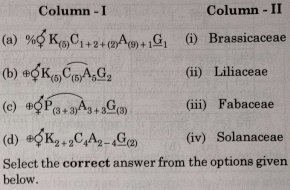
Match Column $- I$ with Column $- II.$
$[Image]$
Select the correct answer from the options given below.
$(a) -(b)- (c)- (d)$
A
$(iii)- (iv) -(ii)- (i)$
B
$(i) -(ii) -(iii) -(iv)$
C
$(i) -(ii) -(iii) -(iv)$
D
$(iv)- (ii) -(i) -(iii)$
0 likes
View Solution387
Medium
Add the missing floral organs of the given floral formula of Fabaceae: $\% \, \text{K}_{(5)} \, \text{C}_{1+2+(2)} \, \text{A}_{(9)+1} \, \underline{\text{G}}_{1}$.
Solution
(A) The complete floral formula of the family $Fabaceae$ is: $\% \, \text{K}_{(5)} \, \text{C}_{1+2+(2)} \, \text{A}_{(9)+1} \, \underline{\text{G}}_{1}$.
The floral characteristics of the $Fabaceae$ family are as follows:
$1$. Symmetry: Zygomorphic $(\%)$.
$2$. Sex: Bisexual $(\%)$.
$3$. Calyx $(K)$: $5$ sepals,gamosepalous (fused),represented as $K_{(5)}$.
$4$. Corolla $(C)$: $5$ petals,polypetalous,papilionaceous aestivation (vexillary),consisting of one posterior standard,two lateral wings,and two anterior petals forming a keel,represented as $C_{1+2+(2)}$.
$5$. Androecium $(A)$: $10$ stamens,diadelphous $(9+1)$,represented as $A_{(9)+1}$.
$6$. Gynoecium $(G)$: Monocarpellary,ovary superior,unilocular with many ovules,represented as $\underline{G}_{1}$.
The floral characteristics of the $Fabaceae$ family are as follows:
$1$. Symmetry: Zygomorphic $(\%)$.
$2$. Sex: Bisexual $(\%)$.
$3$. Calyx $(K)$: $5$ sepals,gamosepalous (fused),represented as $K_{(5)}$.
$4$. Corolla $(C)$: $5$ petals,polypetalous,papilionaceous aestivation (vexillary),consisting of one posterior standard,two lateral wings,and two anterior petals forming a keel,represented as $C_{1+2+(2)}$.
$5$. Androecium $(A)$: $10$ stamens,diadelphous $(9+1)$,represented as $A_{(9)+1}$.
$6$. Gynoecium $(G)$: Monocarpellary,ovary superior,unilocular with many ovules,represented as $\underline{G}_{1}$.
0 likes
View Solution388
MediumMCQ
Which one of the following plants shows vexillary aestivation and diadelphous stamens?
A
Pisum sativum
B
Allium cepa
C
Solanum nigrum
D
Colchicum autumnale
Solution
(A) Vexillary aestivation and diadelphous stamens are characteristic features of the family $Fabaceae$.
$Pisum sativum$ (pea) belongs to the family $Fabaceae$.
In $Pisum sativum$,the corolla consists of five petals: one large posterior petal (standard),two lateral petals (wings),and two small anterior petals (keel) which are fused,showing vexillary aestivation.
The stamens are diadelphous,meaning they are arranged in two bundles ($9+1$ arrangement).
$Allium cepa$ belongs to $Liliaceae$,$Solanum nigrum$ belongs to $Solanaceae$,and $Colchicum autumnale$ belongs to $Liliaceae$.
$Pisum sativum$ (pea) belongs to the family $Fabaceae$.
In $Pisum sativum$,the corolla consists of five petals: one large posterior petal (standard),two lateral petals (wings),and two small anterior petals (keel) which are fused,showing vexillary aestivation.
The stamens are diadelphous,meaning they are arranged in two bundles ($9+1$ arrangement).
$Allium cepa$ belongs to $Liliaceae$,$Solanum nigrum$ belongs to $Solanaceae$,and $Colchicum autumnale$ belongs to $Liliaceae$.
0 likes
View Solution389
MediumMCQ
What is the condition of stamens in Lily?
A
Monadelphous
B
Polyadelphous
C
Epipetalous
D
Epiphyllous
Solution
(D) In the family $Liliaceae$,the perianth is composed of tepals. When stamens are attached to the tepals,the condition is known as $Epiphyllous$ (or $Epitepalous$). Since Lily belongs to the family $Liliaceae$,its stamens are $Epiphyllous$.
0 likes
View Solution390
MediumMCQ
To which family does the mustard plant belong?
A
Fabaceae
B
Solanaceae
C
Liliaceae
D
Brassicaceae
Solution
(D) The mustard plant,scientifically known as $Brassica$ $campestris$,belongs to the family $Brassicaceae$ (also known as $Cruciferae$).
This family is characterized by flowers with four petals arranged in a cross-like pattern,six stamens (four long and two short),and a siliqua type of fruit.
This family is characterized by flowers with four petals arranged in a cross-like pattern,six stamens (four long and two short),and a siliqua type of fruit.
0 likes
View Solution391
MediumMCQ
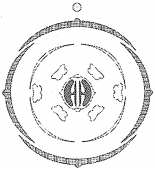
What is the floral formula for the given floral diagram?
A
B
C
D
Solution
(A) The given floral diagram represents the family Brassicaceae (Cruciferae).
$1$. The symbol $\oplus$ indicates that the flower is actinomorphic (radially symmetrical).
$2$. The symbol $\text{O\hspace{-0.5em}/}$ indicates that the flower is bisexual.
$3$. The calyx $(K)$ consists of $4$ sepals arranged in two whorls of $2$ each,represented as $K_{2+2}$.
$4$. The corolla $(C)$ consists of $4$ petals,represented as $C_4$.
$5$. The androecium $(A)$ consists of $6$ stamens arranged in two whorls,an outer whorl of $2$ short stamens and an inner whorl of $4$ long stamens,represented as $A_{2+4}$.
$6$. The gynoecium $(G)$ consists of $2$ fused carpels with a superior ovary,represented as $\underline{G}_{(2)}$.
Thus,the correct floral formula is $\oplus \; \text{O\hspace{-0.5em}/} \; K_{2+2} \; C_4 \; A_{2+4} \; \underline{G}_{(2)}$.
$1$. The symbol $\oplus$ indicates that the flower is actinomorphic (radially symmetrical).
$2$. The symbol $\text{O\hspace{-0.5em}/}$ indicates that the flower is bisexual.
$3$. The calyx $(K)$ consists of $4$ sepals arranged in two whorls of $2$ each,represented as $K_{2+2}$.
$4$. The corolla $(C)$ consists of $4$ petals,represented as $C_4$.
$5$. The androecium $(A)$ consists of $6$ stamens arranged in two whorls,an outer whorl of $2$ short stamens and an inner whorl of $4$ long stamens,represented as $A_{2+4}$.
$6$. The gynoecium $(G)$ consists of $2$ fused carpels with a superior ovary,represented as $\underline{G}_{(2)}$.
Thus,the correct floral formula is $\oplus \; \text{O\hspace{-0.5em}/} \; K_{2+2} \; C_4 \; A_{2+4} \; \underline{G}_{(2)}$.
0 likes
View Solution392
MediumMCQ
Which of the following plants possesses papilionaceous flowers?
A
Tomato
B
Onion
C
Liquorice
D
Belladonna
Solution
(C) Papilionaceous flowers are a characteristic feature of the family $Fabaceae$ (subfamily $Faboideae$ or $Papilionoideae$).
In these flowers, the corolla consists of five petals: one large posterior standard (vexillum), two lateral wings (alae), and two anterior petals fused to form a keel (carina).
Among the given options, $Liquorice$ $(Glycyrrhiza \text{ } glabra)$ belongs to the family $Fabaceae$.
Tomato $(Solanum \text{ } lycopersicum)$ and Belladonna $(Atropa \text{ } belladonna)$ belong to the family $Solanaceae$.
Onion $(Allium \text{ } cepa)$ belongs to the family $Liliaceae$.
In these flowers, the corolla consists of five petals: one large posterior standard (vexillum), two lateral wings (alae), and two anterior petals fused to form a keel (carina).
Among the given options, $Liquorice$ $(Glycyrrhiza \text{ } glabra)$ belongs to the family $Fabaceae$.
Tomato $(Solanum \text{ } lycopersicum)$ and Belladonna $(Atropa \text{ } belladonna)$ belong to the family $Solanaceae$.
Onion $(Allium \text{ } cepa)$ belongs to the family $Liliaceae$.
0 likes
View Solution393
MediumMCQ
Select the correct option from the following regarding the classification of plant families:
A
Monocot family - Fabaceae,Solanaceae; Dicot family - Liliaceae
B
Monocot family - Liliaceae; Dicot family - Fabaceae,Solanaceae
C
Monocot family - Fabaceae; Dicot family - Solanaceae,Liliaceae
D
Monocot family - Solanaceae,Liliaceae; Dicot family - Fabaceae
Solution
(B) The classification of flowering plants is based on the number of cotyledons present in the seed.
$1$. $Fabaceae$ and $Solanaceae$ are families belonging to the class $Dicotyledonae$ (dicots),characterized by having two cotyledons in their seeds.
$2$. $Liliaceae$ is a family belonging to the class $Monocotyledonae$ (monocots),characterized by having a single cotyledon in its seeds.
Therefore,the correct classification is: Monocot family - $Liliaceae$; Dicot family - $Fabaceae$,$Solanaceae$.
$1$. $Fabaceae$ and $Solanaceae$ are families belonging to the class $Dicotyledonae$ (dicots),characterized by having two cotyledons in their seeds.
$2$. $Liliaceae$ is a family belonging to the class $Monocotyledonae$ (monocots),characterized by having a single cotyledon in its seeds.
Therefore,the correct classification is: Monocot family - $Liliaceae$; Dicot family - $Fabaceae$,$Solanaceae$.
0 likes
View Solution394
MediumMCQ
Which of the following plants possesses persistent sepals?
A
Sunn-hemp
B
Indigofera
C
Petunia
D
Asparagus
Solution
(C) Persistent sepals are a characteristic feature of the family $Solanaceae$.
In the family $Solanaceae$,the calyx is often persistent,meaning it remains attached to the fruit even after fertilization.
Among the given options,$Petunia$ belongs to the family $Solanaceae$.
$Sunn-hemp$ $(Crotalaria)$ and $Indigofera$ belong to the family $Fabaceae$,while $Asparagus$ belongs to the family $Liliaceae$.
In the family $Solanaceae$,the calyx is often persistent,meaning it remains attached to the fruit even after fertilization.
Among the given options,$Petunia$ belongs to the family $Solanaceae$.
$Sunn-hemp$ $(Crotalaria)$ and $Indigofera$ belong to the family $Fabaceae$,while $Asparagus$ belongs to the family $Liliaceae$.
0 likes
View Solution395
MediumMCQ
Select the correct option for placentation in the given families.
A
Fabaceae - Axile,Solanaceae - Axile,Liliaceae - Marginal
B
Fabaceae - Axile,Solanaceae - Marginal,Liliaceae - Axile
C
Fabaceae - Marginal,Solanaceae - Axile,Liliaceae - Axile
D
Fabaceae - Marginal,Solanaceae - Marginal,Liliaceae - Axile
Solution
(C) The placentation types for the given families are as follows:
$1$. $Fabaceae$: The ovary is unilocular with a single row of ovules along the ventral suture,which is known as $Marginal$ placentation.
$2$. $Solanaceae$: The ovary is typically bicarpellary,syncarpous,and bilocular with ovules attached to a swollen placenta,known as $Axile$ placentation.
$3$. $Liliaceae$: The ovary is tricarpellary,syncarpous,and trilocular with ovules attached to a central axis,known as $Axile$ placentation.
Therefore,the correct sequence is $Fabaceae - Marginal, Solanaceae - Axile, Liliaceae - Axile$.
$1$. $Fabaceae$: The ovary is unilocular with a single row of ovules along the ventral suture,which is known as $Marginal$ placentation.
$2$. $Solanaceae$: The ovary is typically bicarpellary,syncarpous,and bilocular with ovules attached to a swollen placenta,known as $Axile$ placentation.
$3$. $Liliaceae$: The ovary is tricarpellary,syncarpous,and trilocular with ovules attached to a central axis,known as $Axile$ placentation.
Therefore,the correct sequence is $Fabaceae - Marginal, Solanaceae - Axile, Liliaceae - Axile$.
0 likes
View Solution396
MediumMCQ
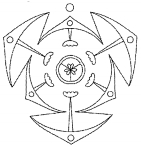
In which plant is the given floral diagram observed?
A
Onion
B
Datura
C
Pea
D
Mung bean
Solution
(A) The provided floral diagram shows trimerous symmetry, which is a characteristic feature of the family $Liliaceae$.
In this family, the floral formula is represented as $Br, \oplus, \widehat{P_{(3+3)}}, A_{3+3}, G_{(3)}$.
Among the given options, $Onion$ $(Allium \text{ } cepa)$ belongs to the family $Liliaceae$.
Therefore, the correct answer is $Onion$.
In this family, the floral formula is represented as $Br, \oplus, \widehat{P_{(3+3)}}, A_{3+3}, G_{(3)}$.
Among the given options, $Onion$ $(Allium \text{ } cepa)$ belongs to the family $Liliaceae$.
Therefore, the correct answer is $Onion$.
0 likes
View Solution




398
MediumMCQ
Which family is known as the potato family?
A
Fabaceae
B
Liliaceae
C
Solanaceae
D
Brassicaceae
Solution
(C) The family $Solanaceae$ is commonly known as the potato family. It is a large family and is often referred to as the potato family because it includes many important food crops such as potato ($Solanum$ $tuberosum$),tomato,brinjal,and chili.
0 likes
View Solution399
MediumMCQ
Which family possesses a perianth?
A
Fabaceae
B
Liliaceae
C
Solanaceae
D
Brassicaceae
Solution
(B) The term $Perianth$ refers to the non-reproductive part of the flower,consisting of the calyx and corolla. In some families,the calyx and corolla are not distinct and are collectively called the $Perianth$ (tepals). The family $Liliaceae$ is characterized by having a $Perianth$ consisting of $6$ tepals (arranged in two whorls of $3$ each),which are often fused at the base. Therefore,$Liliaceae$ is the correct answer.
0 likes
View Solution400
EasyMCQ
What is the scientific name of okra (lady's finger)?
A
Triticum aestivum
B
Abelmoschus esculentus
C
Zea mays
D
Oryza sativa
Solution
(B) The scientific name of okra (lady's finger) is $Abelmoschus esculentus$.
$Triticum aestivum$ is the scientific name for wheat.
$Zea mays$ is the scientific name for maize (corn).
$Oryza sativa$ is the scientific name for rice.
$Triticum aestivum$ is the scientific name for wheat.
$Zea mays$ is the scientific name for maize (corn).
$Oryza sativa$ is the scientific name for rice.
0 likes
View SolutionMorphology of Flowering Plants — Description of Some Important Families · Frequently Asked Questions
1Are these Morphology of Flowering Plants questions useful for JEE and NEET?
Yes. All questions in this section are mapped to JEE Main and NEET exam patterns. Previous year questions from JEE Main, NEET, GUJCET and state-level exams are included with full solutions.
2Can I switch to Hindi or Gujarati for these questions?
Yes. Use the language tabs in the hero section or the sidebar to view the same questions and solutions in English, Hindi or Gujarati.
3How do I generate a question paper from this subtopic?
Use the Vedclass Exam Paper Generator — select the chapter and subtopic, set difficulty, and generate Sets A, B, C, D automatically. First 3 chapters of every subject are free.
Vedclass Products
For Students
Vedclass Test Series
Mock tests in real JEE/NEET style with performance analysis. 5-day free trial.
Start Free TrialFor Teachers
Exam Paper Generator
Generate Set A/B/C/D papers from this chapter in 2 minutes. 3 chapters free.
Try FreeFor Institutes
Online Exam Module
Live online exams with unlimited students, 360° analytics & white-label branding.
See DemoFor Teachers & Institutes
Generate a Morphology of Flowering Plants Exam Paper in 2 Minutes
Select subtopic & difficulty — Sets A, B, C, D auto-generated with No Repeat logic.
First 3 chapters of every subject are free — no payment required.