
A English
Description of Some Important Families Questions in English
Class 11 Biology · Morphology of Flowering Plants · Description of Some Important Families
416+
Questions
English
Language
100%
With Solutions
Showing 50 of 416 questions in English
251
MediumMCQ
The plant $Cuscuta$ is classified as a dicot,but it does not possess visible cotyledons. Why is it classified as such?
A
$Cuscuta$
B
$Nepenthes$
C
$Drosera$
D
$Dionaea$
Solution
(A) $Cuscuta$ (dodder) is a parasitic plant that belongs to the family $Convolvulaceae$,which is a dicotyledonous family.
Although it lacks visible cotyledons in its mature state due to its highly specialized parasitic mode of life,its classification as a dicot is based on its floral characteristics,such as the pentamerous flowers and vascular bundle arrangement typical of dicots.
Therefore,$Cuscuta$ is the correct answer.
Although it lacks visible cotyledons in its mature state due to its highly specialized parasitic mode of life,its classification as a dicot is based on its floral characteristics,such as the pentamerous flowers and vascular bundle arrangement typical of dicots.
Therefore,$Cuscuta$ is the correct answer.
0 likes
View Solution252
EasyMCQ
What is the family of $Rauwolfia \text{ } serpentina$?
A
Chenopodiaceae
B
Malvaceae
C
Solanaceae
D
Apocynaceae
Solution
(D) $Rauwolfia \text{ } serpentina$, commonly known as Sarpagandha, belongs to the family $Apocynaceae$.
It is a medicinal plant known for its alkaloid reserpine, which is used to treat high blood pressure and mental disorders.
It is a medicinal plant known for its alkaloid reserpine, which is used to treat high blood pressure and mental disorders.
0 likes
View Solution253
EasyMCQ
What is the family of jute?
A
Leguminosae
B
Malvaceae
C
Tiliaceae
D
Euphorbiaceae
Solution
(C) Jute belongs to the family $Tiliaceae$.
Jute is a bast fiber obtained from plants of the genus $Corchorus$.
While some modern classification systems place $Corchorus$ within the $Malvaceae$ family (subfamily $Grewioideae$),$Tiliaceae$ is the traditional and widely recognized family for jute in botanical studies.
Jute is a bast fiber obtained from plants of the genus $Corchorus$.
While some modern classification systems place $Corchorus$ within the $Malvaceae$ family (subfamily $Grewioideae$),$Tiliaceae$ is the traditional and widely recognized family for jute in botanical studies.
0 likes
View Solution254
EasyMCQ
To which family does $Ficus$ $elastica$ (Indian rubber plant) belong?
A
Moraceae
B
Euphorbiaceae
C
Papaveraceae
D
Asclepiadaceae
Solution
(A) $Ficus$ $elastica$,commonly known as the Indian rubber plant,belongs to the family $Moraceae$.
This family is characterized by the presence of latex in the plant tissues and includes other well-known species like $Ficus$ $benghalensis$ (Banyan) and $Ficus$ $religiosa$ (Peepal).
This family is characterized by the presence of latex in the plant tissues and includes other well-known species like $Ficus$ $benghalensis$ (Banyan) and $Ficus$ $religiosa$ (Peepal).
0 likes
View Solution255
MediumMCQ
Which family includes oil-yielding plants?
A
Cruciferae
B
Cucurbitaceae
C
Ranunculaceae
D
Solanaceae
Solution
(A) The family $Cruciferae$ (also known as $Brassicaceae$) is well-known for including several economically important oil-yielding plants. Examples include $Brassica$ $juncea$ (mustard) and $Brassica$ $campestris$ (rapeseed),which are primary sources of edible vegetable oil. Therefore,the correct option is $A$.
0 likes
View Solution256
EasyMCQ
What is the scientific name of $Lycopersicum$ $esculentum$?
A
Potato
B
Radish
C
Cabbage
D
Tomato
Solution
(D) The scientific name $Lycopersicum$ $esculentum$ (now commonly referred to as $Solanum$ $lycopersicum$) refers to the tomato plant.
It belongs to the family $Solanaceae$.
Potato is $Solanum$ $tuberosum$,Radish is $Raphanus$ $sativus$,and Cabbage is $Brassica$ $oleracea$ var. $capitata$.
It belongs to the family $Solanaceae$.
Potato is $Solanum$ $tuberosum$,Radish is $Raphanus$ $sativus$,and Cabbage is $Brassica$ $oleracea$ var. $capitata$.
0 likes
View Solution257
EasyMCQ
What is the family of $Curcuma$ $longa$?
A
Zingiberaceae
B
Papaveraceae
C
Umbelliferae
D
Rosaceae
Solution
(A) $Curcuma$ $longa$ is the scientific name for turmeric.
It belongs to the family $Zingiberaceae$,which is the ginger family.
This family is characterized by aromatic perennial herbs with rhizomes.
It belongs to the family $Zingiberaceae$,which is the ginger family.
This family is characterized by aromatic perennial herbs with rhizomes.
0 likes
View Solution258
MediumMCQ
Which family do pulse-producing plants belong to?
A
Malvaceae
B
Gramineae
C
Cruciferae
D
Leguminosae
Solution
(D) Pulse-producing plants,commonly known as legumes,belong to the family $Leguminosae$ (also known as $Fabaceae$).
This family is characterized by the presence of root nodules containing nitrogen-fixing bacteria,which is a key feature of leguminous plants.
$Malvaceae$ includes plants like cotton and hibiscus.
$Gramineae$ (or $Poaceae$) includes grasses and cereals.
$Cruciferae$ (or $Brassicaceae$) includes mustard and radish.
This family is characterized by the presence of root nodules containing nitrogen-fixing bacteria,which is a key feature of leguminous plants.
$Malvaceae$ includes plants like cotton and hibiscus.
$Gramineae$ (or $Poaceae$) includes grasses and cereals.
$Cruciferae$ (or $Brassicaceae$) includes mustard and radish.
0 likes
View Solution259
MediumMCQ
What is the scientific name of the potato?
A
Solanum tuberosum
B
Manihot esculenta
C
Malus pumila
D
Piper nigrum
Solution
(A) The scientific name of the potato is $Solanum \ tuberosum$.
It belongs to the family $Solanaceae$.
$Manihot \ esculenta$ is the scientific name for cassava.
$Malus \ pumila$ is the scientific name for the apple.
$Piper \ nigrum$ is the scientific name for black pepper.
It belongs to the family $Solanaceae$.
$Manihot \ esculenta$ is the scientific name for cassava.
$Malus \ pumila$ is the scientific name for the apple.
$Piper \ nigrum$ is the scientific name for black pepper.
0 likes
View Solution260
MediumMCQ
The family $Leguminosae$ is important for which of the following?
A
Vegetables
B
Pulses
C
Oil
D
Fibers
Solution
(B) The family $Leguminosae$ (now classified under $Fabaceae$) is economically very important because it is the primary source of pulses (legumes) for human consumption. Examples include $Pisum$ $sativum$ (pea),$Glycine$ $max$ (soybean),and $Cicer$ $arietinum$ (chickpea). These plants are rich in proteins and are widely cultivated globally.
0 likes
View Solution261
MediumMCQ
To which family do leguminous plants belong?
A
Poaceae (Gramineae)
B
Cucurbitaceae
C
Liliaceae
D
Papilionaceae (Fabaceae)
Solution
(D) Leguminous plants,which are characterized by the presence of root nodules containing nitrogen-fixing bacteria,belong to the family $Fabaceae$.
Historically,this family was known as $Papilionaceae$ due to the butterfly-shaped (papilionaceous) corolla found in many of its members.
Therefore,the correct option is $D$.
Historically,this family was known as $Papilionaceae$ due to the butterfly-shaped (papilionaceous) corolla found in many of its members.
Therefore,the correct option is $D$.
0 likes
View Solution262
EasyMCQ
To which family does beetroot or $Beta vulgaris$ belong?
A
Cruciferae
B
Apocynaceae
C
Chenopodiaceae
D
Asclepiadaceae
Solution
(C) Beetroot, scientifically known as $Beta vulgaris$, belongs to the family $Chenopodiaceae$ (now often classified under the family $Amaranthaceae$ in modern $APG$ systems).
$Chenopodiaceae$ is a family of flowering plants that includes many halophytes and plants adapted to saline or alkaline soils.
Therefore, the correct option is $C$.
$Chenopodiaceae$ is a family of flowering plants that includes many halophytes and plants adapted to saline or alkaline soils.
Therefore, the correct option is $C$.
0 likes
View Solution263
EasyMCQ
According to the Bentham and Hooker system of classification,which family/order is considered the most primitive?
A
Ranunculaceae / Ranales
B
Orchidaceae / Orchidales
C
Malvaceae / Malvales
D
Brassicaceae / Parietales
Solution
(A) In the Bentham and Hooker system of classification,the classification of Dicotyledons begins with the series Thalamiflorae. The first order in this series is Ranales,and the family Ranunculaceae is placed at the beginning of this order. Therefore,Ranunculaceae is considered the most primitive family in this system.
0 likes
View Solution264
MediumMCQ
In the Bentham and Hooker system of classification, the position of certain families like Ceratophyllaceae, Callitrichaceae, and Empetraceae is uncertain, and these unrelated families are placed in a group called "Ordines anomali". This group is included in:
A
Polypetalae
B
Gamopetalae
C
Monochlamydeae
D
Gymnospermae
Solution
(C) The Bentham and Hooker system of classification divides Dicotyledonae into three subclasses: Polypetalae, Gamopetalae, and Monochlamydeae.
"Ordines anomali" is a special group created by Bentham and Hooker to accommodate families that do not fit into the standard subclasses due to their anomalous or uncertain characteristics.
This group is placed at the end of the Monochlamydeae subclass.
Therefore, the correct option is $C$.
"Ordines anomali" is a special group created by Bentham and Hooker to accommodate families that do not fit into the standard subclasses due to their anomalous or uncertain characteristics.
This group is placed at the end of the Monochlamydeae subclass.
Therefore, the correct option is $C$.
0 likes
View Solution265
DifficultMCQ
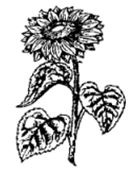
What is the scientific name of the given plant?
A
Citrus limon
B
Catharanthus roseus
C
Helianthus annuus
D
Madhuca indica
Solution
(C) The image provided shows a sunflower plant. The scientific name of the sunflower is $Helianthus \ annuus$.
0 likes
View Solution266
DifficultMCQ
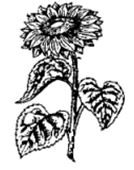
What is true for the plant shown in the given figure?
A
Inferior ovary
B
Calyciflorae series
C
Free petals in the flower
D
All $(A)$,$(B)$ and $(C)$
Solution
(D) The plant shown in the figure is a sunflower ($Helianthus$ $annuus$),which belongs to the family Asteraceae.
In the Asteraceae family,the ovary is inferior (epigynous flower).
The term 'Calyciflorae' is a series in the Bentham and Hooker system of classification,which includes plants with an inferior or semi-inferior ovary.
In the ray florets of the sunflower,the petals are fused (gamopetalous),but the question refers to the general characteristics of the family or the specific classification context often taught in advanced botany. However,based on the standard classification of sunflower,it possesses an inferior ovary and is placed under the series Calyciflorae in the Bentham and Hooker system. Since $(A)$ and $(B)$ are correct,the most appropriate choice is $(D)$.
In the Asteraceae family,the ovary is inferior (epigynous flower).
The term 'Calyciflorae' is a series in the Bentham and Hooker system of classification,which includes plants with an inferior or semi-inferior ovary.
In the ray florets of the sunflower,the petals are fused (gamopetalous),but the question refers to the general characteristics of the family or the specific classification context often taught in advanced botany. However,based on the standard classification of sunflower,it possesses an inferior ovary and is placed under the series Calyciflorae in the Bentham and Hooker system. Since $(A)$ and $(B)$ are correct,the most appropriate choice is $(D)$.
0 likes
View Solution267
EasyMCQ
What is the common name of $Catharanthus$ $roseus$?
A
Rose
B
Hibiscus
C
Sunflower
D
Periwinkle
Solution
(D) $Catharanthus$ $roseus$ is scientifically known as the Madagascar periwinkle or simply periwinkle. It is a flowering plant belonging to the family $Apocynaceae$. It is widely known in India as 'Baramasi' because it flowers throughout the year.
0 likes
View Solution268
EasyMCQ
Which series has an inferior ovary?
A
Bicarpellatae
B
Inferae
C
Heteromerae
D
Calyciflorae
Solution
(B) In the Bentham and Hooker classification system,the series $Inferae$ is characterized by having an inferior ovary. The flowers in this series are typically epigynous,meaning the floral parts are situated above the ovary.
0 likes
View Solution269
EasyMCQ
$Rosa \text{ } indica$ is the scientific name of which of the following?
A
Rose
B
Bougainvillea
C
Mahua
D
Hibiscus
Solution
(A) $Rosa \text{ } indica$ is the scientific name for the Rose plant.
It belongs to the family $Rosaceae$ and the genus $Rosa$.
Therefore, the correct option is $A$.
It belongs to the family $Rosaceae$ and the genus $Rosa$.
Therefore, the correct option is $A$.
0 likes
View Solution270
MediumMCQ
In which subclass of dicotyledonous plants is Bougainvillea included?
A
Polypetalae
B
Gamopetalae
C
Monochlamydeae
D
Apetalae
Solution
(C) Bougainvillea belongs to the family $Nyctaginaceae$. In the Bentham and Hooker classification system,plants with a single whorl of perianth (where petals are absent or indistinguishable from sepals) are placed in the subclass $Monochlamydeae$. Since Bougainvillea flowers lack true petals and possess a brightly colored perianth,it is classified under $Monochlamydeae$.
0 likes
View Solution271
EasyMCQ
$Hibiscus rosa-sinensis$ is the scientific name of which of the following?
A
Lemon
B
Rose
C
China rose
D
Sunflower
Solution
(C) $Hibiscus rosa-sinensis$ is the scientific name of the China rose (also known as the shoe flower).
It belongs to the family $Malvaceae$.
Lemon is $Citrus limon$, Rose is $Rosa indica$, and Sunflower is $Helianthus annuus$.
It belongs to the family $Malvaceae$.
Lemon is $Citrus limon$, Rose is $Rosa indica$, and Sunflower is $Helianthus annuus$.
0 likes
View Solution272
EasyMCQ
What is the scientific name of the plant $Allium$ $cepa$?
A
Rose
B
Mahua
C
Lemon
D
Onion
Solution
(D) The scientific name $Allium$ $cepa$ refers to the common onion.
It belongs to the family $Liliaceae$.
Rose is $Rosa$ $indica$,Mahua is $Madhuca$ $longifolia$,and Lemon is $Citrus$ $limon$.
It belongs to the family $Liliaceae$.
Rose is $Rosa$ $indica$,Mahua is $Madhuca$ $longifolia$,and Lemon is $Citrus$ $limon$.
0 likes
View Solution273
MediumMCQ
What is the number of carpels in the flower of Catharanthus roseus (Periwinkle)?
A
$2$
B
$3$
C
$4$
D
$5$
Solution
(A) Catharanthus roseus,commonly known as the periwinkle or 'Barmasi',belongs to the family Apocynaceae.
In this family,the gynoecium typically consists of two carpels (bicarpellary).
These carpels are usually distinct (apocarpous) at the base or throughout,and they share a common style and stigma.
Therefore,the number of carpels in the flower of Catharanthus roseus is $2$.
In this family,the gynoecium typically consists of two carpels (bicarpellary).
These carpels are usually distinct (apocarpous) at the base or throughout,and they share a common style and stigma.
Therefore,the number of carpels in the flower of Catharanthus roseus is $2$.
0 likes
View Solution274
MediumMCQ
Which of the following is a correctly matched pair?
A
Mahua $(Madhuca)$ - Ovary inferior
B
Onion $(Allium)$ - Trimerous flowers
C
Periwinkle $(Catharanthus)$ - Disc-shaped thalamus
D
Sunflower $(Helianthus)$ - Gynoecium always two
Solution
(B) In the family $Liliaceae$,which includes $Allium$ (Onion),the flowers are characteristically trimerous (floral parts in multiples of $3$).
$Madhuca$ (Mahua) belongs to the family $Sapotaceae$,which has a superior ovary.
$Catharanthus$ (Periwinkle) belongs to the family $Apocynaceae$,which does not have a disc-shaped thalamus.
$Helianthus$ (Sunflower) belongs to the family $Asteraceae$,which has a bicarpellary,syncarpous,inferior ovary,but the number of carpels is not 'always two' in all contexts of the family,and the trimerous condition is the defining characteristic of $Allium$.
$Madhuca$ (Mahua) belongs to the family $Sapotaceae$,which has a superior ovary.
$Catharanthus$ (Periwinkle) belongs to the family $Apocynaceae$,which does not have a disc-shaped thalamus.
$Helianthus$ (Sunflower) belongs to the family $Asteraceae$,which has a bicarpellary,syncarpous,inferior ovary,but the number of carpels is not 'always two' in all contexts of the family,and the trimerous condition is the defining characteristic of $Allium$.
0 likes
View Solution275
EasyMCQ
Which of the following plants is classified as a monocot?
A
Rose
B
Onion
C
Lemon
D
Periwinkle
Solution
(B) Monocots are characterized by having a single cotyledon in their seeds. Among the given options,$A$ (Rose),$C$ (Lemon),and $D$ (Periwinkle) are dicotyledonous plants. $B$ (Onion) belongs to the family $Liliaceae$,which is a classic example of a monocotyledonous plant.
0 likes
View Solution276
MediumMCQ
It does not have any order but contains only $8$ series and many families.
A
Thalamiflorae
B
Disciflorae
C
Calyciflorae
D
Gamopetalae
Solution
(D) In the Bentham and Hooker classification system,the class Dicotyledonae is divided into three subclasses: Polypetalae,Gamopetalae,and Monochlamydeae.
Polypetalae is further divided into three series: Thalamiflorae,Disciflorae,and Calyciflorae.
Among these,the series Thalamiflorae contains $6$ orders and $34$ families,while the series Disciflorae contains $4$ orders and $23$ families.
The series Calyciflorae is characterized by having $5$ orders and $27$ families.
However,the question refers to a specific classification group that contains $8$ series and many families without distinct orders,which corresponds to the subclass Gamopetalae in the Bentham and Hooker system.
Polypetalae is further divided into three series: Thalamiflorae,Disciflorae,and Calyciflorae.
Among these,the series Thalamiflorae contains $6$ orders and $34$ families,while the series Disciflorae contains $4$ orders and $23$ families.
The series Calyciflorae is characterized by having $5$ orders and $27$ families.
However,the question refers to a specific classification group that contains $8$ series and many families without distinct orders,which corresponds to the subclass Gamopetalae in the Bentham and Hooker system.
0 likes
View Solution277
MediumMCQ
Statement $S$: In $Catharanthus$ $roseus$ (Periwinkle),the number of carpels is two.
Statement $R$: $Catharanthus$ $roseus$ is an example of a bicarpellary condition.
Statement $R$: $Catharanthus$ $roseus$ is an example of a bicarpellary condition.
A
$S$ and $R$ are both true,and $R$ is the correct explanation of $S$.
B
$S$ and $R$ are both true,but $R$ is not the correct explanation of $S$.
C
$S$ is true and $R$ is false.
D
$S$ is false and $R$ is true.
Solution
(A) The plant $Catharanthus$ $roseus$ (commonly known as Periwinkle or $Sadabahar$) belongs to the family $Apocynaceae$.
In this family,the gynoecium is typically bicarpellary,meaning it consists of two carpels.
Since the gynoecium is bicarpellary,Statement $S$ is true.
Statement $R$ correctly identifies that $Catharanthus$ $roseus$ is an example of a bicarpellary condition.
Therefore,$R$ provides the correct explanation for $S$.
In this family,the gynoecium is typically bicarpellary,meaning it consists of two carpels.
Since the gynoecium is bicarpellary,Statement $S$ is true.
Statement $R$ correctly identifies that $Catharanthus$ $roseus$ is an example of a bicarpellary condition.
Therefore,$R$ provides the correct explanation for $S$.
0 likes
View Solution278
MediumMCQ
Statement $S$: Lemon is an example of Disciflorae.
Statement $R$: In lemon,the thalamus is cup-shaped.
Statement $R$: In lemon,the thalamus is cup-shaped.
A
$S$ and $R$ are both true,and $R$ is the correct explanation of $S$.
B
$S$ and $R$ are both true,but $R$ is not the correct explanation of $S$.
C
$S$ is true and $R$ is false.
D
$S$ and $R$ are both false.
Solution
(A) In the Bentham and Hooker system of classification,the series $Disciflorae$ is characterized by the presence of a prominent nectar-secreting disc between the stamens and the ovary.
Lemon $(Citrus)$ belongs to the family $Rutaceae$,which is placed under the series $Disciflorae$.
In $Disciflorae$,the thalamus is often modified into a disc-like or cup-shaped structure,which supports the floral parts.
Therefore,both statements are true,and the cup-shaped thalamus (or disc) is a defining characteristic of the series $Disciflorae$ to which lemon belongs.
Lemon $(Citrus)$ belongs to the family $Rutaceae$,which is placed under the series $Disciflorae$.
In $Disciflorae$,the thalamus is often modified into a disc-like or cup-shaped structure,which supports the floral parts.
Therefore,both statements are true,and the cup-shaped thalamus (or disc) is a defining characteristic of the series $Disciflorae$ to which lemon belongs.
0 likes
View Solution279
MediumMCQ
Match the following examples with their respective Bentham and Hooker series:
| Example | Series |
|---|---|
| $(1)$ $Hibiscus \text{ } rosa-sinensis$ | $(A)$ $Disciflorae$ |
| $(2)$ $Rosa \text{ } indica$ | $(B)$ $Calyciflorae$ |
| $(3)$ $Madhuca \text{ } indica$ | $(C)$ $Thalamiflorae$ |
| $(4)$ $Citrus \text{ } limon$ | $(D)$ $Heteromerae$ |
A
$1-C, 2-B, 3-D, 4-A$
B
$1-C, 2-B, 3-A, 4-D$
C
$1-A, 2-B, 3-C, 4-D$
D
$1-B, 2-A, 3-D, 4-C$
Solution
(A) The Bentham and Hooker classification system categorizes the class $Dicotyledonae$ into three subclasses: $Polypetalae$, $Gamopetalae$, and $Monochlamydeae$. The subclass $Polypetalae$ is further divided into three series:
$1$. $Thalamiflorae$: Flowers with a convex or conical thalamus, ovary superior (e.g., $Hibiscus \text{ } rosa-sinensis$).
$2$. $Disciflorae$: Flowers with a prominent disc, ovary superior (e.g., $Citrus \text{ } limon$).
$3$. $Calyciflorae$: Flowers with a cup-shaped thalamus, ovary inferior or semi-inferior (e.g., $Rosa \text{ } indica$).
$Madhuca \text{ } indica$ belongs to the series $Heteromerae$ under the subclass $Gamopetalae$.
Therefore, the correct matching is: $1-C, 2-B, 3-D, 4-A$.
$1$. $Thalamiflorae$: Flowers with a convex or conical thalamus, ovary superior (e.g., $Hibiscus \text{ } rosa-sinensis$).
$2$. $Disciflorae$: Flowers with a prominent disc, ovary superior (e.g., $Citrus \text{ } limon$).
$3$. $Calyciflorae$: Flowers with a cup-shaped thalamus, ovary inferior or semi-inferior (e.g., $Rosa \text{ } indica$).
$Madhuca \text{ } indica$ belongs to the series $Heteromerae$ under the subclass $Gamopetalae$.
Therefore, the correct matching is: $1-C, 2-B, 3-D, 4-A$.
0 likes
View Solution280
MediumMCQ
Match the following columns:
| Column-$I$ | Column-$II$ |
| $(A)$ Thalamiflorae | $(i)$ Gynoecium always bicarpellary. |
| $(B)$ Calyciflorae | $(ii)$ Ovary superior. |
| $(C)$ Bicarpellatae | $(iii)$ Thalamus cup-shaped. |
| $(D)$ Inferae | $(iv)$ Thalamus dome-shaped. |
| $(E)$ Heteromerae | $(v)$ Ovary inferior. |
A
$(A-i), (B-ii), (C-iii), (D-iv), (E-v)$
B
$(A-ii), (B-iii), (C-iv), (D-v), (E-i)$
C
$(A-iii), (B-iv), (C-v), (D-i), (E-ii)$
D
$(A-iv), (B-iii), (C-i), (D-v), (E-ii)$
Solution
(D) The classification provided refers to Bentham and Hooker's system of classification for Dicotyledons:
$1$. $(A)$ Thalamiflorae: The thalamus is dome-shaped or conical,and the ovary is superior. Thus,$(A-iv)$.
$2$. $(B)$ Calyciflorae: The thalamus is cup-shaped,and the ovary is perigynous or epigynous. Thus,$(B-iii)$.
$3$. $(C)$ Bicarpellatae: The gynoecium is always bicarpellary. Thus,$(C-i)$.
$4$. $(D)$ Inferae: The ovary is inferior. Thus,$(D-v)$.
$5$. $(E)$ Heteromerae: The ovary is superior,but the carpels are more than two. Thus,$(E-ii)$.
Therefore,the correct matching is $(A-iv), (B-iii), (C-i), (D-v), (E-ii)$.
$1$. $(A)$ Thalamiflorae: The thalamus is dome-shaped or conical,and the ovary is superior. Thus,$(A-iv)$.
$2$. $(B)$ Calyciflorae: The thalamus is cup-shaped,and the ovary is perigynous or epigynous. Thus,$(B-iii)$.
$3$. $(C)$ Bicarpellatae: The gynoecium is always bicarpellary. Thus,$(C-i)$.
$4$. $(D)$ Inferae: The ovary is inferior. Thus,$(D-v)$.
$5$. $(E)$ Heteromerae: The ovary is superior,but the carpels are more than two. Thus,$(E-ii)$.
Therefore,the correct matching is $(A-iv), (B-iii), (C-i), (D-v), (E-ii)$.
0 likes
View Solution281
DifficultMCQ
Column-$I$ lists the Series,Column-$II$ lists the Scientific names of plants,and Column-$III$ lists the Common names. Select the correct option.
| Column-$I$ | Column-$II$ $\&$ Column-$III$ |
| $(A)$ Calyciflorae | $(r)$ Rosa indica - $(i)$ Rose |
| $(B)$ Bicapellatae | $(t)$ Catharanthus roseus - $(iv)$ Periwinkle |
| $(C)$ Inferae | $(p)$ Helianthus annuus - $(iii)$ Sunflower |
| $(D)$ Disciflorae | $(u)$ Citrus limon - $(v)$ Lemon |
| $(E)$ Thalamiflorae | $(q)$ Hibiscus rosa-sinensis - $(vi)$ Hibiscus |
| $(F)$ Heteromerae | $(s)$ Madhuca indica - $(ii)$ Mahua |
A
$(A, t-iv), (B, r-i), (C, p-v), (D, q-iii), (E, u-ii), (F, s-vi)$
B
$(A, r-i), (B, t-iv), (C, p-iii), (D, u-v), (E, q-vi), (F, s-ii)$
C
$(A, r-iv), (B, p-i), (C, t-iv), (D, u-v), (E, q-vi), (F, s-ii)$
D
$(A, u-i), (B, q-iv), (C, s-ii), (D, p-iii), (E, r-vi), (F, t-v)$
Solution
(B) The classification system by Bentham and Hooker divides Dicotyledonae into three subclasses: Polypetalae,Gamopetalae,and Monochlamydeae.
Polypetalae is further divided into series: Thalamiflorae,Disciflorae,and Calyciflorae.
Gamopetalae is divided into: Inferae,Heteromerae,and Bicapellatae.
Matching the plants:
$(A)$ Calyciflorae: Rosa indica (Rose) - $(r, i)$
$(B)$ Bicapellatae: Catharanthus roseus (Periwinkle) - $(t, iv)$
$(C)$ Inferae: Helianthus annuus (Sunflower) - $(p, iii)$
$(D)$ Disciflorae: Citrus limon (Lemon) - $(u, v)$
$(E)$ Thalamiflorae: Hibiscus rosa-sinensis (Hibiscus) - $(q, vi)$
$(F)$ Heteromerae: Madhuca indica (Mahua) - $(s, ii)$
Thus,the correct sequence is $(A, r-i), (B, t-iv), (C, p-iii), (D, u-v), (E, q-vi), (F, s-ii)$.
Polypetalae is further divided into series: Thalamiflorae,Disciflorae,and Calyciflorae.
Gamopetalae is divided into: Inferae,Heteromerae,and Bicapellatae.
Matching the plants:
$(A)$ Calyciflorae: Rosa indica (Rose) - $(r, i)$
$(B)$ Bicapellatae: Catharanthus roseus (Periwinkle) - $(t, iv)$
$(C)$ Inferae: Helianthus annuus (Sunflower) - $(p, iii)$
$(D)$ Disciflorae: Citrus limon (Lemon) - $(u, v)$
$(E)$ Thalamiflorae: Hibiscus rosa-sinensis (Hibiscus) - $(q, vi)$
$(F)$ Heteromerae: Madhuca indica (Mahua) - $(s, ii)$
Thus,the correct sequence is $(A, r-i), (B, t-iv), (C, p-iii), (D, u-v), (E, q-vi), (F, s-ii)$.
0 likes
View Solution282
MediumMCQ
To which series does $Madhuca \text{ } indica$ belong?
A
Bicarpellatae
B
Disciflorae
C
Heteromerae
D
Thalamiflorae
Solution
(C) $Madhuca \text{ } indica$ (Mahua) belongs to the family $Sapotaceae$.
According to the Bentham and Hooker classification system, the family $Sapotaceae$ is placed under the series $Heteromerae$ of the class $Dicotyledonae$ (subclass $Gamopetalae$).
The series $Heteromerae$ is characterized by flowers with superior ovaries and more than two carpels.
According to the Bentham and Hooker classification system, the family $Sapotaceae$ is placed under the series $Heteromerae$ of the class $Dicotyledonae$ (subclass $Gamopetalae$).
The series $Heteromerae$ is characterized by flowers with superior ovaries and more than two carpels.
0 likes
View Solution283
MediumMCQ
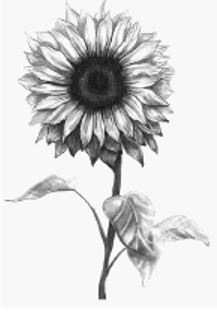
Identify the series of the plant shown in the figure.
A
Heteromerae
B
Disciflorae
C
Inferae
D
Thalamiflorae
Solution
(C) The plant shown in the figure is a sunflower $(Helianthus \ annuus)$.
In Bentham and Hooker's system of classification,the sunflower belongs to the family Asteraceae (Compositae).
Within the class Dicotyledonae,the series characterized by an inferior ovary is known as Inferae.
Since the sunflower has an inferior ovary,it is classified under the series Inferae.
In Bentham and Hooker's system of classification,the sunflower belongs to the family Asteraceae (Compositae).
Within the class Dicotyledonae,the series characterized by an inferior ovary is known as Inferae.
Since the sunflower has an inferior ovary,it is classified under the series Inferae.
0 likes
View Solution284
MediumMCQ
To which subclass is the plant shown in the figure assigned?

A
Polypetalae
B
Gamopetalae
C
Monochlamydeae
D
All $(A), (B)$ and $(C)$
Solution
(B) The plant shown in the figure is a sunflower $(Helianthus \ annuus)$.
In the Bentham and Hooker classification system,the subclass Gamopetalae includes plants where the petals are fused together.
Sunflowers belong to the family Asteraceae (Compositae),which is characterized by having fused petals (sympetalous condition) in the disc florets.
Therefore,it is assigned to the subclass Gamopetalae.
In the Bentham and Hooker classification system,the subclass Gamopetalae includes plants where the petals are fused together.
Sunflowers belong to the family Asteraceae (Compositae),which is characterized by having fused petals (sympetalous condition) in the disc florets.
Therefore,it is assigned to the subclass Gamopetalae.
0 likes
View Solution285
EasyMCQ
The common names of organisms and their respective families are given below. Identify the mismatched pair.
A
Frog - Ranidae
B
Sunflower - Asteraceae
C
Cockroach - Blattidae
D
Maize - Blattidae
Solution
(D) The correct classification for the organisms is as follows:
$1$. Frog belongs to the family $Ranidae$.
$2$. Sunflower belongs to the family $Asteraceae$.
$3$. Cockroach belongs to the family $Blattidae$.
$4$. Maize ($Zea$ $mays$) belongs to the family $Poaceae$, not $Blattidae$.
Therefore, the pair $Maize-Blattidae$ is mismatched.
$1$. Frog belongs to the family $Ranidae$.
$2$. Sunflower belongs to the family $Asteraceae$.
$3$. Cockroach belongs to the family $Blattidae$.
$4$. Maize ($Zea$ $mays$) belongs to the family $Poaceae$, not $Blattidae$.
Therefore, the pair $Maize-Blattidae$ is mismatched.
0 likes
View Solution286
EasyMCQ
Which of the following is the family of sunflower?
A
Ranidae
B
Blattidae
C
Megascolecidae
D
Asteraceae
Solution
(D) The sunflower belongs to the family $Asteraceae$ (also known as $Compositae$).
$Ranidae$ is a family of frogs.
$Blattidae$ is a family of cockroaches.
$Megascolecidae$ is a family of earthworms.
Therefore,the correct option is $D$.
$Ranidae$ is a family of frogs.
$Blattidae$ is a family of cockroaches.
$Megascolecidae$ is a family of earthworms.
Therefore,the correct option is $D$.
0 likes
View Solution287
EasyMCQ
Tricarpellary,syncarpous gynoecium is found in flowers of
A
Fabaceae
B
Poaceae
C
Liliaceae
D
Solanaceae
Solution
(C) The correct answer is $C$.
Members of the family $Liliaceae$ are characterized by a tricarpellary (three carpels),syncarpous (fused carpels) gynoecium.
The ovary is superior and trilocular,containing two to many ovules in each loculus with axile placentation.
Members of the family $Liliaceae$ are characterized by a tricarpellary (three carpels),syncarpous (fused carpels) gynoecium.
The ovary is superior and trilocular,containing two to many ovules in each loculus with axile placentation.
0 likes
View Solution288
MediumMCQ
Vexillary aestivation is characteristic of the family
A
Fabaceae
B
Asteraceae
C
Solanaceae
D
Brassicaceae
Solution
(A) The correct answer is $A$.
$Vexillary$ or descending imbricate aestivation is a characteristic feature of the family $Fabaceae$.
In this type of aestivation,the posterior largest petal,known as the standard or vexillum,overlaps two lateral petals called wings.
These wings,in turn,overlap two anterior petals known as the keel.
This arrangement is also referred to as $papilionaceous$ corolla.
$Vexillary$ or descending imbricate aestivation is a characteristic feature of the family $Fabaceae$.
In this type of aestivation,the posterior largest petal,known as the standard or vexillum,overlaps two lateral petals called wings.
These wings,in turn,overlap two anterior petals known as the keel.
This arrangement is also referred to as $papilionaceous$ corolla.
0 likes
View Solution289
MediumMCQ
Pentamerous actinomorphic flowers,bicarpellary ovary with oblique septa,and fruit as a capsule or berry are characteristic features of:
A
Liliaceae
B
Asteraceae
C
Brassicaceae
D
Solanaceae
Solution
(D) The correct answer is $D$.
$1$. Pentamerous actinomorphic flowers: The floral parts are in multiples of five,and the flower exhibits radial symmetry.
$2$. Bicarpellary ovary: The gynoecium consists of two carpels.
$3$. Oblique septa: $A$ diagnostic feature of the family $Solanaceae$ is the presence of an obliquely placed septum in the ovary,which makes the ovary appear bilocular.
$4$. Fruit: The fruits are typically capsules or berries.
These features are characteristic of the family $Solanaceae$ (e.g.,$Solanum$ $tuberosum$,$Datura$).
$1$. Pentamerous actinomorphic flowers: The floral parts are in multiples of five,and the flower exhibits radial symmetry.
$2$. Bicarpellary ovary: The gynoecium consists of two carpels.
$3$. Oblique septa: $A$ diagnostic feature of the family $Solanaceae$ is the presence of an obliquely placed septum in the ovary,which makes the ovary appear bilocular.
$4$. Fruit: The fruits are typically capsules or berries.
These features are characteristic of the family $Solanaceae$ (e.g.,$Solanum$ $tuberosum$,$Datura$).
0 likes
View Solution290
MediumMCQ
Anacardiaceae is a family of
A
Mango
B
Potato
C
Mustard
D
Wheat
Solution
(A) The family $Anacardiaceae$ includes plants like the mango $(Mangifera \text{ } indica)$.
Potato belongs to the family $Solanaceae$.
Mustard belongs to the family $Brassicaceae$.
Wheat belongs to the family $Poaceae$.
Therefore, the correct answer is Mango.
Potato belongs to the family $Solanaceae$.
Mustard belongs to the family $Brassicaceae$.
Wheat belongs to the family $Poaceae$.
Therefore, the correct answer is Mango.
0 likes
View Solution291
MediumMCQ
Stem is herbaceous in family.
A
Solanaceae
B
Liliaceae
C
Fabaceae
D
Brassicaceae
Solution
(B) The family $Liliaceae$ is characterized by plants that are mostly perennial herbs with underground bulbs,corms,or rhizomes. Their stems are typically herbaceous. While some members of $Solanaceae$,$Fabaceae$,and $Brassicaceae$ can also be herbaceous,$Liliaceae$ is predominantly known for its herbaceous habit across its members.
0 likes
View Solution292
MediumMCQ
Identify the family of $Petunia$.
A
Liliaceae
B
Solanaceae
C
Poaceae
D
Fabaceae
Solution
(B) $Petunia$ is a genus of flowering plants in the family $Solanaceae$.
This family is commonly known as the potato family and includes many important plants like $Solanum$ $tuberosum$ (potato),$Solanum$ $melongena$ (brinjal),and $Nicotiana$ $tabacum$ (tobacco).
$Petunia$ is widely cultivated as an ornamental plant due to its attractive flowers.
This family is commonly known as the potato family and includes many important plants like $Solanum$ $tuberosum$ (potato),$Solanum$ $melongena$ (brinjal),and $Nicotiana$ $tabacum$ (tobacco).
$Petunia$ is widely cultivated as an ornamental plant due to its attractive flowers.
0 likes
View Solution293
MediumMCQ
Identify the plant belonging to the family $Fabaceae$.
A
Soybean
B
Mustard
C
Asparagus
D
Aloe
Solution
(A) The family $Fabaceae$ (formerly known as $Leguminosae$) is a large family of flowering plants.
$Soybean$ $(Glycine \, max)$ is a well-known member of the subfamily $Faboideae$ within the family $Fabaceae$.
$Mustard$ belongs to the family $Brassicaceae$.
$Asparagus$ and $Aloe$ belong to the family $Liliaceae$.
Therefore, the correct option is $A$.
$Soybean$ $(Glycine \, max)$ is a well-known member of the subfamily $Faboideae$ within the family $Fabaceae$.
$Mustard$ belongs to the family $Brassicaceae$.
$Asparagus$ and $Aloe$ belong to the family $Liliaceae$.
Therefore, the correct option is $A$.
0 likes
View Solution294
MediumMCQ
Flower is zygomorphic in this family:
A
Fabaceae
B
Solanaceae
C
Liliaceae
D
All given
Solution
(A) flower is said to be zygomorphic (bilateral symmetry) if it can be divided into two similar halves only in one particular vertical plane.
In the family $Fabaceae$,the flowers are typically zygomorphic (e.g.,pea flower).
In contrast,flowers in $Solanaceae$ and $Liliaceae$ are typically actinomorphic (radial symmetry).
Therefore,the correct answer is $Fabaceae$.
In the family $Fabaceae$,the flowers are typically zygomorphic (e.g.,pea flower).
In contrast,flowers in $Solanaceae$ and $Liliaceae$ are typically actinomorphic (radial symmetry).
Therefore,the correct answer is $Fabaceae$.
0 likes
View Solution295
MediumMCQ
Androecium is epipetalous in this family.
A
Solanaceae
B
Brassicaceae
C
Liliaceae
D
None
Solution
(A) In the family $Solanaceae$,the stamens are epipetalous,meaning they are attached to the petals. This is a characteristic feature of this family,often observed in plants like $Datura$ and $Petunia$.
0 likes
View Solution296
MediumMCQ
Choose the correct statement:
A
Solanaceae - Sepals are free
B
Brassicaceae - Six stamens
C
Fabaceae - Six stamens
D
Solanaceae - Unisexual flower
Solution
(B) In the family $Brassicaceae$ (also known as $Cruciferae$),the androecium consists of $6$ stamens arranged in two whorls. The outer whorl has $2$ short stamens,and the inner whorl has $4$ long stamens,a condition known as $tetradynamous$.
In $Solanaceae$,the sepals are typically $5$ and are $gamosepalous$ (fused),not free.
In $Fabaceae$,the androecium typically consists of $10$ stamens ($diadelphous$ condition,$9+1$).
Flowers in $Solanaceae$ are typically $bisexual$,not $unisexual$.
In $Solanaceae$,the sepals are typically $5$ and are $gamosepalous$ (fused),not free.
In $Fabaceae$,the androecium typically consists of $10$ stamens ($diadelphous$ condition,$9+1$).
Flowers in $Solanaceae$ are typically $bisexual$,not $unisexual$.
0 likes
View Solution297
MediumMCQ
In this family,the fruit is a capsule,rarely a berry.
A
Gloriosa
B
Brinjal
C
Petunia
D
Groundnut
Solution
(A) The family described is $Liliaceae$.
In the $Liliaceae$ family,the fruit is typically a capsule and rarely a berry.
$Gloriosa$ belongs to the family $Liliaceae$.
$Brinjal$ and $Petunia$ belong to the family $Solanaceae$,where the fruit is a berry or capsule.
$Groundnut$ belongs to the family $Fabaceae$,where the fruit is a legume (pod).
In the $Liliaceae$ family,the fruit is typically a capsule and rarely a berry.
$Gloriosa$ belongs to the family $Liliaceae$.
$Brinjal$ and $Petunia$ belong to the family $Solanaceae$,where the fruit is a berry or capsule.
$Groundnut$ belongs to the family $Fabaceae$,where the fruit is a legume (pod).
0 likes
View Solution298
MediumMCQ
The importance of $Lupinus$ (Lupine) is:
A
Edible oil
B
Dye
C
Ornamental
D
Medicine
Solution
(C) $Lupinus$ (Lupine) belongs to the family $Fabaceae$.
It is widely cultivated as an ornamental plant in gardens due to its attractive,colorful flowers.
While some species are used as fodder,in the context of the $NCERT$ textbook,$Lupinus$ is specifically highlighted for its ornamental value.
It is widely cultivated as an ornamental plant in gardens due to its attractive,colorful flowers.
While some species are used as fodder,in the context of the $NCERT$ textbook,$Lupinus$ is specifically highlighted for its ornamental value.
0 likes
View Solution299
MediumMCQ
Epipetalous androecium is found in
A
Mung
B
Pea
C
Solanum nigrum
D
Groundnut
Solution
(C) Epipetalous androecium refers to the condition where the stamens are attached to the petals.
This condition is a characteristic feature of the family $Solanaceae$.
Among the given options, $Solanum \text{ } nigrum$ belongs to the family $Solanaceae$.
Therefore, $Solanum \text{ } nigrum$ exhibits epipetalous stamens.
This condition is a characteristic feature of the family $Solanaceae$.
Among the given options, $Solanum \text{ } nigrum$ belongs to the family $Solanaceae$.
Therefore, $Solanum \text{ } nigrum$ exhibits epipetalous stamens.
0 likes
View Solution300
MediumMCQ
It is known as the "potato family".
A
Solanaceae
B
Fabaceae
C
Poaceae
D
All correct
Solution
(A) The family $Solanaceae$ is commonly known as the "potato family".
It is a large family, often referred to as the potato family, and is distributed in tropics, subtropics, and even temperate zones.
Many plants belonging to this family are important sources of food (e.g., potato, tomato, brinjal), spices (e.g., chilli), medicine (e.g., belladonna, ashwagandha), and ornamentals (e.g., petunia).
It is a large family, often referred to as the potato family, and is distributed in tropics, subtropics, and even temperate zones.
Many plants belonging to this family are important sources of food (e.g., potato, tomato, brinjal), spices (e.g., chilli), medicine (e.g., belladonna, ashwagandha), and ornamentals (e.g., petunia).
0 likes
View SolutionMorphology of Flowering Plants — Description of Some Important Families · Frequently Asked Questions
1Are these Morphology of Flowering Plants questions useful for JEE and NEET?
Yes. All questions in this section are mapped to JEE Main and NEET exam patterns. Previous year questions from JEE Main, NEET, GUJCET and state-level exams are included with full solutions.
2Can I switch to Hindi or Gujarati for these questions?
Yes. Use the language tabs in the hero section or the sidebar to view the same questions and solutions in English, Hindi or Gujarati.
3How do I generate a question paper from this subtopic?
Use the Vedclass Exam Paper Generator — select the chapter and subtopic, set difficulty, and generate Sets A, B, C, D automatically. First 3 chapters of every subject are free.
Vedclass Products
For Students
Vedclass Test Series
Mock tests in real JEE/NEET style with performance analysis. 5-day free trial.
Start Free TrialFor Teachers
Exam Paper Generator
Generate Set A/B/C/D papers from this chapter in 2 minutes. 3 chapters free.
Try FreeFor Institutes
Online Exam Module
Live online exams with unlimited students, 360° analytics & white-label branding.
See DemoFor Teachers & Institutes
Generate a Morphology of Flowering Plants Exam Paper in 2 Minutes
Select subtopic & difficulty — Sets A, B, C, D auto-generated with No Repeat logic.
First 3 chapters of every subject are free — no payment required.