
A English
Description of Some Important Families Questions in English
Class 11 Biology · Morphology of Flowering Plants · Description of Some Important Families
416+
Questions
English
Language
100%
With Solutions
Showing 16 of 416 questions in English
401
MediumMCQ
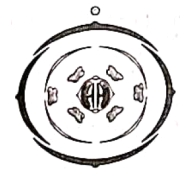
The floral diagram represents which one of the following families?
A
Fabaceae
B
Brassicaceae
C
Solanaceae
D
Liliaceae
Solution
(B) The provided floral diagram shows the following characteristics:
$1$. The flower is actinomorphic (radially symmetrical),indicated by the symbol $\oplus$.
$2$. It has four sepals in two whorls (valvate aestivation).
$3$. It has four petals in a cross-like arrangement (cruciform,valvate aestivation).
$4$. It has six stamens arranged in two whorls (tetradynamous condition: two outer short and four inner long).
$5$. The ovary is superior and bicarpellary,syncarpous with a false septum (replum).
These features are characteristic of the family $Brassicaceae$ (also known as $Cruciferae$).
$1$. The flower is actinomorphic (radially symmetrical),indicated by the symbol $\oplus$.
$2$. It has four sepals in two whorls (valvate aestivation).
$3$. It has four petals in a cross-like arrangement (cruciform,valvate aestivation).
$4$. It has six stamens arranged in two whorls (tetradynamous condition: two outer short and four inner long).
$5$. The ovary is superior and bicarpellary,syncarpous with a false septum (replum).
These features are characteristic of the family $Brassicaceae$ (also known as $Cruciferae$).
0 likes
View Solution402
MediumMCQ
Family $Fabaceae$ differs from $Solanaceae$ and $Liliaceae$. With respect to the stamens,pick out the characteristics specific to family $Fabaceae$ but not found in $Solanaceae$ or $Liliaceae$.
A
Epiphyllous and Dithecous anthers
B
Diadelphous and Dithecous anthers
C
Polyadelphous and epipetalous stamens
D
Monoadelphous and Monothecous anthers
Solution
(B) In family $Fabaceae$,the stamens are $Diadelphous$ (arranged in two bundles) and the anthers are $Dithecous$ (two-lobed).
In family $Solanaceae$,the stamens are $Polyandrous$ (free),$Epipetalous$ (attached to petals),and $Dithecous$.
In family $Liliaceae$,the stamens are $Polyandrous$,$Epiphyllous$ (attached to tepals),and $Dithecous$.
Therefore,the characteristic specific to $Fabaceae$ is $Diadelphous$ condition.
In family $Solanaceae$,the stamens are $Polyandrous$ (free),$Epipetalous$ (attached to petals),and $Dithecous$.
In family $Liliaceae$,the stamens are $Polyandrous$,$Epiphyllous$ (attached to tepals),and $Dithecous$.
Therefore,the characteristic specific to $Fabaceae$ is $Diadelphous$ condition.
0 likes
View Solution403
EasyMCQ
Which one is not a character of a pea flower?
A
Bisexual
B
Zygomorphic
C
Inferior ovary
D
Polypetalous
Solution
(C) The pea flower $(Pisum \text{ } sativum)$ belongs to the family $Fabaceae$.
Its floral characteristics include:
$1$. It is bisexual (contains both stamens and carpels).
$2$. It is zygomorphic (bilateral symmetry).
$3$. It has a superior ovary (hypogynous flower), not an inferior ovary.
$4$. It is polypetalous (petals are free or distinct, specifically papilionaceous corolla).
Therefore, having an inferior ovary is not a character of the pea flower.
Its floral characteristics include:
$1$. It is bisexual (contains both stamens and carpels).
$2$. It is zygomorphic (bilateral symmetry).
$3$. It has a superior ovary (hypogynous flower), not an inferior ovary.
$4$. It is polypetalous (petals are free or distinct, specifically papilionaceous corolla).
Therefore, having an inferior ovary is not a character of the pea flower.
0 likes
View Solution404
MediumMCQ
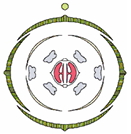
Which of the following floral formulas is correct for the given floral diagram?
A
B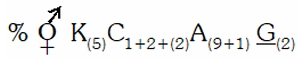
C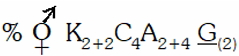
D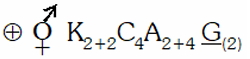
Solution
(D) The given floral diagram shows the following characteristics:
$1$. Symmetry: The flower is actinomorphic (radial symmetry),represented by the symbol $\oplus$.
$2$. Calyx $(K)$: There are $4$ sepals arranged in two whorls $(2+2)$.
$3$. Corolla $(C)$: There are $4$ petals arranged in a single whorl $(4)$.
$4$. Androecium $(A)$: There are $6$ stamens arranged in two whorls,with $2$ in the outer whorl and $4$ in the inner whorl $(2+4)$. This is a characteristic feature of the Brassicaceae family (tetradynamous condition).
$5$. Gynoecium $(G)$: The ovary is superior (represented by $\underline{G}$) and bicarpellary syncarpous (represented by $(2)$).
Combining these features,the floral formula is $\oplus \; \text{O} \; K_{2+2} C_{4} A_{2+4} \underline{G}_{(2)}$.
This corresponds to option $D$.
$1$. Symmetry: The flower is actinomorphic (radial symmetry),represented by the symbol $\oplus$.
$2$. Calyx $(K)$: There are $4$ sepals arranged in two whorls $(2+2)$.
$3$. Corolla $(C)$: There are $4$ petals arranged in a single whorl $(4)$.
$4$. Androecium $(A)$: There are $6$ stamens arranged in two whorls,with $2$ in the outer whorl and $4$ in the inner whorl $(2+4)$. This is a characteristic feature of the Brassicaceae family (tetradynamous condition).
$5$. Gynoecium $(G)$: The ovary is superior (represented by $\underline{G}$) and bicarpellary syncarpous (represented by $(2)$).
Combining these features,the floral formula is $\oplus \; \text{O} \; K_{2+2} C_{4} A_{2+4} \underline{G}_{(2)}$.
This corresponds to option $D$.
0 likes
View Solution405
MediumMCQ
Floral formula of Cruciferae (Brassicaceae) is$-$
A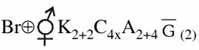
B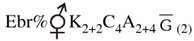
C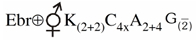
D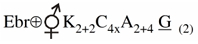
Solution
The family Cruciferae, now known as Brassicaceae, has the following floral characteristics:
$1.$ The flowers are ebracteate (Ebr), actinomorphic $(\oplus)$, and bisexual.
$2.$ The calyx $(K)$ consists of $4$ sepals arranged in two whorls of $2$ each $(2+2)$.
$3.$ The corolla $(C)$ consists of $4$ petals arranged in a cruciform manner.
$4.$ The androecium $(A)$ consists of $6$ stamens arranged in two whorls, with $2$ short outer and $4$ long inner stamens $(2+4)$.
$5.$ The gynoecium $(G)$ is bicarpellary, syncarpous, and superior $(\underline{G}_{(2)})$.
Therefore, the correct floral formula is:
$\text{Ebr} \; \oplus \; \odot \; K_{2+2} \; C_4 \; A_{2+4} \; \underline{G}_{(2)}$
$1.$ The flowers are ebracteate (Ebr), actinomorphic $(\oplus)$, and bisexual.
$2.$ The calyx $(K)$ consists of $4$ sepals arranged in two whorls of $2$ each $(2+2)$.
$3.$ The corolla $(C)$ consists of $4$ petals arranged in a cruciform manner.
$4.$ The androecium $(A)$ consists of $6$ stamens arranged in two whorls, with $2$ short outer and $4$ long inner stamens $(2+4)$.
$5.$ The gynoecium $(G)$ is bicarpellary, syncarpous, and superior $(\underline{G}_{(2)})$.
Therefore, the correct floral formula is:
$\text{Ebr} \; \oplus \; \odot \; K_{2+2} \; C_4 \; A_{2+4} \; \underline{G}_{(2)}$
0 likes
View Solution406
MediumMCQ
Pulvinus leaf base,vexillary aestivation,and marginal placentation are found in which family?
A
Fabaceae
B
Solanaceae
C
Liliaceae
D
Brassicaceae
Solution
(A) The characteristics mentioned are diagnostic features of the family $Fabaceae$:
$1$. $Pulvinus$ leaf base: The leaf base is swollen,which is a characteristic feature of the family $Fabaceae$ (legume family).
$2$. $Vexillary$ aestivation: In the corolla,the posterior standard petal overlaps the two lateral wings,which in turn overlap the two anterior keel petals. This is a specific type of aestivation found in $Fabaceae$.
$3$. $Marginal$ placentation: The ovary is monocarpellary,unilocular,with ovules arranged along the ventral suture. This is a hallmark of $Fabaceae$.
$1$. $Pulvinus$ leaf base: The leaf base is swollen,which is a characteristic feature of the family $Fabaceae$ (legume family).
$2$. $Vexillary$ aestivation: In the corolla,the posterior standard petal overlaps the two lateral wings,which in turn overlap the two anterior keel petals. This is a specific type of aestivation found in $Fabaceae$.
$3$. $Marginal$ placentation: The ovary is monocarpellary,unilocular,with ovules arranged along the ventral suture. This is a hallmark of $Fabaceae$.
0 likes
View Solution407
MediumMCQ
Which of the following characters are related to the Asteraceae family?
$(a)$ Inflorescence racemose head or capitulum
$(b)$ Fruit with hairy pappus
$(c)$ Placentation marginal
$(d)$ Ovary superior
$(a)$ Inflorescence racemose head or capitulum
$(b)$ Fruit with hairy pappus
$(c)$ Placentation marginal
$(d)$ Ovary superior
A
Only $a$ & $c$
B
Only $b$ & $d$
C
Only $a$ & $b$
D
Only $c$ & $d$
Solution
(C) The Asteraceae family (also known as the Compositae family) is characterized by the following features:
$1$. The inflorescence is typically a capitulum or head,which is a type of racemose inflorescence.
$2$. The fruit is a cypsela,which often bears a persistent calyx modified into a hairy structure called a pappus,aiding in seed dispersal.
$3$. The placentation in Asteraceae is basal,not marginal (marginal placentation is characteristic of the Fabaceae family).
$4$. The ovary is inferior,not superior (superior ovary is characteristic of families like Solanaceae or Fabaceae).
Therefore,statements $(a)$ and $(b)$ are correct,while $(c)$ and $(d)$ are incorrect.
The correct option is $C$.
$1$. The inflorescence is typically a capitulum or head,which is a type of racemose inflorescence.
$2$. The fruit is a cypsela,which often bears a persistent calyx modified into a hairy structure called a pappus,aiding in seed dispersal.
$3$. The placentation in Asteraceae is basal,not marginal (marginal placentation is characteristic of the Fabaceae family).
$4$. The ovary is inferior,not superior (superior ovary is characteristic of families like Solanaceae or Fabaceae).
Therefore,statements $(a)$ and $(b)$ are correct,while $(c)$ and $(d)$ are incorrect.
The correct option is $C$.
0 likes
View Solution408
MediumMCQ
The correct floral formula of $Atropa$ $belladonna$ is $:-$
A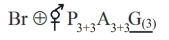
B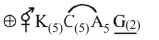
C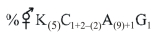
D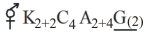
Solution
(B) $Atropa$ $belladonna$ belongs to the family $Solanaceae$.
The floral formula for the family $Solanaceae$ is represented as $\oplus \text{ } \text{ } \text{ } \text{K}_{(5)} \text{C}_{(5)} \text{A}_5 \underline{\text{G}}_{(2)}$.
Here,$\oplus$ represents actinomorphic symmetry,$\text{K}_{(5)}$ represents five fused sepals,$\text{C}_{(5)}$ represents five fused petals,$\text{A}_5$ represents five stamens (epipetalous),and $\underline{\text{G}}_{(2)}$ represents a superior ovary with two fused carpels.
Therefore,option $B$ is the correct floral formula.
The floral formula for the family $Solanaceae$ is represented as $\oplus \text{ } \text{ } \text{ } \text{K}_{(5)} \text{C}_{(5)} \text{A}_5 \underline{\text{G}}_{(2)}$.
Here,$\oplus$ represents actinomorphic symmetry,$\text{K}_{(5)}$ represents five fused sepals,$\text{C}_{(5)}$ represents five fused petals,$\text{A}_5$ represents five stamens (epipetalous),and $\underline{\text{G}}_{(2)}$ represents a superior ovary with two fused carpels.
Therefore,option $B$ is the correct floral formula.
0 likes
View Solution409
MediumMCQ
Which of the following characters are related to the family $Malvaceae$?
$(a)$ Five stamens
$(b)$ Marginal placentation
$(c)$ Infinite stamens
$(d)$ Twisted aestivation
$(a)$ Five stamens
$(b)$ Marginal placentation
$(c)$ Infinite stamens
$(d)$ Twisted aestivation
A
Only $(a)$ and $(b)$
B
Only $(c)$ and $(d)$
C
Only $(b)$ and $(c)$
D
Only $(a)$ and $(d)$
Solution
(B) The family $Malvaceae$ is characterized by the following features:
$1$. The androecium consists of numerous (infinite) stamens which are monadelphous (filaments fused into a tube).
$2$. The aestivation of the petals is twisted.
$3$. The placentation is axile,not marginal (marginal is characteristic of $Fabaceae$).
$4$. Therefore,characters $(c)$ and $(d)$ are correct for $Malvaceae$.
Thus,the correct option is $(B)$.
$1$. The androecium consists of numerous (infinite) stamens which are monadelphous (filaments fused into a tube).
$2$. The aestivation of the petals is twisted.
$3$. The placentation is axile,not marginal (marginal is characteristic of $Fabaceae$).
$4$. Therefore,characters $(c)$ and $(d)$ are correct for $Malvaceae$.
Thus,the correct option is $(B)$.
0 likes
View Solution410
EasyMCQ
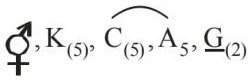
Identify the floral formula of a plant belonging to the potato family (Solanaceae).
A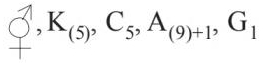
B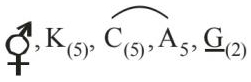
C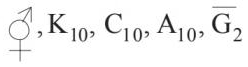
D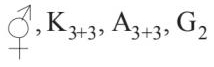
Solution
(B) The potato family is known as the Solanaceae family.
Its characteristic floral formula is $\oplus, \text{K}_{(5)}, \text{C}_{(5)}, \text{A}_5, \underline{\text{G}}_{(2)}$.
- $\oplus$: Actinomorphic (radially symmetrical).
- $\text{K}_{(5)}$: Calyx with $5$ sepals,gamosepalous (fused).
- $\text{C}_{(5)}$: Corolla with $5$ petals,gamopetalous (fused).
- $\text{A}_5$: Androecium with $5$ stamens,epipetalous (often attached to petals,though not explicitly shown in this simplified formula).
- $\underline{\text{G}}_{(2)}$: Gynoecium with $2$ carpels,syncarpous (fused),and superior ovary.
Its characteristic floral formula is $\oplus, \text{K}_{(5)}, \text{C}_{(5)}, \text{A}_5, \underline{\text{G}}_{(2)}$.
- $\oplus$: Actinomorphic (radially symmetrical).
- $\text{K}_{(5)}$: Calyx with $5$ sepals,gamosepalous (fused).
- $\text{C}_{(5)}$: Corolla with $5$ petals,gamopetalous (fused).
- $\text{A}_5$: Androecium with $5$ stamens,epipetalous (often attached to petals,though not explicitly shown in this simplified formula).
- $\underline{\text{G}}_{(2)}$: Gynoecium with $2$ carpels,syncarpous (fused),and superior ovary.
0 likes
View Solution411
EasyMCQ
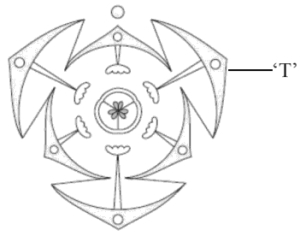
Identify the floral unit '$T$' in the given floral diagram.
A
Perianth
B
Sepal
C
Petal
D
Tepal
Solution
(D) The correct answer is $(D)$ Tepal.
The provided floral diagram represents the family Liliaceae,specifically the genus $Allium$ ($Allium$ $cepa$).
In this family,the calyx and corolla are not distinct,and the floral unit is collectively known as the perianth.
Each individual member of the perianth is referred to as a tepal.
Therefore,'$T$' points to a tepal.
The provided floral diagram represents the family Liliaceae,specifically the genus $Allium$ ($Allium$ $cepa$).
In this family,the calyx and corolla are not distinct,and the floral unit is collectively known as the perianth.
Each individual member of the perianth is referred to as a tepal.
Therefore,'$T$' points to a tepal.
0 likes
View Solution412
EasyMCQ
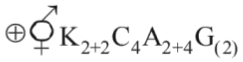
Choose the correct floral formula for the given floral diagram.

A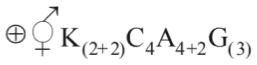
$\oplus \; \text{O} \; K_{(2+2)} C_4 A_{4+2} G_{(3)}$
B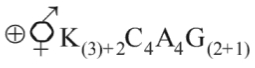
$\oplus \; \text{O} \; K_{(3)+2} C_4 A_4 G_{(2+1)}$
C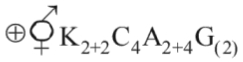
$\oplus \; \text{O} \; K_{2+2} C_4 A_{2+4} G_{(2)}$
D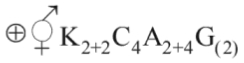
$\oplus \; \text{O} \; K_{2+2} C_4 A_{2+4} G_{(2)}$
Solution
(C) The given floral diagram represents the family Brassicaceae (formerly Cruciferae).
$1$. The flower is actinomorphic $(\oplus)$,
bisexual ($\text{O}$ with male and female symbols).
$2$. The calyx $(K)$ consists of $4$ sepals arranged in two whorls of $2+2$.
$3$. The corolla $(C)$ consists of $4$ petals arranged in a cruciform manner.
$4$. The androecium $(A)$ consists of $6$ stamens arranged in two whorls of $2+4$ (tetradynamous condition).
$5$. The gynoecium $(G)$ is bicarpellary,syncarpous,and superior,represented as $G_{(2)}$.
Thus,the correct floral formula is $\oplus \; \text{O} \; K_{2+2} C_4 A_{2+4} G_{(2)}$.
$1$. The flower is actinomorphic $(\oplus)$,
bisexual ($\text{O}$ with male and female symbols).
$2$. The calyx $(K)$ consists of $4$ sepals arranged in two whorls of $2+2$.
$3$. The corolla $(C)$ consists of $4$ petals arranged in a cruciform manner.
$4$. The androecium $(A)$ consists of $6$ stamens arranged in two whorls of $2+4$ (tetradynamous condition).
$5$. The gynoecium $(G)$ is bicarpellary,syncarpous,and superior,represented as $G_{(2)}$.
Thus,the correct floral formula is $\oplus \; \text{O} \; K_{2+2} C_4 A_{2+4} G_{(2)}$.
0 likes
View Solution413
EasyMCQ
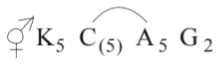
The floral formula given below is that of:
A
Hibiscus
B
Banana
C
Tulip
D
Vinca
Solution
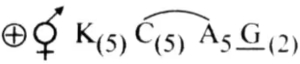
The correct answer is $(D)$ Vinca.
The provided floral formula is: $\oplus$
The provided floral formula is: $\oplus$
0 likes
View Solution414
EasyMCQ
Gynoecium in the members of family Leguminosae is composed of
A
One carpel
B
Two carpels
C
Three carpels
D
Five carpels
Solution
(A) The correct answer is $A$.
In the family Leguminosae (now classified under Fabaceae),the gynoecium is monocarpellary.
This means it consists of a single carpel,which is superior,unilocular,and contains one or more ovules.
In the family Leguminosae (now classified under Fabaceae),the gynoecium is monocarpellary.
This means it consists of a single carpel,which is superior,unilocular,and contains one or more ovules.
0 likes
View Solution415
EasyMCQ
Match Column-$I$ with Column-$II$.
| Column-$I$ | Column-$II$ |
|---|---|
| $A$. Sunflower | $p$. Acanthaceae |
| $B$. Tulsi | $q$. Compositae |
| $C$. Coffee | $r$. Labiatae |
| $D$. Vasaka | $s$. Rubiaceae |
A
$A-q, B-s, C-p, D-t$
B
$A-s, B-r, C-p, D-t$
C
$A-r, B-t, C-s, D-q$
D
$A-q, B-r, C-s, D-p$
Solution
(D) The correct matches are as follows:
$1$. Sunflower $(A)$ belongs to the family Compositae $(q)$.
$2$. Tulsi $(B)$ belongs to the family Labiatae $(r)$.
$3$. Coffee $(C)$ belongs to the family Rubiaceae $(s)$.
$4$. Vasaka $(D)$ belongs to the family Acanthaceae $(p)$.
Therefore,the correct matching is $A-q, B-r, C-s, D-p$.
$1$. Sunflower $(A)$ belongs to the family Compositae $(q)$.
$2$. Tulsi $(B)$ belongs to the family Labiatae $(r)$.
$3$. Coffee $(C)$ belongs to the family Rubiaceae $(s)$.
$4$. Vasaka $(D)$ belongs to the family Acanthaceae $(p)$.
Therefore,the correct matching is $A-q, B-r, C-s, D-p$.
0 likes
View Solution416
EasyMCQ
Which of the following floral formulas is the correct floral formula for the Solanaceae family?
A
$(1)$ $\oplus \text{ K}_{(5)} \text{ C}_5 \text{ A}_5 \text{ G}_{(2)}$
B
$(2)$ $\oplus \text{ K}_5 \text{ C}_5 \text{ A}_5 \text{ G}_{(2)}$
C
$(3)$ $\oplus \text{ K}_{(5)} \text{ C}_{(5)} \text{ A}_5 \text{ G}_{(2)}$
D
$(4)$ $\oplus \text{ K}_5 \text{ C}_{(5)} \text{ A}_5 \text{ G}_{(2)}$
Solution
(C) The floral formula of the Solanaceae family is characterized by being actinomorphic $(\oplus)$,bisexual,having a calyx with $5$ fused sepals $(K_{(5)})$,a corolla with $5$ fused petals $(C_{(5)})$,an androecium with $5$ stamens $(A_5)$,and a gynoecium with $2$ fused carpels $(G_{(2)})$.
Thus,the correct floral formula is $\oplus \text{ K}_{(5)} \text{ C}_{(5)} \text{ A}_5 \text{ G}_{(2)}$.
Thus,the correct floral formula is $\oplus \text{ K}_{(5)} \text{ C}_{(5)} \text{ A}_5 \text{ G}_{(2)}$.
0 likes
View SolutionMorphology of Flowering Plants — Description of Some Important Families · Frequently Asked Questions
1Are these Morphology of Flowering Plants questions useful for JEE and NEET?
Yes. All questions in this section are mapped to JEE Main and NEET exam patterns. Previous year questions from JEE Main, NEET, GUJCET and state-level exams are included with full solutions.
2Can I switch to Hindi or Gujarati for these questions?
Yes. Use the language tabs in the hero section or the sidebar to view the same questions and solutions in English, Hindi or Gujarati.
3How do I generate a question paper from this subtopic?
Use the Vedclass Exam Paper Generator — select the chapter and subtopic, set difficulty, and generate Sets A, B, C, D automatically. First 3 chapters of every subject are free.
Vedclass Products
For Students
Vedclass Test Series
Mock tests in real JEE/NEET style with performance analysis. 5-day free trial.
Start Free TrialFor Teachers
Exam Paper Generator
Generate Set A/B/C/D papers from this chapter in 2 minutes. 3 chapters free.
Try FreeFor Institutes
Online Exam Module
Live online exams with unlimited students, 360° analytics & white-label branding.
See DemoFor Teachers & Institutes
Generate a Morphology of Flowering Plants Exam Paper in 2 Minutes
Select subtopic & difficulty — Sets A, B, C, D auto-generated with No Repeat logic.
First 3 chapters of every subject are free — no payment required.