
A English
Description of Some Important Families Questions in English
Class 11 Biology · Morphology of Flowering Plants · Description of Some Important Families
416+
Questions
English
Language
100%
With Solutions
Showing 48 of 416 questions in English
301
MediumMCQ
Which family does mustard belong to?
A
Brassicaceae
B
Fabaceae
C
Solanaceae
D
None
Solution
(A) Mustard (scientific name: $Brassica \text{ } campestris$) belongs to the family $Brassicaceae$ (also known as $Cruciferae$).
This family is characterized by flowers with four petals arranged in a cross-like pattern, which is why it was historically called $Cruciferae$.
$Fabaceae$ includes legumes like peas and beans, while $Solanaceae$ includes plants like potatoes and tomatoes.
This family is characterized by flowers with four petals arranged in a cross-like pattern, which is why it was historically called $Cruciferae$.
$Fabaceae$ includes legumes like peas and beans, while $Solanaceae$ includes plants like potatoes and tomatoes.
0 likes
View Solution302
MediumMCQ
Choose the correct option for the given features:
$(a)$ Bisexual flower
$(b)$ Zygomorphic flower
$(c)$ Imbricate aestivation
$(a)$ Bisexual flower
$(b)$ Zygomorphic flower
$(c)$ Imbricate aestivation
A
Fabaceae
B
Solanaceae
C
$A$ and $B$ correct
D
$A$ and $B$ incorrect
Solution
(A) The features provided are:
$(a)$ Bisexual flower,$(b)$ Zygomorphic flower,and $(c)$ Imbricate aestivation.
These are characteristic features of the family $Fabaceae$.
In contrast,the family $Solanaceae$ typically exhibits actinomorphic flowers and valvate aestivation.
Therefore,the correct option is $A$.
$(a)$ Bisexual flower,$(b)$ Zygomorphic flower,and $(c)$ Imbricate aestivation.
These are characteristic features of the family $Fabaceae$.
In contrast,the family $Solanaceae$ typically exhibits actinomorphic flowers and valvate aestivation.
Therefore,the correct option is $A$.
0 likes
View Solution303
MediumMCQ
Choose the correct pair.
A
Ashwagandha - Fabaceae
B
Soybean - Liliaceae
C
Tulip - Solanaceae
D
Mustard - Brassicaceae
Solution
(D) The correct pair is $Mustard - Brassicaceae$.
$1$. $Ashwagandha$ $(Withania \text{ } somnifera)$ belongs to the family $Solanaceae$.
$2$. $Soybean$ $(Glycine \text{ } max)$ belongs to the family $Fabaceae$.
$3$. $Tulip$ $(Tulipa)$ belongs to the family $Liliaceae$.
$4$. $Mustard$ $(Brassica \text{ } campestris)$ belongs to the family $Brassicaceae$.
$1$. $Ashwagandha$ $(Withania \text{ } somnifera)$ belongs to the family $Solanaceae$.
$2$. $Soybean$ $(Glycine \text{ } max)$ belongs to the family $Fabaceae$.
$3$. $Tulip$ $(Tulipa)$ belongs to the family $Liliaceae$.
$4$. $Mustard$ $(Brassica \text{ } campestris)$ belongs to the family $Brassicaceae$.
0 likes
View Solution304
MediumMCQ
Which type of sepal aestivation is found in the $Solanaceae$ family?
A
Valvate
B
Vexillary
C
Imbricate
D
Twisted
Solution
(A) In the $Solanaceae$ family,the calyx consists of $5$ sepals that are gamosepalous (united). The aestivation of these sepals is $Valvate$,meaning the margins of the sepals touch each other without overlapping. Therefore,the correct option is $A$.
0 likes
View Solution305
MediumMCQ
........ is the family of chilli.
A
Fabaceae
B
Liliaceae
C
Solanaceae
D
Poaceae
Solution
(C) Chilli (Capsicum annuum) belongs to the family $Solanaceae$.
This family is often referred to as the 'potato family'.
It includes many important plants such as potato,tomato,brinjal,and tobacco.
Members of this family are characterized by flowers with five petals,five sepals,and five stamens,often showing a superior ovary.
This family is often referred to as the 'potato family'.
It includes many important plants such as potato,tomato,brinjal,and tobacco.
Members of this family are characterized by flowers with five petals,five sepals,and five stamens,often showing a superior ovary.
0 likes
View Solution306
MediumMCQ
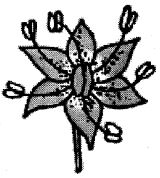
Identify the figure given below.
A
Flower of Solanaceae
B
Flower of Liliaceae
C
Flower of Fabaceae
D
Flower of pea
Solution
(B) The figure shows a flower with tepals arranged in two whorls of three each, which is characteristic of the family $Liliaceae$ (e.g., $Allium \text{ } cepa$).
In $Liliaceae$, the perianth consists of tepals, usually $3+3$ in two whorls, and the stamens are also $3+3$ (epitepalous).
This floral arrangement is a diagnostic feature of the family $Liliaceae$ as described in the $NCERT$ textbook.
In $Liliaceae$, the perianth consists of tepals, usually $3+3$ in two whorls, and the stamens are also $3+3$ (epitepalous).
This floral arrangement is a diagnostic feature of the family $Liliaceae$ as described in the $NCERT$ textbook.
0 likes
View Solution307
MediumMCQ
The floral formula of the $Fabaceae$ family contains the symbol $C_{1+2+(2)}$. This symbol represents the arrangement of which floral part?
A
$Fabaceae$ ; petal
B
$Liliaceae$ ; perianth tepal
C
$Solanaceae$ ; petal
D
$Fabaceae$ ; sepal
Solution
The floral formula of the $Fabaceae$ family is represented as: $Br \oplus \text{ } K_{(5)} C_{1+2+(2)} A_{(9)+1} G_{1}$
0 likes
View Solution308
MediumMCQ
Choose the incorrect pair.
A
Source of food - potato
B
Spices - chilli
C
Ornaments - colchicine
D
Fumigatory - tobacco
Solution
(C) The family $Solanaceae$ is known as the potato family. It provides various economic products:
$1$. Food: Potato ($Solanum$ $tuberosum$).
$2$. Spices: Chilli ($Capsicum$ $annuum$).
$3$. Medicine: Belladonna,Ashwagandha.
$4$. Fumigatory: Tobacco ($Nicotiana$ $tabacum$).
$5$. Ornamentals: Petunia,$Salvia$.
Colchicine is an alkaloid obtained from $Colchicum$ $autumnale$,which belongs to the family $Liliaceae$,not $Solanaceae$. Therefore,the pair 'Ornaments - colchicine' is incorrect.
$1$. Food: Potato ($Solanum$ $tuberosum$).
$2$. Spices: Chilli ($Capsicum$ $annuum$).
$3$. Medicine: Belladonna,Ashwagandha.
$4$. Fumigatory: Tobacco ($Nicotiana$ $tabacum$).
$5$. Ornamentals: Petunia,$Salvia$.
Colchicine is an alkaloid obtained from $Colchicum$ $autumnale$,which belongs to the family $Liliaceae$,not $Solanaceae$. Therefore,the pair 'Ornaments - colchicine' is incorrect.
0 likes
View Solution309
MediumMCQ
Tobacco belongs to the ....... family.
A
Fabaceae
B
Solanaceae
C
Liliaceae
D
Poaceae
Solution
(B) Tobacco $(Nicotiana tabacum)$ belongs to the family $Solanaceae$.
This family is often referred to as the 'potato family' and includes many important plants such as potato, tomato, brinjal, chili, and belladonna.
This family is often referred to as the 'potato family' and includes many important plants such as potato, tomato, brinjal, chili, and belladonna.
0 likes
View Solution310
MediumMCQ
Select the correct option on the basis of the following characteristics:
$(I)$ Inflorescence - racemose
$(II)$ Gynoecium - ovary superior,monocarpellary
$(III)$ Seed - non-endospermic
$(I)$ Inflorescence - racemose
$(II)$ Gynoecium - ovary superior,monocarpellary
$(III)$ Seed - non-endospermic
A
Pulses,dye,fibres,fodder
B
Ornamental,medicine,vegetable
C
Spice,medicine,fumigatory
D
All of the above
Solution
(A) The characteristics provided describe the family $Fabaceae$ (formerly $Leguminosae$).
$(I)$ The inflorescence in $Fabaceae$ is typically racemose.
$(II)$ The gynoecium consists of a superior ovary that is monocarpellary and unilocular.
$(III)$ The seeds are typically non-endospermic (exalbuminous).
Plants belonging to the family $Fabaceae$ are economically very important and provide pulses (e.g.,gram,arhar),edible oils (e.g.,soybean,groundnut),dyes (e.g.,Indigofera),fibres (e.g.,sunnhemp),and fodder (e.g.,Sesbania,Trifolium). Therefore,all the listed categories are correct.
$(I)$ The inflorescence in $Fabaceae$ is typically racemose.
$(II)$ The gynoecium consists of a superior ovary that is monocarpellary and unilocular.
$(III)$ The seeds are typically non-endospermic (exalbuminous).
Plants belonging to the family $Fabaceae$ are economically very important and provide pulses (e.g.,gram,arhar),edible oils (e.g.,soybean,groundnut),dyes (e.g.,Indigofera),fibres (e.g.,sunnhemp),and fodder (e.g.,Sesbania,Trifolium). Therefore,all the listed categories are correct.
0 likes
View Solution311
MediumMCQ
The characteristic fruit of family $Liliaceae$ is:
A
Legume
B
Capsule
C
Drupe
D
None of the above
Solution
(B) The family $Liliaceae$ is a monocotyledonous family.
In this family,the gynoecium is tricarpellary,syncarpous,and superior with axile placentation.
The characteristic fruit of the $Liliaceae$ family is a $Capsule$ (rarely a berry).
Therefore,the correct option is $B$.
In this family,the gynoecium is tricarpellary,syncarpous,and superior with axile placentation.
The characteristic fruit of the $Liliaceae$ family is a $Capsule$ (rarely a berry).
Therefore,the correct option is $B$.
0 likes
View Solution312
MediumMCQ
Which of the following characters are not true about $Solanaceae$?
A
It is herbaceous,rarely woody,aerial and erect.
B
Leaves are alternate,simple,rarely pinnately compound.
C
Inflorescence is solitary.
D
Flower is bisexual,zygomorphic.
Solution
(D) The family $Solanaceae$ is characterized by the following features:
$1$. Habit: Mostly herbs,shrubs,and rarely small trees (woody).
$2$. Leaves: Alternate,simple,rarely pinnately compound,exstipulate.
$3$. Inflorescence: Solitary,axillary,or cymose (e.g.,in $Solanum$).
$4$. Flower: Bisexual and actinomorphic (radial symmetry),not zygomorphic.
Therefore,the statement that the flower is zygomorphic is incorrect,as $Solanaceae$ flowers are typically actinomorphic.
$1$. Habit: Mostly herbs,shrubs,and rarely small trees (woody).
$2$. Leaves: Alternate,simple,rarely pinnately compound,exstipulate.
$3$. Inflorescence: Solitary,axillary,or cymose (e.g.,in $Solanum$).
$4$. Flower: Bisexual and actinomorphic (radial symmetry),not zygomorphic.
Therefore,the statement that the flower is zygomorphic is incorrect,as $Solanaceae$ flowers are typically actinomorphic.
0 likes
View Solution313
MediumMCQ
The floral formula of Tomato/Tobacco is ......
A
$\bigoplus \text{ } K_{4-5} C_{1+2+(2)} A_{10} G_{(2)}$
B
$\bigoplus \text{ } K_{2+2} C_4 A_{2+4} G_1$
C
$\bigoplus \text{ } P_2 A_3 G_1$
D
$\bigoplus \text{ } K_{(5)} C_{(5)} A_5 G_{(2)}$
Solution
(D) Tomato and Tobacco belong to the family $Solanaceae$.
The floral formula for the family $Solanaceae$ is represented as: $\bigoplus \text{ } K_{(5)} C_{(5)} A_5 G_{(2)}$.
- $\bigoplus$: Actinomorphic (radial symmetry).
- $K_{(5)}$: Calyx with $5$ sepals,gamosepalous (fused).
- $C_{(5)}$: Corolla with $5$ petals,gamopetalous (fused).
- $A_5$: Androecium with $5$ stamens,epipetalous.
- $G_{(2)}$: Gynoecium with $2$ carpels,syncarpous (fused),superior ovary.
The floral formula for the family $Solanaceae$ is represented as: $\bigoplus \text{ } K_{(5)} C_{(5)} A_5 G_{(2)}$.
- $\bigoplus$: Actinomorphic (radial symmetry).
- $K_{(5)}$: Calyx with $5$ sepals,gamosepalous (fused).
- $C_{(5)}$: Corolla with $5$ petals,gamopetalous (fused).
- $A_5$: Androecium with $5$ stamens,epipetalous.
- $G_{(2)}$: Gynoecium with $2$ carpels,syncarpous (fused),superior ovary.
0 likes
View Solution314
MediumMCQ
Which plant family is characterized by the $Capitulum$ (or $Head$) type of inflorescence?
A
$Fabaceae$
B
$Asteraceae$
C
$Solanaceae$
D
$Liliaceae$
Solution
(B) The $Asteraceae$ family (also known as the $Compositae$ family) is distinctively characterized by the $Capitulum$ or $Head$ type of inflorescence. In this type,the main axis becomes flattened or convex,and many small,sessile flowers called $florets$ are arranged on it. These are often surrounded by an involucre of $bracts$.
0 likes
View Solution315
EasyMCQ
The botanical name of cabbage is ........ .
A
$Brassica$ $oleracea$ $var.$ $capitata$
B
$Brassica$ $campestris$
C
$Brassica$ $oleracea$ $var.$ $botrytis$
D
$Brassica$ $oleracea$ $var.$ $gemmifera$
Solution
(A) The botanical name of cabbage is $Brassica$ $oleracea$ $var.$ $capitata$.
$Brassica$ $campestris$ is the botanical name for mustard.
$Brassica$ $oleracea$ $var.$ $botrytis$ is the botanical name for cauliflower.
$Brassica$ $oleracea$ $var.$ $gemmifera$ is the botanical name for Brussels sprouts.
$Brassica$ $campestris$ is the botanical name for mustard.
$Brassica$ $oleracea$ $var.$ $botrytis$ is the botanical name for cauliflower.
$Brassica$ $oleracea$ $var.$ $gemmifera$ is the botanical name for Brussels sprouts.
0 likes
View Solution316
MediumMCQ
Epipetalous and syngenesious stamens are found in:
A
Solanaceae
B
Brassicaceae
C
Fabaceae
D
Asteraceae
Solution
(D) $1$. Epipetalous stamens are those where the stamens are attached to the petals. This is a characteristic feature of the family $Solanaceae$.
$2$. Syngenesious stamens are those where the anthers are fused together while the filaments remain free. This is a characteristic feature of the family $Asteraceae$ (also known as $Compositae$).
$3$. The question asks for the family exhibiting both conditions. However,in standard botanical classification,$Asteraceae$ is primarily characterized by syngenesious stamens,while $Solanaceae$ is characterized by epipetalous stamens.
$4$. Re-evaluating the question: If the question implies a specific plant or a combination,it is important to note that $Asteraceae$ members often show syngenesious anthers. If the question is interpreted as asking for the family where these traits are observed,$Asteraceae$ is the correct answer for syngenesious,and $Solanaceae$ for epipetalous. Given the standard curriculum,$Asteraceae$ is the most common answer for syngenesious stamens.
$2$. Syngenesious stamens are those where the anthers are fused together while the filaments remain free. This is a characteristic feature of the family $Asteraceae$ (also known as $Compositae$).
$3$. The question asks for the family exhibiting both conditions. However,in standard botanical classification,$Asteraceae$ is primarily characterized by syngenesious stamens,while $Solanaceae$ is characterized by epipetalous stamens.
$4$. Re-evaluating the question: If the question implies a specific plant or a combination,it is important to note that $Asteraceae$ members often show syngenesious anthers. If the question is interpreted as asking for the family where these traits are observed,$Asteraceae$ is the correct answer for syngenesious,and $Solanaceae$ for epipetalous. Given the standard curriculum,$Asteraceae$ is the most common answer for syngenesious stamens.
0 likes
View Solution317
MediumMCQ
Tetradynamous stamens are found in . . . . . . .
A
Malvaceae
B
Solanaceae
C
Brassicaceae (Cruciferae)
D
Liliaceae
Solution
(C) Tetradynamous condition refers to the presence of $6$ stamens,where $4$ are long (inner) and $2$ are short (outer).
This specific arrangement of stamens is a characteristic feature of the family $Brassicaceae$ (formerly known as $Cruciferae$).
This specific arrangement of stamens is a characteristic feature of the family $Brassicaceae$ (formerly known as $Cruciferae$).
0 likes
View Solution318
MediumMCQ
Match the following families with their representative plants and identify the correct pair.
A
Cucurbitaceae $-$ Orange
B
Malvaceae $-$ Cotton
C
Brassicaceae $-$ Wheat
D
Leguminosae $-$ Sunflower
Solution
(B) The correct pair is $Malvaceae - Cotton$.
$1$. $Cucurbitaceae$ includes plants like cucumber and pumpkin, not orange $(Rutaceae)$.
$2$. $Malvaceae$ includes $Gossypium$ (cotton) and $Hibiscus$.
$3$. $Brassicaceae$ includes mustard, not wheat $(Poaceae)$.
$4$. $Leguminosae$ $(Fabaceae)$ includes pulses and peas, not sunflower $(Asteraceae)$.
$1$. $Cucurbitaceae$ includes plants like cucumber and pumpkin, not orange $(Rutaceae)$.
$2$. $Malvaceae$ includes $Gossypium$ (cotton) and $Hibiscus$.
$3$. $Brassicaceae$ includes mustard, not wheat $(Poaceae)$.
$4$. $Leguminosae$ $(Fabaceae)$ includes pulses and peas, not sunflower $(Asteraceae)$.
0 likes
View Solution319
MediumMCQ
Bicarpellary,syncarpous ovary with oblique ovary is found in:
A
Brassica
B
Banana
C
Pea
D
Solanum
Solution
(D) The family $Solanaceae$ is characterized by a bicarpellary,syncarpous ovary. The ovary is placed obliquely at a $45^{\circ}$ angle,which is a diagnostic feature of this family. Among the given options,$Solanum$ (e.g.,$Solanum \ melongena$ or brinjal) belongs to the family $Solanaceae$. Therefore,the correct answer is $Solanum$.
0 likes
View Solution320
MediumMCQ
What is the floral formula of chili ($Capsicum$ $annuum$)?
A
$\bigoplus \; K_{(5)} \; C_{(5)} \; A_5 \; G_{(2)}$
B
$\bigoplus \; K_5 \; C_5 \; A_5 \; G_2$
C
$\bigoplus \; K_{(5)} \; C_{(5)} \; A_{(5)} \; G_{(2)}$
D
$\bigoplus \; K_5 \; C_{(5)} \; A_5 \; G_{(2)}$
Solution
(A) Chili ($Capsicum$ $annuum$) belongs to the family $Solanaceae$.
Its floral characteristics are:
$1$. Symmetry: Actinomorphic $(\bigoplus)$.
$2$. Calyx: $5$ sepals,gamosepalous $(K_{(5)})$.
$3$. Corolla: $5$ petals,gamopetalous $(C_{(5)})$.
$4$. Androecium: $5$ stamens,epipetalous $(A_5)$.
$5$. Gynoecium: Bicarpellary,syncarpous,superior ovary $(G_{(2)})$.
Therefore,the correct floral formula is $\bigoplus \; K_{(5)} \; C_{(5)} \; A_5 \; G_{(2)}$.
Its floral characteristics are:
$1$. Symmetry: Actinomorphic $(\bigoplus)$.
$2$. Calyx: $5$ sepals,gamosepalous $(K_{(5)})$.
$3$. Corolla: $5$ petals,gamopetalous $(C_{(5)})$.
$4$. Androecium: $5$ stamens,epipetalous $(A_5)$.
$5$. Gynoecium: Bicarpellary,syncarpous,superior ovary $(G_{(2)})$.
Therefore,the correct floral formula is $\bigoplus \; K_{(5)} \; C_{(5)} \; A_5 \; G_{(2)}$.
0 likes
View Solution321
MediumMCQ
Vexillary aestivation is a characteristic feature of the family ................
A
Fabaceae
B
Asteraceae
C
Solanaceae
D
Brassicaceae
Solution
(A) Vexillary aestivation (also known as papilionaceous aestivation) is a type of aestivation where the largest posterior petal (standard or vexillum) overlaps the two lateral petals (wings),which in turn overlap the two smallest anterior petals (keel). This arrangement is a diagnostic characteristic of the family $Fabaceae$ (subfamily $Faboideae$).
0 likes
View Solution322
MediumMCQ
In which family are flowers with a tricarpellary,syncarpous ovary found?
A
Solanaceae
B
Fabaceae
C
Poaceae
D
Liliaceae
Solution
(D) The family $Liliaceae$ is characterized by flowers that are actinomorphic and trimerous.
Specifically,the gynoecium in $Liliaceae$ consists of a tricarpellary (three carpels),syncarpous (fused carpels) ovary.
The ovary is superior and trilocular with axile placentation.
Therefore,the correct option is $D$.
Specifically,the gynoecium in $Liliaceae$ consists of a tricarpellary (three carpels),syncarpous (fused carpels) ovary.
The ovary is superior and trilocular with axile placentation.
Therefore,the correct option is $D$.
0 likes
View Solution323
MediumMCQ
If the anthers are fused together forming a tubular structure while the filaments remain free,the condition is found in which one of the following family?
A
Malvaceae
B
Cucurbitaceae
C
Solanaceae
D
Asteraceae
Solution
(D) The condition where anthers are fused together to form a tube while the filaments remain free is known as $syngenesious$ condition.
This characteristic feature is observed in the members of the family $Asteraceae$ (also known as $Compositae$).
For example,in the disc florets of the sunflower ($Helianthus$ $annuus$),the anthers are united to form a tube around the style.
This characteristic feature is observed in the members of the family $Asteraceae$ (also known as $Compositae$).
For example,in the disc florets of the sunflower ($Helianthus$ $annuus$),the anthers are united to form a tube around the style.
0 likes
View Solution324
DifficultMCQ
Which of the following are not characteristic features of $Fabaceae$?
A
Tap root system,compound leaves and raceme inflorescence
B
Flowers actinomorphic,twisted aestivation and gamopetalous
C
Stamens $10$,introrse,basifixed,dithecous
D
Monocarpellary,ovary superior and bent stigma
Solution
(B) The family $Fabaceae$ is characterized by the following features:
$1$. Root system: Tap root with root nodules.
$2$. Leaves: Alternate,pinnately compound,stipulate,with pulvinus leaf base.
$3$. Inflorescence: Usually racemose.
$4$. Flowers: Zygomorphic,bisexual,papilionaceous corolla (vexillary aestivation).
$5$. Androecium: $10$ stamens,usually diadelphous $(9+1)$,dithecous,introrse.
$6$. Gynoecium: Monocarpellary,ovary superior,unilocular with many ovules,style single.
Option $B$ is incorrect because $Fabaceae$ flowers are zygomorphic (not actinomorphic),have vexillary aestivation (not twisted),and are polypetalous (not gamopetalous). Therefore,these are not characteristic features of $Fabaceae$.
$1$. Root system: Tap root with root nodules.
$2$. Leaves: Alternate,pinnately compound,stipulate,with pulvinus leaf base.
$3$. Inflorescence: Usually racemose.
$4$. Flowers: Zygomorphic,bisexual,papilionaceous corolla (vexillary aestivation).
$5$. Androecium: $10$ stamens,usually diadelphous $(9+1)$,dithecous,introrse.
$6$. Gynoecium: Monocarpellary,ovary superior,unilocular with many ovules,style single.
Option $B$ is incorrect because $Fabaceae$ flowers are zygomorphic (not actinomorphic),have vexillary aestivation (not twisted),and are polypetalous (not gamopetalous). Therefore,these are not characteristic features of $Fabaceae$.
0 likes
View Solution325
MediumMCQ
Assertion: In $Fabaceae$ family,a monocarpellary,unilocular ovary is present.
Reason: In $Fabaceae$,placentation is parietal.
Reason: In $Fabaceae$,placentation is parietal.
A
If both Assertion and Reason are correct and the Reason is a correct explanation of the Assertion.
B
If both Assertion and Reason are correct but Reason is not a correct explanation of the Assertion.
C
If the Assertion is correct but Reason is incorrect.
D
If both the Assertion and Reason are incorrect.
Solution
(C) The $Fabaceae$ family is characterized by a monocarpellary,unilocular ovary containing one or more ovules.
Therefore,the Assertion is correct.
In $Fabaceae$,the placentation is marginal,not parietal.
Parietal placentation is characteristic of families like $Brassicaceae$.
Since the Reason states that placentation is parietal,the Reason is incorrect.
Thus,the correct option is $C$.
Therefore,the Assertion is correct.
In $Fabaceae$,the placentation is marginal,not parietal.
Parietal placentation is characteristic of families like $Brassicaceae$.
Since the Reason states that placentation is parietal,the Reason is incorrect.
Thus,the correct option is $C$.
0 likes
View Solution326
MediumMCQ
Bicarpellary ovary with obliquely placed septum is seen in
A
Brassica
B
Aloe
C
Solanum
D
Sesbania
Solution
(C) The family $Solanaceae$ is characterized by a bicarpellary,syncarpous,and superior ovary.
$A$ key diagnostic feature of this family is the presence of an obliquely placed septum,which occurs because the ovary is tilted at an angle of $45^{\circ}$ relative to the median plane of the flower.
Among the given options,$Solanum$ belongs to the family $Solanaceae$,while $Brassica$ belongs to $Brassicaceae$,$Aloe$ to $Liliaceae$,and $Sesbania$ to $Fabaceae$.
Therefore,the correct answer is $Solanum$.
$A$ key diagnostic feature of this family is the presence of an obliquely placed septum,which occurs because the ovary is tilted at an angle of $45^{\circ}$ relative to the median plane of the flower.
Among the given options,$Solanum$ belongs to the family $Solanaceae$,while $Brassica$ belongs to $Brassicaceae$,$Aloe$ to $Liliaceae$,and $Sesbania$ to $Fabaceae$.
Therefore,the correct answer is $Solanum$.
0 likes
View Solution327
Difficult
Take one flower each of families Fabaceae and Solanaceae and write its semitechnical description. Also draw their floral diagrams after studying them.
Solution
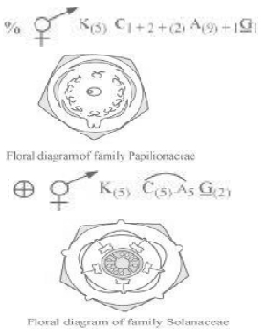
$(1)$ Family Fabaceae/Papilionaceae (pea plant)
Fabaceae/Papilionaceae is a sub-family of the Leguminoseae family.
Vegetative features:
Habit: Pinnately compound, alternately arranged with leaf tendrils with the pulvinus present at the leaf base along folacious stipules.
Root: Tap root system with root nodules.
Floral features:
Inflorescence: Racemose, generally axial than terminal
Flower: Zygomorphic and bisexual flowers are found
Calyx: It contains five sepals which are gamosepalous while aestivation is imbricate.
Corolla: It contains five petals (polypetalous) with vexillary aestivation.
Androecium: It consists of ten anthers that are diadelphous with dithecous anthers.
Gynoecium: Monocarpellary superior ovary which is unilocular with marginal placentation.
Fruit: Legume pod with non-endospermic seeds
Floral formula:
Economic importance: Peas are used as vegetables for making various culinary preparations.
$(2)$ Flowers of Solanum nigrum
Family Solanaceae
Vegetative features:
Habit: Erect, herbaceous plant
Leaves: Simple, exstipulate leaves with reticulate venation Stem:
Erect stem with numerous branches.
Floral features:
Inflorescence: Solitary and axillary
Flowers: Actinomorphic, bisexual flowers
Calyx: Calyx is composed of five sepals that are united and persistent. Aestivation is valvate.
Corolla: Corolla consists of five united petals with valvate aestivation.
Androecium: It consists of five epipetalous stamens.
Gynoecium: It consists of bicarpellary syncarpous superior ovary with axile placentation.
Fruits: Berry
Seeds: Numerous, endospermous
Floral formula:
Economic importance: Used for medicinal purposes.
0 likes
View Solution328
Easy
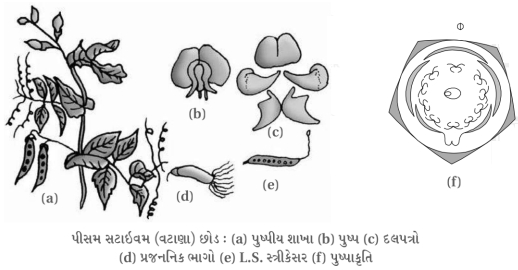
Mention the vegetative and floral characters of the Fabaceae family.
Solution
(N/A) $\rightarrow$ This family was earlier called Papilionoideae,a subfamily of the family Leguminosae.
$\rightarrow$ Vegetative Characters: Plants are trees,shrubs,or herbs; roots have root nodules.
$\rightarrow$ Stem: Erect or climber.
$\rightarrow$ Leaves: Alternate,pinnately compound or simple; leaf base is pulvinate; stipulate; venation is reticulate.
$\rightarrow$ Floral Characters:
$\rightarrow$ Inflorescence: Racemose.
$\rightarrow$ Flower: Bisexual,zygomorphic.
$\rightarrow$ Calyx: Five sepals,gamosepalous; imbricate aestivation.
$\rightarrow$ Corolla: Five petals,polypetalous,papilionaceous,consisting of a posterior standard,two lateral wings,and two anterior petals forming a keel (enclosing stamens and pistil); vexillary aestivation.
$\rightarrow$ Androecium: Ten stamens,diadelphous,anther dithecous.
$\rightarrow$ Gynoecium: Ovary superior,monocarpellary,unilocular with many ovules,single style.
$\rightarrow$ Fruit: Legume; seed: one to many,non-endospermic.
$\rightarrow$ Vegetative Characters: Plants are trees,shrubs,or herbs; roots have root nodules.
$\rightarrow$ Stem: Erect or climber.
$\rightarrow$ Leaves: Alternate,pinnately compound or simple; leaf base is pulvinate; stipulate; venation is reticulate.
$\rightarrow$ Floral Characters:
$\rightarrow$ Inflorescence: Racemose.
$\rightarrow$ Flower: Bisexual,zygomorphic.
$\rightarrow$ Calyx: Five sepals,gamosepalous; imbricate aestivation.
$\rightarrow$ Corolla: Five petals,polypetalous,papilionaceous,consisting of a posterior standard,two lateral wings,and two anterior petals forming a keel (enclosing stamens and pistil); vexillary aestivation.
$\rightarrow$ Androecium: Ten stamens,diadelphous,anther dithecous.
$\rightarrow$ Gynoecium: Ovary superior,monocarpellary,unilocular with many ovules,single style.
$\rightarrow$ Fruit: Legume; seed: one to many,non-endospermic.
0 likes
View Solution329
Easy
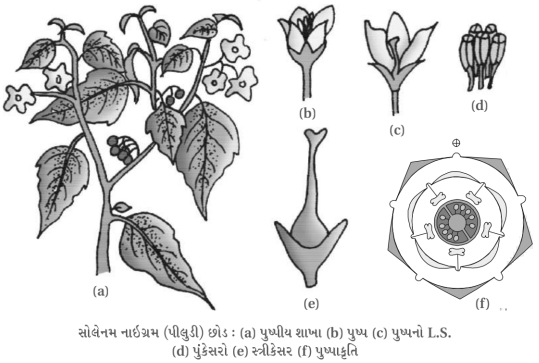
Write a note on the Solanaceae family.
Solution
(N/A) $\rightarrow$ It is a large family, commonly called as the 'potato family'.
$\rightarrow$ Vegetative Characters: Plants are mostly herbs, shrubs, and rarely small trees.
$\rightarrow$ Stem: Herbaceous, rarely woody, aerial; erect, cylindrical, branched, solid or hollow, hairy or glabrous; underground stem is found in potato ($Solanum$ $tuberosum$).
$\rightarrow$ Leaves: Alternate, simple, rarely pinnately compound, exstipulate; venation is reticulate.
Floral Characters:
$\rightarrow$ Inflorescence: Solitary, axillary, or cymose as in $Solanum$.
$\rightarrow$ Flower: Bisexual, actinomorphic.
$\rightarrow$ Calyx: Sepals five, united, persistent, valvate aestivation.
$\rightarrow$ Corolla: Petals five, united; valvate aestivation.
$\rightarrow$ Androecium: Stamens five, epipetalous.
$\rightarrow$ Gynoecium: Bicarpellary, syncarpous; ovary superior, bilocular, placenta swollen with many ovules.
$\rightarrow$ Fruits: Berry or capsule.
$\rightarrow$ Seeds: Many, endospermous.
$\rightarrow$ Vegetative Characters: Plants are mostly herbs, shrubs, and rarely small trees.
$\rightarrow$ Stem: Herbaceous, rarely woody, aerial; erect, cylindrical, branched, solid or hollow, hairy or glabrous; underground stem is found in potato ($Solanum$ $tuberosum$).
$\rightarrow$ Leaves: Alternate, simple, rarely pinnately compound, exstipulate; venation is reticulate.
Floral Characters:
$\rightarrow$ Inflorescence: Solitary, axillary, or cymose as in $Solanum$.
$\rightarrow$ Flower: Bisexual, actinomorphic.
$\rightarrow$ Calyx: Sepals five, united, persistent, valvate aestivation.
$\rightarrow$ Corolla: Petals five, united; valvate aestivation.
$\rightarrow$ Androecium: Stamens five, epipetalous.
$\rightarrow$ Gynoecium: Bicarpellary, syncarpous; ovary superior, bilocular, placenta swollen with many ovules.
$\rightarrow$ Fruits: Berry or capsule.
$\rightarrow$ Seeds: Many, endospermous.
0 likes
View Solution330
Medium
Write a note on the $Liliaceae$ family.
Solution
(A) $\rightarrow$ It is commonly called the 'Lily family'.
$\rightarrow$ Habitat: It is distributed worldwide.
$\rightarrow$ Vegetative characters: Perennial herbs with underground bulbs,corms,or rhizomes.
$\rightarrow$ Leaves: Mostly basal,alternate,linear,exstipulate with parallel venation.
$\rightarrow$ Floral characters:
$\rightarrow$ Inflorescence: Solitary or cymose; often umbellate clusters.
$\rightarrow$ Flower: Bisexual; actinomorphic.
$\rightarrow$ Perianth: Tepals six $(3+3)$,often united into a tube; valvate aestivation.
$\rightarrow$ Androecium: Stamens six $(3+3)$.
$\rightarrow$ Gynoecium: Tricarpellary,syncarpous,ovary superior,trilocular with many ovules; axile placentation.
$\rightarrow$ Fruit: Capsule,rarely berry.
$\rightarrow$ Seed: Endospermous.
$\rightarrow$ Floral Formula: $Br, \oplus, \hat{P}_{(3+3)}, A_{3+3}, G_{(3)}$
$\rightarrow$ Habitat: It is distributed worldwide.
$\rightarrow$ Vegetative characters: Perennial herbs with underground bulbs,corms,or rhizomes.
$\rightarrow$ Leaves: Mostly basal,alternate,linear,exstipulate with parallel venation.
$\rightarrow$ Floral characters:
$\rightarrow$ Inflorescence: Solitary or cymose; often umbellate clusters.
$\rightarrow$ Flower: Bisexual; actinomorphic.
$\rightarrow$ Perianth: Tepals six $(3+3)$,often united into a tube; valvate aestivation.
$\rightarrow$ Androecium: Stamens six $(3+3)$.
$\rightarrow$ Gynoecium: Tricarpellary,syncarpous,ovary superior,trilocular with many ovules; axile placentation.
$\rightarrow$ Fruit: Capsule,rarely berry.
$\rightarrow$ Seed: Endospermous.
$\rightarrow$ Floral Formula: $Br, \oplus, \hat{P}_{(3+3)}, A_{3+3}, G_{(3)}$
0 likes
View Solution331
Easy
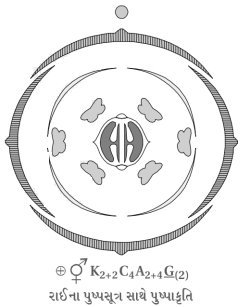
Write the floral formula of mustard and draw its floral diagram.
Solution
(N/A) The floral formula of mustard (Family: Brassicaceae) is: $\oplus \; \text{O}\mkern-11mu\nearrow \; K_{2+2} \; C_4 \; A_{2+4} \; \underline{G}_{(2)}$
Explanation of the floral formula:
$1$. $\oplus$: Actinomorphic (radial symmetry).
$2$. $\text{O}\mkern-11mu\nearrow$: Bisexual flower.
$3$. $K_{2+2}$: Calyx with $4$ sepals in two whorls of $2$ each.
$4$. $C_4$: Corolla with $4$ petals,polypetalous,arranged in a cruciform manner.
$5$. $A_{2+4}$: Androecium with $6$ stamens,tetradynamous ($2$ outer short,$4$ inner long).
$6$. $\underline{G}_{(2)}$: Gynoecium with $2$ carpels,syncarpous,ovary superior.
Explanation of the floral formula:
$1$. $\oplus$: Actinomorphic (radial symmetry).
$2$. $\text{O}\mkern-11mu\nearrow$: Bisexual flower.
$3$. $K_{2+2}$: Calyx with $4$ sepals in two whorls of $2$ each.
$4$. $C_4$: Corolla with $4$ petals,polypetalous,arranged in a cruciform manner.
$5$. $A_{2+4}$: Androecium with $6$ stamens,tetradynamous ($2$ outer short,$4$ inner long).
$6$. $\underline{G}_{(2)}$: Gynoecium with $2$ carpels,syncarpous,ovary superior.
0 likes
View Solution332
MediumMCQ
Describe the floral characteristics of the family Fabaceae.
A
Actinomorphic,bisexual,papilionaceous corolla,diadelphous stamens,monocarpellary ovary.
B
Zygomorphic,bisexual,papilionaceous corolla,diadelphous stamens,monocarpellary ovary.
C
Actinomorphic,unisexual,polypetalous,polyandrous,superior ovary.
D
Zygomorphic,bisexual,valvate aestivation,monadelphous stamens,multicarpellary ovary.
Solution
(B) The family $Fabaceae$ exhibits the following floral characteristics:
$1$. Symmetry: The flowers are $Zygomorphic$ (bilateral symmetry).
$2$. Sexuality: They are $Bisexual$.
$3$. Corolla: They possess a $Papilionaceous$ corolla consisting of one posterior standard (vexillum),two lateral wings (alae),and two anterior keel petals.
$4$. Androecium: They typically have $10$ stamens,which are $Diadelphous$ ($9+1$ arrangement).
$5$. Gynoecium: The ovary is $Monocarpellary$,unilocular with many ovules,and the style is single.
Therefore,option $B$ correctly describes these features.
$1$. Symmetry: The flowers are $Zygomorphic$ (bilateral symmetry).
$2$. Sexuality: They are $Bisexual$.
$3$. Corolla: They possess a $Papilionaceous$ corolla consisting of one posterior standard (vexillum),two lateral wings (alae),and two anterior keel petals.
$4$. Androecium: They typically have $10$ stamens,which are $Diadelphous$ ($9+1$ arrangement).
$5$. Gynoecium: The ovary is $Monocarpellary$,unilocular with many ovules,and the style is single.
Therefore,option $B$ correctly describes these features.
0 likes
View Solution333
Medium
Give the economic importance of the Fabaceae family.
Solution
(N/A) The Fabaceae family,also known as the legume family,is of significant economic importance due to the following reasons:
$1$. Pulses: Many plants in this family are major sources of protein,such as gram ($Cicer$ $arietinum$),arhar ($Cajanus$ $cajan$),sem ($Lablab$ $purpureus$),moong ($Vigna$ $radiata$),and soybean ($Glycine$ $max$).
$2$. Edible Oils: Soybean and groundnut ($Arachis$ $hypogaea$) are widely used for the extraction of edible oils.
$3$. Dye: The plant $Indigofera$ $tinctoria$ is a primary source of blue dye (indigo).
$4$. Fibers: Plants like $Crotalaria$ $juncea$ (sunn hemp) provide fibers used for making ropes and sacks.
$5$. Fodder: Species like $Sesbania$ and $Trifolium$ are used as nutritious fodder for livestock.
$6$. Ornamentals: Many species,such as $Lupinus$ and sweet pea ($Lathyrus$ $odoratus$),are grown for their aesthetic value in gardens.
$7$. Medicine: The plant $Glycyrrhiza$ $glabra$ (mulethi) is used in traditional medicine for treating coughs and sore throats.
$1$. Pulses: Many plants in this family are major sources of protein,such as gram ($Cicer$ $arietinum$),arhar ($Cajanus$ $cajan$),sem ($Lablab$ $purpureus$),moong ($Vigna$ $radiata$),and soybean ($Glycine$ $max$).
$2$. Edible Oils: Soybean and groundnut ($Arachis$ $hypogaea$) are widely used for the extraction of edible oils.
$3$. Dye: The plant $Indigofera$ $tinctoria$ is a primary source of blue dye (indigo).
$4$. Fibers: Plants like $Crotalaria$ $juncea$ (sunn hemp) provide fibers used for making ropes and sacks.
$5$. Fodder: Species like $Sesbania$ and $Trifolium$ are used as nutritious fodder for livestock.
$6$. Ornamentals: Many species,such as $Lupinus$ and sweet pea ($Lathyrus$ $odoratus$),are grown for their aesthetic value in gardens.
$7$. Medicine: The plant $Glycyrrhiza$ $glabra$ (mulethi) is used in traditional medicine for treating coughs and sore throats.
0 likes
View Solution334
Easy
Describe the floral characters of the family $Solanaceae$.
Solution
(N/A) The floral characters of the family $Solanaceae$ are as follows:
$1$. Inflorescence: Solitary,axillary,or cymose (e.g.,in $Solanum$).
$2$. Flower: Bisexual,actinomorphic.
$3$. Calyx: Sepals $5$,united (gamosepalous),valvate aestivation,persistent.
$4$. Corolla: Petals $5$,united (gamopetalous),valvate aestivation.
$5$. Androecium: Stamens $5$,epipetalous.
$6$. Gynoecium: Bicarpellary,syncarpous,ovary superior,bilocular,placenta swollen with many ovules,axile placentation.
$1$. Inflorescence: Solitary,axillary,or cymose (e.g.,in $Solanum$).
$2$. Flower: Bisexual,actinomorphic.
$3$. Calyx: Sepals $5$,united (gamosepalous),valvate aestivation,persistent.
$4$. Corolla: Petals $5$,united (gamopetalous),valvate aestivation.
$5$. Androecium: Stamens $5$,epipetalous.
$6$. Gynoecium: Bicarpellary,syncarpous,ovary superior,bilocular,placenta swollen with many ovules,axile placentation.
0 likes
View Solution335
Easy
Give the economic importance of the $Solanaceae$ family.
Solution
(N/A) The $Solanaceae$ family,also known as the potato family,holds significant economic importance:
$1$. Food: Many plants are used as food,such as $Solanum$ $tuberosum$ (potato),$Solanum$ $melongena$ (brinjal),and $Lycopersicon$ $esculentum$ (tomato).
$2$. Spices: $Capsicum$ $annuum$ (chilli) is widely used as a spice.
$3$. Medicine: Plants like $Atropa$ $belladonna$ (source of atropine) and $Withania$ $somnifera$ (ashwagandha) have medicinal properties.
$4$. Fumigatory: $Nicotiana$ $tabacum$ (tobacco) is used for smoking and chewing.
$5$. Ornamentals: $Petunia$ and $Cestrum$ $nocturnum$ (night-blooming jasmine) are grown as ornamental plants.
$1$. Food: Many plants are used as food,such as $Solanum$ $tuberosum$ (potato),$Solanum$ $melongena$ (brinjal),and $Lycopersicon$ $esculentum$ (tomato).
$2$. Spices: $Capsicum$ $annuum$ (chilli) is widely used as a spice.
$3$. Medicine: Plants like $Atropa$ $belladonna$ (source of atropine) and $Withania$ $somnifera$ (ashwagandha) have medicinal properties.
$4$. Fumigatory: $Nicotiana$ $tabacum$ (tobacco) is used for smoking and chewing.
$5$. Ornamentals: $Petunia$ and $Cestrum$ $nocturnum$ (night-blooming jasmine) are grown as ornamental plants.
0 likes
View Solution336
MediumMCQ
Describe the floral characters of the family Liliaceae.
A
Flowers are actinomorphic,bisexual,perianth present,androecium with $6$ stamens,gynoecium tricarpellary,syncarpous,superior ovary.
B
Flowers are zygomorphic,unisexual,calyx and corolla present,androecium with $5$ stamens,gynoecium monocarpellary,inferior ovary.
C
Flowers are actinomorphic,bisexual,calyx and corolla present,androecium with $10$ stamens,gynoecium monocarpellary,superior ovary.
D
Flowers are actinomorphic,bisexual,perianth present,androecium with $3$ stamens,gynoecium bicarpellary,inferior ovary.
Solution
(A) The family $Liliaceae$ is characterized by the following floral features:
$1$. Symmetry: Flowers are actinomorphic (radial symmetry).
$2$. Sexuality: Flowers are bisexual.
$3$. Perianth: The calyx and corolla are not distinct; instead,a perianth is present,usually consisting of $6$ tepals arranged in two whorls of $3$ each $(3+3)$,often united at the base.
$4$. Androecium: It consists of $6$ stamens arranged in two whorls of $3$ each $(3+3)$,which are epitepalous (attached to the tepals).
$5$. Gynoecium: It is tricarpellary (three carpels),syncarpous (fused),with a superior ovary and axile placentation.
Therefore,option $A$ correctly describes these features.
$1$. Symmetry: Flowers are actinomorphic (radial symmetry).
$2$. Sexuality: Flowers are bisexual.
$3$. Perianth: The calyx and corolla are not distinct; instead,a perianth is present,usually consisting of $6$ tepals arranged in two whorls of $3$ each $(3+3)$,often united at the base.
$4$. Androecium: It consists of $6$ stamens arranged in two whorls of $3$ each $(3+3)$,which are epitepalous (attached to the tepals).
$5$. Gynoecium: It is tricarpellary (three carpels),syncarpous (fused),with a superior ovary and axile placentation.
Therefore,option $A$ correctly describes these features.
0 likes
View Solution337
Medium
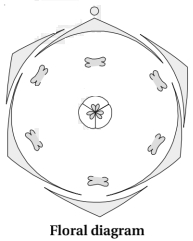
Write the floral formula of plants of the Liliaceae family and also draw a floral diagram.
Solution
(N/A) The floral formula of plants belonging to the Liliaceae family is represented as: $Br, \oplus, \text{♂}, P_{(3+3)}, A_{3+3}, G_{(3)}$.
- $Br$: Bracteate
- $\oplus$: Actinomorphic (radial symmetry)
- $\text{♂}$: Bisexual
- $P_{(3+3)}$: Perianth (tepals) in two whorls of $3$, gamotepalous (fused)
- $A_{3+3}$: Androecium (stamens) in two whorls of $3$, epiphyllous
- $G_{(3)}$: Gynoecium (ovary) tricarpellary, syncarpous, superior ovary.
The floral diagram shows the arrangement of these parts as per the formula.
- $Br$: Bracteate
- $\oplus$: Actinomorphic (radial symmetry)
- $\text{♂}$: Bisexual
- $P_{(3+3)}$: Perianth (tepals) in two whorls of $3$, gamotepalous (fused)
- $A_{3+3}$: Androecium (stamens) in two whorls of $3$, epiphyllous
- $G_{(3)}$: Gynoecium (ovary) tricarpellary, syncarpous, superior ovary.
The floral diagram shows the arrangement of these parts as per the formula.
0 likes
View Solution338
Medium
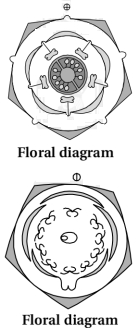
Given below are a few floral formulae of some well-known plants. Identify the families and describe the floral diagrams for these formulae.
$(i)$ $\oplus \, K_{(5)} \, C_{(5)} \, A_{5} \, \underline{G}_{(2)}$
$(ii)$ $\% \, K_{(5)} \, C_{1+2+(2)} \, A_{(9)+1} \, \underline{G}_{1}$
$(iii)$ $\oplus \, K_{5} \, C_{5} \, A_{5+5} \, \underline{G}_{(5)}$
$(i)$ $\oplus \, K_{(5)} \, C_{(5)} \, A_{5} \, \underline{G}_{(2)}$
$(ii)$ $\% \, K_{(5)} \, C_{1+2+(2)} \, A_{(9)+1} \, \underline{G}_{1}$
$(iii)$ $\oplus \, K_{5} \, C_{5} \, A_{5+5} \, \underline{G}_{(5)}$
Solution
(N/A) $(i)$ The floral formula $\oplus K_{(5)} C_{(5)} A_{5} \underline{G}_{(2)}$ represents the family $Solanaceae$. It describes an actinomorphic,bisexual flower with five fused sepals,five fused petals,five epipetalous stamens,and a superior ovary with two fused carpels.
$(ii)$ The floral formula $\% K_{(5)} C_{1+2+(2)} A_{(9)+1} \underline{G}_{1}$ represents the family $Fabaceae$. It describes a zygomorphic,bisexual flower with five fused sepals,a papilionaceous corolla (one standard,two wings,two fused keels),diadelphous stamens $(9+1)$,and a superior,monocarpellary ovary.
$(iii)$ The floral formula $\oplus K_{5} C_{5} A_{5+5} \underline{G}_{(5)}$ represents the family $Liliaceae$ (specifically sub-family or related genera). It describes an actinomorphic,bisexual flower with five free sepals,five free petals,ten stamens arranged in two whorls,and a superior ovary with five fused carpels.
$(ii)$ The floral formula $\% K_{(5)} C_{1+2+(2)} A_{(9)+1} \underline{G}_{1}$ represents the family $Fabaceae$. It describes a zygomorphic,bisexual flower with five fused sepals,a papilionaceous corolla (one standard,two wings,two fused keels),diadelphous stamens $(9+1)$,and a superior,monocarpellary ovary.
$(iii)$ The floral formula $\oplus K_{5} C_{5} A_{5+5} \underline{G}_{(5)}$ represents the family $Liliaceae$ (specifically sub-family or related genera). It describes an actinomorphic,bisexual flower with five free sepals,five free petals,ten stamens arranged in two whorls,and a superior ovary with five fused carpels.
0 likes
View Solution339
Medium
Distinguish between the families Fabaceae,Solanaceae,and Liliaceae on the basis of gynoecium characteristics. Also,write the economic importance of any one of the above families.
Solution
(N/A) The gynoecium characteristics of the three families are compared in the table below:
Economic Importance of Fabaceae:
$1$. Many plants belonging to this family are sources of pulses (e.g.,gram,arhar,sem,moong,soyabean).
$2$. It provides edible oil (e.g.,soyabean,groundnut).
$3$. It is a source of dye (e.g.,Indigofera).
$4$. Many species are used as fodder (e.g.,Sesbania,Trifolium) and as ornamentals (e.g.,Lupinus,Sweet pea).
| Gynoecium Characteristics | Fabaceae | Solanaceae | Liliaceae |
|---|---|---|---|
| Carpels | Monocarpellary,ovary unilocular | Bicarpellary,syncarpous | Tricarpellary,syncarpous |
| Ovary | Superior,unilocular | Superior,bilocular | Superior,trilocular |
| Placentation | Marginal | Axile | Axile |
| Floral Formula (Gynoecium part) | $G_{1}$ | $\underline{G}_{(2)}$ | $\underline{G}_{(3)}$ |
Economic Importance of Fabaceae:
$1$. Many plants belonging to this family are sources of pulses (e.g.,gram,arhar,sem,moong,soyabean).
$2$. It provides edible oil (e.g.,soyabean,groundnut).
$3$. It is a source of dye (e.g.,Indigofera).
$4$. Many species are used as fodder (e.g.,Sesbania,Trifolium) and as ornamentals (e.g.,Lupinus,Sweet pea).
0 likes
View Solution340
MediumMCQ
Identify the correct option for the following analogy:
$Solanaceae$ : $Axillary$ $inflorescence$ :: $Fabaceae$ : .....
$Solanaceae$ : $Axillary$ $inflorescence$ :: $Fabaceae$ : .....
A
Racemose
B
Cymose
C
Solitary
D
Hypanthodium
Solution
(A) In the family $Solanaceae$,the inflorescence is typically $solitary$ or $cymose$ with $axillary$ flowers.
In the family $Fabaceae$,the inflorescence is characteristically $racemose$ (indefinite growth).
Therefore,the correct analogy is $Fabaceae$ : $Racemose$.
In the family $Fabaceae$,the inflorescence is characteristically $racemose$ (indefinite growth).
Therefore,the correct analogy is $Fabaceae$ : $Racemose$.
0 likes
View Solution341
Medium
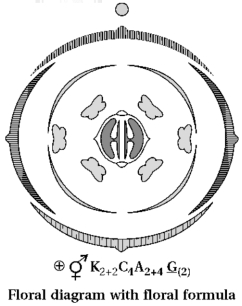
Write the floral formula of a mustard flower and provide its floral diagram.
Solution
(N/A) The mustard plant belongs to the family Brassicaceae. Its floral formula is represented as:
$\oplus \, \text{O\kern-0.4em\raisebox{0.3ex}{+}} \, K_{2+2} \, C_4 \, A_{2+4} \, \underline{G}_{(2)}$
Explanation of symbols:
- $\oplus$: Actinomorphic (radially symmetrical)
- $\text{O\kern-0.4em\raisebox{0.3ex}{+}}$: Bisexual flower
- $K_{2+2}$: Calyx with $4$ sepals in two whorls
- $C_4$: Corolla with $4$ petals
- $A_{2+4}$: Androecium with $6$ stamens in two whorls (tetradynamous)
- $\underline{G}_{(2)}$: Gynoecium with $2$ fused carpels,superior ovary
$\oplus \, \text{O\kern-0.4em\raisebox{0.3ex}{+}} \, K_{2+2} \, C_4 \, A_{2+4} \, \underline{G}_{(2)}$
Explanation of symbols:
- $\oplus$: Actinomorphic (radially symmetrical)
- $\text{O\kern-0.4em\raisebox{0.3ex}{+}}$: Bisexual flower
- $K_{2+2}$: Calyx with $4$ sepals in two whorls
- $C_4$: Corolla with $4$ petals
- $A_{2+4}$: Androecium with $6$ stamens in two whorls (tetradynamous)
- $\underline{G}_{(2)}$: Gynoecium with $2$ fused carpels,superior ovary
0 likes
View Solution342
EasyMCQ
Ray florets have
A
Half inferior ovary
B
Inferior ovary
C
Superior ovary
D
Hypogynous ovary
Solution
(B) In the family $Asteraceae$ (Compositae),the inflorescence is a capitulum or head.
Ray florets are typically pistillate (female) or neutral and zygomorphic.
The ovary in ray florets is inferior,meaning the other floral parts (sepals,petals,and stamens) are situated above the level of the ovary.
Ray florets are typically pistillate (female) or neutral and zygomorphic.
The ovary in ray florets is inferior,meaning the other floral parts (sepals,petals,and stamens) are situated above the level of the ovary.
0 likes
View Solution343
MediumMCQ
Ray florets have:
A
Inferior ovary
B
Superior ovary
C
Half-inferior ovary
D
Hypogynous ovary
Solution
(A) In the family $Asteraceae$ (Compositae),the inflorescence is a capitulum or head.
It consists of two types of florets: ray florets and disc florets.
Ray florets are typically pistillate (female) or neuter and have an inferior ovary (epigynous flower).
Therefore,the correct answer is $A$.
It consists of two types of florets: ray florets and disc florets.
Ray florets are typically pistillate (female) or neuter and have an inferior ovary (epigynous flower).
Therefore,the correct answer is $A$.
0 likes
View Solution344
EasyMCQ
Which of the following is the correct floral formula of Liliaceae?
A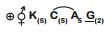
B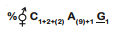
C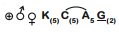
D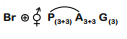
Solution
The floral formula of the family Liliaceae is represented as:
$Br \; \oplus \; \odot \; P_{(3+3)} \; A_{3+3} \; \underline{G}_{(3)}$
Here, $Br$ stands for bracteate, $\oplus$ for actinomorphic, $\odot$ for bisexual, $P_{(3+3)}$ for perianth (tepals) arranged in two whorls of three each (often fused), $A_{3+3}$ for androecium (stamens) in two whorls of three each, and $\underline{G}_{(3)}$ for gynoecium which is tricarpellary, syncarpous, and superior.
$Br \; \oplus \; \odot \; P_{(3+3)} \; A_{3+3} \; \underline{G}_{(3)}$
Here, $Br$ stands for bracteate, $\oplus$ for actinomorphic, $\odot$ for bisexual, $P_{(3+3)}$ for perianth (tepals) arranged in two whorls of three each (often fused), $A_{3+3}$ for androecium (stamens) in two whorls of three each, and $\underline{G}_{(3)}$ for gynoecium which is tricarpellary, syncarpous, and superior.
0 likes
View Solution345
MediumMCQ
$A$ plant has a butterfly-shaped flower with one standard,two wing-like,and two keel petals. To which family does this plant belong?
A
Malvaceae
B
Papilionaceae
C
Rubiaceae
D
Compositae
Solution
(B) The given plant belongs to the family $Papilionaceae$ (a subfamily of $Fabaceae$).
This family is characterized by a papilionaceous corolla,which consists of $5$ petals.
The arrangement includes one large posterior petal called the standard (or vexillum),two lateral petals called wings (or alae),and two anterior petals fused to form a boat-shaped structure called the keel (or carina).
This family is characterized by a papilionaceous corolla,which consists of $5$ petals.
The arrangement includes one large posterior petal called the standard (or vexillum),two lateral petals called wings (or alae),and two anterior petals fused to form a boat-shaped structure called the keel (or carina).
0 likes
View Solution346
EasyMCQ
Families are characterized on which of the following features of plant species?
A
External morphology
B
Anatomy of parts
C
Vegetative and reproductive parts
D
Seasonal similarities and variations
Solution
(C) family is a taxonomic category that ranks between order and genus. It consists of a group of related genera.
Families are characterized on the basis of both vegetative and reproductive features of plant species.
For example,in plants,families are often identified by their floral characteristics (reproductive parts) and vegetative traits like leaves,stems,and roots.
Families are characterized on the basis of both vegetative and reproductive features of plant species.
For example,in plants,families are often identified by their floral characteristics (reproductive parts) and vegetative traits like leaves,stems,and roots.
0 likes
View Solution347
MediumMCQ
Tetradynamous condition is found in
A
Asteraceae
B
Malvaceae
C
Papilionatae
D
Brassicaceae
Solution
(D) In the tetradynamous condition,there are $6$ stamens in total.
These are arranged in two whorls: an outer whorl with $2$ short stamens and an inner whorl with $4$ long stamens.
This specific arrangement is a characteristic feature of the family $Brassicaceae$ (formerly known as $Cruciferae$).
These are arranged in two whorls: an outer whorl with $2$ short stamens and an inner whorl with $4$ long stamens.
This specific arrangement is a characteristic feature of the family $Brassicaceae$ (formerly known as $Cruciferae$).
0 likes
View Solution348
MediumMCQ
Jowar belongs to which family?
A
Glumaceae
B
Gramineae/Poaceae
C
Asteraceae/Compositae
D
Malvaceae
Solution
(B) Jowar (Sorghum),maize,sugarcane,wheat,and rice belong to the family $Gramineae$ or $Poaceae$.
0 likes
View SolutionMorphology of Flowering Plants — Description of Some Important Families · Frequently Asked Questions
1Are these Morphology of Flowering Plants questions useful for JEE and NEET?
Yes. All questions in this section are mapped to JEE Main and NEET exam patterns. Previous year questions from JEE Main, NEET, GUJCET and state-level exams are included with full solutions.
2Can I switch to Hindi or Gujarati for these questions?
Yes. Use the language tabs in the hero section or the sidebar to view the same questions and solutions in English, Hindi or Gujarati.
3How do I generate a question paper from this subtopic?
Use the Vedclass Exam Paper Generator — select the chapter and subtopic, set difficulty, and generate Sets A, B, C, D automatically. First 3 chapters of every subject are free.
Vedclass Products
For Students
Vedclass Test Series
Mock tests in real JEE/NEET style with performance analysis. 5-day free trial.
Start Free TrialFor Teachers
Exam Paper Generator
Generate Set A/B/C/D papers from this chapter in 2 minutes. 3 chapters free.
Try FreeFor Institutes
Online Exam Module
Live online exams with unlimited students, 360° analytics & white-label branding.
See DemoFor Teachers & Institutes
Generate a Morphology of Flowering Plants Exam Paper in 2 Minutes
Select subtopic & difficulty — Sets A, B, C, D auto-generated with No Repeat logic.
First 3 chapters of every subject are free — no payment required.