
A English
Structure and function of heart Questions in English
Class 11 Biology · Body Fluids and Circulations · Structure and function of heart
410+
Questions
English
Language
100%
With Solutions
Showing 50 of 410 questions in English
301
MediumMCQ
During each cardiac cycle, prominent sounds are produced which can be easily heard through a stethoscope. They are
A
Lub
B
Dub
C
Tick
D
Both $(a)$ and $(b)$
Solution
(D) The closing of atrioventricular valves during ventricular systole produces the first heart sound, known as $Lub$.
During ventricular diastole, the semilunar valves close, which produces the second heart sound, known as $Dub$.
Both of these sounds are prominent and can be easily heard through a stethoscope.
During ventricular diastole, the semilunar valves close, which produces the second heart sound, known as $Dub$.
Both of these sounds are prominent and can be easily heard through a stethoscope.
0 likes
View Solution302
MediumMCQ
What is a pacemaker?
A
Instrument for measuring heart beat
B
Instrument for measuring pulse rate
C
$AV$ node that provides impulse for heart beat
D
Sino-atrial node that provides impulse for heart beat
Solution
(D) The contraction of the atria is initiated and activated by the sinoatrial node ($SA$ node),which is commonly known as the pacemaker.
It is located in the right atrium and generates electrical impulses at regular intervals.
These impulses spread across the walls of the atria via muscle fibres,causing them to contract and force blood into the respective ventricles.
It is located in the right atrium and generates electrical impulses at regular intervals.
These impulses spread across the walls of the atria via muscle fibres,causing them to contract and force blood into the respective ventricles.
0 likes
View Solution303
MediumMCQ
The vein that does not directly open into the heart is
A
Pre-caval
B
Post-caval
C
Pulmonary
D
Posterior mesenteric
Solution
(D) The $Pre-caval$ (superior vena cava) and $Post-caval$ (inferior vena cava) veins carry deoxygenated blood directly into the right atrium of the heart.
The $Pulmonary$ veins carry oxygenated blood directly into the left atrium of the heart.
The $Posterior$ $mesenteric$ vein collects blood from the large intestine and drains it into the hepatic portal system,which then goes to the liver,not directly into the heart.
The $Pulmonary$ veins carry oxygenated blood directly into the left atrium of the heart.
The $Posterior$ $mesenteric$ vein collects blood from the large intestine and drains it into the hepatic portal system,which then goes to the liver,not directly into the heart.
0 likes
View Solution304
EasyMCQ
Papillary muscles are found in mammalian
A
Auricles
B
Ventricles
C
Pinna
D
Eyes
Solution
(B) The papillary muscles are muscles located in the ventricles of the heart.
They attach to the atrioventricular valves (tricuspid and mitral valves) via the chordae tendineae.
During ventricular contraction,these muscles contract to prevent the inversion or prolapse of these valves into the atria,ensuring unidirectional blood flow.
They attach to the atrioventricular valves (tricuspid and mitral valves) via the chordae tendineae.
During ventricular contraction,these muscles contract to prevent the inversion or prolapse of these valves into the atria,ensuring unidirectional blood flow.
0 likes
View Solution305
MediumMCQ
Cardiac output is defined as:
A
Volume of blood pumped out by each ventricle per minute
B
Volume of blood contained in the entire heart
C
Volume of oxygenated blood pumped by the heart
D
Volume of deoxygenated blood pumped by the heart
Solution
(A) Cardiac output is defined as the volume of blood pumped out by each ventricle per minute.
It is calculated by multiplying the stroke volume (the volume of blood pumped by each ventricle per beat, approximately $70 \, mL$) by the heart rate (number of beats per minute, approximately $72$ beats per minute).
Thus, the average cardiac output is $70 \, mL \times 72 \, \text{beats/min} \approx 5040 \, mL$ or $5 \, L$ per minute.
It is calculated by multiplying the stroke volume (the volume of blood pumped by each ventricle per beat, approximately $70 \, mL$) by the heart rate (number of beats per minute, approximately $72$ beats per minute).
Thus, the average cardiac output is $70 \, mL \times 72 \, \text{beats/min} \approx 5040 \, mL$ or $5 \, L$ per minute.
0 likes
View Solution306
MediumMCQ
The pulmonary artery carries:
A
Blood from liver to lung
B
Blood from lung to heart
C
Pure blood from heart to lung
D
Impure blood from heart to lung
Solution
(D) The pulmonary artery arises from the right ventricle of the heart. It is the only artery in the adult human body that carries deoxygenated (impure) blood away from the heart to the lungs for oxygenation.
0 likes
View Solution307
EasyMCQ
'$Heart\; of\; Heart$' is
A
$SA-$node
B
$AV-$node
C
Bundle of His
D
Purkinje fibres
Solution
(A) $SA-$node (Sinoatrial node) is located in the right atrial wall near the opening of the superior vena cava.
It has the ability to generate action potentials without any external stimuli (auto-rhythmic).
It initiates each cardiac cycle and determines the basic rhythm of the heartbeat.
Due to this function of initiating and maintaining the heartbeat,it is known as the 'pacemaker' or '$Heart\; of\; Heart$'.
Therefore,the correct option is $A$.
It has the ability to generate action potentials without any external stimuli (auto-rhythmic).
It initiates each cardiac cycle and determines the basic rhythm of the heartbeat.
Due to this function of initiating and maintaining the heartbeat,it is known as the 'pacemaker' or '$Heart\; of\; Heart$'.
Therefore,the correct option is $A$.
0 likes
View Solution308
MediumMCQ
In higher vertebrates,$SA-$node helps in
A
Conduction of blood
B
Initiation of heart beat
C
Opening of tricuspid valve
D
Opening of bicuspid valve
Solution
(B) The Sinu-auricular node ($SA-$node),also known as the natural pacemaker of the heart,is located in the wall of the right atrium.
It is responsible for generating electrical impulses that initiate the heart beat and regulate the rhythm of cardiac contractions.
It is responsible for generating electrical impulses that initiate the heart beat and regulate the rhythm of cardiac contractions.
0 likes
View Solution309
EasyMCQ
The thread-like tendons of papillary muscles inserted upon the flaps of tricuspid and bicuspid valves are:
A
Chordae tendinae
B
Yellow elastin fibres
C
Reticulate fibres
D
Collagen fibres
Solution
(A) The $Chordae \text{ } tendinae$, also known as heart strings, are cord-like tendons that connect the papillary muscles to the tricuspid valve and the mitral (bicuspid) valve in the heart.
These structures play a crucial role in the cardiac cycle by preventing the valve flaps (cusps) from being everted or prolapsed into the atria during ventricular systole.
By holding the flaps in position, they ensure that blood flows in only one direction, from the atria to the ventricles.
These structures play a crucial role in the cardiac cycle by preventing the valve flaps (cusps) from being everted or prolapsed into the atria during ventricular systole.
By holding the flaps in position, they ensure that blood flows in only one direction, from the atria to the ventricles.
0 likes
View Solution310
MediumMCQ
The opening of auricles and ventricles on the right side is guarded by
A
Tricuspid valve
B
Bicuspid valve
C
Semilunar valve
D
Eustachian tube
Solution
(A) The right atrium and the right ventricle are connected by an opening guarded by the tricuspid valve.
This valve consists of three muscular flaps or cusps that prevent the backflow of blood from the right ventricle into the right atrium during ventricular systole.
This valve consists of three muscular flaps or cusps that prevent the backflow of blood from the right ventricle into the right atrium during ventricular systole.
0 likes
View Solution311
MediumMCQ
Purkinje fibres are present in
A
Brain
B
Heart
C
Blood
D
Lungs
Solution
(B) Purkinje fibres are specialized conducting muscle fibres located in the subendocardial layer of the heart ventricles. They are responsible for the rapid conduction of cardiac impulses from the atrioventricular node to the ventricular myocardium,ensuring coordinated contraction of the heart.
0 likes
View Solution312
MediumMCQ
Which arteries supply blood to the pericardium?
A
Brachial artery and Coronary artery
B
Coronary artery and Internal mammary artery
C
Carotid artery and Coronary artery
D
Internal mammary artery and Vertebral artery
Solution
(B) The pericardium is supplied by different arteries based on its layers:
$1$. The parietal pericardium is primarily supplied by the internal mammary artery (also known as the internal thoracic artery).
$2$. The visceral pericardium (epicardium) is supplied by the coronary arteries.
$1$. The parietal pericardium is primarily supplied by the internal mammary artery (also known as the internal thoracic artery).
$2$. The visceral pericardium (epicardium) is supplied by the coronary arteries.
0 likes
View Solution313
EasyMCQ
$SA-$node is located in
A
Lower lateral wall of right atrium
B
Upper lateral wall of right atrium
C
Upper lateral wall of left atrium
D
Lower lateral wall of left atrium
Solution
(B) The $SA-$node (Sinoatrial node),also known as the pacemaker of the heart,is a specialized bundle of cardiac muscle fibers located in the upper lateral wall of the right atrium,near the opening of the superior vena cava.
0 likes
View Solution314
MediumMCQ
In birds and mammals,the oxygenated blood is received by ...$A$... and deoxygenated blood is received by ...$B$.... The ventricles pump it out without any mixing of oxygenated and deoxygenated blood. Choose the correct option for $A$ and $B$.
A
$A-$ left atrium,$B-$ right atrium
B
$A-$ right atrium,$B-$ left atrium
C
$A-$ right ventricle,$B-$ left ventricle
D
$A-$ left ventricle,$B-$ right ventricle
Solution
(A) In birds and mammals,the heart is four-chambered.
Oxygenated blood from the lungs enters the left atrium through the pulmonary veins.
Deoxygenated blood from the body enters the right atrium through the vena cava.
Therefore,$A$ represents the left atrium and $B$ represents the right atrium.
This separation ensures that there is no mixing of oxygenated and deoxygenated blood.
Oxygenated blood from the lungs enters the left atrium through the pulmonary veins.
Deoxygenated blood from the body enters the right atrium through the vena cava.
Therefore,$A$ represents the left atrium and $B$ represents the right atrium.
This separation ensures that there is no mixing of oxygenated and deoxygenated blood.
0 likes
View Solution315
MediumMCQ
The valves in the heart allow the blood flow in which direction?
$I.$ From atria to ventricles
$II.$ From ventricles to pulmonary artery
$III.$ From pulmonary artery to aorta
Choose the correct option.
$I.$ From atria to ventricles
$II.$ From ventricles to pulmonary artery
$III.$ From pulmonary artery to aorta
Choose the correct option.
A
$I$ and $II$
B
$II$ and $III$
C
$III$ and $I$
D
All of these
Solution
(A) The heart contains valves that ensure unidirectional blood flow and prevent backflow.
$I.$ Atrioventricular valves (Tricuspid and Bicuspid) allow blood to flow from the atria to the ventricles.
$II.$ Semilunar valves (Pulmonary and Aortic) allow blood to flow from the ventricles into the pulmonary artery and aorta,respectively.
$III.$ There is no valve between the pulmonary artery and the aorta; blood does not flow between them directly.
Therefore,statements $I$ and $II$ are correct,while statement $III$ is incorrect. The correct option is $A$.
$I.$ Atrioventricular valves (Tricuspid and Bicuspid) allow blood to flow from the atria to the ventricles.
$II.$ Semilunar valves (Pulmonary and Aortic) allow blood to flow from the ventricles into the pulmonary artery and aorta,respectively.
$III.$ There is no valve between the pulmonary artery and the aorta; blood does not flow between them directly.
Therefore,statements $I$ and $II$ are correct,while statement $III$ is incorrect. The correct option is $A$.
0 likes
View Solution316
MediumMCQ
All vertebrates possess a ...$A$.... Fishes have a ...$B$... chambered heart with atrium and ventricles. Amphibians and reptiles have a ...$C$... chambered heart. Birds and mammals have ...$D$... chambered heart.
Choose the correct option.
Choose the correct option.
A
$A-$ muscular chambered heart,$B- 3, C- 2, D- 4$
B
$A-$ muscular chambered heart,$B- 2, C- 3, D- 4$
C
$A-$ muscular chambered heart,$B- 4, C- 3, D- 2$
D
$A-$ muscular chambered heart,$B- 3, C- 4, D- 2$
Solution
(B) All vertebrates possess a muscular chambered heart $(A)$.
Fishes have a $2$-chambered heart consisting of one atrium and one ventricle $(B=2)$.
Amphibians and most reptiles have a $3$-chambered heart consisting of two atria and one ventricle $(C=3)$.
Birds and mammals have a $4$-chambered heart consisting of two atria and two ventricles $(D=4)$.
Therefore,the correct sequence is $A-$ muscular chambered heart,$B- 2, C- 3, D- 4$.
Fishes have a $2$-chambered heart consisting of one atrium and one ventricle $(B=2)$.
Amphibians and most reptiles have a $3$-chambered heart consisting of two atria and one ventricle $(C=3)$.
Birds and mammals have a $4$-chambered heart consisting of two atria and two ventricles $(D=4)$.
Therefore,the correct sequence is $A-$ muscular chambered heart,$B- 2, C- 3, D- 4$.
0 likes
View Solution317
EasyMCQ
Heart sound '$dup$' is caused due to the closing of:
A
Valve
B
Tricuspid valve
C
Semilunar valve
D
None of the above
Solution
(C) The heart sound '$dup$' (the second heart sound) is produced due to the closure of the semilunar valves at the end of ventricular systole.
0 likes
View Solution318
MediumMCQ
Chordae tendinae are found in
A
Atria of heart
B
Ventricles of heart
C
Joints of legs
D
Joints of hands
Solution
(B) Chordae tendinae are fibrous,string-like structures present in the heart.
They connect the cusps of the atrioventricular valves (tricuspid and bicuspid valves) to the papillary muscles located on the walls of the ventricles.
Their primary function is to prevent the valves from prolapsing or being forced back into the atria during ventricular contraction (systole).
Therefore,they are found in the ventricles of the heart.
They connect the cusps of the atrioventricular valves (tricuspid and bicuspid valves) to the papillary muscles located on the walls of the ventricles.
Their primary function is to prevent the valves from prolapsing or being forced back into the atria during ventricular contraction (systole).
Therefore,they are found in the ventricles of the heart.
0 likes
View Solution319
EasyMCQ
Purkinje fibres are present in
A
Left auricle
B
Right auricle
C
Ventricle myocardium
D
$SAN$
Solution
(C) Purkinje fibres are specialized conducting muscle fibres located in the subendocardial layer of the ventricular myocardium. They are responsible for the rapid transmission of electrical impulses throughout the ventricles,ensuring coordinated and efficient ventricular contraction.
0 likes
View Solution320
MediumMCQ
Bicuspid and tricuspid valves open when:
A
Blood flows from the right ventricle and left ventricle into the pulmonary artery and aorta,respectively.
B
Blood flows from the pulmonary vein and vena cava into the left and right atria,respectively.
C
Blood flows from the right and left atria into the right and left ventricles,respectively.
D
None of these.
Solution
(C) The bicuspid (mitral) and tricuspid valves are atrioventricular valves. These valves open when the pressure in the atria exceeds the pressure in the ventricles,allowing blood to flow from the right and left atria into the right and left ventricles,respectively. Once the ventricles begin to contract,the pressure inside them rises,causing these valves to close to prevent the backflow of blood into the atria.
0 likes
View Solution321
EasyMCQ
Foramen ovale
A
Connects the two atria in the foetal heart
B
Is a condition in which the heart valves do not completely close
C
Is a shallow depression in the interventricular septum
D
Is a connection between the pulmonary trunk and the aorta in the foetus
Solution
(A) Foramen ovale is an opening in the interatrial septum of the foetal heart through which both the atria communicate with each other.
In adults,this aperture is closed and represented by a small oval depression called fossa ovalis.
In adults,this aperture is closed and represented by a small oval depression called fossa ovalis.
0 likes
View Solution322
MediumMCQ
Which nodal fibres lie along the right and left ventricles (interventricular septum)?
A
Bundle of His
B
Purkinje fibre
C
Neural tissue fibre
D
Cardiac tissue fibre
Solution
(A) The automatic rhythmicity of the heart is the ability to contract spontaneously. The mammalian heart is myogenic,meaning the heartbeat results from a wave of electrical potential called a cardiac impulse,which arises from the sinoatrial node ($SA$ node) and spreads over the cardiac chambers.
The $SA$ node lies in the wall of the right atrium near the opening of the superior vena cava and contracts about $72$ times per minute. From the $SA$ node,the cardiac impulse travels to the atrioventricular node ($AV$ node),which lies between the right atrium and the ventricle.
Then,the impulse passes to the $AV$ bundle (also called the Bundle of His). The branches of the $AV$ bundle extend along the interventricular septum and reach the Purkinje fibres in the ventricles.
The Bundle of His provides the only route for the transmission of the wave of excitation from the atria to the ventricles. Purkinje fibres conduct the impulses five times more rapidly than the surrounding cells,forming a pathway that ensures the heart muscle contracts in the most efficient manner.
The $SA$ node lies in the wall of the right atrium near the opening of the superior vena cava and contracts about $72$ times per minute. From the $SA$ node,the cardiac impulse travels to the atrioventricular node ($AV$ node),which lies between the right atrium and the ventricle.
Then,the impulse passes to the $AV$ bundle (also called the Bundle of His). The branches of the $AV$ bundle extend along the interventricular septum and reach the Purkinje fibres in the ventricles.
The Bundle of His provides the only route for the transmission of the wave of excitation from the atria to the ventricles. Purkinje fibres conduct the impulses five times more rapidly than the surrounding cells,forming a pathway that ensures the heart muscle contracts in the most efficient manner.
0 likes
View Solution323
EasyMCQ
The $Bundle$ $of$ $His$ are:
A
Nervous tissue supplied to ventricles
B
Nervous tissue supplied to heart
C
Muscular tissue supplied to ventricles
D
Muscular tissue supplied to heart
Solution
(C) The $Bundle$ $of$ $His$ (also known as the atrioventricular bundle) is a specialized collection of modified cardiac muscle fibers.
These fibers are responsible for conducting electrical impulses from the atrioventricular node ($AV$ node) to the ventricles of the heart.
Therefore,it is a specialized muscular tissue that is supplied to the ventricles to facilitate coordinated contraction.
These fibers are responsible for conducting electrical impulses from the atrioventricular node ($AV$ node) to the ventricles of the heart.
Therefore,it is a specialized muscular tissue that is supplied to the ventricles to facilitate coordinated contraction.
0 likes
View Solution324
MediumMCQ
Chordae tendinae
A
Are present close to $AV$ valves
B
Open semilunar valves
C
Prevent the $AV$ valves flaps from everting
D
Are present in auricle
Solution
(C) The $AV$ valves (bicuspid and tricuspid) are connected to the ventricular walls by fibrous cords known as chordae tendinae.
These structures prevent the valve flaps from everting (turning inside out) into the atria during ventricular systole when pressure in the ventricles increases significantly.
These structures prevent the valve flaps from everting (turning inside out) into the atria during ventricular systole when pressure in the ventricles increases significantly.
0 likes
View Solution325
MediumMCQ
During ventricular systole,
A
Oxygenated blood is pumped into the pulmonary artery and deoxygenated blood is pumped into the aorta.
B
Oxygenated blood is pumped into the aorta and deoxygenated blood is pumped into the pulmonary vein.
C
Oxygenated blood is pumped into the pulmonary vein and deoxygenated blood is pumped into the pulmonary artery.
D
Oxygenated blood is pumped into the aorta and deoxygenated blood is pumped into the pulmonary artery.
Solution
(D) During ventricular systole,the ventricles contract,which increases the pressure within them. This pressure forces the semilunar valves to open. As a result,oxygenated blood from the left ventricle is pumped into the aorta for systemic circulation,and deoxygenated blood from the right ventricle is pumped into the pulmonary artery for pulmonary circulation.
0 likes
View Solution326
MediumMCQ
The 'Bundle of His' is a muscular tissue found between:
A
Ventricles
B
Interatrial groove
C
Atrium
D
Atrioventricular septum
Solution
(D) The 'Bundle of His' (also known as the atrioventricular bundle) is a collection of specialized cardiac muscle fibers that conduct electrical impulses from the atrioventricular node to the ventricles. It is located within the atrioventricular septum,which is the muscular wall separating the right and left ventricles.
0 likes
View Solution327
EasyMCQ
To which of the following,bundle of His passes stimulus of contraction?
A
$AV-$node
B
$SA-$node
C
Purkinje fibre
D
Atrium
Solution
(C) The cardiac impulse originates at the $SA-$node and travels to the $AV-$node. From the $AV-$node,the impulse is conducted to the bundle of His. The bundle of His then transmits the stimulus of contraction to the Purkinje fibres,which distribute the impulse throughout the ventricular musculature to initiate contraction.
0 likes
View Solution328
MediumMCQ
$SA$ node (Sinoatrial node) ke baare mein sahi kathan chuniye:
$I$. Located at the right upper corner of the right atrium.
$II$. Heart of heart.
$III$. It initiates the rhythmic contractile activity of the heart.
$IV$. It is called the pace-keeper of the heart.
$V$. It is called the pacemaker of the heart.
Which of the following options contains the correct statements?
$I$. Located at the right upper corner of the right atrium.
$II$. Heart of heart.
$III$. It initiates the rhythmic contractile activity of the heart.
$IV$. It is called the pace-keeper of the heart.
$V$. It is called the pacemaker of the heart.
Which of the following options contains the correct statements?
A
All except $III$
B
All except $IV$
C
All except $V$
D
All except $II$
Solution
(B) $I$. The $SA$ node is located at the right upper corner of the right atrium,not the lateral wall. Thus,statement $I$ is incorrect.
$II$. The $SA$ node is often referred to as the 'heart of heart' because it controls the rhythm. Statement $II$ is correct.
$III$. It initiates the rhythmic contractile activity of the heart. Statement $III$ is correct.
$IV$. The term 'pace-keeper' is not standard terminology for the $SA$ node. Statement $IV$ is incorrect.
$V$. The $SA$ node is correctly called the 'pacemaker' of the heart. Statement $V$ is correct.
Since statements $I$ and $IV$ are incorrect,the correct option is $B$ (All except $IV$).
$II$. The $SA$ node is often referred to as the 'heart of heart' because it controls the rhythm. Statement $II$ is correct.
$III$. It initiates the rhythmic contractile activity of the heart. Statement $III$ is correct.
$IV$. The term 'pace-keeper' is not standard terminology for the $SA$ node. Statement $IV$ is incorrect.
$V$. The $SA$ node is correctly called the 'pacemaker' of the heart. Statement $V$ is correct.
Since statements $I$ and $IV$ are incorrect,the correct option is $B$ (All except $IV$).
0 likes
View Solution329
MediumMCQ
$A$ heart murmur indicates a defective
A
Bundle of His
B
Heart valves
C
Sino-atrial node
D
Atrio-ventricular node
Solution
(B) heart murmur is an abnormal sound produced by turbulent blood flow within the heart. This turbulence is most commonly caused by defective or damaged heart valves,such as stenosis (narrowing) or regurgitation (leaking),which prevent the valves from closing or opening properly.
0 likes
View Solution330
MediumMCQ
When the balloon of an intra-aortic balloon pump $(IABP)$ inflates,more blood is carried to:
A
Coronary artery
B
Pulmonary trunk
C
Hepatic portal
D
Pulmonary arteries
Solution
(A) An intra-aortic balloon pump $(IABP)$ is a mechanical device that helps the heart pump blood. When the balloon inflates during diastole,it increases the pressure in the aorta. This increased pressure forces more blood into the coronary arteries,which supply the heart muscle with oxygenated blood,thereby improving myocardial perfusion.
0 likes
View Solution331
MediumMCQ
Identify the correct statement.
$I$. The impulse of the heart beat originates from $SAN$.
$II$. Rate of the heart is determined by $SAN$.
$III$. Bundle of His/$AV$ bundle is present in the interventricular septum.
$IV$. Atrio Ventricular Node $(AVN)$ is situated in the lower left corner of the right auricle.
Choose the correct option.
$I$. The impulse of the heart beat originates from $SAN$.
$II$. Rate of the heart is determined by $SAN$.
$III$. Bundle of His/$AV$ bundle is present in the interventricular septum.
$IV$. Atrio Ventricular Node $(AVN)$ is situated in the lower left corner of the right auricle.
Choose the correct option.
A
$II$
B
$I, II$
C
$I, II, III$
D
All of these
Solution
(C) Statement $I$ is correct: The cardiac impulse originates from the Sino-Atrial Node $(SAN)$,which acts as the natural pacemaker.
Statement $II$ is correct: The $SAN$ determines the heart rate as it initiates the rhythm of contraction.
Statement $III$ is incorrect: The Bundle of His is located in the interventricular septum,but the statement provided in the original context often implies a distinction regarding the specific location or structure. However,in standard biology,the Bundle of His is indeed in the interventricular septum. Re-evaluating the options: $I, II, III$ are all anatomically correct. $IV$ is incorrect because the $AVN$ is situated in the lower left corner of the right atrium (auricle) close to the atrio-ventricular septum,not the lower left corner of the right auricle in the way described. Given the standard options,$I, II, III$ are the correct statements.
Statement $II$ is correct: The $SAN$ determines the heart rate as it initiates the rhythm of contraction.
Statement $III$ is incorrect: The Bundle of His is located in the interventricular septum,but the statement provided in the original context often implies a distinction regarding the specific location or structure. However,in standard biology,the Bundle of His is indeed in the interventricular septum. Re-evaluating the options: $I, II, III$ are all anatomically correct. $IV$ is incorrect because the $AVN$ is situated in the lower left corner of the right atrium (auricle) close to the atrio-ventricular septum,not the lower left corner of the right auricle in the way described. Given the standard options,$I, II, III$ are the correct statements.
0 likes
View Solution332
MediumMCQ
$SAN$ generates an action potential which stimulates both the $A$ to undergo a simultaneous contraction called $B$. This increases the flow of the blood into the ventricles by about $C$ percentage. Choose the correct option for $A, B$ and $C$.
A
$A-$atria,$B-$atrial systole,$C-30$
B
$A-$ventricle,$B-$atrial systole,$C-30$
C
$A-$atria,$B-$ventricular diastole,$C-30$
D
$A-$atria,$B-$atrial diastole,$C-30$
Solution
(A) $SAN$ (Sinoatrial node) generates an action potential that stimulates both the atria $(A)$ to undergo a simultaneous contraction known as atrial systole $(B)$. This contraction increases the flow of blood into the ventricles by approximately $30$ percent $(C)$.
$1$. The heart is myogenic,meaning the heartbeat originates from an electrical impulse generated by the $SA$ node.
$2$. The $SA$ node is located in the wall of the right atrium and acts as the pacemaker,firing at about $72$ times per minute.
$3$. The impulse spreads across the atria,causing them to contract (atrial systole),which pushes blood into the ventricles.
$4$. This atrial contraction contributes an additional $30\%$ of blood volume to the ventricles beyond what flows passively.
$1$. The heart is myogenic,meaning the heartbeat originates from an electrical impulse generated by the $SA$ node.
$2$. The $SA$ node is located in the wall of the right atrium and acts as the pacemaker,firing at about $72$ times per minute.
$3$. The impulse spreads across the atria,causing them to contract (atrial systole),which pushes blood into the ventricles.
$4$. This atrial contraction contributes an additional $30\%$ of blood volume to the ventricles beyond what flows passively.
0 likes
View Solution333
MediumMCQ
The sequence of electrical impulse conduction in a heartbeat is:
A
$AV$ node $\rightarrow$ Pacemaker $\rightarrow$ Auricles $\rightarrow$ Ventricles
B
Ventricle $\rightarrow$ Pacemaker $\rightarrow$ $AV$ node $\rightarrow$ Auricle
C
Pacemaker $\rightarrow$ Atria $\rightarrow$ $AV$ node $\rightarrow$ Ventricle
D
Pacemaker $\rightarrow$ $AV$ node $\rightarrow$ Atria $\rightarrow$ Ventricle
Solution
(C) The sequence of electrical impulse conduction in the human heart is as follows:
$1$. Sinoatrial node ($SA$ node),also known as the Pacemaker of the heart.
$2$. Atrioventricular node ($AV$ node).
$3$. Bundle of His.
$4$. Purkinje fibers.
$5$. Ventricular myocardium.
Therefore,the impulse travels from the Pacemaker ($SA$ node) to the atria,then to the $AV$ node,and finally to the ventricles via the Bundle of His and Purkinje fibers. Thus,the correct sequence is Pacemaker $\rightarrow$ Atria $\rightarrow$ $AV$ node $\rightarrow$ Ventricle.
$1$. Sinoatrial node ($SA$ node),also known as the Pacemaker of the heart.
$2$. Atrioventricular node ($AV$ node).
$3$. Bundle of His.
$4$. Purkinje fibers.
$5$. Ventricular myocardium.
Therefore,the impulse travels from the Pacemaker ($SA$ node) to the atria,then to the $AV$ node,and finally to the ventricles via the Bundle of His and Purkinje fibers. Thus,the correct sequence is Pacemaker $\rightarrow$ Atria $\rightarrow$ $AV$ node $\rightarrow$ Ventricle.
0 likes
View Solution334
MediumMCQ
The blood pumped by the $A$ ventricle enters the $B$ artery,whereas the $C$ ventricle pumps blood into the $D$. Choose the correct option for $A, B, C$ and $D$.
A
$A-$right,$B-$pulmonary,$C-$left,$D-$aorta
B
$A-$left,$B-$pulmonary,$C-$right,$D-$aorta
C
$A-$left,$B-$pulmonary,$C-$right,$D-$vena cava
D
$A-$right,$B-$pulmonary,$C-$left,$D-$vena cava
Solution
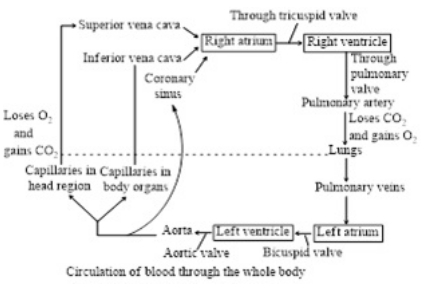
(A) The correct option is $A$.
$1$. The right ventricle pumps deoxygenated blood into the pulmonary artery,which carries it to the lungs for oxygenation.
$2$. The left ventricle pumps oxygenated blood into the aorta,which distributes it to the entire body.
$3$. Therefore,$A$ is right,$B$ is pulmonary,$C$ is left,and $D$ is aorta.
$1$. The right ventricle pumps deoxygenated blood into the pulmonary artery,which carries it to the lungs for oxygenation.
$2$. The left ventricle pumps oxygenated blood into the aorta,which distributes it to the entire body.
$3$. Therefore,$A$ is right,$B$ is pulmonary,$C$ is left,and $D$ is aorta.
0 likes
View Solution335
MediumMCQ
Which one of the following is a matching pair?
A
Lubb - Sharp closure of $AV$ valves at the beginning of ventricular systole
B
Dup - Sudden opening of semilunar valves at the beginning of ventricular diastole
C
Pulsation of the valves in the blood vessels - radial artery
D
Initiation of the heart beat - Purkinje fibres
Solution
(A) The first heart sound is 'lubb',which is a long and booming sound created by the closure of the atrioventricular $(AV)$ valves (tricuspid and bicuspid) at the beginning of ventricular systole.
The second heart sound is 'dup',which is a short and sharp sound produced by the closure of the semilunar valves at the beginning of ventricular diastole.
Therefore,option $A$ is the correct matching pair.
The second heart sound is 'dup',which is a short and sharp sound produced by the closure of the semilunar valves at the beginning of ventricular diastole.
Therefore,option $A$ is the correct matching pair.
0 likes
View Solution336
EasyMCQ
The human heart is derived from which germ layer?
A
Ectoderm
B
Mesoderm
C
Endoderm
D
Both $(a)$ and $(c)$
Solution
(B) The human heart is a muscular organ. In embryonic development,the heart develops from the lateral plate mesoderm. Since the heart is primarily composed of cardiac muscle tissue and connective tissue,and all muscle tissues (except for the ciliary muscles of the eye and iris muscles) are derived from the mesoderm,the correct answer is mesoderm.
0 likes
View Solution337
MediumMCQ
Oxygenated blood from the left ventricle enters into
A
Pulmonary artery
B
Aorta
C
Superior vena cava
D
Pulmonary trunk
Solution
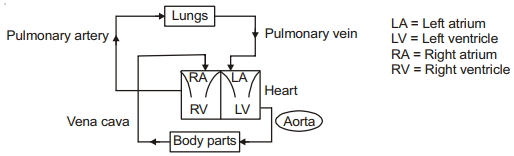
(B) The left ventricle $(LV)$ of the human heart receives oxygenated blood from the left atrium $(LA)$.
During ventricular systole,the left ventricle contracts,pumping this oxygenated blood into the aorta.
The aorta is the largest artery in the body,which then distributes the oxygenated blood to all parts of the body.
Therefore,oxygenated blood from the left ventricle enters into the aorta.
During ventricular systole,the left ventricle contracts,pumping this oxygenated blood into the aorta.
The aorta is the largest artery in the body,which then distributes the oxygenated blood to all parts of the body.
Therefore,oxygenated blood from the left ventricle enters into the aorta.
0 likes
View Solution338
EasyMCQ
Contraction of the right ventricle pumps blood into:
A
Pulmonary vein
B
Pulmonary artery
C
Coronary sinus
D
Coronary artery
Solution
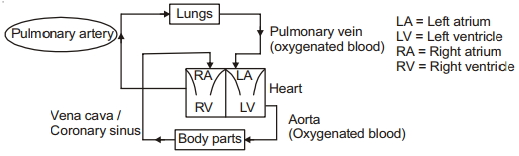
(B) The human heart consists of four chambers: the right atrium,right ventricle,left atrium,and left ventricle.
Deoxygenated blood from the body enters the right atrium and then flows into the right ventricle.
When the right ventricle contracts,it pumps this deoxygenated blood into the pulmonary artery,which carries it to the lungs for oxygenation.
Therefore,the correct option is $B$.
Deoxygenated blood from the body enters the right atrium and then flows into the right ventricle.
When the right ventricle contracts,it pumps this deoxygenated blood into the pulmonary artery,which carries it to the lungs for oxygenation.
Therefore,the correct option is $B$.
0 likes
View Solution339
EasyMCQ
Systemic circulation of oxygenated blood starts from
A
Right atrium
B
Left atrium
C
Left ventricle
D
Right ventricle
Solution
(C) Systemic circulation involves the transport of oxygenated blood from the left ventricle to all parts of the body and the return of deoxygenated blood to the right atrium.
Pulmonary circulation involves the flow of deoxygenated blood from the right ventricle to the lungs and the return of oxygenated blood to the left atrium.
Therefore,systemic circulation of oxygenated blood starts from the left ventricle.
Pulmonary circulation involves the flow of deoxygenated blood from the right ventricle to the lungs and the return of oxygenated blood to the left atrium.
Therefore,systemic circulation of oxygenated blood starts from the left ventricle.
0 likes
View Solution340
EasyMCQ
Coronary sinus carries . . . . . . to the right atrium.
A
Interstitial fluid
B
Deoxygenated blood
C
Lymph
D
Oxygenated blood
Solution
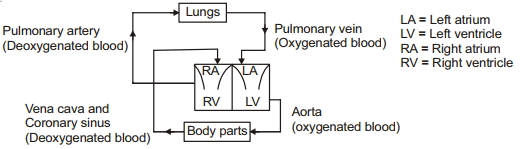
(B) The coronary sinus is a collection of veins joined together to form a large vessel that collects blood from the heart muscle (myocardium).
It delivers deoxygenated blood directly into the right atrium of the heart.
As shown in the diagram,both the vena cava and the coronary sinus carry deoxygenated blood to the right atrium $(RA)$.
It delivers deoxygenated blood directly into the right atrium of the heart.
As shown in the diagram,both the vena cava and the coronary sinus carry deoxygenated blood to the right atrium $(RA)$.
0 likes
View Solution341
MediumMCQ
$A$ patch of nodal tissue responsible for initiating the rhythmic contractile activity of the heart is present in:
A
Lower left corner of the left ventricle
B
Upper right corner of the right atrium
C
Lower left corner of the right ventricle
D
Upper left corner of the left atrium
Solution
(B) The patch of nodal tissue responsible for initiating the rhythmic contractile activity of the heart is the $SAN$ (Sino-Atrial Node).
It is located in the upper right corner of the right atrium.
It is located in the upper right corner of the right atrium.
0 likes
View Solution342
MediumMCQ
$A$ heart murmur occurs due to a defect in:
A
Heart valves
B
$SA$ node
C
Bundle of $His$
D
Purkinje fibres
Solution
(A) In the case of defective or damaged heart valves,their improper closure leads to the backflow or leakage of blood,which produces an abnormal sound referred to as a heart murmur.
0 likes
View Solution343
MediumMCQ
The two auricles are demarcated externally from the ventricles by an irregular groove called:
A
Inter-auricular septum
B
Inter-ventricular septum
C
Coronary sulcus
D
Inter-ventricular groove
Solution
(C) The coronary sulcus (also known as the atrioventricular groove) is an irregular groove that runs externally around the heart,separating the atria (auricles) from the ventricles.
0 likes
View Solution344
MediumMCQ
The opening of the pulmonary vein is without a valve because
A
It is a very small aperture
B
It has low blood pressure
C
Its opening is oblique
D
None of these
Solution
(C) Veins generally contain valves to prevent the backward flow of blood. However,the pulmonary vein is an exception as it lacks valves. This is because the opening of the pulmonary vein into the left atrium is oblique,which naturally prevents the backflow of blood when the atrium contracts.
0 likes
View Solution345
EasyMCQ
Chordae tendinae in the heart are found in
A
Ventricle
B
Left auricle
C
Right auricle
D
Interventricular septum
Solution
(A) Chordae tendinae are special fibrous cords that are attached to the flaps of the bicuspid and tricuspid valves at one end,while their other ends are attached to the ventricular wall via special muscles known as papillary muscles. Therefore,they are located within the ventricles.
0 likes
View Solution346
MediumMCQ
$A$: The cardiac impulse which originates from $SA$ node in mammalian heart cannot spread directly from atria to ventricles.
$R$: In mammalian heart there is no continuity between cardiac muscle fibres of atria and those of ventricles except $AV$ bundles.
$R$: In mammalian heart there is no continuity between cardiac muscle fibres of atria and those of ventricles except $AV$ bundles.
A
Assertion and Reason both are correct and Reason is the correct explanation of Assertion.
B
Assertion and Reason both are correct but Reason is not the correct explanation of Assertion.
C
Assertion is correct,but Reason is incorrect.
D
Both Assertion and Reason are incorrect.
Solution
(A) The $SA$ node (Sinoatrial node) acts as the pacemaker of the heart,initiating the electrical impulse.
This impulse spreads through the atria,causing atrial contraction.
However,there is a fibrous connective tissue layer (the fibrous skeleton of the heart) that acts as an electrical insulator between the atria and the ventricles.
Because of this,the impulse cannot spread directly from the atrial muscle to the ventricular muscle.
The only electrical connection between the atria and the ventricles is the $AV$ bundle (Bundle of His),which conducts the impulse to the ventricles.
Therefore,both the Assertion and the Reason are correct,and the Reason correctly explains why the impulse cannot spread directly.
This impulse spreads through the atria,causing atrial contraction.
However,there is a fibrous connective tissue layer (the fibrous skeleton of the heart) that acts as an electrical insulator between the atria and the ventricles.
Because of this,the impulse cannot spread directly from the atrial muscle to the ventricular muscle.
The only electrical connection between the atria and the ventricles is the $AV$ bundle (Bundle of His),which conducts the impulse to the ventricles.
Therefore,both the Assertion and the Reason are correct,and the Reason correctly explains why the impulse cannot spread directly.
0 likes
View Solution347
MediumMCQ
$A$ : The first phase of ventricular filling is rapid and causes the $3^{rd}$ heart sound.
$R$ : It is because of auricular systole.
$R$ : It is because of auricular systole.
A
Assertion and Reason both are correct and Reason is the correct explanation of Assertion.
B
Assertion and Reason both are correct but Reason is not the correct explanation of Assertion.
C
Assertion is correct,but Reason is incorrect.
D
Both Assertion and Reason are incorrect.
Solution
(C) The first phase of ventricular filling is rapid due to the opening of the $AV$ (atrioventricular) valves,which allows blood to flow passively from the atria into the ventricles. This rapid inflow causes the $3^{rd}$ heart sound. Auricular systole (atrial contraction) occurs later and contributes to the final phase of ventricular filling,not the rapid initial phase. Therefore,the Assertion is correct,but the Reason is incorrect.
0 likes
View Solution348
MediumMCQ
$A$ : Left ventricle pumps blood at a much higher pressure to all body parts involved in systemic circulation.
$R$ : The muscular wall of the left ventricle is two to four times as thick as the wall of the right ventricle.
$R$ : The muscular wall of the left ventricle is two to four times as thick as the wall of the right ventricle.
A
Assertion and Reason both are correct and Reason is the correct explanation of Assertion.
B
Assertion and Reason both are correct but Reason is not the correct explanation of Assertion.
C
Assertion is correct,but Reason is incorrect.
D
Both Assertion and Reason are incorrect.
Solution
(A) The left ventricle is responsible for pumping oxygenated blood to the entire body through the systemic circulation. To overcome the high resistance of the systemic circuit,it must generate significantly higher pressure compared to the right ventricle,which only pumps blood to the lungs (pulmonary circulation).
Consequently,the muscular wall of the left ventricle is structurally adapted to be $2$ to $4$ times thicker than that of the right ventricle to withstand and generate this high pressure.
Therefore,both the Assertion and the Reason are correct,and the Reason is the correct explanation for the Assertion.
Consequently,the muscular wall of the left ventricle is structurally adapted to be $2$ to $4$ times thicker than that of the right ventricle to withstand and generate this high pressure.
Therefore,both the Assertion and the Reason are correct,and the Reason is the correct explanation for the Assertion.
0 likes
View Solution349
MediumMCQ
$A$: Endocardium provides a smooth lining for the inside of the heart and covers the valves of the heart.
$R$: Endocardium is continuous with the endothelial lining of the large blood vessels associated with the heart and the rest of the cardiovascular system.
$R$: Endocardium is continuous with the endothelial lining of the large blood vessels associated with the heart and the rest of the cardiovascular system.
A
Assertion and Reason both are correct and Reason is the correct explanation of Assertion.
B
Assertion and Reason both are correct but Reason is not the correct explanation of Assertion.
C
Assertion is correct,but Reason is incorrect.
D
Both Assertion and Reason are incorrect.
Solution
(A) The endocardium is the innermost layer of the heart wall,which provides a smooth,frictionless surface for blood flow and covers the heart valves.
It is continuous with the endothelium,which is the inner lining of the blood vessels throughout the entire cardiovascular system.
Therefore,both the Assertion and the Reason are correct,and the Reason provides the correct explanation for why the endocardium functions as a smooth lining.
It is continuous with the endothelium,which is the inner lining of the blood vessels throughout the entire cardiovascular system.
Therefore,both the Assertion and the Reason are correct,and the Reason provides the correct explanation for why the endocardium functions as a smooth lining.
0 likes
View Solution350
MediumMCQ
. . . . . . circulates blood to different parts of the body.
A
Peristaltic movement of oesophagus
B
Pumping of heart
C
Peristaltic movement of intestine
D
Ciliary movement of oviduct
Solution
(B) The pumping action of the heart is responsible for circulating blood to various parts of the body.
Peristaltic movement is the rhythmic contraction and relaxation of muscles in the alimentary canal,which helps in the movement of food.
Ciliary movement in the oviduct helps in the transport of the ovum towards the uterus.
Peristaltic movement is the rhythmic contraction and relaxation of muscles in the alimentary canal,which helps in the movement of food.
Ciliary movement in the oviduct helps in the transport of the ovum towards the uterus.
0 likes
View SolutionBody Fluids and Circulations — Structure and function of heart · Frequently Asked Questions
1Are these Body Fluids and Circulations questions useful for JEE and NEET?
Yes. All questions in this section are mapped to JEE Main and NEET exam patterns. Previous year questions from JEE Main, NEET, GUJCET and state-level exams are included with full solutions.
2Can I switch to Hindi or Gujarati for these questions?
Yes. Use the language tabs in the hero section or the sidebar to view the same questions and solutions in English, Hindi or Gujarati.
3How do I generate a question paper from this subtopic?
Use the Vedclass Exam Paper Generator — select the chapter and subtopic, set difficulty, and generate Sets A, B, C, D automatically. First 3 chapters of every subject are free.
Vedclass Products
For Students
Vedclass Test Series
Mock tests in real JEE/NEET style with performance analysis. 5-day free trial.
Start Free TrialFor Teachers
Exam Paper Generator
Generate Set A/B/C/D papers from this chapter in 2 minutes. 3 chapters free.
Try FreeFor Institutes
Online Exam Module
Live online exams with unlimited students, 360° analytics & white-label branding.
See DemoFor Teachers & Institutes
Generate a Body Fluids and Circulations Exam Paper in 2 Minutes
Select subtopic & difficulty — Sets A, B, C, D auto-generated with No Repeat logic.
First 3 chapters of every subject are free — no payment required.