
A English
Blood and Blood Group Questions in English
Class 11 Biology · Body Fluids and Circulations · Blood and Blood Group
639+
Questions
English
Language
100%
With Solutions
Showing 50 of 639 questions in English
301
EasyMCQ
Which vitamin is essential for blood clotting?
A
$A$
B
$E$
C
$C$
D
$K$
Solution
(D) Vitamin $K$ is essential for the process of blood clotting (coagulation).
It acts as a cofactor for the enzyme $\gamma$-glutamyl carboxylase, which is responsible for the carboxylation of certain glutamate residues in proteins such as prothrombin (Factor $II$), Factor $VII$, Factor $IX$, and Factor $X$.
Without Vitamin $K$, these clotting factors cannot bind calcium ions effectively, leading to impaired blood coagulation.
It acts as a cofactor for the enzyme $\gamma$-glutamyl carboxylase, which is responsible for the carboxylation of certain glutamate residues in proteins such as prothrombin (Factor $II$), Factor $VII$, Factor $IX$, and Factor $X$.
Without Vitamin $K$, these clotting factors cannot bind calcium ions effectively, leading to impaired blood coagulation.
0 likes
View Solution302
EasyMCQ
The salt concentration in human blood is approximately:
A
$0.9\, gm/100\, ml$
B
$9\, gm/100\, ml$
C
$100\, gm/100\, ml$
D
$500\, gm/100\, ml$
Solution
(A) The salt concentration in human blood is maintained at approximately $0.9\%$.
This means there is $0.9\, gm$ of salt (primarily $NaCl$) per $100\, ml$ of blood plasma.
This concentration is isotonic to human red blood cells,which is why $0.9\%\, NaCl$ solution is used as a physiological saline solution in medical practices.
This means there is $0.9\, gm$ of salt (primarily $NaCl$) per $100\, ml$ of blood plasma.
This concentration is isotonic to human red blood cells,which is why $0.9\%\, NaCl$ solution is used as a physiological saline solution in medical practices.
0 likes
View Solution303
EasyMCQ
Which of the following blood cells in humans is known to be enucleated (lacking a nucleus)?
A
Erythrocyte
B
Neutrophil
C
Lymphocyte
D
Monocyte
Solution
(A) In humans,mature erythrocytes (Red Blood Cells) are enucleated,meaning they lack a nucleus. This adaptation allows more space for hemoglobin,which is essential for efficient oxygen transport. Neutrophils,lymphocytes,and monocytes are types of leukocytes (White Blood Cells) and all possess a nucleus.
0 likes
View Solution304
EasyMCQ
Which mineral element is responsible for the blood clotting process?
A
Phosphorus
B
Iron
C
Calcium
D
Magnesium
Solution
(C) The blood clotting process (coagulation) is a complex cascade involving various clotting factors.
$Calcium$ ions $(Ca^{2+})$ play a crucial role as a cofactor in several steps of the coagulation cascade,particularly in the conversion of prothrombin to thrombin and the activation of various clotting factors.
Without adequate levels of $Calcium$,the blood clotting mechanism is significantly impaired.
$Calcium$ ions $(Ca^{2+})$ play a crucial role as a cofactor in several steps of the coagulation cascade,particularly in the conversion of prothrombin to thrombin and the activation of various clotting factors.
Without adequate levels of $Calcium$,the blood clotting mechanism is significantly impaired.
0 likes
View Solution305
EasyMCQ
Which of the following is a major ion found in blood?
A
Sodium
B
Chlorine
C
Potassium
D
Molybdenum
Solution
(A) Blood plasma contains various inorganic ions. The major ions present in the blood are $Na^+$,$K^+$,$Mg^{2+}$,$Ca^{2+}$,$Cl^-$,$HCO_3^-$,and $SO_4^{2-}$. Among the given options,$Sodium$ $(Na^+)$ is a major cation found in the extracellular fluid and blood plasma. While $Potassium$ and $Chlorine$ are also present,$Sodium$ is the most abundant extracellular cation.
0 likes
View Solution306
MediumMCQ
What is the significance of sodium $(Na^+)$ and potassium $(K^+)$ ions in biological systems?
A
They maintain the osmotic pressure of extracellular fluid.
B
They are essential for water regulation.
C
They maintain ionic balance.
D
They maintain the osmotic pressure of intracellular fluids.
Solution
(A) Sodium $(Na^+)$ and potassium $(K^+)$ ions play a crucial role in maintaining the osmotic pressure of extracellular fluids.
$Na^+$ is primarily found in the extracellular fluid,where it helps regulate the osmotic balance and water retention.
$K^+$ is primarily found in the intracellular fluid.
Together,they are essential for nerve impulse transmission and muscle contraction,but their primary role in maintaining osmotic pressure is specifically associated with the extracellular environment for $Na^+$.
$Na^+$ is primarily found in the extracellular fluid,where it helps regulate the osmotic balance and water retention.
$K^+$ is primarily found in the intracellular fluid.
Together,they are essential for nerve impulse transmission and muscle contraction,but their primary role in maintaining osmotic pressure is specifically associated with the extracellular environment for $Na^+$.
0 likes
View Solution307
EasyMCQ
Which of the following ions is essential for the synthesis of hemoglobin?
A
$Fe^{2+}$
B
$Cu^{2+}$
C
$Mg^{2+}$
D
$Ca^{2+}$
Solution
(A) Hemoglobin is a complex protein found in red blood cells that is responsible for transporting oxygen throughout the body.
It consists of a protein part called globin and a non-protein prosthetic group called heme.
The heme group contains an iron ion in the ferrous state $(Fe^{2+})$ at its center,which is crucial for binding oxygen molecules.
Therefore,iron $(Fe^{2+})$ is the essential ion required for the synthesis of hemoglobin.
It consists of a protein part called globin and a non-protein prosthetic group called heme.
The heme group contains an iron ion in the ferrous state $(Fe^{2+})$ at its center,which is crucial for binding oxygen molecules.
Therefore,iron $(Fe^{2+})$ is the essential ion required for the synthesis of hemoglobin.
0 likes
View Solution308
MediumMCQ
Which of the following is responsible for maintaining a constant temperature in every part of the human body?
A
Water
B
Blood
C
Extracellular fluid
D
All of the above
Solution
(B) Blood acts as a primary transport medium in the human body. Due to its high specific heat capacity and continuous circulation through the circulatory system,it effectively distributes heat generated by metabolic processes to all parts of the body,thereby maintaining a constant body temperature (homeostasis).
0 likes
View Solution309
MediumMCQ
In which part of the blood are immunoglobulins found?
A
Plasma
B
Blood cells
C
Waste products of blood
D
Cytoplasm of white blood cells
Solution
(A) Immunoglobulins,also known as antibodies,are specialized proteins produced by plasma cells (a type of white blood cell).
These proteins are secreted into the blood plasma,which is the liquid component of blood.
Therefore,immunoglobulins are found in the plasma fraction of the blood,where they circulate to identify and neutralize pathogens.
These proteins are secreted into the blood plasma,which is the liquid component of blood.
Therefore,immunoglobulins are found in the plasma fraction of the blood,where they circulate to identify and neutralize pathogens.
0 likes
View Solution310
EasyMCQ
Name the immune protein present in the blood.
A
Globulin
B
Immunoglobulin
C
Albumin
D
Fibrinogen
Solution
(B) The immune proteins present in the blood are known as $Immunoglobulins$ (also called antibodies).
These are specialized proteins produced by plasma cells (a type of white blood cell) in response to the presence of antigens.
$Globulins$ are a group of proteins in the blood,but $Immunoglobulins$ specifically function in the immune system.
$Albumin$ is primarily involved in maintaining osmotic pressure,and $Fibrinogen$ is involved in blood clotting.
These are specialized proteins produced by plasma cells (a type of white blood cell) in response to the presence of antigens.
$Globulins$ are a group of proteins in the blood,but $Immunoglobulins$ specifically function in the immune system.
$Albumin$ is primarily involved in maintaining osmotic pressure,and $Fibrinogen$ is involved in blood clotting.
0 likes
View Solution311
EasyMCQ
Which protein is present in blood plasma?
A
Myosin
B
Auxin
C
Immunoglobulin
D
Melanin
Solution
(C) Blood plasma contains several types of proteins,including albumin,globulins (such as immunoglobulins),and fibrinogen.
$A$. Myosin is a contractile protein found in muscle fibers.
$B$. Auxin is a plant growth hormone,not a protein found in human blood plasma.
$C$. Immunoglobulins (antibodies) are specialized proteins present in blood plasma that play a crucial role in the immune system.
$D$. Melanin is a pigment found in the skin,hair,and eyes,not a plasma protein.
Therefore,the correct option is $C$.
$A$. Myosin is a contractile protein found in muscle fibers.
$B$. Auxin is a plant growth hormone,not a protein found in human blood plasma.
$C$. Immunoglobulins (antibodies) are specialized proteins present in blood plasma that play a crucial role in the immune system.
$D$. Melanin is a pigment found in the skin,hair,and eyes,not a plasma protein.
Therefore,the correct option is $C$.
0 likes
View Solution312
MediumMCQ
Examination of blood of a person suspected of having anaemia shows large,immature,nucleated erythrocytes without haemoglobin. Supplementing his diet with which of the following is likely to alleviate his symptoms?
A
Iron compounds
B
Thiamine
C
Folic acid and cobalamine
D
Riboflavin
Solution
(C) The presence of large,immature,and nucleated erythrocytes (megaloblasts) indicates a deficiency in $DNA$ synthesis required for $RBC$ maturation.
Folic acid (Vitamin $B_9$) and Cobalamine (Vitamin $B_{12}$) are essential cofactors for $DNA$ synthesis and the maturation of $RBCs$ in the bone marrow.
$A$ deficiency in these vitamins leads to megaloblastic anaemia,where $RBCs$ fail to mature properly and remain large and nucleated.
Therefore,supplementing the diet with Folic acid and Cobalamine is the correct treatment to alleviate these symptoms.
Folic acid (Vitamin $B_9$) and Cobalamine (Vitamin $B_{12}$) are essential cofactors for $DNA$ synthesis and the maturation of $RBCs$ in the bone marrow.
$A$ deficiency in these vitamins leads to megaloblastic anaemia,where $RBCs$ fail to mature properly and remain large and nucleated.
Therefore,supplementing the diet with Folic acid and Cobalamine is the correct treatment to alleviate these symptoms.
0 likes
View Solution313
MediumMCQ
Name the blood cells,whose reduction in number can cause clotting disorder,leading to excessive loss of blood from the body.
A
Erythrocytes
B
Leucocytes
C
Neutrophils
D
Thrombocytes
Solution
(D) : Thrombocytes are also known as blood platelets. They are minute,disc-shaped cell fragments found in mammalian blood. They are formed as fragments of larger cells called megakaryocytes in the red bone marrow and lack a nucleus. They play a crucial role in blood clotting by releasing substances like thromboxane $A_2$,serotonin,and other clotting factors. These chemicals initiate a chain of events that form a plug at the site of injury,preventing excessive blood loss. $A$ significant reduction in their number leads to clotting disorders,resulting in excessive bleeding from the body.
1 likes
View Solution314
MediumMCQ
Serum differs from blood in
A
lacking globulins
B
lacking albumins
C
lacking clotting factors
D
lacking antibodies
Solution
(C) $Serum$ is the fluid that remains after blood has clotted.
When blood is allowed to clot, the clotting factors, such as $fibrinogen$, are consumed in the process of forming the clot.
Therefore, $serum$ is essentially blood plasma from which the clotting factors have been removed.
Thus, the correct answer is $C$.
When blood is allowed to clot, the clotting factors, such as $fibrinogen$, are consumed in the process of forming the clot.
Therefore, $serum$ is essentially blood plasma from which the clotting factors have been removed.
Thus, the correct answer is $C$.
0 likes
View Solution315
EasyMCQ
Erythropoiesis starts in
A
spleen
B
red bone marrow
C
kidney
D
liver
Solution
(B) $Erythropoiesis$ is the process of formation of red blood cells $(erythrocytes)$ which occurs in the red bone marrow in adults.
$Proerythroblast$ is the earliest precursor cell which gives rise successively to the early $erythroblast$,intermediate $erythroblast$,and late $erythroblast$.
Then,the nucleus is extruded and a biconcave,enucleated cell called $reticulocyte$ is formed,which is released into the blood.
In the blood,it matures into functional $erythrocytes$.
$Proerythroblast$ is the earliest precursor cell which gives rise successively to the early $erythroblast$,intermediate $erythroblast$,and late $erythroblast$.
Then,the nucleus is extruded and a biconcave,enucleated cell called $reticulocyte$ is formed,which is released into the blood.
In the blood,it matures into functional $erythrocytes$.
0 likes
View Solution316
MediumMCQ
Which one of the following is correct?
A
Lymph = Plasma + $RBC$ + $WBC$
B
Blood = Plasma + $RBC$ + $WBC$ + Platelets
C
Plasma = Blood - Lymphocytes
D
Serum = Blood + Fibrinogen
Solution
(B) The correct option is $B$.
$1$. Blood is a connective tissue consisting of a fluid matrix,plasma,and formed elements ($RBCs$,$WBCs$,and platelets).
$2$. Lymph is a fluid that lacks $RBCs$ and platelets; it is essentially plasma with $WBCs$ (lymphocytes).
$3$. Plasma is the straw-colored fluid matrix of blood,obtained after removing all cellular components ($RBCs$,$WBCs$,and platelets).
$4$. Serum is the fluid remaining after blood has clotted,which means it is plasma minus the clotting factors (like fibrinogen).
$1$. Blood is a connective tissue consisting of a fluid matrix,plasma,and formed elements ($RBCs$,$WBCs$,and platelets).
$2$. Lymph is a fluid that lacks $RBCs$ and platelets; it is essentially plasma with $WBCs$ (lymphocytes).
$3$. Plasma is the straw-colored fluid matrix of blood,obtained after removing all cellular components ($RBCs$,$WBCs$,and platelets).
$4$. Serum is the fluid remaining after blood has clotted,which means it is plasma minus the clotting factors (like fibrinogen).
0 likes
View Solution317
MediumMCQ
$A$ person with blood group $AB$ is considered a universal recipient because they have:
A
both $A$ and $B$ antigens on $RBC$s but no antibodies in the plasma
B
both $A$ and $B$ antibodies in the plasma
C
no antigen on $RBC$s and no antibody in the plasma
D
both $A$ and $B$ antigens in the plasma but no antibodies
Solution
(A) Individuals with blood group $AB$ possess both antigen $A$ and antigen $B$ on the surface of their $RBC$s.
They do not have any anti-$A$ or anti-$B$ antibodies in their plasma.
Because they lack these antibodies,their immune system does not attack the $RBC$s of donors with blood groups $A, B, AB,$ or $O$.
Therefore,they are known as universal recipients.
They do not have any anti-$A$ or anti-$B$ antibodies in their plasma.
Because they lack these antibodies,their immune system does not attack the $RBC$s of donors with blood groups $A, B, AB,$ or $O$.
Therefore,they are known as universal recipients.
0 likes
View Solution318
MediumMCQ
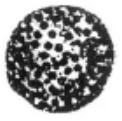
The figure shows a human blood cell. Identify it and give its characteristics.
A
Basophil $\to$ Secretes serotonin,inflammatory response
B
$B$-lymphocyte $\to$ Forms about $20\%$ of blood cells involved in immune response
C
Neutrophil $\to$ Most abundant blood cells,phagocytic
D
Monocyte $\to$ Life span of $3$ days,produces antibodies
Solution
(A) The image shows a Basophil,which is a type of granulocyte.
Basophils are the least abundant WBCs $(0.5-1.0\%)$.
They contain large,coarse granules that stain with basic dyes like methylene blue.
Their nucleus is typically lobed (often $S$-shaped or two-lobed,though sometimes appearing multi-lobed due to dense granules).
They secrete chemicals like histamine,serotonin,and heparin,which are involved in inflammatory responses.
Basophils are the least abundant WBCs $(0.5-1.0\%)$.
They contain large,coarse granules that stain with basic dyes like methylene blue.
Their nucleus is typically lobed (often $S$-shaped or two-lobed,though sometimes appearing multi-lobed due to dense granules).
They secrete chemicals like histamine,serotonin,and heparin,which are involved in inflammatory responses.
0 likes
View Solution319
MediumMCQ
$A$ certain road accident patient with unknown blood group needs immediate blood transfusion. His one doctor friend at once offers his blood. What was the blood group of the donor?
A
Blood group $B$
B
Blood group $AB$
C
Blood group $O$
D
Blood group $A$
Solution
(C) The correct answer is $C$. The blood group of the donor was $O$.
Individuals with blood group $O$ are considered universal donors.
This is because their red blood cells lack both $A$ and $B$ antigens on their surface.
Consequently,when $O$ type blood is transfused into a patient of any other blood group ($A, B, AB,$ or $O$),it does not trigger an immune response or cause agglutination (clumping) of the recipient's blood cells.
Individuals with blood group $O$ are considered universal donors.
This is because their red blood cells lack both $A$ and $B$ antigens on their surface.
Consequently,when $O$ type blood is transfused into a patient of any other blood group ($A, B, AB,$ or $O$),it does not trigger an immune response or cause agglutination (clumping) of the recipient's blood cells.
0 likes
View Solution320
EasyMCQ
Which one of the following human organs is often called the "graveyard" of $RBCs$?
A
Gall bladder
B
Kidney
C
Spleen
D
Liver
Solution
(C) : The $Spleen$ is a vertebrate organ located behind the stomach, primarily composed of lymphoid tissue.
Its functions include the production of lymphocytes and the destruction of foreign particles.
It acts as a reservoir for $RBCs$ and helps regulate their number in circulation.
Furthermore, it is the primary site for the breakdown of worn-out $RBCs$, which is why it is commonly referred to as the "graveyard" of $RBCs$.
Its functions include the production of lymphocytes and the destruction of foreign particles.
It acts as a reservoir for $RBCs$ and helps regulate their number in circulation.
Furthermore, it is the primary site for the breakdown of worn-out $RBCs$, which is why it is commonly referred to as the "graveyard" of $RBCs$.
0 likes
View Solution321
MediumMCQ
Which one of the following plasma proteins is involved in the coagulation of blood?
A
Albumin
B
Serum amylase
C
Globulin
D
Fibrinogen
Solution
(D) $Fibrinogen$ is a plasma protein that plays a crucial role in the coagulation of blood.
When an injury occurs, $Fibrinogen$ is converted into insoluble $Fibrin$ threads by the enzyme $Thrombin$.
These $Fibrin$ threads form a network that traps blood cells to form a clot, thereby preventing excessive blood loss.
$Albumin$ is primarily involved in maintaining osmotic pressure, while $Globulins$ are mainly involved in defense mechanisms of the body.
When an injury occurs, $Fibrinogen$ is converted into insoluble $Fibrin$ threads by the enzyme $Thrombin$.
These $Fibrin$ threads form a network that traps blood cells to form a clot, thereby preventing excessive blood loss.
$Albumin$ is primarily involved in maintaining osmotic pressure, while $Globulins$ are mainly involved in defense mechanisms of the body.
0 likes
View Solution322
MediumMCQ
$A$ person with an unknown blood group under the $ABO$ system has suffered significant blood loss in an accident and requires an immediate blood transfusion. His friend,who has a valid certificate of his own blood type,offers to donate blood without delay. What would be the blood group of the donor friend?
A
Type $B$
B
Type $AB$
C
Type $O$
D
Type $A$
Solution
(C) The correct answer is $C$. The blood group of the donor is $O$.
Individuals with blood group $O$ are known as universal donors.
This is because their red blood cells lack both $A$ and $B$ antigens on their surface.
Consequently,when $O$ type blood is transfused into a recipient of any other blood group ($A, B, AB,$ or $O$),it does not trigger an immune reaction or agglutination (clumping) of the recipient's blood cells.
Individuals with blood group $O$ are known as universal donors.
This is because their red blood cells lack both $A$ and $B$ antigens on their surface.
Consequently,when $O$ type blood is transfused into a recipient of any other blood group ($A, B, AB,$ or $O$),it does not trigger an immune reaction or agglutination (clumping) of the recipient's blood cells.
0 likes
View Solution323
MediumMCQ
The haemoglobin content per $100 \ ml$ of blood of a normal healthy human adult is
A
$5 - 11 \ g$
B
$25 - 30 \ g$
C
$17 - 20 \ g$
D
$12 - 16 \ g$
Solution
(D) In a normal healthy human adult,the average haemoglobin concentration in the blood ranges from $12$ to $16 \ g$ per $100 \ ml$ of blood. Haemoglobin is a red pigment present in red blood cells $(RBCs)$ that plays a crucial role in the transport of respiratory gases,specifically oxygen,throughout the body. Therefore,the correct option is $D$.
0 likes
View Solution324
MediumMCQ
There is no $DNA$ in
A
mature $RBCs$
B
a mature spermatozoan
C
hair root
D
an enucleated ovum
Solution
(A) The correct answer is $A$. Mature mammalian $RBCs$ (red blood cells) are enucleated,meaning they lack a nucleus and consequently do not contain $DNA$. In contrast,mature spermatozoa contain $DNA$ in their head region,hair roots contain cells with nuclei and $DNA$,and an enucleated ovum (though lacking a nucleus) is not a standard biological cell type found in normal physiological conditions,but the question specifically targets the absence of $DNA$ in mature $RBCs$ as a primary biological characteristic.
0 likes
View Solution325
MediumMCQ
Globulins contained in human blood plasma are primarily involved in
A
Blood clotting
B
Oxygen transport in the blood
C
Osmotic balance of body fluids
D
Defence mechanism of body
Solution
(D) : Globulins in human blood plasma are primarily involved in the defence mechanisms of the body.
Globulins,specifically immunoglobulins,act as antibodies that identify and neutralize pathogens such as bacteria,viruses,and other foreign toxic substances that enter the bloodstream.
Globulins,specifically immunoglobulins,act as antibodies that identify and neutralize pathogens such as bacteria,viruses,and other foreign toxic substances that enter the bloodstream.
0 likes
View Solution326
MediumMCQ
The most active phagocytic white blood cells are
A
eosinophils and lymphocytes
B
neutrophils and monocytes
C
neutrophils and eosinophils
D
lymphocytes and macrophages
Solution
(B) : Phagocytes are cells that are able to engulf and break down foreign particles,cell debris,and disease-producing microorganisms.
Neutrophils and monocytes are the most active phagocytic white blood cells in the human body.
Neutrophils are the most abundant and act as the first line of defense,while monocytes differentiate into macrophages to perform phagocytosis.
Neutrophils and monocytes are the most active phagocytic white blood cells in the human body.
Neutrophils are the most abundant and act as the first line of defense,while monocytes differentiate into macrophages to perform phagocytosis.
0 likes
View Solution327
MediumMCQ
Which type of white blood cells are concerned with the release of histamine and the natural anticoagulant heparin?
A
Eosinophils
B
Monocytes
C
Neutrophils
D
Basophils
Solution
(D) : Basophils are a type of white blood cell that contains coarse granules in their cytoplasm. These granules take up basic stains and are responsible for the secretion of substances such as histamine,serotonin,and the natural anticoagulant heparin,which plays a crucial role in inflammatory responses.
0 likes
View Solution328
MediumMCQ
$A$ drop of each of the following is placed separately on four slides. Which of them will not coagulate?
A
Blood serum
B
Sample from the thoracic duct of lymphatic system
C
Whole blood from pulmonary vein
D
Blood plasma
Solution
(A) : Blood serum is blood plasma from which the fibrinogen and other clotting factors have been removed.
Since clotting factors are essential for the coagulation process,their absence prevents blood serum from clotting.
In contrast,whole blood,lymph (which contains clotting factors),and blood plasma (which contains fibrinogen) all have the potential to coagulate under appropriate conditions.
Since clotting factors are essential for the coagulation process,their absence prevents blood serum from clotting.
In contrast,whole blood,lymph (which contains clotting factors),and blood plasma (which contains fibrinogen) all have the potential to coagulate under appropriate conditions.
0 likes
View Solution329
MediumMCQ
The most popularly known blood grouping is the $ABO$ grouping. It is named $ABO$ and not $ABC$, because "$O$" in it refers to having
A
overdominance of this type on the genes for $A$ and $B$ types
B
one antibody only - either anti-$A$ or anti-$B$ on the $RBCs$
C
no antigens $A$ and $B$ on $RBCs$
D
other antigens besides $A$ and $B$ on $RBCs$
Solution
(C) The $ABO$ blood grouping system is based on the presence or absence of two surface antigens, $A$ and $B$, on the surface of red blood cells $(RBCs)$.
Individuals with blood group $A$ have antigen $A$ on their $RBCs$.
Individuals with blood group $B$ have antigen $B$ on their $RBCs$.
Individuals with blood group $AB$ have both antigens $A$ and $B$ on their $RBCs$.
Individuals with blood group $O$ have neither antigen $A$ nor antigen $B$ on their $RBCs$. The term "$O$" is derived from the German word "ohne," which means "without," indicating the absence of these specific antigens.
Individuals with blood group $A$ have antigen $A$ on their $RBCs$.
Individuals with blood group $B$ have antigen $B$ on their $RBCs$.
Individuals with blood group $AB$ have both antigens $A$ and $B$ on their $RBCs$.
Individuals with blood group $O$ have neither antigen $A$ nor antigen $B$ on their $RBCs$. The term "$O$" is derived from the German word "ohne," which means "without," indicating the absence of these specific antigens.
0 likes
View Solution330
MediumMCQ
Blood group of mother and child are $B$ and $AB$ respectively. The possible blood group of father would be .........
A
$A$ and $AB$
B
Only $B$
C
$B$ and $O$
D
Only $O$
Solution
(A) The mother has blood group $B$,which means her genotype can be $I^B I^B$ or $I^B i$.
The child has blood group $AB$,meaning the genotype is $I^A I^B$.
Since the child must inherit one allele from each parent,the child must have received the $I^A$ allele from the father.
If the mother is $I^B I^B$ or $I^B i$,she contributes the $I^B$ allele to the child.
Therefore,the father must possess the $I^A$ allele to pass it to the child.
Possible genotypes for the father that contain the $I^A$ allele are $I^A I^A$,$I^A i$ (Blood group $A$),or $I^A I^B$ (Blood group $AB$).
Thus,the father can have blood group $A$ or $AB$.
The child has blood group $AB$,meaning the genotype is $I^A I^B$.
Since the child must inherit one allele from each parent,the child must have received the $I^A$ allele from the father.
If the mother is $I^B I^B$ or $I^B i$,she contributes the $I^B$ allele to the child.
Therefore,the father must possess the $I^A$ allele to pass it to the child.
Possible genotypes for the father that contain the $I^A$ allele are $I^A I^A$,$I^A i$ (Blood group $A$),or $I^A I^B$ (Blood group $AB$).
Thus,the father can have blood group $A$ or $AB$.
0 likes
View Solution331
EasyMCQ
Lymphocytes are:
A
$A$ kind of white blood cells
B
$A$ kind of red blood cells
C
Blood platelets
D
Plasma cells
Solution
(A) Lymphocytes are a type of white blood cell $(WBCs)$ or leukocytes that play a crucial role in the immune system.
They are primarily responsible for the adaptive immune response,which includes the production of antibodies ($B$-lymphocytes) and the destruction of infected or abnormal cells ($T$-lymphocytes).
Unlike red blood cells,which transport oxygen,or platelets,which aid in blood clotting,lymphocytes are specialized for immune defense.
They are primarily responsible for the adaptive immune response,which includes the production of antibodies ($B$-lymphocytes) and the destruction of infected or abnormal cells ($T$-lymphocytes).
Unlike red blood cells,which transport oxygen,or platelets,which aid in blood clotting,lymphocytes are specialized for immune defense.
0 likes
View Solution332
MediumMCQ
Which of the following $WBCs$ is present in the highest amount?
A
Acidophils
B
Lymphocytes
C
Basophils
D
Neutrophils
Solution
(D) White blood cells $(WBCs)$ are classified into granulocytes and agranulocytes.
Among the granulocytes,Neutrophils are the most abundant cells,constituting about $60-65\%$ of the total $WBCs$.
Lymphocytes constitute about $20-25\%$,Monocytes $6-8\%$,Eosinophils (Acidophils) $2-3\%$,and Basophils are the least abundant,constituting $0.5-1\%$.
Therefore,Neutrophils are present in the highest amount.
Among the granulocytes,Neutrophils are the most abundant cells,constituting about $60-65\%$ of the total $WBCs$.
Lymphocytes constitute about $20-25\%$,Monocytes $6-8\%$,Eosinophils (Acidophils) $2-3\%$,and Basophils are the least abundant,constituting $0.5-1\%$.
Therefore,Neutrophils are present in the highest amount.
0 likes
View Solution333
MediumMCQ
Which one of the following mammalian cells is not capable of metabolizing glucose to carbon-dioxide aerobically?
A
Unstriated muscle cells
B
Liver cells
C
Red blood cells
D
White blood cells
Solution
(C) Mature mammalian red blood cells $(RBCs)$ lack mitochondria and other organelles.
Because aerobic respiration (the Krebs cycle and electron transport chain) occurs within the mitochondria,$RBCs$ are unable to perform aerobic metabolism of glucose to carbon dioxide.
Instead,they rely exclusively on anaerobic glycolysis to produce $ATP$ for their energy requirements.
Because aerobic respiration (the Krebs cycle and electron transport chain) occurs within the mitochondria,$RBCs$ are unable to perform aerobic metabolism of glucose to carbon dioxide.
Instead,they rely exclusively on anaerobic glycolysis to produce $ATP$ for their energy requirements.
0 likes
View Solution334
MediumMCQ
What is correct for albumins,globulins and fibrinogen?
A
They are $60\%$ of total blood
B
They all are active form in blood plasma
C
They are major proteins which contribute $6-8\%$ in the straw-coloured viscous fluid.
D
They are proteins,necessary for only immune response
Solution
(C) Albumins,globulins,and fibrinogen are the major plasma proteins found in human blood.
Plasma is a straw-coloured,viscous fluid constituting nearly $55\%$ of the blood.
These proteins contribute approximately $6-8\%$ of the plasma by weight.
Albumins are primarily involved in osmotic balance,globulins are involved in defense mechanisms (immune response),and fibrinogen is essential for blood clotting.
Therefore,option $C$ is the correct statement.
Plasma is a straw-coloured,viscous fluid constituting nearly $55\%$ of the blood.
These proteins contribute approximately $6-8\%$ of the plasma by weight.
Albumins are primarily involved in osmotic balance,globulins are involved in defense mechanisms (immune response),and fibrinogen is essential for blood clotting.
Therefore,option $C$ is the correct statement.
0 likes
View Solution335
MediumMCQ
Match the following:
| Column-$I$ | Column-$II$ and Column-$III$ |
|---|---|
| $X$. $RBC$ | $R$. Lack of nucleus,$A$. $5-5.5$ Million |
| $Y$. Monocytes | $P$. Nucleated,$C$. $6-8\%$ |
| $Z$. Eosinophil | $Q$. Granulocyte,$B$. $2-3\%$ |
A
$X-R-A, Y-S-D, Z-Q-B$
B
$X-Q-B, Y-R-A, Z-P-C$
C
$X-P-A, Y-P-D, Z-Q-B$
D
$X-R-A, Y-P-C, Z-Q-B$
Solution
(D) $1$. $X$ $(RBC)$: Red blood cells lack a nucleus $(R)$ and are present in a count of $5-5.5$ million per $mm^3$ $(A)$. Thus,$X-R-A$.
$2$. $Y$ (Monocytes): Monocytes are nucleated $(P)$ and constitute $6-8\%$ of total white blood cells $(C)$. Thus,$Y-P-C$.
$3$. $Z$ (Eosinophil): Eosinophils are a type of granulocyte $(Q)$ and constitute $2-3\%$ of total white blood cells $(B)$. Thus,$Z-Q-B$.
Therefore,the correct matching is $X-R-A, Y-P-C, Z-Q-B$.
$2$. $Y$ (Monocytes): Monocytes are nucleated $(P)$ and constitute $6-8\%$ of total white blood cells $(C)$. Thus,$Y-P-C$.
$3$. $Z$ (Eosinophil): Eosinophils are a type of granulocyte $(Q)$ and constitute $2-3\%$ of total white blood cells $(B)$. Thus,$Z-Q-B$.
Therefore,the correct matching is $X-R-A, Y-P-C, Z-Q-B$.
0 likes
View Solution336
MediumMCQ
What is thrombin?
A
Cholesterol
B
Protein
C
Enzyme of gastric juice
D
Enzyme of pancreatic juice
Solution
(B) Thrombin is a serine protease enzyme that plays a crucial role in the blood coagulation process.
It is formed from its inactive precursor,prothrombin,by the action of the enzyme complex prothrombinase.
Chemically,thrombin is a protein (specifically an enzyme) that converts soluble fibrinogen into insoluble fibrin strands,which form the meshwork of a blood clot.
It is formed from its inactive precursor,prothrombin,by the action of the enzyme complex prothrombinase.
Chemically,thrombin is a protein (specifically an enzyme) that converts soluble fibrinogen into insoluble fibrin strands,which form the meshwork of a blood clot.
0 likes
View Solution337
EasyMCQ
Which one of the following plasma proteins is involved in the coagulation of blood?
A
an albumin
B
serum amylase
C
a globulin
D
fibrinogen
Solution
(D) Blood plasma contains various proteins,including albumin,globulins,and fibrinogen.
$1$. Albumin is primarily involved in maintaining osmotic balance.
$2$. Globulins are mainly involved in defense mechanisms of the body.
$3$. Fibrinogen is a clotting factor produced by the liver that is essential for the coagulation of blood. When an injury occurs,fibrinogen is converted into insoluble fibrin threads,which form the meshwork of a blood clot.
Therefore,the correct option is $D$.
$1$. Albumin is primarily involved in maintaining osmotic balance.
$2$. Globulins are mainly involved in defense mechanisms of the body.
$3$. Fibrinogen is a clotting factor produced by the liver that is essential for the coagulation of blood. When an injury occurs,fibrinogen is converted into insoluble fibrin threads,which form the meshwork of a blood clot.
Therefore,the correct option is $D$.
0 likes
View Solution338
MediumMCQ
Their count is about $2-3$ percent of the total white blood cell count in the blood.
A
Eosinophils
B
Basophils
C
Neutrophils
D
Monocytes
Solution
(A) The white blood cells $(WBCs)$ are classified into granulocytes and agranulocytes.
Granulocytes include neutrophils,eosinophils,and basophils.
Neutrophils are the most abundant ($60-65$ percent) of the total $WBCs$.
Eosinophils constitute about $2-3$ percent of the total $WBCs$ and are involved in resisting infections and allergic reactions.
Basophils are the least abundant ($0.5-1$ percent) of the total $WBCs$.
Therefore,the correct option is $A$.
Granulocytes include neutrophils,eosinophils,and basophils.
Neutrophils are the most abundant ($60-65$ percent) of the total $WBCs$.
Eosinophils constitute about $2-3$ percent of the total $WBCs$ and are involved in resisting infections and allergic reactions.
Basophils are the least abundant ($0.5-1$ percent) of the total $WBCs$.
Therefore,the correct option is $A$.
0 likes
View Solution339
MediumMCQ
Which of the following cells are related to inflammation and the release of heparin?
A
Eosinophils
B
Neutrophils
C
Basophils
D
Monocytes
Solution
(C) Basophils are a type of white blood cell (leukocyte) that play a significant role in the body's immune response.
They are involved in inflammatory reactions.
Basophils contain granules that release substances such as heparin (an anticoagulant),histamine (a vasodilator),and serotonin.
Therefore,the correct option is $C$.
They are involved in inflammatory reactions.
Basophils contain granules that release substances such as heparin (an anticoagulant),histamine (a vasodilator),and serotonin.
Therefore,the correct option is $C$.
0 likes
View Solution340
MediumMCQ
Erythroblastosis foetalis is a disease in which
A
Adult have severe anaemia and jaundice
B
Only Female have severe anaemia and jaundice
C
Only Male have severe anaemia and jaundice
D
Foetus have severe anaemia and jaundice
Solution
(D) Erythroblastosis foetalis is a condition that occurs when there is an $Rh$ incompatibility between a pregnant mother and her foetus.
If an $Rh$-negative mother carries an $Rh$-positive foetus,the mother's immune system may produce anti-$Rh$ antibodies upon exposure to the foetal blood during the first delivery.
In subsequent pregnancies,these anti-$Rh$ antibodies can cross the placenta and destroy the foetal red blood cells (haemolysis).
This destruction leads to severe anaemia and jaundice in the developing foetus or newborn,a condition known as erythroblastosis foetalis.
If an $Rh$-negative mother carries an $Rh$-positive foetus,the mother's immune system may produce anti-$Rh$ antibodies upon exposure to the foetal blood during the first delivery.
In subsequent pregnancies,these anti-$Rh$ antibodies can cross the placenta and destroy the foetal red blood cells (haemolysis).
This destruction leads to severe anaemia and jaundice in the developing foetus or newborn,a condition known as erythroblastosis foetalis.
0 likes
View Solution341
MediumMCQ
How much percent of plasma is water (in $\%$)?
A
$75$
B
$65$
C
$92$
D
$40$
Solution
(C) Plasma is a straw-colored,viscous fluid constituting the matrix of the blood.
It consists of approximately $90-92\%$ water and $6-8\%$ proteins.
Therefore,the correct percentage of water in plasma is $92\%$.
It consists of approximately $90-92\%$ water and $6-8\%$ proteins.
Therefore,the correct percentage of water in plasma is $92\%$.
0 likes
View Solution342
MediumMCQ
Match the following:
| Column-$I$ | Column-$II$ |
| $(1)$ Neutrophil | $(a)$ Inflammation |
| $(2)$ Eosinophil | $(b)$ $6-8\%$ |
| $(3)$ Basophil | $(c)$ Phagocytes |
| $(4)$ Monocytes | $(d)$ Resists infections |
A
$(1-d), (2-c), (3-a), (4-b)$
B
$(1-c), (2-d), (3-a), (4-b)$
C
$(1-a), (2-c), (3-b), (4-d)$
D
$(1-b), (2-a), (3-c), (4-d)$
Solution
(B) The correct matching is as follows:
$(1)$ Neutrophils are the most abundant phagocytic cells that destroy foreign organisms.
$(2)$ Eosinophils are associated with allergic reactions and resist infections.
$(3)$ Basophils are involved in inflammatory reactions and release histamine,serotonin,and heparin.
$(4)$ Monocytes constitute $6-8\%$ of the total white blood cells and are phagocytic in nature.
Therefore,the correct sequence is $(1-c), (2-d), (3-a), (4-b)$.
$(1)$ Neutrophils are the most abundant phagocytic cells that destroy foreign organisms.
$(2)$ Eosinophils are associated with allergic reactions and resist infections.
$(3)$ Basophils are involved in inflammatory reactions and release histamine,serotonin,and heparin.
$(4)$ Monocytes constitute $6-8\%$ of the total white blood cells and are phagocytic in nature.
Therefore,the correct sequence is $(1-c), (2-d), (3-a), (4-b)$.
0 likes
View Solution343
MediumMCQ
Clotting disorders occur because:
A
Number of platelets is reduced
B
Number of platelets is increased
C
Number of platelets remains constant
D
Number of $WBC$ increases
Solution
(A) Blood clotting (coagulation) is a process that prevents excessive blood loss from the body. Platelets (thrombocytes) are cell fragments that play a crucial role in the clotting mechanism by releasing substances that trigger the formation of a fibrin clot. When the number of platelets decreases significantly,a condition known as thrombocytopenia occurs. This reduction in platelets impairs the blood's ability to clot effectively,leading to clotting disorders and excessive bleeding. Therefore,the correct reason for clotting disorders is the reduction in the number of platelets.
0 likes
View Solution344
MediumMCQ
Which enzyme is useful to convert inactive fibrinogen into fibrins?
A
Thrombin
B
Prothrombin
C
Thrombokinase
D
None of the above
Solution
(A) During the process of blood coagulation,an enzyme complex called thrombokinase helps in the formation of an enzyme called thrombin from inactive prothrombin present in the plasma.
Thrombin,in turn,catalyzes the conversion of inactive fibrinogen present in the plasma into insoluble fibrin threads.
These fibrin threads form a network of threads on which dead and damaged formed elements of blood are trapped,leading to the formation of a blood clot.
Thrombin,in turn,catalyzes the conversion of inactive fibrinogen present in the plasma into insoluble fibrin threads.
These fibrin threads form a network of threads on which dead and damaged formed elements of blood are trapped,leading to the formation of a blood clot.
0 likes
View Solution345
MediumMCQ
Which of the following statements is $NOT$ true for $WBC$s?
A
They lack haemoglobin.
B
They lack a nucleus and are fewer in number.
C
They are of two types - granulocytes and agranulocytes.
D
Monocytes are agranulocytes.
Solution
(B) $WBC$s (White Blood Cells) or leucocytes are nucleated cells,meaning they possess a nucleus. Option $B$ states that they lack a nucleus,which is incorrect. $WBC$s are colourless due to the absence of haemoglobin. They are broadly classified into two categories: granulocytes (neutrophils,eosinophils,basophils) and agranulocytes (lymphocytes,monocytes). Therefore,the statement 'They lack nucleus and are less in number' is false.
0 likes
View Solution346
EasyMCQ
Globulins contained in human blood plasma are primarily involved in:
A
Osmotic balance of body fluids
B
Oxygen transport in the blood
C
Clotting of blood
D
Defense mechanisms of body
Solution
(D) Human blood plasma contains three major types of proteins: $Albumins$,$Globulins$,and $Fibrinogens$.
$1$. $Albumins$ are primarily responsible for maintaining the osmotic balance of body fluids.
$2$. $Globulins$ are primarily involved in the defense mechanisms of the body,as they include immunoglobulins (antibodies) that protect against pathogens.
$3$. $Fibrinogens$ are essential for the clotting or coagulation of blood.
Therefore,the correct option is $D$.
$1$. $Albumins$ are primarily responsible for maintaining the osmotic balance of body fluids.
$2$. $Globulins$ are primarily involved in the defense mechanisms of the body,as they include immunoglobulins (antibodies) that protect against pathogens.
$3$. $Fibrinogens$ are essential for the clotting or coagulation of blood.
Therefore,the correct option is $D$.
0 likes
View Solution347
MediumMCQ
$A$ person with blood group $A$ requires blood. The blood group which can be given is
A
$A$ or $B$
B
$A$ or $AB$
C
$A$ or $O$
D
$A, B, AB$ and $O$
Solution
(C) In the $ABO$ blood grouping system,individuals with blood group $A$ have $A$ antigens on the surface of their red blood cells and anti-$B$ antibodies in their plasma.
Therefore,they can receive blood from individuals who do not have $B$ antigens,which are those with blood group $A$ (same type) or blood group $O$ (universal donor,as it lacks both $A$ and $B$ antigens).
Thus,a person with blood group $A$ can receive blood from $A$ or $O$ donors.
Therefore,they can receive blood from individuals who do not have $B$ antigens,which are those with blood group $A$ (same type) or blood group $O$ (universal donor,as it lacks both $A$ and $B$ antigens).
Thus,a person with blood group $A$ can receive blood from $A$ or $O$ donors.
0 likes
View Solution348
MediumMCQ
Which of the following cells are phagocytic in nature?
A
Neutrophil,Monocyte and Basophil
B
Neutrophil,Monocyte and Macrophage
C
Neutrophil,Basophil and Macrophage
D
Acidophil,Basophil and Lymphocyte
Solution
(B) Phagocytosis is a process by which cells engulf and digest cellular debris,foreign substances,and pathogens.
Among the white blood cells,$Neutrophils$ and $Monocytes$ are the primary phagocytic cells in the blood.
$Macrophages$ are mature monocytes that have migrated into tissues and are also highly phagocytic.
$Basophils$ are involved in inflammatory reactions and the release of histamine,serotonin,and heparin,but they are not primarily phagocytic.
$Acidophils$ (Eosinophils) are involved in allergic reactions and parasitic infections.
$Lymphocytes$ are involved in the immune response ($B$ and $T$ cells) and are not phagocytic.
Therefore,the correct group of phagocytic cells is $Neutrophil$,$Monocyte$,and $Macrophage$.
Among the white blood cells,$Neutrophils$ and $Monocytes$ are the primary phagocytic cells in the blood.
$Macrophages$ are mature monocytes that have migrated into tissues and are also highly phagocytic.
$Basophils$ are involved in inflammatory reactions and the release of histamine,serotonin,and heparin,but they are not primarily phagocytic.
$Acidophils$ (Eosinophils) are involved in allergic reactions and parasitic infections.
$Lymphocytes$ are involved in the immune response ($B$ and $T$ cells) and are not phagocytic.
Therefore,the correct group of phagocytic cells is $Neutrophil$,$Monocyte$,and $Macrophage$.
0 likes
View Solution349
MediumMCQ
Which of the following is true about plasma?
$(i)$ It contains $90-92 \%$ water.
$(ii)$ It contains $6-8 \%$ proteins.
$(iii)$ It is a straw-coloured,viscous fluid.
$(i)$ It contains $90-92 \%$ water.
$(ii)$ It contains $6-8 \%$ proteins.
$(iii)$ It is a straw-coloured,viscous fluid.
A
$(i)$ and $(ii)$
B
$(ii)$ and $(iii)$
C
$(i)$ and $(iii)$
D
Only $(iii)$
Solution
(D) Plasma is a straw-coloured,viscous fluid constituting the matrix of the blood.
It makes up about $55 \%$ of the blood.
Plasma contains $90-92 \%$ water and $6-8 \%$ proteins (such as fibrinogen,globulins,and albumins).
Statement $(i)$ in the original question was incorrect as it stated $90-92 \%$ protein instead of water.
Statement $(ii)$ in the original question was incorrect as it stated $55 \%$ water instead of protein.
Statement $(iii)$ is correct.
Therefore,only statement $(iii)$ is true.
It makes up about $55 \%$ of the blood.
Plasma contains $90-92 \%$ water and $6-8 \%$ proteins (such as fibrinogen,globulins,and albumins).
Statement $(i)$ in the original question was incorrect as it stated $90-92 \%$ protein instead of water.
Statement $(ii)$ in the original question was incorrect as it stated $55 \%$ water instead of protein.
Statement $(iii)$ is correct.
Therefore,only statement $(iii)$ is true.
0 likes
View Solution350
MediumMCQ
Which ion is essential for blood clotting?
A
$Na^+$
B
$Ca^{2+}$
C
$Cl^-$
D
$Fe^{2+}$
Solution
(B) Blood clotting (coagulation) is a complex process involving a cascade of enzymatic reactions.
Calcium ions $(Ca^{2+})$ play a critical role in this process.
They act as essential cofactors for several clotting factors,including the conversion of prothrombin to thrombin and the activation of various factors in the coagulation cascade.
Therefore,$Ca^{2+}$ is the essential ion for blood clotting.
Calcium ions $(Ca^{2+})$ play a critical role in this process.
They act as essential cofactors for several clotting factors,including the conversion of prothrombin to thrombin and the activation of various factors in the coagulation cascade.
Therefore,$Ca^{2+}$ is the essential ion for blood clotting.
0 likes
View SolutionBody Fluids and Circulations — Blood and Blood Group · Frequently Asked Questions
1Are these Body Fluids and Circulations questions useful for JEE and NEET?
Yes. All questions in this section are mapped to JEE Main and NEET exam patterns. Previous year questions from JEE Main, NEET, GUJCET and state-level exams are included with full solutions.
2Can I switch to Hindi or Gujarati for these questions?
Yes. Use the language tabs in the hero section or the sidebar to view the same questions and solutions in English, Hindi or Gujarati.
3How do I generate a question paper from this subtopic?
Use the Vedclass Exam Paper Generator — select the chapter and subtopic, set difficulty, and generate Sets A, B, C, D automatically. First 3 chapters of every subject are free.
Vedclass Products
For Students
Vedclass Test Series
Mock tests in real JEE/NEET style with performance analysis. 5-day free trial.
Start Free TrialFor Teachers
Exam Paper Generator
Generate Set A/B/C/D papers from this chapter in 2 minutes. 3 chapters free.
Try FreeFor Institutes
Online Exam Module
Live online exams with unlimited students, 360° analytics & white-label branding.
See DemoFor Teachers & Institutes
Generate a Body Fluids and Circulations Exam Paper in 2 Minutes
Select subtopic & difficulty — Sets A, B, C, D auto-generated with No Repeat logic.
First 3 chapters of every subject are free — no payment required.