
A English
Carbohydrates Questions in English
Class 11 Biology · Biomolecules · Carbohydrates
423+
Questions
English
Language
100%
With Solutions
Showing 50 of 423 questions in English
201
EasyMCQ
Which of the following is a type of carbohydrate?
A
Polynucleotide
B
Polypeptide
C
Polysaccharide
D
Glycolipid
Solution
(C) Carbohydrates are organic compounds consisting of carbon,hydrogen,and oxygen.
They are classified into monosaccharides,disaccharides,and polysaccharides based on the number of sugar units.
$A$. Polynucleotides are polymers of nucleotides (e.g.,$DNA$,$RNA$).
$B$. Polypeptides are chains of amino acids linked by peptide bonds.
$C$. Polysaccharides are complex carbohydrates formed by the polymerization of many monosaccharide units (e.g.,starch,cellulose,glycogen).
$D$. Glycolipids are lipids with a carbohydrate attached by a glycosidic bond.
Therefore,the correct answer is $C$.
They are classified into monosaccharides,disaccharides,and polysaccharides based on the number of sugar units.
$A$. Polynucleotides are polymers of nucleotides (e.g.,$DNA$,$RNA$).
$B$. Polypeptides are chains of amino acids linked by peptide bonds.
$C$. Polysaccharides are complex carbohydrates formed by the polymerization of many monosaccharide units (e.g.,starch,cellulose,glycogen).
$D$. Glycolipids are lipids with a carbohydrate attached by a glycosidic bond.
Therefore,the correct answer is $C$.
0 likes
View Solution202
MediumMCQ
Which of the following examples does not contain hexose sugar units?
A
Sucrose
B
Starch
C
Glycogen
D
Inulin
Solution
(D) Inulin is a polysaccharide composed of fructose units. Fructose is a ketohexose, but in the context of carbohydrate classification, inulin is specifically a fructan (polymer of fructose). However, the question asks for the unit that does not contain hexose sugar units. Sucrose is a disaccharide of glucose and fructose (both hexoses). Starch and glycogen are polymers of glucose (a hexose). Inulin is a polymer of fructose. Since fructose is a hexose, the question is technically tricky. However, in many biological contexts, inulin is distinguished because it is a polymer of fructose, whereas starch and glycogen are polymers of glucose. If the question implies 'glucose-based hexose units', then inulin is the answer. Inulin is a polymer of $D$-fructose units linked by $\beta(2 \to 1)$ glycosidic bonds.
0 likes
View Solution203
EasyMCQ
Which of the following contains lactose?
A
Sugarcane
B
Fruits
C
Milk
D
Both $(a)$ and $(b)$
Solution
(C) Lactose is a disaccharide sugar composed of galactose and glucose subunits. It is commonly known as milk sugar because it is the primary carbohydrate found in the milk of mammals. Sugarcane contains sucrose,and fruits typically contain fructose and glucose.
0 likes
View Solution204
MediumMCQ
Which polysaccharide consists of both branched and unbranched chain molecules?
A
Glycogen
B
Cellulose
C
Starch
D
None of these
Solution
(C) Starch is a polysaccharide that serves as a storage carbohydrate in plants. It is composed of two types of glucose polymers: $1$. Amylose,which is an unbranched chain of glucose units linked by $\alpha-1,4$-glycosidic bonds. $2$. Amylopectin,which is a branched chain of glucose units linked by $\alpha-1,4$-glycosidic bonds and $\alpha-1,6$-glycosidic bonds at branch points. Therefore,starch contains both unbranched (amylose) and branched (amylopectin) structures.
0 likes
View Solution205
EasyMCQ
The disaccharide present in mammalian milk is:
A
Glucose
B
Fructose
C
Galactose
D
Lactose
Solution
(D) Lactose,also known as milk sugar,is a disaccharide composed of two monosaccharide units: $D$-glucose and $D$-galactose.
It is the primary carbohydrate found in the milk of most mammals.
Therefore,the correct option is $D$.
It is the primary carbohydrate found in the milk of most mammals.
Therefore,the correct option is $D$.
0 likes
View Solution206
EasyMCQ
The most common monomer molecule of carbohydrates is:
A
Amino acid
B
Phospholipid
C
Maltose
D
Glucose
Solution
(D) Carbohydrates are biomolecules composed of carbon,hydrogen,and oxygen.
Monosaccharides are the simplest form of carbohydrates and serve as the monomers for more complex carbohydrates like disaccharides and polysaccharides.
Glucose $(C_6H_{12}O_6)$ is the most abundant and common monosaccharide found in nature,serving as the primary energy source for living organisms and the building block for many polysaccharides like starch,cellulose,and glycogen.
Monosaccharides are the simplest form of carbohydrates and serve as the monomers for more complex carbohydrates like disaccharides and polysaccharides.
Glucose $(C_6H_{12}O_6)$ is the most abundant and common monosaccharide found in nature,serving as the primary energy source for living organisms and the building block for many polysaccharides like starch,cellulose,and glycogen.
0 likes
View Solution207
EasyMCQ
Which is the most important sugar found in animals?
A
Glucose
B
Fructose
C
Glyceraldehyde
D
Galactose
Solution
(A) $Glucose$ $(C_6H_{12}O_6)$ is the most important sugar in animals because it serves as the primary source of energy for cellular respiration. It is the main sugar transported in the blood and is utilized by cells to produce $ATP$ through glycolysis and the Krebs cycle.
0 likes
View Solution208
EasyMCQ
The stored material in sugarcane is:
A
Maltose
B
Sucrose
C
Lactose
D
Isomaltose
Solution
(B) Sugarcane $(Saccharum \text{ } officinarum)$ stores its carbohydrates primarily in the form of sucrose.
Sucrose is a disaccharide composed of one molecule of glucose and one molecule of fructose linked by a glycosidic bond.
It is the main sugar transported in plants and is stored in high concentrations in the stems of sugarcane.
Sucrose is a disaccharide composed of one molecule of glucose and one molecule of fructose linked by a glycosidic bond.
It is the main sugar transported in plants and is stored in high concentrations in the stems of sugarcane.
0 likes
View Solution209
EasyMCQ
What functional groups are present in carbohydrates?
A
$ -OH$ group
B
$ -CHO$ group
C
$ C = O$ group
D
All of the above
Solution
(D) Carbohydrates are chemically defined as polyhydroxy aldehydes or polyhydroxy ketones,or substances that yield these compounds on hydrolysis.
$1$. The term 'polyhydroxy' indicates the presence of multiple hydroxyl $(-OH)$ groups.
$2$. The term 'aldehyde' refers to the presence of an aldehyde $(-CHO)$ group,which is characteristic of aldoses.
$3$. The term 'ketone' refers to the presence of a carbonyl $(C = O)$ group,which is characteristic of ketoses.
Therefore,carbohydrates contain hydroxyl groups,as well as either an aldehyde or a ketone group.
$1$. The term 'polyhydroxy' indicates the presence of multiple hydroxyl $(-OH)$ groups.
$2$. The term 'aldehyde' refers to the presence of an aldehyde $(-CHO)$ group,which is characteristic of aldoses.
$3$. The term 'ketone' refers to the presence of a carbonyl $(C = O)$ group,which is characteristic of ketoses.
Therefore,carbohydrates contain hydroxyl groups,as well as either an aldehyde or a ketone group.
0 likes
View Solution210
MediumMCQ
What is the ratio of $H$ and $O$ in carbohydrates?
A
$2:1$
B
Not $2:1$
C
$2:1$ or not $2:1$
D
$1:1$
Solution
(C) Carbohydrates are polyhydroxy aldehydes or ketones with the general formula $(CH_2O)_n$.
In this general formula,the ratio of hydrogen $(H)$ atoms to oxygen $(O)$ atoms is $2:1$.
However,not all carbohydrates strictly follow this ratio.
For example,Deoxyribose $(C_5H_{10}O_4)$ is a carbohydrate where the ratio of $H$ to $O$ is not $2:1$.
Therefore,the ratio can be $2:1$ or it may not be $2:1$.
In this general formula,the ratio of hydrogen $(H)$ atoms to oxygen $(O)$ atoms is $2:1$.
However,not all carbohydrates strictly follow this ratio.
For example,Deoxyribose $(C_5H_{10}O_4)$ is a carbohydrate where the ratio of $H$ to $O$ is not $2:1$.
Therefore,the ratio can be $2:1$ or it may not be $2:1$.
0 likes
View Solution211
MediumMCQ
Which of the following statements is inconsistent with the properties of a monosaccharide?
A
Monosaccharides are simple sugars.
B
In the structure of a monosaccharide,the values of $n$ and $m$ are equal.
C
Monosaccharides are sweet in taste,soluble in water,and can pass through the cell membrane.
D
Monosaccharides contain $-NH_2, -COOH, -X$ groups.
Solution
(D) Monosaccharides are the simplest form of carbohydrates and cannot be hydrolyzed further into smaller sugar units.
They generally follow the empirical formula $(CH_2O)_n$,where $n$ ranges from $3$ to $7$.
Properties of monosaccharides include being sweet in taste,crystalline solids,and water-soluble.
They are small enough to pass through the cell membrane via transport proteins.
Option $D$ is incorrect because monosaccharides are polyhydroxy aldehydes or ketones; they do not typically contain $-NH_2$ (amino),$-COOH$ (carboxyl),or $-X$ (halogen) groups as their defining functional groups.
They generally follow the empirical formula $(CH_2O)_n$,where $n$ ranges from $3$ to $7$.
Properties of monosaccharides include being sweet in taste,crystalline solids,and water-soluble.
They are small enough to pass through the cell membrane via transport proteins.
Option $D$ is incorrect because monosaccharides are polyhydroxy aldehydes or ketones; they do not typically contain $-NH_2$ (amino),$-COOH$ (carboxyl),or $-X$ (halogen) groups as their defining functional groups.
0 likes
View Solution212
EasyMCQ
Which of the following carbohydrates cannot be hydrolyzed?
A
Polysaccharide
B
Oligosaccharide
C
Disaccharide
D
Monosaccharide
Solution
(D) Carbohydrates are classified based on their ability to undergo hydrolysis into simpler units.
$1$. Monosaccharides are the simplest form of carbohydrates and cannot be further hydrolyzed into smaller polyhydroxy aldehyde or ketone units.
$2$. Disaccharides,oligosaccharides,and polysaccharides are complex carbohydrates that can be hydrolyzed into two or more monosaccharide units.
Therefore,monosaccharides are the correct answer.
$1$. Monosaccharides are the simplest form of carbohydrates and cannot be further hydrolyzed into smaller polyhydroxy aldehyde or ketone units.
$2$. Disaccharides,oligosaccharides,and polysaccharides are complex carbohydrates that can be hydrolyzed into two or more monosaccharide units.
Therefore,monosaccharides are the correct answer.
0 likes
View Solution213
MediumMCQ
In aldotriose and ketotriose,which carbon atoms are attached to the aldehyde $(-CHO)$ and ketone $(>C=O)$ groups,respectively?
A
First,First
B
First,Second
C
Second,Second
D
Second,First
Solution
(B) An aldotriose is a three-carbon sugar containing an aldehyde group. In an aldotriose,the aldehyde group $(-CHO)$ is always located at the terminal position,which is the $C-1$ carbon.
$A$ ketotriose is a three-carbon sugar containing a ketone group. In a ketotriose,the ketone group $(>C=O)$ is located at the internal position,which is the $C-2$ carbon.
Therefore,the aldehyde group is at the first carbon,and the ketone group is at the second carbon.
$A$ ketotriose is a three-carbon sugar containing a ketone group. In a ketotriose,the ketone group $(>C=O)$ is located at the internal position,which is the $C-2$ carbon.
Therefore,the aldehyde group is at the first carbon,and the ketone group is at the second carbon.
0 likes
View Solution214
EasyMCQ
Which sugars are present in the structure of $DNA$ and $ATP$,respectively?
A
Ketopentose,Aldopentose
B
Ribulose,Ribose
C
Deoxyribose,Ribose
D
Deoxyribose,Ribulose
Solution
(C) $DNA$ stands for Deoxyribonucleic acid,which contains the $2'$-deoxyribose sugar in its nucleotide structure.
$ATP$ stands for Adenosine triphosphate,which contains the ribose sugar in its adenosine moiety.
Therefore,the sugars present in $DNA$ and $ATP$ are $2'$-deoxyribose and ribose,respectively.
$ATP$ stands for Adenosine triphosphate,which contains the ribose sugar in its adenosine moiety.
Therefore,the sugars present in $DNA$ and $ATP$ are $2'$-deoxyribose and ribose,respectively.
0 likes
View Solution215
MediumMCQ
Which sugar is obtained upon the digestion of milk?
A
Ketohexose
B
Fructose
C
Pentose
D
Aldohexose
Solution
(D) Milk contains a disaccharide sugar called lactose.
Upon digestion,the enzyme lactase breaks down lactose into two monosaccharides: glucose and galactose.
Both glucose and galactose are isomers with the chemical formula $C_6H_{12}O_6$ and are classified as aldohexoses because they contain an aldehyde group and six carbon atoms.
Upon digestion,the enzyme lactase breaks down lactose into two monosaccharides: glucose and galactose.
Both glucose and galactose are isomers with the chemical formula $C_6H_{12}O_6$ and are classified as aldohexoses because they contain an aldehyde group and six carbon atoms.
0 likes
View Solution216
MediumMCQ
$A$ molecule of disaccharide is formed by the formation of a glycosidic bond between which two sugars?
A
Two trioses
B
Two pentoses
C
Two hexoses
D
One pentose,one triose
Solution
(C) disaccharide is a carbohydrate formed when two monosaccharides are joined together by a glycosidic bond.
Common disaccharides like sucrose,lactose,and maltose are formed by the condensation of two hexose sugar units (e.g.,glucose,fructose,or galactose).
For example,sucrose is formed by the union of one glucose molecule and one fructose molecule,both of which are hexoses $(C_6H_{12}O_6)$.
Common disaccharides like sucrose,lactose,and maltose are formed by the condensation of two hexose sugar units (e.g.,glucose,fructose,or galactose).
For example,sucrose is formed by the union of one glucose molecule and one fructose molecule,both of which are hexoses $(C_6H_{12}O_6)$.
0 likes
View Solution217
MediumMCQ
How many atoms of $H$ and $O$ are lost when a disaccharide is formed from monosaccharides?
A
$2, 1$
B
$1, 1$
C
$2, 2$
D
$1, 2$
Solution
(A) disaccharide is formed by the condensation reaction between two monosaccharides.
In this reaction,a glycosidic bond is formed with the elimination of one water molecule $(H_2O)$.
One water molecule consists of $2$ atoms of Hydrogen $(H)$ and $1$ atom of Oxygen $(O)$.
Therefore,when a disaccharide is formed,$2$ atoms of $H$ and $1$ atom of $O$ are lost.
In this reaction,a glycosidic bond is formed with the elimination of one water molecule $(H_2O)$.
One water molecule consists of $2$ atoms of Hydrogen $(H)$ and $1$ atom of Oxygen $(O)$.
Therefore,when a disaccharide is formed,$2$ atoms of $H$ and $1$ atom of $O$ are lost.
0 likes
View Solution218
MediumMCQ
Which of the following statements is inconsistent with the properties of disaccharides?
A
Their general molecular formula is $C_n(H_2O)_{n-1}$ where $n$ is the number of carbon atoms.
B
They are sweet in taste.
C
They are soluble in water.
D
They can pass through the cell membrane.
Solution
(D) Disaccharides are carbohydrates formed by the condensation of two monosaccharide units.
$1$. Their general formula is $C_{12}H_{22}O_{11}$ (for common disaccharides like sucrose,lactose,and maltose),which fits the form $C_n(H_2O)_{n-1}$.
$2$. They are crystalline,sweet-tasting,and water-soluble sugars.
$3$. However,disaccharides are large,polar molecules (macromolecules) compared to monosaccharides.
$4$. Due to their size and polarity,they cannot pass through the lipid bilayer of the cell membrane via simple diffusion and require specific transport proteins to enter the cell.
Therefore,the statement that they can pass through the cell membrane is inconsistent with their properties.
$1$. Their general formula is $C_{12}H_{22}O_{11}$ (for common disaccharides like sucrose,lactose,and maltose),which fits the form $C_n(H_2O)_{n-1}$.
$2$. They are crystalline,sweet-tasting,and water-soluble sugars.
$3$. However,disaccharides are large,polar molecules (macromolecules) compared to monosaccharides.
$4$. Due to their size and polarity,they cannot pass through the lipid bilayer of the cell membrane via simple diffusion and require specific transport proteins to enter the cell.
Therefore,the statement that they can pass through the cell membrane is inconsistent with their properties.
0 likes
View Solution219
MediumMCQ
Which process on a disaccharide yields two units of monosaccharides?
A
Dehydration
B
Hydrolysis
C
Halogenation
D
Dehydrogenation
Solution
(B) disaccharide is a carbohydrate composed of two monosaccharide units linked by a glycosidic bond.
Hydrolysis is the chemical process in which a molecule of water is added to break this glycosidic bond,resulting in the release of the two constituent monosaccharide units.
Therefore,the correct process is hydrolysis.
Hydrolysis is the chemical process in which a molecule of water is added to break this glycosidic bond,resulting in the release of the two constituent monosaccharide units.
Therefore,the correct process is hydrolysis.
0 likes
View Solution220
MediumMCQ
Which monosaccharide is common in the structures of maltose,lactose,and sucrose?
A
Glucose
B
Galactose
C
Fructose
D
Ribulose
Solution
(A) The disaccharides are composed of two monosaccharide units linked by a glycosidic bond.
$1$. Maltose consists of two units of $D$-glucose.
$2$. Lactose consists of $D$-galactose and $D$-glucose.
$3$. Sucrose consists of $D$-glucose and $D$-fructose.
Since $D$-glucose is present in all three disaccharides,it is the common monosaccharide.
$1$. Maltose consists of two units of $D$-glucose.
$2$. Lactose consists of $D$-galactose and $D$-glucose.
$3$. Sucrose consists of $D$-glucose and $D$-fructose.
Since $D$-glucose is present in all three disaccharides,it is the common monosaccharide.
0 likes
View Solution221
MediumMCQ
What is the general formula or structural formula of a polysaccharide?
A
$C_n(H_2O)_m$
B
$C_n(H_2O)_{m-1}$
C
$(C_6H_{10}O_5)_n$
D
$C_n(H_2O)_m$,where $n = m$
Solution
(C) Polysaccharides are complex carbohydrates formed by the polymerization of many monosaccharide units.
During the formation of a polysaccharide,each glycosidic bond formation involves the loss of one water molecule $(H_2O)$.
For a polymer of $n$ hexose units (like glucose,$C_6H_{12}O_6$),the general formula is derived as follows:
$n(C_6H_{12}O_6) - (n-1)H_2O = C_{6n}H_{12n}O_{6n} - C_{2n-2}H_{2n-2}O_{n-1} = C_{6n}H_{10n+2}O_{5n+1}$.
For large values of $n$,this simplifies to $(C_6H_{10}O_5)_n$,which is the standard structural formula for storage and structural polysaccharides like starch,cellulose,and glycogen.
During the formation of a polysaccharide,each glycosidic bond formation involves the loss of one water molecule $(H_2O)$.
For a polymer of $n$ hexose units (like glucose,$C_6H_{12}O_6$),the general formula is derived as follows:
$n(C_6H_{12}O_6) - (n-1)H_2O = C_{6n}H_{12n}O_{6n} - C_{2n-2}H_{2n-2}O_{n-1} = C_{6n}H_{10n+2}O_{5n+1}$.
For large values of $n$,this simplifies to $(C_6H_{10}O_5)_n$,which is the standard structural formula for storage and structural polysaccharides like starch,cellulose,and glycogen.
0 likes
View Solution222
EasyMCQ
Which two polysaccharide structures are present in starch,which acts as a stored food in plants?
A
Cellulose,Chitin
B
Lignin,Glycogen
C
Cellulose,Glycogen
D
Amylose,Amylopectin
Solution
(D) Starch is the primary storage polysaccharide in plants. It is a polymer of glucose and consists of two distinct components:
$1$. $Amylose$: $A$ linear,unbranched chain of $\alpha-D-glucose$ units linked by $\alpha-1,4-glycosidic$ bonds.
$2$. $Amylopectin$: $A$ branched-chain polymer of $\alpha-D-glucose$ units,containing both $\alpha-1,4-glycosidic$ bonds and $\alpha-1,6-glycosidic$ bonds at branch points.
Therefore,the correct option is $D$.
$1$. $Amylose$: $A$ linear,unbranched chain of $\alpha-D-glucose$ units linked by $\alpha-1,4-glycosidic$ bonds.
$2$. $Amylopectin$: $A$ branched-chain polymer of $\alpha-D-glucose$ units,containing both $\alpha-1,4-glycosidic$ bonds and $\alpha-1,6-glycosidic$ bonds at branch points.
Therefore,the correct option is $D$.
0 likes
View Solution223
EasyMCQ
Which polysaccharide is present as a stored food material in animals?
A
Cellulose
B
Lignin
C
Starch
D
Glycogen
Solution
(D) In animals,carbohydrates are stored in the form of glycogen.
Glycogen is a branched polymer of glucose and is primarily stored in the liver and muscles.
Cellulose is a structural polysaccharide found in plants.
Starch is the primary storage polysaccharide in plants.
Lignin is a complex organic polymer found in the cell walls of many plants,not a polysaccharide.
Glycogen is a branched polymer of glucose and is primarily stored in the liver and muscles.
Cellulose is a structural polysaccharide found in plants.
Starch is the primary storage polysaccharide in plants.
Lignin is a complex organic polymer found in the cell walls of many plants,not a polysaccharide.
0 likes
View Solution224
EasyMCQ
What is maltose composed of?
A
Glucose + Galactose
B
Glucose + Fructose
C
Glucose + Glucose
D
Galactose + Fructose
Solution
(C) Maltose is a disaccharide formed by the condensation of two molecules of glucose.
These two glucose units are linked together by an $\alpha-1,4$-glycosidic bond.
Therefore,the correct composition is Glucose + Glucose.
These two glucose units are linked together by an $\alpha-1,4$-glycosidic bond.
Therefore,the correct composition is Glucose + Glucose.
0 likes
View Solution225
EasyMCQ
What is the name of the bond present between the units forming a disaccharide sugar?
A
Hydrogen bond
B
Peptide bond
C
Glycosidic bond
D
Ester bond
Solution
(C) disaccharide is a carbohydrate formed when two monosaccharides are joined together.
These monosaccharide units are linked by a covalent bond known as a glycosidic bond.
This bond is formed through a dehydration synthesis reaction,where a water molecule is removed.
Therefore,the correct answer is $C$ (Glycosidic bond).
These monosaccharide units are linked by a covalent bond known as a glycosidic bond.
This bond is formed through a dehydration synthesis reaction,where a water molecule is removed.
Therefore,the correct answer is $C$ (Glycosidic bond).
0 likes
View Solution226
EasyMCQ
The classification of monosaccharides is based on which of the following statements?
A
Number of carbon atoms
B
Chemical bonds
C
Ratio of $H$ and $O$ atoms
D
Valency of carbon atoms
Solution
(A) Monosaccharides are the simplest carbohydrates that cannot be hydrolyzed further into smaller sugar units.
They are classified primarily based on the number of carbon atoms present in their molecule.
For example,a monosaccharide with $3$ carbon atoms is called a triose,with $4$ is a tetrose,with $5$ is a pentose,and with $6$ is a hexose.
Therefore,the correct basis for their classification is the number of carbon atoms.
They are classified primarily based on the number of carbon atoms present in their molecule.
For example,a monosaccharide with $3$ carbon atoms is called a triose,with $4$ is a tetrose,with $5$ is a pentose,and with $6$ is a hexose.
Therefore,the correct basis for their classification is the number of carbon atoms.
0 likes
View Solution227
MediumMCQ
What is the general chemical formula of a disaccharide?
A
$C_n(H_2O)_{n-1}$
B
$C_6H_{12}O_6$
C
$C_{12}H_{22}O_{11}$
D
$C_{12}H_{22}O_{10}$
Solution
(C) disaccharide is formed by the condensation of two monosaccharide units $(C_6H_{12}O_6)$ with the elimination of one water molecule $(H_2O)$.
The general formula for a monosaccharide is $C_nH_{2n}O_n$.
When two monosaccharides combine,the resulting disaccharide formula is $(C_6H_{12}O_6 + C_6H_{12}O_6) - H_2O = C_{12}H_{24}O_{12} - H_2O = C_{12}H_{22}O_{11}$.
The general formula for a monosaccharide is $C_nH_{2n}O_n$.
When two monosaccharides combine,the resulting disaccharide formula is $(C_6H_{12}O_6 + C_6H_{12}O_6) - H_2O = C_{12}H_{24}O_{12} - H_2O = C_{12}H_{22}O_{11}$.
0 likes
View Solution228
MediumMCQ
Which characteristic distinguishes a disaccharide from a monosaccharide?
A
They cannot pass through the cell membrane.
B
They are soluble in water.
C
They are sweet in taste.
D
They are small carbohydrate molecules.
Solution
(A) Monosaccharides are the simplest form of carbohydrates and consist of a single sugar unit,which allows them to easily pass through the cell membrane via specific transport proteins or diffusion. In contrast,disaccharides are composed of two monosaccharide units linked by a glycosidic bond. Due to their larger size and complexity,disaccharides cannot pass through the cell membrane directly and must be hydrolyzed into monosaccharides by specific enzymes before they can be absorbed by the cell.
0 likes
View Solution229
MediumMCQ
$P$: Monosaccharides can pass through the cell membrane.
$Q$: Monosaccharides are the simplest carbohydrates.
$Q$: Monosaccharides are the simplest carbohydrates.
A
Statement $P$ is true but statement $Q$ is false.
B
Both statements $P$ and $Q$ are true,but statement $Q$ is not the correct explanation of $P$.
C
Both statements $P$ and $Q$ are true,and statement $Q$ is the correct explanation of $P$.
D
Both statements $P$ and $Q$ are false.
Solution
(C) Statement $P$ is true because monosaccharides are small,water-soluble molecules that can be transported across the cell membrane via specific transport proteins or facilitated diffusion.
Statement $Q$ is true because monosaccharides are the simplest form of carbohydrates that cannot be hydrolyzed further into smaller sugar units.
Since monosaccharides are the simplest form of carbohydrates,they are small enough to be transported across the cell membrane. Thus,statement $Q$ provides the correct explanation for statement $P$.
Statement $Q$ is true because monosaccharides are the simplest form of carbohydrates that cannot be hydrolyzed further into smaller sugar units.
Since monosaccharides are the simplest form of carbohydrates,they are small enough to be transported across the cell membrane. Thus,statement $Q$ provides the correct explanation for statement $P$.
0 likes
View Solution230
EasyMCQ
Which of the following carbohydrates is not a disaccharide?
A
Maltose
B
Lactose
C
Sucrose
D
Galactose
Solution
(D) Carbohydrates are classified based on the number of sugar units they yield upon hydrolysis.
$1$. Monosaccharides: These are simple sugars that cannot be hydrolyzed further into smaller carbohydrates. Examples include glucose,fructose,and galactose.
$2$. Disaccharides: These are carbohydrates that yield two molecules of monosaccharides upon hydrolysis. Examples include maltose (glucose + glucose),lactose (glucose + galactose),and sucrose (glucose + fructose).
$3$. Since galactose is a monosaccharide,it is not a disaccharide.
$1$. Monosaccharides: These are simple sugars that cannot be hydrolyzed further into smaller carbohydrates. Examples include glucose,fructose,and galactose.
$2$. Disaccharides: These are carbohydrates that yield two molecules of monosaccharides upon hydrolysis. Examples include maltose (glucose + glucose),lactose (glucose + galactose),and sucrose (glucose + fructose).
$3$. Since galactose is a monosaccharide,it is not a disaccharide.
0 likes
View Solution231
EasyMCQ
The most common monomer of carbohydrates is:
A
Glucose
B
Fructose
C
Sucrose
D
Maltose
Solution
(A) Carbohydrates are organic compounds composed of carbon,hydrogen,and oxygen.
Monosaccharides are the simplest form of carbohydrates and serve as the monomers for more complex carbohydrates (disaccharides and polysaccharides).
Glucose $(C_6H_{12}O_6)$ is the most abundant and common monosaccharide in nature,serving as the primary energy source for living organisms and the fundamental building block for many polysaccharides like starch,cellulose,and glycogen.
Fructose is also a monosaccharide,but it is less common than glucose.
Sucrose and Maltose are disaccharides,meaning they are composed of two monosaccharide units.
Monosaccharides are the simplest form of carbohydrates and serve as the monomers for more complex carbohydrates (disaccharides and polysaccharides).
Glucose $(C_6H_{12}O_6)$ is the most abundant and common monosaccharide in nature,serving as the primary energy source for living organisms and the fundamental building block for many polysaccharides like starch,cellulose,and glycogen.
Fructose is also a monosaccharide,but it is less common than glucose.
Sucrose and Maltose are disaccharides,meaning they are composed of two monosaccharide units.
0 likes
View Solution232
MediumMCQ
Which of the following is a dimer?
A
Sucrose
B
Cellulose
C
Chitin
D
Glucose
Solution
(A) dimer is a molecule or molecular complex consisting of two identical or similar subunits (monomers) linked together.
Sucrose is a disaccharide formed by the condensation of two monosaccharides: $1$ molecule of glucose and $1$ molecule of fructose.
Cellulose and chitin are polysaccharides (polymers of many monosaccharide units).
Glucose is a monosaccharide (a single unit).
Therefore,sucrose is the correct answer as it is a dimer of two monosaccharides.
Sucrose is a disaccharide formed by the condensation of two monosaccharides: $1$ molecule of glucose and $1$ molecule of fructose.
Cellulose and chitin are polysaccharides (polymers of many monosaccharide units).
Glucose is a monosaccharide (a single unit).
Therefore,sucrose is the correct answer as it is a dimer of two monosaccharides.
0 likes
View Solution233
EasyMCQ
The chemical form of cellulose is:
A
Disaccharide
B
Polypeptide
C
Polysaccharide
D
Polynucleotide
Solution
(C) Cellulose is a complex carbohydrate consisting of a linear chain of several hundred to many thousands of $\beta(1 \rightarrow 4)$ linked $D$-glucose units.
Since it is composed of many monosaccharide units linked together,it is classified as a polysaccharide.
It serves as a primary structural component of the cell wall in plants.
Since it is composed of many monosaccharide units linked together,it is classified as a polysaccharide.
It serves as a primary structural component of the cell wall in plants.
0 likes
View Solution234
MediumMCQ
$S$ - Statement: Hydrolysis of sucrose yields glucose and fructose.
$R$ - Reason: Hydrolysis of lactose yields glucose and galactose.
$R$ - Reason: Hydrolysis of lactose yields glucose and galactose.
A
$S$ and $R$ are both true,and $R$ is the correct explanation of $S$.
B
$S$ and $R$ are both true,but $R$ is not the correct explanation of $S$.
C
$S$ is true and $R$ is false.
D
$S$ is false and $R$ is true.
Solution
(B) $1$. Sucrose is a disaccharide composed of one molecule of glucose and one molecule of fructose linked by a glycosidic bond. Upon hydrolysis,it breaks down into its constituent monosaccharides: glucose and fructose.
$2$. Lactose is a disaccharide composed of one molecule of glucose and one molecule of galactose. Upon hydrolysis,it breaks down into glucose and galactose.
$3$. Both statements are scientifically correct. However,the reason $(R)$ describes the hydrolysis of lactose,which is a separate chemical process and does not explain why sucrose hydrolyzes into glucose and fructose. Therefore,$R$ is not the correct explanation for $S$.
$2$. Lactose is a disaccharide composed of one molecule of glucose and one molecule of galactose. Upon hydrolysis,it breaks down into glucose and galactose.
$3$. Both statements are scientifically correct. However,the reason $(R)$ describes the hydrolysis of lactose,which is a separate chemical process and does not explain why sucrose hydrolyzes into glucose and fructose. Therefore,$R$ is not the correct explanation for $S$.
0 likes
View Solution235
MediumMCQ
$S$ - Statement: Disaccharides are sweet in taste.
$R$ - Reason: They cannot pass through the cell membrane.
$R$ - Reason: They cannot pass through the cell membrane.
A
$S$ and $R$ both are true,$R$ is the correct explanation of $S$.
B
$S$ and $R$ both are true,but $R$ is not the correct explanation of $S$.
C
$S$ is true and $R$ is false.
D
$S$ is false and $R$ is true.
Solution
(B) $1$. Disaccharides (like sucrose,lactose,and maltose) are sugars,and by definition,they are sweet in taste. Thus,statement $S$ is true.
$2$. Disaccharides are large,polar,water-soluble molecules. Due to their size and polarity,they cannot pass through the lipid bilayer of the cell membrane by simple diffusion. They require specific transport proteins to enter the cell. Thus,statement $R$ is true.
$3$. However,the reason why they cannot pass through the cell membrane (their size and polarity) is not the reason why they are sweet. Therefore,$R$ is not the correct explanation of $S$.
$2$. Disaccharides are large,polar,water-soluble molecules. Due to their size and polarity,they cannot pass through the lipid bilayer of the cell membrane by simple diffusion. They require specific transport proteins to enter the cell. Thus,statement $R$ is true.
$3$. However,the reason why they cannot pass through the cell membrane (their size and polarity) is not the reason why they are sweet. Therefore,$R$ is not the correct explanation of $S$.
0 likes
View Solution236
MediumMCQ
Which of the following is incorrect?
A
Triose - $C_3H_6O_3$
B
Pentose - $C_5H_{10}O_5$
C
Hexose - $C_6H_{12}O_6$
D
Disaccharide - $C_{12}H_{22}O_{12}$
Solution
(D) The general formula for monosaccharides is $(CH_2O)_n$,where $n$ is the number of carbon atoms.
For Triose $(n=3)$,the formula is $C_3H_6O_3$.
For Pentose $(n=5)$,the formula is $C_5H_{10}O_5$.
For Hexose $(n=6)$,the formula is $C_6H_{12}O_6$.
Disaccharides are formed by the condensation of two monosaccharides with the loss of a water molecule $(H_2O)$.
The general formula for a disaccharide is $C_{12}H_{22}O_{11}$ (e.g.,sucrose,lactose,maltose).
Therefore,the formula $C_{12}H_{22}O_{12}$ given for a disaccharide is incorrect.
For Triose $(n=3)$,the formula is $C_3H_6O_3$.
For Pentose $(n=5)$,the formula is $C_5H_{10}O_5$.
For Hexose $(n=6)$,the formula is $C_6H_{12}O_6$.
Disaccharides are formed by the condensation of two monosaccharides with the loss of a water molecule $(H_2O)$.
The general formula for a disaccharide is $C_{12}H_{22}O_{11}$ (e.g.,sucrose,lactose,maltose).
Therefore,the formula $C_{12}H_{22}O_{12}$ given for a disaccharide is incorrect.
0 likes
View Solution237
MediumMCQ
Which of the following is correctly matched?
A
Aldotriose – Dihydroxyacetone phosphate
B
Aldopentose – Ribulose
C
Aldohexose – Fructose
D
Aldopentose – Deoxyribose
Solution
(D) $1$. Aldotriose is a $3$-carbon sugar with an aldehyde group,such as glyceraldehyde. Dihydroxyacetone phosphate is a ketotriose.
$2$. Aldopentose is a $5$-carbon sugar with an aldehyde group,such as ribose or deoxyribose. Ribulose is a ketopentose.
$3$. Aldohexose is a $6$-carbon sugar with an aldehyde group,such as glucose or galactose. Fructose is a ketohexose.
$4$. Deoxyribose is a $5$-carbon sugar $(C_5H_{10}O_4)$ containing an aldehyde group (in its open-chain form),making it an aldopentose. Thus,this is the correct match.
$2$. Aldopentose is a $5$-carbon sugar with an aldehyde group,such as ribose or deoxyribose. Ribulose is a ketopentose.
$3$. Aldohexose is a $6$-carbon sugar with an aldehyde group,such as glucose or galactose. Fructose is a ketohexose.
$4$. Deoxyribose is a $5$-carbon sugar $(C_5H_{10}O_4)$ containing an aldehyde group (in its open-chain form),making it an aldopentose. Thus,this is the correct match.
0 likes
View Solution238
MediumMCQ
Which of the following structural formulas is consistent with a polysaccharide?
A
$C_n(H_2O)_m$
B
$C_n(H_2O)_{n-1}$
C
$-(C_6H_{10}O_6)_n$
D
$-(C_6H_{10}O_5)_n$
Solution
(D) Polysaccharides are long-chain polymers of monosaccharides linked by glycosidic bonds.
During the formation of a glycosidic bond between two monosaccharides (like glucose,$C_6H_{12}O_6$),one molecule of water $(H_2O)$ is removed.
For a polymer consisting of $n$ units of hexose sugar $(C_6H_{12}O_6)$,the general formula is derived by subtracting $(n-1)$ molecules of water from $n$ units of the monomer.
Formula: $n(C_6H_{12}O_6) - (n-1)(H_2O) = nC_6H_{12}O_6 - nH_2O + H_2O = n(C_6H_{10}O_5) + H_2O$.
For large polymers,the terminal water molecule is negligible,resulting in the general formula $-(C_6H_{10}O_5)_n$.
During the formation of a glycosidic bond between two monosaccharides (like glucose,$C_6H_{12}O_6$),one molecule of water $(H_2O)$ is removed.
For a polymer consisting of $n$ units of hexose sugar $(C_6H_{12}O_6)$,the general formula is derived by subtracting $(n-1)$ molecules of water from $n$ units of the monomer.
Formula: $n(C_6H_{12}O_6) - (n-1)(H_2O) = nC_6H_{12}O_6 - nH_2O + H_2O = n(C_6H_{10}O_5) + H_2O$.
For large polymers,the terminal water molecule is negligible,resulting in the general formula $-(C_6H_{10}O_5)_n$.
0 likes
View Solution239
EasyMCQ
Identify the incorrect statement regarding the properties of monosaccharides.
A
Soluble in water
B
Sweet in taste
C
Can undergo hydrolysis
D
Can pass through the cell membrane
Solution
(C) Monosaccharides are the simplest carbohydrates and cannot be further hydrolyzed into smaller sugar units. Therefore,the statement that they can undergo hydrolysis is incorrect. Monosaccharides are generally soluble in water,sweet to the taste,and small enough to pass through the cell membrane via transport mechanisms.
0 likes
View Solution240
EasyMCQ
What is the general formula for a monosaccharide?
A
$C_n(H_2O)_n$
B
$C_n(H_2O)_{n-1}$
C
$(C_6H_{10}O_5)_n$
D
None of these
Solution
(A) Monosaccharides are the simplest carbohydrates that cannot be hydrolyzed into smaller carbohydrate units.
The general formula for most monosaccharides is $(CH_2O)_n$,where $n$ is an integer ranging from $3$ to $7$.
This formula can also be written as $C_n(H_2O)_n$.
The general formula for most monosaccharides is $(CH_2O)_n$,where $n$ is an integer ranging from $3$ to $7$.
This formula can also be written as $C_n(H_2O)_n$.
0 likes
View Solution241
EasyMCQ
State the number of carbon atoms in dihydroxyacetone.
A
$2$
B
$3$
C
$5$
D
$6$
Solution
(B) Dihydroxyacetone is a simple monosaccharide,specifically a triose sugar.
Its chemical formula is $C_3H_6O_3$.
As indicated by the formula,it contains $3$ carbon atoms.
Therefore,the correct option is $B$.
Its chemical formula is $C_3H_6O_3$.
As indicated by the formula,it contains $3$ carbon atoms.
Therefore,the correct option is $B$.
0 likes
View Solution242
MediumMCQ
State the number of carbon atoms in glyceraldehyde.
A
$2$
B
$3$
C
$5$
D
$6$
Solution
(B) Glyceraldehyde is a triose sugar,which means it is a monosaccharide containing three carbon atoms.
Its chemical formula is $C_3H_6O_3$.
In the context of glycolysis,glyceraldehyde$-3-$phosphate $(G3P)$ is a key intermediate that also contains three carbon atoms.
Therefore,the correct number of carbon atoms in glyceraldehyde is $3$.
Its chemical formula is $C_3H_6O_3$.
In the context of glycolysis,glyceraldehyde$-3-$phosphate $(G3P)$ is a key intermediate that also contains three carbon atoms.
Therefore,the correct number of carbon atoms in glyceraldehyde is $3$.
0 likes
View Solution243
EasyMCQ
What is the molecular formula of the sugar present in the structure of $ATP$?
A
$C_5H_{10}O_5$
B
$C_3H_6O_3$
C
$C_6H_{12}O_6$
D
$C_5H_{10}O_4$
Solution
(A) $ATP$ stands for Adenosine Triphosphate.
It consists of an adenine base,a ribose sugar,and three phosphate groups.
The sugar present in $ATP$ is ribose,which is a pentose sugar.
The general molecular formula for a pentose sugar is $C_5H_{10}O_5$.
Therefore,the correct molecular formula for the ribose sugar in $ATP$ is $C_5H_{10}O_5$.
It consists of an adenine base,a ribose sugar,and three phosphate groups.
The sugar present in $ATP$ is ribose,which is a pentose sugar.
The general molecular formula for a pentose sugar is $C_5H_{10}O_5$.
Therefore,the correct molecular formula for the ribose sugar in $ATP$ is $C_5H_{10}O_5$.
0 likes
View Solution244
MediumMCQ
The number of water molecules used for the hydrolysis of lactose is ......... .
A
$1$
B
$2$
C
$3$
D
$4$
Solution
(A) Lactose is a disaccharide composed of one molecule of glucose and one molecule of galactose linked by a $\beta-1,4-glycosidic$ bond.
Hydrolysis is the chemical breakdown of a compound due to reaction with water.
For the hydrolysis of one molecule of a disaccharide like lactose, one molecule of water is required to break the glycosidic bond between the two monosaccharide units.
Therefore, the number of water molecules used is $1$.
Hydrolysis is the chemical breakdown of a compound due to reaction with water.
For the hydrolysis of one molecule of a disaccharide like lactose, one molecule of water is required to break the glycosidic bond between the two monosaccharide units.
Therefore, the number of water molecules used is $1$.
0 likes
View Solution245
EasyMCQ
Identify the components present in the composition of starch.
A
Amylose
B
Amylopectin
C
Both $(A)$ and $(B)$
D
None of these
Solution
(C) Starch is a polysaccharide that serves as the primary storage carbohydrate in plants.
It is composed of two distinct glucose polymers: Amylose and Amylopectin.
$1$. Amylose: $A$ linear,unbranched chain of $\alpha$-$D$-glucose units linked by $\alpha-1,4$-glycosidic bonds.
$2$. Amylopectin: $A$ branched-chain polymer of $\alpha$-$D$-glucose units containing both $\alpha-1,4$-glycosidic bonds and $\alpha-1,6$-glycosidic bonds at branch points.
Therefore,starch consists of both Amylose and Amylopectin.
It is composed of two distinct glucose polymers: Amylose and Amylopectin.
$1$. Amylose: $A$ linear,unbranched chain of $\alpha$-$D$-glucose units linked by $\alpha-1,4$-glycosidic bonds.
$2$. Amylopectin: $A$ branched-chain polymer of $\alpha$-$D$-glucose units containing both $\alpha-1,4$-glycosidic bonds and $\alpha-1,6$-glycosidic bonds at branch points.
Therefore,starch consists of both Amylose and Amylopectin.
0 likes
View Solution246
MediumMCQ
Which sugar is represented by the structural formula shown below?
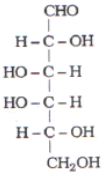
A
Glucose
B
Galactose
C
Fructose
D
Ribulose
Solution
(B) The given structural formula is an open-chain representation of an aldohexose sugar.
By observing the configuration of the hydroxyl $(-OH)$ groups on the chiral carbons:
$1$. The carbon at position $2$ has $-OH$ on the right.
$2$. The carbon at position $3$ has $-OH$ on the left.
$3$. The carbon at position $4$ has $-OH$ on the left.
$4$. The carbon at position $5$ has $-OH$ on the right.
This specific arrangement of hydroxyl groups corresponds to the sugar Galactose. Glucose,by contrast,has the $-OH$ group on the right at position $4$.
By observing the configuration of the hydroxyl $(-OH)$ groups on the chiral carbons:
$1$. The carbon at position $2$ has $-OH$ on the right.
$2$. The carbon at position $3$ has $-OH$ on the left.
$3$. The carbon at position $4$ has $-OH$ on the left.
$4$. The carbon at position $5$ has $-OH$ on the right.
This specific arrangement of hydroxyl groups corresponds to the sugar Galactose. Glucose,by contrast,has the $-OH$ group on the right at position $4$.
0 likes
View Solution247
EasyMCQ
Which sugar is represented by the structural formula shown below?
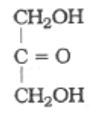
A
Glyceraldehyde
B
Ribulose
C
Dihydroxyacetone
D
Galactose
Solution
(C) The structural formula provided represents a triose sugar with a ketone functional group.
Specifically,it is $CH_2OH-C(=O)-CH_2OH$,which is the simplest ketose sugar known as Dihydroxyacetone.
It is a $3$-carbon sugar (triose) and is an isomer of glyceraldehyde.
Specifically,it is $CH_2OH-C(=O)-CH_2OH$,which is the simplest ketose sugar known as Dihydroxyacetone.
It is a $3$-carbon sugar (triose) and is an isomer of glyceraldehyde.
0 likes
View Solution248
MediumMCQ
$A$: Monosaccharide molecules cannot be hydrolyzed into simpler forms.
$R$: Monosaccharide is a simple sugar consisting of a single unit.
$R$: Monosaccharide is a simple sugar consisting of a single unit.
A
$A$ and $R$ are both true and $R$ is the correct explanation of $A$.
B
$A$ and $R$ are both true,but $R$ is not the correct explanation of $A$.
C
$A$ is true and $R$ is false.
D
$A$ is false and $R$ is true.
Solution
(A) Monosaccharides are the simplest form of carbohydrates,which cannot be further hydrolyzed into smaller sugar units. This is because they consist of only a single polyhydroxy aldehyde or ketone unit. Therefore,assertion $A$ is true. The reason $R$ correctly explains that monosaccharides are simple sugars consisting of a single unit,which is why they cannot be broken down further. Thus,$R$ is the correct explanation of $A$.
0 likes
View Solution249
MediumMCQ
$A$: Starch is a homopolymer of glucose.
$R$: Starch yields glucose upon digestion.
$R$: Starch yields glucose upon digestion.
A
$A$ and $R$ are true and $R$ is the correct explanation of $A$.
B
$A$ and $R$ are true,but $R$ is not the correct explanation of $A$.
C
$A$ is true and $R$ is false.
D
$A$ is false and $R$ is true.
Solution
(A) Starch is a polysaccharide,which is a polymer of glucose units. Since it is composed of only one type of monomer (glucose),it is classified as a homopolymer.
Digestion of starch involves the enzymatic hydrolysis of glycosidic bonds,which breaks the polymer down into its constituent glucose units.
Therefore,both statements are correct,and the fact that starch is a homopolymer of glucose is directly explained by the fact that it yields glucose upon digestion.
Digestion of starch involves the enzymatic hydrolysis of glycosidic bonds,which breaks the polymer down into its constituent glucose units.
Therefore,both statements are correct,and the fact that starch is a homopolymer of glucose is directly explained by the fact that it yields glucose upon digestion.
0 likes
View Solution250
MediumMCQ
Statement $P$: Monosaccharides can pass through the cell membrane.
Statement $Q$: Monosaccharides are the simplest carbohydrates.
Statement $Q$: Monosaccharides are the simplest carbohydrates.
A
Statement $P$ is true and Statement $Q$ is false.
B
Both Statement $P$ and $Q$ are true,but Statement $Q$ is not the correct explanation of Statement $P$.
C
Both Statement $P$ and $Q$ are true and Statement $Q$ is the correct explanation of Statement $P$.
D
Both Statement $P$ and $Q$ are false.
Solution
(C) Monosaccharides,such as glucose,are the simplest form of carbohydrates because they cannot be hydrolyzed further into smaller sugar units.
Because of their small size and simple structure,monosaccharides can easily pass through the cell membrane via facilitated diffusion or active transport,unlike complex polysaccharides which are too large to cross the membrane directly.
Therefore,Statement $P$ is true,Statement $Q$ is true,and Statement $Q$ provides the correct explanation for why monosaccharides can pass through the cell membrane.
Because of their small size and simple structure,monosaccharides can easily pass through the cell membrane via facilitated diffusion or active transport,unlike complex polysaccharides which are too large to cross the membrane directly.
Therefore,Statement $P$ is true,Statement $Q$ is true,and Statement $Q$ provides the correct explanation for why monosaccharides can pass through the cell membrane.
0 likes
View SolutionBiomolecules — Carbohydrates · Frequently Asked Questions
1Are these Biomolecules questions useful for JEE and NEET?
Yes. All questions in this section are mapped to JEE Main and NEET exam patterns. Previous year questions from JEE Main, NEET, GUJCET and state-level exams are included with full solutions.
2Can I switch to Hindi or Gujarati for these questions?
Yes. Use the language tabs in the hero section or the sidebar to view the same questions and solutions in English, Hindi or Gujarati.
3How do I generate a question paper from this subtopic?
Use the Vedclass Exam Paper Generator — select the chapter and subtopic, set difficulty, and generate Sets A, B, C, D automatically. First 3 chapters of every subject are free.
Vedclass Products
For Students
Vedclass Test Series
Mock tests in real JEE/NEET style with performance analysis. 5-day free trial.
Start Free TrialFor Teachers
Exam Paper Generator
Generate Set A/B/C/D papers from this chapter in 2 minutes. 3 chapters free.
Try FreeFor Institutes
Online Exam Module
Live online exams with unlimited students, 360° analytics & white-label branding.
See DemoFor Teachers & Institutes
Generate a Biomolecules Exam Paper in 2 Minutes
Select subtopic & difficulty — Sets A, B, C, D auto-generated with No Repeat logic.
First 3 chapters of every subject are free — no payment required.