
A English
Carbohydrates Questions in English
Class 11 Biology · Biomolecules · Carbohydrates
423+
Questions
English
Language
100%
With Solutions
Showing 50 of 423 questions in English
151
EasyMCQ
Which carbohydrates are insoluble in water?
A
Monosaccharides
B
Disaccharides
C
Polysaccharides
D
Both $B$ and $C$
Solution
(C) Monosaccharides and disaccharides are generally soluble in water because they are small molecules with many hydroxyl $(-OH)$ groups that can form hydrogen bonds with water.
Polysaccharides,such as starch,cellulose,and glycogen,are large,complex polymers with high molecular weights.
Due to their large size and the way they are packed,they have limited interaction with water molecules,making them insoluble or only sparingly soluble in water.
Polysaccharides,such as starch,cellulose,and glycogen,are large,complex polymers with high molecular weights.
Due to their large size and the way they are packed,they have limited interaction with water molecules,making them insoluble or only sparingly soluble in water.
0 likes
View Solution152
EasyMCQ
Which of the following is an unbranched polysaccharide chain made up of glucose units that forms starch?
A
Amylose
B
Amylopectin
C
Amylo polymer
D
Amylo peptide
Solution
(A) Starch is a storage polysaccharide in plants and is composed of two components: Amylose and Amylopectin.
Amylose is an unbranched,helical chain of $D$-glucose units linked by $\alpha-1, 4$-glycosidic bonds.
Amylopectin is a branched-chain polysaccharide consisting of $D$-glucose units linked by $\alpha-1, 4$-glycosidic bonds and $\alpha-1, 6$-glycosidic bonds at branch points.
Therefore,the unbranched component of starch is Amylose.
Amylose is an unbranched,helical chain of $D$-glucose units linked by $\alpha-1, 4$-glycosidic bonds.
Amylopectin is a branched-chain polysaccharide consisting of $D$-glucose units linked by $\alpha-1, 4$-glycosidic bonds and $\alpha-1, 6$-glycosidic bonds at branch points.
Therefore,the unbranched component of starch is Amylose.
0 likes
View Solution153
MediumMCQ
Which of the following is a component found in the structure of $RNA$ and $ATP$?
A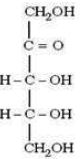
Fructose
B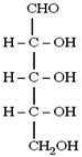
Ribose
C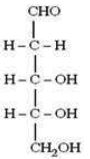
Deoxyribose
D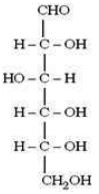
Glucose
Solution
(B) The structure of $RNA$ (Ribonucleic Acid) and $ATP$ (Adenosine Triphosphate) contains a pentose sugar known as ribose.
Ribose is a five-carbon sugar (aldopentose) with the chemical formula $C_5H_{10}O_5$.
Among the given structures,the second option (represented by the image in option $B$) corresponds to the open-chain structure of ribose,which is an aldopentose with hydroxyl groups on the same side for carbons $2, 3,$ and $4$.
Therefore,the correct component found in $RNA$ and $ATP$ is ribose.
Ribose is a five-carbon sugar (aldopentose) with the chemical formula $C_5H_{10}O_5$.
Among the given structures,the second option (represented by the image in option $B$) corresponds to the open-chain structure of ribose,which is an aldopentose with hydroxyl groups on the same side for carbons $2, 3,$ and $4$.
Therefore,the correct component found in $RNA$ and $ATP$ is ribose.
0 likes
View Solution154
MediumMCQ
In the formation of a disaccharide,the glycosidic bond is formed between:
A
The $1^{st}$ $C$ of one hexose sugar and the $5^{th}$ $C$ of another hexose sugar.
B
The $1^{st}$ $C$ of one hexose sugar and the $6^{th}$ $C$ of another hexose sugar.
C
The $1^{st}$ $C$ of one hexose sugar and the $4^{th}$ $C$ of another hexose sugar.
D
The $2^{nd}$ $C$ of one hexose sugar and the $4^{th}$ $C$ of another hexose sugar.
Solution
(C) glycosidic bond is a type of covalent bond that joins a carbohydrate (sugar) molecule to another group,which may or may not be another carbohydrate.
In the formation of common disaccharides like maltose or lactose,the bond typically forms between the anomeric carbon (the $1^{st}$ carbon) of one monosaccharide and the $4^{th}$ carbon of another monosaccharide.
This is known as a $(1 \rightarrow 4)$ glycosidic linkage.
Therefore,the correct option is $C$.
In the formation of common disaccharides like maltose or lactose,the bond typically forms between the anomeric carbon (the $1^{st}$ carbon) of one monosaccharide and the $4^{th}$ carbon of another monosaccharide.
This is known as a $(1 \rightarrow 4)$ glycosidic linkage.
Therefore,the correct option is $C$.
0 likes
View Solution155
EasyMCQ
Which of the following types of carbohydrates are not sweet in taste?
A
Monosaccharides
B
Disaccharides
C
Polysaccharides
D
All of the above
Solution
(C) Carbohydrates are classified based on their hydrolysis and sweetness.
Monosaccharides (e.g.,glucose,fructose) and disaccharides (e.g.,sucrose,lactose) are generally sweet in taste and are often called 'sugars'.
Polysaccharides (e.g.,starch,cellulose,glycogen) are complex carbohydrates consisting of long chains of monosaccharide units.
Due to their high molecular weight and complex structure,they are insoluble in water and are not sweet in taste.
Therefore,the correct answer is $C$.
Monosaccharides (e.g.,glucose,fructose) and disaccharides (e.g.,sucrose,lactose) are generally sweet in taste and are often called 'sugars'.
Polysaccharides (e.g.,starch,cellulose,glycogen) are complex carbohydrates consisting of long chains of monosaccharide units.
Due to their high molecular weight and complex structure,they are insoluble in water and are not sweet in taste.
Therefore,the correct answer is $C$.
0 likes
View Solution156
EasyMCQ
Which functional group is present in ketose sugars?
A
$>C=O$
B
$-COO^-$
C
$-CHO$
D
$-OH$
Solution
(A) Ketose sugars are monosaccharides that contain a ketone functional group. The general structure of a ketone group is a carbonyl group $(>C=O)$ bonded to two carbon atoms. In contrast,aldose sugars contain an aldehyde group $(-CHO)$. Therefore,the functional group present in ketose sugars is the carbonyl group represented by $>C=O$.
0 likes
View Solution157
EasyMCQ
What is produced by the hydrolysis of a sucrose molecule?
A
Glucose + Glucose
B
Glucose + Fructose
C
Glucose + Galactose
D
Fructose + Fructose
Solution
(B) Sucrose is a disaccharide composed of two monosaccharide units: glucose and fructose.
When sucrose undergoes hydrolysis, the glycosidic bond between these two units is broken by the addition of a water molecule.
This reaction is typically catalyzed by the enzyme sucrase or invertase.
The chemical equation for the hydrolysis is: $C_{12}H_{22}O_{11} + H_2O \rightarrow C_6H_{12}O_6$ (Glucose) + $C_6H_{12}O_6$ (Fructose).
Therefore, the hydrolysis of sucrose yields one molecule of glucose and one molecule of fructose.
When sucrose undergoes hydrolysis, the glycosidic bond between these two units is broken by the addition of a water molecule.
This reaction is typically catalyzed by the enzyme sucrase or invertase.
The chemical equation for the hydrolysis is: $C_{12}H_{22}O_{11} + H_2O \rightarrow C_6H_{12}O_6$ (Glucose) + $C_6H_{12}O_6$ (Fructose).
Therefore, the hydrolysis of sucrose yields one molecule of glucose and one molecule of fructose.
0 likes
View Solution158
EasyMCQ
What is the general formula for polysaccharides?
A
$(C_{10}H_6O_5)_n$
B
$(C_5H_{10}O_6)_n$
C
$(C_6H_5O_{10})_n$
D
$(C_6H_{10}O_5)_n$
Solution
(D) Polysaccharides are long-chain polymers of monosaccharides linked by glycosidic bonds.
Most common polysaccharides,such as starch,cellulose,and glycogen,are polymers of glucose $(C_6H_{12}O_6)$.
During the formation of a polysaccharide,each glycosidic linkage involves the removal of a water molecule $(H_2O)$ between two monosaccharide units.
The general formula for a monosaccharide is $(CH_2O)_n$,but for a polymer formed by dehydration synthesis,the formula is $(C_6H_{10}O_5)_n$,where $n$ represents the number of repeating units.
Most common polysaccharides,such as starch,cellulose,and glycogen,are polymers of glucose $(C_6H_{12}O_6)$.
During the formation of a polysaccharide,each glycosidic linkage involves the removal of a water molecule $(H_2O)$ between two monosaccharide units.
The general formula for a monosaccharide is $(CH_2O)_n$,but for a polymer formed by dehydration synthesis,the formula is $(C_6H_{10}O_5)_n$,where $n$ represents the number of repeating units.
0 likes
View Solution159
EasyMCQ
What is the formula for a triose sugar?
A
$C_6H_3O_6$
B
$C_3H_6O_3$
C
$C_6H_6O_3$
D
$C_3H_6O_6$
Solution
(B) triose sugar is a monosaccharide containing three carbon atoms.
The general formula for carbohydrates is $(CH_2O)_n$,where $n$ represents the number of carbon atoms.
For a triose sugar,$n = 3$.
Substituting $n = 3$ into the general formula: $C_3(H_2O)_3 = C_3H_6O_3$.
Therefore,the correct formula for a triose sugar is $C_3H_6O_3$.
The general formula for carbohydrates is $(CH_2O)_n$,where $n$ represents the number of carbon atoms.
For a triose sugar,$n = 3$.
Substituting $n = 3$ into the general formula: $C_3(H_2O)_3 = C_3H_6O_3$.
Therefore,the correct formula for a triose sugar is $C_3H_6O_3$.
0 likes
View Solution160
MediumMCQ
$PGAL$ is an example of which of the following?
A
Aldopentose sugar
B
Aldohexose sugar
C
Aldotriose sugar
D
Ketotriose sugar
Solution
(C) $PGAL$ stands for Phosphoglyceraldehyde,which is a $3$-carbon sugar.
It contains an aldehyde group at the first carbon position.
Since it has $3$ carbon atoms and an aldehyde functional group,it is classified as an aldotriose sugar.
Therefore,the correct option is $C$.
It contains an aldehyde group at the first carbon position.
Since it has $3$ carbon atoms and an aldehyde functional group,it is classified as an aldotriose sugar.
Therefore,the correct option is $C$.
0 likes
View Solution161
EasyMCQ
What is lactose composed of?
A
Glucose + Galactose
B
Glucose + Glucose
C
Glucose + Fructose
D
Fructose + Galactose
Solution
(A) Lactose is a disaccharide sugar composed of two monosaccharide units: $Glucose$ and $Galactose$.
It is commonly known as milk sugar and is linked by a $\beta-1,4-glycosidic$ bond.
It is commonly known as milk sugar and is linked by a $\beta-1,4-glycosidic$ bond.
0 likes
View Solution162
MediumMCQ
What type of sugar is glyceraldehyde?
A
Pentose
B
Hexose
C
Triose
D
Octose
Solution
(C) Glyceraldehyde is a simple sugar with the chemical formula $C_3H_6O_3$.
It contains $3$ carbon atoms in its structure.
Sugars with $3$ carbon atoms are classified as trioses.
Therefore,glyceraldehyde is a triose sugar.
It contains $3$ carbon atoms in its structure.
Sugars with $3$ carbon atoms are classified as trioses.
Therefore,glyceraldehyde is a triose sugar.
0 likes
View Solution163
EasyMCQ
What is obtained upon the hydrolysis of $Maltose$?
A
$Glucose + Galactose$
B
$Glucose + Fructose$
C
$Glucose + Glucose$
D
$Galactose + Fructose$
Solution
(C) $Maltose$ is a disaccharide composed of two $Glucose$ units linked by an $\alpha-1,4-glycosidic$ bond.
Upon hydrolysis,$Maltose$ breaks down into two molecules of $Glucose$ $(C_6H_{12}O_6)$.
The chemical reaction is: $C_{12}H_{22}O_{11} + H_2O \rightarrow 2C_6H_{12}O_6$.
Upon hydrolysis,$Maltose$ breaks down into two molecules of $Glucose$ $(C_6H_{12}O_6)$.
The chemical reaction is: $C_{12}H_{22}O_{11} + H_2O \rightarrow 2C_6H_{12}O_6$.
0 likes
View Solution164
EasyMCQ
Chitin is an example of which of the following?
A
Monosaccharide
B
Disaccharide
C
Polysaccharide
D
Oligosaccharide
Solution
(C) Chitin is a complex carbohydrate,specifically a nitrogen-containing polysaccharide.
It is a polymer of $N$-acetylglucosamine units.
It serves as a structural component in the cell walls of fungi and the exoskeletons of arthropods like insects and crustaceans.
Therefore,it is classified as a polysaccharide.
It is a polymer of $N$-acetylglucosamine units.
It serves as a structural component in the cell walls of fungi and the exoskeletons of arthropods like insects and crustaceans.
Therefore,it is classified as a polysaccharide.
0 likes
View Solution165
EasyMCQ
Which of the following atoms is not present in the structure of carbohydrate molecules?
A
$C$
B
$H$
C
$O$
D
$N$
Solution
(D) Carbohydrates are organic compounds composed of carbon $(C)$,hydrogen $(H)$,and oxygen $(O)$.
The general empirical formula for carbohydrates is $(CH_2O)_n$.
Nitrogen $(N)$ is typically found in proteins and nucleic acids,but it is not a constituent element of basic carbohydrate molecules.
Therefore,the correct option is $D$.
The general empirical formula for carbohydrates is $(CH_2O)_n$.
Nitrogen $(N)$ is typically found in proteins and nucleic acids,but it is not a constituent element of basic carbohydrate molecules.
Therefore,the correct option is $D$.
0 likes
View Solution166
EasyMCQ
Which of the following is not a type of carbohydrate?
A
Monosaccharide
B
Disaccharide
C
Polypeptide
D
Polysaccharide
Solution
(C) Carbohydrates are classified based on the number of sugar units they contain into monosaccharides,disaccharides,and polysaccharides.
$A$. Monosaccharides are simple sugars.
$B$. Disaccharides consist of two sugar units.
$D$. Polysaccharides are complex carbohydrates consisting of many sugar units.
$C$. Polypeptides are chains of amino acids linked by peptide bonds,which are the building blocks of proteins,not carbohydrates.
$A$. Monosaccharides are simple sugars.
$B$. Disaccharides consist of two sugar units.
$D$. Polysaccharides are complex carbohydrates consisting of many sugar units.
$C$. Polypeptides are chains of amino acids linked by peptide bonds,which are the building blocks of proteins,not carbohydrates.
0 likes
View Solution167
EasyMCQ
The simplest carbohydrate is:
A
Monosaccharide
B
Disaccharide
C
Fatty acid
D
Nucleotide
Solution
(A) Carbohydrates are classified based on the number of sugar units they contain.
Monosaccharides are the simplest form of carbohydrates,consisting of a single sugar unit that cannot be further hydrolyzed into simpler sugars.
Examples include glucose,fructose,and galactose.
Disaccharides are composed of two monosaccharide units,while fatty acids are lipids and nucleotides are the building blocks of nucleic acids.
Monosaccharides are the simplest form of carbohydrates,consisting of a single sugar unit that cannot be further hydrolyzed into simpler sugars.
Examples include glucose,fructose,and galactose.
Disaccharides are composed of two monosaccharide units,while fatty acids are lipids and nucleotides are the building blocks of nucleic acids.
0 likes
View Solution168
EasyMCQ
The general formula $C_n(H_2O)_n$ belongs to which of the following biomolecules?
A
Carbohydrates
B
Monosaccharides
C
Disaccharides
D
Polysaccharides
Solution
(A) The general formula $C_n(H_2O)_n$ represents the empirical formula for carbohydrates,which were historically referred to as 'hydrates of carbon'.
While this formula is a characteristic feature of many simple carbohydrates,it is most commonly associated with monosaccharides (e.g.,glucose $C_6H_{12}O_6$ where $n=6$).
However,in the context of general classification,this formula is the defining empirical representation for the class of carbohydrates.
While this formula is a characteristic feature of many simple carbohydrates,it is most commonly associated with monosaccharides (e.g.,glucose $C_6H_{12}O_6$ where $n=6$).
However,in the context of general classification,this formula is the defining empirical representation for the class of carbohydrates.
0 likes
View Solution169
MediumMCQ
Which of the following functional groups is present in the structure of a monosaccharide?
A
$ -COOH $
B
$ -CHO $
C
$ >C=O $
D
Both $ (B) $ and $ (C) $
Solution
(D) Monosaccharides are the simplest carbohydrates that cannot be further hydrolyzed into smaller sugar units.
Chemically,they are polyhydroxy aldehydes or polyhydroxy ketones.
If the monosaccharide contains an aldehyde group $( -CHO )$,it is called an aldose (e.g.,glucose).
If the monosaccharide contains a ketone group $( >C=O )$,it is called a ketose (e.g.,fructose).
Therefore,both aldehyde and ketone functional groups can be present in monosaccharides.
Chemically,they are polyhydroxy aldehydes or polyhydroxy ketones.
If the monosaccharide contains an aldehyde group $( -CHO )$,it is called an aldose (e.g.,glucose).
If the monosaccharide contains a ketone group $( >C=O )$,it is called a ketose (e.g.,fructose).
Therefore,both aldehyde and ketone functional groups can be present in monosaccharides.
0 likes
View Solution170
EasyMCQ
What is a monosaccharide containing a $-CHO$ functional group called?
A
Ketose sugar
B
Aldehyde sugar
C
Aldose sugar
D
Ketone sugar
Solution
(C) Monosaccharides are classified based on the functional group they contain.
If a monosaccharide contains an aldehyde group $(-CHO)$,it is known as an aldose sugar.
If a monosaccharide contains a ketone group $(>C=O)$,it is known as a ketose sugar.
Therefore,a monosaccharide with a $-CHO$ group is called an aldose sugar.
If a monosaccharide contains an aldehyde group $(-CHO)$,it is known as an aldose sugar.
If a monosaccharide contains a ketone group $(>C=O)$,it is known as a ketose sugar.
Therefore,a monosaccharide with a $-CHO$ group is called an aldose sugar.
0 likes
View Solution171
EasyMCQ
What is a monosaccharide containing a $C=O$ functional group called?
A
Ketose sugar
B
Aldehyde sugar
C
Aldose sugar
D
Ketone sugar
Solution
(A) Monosaccharides are classified based on the type of carbonyl group present in their structure.
If the carbonyl group is an aldehyde group $(-CHO)$,the sugar is called an aldose sugar.
If the carbonyl group is a ketone group $(C=O)$,the sugar is called a ketose sugar.
Therefore,a monosaccharide containing a $C=O$ functional group is known as a ketose sugar.
If the carbonyl group is an aldehyde group $(-CHO)$,the sugar is called an aldose sugar.
If the carbonyl group is a ketone group $(C=O)$,the sugar is called a ketose sugar.
Therefore,a monosaccharide containing a $C=O$ functional group is known as a ketose sugar.
0 likes
View Solution172
MediumMCQ
Which of the following is $NOT$ a characteristic of a monosaccharide?
A
Can pass through the cell membrane.
B
It is the simplest carbohydrate.
C
It is soluble in water.
D
It undergoes hydrolysis to form simpler forms.
Solution
(D) Monosaccharides are the simplest form of carbohydrates and cannot be further hydrolyzed into smaller sugar units.
Option $D$ states that they undergo hydrolysis to form simpler forms,which is incorrect because they are already in their simplest form.
Monosaccharides are generally water-soluble and,due to their small size,can often pass through cell membranes.
Option $D$ states that they undergo hydrolysis to form simpler forms,which is incorrect because they are already in their simplest form.
Monosaccharides are generally water-soluble and,due to their small size,can often pass through cell membranes.
0 likes
View Solution173
EasyMCQ
Which carbohydrate molecules cannot be further hydrolyzed into simpler forms?
A
Polysaccharides
B
Disaccharides
C
Monosaccharides
D
All of the above
Solution
(C) Monosaccharides are the simplest form of carbohydrates. They consist of a single sugar unit and cannot be hydrolyzed further into smaller sugar molecules. Disaccharides and polysaccharides are complex carbohydrates that can be broken down into monosaccharides through the process of hydrolysis.
0 likes
View Solution174
EasyMCQ
The classification of monosaccharides is based on which of the following?
A
The chemical bonds present in the structure of the molecules
B
The ratio of $H$ and $O$ atoms in the structure of the molecules
C
The valency of carbon atoms in the molecules
D
The number of carbon atoms in the molecules
Solution
(D) Monosaccharides are the simplest carbohydrates that cannot be hydrolyzed further into smaller sugar units.
They are classified based on the number of carbon atoms present in their structure.
For example,a monosaccharide with $3$ carbon atoms is called a triose,with $4$ carbons is a tetrose,with $5$ carbons is a pentose,and with $6$ carbons is a hexose.
They are classified based on the number of carbon atoms present in their structure.
For example,a monosaccharide with $3$ carbon atoms is called a triose,with $4$ carbons is a tetrose,with $5$ carbons is a pentose,and with $6$ carbons is a hexose.
0 likes
View Solution175
EasyMCQ
Which of the following is a biologically important monosaccharide?
A
Heptose
B
Pentose
C
Octose
D
Tetrose
Solution
(B) Monosaccharides are the simplest form of carbohydrates.
Biologically,$5$-carbon sugars known as pentoses are of immense importance.
Examples include ribose,which is a key component of $RNA$,and deoxyribose,which is a key component of $DNA$.
These sugars form the backbone of nucleic acids,which are essential for genetic information storage and transfer.
Therefore,pentose is the correct answer.
Biologically,$5$-carbon sugars known as pentoses are of immense importance.
Examples include ribose,which is a key component of $RNA$,and deoxyribose,which is a key component of $DNA$.
These sugars form the backbone of nucleic acids,which are essential for genetic information storage and transfer.
Therefore,pentose is the correct answer.
0 likes
View Solution176
EasyMCQ
Which of the following is an example of a monosaccharide?
A
Maltose
B
Cellulose
C
Hexose
D
Sucrose
Solution
(C) Monosaccharides are the simplest form of carbohydrates that cannot be further hydrolyzed into smaller sugar units.
Examples include glucose,fructose,and galactose,which are all hexoses $(C_6H_{12}O_6)$.
Maltose and sucrose are disaccharides,while cellulose is a polysaccharide.
Therefore,hexose is the correct category representing a monosaccharide.
Examples include glucose,fructose,and galactose,which are all hexoses $(C_6H_{12}O_6)$.
Maltose and sucrose are disaccharides,while cellulose is a polysaccharide.
Therefore,hexose is the correct category representing a monosaccharide.
0 likes
View Solution177
MediumMCQ
Which of the following is the molecular formula of a triose sugar?
A
$C_5H_{10}O_5$
B
$C_6H_{12}O_6$
C
$C_3H_{6}O_3$
D
$C_4H_{8}O_4$
Solution
(C) triose sugar is a monosaccharide containing three carbon atoms.
The general formula for carbohydrates is $(CH_2O)_n$,where $n$ represents the number of carbon atoms.
For a triose sugar,$n = 3$.
Substituting $n = 3$ into the formula,we get $C_3(H_2O)_3$,which simplifies to $C_3H_6O_3$.
Therefore,$C_3H_6O_3$ is the molecular formula for a triose sugar.
The general formula for carbohydrates is $(CH_2O)_n$,where $n$ represents the number of carbon atoms.
For a triose sugar,$n = 3$.
Substituting $n = 3$ into the formula,we get $C_3(H_2O)_3$,which simplifies to $C_3H_6O_3$.
Therefore,$C_3H_6O_3$ is the molecular formula for a triose sugar.
0 likes
View Solution178
EasyMCQ
$C_6H_{12}O_6$ is the molecular formula of which sugar?
A
Triose
B
Pentose
C
Heptose
D
Hexose
Solution
(D) The molecular formula $C_6H_{12}O_6$ represents a sugar with $6$ carbon atoms.
Sugars are classified based on the number of carbon atoms present in their molecule.
- Triose: $3$ carbon atoms $(C_3H_6O_3)$
- Pentose: $5$ carbon atoms $(C_5H_{10}O_5)$
- Hexose: $6$ carbon atoms $(C_6H_{12}O_6)$
- Heptose: $7$ carbon atoms $(C_7H_{14}O_7)$
Therefore,$C_6H_{12}O_6$ is a hexose sugar,such as glucose or fructose.
Sugars are classified based on the number of carbon atoms present in their molecule.
- Triose: $3$ carbon atoms $(C_3H_6O_3)$
- Pentose: $5$ carbon atoms $(C_5H_{10}O_5)$
- Hexose: $6$ carbon atoms $(C_6H_{12}O_6)$
- Heptose: $7$ carbon atoms $(C_7H_{14}O_7)$
Therefore,$C_6H_{12}O_6$ is a hexose sugar,such as glucose or fructose.
0 likes
View Solution179
EasyMCQ
Which of the following is a triose sugar?
A
Glyceraldehyde
B
Fructose
C
Ribose
D
Galactose
Solution
(A) triose sugar is a monosaccharide containing three carbon atoms.
$Glyceraldehyde$ is a triose sugar with the chemical formula $C_3H_6O_3$.
$Fructose$ and $Galactose$ are hexose sugars $(C_6H_{12}O_6)$,while $Ribose$ is a pentose sugar $(C_5H_{10}O_5)$.
$Glyceraldehyde$ is a triose sugar with the chemical formula $C_3H_6O_3$.
$Fructose$ and $Galactose$ are hexose sugars $(C_6H_{12}O_6)$,while $Ribose$ is a pentose sugar $(C_5H_{10}O_5)$.
0 likes
View Solution180
EasyMCQ
Which of the following is an aldose sugar?
A
Dihydroxyacetone
B
Ribulose
C
Ribose
D
Fructose
Solution
(C) An aldose sugar is a monosaccharide that contains an aldehyde group $(-CHO)$ at the end of the carbon chain.
Among the given options:
$1$. Dihydroxyacetone is a ketose sugar (contains a ketone group).
$2$. Ribulose is a ketose sugar.
$3$. Ribose is an aldose sugar (contains an aldehyde group).
$4$. Fructose is a ketose sugar.
Therefore,Ribose is the correct answer.
Among the given options:
$1$. Dihydroxyacetone is a ketose sugar (contains a ketone group).
$2$. Ribulose is a ketose sugar.
$3$. Ribose is an aldose sugar (contains an aldehyde group).
$4$. Fructose is a ketose sugar.
Therefore,Ribose is the correct answer.
0 likes
View Solution181
EasyMCQ
Which of the following is an example of a ketose sugar?
A
Glyceraldehyde
B
Ribose
C
Galactose
D
Dihydroxyacetone
Solution
(D) ketose sugar is a monosaccharide containing one ketone group per molecule.
Among the given options:
$1$. Glyceraldehyde is an aldotriose (contains an aldehyde group).
$2$. Ribose is an aldopentose (contains an aldehyde group).
$3$. Galactose is an aldohexose (contains an aldehyde group).
$4$. Dihydroxyacetone is a ketotriose (contains a ketone group).
Therefore,Dihydroxyacetone is the correct example of a ketose sugar.
Among the given options:
$1$. Glyceraldehyde is an aldotriose (contains an aldehyde group).
$2$. Ribose is an aldopentose (contains an aldehyde group).
$3$. Galactose is an aldohexose (contains an aldehyde group).
$4$. Dihydroxyacetone is a ketotriose (contains a ketone group).
Therefore,Dihydroxyacetone is the correct example of a ketose sugar.
0 likes
View Solution182
EasyMCQ
Ribulose is which type of sugar?
A
Pentose
B
Triose
C
Hexose
D
Tetrose
Solution
(A) Ribulose is a ketopentose sugar,which means it contains $5$ carbon atoms and a ketone functional group.
Since it has $5$ carbon atoms,it is classified as a pentose sugar.
It plays a crucial role in the Calvin cycle as the acceptor of $CO_2$ in the form of Ribulose-$1,5$-bisphosphate $(RuBP)$.
Since it has $5$ carbon atoms,it is classified as a pentose sugar.
It plays a crucial role in the Calvin cycle as the acceptor of $CO_2$ in the form of Ribulose-$1,5$-bisphosphate $(RuBP)$.
0 likes
View Solution183
EasyMCQ
Which of the following is not an example of a hexose sugar?
A
Ribulose
B
Glucose
C
Fructose
D
Galactose
Solution
(A) hexose sugar is a monosaccharide containing $6$ carbon atoms,with the general chemical formula $C_6H_{12}O_6$.
Glucose,Fructose,and Galactose are all examples of hexose sugars.
Ribulose is a ketopentose sugar,which contains $5$ carbon atoms and has the chemical formula $C_5H_{10}O_5$.
Therefore,Ribulose is not a hexose sugar.
Glucose,Fructose,and Galactose are all examples of hexose sugars.
Ribulose is a ketopentose sugar,which contains $5$ carbon atoms and has the chemical formula $C_5H_{10}O_5$.
Therefore,Ribulose is not a hexose sugar.
0 likes
View Solution184
EasyMCQ
Which of the following is an example of a ketohexose sugar?
A
Glucose
B
Fructose
C
Galactose
D
Ribulose
Solution
(B) ketohexose is a monosaccharide containing six carbon atoms and a ketone group.
Glucose and Galactose are aldohexoses (containing an aldehyde group).
Ribulose is a ketopentose (containing five carbon atoms).
Fructose is a ketohexose with the chemical formula $C_6H_{12}O_6$ and contains a ketone functional group at the $C-2$ position.
Glucose and Galactose are aldohexoses (containing an aldehyde group).
Ribulose is a ketopentose (containing five carbon atoms).
Fructose is a ketohexose with the chemical formula $C_6H_{12}O_6$ and contains a ketone functional group at the $C-2$ position.
0 likes
View Solution185
EasyMCQ
Which sugar is found in fruit juices?
A
Glucose
B
Galactose
C
Fructose
D
Ribulose
Solution
(C) Fructose is a simple monosaccharide found in many plants,where it is often bonded to glucose to form the disaccharide sucrose. It is commonly known as 'fruit sugar' because it is the primary sugar found in most fruits and fruit juices.
0 likes
View Solution186
MediumMCQ
Which of the following is an aldohexose sugar?
A
Glucose
B
Galactose
C
Fructose
D
Both $(A)$ and $(B)$
Solution
(D) An aldohexose is a $6$-carbon sugar containing an aldehyde group $(-CHO)$.
Glucose $(C_6H_{12}O_6)$ is an aldohexose because it has an aldehyde group at the $C_1$ position.
Galactose $(C_6H_{12}O_6)$ is also an aldohexose and is an epimer of glucose at the $C_4$ position.
Fructose $(C_6H_{12}O_6)$ is a ketohexose because it contains a ketone group $(>C=O)$ at the $C_2$ position.
Therefore,both glucose and galactose are aldohexoses.
Glucose $(C_6H_{12}O_6)$ is an aldohexose because it has an aldehyde group at the $C_1$ position.
Galactose $(C_6H_{12}O_6)$ is also an aldohexose and is an epimer of glucose at the $C_4$ position.
Fructose $(C_6H_{12}O_6)$ is a ketohexose because it contains a ketone group $(>C=O)$ at the $C_2$ position.
Therefore,both glucose and galactose are aldohexoses.
0 likes
View Solution187
MediumMCQ
Which monosaccharide molecules are typically involved in the formation of disaccharides?
A
Triose
B
Pentose
C
Hexose
D
Tetrose
Solution
(C) Disaccharides are carbohydrates formed by the condensation of two monosaccharide units through a glycosidic bond.
Common examples of disaccharides include sucrose,lactose,and maltose.
Sucrose is composed of glucose and fructose,while lactose is composed of glucose and galactose,and maltose is composed of two glucose units.
Glucose,fructose,and galactose are all $6$-carbon sugars,which are classified as hexoses.
Therefore,hexose monosaccharides are typically involved in the formation of disaccharides.
Common examples of disaccharides include sucrose,lactose,and maltose.
Sucrose is composed of glucose and fructose,while lactose is composed of glucose and galactose,and maltose is composed of two glucose units.
Glucose,fructose,and galactose are all $6$-carbon sugars,which are classified as hexoses.
Therefore,hexose monosaccharides are typically involved in the formation of disaccharides.
0 likes
View Solution188
MediumMCQ
Which of the following sugars cannot pass through the plasma membrane?
A
Glucose
B
Maltose
C
Galactose
D
Fructose
Solution
(B) The plasma membrane is selectively permeable. Monosaccharides like $Glucose$,$Galactose$,and $Fructose$ are small molecules that can pass through the plasma membrane via facilitated diffusion or active transport using specific transporters. However,$Maltose$ is a disaccharide (composed of two glucose units) and is too large to pass through the plasma membrane directly without being hydrolyzed into monosaccharides by enzymes like maltase located on the intestinal brush border.
0 likes
View Solution189
EasyMCQ
What is obtained from the hydrolysis of a sucrose molecule?
A
Glucose + Glucose
B
Glucose + Fructose
C
Glucose + Lactose
D
Galactose + Fructose
Solution
(B) Sucrose is a disaccharide composed of two monosaccharide units: glucose and fructose.
Upon hydrolysis, the glycosidic bond between these two units is broken by the addition of a water molecule.
This reaction is represented as: $C_{12}H_{22}O_{11} + H_2O \rightarrow C_6H_{12}O_6$ (Glucose) + $C_6H_{12}O_6$ (Fructose).
Therefore, the hydrolysis of sucrose yields one molecule of glucose and one molecule of fructose.
Upon hydrolysis, the glycosidic bond between these two units is broken by the addition of a water molecule.
This reaction is represented as: $C_{12}H_{22}O_{11} + H_2O \rightarrow C_6H_{12}O_6$ (Glucose) + $C_6H_{12}O_6$ (Fructose).
Therefore, the hydrolysis of sucrose yields one molecule of glucose and one molecule of fructose.
0 likes
View Solution190
EasyMCQ
What is formed by the glycosidic linkage of glucose and galactose?
A
Sucrose
B
Lactose
C
Maltose
D
Fructose
Solution
(B) Lactose is a disaccharide formed by the condensation reaction between one molecule of $D-glucose$ and one molecule of $D-galactose$. This reaction involves the formation of a $\beta-1,4-glycosidic$ linkage between the two monosaccharides. Sucrose is formed from glucose and fructose,while maltose is formed from two molecules of glucose.
0 likes
View Solution191
EasyMCQ
What is formed when a large number of monosaccharide units are linked together by glycosidic bonds?
A
Disaccharide
B
Polypeptide
C
Polysaccharide
D
Polynucleotide
Solution
(C) Monosaccharides are the simplest form of carbohydrates.
When a large number of monosaccharide units are linked together by glycosidic bonds,they form complex carbohydrates known as polysaccharides.
Examples of polysaccharides include starch,glycogen,and cellulose.
Disaccharides are formed by the linkage of only two monosaccharide units.
Polypeptides are chains of amino acids linked by peptide bonds.
Polynucleotides are chains of nucleotides linked by phosphodiester bonds.
When a large number of monosaccharide units are linked together by glycosidic bonds,they form complex carbohydrates known as polysaccharides.
Examples of polysaccharides include starch,glycogen,and cellulose.
Disaccharides are formed by the linkage of only two monosaccharide units.
Polypeptides are chains of amino acids linked by peptide bonds.
Polynucleotides are chains of nucleotides linked by phosphodiester bonds.
0 likes
View Solution192
MediumMCQ
Which of the following is a characteristic of a polysaccharide?
A
They are sweet in taste
B
They are the simplest carbohydrates
C
They can pass through the cell membrane
D
They are insoluble in water
Solution
(D) Polysaccharides are complex carbohydrates formed by the polymerization of many monosaccharide units.
$1$. They are not sweet in taste (unlike monosaccharides and disaccharides).
$2$. They are complex polymers,not simple carbohydrates.
$3$. Due to their large molecular size,they cannot easily pass through the cell membrane.
$4$. They are generally insoluble in water because of their high molecular weight and complex structure.
$1$. They are not sweet in taste (unlike monosaccharides and disaccharides).
$2$. They are complex polymers,not simple carbohydrates.
$3$. Due to their large molecular size,they cannot easily pass through the cell membrane.
$4$. They are generally insoluble in water because of their high molecular weight and complex structure.
0 likes
View Solution193
EasyMCQ
Which of the following is not a polysaccharide?
A
Cellulose
B
Maltose
C
Glycogen
D
Lignin
Solution
(B) polysaccharide is a long chain of monosaccharide units linked by glycosidic bonds.
$1$. Cellulose is a structural polysaccharide found in plant cell walls.
$2$. Glycogen is a storage polysaccharide found in animals.
$3$. Maltose is a disaccharide composed of two glucose units.
$4$. Lignin is a complex organic polymer deposited in the cell walls of many plants,but it is not a carbohydrate (polysaccharide).
Therefore,both Maltose and Lignin are not polysaccharides,but in the context of typical biology questions regarding carbohydrates,Maltose is a disaccharide and Lignin is a non-carbohydrate polymer. Given the options,Maltose is a disaccharide and Lignin is a complex polymer. However,Maltose is the most common answer for 'not a polysaccharide' in carbohydrate classification questions.
$1$. Cellulose is a structural polysaccharide found in plant cell walls.
$2$. Glycogen is a storage polysaccharide found in animals.
$3$. Maltose is a disaccharide composed of two glucose units.
$4$. Lignin is a complex organic polymer deposited in the cell walls of many plants,but it is not a carbohydrate (polysaccharide).
Therefore,both Maltose and Lignin are not polysaccharides,but in the context of typical biology questions regarding carbohydrates,Maltose is a disaccharide and Lignin is a non-carbohydrate polymer. Given the options,Maltose is a disaccharide and Lignin is a complex polymer. However,Maltose is the most common answer for 'not a polysaccharide' in carbohydrate classification questions.
0 likes
View Solution194
EasyMCQ
The unbranched polysaccharide chain made up of glucose units present in starch is:
A
Amylose
B
Amylopectin
C
Cellulose
D
Both $(A)$ and $(B)$
Solution
(A) Starch is a polysaccharide composed of two types of glucose polymers: Amylose and Amylopectin.
Amylose is a linear,unbranched chain of $\alpha$-$D$-glucose units linked by $\alpha(1\to4)$ glycosidic bonds.
Amylopectin is a branched-chain polymer of $\alpha$-$D$-glucose units containing both $\alpha(1\to4)$ and $\alpha(1\to6)$ glycosidic linkages.
Therefore,the unbranched component of starch is Amylose.
Amylose is a linear,unbranched chain of $\alpha$-$D$-glucose units linked by $\alpha(1\to4)$ glycosidic bonds.
Amylopectin is a branched-chain polymer of $\alpha$-$D$-glucose units containing both $\alpha(1\to4)$ and $\alpha(1\to6)$ glycosidic linkages.
Therefore,the unbranched component of starch is Amylose.
0 likes
View Solution195
MediumMCQ
Which of the following is a branched polysaccharide chain of glucose?
A
Amylose
B
Amylopectin
C
Starch
D
Both $(A)$ and $(B)$
Solution
(B) Starch is a storage polysaccharide in plants and is composed of two components: Amylose and Amylopectin.
Amylose is a linear,unbranched polymer of $\alpha$-$D$-glucose units linked by $\alpha(1 \rightarrow 4)$ glycosidic bonds.
Amylopectin is a branched polymer of $\alpha$-$D$-glucose units,containing both $\alpha(1 \rightarrow 4)$ and $\alpha(1 \rightarrow 6)$ glycosidic bonds.
Therefore,Amylopectin is the branched polysaccharide chain of glucose.
Amylose is a linear,unbranched polymer of $\alpha$-$D$-glucose units linked by $\alpha(1 \rightarrow 4)$ glycosidic bonds.
Amylopectin is a branched polymer of $\alpha$-$D$-glucose units,containing both $\alpha(1 \rightarrow 4)$ and $\alpha(1 \rightarrow 6)$ glycosidic bonds.
Therefore,Amylopectin is the branched polysaccharide chain of glucose.
0 likes
View Solution196
EasyMCQ
In which form is food stored in plants?
A
Glycogen
B
Cellulose
C
Starch
D
Lignin
Solution
(C) Plants synthesize glucose during photosynthesis. Since glucose is soluble and reactive,it is converted into a complex polysaccharide called $Starch$ for storage. $Starch$ is the primary storage carbohydrate in plants,typically stored in amyloplasts within cells. In contrast,animals store energy in the form of $Glycogen$.
0 likes
View Solution197
EasyMCQ
Which of the following is an example of an amylose polysaccharide?
A
Cellulose
B
Starch
C
Glycogen
D
Chitin
Solution
(B) Starch is a polysaccharide that is composed of two types of glucose polymers: amylose and amylopectin.
Amylose is a linear,unbranched chain of $\alpha-D-glucose$ units linked by $\alpha-1,4-glycosidic$ bonds.
Since amylose is a major component of starch,starch is the correct answer among the given options.
Amylose is a linear,unbranched chain of $\alpha-D-glucose$ units linked by $\alpha-1,4-glycosidic$ bonds.
Since amylose is a major component of starch,starch is the correct answer among the given options.
0 likes
View Solution198
EasyMCQ
In which form is food stored in animals?
A
Starch
B
Cellulose
C
Glycogen
D
Lignin
Solution
(C) In animals,carbohydrates are stored in the form of $Glycogen$.
$Glycogen$ is a multi-branched polysaccharide of glucose that serves as a form of energy storage in animals,fungi,and bacteria.
$Starch$ is the storage form of carbohydrates in plants.
$Cellulose$ is a structural polysaccharide found in plant cell walls.
$Lignin$ is a complex organic polymer deposited in the cell walls of many plants,making them rigid and woody.
$Glycogen$ is a multi-branched polysaccharide of glucose that serves as a form of energy storage in animals,fungi,and bacteria.
$Starch$ is the storage form of carbohydrates in plants.
$Cellulose$ is a structural polysaccharide found in plant cell walls.
$Lignin$ is a complex organic polymer deposited in the cell walls of many plants,making them rigid and woody.
0 likes
View Solution199
EasyMCQ
The primary source of energy in living organisms is:
A
Lipids
B
Carbohydrates
C
Proteins
D
Nucleic acids
Solution
(B) Carbohydrates are the primary and most readily available source of energy for living organisms.
They are broken down into glucose,which is then used in cellular respiration to produce $ATP$ (Adenosine Triphosphate),the energy currency of the cell.
While lipids provide more energy per gram,carbohydrates are preferred for immediate energy requirements.
They are broken down into glucose,which is then used in cellular respiration to produce $ATP$ (Adenosine Triphosphate),the energy currency of the cell.
While lipids provide more energy per gram,carbohydrates are preferred for immediate energy requirements.
0 likes
View Solution200
EasyMCQ
Which non-lipid component is present in the structure of a glycolipid?
A
Phosphate
B
Protein
C
Sulphate
D
Carbohydrate
Solution
(D) glycolipid is a lipid molecule that has a carbohydrate chain attached to it.
These molecules are essential components of cell membranes,where the carbohydrate portion extends into the extracellular space to facilitate cell-cell recognition and communication.
Unlike phospholipids,which contain a phosphate group,glycolipids contain a sugar or carbohydrate moiety as their non-lipid component.
These molecules are essential components of cell membranes,where the carbohydrate portion extends into the extracellular space to facilitate cell-cell recognition and communication.
Unlike phospholipids,which contain a phosphate group,glycolipids contain a sugar or carbohydrate moiety as their non-lipid component.
0 likes
View SolutionBiomolecules — Carbohydrates · Frequently Asked Questions
1Are these Biomolecules questions useful for JEE and NEET?
Yes. All questions in this section are mapped to JEE Main and NEET exam patterns. Previous year questions from JEE Main, NEET, GUJCET and state-level exams are included with full solutions.
2Can I switch to Hindi or Gujarati for these questions?
Yes. Use the language tabs in the hero section or the sidebar to view the same questions and solutions in English, Hindi or Gujarati.
3How do I generate a question paper from this subtopic?
Use the Vedclass Exam Paper Generator — select the chapter and subtopic, set difficulty, and generate Sets A, B, C, D automatically. First 3 chapters of every subject are free.
Vedclass Products
For Students
Vedclass Test Series
Mock tests in real JEE/NEET style with performance analysis. 5-day free trial.
Start Free TrialFor Teachers
Exam Paper Generator
Generate Set A/B/C/D papers from this chapter in 2 minutes. 3 chapters free.
Try FreeFor Institutes
Online Exam Module
Live online exams with unlimited students, 360° analytics & white-label branding.
See DemoFor Teachers & Institutes
Generate a Biomolecules Exam Paper in 2 Minutes
Select subtopic & difficulty — Sets A, B, C, D auto-generated with No Repeat logic.
First 3 chapters of every subject are free — no payment required.