
A English
Carbohydrates Questions in English
Class 11 Biology · Biomolecules · Carbohydrates
423+
Questions
English
Language
100%
With Solutions
Showing 50 of 423 questions in English
101
MediumMCQ
Excessive intake of . . . . . . leads to an increase in body fat.
A
Vitamins
B
Minerals
C
Carbohydrates
D
None of these
Solution
(C) Carbohydrates are the primary source of energy for the body. When consumed in excess,the body converts the surplus glucose into glycogen for short-term storage in the liver and muscles. Once these storage sites are full,the remaining excess carbohydrates are converted into triglycerides (fats) through a process called de novo lipogenesis and stored in adipose tissue,leading to an increase in body fat.
0 likes
View Solution102
EasyMCQ
Humans cannot digest which of the following?
A
Glycogen
B
Glucose
C
Dextrin
D
Cellulose
Solution
(D) Humans lack the enzyme $Cellulase$,which is required to break down the $\beta-1,4$ glycosidic bonds present in $Cellulose$. $Cellulose$ is a structural polysaccharide found in plant cell walls. While humans can digest $Glycogen$ (stored energy),$Glucose$ (monosaccharide),and $Dextrin$ (a breakdown product of starch),they cannot digest $Cellulose$ due to the absence of the necessary digestive enzyme.
0 likes
View Solution103
MediumMCQ
Which stored food is utilized during the state of starvation in humans?
A
Fat
B
Protein
C
Glycogen
D
Vitamin
Solution
(C) During the state of starvation,the body first utilizes the readily available stored energy source.
$1$. The primary stored carbohydrate in humans is $Glycogen$,which is stored in the liver and muscles.
$2$. Once the $Glycogen$ reserves are depleted,the body begins to break down stored $Fats$ (adipose tissue) to provide energy.
$3$. $Proteins$ are typically used as a last resort for energy when other reserves are exhausted.
$4$. Since the question asks for the stored food utilized during starvation (implying the immediate reserve),$Glycogen$ is the correct answer as it is the first to be mobilized.
$1$. The primary stored carbohydrate in humans is $Glycogen$,which is stored in the liver and muscles.
$2$. Once the $Glycogen$ reserves are depleted,the body begins to break down stored $Fats$ (adipose tissue) to provide energy.
$3$. $Proteins$ are typically used as a last resort for energy when other reserves are exhausted.
$4$. Since the question asks for the stored food utilized during starvation (implying the immediate reserve),$Glycogen$ is the correct answer as it is the first to be mobilized.
0 likes
View Solution104
EasyMCQ
Which proteoglycan found in cartilage is a part of polysaccharide?
A
Chondroitin
B
Casein
C
Ossein
D
Cartilagin
Solution
(A) Cartilage is a specialized connective tissue. The matrix of cartilage is rich in a complex polysaccharide called chondroitin sulfate,which is a type of proteoglycan.
$A$. Chondroitin (specifically chondroitin sulfate) is the correct component found in the cartilage matrix.
$B$. Casein is a protein found in milk.
$C$. Ossein is the protein matrix found in bone.
$D$. Cartilagin is not a standard biological term for a specific proteoglycan.
$A$. Chondroitin (specifically chondroitin sulfate) is the correct component found in the cartilage matrix.
$B$. Casein is a protein found in milk.
$C$. Ossein is the protein matrix found in bone.
$D$. Cartilagin is not a standard biological term for a specific proteoglycan.
0 likes
View Solution105
MediumMCQ
Which sugars are present in sugarcane juice?
A
Sucrose + Glucose
B
Sucrose + Fructose
C
Sucrose + Maltose
D
Only Sucrose
Solution
(A) Sugarcane juice is primarily composed of sucrose,which is a disaccharide. During the process of photosynthesis and storage in the stem,sugarcane also contains significant amounts of glucose and fructose as intermediate products or components of the sap. Therefore,sugarcane juice contains a mixture of sucrose,glucose,and fructose. Among the given options,the most accurate representation of the sugars found in sugarcane juice is $Sucrose + Glucose + Fructose$. However,since the question asks for the primary components,and considering standard biological contexts,sugarcane juice is a rich source of $Sucrose$,$Glucose$,and $Fructose$.
0 likes
View Solution106
EasyMCQ
Which of the following is a rich source of carbohydrates?
A
Sorghum
B
Groundnut
C
Chickpea
D
Wheat
Solution
(D) Wheat ($Triticum$ $aestivum$) is a cereal grain and is a primary source of carbohydrates in the human diet.
Groundnut is rich in fats and proteins.
Chickpea is a pulse,which is rich in proteins.
Sorghum is also a cereal,but wheat is widely recognized as a staple source of carbohydrates globally.
Therefore,among the given options,wheat is the most appropriate answer.
Groundnut is rich in fats and proteins.
Chickpea is a pulse,which is rich in proteins.
Sorghum is also a cereal,but wheat is widely recognized as a staple source of carbohydrates globally.
Therefore,among the given options,wheat is the most appropriate answer.
0 likes
View Solution107
MediumMCQ
The shape of starch grains found in potato is .......
A
Ovoid, eccentric and simple
B
Ovoid, concentric and simple
C
Ovoid, eccentric and complex
D
Ovoid, concentric and complex
Solution
(A) Starch grains in potato $(Solanum \text{ } tuberosum)$ are stored in amyloplasts.
These grains are $ovoid$ in shape.
They are $eccentric$, meaning the hilum (the point of origin of starch deposition) is located towards one side of the grain.
They are $simple$ because each grain consists of a single unit without any compound structure.
These grains are $ovoid$ in shape.
They are $eccentric$, meaning the hilum (the point of origin of starch deposition) is located towards one side of the grain.
They are $simple$ because each grain consists of a single unit without any compound structure.
0 likes
View Solution108
EasyMCQ
Which of the following is a disaccharide?
A
Glucose
B
Fructose
C
Sucrose
D
Galactose
Solution
(C) disaccharide is a sugar (carbohydrate) composed of two monosaccharide units joined by a glycosidic bond.
Glucose,fructose,and galactose are all monosaccharides (simple sugars).
Sucrose is a disaccharide formed by the combination of one molecule of glucose and one molecule of fructose.
Glucose,fructose,and galactose are all monosaccharides (simple sugars).
Sucrose is a disaccharide formed by the combination of one molecule of glucose and one molecule of fructose.
0 likes
View Solution109
EasyMCQ
Which of the following carbohydrates is a monosaccharide?
A
Glucose
B
Sucrose
C
Starch
D
Cellulose
Solution
(A) Monosaccharides are the simplest form of carbohydrates that cannot be hydrolyzed into smaller sugar units.
$Glucose$ $(C_6H_{12}O_6)$ is a classic example of a monosaccharide.
$Sucrose$ is a disaccharide (composed of glucose and fructose).
$Starch$ and $Cellulose$ are polysaccharides (complex polymers of glucose units).
Therefore, the correct option is $A$.
$Glucose$ $(C_6H_{12}O_6)$ is a classic example of a monosaccharide.
$Sucrose$ is a disaccharide (composed of glucose and fructose).
$Starch$ and $Cellulose$ are polysaccharides (complex polymers of glucose units).
Therefore, the correct option is $A$.
0 likes
View Solution110
EasyMCQ
Glucose and galactose together form which of the following?
A
Maltose
B
Sucrose
C
Isomaltose
D
Lactose
Solution
(D) Lactose is a disaccharide sugar composed of two monosaccharide units: glucose and galactose.
It is commonly known as milk sugar.
The chemical reaction can be represented as: $\text{Glucose} + \text{Galactose} \rightarrow \text{Lactose} + \text{H}_2\text{O}$.
It is commonly known as milk sugar.
The chemical reaction can be represented as: $\text{Glucose} + \text{Galactose} \rightarrow \text{Lactose} + \text{H}_2\text{O}$.
0 likes
View Solution111
EasyMCQ
The simple sugar in the blood is .......
A
Maltose
B
Lactose
C
Sucrose
D
Glucose
Solution
(D) The simple sugar present in the blood is $Glucose$.
$Glucose$ is a monosaccharide and is the primary source of energy for the cells in the human body.
After the digestion of carbohydrates,they are converted into $Glucose$,which is then absorbed into the bloodstream to be transported to various tissues.
$Glucose$ is a monosaccharide and is the primary source of energy for the cells in the human body.
After the digestion of carbohydrates,they are converted into $Glucose$,which is then absorbed into the bloodstream to be transported to various tissues.
0 likes
View Solution112
EasyMCQ
Our food mainly consists of .......
A
Carbohydrates
B
Cellulose
C
Sucrose
D
Glucose
Solution
(A) Our food consists of major components like carbohydrates,proteins,and fats,along with minor components like vitamins and minerals. Among these,carbohydrates are the primary source of energy and constitute the bulk of our daily diet. Therefore,our food mainly consists of carbohydrates.
0 likes
View Solution113
EasyMCQ
Glycogen is stored in . . . . . . .
A
Blood
B
Liver
C
Lungs
D
Kidneys
Solution
(B) The liver is the primary organ responsible for the storage of glycogen in the human body.
When blood glucose levels are high,the liver converts excess glucose into glycogen through a process called glycogenesis.
This stored glycogen can be broken down back into glucose (glycogenolysis) and released into the bloodstream when the body requires energy,thus helping to maintain blood sugar homeostasis.
When blood glucose levels are high,the liver converts excess glucose into glycogen through a process called glycogenesis.
This stored glycogen can be broken down back into glucose (glycogenolysis) and released into the bloodstream when the body requires energy,thus helping to maintain blood sugar homeostasis.
0 likes
View Solution114
EasyMCQ
The most abundant component found on Earth is...
A
Protein
B
Cellulose
C
Lipid
D
Steroids
Solution
(B) Cellulose is the most abundant organic compound found in the biosphere. It is a structural polysaccharide that forms the primary component of the cell wall in plants. Because plants are the most abundant organisms on Earth,cellulose is considered the most abundant organic molecule.
0 likes
View Solution115
EasyMCQ
Lactose is composed of ...... .
A
Glucose + Galactose
B
Glucose + Fructose
C
Glucose + Glucose
D
Glucose + Mannose
Solution
(A) Lactose is a disaccharide sugar composed of two monosaccharide units: $Glucose$ and $Galactose$.
It is commonly found in milk and is broken down by the enzyme $Lactase$ into its constituent monosaccharides during digestion.
It is commonly found in milk and is broken down by the enzyme $Lactase$ into its constituent monosaccharides during digestion.
0 likes
View Solution116
MediumMCQ
Humans ingest carbohydrates as a source of energy,which are obtained from ......
A
Starch
B
Cellulose
C
Both
D
None
Solution
(A) Humans ingest carbohydrates primarily in the form of starch,which is a polysaccharide and a major storage form of energy in plants.
While cellulose is also a carbohydrate found in plants,humans lack the enzyme $cellulase$ required to digest it,so it cannot be used as a direct source of energy.
Therefore,starch is the primary source of energy among the given options.
While cellulose is also a carbohydrate found in plants,humans lack the enzyme $cellulase$ required to digest it,so it cannot be used as a direct source of energy.
Therefore,starch is the primary source of energy among the given options.
0 likes
View Solution117
EasyMCQ
The concentration of glucose in the blood for normal body functions is.....
A
$0.08 - 0.1\, g/100\, ml$
B
$200\, mg/100\, ml$
C
$100\, g/100\, ml$
D
$500\, mg/100\, ml$
Solution
(A) The normal fasting blood glucose level in a healthy human is typically maintained between $70$ and $100\, mg/100\, ml$ (or $0.07 - 0.1\, g/100\, ml$).
This concentration is essential for providing a constant energy supply to the cells,particularly the brain and red blood cells.
Among the given options,$0.08 - 0.1\, g/100\, ml$ represents the physiological range for normal blood glucose concentration.
This concentration is essential for providing a constant energy supply to the cells,particularly the brain and red blood cells.
Among the given options,$0.08 - 0.1\, g/100\, ml$ represents the physiological range for normal blood glucose concentration.
0 likes
View Solution118
MediumMCQ
What are the components of sugarcane juice?
A
Sucrose + Glucose
B
Sucrose + Fructose
C
Sucrose + Maltose
D
Sucrose only
Solution
(A) Sugarcane juice is primarily composed of water and sugars. The sugar content in sugarcane juice consists of a mixture of sucrose,glucose,and fructose. Among the given options,the most accurate representation of the sugars present in sugarcane juice is sucrose,glucose,and fructose. Since the options provided are limited,$A$ and $B$ both contain components found in sugarcane juice,but typically,sugarcane juice is characterized by the presence of these three sugars. Given the standard biological context,sugarcane juice contains sucrose as the primary disaccharide along with glucose and fructose as monosaccharides.
0 likes
View Solution119
EasyMCQ
Which is the main component in the diet of herbivorous animals?
A
Protein
B
Lipid
C
Mineral
D
Cellulose
Solution
(D) Herbivorous animals,such as cattle,primarily feed on plant-based materials like grass and leaves.
These plant materials are rich in cell walls,which are composed of $Cellulose$.
$Cellulose$ is a complex carbohydrate (polysaccharide) that serves as the primary structural component of plant cell walls.
Therefore,$Cellulose$ is the main component in the diet of herbivorous animals.
These plant materials are rich in cell walls,which are composed of $Cellulose$.
$Cellulose$ is a complex carbohydrate (polysaccharide) that serves as the primary structural component of plant cell walls.
Therefore,$Cellulose$ is the main component in the diet of herbivorous animals.
0 likes
View Solution120
EasyMCQ
What is the bond length between $H$ and $O$ atoms in a water molecule?
A
$84\ \mu m$
B
$84\ pm$
C
$96\ pm$
D
$85\ \mu m$
Solution
(C) In a water molecule $(H_2O)$, the covalent bond length between the oxygen atom and the hydrogen atom is approximately $96\ pm$ (picometers). This value is determined through spectroscopic measurements and is a standard physical constant for the water molecule.
0 likes
View Solution121
MediumMCQ
All monosaccharides are:
A
Crystalline in nature
B
Soluble in water
C
Cannot be hydrolyzed further
D
All of the above
Solution
(D) Monosaccharides are the simplest form of carbohydrates. Their properties are as follows:
$1$. They are crystalline solids.
$2$. They are readily soluble in water.
$3$. Since monosaccharides are the smallest units of carbohydrates,they cannot be hydrolyzed further into simpler polyhydroxy aldehydes or ketones.
Therefore,all the given options are correct.
$1$. They are crystalline solids.
$2$. They are readily soluble in water.
$3$. Since monosaccharides are the smallest units of carbohydrates,they cannot be hydrolyzed further into simpler polyhydroxy aldehydes or ketones.
Therefore,all the given options are correct.
0 likes
View Solution122
EasyMCQ
In the general formula $(CH_2O)_n$ for monosaccharides,the value of $n$ typically ranges from:
A
$3$ to $6$
B
$3$ to $8$
C
$4$ to $6$
D
$4$ to $8$
Solution
(A) Monosaccharides are the simplest carbohydrates that cannot be hydrolyzed into smaller sugar units.
The general chemical formula for monosaccharides is $(CH_2O)_n$.
In this formula,the value of $n$ represents the number of carbon atoms in the molecule.
For most naturally occurring monosaccharides,the value of $n$ ranges from $3$ to $7$. However,in the context of standard biological curriculum and common examples like trioses $(n=3)$,tetroses $(n=4)$,pentoses $(n=5)$,and hexoses $(n=6)$,the most common range cited is $3$ to $6$.
The general chemical formula for monosaccharides is $(CH_2O)_n$.
In this formula,the value of $n$ represents the number of carbon atoms in the molecule.
For most naturally occurring monosaccharides,the value of $n$ ranges from $3$ to $7$. However,in the context of standard biological curriculum and common examples like trioses $(n=3)$,tetroses $(n=4)$,pentoses $(n=5)$,and hexoses $(n=6)$,the most common range cited is $3$ to $6$.
0 likes
View Solution123
MediumMCQ
Which of the following is an example of a ketopentose sugar?
A
$DHAP$
B
$PGAL$
C
$Ribulose$
D
$PGA$
Solution
(C) ketopentose is a sugar that contains five carbon atoms and a ketone functional group.
$Ribulose$ is a classic example of a ketopentose sugar.
$DHAP$ (Dihydroxyacetone phosphate) is a ketotriose.
$PGAL$ (Glyceraldehyde $3-$phosphate) is an aldotriose.
$PGA$ (Phosphoglyceric acid) is a three-carbon organic acid,not a sugar.
$Ribulose$ is a classic example of a ketopentose sugar.
$DHAP$ (Dihydroxyacetone phosphate) is a ketotriose.
$PGAL$ (Glyceraldehyde $3-$phosphate) is an aldotriose.
$PGA$ (Phosphoglyceric acid) is a three-carbon organic acid,not a sugar.
0 likes
View Solution124
MediumMCQ
Which monosaccharide does not have the ratio of $H$ and $O$ atoms as $2:1$?
A
Glyceraldehyde
B
Ribulose
C
Galactose
D
Deoxyribose
Solution
(D) The general formula for carbohydrates is $(CH_2O)_n$,where the ratio of hydrogen $(H)$ to oxygen $(O)$ atoms is $2:1$.
Deoxyribose is a pentose sugar with the chemical formula $C_5H_{10}O_4$.
In deoxyribose,the ratio of $H$ to $O$ atoms is $10:4$,which simplifies to $2.5:1$,not $2:1$.
Other sugars like glyceraldehyde $(C_3H_6O_3)$,ribulose $(C_5H_{10}O_5)$,and galactose $(C_6H_{12}O_6)$ follow the $2:1$ ratio.
Deoxyribose is a pentose sugar with the chemical formula $C_5H_{10}O_4$.
In deoxyribose,the ratio of $H$ to $O$ atoms is $10:4$,which simplifies to $2.5:1$,not $2:1$.
Other sugars like glyceraldehyde $(C_3H_6O_3)$,ribulose $(C_5H_{10}O_5)$,and galactose $(C_6H_{12}O_6)$ follow the $2:1$ ratio.
0 likes
View Solution125
EasyMCQ
Fructose found in fruit juices is a ........ sugar.
A
Aldohexose
B
Aldopentose
C
Ketohexose
D
Ketopentose
Solution
(C) Fructose is a monosaccharide with the chemical formula $C_6H_{12}O_6$.
It contains a ketone functional group,which classifies it as a ketose.
Since it contains $6$ carbon atoms,it is classified as a hexose.
Therefore,fructose is a ketohexose.
It contains a ketone functional group,which classifies it as a ketose.
Since it contains $6$ carbon atoms,it is classified as a hexose.
Therefore,fructose is a ketohexose.
0 likes
View Solution126
MediumMCQ
What is the general formula for a disaccharide?
A
$C_{12}H_{22}O_{11}$ (General form: $C_n(H_2O)_{n-1}$)
B
$C_n(H_2O)_n$
C
$C_n(H_2O)_{2n}$
D
$C_n H_{2n+2} O_n$
Solution
(A) disaccharide is formed by the condensation of two monosaccharide units $(C_nH_{2n}O_n)$ with the elimination of one water molecule $(H_2O)$.
Mathematically,this is represented as: $2(C_nH_{2n}O_n) - H_2O = C_{2n}H_{4n}O_{2n} - H_2O = C_{2n}H_{4n-2}O_{2n-1}$.
This simplifies to the general formula $C_n(H_2O)_{n-1}$ where $n$ represents the total number of carbon atoms in the disaccharide (e.g.,for sucrose,$n=12$,giving $C_{12}(H_2O)_{11}$).
Mathematically,this is represented as: $2(C_nH_{2n}O_n) - H_2O = C_{2n}H_{4n}O_{2n} - H_2O = C_{2n}H_{4n-2}O_{2n-1}$.
This simplifies to the general formula $C_n(H_2O)_{n-1}$ where $n$ represents the total number of carbon atoms in the disaccharide (e.g.,for sucrose,$n=12$,giving $C_{12}(H_2O)_{11}$).
0 likes
View Solution127
MediumMCQ
Assertion $A$: Monosaccharide molecules cannot be hydrolyzed into simpler forms.
Reason $R$: Monosaccharide is a simple sugar consisting of a single unit.
Which option is correct for Assertion $A$ and Reason $R$?
Reason $R$: Monosaccharide is a simple sugar consisting of a single unit.
Which option is correct for Assertion $A$ and Reason $R$?
A
$A$ and $R$ are both true and $R$ is the correct explanation of $A$.
B
$A$ and $R$ are both true but $R$ is not the correct explanation of $A$.
C
$A$ is true and $R$ is false.
D
$A$ is false and $R$ is true.
Solution
(A) Monosaccharides are the simplest carbohydrates that cannot be further hydrolyzed into smaller carbohydrate units. This is because they consist of a single polyhydroxy aldehyde or ketone unit. Therefore,Assertion $A$ is true. Reason $R$ correctly explains that monosaccharides are simple sugars consisting of a single unit,which is the fundamental reason why they cannot be hydrolyzed further. Thus,$R$ is the correct explanation of $A$.
0 likes
View Solution128
EasyMCQ
What is the general formula of carbohydrates?
A
$C_n(H_2O)_m$
B
$C_m(H_2O)_n$
C
$C_n(H_2O)_{2m}$
D
$C_n(H_2O)_{n-1}$
Solution
(A) Carbohydrates are chemically defined as polyhydroxy aldehydes or ketones or substances that yield these on hydrolysis.
Historically,many carbohydrates were found to have the general formula $C_n(H_2O)_m$,which suggested they were 'hydrates of carbon'.
For example,glucose $(C_6H_{12}O_6)$ can be represented as $C_6(H_2O)_6$,where $n=6$ and $m=6$.
Therefore,the general formula is $C_n(H_2O)_m$.
Historically,many carbohydrates were found to have the general formula $C_n(H_2O)_m$,which suggested they were 'hydrates of carbon'.
For example,glucose $(C_6H_{12}O_6)$ can be represented as $C_6(H_2O)_6$,where $n=6$ and $m=6$.
Therefore,the general formula is $C_n(H_2O)_m$.
0 likes
View Solution129
MediumMCQ
Glycogen is structurally similar to which component of starch?
A
Amylose
B
Amylopectin
C
Both $A$ and $B$
D
Pectin
Solution
(B) Glycogen is a branched-chain polysaccharide of glucose,similar to amylopectin.
Amylose is a linear,unbranched polymer of glucose,whereas amylopectin is a highly branched polymer.
Since glycogen also exhibits a highly branched structure,it is structurally analogous to amylopectin.
Amylose is a linear,unbranched polymer of glucose,whereas amylopectin is a highly branched polymer.
Since glycogen also exhibits a highly branched structure,it is structurally analogous to amylopectin.
0 likes
View Solution130
MediumMCQ
Dehydration occurs between which of the following during its formation?
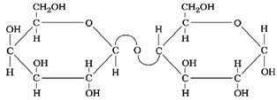
A
Between two molecules of glucose
B
Between glucose and galactose
C
Between glucose and fructose
D
Between galactose and fructose
Solution
(A) The provided image shows a disaccharide formed by the linkage of two glucose units. This specific structure represents maltose,which is formed by the condensation (dehydration) reaction between two molecules of $\alpha$-$D$-glucose. In this process,a water molecule is removed,and a glycosidic bond is formed between the $C_1$ of one glucose molecule and the $C_4$ of another glucose molecule.
0 likes
View Solution131
EasyMCQ
What is the general ratio of $C$,$H$,and $O$ in the structure of monosaccharides?
A
$1:1:2$
B
$2:1:1$
C
$1:2:1$
D
$2:1:2$
Solution
(C) Monosaccharides are the simplest carbohydrates with the general chemical formula $(CH_2O)_n$,where $n$ is the number of carbon atoms $(n \ge 3)$.
In this formula,for every $1$ carbon atom,there are $2$ hydrogen atoms and $1$ oxygen atom.
Therefore,the ratio of $C:H:O$ is $1:2:1$.
In this formula,for every $1$ carbon atom,there are $2$ hydrogen atoms and $1$ oxygen atom.
Therefore,the ratio of $C:H:O$ is $1:2:1$.
0 likes
View Solution132
EasyMCQ
Dihydroxyacetone phosphate is an example of ........
A
Aldotriose sugar
B
Aldoketose sugar
C
Ketotriose sugar
D
Ketopentose sugar
Solution
(C) Dihydroxyacetone phosphate $(DHAP)$ is a $3$-carbon sugar phosphate.
It contains a ketone group at the second carbon atom,making it a ketose.
Since it has $3$ carbon atoms,it is classified as a triose.
Therefore,$DHAP$ is a ketotriose sugar.
It contains a ketone group at the second carbon atom,making it a ketose.
Since it has $3$ carbon atoms,it is classified as a triose.
Therefore,$DHAP$ is a ketotriose sugar.
0 likes
View Solution133
MediumMCQ
Which of the following methods can be used for the hydrolysis of a disaccharide?
A
Boiling with dilute acid
B
Reaction with an appropriate enzyme
C
$A$ or $B$
D
Boiling with dilute base
Solution
(C) Disaccharides are carbohydrates that yield two molecules of monosaccharides upon hydrolysis.
This process can be achieved in two primary ways:
$1$. Chemical Hydrolysis: Boiling the disaccharide with a dilute acid (such as dilute $HCl$ or $H_2SO_4$) breaks the glycosidic bond.
$2$. Enzymatic Hydrolysis: Specific enzymes (such as sucrase,maltase,or lactase) act as biological catalysts to break the glycosidic bond under physiological conditions.
Therefore,both methods are effective for the hydrolysis of disaccharides.
This process can be achieved in two primary ways:
$1$. Chemical Hydrolysis: Boiling the disaccharide with a dilute acid (such as dilute $HCl$ or $H_2SO_4$) breaks the glycosidic bond.
$2$. Enzymatic Hydrolysis: Specific enzymes (such as sucrase,maltase,or lactase) act as biological catalysts to break the glycosidic bond under physiological conditions.
Therefore,both methods are effective for the hydrolysis of disaccharides.
0 likes
View Solution134
MediumMCQ
Which bond is broken during the hydrolysis of a disaccharide in the presence of an enzyme?
A
Hydrogen bond
B
Ionic bond
C
Covalent bond
D
Glycosidic bond
Solution
(D) disaccharide is formed when two monosaccharides are joined together by a glycosidic bond.
During the process of hydrolysis,an enzyme (such as sucrase,maltase,or lactase) facilitates the addition of a water molecule to break this specific linkage.
Therefore,the glycosidic bond is the bond that is broken to release the two monosaccharide units.
During the process of hydrolysis,an enzyme (such as sucrase,maltase,or lactase) facilitates the addition of a water molecule to break this specific linkage.
Therefore,the glycosidic bond is the bond that is broken to release the two monosaccharide units.
0 likes
View Solution135
EasyMCQ
What is produced by the hydrolysis of a $Maltose$ molecule?
A
$Glucose + Glucose$
B
$Glucose + Fructose$
C
$Glucose + Galactose$
D
$Galactose + Galactose$
Solution
(A) $Maltose$ is a disaccharide composed of two glucose units linked by an $\alpha-1,4-glycosidic$ bond. Upon hydrolysis,the glycosidic bond is broken by the addition of a water molecule,resulting in the formation of two molecules of $Glucose$ $(C_6H_{12}O_6)$.
0 likes
View Solution136
MediumMCQ
How many glycosidic bonds are present in a ribose sugar molecule?
A
$0$
B
$1$
C
$2$
D
Many $(\infty)$
Solution
(A) ribose sugar is a monosaccharide.
Glycosidic bonds are formed between two or more monosaccharide units to form disaccharides,oligosaccharides,or polysaccharides.
Since a single monosaccharide molecule like ribose does not contain any other sugar unit to bond with,it contains $0$ glycosidic bonds.
Glycosidic bonds are formed between two or more monosaccharide units to form disaccharides,oligosaccharides,or polysaccharides.
Since a single monosaccharide molecule like ribose does not contain any other sugar unit to bond with,it contains $0$ glycosidic bonds.
0 likes
View Solution137
EasyMCQ
In animals,food is stored as $........$.
A
Starch
B
Glycogen
C
Lactose
D
Cellulose
Solution
(B) In animals,the primary storage form of carbohydrates is $Glycogen$.
$Glycogen$ is a multi-branched polysaccharide of glucose that serves as a form of energy storage in animals,fungi,and bacteria.
$Starch$ is the storage form of carbohydrates in plants.
$Cellulose$ is a structural polysaccharide found in plant cell walls.
$Lactose$ is a disaccharide sugar found in milk.
Therefore,the correct option is $B$.
$Glycogen$ is a multi-branched polysaccharide of glucose that serves as a form of energy storage in animals,fungi,and bacteria.
$Starch$ is the storage form of carbohydrates in plants.
$Cellulose$ is a structural polysaccharide found in plant cell walls.
$Lactose$ is a disaccharide sugar found in milk.
Therefore,the correct option is $B$.
0 likes
View Solution138
EasyMCQ
Which functional group is present in aldose sugars?
A
$ -CHO $
B
$ -COO $
C
$ >C=O $
D
$ -OH $
Solution
(A) Aldose sugars are monosaccharides that contain an aldehyde group $(-CHO)$ at the end of the carbon chain.
In contrast,ketose sugars contain a ketone group $(>C=O)$ within the carbon chain.
Therefore,the functional group characteristic of an aldose sugar is the aldehyde group $(-CHO)$.
In contrast,ketose sugars contain a ketone group $(>C=O)$ within the carbon chain.
Therefore,the functional group characteristic of an aldose sugar is the aldehyde group $(-CHO)$.
0 likes
View Solution139
MediumMCQ
Which of the following statements is incorrect regarding amylopectin?
A
It is a branched chain of glucose molecules.
B
Glycogen is structurally similar to amylopectin.
C
$A$ major part of the starch structure is made up of amylopectin.
D
It consists of linear polysaccharide chains.
Solution
(D) Amylopectin is a polysaccharide found in starch.
It consists of a branched chain of glucose units linked by $\alpha-1,4$-glycosidic bonds in the linear segments and $\alpha-1,6$-glycosidic bonds at the branching points.
Option $D$ is incorrect because amylopectin is branched, not linear.
Glycogen is indeed structurally similar to amylopectin but more highly branched.
Amylopectin constitutes about $80-85\%$ of starch, making it the major component.
It consists of a branched chain of glucose units linked by $\alpha-1,4$-glycosidic bonds in the linear segments and $\alpha-1,6$-glycosidic bonds at the branching points.
Option $D$ is incorrect because amylopectin is branched, not linear.
Glycogen is indeed structurally similar to amylopectin but more highly branched.
Amylopectin constitutes about $80-85\%$ of starch, making it the major component.
0 likes
View Solution140
EasyMCQ
What is produced by the hydrolysis of lactose?
A
Glucose + Glucose
B
Glucose + Fructose
C
Glucose + Galactose
D
Fructose + Galactose
Solution
(C) Lactose is a disaccharide sugar composed of two monosaccharide units.
Upon hydrolysis,the enzyme lactase breaks the glycosidic bond between these units.
The hydrolysis reaction is: $Lactose + H_2O \xrightarrow{Lactase} Glucose + Galactose$.
Therefore,the correct products are glucose and galactose.
Upon hydrolysis,the enzyme lactase breaks the glycosidic bond between these units.
The hydrolysis reaction is: $Lactose + H_2O \xrightarrow{Lactase} Glucose + Galactose$.
Therefore,the correct products are glucose and galactose.
0 likes
View Solution141
EasyMCQ
What does $X$ represent in the given structure?
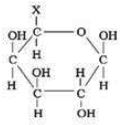
A
$CHOH$
B
$CHO$
C
$CH_2OH$
D
$COOH$
Solution
(C) The given structure represents a cyclic form of a hexose sugar,specifically glucose (glucopyranose). In the Haworth projection of glucose,the carbon atom at position $5$ is attached to a hydroxymethyl group $(CH_2OH)$ which is represented by $X$ in the diagram. Therefore,$X$ corresponds to the $CH_2OH$ group.
0 likes
View Solution142
EasyMCQ
Which type of sugars provide energy to the body?
A
Triose
B
Pentose
C
Hexose
D
Tetrose
Solution
(C) Hexose sugars,such as glucose $(C_6H_{12}O_6)$,are the primary source of energy for cellular respiration in living organisms.
Glucose is a monosaccharide that undergoes glycolysis and the Krebs cycle to produce $ATP$,which is the energy currency of the cell.
Triose,pentose,and tetrose sugars are generally involved in metabolic intermediates or structural components (like ribose in $RNA$) rather than being the primary direct energy source for the body.
Glucose is a monosaccharide that undergoes glycolysis and the Krebs cycle to produce $ATP$,which is the energy currency of the cell.
Triose,pentose,and tetrose sugars are generally involved in metabolic intermediates or structural components (like ribose in $RNA$) rather than being the primary direct energy source for the body.
0 likes
View Solution143
EasyMCQ
What is the valency of carbon?
A
$3$
B
$2$
C
$4$
D
$6$
Solution
(C) The atomic number of carbon is $6$.
Its electronic configuration is $2, 4$.
To achieve a stable octet configuration,carbon needs to share $4$ electrons with other atoms.
Therefore,the valency of carbon is $4$.
Its electronic configuration is $2, 4$.
To achieve a stable octet configuration,carbon needs to share $4$ electrons with other atoms.
Therefore,the valency of carbon is $4$.
0 likes
View Solution144
MediumMCQ
In deoxyribose compared to ribose,there is...
A
one less $O$ atom at the second $C$ atom.
B
one more $O$ atom at the second $C$ atom.
C
one less $O$ atom at the sixth $C$ atom.
D
one more $O$ atom at the sixth $C$ atom.
Solution
(A) Ribose is a pentose sugar with the chemical formula $C_5H_{10}O_5$.
Deoxyribose is a derivative of ribose where one oxygen atom is removed from the $2'$ carbon position,resulting in the formula $C_5H_{10}O_4$.
Therefore,deoxyribose has one less oxygen atom compared to ribose at the second carbon atom $(C-2')$.
Deoxyribose is a derivative of ribose where one oxygen atom is removed from the $2'$ carbon position,resulting in the formula $C_5H_{10}O_4$.
Therefore,deoxyribose has one less oxygen atom compared to ribose at the second carbon atom $(C-2')$.
0 likes
View Solution145
EasyMCQ
Which of the following properties is $NOT$ a characteristic of monosaccharides?
A
They are sweet in taste.
B
They are permeable through the plasma membrane.
C
They undergo hydrolysis.
D
They are soluble in water.
Solution
(C) Monosaccharides are the simplest form of carbohydrates and cannot be further hydrolyzed into smaller sugar units.
Therefore,the statement that 'they undergo hydrolysis' is incorrect.
Monosaccharides are sweet,soluble in water,and can easily pass through the plasma membrane due to their small molecular size.
Therefore,the statement that 'they undergo hydrolysis' is incorrect.
Monosaccharides are sweet,soluble in water,and can easily pass through the plasma membrane due to their small molecular size.
0 likes
View Solution146
EasyMCQ
Which of the following is an animal polysaccharide?
A
Glycogen
B
Pectin
C
Cutin
D
Both $A$ and $C$
Solution
(A) Polysaccharides are long chains of monosaccharides linked by glycosidic bonds.
Glycogen is the primary storage polysaccharide in animals,often referred to as 'animal starch'. It is stored in the liver and muscles.
Pectin is a structural polysaccharide found in the cell walls of plants.
Cutin is a waxy,water-repellent substance found on the cuticle of plants,not a polysaccharide.
Therefore,the correct answer is Glycogen.
Glycogen is the primary storage polysaccharide in animals,often referred to as 'animal starch'. It is stored in the liver and muscles.
Pectin is a structural polysaccharide found in the cell walls of plants.
Cutin is a waxy,water-repellent substance found on the cuticle of plants,not a polysaccharide.
Therefore,the correct answer is Glycogen.
0 likes
View Solution147
MediumMCQ
Which of the following is not an example of an aldose sugar?
A
Ribose
B
Deoxyribose
C
Ribulose
D
Galactose
Solution
(C) An aldose sugar is a monosaccharide that contains an aldehyde group $(-CHO)$ at the end of the carbon chain.
Ribose,Deoxyribose,and Galactose are all aldose sugars because they contain an aldehyde functional group.
Ribulose is a ketose sugar,which means it contains a ketone group $(C=O)$ within the carbon chain,specifically at the $C-2$ position.
Therefore,Ribulose is not an aldose sugar.
Ribose,Deoxyribose,and Galactose are all aldose sugars because they contain an aldehyde functional group.
Ribulose is a ketose sugar,which means it contains a ketone group $(C=O)$ within the carbon chain,specifically at the $C-2$ position.
Therefore,Ribulose is not an aldose sugar.
0 likes
View Solution148
MediumMCQ
Assertion $A$: Starch is a homopolymer of glucose.
Reason $R$: Digestion of starch yields glucose.
Which option is correct for Assertion $A$ and Reason $R$?
Reason $R$: Digestion of starch yields glucose.
Which option is correct for Assertion $A$ and Reason $R$?
A
$A$ and $R$ are both true and $R$ is the correct explanation of $A$.
B
$A$ and $R$ are both true but $R$ is not the correct explanation of $A$.
C
$A$ is true and $R$ is false.
D
$A$ is false and $R$ is true.
Solution
(A) Starch is a polysaccharide composed exclusively of glucose units linked by glycosidic bonds,making it a homopolymer of glucose. This statement is true.
During the process of digestion,enzymes like amylase break down the complex starch molecules into simpler sugar units,specifically glucose. This statement is also true.
Since starch is a homopolymer of glucose,its breakdown naturally results in the release of glucose units. Therefore,$R$ is the correct explanation for $A$.
During the process of digestion,enzymes like amylase break down the complex starch molecules into simpler sugar units,specifically glucose. This statement is also true.
Since starch is a homopolymer of glucose,its breakdown naturally results in the release of glucose units. Therefore,$R$ is the correct explanation for $A$.
0 likes
View Solution149
MediumMCQ
Identify the given chemical structure.
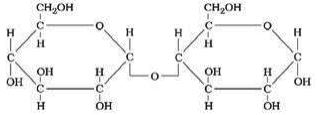
A
Maltose
B
Lactose
C
Sucrose
D
Dextrose
Solution
(A) The provided chemical structure represents a disaccharide formed by the linkage of two glucose units.
Specifically,it shows an $\alpha-1,4$-glycosidic bond between two glucose molecules.
This specific linkage and configuration are characteristic of Maltose.
Sucrose consists of glucose and fructose,while lactose consists of glucose and galactose.
Dextrose is another name for glucose itself,which is a monosaccharide.
Specifically,it shows an $\alpha-1,4$-glycosidic bond between two glucose molecules.
This specific linkage and configuration are characteristic of Maltose.
Sucrose consists of glucose and fructose,while lactose consists of glucose and galactose.
Dextrose is another name for glucose itself,which is a monosaccharide.
0 likes
View Solution150
MediumMCQ
Which of the following pairs does not represent isomers?
A
Phosphoglyceraldehyde - Dihydroxyacetone phosphate
B
Glucose - Galactose
C
Glucose - Fructose
D
Ribose - Deoxyribose
Solution
(D) Isomers are compounds that have the same molecular formula but different structural arrangements.
$1$. Phosphoglyceraldehyde $(C_3H_7O_6P)$ and Dihydroxyacetone phosphate $(C_3H_7O_6P)$ are functional isomers.
$2$. Glucose $(C_6H_{12}O_6)$ and Galactose $(C_6H_{12}O_6)$ are epimers (a type of stereoisomer).
$3$. Glucose $(C_6H_{12}O_6)$ and Fructose $(C_6H_{12}O_6)$ are functional isomers.
$4$. Ribose $(C_5H_{10}O_5)$ and Deoxyribose $(C_5H_{10}O_4)$ have different molecular formulas because Deoxyribose lacks one oxygen atom compared to Ribose. Therefore,they are not isomers.
$1$. Phosphoglyceraldehyde $(C_3H_7O_6P)$ and Dihydroxyacetone phosphate $(C_3H_7O_6P)$ are functional isomers.
$2$. Glucose $(C_6H_{12}O_6)$ and Galactose $(C_6H_{12}O_6)$ are epimers (a type of stereoisomer).
$3$. Glucose $(C_6H_{12}O_6)$ and Fructose $(C_6H_{12}O_6)$ are functional isomers.
$4$. Ribose $(C_5H_{10}O_5)$ and Deoxyribose $(C_5H_{10}O_4)$ have different molecular formulas because Deoxyribose lacks one oxygen atom compared to Ribose. Therefore,they are not isomers.
0 likes
View SolutionBiomolecules — Carbohydrates · Frequently Asked Questions
1Are these Biomolecules questions useful for JEE and NEET?
Yes. All questions in this section are mapped to JEE Main and NEET exam patterns. Previous year questions from JEE Main, NEET, GUJCET and state-level exams are included with full solutions.
2Can I switch to Hindi or Gujarati for these questions?
Yes. Use the language tabs in the hero section or the sidebar to view the same questions and solutions in English, Hindi or Gujarati.
3How do I generate a question paper from this subtopic?
Use the Vedclass Exam Paper Generator — select the chapter and subtopic, set difficulty, and generate Sets A, B, C, D automatically. First 3 chapters of every subject are free.
Vedclass Products
For Students
Vedclass Test Series
Mock tests in real JEE/NEET style with performance analysis. 5-day free trial.
Start Free TrialFor Teachers
Exam Paper Generator
Generate Set A/B/C/D papers from this chapter in 2 minutes. 3 chapters free.
Try FreeFor Institutes
Online Exam Module
Live online exams with unlimited students, 360° analytics & white-label branding.
See DemoFor Teachers & Institutes
Generate a Biomolecules Exam Paper in 2 Minutes
Select subtopic & difficulty — Sets A, B, C, D auto-generated with No Repeat logic.
First 3 chapters of every subject are free — no payment required.