
A English
Mix Examples - Chemical Reactions and Equations Questions in English
Class 10 Science · Chemical Reactions and Equations · Mix Examples - Chemical Reactions and Equations
176+
Questions
English
Language
100%
With Solutions
Showing 50 of 176 questions in English
101
Medium
$(a)$ Give an example of a combination reaction which is exothermic.
$(b)$ Identify the oxidizing agent and reducing agent in the following reaction:
$H_{2}S + Cl_{2} \rightarrow 2HCl + S$
$(c)$ Name the phenomenon due to which the taste and smell of oily food changes when kept for a long time in the open. Suggest one method to prevent it.
$(b)$ Identify the oxidizing agent and reducing agent in the following reaction:
$H_{2}S + Cl_{2} \rightarrow 2HCl + S$
$(c)$ Name the phenomenon due to which the taste and smell of oily food changes when kept for a long time in the open. Suggest one method to prevent it.
Solution
(N/A) An example of an exothermic combination reaction is the formation of water from hydrogen and oxygen: $2H_{2}(g) + O_{2}(g) \rightarrow 2H_{2}O(l) + \text{Heat}$.
$(b)$ In the reaction $H_{2}S + Cl_{2} \rightarrow 2HCl + S$:
- The oxidizing agent is $Cl_{2}$ because it gains electrons (or helps in the removal of hydrogen).
- The reducing agent is $H_{2}S$ because it loses hydrogen (or provides electrons).
$(c)$ The phenomenon is known as Rancidity. It can be prevented by storing food in airtight containers to prevent oxidation.
$(b)$ In the reaction $H_{2}S + Cl_{2} \rightarrow 2HCl + S$:
- The oxidizing agent is $Cl_{2}$ because it gains electrons (or helps in the removal of hydrogen).
- The reducing agent is $H_{2}S$ because it loses hydrogen (or provides electrons).
$(c)$ The phenomenon is known as Rancidity. It can be prevented by storing food in airtight containers to prevent oxidation.
0 likes
View Solution102
Medium
$A$ reddish-brown coloured metal, used in electrical wires, when powdered and heated strongly in an open china dish, its colour turns black. When hydrogen gas is passed over this black substance, it regains its original colour. Based on the above information, answer the following questions:
$(i)$ Name the metal and the black coloured substance formed.
$(ii)$ Write balanced chemical equations for both the reactions.
$(i)$ Name the metal and the black coloured substance formed.
$(ii)$ Write balanced chemical equations for both the reactions.
Solution
(N/A) $(i)$ The metal is copper $(Cu)$.
The black coloured substance formed is copper$(II)$ oxide $(CuO)$.
$(ii)$ The balanced chemical equations are:
Reaction $1$ (Oxidation of copper): $2Cu(s) + O_2(g) \xrightarrow{\Delta} 2CuO(s)$
Reaction $2$ (Reduction of copper oxide): $CuO(s) + H_2(g) \xrightarrow{\Delta} Cu(s) + H_2O(g)$
The black coloured substance formed is copper$(II)$ oxide $(CuO)$.
$(ii)$ The balanced chemical equations are:
Reaction $1$ (Oxidation of copper): $2Cu(s) + O_2(g) \xrightarrow{\Delta} 2CuO(s)$
Reaction $2$ (Reduction of copper oxide): $CuO(s) + H_2(g) \xrightarrow{\Delta} Cu(s) + H_2O(g)$
0 likes
View Solution103
Medium
What is rancidity? Mention any two ways by which rancidity can be prevented?
Solution
(N/A) Rancidity is the process of oxidation of fats and oils in food materials,which leads to an unpleasant smell and taste.
It can be prevented by the following methods:
$(i)$ Adding antioxidants to foods containing fats and oils.
$(ii)$ Flushing food containers with nitrogen gas to remove oxygen.
It can be prevented by the following methods:
$(i)$ Adding antioxidants to foods containing fats and oils.
$(ii)$ Flushing food containers with nitrogen gas to remove oxygen.
0 likes
View Solution104
Medium
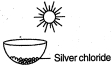
The following diagram displays a chemical reaction. Observe it carefully and answer the following questions:
$(a)$ Identify the type of chemical reaction that will take place and define it. How will the colour of the salt change?
$(b)$ Write the chemical equation of the reaction that takes place.
$(c)$ Mention one commercial use of this salt.
$(a)$ Identify the type of chemical reaction that will take place and define it. How will the colour of the salt change?
$(b)$ Write the chemical equation of the reaction that takes place.
$(c)$ Mention one commercial use of this salt.
Solution
(N/A) It is a photochemical decomposition reaction. It can be defined as the decomposition of a substance in the presence of sunlight in which a single reactant breaks down to give simpler products.
$(b)$ The white silver chloride changes to grey,as it decomposes into silver and chlorine in the presence of sunlight.
The chemical equation is:
$2 AgCl (s) \xrightarrow{\text{Sunlight}} 2 Ag (s) + Cl_2 (g)$
$(c)$ This salt is used in black and white photography.
$(b)$ The white silver chloride changes to grey,as it decomposes into silver and chlorine in the presence of sunlight.
The chemical equation is:
$2 AgCl (s) \xrightarrow{\text{Sunlight}} 2 Ag (s) + Cl_2 (g)$
$(c)$ This salt is used in black and white photography.
0 likes
View Solution105
Medium
$A$ small amount of quicklime is added to water in a beaker.
$(a)$ Name and define the type of reaction that has taken place.
$(b)$ Write the balanced chemical equation for the above reaction. Write the chemical name of the product obtained.
$(c)$ State two observations that you will make in the reaction.
$(a)$ Name and define the type of reaction that has taken place.
$(b)$ Write the balanced chemical equation for the above reaction. Write the chemical name of the product obtained.
$(c)$ State two observations that you will make in the reaction.
Solution
(N/A) This is a combination reaction. It is defined as a reaction in which a single product is formed from two or more reactants.
$(b)$ The balanced chemical equation is: $CaO(s) + H_2O(l) \rightarrow Ca(OH)_2(aq)$. The chemical name of the product obtained is calcium hydroxide.
$(c)$ Two observations made during the reaction are:
$(i)$ The reaction occurs vigorously with the evolution of heat (exothermic reaction).
$(ii)$ The beaker becomes hot to the touch due to the release of thermal energy.
$(b)$ The balanced chemical equation is: $CaO(s) + H_2O(l) \rightarrow Ca(OH)_2(aq)$. The chemical name of the product obtained is calcium hydroxide.
$(c)$ Two observations made during the reaction are:
$(i)$ The reaction occurs vigorously with the evolution of heat (exothermic reaction).
$(ii)$ The beaker becomes hot to the touch due to the release of thermal energy.
0 likes
View Solution106
Medium
$A$ metal $X$ acquires a green colour coating on its surface on exposure to air.
$(i)$ Identify the metal $X$ and name the process responsible for this change.
$(ii)$ Name and write the chemical formula of the green coating formed on the metal.
$(iii)$ List two important methods to prevent this process.
$(i)$ Identify the metal $X$ and name the process responsible for this change.
$(ii)$ Name and write the chemical formula of the green coating formed on the metal.
$(iii)$ List two important methods to prevent this process.
Solution
(N/A) $(i)$ The metal $X$ is Copper $(Cu)$. The process responsible for this change is known as corrosion.
$(ii)$ The green coating is Basic Copper Carbonate. Its chemical formula is $CuCO_{3} \cdot Cu(OH)_{2}$.
$(iii)$ Two important methods to prevent corrosion are:
$1$. Painting or oiling/greasing the surface.
$2$. Galvanisation or alloying.
$(ii)$ The green coating is Basic Copper Carbonate. Its chemical formula is $CuCO_{3} \cdot Cu(OH)_{2}$.
$(iii)$ Two important methods to prevent corrosion are:
$1$. Painting or oiling/greasing the surface.
$2$. Galvanisation or alloying.
0 likes
View Solution107
Medium
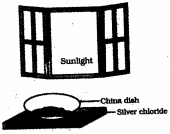
Describe an activity to show a decomposition reaction in which light is used to decompose a reactant. Write the chemical equation of the reaction and state its one use.
Solution
(N/A) $(i)$ Take $2 \, g$ of silver chloride in a china dish.
(ii) Place this china dish in sunlight for some time.
(iii) Observe the colour of silver chloride after some time. Silver chloride turns grey in sunlight due to the decomposition of $AgCl$ into $Ag$ and $Cl_2$.
Chemical equation:
$2AgCl(s) \xrightarrow{\text{Sunlight}} 2Ag(s) + Cl_2(g)$
Use: This reaction is used in black and white photography.
(ii) Place this china dish in sunlight for some time.
(iii) Observe the colour of silver chloride after some time. Silver chloride turns grey in sunlight due to the decomposition of $AgCl$ into $Ag$ and $Cl_2$.
Chemical equation:
$2AgCl(s) \xrightarrow{\text{Sunlight}} 2Ag(s) + Cl_2(g)$
Use: This reaction is used in black and white photography.
0 likes
View Solution108
Medium
$2 \, g$ of ferrous sulphate crystals are heated in a boiling tube.
$(i)$ State the colour of ferrous sulphate crystals both before heating and after heating.
$(ii)$ Name the gases produced during heating.
$(iii)$ Write the chemical equation for the reaction.
$(i)$ State the colour of ferrous sulphate crystals both before heating and after heating.
$(ii)$ Name the gases produced during heating.
$(iii)$ Write the chemical equation for the reaction.
Solution
(N/A) $(i)$ Before heating: Pale green. After heating: Brown or reddish-brown.
$(ii)$ The gases produced are sulphur dioxide $(SO_{2})$ and sulphur trioxide $(SO_{3})$.
$(iii)$ The chemical equation for the thermal decomposition of ferrous sulphate is:
$2FeSO_{4}(s) \xrightarrow{\text{Heat}} Fe_{2}O_{3}(s) + SO_{2}(g) + SO_{3}(g)$
$(ii)$ The gases produced are sulphur dioxide $(SO_{2})$ and sulphur trioxide $(SO_{3})$.
$(iii)$ The chemical equation for the thermal decomposition of ferrous sulphate is:
$2FeSO_{4}(s) \xrightarrow{\text{Heat}} Fe_{2}O_{3}(s) + SO_{2}(g) + SO_{3}(g)$
0 likes
View Solution109
Medium
Give reasons for the following:
$(i)$ All decomposition reactions are endothermic reactions.
$(ii)$ Colour of copper sulphate solution changes when an iron nail is dipped in it.
$(iii)$ Respiration is an exothermic reaction.
$(i)$ All decomposition reactions are endothermic reactions.
$(ii)$ Colour of copper sulphate solution changes when an iron nail is dipped in it.
$(iii)$ Respiration is an exothermic reaction.
Solution
(N/A) $(i)$ Decomposition reactions require energy in the form of heat,light,or electricity to break down the reactants,meaning energy is absorbed.
$(ii)$ Iron is more reactive than copper. When an iron nail is dipped in a copper sulphate solution,iron displaces copper from the solution to form iron sulphate,which is light green in colour.
$(iii)$ During respiration,glucose $(C_6H_{12}O_6)$ combines with oxygen in the cells of our body to produce carbon dioxide,water,and energy. Since energy is released during this process,it is considered an exothermic reaction.
$(ii)$ Iron is more reactive than copper. When an iron nail is dipped in a copper sulphate solution,iron displaces copper from the solution to form iron sulphate,which is light green in colour.
$(iii)$ During respiration,glucose $(C_6H_{12}O_6)$ combines with oxygen in the cells of our body to produce carbon dioxide,water,and energy. Since energy is released during this process,it is considered an exothermic reaction.
0 likes
View Solution110
Medium
Write a balanced chemical equation for the process of photosynthesis and the conditions of the reaction,including the physical states of all the substances.
Solution
(N/A) The balanced chemical equation for photosynthesis is:
$6CO_{2}(g) + 12H_{2}O(l) \xrightarrow[\text{Chlorophyll}]{\text{Sunlight}} C_{6}H_{12}O_{6}(aq) + 6O_{2}(g) + 6H_{2}O(l)$
Explanation:
$1$. $6$ molecules of carbon dioxide $(CO_{2})$ in gaseous state react with $12$ molecules of water $(H_{2}O)$ in liquid state.
$2$. The reaction occurs in the presence of sunlight and chlorophyll (the green pigment in plants).
$3$. The products formed are $1$ molecule of glucose $(C_{6}H_{12}O_{6})$ in aqueous state,$6$ molecules of oxygen $(O_{2})$ in gaseous state,and $6$ molecules of water $(H_{2}O)$ in liquid state.
$6CO_{2}(g) + 12H_{2}O(l) \xrightarrow[\text{Chlorophyll}]{\text{Sunlight}} C_{6}H_{12}O_{6}(aq) + 6O_{2}(g) + 6H_{2}O(l)$
Explanation:
$1$. $6$ molecules of carbon dioxide $(CO_{2})$ in gaseous state react with $12$ molecules of water $(H_{2}O)$ in liquid state.
$2$. The reaction occurs in the presence of sunlight and chlorophyll (the green pigment in plants).
$3$. The products formed are $1$ molecule of glucose $(C_{6}H_{12}O_{6})$ in aqueous state,$6$ molecules of oxygen $(O_{2})$ in gaseous state,and $6$ molecules of water $(H_{2}O)$ in liquid state.
0 likes
View Solution111
Medium
$(a)$ Classify the following chemical reactions as exothermic or endothermic:
$(i)$ Electrolysis of water
$(ii)$ Burning of natural gas
$(iii)$ Decomposition of calcium carbonate
$(iv)$ Burning of magnesium ribbon in air.
$(i)$ Electrolysis of water
$(ii)$ Burning of natural gas
$(iii)$ Decomposition of calcium carbonate
$(iv)$ Burning of magnesium ribbon in air.
Solution
(N/A) $(i)$ Electrolysis of water is an endothermic reaction because it requires electrical energy to break the bonds of water molecules.
$(ii)$ Burning of natural gas (methane) is an exothermic reaction as it releases a large amount of heat energy during combustion.
$(iii)$ Decomposition of calcium carbonate is an endothermic reaction because it requires heat energy to decompose into calcium oxide and carbon dioxide.
$(iv)$ Burning of magnesium ribbon in air is an exothermic reaction as it releases heat and light energy during the formation of magnesium oxide.
$(ii)$ Burning of natural gas (methane) is an exothermic reaction as it releases a large amount of heat energy during combustion.
$(iii)$ Decomposition of calcium carbonate is an endothermic reaction because it requires heat energy to decompose into calcium oxide and carbon dioxide.
$(iv)$ Burning of magnesium ribbon in air is an exothermic reaction as it releases heat and light energy during the formation of magnesium oxide.
0 likes
View Solution112
Medium
$(a)$ Define corrosion.
$(b)$ What is corrosion of iron called?
$(c)$ How will you recognise the corrosion of silver?
$(b)$ What is corrosion of iron called?
$(c)$ How will you recognise the corrosion of silver?
Solution
(N/A) Corrosion: The process in which metals are eaten away gradually by the action of air,moisture,or a chemical on their surface.
$(b)$ The corrosion of iron is called rusting.
$(c)$ Corrosion of silver is recognised by the development of a black coating on the surface of the metal.
$(b)$ The corrosion of iron is called rusting.
$(c)$ Corrosion of silver is recognised by the development of a black coating on the surface of the metal.
0 likes
View Solution113
Easy
$(a)$ Why is the corrosion of iron a serious problem?
$(b)$ How can we prevent corrosion?
$(b)$ How can we prevent corrosion?
Solution
(N/A) Corrosion of iron is a serious problem because it causes significant structural damage to bridges,iron railings,ships,and all objects made of metals,especially those made of iron. Every year,an enormous amount of money is spent to replace damaged iron structures.
$(b)$ Corrosion can be prevented by several methods:
$1$. Painting: Applying a coat of paint on the surface of the iron object.
$2$. Galvanization: Coating iron with a thin layer of zinc.
$3$. Electroplating: Depositing a layer of a non-corrosive metal over the iron surface.
$4$. Greasing or Oiling: Applying oil or grease to moving parts of machines.
$(b)$ Corrosion can be prevented by several methods:
$1$. Painting: Applying a coat of paint on the surface of the iron object.
$2$. Galvanization: Coating iron with a thin layer of zinc.
$3$. Electroplating: Depositing a layer of a non-corrosive metal over the iron surface.
$4$. Greasing or Oiling: Applying oil or grease to moving parts of machines.
0 likes
View Solution114
Medium
$(a)$ Balance the chemical equation:
$Fe(s) + H_2O(g) \rightarrow Fe_3O_4(s) + H_2(g)$
$(b)$ Identify the type of reaction in the equation given below:
$Na_2SO_4(aq) + BaCl_2(aq) \rightarrow BaSO_4(s) + NaCl(aq)$
$Fe(s) + H_2O(g) \rightarrow Fe_3O_4(s) + H_2(g)$
$(b)$ Identify the type of reaction in the equation given below:
$Na_2SO_4(aq) + BaCl_2(aq) \rightarrow BaSO_4(s) + NaCl(aq)$
Solution
(N/A) To balance the equation $Fe(s) + H_2O(g) \rightarrow Fe_3O_4(s) + H_2(g)$:
$1$. Balance $Fe$: $3Fe(s) + H_2O(g) \rightarrow Fe_3O_4(s) + H_2(g)$
$2$. Balance $O$: $3Fe(s) + 4H_2O(g) \rightarrow Fe_3O_4(s) + H_2(g)$
$3$. Balance $H$: $3Fe(s) + 4H_2O(g) \rightarrow Fe_3O_4(s) + 4H_2(g)$
The balanced equation is $3Fe(s) + 4H_2O(g) \rightarrow Fe_3O_4(s) + 4H_2(g)$.
$(b)$ The reaction $Na_2SO_4(aq) + BaCl_2(aq) \rightarrow BaSO_4(s) + NaCl(aq)$ is a double displacement reaction because there is an exchange of ions between the reactants to form new products.
$1$. Balance $Fe$: $3Fe(s) + H_2O(g) \rightarrow Fe_3O_4(s) + H_2(g)$
$2$. Balance $O$: $3Fe(s) + 4H_2O(g) \rightarrow Fe_3O_4(s) + H_2(g)$
$3$. Balance $H$: $3Fe(s) + 4H_2O(g) \rightarrow Fe_3O_4(s) + 4H_2(g)$
The balanced equation is $3Fe(s) + 4H_2O(g) \rightarrow Fe_3O_4(s) + 4H_2(g)$.
$(b)$ The reaction $Na_2SO_4(aq) + BaCl_2(aq) \rightarrow BaSO_4(s) + NaCl(aq)$ is a double displacement reaction because there is an exchange of ions between the reactants to form new products.
0 likes
View Solution115
Medium
You could have noted that when copper powder is heated in a china dish, the surface of copper powder becomes coated with black coloured substance.
$(i)$ Why has this black coloured substance formed?
$(ii)$ What is this black substance?
$(iii)$ Write the chemical equation of the reaction that takes place.
$(i)$ Why has this black coloured substance formed?
$(ii)$ What is this black substance?
$(iii)$ Write the chemical equation of the reaction that takes place.
Solution
(N/A) $(i)$ The black coloured substance is formed because copper reacts with atmospheric oxygen upon heating to form copper $(II)$ oxide.
$(ii)$ This black substance is copper $(II)$ oxide $(CuO)$.
$(iii)$ The chemical equation for the reaction is: $2Cu(s) + O_2(g) \xrightarrow{\text{Heat}} 2CuO(s)$
$(ii)$ This black substance is copper $(II)$ oxide $(CuO)$.
$(iii)$ The chemical equation for the reaction is: $2Cu(s) + O_2(g) \xrightarrow{\text{Heat}} 2CuO(s)$
0 likes
View Solution116
Medium
Translate the following statements into chemical equations and then balance them.
$(a)$ Hydrogen gas combines with nitrogen to form ammonia.
$(b)$ Hydrogen sulphide gas burns in air to give water and sulphur dioxide.
$(a)$ Hydrogen gas combines with nitrogen to form ammonia.
$(b)$ Hydrogen sulphide gas burns in air to give water and sulphur dioxide.
Solution
(N/A) The chemical equation for the reaction between hydrogen gas and nitrogen gas to form ammonia is:
$3H_{2}(g) + N_{2}(g) \rightarrow 2NH_{3}(g)$
$(b)$ The chemical equation for the combustion of hydrogen sulphide gas in air (oxygen) to produce water and sulphur dioxide is:
$2H_{2}S(g) + 3O_{2}(g) \rightarrow 2H_{2}O(g) + 2SO_{2}(g)$
$3H_{2}(g) + N_{2}(g) \rightarrow 2NH_{3}(g)$
$(b)$ The chemical equation for the combustion of hydrogen sulphide gas in air (oxygen) to produce water and sulphur dioxide is:
$2H_{2}S(g) + 3O_{2}(g) \rightarrow 2H_{2}O(g) + 2SO_{2}(g)$
0 likes
View Solution117
Medium
Translate the following statements into chemical equations and then balance them.
$(a)$ Barium chloride reacts with aluminium sulphate to give aluminium chloride and a precipitate of barium sulphate.
$(b)$ Potassium metal reacts with water to give potassium hydroxide and hydrogen gas.
$(a)$ Barium chloride reacts with aluminium sulphate to give aluminium chloride and a precipitate of barium sulphate.
$(b)$ Potassium metal reacts with water to give potassium hydroxide and hydrogen gas.
Solution
(N/A) The unbalanced equation is: $BaCl_{2} + Al_{2}(SO_{4})_{3} \longrightarrow AlCl_{3} + BaSO_{4}$.
To balance,we ensure the number of atoms of each element is equal on both sides: $3BaCl_{2}(aq) + Al_{2}(SO_{4})_{3}(aq) \longrightarrow 2AlCl_{3}(aq) + 3BaSO_{4}(s)$.
$(b)$ The unbalanced equation is: $K + H_{2}O \longrightarrow KOH + H_{2}$.
To balance,we ensure the number of atoms of each element is equal on both sides: $2K(s) + 2H_{2}O(l) \longrightarrow 2KOH(aq) + H_{2}(g)$.
To balance,we ensure the number of atoms of each element is equal on both sides: $3BaCl_{2}(aq) + Al_{2}(SO_{4})_{3}(aq) \longrightarrow 2AlCl_{3}(aq) + 3BaSO_{4}(s)$.
$(b)$ The unbalanced equation is: $K + H_{2}O \longrightarrow KOH + H_{2}$.
To balance,we ensure the number of atoms of each element is equal on both sides: $2K(s) + 2H_{2}O(l) \longrightarrow 2KOH(aq) + H_{2}(g)$.
0 likes
View Solution118
Easy
Translate the following statement into a chemical equation and balance it:
$(a)$ Aluminium chloride reacts with ammonium hydroxide to form a gelatinous white precipitate of aluminium hydroxide and a salt of ammonium chloride.
$(a)$ Aluminium chloride reacts with ammonium hydroxide to form a gelatinous white precipitate of aluminium hydroxide and a salt of ammonium chloride.
Solution
(A) The chemical equation for the reaction is:
$AlCl_{3}(aq) + 3NH_{4}OH(aq) \longrightarrow Al(OH)_{3}(s) \downarrow + 3NH_{4}Cl(aq)$
Explanation:
$1$. Aluminium chloride $(AlCl_{3})$ reacts with ammonium hydroxide $(NH_{4}OH)$.
$2$. This is a double displacement reaction where aluminium hydroxide $(Al(OH)_{3})$ is formed as a gelatinous white precipitate,and ammonium chloride $(NH_{4}Cl)$ remains in the solution.
$3$. To balance the equation,we ensure the number of atoms of each element is equal on both sides: there is $1$ $Al$ atom,$3$ $Cl$ atoms,$3$ $N$ atoms,$15$ $H$ atoms,and $3$ $O$ atoms on both sides.
$AlCl_{3}(aq) + 3NH_{4}OH(aq) \longrightarrow Al(OH)_{3}(s) \downarrow + 3NH_{4}Cl(aq)$
Explanation:
$1$. Aluminium chloride $(AlCl_{3})$ reacts with ammonium hydroxide $(NH_{4}OH)$.
$2$. This is a double displacement reaction where aluminium hydroxide $(Al(OH)_{3})$ is formed as a gelatinous white precipitate,and ammonium chloride $(NH_{4}Cl)$ remains in the solution.
$3$. To balance the equation,we ensure the number of atoms of each element is equal on both sides: there is $1$ $Al$ atom,$3$ $Cl$ atoms,$3$ $N$ atoms,$15$ $H$ atoms,and $3$ $O$ atoms on both sides.
0 likes
View Solution119
Medium
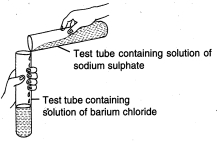
Observe the given figure and answer the following questions:
$(i)$ Write the complete balanced chemical equation for the reaction.
$(ii)$ Write the type of reaction involved.
$(iii)$ Is there any precipitate formed?
$(iv)$ If any precipitate is formed,write the colour of the precipitate.
$(i)$ Write the complete balanced chemical equation for the reaction.
$(ii)$ Write the type of reaction involved.
$(iii)$ Is there any precipitate formed?
$(iv)$ If any precipitate is formed,write the colour of the precipitate.
Solution
(N/A) $(i)$ The balanced chemical equation is:
$Na_{2}SO_{4}(aq) + BaCl_{2}(aq) \longrightarrow BaSO_{4}(s) \downarrow + 2NaCl(aq)$
$(ii)$ This is a double displacement reaction (specifically a precipitation reaction).
$(iii)$ Yes,a precipitate is formed.
$(iv)$ The precipitate formed is barium sulphate $(BaSO_{4})$,which is white in colour.
$Na_{2}SO_{4}(aq) + BaCl_{2}(aq) \longrightarrow BaSO_{4}(s) \downarrow + 2NaCl(aq)$
$(ii)$ This is a double displacement reaction (specifically a precipitation reaction).
$(iii)$ Yes,a precipitate is formed.
$(iv)$ The precipitate formed is barium sulphate $(BaSO_{4})$,which is white in colour.
0 likes
View Solution120
Medium
Write a balanced chemical equation for the reaction in which phosphorus burns in chlorine to form phosphorus pentachloride.
Solution
(N/A) The chemical reaction involves phosphorus $(P_4)$ reacting with chlorine gas $(Cl_2)$ to produce phosphorus pentachloride $(PCl_5)$.
The unbalanced equation is: $P_4 + Cl_2 \longrightarrow PCl_5$.
To balance the phosphorus atoms,we place a coefficient of $4$ before $PCl_5$: $P_4 + Cl_2 \longrightarrow 4PCl_5$.
To balance the chlorine atoms,we need $20$ chlorine atoms on the reactant side,so we place a coefficient of $10$ before $Cl_2$: $P_4(s) + 10Cl_2(g) \longrightarrow 4PCl_5(g)$.
The unbalanced equation is: $P_4 + Cl_2 \longrightarrow PCl_5$.
To balance the phosphorus atoms,we place a coefficient of $4$ before $PCl_5$: $P_4 + Cl_2 \longrightarrow 4PCl_5$.
To balance the chlorine atoms,we need $20$ chlorine atoms on the reactant side,so we place a coefficient of $10$ before $Cl_2$: $P_4(s) + 10Cl_2(g) \longrightarrow 4PCl_5(g)$.
0 likes
View Solution121
Easy
List two observations which you record while burning magnesium in air.
Solution
(N/A) $(i)$ Dazzling white light is emitted during the burning of magnesium.
$(ii)$ $A$ white powdery substance (magnesium oxide) is formed after the burning process.
$(ii)$ $A$ white powdery substance (magnesium oxide) is formed after the burning process.
0 likes
View Solution122
Medium
Identify the type of reactions in each of the following reactions:
$(i)$ $Zn + H_{2}SO_{4} \longrightarrow ZnSO_{4} + H_{2}$
$(ii)$ $CaO + H_{2}O \longrightarrow Ca(OH)_{2}$
$(i)$ $Zn + H_{2}SO_{4} \longrightarrow ZnSO_{4} + H_{2}$
$(ii)$ $CaO + H_{2}O \longrightarrow Ca(OH)_{2}$
Solution
(N/A) $(i)$ This is a displacement reaction because zinc $(Zn)$ displaces hydrogen $(H_{2})$ from sulfuric acid $(H_{2}SO_{4})$.
$(ii)$ This is a combination reaction because calcium oxide $(CaO)$ and water $(H_{2}O)$ combine to form a single product,calcium hydroxide $(Ca(OH)_{2})$.
$(ii)$ This is a combination reaction because calcium oxide $(CaO)$ and water $(H_{2}O)$ combine to form a single product,calcium hydroxide $(Ca(OH)_{2})$.
0 likes
View Solution123
Medium
Identify the type of reactions in each of the following reactions:
$(i)$ $CaCO_{3} \xrightarrow{\text{Heat}} CaO + CO_{2}$
$(ii)$ $AgNO_{3}(aq) + NaCl(aq) \longrightarrow AgCl(s) \downarrow + NaNO_{3}(aq)$
$(i)$ $CaCO_{3} \xrightarrow{\text{Heat}} CaO + CO_{2}$
$(ii)$ $AgNO_{3}(aq) + NaCl(aq) \longrightarrow AgCl(s) \downarrow + NaNO_{3}(aq)$
Solution
(N/A) $(i)$ This is a decomposition reaction because a single reactant breaks down into two or more simpler products upon heating.
$(ii)$ This is a double displacement reaction because there is an exchange of ions between the two reactants to form new compounds.
$(ii)$ This is a double displacement reaction because there is an exchange of ions between the two reactants to form new compounds.
0 likes
View Solution124
Medium
Translate the following reactions into balanced chemical equations:
$(i)$ Manganese dioxide is heated with aluminium powder.
$(ii)$ Iron is treated with steam.
$(i)$ Manganese dioxide is heated with aluminium powder.
$(ii)$ Iron is treated with steam.
Solution
(N/A) $(i)$ The reaction between manganese dioxide and aluminium is a thermite reaction: $3 MnO_{2} + 4 Al \longrightarrow 2 Al_{2}O_{3} + 3 Mn$
$(ii)$ The reaction of iron with steam produces iron($II$,$III$) oxide and hydrogen gas: $3 Fe(s) + 4 H_{2}O(g) \longrightarrow Fe_{3}O_{4}(s) + 4 H_{2}(g)$
$(ii)$ The reaction of iron with steam produces iron($II$,$III$) oxide and hydrogen gas: $3 Fe(s) + 4 H_{2}O(g) \longrightarrow Fe_{3}O_{4}(s) + 4 H_{2}(g)$
0 likes
View Solution125
Easy
Define a chemical equation. What is an unbalanced chemical equation called?
Solution
(N/A) chemical equation is a symbolic representation of a chemical reaction,where the reactants and products are expressed using their respective chemical symbols and formulae.
An unbalanced chemical equation is known as a skeletal chemical equation.
It provides information about the reactants and products involved in the reaction but does not represent the actual number of atoms of each element on both sides of the equation,thus failing to satisfy the law of conservation of mass.
An unbalanced chemical equation is known as a skeletal chemical equation.
It provides information about the reactants and products involved in the reaction but does not represent the actual number of atoms of each element on both sides of the equation,thus failing to satisfy the law of conservation of mass.
0 likes
View Solution126
Easy
Balance the following chemical equations:
$(a)$ $KClO_{3} \longrightarrow KCl + O_{2}$
$(b)$ $Na_{2}CO_{3} + HCl \longrightarrow NaCl + H_{2}O + CO_{2}$
$(a)$ $KClO_{3} \longrightarrow KCl + O_{2}$
$(b)$ $Na_{2}CO_{3} + HCl \longrightarrow NaCl + H_{2}O + CO_{2}$
Solution
(A) To balance a chemical equation,the number of atoms of each element must be equal on both the reactant and product sides.
$(a)$ For $KClO_{3} \longrightarrow KCl + O_{2}$:
There is $1$ $K$,$1$ $Cl$,and $3$ $O$ on the left,and $1$ $K$,$1$ $Cl$,and $2$ $O$ on the right. To balance oxygen,we multiply $KClO_{3}$ by $2$ and $O_{2}$ by $3$. Then,to balance $K$ and $Cl$,we multiply $KCl$ by $2$. The balanced equation is: $2KClO_{3} \longrightarrow 2KCl + 3O_{2}$.
$(b)$ For $Na_{2}CO_{3} + HCl \longrightarrow NaCl + H_{2}O + CO_{2}$:
There are $2$ $Na$ atoms on the left,so we multiply $NaCl$ by $2$. This gives $2$ $Cl$ atoms on the right,so we multiply $HCl$ by $2$. Checking the atoms: $2$ $Na$,$1$ $C$,$3$ $O$,$2$ $H$,and $2$ $Cl$ on both sides. The balanced equation is: $Na_{2}CO_{3} + 2HCl \longrightarrow 2NaCl + H_{2}O + CO_{2}$.
$(a)$ For $KClO_{3} \longrightarrow KCl + O_{2}$:
There is $1$ $K$,$1$ $Cl$,and $3$ $O$ on the left,and $1$ $K$,$1$ $Cl$,and $2$ $O$ on the right. To balance oxygen,we multiply $KClO_{3}$ by $2$ and $O_{2}$ by $3$. Then,to balance $K$ and $Cl$,we multiply $KCl$ by $2$. The balanced equation is: $2KClO_{3} \longrightarrow 2KCl + 3O_{2}$.
$(b)$ For $Na_{2}CO_{3} + HCl \longrightarrow NaCl + H_{2}O + CO_{2}$:
There are $2$ $Na$ atoms on the left,so we multiply $NaCl$ by $2$. This gives $2$ $Cl$ atoms on the right,so we multiply $HCl$ by $2$. Checking the atoms: $2$ $Na$,$1$ $C$,$3$ $O$,$2$ $H$,and $2$ $Cl$ on both sides. The balanced equation is: $Na_{2}CO_{3} + 2HCl \longrightarrow 2NaCl + H_{2}O + CO_{2}$.
0 likes
View Solution127
Medium
Write balanced chemical equations for the following reactions:
$(i)$ Calcium carbonate on reaction with hydrochloric acid gives calcium chloride,water and carbon dioxide.
$(ii)$ Nitrogen reacts with hydrogen under pressure to form ammonia.
$(iii)$ Carbon disulphide burns in air to give carbon dioxide and sulphur dioxide.
$(i)$ Calcium carbonate on reaction with hydrochloric acid gives calcium chloride,water and carbon dioxide.
$(ii)$ Nitrogen reacts with hydrogen under pressure to form ammonia.
$(iii)$ Carbon disulphide burns in air to give carbon dioxide and sulphur dioxide.
Solution
(N/A) $(i)$ $CaCO_{3} + 2HCl \longrightarrow CaCl_{2} + H_{2}O + CO_{2}$
$(ii)$ $N_{2} + 3H_{2} \xrightarrow{\text{pressure}} 2NH_{3}$
$(iii)$ $CS_{2} + 3O_{2} \longrightarrow CO_{2} + 2SO_{2}$
$(ii)$ $N_{2} + 3H_{2} \xrightarrow{\text{pressure}} 2NH_{3}$
$(iii)$ $CS_{2} + 3O_{2} \longrightarrow CO_{2} + 2SO_{2}$
0 likes
View Solution128
Medium
Write two observations for the following chemical reaction:
$(a)$ Dilute sulphuric acid is poured over zinc granules.
$(a)$ Dilute sulphuric acid is poured over zinc granules.
Solution
(N/A) The chemical reaction is: $Zn(s) + H_2SO_4(aq) \longrightarrow ZnSO_4(aq) + H_2(g) \uparrow$
Observations:
$(i)$ Evolution of hydrogen gas bubbles is observed.
$(ii)$ The reaction is exothermic,so the temperature of the reaction vessel increases.
Observations:
$(i)$ Evolution of hydrogen gas bubbles is observed.
$(ii)$ The reaction is exothermic,so the temperature of the reaction vessel increases.
0 likes
View Solution129
Medium
Write two observations for the following chemical reaction:
$(a)$ Potassium iodide solution is added to lead nitrate solution.
$(a)$ Potassium iodide solution is added to lead nitrate solution.
Solution
(N/A) The chemical reaction is: $2KI(aq) + Pb(NO_3)_2(aq) \to PbI_2(s) \downarrow + 2KNO_3(aq)$
$(i)$ $A$ yellow precipitate of lead iodide $(PbI_2)$ is formed.
$(ii)$ The reaction is a double displacement reaction where the solution changes appearance due to the formation of an insoluble solid.
$(i)$ $A$ yellow precipitate of lead iodide $(PbI_2)$ is formed.
$(ii)$ The reaction is a double displacement reaction where the solution changes appearance due to the formation of an insoluble solid.
0 likes
View Solution130
Medium
Write two observations for the following chemical reaction:
$(a)$ Lead nitrate is strongly heated in a hard glass test tube.
$(a)$ Lead nitrate is strongly heated in a hard glass test tube.
Solution
(N/A) The chemical equation for the thermal decomposition of lead nitrate is:
$2Pb(NO_{3})_{2}(s) \xrightarrow{\Delta} 2PbO(s) + 4NO_{2}(g) + O_{2}(g)$
Observations:
$(i)$ Evolution of reddish-brown fumes of nitrogen dioxide $(NO_{2})$ gas.
$(ii)$ Formation of a yellow-colored residue of lead$(II)$ oxide $(PbO)$ in the test tube.
$2Pb(NO_{3})_{2}(s) \xrightarrow{\Delta} 2PbO(s) + 4NO_{2}(g) + O_{2}(g)$
Observations:
$(i)$ Evolution of reddish-brown fumes of nitrogen dioxide $(NO_{2})$ gas.
$(ii)$ Formation of a yellow-colored residue of lead$(II)$ oxide $(PbO)$ in the test tube.
0 likes
View Solution131
Medium
State three applications of a decomposition reaction.
Solution
(N/A) Applications of a decomposition reaction:
$(a)$ White silver chloride turns grey in sunlight due to the decomposition of silver chloride into silver and chlorine.
$2 AgCl (s) \xrightarrow{\text{sunlight}} 2 Ag (s) + Cl_2 (g)$
This reaction is used in black and white photography.
$(b)$ Potassium chlorate $(KClO_3)$ decomposes on heating to produce oxygen gas.
$2 KClO_3 (s) \xrightarrow{\text{heat}} 2 KCl (s) + 3 O_2 (g)$
This is a common laboratory method for the preparation of oxygen gas.
$(c)$ Quicklime $(CaO)$ is prepared by the thermal decomposition of calcium carbonate ($CaCO_3$,limestone).
$CaCO_3 (s) \xrightarrow{\text{heat}} CaO (s) + CO_2 (g)$
Quicklime is used in the manufacture of cement and for preparing slaked lime used in whitewashing.
$(a)$ White silver chloride turns grey in sunlight due to the decomposition of silver chloride into silver and chlorine.
$2 AgCl (s) \xrightarrow{\text{sunlight}} 2 Ag (s) + Cl_2 (g)$
This reaction is used in black and white photography.
$(b)$ Potassium chlorate $(KClO_3)$ decomposes on heating to produce oxygen gas.
$2 KClO_3 (s) \xrightarrow{\text{heat}} 2 KCl (s) + 3 O_2 (g)$
This is a common laboratory method for the preparation of oxygen gas.
$(c)$ Quicklime $(CaO)$ is prepared by the thermal decomposition of calcium carbonate ($CaCO_3$,limestone).
$CaCO_3 (s) \xrightarrow{\text{heat}} CaO (s) + CO_2 (g)$
Quicklime is used in the manufacture of cement and for preparing slaked lime used in whitewashing.
0 likes
View Solution132
Medium
Which two observations will be made when quicklime is added to water? Mention two uses of the product obtained.
Solution
(N/A) Observations:
$(a)$ The reaction occurs vigorously.
$(b)$ $A$ large amount of heat is released (exothermic reaction).
Uses of the product $Ca(OH)_2$ (Calcium hydroxide):
$(a)$ It is used for whitewashing walls. It reacts slowly with $CO_2$ in the air to form a thin layer of calcium carbonate $(CaCO_3)$ on the walls,providing a shiny finish.
$(b)$ It is used as a laboratory reagent for testing the presence of $CO_2$ gas,as it turns milky upon reaction with it.
$(a)$ The reaction occurs vigorously.
$(b)$ $A$ large amount of heat is released (exothermic reaction).
Uses of the product $Ca(OH)_2$ (Calcium hydroxide):
$(a)$ It is used for whitewashing walls. It reacts slowly with $CO_2$ in the air to form a thin layer of calcium carbonate $(CaCO_3)$ on the walls,providing a shiny finish.
$(b)$ It is used as a laboratory reagent for testing the presence of $CO_2$ gas,as it turns milky upon reaction with it.
0 likes
View Solution133
Difficult
$A$ metal $P$,when exposed to moist air for a longer period of time,loses its shiny brown surface and gains a green coat. Why has this happened? Identify the metal. Write the name and chemical formula of this green-coloured compound. List two ways to prevent this process.
Solution
(N/A) $(i)$ The metal has undergone corrosion.
$(ii)$ The metal is copper $(Cu)$.
$(iii)$ The green coating is basic copper carbonate,with the chemical formula $CuCO_{3} \cdot Cu(OH)_{2}$.
$(iv)$ Two ways to prevent this process are:
$1.$ Coating the metal surface with paint or oil/grease to prevent contact with moist air.
$2.$ Alloying the metal to increase its resistance to corrosion.
$(ii)$ The metal is copper $(Cu)$.
$(iii)$ The green coating is basic copper carbonate,with the chemical formula $CuCO_{3} \cdot Cu(OH)_{2}$.
$(iv)$ Two ways to prevent this process are:
$1.$ Coating the metal surface with paint or oil/grease to prevent contact with moist air.
$2.$ Alloying the metal to increase its resistance to corrosion.
0 likes
View Solution134
Easy
What happens when a piece of aluminium metal is added to dilute hydrochloric acid?
Solution
(N/A) When a piece of aluminium metal is added to dilute hydrochloric acid,a displacement reaction occurs. Aluminium is more reactive than hydrogen and lies above it in the reactivity series,so it displaces hydrogen from the dilute $HCl$ solution,resulting in the evolution of hydrogen gas.
The balanced chemical equation for this reaction is:
$2Al(s) + 6HCl(aq) \longrightarrow 2AlCl_3(aq) + 3H_2(g)$
The balanced chemical equation for this reaction is:
$2Al(s) + 6HCl(aq) \longrightarrow 2AlCl_3(aq) + 3H_2(g)$
0 likes
View Solution135
EasyMCQ
What happens when a piece of $Zn$ metal is added to $CuSO_4$ solution?
A
Copper is displaced by Zinc
B
Zinc is displaced by Copper
C
No reaction occurs
D
$A$ double displacement reaction occurs
Solution
(A) When a piece of $Zn$ metal is added to $CuSO_4$ solution, a displacement reaction occurs because $Zn$ is more reactive than $Cu$.
$Zn$ displaces $Cu$ from its solution.
$Zn(s) + CuSO_4(aq) \text{ (Blue colour)} \longrightarrow ZnSO_4(aq) \text{ (Colourless)} + Cu(s)$
$Zn$ displaces $Cu$ from its solution.
$Zn(s) + CuSO_4(aq) \text{ (Blue colour)} \longrightarrow ZnSO_4(aq) \text{ (Colourless)} + Cu(s)$
0 likes
View Solution136
EasyMCQ
What happens when a piece of $(i)$ Silver metal is added to copper sulphate solution? Also,write the balanced chemical equation if the reaction occurs.
A
Copper is displaced from the solution.
B
$A$ displacement reaction occurs.
C
No reaction occurs.
D
Silver sulphate is formed.
Solution
(C) Silver $(Ag)$ is less reactive than copper $(Cu)$ according to the reactivity series of metals.
Therefore,silver cannot displace copper from its salt solution $(CuSO_4)$.
Since no reaction occurs,there is no chemical equation to write.
Therefore,silver cannot displace copper from its salt solution $(CuSO_4)$.
Since no reaction occurs,there is no chemical equation to write.
0 likes
View Solution137
Medium
Complete and balance the following chemical equations:
$(i)$ $CaCO_{3} + HCl \longrightarrow$
$(ii)$ $Al + HCl \longrightarrow$
$(iii)$ $MnO_{2} + HCl \longrightarrow$
$(i)$ $CaCO_{3} + HCl \longrightarrow$
$(ii)$ $Al + HCl \longrightarrow$
$(iii)$ $MnO_{2} + HCl \longrightarrow$
Solution
(N/A) $(i)$ The reaction between calcium carbonate and hydrochloric acid produces calcium chloride,water,and carbon dioxide: $CaCO_{3} + 2HCl \longrightarrow CaCl_{2} + H_{2}O + CO_{2}$
$(ii)$ The reaction between aluminium and hydrochloric acid produces aluminium chloride and hydrogen gas: $2Al + 6HCl \longrightarrow 2AlCl_{3} + 3H_{2}$
$(iii)$ The reaction between manganese dioxide and hydrochloric acid produces manganese$(II)$ chloride,chlorine gas,and water: $MnO_{2} + 4HCl \longrightarrow MnCl_{2} + Cl_{2} + 2H_{2}O$
$(ii)$ The reaction between aluminium and hydrochloric acid produces aluminium chloride and hydrogen gas: $2Al + 6HCl \longrightarrow 2AlCl_{3} + 3H_{2}$
$(iii)$ The reaction between manganese dioxide and hydrochloric acid produces manganese$(II)$ chloride,chlorine gas,and water: $MnO_{2} + 4HCl \longrightarrow MnCl_{2} + Cl_{2} + 2H_{2}O$
0 likes
View Solution138
Medium
Explain the type of reactions represented by the following equations:
$(i)$ $CaO + CO_2 \longrightarrow CaCO_3$
$(ii)$ $2Na + 2H_2O \longrightarrow 2NaOH + H_2$
$(i)$ $CaO + CO_2 \longrightarrow CaCO_3$
$(ii)$ $2Na + 2H_2O \longrightarrow 2NaOH + H_2$
Solution
(N/A) $(i)$ Combination reaction: In this reaction,two or more reactants combine to form a single product. Here,calcium oxide $(CaO)$ reacts with carbon dioxide $(CO_2)$ to form a single product,calcium carbonate $(CaCO_3)$.
$(ii)$ Displacement reaction: In this reaction,a more reactive element displaces a less reactive element from its compound. Here,sodium $(Na)$ displaces hydrogen from water $(H_2O)$ to form sodium hydroxide $(NaOH)$ and releases hydrogen gas $(H_2)$.
$(ii)$ Displacement reaction: In this reaction,a more reactive element displaces a less reactive element from its compound. Here,sodium $(Na)$ displaces hydrogen from water $(H_2O)$ to form sodium hydroxide $(NaOH)$ and releases hydrogen gas $(H_2)$.
0 likes
View Solution139
Medium
Explain the type of reactions represented by the following equations:
$(i)$ $Mg + CuSO_4 \longrightarrow MgSO_4 + Cu$
$(ii)$ $NH_4NO_2 \longrightarrow N_2 + 2H_2O$
$(i)$ $Mg + CuSO_4 \longrightarrow MgSO_4 + Cu$
$(ii)$ $NH_4NO_2 \longrightarrow N_2 + 2H_2O$
Solution
(N/A) $(i)$ Displacement reaction: $A$ more reactive metal $(Mg)$ displaces a less reactive metal $(Cu)$ from its salt solution $(CuSO_4)$.
$(ii)$ Decomposition reaction: $A$ single compound $(NH_4NO_2)$ breaks down into two or more simpler substances ($N_2$ and $H_2O$).
$(ii)$ Decomposition reaction: $A$ single compound $(NH_4NO_2)$ breaks down into two or more simpler substances ($N_2$ and $H_2O$).
0 likes
View Solution140
Easy
Explain the type of reaction represented by the following equation:
$(i) \ CuSO_{4} + 2NaOH \longrightarrow Cu(OH)_{2} + Na_{2}SO_{4}$
$(i) \ CuSO_{4} + 2NaOH \longrightarrow Cu(OH)_{2} + Na_{2}SO_{4}$
Solution
(N/A) The given reaction is a $Double \ Displacement \ Reaction$.
In a double displacement reaction, two reactant compounds exchange their ions to form two new compounds.
In this specific reaction, the $Cu^{2+}$ ion from copper sulfate exchanges with the $Na^{+}$ ion from sodium hydroxide to form copper hydroxide $(Cu(OH)_{2})$ and sodium sulfate $(Na_{2}SO_{4})$.
In a double displacement reaction, two reactant compounds exchange their ions to form two new compounds.
In this specific reaction, the $Cu^{2+}$ ion from copper sulfate exchanges with the $Na^{+}$ ion from sodium hydroxide to form copper hydroxide $(Cu(OH)_{2})$ and sodium sulfate $(Na_{2}SO_{4})$.
0 likes
View Solution141
Difficult
$A$ student has been collecting silver coins and copper coins. One day she observed a black coating on silver coins and a green coating on copper coins. Which chemical phenomenon is responsible for these coatings? Write the chemical name of black and green coatings.
Solution
(N/A) The chemical phenomenon responsible for these coatings is $Corrosion$.
Silver coins develop a black coating of $Silver \text{ } Sulphide$ $(Ag_2S)$ due to the reaction with sulphur compounds present in the air.
Copper coins develop a green coating of $Basic \text{ } Copper \text{ } Carbonate$ $(CuCO_3 \cdot Cu(OH)_2)$ due to the reaction with moist carbon dioxide and oxygen in the air.
Silver coins develop a black coating of $Silver \text{ } Sulphide$ $(Ag_2S)$ due to the reaction with sulphur compounds present in the air.
Copper coins develop a green coating of $Basic \text{ } Copper \text{ } Carbonate$ $(CuCO_3 \cdot Cu(OH)_2)$ due to the reaction with moist carbon dioxide and oxygen in the air.
0 likes
View Solution142
Easy
Give reasons for the following:
$(i)$ Keeping food in airtight containers helps in preventing rancidity.
$(i)$ Keeping food in airtight containers helps in preventing rancidity.
Solution
(N/A) $(i)$ Airtight containers prevent air (oxygen) from coming into contact with the food,which inhibits the oxidation of fats and oils present in the food. Since oxidation is the primary cause of rancidity,preventing it ensures that the food does not become rancid,thereby preserving its original smell and taste.
0 likes
View Solution143
Medium
Give reasons for the following:
$(i)$ Moist air and acidic gases are not good for some metals.
$(ii)$ Chips manufacturers usually flush bags of chips with nitrogen gas.
$(i)$ Moist air and acidic gases are not good for some metals.
$(ii)$ Chips manufacturers usually flush bags of chips with nitrogen gas.
Solution
(N/A) $(i)$ Moist air leads to the corrosion of metals like iron (rusting),while acidic gases react with metals like copper and silver,causing them to tarnish or corrode.
$(ii)$ Nitrogen is an inert gas. By flushing the bags with nitrogen,manufacturers displace oxygen,which prevents the oxidation of fats and oils in the chips,thereby keeping them fresh and preventing rancidity.
$(ii)$ Nitrogen is an inert gas. By flushing the bags with nitrogen,manufacturers displace oxygen,which prevents the oxidation of fats and oils in the chips,thereby keeping them fresh and preventing rancidity.
0 likes
View Solution144
Medium
Give reason why:
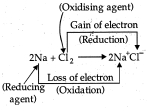
$(i)$ Sodium acts as a reducing agent while chlorine acts as an oxidising agent in the following reaction:
$2 Na (s) + Cl_2 (g) \rightarrow 2 NaCl (s)$
$(i)$ Sodium acts as a reducing agent while chlorine acts as an oxidising agent in the following reaction:
$2 Na (s) + Cl_2 (g) \rightarrow 2 NaCl (s)$
Solution
(N/A) In the reaction $2 Na (s) + Cl_2 (g) \rightarrow 2 NaCl (s)$:
$1$. Sodium $(Na)$ loses electrons to form sodium ions $(Na^+)$. The process of loss of electrons is called oxidation. Since sodium undergoes oxidation and facilitates the reduction of chlorine,it acts as a reducing agent.
$2$. Chlorine $(Cl_2)$ gains electrons to form chloride ions $(Cl^-)$. The process of gain of electrons is called reduction. Since chlorine undergoes reduction and facilitates the oxidation of sodium,it acts as an oxidising agent.
$1$. Sodium $(Na)$ loses electrons to form sodium ions $(Na^+)$. The process of loss of electrons is called oxidation. Since sodium undergoes oxidation and facilitates the reduction of chlorine,it acts as a reducing agent.
$2$. Chlorine $(Cl_2)$ gains electrons to form chloride ions $(Cl^-)$. The process of gain of electrons is called reduction. Since chlorine undergoes reduction and facilitates the oxidation of sodium,it acts as an oxidising agent.
0 likes
View Solution145
Easy
Give reason why:
$(i)$ White coloured silver chloride turns grey when kept in sunlight.
$(i)$ White coloured silver chloride turns grey when kept in sunlight.
Solution
(N/A) When white silver chloride $(AgCl)$ is exposed to sunlight,it undergoes a photochemical decomposition reaction.
In this process,silver chloride decomposes into metallic silver $(Ag)$ and chlorine gas $(Cl_2)$.
The chemical equation for this reaction is: $2AgCl(s) \xrightarrow{\text{sunlight}} 2Ag(s) + Cl_2(g)$.
The grey colour is due to the formation of metallic silver,which is grey in appearance.
In this process,silver chloride decomposes into metallic silver $(Ag)$ and chlorine gas $(Cl_2)$.
The chemical equation for this reaction is: $2AgCl(s) \xrightarrow{\text{sunlight}} 2Ag(s) + Cl_2(g)$.
The grey colour is due to the formation of metallic silver,which is grey in appearance.
0 likes
View Solution146
Easy
Give a reason why:
$(i)$ Why is a decomposition reaction called the opposite of a combination reaction?
$(i)$ Why is a decomposition reaction called the opposite of a combination reaction?
Solution
(N/A) In a decomposition reaction,a single substance [compound] breaks down to produce two or more simpler substances [elements or compounds].
Conversely,in a combination reaction,two or more substances [elements or compounds] combine to form a single new substance.
Because the processes involve opposite chemical changes—breaking down versus building up—a decomposition reaction is considered the opposite of a combination reaction.
Conversely,in a combination reaction,two or more substances [elements or compounds] combine to form a single new substance.
Because the processes involve opposite chemical changes—breaking down versus building up—a decomposition reaction is considered the opposite of a combination reaction.
0 likes
View Solution147
MediumMCQ
Calcium oxide reacts vigorously with water to produce:
A
Calcium oxide and hydrogen with a release of large amount of heat.
B
Calcium hydroxide absorbing a large amount of heat.
C
Calcium hydroxide releasing a large amount of heat.
D
Calcium oxide and hydrogen with the absorption of large amount of heat.
Solution
(C) The reaction between calcium oxide $(CaO)$, also known as quicklime, and water $(H_2O)$ is a highly exothermic combination reaction.
The chemical equation for this reaction is: $CaO(s) + H_2O(l) \rightarrow Ca(OH)_2(aq) + \text{Heat}$.
In this process, calcium oxide reacts with water to form calcium hydroxide $(Ca(OH)_2)$, also known as slaked lime.
Since this reaction releases a large amount of heat, it is classified as an exothermic reaction.
The chemical equation for this reaction is: $CaO(s) + H_2O(l) \rightarrow Ca(OH)_2(aq) + \text{Heat}$.
In this process, calcium oxide reacts with water to form calcium hydroxide $(Ca(OH)_2)$, also known as slaked lime.
Since this reaction releases a large amount of heat, it is classified as an exothermic reaction.
0 likes
View Solution148
MediumMCQ
The reaction, $3 MnO_{2}(s) + 4 Al(s) \longrightarrow 3 Mn(l) + 2 Al_{2}O_{3}(s) + \text{Heat}$, is an example of:
A
Combination and exothermic reaction.
B
Combination and endothermic reaction.
C
Displacement and endothermic reaction.
D
Displacement and exothermic reaction.
Solution
(D) $1$. In this reaction, Aluminum $(Al)$ displaces Manganese $(Mn)$ from Manganese dioxide $(MnO_{2})$ because Aluminum is more reactive than Manganese. This is a displacement reaction.
$2$. The reaction releases a significant amount of heat, as indicated by the '+ Heat' term in the product side. Reactions that release heat are called exothermic reactions.
$3$. Therefore, the reaction is both a displacement reaction and an exothermic reaction.
$2$. The reaction releases a significant amount of heat, as indicated by the '+ Heat' term in the product side. Reactions that release heat are called exothermic reactions.
$3$. Therefore, the reaction is both a displacement reaction and an exothermic reaction.
0 likes
View Solution149
MediumMCQ
Which is the reducing agent in the following reaction?
$MnO_{2}(s) + 4HCl(aq) \longrightarrow MnCl_{2}(s) + 2H_{2}O(l) + Cl_{2}(g)$
$MnO_{2}(s) + 4HCl(aq) \longrightarrow MnCl_{2}(s) + 2H_{2}O(l) + Cl_{2}(g)$
A
$HCl(aq)$
B
$MnO_{2}(s)$
C
$MnCl_{2}(s)$
D
$Cl_{2}(g)$
Solution
(A) In a redox reaction,the reducing agent is the substance that gets oxidized (loses electrons or gains oxygen/loses hydrogen).
In the given reaction: $MnO_{2}(s) + 4HCl(aq) \longrightarrow MnCl_{2}(s) + 2H_{2}O(l) + Cl_{2}(g)$
$1$. The oxidation state of $Cl$ in $HCl$ changes from $-1$ to $0$ in $Cl_{2}$. Since it loses electrons,$HCl$ is oxidized.
$2$. The oxidation state of $Mn$ in $MnO_{2}$ changes from $+4$ to $+2$ in $MnCl_{2}$. Since it gains electrons,$MnO_{2}$ is reduced.
$3$. Since $HCl$ undergoes oxidation,it acts as the reducing agent.
Therefore,the correct option is $A$.
In the given reaction: $MnO_{2}(s) + 4HCl(aq) \longrightarrow MnCl_{2}(s) + 2H_{2}O(l) + Cl_{2}(g)$
$1$. The oxidation state of $Cl$ in $HCl$ changes from $-1$ to $0$ in $Cl_{2}$. Since it loses electrons,$HCl$ is oxidized.
$2$. The oxidation state of $Mn$ in $MnO_{2}$ changes from $+4$ to $+2$ in $MnCl_{2}$. Since it gains electrons,$MnO_{2}$ is reduced.
$3$. Since $HCl$ undergoes oxidation,it acts as the reducing agent.
Therefore,the correct option is $A$.
0 likes
View Solution150
MediumMCQ
Which is the oxidising agent in the following reaction?
$CuO(s) + H_2(g) \longrightarrow Cu(s) + H_2O(l)$
$CuO(s) + H_2(g) \longrightarrow Cu(s) + H_2O(l)$
A
$H_2(g)$
B
$CuO(s)$
C
$Cu(s)$
D
$H_2O(l)$
Solution
(B) In the given reaction: $CuO(s) + H_2(g) \longrightarrow Cu(s) + H_2O(l)$
$1$. Copper oxide $(CuO)$ loses oxygen to form copper $(Cu)$. The loss of oxygen is defined as reduction.
$2$. Hydrogen $(H_2)$ gains oxygen to form water $(H_2O)$. The gain of oxygen is defined as oxidation.
$3$. An oxidising agent is a substance that provides oxygen or removes hydrogen,thereby undergoing reduction itself.
$4$. Since $CuO$ provides oxygen to $H_2$ and gets reduced to $Cu$,$CuO$ acts as the oxidising agent.
Therefore,the correct option is $B$.
$1$. Copper oxide $(CuO)$ loses oxygen to form copper $(Cu)$. The loss of oxygen is defined as reduction.
$2$. Hydrogen $(H_2)$ gains oxygen to form water $(H_2O)$. The gain of oxygen is defined as oxidation.
$3$. An oxidising agent is a substance that provides oxygen or removes hydrogen,thereby undergoing reduction itself.
$4$. Since $CuO$ provides oxygen to $H_2$ and gets reduced to $Cu$,$CuO$ acts as the oxidising agent.
Therefore,the correct option is $B$.
0 likes
View SolutionChemical Reactions and Equations — Mix Examples - Chemical Reactions and Equations · Frequently Asked Questions
1Are these Chemical Reactions and Equations questions useful for JEE and NEET?
Yes. All questions in this section are mapped to JEE Main and NEET exam patterns. Previous year questions from JEE Main, NEET, GUJCET and state-level exams are included with full solutions.
2Can I switch to Hindi or Gujarati for these questions?
Yes. Use the language tabs in the hero section or the sidebar to view the same questions and solutions in English, Hindi or Gujarati.
3How do I generate a question paper from this subtopic?
Use the Vedclass Exam Paper Generator — select the chapter and subtopic, set difficulty, and generate Sets A, B, C, D automatically. First 3 chapters of every subject are free.
Vedclass Products
For Students
Vedclass Test Series
Mock tests in real JEE/NEET style with performance analysis. 5-day free trial.
Start Free TrialFor Teachers
Exam Paper Generator
Generate Set A/B/C/D papers from this chapter in 2 minutes. 3 chapters free.
Try FreeFor Institutes
Online Exam Module
Live online exams with unlimited students, 360° analytics & white-label branding.
See DemoFor Teachers & Institutes
Generate a Chemical Reactions and Equations Exam Paper in 2 Minutes
Select subtopic & difficulty — Sets A, B, C, D auto-generated with No Repeat logic.
First 3 chapters of every subject are free — no payment required.