
A English
Mix Examples - Chemical Reactions and Equations Questions in English
Class 10 Science · Chemical Reactions and Equations · Mix Examples - Chemical Reactions and Equations
176+
Questions
English
Language
100%
With Solutions
Showing 50 of 176 questions in English
51
Difficult
On adding a drop of barium chloride solution to an aqueous solution of sodium sulphite,a white precipitate is obtained.
$(a)$ Write a balanced chemical equation of the reaction involved.
$(b)$ What other name can be given to this precipitation reaction?
$(c)$ On adding dilute hydrochloric acid to the reaction mixture,the white precipitate disappears. Why?
$(a)$ Write a balanced chemical equation of the reaction involved.
$(b)$ What other name can be given to this precipitation reaction?
$(c)$ On adding dilute hydrochloric acid to the reaction mixture,the white precipitate disappears. Why?
Solution
(A) The balanced chemical equation is:
$Na_{2}SO_{3}(aq) + BaCl_{2}(aq) \rightarrow BaSO_{3}(s) + 2NaCl(aq)$
$(b)$ This reaction is also known as a double displacement reaction.
$(c)$ $BaSO_{3}$ is a salt of a weak acid,sulphurous acid $(H_{2}SO_{3})$. When dilute hydrochloric acid $(HCl)$ is added,it reacts with the insoluble barium sulphite to form soluble barium chloride,water,and sulphur dioxide gas. The reaction is:
$BaSO_{3}(s) + 2HCl(aq) \rightarrow BaCl_{2}(aq) + H_{2}O(l) + SO_{2}(g)$
Since $BaCl_{2}$ is soluble in water,the white precipitate disappears.
$Na_{2}SO_{3}(aq) + BaCl_{2}(aq) \rightarrow BaSO_{3}(s) + 2NaCl(aq)$
$(b)$ This reaction is also known as a double displacement reaction.
$(c)$ $BaSO_{3}$ is a salt of a weak acid,sulphurous acid $(H_{2}SO_{3})$. When dilute hydrochloric acid $(HCl)$ is added,it reacts with the insoluble barium sulphite to form soluble barium chloride,water,and sulphur dioxide gas. The reaction is:
$BaSO_{3}(s) + 2HCl(aq) \rightarrow BaCl_{2}(aq) + H_{2}O(l) + SO_{2}(g)$
Since $BaCl_{2}$ is soluble in water,the white precipitate disappears.
0 likes
View Solution52
Difficult
You are provided with two containers made of copper and aluminium. You are also provided with solutions of dilute $HCl$,dilute $HNO_{3}$,$ZnCl_{2}$,and $H_{2}O$. In which of the above containers can these solutions be kept?
Solution
(A-D) When solutions are kept in a copper container:
$(a)$ Dilute $HCl$: Copper does not react with dilute $HCl$,so it can be kept.
$(b)$ Dilute $HNO_{3}$: Nitric acid is a strong oxidizing agent and reacts with copper,so it cannot be kept.
$(c)$ $ZnCl_{2}$: Zinc is more reactive than copper,so no displacement reaction occurs; it can be kept.
$(d)$ $H_{2}O$: Copper does not react with water,so it can be kept.
$(B)$ When solutions are kept in an aluminium container:
$(a)$ Dilute $HCl$: Aluminium reacts with dilute $HCl$ to form $AlCl_{3}$ and $H_{2}$ gas,so it cannot be kept. Reaction: $2Al + 6HCl \rightarrow 2AlCl_{3} + 3H_{2}$.
$(b)$ Dilute $HNO_{3}$: Aluminium forms a protective oxide layer $(Al_{2}O_{3})$ with dilute $HNO_{3}$,which prevents further reaction,so it can be kept.
$(c)$ $ZnCl_{2}$: Aluminium is more reactive than zinc and will displace zinc from the solution,so it cannot be kept. Reaction: $2Al + 3ZnCl_{2} \rightarrow 2AlCl_{3} + 3Zn$.
$(d)$ $H_{2}O$: Aluminium does not react with cold or hot water,so it can be kept.
$(a)$ Dilute $HCl$: Copper does not react with dilute $HCl$,so it can be kept.
$(b)$ Dilute $HNO_{3}$: Nitric acid is a strong oxidizing agent and reacts with copper,so it cannot be kept.
$(c)$ $ZnCl_{2}$: Zinc is more reactive than copper,so no displacement reaction occurs; it can be kept.
$(d)$ $H_{2}O$: Copper does not react with water,so it can be kept.
$(B)$ When solutions are kept in an aluminium container:
$(a)$ Dilute $HCl$: Aluminium reacts with dilute $HCl$ to form $AlCl_{3}$ and $H_{2}$ gas,so it cannot be kept. Reaction: $2Al + 6HCl \rightarrow 2AlCl_{3} + 3H_{2}$.
$(b)$ Dilute $HNO_{3}$: Aluminium forms a protective oxide layer $(Al_{2}O_{3})$ with dilute $HNO_{3}$,which prevents further reaction,so it can be kept.
$(c)$ $ZnCl_{2}$: Aluminium is more reactive than zinc and will displace zinc from the solution,so it cannot be kept. Reaction: $2Al + 3ZnCl_{2} \rightarrow 2AlCl_{3} + 3Zn$.
$(d)$ $H_{2}O$: Aluminium does not react with cold or hot water,so it can be kept.
0 likes
View Solution53
MediumMCQ
What can be seen when a strip of copper metal is placed in a solution of silver nitrate?
A
The solution turns green and silver metal is deposited.
B
The solution turns blue and silver metal is deposited.
C
The solution remains colorless and copper metal dissolves.
D
No reaction occurs.
Solution
(B) When a strip of copper metal is placed in a silver nitrate solution,a displacement reaction occurs because copper is more reactive than silver.
Metallic silver is precipitated as a solid,and the solution turns blue due to the formation of copper$(II)$ nitrate.
The chemical equation is: $Cu(s) + 2AgNO_3(aq) \to 2Ag(s) + Cu(NO_3)_2(aq)$.
Metallic silver is precipitated as a solid,and the solution turns blue due to the formation of copper$(II)$ nitrate.
The chemical equation is: $Cu(s) + 2AgNO_3(aq) \to 2Ag(s) + Cu(NO_3)_2(aq)$.
0 likes
View Solution54
Easy
State one industrial application of the reduction process.
Solution
(N/A) The reduction process is widely used in metallurgy for the extraction of metals from their ores. For example,metal oxides are reduced to their respective pure metals by using reducing agents like carbon or hydrogen.
0 likes
View Solution55
MediumMCQ
Which one of the following is a chemical change? Give reason also.
$A$. Burning of wax
$B$. Melting of wax
$A$. Burning of wax
$B$. Melting of wax
A
Burning of wax
B
Melting of wax
Solution
(A) The correct answer is $A$. Burning of wax.
Reason: Burning of wax is a chemical change because candle wax is a hydrocarbon that reacts with oxygen to produce new substances like carbon dioxide $(CO_{2})$ and water vapor $(H_{2}O)$. This process is irreversible,as the original wax cannot be recovered from the combustion products.
In contrast,the melting of wax is a physical change because it only involves a change in the state of matter from solid to liquid,and the wax can be solidified again by cooling.
Reason: Burning of wax is a chemical change because candle wax is a hydrocarbon that reacts with oxygen to produce new substances like carbon dioxide $(CO_{2})$ and water vapor $(H_{2}O)$. This process is irreversible,as the original wax cannot be recovered from the combustion products.
In contrast,the melting of wax is a physical change because it only involves a change in the state of matter from solid to liquid,and the wax can be solidified again by cooling.
0 likes
View Solution56
EasyMCQ
Which one is a chemical change: Fermentation of fruit juice or diluting fruit juice?
A
Fermentation of fruit juice
B
Diluting fruit juice
C
Both are chemical changes
D
Neither is a chemical change
Solution
(A) chemical change involves the formation of new substances with different chemical properties.
Fermentation of fruit juice is a chemical change because microorganisms (like yeast) convert sugars into alcohol and carbon dioxide,resulting in a new substance.
Diluting fruit juice is a physical change because it only involves adding water to the juice,which does not change the chemical composition of the juice components.
Fermentation of fruit juice is a chemical change because microorganisms (like yeast) convert sugars into alcohol and carbon dioxide,resulting in a new substance.
Diluting fruit juice is a physical change because it only involves adding water to the juice,which does not change the chemical composition of the juice components.
0 likes
View Solution57
EasyMCQ
Which one is a chemical change: Rusting of iron or melting of iron?
A
Rusting of iron
B
Melting of iron
C
Both are chemical changes
D
Neither is a chemical change
Solution
(A) Rusting of iron is a chemical change because it involves a chemical reaction between iron,oxygen,and moisture to form a new substance called iron oxide $(Fe_2O_3 \cdot xH_2O)$.
Melting of iron is a physical change because it only involves a change in the state of matter from solid to liquid,and no new substance is formed.
Melting of iron is a physical change because it only involves a change in the state of matter from solid to liquid,and no new substance is formed.
0 likes
View Solution58
EasyMCQ
State one basic difference between a physical change and a chemical change.
A
Physical change is reversible,chemical is not.
B
No new substance is formed in physical change,whereas a new substance is formed in chemical change.
C
Physical change involves energy,chemical does not.
D
Physical change is permanent,chemical is temporary.
Solution
(B) In a physical change,the chemical composition of the substance remains the same and no new substance is formed.
In a chemical change,the chemical composition of the substance changes,resulting in the formation of one or more new substances with different properties.
In a chemical change,the chemical composition of the substance changes,resulting in the formation of one or more new substances with different properties.
0 likes
View Solution59
Easy
In the electrolysis of water,why is the volume of gas collected over one electrode double that of the gas collected over the other electrode?
Solution
(N/A) During the electrolysis of water,the water molecule $(H_{2}O)$ decomposes into hydrogen gas $(H_{2})$ and oxygen gas $(O_{2})$ in a specific molar ratio.
The chemical equation for this process is:
$2H_{2}O(l) \xrightarrow{\text{Electrolysis}} 2H_{2}(g) + O_{2}(g)$
According to the balanced chemical equation,for every $2$ moles of water decomposed,$2$ moles of hydrogen gas are produced at the cathode and $1$ mole of oxygen gas is produced at the anode.
Therefore,the volume of hydrogen gas collected is double the volume of oxygen gas collected,resulting in a ratio of $2:1$.
The chemical equation for this process is:
$2H_{2}O(l) \xrightarrow{\text{Electrolysis}} 2H_{2}(g) + O_{2}(g)$
According to the balanced chemical equation,for every $2$ moles of water decomposed,$2$ moles of hydrogen gas are produced at the cathode and $1$ mole of oxygen gas is produced at the anode.
Therefore,the volume of hydrogen gas collected is double the volume of oxygen gas collected,resulting in a ratio of $2:1$.
0 likes
View Solution60
Easy
Name the oxidising and reducing agent in the following reaction:
$CuO + H_{2} \longrightarrow Cu + H_{2}O$
$CuO + H_{2} \longrightarrow Cu + H_{2}O$
Solution
(N/A) In the given reaction: $CuO + H_{2} \longrightarrow Cu + H_{2}O$
$1$. The oxidising agent is $CuO$ because it provides oxygen to $H_{2}$ and gets reduced to $Cu$.
$2$. The reducing agent is $H_{2}$ because it removes oxygen from $CuO$ and gets oxidised to $H_{2}O$.
$1$. The oxidising agent is $CuO$ because it provides oxygen to $H_{2}$ and gets reduced to $Cu$.
$2$. The reducing agent is $H_{2}$ because it removes oxygen from $CuO$ and gets oxidised to $H_{2}O$.
0 likes
View Solution61
MediumMCQ
On adding dilute hydrochloric acid to copper oxide powder,the solution formed is blue-green. Predict the new compound formed which imparts a blue-green colour to the solution.
A
Copper $(I)$ chloride
B
Copper $(II)$ chloride
C
Copper hydroxide
D
Copper carbonate
Solution
(B) When copper oxide $(CuO)$ reacts with dilute hydrochloric acid $(HCl)$,a neutralization reaction occurs.
The chemical equation is: $CuO(s) + 2HCl(aq) \rightarrow CuCl_2(aq) + H_2O(l)$.
The new compound formed is copper $(II)$ chloride $(CuCl_2)$,which imparts a blue-green colour to the solution.
The chemical equation is: $CuO(s) + 2HCl(aq) \rightarrow CuCl_2(aq) + H_2O(l)$.
The new compound formed is copper $(II)$ chloride $(CuCl_2)$,which imparts a blue-green colour to the solution.
0 likes
View Solution62
EasyMCQ
What type of coating is formed on silver articles when they get corroded?
A
Green coating
B
Black coating
C
Reddish-brown coating
D
White coating
Solution
(B) When silver articles are exposed to air,they react with sulfur compounds present in the atmosphere,such as hydrogen sulfide $(H_2S)$.
This chemical reaction leads to the formation of a black layer of silver sulfide $(Ag_2S)$ on the surface of the silver.
This process is a form of corrosion known as tarnishing.
This chemical reaction leads to the formation of a black layer of silver sulfide $(Ag_2S)$ on the surface of the silver.
This process is a form of corrosion known as tarnishing.
0 likes
View Solution63
EasyMCQ
What type of coating is formed on copper articles when they get corroded?
A
Black coating of copper oxide
B
Red coating of copper oxide
C
Green coating of basic copper carbonate
D
Blue coating of copper sulphate
Solution
(C) When copper articles are exposed to moist air for a long time,they react with atmospheric carbon dioxide,oxygen,and moisture.
This process leads to the formation of a green-colored layer on the surface of the copper.
This green coating is chemically known as basic copper carbonate,which has the formula $[CuCO_{3} \cdot Cu(OH)_{2}]$.
Therefore,the correct answer is a green coating of basic copper carbonate.
This process leads to the formation of a green-colored layer on the surface of the copper.
This green coating is chemically known as basic copper carbonate,which has the formula $[CuCO_{3} \cdot Cu(OH)_{2}]$.
Therefore,the correct answer is a green coating of basic copper carbonate.
0 likes
View Solution64
EasyMCQ
Balance the following chemical equation:
$Fe(s) + H_2O(g) \rightarrow Fe_3O_4(s) + H_2(g)$
$Fe(s) + H_2O(g) \rightarrow Fe_3O_4(s) + H_2(g)$
A
$3Fe(s) + 4H_2O(g) \rightarrow Fe_3O_4(s) + 4H_2(g)$
B
$Fe(s) + 4H_2O(g) \rightarrow Fe_3O_4(s) + 4H_2(g)$
C
$3Fe(s) + H_2O(g) \rightarrow Fe_3O_4(s) + H_2(g)$
D
$3Fe(s) + 4H_2O(g) \rightarrow Fe_3O_4(s) + H_2(g)$
Solution
(A) To balance the equation $Fe(s) + H_2O(g) \rightarrow Fe_3O_4(s) + H_2(g)$:
$1$. Balance $Fe$: There are $3$ atoms of $Fe$ on the right side,so place a coefficient of $3$ before $Fe$ on the left side: $3Fe + H_2O \rightarrow Fe_3O_4 + H_2$.
$2$. Balance $O$: There are $4$ atoms of $O$ on the right side,so place a coefficient of $4$ before $H_2O$ on the left side: $3Fe + 4H_2O \rightarrow Fe_3O_4 + H_2$.
$3$. Balance $H$: Now there are $8$ atoms of $H$ on the left side $(4 \times 2)$,so place a coefficient of $4$ before $H_2$ on the right side: $3Fe(s) + 4H_2O(g) \rightarrow Fe_3O_4(s) + 4H_2(g)$.
The equation is now balanced.
$1$. Balance $Fe$: There are $3$ atoms of $Fe$ on the right side,so place a coefficient of $3$ before $Fe$ on the left side: $3Fe + H_2O \rightarrow Fe_3O_4 + H_2$.
$2$. Balance $O$: There are $4$ atoms of $O$ on the right side,so place a coefficient of $4$ before $H_2O$ on the left side: $3Fe + 4H_2O \rightarrow Fe_3O_4 + H_2$.
$3$. Balance $H$: Now there are $8$ atoms of $H$ on the left side $(4 \times 2)$,so place a coefficient of $4$ before $H_2$ on the right side: $3Fe(s) + 4H_2O(g) \rightarrow Fe_3O_4(s) + 4H_2(g)$.
The equation is now balanced.
0 likes
View Solution65
EasyMCQ
What is meant by a skeletal chemical equation?
A
$A$ balanced chemical equation
B
An unbalanced chemical equation
C
$A$ chemical equation with only reactants
D
$A$ chemical equation with only products
Solution
(B) skeletal chemical equation is an unbalanced chemical equation in which the number of atoms of each element is not equal on both the reactant and product sides.
For example,the reaction $Mg + O_2 \rightarrow MgO$ is a skeletal equation because the number of oxygen atoms is not balanced.
For example,the reaction $Mg + O_2 \rightarrow MgO$ is a skeletal equation because the number of oxygen atoms is not balanced.
0 likes
View Solution66
EasyMCQ
Which one is a chemical change: Electrolysis of water or Sodium chloride exposed to sunlight?
A
Electrolysis of water
B
Sodium chloride exposed to sunlight
C
Both are chemical changes
D
None of the above
Solution
(A) Electrolysis of water is a chemical change because it involves the decomposition of water $(H_2O)$ into hydrogen $(H_2)$ and oxygen $(O_2)$ gases using electricity,resulting in the formation of new substances.
Sodium chloride $(NaCl)$ is stable under sunlight and does not undergo a chemical change when exposed to it.
Sodium chloride $(NaCl)$ is stable under sunlight and does not undergo a chemical change when exposed to it.
0 likes
View Solution67
EasyMCQ
If copper metal is heated over a flame, it develops a coating. What is the colour and composition of this coating?
A
Black, Copper $(II)$ oxide $(CuO)$
B
Red, Copper $(I)$ oxide $(Cu_2O)$
C
Green, Copper carbonate $(CuCO_3)$
D
Blue, Copper sulphate $(CuSO_4)$
Solution
(A) When copper metal is heated in the presence of air (oxygen), it undergoes an oxidation reaction.
The copper reacts with oxygen to form copper $(II)$ oxide, which is represented by the chemical formula $CuO$.
This copper $(II)$ oxide forms a black-coloured coating on the surface of the copper metal.
The chemical equation for this reaction is: $2Cu(s) + O_2(g) \rightarrow 2CuO(s)$.
The copper reacts with oxygen to form copper $(II)$ oxide, which is represented by the chemical formula $CuO$.
This copper $(II)$ oxide forms a black-coloured coating on the surface of the copper metal.
The chemical equation for this reaction is: $2Cu(s) + O_2(g) \rightarrow 2CuO(s)$.
0 likes
View Solution68
Medium
When a green iron salt is heated strongly, its colour finally changes to black and the odour of burning sulphur is given out.
$(a)$ Name the iron salt.
$(b)$ Name the type of reaction that takes place during the heating of iron salt.
$(a)$ Name the iron salt.
$(b)$ Name the type of reaction that takes place during the heating of iron salt.
Solution
(N/A) The green iron salt is Ferrous sulphate heptahydrate $(FeSO_{4} \cdot 7H_{2}O)$. Upon strong heating, it loses water of crystallization and then decomposes into Ferric oxide $(Fe_{2}O_{3})$, which is black in colour, along with sulphur dioxide $(SO_{2})$ and sulphur trioxide $(SO_{3})$ gases.
$(b)$ This is a thermal decomposition reaction because a single reactant breaks down into multiple products upon the application of heat.
$(b)$ This is a thermal decomposition reaction because a single reactant breaks down into multiple products upon the application of heat.
0 likes
View Solution69
Easy
State the kind of chemical reactions in the following examples:
$(a)$ Digestion of food in the stomach
$(b)$ Combustion of coal in air.
$(a)$ Digestion of food in the stomach
$(b)$ Combustion of coal in air.
Solution
(N/A) Digestion of food involves the breakdown of complex food molecules into simpler substances,which is a decomposition reaction.
$(b)$ Combustion of coal involves the reaction of carbon with oxygen to form carbon dioxide,which is a combination reaction.
$(b)$ Combustion of coal involves the reaction of carbon with oxygen to form carbon dioxide,which is a combination reaction.
0 likes
View Solution70
Easy
When hydrogen gas burns in the presence of oxygen,water is formed,and when water is electrolysed,hydrogen and oxygen gases are produced. State the kind of reaction that takes place:
$(a)$ In the first case
$(b)$ In the second case
$(a)$ In the first case
$(b)$ In the second case
Solution
(A) Combination reaction: In this reaction,two or more reactants combine to form a single product $(2H_2 + O_2 \rightarrow 2H_2O)$.
$(b)$ Decomposition reaction: In this reaction,a single reactant breaks down into two or more simpler products under the influence of electricity $(2H_2O \xrightarrow{\text{electricity}} 2H_2 + O_2)$.
$(b)$ Decomposition reaction: In this reaction,a single reactant breaks down into two or more simpler products under the influence of electricity $(2H_2O \xrightarrow{\text{electricity}} 2H_2 + O_2)$.
0 likes
View Solution71
Medium
Can oxidation or reduction take place alone? Why or why not? What are such reactions called?
Solution
(N/A) No,oxidation or reduction cannot take place alone. This is because electrons lost during oxidation must be gained by another substance during reduction. Therefore,these processes always occur simultaneously. Such reactions are known as $Redox$ reactions.
0 likes
View Solution72
Medium
Explain,giving chemical equations,any two uses of chemical decomposition reactions in industry.
Solution
(N/A) $(i)$ In the manufacturing of cement,quicklime $(CaO)$ is used,which is obtained by the thermal decomposition of limestone $(CaCO_3)$:
$CaCO_3(s) \xrightarrow{\text{Heat}} CaO(s) + CO_2(g)$
$(ii)$ In the manufacturing of photochromic glass,silver chloride $(AgCl)$ or silver bromide $(AgBr)$ is used,which undergoes photochemical decomposition in sunlight to form metallic silver,causing the glass to darken:
$2AgCl(s) \xrightarrow{\text{Sunlight}} 2Ag(s) + Cl_2(g)$
$2AgBr(s) \xrightarrow{\text{Sunlight}} 2Ag(s) + Br_2(g)$
$CaCO_3(s) \xrightarrow{\text{Heat}} CaO(s) + CO_2(g)$
$(ii)$ In the manufacturing of photochromic glass,silver chloride $(AgCl)$ or silver bromide $(AgBr)$ is used,which undergoes photochemical decomposition in sunlight to form metallic silver,causing the glass to darken:
$2AgCl(s) \xrightarrow{\text{Sunlight}} 2Ag(s) + Cl_2(g)$
$2AgBr(s) \xrightarrow{\text{Sunlight}} 2Ag(s) + Br_2(g)$
0 likes
View Solution73
Medium
Name the type of reaction for the following:
$(i)$ Vegetable matter changing into compost.
$(ii)$ Burning of natural gas.
$(i)$ Vegetable matter changing into compost.
$(ii)$ Burning of natural gas.
Solution
(N/A) $(i)$ Decomposition reaction: The breakdown of complex organic matter into simpler substances by microorganisms is a decomposition process.
$(ii)$ Oxidation (Combustion) reaction: Burning of natural gas $(CH_4)$ in the presence of oxygen is an exothermic oxidation reaction, represented as: $CH_4 + 2O_2 \rightarrow CO_2 + 2H_2O + \text{Heat}$.
$(ii)$ Oxidation (Combustion) reaction: Burning of natural gas $(CH_4)$ in the presence of oxygen is an exothermic oxidation reaction, represented as: $CH_4 + 2O_2 \rightarrow CO_2 + 2H_2O + \text{Heat}$.
0 likes
View Solution74
Easy
Name the type of reaction for the following:
$(i)$ Silver items turning black when left exposed to air.
$(ii)$ Change in colour of copper sulphate from blue to green on dipping an iron nail in it.
$(i)$ Silver items turning black when left exposed to air.
$(ii)$ Change in colour of copper sulphate from blue to green on dipping an iron nail in it.
Solution
(N/A) $(i)$ Corrosion (Oxidation reaction): Silver reacts with sulfur compounds in the air to form silver sulfide $(Ag_2S)$,which is black in color.
$(ii)$ Displacement reaction: Iron $(Fe)$ is more reactive than copper $(Cu)$,so it displaces copper from the copper sulphate $(CuSO_4)$ solution to form ferrous sulphate $(FeSO_4)$,which is green in color.
$(ii)$ Displacement reaction: Iron $(Fe)$ is more reactive than copper $(Cu)$,so it displaces copper from the copper sulphate $(CuSO_4)$ solution to form ferrous sulphate $(FeSO_4)$,which is green in color.
0 likes
View Solution75
Easy
Write the essential condition for the following reaction to take place: $2 AgCl \rightarrow 2 Ag + Cl_{2}$ and write one use of this reaction.
Solution
(N/A) $(i)$ The essential condition for the reaction $2 AgCl \rightarrow 2 Ag + Cl_{2}$ to occur is the presence of sunlight (photolytic decomposition).
$(ii)$ This reaction is used in black and white photography.
$(ii)$ This reaction is used in black and white photography.
0 likes
View Solution76
MediumMCQ
Complete the following reaction:
$2 FeSO_{4} \xrightarrow{\text{Heat}} Fe_{2}O_{3} + \dots + \dots$
$2 FeSO_{4} \xrightarrow{\text{Heat}} Fe_{2}O_{3} + \dots + \dots$
A
$SO_{2} + SO_{3}$
B
$SO_{2} + SO_{2}$
C
$SO_{3} + SO_{3}$
D
$S + O_{2}$
Solution
(A) The thermal decomposition of ferrous sulfate $(FeSO_{4})$ is a classic chemical reaction.
When heated,ferrous sulfate crystals lose water and then decompose to form ferric oxide $(Fe_{2}O_{3})$,sulfur dioxide $(SO_{2})$,and sulfur trioxide $(SO_{3})$.
The balanced chemical equation is:
$2 FeSO_{4} \xrightarrow{\text{Heat}} Fe_{2}O_{3} + SO_{2} + SO_{3}$
When heated,ferrous sulfate crystals lose water and then decompose to form ferric oxide $(Fe_{2}O_{3})$,sulfur dioxide $(SO_{2})$,and sulfur trioxide $(SO_{3})$.
The balanced chemical equation is:
$2 FeSO_{4} \xrightarrow{\text{Heat}} Fe_{2}O_{3} + SO_{2} + SO_{3}$
0 likes
View Solution77
Difficult
$(i)$ When a metal $X$ is added to the salt solution of a metal $Y$,the following chemical reaction takes place: Metal $X +$ Salt solution of $Y \rightarrow$ Salt solution of $X +$ Metal $Y$.
$(ii)$ Mention the inference you draw regarding the reactivity of metal $X$ and $Y$ and also about the type of reaction. State the reason for your conclusions.
$(ii)$ Mention the inference you draw regarding the reactivity of metal $X$ and $Y$ and also about the type of reaction. State the reason for your conclusions.
Solution
(N/A) The given reaction is a displacement reaction.
$(i)$ Metal $X$ is more reactive than metal $Y$.
$(ii)$ Metal $X$ is displacing metal $Y$ from its salt solution. According to the reactivity series,a more reactive metal displaces a less reactive metal from its salt solution. Therefore,$X$ is more reactive than $Y$.
$(i)$ Metal $X$ is more reactive than metal $Y$.
$(ii)$ Metal $X$ is displacing metal $Y$ from its salt solution. According to the reactivity series,a more reactive metal displaces a less reactive metal from its salt solution. Therefore,$X$ is more reactive than $Y$.
0 likes
View Solution78
Medium
Giving chemical equations,answer the following:
$(a)$ What happens when copper is heated in air?
$(b)$ What happens when the product obtained in the above reaction is heated in hydrogen?
$(a)$ What happens when copper is heated in air?
$(b)$ What happens when the product obtained in the above reaction is heated in hydrogen?
Solution
(N/A) When copper is heated in air,it reacts with oxygen to form copper$(II)$ oxide,which is a black-colored substance.
Equation: $2Cu(s) + O_2(g) \xrightarrow{\text{Heat}} 2CuO(s)$
$(b)$ When the product obtained (copper$(II)$ oxide) is heated in hydrogen gas,it undergoes a reduction reaction to form copper metal and water.
Equation: $CuO(s) + H_2(g) \xrightarrow{\text{Heat}} Cu(s) + H_2O(l)$
The black coating turns brown as copper metal is formed.
Equation: $2Cu(s) + O_2(g) \xrightarrow{\text{Heat}} 2CuO(s)$
$(b)$ When the product obtained (copper$(II)$ oxide) is heated in hydrogen gas,it undergoes a reduction reaction to form copper metal and water.
Equation: $CuO(s) + H_2(g) \xrightarrow{\text{Heat}} Cu(s) + H_2O(l)$
The black coating turns brown as copper metal is formed.
0 likes
View Solution79
Medium
When potassium iodide solution is added to a solution of lead $(II)$ nitrate in a test tube,a precipitate is formed.
$(i)$ What is the colour of this precipitate?
$(ii)$ Name the compound precipitated.
$(i)$ What is the colour of this precipitate?
$(ii)$ Name the compound precipitated.
Solution
(N/A) $(i)$ The colour of the precipitate formed is yellow.
$(ii)$ The compound precipitated is lead iodide,which has the chemical formula $PbI_{2}$.
$(ii)$ The compound precipitated is lead iodide,which has the chemical formula $PbI_{2}$.
0 likes
View Solution80
Medium
When potassium iodide solution is added to a solution of lead $(II)$ nitrate in a test tube,a precipitate is formed.
$(i)$ Write a balanced chemical equation for this reaction.
$(ii)$ What type of reaction is this?
$(i)$ Write a balanced chemical equation for this reaction.
$(ii)$ What type of reaction is this?
Solution
(N/A) $(i)$ The balanced chemical equation is:
$2KI(aq) + Pb(NO_3)_2(aq) \to PbI_2(s) \downarrow + 2KNO_3(aq)$
$(ii)$ This is a double displacement reaction. Since an insoluble solid (precipitate) is formed,it is also classified as a precipitation reaction.
$2KI(aq) + Pb(NO_3)_2(aq) \to PbI_2(s) \downarrow + 2KNO_3(aq)$
$(ii)$ This is a double displacement reaction. Since an insoluble solid (precipitate) is formed,it is also classified as a precipitation reaction.
0 likes
View Solution81
Medium
"$A$ solution of potassium chloride when mixed with silver nitrate solution, an insoluble white substance is formed".
$(i)$ Translate the above statement into a chemical equation.
$(i)$ Translate the above statement into a chemical equation.
Solution
(N/A) $KCl(aq) + AgNO_3(aq) \to AgCl(s) \downarrow + KNO_3(aq)$
In this reaction, potassium chloride reacts with silver nitrate to form silver chloride, which is an insoluble white precipitate, and potassium nitrate.
In this reaction, potassium chloride reacts with silver nitrate to form silver chloride, which is an insoluble white precipitate, and potassium nitrate.
0 likes
View Solution82
Medium
$A$ solution of potassium chloride when mixed with silver nitrate solution, an insoluble white substance is formed. $(i)$ State two types of this reaction.
Solution
(A-D) The chemical reaction is: $KCl(aq) + AgNO_3(aq) \rightarrow AgCl(s) + KNO_3(aq)$.
$(a)$ Double displacement reaction: The ions $K^+$ and $Ag^+$ exchange their partners to form new products.
$(b)$ Precipitation reaction: An insoluble white solid, silver chloride $(AgCl)$, is formed as a precipitate.
$(a)$ Double displacement reaction: The ions $K^+$ and $Ag^+$ exchange their partners to form new products.
$(b)$ Precipitation reaction: An insoluble white solid, silver chloride $(AgCl)$, is formed as a precipitate.
0 likes
View Solution83
Medium
An aluminium can was used to store ferrous sulphate solution. It is observed that in a few days,holes appeared in the can. Explain the observation and write the chemical equation to support your answer.
Solution
(N/A) Aluminium is more reactive than iron. Therefore,it displaces iron from the ferrous sulphate solution in a displacement reaction.
The chemical reaction is as follows:
$2Al(s) + 3FeSO_4(aq) \to Al_2(SO_4)_3(aq) + 3Fe(s)$
Due to this reaction,the aluminium metal of the can is consumed to form aluminium sulphate,which leads to the formation of holes in the can.
The chemical reaction is as follows:
$2Al(s) + 3FeSO_4(aq) \to Al_2(SO_4)_3(aq) + 3Fe(s)$
Due to this reaction,the aluminium metal of the can is consumed to form aluminium sulphate,which leads to the formation of holes in the can.
0 likes
View Solution84
EasyMCQ
Why is a combustion reaction considered an oxidation reaction?
A
It involves the release of energy.
B
It requires the presence of oxygen.
C
It produces carbon dioxide.
D
It involves the reduction of fuel.
Solution
(B) combustion reaction is classified as an oxidation reaction because it involves the addition of oxygen to a substance or the removal of hydrogen from it.
In most combustion processes,the fuel reacts with oxygen to form oxides,which is a fundamental characteristic of oxidation.
For example,the combustion of methane is represented as:
$CH_{4}(g) + 2O_{2}(g) \rightarrow CO_{2}(g) + 2H_{2}O(l)$
In this reaction,oxygen is added to carbon and hydrogen,confirming it as an oxidation process.
In most combustion processes,the fuel reacts with oxygen to form oxides,which is a fundamental characteristic of oxidation.
For example,the combustion of methane is represented as:
$CH_{4}(g) + 2O_{2}(g) \rightarrow CO_{2}(g) + 2H_{2}O(l)$
In this reaction,oxygen is added to carbon and hydrogen,confirming it as an oxidation process.
0 likes
View Solution85
Easy
How will you test whether the gas evolved in a reaction is hydrogen?
Solution
(N/A) To test for hydrogen gas,bring a burning matchstick or a burning splinter near the mouth of the test tube from which the gas is being evolved.
If the gas is hydrogen,it will burn with a characteristic '$pop$' sound,which is caused by the rapid combustion of hydrogen in the presence of oxygen.
If the gas is hydrogen,it will burn with a characteristic '$pop$' sound,which is caused by the rapid combustion of hydrogen in the presence of oxygen.
0 likes
View Solution86
Medium
What is the colour of $FeSO_{4} \cdot 7H_{2}O$ crystals? How does this colour change upon heating? Give the balanced chemical equation for the change.
Solution
(N/A) $FeSO_{4} \cdot 7H_{2}O$ crystals are green in colour. Upon heating,they first lose their water of crystallisation and turn white (anhydrous $FeSO_{4}$). On further heating,they decompose to form ferric oxide $(Fe_{2}O_{3})$,which is reddish-brown in colour,along with sulphur dioxide $(SO_{2})$ and sulphur trioxide $(SO_{3})$ gases.
Step $1$: Loss of water of crystallisation:
$FeSO_{4} \cdot 7H_{2}O(s) \xrightarrow{\Delta} FeSO_{4}(s) + 7H_{2}O(g)$
(Green) (White)
Step $2$: Decomposition of anhydrous ferrous sulphate:
$2FeSO_{4}(s) \xrightarrow{\Delta} Fe_{2}O_{3}(s) + SO_{2}(g) + SO_{3}(g)$
(Reddish-brown)
Step $1$: Loss of water of crystallisation:
$FeSO_{4} \cdot 7H_{2}O(s) \xrightarrow{\Delta} FeSO_{4}(s) + 7H_{2}O(g)$
(Green) (White)
Step $2$: Decomposition of anhydrous ferrous sulphate:
$2FeSO_{4}(s) \xrightarrow{\Delta} Fe_{2}O_{3}(s) + SO_{2}(g) + SO_{3}(g)$
(Reddish-brown)
0 likes
View Solution87
Medium
The smell and taste of food containing fats and oils change after some time. Why does this happen? Name the process. List two ways which help to slow down the above-mentioned process.
Solution
(N/A) The smell and taste of food containing fats and oils change because they get oxidized when exposed to air,leading to a condition known as $Rancidity$.
Process: $Rancidity$.
Two ways to slow down this process are:
$1$. Storing food in airtight containers to prevent contact with oxygen.
$2$. Flushing nitrogen gas into food packets (like chips) to replace oxygen and prevent oxidation.
Process: $Rancidity$.
Two ways to slow down this process are:
$1$. Storing food in airtight containers to prevent contact with oxygen.
$2$. Flushing nitrogen gas into food packets (like chips) to replace oxygen and prevent oxidation.
0 likes
View Solution88
Medium
State what happens when:
$(a)$ Hydrated copper sulphate is heated.
Also,write the chemical equation for the reaction.
$(a)$ Hydrated copper sulphate is heated.
Also,write the chemical equation for the reaction.
Solution
(N/A) When hydrated copper sulphate $(CuSO_4 \cdot 5H_2O)$ is heated,the five molecules of water of crystallisation are lost,and the blue-coloured crystals turn into a white anhydrous powder.
If we add water back to this white powder,the blue colour reappears due to the re-formation of hydrated copper sulphate.
The chemical equation is:
$CuSO_4 \cdot 5H_2O (s) \xrightarrow{\text{Heat}} CuSO_4 (s) + 5H_2O (g)$
(Blue) $\quad \quad \quad \quad \quad \quad \quad \quad$ (White)
If we add water back to this white powder,the blue colour reappears due to the re-formation of hydrated copper sulphate.
The chemical equation is:
$CuSO_4 \cdot 5H_2O (s) \xrightarrow{\text{Heat}} CuSO_4 (s) + 5H_2O (g)$
(Blue) $\quad \quad \quad \quad \quad \quad \quad \quad$ (White)
0 likes
View Solution89
Medium
State what happens when:
$(a)$ Gypsum is heated at $373 \, K$.
Also,write the chemical equation for the reaction.
$(a)$ Gypsum is heated at $373 \, K$.
Also,write the chemical equation for the reaction.
Solution
(N/A) When gypsum $(CaSO_4 \cdot 2H_2O)$ is heated at $373 \, K$,it loses three-fourths of its water of crystallization and forms Plaster of Paris $(CaSO_4 \cdot \frac{1}{2}H_2O)$.
The chemical equation for this reaction is:
$CaSO_4 \cdot 2H_2O(s) \xrightarrow{373 \, K} CaSO_4 \cdot \frac{1}{2}H_2O(s) + 1\frac{1}{2}H_2O(g)$
The chemical equation for this reaction is:
$CaSO_4 \cdot 2H_2O(s) \xrightarrow{373 \, K} CaSO_4 \cdot \frac{1}{2}H_2O(s) + 1\frac{1}{2}H_2O(g)$
0 likes
View Solution90
Medium
State what happens when:
$(a)$ Chlorine gas is passed through dry slaked lime.
Also write the chemical equation in each case.
$(a)$ Chlorine gas is passed through dry slaked lime.
Also write the chemical equation in each case.
Solution
(N/A) When chlorine gas is passed through dry slaked lime,it reacts to form bleaching powder (calcium oxychloride) and water.
The chemical equation is:
$Ca(OH)_2 + Cl_2 \to CaOCl_2 + H_2O$
The chemical equation is:
$Ca(OH)_2 + Cl_2 \to CaOCl_2 + H_2O$
0 likes
View Solution91
Medium
State the reason for the following:
$(a)$ Potato chips manufacturers usually flush bags of chips with nitrogen gas.
$(b)$ Iron articles lose their shine gradually.
$(c)$ Foods should be kept in airtight containers.
$(a)$ Potato chips manufacturers usually flush bags of chips with nitrogen gas.
$(b)$ Iron articles lose their shine gradually.
$(c)$ Foods should be kept in airtight containers.
Solution
(N/A) Potato chips manufacturers flush bags with nitrogen gas to create an unreactive environment,which prevents the oxidation of fats and oils,thereby stopping the chips from becoming rancid.
$(b)$ Iron articles lose their shine because they react with moisture and oxygen present in the atmosphere to form a layer of hydrated iron oxide,a process known as corrosion or rusting.
$(c)$ Foods should be kept in airtight containers to minimize their exposure to oxygen and moisture,which helps in preventing oxidation and slowing down the growth of microorganisms,thus keeping the food fresh for a longer period.
$(b)$ Iron articles lose their shine because they react with moisture and oxygen present in the atmosphere to form a layer of hydrated iron oxide,a process known as corrosion or rusting.
$(c)$ Foods should be kept in airtight containers to minimize their exposure to oxygen and moisture,which helps in preventing oxidation and slowing down the growth of microorganisms,thus keeping the food fresh for a longer period.
0 likes
View Solution92
Medium
Study the reactions given below. State which of the following chemical reactions will take place or not,giving suitable reason for each:
$(a)$ $Zn(s) + CuSO_4(aq) \rightarrow ZnSO_4(aq) + Cu(s)$
$(b)$ $Fe(s) + ZnSO_4(aq) \rightarrow FeSO_4(aq) + Zn(s)$
$(c)$ $Zn(s) + FeSO_4(aq) \rightarrow ZnSO_4(aq) + Fe(s)$
$(a)$ $Zn(s) + CuSO_4(aq) \rightarrow ZnSO_4(aq) + Cu(s)$
$(b)$ $Fe(s) + ZnSO_4(aq) \rightarrow FeSO_4(aq) + Zn(s)$
$(c)$ $Zn(s) + FeSO_4(aq) \rightarrow ZnSO_4(aq) + Fe(s)$
Solution
(N/A) Zinc is more reactive than copper; therefore,it will displace copper from $CuSO_4$. This reaction will take place.
$(b)$ Iron is less reactive than zinc; therefore,it cannot displace zinc from zinc sulphate. This reaction will not take place.
$(c)$ Zinc is more reactive than iron; therefore,it will displace iron from $FeSO_4$. This reaction will take place.
$(b)$ Iron is less reactive than zinc; therefore,it cannot displace zinc from zinc sulphate. This reaction will not take place.
$(c)$ Zinc is more reactive than iron; therefore,it will displace iron from $FeSO_4$. This reaction will take place.
0 likes
View Solution93
MediumMCQ
Write the chemical equation of the reaction with an example in which a change in colour takes place.
A
$N$/$A$
B
$N$/$A$
C
$N$/$A$
D
$N$/$A$
Solution
(N/A) chemical reaction involving a change in colour can be observed when lead nitrate solution reacts with potassium iodide solution. The reaction mixture changes from colourless to a yellow precipitate.
The balanced chemical equation is:
$Pb(NO_3)_2(aq) + 2KI(aq) \rightarrow PbI_2(s) + 2KNO_3(aq)$
In this reaction,lead$(II)$ iodide $(PbI_2)$ is formed as a yellow precipitate.
The balanced chemical equation is:
$Pb(NO_3)_2(aq) + 2KI(aq) \rightarrow PbI_2(s) + 2KNO_3(aq)$
In this reaction,lead$(II)$ iodide $(PbI_2)$ is formed as a yellow precipitate.
0 likes
View Solution94
Easy
Write the chemical equation of the reaction with an example in which a change in temperature takes place.
Solution
(N/A) change in temperature occurs during an exothermic reaction, where heat is released into the surroundings.
Example: The reaction between zinc granules and dilute sulphuric acid.
Chemical equation: $Zn(s) + H_2SO_4(aq) \rightarrow ZnSO_4(aq) + H_2(g) + \text{Heat}$
Example: The reaction between zinc granules and dilute sulphuric acid.
Chemical equation: $Zn(s) + H_2SO_4(aq) \rightarrow ZnSO_4(aq) + H_2(g) + \text{Heat}$
0 likes
View Solution95
Easy
Write the chemical equation of the reaction with an example each in which the following changes have taken place:
$(i)$ Formation of a precipitate.
$(i)$ Formation of a precipitate.
Solution
(N/A) Formation of a precipitate occurs when two aqueous solutions react to form an insoluble solid product,known as a precipitate.
Example: The reaction between barium chloride and sodium sulphate results in the formation of a white precipitate of barium sulphate.
Chemical equation:
$BaCl_{2}(aq) + Na_{2}SO_{4}(aq) \rightarrow BaSO_{4}(s) + 2NaCl(aq)$
Example: The reaction between barium chloride and sodium sulphate results in the formation of a white precipitate of barium sulphate.
Chemical equation:
$BaCl_{2}(aq) + Na_{2}SO_{4}(aq) \rightarrow BaSO_{4}(s) + 2NaCl(aq)$
0 likes
View Solution96
Medium
Write one example for each of the decomposition reactions carried out with the help of:
$(i)$ electricity
$(ii)$ heat
$(iii)$ sunlight
Give balanced chemical equations in each case.
$(i)$ electricity
$(ii)$ heat
$(iii)$ sunlight
Give balanced chemical equations in each case.
Solution
(N/A) $(i)$ Electricity (Electrolytic decomposition):
$2H_{2}O(l) \xrightarrow{\text{Electric current}} 2H_{2}(g) + O_{2}(g)$
$(ii)$ Heat (Thermal decomposition):
$CaCO_{3}(s) \xrightarrow{\text{Heat}} CaO(s) + CO_{2}(g)$
$(iii)$ Sunlight (Photolytic decomposition):
$2AgCl(s) \xrightarrow{\text{Sunlight}} 2Ag(s) + Cl_{2}(g)$
$2H_{2}O(l) \xrightarrow{\text{Electric current}} 2H_{2}(g) + O_{2}(g)$
$(ii)$ Heat (Thermal decomposition):
$CaCO_{3}(s) \xrightarrow{\text{Heat}} CaO(s) + CO_{2}(g)$
$(iii)$ Sunlight (Photolytic decomposition):
$2AgCl(s) \xrightarrow{\text{Sunlight}} 2Ag(s) + Cl_{2}(g)$
0 likes
View Solution97
MediumMCQ
Which of the following statements is correct regarding the displacement reaction between copper and silver?
A
Copper can displace silver from silver nitrate solution,and silver can displace copper from copper sulphate solution.
B
Copper can displace silver from silver nitrate solution,but silver cannot displace copper from copper sulphate solution.
C
Silver can displace copper from copper sulphate solution,but copper cannot displace silver from silver nitrate solution.
D
Neither copper can displace silver nor silver can displace copper.
Solution
(B) The correct statement is that copper can displace silver from silver nitrate solution,but silver cannot displace copper from copper sulphate solution.
This is because copper is more reactive than silver,as per the reactivity series of metals.
$A$ more reactive metal can displace a less reactive metal from its salt solution.
The chemical reaction is: $Cu(s) + 2AgNO_3(aq) \rightarrow Cu(NO_3)_2(aq) + 2Ag(s)$.
This is because copper is more reactive than silver,as per the reactivity series of metals.
$A$ more reactive metal can displace a less reactive metal from its salt solution.
The chemical reaction is: $Cu(s) + 2AgNO_3(aq) \rightarrow Cu(NO_3)_2(aq) + 2Ag(s)$.
0 likes
View Solution98
Medium
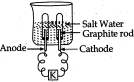
Observe the following diagram and answer the questions that follow:
$(i)$ Identify the gases evolved at anode and cathode.
$(ii)$ Why are the amounts of gases collected in the two test tubes not of the same volume?
$(iii)$ What type of reaction is this?
$(iv)$ Why should we use salt water?
$(i)$ Identify the gases evolved at anode and cathode.
$(ii)$ Why are the amounts of gases collected in the two test tubes not of the same volume?
$(iii)$ What type of reaction is this?
$(iv)$ Why should we use salt water?
Solution
(N/A) $(i)$ $(a)$ At the anode,oxygen gas is evolved.
$(b)$ At the cathode,hydrogen gas is evolved.
$(ii)$ The amounts of gases collected in the two test tubes are not of the same volume because water $(H_2O)$ consists of hydrogen and oxygen in a molar ratio of $2:1$. Thus,twice as much hydrogen gas is produced compared to oxygen gas.
$(iii)$ This reaction is an electrolytic decomposition reaction.
$(iv)$ Pure water is a poor conductor of electricity. Salt water is used to act as an electrolyte,allowing electricity to pass through the solution to facilitate the decomposition of water.
$(b)$ At the cathode,hydrogen gas is evolved.
$(ii)$ The amounts of gases collected in the two test tubes are not of the same volume because water $(H_2O)$ consists of hydrogen and oxygen in a molar ratio of $2:1$. Thus,twice as much hydrogen gas is produced compared to oxygen gas.
$(iii)$ This reaction is an electrolytic decomposition reaction.
$(iv)$ Pure water is a poor conductor of electricity. Salt water is used to act as an electrolyte,allowing electricity to pass through the solution to facilitate the decomposition of water.
0 likes
View Solution99
Medium
Give differences between the displacement and double displacement reactions.
Solution
(N/A)
| Displacement reactions | Double displacement reactions |
| $1.$ In these reactions, a more active element displaces a less active element from its salt solution. | $1.$ In these reactions, there is an exchange of ions between two reactants. |
| $2.$ These reactions are usually slow and take longer time for their completion. | $2.$ These reactions are usually fast and take place instantaneously. |
| $3.$ During these reactions, a change of color usually takes place. Example: $Fe(s) + CuSO_4(aq) \to FeSO_4(aq) + Cu(s)$ (Blue to Light green). | $3.$ During these reactions, precipitates are usually formed. Example: $AgNO_3(aq) + NaCl(aq) \to AgCl(s) \downarrow + NaNO_3(aq)$ (White precipitate). |
0 likes
View Solution100
Difficult
$A, B$ and $C$ are three elements which undergo chemical reactions according to the following equations:
$A_{2}O_{3} + 2B \rightarrow B_{2}O_{3} + 2A$
$3CSO_{4} + 2B \rightarrow B_{2}(SO_{4})_{3} + 3C$
$3CO + 2A \rightarrow A_{2}O_{3} + 3C$
Answer the following questions with reasons:
$(a)$ Which element is the most reactive?
$(b)$ Which element is the least reactive?
$(c)$ What is the type of reactions listed above?
$A_{2}O_{3} + 2B \rightarrow B_{2}O_{3} + 2A$
$3CSO_{4} + 2B \rightarrow B_{2}(SO_{4})_{3} + 3C$
$3CO + 2A \rightarrow A_{2}O_{3} + 3C$
Answer the following questions with reasons:
$(a)$ Which element is the most reactive?
$(b)$ Which element is the least reactive?
$(c)$ What is the type of reactions listed above?
Solution
(B) is the most reactive element.
Reason: $B$ displaces both $A$ and $C$ from their respective compounds,which indicates that $B$ has a higher reactivity than both $A$ and $C$.
$(b)$ $C$ is the least reactive element.
Reason: $C$ is displaced by both $A$ and $B$ in the given chemical reactions,which indicates that $C$ has the lowest reactivity among the three.
$(c)$ These are displacement reactions.
Reason: In each reaction,a more reactive element displaces a less reactive element from its compound.
Reason: $B$ displaces both $A$ and $C$ from their respective compounds,which indicates that $B$ has a higher reactivity than both $A$ and $C$.
$(b)$ $C$ is the least reactive element.
Reason: $C$ is displaced by both $A$ and $B$ in the given chemical reactions,which indicates that $C$ has the lowest reactivity among the three.
$(c)$ These are displacement reactions.
Reason: In each reaction,a more reactive element displaces a less reactive element from its compound.
0 likes
View SolutionChemical Reactions and Equations — Mix Examples - Chemical Reactions and Equations · Frequently Asked Questions
1Are these Chemical Reactions and Equations questions useful for JEE and NEET?
Yes. All questions in this section are mapped to JEE Main and NEET exam patterns. Previous year questions from JEE Main, NEET, GUJCET and state-level exams are included with full solutions.
2Can I switch to Hindi or Gujarati for these questions?
Yes. Use the language tabs in the hero section or the sidebar to view the same questions and solutions in English, Hindi or Gujarati.
3How do I generate a question paper from this subtopic?
Use the Vedclass Exam Paper Generator — select the chapter and subtopic, set difficulty, and generate Sets A, B, C, D automatically. First 3 chapters of every subject are free.
Vedclass Products
For Students
Vedclass Test Series
Mock tests in real JEE/NEET style with performance analysis. 5-day free trial.
Start Free TrialFor Teachers
Exam Paper Generator
Generate Set A/B/C/D papers from this chapter in 2 minutes. 3 chapters free.
Try FreeFor Institutes
Online Exam Module
Live online exams with unlimited students, 360° analytics & white-label branding.
See DemoFor Teachers & Institutes
Generate a Chemical Reactions and Equations Exam Paper in 2 Minutes
Select subtopic & difficulty — Sets A, B, C, D auto-generated with No Repeat logic.
First 3 chapters of every subject are free — no payment required.