
A English
Textbook - Chemical Reactions and Equations Questions in English
Class 10 Science · Chemical Reactions and Equations · Textbook - Chemical Reactions and Equations
30+
Questions
English
Language
100%
With Solutions
Showing 30 of 30 questions in English
1
Medium
Why should a magnesium ribbon be cleaned before burning in air?
Solution
(N/A) $Magnesium$ is a very reactive metal. When stored,it reacts with oxygen to form a layer of $Magnesium$ $Oxide$ $(MgO)$ on its surface. This layer of $Magnesium$ $Oxide$ is quite stable and prevents further reaction of $Magnesium$ with oxygen. The $Magnesium$ ribbon is cleaned with sandpaper to remove this layer so that the underlying metal can be exposed to air for combustion.
1 likes
View Solution2
Medium
Write the balanced chemical equations for the following reactions:
$(i)$ Hydrogen $+$ Chlorine $\to$ Hydrogen chloride
$(ii)$ Barium chloride $+$ Aluminium sulphate $\to$ Barium sulphate $+$ Aluminium chloride
$(iii)$ Sodium $+$ Water $\to$ Sodium hydroxide $+$ Hydrogen
$(i)$ Hydrogen $+$ Chlorine $\to$ Hydrogen chloride
$(ii)$ Barium chloride $+$ Aluminium sulphate $\to$ Barium sulphate $+$ Aluminium chloride
$(iii)$ Sodium $+$ Water $\to$ Sodium hydroxide $+$ Hydrogen
Solution
(N/A) $(i)$ $H_{2(g)} + Cl_{2(g)} \longrightarrow 2HCl_{(g)}$
$(ii)$ $3BaCl_{2(aq)} + Al_{2}(SO_{4})_{3(aq)} \longrightarrow 3BaSO_{4(s)} + 2AlCl_{3(aq)}$
$(iii)$ $2Na_{(s)} + 2H_{2}O_{(l)} \longrightarrow 2NaOH_{(aq)} + H_{2(g)}$
$(ii)$ $3BaCl_{2(aq)} + Al_{2}(SO_{4})_{3(aq)} \longrightarrow 3BaSO_{4(s)} + 2AlCl_{3(aq)}$
$(iii)$ $2Na_{(s)} + 2H_{2}O_{(l)} \longrightarrow 2NaOH_{(aq)} + H_{2(g)}$
0 likes
View Solution3
DifficultMCQ
Write a balanced chemical equation with state symbols for the following reactions.
$(i)$ Solutions of barium chloride and sodium sulphate in water react to give insoluble barium sulphate and the solution of sodium chloride.
$(ii)$ Sodium hydroxide solution (in water) reacts with hydrochloric acid solution (in water) to produce sodium chloride solution and water.
$(i)$ Solutions of barium chloride and sodium sulphate in water react to give insoluble barium sulphate and the solution of sodium chloride.
$(ii)$ Sodium hydroxide solution (in water) reacts with hydrochloric acid solution (in water) to produce sodium chloride solution and water.
A
Not applicable
B
Not applicable
C
Not applicable
D
Not applicable
Solution
(N/A) $(i)$ The reaction between barium chloride and sodium sulphate is a double displacement reaction:
$BaCl_{2(aq)} + Na_2SO_{4(aq)} \to BaSO_{4(s)} + 2NaCl_{(aq)}$
$(ii)$ The reaction between sodium hydroxide and hydrochloric acid is a neutralization reaction:
$NaOH_{(aq)} + HCl_{(aq)} \to NaCl_{(aq)} + H_2O_{(l)}$
$BaCl_{2(aq)} + Na_2SO_{4(aq)} \to BaSO_{4(s)} + 2NaCl_{(aq)}$
$(ii)$ The reaction between sodium hydroxide and hydrochloric acid is a neutralization reaction:
$NaOH_{(aq)} + HCl_{(aq)} \to NaCl_{(aq)} + H_2O_{(l)}$
1 likes
View Solution4
Difficult
$A$ solution of a substance $X$ is used for whitewashing.
$(i)$ Name the substance $X$ and write its formula.
$(ii)$ Write the reaction of the substance $X$ named in $(i)$ above with water.
$(i)$ Name the substance $X$ and write its formula.
$(ii)$ Write the reaction of the substance $X$ named in $(i)$ above with water.
Solution
(N/A) $(i)$ The substance $X$ is calcium oxide. Its chemical formula is $CaO$.
$(ii)$ Calcium oxide reacts vigorously with water to form calcium hydroxide (slaked lime).
The chemical reaction is:
$CaO_{(s)} + H_2O_{(l)} \to Ca(OH)_{2(aq)}$
Where $CaO$ is Calcium oxide (Quick lime) and $Ca(OH)_2$ is Calcium hydroxide (Slaked lime).
$(ii)$ Calcium oxide reacts vigorously with water to form calcium hydroxide (slaked lime).
The chemical reaction is:
$CaO_{(s)} + H_2O_{(l)} \to Ca(OH)_{2(aq)}$
Where $CaO$ is Calcium oxide (Quick lime) and $Ca(OH)_2$ is Calcium hydroxide (Slaked lime).
0 likes
View Solution5
Easy
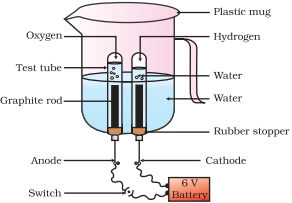
Why is the amount of gas collected in one of the test tubes in the image double the amount collected in the other? Name this gas.
Solution
(N/A) Water $(H_2O)$ consists of two parts hydrogen and one part oxygen by volume.
During the electrolysis of water,the chemical reaction is: $2H_2O(l) \rightarrow 2H_2(g) + O_2(g)$.
This reaction shows that hydrogen gas and oxygen gas are produced in a $2:1$ ratio.
Since hydrogen gas is collected at the cathode and oxygen gas is collected at the anode,the volume of hydrogen collected is double the volume of oxygen collected.
The gas collected in double the amount is hydrogen.
During the electrolysis of water,the chemical reaction is: $2H_2O(l) \rightarrow 2H_2(g) + O_2(g)$.
This reaction shows that hydrogen gas and oxygen gas are produced in a $2:1$ ratio.
Since hydrogen gas is collected at the cathode and oxygen gas is collected at the anode,the volume of hydrogen collected is double the volume of oxygen collected.
The gas collected in double the amount is hydrogen.
0 likes
View Solution6
Medium
Why does the colour of copper sulphate solution change when an iron nail is dipped in it?
Solution
(N/A) When an iron nail is placed in a copper sulphate solution,iron being more reactive than copper,displaces copper from the copper sulphate solution. This reaction forms iron sulphate,which is green in colour.
$Fe_{(s)} + CuSO_{4(aq)} \rightarrow FeSO_{4(aq)} + Cu_{(s)}$
In this reaction,the blue colour of the copper sulphate solution fades as it is converted into light green iron sulphate solution,and a reddish-brown deposit of copper is formed on the iron nail.
$Fe_{(s)} + CuSO_{4(aq)} \rightarrow FeSO_{4(aq)} + Cu_{(s)}$
In this reaction,the blue colour of the copper sulphate solution fades as it is converted into light green iron sulphate solution,and a reddish-brown deposit of copper is formed on the iron nail.
0 likes
View Solution7
Medium
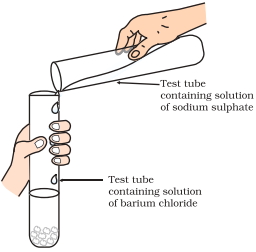
Give an example of a double displacement reaction other than the one given in the image.
Solution
(N/A) Sodium carbonate reacts with calcium chloride to form calcium carbonate and sodium chloride.
$Na_{2}CO_{3(aq)} + CaCl_{2(aq)} \to CaCO_{3(s)} + 2NaCl_{(aq)}$
In this reaction,sodium carbonate and calcium chloride exchange ions to form two new compounds. Hence,it is a double displacement reaction.
$Na_{2}CO_{3(aq)} + CaCl_{2(aq)} \to CaCO_{3(s)} + 2NaCl_{(aq)}$
In this reaction,sodium carbonate and calcium chloride exchange ions to form two new compounds. Hence,it is a double displacement reaction.
0 likes
View Solution8
Medium
Identify the substances that are oxidised and the substances that are reduced in the following reactions.
$(i)$ $4Na(s) + O_2(g) \rightarrow 2Na_2O(s)$
$(ii)$ $CuO(s) + H_2(g) \rightarrow Cu(s) + H_2O(l)$
$(i)$ $4Na(s) + O_2(g) \rightarrow 2Na_2O(s)$
$(ii)$ $CuO(s) + H_2(g) \rightarrow Cu(s) + H_2O(l)$
Solution
(A) $(i)$ In the reaction $4Na(s) + O_2(g) \rightarrow 2Na_2O(s)$,Sodium $(Na)$ is oxidised because it gains oxygen to form $Na_2O$,and Oxygen $(O_2)$ is reduced.
$(ii)$ In the reaction $CuO(s) + H_2(g) \rightarrow Cu(s) + H_2O(l)$,Copper oxide $(CuO)$ is reduced to Copper $(Cu)$ because it loses oxygen,while Hydrogen $(H_2)$ is oxidised to Water $(H_2O)$ because it gains oxygen.
$(ii)$ In the reaction $CuO(s) + H_2(g) \rightarrow Cu(s) + H_2O(l)$,Copper oxide $(CuO)$ is reduced to Copper $(Cu)$ because it loses oxygen,while Hydrogen $(H_2)$ is oxidised to Water $(H_2O)$ because it gains oxygen.
0 likes
View Solution9
EasyMCQ
Which of the statements about the reaction below are incorrect?
$2 PbO_{(s)} + C_{(s)} \longrightarrow 2 Pb_{(s)} + CO_{2(g)}$
$(a)$ Lead is getting reduced.
$(b)$ Carbon dioxide is getting oxidised.
$(c)$ Carbon is getting oxidised.
$(d)$ Lead oxide is getting reduced.
$2 PbO_{(s)} + C_{(s)} \longrightarrow 2 Pb_{(s)} + CO_{2(g)}$
$(a)$ Lead is getting reduced.
$(b)$ Carbon dioxide is getting oxidised.
$(c)$ Carbon is getting oxidised.
$(d)$ Lead oxide is getting reduced.
A
$(a)$ and $(b)$
B
$(a)$ and $(c)$
C
$(a)$,$(b)$ and $(c)$
D
all
Solution
(A) In the given reaction: $2 PbO_{(s)} + C_{(s)} \longrightarrow 2 Pb_{(s)} + CO_{2(g)}$
$1$. Lead oxide $(PbO)$ loses oxygen to form lead $(Pb)$,so $PbO$ is being reduced.
$2$. Carbon $(C)$ gains oxygen to form carbon dioxide $(CO_2)$,so $C$ is being oxidised.
Evaluating the statements:
$(a)$ Lead is getting reduced: Incorrect. Lead oxide is being reduced,not lead.
$(b)$ Carbon dioxide is getting oxidised: Incorrect. Carbon is being oxidised to form carbon dioxide.
$(c)$ Carbon is getting oxidised: Correct.
$(d)$ Lead oxide is getting reduced: Correct.
Therefore,statements $(a)$ and $(b)$ are incorrect.
$1$. Lead oxide $(PbO)$ loses oxygen to form lead $(Pb)$,so $PbO$ is being reduced.
$2$. Carbon $(C)$ gains oxygen to form carbon dioxide $(CO_2)$,so $C$ is being oxidised.
Evaluating the statements:
$(a)$ Lead is getting reduced: Incorrect. Lead oxide is being reduced,not lead.
$(b)$ Carbon dioxide is getting oxidised: Incorrect. Carbon is being oxidised to form carbon dioxide.
$(c)$ Carbon is getting oxidised: Correct.
$(d)$ Lead oxide is getting reduced: Correct.
Therefore,statements $(a)$ and $(b)$ are incorrect.
0 likes
View Solution10
EasyMCQ
$Fe_{2}O_{3} + 2Al \rightarrow Al_{2}O_{3} + 2Fe$
The above reaction is an example of a:
The above reaction is an example of a:
A
combination reaction.
B
displacement reaction.
C
decomposition reaction.
D
double displacement reaction.
Solution
(B) In the given chemical reaction,$Al$ (aluminum) is more reactive than $Fe$ (iron).
Therefore,$Al$ displaces $Fe$ from its oxide $(Fe_{2}O_{3})$.
This type of reaction,where a more reactive element displaces a less reactive element from its compound,is known as a displacement reaction.
Specifically,this is a thermite reaction.
Therefore,$Al$ displaces $Fe$ from its oxide $(Fe_{2}O_{3})$.
This type of reaction,where a more reactive element displaces a less reactive element from its compound,is known as a displacement reaction.
Specifically,this is a thermite reaction.
0 likes
View Solution11
MediumMCQ
What happens when dilute hydrochloric acid is added to iron filings? Tick the correct answer.
A
No reaction takes place.
B
Chlorine gas and iron hydroxide are produced.
C
Hydrogen gas and iron chloride are produced.
D
Iron salt and water are produced.
Solution
(C) When dilute hydrochloric acid $(HCl)$ is added to iron $(Fe)$ filings,a displacement reaction occurs where iron displaces hydrogen from the acid.
This results in the formation of iron$(II)$ chloride $(FeCl_2)$ and the evolution of hydrogen gas $(H_2)$.
The chemical equation for this reaction is:
$Fe_{(s)} + 2HCl_{(aq)} \to FeCl_{2(aq)} + H_{2(g)} \uparrow$
This results in the formation of iron$(II)$ chloride $(FeCl_2)$ and the evolution of hydrogen gas $(H_2)$.
The chemical equation for this reaction is:
$Fe_{(s)} + 2HCl_{(aq)} \to FeCl_{2(aq)} + H_{2(g)} \uparrow$
1 likes
View Solution12
Medium
What is a balanced chemical equation? Why should chemical equations be balanced?
Solution
(N/A) balanced chemical equation is one in which the number of atoms of each element is equal on both the reactant and product sides.
Chemical equations must be balanced to satisfy the $Law$ of $Conservation$ of $Mass$. This law states that mass can neither be created nor destroyed in a chemical reaction. Therefore,the total mass of the elements present in the reactants must be equal to the total mass of the elements present in the products. To ensure this,the number of atoms of each element must be the same on both sides of the equation.
Chemical equations must be balanced to satisfy the $Law$ of $Conservation$ of $Mass$. This law states that mass can neither be created nor destroyed in a chemical reaction. Therefore,the total mass of the elements present in the reactants must be equal to the total mass of the elements present in the products. To ensure this,the number of atoms of each element must be the same on both sides of the equation.
0 likes
View Solution13
Medium
Translate the following statements into chemical equations and then balance them.
$(a)$ Hydrogen gas combines with nitrogen to form ammonia.
$(b)$ Hydrogen sulphide gas burns in air to give water and sulphur dioxide.
$(c)$ Barium chloride reacts with aluminium sulphate to give aluminium chloride and a precipitate of barium sulphate.
$(d)$ Potassium metal reacts with water to give potassium hydroxide and hydrogen gas.
$(a)$ Hydrogen gas combines with nitrogen to form ammonia.
$(b)$ Hydrogen sulphide gas burns in air to give water and sulphur dioxide.
$(c)$ Barium chloride reacts with aluminium sulphate to give aluminium chloride and a precipitate of barium sulphate.
$(d)$ Potassium metal reacts with water to give potassium hydroxide and hydrogen gas.
Solution
(A) The reaction is $H_{2(g)} + N_{2(g)} \to NH_{3(g)}$. Balancing gives $3H_{2(g)} + N_{2(g)} \to 2NH_{3(g)}$.
$(b)$ The reaction is $H_{2}S_{(g)} + O_{2(g)} \to H_{2}O_{(l)} + SO_{2(g)}$. Balancing gives $2H_{2}S_{(g)} + 3O_{2(g)} \to 2H_{2}O_{(l)} + 2SO_{2(g)}$.
$(c)$ The reaction is $BaCl_{2(aq)} + Al_{2}(SO_{4})_{3(aq)} \to AlCl_{3(aq)} + BaSO_{4(s)}$. Balancing gives $3BaCl_{2(aq)} + Al_{2}(SO_{4})_{3(aq)} \to 2AlCl_{3(aq)} + 3BaSO_{4(s)}$.
$(d)$ The reaction is $K_{(s)} + H_{2}O_{(l)} \to KOH_{(aq)} + H_{2(g)}$. Balancing gives $2K_{(s)} + 2H_{2}O_{(l)} \to 2KOH_{(aq)} + H_{2(g)}$.
$(b)$ The reaction is $H_{2}S_{(g)} + O_{2(g)} \to H_{2}O_{(l)} + SO_{2(g)}$. Balancing gives $2H_{2}S_{(g)} + 3O_{2(g)} \to 2H_{2}O_{(l)} + 2SO_{2(g)}$.
$(c)$ The reaction is $BaCl_{2(aq)} + Al_{2}(SO_{4})_{3(aq)} \to AlCl_{3(aq)} + BaSO_{4(s)}$. Balancing gives $3BaCl_{2(aq)} + Al_{2}(SO_{4})_{3(aq)} \to 2AlCl_{3(aq)} + 3BaSO_{4(s)}$.
$(d)$ The reaction is $K_{(s)} + H_{2}O_{(l)} \to KOH_{(aq)} + H_{2(g)}$. Balancing gives $2K_{(s)} + 2H_{2}O_{(l)} \to 2KOH_{(aq)} + H_{2(g)}$.
0 likes
View Solution14
Medium
Balance the following chemical equations:
$(a)$ $HNO_{3} + Ca(OH)_{2} \longrightarrow Ca(NO_{3})_{2} + H_{2}O$
$(b)$ $NaOH + H_{2}SO_{4} \longrightarrow Na_{2}SO_{4} + H_{2}O$
$(c)$ $NaCl + AgNO_{3} \longrightarrow AgCl + NaNO_{3}$
$(d)$ $BaCl_{2} + H_{2}SO_{4} \longrightarrow BaSO_{4} + HCl$
$(a)$ $HNO_{3} + Ca(OH)_{2} \longrightarrow Ca(NO_{3})_{2} + H_{2}O$
$(b)$ $NaOH + H_{2}SO_{4} \longrightarrow Na_{2}SO_{4} + H_{2}O$
$(c)$ $NaCl + AgNO_{3} \longrightarrow AgCl + NaNO_{3}$
$(d)$ $BaCl_{2} + H_{2}SO_{4} \longrightarrow BaSO_{4} + HCl$
Solution
(A) To balance a chemical equation,the number of atoms of each element must be equal on both the reactant and product sides.
$(a)$ $2HNO_{3} + Ca(OH)_{2} \longrightarrow Ca(NO_{3})_{2} + 2H_{2}O$
Here,there are $2$ $N$ atoms,$8$ $O$ atoms,$4$ $H$ atoms,and $1$ $Ca$ atom on both sides.
$(b)$ $2NaOH + H_{2}SO_{4} \longrightarrow Na_{2}SO_{4} + 2H_{2}O$
Here,there are $2$ $Na$ atoms,$6$ $O$ atoms,$4$ $H$ atoms,and $1$ $S$ atom on both sides.
$(c)$ $NaCl + AgNO_{3} \longrightarrow AgCl + NaNO_{3}$
This equation is already balanced as the number of atoms of each element is equal on both sides.
$(d)$ $BaCl_{2} + H_{2}SO_{4} \longrightarrow BaSO_{4} + 2HCl$
Here,there is $1$ $Ba$ atom,$2$ $Cl$ atoms,$2$ $H$ atoms,$1$ $S$ atom,and $4$ $O$ atoms on both sides.
$(a)$ $2HNO_{3} + Ca(OH)_{2} \longrightarrow Ca(NO_{3})_{2} + 2H_{2}O$
Here,there are $2$ $N$ atoms,$8$ $O$ atoms,$4$ $H$ atoms,and $1$ $Ca$ atom on both sides.
$(b)$ $2NaOH + H_{2}SO_{4} \longrightarrow Na_{2}SO_{4} + 2H_{2}O$
Here,there are $2$ $Na$ atoms,$6$ $O$ atoms,$4$ $H$ atoms,and $1$ $S$ atom on both sides.
$(c)$ $NaCl + AgNO_{3} \longrightarrow AgCl + NaNO_{3}$
This equation is already balanced as the number of atoms of each element is equal on both sides.
$(d)$ $BaCl_{2} + H_{2}SO_{4} \longrightarrow BaSO_{4} + 2HCl$
Here,there is $1$ $Ba$ atom,$2$ $Cl$ atoms,$2$ $H$ atoms,$1$ $S$ atom,and $4$ $O$ atoms on both sides.
0 likes
View Solution15
Difficult
Write the balanced chemical equations for the following reactions.
$(a)$ Calcium hydroxide $+$ Carbon dioxide $\rightarrow$ Calcium carbonate $+$ Water
$(b)$ Zinc $+$ Silver nitrate $\rightarrow$ Zinc nitrate $+$ Silver
$(c)$ Aluminium $+$ Copper chloride $\rightarrow$ Aluminium chloride $+$ Copper
$(d)$ Barium chloride $+$ Potassium sulphate $\rightarrow$ Barium sulphate $+$ Potassium chloride
$(a)$ Calcium hydroxide $+$ Carbon dioxide $\rightarrow$ Calcium carbonate $+$ Water
$(b)$ Zinc $+$ Silver nitrate $\rightarrow$ Zinc nitrate $+$ Silver
$(c)$ Aluminium $+$ Copper chloride $\rightarrow$ Aluminium chloride $+$ Copper
$(d)$ Barium chloride $+$ Potassium sulphate $\rightarrow$ Barium sulphate $+$ Potassium chloride
Solution
(N/A) $Ca(OH)_{2} + CO_{2} \rightarrow CaCO_{3} + H_{2}O$
$(b)$ $Zn + 2AgNO_{3} \rightarrow Zn(NO_{3})_{2} + 2Ag$
$(c)$ $2Al + 3CuCl_{2} \rightarrow 2AlCl_{3} + 3Cu$
$(d)$ $BaCl_{2} + K_{2}SO_{4} \rightarrow BaSO_{4} + 2KCl$
$(b)$ $Zn + 2AgNO_{3} \rightarrow Zn(NO_{3})_{2} + 2Ag$
$(c)$ $2Al + 3CuCl_{2} \rightarrow 2AlCl_{3} + 3Cu$
$(d)$ $BaCl_{2} + K_{2}SO_{4} \rightarrow BaSO_{4} + 2KCl$
0 likes
View Solution16
Difficult
Write the balanced chemical equation for the following and identify the type of reaction in each case.
$(a)$ Potassium bromide $(aq) +$ Barium iodide $(aq) \rightarrow$ Potassium iodide $(aq) +$ Barium bromide $(s)$
$(b)$ Zinc carbonate $(s) \rightarrow$ Zinc oxide $(s) +$ Carbon dioxide $(g)$
$(c)$ Hydrogen $(g) +$ Chlorine $(g) \rightarrow$ Hydrogen chloride $(g)$
$(d)$ Magnesium $(s) +$ Hydrochloric acid $(aq) \rightarrow$ Magnesium chloride $(aq) +$ Hydrogen $(g)$
$(a)$ Potassium bromide $(aq) +$ Barium iodide $(aq) \rightarrow$ Potassium iodide $(aq) +$ Barium bromide $(s)$
$(b)$ Zinc carbonate $(s) \rightarrow$ Zinc oxide $(s) +$ Carbon dioxide $(g)$
$(c)$ Hydrogen $(g) +$ Chlorine $(g) \rightarrow$ Hydrogen chloride $(g)$
$(d)$ Magnesium $(s) +$ Hydrochloric acid $(aq) \rightarrow$ Magnesium chloride $(aq) +$ Hydrogen $(g)$
Solution
(A-D) $2KBr(aq) + BaI_2(aq) \rightarrow 2KI(aq) + BaBr_2(s)$; Double displacement reaction.
$(b)$ $ZnCO_3(s) \rightarrow ZnO(s) + CO_2(g)$; Decomposition reaction.
$(c)$ $H_2(g) + Cl_2(g) \rightarrow 2HCl(g)$; Combination reaction.
$(d)$ $Mg(s) + 2HCl(aq) \rightarrow MgCl_2(aq) + H_2(g)$; Displacement reaction.
$(b)$ $ZnCO_3(s) \rightarrow ZnO(s) + CO_2(g)$; Decomposition reaction.
$(c)$ $H_2(g) + Cl_2(g) \rightarrow 2HCl(g)$; Combination reaction.
$(d)$ $Mg(s) + 2HCl(aq) \rightarrow MgCl_2(aq) + H_2(g)$; Displacement reaction.
0 likes
View Solution17
Medium
What does one mean by exothermic and endothermic reactions? Give examples.
Solution
(N/A) Chemical reactions that release energy in the form of heat,light,or sound are called exothermic reactions.
Example: The reaction of sodium and chlorine to yield table salt:
$Na_{(s)} + \frac{1}{2} Cl_{2(g)} \longrightarrow NaCl_{(s)} + 411 \, kJ$ of energy.
Reactions that absorb energy or require energy in order to proceed are called endothermic reactions.
Example: In the process of photosynthesis,plants use energy from the sun to convert carbon dioxide and water into glucose and oxygen:
$6CO_{2(g)} + 6H_{2}O_{(l)} \xrightarrow{\text{Sunlight}} C_{6}H_{12}O_{6(aq)} + 6O_{2(g)}$
Example: The reaction of sodium and chlorine to yield table salt:
$Na_{(s)} + \frac{1}{2} Cl_{2(g)} \longrightarrow NaCl_{(s)} + 411 \, kJ$ of energy.
Reactions that absorb energy or require energy in order to proceed are called endothermic reactions.
Example: In the process of photosynthesis,plants use energy from the sun to convert carbon dioxide and water into glucose and oxygen:
$6CO_{2(g)} + 6H_{2}O_{(l)} \xrightarrow{\text{Sunlight}} C_{6}H_{12}O_{6(aq)} + 6O_{2(g)}$
0 likes
View Solution18
Medium
Why is respiration considered an exothermic reaction? Explain.
Solution
(N/A) Respiration is considered an exothermic reaction because energy is released during the process.
$1$. Living organisms require energy to survive, which is obtained from the food we eat.
$2$. During digestion, complex food molecules (like carbohydrates) are broken down into simpler substances like glucose.
$3$. This glucose combines with oxygen in the cells of our body to provide energy.
$4$. Since energy is released in the form of heat (or $ATP$) during this process, it is classified as an exothermic reaction.
The chemical equation for respiration is:
$C_{6}H_{12}O_{6(aq)} + 6O_{2(g)} \to 6CO_{2(g)} + 6H_{2}O_{(l)} + \text{Energy}$
$1$. Living organisms require energy to survive, which is obtained from the food we eat.
$2$. During digestion, complex food molecules (like carbohydrates) are broken down into simpler substances like glucose.
$3$. This glucose combines with oxygen in the cells of our body to provide energy.
$4$. Since energy is released in the form of heat (or $ATP$) during this process, it is classified as an exothermic reaction.
The chemical equation for respiration is:
$C_{6}H_{12}O_{6(aq)} + 6O_{2(g)} \to 6CO_{2(g)} + 6H_{2}O_{(l)} + \text{Energy}$
0 likes
View Solution19
Medium
Why are decomposition reactions called the opposite of combination reactions? Write equations for these reactions.
Solution
(N/A) Decomposition reactions are those in which a single compound breaks down to form two or more simpler substances. These reactions typically require an input of energy in the form of heat, light, or electricity to proceed.
Combination reactions are those in which two or more substances combine to form a single new substance, often releasing energy in the process.
Therefore, they are considered opposites because decomposition involves breaking down a substance (requiring energy), while combination involves forming a substance (releasing energy).
Decomposition reaction: $2H_2O(l) \xrightarrow{\text{Electrolysis}} 2H_2(g) + O_2(g)$
Combination reaction: $2H_2(g) + O_2(g) \to 2H_2O(l) + \text{Energy}$
Combination reactions are those in which two or more substances combine to form a single new substance, often releasing energy in the process.
Therefore, they are considered opposites because decomposition involves breaking down a substance (requiring energy), while combination involves forming a substance (releasing energy).
Decomposition reaction: $2H_2O(l) \xrightarrow{\text{Electrolysis}} 2H_2(g) + O_2(g)$
Combination reaction: $2H_2(g) + O_2(g) \to 2H_2O(l) + \text{Energy}$
0 likes
View Solution20
Difficult
Write one equation each for decomposition reactions where energy is supplied in the form of heat,light,or electricity.
Solution
(N/A) Thermal decomposition:
$2FeSO_{4(s)} \xrightarrow{\Delta} Fe_2O_{3(s)} + SO_{2(g)} + SO_{3(g)}$
(Ferrous sulphate $\rightarrow$ Ferric oxide + Sulphur dioxide + Sulphur trioxide)
$(b)$ Photolytic decomposition (by light):
$2AgCl_{(s)} \xrightarrow{\text{Light}} 2Ag_{(s)} + Cl_{2(g)}$
(Silver chloride $\rightarrow$ Silver + Chlorine)
$(c)$ Electrolytic decomposition (by electricity):
$2H_2O_{(l)} \xrightarrow{\text{Electricity}} 2H_{2(g)} + O_{2(g)}$
(Water $\rightarrow$ Hydrogen + Oxygen)
$2FeSO_{4(s)} \xrightarrow{\Delta} Fe_2O_{3(s)} + SO_{2(g)} + SO_{3(g)}$
(Ferrous sulphate $\rightarrow$ Ferric oxide + Sulphur dioxide + Sulphur trioxide)
$(b)$ Photolytic decomposition (by light):
$2AgCl_{(s)} \xrightarrow{\text{Light}} 2Ag_{(s)} + Cl_{2(g)}$
(Silver chloride $\rightarrow$ Silver + Chlorine)
$(c)$ Electrolytic decomposition (by electricity):
$2H_2O_{(l)} \xrightarrow{\text{Electricity}} 2H_{2(g)} + O_{2(g)}$
(Water $\rightarrow$ Hydrogen + Oxygen)
1 likes
View Solution21
Difficult
What is the difference between displacement and double displacement reactions? Write equations for these reactions.
Solution
(N/A) In a displacement reaction,a more reactive element replaces a less reactive element from its compound.
$A + BX \longrightarrow AX + B$; where $A$ is more reactive than $B$.
In a double displacement reaction,two atoms or groups of atoms exchange their positions to form two new compounds.
$AB + CD \longrightarrow AD + CB$
Examples:
Displacement reaction:
$CuSO_{4(aq)} + Zn_{(s)} \longrightarrow ZnSO_{4(aq)} + Cu_{(s)}$
Double displacement reaction:
$Na_2SO_{4(aq)} + BaCl_{2(aq)} \longrightarrow BaSO_{4(s)} + 2NaCl_{(aq)}$
$A + BX \longrightarrow AX + B$; where $A$ is more reactive than $B$.
In a double displacement reaction,two atoms or groups of atoms exchange their positions to form two new compounds.
$AB + CD \longrightarrow AD + CB$
Examples:
Displacement reaction:
$CuSO_{4(aq)} + Zn_{(s)} \longrightarrow ZnSO_{4(aq)} + Cu_{(s)}$
Double displacement reaction:
$Na_2SO_{4(aq)} + BaCl_{2(aq)} \longrightarrow BaSO_{4(s)} + 2NaCl_{(aq)}$
0 likes
View Solution22
Medium
In the refining of silver,the recovery of silver from silver nitrate solution involves displacement by copper metal. Write down the reaction involved.
Solution
(N/A) The recovery of silver from silver nitrate solution by copper metal is a displacement reaction. Copper is more reactive than silver,so it displaces silver from its salt solution.
The chemical reaction is:
$2AgNO_{3(aq)} + Cu_{(s)} \to Cu(NO_3)_{2(aq)} + 2Ag_{(s)}$
In this reaction,copper metal displaces silver ions from the silver nitrate solution to form copper$(II)$ nitrate and solid silver.
The chemical reaction is:
$2AgNO_{3(aq)} + Cu_{(s)} \to Cu(NO_3)_{2(aq)} + 2Ag_{(s)}$
In this reaction,copper metal displaces silver ions from the silver nitrate solution to form copper$(II)$ nitrate and solid silver.
0 likes
View Solution23
Medium
What do you mean by a precipitation reaction? Explain by giving examples.
Solution
(N/A) reaction in which an insoluble solid (called precipitate) is formed is called a precipitation reaction.
For example:
$Na_2CO_{3(aq)} + CaCl_{2(aq)} \to CaCO_{3(s)} + 2NaCl_{(aq)}$
In this reaction,calcium carbonate $(CaCO_3)$ is obtained as a white precipitate.
Another example of a precipitation reaction is:
$Na_2SO_{4(aq)} + BaCl_{2(aq)} \to BaSO_{4(s)} + 2NaCl_{(aq)}$
In this reaction,barium sulphate $(BaSO_4)$ is obtained as a white precipitate.
For example:
$Na_2CO_{3(aq)} + CaCl_{2(aq)} \to CaCO_{3(s)} + 2NaCl_{(aq)}$
In this reaction,calcium carbonate $(CaCO_3)$ is obtained as a white precipitate.
Another example of a precipitation reaction is:
$Na_2SO_{4(aq)} + BaCl_{2(aq)} \to BaSO_{4(s)} + 2NaCl_{(aq)}$
In this reaction,barium sulphate $(BaSO_4)$ is obtained as a white precipitate.
0 likes
View Solution24
Medium
Explain the "Oxidation" in terms of gain or loss of oxygen with two examples.
Solution
(N/A) Oxidation is defined as the gain of oxygen by a substance during a chemical reaction.
For example:
$(i)$ $H_2 + CO_2 \rightarrow H_2O + CO$
In this reaction, $H_2$ gains oxygen to form $H_2O$, therefore $H_2$ is oxidized.
$(ii)$ $2Cu + O_2 \rightarrow 2CuO$
In this reaction, $Cu$ gains oxygen to form $CuO$, therefore $Cu$ is oxidized.
For example:
$(i)$ $H_2 + CO_2 \rightarrow H_2O + CO$
In this reaction, $H_2$ gains oxygen to form $H_2O$, therefore $H_2$ is oxidized.
$(ii)$ $2Cu + O_2 \rightarrow 2CuO$
In this reaction, $Cu$ gains oxygen to form $CuO$, therefore $Cu$ is oxidized.
0 likes
View Solution25
Difficult
$A$ shiny brown coloured element $X$ on heating in air becomes black in colour. Name the element $X$ and the black coloured compound formed.
Solution
(N/A) $X$ is copper $(Cu)$ and the black-coloured compound formed is copper oxide $(CuO)$.
The chemical reaction that occurs when copper is heated in air is as follows:
$2Cu (s) + O_2 (g) \xrightarrow{\text{Heat}} 2CuO (s)$
In this reaction,copper reacts with oxygen to form copper$(II)$ oxide,which is black in colour.
The chemical reaction that occurs when copper is heated in air is as follows:
$2Cu (s) + O_2 (g) \xrightarrow{\text{Heat}} 2CuO (s)$
In this reaction,copper reacts with oxygen to form copper$(II)$ oxide,which is black in colour.
0 likes
View Solution26
EasyMCQ
Why do we apply paint on iron articles?
A
To make them look attractive.
B
To prevent them from rusting.
C
To increase their weight.
D
To make them smooth.
Solution
(B) Iron articles are painted to prevent them from rusting.
Rusting is a chemical process that occurs when iron is exposed to moisture and oxygen in the air.
Applying a layer of paint creates a physical barrier that cuts off the contact between the iron surface and the atmospheric moisture and oxygen.
Since the presence of both moisture and oxygen is essential for the rusting process,painting effectively prevents the corrosion of iron.
Rusting is a chemical process that occurs when iron is exposed to moisture and oxygen in the air.
Applying a layer of paint creates a physical barrier that cuts off the contact between the iron surface and the atmospheric moisture and oxygen.
Since the presence of both moisture and oxygen is essential for the rusting process,painting effectively prevents the corrosion of iron.
0 likes
View Solution27
MediumMCQ
Oil and fat containing food items are flushed with nitrogen. Why?
A
To prevent oxidation and rancidity
B
To keep the food crispy
C
To increase the weight of the packet
D
To provide a pleasant smell
Solution
(A) Nitrogen is an inert gas and does not easily react with these substances.
On the other hand,oxygen reacts with food substances and makes them rancid.
Thus,bags used in packing food items are flushed with nitrogen gas to remove oxygen inside the pack.
When oxygen is not present inside the pack,rancidity of oil and fat containing food items is avoided.
On the other hand,oxygen reacts with food substances and makes them rancid.
Thus,bags used in packing food items are flushed with nitrogen gas to remove oxygen inside the pack.
When oxygen is not present inside the pack,rancidity of oil and fat containing food items is avoided.
1 likes
View Solution28
Medium
Explain the term 'Corrosion' with one example.
Solution
(N/A) Corrosion:
Corrosion is defined as a process where materials,usually metals,deteriorate as a result of a chemical reaction with their environment,such as air,moisture,or chemicals.
For example,iron,in the presence of moisture,reacts with oxygen to form hydrated iron oxide.
$4Fe + 3O_2 + nH_2O \to 2Fe_2O_3 \cdot nH_2O$ (Hydrated iron oxide)
This hydrated iron oxide is commonly known as rust.
Corrosion is defined as a process where materials,usually metals,deteriorate as a result of a chemical reaction with their environment,such as air,moisture,or chemicals.
For example,iron,in the presence of moisture,reacts with oxygen to form hydrated iron oxide.
$4Fe + 3O_2 + nH_2O \to 2Fe_2O_3 \cdot nH_2O$ (Hydrated iron oxide)
This hydrated iron oxide is commonly known as rust.
0 likes
View Solution29
Medium
Explain the term 'Rancidity' with one example.
Solution
(N/A) Rancidity:
The process of oxidation of fats and oils that can be easily noticed by the change in taste and smell is known as rancidity.
For example,the taste and smell of butter changes when kept for a long time.
Rancidity can be prevented by:
$1.$ Storing food in airtight containers.
$2.$ Storing food in refrigerators.
$3.$ Adding antioxidants.
$4.$ Storing food in an environment of nitrogen gas.
The process of oxidation of fats and oils that can be easily noticed by the change in taste and smell is known as rancidity.
For example,the taste and smell of butter changes when kept for a long time.
Rancidity can be prevented by:
$1.$ Storing food in airtight containers.
$2.$ Storing food in refrigerators.
$3.$ Adding antioxidants.
$4.$ Storing food in an environment of nitrogen gas.
0 likes
View Solution30
Difficult
Explain the "Reduction" in terms of gain or loss of oxygen with two examples.
Solution
(N/A) Reduction is defined as the loss of oxygen from a substance during a chemical reaction.
For example:
$(i)$ $\mathop {CO_2 + H_2 \to CO}\limits_{\text{Removal of oxygen - reduction}} + H_2O$
$(ii)$ $\mathop {CuO + H_2 \xrightarrow{\Delta } Cu}\limits_{\text{Loss of oxygen - reduction}} + H_2O$
In equation $(i)$, $CO_2$ is reduced to $CO$ due to the loss of oxygen, and in equation $(ii)$, $CuO$ is reduced to $Cu$ due to the loss of oxygen.
For example:
$(i)$ $\mathop {CO_2 + H_2 \to CO}\limits_{\text{Removal of oxygen - reduction}} + H_2O$
$(ii)$ $\mathop {CuO + H_2 \xrightarrow{\Delta } Cu}\limits_{\text{Loss of oxygen - reduction}} + H_2O$
In equation $(i)$, $CO_2$ is reduced to $CO$ due to the loss of oxygen, and in equation $(ii)$, $CuO$ is reduced to $Cu$ due to the loss of oxygen.
0 likes
View SolutionChemical Reactions and Equations — Textbook - Chemical Reactions and Equations · Frequently Asked Questions
1Are these Chemical Reactions and Equations questions useful for JEE and NEET?
Yes. All questions in this section are mapped to JEE Main and NEET exam patterns. Previous year questions from JEE Main, NEET, GUJCET and state-level exams are included with full solutions.
2Can I switch to Hindi or Gujarati for these questions?
Yes. Use the language tabs in the hero section or the sidebar to view the same questions and solutions in English, Hindi or Gujarati.
3How do I generate a question paper from this subtopic?
Use the Vedclass Exam Paper Generator — select the chapter and subtopic, set difficulty, and generate Sets A, B, C, D automatically. First 3 chapters of every subject are free.
Vedclass Products
For Students
Vedclass Test Series
Mock tests in real JEE/NEET style with performance analysis. 5-day free trial.
Start Free TrialFor Teachers
Exam Paper Generator
Generate Set A/B/C/D papers from this chapter in 2 minutes. 3 chapters free.
Try FreeFor Institutes
Online Exam Module
Live online exams with unlimited students, 360° analytics & white-label branding.
See DemoFor Teachers & Institutes
Generate a Chemical Reactions and Equations Exam Paper in 2 Minutes
Select subtopic & difficulty — Sets A, B, C, D auto-generated with No Repeat logic.
First 3 chapters of every subject are free — no payment required.