
PhysicsQ101–140 of 240 questions
Page 3 of 3 · English
101
PhysicsMediumMCQTS EAMCET · 2025
Two tuning forks of frequencies $320 \ Hz$ and $323 \ Hz$ are vibrated together. The time interval between a maximum sound and its adjacent minimum sound heard by an observer is
A
$\frac{1}{6} \ s$
B
$\frac{1}{3} \ s$
C
$\frac{1}{12} \ s$
D
$\frac{1}{9} \ s$
Solution
(A) The beat frequency is given by the difference between the two frequencies: $f_{beat} = |f_2 - f_1| = |323 \ Hz - 320 \ Hz| = 3 \ Hz$.
This means there are $3$ beats per second.
The time interval between two successive beats (one maximum and one adjacent minimum) is half of the time period of one beat cycle.
The time period of the beat is $T = \frac{1}{f_{beat}} = \frac{1}{3} \ s$.
The time interval between a maximum sound and its adjacent minimum sound is $\Delta t = \frac{T}{2} = \frac{1}{2} \times \frac{1}{3} \ s = \frac{1}{6} \ s$.
This means there are $3$ beats per second.
The time interval between two successive beats (one maximum and one adjacent minimum) is half of the time period of one beat cycle.
The time period of the beat is $T = \frac{1}{f_{beat}} = \frac{1}{3} \ s$.
The time interval between a maximum sound and its adjacent minimum sound is $\Delta t = \frac{T}{2} = \frac{1}{2} \times \frac{1}{3} \ s = \frac{1}{6} \ s$.
0 likesView Solution
102
PhysicsMediumMCQTS EAMCET · 2025
The frequency of sound heard by an observer moving towards a stationary source with certain speed is $n_1$ and if the observer moves away from the same source with same speed,the frequency of sound heard by the observer is $n_2$. If the speed of sound in air is $340 \ m/s$ and $n_1: n_2 = 71: 65$,then the speed of the observer is: (in $km/h$)
A
$36$
B
$27$
C
$15$
D
$54$
Solution
(D) Let $v$ be the speed of sound,$v_o$ be the speed of the observer,and $f$ be the frequency of the source.
When the observer moves towards the stationary source,the observed frequency is $n_1 = f \left( \frac{v + v_o}{v} \right)$.
When the observer moves away from the stationary source,the observed frequency is $n_2 = f \left( \frac{v - v_o}{v} \right)$.
Given the ratio $n_1 / n_2 = 71 / 65$,we have:
$\frac{v + v_o}{v - v_o} = \frac{71}{65}$.
Cross-multiplying gives: $65(v + v_o) = 71(v - v_o)$.
$65v + 65v_o = 71v - 71v_o$.
$136v_o = 6v$.
$v_o = \frac{6}{136} v = \frac{3}{68} v$.
Given $v = 340 \ m/s$,we get $v_o = \frac{3}{68} \times 340 = 3 \times 5 = 15 \ m/s$.
To convert $m/s$ to $km/h$,multiply by $18/5$: $v_o = 15 \times \frac{18}{5} = 3 \times 18 = 54 \ km/h$.
When the observer moves towards the stationary source,the observed frequency is $n_1 = f \left( \frac{v + v_o}{v} \right)$.
When the observer moves away from the stationary source,the observed frequency is $n_2 = f \left( \frac{v - v_o}{v} \right)$.
Given the ratio $n_1 / n_2 = 71 / 65$,we have:
$\frac{v + v_o}{v - v_o} = \frac{71}{65}$.
Cross-multiplying gives: $65(v + v_o) = 71(v - v_o)$.
$65v + 65v_o = 71v - 71v_o$.
$136v_o = 6v$.
$v_o = \frac{6}{136} v = \frac{3}{68} v$.
Given $v = 340 \ m/s$,we get $v_o = \frac{3}{68} \times 340 = 3 \times 5 = 15 \ m/s$.
To convert $m/s$ to $km/h$,multiply by $18/5$: $v_o = 15 \times \frac{18}{5} = 3 \times 18 = 54 \ km/h$.
0 likesView Solution
103
PhysicsMediumMCQTS EAMCET · 2025
$A$ car moving towards a cliff emits sound of frequency '$n$'. If the difference in frequencies of the horn and its echo heard by the driver of the car is $10 \%$ of '$n$',then the speed of the car is nearly (Speed of sound in air is $336 \ m/s$) (in $m/s$)
A
$16$
B
$18$
C
$30$
D
$33$
Solution
(A) Let $v$ be the speed of sound $(336 \ m/s)$ and $u$ be the speed of the car.
The frequency of the sound emitted by the horn is $n$.
The frequency of the echo heard by the driver is $n' = n \left( \frac{v + u}{v - u} \right)$.
The difference in frequencies is $n' - n = 0.1n$.
Substituting $n'$,we get $n \left( \frac{v + u}{v - u} - 1 \right) = 0.1n$.
Simplifying the expression: $\frac{v + u - (v - u)}{v - u} = 0.1$.
This leads to $\frac{2u}{v - u} = 0.1$.
$2u = 0.1(v - u) \implies 2u = 0.1v - 0.1u$.
$2.1u = 0.1v \implies u = \frac{0.1}{2.1} v = \frac{1}{21} v$.
Given $v = 336 \ m/s$,$u = \frac{336}{21} = 16 \ m/s$.
The frequency of the sound emitted by the horn is $n$.
The frequency of the echo heard by the driver is $n' = n \left( \frac{v + u}{v - u} \right)$.
The difference in frequencies is $n' - n = 0.1n$.
Substituting $n'$,we get $n \left( \frac{v + u}{v - u} - 1 \right) = 0.1n$.
Simplifying the expression: $\frac{v + u - (v - u)}{v - u} = 0.1$.
This leads to $\frac{2u}{v - u} = 0.1$.
$2u = 0.1(v - u) \implies 2u = 0.1v - 0.1u$.
$2.1u = 0.1v \implies u = \frac{0.1}{2.1} v = \frac{1}{21} v$.
Given $v = 336 \ m/s$,$u = \frac{336}{21} = 16 \ m/s$.
0 likesView Solution
104
PhysicsMediumMCQTS EAMCET · 2025
Two sound waves each of intensity $I$ are superimposed. If the phase difference between the waves is $\frac{\pi}{2}$,then the intensity of the resultant wave is
A
$2 I$
B
$3 I$
C
$4 I$
D
$I$
Solution
(A) The resultant intensity $I_R$ of two waves with individual intensities $I_1$ and $I_2$ and a phase difference $\phi$ is given by the formula:
$I_R = I_1 + I_2 + 2\sqrt{I_1 I_2} \cos(\phi)$
Given that $I_1 = I_2 = I$ and $\phi = \frac{\pi}{2}$,we substitute these values into the formula:
$I_R = I + I + 2\sqrt{I \cdot I} \cos(\frac{\pi}{2})$
Since $\cos(\frac{\pi}{2}) = 0$,the expression simplifies to:
$I_R = 2I + 2I(0) = 2I$
Therefore,the resultant intensity is $2I$.
$I_R = I_1 + I_2 + 2\sqrt{I_1 I_2} \cos(\phi)$
Given that $I_1 = I_2 = I$ and $\phi = \frac{\pi}{2}$,we substitute these values into the formula:
$I_R = I + I + 2\sqrt{I \cdot I} \cos(\frac{\pi}{2})$
Since $\cos(\frac{\pi}{2}) = 0$,the expression simplifies to:
$I_R = 2I + 2I(0) = 2I$
Therefore,the resultant intensity is $2I$.
0 likesView Solution
105
PhysicsMediumMCQTS EAMCET · 2025
If the lengths of the open and closed pipes are in the ratio of $2 : 3$, then the ratio of the frequencies of the third harmonic of the open pipe and the fifth harmonic of the closed pipe is
A
$3 : 5$
B
$9 : 5$
C
$2 : 3$
D
$4 : 9$
Solution
(B) Let $L_o$ and $L_c$ be the lengths of the open and closed pipes respectively. Given $L_o / L_c = 2 / 3$.
For an open pipe, the frequency of the $n^{th}$ harmonic is given by $f_{o,n} = n(v / 2L_o)$. The third harmonic $(n=3)$ is $f_{o,3} = 3(v / 2L_o)$.
For a closed pipe, the frequency of the $m^{th}$ harmonic is given by $f_{c,m} = m(v / 4L_c)$, where $m$ must be an odd integer. The fifth harmonic $(m=5)$ is $f_{c,5} = 5(v / 4L_c)$.
The ratio of the frequencies is $R = f_{o,3} / f_{c,5} = [3(v / 2L_o)] / [5(v / 4L_c)]$.
$R = (3v / 2L_o) \times (4L_c / 5v) = (3 \times 4 \times L_c) / (2 \times 5 \times L_o) = (12 / 10) \times (L_c / L_o)$.
Since $L_o / L_c = 2 / 3$, then $L_c / L_o = 3 / 2$.
Substituting this value: $R = (1.2) \times (1.5) = 1.8 = 18 / 10 = 9 / 5$.
Thus, the ratio is $9 : 5$.
For an open pipe, the frequency of the $n^{th}$ harmonic is given by $f_{o,n} = n(v / 2L_o)$. The third harmonic $(n=3)$ is $f_{o,3} = 3(v / 2L_o)$.
For a closed pipe, the frequency of the $m^{th}$ harmonic is given by $f_{c,m} = m(v / 4L_c)$, where $m$ must be an odd integer. The fifth harmonic $(m=5)$ is $f_{c,5} = 5(v / 4L_c)$.
The ratio of the frequencies is $R = f_{o,3} / f_{c,5} = [3(v / 2L_o)] / [5(v / 4L_c)]$.
$R = (3v / 2L_o) \times (4L_c / 5v) = (3 \times 4 \times L_c) / (2 \times 5 \times L_o) = (12 / 10) \times (L_c / L_o)$.
Since $L_o / L_c = 2 / 3$, then $L_c / L_o = 3 / 2$.
Substituting this value: $R = (1.2) \times (1.5) = 1.8 = 18 / 10 = 9 / 5$.
Thus, the ratio is $9 : 5$.
0 likesView Solution
106
PhysicsMediumMCQTS EAMCET · 2025
The air columns in two tubes closed at one end vibrating in their fundamental modes produce $2$ beats per second. The number of beats produced per second when the same tubes are vibrated in their fundamental mode with their both ends open are
A
$1$
B
$2$
C
$3$
D
$4$
Solution
(D) For a tube closed at one end,the fundamental frequency is given by $f_c = \frac{v}{4L}$.
Given that the beat frequency is $f_{c1} - f_{c2} = 2$,where $f_{c1} = \frac{v}{4L_1}$ and $f_{c2} = \frac{v}{4L_2}$.
Thus,$\frac{v}{4L_1} - \frac{v}{4L_2} = 2$.
For a tube open at both ends,the fundamental frequency is given by $f_o = \frac{v}{2L}$.
The new beat frequency is $f_{o1} - f_{o2} = \frac{v}{2L_1} - \frac{v}{2L_2}$.
We can rewrite this as $2 \times (\frac{v}{4L_1} - \frac{v}{4L_2})$.
Substituting the known value,the new beat frequency is $2 \times 2 = 4$ beats per second.
Given that the beat frequency is $f_{c1} - f_{c2} = 2$,where $f_{c1} = \frac{v}{4L_1}$ and $f_{c2} = \frac{v}{4L_2}$.
Thus,$\frac{v}{4L_1} - \frac{v}{4L_2} = 2$.
For a tube open at both ends,the fundamental frequency is given by $f_o = \frac{v}{2L}$.
The new beat frequency is $f_{o1} - f_{o2} = \frac{v}{2L_1} - \frac{v}{2L_2}$.
We can rewrite this as $2 \times (\frac{v}{4L_1} - \frac{v}{4L_2})$.
Substituting the known value,the new beat frequency is $2 \times 2 = 4$ beats per second.
0 likesView Solution
107
PhysicsMediumMCQTS EAMCET · 2025
An air column in a tube of length $L = 50 \ cm$,closed at one end,is vibrating in its fifth harmonic. The phase difference between a particle at the open end and a particle at $42 \ cm$ from the open end is: (in $^{\circ}$)
A
$90$
B
$180$
C
$0$
D
$270$
Solution
(C) For a tube closed at one end,the frequencies of harmonics are given by $f_n = n \frac{v}{4L}$,where $n = 1, 3, 5, ...$ are odd integers. The fifth harmonic corresponds to $n = 5$.
The wavelength $\lambda$ is given by $\lambda = \frac{4L}{n} = \frac{4 \times 50 \ cm}{5} = 40 \ cm$.
The standing wave equation for a closed pipe (taking the open end at $x = 0$) is $y = A \sin(kx) \cos(\omega t)$,where $k = \frac{2\pi}{\lambda} = \frac{2\pi}{40} = \frac{\pi}{20} \ rad/cm$.
The particle at the open end $(x = 0)$ is at a node of the displacement wave (or antinode of pressure),but in terms of displacement amplitude,the open end is an antinode. However,the standard equation $y = A \sin(kx) \cos(\omega t)$ assumes $x=0$ is a node. For an open end at $x=0$,the displacement is $y = A \cos(kx) \cos(\omega t)$.
At $x = 0$,$y_1 = A \cos(0) \cos(\omega t) = A \cos(\omega t)$.
At $x = 42 \ cm$,$y_2 = A \cos(k \times 42) \cos(\omega t) = A \cos(\frac{\pi}{20} \times 42) \cos(\omega t) = A \cos(2.1\pi) \cos(\omega t) = A \cos(2\pi + 0.1\pi) \cos(\omega t) = A \cos(0.1\pi) \cos(\omega t)$.
Since both particles oscillate in phase (the cosine terms have the same sign),the phase difference is $0^{\circ}$.
The wavelength $\lambda$ is given by $\lambda = \frac{4L}{n} = \frac{4 \times 50 \ cm}{5} = 40 \ cm$.
The standing wave equation for a closed pipe (taking the open end at $x = 0$) is $y = A \sin(kx) \cos(\omega t)$,where $k = \frac{2\pi}{\lambda} = \frac{2\pi}{40} = \frac{\pi}{20} \ rad/cm$.
The particle at the open end $(x = 0)$ is at a node of the displacement wave (or antinode of pressure),but in terms of displacement amplitude,the open end is an antinode. However,the standard equation $y = A \sin(kx) \cos(\omega t)$ assumes $x=0$ is a node. For an open end at $x=0$,the displacement is $y = A \cos(kx) \cos(\omega t)$.
At $x = 0$,$y_1 = A \cos(0) \cos(\omega t) = A \cos(\omega t)$.
At $x = 42 \ cm$,$y_2 = A \cos(k \times 42) \cos(\omega t) = A \cos(\frac{\pi}{20} \times 42) \cos(\omega t) = A \cos(2.1\pi) \cos(\omega t) = A \cos(2\pi + 0.1\pi) \cos(\omega t) = A \cos(0.1\pi) \cos(\omega t)$.
Since both particles oscillate in phase (the cosine terms have the same sign),the phase difference is $0^{\circ}$.
0 likesView Solution
108
PhysicsMediumMCQTS EAMCET · 2025
$A$ sound wave of frequency $210 \text{ Hz}$ travels with a speed of $330 \text{ ms}^{-1}$ along the positive $x$-axis. Each particle of the wave moves a distance of $10 \text{ cm}$ between the two extreme points. The equation of the displacement function $s(x, t)$ of this wave is ($x$ in metre,$t$ in second):
A
$s(x, t)=0.10 \sin [4 x-1320 t] \text{ m}$
B
$s(x, t)=0.05 \sin [4 x-1320 t] \text{ m}$
C
$s(x, t)=0.05 \sin [1320 x-4 t] \text{ m}$
D
$s(x, t)=0.10 \sin [1320 x-4 t] \text{ m}$
Solution
(B) The general equation of a progressive wave is $s(x, t) = A \sin(kx - \omega t)$.
$1$. Amplitude $(A)$: The particle moves $10 \text{ cm}$ between two extreme points,which is the total path length $(2A)$. Thus,$2A = 10 \text{ cm} = 0.10 \text{ m}$,so $A = 0.05 \text{ m}$.
$2$. Angular frequency $(\omega)$: $\omega = 2\pi f = 2 \times \pi \times 210 = 420\pi \approx 1319.47 \approx 1320 \text{ rad/s}$.
$3$. Wave number $(k)$: $v = \frac{\omega}{k} \implies k = \frac{\omega}{v} = \frac{420\pi}{330} = \frac{42\pi}{33} = \frac{14\pi}{11} \approx 4 \text{ rad/m}$.
$4$. Substituting these values into the wave equation: $s(x, t) = 0.05 \sin(4x - 1320t) \text{ m}$.
$1$. Amplitude $(A)$: The particle moves $10 \text{ cm}$ between two extreme points,which is the total path length $(2A)$. Thus,$2A = 10 \text{ cm} = 0.10 \text{ m}$,so $A = 0.05 \text{ m}$.
$2$. Angular frequency $(\omega)$: $\omega = 2\pi f = 2 \times \pi \times 210 = 420\pi \approx 1319.47 \approx 1320 \text{ rad/s}$.
$3$. Wave number $(k)$: $v = \frac{\omega}{k} \implies k = \frac{\omega}{v} = \frac{420\pi}{330} = \frac{42\pi}{33} = \frac{14\pi}{11} \approx 4 \text{ rad/m}$.
$4$. Substituting these values into the wave equation: $s(x, t) = 0.05 \sin(4x - 1320t) \text{ m}$.
0 likesView Solution
109
PhysicsMediumMCQTS EAMCET · 2025
The fundamental frequency of a transverse wave of a stretched string subjected to a tension $T_1$ is $300 \ Hz$. If the length of the string is doubled and subjected to a tension of $T_2$,the fundamental frequency of the transverse wave in the string becomes $100 \ Hz$. Then $T_2: T_1=$ (Linear density of the string is constant)
A
$1: 2$
B
$3: 4$
C
$2: 3$
D
$4: 9$
Solution
(D) The fundamental frequency $f$ of a stretched string is given by the formula: $f = \frac{1}{2L} \sqrt{\frac{T}{\mu}}$,where $L$ is the length,$T$ is the tension,and $\mu$ is the linear mass density.
Given $f_1 = 300 \ Hz$,$L_1 = L$,and $T_1 = T_1$. Thus,$300 = \frac{1}{2L} \sqrt{\frac{T_1}{\mu}}$.
Given $f_2 = 100 \ Hz$,$L_2 = 2L$,and $T_2 = T_2$. Thus,$100 = \frac{1}{2(2L)} \sqrt{\frac{T_2}{\mu}} = \frac{1}{4L} \sqrt{\frac{T_2}{\mu}}$.
Dividing the two equations: $\frac{300}{100} = \frac{\frac{1}{2L} \sqrt{\frac{T_1}{\mu}}}{\frac{1}{4L} \sqrt{\frac{T_2}{\mu}}}$.
$3 = \frac{4L}{2L} \sqrt{\frac{T_1}{T_2}} = 2 \sqrt{\frac{T_1}{T_2}}$.
$1.5 = \sqrt{\frac{T_1}{T_2}}$.
Squaring both sides: $2.25 = \frac{T_1}{T_2}$,which is $\frac{9}{4} = \frac{T_1}{T_2}$.
Therefore,$\frac{T_2}{T_1} = \frac{4}{9}$.
Given $f_1 = 300 \ Hz$,$L_1 = L$,and $T_1 = T_1$. Thus,$300 = \frac{1}{2L} \sqrt{\frac{T_1}{\mu}}$.
Given $f_2 = 100 \ Hz$,$L_2 = 2L$,and $T_2 = T_2$. Thus,$100 = \frac{1}{2(2L)} \sqrt{\frac{T_2}{\mu}} = \frac{1}{4L} \sqrt{\frac{T_2}{\mu}}$.
Dividing the two equations: $\frac{300}{100} = \frac{\frac{1}{2L} \sqrt{\frac{T_1}{\mu}}}{\frac{1}{4L} \sqrt{\frac{T_2}{\mu}}}$.
$3 = \frac{4L}{2L} \sqrt{\frac{T_1}{T_2}} = 2 \sqrt{\frac{T_1}{T_2}}$.
$1.5 = \sqrt{\frac{T_1}{T_2}}$.
Squaring both sides: $2.25 = \frac{T_1}{T_2}$,which is $\frac{9}{4} = \frac{T_1}{T_2}$.
Therefore,$\frac{T_2}{T_1} = \frac{4}{9}$.
0 likesView Solution
110
PhysicsMediumMCQTS EAMCET · 2025
$A$ string vibrates in its fundamental mode when a tension $T_1$ is applied to it. If the length of the string is decreased by $25 \%$ and the tension applied is changed to $T_2$,the fundamental frequency of the string increases by $100 \%$,then $\frac{T_2}{T_1} =$ (Linear density of the string is constant)
A
$\frac{3}{8}$
B
$\frac{2}{3}$
C
$\frac{8}{9}$
D
$\frac{9}{4}$
Solution
(D) The fundamental frequency of a vibrating string is given by $f = \frac{1}{2L} \sqrt{\frac{T}{\mu}}$,where $L$ is the length,$T$ is the tension,and $\mu$ is the linear mass density.
Initially,$f_1 = \frac{1}{2L_1} \sqrt{\frac{T_1}{\mu}}$.
Given that the length is decreased by $25 \%$,the new length $L_2 = L_1 - 0.25L_1 = 0.75L_1 = \frac{3}{4}L_1$.
The new frequency $f_2$ increases by $100 \%$,so $f_2 = f_1 + 1.00f_1 = 2f_1$.
Using the frequency formula for the new state: $f_2 = \frac{1}{2L_2} \sqrt{\frac{T_2}{\mu}}$.
Substituting $L_2$ and $f_2$: $2f_1 = \frac{1}{2(\frac{3}{4}L_1)} \sqrt{\frac{T_2}{\mu}} = \frac{4}{6L_1} \sqrt{\frac{T_2}{\mu}} = \frac{2}{3L_1} \sqrt{\frac{T_2}{\mu}}$.
Dividing the expression for $f_2$ by $f_1$: $\frac{2f_1}{f_1} = \frac{\frac{2}{3L_1} \sqrt{\frac{T_2}{\mu}}}{\frac{1}{2L_1} \sqrt{\frac{T_1}{\mu}}}$.
$2 = \frac{2}{3} \cdot 2 \cdot \sqrt{\frac{T_2}{T_1}} = \frac{4}{3} \sqrt{\frac{T_2}{T_1}}$.
$\sqrt{\frac{T_2}{T_1}} = 2 \cdot \frac{3}{4} = \frac{3}{2}$.
Squaring both sides,$\frac{T_2}{T_1} = (\frac{3}{2})^2 = \frac{9}{4}$.
Initially,$f_1 = \frac{1}{2L_1} \sqrt{\frac{T_1}{\mu}}$.
Given that the length is decreased by $25 \%$,the new length $L_2 = L_1 - 0.25L_1 = 0.75L_1 = \frac{3}{4}L_1$.
The new frequency $f_2$ increases by $100 \%$,so $f_2 = f_1 + 1.00f_1 = 2f_1$.
Using the frequency formula for the new state: $f_2 = \frac{1}{2L_2} \sqrt{\frac{T_2}{\mu}}$.
Substituting $L_2$ and $f_2$: $2f_1 = \frac{1}{2(\frac{3}{4}L_1)} \sqrt{\frac{T_2}{\mu}} = \frac{4}{6L_1} \sqrt{\frac{T_2}{\mu}} = \frac{2}{3L_1} \sqrt{\frac{T_2}{\mu}}$.
Dividing the expression for $f_2$ by $f_1$: $\frac{2f_1}{f_1} = \frac{\frac{2}{3L_1} \sqrt{\frac{T_2}{\mu}}}{\frac{1}{2L_1} \sqrt{\frac{T_1}{\mu}}}$.
$2 = \frac{2}{3} \cdot 2 \cdot \sqrt{\frac{T_2}{T_1}} = \frac{4}{3} \sqrt{\frac{T_2}{T_1}}$.
$\sqrt{\frac{T_2}{T_1}} = 2 \cdot \frac{3}{4} = \frac{3}{2}$.
Squaring both sides,$\frac{T_2}{T_1} = (\frac{3}{2})^2 = \frac{9}{4}$.
0 likesView Solution
111
PhysicsMediumMCQTS EAMCET · 2025
$A$ metal rod of length $125 \ cm$ is clamped at its midpoint. If the speed of sound in the metal is $5000 \ ms^{-1}$,then the fundamental frequency of the longitudinal vibrations of the rod is (in $kHz$)
A
$2$
B
$20$
C
$0.2$
D
$200$
Solution
(A) For a rod clamped at its midpoint,the midpoint acts as a node and the two ends act as antinodes for the fundamental longitudinal vibration.
Let $L$ be the length of the rod. The distance between two consecutive antinodes is $\lambda/2$. Here,the rod is clamped at the center,so the length $L$ corresponds to the distance between the two ends (antinodes),which is $\lambda/2$.
Thus,$L = \lambda/2$,which implies $\lambda = 2L$.
The fundamental frequency $f$ is given by $f = v/\lambda$,where $v$ is the speed of sound.
Substituting $\lambda = 2L$,we get $f = v/(2L)$.
Given: $L = 125 \ cm = 1.25 \ m$ and $v = 5000 \ ms^{-1}$.
$f = 5000 / (2 \times 1.25) = 5000 / 2.5 = 2000 \ Hz$.
$2000 \ Hz = 2 \ kHz$.
Let $L$ be the length of the rod. The distance between two consecutive antinodes is $\lambda/2$. Here,the rod is clamped at the center,so the length $L$ corresponds to the distance between the two ends (antinodes),which is $\lambda/2$.
Thus,$L = \lambda/2$,which implies $\lambda = 2L$.
The fundamental frequency $f$ is given by $f = v/\lambda$,where $v$ is the speed of sound.
Substituting $\lambda = 2L$,we get $f = v/(2L)$.
Given: $L = 125 \ cm = 1.25 \ m$ and $v = 5000 \ ms^{-1}$.
$f = 5000 / (2 \times 1.25) = 5000 / 2.5 = 2000 \ Hz$.
$2000 \ Hz = 2 \ kHz$.
0 likesView Solution
112
PhysicsMediumMCQTS EAMCET · 2025
$A$ body of mass $500 \ g$ is falling from rest from a height of $3.2 \ m$ from the ground. If the body reaches the ground with a velocity of $6 \ ms^{-1}$, then the energy lost by the body due to air resistance is (Acceleration due to gravity $= 10 \ ms^{-2}$) (in $J$)
A
$14$
B
$7$
C
$21$
D
$28$
Solution
(B) Given: Mass $m = 500 \ g = 0.5 \ kg$, Height $h = 3.2 \ m$, Initial velocity $u = 0 \ ms^{-1}$, Final velocity $v = 6 \ ms^{-1}$, Acceleration due to gravity $g = 10 \ ms^{-2}$.
The initial potential energy of the body at height $h$ is $PE_i = mgh = 0.5 \times 10 \times 3.2 = 16 \ J$.
The initial kinetic energy is $KE_i = \frac{1}{2}mu^2 = 0 \ J$.
Total initial mechanical energy $E_i = PE_i + KE_i = 16 \ J$.
The final potential energy at the ground is $PE_f = 0 \ J$.
The final kinetic energy is $KE_f = \frac{1}{2}mv^2 = \frac{1}{2} \times 0.5 \times (6)^2 = 0.25 \times 36 = 9 \ J$.
Total final mechanical energy $E_f = PE_f + KE_f = 9 \ J$.
The energy lost due to air resistance is the difference between the initial and final mechanical energy:
$Loss = E_i - E_f = 16 \ J - 9 \ J = 7 \ J$.
The initial potential energy of the body at height $h$ is $PE_i = mgh = 0.5 \times 10 \times 3.2 = 16 \ J$.
The initial kinetic energy is $KE_i = \frac{1}{2}mu^2 = 0 \ J$.
Total initial mechanical energy $E_i = PE_i + KE_i = 16 \ J$.
The final potential energy at the ground is $PE_f = 0 \ J$.
The final kinetic energy is $KE_f = \frac{1}{2}mv^2 = \frac{1}{2} \times 0.5 \times (6)^2 = 0.25 \times 36 = 9 \ J$.
Total final mechanical energy $E_f = PE_f + KE_f = 9 \ J$.
The energy lost due to air resistance is the difference between the initial and final mechanical energy:
$Loss = E_i - E_f = 16 \ J - 9 \ J = 7 \ J$.
0 likesView Solution
113
PhysicsEasyMCQTS EAMCET · 2025
If the kinetic energy of a body moving with a velocity of $(2 \hat{i} + 3 \hat{j} - 4 \hat{k}) \text{ m/s}$ is $87 \text{ J}$, then the mass of the body is: (in $\text{ kg}$)
A
$3$
B
$12$
C
$9$
D
$6$
Solution
(D) The kinetic energy $(K)$ of a body is given by the formula $K = \frac{1}{2}mv^2$, where $m$ is the mass and $v$ is the magnitude of the velocity.
First, calculate the magnitude of the velocity vector $\vec{v} = (2 \hat{i} + 3 \hat{j} - 4 \hat{k}) \text{ m/s}$.
$v = |\vec{v}| = \sqrt{2^2 + 3^2 + (-4)^2} = \sqrt{4 + 9 + 16} = \sqrt{29} \text{ m/s}$.
Thus, $v^2 = 29 \text{ m}^2/\text{s}^2$.
Given $K = 87 \text{ J}$, substitute the values into the kinetic energy formula:
$87 = \frac{1}{2} \times m \times 29$.
$87 = 14.5 \times m$.
$m = \frac{87}{14.5} = 6 \text{ kg}$.
Therefore, the mass of the body is $6 \text{ kg}$.
First, calculate the magnitude of the velocity vector $\vec{v} = (2 \hat{i} + 3 \hat{j} - 4 \hat{k}) \text{ m/s}$.
$v = |\vec{v}| = \sqrt{2^2 + 3^2 + (-4)^2} = \sqrt{4 + 9 + 16} = \sqrt{29} \text{ m/s}$.
Thus, $v^2 = 29 \text{ m}^2/\text{s}^2$.
Given $K = 87 \text{ J}$, substitute the values into the kinetic energy formula:
$87 = \frac{1}{2} \times m \times 29$.
$87 = 14.5 \times m$.
$m = \frac{87}{14.5} = 6 \text{ kg}$.
Therefore, the mass of the body is $6 \text{ kg}$.
0 likesView Solution
114
PhysicsMediumMCQTS EAMCET · 2025
$A$ body of mass $0.5 \ kg$ is supplied with a power $P$ (in watt) which varies with time $t$ (in second) as $P = 3t^2 + 3$. If the velocity of the body at time $t = 0$ is zero,then the velocity of the body at time $t = 3 \ s$ is (in $ms^{-1}$)
A
$12$
B
$24$
C
$18$
D
$36$
Solution
(A) The power supplied to the body is given by $P = \frac{dK}{dt} = 3t^2 + 3$,where $K$ is the kinetic energy.
Integrating with respect to time $t$ from $0$ to $3 \ s$:
$\int_{0}^{K} dK = \int_{0}^{3} (3t^2 + 3) dt$
$K = [t^3 + 3t]_{0}^{3} = (3^3 + 3(3)) - 0 = 27 + 9 = 36 \ J$.
Since the initial velocity is zero,the initial kinetic energy is zero.
Using the formula for kinetic energy $K = \frac{1}{2}mv^2$:
$36 = \frac{1}{2} \times 0.5 \times v^2$
$36 = 0.25 \times v^2$
$v^2 = \frac{36}{0.25} = 144$
$v = \sqrt{144} = 12 \ ms^{-1}$.
Integrating with respect to time $t$ from $0$ to $3 \ s$:
$\int_{0}^{K} dK = \int_{0}^{3} (3t^2 + 3) dt$
$K = [t^3 + 3t]_{0}^{3} = (3^3 + 3(3)) - 0 = 27 + 9 = 36 \ J$.
Since the initial velocity is zero,the initial kinetic energy is zero.
Using the formula for kinetic energy $K = \frac{1}{2}mv^2$:
$36 = \frac{1}{2} \times 0.5 \times v^2$
$36 = 0.25 \times v^2$
$v^2 = \frac{36}{0.25} = 144$
$v = \sqrt{144} = 12 \ ms^{-1}$.
0 likesView Solution
115
PhysicsMediumMCQTS EAMCET · 2025
The work done in displacing a particle from $y=a$ to $y=2a$ by a force $F = -\frac{K}{y^2}$ acting along the $y$-axis is:
A
$-\frac{K}{2a}$
B
$-\frac{K}{a}$
C
$-\frac{K}{4a}$
D
$-\frac{3K}{2a}$
Solution
(A) The work done $W$ by a variable force $F(y)$ in displacing a particle from $y_1$ to $y_2$ is given by the integral: $W = \int_{y_1}^{y_2} F(y) dy$.
Given $F(y) = -\frac{K}{y^2}$,$y_1 = a$,and $y_2 = 2a$.
Substituting these values: $W = \int_{a}^{2a} (-\frac{K}{y^2}) dy$.
$W = -K \int_{a}^{2a} y^{-2} dy$.
Integrating $y^{-2}$ gives $-y^{-1} = -\frac{1}{y}$.
$W = -K [-\frac{1}{y}]_{a}^{2a}$.
$W = K [\frac{1}{y}]_{a}^{2a}$.
$W = K (\frac{1}{2a} - \frac{1}{a})$.
$W = K (\frac{1-2}{2a}) = K (-\frac{1}{2a}) = -\frac{K}{2a}$.
Given $F(y) = -\frac{K}{y^2}$,$y_1 = a$,and $y_2 = 2a$.
Substituting these values: $W = \int_{a}^{2a} (-\frac{K}{y^2}) dy$.
$W = -K \int_{a}^{2a} y^{-2} dy$.
Integrating $y^{-2}$ gives $-y^{-1} = -\frac{1}{y}$.
$W = -K [-\frac{1}{y}]_{a}^{2a}$.
$W = K [\frac{1}{y}]_{a}^{2a}$.
$W = K (\frac{1}{2a} - \frac{1}{a})$.
$W = K (\frac{1-2}{2a}) = K (-\frac{1}{2a}) = -\frac{K}{2a}$.
0 likesView Solution
116
PhysicsMediumMCQTS EAMCET · 2025
$A$ horizontal force of $10 \ N$ is applied on a block of mass $1.5 \ kg$ which is initially at rest on a rough horizontal surface. The work done by the applied force in a time of $6 \ s$ from the beginning of the motion is (Acceleration due to gravity $= 10 \ m/s^2$; the coefficient of kinetic friction between the block and the surface is $0.2$). (in $J$)
A
$588$
B
$360$
C
$840$
D
$420$
Solution
(C) Given: Force $F = 10 \ N$,mass $m = 1.5 \ kg$,coefficient of kinetic friction $\mu_k = 0.2$,$g = 10 \ m/s^2$,initial velocity $u = 0$,time $t = 6 \ s$.
First,calculate the kinetic friction force: $f_k = \mu_k \cdot m \cdot g = 0.2 \times 1.5 \times 10 = 3 \ N$.
The net force acting on the block is $F_{net} = F - f_k = 10 - 3 = 7 \ N$.
The acceleration of the block is $a = F_{net} / m = 7 / 1.5 = 14 / 3 \ m/s^2$.
The displacement $s$ in $t = 6 \ s$ is given by $s = ut + (1/2)at^2 = 0 + (1/2) \times (14/3) \times (6)^2 = (1/2) \times (14/3) \times 36 = 7 \times 12 = 84 \ m$.
The work done by the applied force is $W = F \times s = 10 \times 84 = 840 \ J$.
First,calculate the kinetic friction force: $f_k = \mu_k \cdot m \cdot g = 0.2 \times 1.5 \times 10 = 3 \ N$.
The net force acting on the block is $F_{net} = F - f_k = 10 - 3 = 7 \ N$.
The acceleration of the block is $a = F_{net} / m = 7 / 1.5 = 14 / 3 \ m/s^2$.
The displacement $s$ in $t = 6 \ s$ is given by $s = ut + (1/2)at^2 = 0 + (1/2) \times (14/3) \times (6)^2 = (1/2) \times (14/3) \times 36 = 7 \times 12 = 84 \ m$.
The work done by the applied force is $W = F \times s = 10 \times 84 = 840 \ J$.
0 likesView Solution
117
PhysicsMediumMCQTS EAMCET · 2025
The angle of a prism made of a material of refractive index $\sqrt{2}$ is $90^{\circ}$. The angle of incidence for a light ray on the first face of the prism such that the light ray suffers total internal reflection at the second face is (in $^{\circ}$)
A
$0$
B
$90$
C
$60$
D
$45$
Solution
(B) Let the prism angle be $A = 90^{\circ}$ and refractive index be $\mu = \sqrt{2}$.
For total internal reflection $(TIR)$ at the second face, the angle of incidence at the second face $r_2$ must be greater than or equal to the critical angle $C$.
The critical angle $C$ is given by $\sin C = \frac{1}{\mu} = \frac{1}{\sqrt{2}}$, which gives $C = 45^{\circ}$.
Thus, for $TIR$, $r_2 > 45^{\circ}$.
From the geometry of the prism, $r_1 + r_2 = A = 90^{\circ}$.
Substituting $r_2 > 45^{\circ}$, we get $r_1 < 90^{\circ} - 45^{\circ} = 45^{\circ}$.
Using Snell's law at the first face: $\sin i = \mu \sin r_1$.
Since $r_1 < 45^{\circ}$, $\sin r_1 < \sin 45^{\circ} = \frac{1}{\sqrt{2}}$.
Therefore, $\sin i < \sqrt{2} \times \frac{1}{\sqrt{2}} = 1$, which implies $i < 90^{\circ}$.
However, for the light to enter the prism and satisfy the condition, we look for the boundary condition where $r_2 = 45^{\circ}$, which implies $r_1 = 45^{\circ}$.
Then $\sin i = \sqrt{2} \sin 45^{\circ} = \sqrt{2} \times \frac{1}{\sqrt{2}} = 1$, so $i = 90^{\circ}$.
Since the question asks for the condition for $TIR$, any angle of incidence $i < 90^{\circ}$ will result in $r_1 > 45^{\circ}$ which leads to $r_2 < 45^{\circ}$ (no $TIR$). Thus, the boundary is at $i = 90^{\circ}$.
For total internal reflection $(TIR)$ at the second face, the angle of incidence at the second face $r_2$ must be greater than or equal to the critical angle $C$.
The critical angle $C$ is given by $\sin C = \frac{1}{\mu} = \frac{1}{\sqrt{2}}$, which gives $C = 45^{\circ}$.
Thus, for $TIR$, $r_2 > 45^{\circ}$.
From the geometry of the prism, $r_1 + r_2 = A = 90^{\circ}$.
Substituting $r_2 > 45^{\circ}$, we get $r_1 < 90^{\circ} - 45^{\circ} = 45^{\circ}$.
Using Snell's law at the first face: $\sin i = \mu \sin r_1$.
Since $r_1 < 45^{\circ}$, $\sin r_1 < \sin 45^{\circ} = \frac{1}{\sqrt{2}}$.
Therefore, $\sin i < \sqrt{2} \times \frac{1}{\sqrt{2}} = 1$, which implies $i < 90^{\circ}$.
However, for the light to enter the prism and satisfy the condition, we look for the boundary condition where $r_2 = 45^{\circ}$, which implies $r_1 = 45^{\circ}$.
Then $\sin i = \sqrt{2} \sin 45^{\circ} = \sqrt{2} \times \frac{1}{\sqrt{2}} = 1$, so $i = 90^{\circ}$.
Since the question asks for the condition for $TIR$, any angle of incidence $i < 90^{\circ}$ will result in $r_1 > 45^{\circ}$ which leads to $r_2 < 45^{\circ}$ (no $TIR$). Thus, the boundary is at $i = 90^{\circ}$.
0 likesView Solution
118
PhysicsEasyMCQTS EAMCET · 2025
The property of light that explains the formation of coloured images due to thick lenses is
A
Refraction
B
Dispersion
C
Reflection
D
Total internal reflection
Solution
(B) When light passes through a thick lens,it behaves similarly to a prism.
Different wavelengths (colors) of light travel at different speeds within the lens material,leading to different refractive indices for each color.
This phenomenon,where white light splits into its constituent colors due to the variation of refractive index with wavelength,is known as dispersion.
Consequently,the lens focuses different colors at slightly different points,resulting in colored fringes or blurred images,a defect known as chromatic aberration.
Therefore,the formation of colored images due to thick lenses is explained by the property of dispersion.
Different wavelengths (colors) of light travel at different speeds within the lens material,leading to different refractive indices for each color.
This phenomenon,where white light splits into its constituent colors due to the variation of refractive index with wavelength,is known as dispersion.
Consequently,the lens focuses different colors at slightly different points,resulting in colored fringes or blurred images,a defect known as chromatic aberration.
Therefore,the formation of colored images due to thick lenses is explained by the property of dispersion.
0 likesView Solution
119
PhysicsMediumMCQTS EAMCET · 2025
Monochromatic light of wavelength $6000 Å$ is incident on a small-angled prism. If the angle of the prism is $6^{\circ}$ and the refractive indices of the material of the prism for violet and red lights are $1.52$ and $1.48$ respectively,then the angle of dispersion produced for this incident light is: (in $^{\circ}$)
A
$0.24$
B
$0.36$
C
$0.12$
D
$0.48$
Solution
(A) For a small-angled prism,the angle of deviation $\delta$ is given by the formula: $\delta = (\mu - 1)A$,where $\mu$ is the refractive index and $A$ is the angle of the prism.
The angle of dispersion (angular dispersion) $\theta$ is the difference between the angles of deviation for violet and red light: $\theta = \delta_v - \delta_r$.
Substituting the formula for deviation: $\theta = (\mu_v - 1)A - (\mu_r - 1)A = (\mu_v - \mu_r)A$.
Given values: $\mu_v = 1.52$,$\mu_r = 1.48$,and $A = 6^{\circ}$.
Calculation: $\theta = (1.52 - 1.48) \times 6^{\circ} = 0.04 \times 6^{\circ} = 0.24^{\circ}$.
Therefore,the angle of dispersion is $0.24^{\circ}$.
The angle of dispersion (angular dispersion) $\theta$ is the difference between the angles of deviation for violet and red light: $\theta = \delta_v - \delta_r$.
Substituting the formula for deviation: $\theta = (\mu_v - 1)A - (\mu_r - 1)A = (\mu_v - \mu_r)A$.
Given values: $\mu_v = 1.52$,$\mu_r = 1.48$,and $A = 6^{\circ}$.
Calculation: $\theta = (1.52 - 1.48) \times 6^{\circ} = 0.04 \times 6^{\circ} = 0.24^{\circ}$.
Therefore,the angle of dispersion is $0.24^{\circ}$.
0 likesView Solution
120
PhysicsMediumMCQTS EAMCET · 2025
If the angle of minimum deviation produced by an equilateral prism is equal to the angle of the prism,then the refractive index of the material of the prism is nearly
A
$1.515$
B
$1.414$
C
$1.732$
D
$1.625$
Solution
(C) For an equilateral prism,the angle of the prism $A = 60^{\circ}$.
Given that the angle of minimum deviation $\delta_m = A = 60^{\circ}$.
The formula for the refractive index $n$ of a prism is given by $n = \frac{\sin((A + \delta_m) / 2)}{\sin(A / 2)}$.
Substituting the values,we get $n = \frac{\sin((60^{\circ} + 60^{\circ}) / 2)}{\sin(60^{\circ} / 2)}$.
$n = \frac{\sin(120^{\circ} / 2)}{\sin(30^{\circ})} = \frac{\sin(60^{\circ})}{\sin(30^{\circ})}$.
Since $\sin(60^{\circ}) = \frac{\sqrt{3}}{2}$ and $\sin(30^{\circ}) = \frac{1}{2}$,we have $n = \frac{\sqrt{3} / 2}{1 / 2} = \sqrt{3}$.
The value of $\sqrt{3}$ is approximately $1.732$.
Given that the angle of minimum deviation $\delta_m = A = 60^{\circ}$.
The formula for the refractive index $n$ of a prism is given by $n = \frac{\sin((A + \delta_m) / 2)}{\sin(A / 2)}$.
Substituting the values,we get $n = \frac{\sin((60^{\circ} + 60^{\circ}) / 2)}{\sin(60^{\circ} / 2)}$.
$n = \frac{\sin(120^{\circ} / 2)}{\sin(30^{\circ})} = \frac{\sin(60^{\circ})}{\sin(30^{\circ})}$.
Since $\sin(60^{\circ}) = \frac{\sqrt{3}}{2}$ and $\sin(30^{\circ}) = \frac{1}{2}$,we have $n = \frac{\sqrt{3} / 2}{1 / 2} = \sqrt{3}$.
The value of $\sqrt{3}$ is approximately $1.732$.
0 likesView Solution
121
PhysicsMediumMCQTS EAMCET · 2025
$A$ ray of light is incident at an angle of $9.3^{\circ}$ on one face of a small-angle prism with a refracting angle of $6^{\circ}$. If the ray of light emerges normally from the second face,the refractive index of the material of the prism is:
A
$1.40$
B
$1.45$
C
$1.55$
D
$1.50$
Solution
(C) For a small-angle prism,the relationship between the angle of incidence $i$,the angle of refraction $r_1$ at the first face,the angle of refraction $r_2$ at the second face,and the angle of emergence $e$ is given by:
$A = r_1 + r_2$
Given that the ray emerges normally from the second face,the angle of emergence $e = 0^{\circ}$,which implies that $r_2 = 0^{\circ}$.
Since the refracting angle $A = 6^{\circ}$,we have $r_1 = A - r_2 = 6^{\circ} - 0^{\circ} = 6^{\circ}$.
According to Snell's Law at the first face,$n_1 \sin(i) = n_2 \sin(r_1)$,where $n_1 = 1$ (air) and $n_2 = n$ (prism material).
$1 \cdot \sin(9.3^{\circ}) = n \cdot \sin(6^{\circ})$.
Using the small-angle approximation $\sin(\theta) \approx \theta$ (in radians) or simply the ratio of angles for small values:
$n = \frac{\sin(9.3^{\circ})}{\sin(6^{\circ})} \approx \frac{9.3}{6} = 1.55$.
Thus,the refractive index of the material of the prism is $1.55$.
$A = r_1 + r_2$
Given that the ray emerges normally from the second face,the angle of emergence $e = 0^{\circ}$,which implies that $r_2 = 0^{\circ}$.
Since the refracting angle $A = 6^{\circ}$,we have $r_1 = A - r_2 = 6^{\circ} - 0^{\circ} = 6^{\circ}$.
According to Snell's Law at the first face,$n_1 \sin(i) = n_2 \sin(r_1)$,where $n_1 = 1$ (air) and $n_2 = n$ (prism material).
$1 \cdot \sin(9.3^{\circ}) = n \cdot \sin(6^{\circ})$.
Using the small-angle approximation $\sin(\theta) \approx \theta$ (in radians) or simply the ratio of angles for small values:
$n = \frac{\sin(9.3^{\circ})}{\sin(6^{\circ})} \approx \frac{9.3}{6} = 1.55$.
Thus,the refractive index of the material of the prism is $1.55$.
0 likesView Solution
122
PhysicsMediumMCQTS EAMCET · 2025
An electron in the $n$-region of a $p-n$ junction moves towards the junction with a speed of $5 \times 10^5 \ m/s$. If the barrier potential of the junction is $0.45 \ V$,then the speed with which the electron enters the $p$-region after penetration through the barrier is (Charge of the electron $e = 1.6 \times 10^{-19} \ C$ and mass of the electron $m = 9 \times 10^{-31} \ kg$).
A
$3 \times 10^5 \ m/s$
B
$5 \times 10^5 \ m/s$
C
$4 \times 10^5 \ m/s$
D
$6 \times 10^5 \ m/s$
Solution
(A) The initial kinetic energy of the electron is $K_i = \frac{1}{2}mv^2$.
As the electron moves through the barrier potential $V$,it loses energy equal to $eV$.
The final kinetic energy $K_f$ is given by $K_f = K_i - eV = \frac{1}{2}mv_f^2$.
Substituting the values: $K_i = \frac{1}{2} \times (9 \times 10^{-31}) \times (5 \times 10^5)^2 = 0.5 \times 9 \times 10^{-31} \times 25 \times 10^{10} = 112.5 \times 10^{-21} \ J$.
The energy lost is $eV = 1.6 \times 10^{-19} \times 0.45 = 0.72 \times 10^{-19} = 72 \times 10^{-21} \ J$.
So,$K_f = 112.5 \times 10^{-21} - 72 \times 10^{-21} = 40.5 \times 10^{-21} \ J$.
Now,$\frac{1}{2}mv_f^2 = 40.5 \times 10^{-21} \implies v_f^2 = \frac{2 \times 40.5 \times 10^{-21}}{9 \times 10^{-31}} = 9 \times 10^{10} \ m^2/s^2$.
Therefore,$v_f = 3 \times 10^5 \ m/s$.
As the electron moves through the barrier potential $V$,it loses energy equal to $eV$.
The final kinetic energy $K_f$ is given by $K_f = K_i - eV = \frac{1}{2}mv_f^2$.
Substituting the values: $K_i = \frac{1}{2} \times (9 \times 10^{-31}) \times (5 \times 10^5)^2 = 0.5 \times 9 \times 10^{-31} \times 25 \times 10^{10} = 112.5 \times 10^{-21} \ J$.
The energy lost is $eV = 1.6 \times 10^{-19} \times 0.45 = 0.72 \times 10^{-19} = 72 \times 10^{-21} \ J$.
So,$K_f = 112.5 \times 10^{-21} - 72 \times 10^{-21} = 40.5 \times 10^{-21} \ J$.
Now,$\frac{1}{2}mv_f^2 = 40.5 \times 10^{-21} \implies v_f^2 = \frac{2 \times 40.5 \times 10^{-21}}{9 \times 10^{-31}} = 9 \times 10^{10} \ m^2/s^2$.
Therefore,$v_f = 3 \times 10^5 \ m/s$.
0 likesView Solution
123
PhysicsMediumMCQTS EAMCET · 2025
The power gain and voltage gain of a transistor connected in common emitter configuration are $1800$ and $60$ respectively. If the change in the emitter current is $0.62 \text{ mA}$, then the change in the collector current is: (in $\text{ mA}$)
A
$0.60$
B
$0.58$
C
$0.52$
D
$0.48$
Solution
(A) Given: Power gain $(A_p)$ = $1800$, Voltage gain $(A_v)$ = $60$, Change in emitter current $(\Delta I_e)$ = $0.62 \text{ mA}$.
We know that Power gain $(A_p)$ = Current gain $(\beta)$ $\times$ Voltage gain $(A_v)$.
Therefore, $\beta = A_p / A_v = 1800 / 60 = 30$.
We also know that the current gain in common emitter configuration is $\beta = \Delta I_c / \Delta I_b$, and $\Delta I_e = \Delta I_b + \Delta I_c$.
Substituting $\Delta I_b = \Delta I_c / \beta$, we get $\Delta I_e = \Delta I_c / \beta + \Delta I_c = \Delta I_c (1 + 1/\beta) = \Delta I_c ((\beta + 1) / \beta)$.
Rearranging for $\Delta I_c$: $\Delta I_c = \Delta I_e \times (\beta / (\beta + 1))$.
Substituting the values: $\Delta I_c = 0.62 \times (30 / 31) = 0.62 \times (0.9677) \approx 0.60 \text{ mA}$.
We know that Power gain $(A_p)$ = Current gain $(\beta)$ $\times$ Voltage gain $(A_v)$.
Therefore, $\beta = A_p / A_v = 1800 / 60 = 30$.
We also know that the current gain in common emitter configuration is $\beta = \Delta I_c / \Delta I_b$, and $\Delta I_e = \Delta I_b + \Delta I_c$.
Substituting $\Delta I_b = \Delta I_c / \beta$, we get $\Delta I_e = \Delta I_c / \beta + \Delta I_c = \Delta I_c (1 + 1/\beta) = \Delta I_c ((\beta + 1) / \beta)$.
Rearranging for $\Delta I_c$: $\Delta I_c = \Delta I_e \times (\beta / (\beta + 1))$.
Substituting the values: $\Delta I_c = 0.62 \times (30 / 31) = 0.62 \times (0.9677) \approx 0.60 \text{ mA}$.
0 likesView Solution
124
PhysicsMediumMCQTS EAMCET · 2025
$10^{10}$ electrons enter the emitter of a junction transistor in a time of $0.4 \mu s$. If $5 \%$ of the electrons are lost in the base, then the collector current is (in $\text{ mA}$)
A
$3.0$
B
$3.2$
C
$3.6$
D
$3.8$
Solution
(D) The emitter current $I_E$ is given by the rate of flow of charge: $I_E = \frac{q}{t} = \frac{n \cdot e}{t}$.
Given $n = 10^{10}$, $e = 1.6 \times 10^{-19} \text{ C}$, and $t = 0.4 \times 10^{-6} \text{ s}$.
$I_E = \frac{10^{10} \times 1.6 \times 10^{-19}}{0.4 \times 10^{-6}} = \frac{1.6 \times 10^{-9}}{0.4 \times 10^{-6}} = 4 \times 10^{-3} \text{ A} = 4 \text{ mA}$.
Since $5 \%$ of the electrons are lost in the base, the collector current $I_C$ is $95 \%$ of the emitter current $I_E$.
$I_C = 0.95 \times I_E = 0.95 \times 4 \text{ mA} = 3.8 \text{ mA}$.
Given $n = 10^{10}$, $e = 1.6 \times 10^{-19} \text{ C}$, and $t = 0.4 \times 10^{-6} \text{ s}$.
$I_E = \frac{10^{10} \times 1.6 \times 10^{-19}}{0.4 \times 10^{-6}} = \frac{1.6 \times 10^{-9}}{0.4 \times 10^{-6}} = 4 \times 10^{-3} \text{ A} = 4 \text{ mA}$.
Since $5 \%$ of the electrons are lost in the base, the collector current $I_C$ is $95 \%$ of the emitter current $I_E$.
$I_C = 0.95 \times I_E = 0.95 \times 4 \text{ mA} = 3.8 \text{ mA}$.
0 likesView Solution
125
PhysicsMediumMCQTS EAMCET · 2025
According to a graph drawn between the input and output voltages of a transistor connected in common emitter configuration,the region in which the transistor acts as a switch is
A
Cutoff or saturation region
B
Active region
C
Active or saturation region
D
Cutoff or active region
Solution
(A) transistor acts as a switch when it is operated between two states: the $OFF$ state and the $ON$ state.
In the $OFF$ state,the transistor is in the cutoff region,where the collector current is zero.
In the $ON$ state,the transistor is in the saturation region,where the collector current is maximum and the output voltage is very low.
The active region is used for amplification,not for switching.
Therefore,the transistor acts as a switch in the cutoff or saturation region.
In the $OFF$ state,the transistor is in the cutoff region,where the collector current is zero.
In the $ON$ state,the transistor is in the saturation region,where the collector current is maximum and the output voltage is very low.
The active region is used for amplification,not for switching.
Therefore,the transistor acts as a switch in the cutoff or saturation region.
0 likesView Solution
126
PhysicsMediumMCQTS EAMCET · 2025
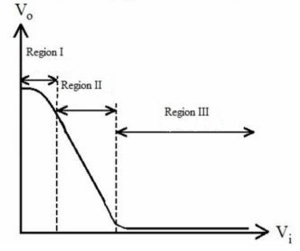
The graph between the input voltage $(V_{i})$ and the output voltage $(V_{o})$ of a transistor connected in common emitter configuration is shown in the figure. The active,saturation and cutoff regions of the transistor are respectively
A
$I, II$ and $III$
B
$II, III$ and $I$
C
$I, III$ and $II$
D
$III, I$ and $II$
Solution
(B) In a common emitter transistor configuration,the transfer characteristic curve shows three distinct regions:
$1$. Cutoff Region: When the input voltage $(V_{i})$ is low,the transistor is in the cutoff region,and the output voltage $(V_{o})$ is high (near $V_{CC}$). This corresponds to Region $I$.
$2$. Active Region: As $(V_{i})$ increases,the transistor enters the active region where the output voltage $(V_{o})$ decreases linearly with $(V_{i})$. This corresponds to Region $II$.
$3$. Saturation Region: When $(V_{i})$ is high,the transistor enters the saturation region,and the output voltage $(V_{o})$ becomes very low (near $0$). This corresponds to Region $III$.
Therefore,the active,saturation,and cutoff regions are represented by $II, III$ and $I$ respectively.
$1$. Cutoff Region: When the input voltage $(V_{i})$ is low,the transistor is in the cutoff region,and the output voltage $(V_{o})$ is high (near $V_{CC}$). This corresponds to Region $I$.
$2$. Active Region: As $(V_{i})$ increases,the transistor enters the active region where the output voltage $(V_{o})$ decreases linearly with $(V_{i})$. This corresponds to Region $II$.
$3$. Saturation Region: When $(V_{i})$ is high,the transistor enters the saturation region,and the output voltage $(V_{o})$ becomes very low (near $0$). This corresponds to Region $III$.
Therefore,the active,saturation,and cutoff regions are represented by $II, III$ and $I$ respectively.
0 likesView Solution
127
PhysicsEasyMCQTS EAMCET · 2025
The current amplification factor of a transistor in common emitter configuration is $80$. If the emitter current is $2.43 \text{ mA}$,then the base current is (in $\mu \text{A}$)
A
$15$
B
$1.5$
C
$3$
D
$30$
Solution
(D) In a common emitter configuration,the current amplification factor is given by $\beta = 80$.
The relationship between emitter current $(I_E)$,collector current $(I_C)$,and base current $(I_B)$ is $I_E = I_C + I_B$.
We also know that $\beta = \frac{I_C}{I_B}$,which implies $I_C = \beta I_B$.
Substituting $I_C$ in the first equation: $I_E = \beta I_B + I_B = I_B(\beta + 1)$.
Given $I_E = 2.43 \text{ mA} = 2430 \mu \text{A}$ and $\beta = 80$.
$I_B = \frac{I_E}{\beta + 1} = \frac{2430 \mu \text{A}}{80 + 1} = \frac{2430 \mu \text{A}}{81}$.
$I_B = 30 \mu \text{A}$.
The relationship between emitter current $(I_E)$,collector current $(I_C)$,and base current $(I_B)$ is $I_E = I_C + I_B$.
We also know that $\beta = \frac{I_C}{I_B}$,which implies $I_C = \beta I_B$.
Substituting $I_C$ in the first equation: $I_E = \beta I_B + I_B = I_B(\beta + 1)$.
Given $I_E = 2.43 \text{ mA} = 2430 \mu \text{A}$ and $\beta = 80$.
$I_B = \frac{I_E}{\beta + 1} = \frac{2430 \mu \text{A}}{80 + 1} = \frac{2430 \mu \text{A}}{81}$.
$I_B = 30 \mu \text{A}$.
0 likesView Solution
128
PhysicsEasyMCQTS EAMCET · 2025
The negative feedback in an amplifier
A
increases noise and distortion
B
reduces noise and distortion
C
reduces noise and increases distortion
D
increases noise and reduces distortion
Solution
(B) Negative feedback in an amplifier is a technique where a portion of the output signal is fed back to the input in phase opposition to the original input signal.
This process reduces the overall gain of the amplifier but provides several benefits.
Specifically,negative feedback significantly reduces the noise and distortion introduced by the amplifier circuitry itself.
It also increases the bandwidth and stabilizes the gain against variations in temperature or component aging.
Therefore,the correct effect of negative feedback is the reduction of both noise and distortion.
This process reduces the overall gain of the amplifier but provides several benefits.
Specifically,negative feedback significantly reduces the noise and distortion introduced by the amplifier circuitry itself.
It also increases the bandwidth and stabilizes the gain against variations in temperature or component aging.
Therefore,the correct effect of negative feedback is the reduction of both noise and distortion.
0 likesView Solution
129
PhysicsMediumMCQTS EAMCET · 2025
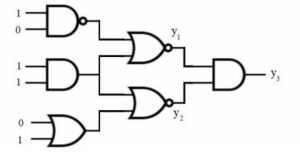
Six logic gates are connected as shown in the figure. The values of $y_1, y_2$ and $y_3$ respectively are
A
$(0,1,0)$
B
$(1,0,0)$
C
$(0,0,1)$
D
$(0,0,0)$
Solution
(D) Let us analyze the circuit step by step:
$1$. The top $NAND$ gate has inputs $1$ and $0$. The output is $(1 \cdot 0)' = 0' = 1$.
$2$. The middle $AND$ gate has inputs $1$ and $1$. The output is $1 \cdot 1 = 1$.
$3$. The bottom $OR$ gate has inputs $0$ and $1$. The output is $0 + 1 = 1$.
$4$. The top $NOR$ gate receives inputs from the $NAND$ gate $(1)$ and the $AND$ gate $(1)$. Its output $y_1 = (1 + 1)' = 1' = 0$.
$5$. The bottom $NOR$ gate receives inputs from the $AND$ gate $(1)$ and the $OR$ gate $(1)$. Its output $y_2 = (1 + 1)' = 1' = 0$.
$6$. The final $AND$ gate receives inputs $y_1 = 0$ and $y_2 = 0$. Its output $y_3 = 0 \cdot 0 = 0$.
Therefore,the values are $y_1 = 0, y_2 = 0, y_3 = 0$.
$1$. The top $NAND$ gate has inputs $1$ and $0$. The output is $(1 \cdot 0)' = 0' = 1$.
$2$. The middle $AND$ gate has inputs $1$ and $1$. The output is $1 \cdot 1 = 1$.
$3$. The bottom $OR$ gate has inputs $0$ and $1$. The output is $0 + 1 = 1$.
$4$. The top $NOR$ gate receives inputs from the $NAND$ gate $(1)$ and the $AND$ gate $(1)$. Its output $y_1 = (1 + 1)' = 1' = 0$.
$5$. The bottom $NOR$ gate receives inputs from the $AND$ gate $(1)$ and the $OR$ gate $(1)$. Its output $y_2 = (1 + 1)' = 1' = 0$.
$6$. The final $AND$ gate receives inputs $y_1 = 0$ and $y_2 = 0$. Its output $y_3 = 0 \cdot 0 = 0$.
Therefore,the values are $y_1 = 0, y_2 = 0, y_3 = 0$.
0 likesView Solution
130
PhysicsEasyMCQTS EAMCET · 2025
Which of the following logic gates is a universal gate?
A
$AND$
B
$OR$
C
$NOT$
D
$NAND$
Solution
(D) universal gate is a logic gate that can be used to implement any other logic gate or Boolean function without the need for any other type of gate.
$NAND$ and $NOR$ gates are known as universal gates.
In the given options,$NAND$ is a universal gate.
Therefore,the correct option is $D$.
$NAND$ and $NOR$ gates are known as universal gates.
In the given options,$NAND$ is a universal gate.
Therefore,the correct option is $D$.
0 likesView Solution
131
PhysicsMediumMCQTS EAMCET · 2025
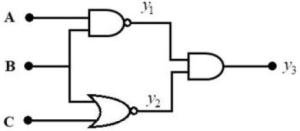
Three logic gates are connected as shown in the figure. If the inputs are $A=1, B=0$ and $C=1$,then the values of $y_1, y_2$ and $y_3$ respectively are
A
$1, 0, 0$
B
$0, 1, 0$
C
$1, 1, 0$
D
$1, 0, 1$
Solution
(A) The circuit consists of a $NAND$ gate,a $NOR$ gate,and an $AND$ gate.
$1$. The $NAND$ gate has inputs $A=1$ and $B=0$. The output $y_1$ of a $NAND$ gate is given by $y_1 = \overline{A \cdot B}$. Thus,$y_1 = \overline{1 \cdot 0} = \overline{0} = 1$.
$2$. The $NOR$ gate has inputs $B=0$ and $C=1$. The output $y_2$ of a $NOR$ gate is given by $y_2 = \overline{B + C}$. Thus,$y_2 = \overline{0 + 1} = \overline{1} = 0$.
$3$. The $AND$ gate has inputs $y_1=1$ and $y_2=0$. The output $y_3$ of an $AND$ gate is given by $y_3 = y_1 \cdot y_2$. Thus,$y_3 = 1 \cdot 0 = 0$.
Therefore,the values are $y_1=1, y_2=0, y_3=0$.
$1$. The $NAND$ gate has inputs $A=1$ and $B=0$. The output $y_1$ of a $NAND$ gate is given by $y_1 = \overline{A \cdot B}$. Thus,$y_1 = \overline{1 \cdot 0} = \overline{0} = 1$.
$2$. The $NOR$ gate has inputs $B=0$ and $C=1$. The output $y_2$ of a $NOR$ gate is given by $y_2 = \overline{B + C}$. Thus,$y_2 = \overline{0 + 1} = \overline{1} = 0$.
$3$. The $AND$ gate has inputs $y_1=1$ and $y_2=0$. The output $y_3$ of an $AND$ gate is given by $y_3 = y_1 \cdot y_2$. Thus,$y_3 = 1 \cdot 0 = 0$.
Therefore,the values are $y_1=1, y_2=0, y_3=0$.
0 likesView Solution
132
PhysicsEasyMCQTS EAMCET · 2025
At absolute zero temperature,a semiconductor behaves like
A
semiconductor
B
superconductor
C
conductor
D
insulator
Solution
(D) At absolute zero temperature $(T = 0 \ K)$,all the valence electrons are tightly bound to their respective atoms in the crystal lattice.
There is no thermal energy available to excite electrons from the valence band to the conduction band.
Consequently,the conduction band remains completely empty,and the valence band is completely filled.
Due to the absence of free charge carriers,the semiconductor acts as a perfect insulator.
There is no thermal energy available to excite electrons from the valence band to the conduction band.
Consequently,the conduction band remains completely empty,and the valence band is completely filled.
Due to the absence of free charge carriers,the semiconductor acts as a perfect insulator.
0 likesView Solution
133
PhysicsEasyMCQTS EAMCET · 2025
If the energy gap of a semiconductor used for the fabrication of an $LED$ is nearly $1.9 \ eV$,then the color of the light emitted by the $LED$ is
A
White
B
Red
C
Green
D
Blue
Solution
(B) The energy of the emitted photon is given by the relation $E = \frac{hc}{\lambda}$.
Given the energy gap $E = 1.9 \ eV$.
We know that $hc \approx 1240 \ eV \cdot nm$.
Therefore,the wavelength $\lambda = \frac{hc}{E} = \frac{1240 \ eV \cdot nm}{1.9 \ eV} \approx 652.6 \ nm$.
The wavelength range for red light is approximately $620 \ nm$ to $750 \ nm$.
Since $652.6 \ nm$ falls within this range,the color of the light emitted by the $LED$ is red.
Given the energy gap $E = 1.9 \ eV$.
We know that $hc \approx 1240 \ eV \cdot nm$.
Therefore,the wavelength $\lambda = \frac{hc}{E} = \frac{1240 \ eV \cdot nm}{1.9 \ eV} \approx 652.6 \ nm$.
The wavelength range for red light is approximately $620 \ nm$ to $750 \ nm$.
Since $652.6 \ nm$ falls within this range,the color of the light emitted by the $LED$ is red.
0 likesView Solution
134
PhysicsMediumMCQTS EAMCET · 2025
If $L$ and $C$ are inductance and capacitance respectively,then the dimensional formula of $(LC)^{-\frac{1}{2}}$ is
A
$[M^0 L^0 T^{-1}]$
B
$[M^1 L^1 T^{-1}]$
C
$[M^0 L^1 T^1]$
D
$[M^0 L^0 T^{-2}]$
Solution
(A) The resonant frequency of an $LC$ circuit is given by the formula $\omega = \frac{1}{\sqrt{LC}}$.
Here,$\omega$ represents the angular frequency,which has the dimensions of $[T^{-1}]$.
Therefore,$(LC)^{-\frac{1}{2}} = \frac{1}{\sqrt{LC}} = \omega$.
The dimensional formula for angular frequency is $[M^0 L^0 T^{-1}]$.
Thus,the correct option is $A$.
Here,$\omega$ represents the angular frequency,which has the dimensions of $[T^{-1}]$.
Therefore,$(LC)^{-\frac{1}{2}} = \frac{1}{\sqrt{LC}} = \omega$.
The dimensional formula for angular frequency is $[M^0 L^0 T^{-1}]$.
Thus,the correct option is $A$.
0 likesView Solution
135
PhysicsMediumMCQTS EAMCET · 2025
For an aperture of $5 \times 10^{-3} \ m$ and a monochromatic light of wavelength $\lambda$, the distance for which ray optics becomes a good approximation is $50 \ m$, then $\lambda=$ (in $\text{Å}$)
A
$5000$
B
$6000$
C
$5400$
D
$6500$
Solution
(A) The Fresnel distance $(z_F)$ is the distance up to which ray optics is a good approximation. It is given by the formula:
$z_F = \frac{a^2}{\lambda}$
where $a$ is the aperture size and $\lambda$ is the wavelength of light.
Given:
Aperture $a = 5 \times 10^{-3} \ m$
Fresnel distance $z_F = 50 \ m$
Substituting the values into the formula:
$50 = \frac{(5 \times 10^{-3})^2}{\lambda}$
$50 = \frac{25 \times 10^{-6}}{\lambda}$
$\lambda = \frac{25 \times 10^{-6}}{50}$
$\lambda = 0.5 \times 10^{-6} \ m$
$\lambda = 5 \times 10^{-7} \ m$
Converting to $\text{Å}$s $(\text{Å})$:
$1 \ \text{Å} = 10^{-10} \ m$
$\lambda = 5 \times 10^{-7} \times 10^{10} \ \text{Å} = 5000 \ \text{Å}$
Therefore, the correct option is $A$.
$z_F = \frac{a^2}{\lambda}$
where $a$ is the aperture size and $\lambda$ is the wavelength of light.
Given:
Aperture $a = 5 \times 10^{-3} \ m$
Fresnel distance $z_F = 50 \ m$
Substituting the values into the formula:
$50 = \frac{(5 \times 10^{-3})^2}{\lambda}$
$50 = \frac{25 \times 10^{-6}}{\lambda}$
$\lambda = \frac{25 \times 10^{-6}}{50}$
$\lambda = 0.5 \times 10^{-6} \ m$
$\lambda = 5 \times 10^{-7} \ m$
Converting to $\text{Å}$s $(\text{Å})$:
$1 \ \text{Å} = 10^{-10} \ m$
$\lambda = 5 \times 10^{-7} \times 10^{10} \ \text{Å} = 5000 \ \text{Å}$
Therefore, the correct option is $A$.
0 likesView Solution
136
PhysicsMediumMCQTS EAMCET · 2025
The distance for which ray optics becomes a good approximation for an aperture of $0.3 \ cm$ and a light of wavelength $6000 \ Å$ is (in $m$)
A
$12$
B
$15$
C
$24$
D
$30$
Solution
(B) The Fresnel distance $(z_F)$ is the distance at which ray optics is a good approximation for an aperture of size $a$ and wavelength $\lambda$. It is given by the formula: $z_F = \frac{a^2}{\lambda}$.
Given:
Aperture $a = 0.3 \ cm = 0.3 \times 10^{-2} \ m = 3 \times 10^{-3} \ m$.
Wavelength $\lambda = 6000 \ Å = 6000 \times 10^{-10} \ m = 6 \times 10^{-7} \ m$.
Substituting the values into the formula:
$z_F = \frac{(3 \times 10^{-3})^2}{6 \times 10^{-7}}$
$z_F = \frac{9 \times 10^{-6}}{6 \times 10^{-7}}$
$z_F = 1.5 \times 10^1 = 15 \ m$.
Therefore,the correct option is $B$.
Given:
Aperture $a = 0.3 \ cm = 0.3 \times 10^{-2} \ m = 3 \times 10^{-3} \ m$.
Wavelength $\lambda = 6000 \ Å = 6000 \times 10^{-10} \ m = 6 \times 10^{-7} \ m$.
Substituting the values into the formula:
$z_F = \frac{(3 \times 10^{-3})^2}{6 \times 10^{-7}}$
$z_F = \frac{9 \times 10^{-6}}{6 \times 10^{-7}}$
$z_F = 1.5 \times 10^1 = 15 \ m$.
Therefore,the correct option is $B$.
0 likesView Solution
137
PhysicsMediumMCQTS EAMCET · 2025
When two light waves of equal intensity superimpose,the maximum intensity obtained is $I$. If the intensity of one of the waves is quadrupled,then the maximum intensity obtained is
A
$\frac{4 I}{9}$
B
$\frac{9 I}{4}$
C
$\frac{2 I}{3}$
D
$\frac{3 I}{2}$
Solution
(B) Let the intensity of each wave be $I_0$. The maximum intensity $I_{max}$ for two waves of intensity $I_1$ and $I_2$ is given by $I_{max} = (\sqrt{I_1} + \sqrt{I_2})^2$.
Given $I_1 = I_2 = I_0$,the maximum intensity is $I = (\sqrt{I_0} + \sqrt{I_0})^2 = (2\sqrt{I_0})^2 = 4I_0$. Thus,$I_0 = I/4$.
Now,the intensity of one wave is quadrupled,so $I_1' = 4I_0 = 4(I/4) = I$ and $I_2' = I_0 = I/4$.
The new maximum intensity $I_{max}'$ is $(\sqrt{I_1'} + \sqrt{I_2'})^2 = (\sqrt{I} + \sqrt{I/4})^2 = (\sqrt{I} + \frac{\sqrt{I}}{2})^2 = (\frac{3\sqrt{I}}{2})^2 = \frac{9I}{4}$.
Given $I_1 = I_2 = I_0$,the maximum intensity is $I = (\sqrt{I_0} + \sqrt{I_0})^2 = (2\sqrt{I_0})^2 = 4I_0$. Thus,$I_0 = I/4$.
Now,the intensity of one wave is quadrupled,so $I_1' = 4I_0 = 4(I/4) = I$ and $I_2' = I_0 = I/4$.
The new maximum intensity $I_{max}'$ is $(\sqrt{I_1'} + \sqrt{I_2'})^2 = (\sqrt{I} + \sqrt{I/4})^2 = (\sqrt{I} + \frac{\sqrt{I}}{2})^2 = (\frac{3\sqrt{I}}{2})^2 = \frac{9I}{4}$.
0 likesView Solution
138
PhysicsMediumMCQTS EAMCET · 2025
When unpolarised light from air is incident on the surface of a medium of refractive index $\sqrt{3}$,the reflected light is totally polarised. The angle of refraction is (in $^{\circ}$)
A
$30$
B
$53$
C
$60$
D
$37$
Solution
(A) According to Brewster's Law,when light is incident at the polarizing angle $(i_p)$,the reflected light is totally plane-polarized.
At this angle,the reflected ray and the refracted ray are perpendicular to each other.
Brewster's Law states that $\tan(i_p) = \mu$.
Given $\mu = \sqrt{3}$,we have $\tan(i_p) = \sqrt{3}$,which implies $i_p = 60^{\circ}$.
According to Snell's Law,$\mu_1 \sin(i_p) = \mu_2 \sin(r)$,where $r$ is the angle of refraction.
Here,$\mu_1 = 1$ (air) and $\mu_2 = \sqrt{3}$.
$1 \cdot \sin(60^{\circ}) = \sqrt{3} \cdot \sin(r)$.
$\frac{\sqrt{3}}{2} = \sqrt{3} \cdot \sin(r)$.
$\sin(r) = \frac{1}{2}$.
Therefore,$r = 30^{\circ}$.
At this angle,the reflected ray and the refracted ray are perpendicular to each other.
Brewster's Law states that $\tan(i_p) = \mu$.
Given $\mu = \sqrt{3}$,we have $\tan(i_p) = \sqrt{3}$,which implies $i_p = 60^{\circ}$.
According to Snell's Law,$\mu_1 \sin(i_p) = \mu_2 \sin(r)$,where $r$ is the angle of refraction.
Here,$\mu_1 = 1$ (air) and $\mu_2 = \sqrt{3}$.
$1 \cdot \sin(60^{\circ}) = \sqrt{3} \cdot \sin(r)$.
$\frac{\sqrt{3}}{2} = \sqrt{3} \cdot \sin(r)$.
$\sin(r) = \frac{1}{2}$.
Therefore,$r = 30^{\circ}$.
0 likesView Solution
139
PhysicsMediumMCQTS EAMCET · 2025
In Young's double slit experiment with light of wavelength $\lambda$,the intensity of light at a point on the screen where the path difference becomes $\frac{\lambda}{3}$ is (where $I$ is the intensity of the central bright fringe).
A
$I$
B
$\frac{I}{2}$
C
$\frac{I}{3}$
D
$\frac{I}{4}$
Solution
(D) The intensity at any point in an interference pattern is given by $I_p = I_{max} \cos^2(\frac{\phi}{2})$,where $\phi$ is the phase difference.
Given that $I_{max} = I$ (intensity of the central bright fringe).
The relationship between phase difference $\phi$ and path difference $\Delta x$ is $\phi = \frac{2\pi}{\lambda} \Delta x$.
Given $\Delta x = \frac{\lambda}{3}$,we have $\phi = \frac{2\pi}{\lambda} \times \frac{\lambda}{3} = \frac{2\pi}{3}$.
Substituting this into the intensity formula:
$I_p = I \cos^2(\frac{2\pi/3}{2}) = I \cos^2(\frac{\pi}{3})$.
Since $\cos(\frac{\pi}{3}) = \frac{1}{2}$,we get $I_p = I (\frac{1}{2})^2 = \frac{I}{4}$.
Given that $I_{max} = I$ (intensity of the central bright fringe).
The relationship between phase difference $\phi$ and path difference $\Delta x$ is $\phi = \frac{2\pi}{\lambda} \Delta x$.
Given $\Delta x = \frac{\lambda}{3}$,we have $\phi = \frac{2\pi}{\lambda} \times \frac{\lambda}{3} = \frac{2\pi}{3}$.
Substituting this into the intensity formula:
$I_p = I \cos^2(\frac{2\pi/3}{2}) = I \cos^2(\frac{\pi}{3})$.
Since $\cos(\frac{\pi}{3}) = \frac{1}{2}$,we get $I_p = I (\frac{1}{2})^2 = \frac{I}{4}$.
0 likesView Solution
140
PhysicsMediumMCQTS EAMCET · 2025
In Young's double slit experiment, if the distance between $5^{\text{th}}$ bright and $7^{\text{th}}$ dark fringes is $3 \text{ mm}$, then the distance between $5^{\text{th}}$ dark and $7^{\text{th}}$ bright fringes is (in $\text{ mm}$)
A
$6$
B
$3$
C
$5$
D
$4$
Solution
(C) The position of the $n^{\text{th}}$ bright fringe is given by $y_n = n \beta$, where $\beta = \frac{\lambda D}{d}$.
The position of the $n^{\text{th}}$ dark fringe is given by $y'_n = (n - 0.5) \beta$.
Given the distance between the $5^{\text{th}}$ bright fringe $(y_5 = 5 \beta)$ and the $7^{\text{th}}$ dark fringe $(y'_7 = (7 - 0.5) \beta = 6.5 \beta)$ is $3 \text{ mm}$:
$|6.5 \beta - 5 \beta| = 3 \text{ mm} \implies 1.5 \beta = 3 \text{ mm} \implies \beta = 2 \text{ mm}$.
Now, we need to find the distance between the $5^{\text{th}}$ dark fringe $(y'_5 = (5 - 0.5) \beta = 4.5 \beta)$ and the $7^{\text{th}}$ bright fringe $(y_7 = 7 \beta)$:
Distance $= |7 \beta - 4.5 \beta| = 2.5 \beta$.
Substituting $\beta = 2 \text{ mm}$:
Distance $= 2.5 \times 2 \text{ mm} = 5 \text{ mm}$.
The position of the $n^{\text{th}}$ dark fringe is given by $y'_n = (n - 0.5) \beta$.
Given the distance between the $5^{\text{th}}$ bright fringe $(y_5 = 5 \beta)$ and the $7^{\text{th}}$ dark fringe $(y'_7 = (7 - 0.5) \beta = 6.5 \beta)$ is $3 \text{ mm}$:
$|6.5 \beta - 5 \beta| = 3 \text{ mm} \implies 1.5 \beta = 3 \text{ mm} \implies \beta = 2 \text{ mm}$.
Now, we need to find the distance between the $5^{\text{th}}$ dark fringe $(y'_5 = (5 - 0.5) \beta = 4.5 \beta)$ and the $7^{\text{th}}$ bright fringe $(y_7 = 7 \beta)$:
Distance $= |7 \beta - 4.5 \beta| = 2.5 \beta$.
Substituting $\beta = 2 \text{ mm}$:
Distance $= 2.5 \times 2 \text{ mm} = 5 \text{ mm}$.
0 likesView Solution
Vedclass Products
For Students
Vedclass Test Series
Mock tests in real TS EAMCET style covering Physics with performance analysis. 5-day free trial.
Start Free TrialFor Teachers
Exam Paper Generator
Generate Set A/B/C/D Physics papers from 7.5L+ questions in 2 minutes. 3 chapters free.
Try FreeFor Institutes
Online Exam Module
Run live TS EAMCET mock exams with unlimited students, 360° analytics & white-label branding.
See DemoFrequently Asked Questions
How many Physics questions are in TS EAMCET 2025?
There are 240 Physics questions from the TS EAMCET 2025 paper on Vedclass, each with a detailed step-by-step solution in English.
Are TS EAMCET 2025 Physics solutions available in English?
Yes. All solutions on this page are in English. You can also switch to English or Hindi using the language buttons above the questions.
Can I practice TS EAMCET 2025 Physics as a timed test?
Yes. Use the Vedclass Test Series to attempt a full TS EAMCET mock test covering Physics with time limits and instant score analysis.
Can teachers create Physics papers from TS EAMCET previous year questions?
Yes. The Vedclass Exam Paper Generator lets teachers mix TS EAMCET Physics questions and generate Set A/B/C/D papers in minutes.
For Teachers & Institutes
Build a Custom Physics Paper
Pick TS EAMCET 2025 Physics questions, set difficulty, and generate Set A/B/C/D in 2 minutes.