
MathematicsQ251–350 of 652 questions
Page 6 of 7 · English
251
MathematicsEasyMCQTS EAMCET · 2020
If $S(a, b)$ is a fixed point and $P(\alpha, \beta)$ is a variable point such that $4[(x-a)^2+(y-b)^2]=(\alpha x+\beta y+7)^2$ represents a parabola,then the locus of $P(\alpha, \beta)$ is
A
$\beta^2=4 \alpha$
B
$\alpha^2+\beta^2=4$
C
$\frac{\alpha^2}{4}+\frac{\beta^2}{2}=1$
D
$(\alpha+\beta)^2=4$
Solution
(B) The general equation of a parabola is defined as $PF^2 = e^2 PM^2$,where $e=1$ for a parabola.
Given the equation $4[(x-a)^2+(y-b)^2]=(\alpha x+\beta y+7)^2$,we can rewrite it as:
$(x-a)^2+(y-b)^2 = \left(\frac{\alpha x+\beta y+7}{2}\right)^2$
To match the form $PF^2 = PM^2$,we normalize the line equation:
$(x-a)^2+(y-b)^2 = \left(\frac{\alpha x+\beta y+7}{\sqrt{\alpha^2+\beta^2}}\right)^2 \cdot \frac{\alpha^2+\beta^2}{4}$
For this to represent a parabola,the eccentricity $e$ must be $1$,which implies the coefficient $\frac{\alpha^2+\beta^2}{4} = 1^2$.
Therefore,$\alpha^2+\beta^2=4$.
Given the equation $4[(x-a)^2+(y-b)^2]=(\alpha x+\beta y+7)^2$,we can rewrite it as:
$(x-a)^2+(y-b)^2 = \left(\frac{\alpha x+\beta y+7}{2}\right)^2$
To match the form $PF^2 = PM^2$,we normalize the line equation:
$(x-a)^2+(y-b)^2 = \left(\frac{\alpha x+\beta y+7}{\sqrt{\alpha^2+\beta^2}}\right)^2 \cdot \frac{\alpha^2+\beta^2}{4}$
For this to represent a parabola,the eccentricity $e$ must be $1$,which implies the coefficient $\frac{\alpha^2+\beta^2}{4} = 1^2$.
Therefore,$\alpha^2+\beta^2=4$.
0 likesView Solution
252
MathematicsEasyMCQTS EAMCET · 2020
The equation of the ellipse in the standard form whose length of the latus rectum is $4$ and whose distance between the foci is $4 \sqrt{2}$,is
A
$\frac{x^2}{2} + \frac{y^2}{3} = 1$
B
$2x^2 + y^2 = 8$
C
$x^2 + 2y^2 = 16$
D
$x^2 + 5y^2 = 25$
Solution
(C) The length of the latus rectum is $\frac{2b^2}{a} = 4$,which implies $b^2 = 2a$.
The distance between the foci is $2ae = 4\sqrt{2}$,so $ae = 2\sqrt{2}$.
Squaring both sides,$a^2e^2 = 8$.
Using the relation $a^2e^2 = a^2 - b^2$,we have $a^2 - b^2 = 8$.
Substituting $b^2 = 2a$,we get $a^2 - 2a - 8 = 0$.
Solving the quadratic equation $(a - 4)(a + 2) = 0$,we get $a = 4$ (since $a > 0$).
Then $b^2 = 2(4) = 8$.
The equation of the ellipse is $\frac{x^2}{a^2} + \frac{y^2}{b^2} = 1$,which is $\frac{x^2}{16} + \frac{y^2}{8} = 1$.
Multiplying by $16$,we get $x^2 + 2y^2 = 16$.
The distance between the foci is $2ae = 4\sqrt{2}$,so $ae = 2\sqrt{2}$.
Squaring both sides,$a^2e^2 = 8$.
Using the relation $a^2e^2 = a^2 - b^2$,we have $a^2 - b^2 = 8$.
Substituting $b^2 = 2a$,we get $a^2 - 2a - 8 = 0$.
Solving the quadratic equation $(a - 4)(a + 2) = 0$,we get $a = 4$ (since $a > 0$).
Then $b^2 = 2(4) = 8$.
The equation of the ellipse is $\frac{x^2}{a^2} + \frac{y^2}{b^2} = 1$,which is $\frac{x^2}{16} + \frac{y^2}{8} = 1$.
Multiplying by $16$,we get $x^2 + 2y^2 = 16$.
0 likesView Solution
253
MathematicsEasyMCQTS EAMCET · 2020
The eccentricity of an ellipse passing through $(3 \sqrt{2}, \sqrt{10})$ with foci at $(-4,0)$ and $(4,0)$ is
A
$\frac{1}{2}$
B
$\frac{2}{3}$
C
$\frac{\sqrt{2}}{3}$
D
$\frac{1}{\sqrt{3}}$
Solution
(B) Let the equation of the ellipse be $\frac{x^2}{a^2} + \frac{y^2}{b^2} = 1$.
Since the ellipse passes through $(3 \sqrt{2}, \sqrt{10})$,we have $\frac{(3 \sqrt{2})^2}{a^2} + \frac{(\sqrt{10})^2}{b^2} = 1$,which simplifies to $\frac{18}{a^2} + \frac{10}{b^2} = 1$ $(i)$.
The foci are at $(\pm 4, 0)$,so $ae = 4$,which means $a^2 e^2 = 16$.
Using the relation $b^2 = a^2(1 - e^2) = a^2 - a^2 e^2$,we get $b^2 = a^2 - 16$.
Substituting $b^2$ into equation $(i)$: $\frac{18}{a^2} + \frac{10}{a^2 - 16} = 1$.
Multiplying by $a^2(a^2 - 16)$,we get $18(a^2 - 16) + 10a^2 = a^2(a^2 - 16)$.
$18a^2 - 288 + 10a^2 = a^4 - 16a^2$.
$a^4 - 44a^2 + 288 = 0$.
Factoring the quadratic in $a^2$: $(a^2 - 36)(a^2 - 8) = 0$.
Since $b^2 = a^2 - 16 > 0$,we must have $a^2 > 16$,so $a^2 = 36$.
Finally,$e^2 = \frac{16}{a^2} = \frac{16}{36} = \frac{4}{9}$.
Therefore,$e = \sqrt{\frac{4}{9}} = \frac{2}{3}$.
Since the ellipse passes through $(3 \sqrt{2}, \sqrt{10})$,we have $\frac{(3 \sqrt{2})^2}{a^2} + \frac{(\sqrt{10})^2}{b^2} = 1$,which simplifies to $\frac{18}{a^2} + \frac{10}{b^2} = 1$ $(i)$.
The foci are at $(\pm 4, 0)$,so $ae = 4$,which means $a^2 e^2 = 16$.
Using the relation $b^2 = a^2(1 - e^2) = a^2 - a^2 e^2$,we get $b^2 = a^2 - 16$.
Substituting $b^2$ into equation $(i)$: $\frac{18}{a^2} + \frac{10}{a^2 - 16} = 1$.
Multiplying by $a^2(a^2 - 16)$,we get $18(a^2 - 16) + 10a^2 = a^2(a^2 - 16)$.
$18a^2 - 288 + 10a^2 = a^4 - 16a^2$.
$a^4 - 44a^2 + 288 = 0$.
Factoring the quadratic in $a^2$: $(a^2 - 36)(a^2 - 8) = 0$.
Since $b^2 = a^2 - 16 > 0$,we must have $a^2 > 16$,so $a^2 = 36$.
Finally,$e^2 = \frac{16}{a^2} = \frac{16}{36} = \frac{4}{9}$.
Therefore,$e = \sqrt{\frac{4}{9}} = \frac{2}{3}$.
0 likesView Solution
254
MathematicsEasyMCQTS EAMCET · 2020
The ellipse having its foci $(0, \pm 1)$ and major axis of length $\sqrt{5}$ is
A
$20 x^2+4 y^2=5$
B
$36 x^2+20 y^2=45$
C
$4 x^2+20 y^2=5$
D
$20 x^2+36 y^2=45$
Solution
(A) Since the foci of the given ellipse lie on the $Y$-axis,it is a vertical ellipse.
Let the required equation be $\frac{x^2}{b^2} + \frac{y^2}{a^2} = 1$,where $a^2 > b^2$.
The foci are $(0, \pm c) = (0, \pm 1)$,which implies $c = 1$.
The length of the major axis is $2a = \sqrt{5}$,so $a = \frac{\sqrt{5}}{2}$ and $a^2 = \frac{5}{4}$.
Using the relation $c^2 = a^2 - b^2$,we have $1 = \frac{5}{4} - b^2$.
Thus,$b^2 = \frac{5}{4} - 1 = \frac{1}{4}$.
Substituting $a^2$ and $b^2$ into the equation,we get $\frac{x^2}{1/4} + \frac{y^2}{5/4} = 1$.
This simplifies to $4x^2 + \frac{4y^2}{5} = 1$,or $20x^2 + 4y^2 = 5$.
Let the required equation be $\frac{x^2}{b^2} + \frac{y^2}{a^2} = 1$,where $a^2 > b^2$.
The foci are $(0, \pm c) = (0, \pm 1)$,which implies $c = 1$.
The length of the major axis is $2a = \sqrt{5}$,so $a = \frac{\sqrt{5}}{2}$ and $a^2 = \frac{5}{4}$.
Using the relation $c^2 = a^2 - b^2$,we have $1 = \frac{5}{4} - b^2$.
Thus,$b^2 = \frac{5}{4} - 1 = \frac{1}{4}$.
Substituting $a^2$ and $b^2$ into the equation,we get $\frac{x^2}{1/4} + \frac{y^2}{5/4} = 1$.
This simplifies to $4x^2 + \frac{4y^2}{5} = 1$,or $20x^2 + 4y^2 = 5$.
0 likesView Solution
255
MathematicsEasyMCQTS EAMCET · 2020
The equation of the ellipse with directrix $3x+4y-5=0$,focus $(1,2)$ and eccentricity $e = \frac{1}{2}$,is
A
$x^2+84y^2-24xy-360y+170x+475=0$
B
$91x^2+84y^2-24xy-170x-360y+475=0$
C
$91x^2+84y^2-24xy-170x+360y+475=0$
D
$91x^2+84y^2-24xy-170x-360y-475=0$
Solution
(B) By the definition of an ellipse,the distance from a point $(x, y)$ to the focus is $e$ times the distance from the point to the directrix: $\sqrt{(x-1)^2+(y-2)^2} = \frac{1}{2} \frac{|3x+4y-5|}{\sqrt{3^2+4^2}}$.
Squaring both sides,we get: $(x-1)^2+(y-2)^2 = \frac{1}{4} \frac{(3x+4y-5)^2}{25}$.
$100(x^2-2x+1+y^2-4y+4) = (3x+4y-5)^2$.
$100(x^2+y^2-2x-4y+5) = 9x^2+16y^2+25+24xy-30x-40y$.
$100x^2+100y^2-200x-400y+500 = 9x^2+16y^2+24xy-30x-40y+25$.
Rearranging terms: $91x^2+84y^2-24xy-170x-360y+475=0$.
Squaring both sides,we get: $(x-1)^2+(y-2)^2 = \frac{1}{4} \frac{(3x+4y-5)^2}{25}$.
$100(x^2-2x+1+y^2-4y+4) = (3x+4y-5)^2$.
$100(x^2+y^2-2x-4y+5) = 9x^2+16y^2+25+24xy-30x-40y$.
$100x^2+100y^2-200x-400y+500 = 9x^2+16y^2+24xy-30x-40y+25$.
Rearranging terms: $91x^2+84y^2-24xy-170x-360y+475=0$.
0 likesView Solution
256
MathematicsMediumMCQTS EAMCET · 2020
If the sum of the distances from the foci to the centre $O(0,0)$ of an ellipse is $8 \sqrt{6}$ units and the area of the smallest rectangle in which that ellipse is inscribed is $80$ sq. units,then the equation of such an ellipse is
A
$\frac{x^2}{100}+\frac{y^2}{64}=1$
B
$\frac{x^2}{100}+\frac{y^2}{16}=1$
C
$\frac{x^2}{10}+\frac{y^2}{4}=1$
D
$\frac{x^2}{100}+\frac{y^2}{4}=1$
Solution
(D) Let the equation of the required ellipse be $\frac{x^2}{a^2}+\frac{y^2}{b^2}=1, \quad (a>b)$.
According to the given information,the distance from each focus to the centre is $ae$,so the sum of distances is $ae + ae = 2ae = 8\sqrt{6} \Rightarrow ae = 4\sqrt{6}$.
Squaring both sides,$a^2e^2 = 16 \times 6 = 96$.
Since $e^2 = 1 - \frac{b^2}{a^2}$,we have $a^2(1 - \frac{b^2}{a^2}) = 96$,which simplifies to $a^2 - b^2 = 96 \quad (i)$.
The smallest rectangle in which the ellipse is inscribed has dimensions $2a \times 2b$. Thus,$4ab = 80$ $\Rightarrow ab = 20$ $\Rightarrow a^2b^2 = 400 \quad (ii)$.
Using the identity $(a^2+b^2)^2 = (a^2-b^2)^2 + 4a^2b^2$,we get $(a^2+b^2)^2 = (96)^2 + 4(400) = 9216 + 1600 = 10816$.
Taking the square root,$a^2+b^2 = \sqrt{10816} = 104 \quad (iii)$.
Adding $(i)$ and $(iii)$,$2a^2 = 200 \Rightarrow a^2 = 100$.
Subtracting $(i)$ from $(iii)$,$2b^2 = 8 \Rightarrow b^2 = 4$.
Therefore,the equation of the ellipse is $\frac{x^2}{100}+\frac{y^2}{4}=1$.
According to the given information,the distance from each focus to the centre is $ae$,so the sum of distances is $ae + ae = 2ae = 8\sqrt{6} \Rightarrow ae = 4\sqrt{6}$.
Squaring both sides,$a^2e^2 = 16 \times 6 = 96$.
Since $e^2 = 1 - \frac{b^2}{a^2}$,we have $a^2(1 - \frac{b^2}{a^2}) = 96$,which simplifies to $a^2 - b^2 = 96 \quad (i)$.
The smallest rectangle in which the ellipse is inscribed has dimensions $2a \times 2b$. Thus,$4ab = 80$ $\Rightarrow ab = 20$ $\Rightarrow a^2b^2 = 400 \quad (ii)$.
Using the identity $(a^2+b^2)^2 = (a^2-b^2)^2 + 4a^2b^2$,we get $(a^2+b^2)^2 = (96)^2 + 4(400) = 9216 + 1600 = 10816$.
Taking the square root,$a^2+b^2 = \sqrt{10816} = 104 \quad (iii)$.
Adding $(i)$ and $(iii)$,$2a^2 = 200 \Rightarrow a^2 = 100$.
Subtracting $(i)$ from $(iii)$,$2b^2 = 8 \Rightarrow b^2 = 4$.
Therefore,the equation of the ellipse is $\frac{x^2}{100}+\frac{y^2}{4}=1$.
0 likesView Solution
257
MathematicsDifficultMCQTS EAMCET · 2020
If $\frac{\pi}{3}$ and $\theta$ are the eccentric angles of the ends of a focal chord of the ellipse $\frac{x^2}{16}+\frac{y^2}{12}=1$,then $\tan \theta=$
A
$-\sqrt{3}$
B
$\sqrt{3}$
C
$-1$
D
$\frac{1}{\sqrt{2}}$
Solution
(A) Given the ellipse $\frac{x^2}{16}+\frac{y^2}{12}=1$,we have $a^2=16$ and $b^2=12$.
The eccentricity $e$ is given by $b^2=a^2(1-e^2)$,so $12=16(1-e^2)$,which gives $1-e^2=\frac{3}{4}$,so $e^2=\frac{1}{4}$ and $e=\frac{1}{2}$.
For a focal chord with eccentric angles $\alpha$ and $\beta$,the condition is $\tan(\frac{\alpha}{2}) \tan(\frac{\beta}{2}) = \frac{e-1}{e+1}$.
Here $\alpha = \frac{\pi}{3}$,so $\frac{\alpha}{2} = \frac{\pi}{6}$.
$\tan(\frac{\pi}{6}) \tan(\frac{\theta}{2}) = \frac{1/2 - 1}{1/2 + 1} = \frac{-1/2}{3/2} = -\frac{1}{3}$.
Since $\tan(\frac{\pi}{6}) = \frac{1}{\sqrt{3}}$,we have $\frac{1}{\sqrt{3}} \tan(\frac{\theta}{2}) = -\frac{1}{3}$,so $\tan(\frac{\theta}{2}) = -\frac{\sqrt{3}}{3} = -\frac{1}{\sqrt{3}}$.
Thus,$\frac{\theta}{2} = -\frac{\pi}{6}$,which means $\theta = -\frac{\pi}{3}$.
Therefore,$\tan \theta = \tan(-\frac{\pi}{3}) = -\sqrt{3}$.
The eccentricity $e$ is given by $b^2=a^2(1-e^2)$,so $12=16(1-e^2)$,which gives $1-e^2=\frac{3}{4}$,so $e^2=\frac{1}{4}$ and $e=\frac{1}{2}$.
For a focal chord with eccentric angles $\alpha$ and $\beta$,the condition is $\tan(\frac{\alpha}{2}) \tan(\frac{\beta}{2}) = \frac{e-1}{e+1}$.
Here $\alpha = \frac{\pi}{3}$,so $\frac{\alpha}{2} = \frac{\pi}{6}$.
$\tan(\frac{\pi}{6}) \tan(\frac{\theta}{2}) = \frac{1/2 - 1}{1/2 + 1} = \frac{-1/2}{3/2} = -\frac{1}{3}$.
Since $\tan(\frac{\pi}{6}) = \frac{1}{\sqrt{3}}$,we have $\frac{1}{\sqrt{3}} \tan(\frac{\theta}{2}) = -\frac{1}{3}$,so $\tan(\frac{\theta}{2}) = -\frac{\sqrt{3}}{3} = -\frac{1}{\sqrt{3}}$.
Thus,$\frac{\theta}{2} = -\frac{\pi}{6}$,which means $\theta = -\frac{\pi}{3}$.
Therefore,$\tan \theta = \tan(-\frac{\pi}{3}) = -\sqrt{3}$.
0 likesView Solution
258
MathematicsDifficultMCQTS EAMCET · 2020
The locus of the midpoints of the intercepted portion of the tangents by the coordinate axes,which are drawn to the ellipse $x^2+2y^2=2$,is
A
$\frac{1}{2x^2}+\frac{1}{4y^2}=1$
B
$\frac{1}{4x^2}+\frac{1}{2y^2}=1$
C
$\frac{x^2}{2}+\frac{y^2}{4}=1$
D
$\frac{x^2}{4}+\frac{y^2}{2}=1$
Solution
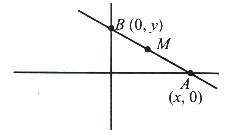
(A) The given equation of the ellipse is $x^2+2y^2=2$,which can be written as $\frac{x^2}{2}+\frac{y^2}{1}=1$. Here $a^2=2$ and $b^2=1$,so $a=\sqrt{2}$ and $b=1$.
The equation of the tangent to the ellipse at point $P(a \cos \theta, b \sin \theta)$ is $\frac{x \cos \theta}{a} + \frac{y \sin \theta}{b} = 1$.
Substituting the values,we get $\frac{x \cos \theta}{\sqrt{2}} + y \sin \theta = 1$.
For the $x$-intercept $(A)$,set $y=0$: $\frac{x \cos \theta}{\sqrt{2}} = 1 \Rightarrow x = \sqrt{2} \sec \theta$. So,$A = (\sqrt{2} \sec \theta, 0)$.
For the $y$-intercept $(B)$,set $x=0$: $y \sin \theta = 1 \Rightarrow y = \operatorname{cosec} \theta$. So,$B = (0, \operatorname{cosec} \theta)$.
Let $M(h, k)$ be the midpoint of $AB$. Then:
$h = \frac{\sqrt{2} \sec \theta + 0}{2} = \frac{\sec \theta}{\sqrt{2}} \Rightarrow \sec \theta = \sqrt{2}h$
$k = \frac{0 + \operatorname{cosec} \theta}{2} = \frac{\operatorname{cosec} \theta}{2} \Rightarrow \operatorname{cosec} \theta = 2k$
We know that $\cos^2 \theta + \sin^2 \theta = 1$,which implies $\frac{1}{\sec^2 \theta} + \frac{1}{\operatorname{cosec}^2 \theta} = 1$.
Substituting the values of $\sec \theta$ and $\operatorname{cosec} \theta$:
$\frac{1}{(\sqrt{2}h)^2} + \frac{1}{(2k)^2} = 1$
$\frac{1}{2h^2} + \frac{1}{4k^2} = 1$
Replacing $(h, k)$ with $(x, y)$,the locus is $\frac{1}{2x^2} + \frac{1}{4y^2} = 1$.
The equation of the tangent to the ellipse at point $P(a \cos \theta, b \sin \theta)$ is $\frac{x \cos \theta}{a} + \frac{y \sin \theta}{b} = 1$.
Substituting the values,we get $\frac{x \cos \theta}{\sqrt{2}} + y \sin \theta = 1$.
For the $x$-intercept $(A)$,set $y=0$: $\frac{x \cos \theta}{\sqrt{2}} = 1 \Rightarrow x = \sqrt{2} \sec \theta$. So,$A = (\sqrt{2} \sec \theta, 0)$.
For the $y$-intercept $(B)$,set $x=0$: $y \sin \theta = 1 \Rightarrow y = \operatorname{cosec} \theta$. So,$B = (0, \operatorname{cosec} \theta)$.
Let $M(h, k)$ be the midpoint of $AB$. Then:
$h = \frac{\sqrt{2} \sec \theta + 0}{2} = \frac{\sec \theta}{\sqrt{2}} \Rightarrow \sec \theta = \sqrt{2}h$
$k = \frac{0 + \operatorname{cosec} \theta}{2} = \frac{\operatorname{cosec} \theta}{2} \Rightarrow \operatorname{cosec} \theta = 2k$
We know that $\cos^2 \theta + \sin^2 \theta = 1$,which implies $\frac{1}{\sec^2 \theta} + \frac{1}{\operatorname{cosec}^2 \theta} = 1$.
Substituting the values of $\sec \theta$ and $\operatorname{cosec} \theta$:
$\frac{1}{(\sqrt{2}h)^2} + \frac{1}{(2k)^2} = 1$
$\frac{1}{2h^2} + \frac{1}{4k^2} = 1$
Replacing $(h, k)$ with $(x, y)$,the locus is $\frac{1}{2x^2} + \frac{1}{4y^2} = 1$.
0 likesView Solution
259
MathematicsDifficultMCQTS EAMCET · 2020
$A$ tangent drawn at a point on the ellipse $\frac{x^2}{25}+\frac{y^2}{16}=1$ cuts the $X$-axis at point $A$. If $A^{\prime}$ is the image of $A$ with respect to the line $y=x$,then the circle with $AA^{\prime}$ as its diameter passes through the fixed point:
A
$(0, -4)$
B
$(0, 4)$
C
$(0, 0)$
D
$(1, 1)$
Solution
(C) The equation of the ellipse is $\frac{x^2}{25} + \frac{y^2}{16} = 1$.
Let $P(5 \cos \theta, 4 \sin \theta)$ be a point on the ellipse.
The equation of the tangent at $P$ is $\frac{x(5 \cos \theta)}{25} + \frac{y(4 \sin \theta)}{16} = 1$,which simplifies to $\frac{x \cos \theta}{5} + \frac{y \sin \theta}{4} = 1$.
This tangent intersects the $X$-axis at point $A$ by setting $y=0$,giving $A = (\frac{5}{\cos \theta}, 0) = (5 \sec \theta, 0)$.
The image of $A(5 \sec \theta, 0)$ with respect to the line $y=x$ is $A^{\prime} = (0, 5 \sec \theta)$.
The equation of the circle with diameter $AA^{\prime}$ is $(x - 5 \sec \theta)(x - 0) + (y - 0)(y - 5 \sec \theta) = 0$.
This simplifies to $x^2 + y^2 - 5 \sec \theta (x + y) = 0$.
For this circle to pass through a fixed point independent of $\theta$,we observe that for any $\theta$,the point $(0, 0)$ satisfies the equation $0^2 + 0^2 - 5 \sec \theta (0 + 0) = 0$.
Let $P(5 \cos \theta, 4 \sin \theta)$ be a point on the ellipse.
The equation of the tangent at $P$ is $\frac{x(5 \cos \theta)}{25} + \frac{y(4 \sin \theta)}{16} = 1$,which simplifies to $\frac{x \cos \theta}{5} + \frac{y \sin \theta}{4} = 1$.
This tangent intersects the $X$-axis at point $A$ by setting $y=0$,giving $A = (\frac{5}{\cos \theta}, 0) = (5 \sec \theta, 0)$.
The image of $A(5 \sec \theta, 0)$ with respect to the line $y=x$ is $A^{\prime} = (0, 5 \sec \theta)$.
The equation of the circle with diameter $AA^{\prime}$ is $(x - 5 \sec \theta)(x - 0) + (y - 0)(y - 5 \sec \theta) = 0$.
This simplifies to $x^2 + y^2 - 5 \sec \theta (x + y) = 0$.
For this circle to pass through a fixed point independent of $\theta$,we observe that for any $\theta$,the point $(0, 0)$ satisfies the equation $0^2 + 0^2 - 5 \sec \theta (0 + 0) = 0$.
0 likesView Solution
260
MathematicsDifficultMCQTS EAMCET · 2020
If the product of the lengths of the perpendiculars drawn from the foci to the tangent $y = \frac{-3}{4}x + 3\sqrt{2}$ of the ellipse $\frac{x^2}{a^2} + \frac{y^2}{b^2} = 1$ is $9$,then the eccentricity of that ellipse is
A
$\frac{\sqrt{2}}{3}$
B
$\frac{\sqrt{5}}{6}$
C
$\frac{1}{9}$
D
$\frac{\sqrt{7}}{4}$
Solution
(D) We know that the product of the lengths of the perpendiculars drawn from the foci to any tangent of the ellipse $\frac{x^2}{a^2} + \frac{y^2}{b^2} = 1$ is equal to $b^2$.
Given that the product is $9$,we have $b^2 = 9$.
The equation of the tangent is $y = \frac{-3}{4}x + 3\sqrt{2}$.
Comparing this with the standard tangent equation $y = mx \pm \sqrt{a^2m^2 + b^2}$,where $m = \frac{-3}{4}$,we have $3\sqrt{2} = \sqrt{a^2(\frac{-3}{4})^2 + b^2}$.
Squaring both sides,we get $18 = a^2(\frac{9}{16}) + 9$.
Subtracting $9$ from both sides,$9 = \frac{9a^2}{16}$,which gives $a^2 = 16$.
The eccentricity $e$ is given by $e = \sqrt{1 - \frac{b^2}{a^2}} = \sqrt{1 - \frac{9}{16}} = \sqrt{\frac{7}{16}} = \frac{\sqrt{7}}{4}$.
Given that the product is $9$,we have $b^2 = 9$.
The equation of the tangent is $y = \frac{-3}{4}x + 3\sqrt{2}$.
Comparing this with the standard tangent equation $y = mx \pm \sqrt{a^2m^2 + b^2}$,where $m = \frac{-3}{4}$,we have $3\sqrt{2} = \sqrt{a^2(\frac{-3}{4})^2 + b^2}$.
Squaring both sides,we get $18 = a^2(\frac{9}{16}) + 9$.
Subtracting $9$ from both sides,$9 = \frac{9a^2}{16}$,which gives $a^2 = 16$.
The eccentricity $e$ is given by $e = \sqrt{1 - \frac{b^2}{a^2}} = \sqrt{1 - \frac{9}{16}} = \sqrt{\frac{7}{16}} = \frac{\sqrt{7}}{4}$.
0 likesView Solution
261
MathematicsMediumMCQTS EAMCET · 2020
If $x+2y+k=0, k>0$ is a tangent to the ellipse $2x^2+y^2=2$,then the equation of the normal to the given ellipse at $\left(\frac{1}{\sqrt{2}}, \frac{k}{3}\right)$ is:
A
$\sqrt{2}x-2y+1=0$
B
$3\sqrt{2}x-y-2=0$
C
$2\sqrt{2}x-5y+3=0$
D
$\sqrt{2}x+3y-4=0$
Solution
(A) Given the ellipse equation: $2x^2+y^2=2$,which can be written as $x^2+\frac{y^2}{2}=1$.
Here,$a^2=1$ and $b^2=2$.
The equation of the tangent is $x+2y+k=0$,which implies $y=-\frac{1}{2}x-\frac{k}{2}$.
Comparing this with $y=mx+c$,we get $m=-\frac{1}{2}$ and $c=-\frac{k}{2}$.
The condition for a line $y=mx+c$ to be a tangent to the ellipse $\frac{x^2}{a^2}+\frac{y^2}{b^2}=1$ is $c^2=a^2m^2+b^2$.
Substituting the values: $(-\frac{k}{2})^2 = (1)(-\frac{1}{2})^2 + 2$.
$\frac{k^2}{4} = \frac{1}{4} + 2 = \frac{9}{4}$.
$k^2=9$,so $k=\pm 3$. Since $k>0$,we have $k=3$.
The point of contact is $\left(\frac{1}{\sqrt{2}}, \frac{3}{3}\right) = \left(\frac{1}{\sqrt{2}}, 1\right)$.
The equation of the normal to the ellipse $\frac{x^2}{a^2}+\frac{y^2}{b^2}=1$ at $(x_1, y_1)$ is $\frac{a^2x}{x_1}-\frac{b^2y}{y_1}=a^2-b^2$.
Substituting $a^2=1, b^2=2, x_1=\frac{1}{\sqrt{2}}, y_1=1$:
$\frac{1 \cdot x}{1/\sqrt{2}} - \frac{2 \cdot y}{1} = 1-2$.
$\sqrt{2}x - 2y = -1$,which simplifies to $\sqrt{2}x-2y+1=0$.
Here,$a^2=1$ and $b^2=2$.
The equation of the tangent is $x+2y+k=0$,which implies $y=-\frac{1}{2}x-\frac{k}{2}$.
Comparing this with $y=mx+c$,we get $m=-\frac{1}{2}$ and $c=-\frac{k}{2}$.
The condition for a line $y=mx+c$ to be a tangent to the ellipse $\frac{x^2}{a^2}+\frac{y^2}{b^2}=1$ is $c^2=a^2m^2+b^2$.
Substituting the values: $(-\frac{k}{2})^2 = (1)(-\frac{1}{2})^2 + 2$.
$\frac{k^2}{4} = \frac{1}{4} + 2 = \frac{9}{4}$.
$k^2=9$,so $k=\pm 3$. Since $k>0$,we have $k=3$.
The point of contact is $\left(\frac{1}{\sqrt{2}}, \frac{3}{3}\right) = \left(\frac{1}{\sqrt{2}}, 1\right)$.
The equation of the normal to the ellipse $\frac{x^2}{a^2}+\frac{y^2}{b^2}=1$ at $(x_1, y_1)$ is $\frac{a^2x}{x_1}-\frac{b^2y}{y_1}=a^2-b^2$.
Substituting $a^2=1, b^2=2, x_1=\frac{1}{\sqrt{2}}, y_1=1$:
$\frac{1 \cdot x}{1/\sqrt{2}} - \frac{2 \cdot y}{1} = 1-2$.
$\sqrt{2}x - 2y = -1$,which simplifies to $\sqrt{2}x-2y+1=0$.
0 likesView Solution
262
MathematicsMediumMCQTS EAMCET · 2020
If $\theta$ is the angle made by the common tangent to the circle $x^2+y^2=16$ and the ellipse $\frac{x^2}{25}+\frac{y^2}{9}=1$ with the positive $X$-axis,then $\cos 2 \theta=$
A
$\frac{-2}{3}$
B
$\frac{5}{6}$
C
$\frac{-1}{8}$
D
$\frac{1}{8}$
Solution
(D) The equation of a line $y = mx + c$ is a common tangent to the circle $x^2 + y^2 = 16$ and the ellipse $\frac{x^2}{25} + \frac{y^2}{9} = 1$.
For the circle $x^2 + y^2 = 16$,the condition for tangency is $c^2 = r^2(1 + m^2)$,so $c^2 = 16(1 + m^2)$.
For the ellipse $\frac{x^2}{25} + \frac{y^2}{9} = 1$,the condition for tangency is $c^2 = a^2m^2 + b^2$,so $c^2 = 25m^2 + 9$.
Equating the two expressions for $c^2$:
$16(1 + m^2) = 25m^2 + 9$
$16 + 16m^2 = 25m^2 + 9$
$9m^2 = 7$
$m^2 = \frac{7}{9}$.
Since $m = \tan \theta$,we have $\tan^2 \theta = \frac{7}{9}$.
Using the formula $\cos 2\theta = \frac{1 - \tan^2 \theta}{1 + \tan^2 \theta}$:
$\cos 2\theta = \frac{1 - \frac{7}{9}}{1 + \frac{7}{9}} = \frac{\frac{2}{9}}{\frac{16}{9}} = \frac{2}{16} = \frac{1}{8}$.
For the circle $x^2 + y^2 = 16$,the condition for tangency is $c^2 = r^2(1 + m^2)$,so $c^2 = 16(1 + m^2)$.
For the ellipse $\frac{x^2}{25} + \frac{y^2}{9} = 1$,the condition for tangency is $c^2 = a^2m^2 + b^2$,so $c^2 = 25m^2 + 9$.
Equating the two expressions for $c^2$:
$16(1 + m^2) = 25m^2 + 9$
$16 + 16m^2 = 25m^2 + 9$
$9m^2 = 7$
$m^2 = \frac{7}{9}$.
Since $m = \tan \theta$,we have $\tan^2 \theta = \frac{7}{9}$.
Using the formula $\cos 2\theta = \frac{1 - \tan^2 \theta}{1 + \tan^2 \theta}$:
$\cos 2\theta = \frac{1 - \frac{7}{9}}{1 + \frac{7}{9}} = \frac{\frac{2}{9}}{\frac{16}{9}} = \frac{2}{16} = \frac{1}{8}$.
0 likesView Solution
263
MathematicsEasyMCQTS EAMCET · 2020
The equation of a common tangent to the circle $x^2+y^2=4$ and the ellipse $2x^2+25y^2=50$ is
A
$\sqrt{2}x+\sqrt{21}y+\sqrt{23}=0$
B
$\sqrt{2}x-\sqrt{21}y+2\sqrt{23}=0$
C
$\sqrt{19}x-\sqrt{2}y+2\sqrt{21}=0$
D
$\sqrt{19}x-y+2\sqrt{20}=0$
Solution
(B) Let the equation of the common tangent be $y=mx+c$.
For the circle $x^2+y^2=4$,the condition for tangency is $c^2 = r^2(1+m^2)$,where $r^2=4$. So,$c^2 = 4(1+m^2)$.
For the ellipse $\frac{x^2}{25} + \frac{y^2}{2} = 1$,the condition for tangency is $c^2 = a^2m^2 + b^2$,where $a^2=25$ and $b^2=2$. So,$c^2 = 25m^2 + 2$.
Equating the two expressions for $c^2$:
$4(1+m^2) = 25m^2 + 2$
$4 + 4m^2 = 25m^2 + 2$
$21m^2 = 2$ $\Rightarrow m^2 = \frac{2}{21}$ $\Rightarrow m = \pm \sqrt{\frac{2}{21}}$.
Substituting $m^2$ back into $c^2 = 4(1+m^2)$:
$c^2 = 4(1 + \frac{2}{21}) = 4(\frac{23}{21}) = \frac{92}{21}$.
Thus,$c = \pm \sqrt{\frac{92}{21}} = \pm \frac{2\sqrt{23}}{\sqrt{21}}$.
The equation of the tangent is $y = \pm \sqrt{\frac{2}{21}}x \pm \frac{2\sqrt{23}}{\sqrt{21}}$.
Multiplying by $\sqrt{21}$: $\sqrt{21}y = \pm \sqrt{2}x \pm 2\sqrt{23}$.
Rearranging gives $\sqrt{2}x - \sqrt{21}y + 2\sqrt{23} = 0$.
For the circle $x^2+y^2=4$,the condition for tangency is $c^2 = r^2(1+m^2)$,where $r^2=4$. So,$c^2 = 4(1+m^2)$.
For the ellipse $\frac{x^2}{25} + \frac{y^2}{2} = 1$,the condition for tangency is $c^2 = a^2m^2 + b^2$,where $a^2=25$ and $b^2=2$. So,$c^2 = 25m^2 + 2$.
Equating the two expressions for $c^2$:
$4(1+m^2) = 25m^2 + 2$
$4 + 4m^2 = 25m^2 + 2$
$21m^2 = 2$ $\Rightarrow m^2 = \frac{2}{21}$ $\Rightarrow m = \pm \sqrt{\frac{2}{21}}$.
Substituting $m^2$ back into $c^2 = 4(1+m^2)$:
$c^2 = 4(1 + \frac{2}{21}) = 4(\frac{23}{21}) = \frac{92}{21}$.
Thus,$c = \pm \sqrt{\frac{92}{21}} = \pm \frac{2\sqrt{23}}{\sqrt{21}}$.
The equation of the tangent is $y = \pm \sqrt{\frac{2}{21}}x \pm \frac{2\sqrt{23}}{\sqrt{21}}$.
Multiplying by $\sqrt{21}$: $\sqrt{21}y = \pm \sqrt{2}x \pm 2\sqrt{23}$.
Rearranging gives $\sqrt{2}x - \sqrt{21}y + 2\sqrt{23} = 0$.
0 likesView Solution
264
MathematicsEasyMCQTS EAMCET · 2020
The area (in sq. units) of the quadrilateral formed by the tangents drawn at the end points of the latus rectum to the ellipse $S \equiv \frac{x^2}{16}+\frac{y^2}{12}=1$ is
A
$96$
B
$16$
C
$128$
D
$64$
Solution
(D) Given ellipse is $\frac{x^2}{16}+\frac{y^2}{12}=1$. Here $a^2=16$ and $b^2=12$.
Eccentricity $e = \sqrt{1-\frac{b^2}{a^2}} = \sqrt{1-\frac{12}{16}} = \sqrt{\frac{4}{16}} = \frac{1}{2}$.
The end points of the latus rectum are $(\pm ae, \pm \frac{b^2}{a}) = (\pm 4 \times \frac{1}{2}, \pm \frac{12}{4}) = (\pm 2, \pm 3)$.
The equation of the tangent at $(x_1, y_1)$ to the ellipse $\frac{x^2}{a^2}+\frac{y^2}{b^2}=1$ is $\frac{xx_1}{a^2}+\frac{yy_1}{b^2}=1$.
For the point $(2, 3)$,the tangent is $\frac{2x}{16}+\frac{3y}{12}=1$,which simplifies to $\frac{x}{8}+\frac{y}{4}=1$.
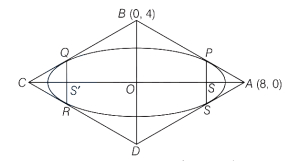
This line intersects the $x$-axis at $(8, 0)$ and the $y$-axis at $(0, 4)$.
Due to symmetry,the quadrilateral formed by the four tangents at $(\pm 2, \pm 3)$ is a rhombus with vertices at $(\pm 8, 0)$ and $(0, \pm 4)$.
The area of this rhombus is $4 \times (\text{Area of triangle with vertices } (0,0), (8,0), (0,4)) = 4 \times (\frac{1}{2} \times 8 \times 4) = 64$ sq. units.
Eccentricity $e = \sqrt{1-\frac{b^2}{a^2}} = \sqrt{1-\frac{12}{16}} = \sqrt{\frac{4}{16}} = \frac{1}{2}$.
The end points of the latus rectum are $(\pm ae, \pm \frac{b^2}{a}) = (\pm 4 \times \frac{1}{2}, \pm \frac{12}{4}) = (\pm 2, \pm 3)$.
The equation of the tangent at $(x_1, y_1)$ to the ellipse $\frac{x^2}{a^2}+\frac{y^2}{b^2}=1$ is $\frac{xx_1}{a^2}+\frac{yy_1}{b^2}=1$.
For the point $(2, 3)$,the tangent is $\frac{2x}{16}+\frac{3y}{12}=1$,which simplifies to $\frac{x}{8}+\frac{y}{4}=1$.
This line intersects the $x$-axis at $(8, 0)$ and the $y$-axis at $(0, 4)$.
Due to symmetry,the quadrilateral formed by the four tangents at $(\pm 2, \pm 3)$ is a rhombus with vertices at $(\pm 8, 0)$ and $(0, \pm 4)$.
The area of this rhombus is $4 \times (\text{Area of triangle with vertices } (0,0), (8,0), (0,4)) = 4 \times (\frac{1}{2} \times 8 \times 4) = 64$ sq. units.
0 likesView Solution
265
MathematicsDifficultMCQTS EAMCET · 2020
If tangents are drawn to the ellipse $x^2+2y^2=2$,then the locus of the mid-points of the intercepts made by those tangents between the coordinate axes is
A
$\frac{x^2}{2}+\frac{y^2}{4}=1$
B
$\frac{x^2}{4}+\frac{y^2}{2}=1$
C
$\frac{1}{2x^2}+\frac{1}{4y^2}=1$
D
$\frac{1}{4x^2}+\frac{1}{2y^2}=1$
Solution
(C) The equation of the ellipse is $x^2+2y^2=2$,which can be written as $\frac{x^2}{2}+\frac{y^2}{1}=1$.
Any point $P$ on the ellipse is $(\sqrt{2}\cos\theta, \sin\theta)$.
The equation of the tangent at $P$ is $\frac{x(\sqrt{2}\cos\theta)}{2} + \frac{y(\sin\theta)}{1} = 1$,which simplifies to $\frac{x\cos\theta}{\sqrt{2}} + y\sin\theta = 1$.
The intercepts made by the tangent on the coordinate axes are $A\left(\frac{\sqrt{2}}{\cos\theta}, 0\right)$ and $B\left(0, \frac{1}{\sin\theta}\right)$.
Let $(h, k)$ be the mid-point of $AB$. Then $h = \frac{\sqrt{2}}{2\cos\theta}$ and $k = \frac{1}{2\sin\theta}$.
This implies $\cos\theta = \frac{1}{\sqrt{2}h}$ and $\sin\theta = \frac{1}{2k}$.
Using the identity $\cos^2\theta + \sin^2\theta = 1$,we get $\left(\frac{1}{\sqrt{2}h}\right)^2 + \left(\frac{1}{2k}\right)^2 = 1$.
Thus,the locus is $\frac{1}{2x^2} + \frac{1}{4y^2} = 1$.
Any point $P$ on the ellipse is $(\sqrt{2}\cos\theta, \sin\theta)$.
The equation of the tangent at $P$ is $\frac{x(\sqrt{2}\cos\theta)}{2} + \frac{y(\sin\theta)}{1} = 1$,which simplifies to $\frac{x\cos\theta}{\sqrt{2}} + y\sin\theta = 1$.
The intercepts made by the tangent on the coordinate axes are $A\left(\frac{\sqrt{2}}{\cos\theta}, 0\right)$ and $B\left(0, \frac{1}{\sin\theta}\right)$.
Let $(h, k)$ be the mid-point of $AB$. Then $h = \frac{\sqrt{2}}{2\cos\theta}$ and $k = \frac{1}{2\sin\theta}$.
This implies $\cos\theta = \frac{1}{\sqrt{2}h}$ and $\sin\theta = \frac{1}{2k}$.
Using the identity $\cos^2\theta + \sin^2\theta = 1$,we get $\left(\frac{1}{\sqrt{2}h}\right)^2 + \left(\frac{1}{2k}\right)^2 = 1$.
Thus,the locus is $\frac{1}{2x^2} + \frac{1}{4y^2} = 1$.
0 likesView Solution
266
MathematicsMediumMCQTS EAMCET · 2020
For $k>0$,the shortest distance from a point $P(1, k)$ on the ellipse $9x^2+4y^2-18x+16y-11=0$ to one of its directrices is
A
$3-\sqrt{5}$
B
$3+\sqrt{5}$
C
$\frac{9}{\sqrt{5}}-3$
D
$\frac{9}{\sqrt{5}}-2$
Solution
(C) Given the ellipse equation: $9x^2+4y^2-18x+16y-11=0$.
Since $P(1, k)$ lies on the ellipse,substitute $x=1$:
$9(1)^2+4k^2-18(1)+16k-11=0$
$9+4k^2-18+16k-11=0$
$4k^2+16k-20=0$
$k^2+4k-5=0$
$(k+5)(k-1)=0$.
Since $k>0$,we have $k=1$. Thus,$P$ is $(1, 1)$.
Rewrite the ellipse equation in standard form:
$9(x-1)^2+4(y+2)^2 = 11+9+16 = 36$
$\frac{(x-1)^2}{4} + \frac{(y+2)^2}{9} = 1$.
Here $a^2=4$ and $b^2=9$,so $b>a$.
Eccentricity $e = \sqrt{1-\frac{a^2}{b^2}} = \sqrt{1-\frac{4}{9}} = \frac{\sqrt{5}}{3}$.
The directrices are $y+2 = \pm \frac{b}{e} = \pm \frac{3}{\sqrt{5}/3} = \pm \frac{9}{\sqrt{5}}$.
So,$y = -2 \pm \frac{9}{\sqrt{5}}$.
The distances from $P(1, 1)$ to the directrices $y = -2 + \frac{9}{\sqrt{5}}$ and $y = -2 - \frac{9}{\sqrt{5}}$ are:
$d_1 = |1 - (-2 + \frac{9}{\sqrt{5}})| = |3 - \frac{9}{\sqrt{5}}| = \frac{9}{\sqrt{5}} - 3$ (since $\frac{9}{\sqrt{5}} \approx 4.02 > 3$).
$d_2 = |1 - (-2 - \frac{9}{\sqrt{5}})| = |3 + \frac{9}{\sqrt{5}}| = 3 + \frac{9}{\sqrt{5}}$.
The shortest distance is $\frac{9}{\sqrt{5}} - 3$.
Since $P(1, k)$ lies on the ellipse,substitute $x=1$:
$9(1)^2+4k^2-18(1)+16k-11=0$
$9+4k^2-18+16k-11=0$
$4k^2+16k-20=0$
$k^2+4k-5=0$
$(k+5)(k-1)=0$.
Since $k>0$,we have $k=1$. Thus,$P$ is $(1, 1)$.
Rewrite the ellipse equation in standard form:
$9(x-1)^2+4(y+2)^2 = 11+9+16 = 36$
$\frac{(x-1)^2}{4} + \frac{(y+2)^2}{9} = 1$.
Here $a^2=4$ and $b^2=9$,so $b>a$.
Eccentricity $e = \sqrt{1-\frac{a^2}{b^2}} = \sqrt{1-\frac{4}{9}} = \frac{\sqrt{5}}{3}$.
The directrices are $y+2 = \pm \frac{b}{e} = \pm \frac{3}{\sqrt{5}/3} = \pm \frac{9}{\sqrt{5}}$.
So,$y = -2 \pm \frac{9}{\sqrt{5}}$.
The distances from $P(1, 1)$ to the directrices $y = -2 + \frac{9}{\sqrt{5}}$ and $y = -2 - \frac{9}{\sqrt{5}}$ are:
$d_1 = |1 - (-2 + \frac{9}{\sqrt{5}})| = |3 - \frac{9}{\sqrt{5}}| = \frac{9}{\sqrt{5}} - 3$ (since $\frac{9}{\sqrt{5}} \approx 4.02 > 3$).
$d_2 = |1 - (-2 - \frac{9}{\sqrt{5}})| = |3 + \frac{9}{\sqrt{5}}| = 3 + \frac{9}{\sqrt{5}}$.
The shortest distance is $\frac{9}{\sqrt{5}} - 3$.
0 likesView Solution
267
MathematicsMediumMCQTS EAMCET · 2020
The value of $b^2$ such that the foci of the hyperbola $\frac{x^2}{144} - \frac{y^2}{81} = \frac{1}{25}$ and the ellipse $\frac{x^2}{16} + \frac{y^2}{b^2} = 1$ coincide is
A
$1$
B
$5$
C
$7$
D
$9$
Solution
(C) The given hyperbola is $\frac{x^2}{144} - \frac{y^2}{81} = \frac{1}{25}$,which can be written as $\frac{x^2}{(12/5)^2} - \frac{y^2}{(9/5)^2} = 1$.
Here,$a_1^2 = \frac{144}{25}$ and $b_1^2 = \frac{81}{25}$.
The eccentricity $e_1 = \sqrt{1 + \frac{b_1^2}{a_1^2}} = \sqrt{1 + \frac{81}{144}} = \sqrt{\frac{225}{144}} = \frac{15}{12} = \frac{5}{4}$.
The foci of the hyperbola are $(\pm a_1 e_1, 0) = (\pm \frac{12}{5} \times \frac{5}{4}, 0) = (\pm 3, 0)$.
For the ellipse $\frac{x^2}{16} + \frac{y^2}{b^2} = 1$,the foci are $(\pm a_2 e_2, 0) = (\pm 4 e_2, 0)$.
Since the foci coincide,$4 e_2 = 3$,so $e_2 = \frac{3}{4}$.
For an ellipse,$e_2^2 = 1 - \frac{b^2}{a_2^2} = 1 - \frac{b^2}{16}$.
Substituting $e_2 = \frac{3}{4}$,we get $\frac{9}{16} = 1 - \frac{b^2}{16}$.
Thus,$\frac{b^2}{16} = 1 - \frac{9}{16} = \frac{7}{16}$,which implies $b^2 = 7$.
Here,$a_1^2 = \frac{144}{25}$ and $b_1^2 = \frac{81}{25}$.
The eccentricity $e_1 = \sqrt{1 + \frac{b_1^2}{a_1^2}} = \sqrt{1 + \frac{81}{144}} = \sqrt{\frac{225}{144}} = \frac{15}{12} = \frac{5}{4}$.
The foci of the hyperbola are $(\pm a_1 e_1, 0) = (\pm \frac{12}{5} \times \frac{5}{4}, 0) = (\pm 3, 0)$.
For the ellipse $\frac{x^2}{16} + \frac{y^2}{b^2} = 1$,the foci are $(\pm a_2 e_2, 0) = (\pm 4 e_2, 0)$.
Since the foci coincide,$4 e_2 = 3$,so $e_2 = \frac{3}{4}$.
For an ellipse,$e_2^2 = 1 - \frac{b^2}{a_2^2} = 1 - \frac{b^2}{16}$.
Substituting $e_2 = \frac{3}{4}$,we get $\frac{9}{16} = 1 - \frac{b^2}{16}$.
Thus,$\frac{b^2}{16} = 1 - \frac{9}{16} = \frac{7}{16}$,which implies $b^2 = 7$.
0 likesView Solution
268
MathematicsEasyMCQTS EAMCET · 2020
The equation of the hyperbola,whose eccentricity is $\sqrt{2}$ and whose foci are $16$ units apart,is
A
$9 x^2-4 y^2=36$
B
$2 x^2-3 y^2=7$
C
$x^2-y^2=16$
D
$x^2-y^2=32$
Solution
(D) Let the equation of the hyperbola be $\frac{x^2}{a^2} - \frac{y^2}{b^2} = 1$.
Given that the eccentricity $e = \sqrt{2}$ and the distance between the foci is $2ae = 16$.
Substituting $e = \sqrt{2}$ into the equation $2ae = 16$,we get $2a(\sqrt{2}) = 16$.
Thus,$a = \frac{16}{2\sqrt{2}} = 4\sqrt{2}$,so $a^2 = (4\sqrt{2})^2 = 32$.
For a hyperbola,$b^2 = a^2(e^2 - 1)$.
Substituting the values,$b^2 = 32((\sqrt{2})^2 - 1) = 32(2 - 1) = 32$.
Therefore,the equation of the hyperbola is $\frac{x^2}{32} - \frac{y^2}{32} = 1$,which simplifies to $x^2 - y^2 = 32$.
Given that the eccentricity $e = \sqrt{2}$ and the distance between the foci is $2ae = 16$.
Substituting $e = \sqrt{2}$ into the equation $2ae = 16$,we get $2a(\sqrt{2}) = 16$.
Thus,$a = \frac{16}{2\sqrt{2}} = 4\sqrt{2}$,so $a^2 = (4\sqrt{2})^2 = 32$.
For a hyperbola,$b^2 = a^2(e^2 - 1)$.
Substituting the values,$b^2 = 32((\sqrt{2})^2 - 1) = 32(2 - 1) = 32$.
Therefore,the equation of the hyperbola is $\frac{x^2}{32} - \frac{y^2}{32} = 1$,which simplifies to $x^2 - y^2 = 32$.
0 likesView Solution
269
MathematicsEasyMCQTS EAMCET · 2020
If $(8,2)$ is a point on the hyperbola whose length of the transverse axis is $12$ and conjugate axis is $x=0$,then the eccentricity of that hyperbola is
A
$\frac{2 \sqrt{2}}{7}$
B
$\frac{8}{5}$
C
$\frac{2 \sqrt{2}}{\sqrt{7}}$
D
$\frac{\sqrt{8}}{5}$
Solution
(C) Let the equation of the hyperbola be $\frac{x^2}{a^2} - \frac{y^2}{b^2} = 1$.
Given that the length of the transverse axis is $2a = 12$,so $a = 6$.
Since the point $(8, 2)$ lies on the hyperbola,it must satisfy the equation:
$\frac{8^2}{a^2} - \frac{2^2}{b^2} = 1$
Substituting $a = 6$:
$\frac{64}{36} - \frac{4}{b^2} = 1$
$\frac{16}{9} - 1 = \frac{4}{b^2}$
$\frac{7}{9} = \frac{4}{b^2} \implies b^2 = \frac{36}{7}$.
The eccentricity $e$ is given by $e = \sqrt{1 + \frac{b^2}{a^2}}$.
$e = \sqrt{1 + \frac{36/7}{36}} = \sqrt{1 + \frac{1}{7}} = \sqrt{\frac{8}{7}} = \frac{2 \sqrt{2}}{\sqrt{7}}$.
Given that the length of the transverse axis is $2a = 12$,so $a = 6$.
Since the point $(8, 2)$ lies on the hyperbola,it must satisfy the equation:
$\frac{8^2}{a^2} - \frac{2^2}{b^2} = 1$
Substituting $a = 6$:
$\frac{64}{36} - \frac{4}{b^2} = 1$
$\frac{16}{9} - 1 = \frac{4}{b^2}$
$\frac{7}{9} = \frac{4}{b^2} \implies b^2 = \frac{36}{7}$.
The eccentricity $e$ is given by $e = \sqrt{1 + \frac{b^2}{a^2}}$.
$e = \sqrt{1 + \frac{36/7}{36}} = \sqrt{1 + \frac{1}{7}} = \sqrt{\frac{8}{7}} = \frac{2 \sqrt{2}}{\sqrt{7}}$.
0 likesView Solution
270
MathematicsMediumMCQTS EAMCET · 2020
For the hyperbola $x^2-y^2-4x+2y+c=0$,if the focus is $S(2+2\sqrt{2}, k)$ and the directrix that is adjacent to $S$ is $x=2+\sqrt{2}$,then $c=$
A
$0$
B
-$1$
C
$1$
D
$2$
Solution
(B) The given equation of the hyperbola is $x^2-y^2-4x+2y+c=0$.
Completing the square,we get $(x-2)^2 - (y-1)^2 = 3-c$.
Let $a^2 = 3-c$. The equation becomes $\frac{(x-2)^2}{a^2} - \frac{(y-1)^2}{a^2} = 1$.
For this rectangular hyperbola,the eccentricity $e = \sqrt{2}$.
The focus is given by $x = 2 \pm ae = 2 \pm \sqrt{a^2} \cdot \sqrt{2} = 2 \pm \sqrt{2a^2}$.
Given the focus $S(2+2\sqrt{2}, k)$,we have $\sqrt{2a^2} = 2\sqrt{2} \implies 2a^2 = 8 \implies a^2 = 4$.
Since $a^2 = 3-c$,we have $4 = 3-c$,which gives $c = -1$.
The directrix is $x = 2 \pm \frac{a}{e} = 2 \pm \frac{2}{\sqrt{2}} = 2 \pm \sqrt{2}$.
The directrix adjacent to the focus $x = 2+2\sqrt{2}$ is $x = 2+\sqrt{2}$,which matches the given condition.
Thus,$c = -1$.
Completing the square,we get $(x-2)^2 - (y-1)^2 = 3-c$.
Let $a^2 = 3-c$. The equation becomes $\frac{(x-2)^2}{a^2} - \frac{(y-1)^2}{a^2} = 1$.
For this rectangular hyperbola,the eccentricity $e = \sqrt{2}$.
The focus is given by $x = 2 \pm ae = 2 \pm \sqrt{a^2} \cdot \sqrt{2} = 2 \pm \sqrt{2a^2}$.
Given the focus $S(2+2\sqrt{2}, k)$,we have $\sqrt{2a^2} = 2\sqrt{2} \implies 2a^2 = 8 \implies a^2 = 4$.
Since $a^2 = 3-c$,we have $4 = 3-c$,which gives $c = -1$.
The directrix is $x = 2 \pm \frac{a}{e} = 2 \pm \frac{2}{\sqrt{2}} = 2 \pm \sqrt{2}$.
The directrix adjacent to the focus $x = 2+2\sqrt{2}$ is $x = 2+\sqrt{2}$,which matches the given condition.
Thus,$c = -1$.
0 likesView Solution
271
MathematicsMediumMCQTS EAMCET · 2020
If $p$ and $q$ are the eccentricities of the hyperbola $\frac{x^2}{a^2}-\frac{y^2}{b^2}=1$ and its conjugate hyperbola respectively,then the area of the square (in sq. units) formed by the points of intersection of the ellipse $\frac{x^2}{p^2}+\frac{y^2}{q^2}=1$ and the pair of lines $x^2-y^2=0$ is
A
$4$
B
$\sqrt{2}$
C
$\frac{\sqrt{3}}{2}$
D
$16$
Solution
(A) Given that $p$ and $q$ are the eccentricities of the hyperbola $\frac{x^2}{a^2}-\frac{y^2}{b^2}=1$ and its conjugate hyperbola respectively.
We know that $p^2 = 1 + \frac{b^2}{a^2} = \frac{a^2+b^2}{a^2}$ and $q^2 = 1 + \frac{a^2}{b^2} = \frac{a^2+b^2}{b^2}$.
The equation of the ellipse is $\frac{x^2}{p^2} + \frac{y^2}{q^2} = 1$.
Substituting the values of $p^2$ and $q^2$,we get $\frac{x^2 a^2}{a^2+b^2} + \frac{y^2 b^2}{a^2+b^2} = 1$,which simplifies to $a^2 x^2 + b^2 y^2 = a^2 + b^2$.
Given the pair of lines $x^2 - y^2 = 0$,which implies $y^2 = x^2$.
Substituting $y^2 = x^2$ into the ellipse equation: $a^2 x^2 + b^2 x^2 = a^2 + b^2$.
$(a^2 + b^2) x^2 = a^2 + b^2 \implies x^2 = 1 \implies x = \pm 1$.
Since $y^2 = x^2$,we have $y = \pm 1$.
The points of intersection are $(1, 1), (1, -1), (-1, 1), (-1, -1)$.
These points form a square with side length $s = \sqrt{(1 - (-1))^2 + (1 - 1)^2} = 2$.
Area of the square = $s^2 = 2^2 = 4$ sq. units.
We know that $p^2 = 1 + \frac{b^2}{a^2} = \frac{a^2+b^2}{a^2}$ and $q^2 = 1 + \frac{a^2}{b^2} = \frac{a^2+b^2}{b^2}$.
The equation of the ellipse is $\frac{x^2}{p^2} + \frac{y^2}{q^2} = 1$.
Substituting the values of $p^2$ and $q^2$,we get $\frac{x^2 a^2}{a^2+b^2} + \frac{y^2 b^2}{a^2+b^2} = 1$,which simplifies to $a^2 x^2 + b^2 y^2 = a^2 + b^2$.
Given the pair of lines $x^2 - y^2 = 0$,which implies $y^2 = x^2$.
Substituting $y^2 = x^2$ into the ellipse equation: $a^2 x^2 + b^2 x^2 = a^2 + b^2$.
$(a^2 + b^2) x^2 = a^2 + b^2 \implies x^2 = 1 \implies x = \pm 1$.
Since $y^2 = x^2$,we have $y = \pm 1$.
The points of intersection are $(1, 1), (1, -1), (-1, 1), (-1, -1)$.
These points form a square with side length $s = \sqrt{(1 - (-1))^2 + (1 - 1)^2} = 2$.
Area of the square = $s^2 = 2^2 = 4$ sq. units.
0 likesView Solution
272
MathematicsDifficultMCQTS EAMCET · 2020
Let $P(a \sec \theta, b \tan \theta)$ and $Q(a \sec \phi, b \tan \phi)$ be two points such that $\theta+\phi=\frac{\pi}{2}$ on the hyperbola $\frac{x^2}{a^2}-\frac{y^2}{b^2}=1$. If $(h, k)$ is the point of intersection of the normals at $P$ and $Q$,then $k=$
A
$\frac{a^2+b^2}{a}$
B
$-\left(\frac{a^2+b^2}{a}\right)$
C
$\frac{a^2+b^2}{b}$
D
$-\left(\frac{a^2+b^2}{b}\right)$
Solution
(D) The equation of the hyperbola is $\frac{x^2}{a^2}-\frac{y^2}{b^2}=1$.
The equation of the normal at a point $P(a \sec \theta, b \tan \theta)$ is $\frac{ax}{\sec \theta} + \frac{by}{\tan \theta} = a^2+b^2$,which simplifies to $ax \cos \theta + by \cot \theta = a^2+b^2$.
Similarly,the equation of the normal at $Q(a \sec \phi, b \tan \phi)$ is $ax \cos \phi + by \cot \phi = a^2+b^2$.
Given $\theta + \phi = \frac{\pi}{2}$,we have $\phi = \frac{\pi}{2} - \theta$. Thus,$\cos \phi = \sin \theta$ and $\cot \phi = \tan \theta$.
The two equations are:
$(1) \quad ax \cos \theta + by \cot \theta = a^2+b^2$
$(2) \quad ax \sin \theta + by \tan \theta = a^2+b^2$
To find $k$ (the $y$-coordinate),we eliminate $x$ by multiplying $(1)$ by $\sin \theta$ and $(2)$ by $\cos \theta$:
$ax \cos \theta \sin \theta + by \cot \theta \sin \theta = (a^2+b^2) \sin \theta$
$ax \sin \theta \cos \theta + by \tan \theta \cos \theta = (a^2+b^2) \cos \theta$
Subtracting the two equations:
$by(\cot \theta \sin \theta - \tan \theta \cos \theta) = (a^2+b^2)(\sin \theta - \cos \theta)$
$by(\cos \theta - \sin \theta) = (a^2+b^2)(\sin \theta - \cos \theta)$
$by = -(a^2+b^2)$
$y = -\frac{a^2+b^2}{b}$
Therefore,$k = -\frac{a^2+b^2}{b}$.
The equation of the normal at a point $P(a \sec \theta, b \tan \theta)$ is $\frac{ax}{\sec \theta} + \frac{by}{\tan \theta} = a^2+b^2$,which simplifies to $ax \cos \theta + by \cot \theta = a^2+b^2$.
Similarly,the equation of the normal at $Q(a \sec \phi, b \tan \phi)$ is $ax \cos \phi + by \cot \phi = a^2+b^2$.
Given $\theta + \phi = \frac{\pi}{2}$,we have $\phi = \frac{\pi}{2} - \theta$. Thus,$\cos \phi = \sin \theta$ and $\cot \phi = \tan \theta$.
The two equations are:
$(1) \quad ax \cos \theta + by \cot \theta = a^2+b^2$
$(2) \quad ax \sin \theta + by \tan \theta = a^2+b^2$
To find $k$ (the $y$-coordinate),we eliminate $x$ by multiplying $(1)$ by $\sin \theta$ and $(2)$ by $\cos \theta$:
$ax \cos \theta \sin \theta + by \cot \theta \sin \theta = (a^2+b^2) \sin \theta$
$ax \sin \theta \cos \theta + by \tan \theta \cos \theta = (a^2+b^2) \cos \theta$
Subtracting the two equations:
$by(\cot \theta \sin \theta - \tan \theta \cos \theta) = (a^2+b^2)(\sin \theta - \cos \theta)$
$by(\cos \theta - \sin \theta) = (a^2+b^2)(\sin \theta - \cos \theta)$
$by = -(a^2+b^2)$
$y = -\frac{a^2+b^2}{b}$
Therefore,$k = -\frac{a^2+b^2}{b}$.
0 likesView Solution
273
MathematicsEasyMCQTS EAMCET · 2020
$A$ rectangular hyperbola passing through $(3,2)$ has its asymptotes parallel to the coordinate axes. If $(1,1)$ is the point of intersection of the two perpendicular tangents of that hyperbola,then its equation is
A
$xy = x + \frac{1}{y}$
B
$x(y + 1 + \frac{1}{x}) = 1$
C
$x(1 - y) = y - 1$
D
$xy = x + y + 1$
Solution
(D) The asymptotes of a rectangular hyperbola are parallel to the coordinate axes,so its equation is of the form $(x - h)(y - k) = c$.
Since the point of intersection of the two perpendicular tangents is the center of the hyperbola,we have $(h, k) = (1, 1)$.
Thus,the equation is $(x - 1)(y - 1) = c$.
Since the hyperbola passes through $(3, 2)$,we substitute these coordinates: $(3 - 1)(2 - 1) = c$ $\Rightarrow 2 \times 1 = c$ $\Rightarrow c = 2$.
Substituting $c = 2$ into the equation,we get $(x - 1)(y - 1) = 2$.
Expanding this,we get $xy - x - y + 1 = 2$,which simplifies to $xy = x + y + 1$.
Since the point of intersection of the two perpendicular tangents is the center of the hyperbola,we have $(h, k) = (1, 1)$.
Thus,the equation is $(x - 1)(y - 1) = c$.
Since the hyperbola passes through $(3, 2)$,we substitute these coordinates: $(3 - 1)(2 - 1) = c$ $\Rightarrow 2 \times 1 = c$ $\Rightarrow c = 2$.
Substituting $c = 2$ into the equation,we get $(x - 1)(y - 1) = 2$.
Expanding this,we get $xy - x - y + 1 = 2$,which simplifies to $xy = x + y + 1$.
0 likesView Solution
274
MathematicsMediumMCQTS EAMCET · 2020
If the pole of the line $3x - 16y + 48 = 0$ with respect to the hyperbola $9x^2 - 16y^2 = 144$ is $(\alpha, \beta)$,then $\alpha - \beta = $
A
$0$
B
$-3$
C
$2$
D
$-7$
Solution
(C) The equation of the polar of a point $(\alpha, \beta)$ with respect to the hyperbola $\frac{x^2}{a^2} - \frac{y^2}{b^2} = 1$ is given by $\frac{\alpha x}{a^2} - \frac{\beta y}{b^2} = 1$.
Given hyperbola is $9x^2 - 16y^2 = 144$,which can be written as $\frac{x^2}{16} - \frac{y^2}{9} = 1$.
So,the equation of the polar of $(\alpha, \beta)$ is $\frac{\alpha x}{16} - \frac{\beta y}{9} = 1$,or $9\alpha x - 16\beta y - 144 = 0$.
Comparing this with the given line $3x - 16y + 48 = 0$,we have:
$\frac{9\alpha}{3} = \frac{-16\beta}{-16} = \frac{-144}{48}$.
$3\alpha = \beta = -3$.
Thus,$\alpha = -1$ and $\beta = -3$.
Therefore,$\alpha - \beta = -1 - (-3) = -1 + 3 = 2$.
Given hyperbola is $9x^2 - 16y^2 = 144$,which can be written as $\frac{x^2}{16} - \frac{y^2}{9} = 1$.
So,the equation of the polar of $(\alpha, \beta)$ is $\frac{\alpha x}{16} - \frac{\beta y}{9} = 1$,or $9\alpha x - 16\beta y - 144 = 0$.
Comparing this with the given line $3x - 16y + 48 = 0$,we have:
$\frac{9\alpha}{3} = \frac{-16\beta}{-16} = \frac{-144}{48}$.
$3\alpha = \beta = -3$.
Thus,$\alpha = -1$ and $\beta = -3$.
Therefore,$\alpha - \beta = -1 - (-3) = -1 + 3 = 2$.
0 likesView Solution
275
MathematicsEasyMCQTS EAMCET · 2020
If the circle $x^2+y^2=a^2$ intersects the hyperbola $xy=b^2$ at four points $(x_1, y_1)$,$(x_2, y_2)$,$(x_3, y_3)$,and $(x_4, y_4)$,then $y_1 y_2 y_3 y_4 = $
A
$a^4$
B
$0$
C
$b^4$
D
$b^2$
Solution
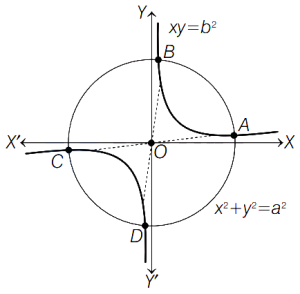
(C) We have the equations:
$x^2+y^2=a^2$ $\dots(i)$
$xy=b^2$ $\dots(ii)$
From equation $(ii)$,we have $x = \frac{b^2}{y}$.
Substituting this into equation $(i)$:
$\left(\frac{b^2}{y}\right)^2 + y^2 = a^2$
$\frac{b^4}{y^2} + y^2 = a^2$
Multiplying by $y^2$:
$b^4 + y^4 = a^2 y^2$
$y^4 - a^2 y^2 + b^4 = 0$
This is a biquadratic equation in $y$. Let its roots be $y_1, y_2, y_3, y_4$.
According to the properties of the roots of a polynomial equation,the product of the roots $y_1 y_2 y_3 y_4$ is equal to the constant term divided by the leading coefficient.
Thus,$y_1 y_2 y_3 y_4 = \frac{b^4}{1} = b^4$.
$x^2+y^2=a^2$ $\dots(i)$
$xy=b^2$ $\dots(ii)$
From equation $(ii)$,we have $x = \frac{b^2}{y}$.
Substituting this into equation $(i)$:
$\left(\frac{b^2}{y}\right)^2 + y^2 = a^2$
$\frac{b^4}{y^2} + y^2 = a^2$
Multiplying by $y^2$:
$b^4 + y^4 = a^2 y^2$
$y^4 - a^2 y^2 + b^4 = 0$
This is a biquadratic equation in $y$. Let its roots be $y_1, y_2, y_3, y_4$.
According to the properties of the roots of a polynomial equation,the product of the roots $y_1 y_2 y_3 y_4$ is equal to the constant term divided by the leading coefficient.
Thus,$y_1 y_2 y_3 y_4 = \frac{b^4}{1} = b^4$.
0 likesView Solution
276
MathematicsEasyMCQTS EAMCET · 2020
$\lim _{x \rightarrow 0} \frac{1-\cos \left(x^2+\pi(x+2)\right)}{x^2} = $
A
$\frac{\pi}{2}$
B
$\frac{\pi^2}{4}$
C
$\frac{\pi^2}{2}$
D
$\frac{\pi}{4}$
Solution
(C) We have,$\lim _{x \rightarrow 0} \frac{1-\cos \left(x^2+\pi x+2\pi\right)}{x^2}$
Since $\cos(2\pi + \theta) = \cos \theta$,the expression becomes $\lim _{x \rightarrow 0} \frac{1-\cos \left(x^2+\pi x\right)}{x^2}$
Using the identity $1 - \cos \theta = 2 \sin^2 \left(\frac{\theta}{2}\right)$,we get:
$\lim _{x \rightarrow 0} \frac{2 \sin^2 \left(\frac{x^2+\pi x}{2}\right)}{x^2}$
$= 2 \lim _{x}$ ${\rightarrow 0} \left[ \frac{\sin \left(\frac{x^2+\pi x}{2}\right)}{\frac{x^2+\pi x}{2}} \right]^2 \times \left( \frac{x^2+\pi x}{2} \right)^2 \times \frac{1}{x^2}$
$= 2 \times 1^2 \times \lim _{x \rightarrow 0} \frac{x^2(x+\pi)^2}{4x^2}$
$= 2 \times \frac{1}{4} \times \pi^2 = \frac{\pi^2}{2}$
Since $\cos(2\pi + \theta) = \cos \theta$,the expression becomes $\lim _{x \rightarrow 0} \frac{1-\cos \left(x^2+\pi x\right)}{x^2}$
Using the identity $1 - \cos \theta = 2 \sin^2 \left(\frac{\theta}{2}\right)$,we get:
$\lim _{x \rightarrow 0} \frac{2 \sin^2 \left(\frac{x^2+\pi x}{2}\right)}{x^2}$
$= 2 \lim _{x}$ ${\rightarrow 0} \left[ \frac{\sin \left(\frac{x^2+\pi x}{2}\right)}{\frac{x^2+\pi x}{2}} \right]^2 \times \left( \frac{x^2+\pi x}{2} \right)^2 \times \frac{1}{x^2}$
$= 2 \times 1^2 \times \lim _{x \rightarrow 0} \frac{x^2(x+\pi)^2}{4x^2}$
$= 2 \times \frac{1}{4} \times \pi^2 = \frac{\pi^2}{2}$
0 likesView Solution
277
MathematicsEasyMCQTS EAMCET · 2020
$\lim _{x \rightarrow 0} \frac{x^4+x^3+x^2}{\sin ^{-1}\left(\frac{x}{\sqrt{1+x^2}}\right) \cdot \tan ^{-1} x} = $
A
$1/\sqrt{2}$
B
$0$
C
$1$
D
$-1/\sqrt{2}$
Solution
(C) We know that for small $x$,$\sin^{-1}\left(\frac{x}{\sqrt{1+x^2}}\right) = \tan^{-1} x$.
Substituting this into the limit,we get:
$L = \lim_{x \rightarrow 0} \frac{x^4+x^3+x^2}{(\tan^{-1} x)(\tan^{-1} x)} = \lim_{x \rightarrow 0} \frac{x^2(x^2+x+1)}{(\tan^{-1} x)^2}$.
Since $\lim_{x \rightarrow 0} \frac{\tan^{-1} x}{x} = 1$,we can write $(\tan^{-1} x)^2 \approx x^2$ as $x \rightarrow 0$.
$L = \lim_{x \rightarrow 0} \frac{x^2(x^2+x+1)}{x^2} = \lim_{x \rightarrow 0} (x^2+x+1) = 0^2+0+1 = 1$.
Substituting this into the limit,we get:
$L = \lim_{x \rightarrow 0} \frac{x^4+x^3+x^2}{(\tan^{-1} x)(\tan^{-1} x)} = \lim_{x \rightarrow 0} \frac{x^2(x^2+x+1)}{(\tan^{-1} x)^2}$.
Since $\lim_{x \rightarrow 0} \frac{\tan^{-1} x}{x} = 1$,we can write $(\tan^{-1} x)^2 \approx x^2$ as $x \rightarrow 0$.
$L = \lim_{x \rightarrow 0} \frac{x^2(x^2+x+1)}{x^2} = \lim_{x \rightarrow 0} (x^2+x+1) = 0^2+0+1 = 1$.
0 likesView Solution
278
MathematicsMediumMCQTS EAMCET · 2020
$\lim _{x \rightarrow 0} \frac{x \tan 4x - 2x \tan 2x}{(1 - \cos 4x)^2} = $
A
$\frac{1}{8}$
B
$\frac{1}{4}$
C
$\frac{1}{2}$
D
$1$
Solution
(B) We use the Taylor series expansion for $\tan \theta = \theta + \frac{\theta^3}{3} + \frac{2\theta^5}{15} + \dots$ and $1 - \cos \theta = 2 \sin^2(\frac{\theta}{2}) \approx 2(\frac{\theta}{2})^2 = \frac{\theta^2}{2}$.
The denominator is $(1 - \cos 4x)^2 \approx (\frac{(4x)^2}{2})^2 = (8x^2)^2 = 64x^4$.
The numerator is $x(4x + \frac{(4x)^3}{3} + \dots) - 2x(2x + \frac{(2x)^3}{3} + \dots)$.
$= (4x^2 + \frac{64x^4}{3}) - (4x^2 + \frac{16x^4}{3}) = \frac{48x^4}{3} = 16x^4$.
Thus,the limit is $\lim _{x \rightarrow 0} \frac{16x^4}{64x^4} = \frac{16}{64} = \frac{1}{4}$.
The denominator is $(1 - \cos 4x)^2 \approx (\frac{(4x)^2}{2})^2 = (8x^2)^2 = 64x^4$.
The numerator is $x(4x + \frac{(4x)^3}{3} + \dots) - 2x(2x + \frac{(2x)^3}{3} + \dots)$.
$= (4x^2 + \frac{64x^4}{3}) - (4x^2 + \frac{16x^4}{3}) = \frac{48x^4}{3} = 16x^4$.
Thus,the limit is $\lim _{x \rightarrow 0} \frac{16x^4}{64x^4} = \frac{16}{64} = \frac{1}{4}$.
0 likesView Solution
279
MathematicsMediumMCQTS EAMCET · 2020
$\lim _{x \rightarrow 0} \frac{1-\cos (1-\cos x)}{\sin ^4 x} = $
A
$\frac{1}{2}$
B
$\frac{1}{4}$
C
$\frac{1}{6}$
D
$\frac{1}{8}$
Solution
(D) Given that,$\lim _{x \rightarrow 0} \frac{1-\cos (1-\cos x)}{\sin ^4 x}$
$= \lim _{x}$ ${\rightarrow 0} \frac{1-\cos (1-\cos x)}{(1-\cos x)^2} \times \left(\frac{1-\cos x}{x^2}\right)^2 \times \left(\frac{x}{\sin x}\right)^4$
As $x \rightarrow 0$,$(1-\cos x) \rightarrow 0$.
Using the standard limit $\lim _{\theta \rightarrow 0} \frac{1-\cos \theta}{\theta^2} = \frac{1}{2}$ and $\lim _{x \rightarrow 0} \frac{\sin x}{x} = 1$:
$= \frac{1}{2} \times \left(\frac{1}{2}\right)^2 \times (1)^4$
$= \frac{1}{2} \times \frac{1}{4} \times 1 = \frac{1}{8}$
$= \lim _{x}$ ${\rightarrow 0} \frac{1-\cos (1-\cos x)}{(1-\cos x)^2} \times \left(\frac{1-\cos x}{x^2}\right)^2 \times \left(\frac{x}{\sin x}\right)^4$
As $x \rightarrow 0$,$(1-\cos x) \rightarrow 0$.
Using the standard limit $\lim _{\theta \rightarrow 0} \frac{1-\cos \theta}{\theta^2} = \frac{1}{2}$ and $\lim _{x \rightarrow 0} \frac{\sin x}{x} = 1$:
$= \frac{1}{2} \times \left(\frac{1}{2}\right)^2 \times (1)^4$
$= \frac{1}{2} \times \frac{1}{4} \times 1 = \frac{1}{8}$
0 likesView Solution
280
MathematicsEasyMCQTS EAMCET · 2020
Let $[x]$ denote the greatest integer less than or equal to $x$ and $k \geq 2$ be an integer. Then $\lim_{x \rightarrow k} \frac{\sin \left(2 \pi\left([x]-\left[\frac{x}{k}\right]\right)-x\right)+\sin k}{x-k} = $
A
$1$
B
$0$
C
$-\cos k$
D
$\sin k$
Solution
(C) Let $f(x) = \sin \left(2 \pi\left([x]-\left[\frac{x}{k}\right]\right)-x\right) + \sin k$.
As $x \rightarrow k$,the expression $[x] - [x/k]$ takes integer values.
Specifically,for $x$ in a small neighborhood of $k$,$[x] = k$ and $[x/k] = 1$ (since $k \geq 2$).
Thus,the term $2 \pi ([x] - [x/k])$ is an even multiple of $\pi$,say $2 \pi m$.
So,$\sin(2 \pi m - x) = \sin(-x) = -\sin x$.
The limit becomes $\lim_{x \rightarrow k} \frac{-\sin x + \sin k}{x - k}$.
Applying $L$'$H$ôpital's rule,we differentiate the numerator and denominator with respect to $x$:
$\lim_{x \rightarrow k} \frac{-\cos x}{1} = -\cos k$.
As $x \rightarrow k$,the expression $[x] - [x/k]$ takes integer values.
Specifically,for $x$ in a small neighborhood of $k$,$[x] = k$ and $[x/k] = 1$ (since $k \geq 2$).
Thus,the term $2 \pi ([x] - [x/k])$ is an even multiple of $\pi$,say $2 \pi m$.
So,$\sin(2 \pi m - x) = \sin(-x) = -\sin x$.
The limit becomes $\lim_{x \rightarrow k} \frac{-\sin x + \sin k}{x - k}$.
Applying $L$'$H$ôpital's rule,we differentiate the numerator and denominator with respect to $x$:
$\lim_{x \rightarrow k} \frac{-\cos x}{1} = -\cos k$.
0 likesView Solution
281
MathematicsEasyMCQTS EAMCET · 2020
If $\log (1+x)=x-\frac{x^2}{2}+\frac{x^3}{3}-\frac{x^4}{4}+\ldots \infty$ and $\lim _{x \rightarrow 0} \frac{\log (1+x)^{1+x}}{x^2}-\frac{1}{x}=k$,then $12 k=$
A
$1$
B
$3$
C
$6$
D
$9$
Solution
(C) Given the limit expression: $\lim _{x \rightarrow 0} \left[ \frac{\log (1+x)^{1+x}}{x^2} - \frac{1}{x} \right] = k$
Using the property $\log(a^b) = b \log a$,we get:
$\lim _{x \rightarrow 0} \left[ \frac{(1+x) \log (1+x) - x}{x^2} \right] = k$
Since this is a $\frac{0}{0}$ form,we apply $L$' Hospital's Rule:
$\lim _{x \rightarrow 0} \frac{\frac{d}{dx} [(1+x) \log (1+x) - x]}{\frac{d}{dx} [x^2]} = k$
$\lim _{x \rightarrow 0} \frac{[1 \cdot \log (1+x) + (1+x) \cdot \frac{1}{1+x}] - 1}{2x} = k$
$\lim _{x \rightarrow 0} \frac{\log (1+x) + 1 - 1}{2x} = k$
$\lim _{x \rightarrow 0} \frac{\log (1+x)}{2x} = k$
$\frac{1}{2} \lim _{x \rightarrow 0} \frac{\log (1+x)}{x} = k$
Since $\lim _{x \rightarrow 0} \frac{\log (1+x)}{x} = 1$,we have $k = \frac{1}{2} \times 1 = \frac{1}{2}$.
Therefore,$12k = 12 \times \frac{1}{2} = 6$.
Using the property $\log(a^b) = b \log a$,we get:
$\lim _{x \rightarrow 0} \left[ \frac{(1+x) \log (1+x) - x}{x^2} \right] = k$
Since this is a $\frac{0}{0}$ form,we apply $L$' Hospital's Rule:
$\lim _{x \rightarrow 0} \frac{\frac{d}{dx} [(1+x) \log (1+x) - x]}{\frac{d}{dx} [x^2]} = k$
$\lim _{x \rightarrow 0} \frac{[1 \cdot \log (1+x) + (1+x) \cdot \frac{1}{1+x}] - 1}{2x} = k$
$\lim _{x \rightarrow 0} \frac{\log (1+x) + 1 - 1}{2x} = k$
$\lim _{x \rightarrow 0} \frac{\log (1+x)}{2x} = k$
$\frac{1}{2} \lim _{x \rightarrow 0} \frac{\log (1+x)}{x} = k$
Since $\lim _{x \rightarrow 0} \frac{\log (1+x)}{x} = 1$,we have $k = \frac{1}{2} \times 1 = \frac{1}{2}$.
Therefore,$12k = 12 \times \frac{1}{2} = 6$.
0 likesView Solution
282
MathematicsMediumMCQTS EAMCET · 2020
Let $f: R^{+} \rightarrow R$ be an increasing function such that $f(x) > 0$ for all $x$. If $\lim _{x \rightarrow \infty} \frac{f(9 x)}{f(3 x)}=1$,then $\lim _{x \rightarrow \infty} \frac{f(6 x)}{f(3 x)}=$
A
$1$
B
$2$
C
$\frac{3}{2}$
D
$\frac{2}{3}$
Solution
(A) Given that $f$ is an increasing function and $f(x) > 0$ for all $x \in R^{+}$.
We are given that $\lim _{x \rightarrow \infty} \frac{f(9 x)}{f(3 x)}=1$.
Since $f$ is an increasing function,for any $x > 0$,we have the inequality:
$3x < 6x < 9x$
$\Rightarrow f(3x) < f(6x) < f(9x)$
Dividing the entire inequality by $f(3x)$ (which is positive),we get:
$\frac{f(3x)}{f(3x)} < \frac{f(6x)}{f(3x)} < \frac{f(9x)}{f(3x)}$
$1 < \frac{f(6x)}{f(3x)} < \frac{f(9x)}{f(3x)}$
Now,taking the limit as $x \rightarrow \infty$ on all sides:
$\lim _{x \rightarrow \infty} 1 \leq \lim _{x \rightarrow \infty} \frac{f(6x)}{f(3x)} \leq \lim _{x \rightarrow \infty} \frac{f(9x)}{f(3x)}$
$1 \leq \lim _{x \rightarrow \infty} \frac{f(6x)}{f(3x)} \leq 1$
By the Sandwich Theorem (or Squeeze Theorem),we conclude that:
$\lim _{x \rightarrow \infty} \frac{f(6x)}{f(3x)} = 1$.
We are given that $\lim _{x \rightarrow \infty} \frac{f(9 x)}{f(3 x)}=1$.
Since $f$ is an increasing function,for any $x > 0$,we have the inequality:
$3x < 6x < 9x$
$\Rightarrow f(3x) < f(6x) < f(9x)$
Dividing the entire inequality by $f(3x)$ (which is positive),we get:
$\frac{f(3x)}{f(3x)} < \frac{f(6x)}{f(3x)} < \frac{f(9x)}{f(3x)}$
$1 < \frac{f(6x)}{f(3x)} < \frac{f(9x)}{f(3x)}$
Now,taking the limit as $x \rightarrow \infty$ on all sides:
$\lim _{x \rightarrow \infty} 1 \leq \lim _{x \rightarrow \infty} \frac{f(6x)}{f(3x)} \leq \lim _{x \rightarrow \infty} \frac{f(9x)}{f(3x)}$
$1 \leq \lim _{x \rightarrow \infty} \frac{f(6x)}{f(3x)} \leq 1$
By the Sandwich Theorem (or Squeeze Theorem),we conclude that:
$\lim _{x \rightarrow \infty} \frac{f(6x)}{f(3x)} = 1$.
0 likesView Solution
283
MathematicsEasyMCQTS EAMCET · 2020
The means of two groups of observations $A$ and $B$ are $\bar{x}$ and $\bar{y}$ respectively,and their standard deviations are $2$ and $3$ respectively. In order for group $A$ to be more consistent than group $B$,$\frac{\bar{y}}{\bar{x}} < $
A
$\frac{3}{2}$
B
$\frac{5}{1}$
C
$\frac{2}{3}$
D
$\frac{6}{5}$
Solution
(A) The coefficient of variation $(CV)$ is defined as $CV = \frac{\sigma}{\bar{x}} \times 100$.
For group $A$ to be more consistent than group $B$,the coefficient of variation of $A$ must be less than the coefficient of variation of $B$.
Thus,$CV_A < CV_B$.
Substituting the values,we get $\frac{\sigma_A}{\bar{x}} < \frac{\sigma_B}{\bar{y}}$.
Given $\sigma_A = 2$ and $\sigma_B = 3$,we have $\frac{2}{\bar{x}} < \frac{3}{\bar{y}}$.
Rearranging the inequality to solve for $\frac{\bar{y}}{\bar{x}}$,we get $\frac{\bar{y}}{\bar{x}} < \frac{3}{2}$.
For group $A$ to be more consistent than group $B$,the coefficient of variation of $A$ must be less than the coefficient of variation of $B$.
Thus,$CV_A < CV_B$.
Substituting the values,we get $\frac{\sigma_A}{\bar{x}} < \frac{\sigma_B}{\bar{y}}$.
Given $\sigma_A = 2$ and $\sigma_B = 3$,we have $\frac{2}{\bar{x}} < \frac{3}{\bar{y}}$.
Rearranging the inequality to solve for $\frac{\bar{y}}{\bar{x}}$,we get $\frac{\bar{y}}{\bar{x}} < \frac{3}{2}$.
0 likesView Solution
284
MathematicsMediumMCQTS EAMCET · 2020
The mean deviation about the mean for the following data is
| Class Interval | $0-4$ | $4-8$ | $8-12$ | $12-16$ |
| Frequency | $4$ | $3$ | $2$ | $1$ |
A
$6$
B
$3.6$
C
$3.2$
D
$10$
Solution
(C) First,we find the midpoints $(x_i)$ of each class interval and calculate the mean $(\bar{x})$:
Mean $(\bar{x})$ = $\frac{\sum f_i x_i}{N} = \frac{60}{10} = 6$
Mean Deviation about the mean = $\frac{\sum f_i |x_i - \bar{x}|}{N} = \frac{32}{10} = 3.2$
| Class Interval | Frequency $(f_i)$ | Midpoint $(x_i)$ | $f_i x_i$ | $|x_i - \bar{x}|$ | $f_i |x_i - \bar{x}|$ |
| $0-4$ | $4$ | $2$ | $8$ | $|2-6|=4$ | $16$ |
| $4-8$ | $3$ | $6$ | $18$ | $|6-6|=0$ | $0$ |
| $8-12$ | $2$ | $10$ | $20$ | $|10-6|=4$ | $8$ |
| $12-16$ | $1$ | $14$ | $14$ | $|14-6|=8$ | $8$ |
| Total | $N=10$ | - | $\sum f_i x_i = 60$ | - | $\sum f_i |x_i - \bar{x}| = 32$ |
Mean $(\bar{x})$ = $\frac{\sum f_i x_i}{N} = \frac{60}{10} = 6$
Mean Deviation about the mean = $\frac{\sum f_i |x_i - \bar{x}|}{N} = \frac{32}{10} = 3.2$
0 likesView Solution
285
MathematicsEasyMCQTS EAMCET · 2020
If the mean of the discrete distribution $8, 9, 6, 5, x, 4, 6, 5$ is $6$,then its standard deviation (nearest to two decimal places) is
A
$2.5$
B
$1.58$
C
$0.51$
D
$0.41$
Solution
(B) We have,$\text{Mean} = 6$.
$\frac{8+9+6+5+x+4+6+5}{8} = 6$
$\Rightarrow 43+x = 48$ $\Rightarrow x = 5$.
So,the data set is $8, 9, 6, 5, 5, 4, 6, 5$.
The sum of observations $\Sigma x_i = 48$ and the sum of squares $\Sigma x_i^2 = 8^2 + 9^2 + 6^2 + 5^2 + 5^2 + 4^2 + 6^2 + 5^2 = 64 + 81 + 36 + 25 + 25 + 16 + 36 + 25 = 308$.
The variance is given by $\sigma^2 = \frac{1}{N} \Sigma x_i^2 - (\bar{x})^2 = \frac{308}{8} - (6)^2 = 38.5 - 36 = 2.5$.
The standard deviation is $\sigma = \sqrt{2.5} \approx 1.58$.
$\frac{8+9+6+5+x+4+6+5}{8} = 6$
$\Rightarrow 43+x = 48$ $\Rightarrow x = 5$.
So,the data set is $8, 9, 6, 5, 5, 4, 6, 5$.
The sum of observations $\Sigma x_i = 48$ and the sum of squares $\Sigma x_i^2 = 8^2 + 9^2 + 6^2 + 5^2 + 5^2 + 4^2 + 6^2 + 5^2 = 64 + 81 + 36 + 25 + 25 + 16 + 36 + 25 = 308$.
The variance is given by $\sigma^2 = \frac{1}{N} \Sigma x_i^2 - (\bar{x})^2 = \frac{308}{8} - (6)^2 = 38.5 - 36 = 2.5$.
The standard deviation is $\sigma = \sqrt{2.5} \approx 1.58$.
0 likesView Solution
286
MathematicsMediumMCQTS EAMCET · 2020
For the following frequency distribution,the variance is approximately equal to
| Class Interval | $0$-$5$ | $5$-$10$ | $10$-$15$ | $15$-$20$ | $20$-$25$ |
|---|---|---|---|---|---|
| Frequency | $4$ | $1$ | $10$ | $3$ | $2$ |
A
$33.1$
B
$30.55$
C
$34.75$
D
$37.5$
Solution
(C) To find the variance,we first calculate the midpoint $x_i$ for each class interval and then compute the necessary sums:
The variance $\sigma^2$ is given by the formula:
$\sigma^2 = \frac{1}{N} \Sigma f_i x_i^2 - \left(\frac{1}{N} \Sigma f_i x_i\right)^2$
Substituting the values:
$\sigma^2 = \frac{3575}{20} - \left(\frac{240}{20}\right)^2$
$\sigma^2 = 178.75 - (12)^2$
$\sigma^2 = 178.75 - 144 = 34.75$
| Class Interval | $f_i$ | $x_i$ | $f_i x_i$ | $f_i x_i^2$ |
|---|---|---|---|---|
| $0$-$5$ | $4$ | $2.5$ | $10$ | $25$ |
| $5$-$10$ | $1$ | $7.5$ | $7.5$ | $56.25$ |
| $10$-$15$ | $10$ | $12.5$ | $125$ | $1562.5$ |
| $15$-$20$ | $3$ | $17.5$ | $52.5$ | $918.75$ |
| $20$-$25$ | $2$ | $22.5$ | $45$ | $1012.5$ |
| Total | $N=20$ | $\Sigma f_i x_i = 240$ | $\Sigma f_i x_i^2 = 3575$ |
The variance $\sigma^2$ is given by the formula:
$\sigma^2 = \frac{1}{N} \Sigma f_i x_i^2 - \left(\frac{1}{N} \Sigma f_i x_i\right)^2$
Substituting the values:
$\sigma^2 = \frac{3575}{20} - \left(\frac{240}{20}\right)^2$
$\sigma^2 = 178.75 - (12)^2$
$\sigma^2 = 178.75 - 144 = 34.75$
0 likesView Solution
287
MathematicsMediumMCQTS EAMCET · 2020
If $\alpha$ and $\beta$ are respectively the mean deviation about the mean and the variance of the first five prime numbers,then the ordered pair $(\alpha, \beta)$ is:
A
$(2.27, 10.42)$
B
$(2.27, 10.24)$
C
$(2.72, 10.24)$
D
$(2.72, 10.42)$
Solution
(C) The first five prime numbers are $2, 3, 5, 7, 11$.
Mean $(\bar{x}) = \frac{2+3+5+7+11}{5} = \frac{28}{5} = 5.6$.
Mean deviation about mean $(\alpha) = \frac{\sum |x_i - \bar{x}|}{n} = \frac{|2-5.6| + |3-5.6| + |5-5.6| + |7-5.6| + |11-5.6|}{5} = \frac{3.6 + 2.6 + 0.6 + 1.4 + 5.4}{5} = \frac{13.6}{5} = 2.72$.
Variance $(\beta) = \frac{\sum x_i^2}{n} - (\bar{x})^2 = \frac{2^2 + 3^2 + 5^2 + 7^2 + 11^2}{5} - (5.6)^2 = \frac{4 + 9 + 25 + 49 + 121}{5} - 31.36 = \frac{208}{5} - 31.36 = 41.6 - 31.36 = 10.24$.
Thus,the ordered pair $(\alpha, \beta)$ is $(2.72, 10.24)$.
Mean $(\bar{x}) = \frac{2+3+5+7+11}{5} = \frac{28}{5} = 5.6$.
Mean deviation about mean $(\alpha) = \frac{\sum |x_i - \bar{x}|}{n} = \frac{|2-5.6| + |3-5.6| + |5-5.6| + |7-5.6| + |11-5.6|}{5} = \frac{3.6 + 2.6 + 0.6 + 1.4 + 5.4}{5} = \frac{13.6}{5} = 2.72$.
Variance $(\beta) = \frac{\sum x_i^2}{n} - (\bar{x})^2 = \frac{2^2 + 3^2 + 5^2 + 7^2 + 11^2}{5} - (5.6)^2 = \frac{4 + 9 + 25 + 49 + 121}{5} - 31.36 = \frac{208}{5} - 31.36 = 41.6 - 31.36 = 10.24$.
Thus,the ordered pair $(\alpha, \beta)$ is $(2.72, 10.24)$.
0 likesView Solution
288
MathematicsEasyMCQTS EAMCET · 2020
$\text{Assertion (A):}$ Variance of $4x_1, 4x_2, \ldots, 4x_n$ is $16$ times the variance of $x_1, x_2, \ldots, x_n$. $\text{Reason (R):}$ If $y = ax + b$,then variance of $y$ is $a(\text{variance of } x) + b$. The correct option among the following is
A
$(A)$ is true,$(R)$ is true and $(R)$ is the correct explanation for $(A)$.
B
$(A)$ is true,$(R)$ is true but $(R)$ is not the correct explanation for $(A)$.
C
$(A)$ is true but $(R)$ is false.
D
$(A)$ is false but $(R)$ is true.
Solution
(C) Let the variance of $x_1, x_2, \ldots, x_n$ be $\sigma^2$.
By the property of variance,$\text{Var}(ax + b) = a^2 \text{Var}(x)$.
For the assertion,$a = 4$ and $b = 0$,so $\text{Var}(4x) = 4^2 \text{Var}(x) = 16 \sigma^2$. Thus,$(A)$ is true.
For the reason,the property states $\text{Var}(ax + b) = a^2 \text{Var}(x)$. The given statement says $\text{Var}(y) = a \text{Var}(x) + b$,which is incorrect. Thus,$(R)$ is false.
By the property of variance,$\text{Var}(ax + b) = a^2 \text{Var}(x)$.
For the assertion,$a = 4$ and $b = 0$,so $\text{Var}(4x) = 4^2 \text{Var}(x) = 16 \sigma^2$. Thus,$(A)$ is true.
For the reason,the property states $\text{Var}(ax + b) = a^2 \text{Var}(x)$. The given statement says $\text{Var}(y) = a \text{Var}(x) + b$,which is incorrect. Thus,$(R)$ is false.
0 likesView Solution
289
MathematicsEasyMCQTS EAMCET · 2020
The mean deviation about the mean of the following data is nearly:
| Size $(x)$ | $1$ | $3$ | $5$ | $7$ | $9$ | $11$ | $13$ | $15$ |
|---|---|---|---|---|---|---|---|---|
| Frequency $(f)$ | $3$ | $3$ | $4$ | $14$ | $7$ | $4$ | $3$ | $4$ |
A
$3.45$
B
$3.25$
C
$2.75$
D
$2.95$
Solution
(D) First,we calculate the mean $(\bar{x})$ of the given data:
$\bar{x} = \frac{\Sigma f x}{\Sigma f} = \frac{(1 \times 3) + (3 \times 3) + (5 \times 4) + (7 \times 14) + (9 \times 7) + (11 \times 4) + (13 \times 3) + (15 \times 4)}{3 + 3 + 4 + 14 + 7 + 4 + 3 + 4}$
$\bar{x} = \frac{3 + 9 + 20 + 98 + 63 + 44 + 39 + 60}{42} = \frac{336}{42} = 8$
Now,we calculate the mean deviation about the mean using the formula: $\text{M.D.}(\bar{x}) = \frac{\Sigma f|x - \bar{x}|}{N}$
Calculating $|x - \bar{x}|$ for each $x$:
$|1-8|=7, |3-8|=5, |5-8|=3, |7-8|=1, |9-8|=1, |11-8|=3, |13-8|=5, |15-8|=7$
Calculating $\Sigma f|x - \bar{x}|$:
$(3 \times 7) + (3 \times 5) + (4 \times 3) + (14 \times 1) + (7 \times 1) + (4 \times 3) + (3 \times 5) + (4 \times 7)$
$= 21 + 15 + 12 + 14 + 7 + 12 + 15 + 28 = 124$
$\therefore \text{M.D.}(\bar{x}) = \frac{124}{42} \approx 2.95$
$\bar{x} = \frac{\Sigma f x}{\Sigma f} = \frac{(1 \times 3) + (3 \times 3) + (5 \times 4) + (7 \times 14) + (9 \times 7) + (11 \times 4) + (13 \times 3) + (15 \times 4)}{3 + 3 + 4 + 14 + 7 + 4 + 3 + 4}$
$\bar{x} = \frac{3 + 9 + 20 + 98 + 63 + 44 + 39 + 60}{42} = \frac{336}{42} = 8$
Now,we calculate the mean deviation about the mean using the formula: $\text{M.D.}(\bar{x}) = \frac{\Sigma f|x - \bar{x}|}{N}$
Calculating $|x - \bar{x}|$ for each $x$:
$|1-8|=7, |3-8|=5, |5-8|=3, |7-8|=1, |9-8|=1, |11-8|=3, |13-8|=5, |15-8|=7$
Calculating $\Sigma f|x - \bar{x}|$:
$(3 \times 7) + (3 \times 5) + (4 \times 3) + (14 \times 1) + (7 \times 1) + (4 \times 3) + (3 \times 5) + (4 \times 7)$
$= 21 + 15 + 12 + 14 + 7 + 12 + 15 + 28 = 124$
$\therefore \text{M.D.}(\bar{x}) = \frac{124}{42} \approx 2.95$
0 likesView Solution
290
MathematicsEasyMCQTS EAMCET · 2020
The coefficient of variation of the first $5$ prime numbers is
A
$\frac{400}{7}$
B
$\frac{406}{7}$
C
$\frac{416}{7}$
D
$\frac{425}{8}$
Solution
(A) The first $5$ prime numbers are $2, 3, 5, 7, 11$.
The mean $\bar{x} = \frac{2+3+5+7+11}{5} = \frac{28}{5} = 5.6$.
The sum of squares $\Sigma x_i^2 = 2^2 + 3^2 + 5^2 + 7^2 + 11^2 = 4 + 9 + 25 + 49 + 121 = 208$.
The standard deviation $\sigma = \sqrt{\frac{\Sigma x_i^2}{n} - (\bar{x})^2} = \sqrt{\frac{208}{5} - (\frac{28}{5})^2} = \sqrt{\frac{1040 - 784}{25}} = \sqrt{\frac{256}{25}} = \frac{16}{5} = 3.2$.
The coefficient of variation $C.V. = \frac{\sigma}{\bar{x}} \times 100 = \frac{16/5}{28/5} \times 100 = \frac{16}{28} \times 100 = \frac{4}{7} \times 100 = \frac{400}{7}$.
The mean $\bar{x} = \frac{2+3+5+7+11}{5} = \frac{28}{5} = 5.6$.
The sum of squares $\Sigma x_i^2 = 2^2 + 3^2 + 5^2 + 7^2 + 11^2 = 4 + 9 + 25 + 49 + 121 = 208$.
The standard deviation $\sigma = \sqrt{\frac{\Sigma x_i^2}{n} - (\bar{x})^2} = \sqrt{\frac{208}{5} - (\frac{28}{5})^2} = \sqrt{\frac{1040 - 784}{25}} = \sqrt{\frac{256}{25}} = \frac{16}{5} = 3.2$.
The coefficient of variation $C.V. = \frac{\sigma}{\bar{x}} \times 100 = \frac{16/5}{28/5} \times 100 = \frac{16}{28} \times 100 = \frac{4}{7} \times 100 = \frac{400}{7}$.
0 likesView Solution
291
MathematicsEasyMCQTS EAMCET · 2020
The mean and standard deviation of $100$ observations $x_1, x_2, \ldots, x_{100}$ were calculated as $40$ and $5.1$ respectively by a student who took by mistake $50$ instead of $40$ for one observation. Then the correct value of $\sum_{i=1}^{100} x_i^2=$
A
$3990$
B
$161701$
C
$162601$
D
$4000$
Solution
(B) Given,$n = 100$,$\bar{x} = 40$,and $\sigma = 5.1$.
The formula for variance is $\sigma^2 = \frac{\sum x_i^2}{n} - (\bar{x})^2$.
Substituting the values: $(5.1)^2 = \frac{\sum x_i^2}{100} - (40)^2$.
$26.01 = \frac{\sum x_i^2}{100} - 1600$.
$\sum x_i^2 = (26.01 + 1600) \times 100 = 162601$.
This sum includes the incorrect observation $50$. To find the correct sum of squares,we subtract the square of the incorrect value and add the square of the correct value:
Correct $\sum x_i^2 = 162601 - (50)^2 + (40)^2$.
Correct $\sum x_i^2 = 162601 - 2500 + 1600 = 161701$.
The formula for variance is $\sigma^2 = \frac{\sum x_i^2}{n} - (\bar{x})^2$.
Substituting the values: $(5.1)^2 = \frac{\sum x_i^2}{100} - (40)^2$.
$26.01 = \frac{\sum x_i^2}{100} - 1600$.
$\sum x_i^2 = (26.01 + 1600) \times 100 = 162601$.
This sum includes the incorrect observation $50$. To find the correct sum of squares,we subtract the square of the incorrect value and add the square of the correct value:
Correct $\sum x_i^2 = 162601 - (50)^2 + (40)^2$.
Correct $\sum x_i^2 = 162601 - 2500 + 1600 = 161701$.
0 likesView Solution
292
MathematicsEasyMCQTS EAMCET · 2020
The variance of the following frequency distribution is:
| Classes | $0-10$ | $10-20$ | $20-30$ | $30-40$ | $40-50$ | $50-60$ |
|---|---|---|---|---|---|---|
| Frequency | $11$ | $29$ | $18$ | $4$ | $5$ | $3$ |
A
$165.3$
B
$161.1$
C
$282.1$
D
$152.5$
Solution
(B) To find the variance,we first calculate the mid-values $(x_i)$ for each class and then compute $\Sigma f_i x_i$ and $\Sigma f_i x_i^2$.
Here,$N = \Sigma f_i = 70$ and $\Sigma f_i x_i = 1470$.
The mean $\bar{x} = \frac{\Sigma f_i x_i}{N} = \frac{1470}{70} = 21$.
The variance $\sigma^2 = \frac{1}{N} \Sigma f_i x_i^2 - (\bar{x})^2$.
$\sigma^2 = \frac{42150}{70} - (21)^2$.
$\sigma^2 = 602.14 - 441 = 161.14$.
Rounding to one decimal place,the variance is $161.1$.
| Class | Mid value $(x_i)$ | $f_i$ | $f_i x_i$ | $f_i x_i^2$ |
|---|---|---|---|---|
| $0-10$ | $5$ | $11$ | $55$ | $275$ |
| $10-20$ | $15$ | $29$ | $435$ | $6525$ |
| $20-30$ | $25$ | $18$ | $450$ | $11250$ |
| $30-40$ | $35$ | $4$ | $140$ | $4900$ |
| $40-50$ | $45$ | $5$ | $225$ | $10125$ |
| $50-60$ | $55$ | $3$ | $165$ | $9075$ |
| Total | - | $70$ | $1470$ | $42150$ |
Here,$N = \Sigma f_i = 70$ and $\Sigma f_i x_i = 1470$.
The mean $\bar{x} = \frac{\Sigma f_i x_i}{N} = \frac{1470}{70} = 21$.
The variance $\sigma^2 = \frac{1}{N} \Sigma f_i x_i^2 - (\bar{x})^2$.
$\sigma^2 = \frac{42150}{70} - (21)^2$.
$\sigma^2 = 602.14 - 441 = 161.14$.
Rounding to one decimal place,the variance is $161.1$.
0 likesView Solution
293
MathematicsEasyMCQTS EAMCET · 2020
The variance of the following frequency distribution is
| Class Interval | Frequency |
|---|---|
| $0 - 6$ | $10$ |
| $6 - 12$ | $8$ |
| $12 - 18$ | $6$ |
| $18 - 24$ | $4$ |
| $24 - 30$ | $2$ |
A
$56$
B
$30$
C
$11$
D
$20$
Solution
(A) To find the variance,we first calculate the midpoint $(x_i)$ for each class interval and then compute the required sums:
The formula for variance is $\sigma^2 = \frac{1}{N} \Sigma f_i x_i^2 - \left(\frac{\Sigma f_i x_i}{N}\right)^2$.
Substituting the values:
$\sigma^2 = \frac{5310}{30} - \left(\frac{330}{30}\right)^2$
$\sigma^2 = 177 - (11)^2$
$\sigma^2 = 177 - 121 = 56$.
| Class Interval | $f_i$ | $x_i$ | $f_i x_i$ | $f_i x_i^2$ |
|---|---|---|---|---|
| $0-6$ | $10$ | $3$ | $30$ | $90$ |
| $6-12$ | $8$ | $9$ | $72$ | $648$ |
| $12-18$ | $6$ | $15$ | $90$ | $1350$ |
| $18-24$ | $4$ | $21$ | $84$ | $1764$ |
| $24-30$ | $2$ | $27$ | $54$ | $1458$ |
| Total | $N = 30$ | - | $\Sigma f_i x_i = 330$ | $\Sigma f_i x_i^2 = 5310$ |
The formula for variance is $\sigma^2 = \frac{1}{N} \Sigma f_i x_i^2 - \left(\frac{\Sigma f_i x_i}{N}\right)^2$.
Substituting the values:
$\sigma^2 = \frac{5310}{30} - \left(\frac{330}{30}\right)^2$
$\sigma^2 = 177 - (11)^2$
$\sigma^2 = 177 - 121 = 56$.
0 likesView Solution
294
MathematicsEasyMCQTS EAMCET · 2020
The mean deviation from the arithmetic mean of the discrete data $2, 7, 5, 6, 4, 3, 11, 17, 8$ is
A
$\frac{17}{2}$
B
$\frac{10}{3}$
C
$\frac{37}{2}$
D
$9$
Solution
(B) Given observations are $2, 7, 5, 6, 4, 3, 11, 17, 8$.
First,calculate the arithmetic mean $(\bar{x})$:
$\bar{x} = \frac{2 + 7 + 5 + 6 + 4 + 3 + 11 + 17 + 8}{9} = \frac{63}{9} = 7$.
Now,calculate the absolute deviations $d_i = |x_i - \bar{x}|$ for each observation:
$|2 - 7| = 5$
$|7 - 7| = 0$
$|5 - 7| = 2$
$|6 - 7| = 1$
$|4 - 7| = 3$
$|3 - 7| = 4$
$|11 - 7| = 4$
$|17 - 7| = 10$
$|8 - 7| = 1$
Sum of deviations $\Sigma d_i = 5 + 0 + 2 + 1 + 3 + 4 + 4 + 10 + 1 = 30$.
Mean deviation ($M$.$D$.) = $\frac{\Sigma d_i}{N} = \frac{30}{9} = \frac{10}{3}$.
First,calculate the arithmetic mean $(\bar{x})$:
$\bar{x} = \frac{2 + 7 + 5 + 6 + 4 + 3 + 11 + 17 + 8}{9} = \frac{63}{9} = 7$.
Now,calculate the absolute deviations $d_i = |x_i - \bar{x}|$ for each observation:
$|2 - 7| = 5$
$|7 - 7| = 0$
$|5 - 7| = 2$
$|6 - 7| = 1$
$|4 - 7| = 3$
$|3 - 7| = 4$
$|11 - 7| = 4$
$|17 - 7| = 10$
$|8 - 7| = 1$
Sum of deviations $\Sigma d_i = 5 + 0 + 2 + 1 + 3 + 4 + 4 + 10 + 1 = 30$.
Mean deviation ($M$.$D$.) = $\frac{\Sigma d_i}{N} = \frac{30}{9} = \frac{10}{3}$.
0 likesView Solution
295
MathematicsMediumMCQTS EAMCET · 2020
The standard deviations of two sets of observations $X=\{x_i\}$ and $Y=\{y_i\}$ $(i=1, 2, \ldots, 100)$ are respectively $5$ and $6$. If $\bar{x}, \bar{y}$ are their means and $\sum_{i=1}^{100}(x_i-\bar{x})(y_i-\bar{y})=600$,then the standard deviation of $Z=\{z_i \mid z_i=x_i-y_i\}$ is
A
$12$
B
$6$
C
$7$
D
$10$
Solution
(C) Given standard deviations $\sigma_x = 5$ and $\sigma_y = 6$ for $n = 100$ observations.
$\sum_{i=1}^{100}(x_i-\bar{x})^2 = n \sigma_x^2 = 100 \times 25 = 2500$.
$\sum_{i=1}^{100}(y_i-\bar{y})^2 = n \sigma_y^2 = 100 \times 36 = 3600$.
Given $\sum_{i=1}^{100}(x_i-\bar{x})(y_i-\bar{y}) = 600$.
Let $z_i = x_i - y_i$. Then $\bar{z} = \bar{x} - \bar{y}$.
The variance of $Z$ is $\sigma_z^2 = \frac{1}{n} \sum_{i=1}^{100}(z_i - \bar{z})^2$.
$\sigma_z^2 = \frac{1}{100} \sum_{i=1}^{100}((x_i - y_i) - (\bar{x} - \bar{y}))^2 = \frac{1}{100} \sum_{i=1}^{100}((x_i - \bar{x}) - (y_i - \bar{y}))^2$.
Expanding the square: $\sigma_z^2 = \frac{1}{100} [\sum(x_i - \bar{x})^2 + \sum(y_i - \bar{y})^2 - 2 \sum(x_i - \bar{x})(y_i - \bar{y})]$.
$\sigma_z^2 = \frac{1}{100} [2500 + 3600 - 2(600)] = \frac{1}{100} [6100 - 1200] = \frac{4900}{100} = 49$.
Therefore,$\sigma_z = \sqrt{49} = 7$.
$\sum_{i=1}^{100}(x_i-\bar{x})^2 = n \sigma_x^2 = 100 \times 25 = 2500$.
$\sum_{i=1}^{100}(y_i-\bar{y})^2 = n \sigma_y^2 = 100 \times 36 = 3600$.
Given $\sum_{i=1}^{100}(x_i-\bar{x})(y_i-\bar{y}) = 600$.
Let $z_i = x_i - y_i$. Then $\bar{z} = \bar{x} - \bar{y}$.
The variance of $Z$ is $\sigma_z^2 = \frac{1}{n} \sum_{i=1}^{100}(z_i - \bar{z})^2$.
$\sigma_z^2 = \frac{1}{100} \sum_{i=1}^{100}((x_i - y_i) - (\bar{x} - \bar{y}))^2 = \frac{1}{100} \sum_{i=1}^{100}((x_i - \bar{x}) - (y_i - \bar{y}))^2$.
Expanding the square: $\sigma_z^2 = \frac{1}{100} [\sum(x_i - \bar{x})^2 + \sum(y_i - \bar{y})^2 - 2 \sum(x_i - \bar{x})(y_i - \bar{y})]$.
$\sigma_z^2 = \frac{1}{100} [2500 + 3600 - 2(600)] = \frac{1}{100} [6100 - 1200] = \frac{4900}{100} = 49$.
Therefore,$\sigma_z = \sqrt{49} = 7$.
0 likesView Solution
296
MathematicsEasyMCQTS EAMCET · 2020
If $S_1$ and $S_2$ are the variances of the first $2k$ and $k$ $(k > 1)$ natural numbers respectively,then $(S_1 / S_2)$ lies in the interval
A
$[4, \infty)$
B
$(1, 4]$
C
$(4, 5]$
D
$[7, \infty)$
Solution
(A) The variance of the first $n$ natural numbers is given by $\sigma^2 = \frac{n^2 - 1}{12}$.
For the first $2k$ natural numbers,$S_1 = \frac{(2k)^2 - 1}{12} = \frac{4k^2 - 1}{12}$.
For the first $k$ natural numbers,$S_2 = \frac{k^2 - 1}{12}$.
Therefore,the ratio is $\frac{S_1}{S_2} = \frac{4k^2 - 1}{k^2 - 1} = \frac{4(k^2 - 1) + 3}{k^2 - 1} = 4 + \frac{3}{k^2 - 1}$.
Since $k > 1$,$k^2 - 1 > 0$. As $k \to 1^+$,$\frac{3}{k^2 - 1} \to \infty$,and as $k \to \infty$,$\frac{3}{k^2 - 1} \to 0$.
Thus,$4 + \frac{3}{k^2 - 1} \in (4, \infty)$.
For the first $2k$ natural numbers,$S_1 = \frac{(2k)^2 - 1}{12} = \frac{4k^2 - 1}{12}$.
For the first $k$ natural numbers,$S_2 = \frac{k^2 - 1}{12}$.
Therefore,the ratio is $\frac{S_1}{S_2} = \frac{4k^2 - 1}{k^2 - 1} = \frac{4(k^2 - 1) + 3}{k^2 - 1} = 4 + \frac{3}{k^2 - 1}$.
Since $k > 1$,$k^2 - 1 > 0$. As $k \to 1^+$,$\frac{3}{k^2 - 1} \to \infty$,and as $k \to \infty$,$\frac{3}{k^2 - 1} \to 0$.
Thus,$4 + \frac{3}{k^2 - 1} \in (4, \infty)$.
0 likesView Solution
297
MathematicsEasyMCQTS EAMCET · 2020
For the following distribution,the mean deviation about the median is:
| $x_i$ | $6$ | $12$ | $18$ | $24$ | $30$ | $36$ | $42$ |
|---|---|---|---|---|---|---|---|
| $f_i$ | $4$ | $7$ | $9$ | $18$ | $15$ | $10$ | $5$ |
A
$8$
B
$7.5$
C
$7.2$
D
$7$
Solution
(B) First,we calculate the cumulative frequency $(cf)$ and the total frequency $(N)$:
Here,$N = 68$,which is even. The median is the average of the $(\frac{N}{2})^{th}$ and $(\frac{N}{2} + 1)^{th}$ observations,i.e.,the $34^{th}$ and $35^{th}$ observations.
Looking at the cumulative frequency,both the $34^{th}$ and $35^{th}$ observations fall in the class where $x_i = 24$.
Therefore,$\text{Median} = 24$.
Now,we calculate the mean deviation about the median using the formula $\text{MD}(\text{Median}) = \frac{\sum f_i |x_i - \text{Median}|}{N}$:
$\sum f_i |x_i - 24| = 4|6-24| + 7|12-24| + 9|18-24| + 18|24-24| + 15|30-24| + 10|36-24| + 5|42-24|$
$= 4(18) + 7(12) + 9(6) + 18(0) + 15(6) + 10(12) + 5(18)$
$= 72 + 84 + 54 + 0 + 90 + 120 + 90 = 510$
$\text{MD}(\text{Median}) = \frac{510}{68} = 7.5$.
| $x_i$ | $f_i$ | $cf$ |
|---|---|---|
| $6$ | $4$ | $4$ |
| $12$ | $7$ | $11$ |
| $18$ | $9$ | $20$ |
| $24$ | $18$ | $38$ |
| $30$ | $15$ | $53$ |
| $36$ | $10$ | $63$ |
| $42$ | $5$ | $68$ |
Here,$N = 68$,which is even. The median is the average of the $(\frac{N}{2})^{th}$ and $(\frac{N}{2} + 1)^{th}$ observations,i.e.,the $34^{th}$ and $35^{th}$ observations.
Looking at the cumulative frequency,both the $34^{th}$ and $35^{th}$ observations fall in the class where $x_i = 24$.
Therefore,$\text{Median} = 24$.
Now,we calculate the mean deviation about the median using the formula $\text{MD}(\text{Median}) = \frac{\sum f_i |x_i - \text{Median}|}{N}$:
$\sum f_i |x_i - 24| = 4|6-24| + 7|12-24| + 9|18-24| + 18|24-24| + 15|30-24| + 10|36-24| + 5|42-24|$
$= 4(18) + 7(12) + 9(6) + 18(0) + 15(6) + 10(12) + 5(18)$
$= 72 + 84 + 54 + 0 + 90 + 120 + 90 = 510$
$\text{MD}(\text{Median}) = \frac{510}{68} = 7.5$.
0 likesView Solution
298
MathematicsMediumMCQTS EAMCET · 2020
In a discrete data,$\frac{1}{4}$ of the observations are equal to $a$,another $\frac{1}{4}$ of the observations are equal to $-a$. Out of the remaining,half of them are equal to $b$ and the rest are equal to $-b$. If the variance of all the observations is $ab$,then:
A
$a^2 = 4b^2$
B
$a = -2b$
C
$a = b$
D
$a = -3b$
Solution
(C) Let the total number of observations be $n$.
Given that $\frac{n}{4}$ observations are $a$,$\frac{n}{4}$ are $-a$,$\frac{n}{4}$ are $b$,and $\frac{n}{4}$ are $-b$.
The mean $\bar{x} = \frac{\frac{n}{4}(a - a + b - b)}{n} = 0$.
The variance is given by $\sigma^2 = \frac{\sum x_i^2}{n} - (\bar{x})^2$.
Substituting the values: $ab = \frac{\frac{n}{4}(a^2 + (-a)^2 + b^2 + (-b)^2)}{n} - 0$.
$ab = \frac{a^2 + a^2 + b^2 + b^2}{4} = \frac{2a^2 + 2b^2}{4} = \frac{a^2 + b^2}{2}$.
$2ab = a^2 + b^2 \Rightarrow a^2 + b^2 - 2ab = 0$.
$(a - b)^2 = 0 \Rightarrow a = b$.
Given that $\frac{n}{4}$ observations are $a$,$\frac{n}{4}$ are $-a$,$\frac{n}{4}$ are $b$,and $\frac{n}{4}$ are $-b$.
The mean $\bar{x} = \frac{\frac{n}{4}(a - a + b - b)}{n} = 0$.
The variance is given by $\sigma^2 = \frac{\sum x_i^2}{n} - (\bar{x})^2$.
Substituting the values: $ab = \frac{\frac{n}{4}(a^2 + (-a)^2 + b^2 + (-b)^2)}{n} - 0$.
$ab = \frac{a^2 + a^2 + b^2 + b^2}{4} = \frac{2a^2 + 2b^2}{4} = \frac{a^2 + b^2}{2}$.
$2ab = a^2 + b^2 \Rightarrow a^2 + b^2 - 2ab = 0$.
$(a - b)^2 = 0 \Rightarrow a = b$.
0 likesView Solution
299
MathematicsDifficultMCQTS EAMCET · 2020
If $\triangle ABC$ is a non-isosceles triangle and $\angle C = 90^{\circ}$,then $\frac{a^2+b^2}{a^2-b^2} \sin(A-B) = $
A
$1$
B
$2$
C
$0$
D
$-1$
Solution
(A) Given that in $\triangle ABC$,$\angle C = 90^{\circ}$.
Since $\angle A + \angle B + \angle C = 180^{\circ}$,we have $\angle A + \angle B = 90^{\circ}$.
Using the sine rule,$a = k \sin A$ and $b = k \sin B$.
Substituting these into the expression:
$\frac{a^2+b^2}{a^2-b^2} \sin(A-B) = \frac{k^2 \sin^2 A + k^2 \sin^2 B}{k^2 \sin^2 A - k^2 \sin^2 B} \sin(A-B) = \frac{\sin^2 A + \sin^2 B}{\sin^2 A - \sin^2 B} \sin(A-B)$.
Using the identity $\sin^2 A - \sin^2 B = \sin(A+B) \sin(A-B)$:
$= \frac{\sin^2 A + \sin^2 B}{\sin(A+B) \sin(A-B)} \sin(A-B) = \frac{\sin^2 A + \sin^2 B}{\sin(A+B)}$.
Since $A+B = 90^{\circ}$,$\sin(A+B) = 1$ and $B = 90^{\circ}-A$,so $\sin B = \cos A$.
$= \frac{\sin^2 A + \cos^2 A}{1} = 1$.
Since $\angle A + \angle B + \angle C = 180^{\circ}$,we have $\angle A + \angle B = 90^{\circ}$.
Using the sine rule,$a = k \sin A$ and $b = k \sin B$.
Substituting these into the expression:
$\frac{a^2+b^2}{a^2-b^2} \sin(A-B) = \frac{k^2 \sin^2 A + k^2 \sin^2 B}{k^2 \sin^2 A - k^2 \sin^2 B} \sin(A-B) = \frac{\sin^2 A + \sin^2 B}{\sin^2 A - \sin^2 B} \sin(A-B)$.
Using the identity $\sin^2 A - \sin^2 B = \sin(A+B) \sin(A-B)$:
$= \frac{\sin^2 A + \sin^2 B}{\sin(A+B) \sin(A-B)} \sin(A-B) = \frac{\sin^2 A + \sin^2 B}{\sin(A+B)}$.
Since $A+B = 90^{\circ}$,$\sin(A+B) = 1$ and $B = 90^{\circ}-A$,so $\sin B = \cos A$.
$= \frac{\sin^2 A + \cos^2 A}{1} = 1$.
0 likesView Solution
300
MathematicsDifficultMCQTS EAMCET · 2020
In a triangle $ABC$,if $\cos A \cos B + \sin A \sin B \sin C = 1$,then $a : b : c =$
A
$1 : 1 : \sqrt{2}$
B
$1 : 1 : 1$
C
$\sqrt{2} : 1 : 1$
D
$1 : \sqrt{2} : 1$
Solution
(A) Given,$\cos A \cos B + \sin A \sin B \sin C = 1$.
We can rewrite this as $\cos A \cos B + \sin A \sin B - \sin A \sin B + \sin A \sin B \sin C = 1$.
This simplifies to $\cos(A - B) - \sin A \sin B(1 - \sin C) = 1$.
Rearranging gives $1 - \cos(A - B) + \sin A \sin B(1 - \sin C) = 0$.
Using the identity $1 - \cos \theta = 2 \sin^2(\theta/2)$,we get $2 \sin^2(\frac{A - B}{2}) + \sin A \sin B(1 - \sin C) = 0$.
Since the sum of two non-negative terms is zero,each term must be zero: $\sin(\frac{A - B}{2}) = 0$ and $\sin A \sin B(1 - \sin C) = 0$.
This implies $A = B$ and $\sin C = 1$ (as $\sin A, \sin B \neq 0$ in a triangle).
Thus,$C = 90^{\circ}$ and $A = B = 45^{\circ}$.
Using the Sine Rule,$\frac{a}{\sin A} = \frac{b}{\sin B} = \frac{c}{\sin C}$.
$\frac{a}{\sin 45^{\circ}} = \frac{b}{\sin 45^{\circ}} = \frac{c}{\sin 90^{\circ}}$.
$a : b : c = \frac{1}{\sqrt{2}} : \frac{1}{\sqrt{2}} : 1 = 1 : 1 : \sqrt{2}$.
We can rewrite this as $\cos A \cos B + \sin A \sin B - \sin A \sin B + \sin A \sin B \sin C = 1$.
This simplifies to $\cos(A - B) - \sin A \sin B(1 - \sin C) = 1$.
Rearranging gives $1 - \cos(A - B) + \sin A \sin B(1 - \sin C) = 0$.
Using the identity $1 - \cos \theta = 2 \sin^2(\theta/2)$,we get $2 \sin^2(\frac{A - B}{2}) + \sin A \sin B(1 - \sin C) = 0$.
Since the sum of two non-negative terms is zero,each term must be zero: $\sin(\frac{A - B}{2}) = 0$ and $\sin A \sin B(1 - \sin C) = 0$.
This implies $A = B$ and $\sin C = 1$ (as $\sin A, \sin B \neq 0$ in a triangle).
Thus,$C = 90^{\circ}$ and $A = B = 45^{\circ}$.
Using the Sine Rule,$\frac{a}{\sin A} = \frac{b}{\sin B} = \frac{c}{\sin C}$.
$\frac{a}{\sin 45^{\circ}} = \frac{b}{\sin 45^{\circ}} = \frac{c}{\sin 90^{\circ}}$.
$a : b : c = \frac{1}{\sqrt{2}} : \frac{1}{\sqrt{2}} : 1 = 1 : 1 : \sqrt{2}$.
0 likesView Solution
301
MathematicsMediumMCQTS EAMCET · 2020
$L_1$ is a line passing through the points with position vectors $\hat{i}-2 \hat{j}-\hat{k}$ and $4 \hat{i}-3 \hat{k}$. $L_2$ is a line passing through the points with position vectors $\hat{i}+2 \hat{j}-\hat{k}$ and $2 \hat{i}-4 \hat{j}-5 \hat{k}$. Then the distance between $L_1$ and $L_2$ is
A
$0$
B
$\frac{3}{4}$
C
$\frac{4}{3}$
D
$\frac{2}{3}$
Solution
(C) The equation of line $L_1$ passing through $A_1 = \hat{i}-2 \hat{j}-\hat{k}$ and $B_1 = 4 \hat{i}-3 \hat{k}$ is given by $r = A_1 + \lambda(B_1 - A_1)$.
$B_1 - A_1 = (4-1)\hat{i} + (0-(-2))\hat{j} + (-3-(-1))\hat{k} = 3\hat{i} + 2\hat{j} - 2\hat{k}$.
So,$L_1: r = (\hat{i}-2 \hat{j}-\hat{k}) + \lambda(3 \hat{i}+2 \hat{j}-2 \hat{k})$.
The equation of line $L_2$ passing through $A_2 = \hat{i}+2 \hat{j}-\hat{k}$ and $B_2 = 2 \hat{i}-4 \hat{j}-5 \hat{k}$ is given by $r = A_2 + \mu(B_2 - A_2)$.
$B_2 - A_2 = (2-1)\hat{i} + (-4-2)\hat{j} + (-5-(-1))\hat{k} = \hat{i} - 6\hat{j} - 4\hat{k}$.
So,$L_2: r = (\hat{i}+2 \hat{j}-\hat{k}) + \mu(\hat{i}-6 \hat{j}-4 \hat{k})$.
The shortest distance $D$ between two skew lines $r = a_1 + \lambda b_1$ and $r = a_2 + \mu b_2$ is $D = \frac{|(a_2 - a_1) \cdot (b_1 \times b_2)|}{|b_1 \times b_2|}$.
$a_2 - a_1 = (\hat{i}+2 \hat{j}-\hat{k}) - (\hat{i}-2 \hat{j}-\hat{k}) = 4\hat{j}$.
$b_1 \times b_2 = \begin{vmatrix} \hat{i} & \hat{j} & \hat{k} \\ 3 & 2 & -2 \\ 1 & -6 & -4 \end{vmatrix} = \hat{i}(-8 - 12) - \hat{j}(-12 - (-2)) + \hat{k}(-18 - 2) = -20\hat{i} + 10\hat{j} - 20\hat{k}$.
$|b_1 \times b_2| = \sqrt{(-20)^2 + 10^2 + (-20)^2} = \sqrt{400 + 100 + 400} = \sqrt{900} = 30$.
$(a_2 - a_1) \cdot (b_1 \times b_2) = (4\hat{j}) \cdot (-20\hat{i} + 10\hat{j} - 20\hat{k}) = 4 \times 10 = 40$.
$D = \frac{|40|}{30} = \frac{4}{3}$.
$B_1 - A_1 = (4-1)\hat{i} + (0-(-2))\hat{j} + (-3-(-1))\hat{k} = 3\hat{i} + 2\hat{j} - 2\hat{k}$.
So,$L_1: r = (\hat{i}-2 \hat{j}-\hat{k}) + \lambda(3 \hat{i}+2 \hat{j}-2 \hat{k})$.
The equation of line $L_2$ passing through $A_2 = \hat{i}+2 \hat{j}-\hat{k}$ and $B_2 = 2 \hat{i}-4 \hat{j}-5 \hat{k}$ is given by $r = A_2 + \mu(B_2 - A_2)$.
$B_2 - A_2 = (2-1)\hat{i} + (-4-2)\hat{j} + (-5-(-1))\hat{k} = \hat{i} - 6\hat{j} - 4\hat{k}$.
So,$L_2: r = (\hat{i}+2 \hat{j}-\hat{k}) + \mu(\hat{i}-6 \hat{j}-4 \hat{k})$.
The shortest distance $D$ between two skew lines $r = a_1 + \lambda b_1$ and $r = a_2 + \mu b_2$ is $D = \frac{|(a_2 - a_1) \cdot (b_1 \times b_2)|}{|b_1 \times b_2|}$.
$a_2 - a_1 = (\hat{i}+2 \hat{j}-\hat{k}) - (\hat{i}-2 \hat{j}-\hat{k}) = 4\hat{j}$.
$b_1 \times b_2 = \begin{vmatrix} \hat{i} & \hat{j} & \hat{k} \\ 3 & 2 & -2 \\ 1 & -6 & -4 \end{vmatrix} = \hat{i}(-8 - 12) - \hat{j}(-12 - (-2)) + \hat{k}(-18 - 2) = -20\hat{i} + 10\hat{j} - 20\hat{k}$.
$|b_1 \times b_2| = \sqrt{(-20)^2 + 10^2 + (-20)^2} = \sqrt{400 + 100 + 400} = \sqrt{900} = 30$.
$(a_2 - a_1) \cdot (b_1 \times b_2) = (4\hat{j}) \cdot (-20\hat{i} + 10\hat{j} - 20\hat{k}) = 4 \times 10 = 40$.
$D = \frac{|40|}{30} = \frac{4}{3}$.
0 likesView Solution
302
MathematicsEasyMCQTS EAMCET · 2020
The shortest distance between the skew lines $r = (-\hat{i} + 3\hat{k}) + t(2\hat{i} + 3\hat{j} + 6\hat{k})$ and $r = (3\hat{i} + \hat{j} - \hat{k}) + s(2\hat{i} - \hat{j} + 2\hat{k})$ is
A
$\frac{10}{\sqrt{17}}$
B
$\frac{22}{\sqrt{17}}$
C
$9$
D
$8$
Solution
(B) The shortest distance $d$ between two skew lines $r = a_1 + t b_1$ and $r = a_2 + s b_2$ is given by $d = \frac{|(a_2 - a_1) \cdot (b_1 \times b_2)|}{|b_1 \times b_2|}$.
Here,$a_1 = -\hat{i} + 3\hat{k}$,$b_1 = 2\hat{i} + 3\hat{j} + 6\hat{k}$,$a_2 = 3\hat{i} + \hat{j} - \hat{k}$,and $b_2 = 2\hat{i} - \hat{j} + 2\hat{k}$.
First,calculate $a_2 - a_1 = (3 - (-1))\hat{i} + (1 - 0)\hat{j} + (-1 - 3)\hat{k} = 4\hat{i} + \hat{j} - 4\hat{k}$.
Next,calculate the cross product $b_1 \times b_2 = \begin{vmatrix} \hat{i} & \hat{j} & \hat{k} \\ 2 & 3 & 6 \\ 2 & -1 & 2 \end{vmatrix} = \hat{i}(6 - (-6)) - \hat{j}(4 - 12) + \hat{k}(-2 - 6) = 12\hat{i} + 8\hat{j} - 8\hat{k}$.
The magnitude $|b_1 \times b_2| = \sqrt{12^2 + 8^2 + (-8)^2} = \sqrt{144 + 64 + 64} = \sqrt{272} = \sqrt{16 \times 17} = 4\sqrt{17}$.
The dot product $(a_2 - a_1) \cdot (b_1 \times b_2) = (4\hat{i} + \hat{j} - 4\hat{k}) \cdot (12\hat{i} + 8\hat{j} - 8\hat{k}) = (4 \times 12) + (1 \times 8) + (-4 \times -8) = 48 + 8 + 32 = 88$.
Therefore,$d = \frac{|88|}{4\sqrt{17}} = \frac{22}{\sqrt{17}}$.
Here,$a_1 = -\hat{i} + 3\hat{k}$,$b_1 = 2\hat{i} + 3\hat{j} + 6\hat{k}$,$a_2 = 3\hat{i} + \hat{j} - \hat{k}$,and $b_2 = 2\hat{i} - \hat{j} + 2\hat{k}$.
First,calculate $a_2 - a_1 = (3 - (-1))\hat{i} + (1 - 0)\hat{j} + (-1 - 3)\hat{k} = 4\hat{i} + \hat{j} - 4\hat{k}$.
Next,calculate the cross product $b_1 \times b_2 = \begin{vmatrix} \hat{i} & \hat{j} & \hat{k} \\ 2 & 3 & 6 \\ 2 & -1 & 2 \end{vmatrix} = \hat{i}(6 - (-6)) - \hat{j}(4 - 12) + \hat{k}(-2 - 6) = 12\hat{i} + 8\hat{j} - 8\hat{k}$.
The magnitude $|b_1 \times b_2| = \sqrt{12^2 + 8^2 + (-8)^2} = \sqrt{144 + 64 + 64} = \sqrt{272} = \sqrt{16 \times 17} = 4\sqrt{17}$.
The dot product $(a_2 - a_1) \cdot (b_1 \times b_2) = (4\hat{i} + \hat{j} - 4\hat{k}) \cdot (12\hat{i} + 8\hat{j} - 8\hat{k}) = (4 \times 12) + (1 \times 8) + (-4 \times -8) = 48 + 8 + 32 = 88$.
Therefore,$d = \frac{|88|}{4\sqrt{17}} = \frac{22}{\sqrt{17}}$.
0 likesView Solution
303
MathematicsMediumMCQTS EAMCET · 2020
The combined equation for a pair of planes is $S \equiv 2 x^2-6 y^2-12 z^2+18 y z+2 z x+x y=0$. If one of the planes is parallel to $x+2 y-2 z=5$,then the acute angle between the planes $S=0$ is
A
$\cos ^{-1}\left(\frac{16}{21}\right)$
B
$\frac{\pi}{2}$
C
$\frac{2 \pi}{3}$
D
$\sin ^{-1}\left(\frac{7}{15}\right)$
Solution
(A) The given equation is $S = 2 x^2 - 6 y^2 - 12 z^2 + 18 y z + 2 z x + x y = 0$.
Factorizing the quadratic form,we get $S = (x + 2 y - 2 z)(2 x - 3 y + 6 z) = 0$.
Thus,the two planes are $P_1: x + 2 y - 2 z = 0$ and $P_2: 2 x - 3 y + 6 z = 0$.
The normal vectors to these planes are $\vec{n_1} = (1, 2, -2)$ and $\vec{n_2} = (2, -3, 6)$.
The angle $\theta$ between the planes is given by $\cos \theta = \frac{|\vec{n_1} \cdot \vec{n_2}|}{|\vec{n_1}| |\vec{n_2}|}$.
Calculating the dot product: $\vec{n_1} \cdot \vec{n_2} = (1)(2) + (2)(-3) + (-2)(6) = 2 - 6 - 12 = -16$.
Calculating the magnitudes: $|\vec{n_1}| = \sqrt{1^2 + 2^2 + (-2)^2} = \sqrt{9} = 3$ and $|\vec{n_2}| = \sqrt{2^2 + (-3)^2 + 6^2} = \sqrt{49} = 7$.
Therefore,$\cos \theta = \frac{|-16|}{3 \times 7} = \frac{16}{21}$.
Hence,the acute angle is $\theta = \cos ^{-1}\left(\frac{16}{21}\right)$.
Factorizing the quadratic form,we get $S = (x + 2 y - 2 z)(2 x - 3 y + 6 z) = 0$.
Thus,the two planes are $P_1: x + 2 y - 2 z = 0$ and $P_2: 2 x - 3 y + 6 z = 0$.
The normal vectors to these planes are $\vec{n_1} = (1, 2, -2)$ and $\vec{n_2} = (2, -3, 6)$.
The angle $\theta$ between the planes is given by $\cos \theta = \frac{|\vec{n_1} \cdot \vec{n_2}|}{|\vec{n_1}| |\vec{n_2}|}$.
Calculating the dot product: $\vec{n_1} \cdot \vec{n_2} = (1)(2) + (2)(-3) + (-2)(6) = 2 - 6 - 12 = -16$.
Calculating the magnitudes: $|\vec{n_1}| = \sqrt{1^2 + 2^2 + (-2)^2} = \sqrt{9} = 3$ and $|\vec{n_2}| = \sqrt{2^2 + (-3)^2 + 6^2} = \sqrt{49} = 7$.
Therefore,$\cos \theta = \frac{|-16|}{3 \times 7} = \frac{16}{21}$.
Hence,the acute angle is $\theta = \cos ^{-1}\left(\frac{16}{21}\right)$.
0 likesView Solution
304
MathematicsMediumMCQTS EAMCET · 2020
$A$ plane $\Pi$ passes through the points $A=(0,0,2)$,$B=(1,0,1)$,and $C=(3,1,1)$. If the plane $\Pi$ makes angles $\alpha$ and $\beta$ with the $XY$ and $XZ$-coordinate planes respectively,then $\sin^2 \alpha + \sin^2 \beta =$
A
$\frac{7}{6}$
B
$\frac{5}{6}$
C
$0$
D
$1$
Solution
(A) The equation of the plane passing through $A(0,0,2)$,$B(1,0,1)$,and $C(3,1,1)$ is given by the determinant equation:
$\begin{vmatrix} x-0 & y-0 & z-2 \\ 1-0 & 0-0 & 1-2 \\ 3-0 & 1-0 & 1-2 \end{vmatrix} = 0$
$\Rightarrow \begin{vmatrix} x & y & z-2 \\ 1 & 0 & -1 \\ 3 & 1 & -1 \end{vmatrix} = 0$
Expanding along the first row: $x(0 - (-1)) - y(-1 - (-3)) + (z-2)(1 - 0) = 0$
$x(1) - y(2) + (z-2)(1) = 0$
$x - 2y + z - 2 = 0$.
The normal vector to the plane is $\vec{n} = \langle 1, -2, 1 \rangle$.
The $XY$-plane has normal $\vec{n}_1 = \langle 0, 0, 1 \rangle$. The angle $\alpha$ between the planes is given by $\cos \alpha = \frac{|\vec{n} \cdot \vec{n}_1|}{|\vec{n}| |\vec{n}_1|} = \frac{|1|}{\sqrt{1^2 + (-2)^2 + 1^2} \sqrt{1^2}} = \frac{1}{\sqrt{6}}$.
Thus,$\sin^2 \alpha = 1 - \cos^2 \alpha = 1 - \frac{1}{6} = \frac{5}{6}$.
The $XZ$-plane has normal $\vec{n}_2 = \langle 0, 1, 0 \rangle$. The angle $\beta$ between the planes is given by $\cos \beta = \frac{|\vec{n} \cdot \vec{n}_2|}{|\vec{n}| |\vec{n}_2|} = \frac{|-2|}{\sqrt{6} \sqrt{1^2}} = \frac{2}{\sqrt{6}}$.
Thus,$\sin^2 \beta = 1 - \cos^2 \beta = 1 - \frac{4}{6} = \frac{2}{6}$.
Therefore,$\sin^2 \alpha + \sin^2 \beta = \frac{5}{6} + \frac{2}{6} = \frac{7}{6}$.
$\begin{vmatrix} x-0 & y-0 & z-2 \\ 1-0 & 0-0 & 1-2 \\ 3-0 & 1-0 & 1-2 \end{vmatrix} = 0$
$\Rightarrow \begin{vmatrix} x & y & z-2 \\ 1 & 0 & -1 \\ 3 & 1 & -1 \end{vmatrix} = 0$
Expanding along the first row: $x(0 - (-1)) - y(-1 - (-3)) + (z-2)(1 - 0) = 0$
$x(1) - y(2) + (z-2)(1) = 0$
$x - 2y + z - 2 = 0$.
The normal vector to the plane is $\vec{n} = \langle 1, -2, 1 \rangle$.
The $XY$-plane has normal $\vec{n}_1 = \langle 0, 0, 1 \rangle$. The angle $\alpha$ between the planes is given by $\cos \alpha = \frac{|\vec{n} \cdot \vec{n}_1|}{|\vec{n}| |\vec{n}_1|} = \frac{|1|}{\sqrt{1^2 + (-2)^2 + 1^2} \sqrt{1^2}} = \frac{1}{\sqrt{6}}$.
Thus,$\sin^2 \alpha = 1 - \cos^2 \alpha = 1 - \frac{1}{6} = \frac{5}{6}$.
The $XZ$-plane has normal $\vec{n}_2 = \langle 0, 1, 0 \rangle$. The angle $\beta$ between the planes is given by $\cos \beta = \frac{|\vec{n} \cdot \vec{n}_2|}{|\vec{n}| |\vec{n}_2|} = \frac{|-2|}{\sqrt{6} \sqrt{1^2}} = \frac{2}{\sqrt{6}}$.
Thus,$\sin^2 \beta = 1 - \cos^2 \beta = 1 - \frac{4}{6} = \frac{2}{6}$.
Therefore,$\sin^2 \alpha + \sin^2 \beta = \frac{5}{6} + \frac{2}{6} = \frac{7}{6}$.
0 likesView Solution
305
MathematicsEasyMCQTS EAMCET · 2020
The vector equation of the plane containing the lines $r=(\hat{i}+\hat{j})+t(\hat{i}+2 \hat{j}-\hat{k})$ and $r=(\hat{i}+\hat{j})+s(-\hat{i}+\hat{j}-2 \hat{k})$ is
A
$r \cdot n=3$,where $n=\hat{i}-3 \hat{j}-2 \hat{k}$
B
$r \cdot n=1$,where $n=\hat{i}-\hat{j}+2 \hat{k}$
C
$r \cdot n=0$,where $n=\hat{i}-\hat{j}-\hat{k}$
D
$r \cdot n=2$,where $n=\hat{i}-\hat{j}-\hat{k}$
Solution
(C) The two given lines pass through the point with position vector $a=\hat{i}+\hat{j}$ and are parallel to the vectors $b_1=\hat{i}+2 \hat{j}-\hat{k}$ and $b_2=-\hat{i}+\hat{j}-2 \hat{k}$ respectively. The plane containing these lines passes through the point $a=\hat{i}+\hat{j}$ and is normal to the vector $n = b_1 \times b_2$.
Calculating the normal vector $n$:
$n = \begin{vmatrix} \hat{i} & \hat{j} & \hat{k} \\ 1 & 2 & -1 \\ -1 & 1 & -2 \end{vmatrix} = \hat{i}(-4+1) - \hat{j}(-2-1) + \hat{k}(1+2) = -3\hat{i} + 3\hat{j} + 3\hat{k}$.
The vector equation of the plane is $r \cdot n = a \cdot n$.
$r \cdot (-3\hat{i} + 3\hat{j} + 3\hat{k}) = (\hat{i} + \hat{j}) \cdot (-3\hat{i} + 3\hat{j} + 3\hat{k}) = -3 + 3 + 0 = 0$.
Dividing by $-3$,we get $r \cdot (\hat{i} - \hat{j} - \hat{k}) = 0$.
Calculating the normal vector $n$:
$n = \begin{vmatrix} \hat{i} & \hat{j} & \hat{k} \\ 1 & 2 & -1 \\ -1 & 1 & -2 \end{vmatrix} = \hat{i}(-4+1) - \hat{j}(-2-1) + \hat{k}(1+2) = -3\hat{i} + 3\hat{j} + 3\hat{k}$.
The vector equation of the plane is $r \cdot n = a \cdot n$.
$r \cdot (-3\hat{i} + 3\hat{j} + 3\hat{k}) = (\hat{i} + \hat{j}) \cdot (-3\hat{i} + 3\hat{j} + 3\hat{k}) = -3 + 3 + 0 = 0$.
Dividing by $-3$,we get $r \cdot (\hat{i} - \hat{j} - \hat{k}) = 0$.
0 likesView Solution
306
MathematicsMediumMCQTS EAMCET · 2020
$A$ tetrahedron has vertices $O(0,0,0)$,$A(1,2,1)$,$B(2,1,3)$,and $C(-1,1,2)$. If $\theta$ is the angle between the faces $OAB$ and $ABC$,then $\cos \theta =$
A
$\frac{1}{\sqrt{2}}$
B
$\frac{19}{35}$
C
$\frac{\sqrt{3}}{2}$
D
$\frac{17}{31}$
Solution
(B) The equation of the plane $OAB$ is given by the determinant form:
$\begin{vmatrix} x-0 & y-0 & z-0 \\ 1-0 & 2-0 & 1-0 \\ 2-0 & 1-0 & 3-0 \end{vmatrix} = 0 \Rightarrow \begin{vmatrix} x & y & z \\ 1 & 2 & 1 \\ 2 & 1 & 3 \end{vmatrix} = 0$
Expanding the determinant: $x(6-1) - y(3-2) + z(1-4) = 0 \Rightarrow 5x - y - 3z = 0$ ... $(i)$
The equation of the plane $ABC$ is given by:
$\begin{vmatrix} x-1 & y-2 & z-1 \\ 2-1 & 1-2 & 3-1 \\ -1-1 & 1-2 & 2-1 \end{vmatrix} = 0 \Rightarrow \begin{vmatrix} x-1 & y-2 & z-1 \\ 1 & -1 & 2 \\ -2 & -1 & 1 \end{vmatrix} = 0$
Expanding the determinant: $(x-1)(-1+2) - (y-2)(1+4) + (z-1)(-1-2) = 0$
$(x-1)(1) - (y-2)(5) + (z-1)(-3) = 0 \Rightarrow x - 1 - 5y + 10 - 3z + 3 = 0 \Rightarrow x - 5y - 3z + 12 = 0$ ... $(ii)$
The angle $\theta$ between the planes $5x - y - 3z = 0$ and $x - 5y - 3z + 12 = 0$ is given by:
$\cos \theta = \frac{|(5)(1) + (-1)(-5) + (-3)(-3)|}{\sqrt{5^2 + (-1)^2 + (-3)^2} \sqrt{1^2 + (-5)^2 + (-3)^2}}$
$\cos \theta = \frac{|5 + 5 + 9|}{\sqrt{25 + 1 + 9} \sqrt{1 + 25 + 9}} = \frac{19}{\sqrt{35} \sqrt{35}} = \frac{19}{35}$
$\begin{vmatrix} x-0 & y-0 & z-0 \\ 1-0 & 2-0 & 1-0 \\ 2-0 & 1-0 & 3-0 \end{vmatrix} = 0 \Rightarrow \begin{vmatrix} x & y & z \\ 1 & 2 & 1 \\ 2 & 1 & 3 \end{vmatrix} = 0$
Expanding the determinant: $x(6-1) - y(3-2) + z(1-4) = 0 \Rightarrow 5x - y - 3z = 0$ ... $(i)$
The equation of the plane $ABC$ is given by:
$\begin{vmatrix} x-1 & y-2 & z-1 \\ 2-1 & 1-2 & 3-1 \\ -1-1 & 1-2 & 2-1 \end{vmatrix} = 0 \Rightarrow \begin{vmatrix} x-1 & y-2 & z-1 \\ 1 & -1 & 2 \\ -2 & -1 & 1 \end{vmatrix} = 0$
Expanding the determinant: $(x-1)(-1+2) - (y-2)(1+4) + (z-1)(-1-2) = 0$
$(x-1)(1) - (y-2)(5) + (z-1)(-3) = 0 \Rightarrow x - 1 - 5y + 10 - 3z + 3 = 0 \Rightarrow x - 5y - 3z + 12 = 0$ ... $(ii)$
The angle $\theta$ between the planes $5x - y - 3z = 0$ and $x - 5y - 3z + 12 = 0$ is given by:
$\cos \theta = \frac{|(5)(1) + (-1)(-5) + (-3)(-3)|}{\sqrt{5^2 + (-1)^2 + (-3)^2} \sqrt{1^2 + (-5)^2 + (-3)^2}}$
$\cos \theta = \frac{|5 + 5 + 9|}{\sqrt{25 + 1 + 9} \sqrt{1 + 25 + 9}} = \frac{19}{\sqrt{35} \sqrt{35}} = \frac{19}{35}$
0 likesView Solution
307
MathematicsDifficultMCQTS EAMCET · 2020
The foot of the perpendicular drawn from the point $(1, 1, 1)$ to the plane $\pi_1$ is $(1, 3, 5)$. If $(2, 2, -1), (3, 4, 2), (3, 3, 0)$ are three points on the plane $\pi_2$,then the angle between the planes $\pi_1$ and $\pi_2$ is
A
$\frac{\pi}{2}$
B
$\cos ^{-1}\left(\frac{1}{3}\right)$
C
$\frac{\pi}{6}$
D
$\cos ^{-1}\left(\frac{2}{5}\right)$
Solution
(A) The normal vector $\vec{n_1}$ to the plane $\pi_1$ is the vector joining the point $(1, 1, 1)$ and the foot of the perpendicular $(1, 3, 5)$.
$\vec{n_1} = (1-1, 3-1, 5-1) = (0, 2, 4)$.
We can simplify this to $\vec{n_1} = (0, 1, 2)$.
The equation of plane $\pi_1$ passing through $(1, 3, 5)$ is $0(x-1) + 1(y-3) + 2(z-5) = 0$,which simplifies to $y + 2z - 13 = 0$.
For plane $\pi_2$,it passes through points $A(2, 2, -1), B(3, 4, 2), C(3, 3, 0)$.
The vectors $\vec{AB} = (1, 2, 3)$ and $\vec{AC} = (1, 1, 1)$ lie on the plane $\pi_2$.
The normal vector $\vec{n_2}$ is $\vec{AB} \times \vec{AC} = \begin{vmatrix} \hat{i} & \hat{j} & \hat{k} \\ 1 & 2 & 3 \\ 1 & 1 & 1 \end{vmatrix} = \hat{i}(2-3) - \hat{j}(1-3) + \hat{k}(1-2) = -\hat{i} + 2\hat{j} - \hat{k}$.
So,$\vec{n_2} = (-1, 2, -1)$.
The angle $\theta$ between the planes is given by $\cos \theta = \frac{|\vec{n_1} \cdot \vec{n_2}|}{|\vec{n_1}| |\vec{n_2}|}$.
$\vec{n_1} \cdot \vec{n_2} = (0)(-1) + (1)(2) + (2)(-1) = 0 + 2 - 2 = 0$.
Since the dot product is $0$,the angle $\theta = \frac{\pi}{2}$.
$\vec{n_1} = (1-1, 3-1, 5-1) = (0, 2, 4)$.
We can simplify this to $\vec{n_1} = (0, 1, 2)$.
The equation of plane $\pi_1$ passing through $(1, 3, 5)$ is $0(x-1) + 1(y-3) + 2(z-5) = 0$,which simplifies to $y + 2z - 13 = 0$.
For plane $\pi_2$,it passes through points $A(2, 2, -1), B(3, 4, 2), C(3, 3, 0)$.
The vectors $\vec{AB} = (1, 2, 3)$ and $\vec{AC} = (1, 1, 1)$ lie on the plane $\pi_2$.
The normal vector $\vec{n_2}$ is $\vec{AB} \times \vec{AC} = \begin{vmatrix} \hat{i} & \hat{j} & \hat{k} \\ 1 & 2 & 3 \\ 1 & 1 & 1 \end{vmatrix} = \hat{i}(2-3) - \hat{j}(1-3) + \hat{k}(1-2) = -\hat{i} + 2\hat{j} - \hat{k}$.
So,$\vec{n_2} = (-1, 2, -1)$.
The angle $\theta$ between the planes is given by $\cos \theta = \frac{|\vec{n_1} \cdot \vec{n_2}|}{|\vec{n_1}| |\vec{n_2}|}$.
$\vec{n_1} \cdot \vec{n_2} = (0)(-1) + (1)(2) + (2)(-1) = 0 + 2 - 2 = 0$.
Since the dot product is $0$,the angle $\theta = \frac{\pi}{2}$.
0 likesView Solution
308
MathematicsEasyMCQTS EAMCET · 2020
The equation of the plane passing through the line of intersection of planes $\pi_1: 2x + 6y + 4z - 7 = 0$ and $\pi_2: x - y - 2z - 2 = 0$,and perpendicular to the plane $x + y + 2z - 5 = 0$ is:
A
$3x + y - 2z = 0$
B
$6x + 2y - 4z + 55 = 0$
C
$6x + 2y - 4z - 15 = 0$
D
$3x + y - 2z - 15 = 0$
Solution
(C) The equation of any plane passing through the line of intersection of planes $\pi_1 = 0$ and $\pi_2 = 0$ is given by $\pi_1 + \lambda \pi_2 = 0$.
Substituting the given planes:
$(2x + 6y + 4z - 7) + \lambda(x - y - 2z - 2) = 0$
$(2 + \lambda)x + (6 - \lambda)y + (4 - 2\lambda)z - (7 + 2\lambda) = 0 \quad \dots(i)$
Since this plane is perpendicular to the plane $x + y + 2z - 5 = 0$,the dot product of their normal vectors must be zero.
The normal vectors are $\vec{n_1} = (2 + \lambda, 6 - \lambda, 4 - 2\lambda)$ and $\vec{n_2} = (1, 1, 2)$.
$(2 + \lambda)(1) + (6 - \lambda)(1) + (4 - 2\lambda)(2) = 0$
$2 + \lambda + 6 - \lambda + 8 - 4\lambda = 0$
$16 - 4\lambda = 0 \implies \lambda = 4$.
Substituting $\lambda = 4$ into equation $(i)$:
$(2 + 4)x + (6 - 4)y + (4 - 8)z - (7 + 8) = 0$
$6x + 2y - 4z - 15 = 0$.
Substituting the given planes:
$(2x + 6y + 4z - 7) + \lambda(x - y - 2z - 2) = 0$
$(2 + \lambda)x + (6 - \lambda)y + (4 - 2\lambda)z - (7 + 2\lambda) = 0 \quad \dots(i)$
Since this plane is perpendicular to the plane $x + y + 2z - 5 = 0$,the dot product of their normal vectors must be zero.
The normal vectors are $\vec{n_1} = (2 + \lambda, 6 - \lambda, 4 - 2\lambda)$ and $\vec{n_2} = (1, 1, 2)$.
$(2 + \lambda)(1) + (6 - \lambda)(1) + (4 - 2\lambda)(2) = 0$
$2 + \lambda + 6 - \lambda + 8 - 4\lambda = 0$
$16 - 4\lambda = 0 \implies \lambda = 4$.
Substituting $\lambda = 4$ into equation $(i)$:
$(2 + 4)x + (6 - 4)y + (4 - 8)z - (7 + 8) = 0$
$6x + 2y - 4z - 15 = 0$.
0 likesView Solution
309
MathematicsEasyMCQTS EAMCET · 2020
The equation of the plane in normal form passing through the point $A(\vec{a})$,parallel to a vector $\vec{b}$ and containing a vector $\vec{c}$ is
A
$\vec{r} \cdot \frac{\vec{c} \times \vec{a}}{|\vec{c} \times \vec{a}|} = \left|\frac{\vec{a} \times \vec{b}}{\vec{a} \times \vec{c}}\right|$
B
$\vec{r} \cdot \frac{\vec{a} \times \vec{b}}{|\vec{a} \times \vec{b}|} = \frac{[\vec{a} \vec{b} \vec{c}]}{|\vec{b} \times \vec{c}|}$
C
$\vec{r} \cdot \frac{\vec{b} \times \vec{c}}{|\vec{b} \times \vec{c}|} = \frac{[\vec{a} \vec{b} \vec{c}]}{|\vec{b} \times \vec{c}|}$
D
$\vec{r} \cdot [\vec{a} \vec{b} \vec{c}] \vec{a} = \frac{|\vec{b} \times \vec{c}|}{|\vec{a} \times \vec{c}|}$
Solution
(C) The plane passes through point $A$ with position vector $\vec{a}$ and is parallel to vectors $\vec{b}$ and $\vec{c}$.
Therefore,the normal vector to the plane is $\vec{n} = \vec{b} \times \vec{c}$.
The unit normal vector is $\hat{n} = \frac{\vec{b} \times \vec{c}}{|\vec{b} \times \vec{c}|}$.
The equation of the plane in normal form is given by $\vec{r} \cdot \hat{n} = \vec{a} \cdot \hat{n}$.
Substituting $\hat{n}$,we get $\vec{r} \cdot \frac{\vec{b} \times \vec{c}}{|\vec{b} \times \vec{c}|} = \vec{a} \cdot \frac{\vec{b} \times \vec{c}}{|\vec{b} \times \vec{c}|}$.
Since the scalar triple product $[\vec{a} \vec{b} \vec{c}] = \vec{a} \cdot (\vec{b} \times \vec{c})$,the equation becomes $\vec{r} \cdot \frac{\vec{b} \times \vec{c}}{|\vec{b} \times \vec{c}|} = \frac{[\vec{a} \vec{b} \vec{c}]}{|\vec{b} \times \vec{c}|}$.
Therefore,the normal vector to the plane is $\vec{n} = \vec{b} \times \vec{c}$.
The unit normal vector is $\hat{n} = \frac{\vec{b} \times \vec{c}}{|\vec{b} \times \vec{c}|}$.
The equation of the plane in normal form is given by $\vec{r} \cdot \hat{n} = \vec{a} \cdot \hat{n}$.
Substituting $\hat{n}$,we get $\vec{r} \cdot \frac{\vec{b} \times \vec{c}}{|\vec{b} \times \vec{c}|} = \vec{a} \cdot \frac{\vec{b} \times \vec{c}}{|\vec{b} \times \vec{c}|}$.
Since the scalar triple product $[\vec{a} \vec{b} \vec{c}] = \vec{a} \cdot (\vec{b} \times \vec{c})$,the equation becomes $\vec{r} \cdot \frac{\vec{b} \times \vec{c}}{|\vec{b} \times \vec{c}|} = \frac{[\vec{a} \vec{b} \vec{c}]}{|\vec{b} \times \vec{c}|}$.
0 likesView Solution
310
MathematicsEasyMCQTS EAMCET · 2020
If a plane $\pi$ passes through the point $(-1,6,2)$ and is perpendicular to the planes $x+2y+2z-5=0$ and $3x+3y+2z-8=0$,then the perpendicular distance from the point $(1,-1,1)$ to the plane $\pi$ is
A
$\frac{20}{\sqrt{29}}$
B
$\frac{21}{\sqrt{29}}$
C
$\frac{27}{\sqrt{29}}$
D
$\sqrt{29}$
Solution
(D) The equation of a plane passing through the point $(x_1, y_1, z_1)$ and perpendicular to two planes with normal vectors $\vec{n_1}$ and $\vec{n_2}$ is given by the determinant form:
$\begin{vmatrix} x-x_1 & y-y_1 & z-z_1 \\ a_1 & b_1 & c_1 \\ a_2 & b_2 & c_2 \end{vmatrix} = 0$
Substituting the given values:
$\begin{vmatrix} x+1 & y-6 & z-2 \\ 1 & 2 & 2 \\ 3 & 3 & 2 \end{vmatrix} = 0$
Expanding the determinant:
$(x+1)(4-6) - (y-6)(2-6) + (z-2)(3-6) = 0$
$-2(x+1) + 4(y-6) - 3(z-2) = 0$
$-2x - 2 + 4y - 24 - 3z + 6 = 0$
$-2x + 4y - 3z - 20 = 0$ or $2x - 4y + 3z + 20 = 0$
The perpendicular distance $d$ from a point $(x_0, y_0, z_0)$ to a plane $Ax+By+Cz+D=0$ is given by $d = \frac{|Ax_0 + By_0 + Cz_0 + D|}{\sqrt{A^2 + B^2 + C^2}}$.
For the point $(1, -1, 1)$ and the plane $2x - 4y + 3z + 20 = 0$:
$d = \frac{|2(1) - 4(-1) + 3(1) + 20|}{\sqrt{2^2 + (-4)^2 + 3^2}}$
$d = \frac{|2 + 4 + 3 + 20|}{\sqrt{4 + 16 + 9}} = \frac{29}{\sqrt{29}} = \sqrt{29}$
$\begin{vmatrix} x-x_1 & y-y_1 & z-z_1 \\ a_1 & b_1 & c_1 \\ a_2 & b_2 & c_2 \end{vmatrix} = 0$
Substituting the given values:
$\begin{vmatrix} x+1 & y-6 & z-2 \\ 1 & 2 & 2 \\ 3 & 3 & 2 \end{vmatrix} = 0$
Expanding the determinant:
$(x+1)(4-6) - (y-6)(2-6) + (z-2)(3-6) = 0$
$-2(x+1) + 4(y-6) - 3(z-2) = 0$
$-2x - 2 + 4y - 24 - 3z + 6 = 0$
$-2x + 4y - 3z - 20 = 0$ or $2x - 4y + 3z + 20 = 0$
The perpendicular distance $d$ from a point $(x_0, y_0, z_0)$ to a plane $Ax+By+Cz+D=0$ is given by $d = \frac{|Ax_0 + By_0 + Cz_0 + D|}{\sqrt{A^2 + B^2 + C^2}}$.
For the point $(1, -1, 1)$ and the plane $2x - 4y + 3z + 20 = 0$:
$d = \frac{|2(1) - 4(-1) + 3(1) + 20|}{\sqrt{2^2 + (-4)^2 + 3^2}}$
$d = \frac{|2 + 4 + 3 + 20|}{\sqrt{4 + 16 + 9}} = \frac{29}{\sqrt{29}} = \sqrt{29}$
0 likesView Solution
311
MathematicsEasyMCQTS EAMCET · 2020
$A$ plane meets the coordinate axes at $A, B, C$ respectively such that the centroid of the $\triangle ABC$ is $(2, 3, 5)$. Then,the equation of that plane is
A
$3x + 3y + 3z = 10$
B
$6x + 9y + 15z = 1$
C
$2x + 3y + 5z = 1$
D
$15x + 10y + 6z = 90$
Solution
(D) Let the equation of the plane be $\frac{x}{a} + \frac{y}{b} + \frac{z}{c} = 1$,where $a, b, c$ are the $x, y, z$ intercepts respectively.
The coordinates of the vertices are $A(a, 0, 0)$,$B(0, b, 0)$,and $C(0, 0, c)$.
The centroid of $\triangle ABC$ is given by $\left(\frac{a+0+0}{3}, \frac{0+b+0}{3}, \frac{0+0+c}{3}\right) = \left(\frac{a}{3}, \frac{b}{3}, \frac{c}{3}\right)$.
Given that the centroid is $(2, 3, 5)$,we have:
$\frac{a}{3} = 2 \implies a = 6$
$\frac{b}{3} = 3 \implies b = 9$
$\frac{c}{3} = 5 \implies c = 15$
Substituting these values into the intercept form of the plane equation:
$\frac{x}{6} + \frac{y}{9} + \frac{z}{15} = 1$
To simplify,multiply the entire equation by the least common multiple of $6, 9, 15$,which is $90$:
$15x + 10y + 6z = 90$.
The coordinates of the vertices are $A(a, 0, 0)$,$B(0, b, 0)$,and $C(0, 0, c)$.
The centroid of $\triangle ABC$ is given by $\left(\frac{a+0+0}{3}, \frac{0+b+0}{3}, \frac{0+0+c}{3}\right) = \left(\frac{a}{3}, \frac{b}{3}, \frac{c}{3}\right)$.
Given that the centroid is $(2, 3, 5)$,we have:
$\frac{a}{3} = 2 \implies a = 6$
$\frac{b}{3} = 3 \implies b = 9$
$\frac{c}{3} = 5 \implies c = 15$
Substituting these values into the intercept form of the plane equation:
$\frac{x}{6} + \frac{y}{9} + \frac{z}{15} = 1$
To simplify,multiply the entire equation by the least common multiple of $6, 9, 15$,which is $90$:
$15x + 10y + 6z = 90$.
0 likesView Solution
312
MathematicsEasyMCQTS EAMCET · 2020
$\Pi_1, \Pi_2, \Pi_3$ are three planes which are respectively parallel to the $YZ, ZX$ and $XY$ planes at distances $a, b$ and $c$ forming a rectangular parallelopiped. $d_1$ is a diagonal of the face of $XY$-plane not passing through the origin and $d_2$ is a diagonal of the plane $\Pi_2$ coterminous with $d_1$. If none of the coordinates of the vertices of the parallelopiped are negative,then the angle between $d_1$ and $d_2$ is
A
$\cos ^{-1}\left(\frac{a^2}{\sqrt{a^2+b^2} \sqrt{a^2+c^2}}\right)$
B
$\cos ^{-1}\left(\frac{a}{a^2+b^2+c^2}\right)$
C
$\frac{\pi}{2}$
D
$\sin ^{-1}\left(\frac{a^2}{\sqrt{a^2+b^2} \sqrt{b^2+c^2}}\right)$
Solution
(A) Let the origin be $O(0, 0, 0)$. The vertices of the rectangular parallelopiped are $O(0, 0, 0)$,$A(a, 0, 0)$,$E(0, b, 0)$,$D(0, 0, c)$,and others.
$d_1$ is a diagonal of the face in the $XY$-plane not passing through the origin. The vertices of this face are $(0, 0, 0), (a, 0, 0), (0, b, 0), (a, b, 0)$. The diagonal not passing through the origin is the line segment connecting $(a, 0, 0)$ and $(0, b, 0)$,i.e.,$AE$.
The vector along $d_1$ is $\vec{v_1} = (0-a)\hat{i} + (b-0)\hat{j} + (0-0)\hat{k} = -a\hat{i} + b\hat{j}$.
$d_2$ is a diagonal of the plane $\Pi_2$ (which is parallel to $ZX$ plane at distance $b$) coterminous with $d_1$. The plane $\Pi_2$ contains points $(0, b, 0), (a, b, 0), (0, b, c), (a, b, c)$. The diagonal coterminous with $d_1$ (which starts at $A(a, 0, 0)$) is $AD$,where $D$ is $(0, 0, c)$.
Wait,looking at the provided image,$d_1$ is $AE$ and $d_2$ is $AD$.
The vector $\vec{AE} = (0-a)\hat{i} + (b-0)\hat{j} + (0-0)\hat{k} = -a\hat{i} + b\hat{j}$.
The vector $\vec{AD} = (0-a)\hat{i} + (0-0)\hat{j} + (c-0)\hat{k} = -a\hat{i} + c\hat{k}$.
The angle $\theta$ between them is given by $\cos \theta = \frac{\vec{AE} \cdot \vec{AD}}{|\vec{AE}| |\vec{AD}|}$.
$\vec{AE} \cdot \vec{AD} = (-a)(-a) + (b)(0) + (0)(c) = a^2$.
$|\vec{AE}| = \sqrt{(-a)^2 + b^2} = \sqrt{a^2+b^2}$.
$|\vec{AD}| = \sqrt{(-a)^2 + c^2} = \sqrt{a^2+c^2}$.
Thus,$\cos \theta = \frac{a^2}{\sqrt{a^2+b^2} \sqrt{a^2+c^2}}$.
Therefore,$\theta = \cos ^{-1}\left(\frac{a^2}{\sqrt{a^2+b^2} \sqrt{a^2+c^2}}\right)$.
$d_1$ is a diagonal of the face in the $XY$-plane not passing through the origin. The vertices of this face are $(0, 0, 0), (a, 0, 0), (0, b, 0), (a, b, 0)$. The diagonal not passing through the origin is the line segment connecting $(a, 0, 0)$ and $(0, b, 0)$,i.e.,$AE$.
The vector along $d_1$ is $\vec{v_1} = (0-a)\hat{i} + (b-0)\hat{j} + (0-0)\hat{k} = -a\hat{i} + b\hat{j}$.
$d_2$ is a diagonal of the plane $\Pi_2$ (which is parallel to $ZX$ plane at distance $b$) coterminous with $d_1$. The plane $\Pi_2$ contains points $(0, b, 0), (a, b, 0), (0, b, c), (a, b, c)$. The diagonal coterminous with $d_1$ (which starts at $A(a, 0, 0)$) is $AD$,where $D$ is $(0, 0, c)$.
Wait,looking at the provided image,$d_1$ is $AE$ and $d_2$ is $AD$.
The vector $\vec{AE} = (0-a)\hat{i} + (b-0)\hat{j} + (0-0)\hat{k} = -a\hat{i} + b\hat{j}$.
The vector $\vec{AD} = (0-a)\hat{i} + (0-0)\hat{j} + (c-0)\hat{k} = -a\hat{i} + c\hat{k}$.
The angle $\theta$ between them is given by $\cos \theta = \frac{\vec{AE} \cdot \vec{AD}}{|\vec{AE}| |\vec{AD}|}$.
$\vec{AE} \cdot \vec{AD} = (-a)(-a) + (b)(0) + (0)(c) = a^2$.
$|\vec{AE}| = \sqrt{(-a)^2 + b^2} = \sqrt{a^2+b^2}$.
$|\vec{AD}| = \sqrt{(-a)^2 + c^2} = \sqrt{a^2+c^2}$.
Thus,$\cos \theta = \frac{a^2}{\sqrt{a^2+b^2} \sqrt{a^2+c^2}}$.
Therefore,$\theta = \cos ^{-1}\left(\frac{a^2}{\sqrt{a^2+b^2} \sqrt{a^2+c^2}}\right)$.
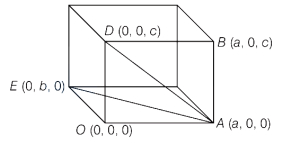
0 likesView Solution
313
MathematicsEasyMCQTS EAMCET · 2020
The shortest distance between the line $r = 2\hat{i} - 2\hat{j} + 3\hat{k} + \lambda(\hat{i} - \hat{j} + 4\hat{k})$ and the plane $r \cdot (\hat{i} + 5\hat{j} + \hat{k}) = 5$ is
A
$\frac{1}{3\sqrt{3}}$
B
$\frac{5}{3\sqrt{3}}$
C
$\frac{10}{3\sqrt{3}}$
D
$\frac{11}{3\sqrt{3}}$
Solution
(C) The line is given by $r = a + \lambda b$,where $a = 2\hat{i} - 2\hat{j} + 3\hat{k}$ and $b = \hat{i} - \hat{j} + 4\hat{k}$.
The plane is given by $r \cdot n = d$,where $n = \hat{i} + 5\hat{j} + \hat{k}$ and $d = 5$.
First,check if the line is parallel to the plane by calculating $b \cdot n = (1)(1) + (-1)(5) + (4)(1) = 1 - 5 + 4 = 0$.
Since $b \cdot n = 0$,the line is parallel to the plane.
The shortest distance $D$ between a parallel line and a plane is given by the formula $D = \frac{|a \cdot n - d|}{|n|}$.
Calculate $a \cdot n = (2)(1) + (-2)(5) + (3)(1) = 2 - 10 + 3 = -5$.
Calculate $|n| = \sqrt{1^2 + 5^2 + 1^2} = \sqrt{1 + 25 + 1} = \sqrt{27} = 3\sqrt{3}$.
Substitute the values into the formula: $D = \frac{|-5 - 5|}{|3\sqrt{3}|} = \frac{|-10|}{3\sqrt{3}} = \frac{10}{3\sqrt{3}}$.
The plane is given by $r \cdot n = d$,where $n = \hat{i} + 5\hat{j} + \hat{k}$ and $d = 5$.
First,check if the line is parallel to the plane by calculating $b \cdot n = (1)(1) + (-1)(5) + (4)(1) = 1 - 5 + 4 = 0$.
Since $b \cdot n = 0$,the line is parallel to the plane.
The shortest distance $D$ between a parallel line and a plane is given by the formula $D = \frac{|a \cdot n - d|}{|n|}$.
Calculate $a \cdot n = (2)(1) + (-2)(5) + (3)(1) = 2 - 10 + 3 = -5$.
Calculate $|n| = \sqrt{1^2 + 5^2 + 1^2} = \sqrt{1 + 25 + 1} = \sqrt{27} = 3\sqrt{3}$.
Substitute the values into the formula: $D = \frac{|-5 - 5|}{|3\sqrt{3}|} = \frac{|-10|}{3\sqrt{3}} = \frac{10}{3\sqrt{3}}$.
0 likesView Solution
314
MathematicsEasyMCQTS EAMCET · 2020
The position vector of a point $P$ is $2 \hat{i}+\hat{j}+3 \hat{k}$ and $a=-\hat{i}-2 \hat{k}, b=\hat{i}+\hat{j}+2 \hat{k}$ are two vectors which determine a plane $\pi$. The equation of a line through $P$ normal to $b$ and lying on the plane $\pi$ is
A
$r=2 \hat{i}+\hat{j}+3 \hat{k}+\lambda(-\hat{i}+5 \hat{j}-2 \hat{k})$
B
$r=2 \hat{i}+\hat{j}+3 \hat{k}+\lambda(\hat{i}+\hat{j}+\hat{k})$
C
$r=2 \hat{i}+\hat{j}+3 \hat{k}+\lambda(-2 \hat{i}-\hat{j}+3 \hat{k})$
D
$r=2 \hat{i}+\hat{j}+3 \hat{k}+\lambda(-3 \hat{i}+4 \hat{j}-5 \hat{k})$
Solution
(A) Given,the position vector of point $P$ is $\vec{p} = 2 \hat{i}+\hat{j}+3 \hat{k}$.
The plane $\pi$ is determined by vectors $\vec{a} = -\hat{i}-2 \hat{k}$ and $\vec{b} = \hat{i}+\hat{j}+2 \hat{k}$.
The normal vector to the plane is $\vec{n} = \vec{a} \times \vec{b}$.
The line lies on the plane and is normal to $\vec{b}$,so its direction vector $\vec{v}$ must be perpendicular to both $\vec{n}$ and $\vec{b}$.
Thus,$\vec{v} = \vec{n} \times \vec{b} = (\vec{a} \times \vec{b}) \times \vec{b}$.
Using the vector triple product formula $(\vec{a} \times \vec{b}) \times \vec{b} = (\vec{a} \cdot \vec{b})\vec{b} - (\vec{b} \cdot \vec{b})\vec{a}$.
Calculate $\vec{a} \cdot \vec{b} = (-1)(1) + (0)(1) + (-2)(2) = -1 - 4 = -5$.
Calculate $\vec{b} \cdot \vec{b} = (1)^2 + (1)^2 + (2)^2 = 1 + 1 + 4 = 6$.
So,$\vec{v} = -5(\hat{i}+\hat{j}+2 \hat{k}) - 6(-\hat{i}-2 \hat{k}) = -5\hat{i}-5\hat{j}-10\hat{k} + 6\hat{i} + 12\hat{k} = \hat{i}-5\hat{j}+2\hat{k}$.
Note: The direction vector can be scaled by $-1$,giving $-\hat{i}+5\hat{j}-2\hat{k}$.
The equation of the line is $\vec{r} = \vec{p} + \lambda \vec{v} = 2 \hat{i}+\hat{j}+3 \hat{k} + \lambda(-\hat{i}+5 \hat{j}-2 \hat{k})$.
The plane $\pi$ is determined by vectors $\vec{a} = -\hat{i}-2 \hat{k}$ and $\vec{b} = \hat{i}+\hat{j}+2 \hat{k}$.
The normal vector to the plane is $\vec{n} = \vec{a} \times \vec{b}$.
The line lies on the plane and is normal to $\vec{b}$,so its direction vector $\vec{v}$ must be perpendicular to both $\vec{n}$ and $\vec{b}$.
Thus,$\vec{v} = \vec{n} \times \vec{b} = (\vec{a} \times \vec{b}) \times \vec{b}$.
Using the vector triple product formula $(\vec{a} \times \vec{b}) \times \vec{b} = (\vec{a} \cdot \vec{b})\vec{b} - (\vec{b} \cdot \vec{b})\vec{a}$.
Calculate $\vec{a} \cdot \vec{b} = (-1)(1) + (0)(1) + (-2)(2) = -1 - 4 = -5$.
Calculate $\vec{b} \cdot \vec{b} = (1)^2 + (1)^2 + (2)^2 = 1 + 1 + 4 = 6$.
So,$\vec{v} = -5(\hat{i}+\hat{j}+2 \hat{k}) - 6(-\hat{i}-2 \hat{k}) = -5\hat{i}-5\hat{j}-10\hat{k} + 6\hat{i} + 12\hat{k} = \hat{i}-5\hat{j}+2\hat{k}$.
Note: The direction vector can be scaled by $-1$,giving $-\hat{i}+5\hat{j}-2\hat{k}$.
The equation of the line is $\vec{r} = \vec{p} + \lambda \vec{v} = 2 \hat{i}+\hat{j}+3 \hat{k} + \lambda(-\hat{i}+5 \hat{j}-2 \hat{k})$.
0 likesView Solution
315
MathematicsEasyMCQTS EAMCET · 2020
For non-coplanar vectors $a, b$ and $c$,if the point of intersection of the line $r=a+t(b-c)$ and the plane $r=b+c+x(a-b)+y(c+a)$ is $l a+m b+n c$,then $3 l+4 m+2 n=$
A
$0$
B
$\frac{1}{2}$
C
$2$
D
$1$
Solution
(C) The equation of the plane is given by $r = b + c + x(a - b) + y(c + a) = (x + y)a + (1 - x)b + (1 + y)c$ $\ldots(i)$.
The equation of the line is given by $r = a + t(b - c) = a + tb - tc$ $\ldots(ii)$.
Since the point of intersection satisfies both equations,we equate the coefficients of $a, b,$ and $c$ because $a, b, c$ are non-coplanar:
$x + y = 1$ $\ldots(iii)$
$1 - x = t$ $\ldots(iv)$
$1 + y = -t$ $\ldots(v)$
Adding equations $(iv)$ and $(v)$,we get $2 - x + y = 0$,so $x - y = 2$ $\ldots(vi)$.
Adding $(iii)$ and $(vi)$,we get $2x = 3$,so $x = \frac{3}{2}$.
Substituting $x = \frac{3}{2}$ into $(iii)$,we get $y = 1 - \frac{3}{2} = -\frac{1}{2}$.
Substituting $x = \frac{3}{2}$ into $(iv)$,we get $t = 1 - \frac{3}{2} = -\frac{1}{2}$.
Now,the point of intersection $r$ is $a + t(b - c) = a - \frac{1}{2}(b - c) = a - \frac{1}{2}b + \frac{1}{2}c$.
Comparing this with $la + mb + nc$,we get $l = 1, m = -\frac{1}{2}, n = \frac{1}{2}$.
Finally,$3l + 4m + 2n = 3(1) + 4(-\frac{1}{2}) + 2(\frac{1}{2}) = 3 - 2 + 1 = 2$.
The equation of the line is given by $r = a + t(b - c) = a + tb - tc$ $\ldots(ii)$.
Since the point of intersection satisfies both equations,we equate the coefficients of $a, b,$ and $c$ because $a, b, c$ are non-coplanar:
$x + y = 1$ $\ldots(iii)$
$1 - x = t$ $\ldots(iv)$
$1 + y = -t$ $\ldots(v)$
Adding equations $(iv)$ and $(v)$,we get $2 - x + y = 0$,so $x - y = 2$ $\ldots(vi)$.
Adding $(iii)$ and $(vi)$,we get $2x = 3$,so $x = \frac{3}{2}$.
Substituting $x = \frac{3}{2}$ into $(iii)$,we get $y = 1 - \frac{3}{2} = -\frac{1}{2}$.
Substituting $x = \frac{3}{2}$ into $(iv)$,we get $t = 1 - \frac{3}{2} = -\frac{1}{2}$.
Now,the point of intersection $r$ is $a + t(b - c) = a - \frac{1}{2}(b - c) = a - \frac{1}{2}b + \frac{1}{2}c$.
Comparing this with $la + mb + nc$,we get $l = 1, m = -\frac{1}{2}, n = \frac{1}{2}$.
Finally,$3l + 4m + 2n = 3(1) + 4(-\frac{1}{2}) + 2(\frac{1}{2}) = 3 - 2 + 1 = 2$.
0 likesView Solution
316
MathematicsMediumMCQTS EAMCET · 2020
Let $\Pi$ be a plane containing the points $(0,-5,-1), (1,-2,5), (-3,5,0)$ and $L$ be a line passing through the point $(0,-5,-1)$ and parallel to the vector $\hat{i}+5\hat{j}-6\hat{k}$. Then the length of the projection of the unit normal vector to the plane $\Pi$ on the line $L$ is
A
$\frac{133\sqrt{2}}{\sqrt{31}}$
B
$\frac{14}{\sqrt{682}}$
C
$\frac{133}{\sqrt{31}}$
D
$\frac{268}{2\sqrt{32}}$
Solution
(B) The equation of the plane $\Pi$ passing through points $A(0,-5,-1), B(1,-2,5), C(-3,5,0)$ is given by the determinant equation:
$\begin{vmatrix} x-0 & y+5 & z+1 \\ 1-0 & -2+5 & 5+1 \\ -3-0 & 5+5 & 0+1 \end{vmatrix} = 0$
$\begin{vmatrix} x & y+5 & z+1 \\ 1 & 3 & 6 \\ -3 & 10 & 1 \end{vmatrix} = 0$
Expanding along the first row:
$x(3-60) - (y+5)(1+18) + (z+1)(10+9) = 0$
$-57x - 19(y+5) + 19(z+1) = 0$
Dividing by $-19$:
$3x + y + 5 - z - 1 = 0 \Rightarrow 3x + y - z + 4 = 0$
The normal vector to the plane is $\vec{n} = 3\hat{i} + \hat{j} - \hat{k}$.
The unit normal vector is $\hat{n} = \frac{3\hat{i} + \hat{j} - \hat{k}}{\sqrt{3^2 + 1^2 + (-1)^2}} = \frac{3\hat{i} + \hat{j} - \hat{k}}{\sqrt{11}}$.
The line $L$ is parallel to the vector $\vec{v} = \hat{i} + 5\hat{j} - 6\hat{k}$.
The unit vector along the line $L$ is $\hat{u} = \frac{\hat{i} + 5\hat{j} - 6\hat{k}}{\sqrt{1^2 + 5^2 + (-6)^2}} = \frac{\hat{i} + 5\hat{j} - 6\hat{k}}{\sqrt{62}}$.
The length of the projection of $\hat{n}$ on line $L$ is $|\hat{n} \cdot \hat{u}|$:
$|\hat{n} \cdot \hat{u}| = \left| \left( \frac{3\hat{i} + \hat{j} - \hat{k}}{\sqrt{11}} \right) \cdot \left( \frac{\hat{i} + 5\hat{j} - 6\hat{k}}{\sqrt{62}} \right) \right|$
$= \left| \frac{3(1) + 1(5) + (-1)(-6)}{\sqrt{11} \cdot \sqrt{62}} \right| = \left| \frac{3 + 5 + 6}{\sqrt{682}} \right| = \frac{14}{\sqrt{682}}$.
$\begin{vmatrix} x-0 & y+5 & z+1 \\ 1-0 & -2+5 & 5+1 \\ -3-0 & 5+5 & 0+1 \end{vmatrix} = 0$
$\begin{vmatrix} x & y+5 & z+1 \\ 1 & 3 & 6 \\ -3 & 10 & 1 \end{vmatrix} = 0$
Expanding along the first row:
$x(3-60) - (y+5)(1+18) + (z+1)(10+9) = 0$
$-57x - 19(y+5) + 19(z+1) = 0$
Dividing by $-19$:
$3x + y + 5 - z - 1 = 0 \Rightarrow 3x + y - z + 4 = 0$
The normal vector to the plane is $\vec{n} = 3\hat{i} + \hat{j} - \hat{k}$.
The unit normal vector is $\hat{n} = \frac{3\hat{i} + \hat{j} - \hat{k}}{\sqrt{3^2 + 1^2 + (-1)^2}} = \frac{3\hat{i} + \hat{j} - \hat{k}}{\sqrt{11}}$.
The line $L$ is parallel to the vector $\vec{v} = \hat{i} + 5\hat{j} - 6\hat{k}$.
The unit vector along the line $L$ is $\hat{u} = \frac{\hat{i} + 5\hat{j} - 6\hat{k}}{\sqrt{1^2 + 5^2 + (-6)^2}} = \frac{\hat{i} + 5\hat{j} - 6\hat{k}}{\sqrt{62}}$.
The length of the projection of $\hat{n}$ on line $L$ is $|\hat{n} \cdot \hat{u}|$:
$|\hat{n} \cdot \hat{u}| = \left| \left( \frac{3\hat{i} + \hat{j} - \hat{k}}{\sqrt{11}} \right) \cdot \left( \frac{\hat{i} + 5\hat{j} - 6\hat{k}}{\sqrt{62}} \right) \right|$
$= \left| \frac{3(1) + 1(5) + (-1)(-6)}{\sqrt{11} \cdot \sqrt{62}} \right| = \left| \frac{3 + 5 + 6}{\sqrt{682}} \right| = \frac{14}{\sqrt{682}}$.
0 likesView Solution
317
MathematicsMediumMCQTS EAMCET · 2020
$l, m, n$ are three unit vectors in a right-handed system and $L$ is a line through the points $A, B, C$ whose position vectors are $p l + 7 m - 6 n, 2 l + 5 m - 4 n$ and $l + 4 m - 3 n$ respectively. If the equation of the plane containing $L$ and the point $(-p, p, p+1)$ is $ax + by + cz = 1$,then $p(a+b+c) =$
A
$0$
B
$\frac{-40}{19}$
C
$\frac{40}{19}$
D
$-6$
Solution
(B) Let $l, m, n$ be $\hat{i}, \hat{j}, \hat{k}$.
Points are $A(p, 7, -6), B(2, 5, -4), C(1, 4, -3)$.
Since $A, B, C$ are collinear,the vector $\vec{AB}$ must be parallel to $\vec{BC}$.
$\vec{AB} = (2-p)\hat{i} - 2\hat{j} + 2\hat{k}$.
$\vec{BC} = (1-2)\hat{i} + (4-5)\hat{j} + (-3+4)\hat{k} = -\hat{i} - \hat{j} + \hat{k}$.
Since $\vec{AB} = k\vec{BC}$,we have $\frac{2-p}{-1} = \frac{-2}{-1} = \frac{2}{1} = 2$.
Thus,$2-p = -2 \implies p = 4$.
The point is $(-p, p, p+1) = (-4, 4, 5)$.
The line $L$ passes through $B(2, 5, -4)$ and has direction vector $\vec{v} = (-1, -1, 1)$.
The plane contains the line $L$ and the point $P(-4, 4, 5)$.
The normal to the plane $\vec{n}$ is $\vec{PB} \times \vec{v}$.
$\vec{PB} = (2 - (-4))\hat{i} + (5 - 4)\hat{j} + (-4 - 5)\hat{k} = 6\hat{i} + \hat{j} - 9\hat{k}$.
$\vec{n} = \begin{vmatrix} \hat{i} & \hat{j} & \hat{k} \\ 6 & 1 & -9 \\ -1 & -1 & 1 \end{vmatrix} = \hat{i}(1-9) - \hat{j}(6-9) + \hat{k}(-6+1) = -8\hat{i} + 3\hat{j} - 5\hat{k}$.
The equation of the plane is $-8(x-2) + 3(y-5) - 5(z+4) = 0$.
$-8x + 16 + 3y - 15 - 5z - 20 = 0 \implies -8x + 3y - 5z = 19$.
Dividing by $19$,we get $-\frac{8}{19}x + \frac{3}{19}y - \frac{5}{19}z = 1$.
Here $a = -\frac{8}{19}, b = \frac{3}{19}, c = -\frac{5}{19}$.
$p(a+b+c) = 4 \times (\frac{-8+3-5}{19}) = 4 \times (\frac{-10}{19}) = -\frac{40}{19}$.
Points are $A(p, 7, -6), B(2, 5, -4), C(1, 4, -3)$.
Since $A, B, C$ are collinear,the vector $\vec{AB}$ must be parallel to $\vec{BC}$.
$\vec{AB} = (2-p)\hat{i} - 2\hat{j} + 2\hat{k}$.
$\vec{BC} = (1-2)\hat{i} + (4-5)\hat{j} + (-3+4)\hat{k} = -\hat{i} - \hat{j} + \hat{k}$.
Since $\vec{AB} = k\vec{BC}$,we have $\frac{2-p}{-1} = \frac{-2}{-1} = \frac{2}{1} = 2$.
Thus,$2-p = -2 \implies p = 4$.
The point is $(-p, p, p+1) = (-4, 4, 5)$.
The line $L$ passes through $B(2, 5, -4)$ and has direction vector $\vec{v} = (-1, -1, 1)$.
The plane contains the line $L$ and the point $P(-4, 4, 5)$.
The normal to the plane $\vec{n}$ is $\vec{PB} \times \vec{v}$.
$\vec{PB} = (2 - (-4))\hat{i} + (5 - 4)\hat{j} + (-4 - 5)\hat{k} = 6\hat{i} + \hat{j} - 9\hat{k}$.
$\vec{n} = \begin{vmatrix} \hat{i} & \hat{j} & \hat{k} \\ 6 & 1 & -9 \\ -1 & -1 & 1 \end{vmatrix} = \hat{i}(1-9) - \hat{j}(6-9) + \hat{k}(-6+1) = -8\hat{i} + 3\hat{j} - 5\hat{k}$.
The equation of the plane is $-8(x-2) + 3(y-5) - 5(z+4) = 0$.
$-8x + 16 + 3y - 15 - 5z - 20 = 0 \implies -8x + 3y - 5z = 19$.
Dividing by $19$,we get $-\frac{8}{19}x + \frac{3}{19}y - \frac{5}{19}z = 1$.
Here $a = -\frac{8}{19}, b = \frac{3}{19}, c = -\frac{5}{19}$.
$p(a+b+c) = 4 \times (\frac{-8+3-5}{19}) = 4 \times (\frac{-10}{19}) = -\frac{40}{19}$.
0 likesView Solution
318
MathematicsEasyMCQTS EAMCET · 2020
If $\frac{x-4}{1}=\frac{y-2}{1}=\frac{z-7}{2}$ lies in the plane $ax+by+z=7$,then $a+b=$
A
-$2$
B
$3$
C
$5$
D
$7$
Solution
(A) The given line is $\frac{x-4}{1}=\frac{y-2}{1}=\frac{z-7}{2}$.
This line passes through the point $P(4, 2, 7)$ and has direction ratios $(1, 1, 2)$.
Since the line lies in the plane $ax+by+z=7$,the point $P(4, 2, 7)$ must satisfy the plane equation:
$a(4) + b(2) + 7 = 7$
$4a + 2b = 0$
$2a + b = 0 \quad \dots(i)$
Also,the direction vector of the line $\vec{v} = (1, 1, 2)$ must be perpendicular to the normal vector of the plane $\vec{n} = (a, b, 1)$.
Thus,their dot product is zero:
$(1)(a) + (1)(b) + (2)(1) = 0$
$a + b + 2 = 0$
$a + b = -2$.
This line passes through the point $P(4, 2, 7)$ and has direction ratios $(1, 1, 2)$.
Since the line lies in the plane $ax+by+z=7$,the point $P(4, 2, 7)$ must satisfy the plane equation:
$a(4) + b(2) + 7 = 7$
$4a + 2b = 0$
$2a + b = 0 \quad \dots(i)$
Also,the direction vector of the line $\vec{v} = (1, 1, 2)$ must be perpendicular to the normal vector of the plane $\vec{n} = (a, b, 1)$.
Thus,their dot product is zero:
$(1)(a) + (1)(b) + (2)(1) = 0$
$a + b + 2 = 0$
$a + b = -2$.
0 likesView Solution
319
MathematicsMediumMCQTS EAMCET · 2020
The position vectors of the points $A$ and $B$ are respectively $\hat{i}+2 \hat{j}$ and $2 \hat{i}+\hat{j}+\hat{k}$. If the points $P$ and $Q$ are respectively the orthogonal projections of $A$ and $B$ on the plane $x+y+z=3$,then $P Q=$
A
$\frac{2 \sqrt{2}}{\sqrt{3}}$
B
$\frac{\sqrt{3}}{2}$
C
$\frac{\sqrt{5}}{7}$
D
$\frac{\sqrt{7}}{2}$
Solution
(A) Given the position vectors of $A$ and $B$ are $A(1, 2, 0)$ and $B(2, 1, 1)$.
The equation of the plane is $x+y+z=3$.
The normal vector to the plane is $\vec{n} = \hat{i}+\hat{j}+\hat{k}$.
The line passing through $A$ and perpendicular to the plane is given by $\vec{r} = (\hat{i}+2\hat{j}) + \lambda(\hat{i}+\hat{j}+\hat{k})$.
Any point on this line is $(1+\lambda, 2+\lambda, \lambda)$. Since this point lies on the plane $x+y+z=3$,we have $(1+\lambda) + (2+\lambda) + \lambda = 3$,which gives $3\lambda + 3 = 3$,so $\lambda = 0$. Thus,$P = (1, 2, 0)$.
The line passing through $B$ and perpendicular to the plane is given by $\vec{r} = (2\hat{i}+\hat{j}+\hat{k}) + \mu(\hat{i}+\hat{j}+\hat{k})$.
Any point on this line is $(2+\mu, 1+\mu, 1+\mu)$. Since this point lies on the plane $x+y+z=3$,we have $(2+\mu) + (1+\mu) + (1+\mu) = 3$,which gives $3\mu + 4 = 3$,so $\mu = -\frac{1}{3}$.
Thus,$Q = (2-\frac{1}{3}, 1-\frac{1}{3}, 1-\frac{1}{3}) = (\frac{5}{3}, \frac{2}{3}, \frac{2}{3})$.
The distance $PQ$ is given by $\sqrt{(\frac{5}{3}-1)^2 + (\frac{2}{3}-2)^2 + (\frac{2}{3}-0)^2} = \sqrt{(\frac{2}{3})^2 + (-\frac{4}{3})^2 + (\frac{2}{3})^2} = \sqrt{\frac{4}{9} + \frac{16}{9} + \frac{4}{9}} = \sqrt{\frac{24}{9}} = \frac{\sqrt{24}}{3} = \frac{2\sqrt{6}}{3} = \frac{2\sqrt{2}}{\sqrt{3}}$.
The equation of the plane is $x+y+z=3$.
The normal vector to the plane is $\vec{n} = \hat{i}+\hat{j}+\hat{k}$.
The line passing through $A$ and perpendicular to the plane is given by $\vec{r} = (\hat{i}+2\hat{j}) + \lambda(\hat{i}+\hat{j}+\hat{k})$.
Any point on this line is $(1+\lambda, 2+\lambda, \lambda)$. Since this point lies on the plane $x+y+z=3$,we have $(1+\lambda) + (2+\lambda) + \lambda = 3$,which gives $3\lambda + 3 = 3$,so $\lambda = 0$. Thus,$P = (1, 2, 0)$.
The line passing through $B$ and perpendicular to the plane is given by $\vec{r} = (2\hat{i}+\hat{j}+\hat{k}) + \mu(\hat{i}+\hat{j}+\hat{k})$.
Any point on this line is $(2+\mu, 1+\mu, 1+\mu)$. Since this point lies on the plane $x+y+z=3$,we have $(2+\mu) + (1+\mu) + (1+\mu) = 3$,which gives $3\mu + 4 = 3$,so $\mu = -\frac{1}{3}$.
Thus,$Q = (2-\frac{1}{3}, 1-\frac{1}{3}, 1-\frac{1}{3}) = (\frac{5}{3}, \frac{2}{3}, \frac{2}{3})$.
The distance $PQ$ is given by $\sqrt{(\frac{5}{3}-1)^2 + (\frac{2}{3}-2)^2 + (\frac{2}{3}-0)^2} = \sqrt{(\frac{2}{3})^2 + (-\frac{4}{3})^2 + (\frac{2}{3})^2} = \sqrt{\frac{4}{9} + \frac{16}{9} + \frac{4}{9}} = \sqrt{\frac{24}{9}} = \frac{\sqrt{24}}{3} = \frac{2\sqrt{6}}{3} = \frac{2\sqrt{2}}{\sqrt{3}}$.
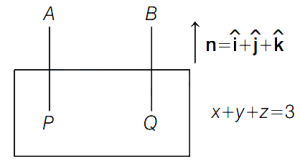
0 likesView Solution
320
MathematicsDifficultMCQTS EAMCET · 2020
When two dice are rolled,let $x$ be the probability that the sum of the numbers appearing on the dice is at most $7$. Let $y$ be the probability of getting a sum of $7$ at least once when a pair of dice are rolled $n$ times. In order to have $y > x$,the minimum value of $n$ is
A
$5$
B
$6$
C
$4$
D
$2$
Solution
(A) The total number of outcomes when two dice are rolled is $6 \times 6 = 36$.
The outcomes where the sum is at most $7$ are:
Sum $= 2: (1,1)$ ($1$ outcome)
Sum $= 3: (1,2), (2,1)$ ($2$ outcomes)
Sum $= 4: (1,3), (2,2), (3,1)$ ($3$ outcomes)
Sum $= 5: (1,4), (2,3), (3,2), (4,1)$ ($4$ outcomes)
Sum $= 6: (1,5), (2,4), (3,3), (4,2), (5,1)$ ($5$ outcomes)
Sum $= 7: (1,6), (2,5), (3,4), (4,3), (5,2), (6,1)$ ($6$ outcomes)
Total favorable outcomes $= 1+2+3+4+5+6 = 21$.
Thus,$x = \frac{21}{36} = \frac{7}{12}$.
For $y$,the probability of getting a sum of $7$ in one roll is $p = \frac{6}{36} = \frac{1}{6}$. The probability of not getting a sum of $7$ is $q = 1 - \frac{1}{6} = \frac{5}{6}$.
When rolled $n$ times,the probability of getting a sum of $7$ at least once is $y = 1 - q^n = 1 - (\frac{5}{6})^n$.
We want $y > x$,so $1 - (\frac{5}{6})^n > \frac{7}{12} \Rightarrow (\frac{5}{6})^n < 1 - \frac{7}{12} = \frac{5}{12}$.
For $n=1: \frac{5}{6} \approx 0.833 > 0.416$
For $n=2: \frac{25}{36} \approx 0.694 > 0.416$
For $n=3: \frac{125}{216} \approx 0.578 > 0.416$
For $n=4: \frac{625}{1296} \approx 0.482 > 0.416$
For $n=5: \frac{3125}{7776} \approx 0.401 < 0.416$.
Thus,the minimum $n$ is $5$.
The outcomes where the sum is at most $7$ are:
Sum $= 2: (1,1)$ ($1$ outcome)
Sum $= 3: (1,2), (2,1)$ ($2$ outcomes)
Sum $= 4: (1,3), (2,2), (3,1)$ ($3$ outcomes)
Sum $= 5: (1,4), (2,3), (3,2), (4,1)$ ($4$ outcomes)
Sum $= 6: (1,5), (2,4), (3,3), (4,2), (5,1)$ ($5$ outcomes)
Sum $= 7: (1,6), (2,5), (3,4), (4,3), (5,2), (6,1)$ ($6$ outcomes)
Total favorable outcomes $= 1+2+3+4+5+6 = 21$.
Thus,$x = \frac{21}{36} = \frac{7}{12}$.
For $y$,the probability of getting a sum of $7$ in one roll is $p = \frac{6}{36} = \frac{1}{6}$. The probability of not getting a sum of $7$ is $q = 1 - \frac{1}{6} = \frac{5}{6}$.
When rolled $n$ times,the probability of getting a sum of $7$ at least once is $y = 1 - q^n = 1 - (\frac{5}{6})^n$.
We want $y > x$,so $1 - (\frac{5}{6})^n > \frac{7}{12} \Rightarrow (\frac{5}{6})^n < 1 - \frac{7}{12} = \frac{5}{12}$.
For $n=1: \frac{5}{6} \approx 0.833 > 0.416$
For $n=2: \frac{25}{36} \approx 0.694 > 0.416$
For $n=3: \frac{125}{216} \approx 0.578 > 0.416$
For $n=4: \frac{625}{1296} \approx 0.482 > 0.416$
For $n=5: \frac{3125}{7776} \approx 0.401 < 0.416$.
Thus,the minimum $n$ is $5$.
0 likesView Solution
321
MathematicsDifficultMCQTS EAMCET · 2020
$A$ target is to be destroyed in a bombing exercise and there is a $75 \%$ chance that a bomb will hit the target. Assuming that two direct hits are required to destroy the target completely,the minimum number of bombs to be dropped in order that the probability of destroying the target is not less than $99 \%$,is
A
$4$
B
$5$
C
$6$
D
$7$
Solution
(C) Let the probability of a bomb hitting the target be $p = \frac{3}{4}$.
Thus,the probability of a bomb missing the target is $q = 1 - p = \frac{1}{4}$.
Let $n$ be the number of bombs dropped. The target is destroyed if there are at least $2$ hits.
Let $X$ be the number of hits. We want $P(X \geq 2) \geq 0.99$.
This is equivalent to $1 - [P(X = 0) + P(X = 1)] \geq 0.99$.
$P(X = 0) + P(X = 1) \leq 0.01 = \frac{1}{100}$.
Using the binomial distribution: $P(X = k) = {}^{n}C_{k} p^{k} q^{n-k}$.
${}^{n}C_{0} (\frac{3}{4})^{0} (\frac{1}{4})^{n} + {}^{n}C_{1} (\frac{3}{4})^{1} (\frac{1}{4})^{n-1} \leq \frac{1}{100}$.
$\frac{1}{4^{n}} + n \cdot \frac{3}{4} \cdot \frac{4}{4^{n}} \leq \frac{1}{100}$.
$\frac{1 + 3n}{4^{n}} \leq \frac{1}{100} \Rightarrow 4^{n} \geq 100(3n + 1) = 300n + 100$.
For $n = 5$: $4^{5} = 1024$ and $300(5) + 100 = 1600$. ($1024 < 1600$,false).
For $n = 6$: $4^{6} = 4096$ and $300(6) + 100 = 1900$. ($4096 \geq 1900$,true).
Thus,the minimum number of bombs is $6$.
Thus,the probability of a bomb missing the target is $q = 1 - p = \frac{1}{4}$.
Let $n$ be the number of bombs dropped. The target is destroyed if there are at least $2$ hits.
Let $X$ be the number of hits. We want $P(X \geq 2) \geq 0.99$.
This is equivalent to $1 - [P(X = 0) + P(X = 1)] \geq 0.99$.
$P(X = 0) + P(X = 1) \leq 0.01 = \frac{1}{100}$.
Using the binomial distribution: $P(X = k) = {}^{n}C_{k} p^{k} q^{n-k}$.
${}^{n}C_{0} (\frac{3}{4})^{0} (\frac{1}{4})^{n} + {}^{n}C_{1} (\frac{3}{4})^{1} (\frac{1}{4})^{n-1} \leq \frac{1}{100}$.
$\frac{1}{4^{n}} + n \cdot \frac{3}{4} \cdot \frac{4}{4^{n}} \leq \frac{1}{100}$.
$\frac{1 + 3n}{4^{n}} \leq \frac{1}{100} \Rightarrow 4^{n} \geq 100(3n + 1) = 300n + 100$.
For $n = 5$: $4^{5} = 1024$ and $300(5) + 100 = 1600$. ($1024 < 1600$,false).
For $n = 6$: $4^{6} = 4096$ and $300(6) + 100 = 1900$. ($4096 \geq 1900$,true).
Thus,the minimum number of bombs is $6$.
0 likesView Solution
322
MathematicsMediumMCQTS EAMCET · 2020
$A$ number is selected at random from the set $\{1, 2, \ldots, 100\}$. Given that the selected number is divisible by $2$,what is the probability that it is also divisible by $3$ or $5$?
A
$\frac{26}{50}$
B
$\frac{23}{50}$
C
$\frac{7}{50}$
D
$\frac{13}{50}$
Solution
(B) Let $S = \{1, 2, \ldots, 100\}$. The total number of elements is $100$.
Let $A$ be the event that the number is divisible by $2$. The elements of $A$ are $\{2, 4, 6, \ldots, 100\}$. The number of elements in $A$ is $n(A) = 50$.
Let $B$ be the event that the number is divisible by $3$ or $5$. We want to find the conditional probability $P(B|A) = \frac{n(A \cap B)}{n(A)}$.
$A \cap B$ is the set of numbers in $\{1, 2, \ldots, 100\}$ that are divisible by $2$ $AND$ (divisible by $3$ $OR$ divisible by $5$).
This is equivalent to numbers divisible by $6$ or $10$.
Numbers divisible by $6$ up to $100$: $\lfloor \frac{100}{6} \rfloor = 16$.
Numbers divisible by $10$ up to $100$: $\lfloor \frac{100}{10} \rfloor = 10$.
Numbers divisible by both $6$ and $10$ (i.e.,divisible by $30$): $\lfloor \frac{100}{30} \rfloor = 3$.
By the Principle of Inclusion-Exclusion,$n(A \cap B) = 16 + 10 - 3 = 23$.
The required probability is $\frac{n(A \cap B)}{n(A)} = \frac{23}{50}$.
Let $A$ be the event that the number is divisible by $2$. The elements of $A$ are $\{2, 4, 6, \ldots, 100\}$. The number of elements in $A$ is $n(A) = 50$.
Let $B$ be the event that the number is divisible by $3$ or $5$. We want to find the conditional probability $P(B|A) = \frac{n(A \cap B)}{n(A)}$.
$A \cap B$ is the set of numbers in $\{1, 2, \ldots, 100\}$ that are divisible by $2$ $AND$ (divisible by $3$ $OR$ divisible by $5$).
This is equivalent to numbers divisible by $6$ or $10$.
Numbers divisible by $6$ up to $100$: $\lfloor \frac{100}{6} \rfloor = 16$.
Numbers divisible by $10$ up to $100$: $\lfloor \frac{100}{10} \rfloor = 10$.
Numbers divisible by both $6$ and $10$ (i.e.,divisible by $30$): $\lfloor \frac{100}{30} \rfloor = 3$.
By the Principle of Inclusion-Exclusion,$n(A \cap B) = 16 + 10 - 3 = 23$.
The required probability is $\frac{n(A \cap B)}{n(A)} = \frac{23}{50}$.
0 likesView Solution
323
MathematicsDifficultMCQTS EAMCET · 2020
Cards are drawn one after the other without replacement from a well-shuffled pack of cards until an ace card appears. If the probability that exactly $5$ cards are drawn before the first ace card appears is $\frac{4}{49}\left(\frac{p_1 \cdot p_2 \cdot p_3}{p_4 \cdot p_5 \cdot p_6}\right)$,where $p_i$ is prime for $i=1, 2, 3, 4, 5, 6$,then $(\max \{p_i\} - \min \{p_i\}) = $
A
$12$
B
$18$
C
$20$
D
$22$
Solution
(C) The probability that exactly $5$ cards are drawn before the first ace appears means the first $5$ cards are non-aces and the $6$th card is an ace.
$P = \frac{48}{52} \times \frac{47}{51} \times \frac{46}{50} \times \frac{45}{49} \times \frac{44}{48} \times \frac{4}{47}$
Simplifying the expression:
$P = \frac{4}{49} \times \left( \frac{48 \times 47 \times 46 \times 45 \times 44}{52 \times 51 \times 50 \times 48 \times 47} \right) = \frac{4}{49} \times \left( \frac{46 \times 45 \times 44}{52 \times 51 \times 50} \right)$
$P = \frac{4}{49} \times \left( \frac{23 \times 2 \times 9 \times 5 \times 11 \times 4}{13 \times 4 \times 17 \times 3 \times 25 \times 2} \right) = \frac{4}{49} \times \left( \frac{23 \times 3 \times 11}{13 \times 17 \times 5} \right)$
Here,the prime factors are $p_1=23, p_2=11, p_3=3$ and $p_4=13, p_5=17, p_6=5$.
Thus,$\max \{p_i\} = 23$ and $\min \{p_i\} = 3$.
Therefore,$\max \{p_i\} - \min \{p_i\} = 23 - 3 = 20$.
$P = \frac{48}{52} \times \frac{47}{51} \times \frac{46}{50} \times \frac{45}{49} \times \frac{44}{48} \times \frac{4}{47}$
Simplifying the expression:
$P = \frac{4}{49} \times \left( \frac{48 \times 47 \times 46 \times 45 \times 44}{52 \times 51 \times 50 \times 48 \times 47} \right) = \frac{4}{49} \times \left( \frac{46 \times 45 \times 44}{52 \times 51 \times 50} \right)$
$P = \frac{4}{49} \times \left( \frac{23 \times 2 \times 9 \times 5 \times 11 \times 4}{13 \times 4 \times 17 \times 3 \times 25 \times 2} \right) = \frac{4}{49} \times \left( \frac{23 \times 3 \times 11}{13 \times 17 \times 5} \right)$
Here,the prime factors are $p_1=23, p_2=11, p_3=3$ and $p_4=13, p_5=17, p_6=5$.
Thus,$\max \{p_i\} = 23$ and $\min \{p_i\} = 3$.
Therefore,$\max \{p_i\} - \min \{p_i\} = 23 - 3 = 20$.
0 likesView Solution
324
MathematicsEasyMCQTS EAMCET · 2020
$A$ fair coin is tossed $K$ times such that the probability of getting $4$ heads is equal to that of getting $6$ heads. If the probability is maximum for getting $r$ heads,then $r=$
A
$9$
B
$5$
C
$8$
D
$10$
Solution
(B) Given that a fair coin is tossed $K$ times,the probability of getting $X$ heads follows a binomial distribution with $p = \frac{1}{2}$ and $q = \frac{1}{2}$.
Given $P(X=4) = P(X=6)$.
Using the binomial probability formula $P(X=r) = {}^K C_r p^r q^{K-r}$,we have:
${}^K C_4 (\frac{1}{2})^K = {}^K C_6 (\frac{1}{2})^K$
${}^K C_4 = {}^K C_6$
Since ${}^n C_x = {}^n C_y$ implies $n = x + y$ (for $x \neq y$),we get $K = 4 + 6 = 10$.
For a binomial distribution with $p = q = \frac{1}{2}$,the probability $P(X=r)$ is maximum at the mean value.
For $n = 10$,the maximum probability occurs at $r = \frac{n}{2} = \frac{10}{2} = 5$.
Given $P(X=4) = P(X=6)$.
Using the binomial probability formula $P(X=r) = {}^K C_r p^r q^{K-r}$,we have:
${}^K C_4 (\frac{1}{2})^K = {}^K C_6 (\frac{1}{2})^K$
${}^K C_4 = {}^K C_6$
Since ${}^n C_x = {}^n C_y$ implies $n = x + y$ (for $x \neq y$),we get $K = 4 + 6 = 10$.
For a binomial distribution with $p = q = \frac{1}{2}$,the probability $P(X=r)$ is maximum at the mean value.
For $n = 10$,the maximum probability occurs at $r = \frac{n}{2} = \frac{10}{2} = 5$.
0 likesView Solution
325
MathematicsEasyMCQTS EAMCET · 2020
If the probability that an individual will suffer a reaction from an injection of a drug is $0.001$,then the probability that out of $2000$ individuals having that injection,more than $2$ individuals will suffer a reaction,is
A
$\frac{5}{e^2}$
B
$1-\frac{5}{e^2}$
C
$1-\frac{4}{e^2}$
D
$\frac{4}{e^2}$
Solution
(B) Given $n = 2000$ and $p = 0.001$.
Using the Poisson distribution,the parameter $\lambda = np = 2000 \times 0.001 = 2$.
The probability of $X$ individuals suffering a reaction is given by $P(X=k) = \frac{e^{-\lambda} \lambda^k}{k!}$.
We need to find $P(X > 2) = 1 - [P(X=0) + P(X=1) + P(X=2)]$.
Calculating the individual probabilities:
$P(X=0) = \frac{e^{-2} 2^0}{0!} = e^{-2}$
$P(X=1) = \frac{e^{-2} 2^1}{1!} = 2e^{-2}$
$P(X=2) = \frac{e^{-2} 2^2}{2!} = 2e^{-2}$
Summing these: $P(X \le 2) = e^{-2} + 2e^{-2} + 2e^{-2} = 5e^{-2}$.
Therefore,$P(X > 2) = 1 - 5e^{-2} = 1 - \frac{5}{e^2}$.
Using the Poisson distribution,the parameter $\lambda = np = 2000 \times 0.001 = 2$.
The probability of $X$ individuals suffering a reaction is given by $P(X=k) = \frac{e^{-\lambda} \lambda^k}{k!}$.
We need to find $P(X > 2) = 1 - [P(X=0) + P(X=1) + P(X=2)]$.
Calculating the individual probabilities:
$P(X=0) = \frac{e^{-2} 2^0}{0!} = e^{-2}$
$P(X=1) = \frac{e^{-2} 2^1}{1!} = 2e^{-2}$
$P(X=2) = \frac{e^{-2} 2^2}{2!} = 2e^{-2}$
Summing these: $P(X \le 2) = e^{-2} + 2e^{-2} + 2e^{-2} = 5e^{-2}$.
Therefore,$P(X > 2) = 1 - 5e^{-2} = 1 - \frac{5}{e^2}$.
0 likesView Solution
326
MathematicsEasyMCQTS EAMCET · 2020
Consider the following statements:
Assertion $(A)$: If $P_1, P_2, P_3$ are probabilities of occurrence of three independent events,then the probability of occurrence of at least one of them is $1 - [(1 - P_1)(1 - P_2)(1 - P_3)]$.
Reason $(R)$: For any three independent events $A, B$,and $C$,$P(A \cup B \cup C) = P(A) + P(B) + P(C) - P(A)P(B) - P(A)P(C) - P(B)P(C) + P(A)P(B)P(C)$.
The correct option among the following is:
Assertion $(A)$: If $P_1, P_2, P_3$ are probabilities of occurrence of three independent events,then the probability of occurrence of at least one of them is $1 - [(1 - P_1)(1 - P_2)(1 - P_3)]$.
Reason $(R)$: For any three independent events $A, B$,and $C$,$P(A \cup B \cup C) = P(A) + P(B) + P(C) - P(A)P(B) - P(A)P(C) - P(B)P(C) + P(A)P(B)P(C)$.
The correct option among the following is:
A
$(A)$ is true,$(R)$ is true,and $(R)$ is the correct explanation for $(A)$
B
$(A)$ is true,$(R)$ is true,but $(R)$ is not the correct explanation for $(A)$
C
$(A)$ is true,but $(R)$ is false
D
$(A)$ is false,but $(R)$ is true
Solution
(A) Let $E_1, E_2, E_3$ be three independent events with probabilities $P_1, P_2, P_3$.
The probability that none of the events occur is $P(\bar{E}_1 \cap \bar{E}_2 \cap \bar{E}_3) = (1 - P_1)(1 - P_2)(1 - P_3)$.
The probability that at least one event occurs is $1 - P(\text{none occur}) = 1 - [(1 - P_1)(1 - P_2)(1 - P_3)]$. Thus,$(A)$ is true.
For independent events $A, B, C$,the probability of their union is given by the inclusion-exclusion principle: $P(A \cup B \cup C) = P(A) + P(B) + P(C) - [P(A \cap B) + P(A \cap C) + P(B \cap C)] + P(A \cap B \cap C)$.
Since the events are independent,$P(A \cap B) = P(A)P(B)$,etc. Thus,$P(A \cup B \cup C) = P(A) + P(B) + P(C) - P(A)P(B) - P(A)P(C) - P(B)P(C) + P(A)P(B)P(C)$. Thus,$(R)$ is true.
Since the formula in $(R)$ is the standard expansion used to derive the result in $(A)$,$(R)$ is the correct explanation for $(A)$.
The probability that none of the events occur is $P(\bar{E}_1 \cap \bar{E}_2 \cap \bar{E}_3) = (1 - P_1)(1 - P_2)(1 - P_3)$.
The probability that at least one event occurs is $1 - P(\text{none occur}) = 1 - [(1 - P_1)(1 - P_2)(1 - P_3)]$. Thus,$(A)$ is true.
For independent events $A, B, C$,the probability of their union is given by the inclusion-exclusion principle: $P(A \cup B \cup C) = P(A) + P(B) + P(C) - [P(A \cap B) + P(A \cap C) + P(B \cap C)] + P(A \cap B \cap C)$.
Since the events are independent,$P(A \cap B) = P(A)P(B)$,etc. Thus,$P(A \cup B \cup C) = P(A) + P(B) + P(C) - P(A)P(B) - P(A)P(C) - P(B)P(C) + P(A)P(B)P(C)$. Thus,$(R)$ is true.
Since the formula in $(R)$ is the standard expansion used to derive the result in $(A)$,$(R)$ is the correct explanation for $(A)$.
0 likesView Solution
327
MathematicsMediumMCQTS EAMCET · 2020
If a man throws a die until he gets a number bigger than $3$,then the probability that he gets a $5$ in his last throw is
A
$1/3$
B
$1/4$
C
$3/5$
D
$2/3$
Solution
(A) Let $E$ be the event of getting a number greater than $3$ in a single throw of a die. The outcomes are $\{4, 5, 6\}$.
$P(E) = \frac{3}{6} = \frac{1}{2}$.
Let $F$ be the event of getting a $5$ in a single throw. $P(F) = \frac{1}{6}$.
Let $S$ be the event of getting a number $\leq 3$ in a single throw. $P(S) = \frac{3}{6} = \frac{1}{2}$.
The man stops when he gets a number $> 3$. The possible sequences for the last throw being $5$ are:
$1$. First throw is $5$: Probability $= \frac{1}{6}$.
$2$. First throw is $\leq 3$,second throw is $5$: Probability $= \frac{1}{2} \times \frac{1}{6}$.
$3$. First two throws are $\leq 3$,third throw is $5$: Probability $= (\frac{1}{2})^2 \times \frac{1}{6}$.
This is an infinite geometric series: $\frac{1}{6} + \frac{1}{6}(\frac{1}{2}) + \frac{1}{6}(\frac{1}{2})^2 + \dots$
The sum is $S = \frac{a}{1-r} = \frac{1/6}{1-1/2} = \frac{1/6}{1/2} = \frac{1}{3}$.
$P(E) = \frac{3}{6} = \frac{1}{2}$.
Let $F$ be the event of getting a $5$ in a single throw. $P(F) = \frac{1}{6}$.
Let $S$ be the event of getting a number $\leq 3$ in a single throw. $P(S) = \frac{3}{6} = \frac{1}{2}$.
The man stops when he gets a number $> 3$. The possible sequences for the last throw being $5$ are:
$1$. First throw is $5$: Probability $= \frac{1}{6}$.
$2$. First throw is $\leq 3$,second throw is $5$: Probability $= \frac{1}{2} \times \frac{1}{6}$.
$3$. First two throws are $\leq 3$,third throw is $5$: Probability $= (\frac{1}{2})^2 \times \frac{1}{6}$.
This is an infinite geometric series: $\frac{1}{6} + \frac{1}{6}(\frac{1}{2}) + \frac{1}{6}(\frac{1}{2})^2 + \dots$
The sum is $S = \frac{a}{1-r} = \frac{1/6}{1-1/2} = \frac{1/6}{1/2} = \frac{1}{3}$.
0 likesView Solution
328
MathematicsEasyMCQTS EAMCET · 2020
Two numbers are selected at random from the set $\{1, 2, 3, \ldots, 13\}$. If the sum of the selected numbers is even,what is the probability that both the numbers are odd?
A
$\frac{2}{13}$
B
$\frac{1}{2}$
C
$\frac{7}{12}$
D
$\frac{5}{26}$
Solution
(C) The set is $S = \{1, 2, 3, \ldots, 13\}$. There are $7$ odd numbers $\{1, 3, 5, 7, 9, 11, 13\}$ and $6$ even numbers $\{2, 4, 6, 8, 10, 12\}$.
Let $E$ be the event that the sum of the two selected numbers is even. This happens if both numbers are odd or both numbers are even.
Number of ways to select two odd numbers = $^7C_2 = \frac{7 \times 6}{2} = 21$.
Number of ways to select two even numbers = $^6C_2 = \frac{6 \times 5}{2} = 15$.
Total ways for the sum to be even = $21 + 15 = 36$.
Let $A$ be the event that both numbers are odd. We want to find $P(A|E) = \frac{n(A \cap E)}{n(E)}$.
Since $A \cap E$ is the event that both numbers are odd,$n(A \cap E) = 21$.
Therefore,$P(A|E) = \frac{21}{36} = \frac{7}{12}$.
Let $E$ be the event that the sum of the two selected numbers is even. This happens if both numbers are odd or both numbers are even.
Number of ways to select two odd numbers = $^7C_2 = \frac{7 \times 6}{2} = 21$.
Number of ways to select two even numbers = $^6C_2 = \frac{6 \times 5}{2} = 15$.
Total ways for the sum to be even = $21 + 15 = 36$.
Let $A$ be the event that both numbers are odd. We want to find $P(A|E) = \frac{n(A \cap E)}{n(E)}$.
Since $A \cap E$ is the event that both numbers are odd,$n(A \cap E) = 21$.
Therefore,$P(A|E) = \frac{21}{36} = \frac{7}{12}$.
0 likesView Solution
329
MathematicsMediumMCQTS EAMCET · 2020
If $E_1$ and $E_2$ are two events of the sample space such that $P(E_1) = \frac{1}{4}$,$P(E_1 | E_2) = \frac{1}{2}$ and $P(E_2 | E_1) = \frac{1}{3}$,then $P(E_1 | \bar{E}_2) = $
A
$\frac{2}{15}$
B
$\frac{1}{10}$
C
$\frac{1}{5}$
D
$\frac{3}{10}$
Solution
(C) We have,$P(E_1 \cap E_2) = P(E_1) \cdot P(E_2 | E_1)$.
$\therefore P(E_1 \cap E_2) = \frac{1}{4} \cdot \frac{1}{3} = \frac{1}{12}$.
Now,$P(E_1 | E_2) = \frac{P(E_1 \cap E_2)}{P(E_2)}$.
$\Rightarrow \frac{1}{2} = \frac{1/12}{P(E_2)}$.
$\Rightarrow P(E_2) = \frac{1}{12} \times 2 = \frac{1}{6}$.
$\therefore P(\bar{E}_2) = 1 - P(E_2) = 1 - \frac{1}{6} = \frac{5}{6}$.
Now,$P(E_1 | \bar{E}_2) = \frac{P(E_1 \cap \bar{E}_2)}{P(\bar{E}_2)} = \frac{P(E_1) - P(E_1 \cap E_2)}{P(\bar{E}_2)}$.
$= \frac{\frac{1}{4} - \frac{1}{12}}{\frac{5}{6}} = \frac{\frac{3-1}{12}}{\frac{5}{6}} = \frac{\frac{2}{12}}{\frac{5}{6}} = \frac{1}{6} \times \frac{6}{5} = \frac{1}{5}$.
$\therefore P(E_1 \cap E_2) = \frac{1}{4} \cdot \frac{1}{3} = \frac{1}{12}$.
Now,$P(E_1 | E_2) = \frac{P(E_1 \cap E_2)}{P(E_2)}$.
$\Rightarrow \frac{1}{2} = \frac{1/12}{P(E_2)}$.
$\Rightarrow P(E_2) = \frac{1}{12} \times 2 = \frac{1}{6}$.
$\therefore P(\bar{E}_2) = 1 - P(E_2) = 1 - \frac{1}{6} = \frac{5}{6}$.
Now,$P(E_1 | \bar{E}_2) = \frac{P(E_1 \cap \bar{E}_2)}{P(\bar{E}_2)} = \frac{P(E_1) - P(E_1 \cap E_2)}{P(\bar{E}_2)}$.
$= \frac{\frac{1}{4} - \frac{1}{12}}{\frac{5}{6}} = \frac{\frac{3-1}{12}}{\frac{5}{6}} = \frac{\frac{2}{12}}{\frac{5}{6}} = \frac{1}{6} \times \frac{6}{5} = \frac{1}{5}$.
0 likesView Solution
330
MathematicsEasyMCQTS EAMCET · 2020
Let $A$ and $B$ be not mutually exclusive events. If $P(A) = \frac{4}{9}$ and $P(A \cap \bar{B}) = \frac{3}{7}$,then find $P\left(\frac{B}{A}\right)$.
A
$0$
B
$\frac{1}{28}$
C
$\frac{3}{13}$
D
$\frac{4}{7}$
Solution
(B) Given that $P(A) = \frac{4}{9}$ and $P(A \cap \bar{B}) = \frac{3}{7}$.
We know that $P(A) = P(A \cap B) + P(A \cap \bar{B})$.
Therefore,$P(A \cap B) = P(A) - P(A \cap \bar{B})$.
Substituting the values,we get $P(A \cap B) = \frac{4}{9} - \frac{3}{7} = \frac{28 - 27}{63} = \frac{1}{63}$.
Now,the conditional probability $P\left(\frac{B}{A}\right)$ is defined as $P\left(\frac{B}{A}\right) = \frac{P(A \cap B)}{P(A)}$.
Substituting the values,$P\left(\frac{B}{A}\right) = \frac{\frac{1}{63}}{\frac{4}{9}} = \frac{1}{63} \times \frac{9}{4} = \frac{1}{7 \times 4} = \frac{1}{28}$.
We know that $P(A) = P(A \cap B) + P(A \cap \bar{B})$.
Therefore,$P(A \cap B) = P(A) - P(A \cap \bar{B})$.
Substituting the values,we get $P(A \cap B) = \frac{4}{9} - \frac{3}{7} = \frac{28 - 27}{63} = \frac{1}{63}$.
Now,the conditional probability $P\left(\frac{B}{A}\right)$ is defined as $P\left(\frac{B}{A}\right) = \frac{P(A \cap B)}{P(A)}$.
Substituting the values,$P\left(\frac{B}{A}\right) = \frac{\frac{1}{63}}{\frac{4}{9}} = \frac{1}{63} \times \frac{9}{4} = \frac{1}{7 \times 4} = \frac{1}{28}$.
0 likesView Solution
331
MathematicsEasyMCQTS EAMCET · 2020
Let $X$ and $Y$ be two events of a sample space such that $P(X)=\frac{1}{3}$,$P(X|Y)=\frac{1}{2}$ and $P(Y|X)=\frac{2}{5}$,then which of the following is true?
A
$P(X \cap Y)=\frac{1}{5}$
B
$P(X \cup Y)=\frac{2}{5}$
C
$P(Y)=\frac{4}{15}$
D
$P(X \cup Y)=\frac{1}{2}$
Solution
(C) Given: $P(X)=\frac{1}{3}$,$P(X|Y)=\frac{1}{2}$,and $P(Y|X)=\frac{2}{5}$.
Using the definition of conditional probability,$P(Y|X) = \frac{P(X \cap Y)}{P(X)}$.
Therefore,$P(X \cap Y) = P(Y|X) \times P(X) = \frac{2}{5} \times \frac{1}{3} = \frac{2}{15}$.
Now,using $P(X|Y) = \frac{P(X \cap Y)}{P(Y)}$,we have $\frac{1}{2} = \frac{2/15}{P(Y)}$.
This implies $P(Y) = 2 \times \frac{2}{15} = \frac{4}{15}$.
Thus,option $C$ is correct.
Using the definition of conditional probability,$P(Y|X) = \frac{P(X \cap Y)}{P(X)}$.
Therefore,$P(X \cap Y) = P(Y|X) \times P(X) = \frac{2}{5} \times \frac{1}{3} = \frac{2}{15}$.
Now,using $P(X|Y) = \frac{P(X \cap Y)}{P(Y)}$,we have $\frac{1}{2} = \frac{2/15}{P(Y)}$.
This implies $P(Y) = 2 \times \frac{2}{15} = \frac{4}{15}$.
Thus,option $C$ is correct.
0 likesView Solution
332
MathematicsMediumMCQTS EAMCET · 2020
$A$ diagnostic test has a probability of $0.95$ of giving a positive result when applied to a person suffering from a certain disease and a probability of $0.10$ of giving a positive result when given to a non-sufferer. It is estimated that $0.5 \%$ of the population are suffering from the disease. If this test is administered to a person from this population about whom there is no information relating to the incidence of this disease and the test gives a positive result,then the probability that the person is a sufferer is:
A
$0.9545$
B
$0.2194$
C
$0.0455$
D
$0.9499$
Solution
(C) Let $E_1$ be the event that the person suffers from the disease and $E_2$ be the event that the person does not suffer from the disease. Let $A$ be the event that the diagnostic test is positive.
Given:
$P(E_1) = 0.5 \% = 0.005$
$P(E_2) = 99.5 \% = 0.995$
$P(A|E_1) = 0.95$
$P(A|E_2) = 0.10$
We need to find $P(E_1|A)$. Using Bayes' Theorem:
$P(E_1|A) = \frac{P(E_1) \times P(A|E_1)}{P(E_1) \times P(A|E_1) + P(E_2) \times P(A|E_2)}$
$P(E_1|A) = \frac{0.005 \times 0.95}{(0.005 \times 0.95) + (0.995 \times 0.10)}$
$P(E_1|A) = \frac{0.00475}{0.00475 + 0.0995}$
$P(E_1|A) = \frac{0.00475}{0.10425} = \frac{475}{10425} \approx 0.0455$
Given:
$P(E_1) = 0.5 \% = 0.005$
$P(E_2) = 99.5 \% = 0.995$
$P(A|E_1) = 0.95$
$P(A|E_2) = 0.10$
We need to find $P(E_1|A)$. Using Bayes' Theorem:
$P(E_1|A) = \frac{P(E_1) \times P(A|E_1)}{P(E_1) \times P(A|E_1) + P(E_2) \times P(A|E_2)}$
$P(E_1|A) = \frac{0.005 \times 0.95}{(0.005 \times 0.95) + (0.995 \times 0.10)}$
$P(E_1|A) = \frac{0.00475}{0.00475 + 0.0995}$
$P(E_1|A) = \frac{0.00475}{0.10425} = \frac{475}{10425} \approx 0.0455$
0 likesView Solution
333
MathematicsMediumMCQTS EAMCET · 2020
$E_1$ and $E_2$ are two independent events of a random experiment with $P(E_1) = \frac{1}{2}$ and $P(E_1 \cup E_2) = \frac{2}{3}$. Match the items of List-$I$ with those of List-$II$.
| List-$I$ | List-$II$ |
| $A. P(E_2) =$ | $I. 2/3$ |
| $B. P(E_1 | E_2) =$ | $II. 5/6$ |
| $C. P(\bar{E}_2 | E_1) =$ | $III. 1/3$ |
| $D. P(\bar{E}_1 \cup \bar{E}_2) =$ | $IV. 1/2$ |
A
$A-III, B-IV, C-I, D-II$
B
$A-III, B-IV, C-I, D-II$
C
$A-III, B-IV, C-I, D-II$
D
$A-III, B-IV, C-I, D-II$
Solution
(A) Given: $P(E_1) = \frac{1}{2}$ and $P(E_1 \cup E_2) = \frac{2}{3}$.
Since $E_1$ and $E_2$ are independent events,$P(E_1 \cap E_2) = P(E_1) \times P(E_2)$.
Let $P(E_2) = x$. Then $P(E_1 \cap E_2) = \frac{1}{2}x$.
Using the formula $P(E_1 \cup E_2) = P(E_1) + P(E_2) - P(E_1 \cap E_2)$:
$\frac{2}{3} = \frac{1}{2} + x - \frac{x}{2}$
$\frac{2}{3} = \frac{1}{2} + \frac{x}{2}$
$\frac{x}{2} = \frac{2}{3} - \frac{1}{2} = \frac{4-3}{6} = \frac{1}{6}$
$x = \frac{1}{3}$. Thus,$P(E_2) = \frac{1}{3}$. $(A \rightarrow III)$
Now,$P(E_1 \cap E_2) = \frac{1}{2} \times \frac{1}{3} = \frac{1}{6}$.
$P(E_1 | E_2) = \frac{P(E_1 \cap E_2)}{P(E_2)} = \frac{1/6}{1/3} = \frac{1}{2}$. $(B \rightarrow IV)$
$P(\bar{E}_2 | E_1) = 1 - P(E_2 | E_1) = 1 - P(E_2) = 1 - \frac{1}{3} = \frac{2}{3}$. $(C \rightarrow I)$
$P(\bar{E}_1 \cup \bar{E}_2) = P(\overline{E_1 \cap E_2}) = 1 - P(E_1 \cap E_2) = 1 - \frac{1}{6} = \frac{5}{6}$. $(D \rightarrow II)$
Therefore,the correct match is $A-III, B-IV, C-I, D-II$.
Since $E_1$ and $E_2$ are independent events,$P(E_1 \cap E_2) = P(E_1) \times P(E_2)$.
Let $P(E_2) = x$. Then $P(E_1 \cap E_2) = \frac{1}{2}x$.
Using the formula $P(E_1 \cup E_2) = P(E_1) + P(E_2) - P(E_1 \cap E_2)$:
$\frac{2}{3} = \frac{1}{2} + x - \frac{x}{2}$
$\frac{2}{3} = \frac{1}{2} + \frac{x}{2}$
$\frac{x}{2} = \frac{2}{3} - \frac{1}{2} = \frac{4-3}{6} = \frac{1}{6}$
$x = \frac{1}{3}$. Thus,$P(E_2) = \frac{1}{3}$. $(A \rightarrow III)$
Now,$P(E_1 \cap E_2) = \frac{1}{2} \times \frac{1}{3} = \frac{1}{6}$.
$P(E_1 | E_2) = \frac{P(E_1 \cap E_2)}{P(E_2)} = \frac{1/6}{1/3} = \frac{1}{2}$. $(B \rightarrow IV)$
$P(\bar{E}_2 | E_1) = 1 - P(E_2 | E_1) = 1 - P(E_2) = 1 - \frac{1}{3} = \frac{2}{3}$. $(C \rightarrow I)$
$P(\bar{E}_1 \cup \bar{E}_2) = P(\overline{E_1 \cap E_2}) = 1 - P(E_1 \cap E_2) = 1 - \frac{1}{6} = \frac{5}{6}$. $(D \rightarrow II)$
Therefore,the correct match is $A-III, B-IV, C-I, D-II$.
0 likesView Solution
334
MathematicsMediumMCQTS EAMCET · 2020
If $E_1, E_2, \ldots, E_n$ are independent events such that $P(E_r) = \frac{1}{1+r}$ for $r = 1, 2, \ldots, n$,then the probability that at least one of $E_1, E_2, \ldots, E_n$ happens is
A
$\frac{1}{n+1}$
B
$\frac{n+1}{n(2n+1)}$
C
$\frac{n}{n+1}$
D
$\frac{1}{2n+1}$
Solution
(C) Given that $E_1, E_2, \ldots, E_n$ are independent events with $P(E_r) = \frac{1}{1+r}$.
First,we find the probability of the complement event $\bar{E}_r$ for each $r$:
$P(\bar{E}_r) = 1 - P(E_r) = 1 - \frac{1}{1+r} = \frac{r}{1+r}$.
The probability that at least one of the events occurs is given by $1 - P(\text{none of the events occur})$.
Since the events are independent,the probability that none of the events occur is the product of the probabilities of their complements:
$P(\text{none}) = P(\bar{E}_1) \times P(\bar{E}_2) \times \cdots \times P(\bar{E}_n)$.
Substituting the values:
$P(\text{none}) = \left(\frac{1}{2}\right) \times \left(\frac{2}{3}\right) \times \left(\frac{3}{4}\right) \times \cdots \times \left(\frac{n}{n+1}\right)$.
This is a telescoping product where the numerator of each term cancels with the denominator of the previous term:
$P(\text{none}) = \frac{1}{n+1}$.
Therefore,the probability that at least one event happens is:
$1 - P(\text{none}) = 1 - \frac{1}{n+1} = \frac{n+1-1}{n+1} = \frac{n}{n+1}$.
First,we find the probability of the complement event $\bar{E}_r$ for each $r$:
$P(\bar{E}_r) = 1 - P(E_r) = 1 - \frac{1}{1+r} = \frac{r}{1+r}$.
The probability that at least one of the events occurs is given by $1 - P(\text{none of the events occur})$.
Since the events are independent,the probability that none of the events occur is the product of the probabilities of their complements:
$P(\text{none}) = P(\bar{E}_1) \times P(\bar{E}_2) \times \cdots \times P(\bar{E}_n)$.
Substituting the values:
$P(\text{none}) = \left(\frac{1}{2}\right) \times \left(\frac{2}{3}\right) \times \left(\frac{3}{4}\right) \times \cdots \times \left(\frac{n}{n+1}\right)$.
This is a telescoping product where the numerator of each term cancels with the denominator of the previous term:
$P(\text{none}) = \frac{1}{n+1}$.
Therefore,the probability that at least one event happens is:
$1 - P(\text{none}) = 1 - \frac{1}{n+1} = \frac{n+1-1}{n+1} = \frac{n}{n+1}$.
0 likesView Solution
335
MathematicsEasyMCQTS EAMCET · 2020
Four boxes $A, B, C$ and $D$ contain $5000, 3000, 2000$ and $1000$ fuses respectively. The percentages of defective fuses in these boxes are $3\%, 2\%, 1\%$ and $0.5\%$ respectively. If a fuse selected at random from one of the boxes is found to be defective,then the probability that it has come from box $D$ is
A
$\frac{1}{13}$
B
$\frac{4}{65}$
C
$\frac{1}{65}$
D
None of these
Solution
(D) Let $E_1, E_2, E_3, E_4$ be the events of selecting boxes $A, B, C, D$ respectively. Let $F$ be the event that the selected fuse is defective.
$P(E_1) = \frac{5000}{11000} = \frac{5}{11}, P(E_2) = \frac{3000}{11000} = \frac{3}{11}, P(E_3) = \frac{2000}{11000} = \frac{2}{11}, P(E_4) = \frac{1000}{11000} = \frac{1}{11}$.
The conditional probabilities of selecting a defective fuse are:
$P(F|E_1) = \frac{3}{100}, P(F|E_2) = \frac{2}{100}, P(F|E_3) = \frac{1}{100}, P(F|E_4) = \frac{0.5}{100} = \frac{1}{200}$.
Using Bayes' Theorem,the probability that the defective fuse came from box $D$ is $P(E_4|F) = \frac{P(E_4)P(F|E_4)}{\sum_{i=1}^{4} P(E_i)P(F|E_i)}$.
$P(E_4|F) = \frac{\frac{1}{11} \times \frac{1}{200}}{\frac{5}{11} \times \frac{3}{100} + \frac{3}{11} \times \frac{2}{100} + \frac{2}{11} \times \frac{1}{100} + \frac{1}{11} \times \frac{1}{200}}$.
$P(E_4|F) = \frac{\frac{1}{2200}}{\frac{15}{1100} + \frac{6}{1100} + \frac{2}{1100} + \frac{1}{2200}} = \frac{\frac{1}{2200}}{\frac{30+12+4+1}{2200}} = \frac{1}{47}$.
$P(E_1) = \frac{5000}{11000} = \frac{5}{11}, P(E_2) = \frac{3000}{11000} = \frac{3}{11}, P(E_3) = \frac{2000}{11000} = \frac{2}{11}, P(E_4) = \frac{1000}{11000} = \frac{1}{11}$.
The conditional probabilities of selecting a defective fuse are:
$P(F|E_1) = \frac{3}{100}, P(F|E_2) = \frac{2}{100}, P(F|E_3) = \frac{1}{100}, P(F|E_4) = \frac{0.5}{100} = \frac{1}{200}$.
Using Bayes' Theorem,the probability that the defective fuse came from box $D$ is $P(E_4|F) = \frac{P(E_4)P(F|E_4)}{\sum_{i=1}^{4} P(E_i)P(F|E_i)}$.
$P(E_4|F) = \frac{\frac{1}{11} \times \frac{1}{200}}{\frac{5}{11} \times \frac{3}{100} + \frac{3}{11} \times \frac{2}{100} + \frac{2}{11} \times \frac{1}{100} + \frac{1}{11} \times \frac{1}{200}}$.
$P(E_4|F) = \frac{\frac{1}{2200}}{\frac{15}{1100} + \frac{6}{1100} + \frac{2}{1100} + \frac{1}{2200}} = \frac{\frac{1}{2200}}{\frac{30+12+4+1}{2200}} = \frac{1}{47}$.
0 likesView Solution
336
MathematicsDifficultMCQTS EAMCET · 2020
In an examination,there are $4$ Yes/No type questions. The probability that a student answers a question correctly without guessing is $2/3$. The probability that a student guesses a correct answer is $1/2$. $A$ student writes the examination either by not guessing any of the $4$ questions or by guessing all $4$ questions. The probability that they attempt the exam by guessing all questions is $3/7$. Given that a student answered at least $3$ questions correctly,what is the probability that they answered all questions without guessing?
A
$\frac{13}{15}$
B
$\frac{405}{1429}$
C
$\frac{1024}{1429}$
D
$\frac{2}{15}$
Solution
(C) Let $E_1$ be the event that the student answers without guessing,and $E_2$ be the event that the student answers by guessing. Given $P(E_2) = 3/7$,so $P(E_1) = 1 - 3/7 = 4/7$.
Let $A$ be the event that at least $3$ questions are answered correctly.
For $E_1$ (without guessing),the probability of success is $p = 2/3$. Using binomial distribution $B(4, 2/3)$:
$P(A|E_1) = \binom{4}{3} (2/3)^3 (1/3)^1 + \binom{4}{4} (2/3)^4 = 4 \cdot (8/27) \cdot (1/3) + 16/81 = 32/81 + 16/81 = 48/81 = 16/27$.
For $E_2$ (guessing),the probability of success is $p = 1/2$. Using binomial distribution $B(4, 1/2)$:
$P(A|E_2) = \binom{4}{3} (1/2)^4 + \binom{4}{4} (1/2)^4 = 5/16$.
Using Bayes' Theorem,we need $P(E_1|A) = \frac{P(E_1)P(A|E_1)}{P(E_1)P(A|E_1) + P(E_2)P(A|E_2)}$.
$P(E_1|A) = \frac{(4/7) \cdot (16/27)}{(4/7) \cdot (16/27) + (3/7) \cdot (5/16)} = \frac{64/189}{64/189 + 15/112} = \frac{64/189}{7168/21168 + 2835/21168} = \frac{64/189}{10003/21168} = \frac{64 \cdot 112}{10003} = \frac{7168}{10003} = \frac{1024}{1429}$.
Let $A$ be the event that at least $3$ questions are answered correctly.
For $E_1$ (without guessing),the probability of success is $p = 2/3$. Using binomial distribution $B(4, 2/3)$:
$P(A|E_1) = \binom{4}{3} (2/3)^3 (1/3)^1 + \binom{4}{4} (2/3)^4 = 4 \cdot (8/27) \cdot (1/3) + 16/81 = 32/81 + 16/81 = 48/81 = 16/27$.
For $E_2$ (guessing),the probability of success is $p = 1/2$. Using binomial distribution $B(4, 1/2)$:
$P(A|E_2) = \binom{4}{3} (1/2)^4 + \binom{4}{4} (1/2)^4 = 5/16$.
Using Bayes' Theorem,we need $P(E_1|A) = \frac{P(E_1)P(A|E_1)}{P(E_1)P(A|E_1) + P(E_2)P(A|E_2)}$.
$P(E_1|A) = \frac{(4/7) \cdot (16/27)}{(4/7) \cdot (16/27) + (3/7) \cdot (5/16)} = \frac{64/189}{64/189 + 15/112} = \frac{64/189}{7168/21168 + 2835/21168} = \frac{64/189}{10003/21168} = \frac{64 \cdot 112}{10003} = \frac{7168}{10003} = \frac{1024}{1429}$.
0 likesView Solution
337
MathematicsMediumMCQTS EAMCET · 2020
An observer counts $240$ vehicles per hour at a specific location on a highway. Assuming that the arrival of vehicles at the location follows a Poisson distribution,the probability that more than two vehicles arrive over a $30 \text{ sec}$ time interval is
A
$\frac{e^2-5}{e^2}$
B
$\frac{e^2-2}{e^2}$
C
$\frac{1}{12 e^2}$
D
$\frac{12-e^2}{e^2}$
Solution
(A) The average arrival rate,$\lambda$,is $240 \text{ vehicles/hour} = \frac{240}{3600} \text{ vehicles/second} = \frac{1}{15} \text{ vehicles/second}$.
For a time interval $t = 30 \text{ seconds}$,the expected number of arrivals is $\mu = \lambda t = \frac{1}{15} \times 30 = 2$.
According to the Poisson distribution,the probability of $n$ arrivals is $P(n) = \frac{\mu^n e^{-\mu}}{n!}$.
We need to find the probability of more than two vehicles arriving,i.e.,$P(n > 2) = 1 - [P(0) + P(1) + P(2)]$.
Calculating individual probabilities:
$P(0) = \frac{2^0 e^{-2}}{0!} = e^{-2}$
$P(1) = \frac{2^1 e^{-2}}{1!} = 2e^{-2}$
$P(2) = \frac{2^2 e^{-2}}{2!} = \frac{4e^{-2}}{2} = 2e^{-2}$
Summing these probabilities: $P(n \leq 2) = e^{-2} + 2e^{-2} + 2e^{-2} = 5e^{-2}$.
Therefore,$P(n > 2) = 1 - 5e^{-2} = 1 - \frac{5}{e^2} = \frac{e^2 - 5}{e^2}$.
For a time interval $t = 30 \text{ seconds}$,the expected number of arrivals is $\mu = \lambda t = \frac{1}{15} \times 30 = 2$.
According to the Poisson distribution,the probability of $n$ arrivals is $P(n) = \frac{\mu^n e^{-\mu}}{n!}$.
We need to find the probability of more than two vehicles arriving,i.e.,$P(n > 2) = 1 - [P(0) + P(1) + P(2)]$.
Calculating individual probabilities:
$P(0) = \frac{2^0 e^{-2}}{0!} = e^{-2}$
$P(1) = \frac{2^1 e^{-2}}{1!} = 2e^{-2}$
$P(2) = \frac{2^2 e^{-2}}{2!} = \frac{4e^{-2}}{2} = 2e^{-2}$
Summing these probabilities: $P(n \leq 2) = e^{-2} + 2e^{-2} + 2e^{-2} = 5e^{-2}$.
Therefore,$P(n > 2) = 1 - 5e^{-2} = 1 - \frac{5}{e^2} = \frac{e^2 - 5}{e^2}$.
0 likesView Solution
338
MathematicsMediumMCQTS EAMCET · 2020
If the probability function of a random variable $X$ is given by $P(X=n) = \frac{k(n+1)}{3^n}$ for $n \in \mathbb{N} \cup \{0\}$ where $k$ is a constant,then $P(X < 2) = $
A
$\frac{20}{27}$
B
$\frac{20}{81}$
C
$\frac{2}{27}$
D
$\frac{8}{81}$
Solution
(A) Given the probability mass function $P(X=n) = \frac{k(n+1)}{3^n}$ for $n \in \{0, 1, 2, \dots\}$.
Since the sum of all probabilities must be $1$,we have $\sum_{n=0}^{\infty} P(X=n) = 1$.
$k \sum_{n=0}^{\infty} \frac{n+1}{3^n} = k \left( \frac{1}{3^0} + \frac{2}{3^1} + \frac{3}{3^2} + \frac{4}{3^3} + \dots \right) = 1$.
This is an arithmetico-geometric series with $a=1$,$d=1$,and $r=\frac{1}{3}$.
The sum of the series is $S = \frac{a}{1-r} + \frac{dr}{(1-r)^2} = \frac{1}{1-1/3} + \frac{1 \cdot (1/3)}{(1-1/3)^2} = \frac{3}{2} + \frac{1/3}{4/9} = \frac{3}{2} + \frac{3}{4} = \frac{9}{4}$.
Thus,$k \cdot \frac{9}{4} = 1 \implies k = \frac{4}{9}$.
We need to find $P(X < 2) = P(X=0) + P(X=1)$.
$P(X=0) = k \cdot \frac{0+1}{3^0} = k \cdot 1 = \frac{4}{9}$.
$P(X=1) = k \cdot \frac{1+1}{3^1} = k \cdot \frac{2}{3} = \frac{4}{9} \cdot \frac{2}{3} = \frac{8}{27}$.
$P(X < 2) = \frac{4}{9} + \frac{8}{27} = \frac{12+8}{27} = \frac{20}{27}$.
Since the sum of all probabilities must be $1$,we have $\sum_{n=0}^{\infty} P(X=n) = 1$.
$k \sum_{n=0}^{\infty} \frac{n+1}{3^n} = k \left( \frac{1}{3^0} + \frac{2}{3^1} + \frac{3}{3^2} + \frac{4}{3^3} + \dots \right) = 1$.
This is an arithmetico-geometric series with $a=1$,$d=1$,and $r=\frac{1}{3}$.
The sum of the series is $S = \frac{a}{1-r} + \frac{dr}{(1-r)^2} = \frac{1}{1-1/3} + \frac{1 \cdot (1/3)}{(1-1/3)^2} = \frac{3}{2} + \frac{1/3}{4/9} = \frac{3}{2} + \frac{3}{4} = \frac{9}{4}$.
Thus,$k \cdot \frac{9}{4} = 1 \implies k = \frac{4}{9}$.
We need to find $P(X < 2) = P(X=0) + P(X=1)$.
$P(X=0) = k \cdot \frac{0+1}{3^0} = k \cdot 1 = \frac{4}{9}$.
$P(X=1) = k \cdot \frac{1+1}{3^1} = k \cdot \frac{2}{3} = \frac{4}{9} \cdot \frac{2}{3} = \frac{8}{27}$.
$P(X < 2) = \frac{4}{9} + \frac{8}{27} = \frac{12+8}{27} = \frac{20}{27}$.
0 likesView Solution
339
MathematicsMediumMCQTS EAMCET · 2020
An urn contains $5$ balls. Two balls are drawn at random and they are found to be white. The probability that all the balls in the urn are white is:
A
$\frac{1}{2}$
B
$\frac{3}{8}$
C
$\frac{2}{5}$
D
$\frac{2}{3}$
Solution
(A) Let $A_i$ (for $i=1, 2, 3, 4$) be the event that the urn contains $i+1$ white balls. Let $B$ be the event that two white balls are drawn.
We need to find $P(A_4 | B)$.
Since the four events $A_1, A_2, A_3, A_4$ are equally likely,$P(A_1) = P(A_2) = P(A_3) = P(A_4) = \frac{1}{4}$.
$P(B | A_i)$ is the probability that two white balls are drawn given the urn contains $i+1$ white balls.
$P(B | A_1) = \frac{^2C_2}{^5C_2} = \frac{1}{10}$.
$P(B | A_2) = \frac{^3C_2}{^5C_2} = \frac{3}{10}$.
$P(B | A_3) = \frac{^4C_2}{^5C_2} = \frac{6}{10} = \frac{3}{5}$.
$P(B | A_4) = \frac{^5C_2}{^5C_2} = 1$.
By Bayes' Theorem:
$P(A_4 | B) = \frac{P(A_4) P(B | A_4)}{\sum_{i=1}^4 P(A_i) P(B | A_i)} = \frac{\frac{1}{4} \cdot 1}{\frac{1}{4} \left( \frac{1}{10} + \frac{3}{10} + \frac{6}{10} + \frac{10}{10} \right)} = \frac{1}{\frac{20}{10}} = \frac{1}{2}$.
We need to find $P(A_4 | B)$.
Since the four events $A_1, A_2, A_3, A_4$ are equally likely,$P(A_1) = P(A_2) = P(A_3) = P(A_4) = \frac{1}{4}$.
$P(B | A_i)$ is the probability that two white balls are drawn given the urn contains $i+1$ white balls.
$P(B | A_1) = \frac{^2C_2}{^5C_2} = \frac{1}{10}$.
$P(B | A_2) = \frac{^3C_2}{^5C_2} = \frac{3}{10}$.
$P(B | A_3) = \frac{^4C_2}{^5C_2} = \frac{6}{10} = \frac{3}{5}$.
$P(B | A_4) = \frac{^5C_2}{^5C_2} = 1$.
By Bayes' Theorem:
$P(A_4 | B) = \frac{P(A_4) P(B | A_4)}{\sum_{i=1}^4 P(A_i) P(B | A_i)} = \frac{\frac{1}{4} \cdot 1}{\frac{1}{4} \left( \frac{1}{10} + \frac{3}{10} + \frac{6}{10} + \frac{10}{10} \right)} = \frac{1}{\frac{20}{10}} = \frac{1}{2}$.
0 likesView Solution
340
MathematicsEasyMCQTS EAMCET · 2020
Let $B(\alpha, \beta, \gamma)$ represent that a bag $B$ contains $\alpha$ red balls,$\beta$ green balls,and $\gamma$ blue balls. Given $B_1(2, 3, 2)$,$B_2(3, 2, 2)$,$B_3(2, 2, 3)$. $A$ die is rolled. If the die shows $2, 3,$ or $5$,a ball is drawn from bag $B_1$. If the die shows $4$ or $6$,a ball is drawn from bag $B_2$. If the die shows $1$,a ball is drawn from bag $B_3$. Find the probability of drawing a green ball.
A
$\frac{2}{7}$
B
$\frac{5}{14}$
C
$\frac{3}{5}$
D
$\frac{2}{3}$
Solution
(B) Let $E_1, E_2, E_3$ be the events of choosing bags $B_1, B_2, B_3$ respectively.
The probabilities of choosing the bags are:
$P(E_1) = \frac{3}{6} = \frac{1}{2}$ (for outcomes $2, 3, 5$)
$P(E_2) = \frac{2}{6} = \frac{1}{3}$ (for outcomes $4, 6$)
$P(E_3) = \frac{1}{6}$ (for outcome $1$)
Let $G$ be the event of drawing a green ball. The conditional probabilities are:
$P(G|E_1) = \frac{3}{2+3+2} = \frac{3}{7}$
$P(G|E_2) = \frac{2}{3+2+2} = \frac{2}{7}$
$P(G|E_3) = \frac{2}{2+2+3} = \frac{2}{7}$
Using the Law of Total Probability:
$P(G) = P(E_1)P(G|E_1) + P(E_2)P(G|E_2) + P(E_3)P(G|E_3)$
$P(G) = \left(\frac{3}{6} \times \frac{3}{7}\right) + \left(\frac{2}{6} \times \frac{2}{7}\right) + \left(\frac{1}{6} \times \frac{2}{7}\right)$
$P(G) = \frac{9}{42} + \frac{4}{42} + \frac{2}{42} = \frac{15}{42} = \frac{5}{14}$
The probabilities of choosing the bags are:
$P(E_1) = \frac{3}{6} = \frac{1}{2}$ (for outcomes $2, 3, 5$)
$P(E_2) = \frac{2}{6} = \frac{1}{3}$ (for outcomes $4, 6$)
$P(E_3) = \frac{1}{6}$ (for outcome $1$)
Let $G$ be the event of drawing a green ball. The conditional probabilities are:
$P(G|E_1) = \frac{3}{2+3+2} = \frac{3}{7}$
$P(G|E_2) = \frac{2}{3+2+2} = \frac{2}{7}$
$P(G|E_3) = \frac{2}{2+2+3} = \frac{2}{7}$
Using the Law of Total Probability:
$P(G) = P(E_1)P(G|E_1) + P(E_2)P(G|E_2) + P(E_3)P(G|E_3)$
$P(G) = \left(\frac{3}{6} \times \frac{3}{7}\right) + \left(\frac{2}{6} \times \frac{2}{7}\right) + \left(\frac{1}{6} \times \frac{2}{7}\right)$
$P(G) = \frac{9}{42} + \frac{4}{42} + \frac{2}{42} = \frac{15}{42} = \frac{5}{14}$
0 likesView Solution
341
MathematicsMediumMCQTS EAMCET · 2020
$2n$ unbiased coins are tossed. The probability that the number of heads is not equal to the number of tails is
A
$\frac{(2n)!}{(n!)^2} \cdot \frac{1}{2^{2n}}$
B
$1 - \frac{(2n)!}{(n!)^2} \cdot \frac{1}{2^{2n}}$
C
$\frac{(2n)!}{(n!)^2}$
D
$1 - \frac{(2n)!}{(n!)^2}$
Solution
(B) When $2n$ unbiased coins are tossed,the total number of outcomes is $2^{2n}$.
The probability of getting $r$ heads in $2n$ tosses is given by the binomial distribution: $P(r) = \frac{1}{2^{2n}} \binom{2n}{r}$.
The number of heads is equal to the number of tails when the number of heads is exactly $n$.
The probability of getting exactly $n$ heads is $P(n) = \frac{1}{2^{2n}} \binom{2n}{n} = \frac{1}{2^{2n}} \cdot \frac{(2n)!}{(n!)^2}$.
The probability that the number of heads is not equal to the number of tails is $1 - P(n)$.
Therefore,the required probability is $1 - \frac{(2n)!}{(n!)^2} \cdot \frac{1}{2^{2n}}$.
The probability of getting $r$ heads in $2n$ tosses is given by the binomial distribution: $P(r) = \frac{1}{2^{2n}} \binom{2n}{r}$.
The number of heads is equal to the number of tails when the number of heads is exactly $n$.
The probability of getting exactly $n$ heads is $P(n) = \frac{1}{2^{2n}} \binom{2n}{n} = \frac{1}{2^{2n}} \cdot \frac{(2n)!}{(n!)^2}$.
The probability that the number of heads is not equal to the number of tails is $1 - P(n)$.
Therefore,the required probability is $1 - \frac{(2n)!}{(n!)^2} \cdot \frac{1}{2^{2n}}$.
0 likesView Solution
342
MathematicsEasyMCQTS EAMCET · 2020
If $20 \%$ of the bolts produced by a machine are defective,then the probability that out of $4$ bolts chosen at random,less than $2$ bolts will be defective,is
A
$0.2048$
B
$0.4096$
C
$0.8192$
D
$0.1024$
Solution
(C) Let $X$ be the number of defective bolts in a sample of $n=4$. The probability of a bolt being defective is $p = 20\% = 0.2 = \frac{1}{5}$.
Thus,the probability of a bolt being non-defective is $q = 1 - p = 1 - \frac{1}{5} = \frac{4}{5}$.
Since the selection is random,$X$ follows a binomial distribution $B(n, p)$ with $n=4$ and $p=\frac{1}{5}$.
The probability mass function is given by $P(X=k) = {}^nC_k p^k q^{n-k}$.
We need to find the probability that less than $2$ bolts are defective,i.e.,$P(X < 2) = P(X=0) + P(X=1)$.
$P(X=0) = {}^4C_0 \left(\frac{1}{5}\right)^0 \left(\frac{4}{5}\right)^4 = 1 \times 1 \times \frac{256}{625} = \frac{256}{625}$.
$P(X=1) = {}^4C_1 \left(\frac{1}{5}\right)^1 \left(\frac{4}{5}\right)^3 = 4 \times \frac{1}{5} \times \frac{64}{125} = \frac{256}{625}$.
Therefore,$P(X < 2) = \frac{256}{625} + \frac{256}{625} = \frac{512}{625} = 0.8192$.
Thus,the probability of a bolt being non-defective is $q = 1 - p = 1 - \frac{1}{5} = \frac{4}{5}$.
Since the selection is random,$X$ follows a binomial distribution $B(n, p)$ with $n=4$ and $p=\frac{1}{5}$.
The probability mass function is given by $P(X=k) = {}^nC_k p^k q^{n-k}$.
We need to find the probability that less than $2$ bolts are defective,i.e.,$P(X < 2) = P(X=0) + P(X=1)$.
$P(X=0) = {}^4C_0 \left(\frac{1}{5}\right)^0 \left(\frac{4}{5}\right)^4 = 1 \times 1 \times \frac{256}{625} = \frac{256}{625}$.
$P(X=1) = {}^4C_1 \left(\frac{1}{5}\right)^1 \left(\frac{4}{5}\right)^3 = 4 \times \frac{1}{5} \times \frac{64}{125} = \frac{256}{625}$.
Therefore,$P(X < 2) = \frac{256}{625} + \frac{256}{625} = \frac{512}{625} = 0.8192$.
0 likesView Solution
343
MathematicsMediumMCQTS EAMCET · 2020
$A$ die is thrown thrice. If getting $1$ or $6$ in a single throw is considered as success,then the variance of the number of successes is
A
$1$
B
$\frac{5}{3}$
C
$\frac{2}{3}$
D
$\frac{2}{9}$
Solution
(C) This is a binomial distribution problem where the number of trials $n = 3$.
Success is defined as getting $1$ or $6$ on a die.
The probability of success in a single trial is $p = \frac{2}{6} = \frac{1}{3}$.
The probability of failure is $q = 1 - p = 1 - \frac{1}{3} = \frac{2}{3}$.
For a binomial distribution,the variance is given by the formula $Var(X) = npq$.
Substituting the values,we get:
$Var(X) = 3 \times \frac{1}{3} \times \frac{2}{3} = \frac{2}{3}$.
Success is defined as getting $1$ or $6$ on a die.
The probability of success in a single trial is $p = \frac{2}{6} = \frac{1}{3}$.
The probability of failure is $q = 1 - p = 1 - \frac{1}{3} = \frac{2}{3}$.
For a binomial distribution,the variance is given by the formula $Var(X) = npq$.
Substituting the values,we get:
$Var(X) = 3 \times \frac{1}{3} \times \frac{2}{3} = \frac{2}{3}$.
0 likesView Solution
344
MathematicsMediumMCQTS EAMCET · 2020
$A$ person tossing a biased coin indefinitely wins the game by getting head for the first time. The probability that he wins the game in an odd number of tosses is $3/4$. If $5$ such coins are tossed at a time,then the probability that head appears on all the coins is:
A
$\frac{32}{3125}$
B
$\frac{243}{3125}$
C
$\frac{1}{243}$
D
$\frac{32}{243}$
Solution
(D) Let the probability of getting a head be $p$.
Then the probability of not getting a head is $1-p$.
The person wins in an odd number of tosses if the first head appears on the $1^{st}, 3^{rd}, 5^{th}, \dots$ toss.
This forms a geometric series: $p + (1-p)^2 p + (1-p)^4 p + \dots = 3/4$.
Using the sum formula for an infinite geometric series $S = \frac{a}{1-r}$,where $a = p$ and $r = (1-p)^2$:
$\frac{p}{1-(1-p)^2} = \frac{3}{4}$
$\frac{p}{1-(1-2p+p^2)} = \frac{3}{4}$
$\frac{p}{2p-p^2} = \frac{3}{4}$
$\frac{1}{2-p} = \frac{3}{4}$
$4 = 6 - 3p \implies 3p = 2 \implies p = 2/3$.
If $5$ such coins are tossed at a time,the probability that a head appears on all $5$ coins is $p^5 = (2/3)^5 = 32/243$.
Then the probability of not getting a head is $1-p$.
The person wins in an odd number of tosses if the first head appears on the $1^{st}, 3^{rd}, 5^{th}, \dots$ toss.
This forms a geometric series: $p + (1-p)^2 p + (1-p)^4 p + \dots = 3/4$.
Using the sum formula for an infinite geometric series $S = \frac{a}{1-r}$,where $a = p$ and $r = (1-p)^2$:
$\frac{p}{1-(1-p)^2} = \frac{3}{4}$
$\frac{p}{1-(1-2p+p^2)} = \frac{3}{4}$
$\frac{p}{2p-p^2} = \frac{3}{4}$
$\frac{1}{2-p} = \frac{3}{4}$
$4 = 6 - 3p \implies 3p = 2 \implies p = 2/3$.
If $5$ such coins are tossed at a time,the probability that a head appears on all $5$ coins is $p^5 = (2/3)^5 = 32/243$.
0 likesView Solution
345
MathematicsMediumMCQTS EAMCET · 2020
$A$ random variable $X$ has the following probability distribution:
For the events $E = \{x : x \text{ is a prime number}\}$ and $F = \{x : x < 4\}$,then $P(E \cup F) = $
| $X = x$ | $1$ | $2$ | $3$ | $4$ | $5$ | $6$ | $7$ | $8$ |
| $P(X = x)$ | $0.15$ | $0.23$ | $k$ | $0.10$ | $0.20$ | $0.08$ | $0.07$ | $0.05$ |
For the events $E = \{x : x \text{ is a prime number}\}$ and $F = \{x : x < 4\}$,then $P(E \cup F) = $
A
$0.57$
B
$0.87$
C
$0.77$
D
$0.35$
Solution
(C) The sum of all probabilities in a distribution must be $1$:
$\Sigma P(X = x) = 0.15 + 0.23 + k + 0.10 + 0.20 + 0.08 + 0.07 + 0.05 = 1$
$0.88 + k = 1$
$k = 0.12$
The event $E$ consists of prime numbers in the set $\{1, 2, 3, 4, 5, 6, 7, 8\}$,so $E = \{2, 3, 5, 7\}$.
The event $F$ consists of values less than $4$,so $F = \{1, 2, 3\}$.
The union $E \cup F = \{1, 2, 3, 5, 7\}$.
The probability $P(E \cup F) = P(X=1) + P(X=2) + P(X=3) + P(X=5) + P(X=7)$
$P(E \cup F) = 0.15 + 0.23 + 0.12 + 0.20 + 0.07 = 0.77$.
$\Sigma P(X = x) = 0.15 + 0.23 + k + 0.10 + 0.20 + 0.08 + 0.07 + 0.05 = 1$
$0.88 + k = 1$
$k = 0.12$
The event $E$ consists of prime numbers in the set $\{1, 2, 3, 4, 5, 6, 7, 8\}$,so $E = \{2, 3, 5, 7\}$.
The event $F$ consists of values less than $4$,so $F = \{1, 2, 3\}$.
The union $E \cup F = \{1, 2, 3, 5, 7\}$.
The probability $P(E \cup F) = P(X=1) + P(X=2) + P(X=3) + P(X=5) + P(X=7)$
$P(E \cup F) = 0.15 + 0.23 + 0.12 + 0.20 + 0.07 = 0.77$.
0 likesView Solution
346
MathematicsDifficultMCQTS EAMCET · 2020
Let $p(x)$ represent the probability mass function of a Poisson distribution. If its mean $\lambda = 3.725$,then the value of $x$ at which $p(x)$ is maximum is
A
$2$
B
$3$
C
$4$
D
$5$
Solution
(B) The probability mass function of a Poisson distribution is given by $p(x) = \frac{e^{-\lambda} \lambda^x}{x!}$ for $x = 0, 1, 2, \dots$.
To find the value of $x$ for which $p(x)$ is maximum,we examine the ratio $\frac{p(x)}{p(x-1)}$.
$\frac{p(x)}{p(x-1)} = \frac{e^{-\lambda} \lambda^x / x!}{e^{-\lambda} \lambda^{x-1} / (x-1)!} = \frac{\lambda}{x}$.
For $p(x)$ to be maximum,we need $\frac{p(x)}{p(x-1)} \geq 1$ and $\frac{p(x+1)}{p(x)} \leq 1$.
This implies $\frac{\lambda}{x} \geq 1 \implies x \leq \lambda$ and $\frac{\lambda}{x+1} \leq 1 \implies x+1 \geq \lambda$.
Thus,the mode $x$ satisfies $\lambda - 1 \leq x \leq \lambda$.
Given $\lambda = 3.725$,we have $3.725 - 1 \leq x \leq 3.725$,which means $2.725 \leq x \leq 3.725$.
Since $x$ must be an integer,the value of $x$ that maximizes $p(x)$ is $3$.
To find the value of $x$ for which $p(x)$ is maximum,we examine the ratio $\frac{p(x)}{p(x-1)}$.
$\frac{p(x)}{p(x-1)} = \frac{e^{-\lambda} \lambda^x / x!}{e^{-\lambda} \lambda^{x-1} / (x-1)!} = \frac{\lambda}{x}$.
For $p(x)$ to be maximum,we need $\frac{p(x)}{p(x-1)} \geq 1$ and $\frac{p(x+1)}{p(x)} \leq 1$.
This implies $\frac{\lambda}{x} \geq 1 \implies x \leq \lambda$ and $\frac{\lambda}{x+1} \leq 1 \implies x+1 \geq \lambda$.
Thus,the mode $x$ satisfies $\lambda - 1 \leq x \leq \lambda$.
Given $\lambda = 3.725$,we have $3.725 - 1 \leq x \leq 3.725$,which means $2.725 \leq x \leq 3.725$.
Since $x$ must be an integer,the value of $x$ that maximizes $p(x)$ is $3$.
0 likesView Solution
347
MathematicsMediumMCQTS EAMCET · 2020
Let $X$ be the discrete random variable representing the number $(x)$ that appears on the face of a biased die when it is rolled. The probability distribution of $X$ is given by:
Find the variance of $X$.
| $X = x$ | $1$ | $2$ | $3$ | $4$ | $5$ | $6$ |
| $P(X = x)$ | $0.1$ | $0.15$ | $0.3$ | $0.25$ | $k$ | $k$ |
Find the variance of $X$.
A
$1.64$
B
$1.94$
C
$2.16$
D
$2.28$
Solution
(B) We know that the sum of all probabilities in a probability distribution is $1$,so $\sum P(X=x_i) = 1$.
$0.1 + 0.15 + 0.3 + 0.25 + k + k = 1$
$0.8 + 2k = 1 \implies 2k = 0.2 \implies k = 0.1$.
Now,we calculate the mean $E(X) = \sum x_i P(x_i)$ and $E(X^2) = \sum x_i^2 P(x_i)$:
The variance is given by $Var(X) = E(X^2) - [E(X)]^2$.
$Var(X) = 13.5 - (3.4)^2 = 13.5 - 11.56 = 1.94$.
$0.1 + 0.15 + 0.3 + 0.25 + k + k = 1$
$0.8 + 2k = 1 \implies 2k = 0.2 \implies k = 0.1$.
Now,we calculate the mean $E(X) = \sum x_i P(x_i)$ and $E(X^2) = \sum x_i^2 P(x_i)$:
| $x_i$ | $P(x_i)$ | $x_i P(x_i)$ | $x_i^2 P(x_i)$ |
| $1$ | $0.1$ | $0.1$ | $0.1$ |
| $2$ | $0.15$ | $0.3$ | $0.6$ |
| $3$ | $0.3$ | $0.9$ | $2.7$ |
| $4$ | $0.25$ | $1.0$ | $4.0$ |
| $5$ | $0.1$ | $0.5$ | $2.5$ |
| $6$ | $0.1$ | $0.6$ | $3.6$ |
| Total | $1.0$ | $3.4$ | $13.5$ |
The variance is given by $Var(X) = E(X^2) - [E(X)]^2$.
$Var(X) = 13.5 - (3.4)^2 = 13.5 - 11.56 = 1.94$.
0 likesView Solution
348
MathematicsEasyMCQTS EAMCET · 2020
If a random variable $X$ follows the Poisson distribution with variance $3$,then $P(X=r)$ is maximum,when $r=$
A
$0$
B
$1$
C
$2$
D
$3$
Solution
(C) For a Poisson distribution,the variance is equal to the parameter $\lambda$. Given that the variance is $3$,we have $\lambda = 3$.
The probability mass function is given by $P(X=r) = \frac{e^{-\lambda} \lambda^r}{r!}$.
For a Poisson distribution,the probability $P(X=r)$ is maximum when $r = \lfloor \lambda \rfloor$ if $\lambda$ is not an integer,and it takes two maximum values at $r = \lambda$ and $r = \lambda - 1$ if $\lambda$ is an integer.
Here,$\lambda = 3$,which is an integer.
Therefore,$P(X=r)$ is maximum at $r = 3$ and $r = 3 - 1 = 2$.
Comparing this with the given options,$r=2$ and $r=3$ are both valid,but since $r=2$ is provided in the options,it is a correct value.
The probability mass function is given by $P(X=r) = \frac{e^{-\lambda} \lambda^r}{r!}$.
For a Poisson distribution,the probability $P(X=r)$ is maximum when $r = \lfloor \lambda \rfloor$ if $\lambda$ is not an integer,and it takes two maximum values at $r = \lambda$ and $r = \lambda - 1$ if $\lambda$ is an integer.
Here,$\lambda = 3$,which is an integer.
Therefore,$P(X=r)$ is maximum at $r = 3$ and $r = 3 - 1 = 2$.
Comparing this with the given options,$r=2$ and $r=3$ are both valid,but since $r=2$ is provided in the options,it is a correct value.
0 likesView Solution
349
MathematicsDifficultMCQTS EAMCET · 2020
$A$ random experiment is conducted five times. If the number of successes of the experiment follows a binomial distribution such that the difference between the mean and variance of the successes is $\frac{5}{9}$,then the probability of getting at most two successes is
A
$\frac{64}{81}$
B
$\frac{32}{243}$
C
$\frac{17}{81}$
D
$\frac{211}{243}$
Solution
(A) Given that the experiment is conducted $n = 5$ times. Let $p$ be the probability of success and $q = 1 - p$ be the probability of failure. The mean of a binomial distribution is $np$ and the variance is $npq$.
Given $np - npq = \frac{5}{9}$.
Substituting $n = 5$: $5p - 5pq = \frac{5}{9} \implies p - pq = \frac{1}{9}$.
Since $1 - q = p$,we have $p(1 - q) = p^2 = \frac{1}{9}$,which gives $p = \frac{1}{3}$.
Thus,$q = 1 - \frac{1}{3} = \frac{2}{3}$.
The probability of getting at most two successes is $P(X \leq 2) = P(X = 0) + P(X = 1) + P(X = 2)$.
Using the formula $P(X = k) = {}^nC_k p^k q^{n-k}$:
$P(X = 0) = {}^5C_0 (\frac{1}{3})^0 (\frac{2}{3})^5 = 1 \times 1 \times \frac{32}{243} = \frac{32}{243}$.
$P(X = 1) = {}^5C_1 (\frac{1}{3})^1 (\frac{2}{3})^4 = 5 \times \frac{1}{3} \times \frac{16}{81} = \frac{80}{243}$.
$P(X = 2) = {}^5C_2 (\frac{1}{3})^2 (\frac{2}{3})^3 = 10 \times \frac{1}{9} \times \frac{8}{27} = \frac{80}{243}$.
Summing these probabilities: $P(X \leq 2) = \frac{32}{243} + \frac{80}{243} + \frac{80}{243} = \frac{192}{243} = \frac{64}{81}$.
Given $np - npq = \frac{5}{9}$.
Substituting $n = 5$: $5p - 5pq = \frac{5}{9} \implies p - pq = \frac{1}{9}$.
Since $1 - q = p$,we have $p(1 - q) = p^2 = \frac{1}{9}$,which gives $p = \frac{1}{3}$.
Thus,$q = 1 - \frac{1}{3} = \frac{2}{3}$.
The probability of getting at most two successes is $P(X \leq 2) = P(X = 0) + P(X = 1) + P(X = 2)$.
Using the formula $P(X = k) = {}^nC_k p^k q^{n-k}$:
$P(X = 0) = {}^5C_0 (\frac{1}{3})^0 (\frac{2}{3})^5 = 1 \times 1 \times \frac{32}{243} = \frac{32}{243}$.
$P(X = 1) = {}^5C_1 (\frac{1}{3})^1 (\frac{2}{3})^4 = 5 \times \frac{1}{3} \times \frac{16}{81} = \frac{80}{243}$.
$P(X = 2) = {}^5C_2 (\frac{1}{3})^2 (\frac{2}{3})^3 = 10 \times \frac{1}{9} \times \frac{8}{27} = \frac{80}{243}$.
Summing these probabilities: $P(X \leq 2) = \frac{32}{243} + \frac{80}{243} + \frac{80}{243} = \frac{192}{243} = \frac{64}{81}$.
0 likesView Solution
350
MathematicsMediumMCQTS EAMCET · 2020
In a book consisting of $600$ pages,there are $60$ typographical errors. The probability that a randomly chosen page will contain at most two errors is
A
$\frac{1}{5} \sqrt{e}$
B
$\frac{1}{e^{0.1}}\left(\frac{221}{200}\right)$
C
$\frac{1}{e^{0.1}}\left(\frac{111}{200}\right)$
D
$\frac{1}{5} e^{0.1}$
Solution
(B) The number of errors per page follows a Poisson distribution with parameter $\lambda = \frac{60}{600} = 0.1$.
The probability mass function is given by $P(X=x) = \frac{e^{-\lambda} \lambda^x}{x!} = \frac{e^{-0.1} (0.1)^x}{x!}$.
We need to find the probability that a page contains at most two errors,which is $P(X \le 2) = P(X=0) + P(X=1) + P(X=2)$.
$P(X=0) = \frac{e^{-0.1} (0.1)^0}{0!} = e^{-0.1}$.
$P(X=1) = \frac{e^{-0.1} (0.1)^1}{1!} = 0.1 e^{-0.1}$.
$P(X=2) = \frac{e^{-0.1} (0.1)^2}{2!} = \frac{0.01}{2} e^{-0.1} = 0.005 e^{-0.1}$.
Adding these probabilities: $P(X \le 2) = e^{-0.1} (1 + 0.1 + 0.005) = e^{-0.1} (1.105) = e^{-0.1} \left(\frac{1105}{1000}\right) = e^{-0.1} \left(\frac{221}{200}\right) = \frac{1}{e^{0.1}} \left(\frac{221}{200}\right)$.
The probability mass function is given by $P(X=x) = \frac{e^{-\lambda} \lambda^x}{x!} = \frac{e^{-0.1} (0.1)^x}{x!}$.
We need to find the probability that a page contains at most two errors,which is $P(X \le 2) = P(X=0) + P(X=1) + P(X=2)$.
$P(X=0) = \frac{e^{-0.1} (0.1)^0}{0!} = e^{-0.1}$.
$P(X=1) = \frac{e^{-0.1} (0.1)^1}{1!} = 0.1 e^{-0.1}$.
$P(X=2) = \frac{e^{-0.1} (0.1)^2}{2!} = \frac{0.01}{2} e^{-0.1} = 0.005 e^{-0.1}$.
Adding these probabilities: $P(X \le 2) = e^{-0.1} (1 + 0.1 + 0.005) = e^{-0.1} (1.105) = e^{-0.1} \left(\frac{1105}{1000}\right) = e^{-0.1} \left(\frac{221}{200}\right) = \frac{1}{e^{0.1}} \left(\frac{221}{200}\right)$.
0 likesView Solution
Vedclass Products
For Students
Vedclass Test Series
Mock tests in real TS EAMCET style covering Mathematics with performance analysis. 5-day free trial.
Start Free TrialFor Teachers
Exam Paper Generator
Generate Set A/B/C/D Mathematics papers from 7.5L+ questions in 2 minutes. 3 chapters free.
Try FreeFor Institutes
Online Exam Module
Run live TS EAMCET mock exams with unlimited students, 360° analytics & white-label branding.
See DemoFrequently Asked Questions
How many Mathematics questions are in TS EAMCET 2020?
There are 652 Mathematics questions from the TS EAMCET 2020 paper on Vedclass, each with a detailed step-by-step solution in English.
Are TS EAMCET 2020 Mathematics solutions available in English?
Yes. All solutions on this page are in English. You can also switch to English or Hindi using the language buttons above the questions.
Can I practice TS EAMCET 2020 Mathematics as a timed test?
Yes. Use the Vedclass Test Series to attempt a full TS EAMCET mock test covering Mathematics with time limits and instant score analysis.
Can teachers create Mathematics papers from TS EAMCET previous year questions?
Yes. The Vedclass Exam Paper Generator lets teachers mix TS EAMCET Mathematics questions and generate Set A/B/C/D papers in minutes.
For Teachers & Institutes
Build a Custom Mathematics Paper
Pick TS EAMCET 2020 Mathematics questions, set difficulty, and generate Set A/B/C/D in 2 minutes.