
MathematicsQ301–352 of 652 questions
Page 7 of 7 · English
301
MathematicsMediumMCQTS EAMCET · 2020
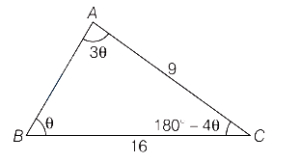
In a $\triangle ABC$,if $\angle A = 3\angle B$,$CA = 9$,and $BC = 16$,then the length of $AB$ is
A
$\frac{5}{3}$
B
$\frac{7}{3}$
C
$2$
D
$\frac{35}{3}$
Solution
(D) Let $\angle B = \theta$. Then $\angle A = 3\theta$. Since the sum of angles in a triangle is $180^{\circ}$,$\angle C = 180^{\circ} - (A + B) = 180^{\circ} - 4\theta$.
Using the sine rule,$\frac{AB}{\sin C} = \frac{BC}{\sin A} = \frac{AC}{\sin B}$.
Substituting the given values: $\frac{AB}{\sin(180^{\circ} - 4\theta)} = \frac{16}{\sin 3\theta} = \frac{9}{\sin \theta}$.
From $\frac{16}{\sin 3\theta} = \frac{9}{\sin \theta}$,we have $16 \sin \theta = 9 \sin 3\theta = 9(3 \sin \theta - 4 \sin^3 \theta)$.
Dividing by $\sin \theta$ (since $\sin \theta \neq 0$),$16 = 27 - 36 \sin^2 \theta$,which gives $36 \sin^2 \theta = 11$,so $\sin^2 \theta = \frac{11}{36}$.
Then $\cos^2 \theta = 1 - \frac{11}{36} = \frac{25}{36}$,so $\cos \theta = \frac{5}{6}$.
Now,$\sin 4\theta = 2 \sin 2\theta \cos 2\theta = 4 \sin \theta \cos \theta (1 - 2 \sin^2 \theta) = 4 \times \frac{\sqrt{11}}{6} \times \frac{5}{6} \times (1 - 2 \times \frac{11}{36}) = \frac{20\sqrt{11}}{36} \times (1 - \frac{11}{18}) = \frac{5\sqrt{11}}{9} \times \frac{7}{18} = \frac{35\sqrt{11}}{162}$.
Finally,$AB = \frac{9 \sin 4\theta}{\sin \theta} = 9 \times \frac{35\sqrt{11}}{162} \times \frac{6}{\sqrt{11}} = \frac{35}{3}$.
Using the sine rule,$\frac{AB}{\sin C} = \frac{BC}{\sin A} = \frac{AC}{\sin B}$.
Substituting the given values: $\frac{AB}{\sin(180^{\circ} - 4\theta)} = \frac{16}{\sin 3\theta} = \frac{9}{\sin \theta}$.
From $\frac{16}{\sin 3\theta} = \frac{9}{\sin \theta}$,we have $16 \sin \theta = 9 \sin 3\theta = 9(3 \sin \theta - 4 \sin^3 \theta)$.
Dividing by $\sin \theta$ (since $\sin \theta \neq 0$),$16 = 27 - 36 \sin^2 \theta$,which gives $36 \sin^2 \theta = 11$,so $\sin^2 \theta = \frac{11}{36}$.
Then $\cos^2 \theta = 1 - \frac{11}{36} = \frac{25}{36}$,so $\cos \theta = \frac{5}{6}$.
Now,$\sin 4\theta = 2 \sin 2\theta \cos 2\theta = 4 \sin \theta \cos \theta (1 - 2 \sin^2 \theta) = 4 \times \frac{\sqrt{11}}{6} \times \frac{5}{6} \times (1 - 2 \times \frac{11}{36}) = \frac{20\sqrt{11}}{36} \times (1 - \frac{11}{18}) = \frac{5\sqrt{11}}{9} \times \frac{7}{18} = \frac{35\sqrt{11}}{162}$.
Finally,$AB = \frac{9 \sin 4\theta}{\sin \theta} = 9 \times \frac{35\sqrt{11}}{162} \times \frac{6}{\sqrt{11}} = \frac{35}{3}$.
0 likesView Solution
302
MathematicsDifficultMCQTS EAMCET · 2020
In a $\triangle ABC$,$(b^2-c^2) \cot A + (c^2-a^2) \cot B =$
A
$0$
B
$2R^2(\sin 2A - \sin 2B)$
C
$(b^2-a^2) \cot(A+B)$
D
$2R^2(\tan 2A - \tan 2B)$
Solution
(B) In $\triangle ABC$,we have $a = 2R \sin A$,$b = 2R \sin B$,and $c = 2R \sin C$.
Substituting these into the expression $(b^2-c^2) \cot A + (c^2-a^2) \cot B$:
$= 4R^2(\sin^2 B - \sin^2 C) \cot A + 4R^2(\sin^2 C - \sin^2 A) \cot B$
$= 4R^2[\sin(B+C)\sin(B-C) \frac{\cos A}{\sin A} + \sin(C+A)\sin(C-A) \frac{\cos B}{\sin B}]$
Since $A+B+C = \pi$,we have $\sin(B+C) = \sin A$ and $\sin(C+A) = \sin B$.
$= 4R^2[\sin A \sin(B-C) \frac{\cos A}{\sin A} + \sin B \sin(C-A) \frac{\cos B}{\sin B}]$
$= 4R^2[\sin(B-C)\cos A + \sin(C-A)\cos B]$
$= 4R^2[\sin(B-C)(-\cos(B+C)) + \sin(C-A)(-\cos(C+A))]$
$= 2R^2[-(2\sin(B-C)\cos(B+C)) - (2\sin(C-A)\cos(C+A))]$
$= 2R^2[-(\sin 2B - \sin 2C) - (\sin 2C - \sin 2A)]$
$= 2R^2[\sin 2A - \sin 2B]$
Substituting these into the expression $(b^2-c^2) \cot A + (c^2-a^2) \cot B$:
$= 4R^2(\sin^2 B - \sin^2 C) \cot A + 4R^2(\sin^2 C - \sin^2 A) \cot B$
$= 4R^2[\sin(B+C)\sin(B-C) \frac{\cos A}{\sin A} + \sin(C+A)\sin(C-A) \frac{\cos B}{\sin B}]$
Since $A+B+C = \pi$,we have $\sin(B+C) = \sin A$ and $\sin(C+A) = \sin B$.
$= 4R^2[\sin A \sin(B-C) \frac{\cos A}{\sin A} + \sin B \sin(C-A) \frac{\cos B}{\sin B}]$
$= 4R^2[\sin(B-C)\cos A + \sin(C-A)\cos B]$
$= 4R^2[\sin(B-C)(-\cos(B+C)) + \sin(C-A)(-\cos(C+A))]$
$= 2R^2[-(2\sin(B-C)\cos(B+C)) - (2\sin(C-A)\cos(C+A))]$
$= 2R^2[-(\sin 2B - \sin 2C) - (\sin 2C - \sin 2A)]$
$= 2R^2[\sin 2A - \sin 2B]$
0 likesView Solution
303
MathematicsDifficultMCQTS EAMCET · 2020
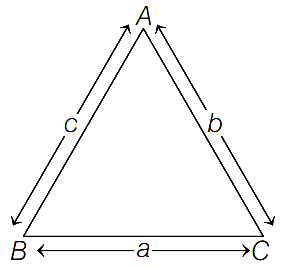
In a $\triangle ABC$,$\cot A+\cot B+\cot C=$
A
$\frac{a^2+b^2+c^2}{\Delta}$
B
$\frac{a+b+c}{4 \Delta}$
C
$\frac{a^2+b^2+c^2}{4 \Delta}$
D
$\frac{a^2+b^2+c^2}{2 \Delta}$
Solution
(C) Let a triangle $ABC$ have sides $a, b, c$ and area $\Delta$.
We know that the area $\Delta = \frac{1}{2}bc \sin A = \frac{1}{2}ac \sin B = \frac{1}{2}ab \sin C$.
From the cosine rule,we have $a^2 = b^2+c^2-2bc \cos A$,$b^2 = a^2+c^2-2ac \cos B$,and $c^2 = a^2+b^2-2ab \cos C$.
Adding these three equations gives $a^2+b^2+c^2 = 2(a^2+b^2+c^2) - 2(bc \cos A + ac \cos B + ab \cos C)$.
Rearranging,we get $a^2+b^2+c^2 = 2(bc \cos A + ac \cos B + ab \cos C)$.
Since $\Delta = \frac{1}{2}bc \sin A$,we have $bc = \frac{2\Delta}{\sin A}$. Similarly,$ac = \frac{2\Delta}{\sin B}$ and $ab = \frac{2\Delta}{\sin C}$.
Substituting these into the equation:
$a^2+b^2+c^2 = 2 \left( \frac{2\Delta}{\sin A} \cos A + \frac{2\Delta}{\sin B} \cos B + \frac{2\Delta}{\sin C} \cos C \right)$
$a^2+b^2+c^2 = 4\Delta (\cot A + \cot B + \cot C)$
Therefore,$\cot A + \cot B + \cot C = \frac{a^2+b^2+c^2}{4\Delta}$.
We know that the area $\Delta = \frac{1}{2}bc \sin A = \frac{1}{2}ac \sin B = \frac{1}{2}ab \sin C$.
From the cosine rule,we have $a^2 = b^2+c^2-2bc \cos A$,$b^2 = a^2+c^2-2ac \cos B$,and $c^2 = a^2+b^2-2ab \cos C$.
Adding these three equations gives $a^2+b^2+c^2 = 2(a^2+b^2+c^2) - 2(bc \cos A + ac \cos B + ab \cos C)$.
Rearranging,we get $a^2+b^2+c^2 = 2(bc \cos A + ac \cos B + ab \cos C)$.
Since $\Delta = \frac{1}{2}bc \sin A$,we have $bc = \frac{2\Delta}{\sin A}$. Similarly,$ac = \frac{2\Delta}{\sin B}$ and $ab = \frac{2\Delta}{\sin C}$.
Substituting these into the equation:
$a^2+b^2+c^2 = 2 \left( \frac{2\Delta}{\sin A} \cos A + \frac{2\Delta}{\sin B} \cos B + \frac{2\Delta}{\sin C} \cos C \right)$
$a^2+b^2+c^2 = 4\Delta (\cot A + \cot B + \cot C)$
Therefore,$\cot A + \cot B + \cot C = \frac{a^2+b^2+c^2}{4\Delta}$.
0 likesView Solution
304
MathematicsMediumMCQTS EAMCET · 2020
In a triangle $ABC$,if $a < b < c$ and $\frac{a^3+b^3+c^3}{\sin^3 A+\sin^3 B+\sin^3 C}=8$,then the maximum value of $c$ is
A
$3$
B
$4$
C
$2$
D
$6$
Solution
(C) Given that,$\frac{a^3+b^3+c^3}{\sin^3 A+\sin^3 B+\sin^3 C}=8$ $(i)$
Using the sine rule for a triangle $ABC$,we have $\frac{a}{\sin A} = \frac{b}{\sin B} = \frac{c}{\sin C} = 2R$,where $R$ is the circumradius.
Thus,$a = 2R \sin A$,$b = 2R \sin B$,and $c = 2R \sin C$.
Substituting these into equation $(i)$:
$\frac{(2R \sin A)^3 + (2R \sin B)^3 + (2R \sin C)^3}{\sin^3 A + \sin^3 B + \sin^3 C} = 8$
$\frac{(2R)^3 (\sin^3 A + \sin^3 B + \sin^3 C)}{\sin^3 A + \sin^3 B + \sin^3 C} = 8$
$(2R)^3 = 8 \implies 2R = 2 \implies R = 1$.
Since $c = 2R \sin C = 2 \sin C$,and the maximum value of $\sin C$ is $1$ (as $C < 180^\circ$),the maximum value of $c$ is $2 \times 1 = 2$.
Using the sine rule for a triangle $ABC$,we have $\frac{a}{\sin A} = \frac{b}{\sin B} = \frac{c}{\sin C} = 2R$,where $R$ is the circumradius.
Thus,$a = 2R \sin A$,$b = 2R \sin B$,and $c = 2R \sin C$.
Substituting these into equation $(i)$:
$\frac{(2R \sin A)^3 + (2R \sin B)^3 + (2R \sin C)^3}{\sin^3 A + \sin^3 B + \sin^3 C} = 8$
$\frac{(2R)^3 (\sin^3 A + \sin^3 B + \sin^3 C)}{\sin^3 A + \sin^3 B + \sin^3 C} = 8$
$(2R)^3 = 8 \implies 2R = 2 \implies R = 1$.
Since $c = 2R \sin C = 2 \sin C$,and the maximum value of $\sin C$ is $1$ (as $C < 180^\circ$),the maximum value of $c$ is $2 \times 1 = 2$.
0 likesView Solution
305
MathematicsMediumMCQTS EAMCET · 2020
In $\triangle ABC$,if $a^2-c^2=b(b-c)$,$\sqrt{2}a=2b-c$ and $R=\frac{1}{\sqrt{3}}$,then $b=$
A
$\frac{\sqrt{2}}{\sqrt{3}}$
B
$\frac{\sqrt{3}-1}{\sqrt{6}}$
C
$\frac{\sqrt{3}+1}{\sqrt{6}}$
D
$\frac{\sqrt{3}}{\sqrt{2}}$
Solution
(C) Given: $a^2-c^2=b^2-bc$ $\Rightarrow a^2-c^2=b^2-bc$ $\Rightarrow b^2+c^2-a^2=bc$.
Using the cosine rule,$\cos A = \frac{b^2+c^2-a^2}{2bc} = \frac{bc}{2bc} = \frac{1}{2}$.
Thus,$A = 60^{\circ}$.
Using the sine rule,$\frac{a}{\sin A} = 2R$ $\Rightarrow \frac{a}{\sin 60^{\circ}} = 2 \times \frac{1}{\sqrt{3}}$ $\Rightarrow a = \frac{2}{\sqrt{3}} \times \frac{\sqrt{3}}{2} = 1$.
Given $\sqrt{2}a = 2b-c$,substitute $a=1$: $\sqrt{2} = 2b-c \Rightarrow c = 2b-\sqrt{2}$.
Substitute $c$ into $a^2-c^2=b^2-bc$: $1^2 - (2b-\sqrt{2})^2 = b^2 - b(2b-\sqrt{2})$.
$1 - (4b^2 - 4\sqrt{2}b + 2) = b^2 - 2b^2 + \sqrt{2}b$.
$1 - 4b^2 + 4\sqrt{2}b - 2 = -b^2 + \sqrt{2}b$.
$-3b^2 + 3\sqrt{2}b - 1 = 0 \Rightarrow 3b^2 - 3\sqrt{2}b + 1 = 0$.
Using the quadratic formula $b = \frac{-(-3\sqrt{2}) \pm \sqrt{(-3\sqrt{2})^2 - 4(3)(1)}}{2(3)} = \frac{3\sqrt{2} \pm \sqrt{18-12}}{6} = \frac{3\sqrt{2} \pm \sqrt{6}}{6} = \frac{\sqrt{2}}{2} \pm \frac{\sqrt{6}}{6} = \frac{\sqrt{2}}{2} + \frac{\sqrt{6}}{6} = \frac{3\sqrt{2}+\sqrt{6}}{6} = \frac{\sqrt{3}+1}{\sqrt{6}}$.
Using the cosine rule,$\cos A = \frac{b^2+c^2-a^2}{2bc} = \frac{bc}{2bc} = \frac{1}{2}$.
Thus,$A = 60^{\circ}$.
Using the sine rule,$\frac{a}{\sin A} = 2R$ $\Rightarrow \frac{a}{\sin 60^{\circ}} = 2 \times \frac{1}{\sqrt{3}}$ $\Rightarrow a = \frac{2}{\sqrt{3}} \times \frac{\sqrt{3}}{2} = 1$.
Given $\sqrt{2}a = 2b-c$,substitute $a=1$: $\sqrt{2} = 2b-c \Rightarrow c = 2b-\sqrt{2}$.
Substitute $c$ into $a^2-c^2=b^2-bc$: $1^2 - (2b-\sqrt{2})^2 = b^2 - b(2b-\sqrt{2})$.
$1 - (4b^2 - 4\sqrt{2}b + 2) = b^2 - 2b^2 + \sqrt{2}b$.
$1 - 4b^2 + 4\sqrt{2}b - 2 = -b^2 + \sqrt{2}b$.
$-3b^2 + 3\sqrt{2}b - 1 = 0 \Rightarrow 3b^2 - 3\sqrt{2}b + 1 = 0$.
Using the quadratic formula $b = \frac{-(-3\sqrt{2}) \pm \sqrt{(-3\sqrt{2})^2 - 4(3)(1)}}{2(3)} = \frac{3\sqrt{2} \pm \sqrt{18-12}}{6} = \frac{3\sqrt{2} \pm \sqrt{6}}{6} = \frac{\sqrt{2}}{2} \pm \frac{\sqrt{6}}{6} = \frac{\sqrt{2}}{2} + \frac{\sqrt{6}}{6} = \frac{3\sqrt{2}+\sqrt{6}}{6} = \frac{\sqrt{3}+1}{\sqrt{6}}$.
0 likesView Solution
306
MathematicsMediumMCQTS EAMCET · 2020
In a $\triangle ABC$,if $\tan A : \tan B : \tan C = 1 : 2 : 3$ and $\sin A : \sin B : \sin C = \sqrt{5} : 2\sqrt{2} : k$,then $k =$
A
$\sqrt{2}$
B
$2$
C
$\sqrt{3}$
D
$3$
Solution
(D) Given,$\tan A : \tan B : \tan C = 1 : 2 : 3$.
We know that $\tan A = \frac{\sin A}{\cos A} = \frac{a/2R}{(b^2+c^2-a^2)/2bc} = \frac{abc}{R(b^2+c^2-a^2)}$.
Thus,$\tan A : \tan B : \tan C = \frac{1}{b^2+c^2-a^2} : \frac{1}{a^2+c^2-b^2} : \frac{1}{a^2+b^2-c^2} = 1 : 2 : 3$.
Let $b^2+c^2-a^2 = x$,$a^2+c^2-b^2 = 2x$,and $a^2+b^2-c^2 = 3x$.
Adding these equations,we get $a^2+b^2+c^2 = 3x$.
Then $a^2 = (a^2+b^2+c^2) - (b^2+c^2-a^2) = 3x - x = 2x$.
$b^2 = (a^2+b^2+c^2) - (a^2+c^2-b^2) = 3x - 2x = x$.
$c^2 = (a^2+b^2+c^2) - (a^2+b^2-c^2) = 3x - 3x = 0$.
Wait,the ratio of sides $a:b:c$ is proportional to $\sin A : \sin B : \sin C$.
Using the property $\tan A : \tan B : \tan C = l : m : n$,we have $a : b : c = \sqrt{\frac{1}{m} + \frac{1}{n}} : \sqrt{\frac{1}{n} + \frac{1}{l}} : \sqrt{\frac{1}{l} + \frac{1}{m}}$.
Substituting $l=1, m=2, n=3$:
$a : b : c = \sqrt{\frac{1}{2} + \frac{1}{3}} : \sqrt{\frac{1}{3} + 1} : \sqrt{1 + \frac{1}{2}} = \sqrt{\frac{5}{6}} : \sqrt{\frac{4}{3}} : \sqrt{\frac{3}{2}} = \sqrt{\frac{5}{6}} : \sqrt{\frac{8}{6}} : \sqrt{\frac{9}{6}} = \sqrt{5} : 2\sqrt{2} : 3$.
Since $\sin A : \sin B : \sin C = a : b : c$,we have $\sqrt{5} : 2\sqrt{2} : k = \sqrt{5} : 2\sqrt{2} : 3$.
Therefore,$k = 3$.
We know that $\tan A = \frac{\sin A}{\cos A} = \frac{a/2R}{(b^2+c^2-a^2)/2bc} = \frac{abc}{R(b^2+c^2-a^2)}$.
Thus,$\tan A : \tan B : \tan C = \frac{1}{b^2+c^2-a^2} : \frac{1}{a^2+c^2-b^2} : \frac{1}{a^2+b^2-c^2} = 1 : 2 : 3$.
Let $b^2+c^2-a^2 = x$,$a^2+c^2-b^2 = 2x$,and $a^2+b^2-c^2 = 3x$.
Adding these equations,we get $a^2+b^2+c^2 = 3x$.
Then $a^2 = (a^2+b^2+c^2) - (b^2+c^2-a^2) = 3x - x = 2x$.
$b^2 = (a^2+b^2+c^2) - (a^2+c^2-b^2) = 3x - 2x = x$.
$c^2 = (a^2+b^2+c^2) - (a^2+b^2-c^2) = 3x - 3x = 0$.
Wait,the ratio of sides $a:b:c$ is proportional to $\sin A : \sin B : \sin C$.
Using the property $\tan A : \tan B : \tan C = l : m : n$,we have $a : b : c = \sqrt{\frac{1}{m} + \frac{1}{n}} : \sqrt{\frac{1}{n} + \frac{1}{l}} : \sqrt{\frac{1}{l} + \frac{1}{m}}$.
Substituting $l=1, m=2, n=3$:
$a : b : c = \sqrt{\frac{1}{2} + \frac{1}{3}} : \sqrt{\frac{1}{3} + 1} : \sqrt{1 + \frac{1}{2}} = \sqrt{\frac{5}{6}} : \sqrt{\frac{4}{3}} : \sqrt{\frac{3}{2}} = \sqrt{\frac{5}{6}} : \sqrt{\frac{8}{6}} : \sqrt{\frac{9}{6}} = \sqrt{5} : 2\sqrt{2} : 3$.
Since $\sin A : \sin B : \sin C = a : b : c$,we have $\sqrt{5} : 2\sqrt{2} : k = \sqrt{5} : 2\sqrt{2} : 3$.
Therefore,$k = 3$.
0 likesView Solution
307
MathematicsEasyMCQTS EAMCET · 2020
If the sides of a triangle are in the ratio $\sqrt{3} : \sqrt{5} : \sqrt{8+\sqrt{15}}$,then the largest angle in that triangle is
A
$\frac{2 \pi}{3}$
B
$\frac{\pi}{2}$
C
$\frac{\pi}{3}$
D
$\frac{5 \pi}{6}$
Solution
(A) Let the sides of the triangle be $a = \sqrt{3}k$,$b = \sqrt{5}k$,and $c = \sqrt{8+\sqrt{15}}k$.
Since $c$ is the largest side,the largest angle $\theta$ is opposite to side $c$.
Using the Law of Cosines: $\cos \theta = \frac{a^2 + b^2 - c^2}{2ab}$.
Substituting the values: $\cos \theta = \frac{(\sqrt{3}k)^2 + (\sqrt{5}k)^2 - (\sqrt{8+\sqrt{15}}k)^2}{2(\sqrt{3}k)(\sqrt{5}k)}$.
$\cos \theta = \frac{3k^2 + 5k^2 - (8+\sqrt{15})k^2}{2\sqrt{15}k^2}$.
$\cos \theta = \frac{8k^2 - 8k^2 - \sqrt{15}k^2}{2\sqrt{15}k^2} = \frac{-\sqrt{15}k^2}{2\sqrt{15}k^2} = -\frac{1}{2}$.
Since $\cos \theta = -\frac{1}{2}$,the angle $\theta = \frac{2\pi}{3}$.
Since $c$ is the largest side,the largest angle $\theta$ is opposite to side $c$.
Using the Law of Cosines: $\cos \theta = \frac{a^2 + b^2 - c^2}{2ab}$.
Substituting the values: $\cos \theta = \frac{(\sqrt{3}k)^2 + (\sqrt{5}k)^2 - (\sqrt{8+\sqrt{15}}k)^2}{2(\sqrt{3}k)(\sqrt{5}k)}$.
$\cos \theta = \frac{3k^2 + 5k^2 - (8+\sqrt{15})k^2}{2\sqrt{15}k^2}$.
$\cos \theta = \frac{8k^2 - 8k^2 - \sqrt{15}k^2}{2\sqrt{15}k^2} = \frac{-\sqrt{15}k^2}{2\sqrt{15}k^2} = -\frac{1}{2}$.
Since $\cos \theta = -\frac{1}{2}$,the angle $\theta = \frac{2\pi}{3}$.
0 likesView Solution
308
MathematicsEasyMCQTS EAMCET · 2020
The perimeter of a $\triangle ABC$ is $6$ times the arithmetic mean of the values of the sine of its angles. If its side $BC$ is of unit length,then $\angle A=$
A
$\frac{\pi}{6}$
B
$\frac{\pi}{3}$
C
$\frac{\pi}{2}$
D
$\pi$
Solution
(A) The perimeter of $\triangle ABC$ is $a+b+c$. The arithmetic mean of the sines of its angles is $\frac{\sin A + \sin B + \sin C}{3}$.
Given: $a+b+c = 6 \times \left(\frac{\sin A + \sin B + \sin C}{3}\right) = 2(\sin A + \sin B + \sin C)$.
Using the Sine Rule,$a = 2R \sin A$,$b = 2R \sin B$,and $c = 2R \sin C$,we have:
$2R(\sin A + \sin B + \sin C) = 2(\sin A + \sin B + \sin C)$.
This implies $2R = 2$,so $R = 1$.
Given $BC = a = 1$,we use $a = 2R \sin A$:
$1 = 2(1) \sin A \implies \sin A = \frac{1}{2}$.
Since $A$ is an angle of a triangle,$A = 30^{\circ} = \frac{\pi}{6}$.
Given: $a+b+c = 6 \times \left(\frac{\sin A + \sin B + \sin C}{3}\right) = 2(\sin A + \sin B + \sin C)$.
Using the Sine Rule,$a = 2R \sin A$,$b = 2R \sin B$,and $c = 2R \sin C$,we have:
$2R(\sin A + \sin B + \sin C) = 2(\sin A + \sin B + \sin C)$.
This implies $2R = 2$,so $R = 1$.
Given $BC = a = 1$,we use $a = 2R \sin A$:
$1 = 2(1) \sin A \implies \sin A = \frac{1}{2}$.
Since $A$ is an angle of a triangle,$A = 30^{\circ} = \frac{\pi}{6}$.
0 likesView Solution
309
MathematicsEasyMCQTS EAMCET · 2020
If $d_1, d_2, d_3$ are the diameters of three ex-circles of a $\triangle ABC$,then $d_1 d_2 + d_2 d_3 + d_3 d_1 =$
A
$(a+b+c)^2$
B
$ab + bc + ca$
C
$4 \Delta^2$
D
$4s^3$
Solution
(A) The diameters of the ex-circles are given by $d_1 = \frac{2\Delta}{s-a}$,$d_2 = \frac{2\Delta}{s-b}$,and $d_3 = \frac{2\Delta}{s-c}$.
We need to calculate $d_1 d_2 + d_2 d_3 + d_3 d_1 = \frac{4\Delta^2}{(s-a)(s-b)} + \frac{4\Delta^2}{(s-b)(s-c)} + \frac{4\Delta^2}{(s-c)(s-a)}$.
Taking $4\Delta^2$ as a common factor,we get $4\Delta^2 \left[ \frac{(s-c) + (s-a) + (s-b)}{(s-a)(s-b)(s-c)} \right]$.
Since $a+b+c = 2s$,the numerator becomes $3s - (a+b+c) = 3s - 2s = s$.
Thus,the expression becomes $\frac{4\Delta^2 \cdot s}{(s-a)(s-b)(s-c)}$.
Using Heron's formula,$\Delta^2 = s(s-a)(s-b)(s-c)$,so $(s-a)(s-b)(s-c) = \frac{\Delta^2}{s}$.
Substituting this,we get $\frac{4\Delta^2 \cdot s}{\Delta^2 / s} = 4s^2 = (2s)^2 = (a+b+c)^2$.
We need to calculate $d_1 d_2 + d_2 d_3 + d_3 d_1 = \frac{4\Delta^2}{(s-a)(s-b)} + \frac{4\Delta^2}{(s-b)(s-c)} + \frac{4\Delta^2}{(s-c)(s-a)}$.
Taking $4\Delta^2$ as a common factor,we get $4\Delta^2 \left[ \frac{(s-c) + (s-a) + (s-b)}{(s-a)(s-b)(s-c)} \right]$.
Since $a+b+c = 2s$,the numerator becomes $3s - (a+b+c) = 3s - 2s = s$.
Thus,the expression becomes $\frac{4\Delta^2 \cdot s}{(s-a)(s-b)(s-c)}$.
Using Heron's formula,$\Delta^2 = s(s-a)(s-b)(s-c)$,so $(s-a)(s-b)(s-c) = \frac{\Delta^2}{s}$.
Substituting this,we get $\frac{4\Delta^2 \cdot s}{\Delta^2 / s} = 4s^2 = (2s)^2 = (a+b+c)^2$.
0 likesView Solution
310
MathematicsMediumMCQTS EAMCET · 2020
In a $\triangle ABC$,if $b=10$,$a \cos^2 \frac{C}{2} + c \cos^2 \frac{A}{2} = 15$,and the area of the triangle is $15\sqrt{3}$ sq. units,then $\cot \frac{B}{2} =$
A
$\frac{3}{2}$
B
$\frac{1}{2}$
C
$\frac{2}{\sqrt{3}}$
D
$\frac{5}{\sqrt{3}}$
Solution
(D) Given $a \cos^2 \frac{C}{2} + c \cos^2 \frac{A}{2} = 15$.
Using $\cos^2 \theta = \frac{1+\cos 2\theta}{2}$,we get $\frac{a(1+\cos C)}{2} + \frac{c(1+\cos A)}{2} = 15$.
$\Rightarrow (a+c) + (a \cos C + c \cos A) = 30$.
Since $a \cos C + c \cos A = b$,we have $a+c+b = 30$.
Given $b=10$,so $a+c = 20$.
The semi-perimeter $s = \frac{a+b+c}{2} = \frac{30}{2} = 15$.
Area $\Delta = \sqrt{s(s-a)(s-b)(s-c)} = 15\sqrt{3}$.
$15\sqrt{3} = \sqrt{15(15-a)(15-10)(15-c)} = \sqrt{75(15-a)(15-c)}$.
Squaring both sides: $225 \times 3 = 75(15-a)(15-c) \Rightarrow 9 = (15-a)(15-c) = 225 - 15(a+c) + ac$.
$9 = 225 - 15(20) + ac$ $\Rightarrow 9 = 225 - 300 + ac$ $\Rightarrow ac = 84$.
Area $\Delta = \frac{1}{2}ac \sin B = 15\sqrt{3}$ $\Rightarrow \frac{1}{2}(84) \sin B = 15\sqrt{3}$ $\Rightarrow 42 \sin B = 15\sqrt{3}$ $\Rightarrow \sin B = \frac{5\sqrt{3}}{14}$.
Then $\cos^2 B = 1 - \sin^2 B = 1 - \frac{75}{196} = \frac{121}{196} \Rightarrow \cos B = \frac{11}{14}$.
Finally,$\cot \frac{B}{2} = \sqrt{\frac{1+\cos B}{1-\cos B}} = \sqrt{\frac{1 + 11/14}{1 - 11/14}} = \sqrt{\frac{25/14}{3/14}} = \sqrt{\frac{25}{3}} = \frac{5}{\sqrt{3}}$.
Using $\cos^2 \theta = \frac{1+\cos 2\theta}{2}$,we get $\frac{a(1+\cos C)}{2} + \frac{c(1+\cos A)}{2} = 15$.
$\Rightarrow (a+c) + (a \cos C + c \cos A) = 30$.
Since $a \cos C + c \cos A = b$,we have $a+c+b = 30$.
Given $b=10$,so $a+c = 20$.
The semi-perimeter $s = \frac{a+b+c}{2} = \frac{30}{2} = 15$.
Area $\Delta = \sqrt{s(s-a)(s-b)(s-c)} = 15\sqrt{3}$.
$15\sqrt{3} = \sqrt{15(15-a)(15-10)(15-c)} = \sqrt{75(15-a)(15-c)}$.
Squaring both sides: $225 \times 3 = 75(15-a)(15-c) \Rightarrow 9 = (15-a)(15-c) = 225 - 15(a+c) + ac$.
$9 = 225 - 15(20) + ac$ $\Rightarrow 9 = 225 - 300 + ac$ $\Rightarrow ac = 84$.
Area $\Delta = \frac{1}{2}ac \sin B = 15\sqrt{3}$ $\Rightarrow \frac{1}{2}(84) \sin B = 15\sqrt{3}$ $\Rightarrow 42 \sin B = 15\sqrt{3}$ $\Rightarrow \sin B = \frac{5\sqrt{3}}{14}$.
Then $\cos^2 B = 1 - \sin^2 B = 1 - \frac{75}{196} = \frac{121}{196} \Rightarrow \cos B = \frac{11}{14}$.
Finally,$\cot \frac{B}{2} = \sqrt{\frac{1+\cos B}{1-\cos B}} = \sqrt{\frac{1 + 11/14}{1 - 11/14}} = \sqrt{\frac{25/14}{3/14}} = \sqrt{\frac{25}{3}} = \frac{5}{\sqrt{3}}$.
0 likesView Solution
311
MathematicsEasyMCQTS EAMCET · 2020
In any triangle $ABC$,find the value of $\cos ^2 \frac{A}{2}+\cos ^2 \frac{B}{2}+\cos ^2 \frac{C}{2}$.
A
$1+\frac{r}{2R}$
B
$2-\frac{r}{2R}$
C
$2+\frac{r}{4R}$
D
$2+\frac{r}{2R}$
Solution
(D) We use the identity $\cos^2 \theta = \frac{1+\cos(2\theta)}{2}$.
Thus,$\cos ^2 \frac{A}{2}+\cos ^2 \frac{B}{2}+\cos ^2 \frac{C}{2} = \frac{1+\cos A}{2} + \frac{1+\cos B}{2} + \frac{1+\cos C}{2}$.
$= \frac{1}{2} \{3 + (\cos A + \cos B + \cos C)\}$.
Using the identity $\cos A + \cos B + \cos C = 1 + \frac{r}{R}$,where $r$ is the inradius and $R$ is the circumradius of the triangle:
$= \frac{1}{2} \{3 + 1 + \frac{r}{R}\}$.
$= \frac{1}{2} \{4 + \frac{r}{R}\}$.
$= 2 + \frac{r}{2R}$.
Thus,$\cos ^2 \frac{A}{2}+\cos ^2 \frac{B}{2}+\cos ^2 \frac{C}{2} = \frac{1+\cos A}{2} + \frac{1+\cos B}{2} + \frac{1+\cos C}{2}$.
$= \frac{1}{2} \{3 + (\cos A + \cos B + \cos C)\}$.
Using the identity $\cos A + \cos B + \cos C = 1 + \frac{r}{R}$,where $r$ is the inradius and $R$ is the circumradius of the triangle:
$= \frac{1}{2} \{3 + 1 + \frac{r}{R}\}$.
$= \frac{1}{2} \{4 + \frac{r}{R}\}$.
$= 2 + \frac{r}{2R}$.
0 likesView Solution
312
MathematicsEasyMCQTS EAMCET · 2020
In a $\triangle ABC$,let $a, b, c, s, r, R, I, S, r_1, r_2, r_3$ stand for their usual meanings. Match the items of List-$I$ with those of List-$II$.
The correct match is:
| List-$I$ | List-$II$ |
| $A. \tan \frac{A}{2} = \frac{r}{s-a}$ | $I. (AI) \left( \frac{\sqrt{(s-b)(s-c)}}{bc} \right)$ |
| $B. r$ | $II. R^2$ |
| $C. (SI)^2 + 2Rr$ | $III. (4R + r + \sqrt{2}s)(4R + r - \sqrt{2}s)$ |
| $D. r_1^2 + r_2^2 + r_3^2$ | $IV. \frac{Rr}{S}$ |
| $V. \frac{(s-b)(s-c)}{\Delta}$ |
The correct match is:
A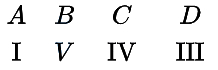
B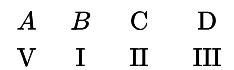
C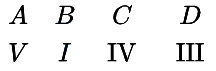
D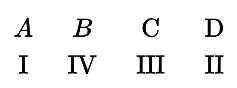
Solution
(C) . $\because \tan \frac{A}{2} = \sqrt{\frac{(s-b)(s-c)}{s(s-a)}} = \frac{(s-b)(s-c)}{\Delta}$.
Also,$\frac{r}{s-a} = \frac{\Delta}{s(s-a)} = \sqrt{\frac{(s-b)(s-c)}{s(s-a)}} = \frac{(s-b)(s-c)}{\Delta}$.
$\therefore \tan \frac{A}{2} = \frac{r}{s-a} = \frac{(s-b)(s-c)}{\Delta}$. Thus,$A-V$.
$B$. From the figure,$r = IF = (AI) \sin \frac{A}{2} = (AI) \sqrt{\frac{(s-b)(s-c)}{bc}}$. Thus,$B-I$.
$C$. $SI$ is the distance between the circumcentre and in-centre,given by $SI = \sqrt{R^2 - 2rR}$.
Squaring gives $(SI)^2 = R^2 - 2rR$,so $(SI)^2 + 2Rr = R^2$. Thus,$C-II$.
$D$. We know $r_1 + r_2 + r_3 = 4R + r$.
Squaring both sides: $r_1^2 + r_2^2 + r_3^2 = (4R + r)^2 - 2(r_1r_2 + r_2r_3 + r_3r_1)$.
Using $r_1r_2 + r_2r_3 + r_3r_1 = s^2$,we get $r_1^2 + r_2^2 + r_3^2 = (4R + r)^2 - 2s^2 = (4R + r + \sqrt{2}s)(4R + r - \sqrt{2}s)$. Thus,$D-III$.
Also,$\frac{r}{s-a} = \frac{\Delta}{s(s-a)} = \sqrt{\frac{(s-b)(s-c)}{s(s-a)}} = \frac{(s-b)(s-c)}{\Delta}$.
$\therefore \tan \frac{A}{2} = \frac{r}{s-a} = \frac{(s-b)(s-c)}{\Delta}$. Thus,$A-V$.
$B$. From the figure,$r = IF = (AI) \sin \frac{A}{2} = (AI) \sqrt{\frac{(s-b)(s-c)}{bc}}$. Thus,$B-I$.
$C$. $SI$ is the distance between the circumcentre and in-centre,given by $SI = \sqrt{R^2 - 2rR}$.
Squaring gives $(SI)^2 = R^2 - 2rR$,so $(SI)^2 + 2Rr = R^2$. Thus,$C-II$.
$D$. We know $r_1 + r_2 + r_3 = 4R + r$.
Squaring both sides: $r_1^2 + r_2^2 + r_3^2 = (4R + r)^2 - 2(r_1r_2 + r_2r_3 + r_3r_1)$.
Using $r_1r_2 + r_2r_3 + r_3r_1 = s^2$,we get $r_1^2 + r_2^2 + r_3^2 = (4R + r)^2 - 2s^2 = (4R + r + \sqrt{2}s)(4R + r - \sqrt{2}s)$. Thus,$D-III$.
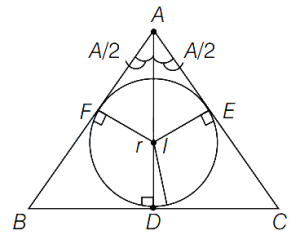
0 likesView Solution
313
MathematicsMediumMCQTS EAMCET · 2020
In a triangle $ABC$,if $c=9, s=10$ and $\Delta=10\sqrt{2}$,then $b\left[1+\sqrt{2}\tan\left(\frac{A-B}{2}\right)\right]=$
A
$a\left[1-\sqrt{2}\tan\left(\frac{A-B}{2}\right)\right]$
B
$c\left[1-\sqrt{2}\tan\left(\frac{A-B}{2}\right)\right]$
C
$a\left[\sqrt{2}\tan\left(\frac{A-B}{2}\right)-1\right]$
D
$c\left[\sqrt{2}\tan\left(\frac{A-B}{2}\right)-1\right]$
Solution
(A) Given for triangle $ABC$: $c=9, s=10, \Delta=10\sqrt{2}$.
Using Napier's Analogy: $\tan\left(\frac{A-B}{2}\right) = \frac{a-b}{a+b}\cot\left(\frac{C}{2}\right)$.
We know $\cot\left(\frac{C}{2}\right) = \frac{s(s-c)}{\Delta} = \frac{10(10-9)}{10\sqrt{2}} = \frac{1}{\sqrt{2}}$.
Thus,$\tan\left(\frac{A-B}{2}\right) = \frac{a-b}{a+b} \cdot \frac{1}{\sqrt{2}}$,which implies $\sqrt{2}\tan\left(\frac{A-B}{2}\right) = \frac{a-b}{a+b}$.
Now,substitute this into the expression $b\left[1+\sqrt{2}\tan\left(\frac{A-B}{2}\right)\right]$:
$= b\left[1 + \frac{a-b}{a+b}\right] = b\left[\frac{a+b+a-b}{a+b}\right] = b\left[\frac{2a}{a+b}\right]$.
Rearranging the terms: $a\left[\frac{2b}{a+b}\right] = a\left[\frac{(a+b)-(a-b)}{a+b}\right] = a\left[1 - \frac{a-b}{a+b}\right]$.
Substituting back $\frac{a-b}{a+b} = \sqrt{2}\tan\left(\frac{A-B}{2}\right)$,we get:
$= a\left[1 - \sqrt{2}\tan\left(\frac{A-B}{2}\right)\right]$.
Using Napier's Analogy: $\tan\left(\frac{A-B}{2}\right) = \frac{a-b}{a+b}\cot\left(\frac{C}{2}\right)$.
We know $\cot\left(\frac{C}{2}\right) = \frac{s(s-c)}{\Delta} = \frac{10(10-9)}{10\sqrt{2}} = \frac{1}{\sqrt{2}}$.
Thus,$\tan\left(\frac{A-B}{2}\right) = \frac{a-b}{a+b} \cdot \frac{1}{\sqrt{2}}$,which implies $\sqrt{2}\tan\left(\frac{A-B}{2}\right) = \frac{a-b}{a+b}$.
Now,substitute this into the expression $b\left[1+\sqrt{2}\tan\left(\frac{A-B}{2}\right)\right]$:
$= b\left[1 + \frac{a-b}{a+b}\right] = b\left[\frac{a+b+a-b}{a+b}\right] = b\left[\frac{2a}{a+b}\right]$.
Rearranging the terms: $a\left[\frac{2b}{a+b}\right] = a\left[\frac{(a+b)-(a-b)}{a+b}\right] = a\left[1 - \frac{a-b}{a+b}\right]$.
Substituting back $\frac{a-b}{a+b} = \sqrt{2}\tan\left(\frac{A-B}{2}\right)$,we get:
$= a\left[1 - \sqrt{2}\tan\left(\frac{A-B}{2}\right)\right]$.
0 likesView Solution
314
MathematicsDifficultMCQTS EAMCET · 2020
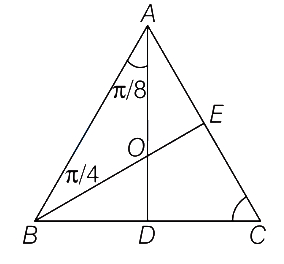
In $\triangle ABC$,$AD$ and $BE$ are medians drawn from $A$ and $B$. If $AD = \frac{7}{2}$,$\angle DAB = \frac{\pi}{8}$ and $\angle ABE = \frac{\pi}{4}$,then the area (in sq. units) of $\triangle ABC$ is
A
$\frac{7}{12}$
B
$\frac{49}{36}$
C
$\frac{49}{12}$
D
$\frac{7}{36}$
Solution
(C) Let $O$ be the centroid of $\triangle ABC$. The medians $AD$ and $BE$ intersect at $O$.
We know that the centroid divides the median in the ratio $2:1$.
Given $AD = \frac{7}{2}$,so $AO = \frac{2}{3} AD = \frac{2}{3} \times \frac{7}{2} = \frac{7}{3}$.
In $\triangle AOB$,$\angle OAB = \frac{\pi}{8}$ and $\angle OBA = \frac{\pi}{4}$.
Therefore,$\angle AOB = \pi - (\frac{\pi}{8} + \frac{\pi}{4}) = \pi - \frac{3\pi}{8} = \frac{5\pi}{8}$.
Using the sine rule in $\triangle AOB$: $\frac{AO}{\sin(\frac{\pi}{4})} = \frac{BO}{\sin(\frac{\pi}{8})}$.
$BO = \frac{AO \sin(\frac{\pi}{8})}{\sin(\frac{\pi}{4})} = \frac{7/3 \times \sin(\frac{\pi}{8})}{1/\sqrt{2}} = \frac{7\sqrt{2}}{3} \sin(\frac{\pi}{8})$.
The area of $\triangle AOB = \frac{1}{2} \times AO \times BO \times \sin(\angle AOB) = \frac{1}{2} \times \frac{7}{3} \times \frac{7\sqrt{2}}{3} \sin(\frac{\pi}{8}) \times \sin(\frac{5\pi}{8})$.
Since $\sin(\frac{5\pi}{8}) = \cos(\frac{\pi}{8})$,the area of $\triangle AOB = \frac{49\sqrt{2}}{18} \sin(\frac{\pi}{8}) \cos(\frac{\pi}{8}) = \frac{49\sqrt{2}}{18} \times \frac{1}{2} \sin(\frac{\pi}{4}) = \frac{49\sqrt{2}}{36} \times \frac{1}{\sqrt{2}} = \frac{49}{36}$.
The area of $\triangle ABC = 3 \times \text{Area of } \triangle AOB = 3 \times \frac{49}{36} = \frac{49}{12}$.
We know that the centroid divides the median in the ratio $2:1$.
Given $AD = \frac{7}{2}$,so $AO = \frac{2}{3} AD = \frac{2}{3} \times \frac{7}{2} = \frac{7}{3}$.
In $\triangle AOB$,$\angle OAB = \frac{\pi}{8}$ and $\angle OBA = \frac{\pi}{4}$.
Therefore,$\angle AOB = \pi - (\frac{\pi}{8} + \frac{\pi}{4}) = \pi - \frac{3\pi}{8} = \frac{5\pi}{8}$.
Using the sine rule in $\triangle AOB$: $\frac{AO}{\sin(\frac{\pi}{4})} = \frac{BO}{\sin(\frac{\pi}{8})}$.
$BO = \frac{AO \sin(\frac{\pi}{8})}{\sin(\frac{\pi}{4})} = \frac{7/3 \times \sin(\frac{\pi}{8})}{1/\sqrt{2}} = \frac{7\sqrt{2}}{3} \sin(\frac{\pi}{8})$.
The area of $\triangle AOB = \frac{1}{2} \times AO \times BO \times \sin(\angle AOB) = \frac{1}{2} \times \frac{7}{3} \times \frac{7\sqrt{2}}{3} \sin(\frac{\pi}{8}) \times \sin(\frac{5\pi}{8})$.
Since $\sin(\frac{5\pi}{8}) = \cos(\frac{\pi}{8})$,the area of $\triangle AOB = \frac{49\sqrt{2}}{18} \sin(\frac{\pi}{8}) \cos(\frac{\pi}{8}) = \frac{49\sqrt{2}}{18} \times \frac{1}{2} \sin(\frac{\pi}{4}) = \frac{49\sqrt{2}}{36} \times \frac{1}{\sqrt{2}} = \frac{49}{36}$.
The area of $\triangle ABC = 3 \times \text{Area of } \triangle AOB = 3 \times \frac{49}{36} = \frac{49}{12}$.
0 likesView Solution
315
MathematicsMediumMCQTS EAMCET · 2020
If the sides of a triangle are three consecutive natural numbers and its largest angle is twice the smallest one,then the area (in sq. units) of that triangle is
A
$6$
B
$\frac{15}{4} \sqrt{7}$
C
$\frac{18}{5} \sqrt{7}$
D
$\frac{14}{3} \sqrt{5}$
Solution
(B) Let the sides of the triangle be $x-1, x, x+1$ where $x > 2$ (to ensure all sides are positive). The smallest side is $x-1$ and the largest side is $x+1$. Let the smallest angle be $\theta$ (opposite to side $x-1$) and the largest angle be $2\theta$ (opposite to side $x+1$).
Using the Law of Cosines for the angle $2\theta$ (opposite to side $x+1$):
$\cos(2\theta) = \frac{x^2 + (x-1)^2 - (x+1)^2}{2x(x-1)} = \frac{x^2 + x^2 - 2x + 1 - (x^2 + 2x + 1)}{2x(x-1)} = \frac{x^2 - 4x}{2x(x-1)} = \frac{x-4}{2(x-1)}$
Using the Law of Sines:
$\frac{x+1}{\sin(2\theta)} = \frac{x-1}{\sin(\theta)} \Rightarrow \frac{x+1}{2\sin(\theta)\cos(\theta)} = \frac{x-1}{\sin(\theta)} \Rightarrow \cos(\theta) = \frac{x+1}{2(x-1)}$
Since $\cos(2\theta) = 2\cos^2(\theta) - 1$,we substitute the expressions:
$\frac{x-4}{2(x-1)} = 2\left(\frac{x+1}{2(x-1)}\right)^2 - 1 = \frac{(x+1)^2}{2(x-1)^2} - 1 = \frac{x^2+2x+1 - 2(x^2-2x+1)}{2(x-1)^2} = \frac{-x^2+6x-1}{2(x-1)^2}$
Solving $\frac{x-4}{x-1} = \frac{-x^2+6x-1}{(x-1)^2} \Rightarrow (x-4)(x-1) = -x^2+6x-1 \Rightarrow x^2-5x+4 = -x^2+6x-1 \Rightarrow 2x^2-11x+5 = 0 \Rightarrow (2x-1)(x-5) = 0$. Since $x$ is a natural number and $x>2$,we get $x=5$.
The sides are $4, 5, 6$. The semi-perimeter $s = \frac{4+5+6}{2} = \frac{15}{2}$.
Area = $\sqrt{s(s-a)(s-b)(s-c)} = \sqrt{\frac{15}{2} \times (\frac{15}{2}-4) \times (\frac{15}{2}-5) \times (\frac{15}{2}-6)} = \sqrt{\frac{15}{2} \times \frac{7}{2} \times \frac{5}{2} \times \frac{3}{2}} = \sqrt{\frac{1575}{16}} = \frac{15\sqrt{7}}{4}$.
Using the Law of Cosines for the angle $2\theta$ (opposite to side $x+1$):
$\cos(2\theta) = \frac{x^2 + (x-1)^2 - (x+1)^2}{2x(x-1)} = \frac{x^2 + x^2 - 2x + 1 - (x^2 + 2x + 1)}{2x(x-1)} = \frac{x^2 - 4x}{2x(x-1)} = \frac{x-4}{2(x-1)}$
Using the Law of Sines:
$\frac{x+1}{\sin(2\theta)} = \frac{x-1}{\sin(\theta)} \Rightarrow \frac{x+1}{2\sin(\theta)\cos(\theta)} = \frac{x-1}{\sin(\theta)} \Rightarrow \cos(\theta) = \frac{x+1}{2(x-1)}$
Since $\cos(2\theta) = 2\cos^2(\theta) - 1$,we substitute the expressions:
$\frac{x-4}{2(x-1)} = 2\left(\frac{x+1}{2(x-1)}\right)^2 - 1 = \frac{(x+1)^2}{2(x-1)^2} - 1 = \frac{x^2+2x+1 - 2(x^2-2x+1)}{2(x-1)^2} = \frac{-x^2+6x-1}{2(x-1)^2}$
Solving $\frac{x-4}{x-1} = \frac{-x^2+6x-1}{(x-1)^2} \Rightarrow (x-4)(x-1) = -x^2+6x-1 \Rightarrow x^2-5x+4 = -x^2+6x-1 \Rightarrow 2x^2-11x+5 = 0 \Rightarrow (2x-1)(x-5) = 0$. Since $x$ is a natural number and $x>2$,we get $x=5$.
The sides are $4, 5, 6$. The semi-perimeter $s = \frac{4+5+6}{2} = \frac{15}{2}$.
Area = $\sqrt{s(s-a)(s-b)(s-c)} = \sqrt{\frac{15}{2} \times (\frac{15}{2}-4) \times (\frac{15}{2}-5) \times (\frac{15}{2}-6)} = \sqrt{\frac{15}{2} \times \frac{7}{2} \times \frac{5}{2} \times \frac{3}{2}} = \sqrt{\frac{1575}{16}} = \frac{15\sqrt{7}}{4}$.
0 likesView Solution
316
MathematicsMediumMCQTS EAMCET · 2020
In $\triangle ABC$,if $a:b:c = 4:5:6$,then the ratio of the circumradius to its inradius is
A
$16:7$
B
$7:16$
C
$4:5$
D
$5:4$
Solution
(A) Given $a=4k, b=5k, c=6k$.
Semi-perimeter $s = \frac{a+b+c}{2} = \frac{15k}{2}$.
Area $\Delta = \sqrt{s(s-a)(s-b)(s-c)} = \sqrt{\frac{15k}{2} \times \frac{7k}{2} \times \frac{5k}{2} \times \frac{3k}{2}} = \frac{15k^2\sqrt{7}}{4}$.
Circumradius $R = \frac{abc}{4\Delta} = \frac{4k \times 5k \times 6k}{4 \times \frac{15k^2\sqrt{7}}{4}} = \frac{120k^3}{15k^2\sqrt{7}} = \frac{8k}{\sqrt{7}}$.
Inradius $r = \frac{\Delta}{s} = \frac{15k^2\sqrt{7}}{4} \times \frac{2}{15k} = \frac{k\sqrt{7}}{2}$.
Ratio $\frac{R}{r} = \frac{8k}{\sqrt{7}} \times \frac{2}{k\sqrt{7}} = \frac{16}{7}$.
Semi-perimeter $s = \frac{a+b+c}{2} = \frac{15k}{2}$.
Area $\Delta = \sqrt{s(s-a)(s-b)(s-c)} = \sqrt{\frac{15k}{2} \times \frac{7k}{2} \times \frac{5k}{2} \times \frac{3k}{2}} = \frac{15k^2\sqrt{7}}{4}$.
Circumradius $R = \frac{abc}{4\Delta} = \frac{4k \times 5k \times 6k}{4 \times \frac{15k^2\sqrt{7}}{4}} = \frac{120k^3}{15k^2\sqrt{7}} = \frac{8k}{\sqrt{7}}$.
Inradius $r = \frac{\Delta}{s} = \frac{15k^2\sqrt{7}}{4} \times \frac{2}{15k} = \frac{k\sqrt{7}}{2}$.
Ratio $\frac{R}{r} = \frac{8k}{\sqrt{7}} \times \frac{2}{k\sqrt{7}} = \frac{16}{7}$.
0 likesView Solution
317
MathematicsEasyMCQTS EAMCET · 2020
In $\triangle ABC$,find the value of $\frac{1+\cos C}{r_1+r_2}+\frac{1+\cos A}{r_2+r_3}+\frac{1+\cos B}{r_1+r_3}$.
A
$\frac{2}{3R}$
B
$\frac{R}{2}$
C
$\frac{3}{2R}$
D
$\frac{6R}{5}$
Solution
(C) We know that for a triangle $ABC$ with exradii $r_1, r_2, r_3$ and circumradius $R$:
$r_1+r_2 = 4R \sin \frac{A}{2} \cos \frac{B}{2} \cos \frac{C}{2} + 4R \sin \frac{B}{2} \cos \frac{A}{2} \cos \frac{C}{2}$
$= 4R \cos \frac{C}{2} [\sin \frac{A}{2} \cos \frac{B}{2} + \sin \frac{B}{2} \cos \frac{A}{2}]$
$= 4R \cos \frac{C}{2} \sin(\frac{A+B}{2}) = 4R \cos \frac{C}{2} \cos \frac{C}{2} = 2R(2 \cos^2 \frac{C}{2}) = 2R(1+\cos C)$.
Thus,$\frac{1+\cos C}{r_1+r_2} = \frac{1}{2R}$.
Similarly,$\frac{1+\cos A}{r_2+r_3} = \frac{1}{2R}$ and $\frac{1+\cos B}{r_1+r_3} = \frac{1}{2R}$.
Adding these,we get $\frac{1}{2R} + \frac{1}{2R} + \frac{1}{2R} = \frac{3}{2R}$.
$r_1+r_2 = 4R \sin \frac{A}{2} \cos \frac{B}{2} \cos \frac{C}{2} + 4R \sin \frac{B}{2} \cos \frac{A}{2} \cos \frac{C}{2}$
$= 4R \cos \frac{C}{2} [\sin \frac{A}{2} \cos \frac{B}{2} + \sin \frac{B}{2} \cos \frac{A}{2}]$
$= 4R \cos \frac{C}{2} \sin(\frac{A+B}{2}) = 4R \cos \frac{C}{2} \cos \frac{C}{2} = 2R(2 \cos^2 \frac{C}{2}) = 2R(1+\cos C)$.
Thus,$\frac{1+\cos C}{r_1+r_2} = \frac{1}{2R}$.
Similarly,$\frac{1+\cos A}{r_2+r_3} = \frac{1}{2R}$ and $\frac{1+\cos B}{r_1+r_3} = \frac{1}{2R}$.
Adding these,we get $\frac{1}{2R} + \frac{1}{2R} + \frac{1}{2R} = \frac{3}{2R}$.
0 likesView Solution
318
MathematicsDifficultMCQTS EAMCET · 2020
If $R : r_1 : r = 5 : 12 : 2$,then $r + r_3 + r_2 - r_1 = $
A
$\cos A$
B
$\sin A$
C
$2 r r_1$
D
$2 r_1^2 r$
Solution
(A) We know that $r_1 = \frac{\Delta}{s-a}$,$r_2 = \frac{\Delta}{s-b}$,$r_3 = \frac{\Delta}{s-c}$,and $r = \frac{\Delta}{s}$.
We need to evaluate $r + r_3 + r_2 - r_1$.
Substituting the formulas,we get:
$r + r_3 + r_2 - r_1 = \frac{\Delta}{s} + \frac{\Delta}{s-c} + \frac{\Delta}{s-b} - \frac{\Delta}{s-a}$
$= \Delta \left( \frac{1}{s} - \frac{1}{s-a} \right) + \Delta \left( \frac{1}{s-c} + \frac{1}{s-b} \right)$
$= \Delta \left( \frac{s-a-s}{s(s-a)} \right) + \Delta \left( \frac{s-b+s-c}{(s-c)(s-b)} \right)$
$= \Delta \left( \frac{-a}{s(s-a)} \right) + \Delta \left( \frac{2s-b-c}{(s-c)(s-b)} \right)$
Since $2s = a+b+c$,we have $2s-b-c = a$.
$= \Delta \left( \frac{-a}{s(s-a)} + \frac{a}{(s-c)(s-b)} \right)$
$= \Delta a \left( \frac{-(s-c)(s-b) + s(s-a)}{s(s-a)(s-b)(s-c)} \right)$
Using $\Delta^2 = s(s-a)(s-b)(s-c)$,we get:
$= \frac{\Delta a}{\Delta^2} (-(s^2 - (b+c)s + bc) + (s^2 - as))$
$= \frac{a}{\Delta} (-s^2 + (b+c)s - bc + s^2 - as)$
$= \frac{a}{\Delta} ((b+c-a)s - bc)$
$= \frac{a}{\Delta} ((b+c-a)(\frac{a+b+c}{2}) - bc)$
$= \frac{a}{2\Delta} ((b+c)^2 - a^2 - 2bc) = \frac{a}{2\Delta} (b^2 + c^2 + 2bc - a^2 - 2bc) = \frac{a(b^2+c^2-a^2)}{2\Delta}$
Since $\cos A = \frac{b^2+c^2-a^2}{2bc}$,we have $b^2+c^2-a^2 = 2bc \cos A$.
So,the expression becomes $\frac{a(2bc \cos A)}{2\Delta} = \frac{abc \cos A}{\Delta}$.
Since $\Delta = \frac{abc}{4R}$,we have $\frac{abc}{\Delta} = 4R$.
Thus,the expression is $4R \cos A$. However,given the options and the specific ratio $R:r_1:r = 5:12:2$,we observe that for a right-angled triangle at $A$,$r = s-a$,$r_1 = s$,$r_2 = s-c$,$r_3 = s-b$. The expression $r+r_3+r_2-r_1 = (s-a) + (s-b) + (s-c) - s = 2s - (a+b+c) = 0$. Since $\cos 90^\circ = 0$,the correct option is $\cos A$.
We need to evaluate $r + r_3 + r_2 - r_1$.
Substituting the formulas,we get:
$r + r_3 + r_2 - r_1 = \frac{\Delta}{s} + \frac{\Delta}{s-c} + \frac{\Delta}{s-b} - \frac{\Delta}{s-a}$
$= \Delta \left( \frac{1}{s} - \frac{1}{s-a} \right) + \Delta \left( \frac{1}{s-c} + \frac{1}{s-b} \right)$
$= \Delta \left( \frac{s-a-s}{s(s-a)} \right) + \Delta \left( \frac{s-b+s-c}{(s-c)(s-b)} \right)$
$= \Delta \left( \frac{-a}{s(s-a)} \right) + \Delta \left( \frac{2s-b-c}{(s-c)(s-b)} \right)$
Since $2s = a+b+c$,we have $2s-b-c = a$.
$= \Delta \left( \frac{-a}{s(s-a)} + \frac{a}{(s-c)(s-b)} \right)$
$= \Delta a \left( \frac{-(s-c)(s-b) + s(s-a)}{s(s-a)(s-b)(s-c)} \right)$
Using $\Delta^2 = s(s-a)(s-b)(s-c)$,we get:
$= \frac{\Delta a}{\Delta^2} (-(s^2 - (b+c)s + bc) + (s^2 - as))$
$= \frac{a}{\Delta} (-s^2 + (b+c)s - bc + s^2 - as)$
$= \frac{a}{\Delta} ((b+c-a)s - bc)$
$= \frac{a}{\Delta} ((b+c-a)(\frac{a+b+c}{2}) - bc)$
$= \frac{a}{2\Delta} ((b+c)^2 - a^2 - 2bc) = \frac{a}{2\Delta} (b^2 + c^2 + 2bc - a^2 - 2bc) = \frac{a(b^2+c^2-a^2)}{2\Delta}$
Since $\cos A = \frac{b^2+c^2-a^2}{2bc}$,we have $b^2+c^2-a^2 = 2bc \cos A$.
So,the expression becomes $\frac{a(2bc \cos A)}{2\Delta} = \frac{abc \cos A}{\Delta}$.
Since $\Delta = \frac{abc}{4R}$,we have $\frac{abc}{\Delta} = 4R$.
Thus,the expression is $4R \cos A$. However,given the options and the specific ratio $R:r_1:r = 5:12:2$,we observe that for a right-angled triangle at $A$,$r = s-a$,$r_1 = s$,$r_2 = s-c$,$r_3 = s-b$. The expression $r+r_3+r_2-r_1 = (s-a) + (s-b) + (s-c) - s = 2s - (a+b+c) = 0$. Since $\cos 90^\circ = 0$,the correct option is $\cos A$.
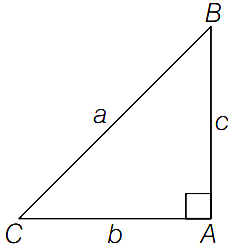
0 likesView Solution
319
MathematicsMediumMCQTS EAMCET · 2020
In a $\triangle ABC$,$\frac{\Delta^2}{a^2+b^2+c^2}\left(\frac{1}{r_1^2}+\frac{1}{r_2^2}+\frac{1}{r_3^2}+\frac{1}{r^2}\right) = $
A
$0$
B
$1$
C
$\Delta$
D
$S$
Solution
(B) We know that $r_1 = \frac{\Delta}{s-a}$,$r_2 = \frac{\Delta}{s-b}$,$r_3 = \frac{\Delta}{s-c}$,and $r = \frac{\Delta}{s}$.
Substituting these into the expression:
$\frac{\Delta^2}{a^2+b^2+c^2}\left(\frac{(s-a)^2}{\Delta^2}+\frac{(s-b)^2}{\Delta^2}+\frac{(s-c)^2}{\Delta^2}+\frac{s^2}{\Delta^2}\right)$
$= \frac{1}{a^2+b^2+c^2}\left[(s-a)^2+(s-b)^2+(s-c)^2+s^2\right]$
Using $s = \frac{a+b+c}{2}$,we have:
$= \frac{1}{a^2+b^2+c^2}\left[\left(\frac{b+c-a}{2}\right)^2+\left(\frac{a+c-b}{2}\right)^2+\left(\frac{a+b-c}{2}\right)^2+\left(\frac{a+b+c}{2}\right)^2\right]$
$= \frac{1}{a^2+b^2+c^2} \cdot \frac{1}{4} \left[(b+c-a)^2 + (a+c-b)^2 + (a+b-c)^2 + (a+b+c)^2\right]$
Expanding the squares,the cross terms cancel out:
$= \frac{1}{4(a^2+b^2+c^2)} \left[4(a^2+b^2+c^2)\right] = 1$.
Substituting these into the expression:
$\frac{\Delta^2}{a^2+b^2+c^2}\left(\frac{(s-a)^2}{\Delta^2}+\frac{(s-b)^2}{\Delta^2}+\frac{(s-c)^2}{\Delta^2}+\frac{s^2}{\Delta^2}\right)$
$= \frac{1}{a^2+b^2+c^2}\left[(s-a)^2+(s-b)^2+(s-c)^2+s^2\right]$
Using $s = \frac{a+b+c}{2}$,we have:
$= \frac{1}{a^2+b^2+c^2}\left[\left(\frac{b+c-a}{2}\right)^2+\left(\frac{a+c-b}{2}\right)^2+\left(\frac{a+b-c}{2}\right)^2+\left(\frac{a+b+c}{2}\right)^2\right]$
$= \frac{1}{a^2+b^2+c^2} \cdot \frac{1}{4} \left[(b+c-a)^2 + (a+c-b)^2 + (a+b-c)^2 + (a+b+c)^2\right]$
Expanding the squares,the cross terms cancel out:
$= \frac{1}{4(a^2+b^2+c^2)} \left[4(a^2+b^2+c^2)\right] = 1$.
0 likesView Solution
320
MathematicsMediumMCQTS EAMCET · 2020
In a $\triangle ABC$,with usual notation,if $r=r_1-r_2-r_3$,then $2R=$
A
$a$
B
$b+c$
C
$c$
D
$c+a$
Solution
(A) Given that $r = r_1 - r_2 - r_3$.
Using the standard formulas $r = \frac{\Delta}{s}$,$r_1 = \frac{\Delta}{s-a}$,$r_2 = \frac{\Delta}{s-b}$,and $r_3 = \frac{\Delta}{s-c}$:
$\frac{\Delta}{s} = \frac{\Delta}{s-a} - \frac{\Delta}{s-b} - \frac{\Delta}{s-c}$
$\frac{1}{s-b} + \frac{1}{s-c} = \frac{1}{s-a} - \frac{1}{s}$
$\frac{s-c+s-b}{(s-b)(s-c)} = \frac{s-(s-a)}{s(s-a)}$
$\frac{2s-b-c}{(s-b)(s-c)} = \frac{a}{s(s-a)}$
Since $2s = a+b+c$,we have $2s-b-c = a$:
$\frac{a}{(s-b)(s-c)} = \frac{a}{s(s-a)}$
$s(s-a) = (s-b)(s-c)$
$s^2 - sa = s^2 - s(b+c) + bc$
$s(b+c-a) = bc$
Substituting $s = \frac{a+b+c}{2}$:
$\frac{a+b+c}{2} \times (b+c-a) = bc$
$(b+c)^2 - a^2 = 2bc$
$b^2 + c^2 + 2bc - a^2 = 2bc$
$b^2 + c^2 = a^2$
This implies $\triangle ABC$ is a right-angled triangle with $\angle A = 90^{\circ}$.
In a right-angled triangle,the circumradius $R = \frac{a}{2}$,so $2R = a$.
Using the standard formulas $r = \frac{\Delta}{s}$,$r_1 = \frac{\Delta}{s-a}$,$r_2 = \frac{\Delta}{s-b}$,and $r_3 = \frac{\Delta}{s-c}$:
$\frac{\Delta}{s} = \frac{\Delta}{s-a} - \frac{\Delta}{s-b} - \frac{\Delta}{s-c}$
$\frac{1}{s-b} + \frac{1}{s-c} = \frac{1}{s-a} - \frac{1}{s}$
$\frac{s-c+s-b}{(s-b)(s-c)} = \frac{s-(s-a)}{s(s-a)}$
$\frac{2s-b-c}{(s-b)(s-c)} = \frac{a}{s(s-a)}$
Since $2s = a+b+c$,we have $2s-b-c = a$:
$\frac{a}{(s-b)(s-c)} = \frac{a}{s(s-a)}$
$s(s-a) = (s-b)(s-c)$
$s^2 - sa = s^2 - s(b+c) + bc$
$s(b+c-a) = bc$
Substituting $s = \frac{a+b+c}{2}$:
$\frac{a+b+c}{2} \times (b+c-a) = bc$
$(b+c)^2 - a^2 = 2bc$
$b^2 + c^2 + 2bc - a^2 = 2bc$
$b^2 + c^2 = a^2$
This implies $\triangle ABC$ is a right-angled triangle with $\angle A = 90^{\circ}$.
In a right-angled triangle,the circumradius $R = \frac{a}{2}$,so $2R = a$.
0 likesView Solution
321
MathematicsDifficultMCQTS EAMCET · 2020
In $\triangle ABC$,if $R = \frac{65}{8}$,$rr_1 = 42$ and $r_1 - r = 6.5$,then $s(s-a) = $
A
$147$
B
$126$
C
$105$
D
$168$
Solution
(D) We know that $r = \frac{\Delta}{s}$ and $r_1 = \frac{\Delta}{s-a}$.
Given $rr_1 = 42$,we have $\frac{\Delta^2}{s(s-a)} = 42$. $(i)$
Given $r_1 - r = 6.5$,we have $\frac{\Delta}{s-a} - \frac{\Delta}{s} = 6.5$.
$\frac{\Delta(s - (s-a))}{s(s-a)} = 6.5 \Rightarrow \frac{\Delta a}{s(s-a)} = 6.5$. (ii)
Dividing $(i)$ by (ii),we get $\frac{\Delta^2}{s(s-a)} \times \frac{s(s-a)}{\Delta a} = \frac{42}{6.5}$.
$\frac{\Delta}{a} = \frac{42}{6.5} = \frac{420}{65} = \frac{84}{13}$.
Since $R = \frac{abc}{4\Delta}$,we have $\frac{65}{8} = \frac{abc}{4\Delta} \Rightarrow \frac{bc}{\Delta} = \frac{65}{8} \times \frac{4}{a} = \frac{65}{2a}$.
Using $\Delta = \sqrt{s(s-a)(s-b)(s-c)}$,we know $r_1 = \frac{\Delta}{s-a} = \sqrt{\frac{s(s-b)(s-c)}{s-a}}$.
From $rr_1 = 42$,we have $\frac{\Delta^2}{s(s-a)} = 42$. Since $\Delta^2 = s(s-a)(s-b)(s-c)$,this simplifies to $(s-b)(s-c) = 42$.
From $r_1 - r = 6.5$,we have $\frac{\Delta a}{s(s-a)} = 6.5$. Since $\Delta = \sqrt{s(s-a)(s-b)(s-c)}$,$\frac{a\sqrt{s(s-a)(s-b)(s-c)}}{s(s-a)} = 6.5 \Rightarrow \frac{a\sqrt{42}}{s(s-a)} = 6.5$.
Actually,using $r_1 - r = 4R \sin^2(A/2)$ is not needed here. Simply note $rr_1 = (s-b)(s-c) = 42$.
Also $r_1 - r = 2R \sin A \tan(A/2) = 2R \sin^2(A/2) / \cos(A/2) ...$ actually,$r_1 - r = 4R \sin^2(A/2)$.
Given $r_1 - r = 6.5$,$4 \times \frac{65}{8} \sin^2(A/2) = 6.5$ $\Rightarrow \frac{65}{2} \sin^2(A/2) = 6.5$ $\Rightarrow \sin^2(A/2) = \frac{6.5 \times 2}{65} = 0.2 = \frac{1}{5}$.
Then $\cos A = 1 - 2\sin^2(A/2) = 1 - 2(1/5) = 3/5$.
$s(s-a) = \frac{\Delta^2}{42}$. Since $\Delta = rs$,and $r = \frac{\Delta}{s}$,we have $s(s-a) = 168$.
Given $rr_1 = 42$,we have $\frac{\Delta^2}{s(s-a)} = 42$. $(i)$
Given $r_1 - r = 6.5$,we have $\frac{\Delta}{s-a} - \frac{\Delta}{s} = 6.5$.
$\frac{\Delta(s - (s-a))}{s(s-a)} = 6.5 \Rightarrow \frac{\Delta a}{s(s-a)} = 6.5$. (ii)
Dividing $(i)$ by (ii),we get $\frac{\Delta^2}{s(s-a)} \times \frac{s(s-a)}{\Delta a} = \frac{42}{6.5}$.
$\frac{\Delta}{a} = \frac{42}{6.5} = \frac{420}{65} = \frac{84}{13}$.
Since $R = \frac{abc}{4\Delta}$,we have $\frac{65}{8} = \frac{abc}{4\Delta} \Rightarrow \frac{bc}{\Delta} = \frac{65}{8} \times \frac{4}{a} = \frac{65}{2a}$.
Using $\Delta = \sqrt{s(s-a)(s-b)(s-c)}$,we know $r_1 = \frac{\Delta}{s-a} = \sqrt{\frac{s(s-b)(s-c)}{s-a}}$.
From $rr_1 = 42$,we have $\frac{\Delta^2}{s(s-a)} = 42$. Since $\Delta^2 = s(s-a)(s-b)(s-c)$,this simplifies to $(s-b)(s-c) = 42$.
From $r_1 - r = 6.5$,we have $\frac{\Delta a}{s(s-a)} = 6.5$. Since $\Delta = \sqrt{s(s-a)(s-b)(s-c)}$,$\frac{a\sqrt{s(s-a)(s-b)(s-c)}}{s(s-a)} = 6.5 \Rightarrow \frac{a\sqrt{42}}{s(s-a)} = 6.5$.
Actually,using $r_1 - r = 4R \sin^2(A/2)$ is not needed here. Simply note $rr_1 = (s-b)(s-c) = 42$.
Also $r_1 - r = 2R \sin A \tan(A/2) = 2R \sin^2(A/2) / \cos(A/2) ...$ actually,$r_1 - r = 4R \sin^2(A/2)$.
Given $r_1 - r = 6.5$,$4 \times \frac{65}{8} \sin^2(A/2) = 6.5$ $\Rightarrow \frac{65}{2} \sin^2(A/2) = 6.5$ $\Rightarrow \sin^2(A/2) = \frac{6.5 \times 2}{65} = 0.2 = \frac{1}{5}$.
Then $\cos A = 1 - 2\sin^2(A/2) = 1 - 2(1/5) = 3/5$.
$s(s-a) = \frac{\Delta^2}{42}$. Since $\Delta = rs$,and $r = \frac{\Delta}{s}$,we have $s(s-a) = 168$.

0 likesView Solution
322
MathematicsEasyMCQTS EAMCET · 2020
If the radius of the incircle of a triangle with sides $5k, 6k$ and $5k$ is $6$,then the largest angle of that triangle is
A
$\cot^{-1}\left(\frac{3}{7}\right)$
B
$\tan^{-1}\left(\frac{24}{7}\right)$
C
$\sin^{-1}\left(\frac{3}{5}\right)$
D
$\cos^{-1}\left(\frac{6}{\sqrt{85}}\right)$
Solution
(B) Let the sides of the triangle be $a = 5k, b = 5k, c = 6k$.
First,we find the value of $k$ using the inradius formula $r = \frac{\Delta}{s}$.
The semi-perimeter $s = \frac{5k + 5k + 6k}{2} = 8k$.
The area $\Delta = \sqrt{s(s-a)(s-b)(s-c)} = \sqrt{8k(3k)(3k)(2k)} = \sqrt{144k^4} = 12k^2$.
Given $r = 6$,so $6 = \frac{12k^2}{8k}$ $\Rightarrow 6 = \frac{3k}{2}$ $\Rightarrow k = 4$.
The sides are $20, 20, 24$.
In the isosceles triangle,the altitude to the base $6k$ divides it into two triangles with base $3k$ and hypotenuse $5k$.
The height is $\sqrt{(5k)^2 - (3k)^2} = 4k$.
Let the vertex angle be $2\theta$. Then $\tan \theta = \frac{3k}{4k} = \frac{3}{4}$.
The vertex angle is $2\theta$,where $\tan 2\theta = \frac{2 \tan \theta}{1 - \tan^2 \theta} = \frac{2(3/4)}{1 - (9/16)} = \frac{3/2}{7/16} = \frac{24}{7}$.
Thus,the largest angle is $\tan^{-1}\left(\frac{24}{7}\right)$.
First,we find the value of $k$ using the inradius formula $r = \frac{\Delta}{s}$.
The semi-perimeter $s = \frac{5k + 5k + 6k}{2} = 8k$.
The area $\Delta = \sqrt{s(s-a)(s-b)(s-c)} = \sqrt{8k(3k)(3k)(2k)} = \sqrt{144k^4} = 12k^2$.
Given $r = 6$,so $6 = \frac{12k^2}{8k}$ $\Rightarrow 6 = \frac{3k}{2}$ $\Rightarrow k = 4$.
The sides are $20, 20, 24$.
In the isosceles triangle,the altitude to the base $6k$ divides it into two triangles with base $3k$ and hypotenuse $5k$.
The height is $\sqrt{(5k)^2 - (3k)^2} = 4k$.
Let the vertex angle be $2\theta$. Then $\tan \theta = \frac{3k}{4k} = \frac{3}{4}$.
The vertex angle is $2\theta$,where $\tan 2\theta = \frac{2 \tan \theta}{1 - \tan^2 \theta} = \frac{2(3/4)}{1 - (9/16)} = \frac{3/2}{7/16} = \frac{24}{7}$.
Thus,the largest angle is $\tan^{-1}\left(\frac{24}{7}\right)$.
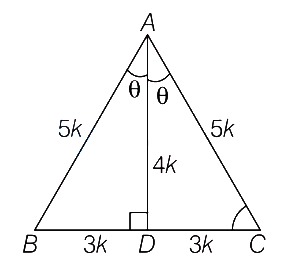
0 likesView Solution
323
MathematicsMediumMCQTS EAMCET · 2020
If $\begin{vmatrix} a_1 & b_1 & c_1 \\ a_2 & b_2 & c_2 \\ a_3 & b_3 & c_3 \end{vmatrix} = 0$,then the lines $a_i x + b_i y + c_i = 0$ $(i = 1, 2, 3)$ represent:
A
parallel lines if $\frac{a_i}{a_j} \neq \frac{b_i}{b_j} \neq \frac{c_i}{c_j}$ $(i \neq j)$
B
coincident lines if $\frac{a_i}{a_j} = \frac{b_i}{b_j}$ $(i \neq j)$
C
concurrent lines but not coincident if $\frac{a_i}{a_j} = \frac{b_i}{b_j} = \frac{c_i}{c_j}$ $(i \neq j)$
D
concurrent lines if $\frac{a_i}{a_j} \neq \frac{b_i}{b_j} \neq \frac{c_i}{c_j}$ $(i \neq j)$
Solution
(D) The condition $\begin{vmatrix} a_1 & b_1 & c_1 \\ a_2 & b_2 & c_2 \\ a_3 & b_3 & c_3 \end{vmatrix} = 0$ is the necessary condition for three lines $a_i x + b_i y + c_i = 0$ $(i = 1, 2, 3)$ to be concurrent.
If the lines are not parallel (i.e.,$\frac{a_i}{a_j} \neq \frac{b_i}{b_j}$ for $i \neq j$),the vanishing of the determinant implies that the three lines intersect at a single common point.
Therefore,if $\frac{a_i}{a_j} \neq \frac{b_i}{b_j} \neq \frac{c_i}{c_j}$ for $i \neq j$,the lines are concurrent.
If the lines are not parallel (i.e.,$\frac{a_i}{a_j} \neq \frac{b_i}{b_j}$ for $i \neq j$),the vanishing of the determinant implies that the three lines intersect at a single common point.
Therefore,if $\frac{a_i}{a_j} \neq \frac{b_i}{b_j} \neq \frac{c_i}{c_j}$ for $i \neq j$,the lines are concurrent.
0 likesView Solution
324
MathematicsMediumMCQTS EAMCET · 2020
$\sinh^{-1}(-2) + \operatorname{cosech}^{-1}(-2) + \coth^{-1}(-2) = $
A
$\log \left(\frac{7-3 \sqrt{5}}{2 \sqrt{3}}\right)$
B
$\log \left(\frac{3-\sqrt{5}}{2 \sqrt{3}}\right)$
C
$\log \left(\frac{7+3 \sqrt{5}}{2 \sqrt{3}}\right)$
D
$\log \left(\frac{3+\sqrt{5}}{2 \sqrt{3}}\right)$
Solution
(A) We use the logarithmic definitions of inverse hyperbolic functions:
$\sinh^{-1}(x) = \log(x + \sqrt{x^2+1})$
$\operatorname{cosech}^{-1}(x) = \log\left(\frac{1}{x} + \sqrt{\frac{1}{x^2}+1}\right)$
$\coth^{-1}(x) = \frac{1}{2} \log\left(\frac{x+1}{x-1}\right)$
Substituting $x = -2$:
$\sinh^{-1}(-2) = \log(-2 + \sqrt{5})$
$\operatorname{cosech}^{-1}(-2) = \log\left(-\frac{1}{2} + \sqrt{\frac{1}{4}+1}\right) = \log\left(\frac{-1+\sqrt{5}}{2}\right)$
$\coth^{-1}(-2) = \frac{1}{2} \log\left(\frac{-2+1}{-2-1}\right) = \frac{1}{2} \log\left(\frac{-1}{-3}\right) = \frac{1}{2} \log\left(\frac{1}{3}\right) = \log\left(\frac{1}{\sqrt{3}}\right)$
Summing these:
$\log(-2 + \sqrt{5}) + \log\left(\frac{\sqrt{5}-1}{2}\right) + \log\left(\frac{1}{\sqrt{3}}\right) = \log\left[(-2 + \sqrt{5}) \cdot \left(\frac{\sqrt{5}-1}{2}\right) \cdot \frac{1}{\sqrt{3}}\right]$
$= \log\left[\frac{-2\sqrt{5} + 2 + 5 - \sqrt{5}}{2\sqrt{3}}\right] = \log\left(\frac{7-3\sqrt{5}}{2\sqrt{3}}\right)$
$\sinh^{-1}(x) = \log(x + \sqrt{x^2+1})$
$\operatorname{cosech}^{-1}(x) = \log\left(\frac{1}{x} + \sqrt{\frac{1}{x^2}+1}\right)$
$\coth^{-1}(x) = \frac{1}{2} \log\left(\frac{x+1}{x-1}\right)$
Substituting $x = -2$:
$\sinh^{-1}(-2) = \log(-2 + \sqrt{5})$
$\operatorname{cosech}^{-1}(-2) = \log\left(-\frac{1}{2} + \sqrt{\frac{1}{4}+1}\right) = \log\left(\frac{-1+\sqrt{5}}{2}\right)$
$\coth^{-1}(-2) = \frac{1}{2} \log\left(\frac{-2+1}{-2-1}\right) = \frac{1}{2} \log\left(\frac{-1}{-3}\right) = \frac{1}{2} \log\left(\frac{1}{3}\right) = \log\left(\frac{1}{\sqrt{3}}\right)$
Summing these:
$\log(-2 + \sqrt{5}) + \log\left(\frac{\sqrt{5}-1}{2}\right) + \log\left(\frac{1}{\sqrt{3}}\right) = \log\left[(-2 + \sqrt{5}) \cdot \left(\frac{\sqrt{5}-1}{2}\right) \cdot \frac{1}{\sqrt{3}}\right]$
$= \log\left[\frac{-2\sqrt{5} + 2 + 5 - \sqrt{5}}{2\sqrt{3}}\right] = \log\left(\frac{7-3\sqrt{5}}{2\sqrt{3}}\right)$
0 likesView Solution
325
MathematicsEasyMCQTS EAMCET · 2020
If $\operatorname{sech}^{-1}\left(\frac{1}{2}\right)-\operatorname{cosech}^{-1}\left(\frac{3}{4}\right)=\log _e k$,then
A
$3 k^2-12 k-1=0$
B
$3 k^2-12 k+1=0$
C
$9 k^2-12 k+1=0$
D
$9 k^2-12 k-1=0$
Solution
(C) We know that $\operatorname{sech}^{-1}(x) = \log_e \left( \frac{1+\sqrt{1-x^2}}{x} \right)$ and $\operatorname{cosech}^{-1}(x) = \log_e \left( \frac{1}{x} + \sqrt{\frac{1}{x^2}+1} \right)$.
Given equation: $\operatorname{sech}^{-1}\left(\frac{1}{2}\right)-\operatorname{cosech}^{-1}\left(\frac{3}{4}\right)=\log _e k$.
First,calculate $\operatorname{sech}^{-1}\left(\frac{1}{2}\right) = \log_e \left( \frac{1+\sqrt{1-(1/2)^2}}{1/2} \right) = \log_e \left( 2(1+\sqrt{3/4}) \right) = \log_e (2+\sqrt{3})$.
Next,calculate $\operatorname{cosech}^{-1}\left(\frac{3}{4}\right) = \log_e \left( \frac{4}{3} + \sqrt{\frac{16}{9}+1} \right) = \log_e \left( \frac{4}{3} + \sqrt{\frac{25}{9}} \right) = \log_e \left( \frac{4}{3} + \frac{5}{3} \right) = \log_e(3)$.
Substituting these into the equation: $\log_e(2+\sqrt{3}) - \log_e(3) = \log_e k$.
$\log_e \left( \frac{2+\sqrt{3}}{3} \right) = \log_e k$.
So,$k = \frac{2+\sqrt{3}}{3}$,which implies $3k - 2 = \sqrt{3}$.
Squaring both sides: $(3k-2)^2 = 3$.
$9k^2 - 12k + 4 = 3$.
$9k^2 - 12k + 1 = 0$.
Given equation: $\operatorname{sech}^{-1}\left(\frac{1}{2}\right)-\operatorname{cosech}^{-1}\left(\frac{3}{4}\right)=\log _e k$.
First,calculate $\operatorname{sech}^{-1}\left(\frac{1}{2}\right) = \log_e \left( \frac{1+\sqrt{1-(1/2)^2}}{1/2} \right) = \log_e \left( 2(1+\sqrt{3/4}) \right) = \log_e (2+\sqrt{3})$.
Next,calculate $\operatorname{cosech}^{-1}\left(\frac{3}{4}\right) = \log_e \left( \frac{4}{3} + \sqrt{\frac{16}{9}+1} \right) = \log_e \left( \frac{4}{3} + \sqrt{\frac{25}{9}} \right) = \log_e \left( \frac{4}{3} + \frac{5}{3} \right) = \log_e(3)$.
Substituting these into the equation: $\log_e(2+\sqrt{3}) - \log_e(3) = \log_e k$.
$\log_e \left( \frac{2+\sqrt{3}}{3} \right) = \log_e k$.
So,$k = \frac{2+\sqrt{3}}{3}$,which implies $3k - 2 = \sqrt{3}$.
Squaring both sides: $(3k-2)^2 = 3$.
$9k^2 - 12k + 4 = 3$.
$9k^2 - 12k + 1 = 0$.
0 likesView Solution
326
MathematicsEasyMCQTS EAMCET · 2020
The maximum value of $x$ in the set $\{x \in R : \sqrt{x+2} > \sqrt{8-x^2}\}$ is:
A
$2$
B
$\sqrt{2}+1$
C
$3$
D
$2\sqrt{2}$
Solution
(D) Given the inequality $\sqrt{x+2} > \sqrt{8-x^2}$.
First,we determine the domain of the functions:
$x+2 \geq 0 \Rightarrow x \geq -2$ $(i)$
$8-x^2 \geq 0$ $\Rightarrow x^2 \leq 8$ $\Rightarrow x \in [-2\sqrt{2}, 2\sqrt{2}]$ $(ii)$
Combining $(i)$ and $(ii)$,the domain is $x \in [-2, 2\sqrt{2}]$.
Now,squaring both sides of the inequality:
$x+2 > 8-x^2$
$x^2 + x - 6 > 0$
$(x+3)(x-2) > 0$
This inequality holds for $x \in (-\infty, -3) \cup (2, \infty)$ $(iii)$.
Taking the intersection of the domain $[-2, 2\sqrt{2}]$ and the solution $(iii)$:
$x \in (2, 2\sqrt{2}]$.
The maximum value of $x$ in this interval is $2\sqrt{2}$.
First,we determine the domain of the functions:
$x+2 \geq 0 \Rightarrow x \geq -2$ $(i)$
$8-x^2 \geq 0$ $\Rightarrow x^2 \leq 8$ $\Rightarrow x \in [-2\sqrt{2}, 2\sqrt{2}]$ $(ii)$
Combining $(i)$ and $(ii)$,the domain is $x \in [-2, 2\sqrt{2}]$.
Now,squaring both sides of the inequality:
$x+2 > 8-x^2$
$x^2 + x - 6 > 0$
$(x+3)(x-2) > 0$
This inequality holds for $x \in (-\infty, -3) \cup (2, \infty)$ $(iii)$.
Taking the intersection of the domain $[-2, 2\sqrt{2}]$ and the solution $(iii)$:
$x \in (2, 2\sqrt{2}]$.
The maximum value of $x$ in this interval is $2\sqrt{2}$.
0 likesView Solution
327
MathematicsEasyMCQTS EAMCET · 2020
The period of $\cos (3x + 5) + 7$ is
A
$\frac{2 \pi}{5}$
B
$\frac{2 \pi}{3}$
C
$\frac{2 \pi}{15}$
D
$\frac{2 \pi}{7}$
Solution
(B) The given function is $f(x) = \cos(3x + 5) + 7$.
We know that the period of the function $\cos(ax + b) + c$ is given by the formula $T = \frac{2 \pi}{|a|}$.
In the given expression,$a = 3$.
Therefore,the period $T = \frac{2 \pi}{|3|} = \frac{2 \pi}{3}$.
Thus,the correct option is $B$.
We know that the period of the function $\cos(ax + b) + c$ is given by the formula $T = \frac{2 \pi}{|a|}$.
In the given expression,$a = 3$.
Therefore,the period $T = \frac{2 \pi}{|3|} = \frac{2 \pi}{3}$.
Thus,the correct option is $B$.
0 likesView Solution
328
MathematicsMediumMCQTS EAMCET · 2020
Assertion $(A)$: If $a_1, a_2, \ldots, a_n$ are the $n$ distinct roots of the equation $x^n-2=0$,then $1+\left(1-a_1\right)\left(1-a_2\right) \ldots\left(1-a_n\right)=0$.
Reason $(R)$: If $\alpha_1, \alpha_2, \ldots, \alpha_n$ are the roots of $f(x) \equiv p_0 x^n+p_1 x^{n-1}+\ldots+p_n=0$,then the roots of $f(g(x))=0$ are $g^{-1}(\alpha_i)$ for $i=1, 2, \ldots, n$.
The correct option among the following is:
Reason $(R)$: If $\alpha_1, \alpha_2, \ldots, \alpha_n$ are the roots of $f(x) \equiv p_0 x^n+p_1 x^{n-1}+\ldots+p_n=0$,then the roots of $f(g(x))=0$ are $g^{-1}(\alpha_i)$ for $i=1, 2, \ldots, n$.
The correct option among the following is:
A
$(A)$ is true,$(R)$ is true and $(R)$ is the correct explanation for $(A)$.
B
$(A)$ is true,$(R)$ is true but $(R)$ is not the correct explanation for $(A)$.
C
$(A)$ is true but $(R)$ is false.
D
$(A)$ is false but $(R)$ is true.
Solution
(A) Given that $a_1, a_2, \ldots, a_n$ are the $n$ distinct roots of $x^n-2=0$.
Thus,we can write the polynomial as $x^n-2 = (x-a_1)(x-a_2)\ldots(x-a_n)$.
Substituting $x=1$ in the equation,we get:
$1^n - 2 = (1-a_1)(1-a_2)\ldots(1-a_n)$
$-1 = (1-a_1)(1-a_2)\ldots(1-a_n)$
Adding $1$ to both sides,we get $1 + (1-a_1)(1-a_2)\ldots(1-a_n) = 0$.
Therefore,Assertion $(A)$ is true.
For Reason $(R)$,if $\alpha_i$ are roots of $f(x)=0$,then $f(\alpha_i)=0$. If we consider $f(g(x))=0$,then $g(x)$ must equal one of the roots $\alpha_i$. Thus,$x = g^{-1}(\alpha_i)$.
Therefore,Reason $(R)$ is true and provides the correct explanation for $(A)$.
Thus,we can write the polynomial as $x^n-2 = (x-a_1)(x-a_2)\ldots(x-a_n)$.
Substituting $x=1$ in the equation,we get:
$1^n - 2 = (1-a_1)(1-a_2)\ldots(1-a_n)$
$-1 = (1-a_1)(1-a_2)\ldots(1-a_n)$
Adding $1$ to both sides,we get $1 + (1-a_1)(1-a_2)\ldots(1-a_n) = 0$.
Therefore,Assertion $(A)$ is true.
For Reason $(R)$,if $\alpha_i$ are roots of $f(x)=0$,then $f(\alpha_i)=0$. If we consider $f(g(x))=0$,then $g(x)$ must equal one of the roots $\alpha_i$. Thus,$x = g^{-1}(\alpha_i)$.
Therefore,Reason $(R)$ is true and provides the correct explanation for $(A)$.
0 likesView Solution
329
MathematicsEasyMCQTS EAMCET · 2020
Let $H(x)=3x^4+6x^3-2x^2+1$ and $g(x)$ be a polynomial of degree one. If $\frac{H(x)}{(x-1)(x+1)(x-2)}=f(x)+\frac{g(x)}{(x-1)(x+1)(x-2)}$,then $H(-1)+2H(2)-3H(1)=$
A
$f(-1)+2f(2)-3f(1)$
B
$H(-1)+f(2)+g(3)$
C
$g(-1)+2g(2)-3g(1)$
D
$H(1)+2f(2)-g(1)$
Solution
(C) Given the equation: $\frac{H(x)}{(x-1)(x+1)(x-2)}=f(x)+\frac{g(x)}{(x-1)(x+1)(x-2)}$
Multiplying both sides by $(x-1)(x+1)(x-2)$,we get:
$H(x)=(x-1)(x+1)(x-2)f(x)+g(x)$
Now,we evaluate $H(x)$ at $x=-1, 2, 1$:
For $x=-1$: $H(-1)=( -1-1)( -1+1)( -1-2)f(-1)+g(-1) = 0+g(-1) = g(-1)$
For $x=2$: $H(2)=(2-1)(2+1)(2-2)f(2)+g(2) = 0+g(2) = g(2)$
For $x=1$: $H(1)=(1-1)(1+1)(1-2)f(1)+g(1) = 0+g(1) = g(1)$
Substituting these into the expression $H(-1)+2H(2)-3H(1)$:
$H(-1)+2H(2)-3H(1) = g(-1)+2g(2)-3g(1)$
Multiplying both sides by $(x-1)(x+1)(x-2)$,we get:
$H(x)=(x-1)(x+1)(x-2)f(x)+g(x)$
Now,we evaluate $H(x)$ at $x=-1, 2, 1$:
For $x=-1$: $H(-1)=( -1-1)( -1+1)( -1-2)f(-1)+g(-1) = 0+g(-1) = g(-1)$
For $x=2$: $H(2)=(2-1)(2+1)(2-2)f(2)+g(2) = 0+g(2) = g(2)$
For $x=1$: $H(1)=(1-1)(1+1)(1-2)f(1)+g(1) = 0+g(1) = g(1)$
Substituting these into the expression $H(-1)+2H(2)-3H(1)$:
$H(-1)+2H(2)-3H(1) = g(-1)+2g(2)-3g(1)$
0 likesView Solution
330
MathematicsMediumMCQTS EAMCET · 2020
If $f(1)=3$,and $f(n+1)-f(n)=3(4^n-1)$,then for all $n \in N$,$f(n)=$
A
$4^n-1$
B
$4^n-5n+4$
C
$4^n-3n+2$
D
$4^n+4n-5$
Solution
(C) Given $f(1)=3$ and $f(n+1)-f(n)=3(4^n-1)$.
We can write the recurrence as a telescoping sum:
$f(n) = f(1) + \sum_{k=1}^{n-1} (f(k+1)-f(k))$
$f(n) = 3 + \sum_{k=1}^{n-1} 3(4^k-1)$
$f(n) = 3 + 3 \left( \sum_{k=1}^{n-1} 4^k - \sum_{k=1}^{n-1} 1 \right)$
Using the geometric series sum formula $\sum_{k=1}^{n-1} 4^k = \frac{4(4^{n-1}-1)}{4-1} = \frac{4^n-4}{3}$:
$f(n) = 3 + 3 \left( \frac{4^n-4}{3} - (n-1) \right)$
$f(n) = 3 + (4^n-4) - 3(n-1)$
$f(n) = 3 + 4^n - 4 - 3n + 3$
$f(n) = 4^n - 3n + 2$
We can write the recurrence as a telescoping sum:
$f(n) = f(1) + \sum_{k=1}^{n-1} (f(k+1)-f(k))$
$f(n) = 3 + \sum_{k=1}^{n-1} 3(4^k-1)$
$f(n) = 3 + 3 \left( \sum_{k=1}^{n-1} 4^k - \sum_{k=1}^{n-1} 1 \right)$
Using the geometric series sum formula $\sum_{k=1}^{n-1} 4^k = \frac{4(4^{n-1}-1)}{4-1} = \frac{4^n-4}{3}$:
$f(n) = 3 + 3 \left( \frac{4^n-4}{3} - (n-1) \right)$
$f(n) = 3 + (4^n-4) - 3(n-1)$
$f(n) = 3 + 4^n - 4 - 3n + 3$
$f(n) = 4^n - 3n + 2$
0 likesView Solution
331
MathematicsEasyMCQTS EAMCET · 2020
Let $f(n)=A(-2)^n+B(-3)^n$ for all $A, B \in \mathbb{R}$ and $n \in \mathbb{N}-\{1, 2\}$. If $f(n)+a f(n-1)+b f(n-2)=0$,then $(a+b)(b-a)=$
A
$0$
B
$5$
C
$7$
D
$11$
Solution
(D) Given $f(n) = A(-2)^n + B(-3)^n$.
Substituting $f(n)$ into the equation $f(n) + a f(n-1) + b f(n-2) = 0$:
$A(-2)^n + B(-3)^n + a(A(-2)^{n-1} + B(-3)^{n-1}) + b(A(-2)^{n-2} + B(-3)^{n-2}) = 0$.
Grouping terms with $A$ and $B$:
$A(-2)^{n-2} [(-2)^2 + a(-2) + b] + B(-3)^{n-2} [(-3)^2 + a(-3) + b] = 0$.
$A(-2)^{n-2} [4 - 2a + b] + B(-3)^{n-2} [9 - 3a + b] = 0$.
Since this holds for all $A, B$,the coefficients must be zero:
$4 - 2a + b = 0 \implies b - 2a = -4$.
$9 - 3a + b = 0 \implies b - 3a = -9$.
Subtracting the two equations:
$(b - 2a) - (b - 3a) = -4 - (-9) \implies a = 5$.
Substituting $a=5$ into $b - 2a = -4$:
$b - 10 = -4 \implies b = 6$.
Finally,$(a+b)(b-a) = (5+6)(6-5) = 11 \times 1 = 11$.
Substituting $f(n)$ into the equation $f(n) + a f(n-1) + b f(n-2) = 0$:
$A(-2)^n + B(-3)^n + a(A(-2)^{n-1} + B(-3)^{n-1}) + b(A(-2)^{n-2} + B(-3)^{n-2}) = 0$.
Grouping terms with $A$ and $B$:
$A(-2)^{n-2} [(-2)^2 + a(-2) + b] + B(-3)^{n-2} [(-3)^2 + a(-3) + b] = 0$.
$A(-2)^{n-2} [4 - 2a + b] + B(-3)^{n-2} [9 - 3a + b] = 0$.
Since this holds for all $A, B$,the coefficients must be zero:
$4 - 2a + b = 0 \implies b - 2a = -4$.
$9 - 3a + b = 0 \implies b - 3a = -9$.
Subtracting the two equations:
$(b - 2a) - (b - 3a) = -4 - (-9) \implies a = 5$.
Substituting $a=5$ into $b - 2a = -4$:
$b - 10 = -4 \implies b = 6$.
Finally,$(a+b)(b-a) = (5+6)(6-5) = 11 \times 1 = 11$.
0 likesView Solution
332
MathematicsMediumMCQTS EAMCET · 2020
If $\alpha, \beta, \gamma, \delta$ are the roots of the equation $x^4-8x^3+11x^2+32x-60=0$ and $\alpha < \beta < \gamma < \delta$,then $4\alpha+3\beta+2\gamma+\delta=$
A
$0$
B
$1$
C
$9$
D
$10$
Solution
(C) Given the equation $x^4-8x^3+11x^2+32x-60=0$.
By testing integer roots using the factor theorem,we find that $x = -2, 2, 3, 5$ are the roots.
Factoring the polynomial,we get $(x+2)(x-2)(x-3)(x-5)=0$.
Since $\alpha < \beta < \gamma < \delta$,we have $\alpha = -2, \beta = 2, \gamma = 3, \delta = 5$.
Now,calculating the expression $4\alpha+3\beta+2\gamma+\delta$:
$4(-2) + 3(2) + 2(3) + 5 = -8 + 6 + 6 + 5 = 9$.
By testing integer roots using the factor theorem,we find that $x = -2, 2, 3, 5$ are the roots.
Factoring the polynomial,we get $(x+2)(x-2)(x-3)(x-5)=0$.
Since $\alpha < \beta < \gamma < \delta$,we have $\alpha = -2, \beta = 2, \gamma = 3, \delta = 5$.
Now,calculating the expression $4\alpha+3\beta+2\gamma+\delta$:
$4(-2) + 3(2) + 2(3) + 5 = -8 + 6 + 6 + 5 = 9$.
0 likesView Solution
333
MathematicsMediumMCQTS EAMCET · 2020
If $\frac{x^5-5}{x^3+x^2}=f(x)+\frac{A}{x}+\frac{B}{x^2}+\frac{C}{x+1}$,then the larger value of $K$ for which $f(K)+A+B+C=1$ is:
A
$3$
B
$2$
C
$-2$
D
$4$
Solution
(A) Performing polynomial long division on $\frac{x^5-5}{x^3+x^2}$:
$\frac{x^5-5}{x^3+x^2} = x^2 - x + 1 + \frac{-x^2-5}{x^3+x^2}$
Thus,$f(x) = x^2 - x + 1$ and $\frac{-x^2-5}{x^2(x+1)} = \frac{A}{x} + \frac{B}{x^2} + \frac{C}{x+1}$.
Multiplying by $x^2(x+1)$,we get:
$-x^2-5 = Ax(x+1) + B(x+1) + Cx^2$
$-x^2-5 = (A+C)x^2 + (A+B)x + B$
Comparing coefficients:
$B = -5$,$A+B = 0 \Rightarrow A = 5$,$A+C = -1 \Rightarrow C = -6$.
Given $f(K) + A + B + C = 1$:
$(K^2 - K + 1) + 5 - 5 - 6 = 1$
$K^2 - K - 6 = 0$
$(K-3)(K+2) = 0$
$K = 3$ or $K = -2$.
The larger value of $K$ is $3$.
$\frac{x^5-5}{x^3+x^2} = x^2 - x + 1 + \frac{-x^2-5}{x^3+x^2}$
Thus,$f(x) = x^2 - x + 1$ and $\frac{-x^2-5}{x^2(x+1)} = \frac{A}{x} + \frac{B}{x^2} + \frac{C}{x+1}$.
Multiplying by $x^2(x+1)$,we get:
$-x^2-5 = Ax(x+1) + B(x+1) + Cx^2$
$-x^2-5 = (A+C)x^2 + (A+B)x + B$
Comparing coefficients:
$B = -5$,$A+B = 0 \Rightarrow A = 5$,$A+C = -1 \Rightarrow C = -6$.
Given $f(K) + A + B + C = 1$:
$(K^2 - K + 1) + 5 - 5 - 6 = 1$
$K^2 - K - 6 = 0$
$(K-3)(K+2) = 0$
$K = 3$ or $K = -2$.
The larger value of $K$ is $3$.
0 likesView Solution
334
MathematicsMediumMCQTS EAMCET · 2020
Consider the following statements:
$I$. The number of positive integral solutions of $x_1+x_2+x_3+x_4=10$ is $286$.
$II$. If $25! = 10^n \times k, (k \in N)$,then $n=6$.
Which one of the following options is true?
$I$. The number of positive integral solutions of $x_1+x_2+x_3+x_4=10$ is $286$.
$II$. If $25! = 10^n \times k, (k \in N)$,then $n=6$.
Which one of the following options is true?
A
Only $I$ is true
B
Only $II$ is true
C
Both $I$ and $II$ are true
D
Both $I$ and $II$ are false
Solution
(B) For statement $I$: The number of positive integral solutions of $x_1+x_2+x_3+x_4=n$ is given by the formula $\binom{n-1}{r-1}$.
Here,$n=10$ and $r=4$,so the number of solutions is $\binom{10-1}{4-1} = \binom{9}{3} = \frac{9 \times 8 \times 7}{3 \times 2 \times 1} = 84$.
Since $84 \neq 286$,statement $I$ is false.
For statement $II$: The exponent of a prime $p$ in $m!$ is given by Legendre's formula $\sum_{k=1}^{\infty} [\frac{m}{p^k}]$.
The exponent of $5$ in $25!$ is $[\frac{25}{5}] + [\frac{25}{25}] = 5 + 1 = 6$.
The exponent of $2$ in $25!$ is $[\frac{25}{2}] + [\frac{25}{4}] + [\frac{25}{8}] + [\frac{25}{16}] = 12 + 6 + 3 + 1 = 22$.
Since the exponent of $5$ is $6$ and the exponent of $2$ is $22$,the highest power of $10$ that divides $25!$ is $10^6$.
Thus,$25! = 10^6 \times k$,where $k$ is an integer not divisible by $10$.
Therefore,statement $II$ is true.
Here,$n=10$ and $r=4$,so the number of solutions is $\binom{10-1}{4-1} = \binom{9}{3} = \frac{9 \times 8 \times 7}{3 \times 2 \times 1} = 84$.
Since $84 \neq 286$,statement $I$ is false.
For statement $II$: The exponent of a prime $p$ in $m!$ is given by Legendre's formula $\sum_{k=1}^{\infty} [\frac{m}{p^k}]$.
The exponent of $5$ in $25!$ is $[\frac{25}{5}] + [\frac{25}{25}] = 5 + 1 = 6$.
The exponent of $2$ in $25!$ is $[\frac{25}{2}] + [\frac{25}{4}] + [\frac{25}{8}] + [\frac{25}{16}] = 12 + 6 + 3 + 1 = 22$.
Since the exponent of $5$ is $6$ and the exponent of $2$ is $22$,the highest power of $10$ that divides $25!$ is $10^6$.
Thus,$25! = 10^6 \times k$,where $k$ is an integer not divisible by $10$.
Therefore,statement $II$ is true.
0 likesView Solution
335
MathematicsEasyMCQTS EAMCET · 2020
If $A$ and $B$ are events of a sample space such that $P(A \cup B) = \frac{3}{4}$,$P(A \cap B) = \frac{1}{4}$,and $P(\bar{A}) = \frac{2}{3}$,then $P(\bar{A} \cap B)$ is
A
$\frac{5}{12}$
B
$\frac{3}{8}$
C
$\frac{4}{5}$
D
$\frac{5}{4}$
Solution
(A) Given: $P(A \cup B) = \frac{3}{4}$,$P(A \cap B) = \frac{1}{4}$,and $P(\bar{A}) = \frac{2}{3}$.
First,find $P(A)$:
$P(A) = 1 - P(\bar{A}) = 1 - \frac{2}{3} = \frac{1}{3}$.
We know that $P(A \cup B) = P(A) + P(B) - P(A \cap B)$.
Substituting the values: $\frac{3}{4} = \frac{1}{3} + P(B) - \frac{1}{4}$.
$P(B) = \frac{3}{4} - \frac{1}{3} + \frac{1}{4} = 1 - \frac{1}{3} = \frac{2}{3}$.
We need to find $P(\bar{A} \cap B)$.
Using the property $P(\bar{A} \cap B) = P(B) - P(A \cap B)$:
$P(\bar{A} \cap B) = \frac{2}{3} - \frac{1}{4} = \frac{8 - 3}{12} = \frac{5}{12}$.
First,find $P(A)$:
$P(A) = 1 - P(\bar{A}) = 1 - \frac{2}{3} = \frac{1}{3}$.
We know that $P(A \cup B) = P(A) + P(B) - P(A \cap B)$.
Substituting the values: $\frac{3}{4} = \frac{1}{3} + P(B) - \frac{1}{4}$.
$P(B) = \frac{3}{4} - \frac{1}{3} + \frac{1}{4} = 1 - \frac{1}{3} = \frac{2}{3}$.
We need to find $P(\bar{A} \cap B)$.
Using the property $P(\bar{A} \cap B) = P(B) - P(A \cap B)$:
$P(\bar{A} \cap B) = \frac{2}{3} - \frac{1}{4} = \frac{8 - 3}{12} = \frac{5}{12}$.
0 likesView Solution
336
MathematicsDifficultMCQTS EAMCET · 2020
Let $\alpha, \beta$ be two roots of the quadratic equation $x^2+ax-b=0, b \neq 0$. If the straight line $x \cos \theta + y \sin \theta = c$ touches the curve $(\frac{x}{\alpha})^n + (\frac{y}{\beta})^n = 2$ at the point $(\alpha, \beta)$,then $(\frac{a}{b})^2 + \frac{2}{b} =$
A
$\frac{1}{2c^2}$
B
$\frac{4}{c^2}$
C
$\frac{2}{c^2}$
D
$\frac{1}{c^2}$
Solution
(B) Given $\alpha$ and $\beta$ are roots of $x^2+ax-b=0$.
From Vieta's formulas,$\alpha+\beta = -a$ and $\alpha\beta = -b$.
Differentiating the curve $(\frac{x}{\alpha})^n + (\frac{y}{\beta})^n = 2$ with respect to $x$:
$\frac{n}{\alpha}(\frac{x}{\alpha})^{n-1} + \frac{n}{\beta}(\frac{y}{\beta})^{n-1} \frac{dy}{dx} = 0$.
At the point $(\alpha, \beta)$,the slope of the tangent is $\frac{dy}{dx} = -\frac{\beta}{\alpha}$.
The line $x \cos \theta + y \sin \theta = c$ has a slope of $-\cot \theta$.
Equating the slopes: $-\cot \theta = -\frac{\beta}{\alpha} \implies \cot \theta = \frac{\beta}{\alpha}$.
Since the line passes through $(\alpha, \beta)$,$\alpha \cos \theta + \beta \sin \theta = c$.
Using $\cot \theta = \frac{\beta}{\alpha}$,we have $\cos \theta = \frac{\beta}{\sqrt{\alpha^2+\beta^2}}$ and $\sin \theta = \frac{\alpha}{\sqrt{\alpha^2+\beta^2}}$.
Substituting these into the line equation: $\alpha(\frac{\beta}{\sqrt{\alpha^2+\beta^2}}) + \beta(\frac{\alpha}{\sqrt{\alpha^2+\beta^2}}) = c \implies \frac{2\alpha\beta}{\sqrt{\alpha^2+\beta^2}} = c$.
We need to evaluate $(\frac{a}{b})^2 + \frac{2}{b} = (\frac{-(\alpha+\beta)}{-\alpha\beta})^2 + \frac{2}{-\alpha\beta} = \frac{(\alpha+\beta)^2}{(\alpha\beta)^2} - \frac{2}{\alpha\beta} = \frac{\alpha^2+\beta^2+2\alpha\beta-2\alpha\beta}{(\alpha\beta)^2} = \frac{\alpha^2+\beta^2}{(\alpha\beta)^2}$.
From $\frac{2\alpha\beta}{\sqrt{\alpha^2+\beta^2}} = c$,we get $\alpha^2+\beta^2 = \frac{4\alpha^2\beta^2}{c^2}$.
Substituting this into the expression: $\frac{4\alpha^2\beta^2/c^2}{(\alpha\beta)^2} = \frac{4}{c^2}$.
From Vieta's formulas,$\alpha+\beta = -a$ and $\alpha\beta = -b$.
Differentiating the curve $(\frac{x}{\alpha})^n + (\frac{y}{\beta})^n = 2$ with respect to $x$:
$\frac{n}{\alpha}(\frac{x}{\alpha})^{n-1} + \frac{n}{\beta}(\frac{y}{\beta})^{n-1} \frac{dy}{dx} = 0$.
At the point $(\alpha, \beta)$,the slope of the tangent is $\frac{dy}{dx} = -\frac{\beta}{\alpha}$.
The line $x \cos \theta + y \sin \theta = c$ has a slope of $-\cot \theta$.
Equating the slopes: $-\cot \theta = -\frac{\beta}{\alpha} \implies \cot \theta = \frac{\beta}{\alpha}$.
Since the line passes through $(\alpha, \beta)$,$\alpha \cos \theta + \beta \sin \theta = c$.
Using $\cot \theta = \frac{\beta}{\alpha}$,we have $\cos \theta = \frac{\beta}{\sqrt{\alpha^2+\beta^2}}$ and $\sin \theta = \frac{\alpha}{\sqrt{\alpha^2+\beta^2}}$.
Substituting these into the line equation: $\alpha(\frac{\beta}{\sqrt{\alpha^2+\beta^2}}) + \beta(\frac{\alpha}{\sqrt{\alpha^2+\beta^2}}) = c \implies \frac{2\alpha\beta}{\sqrt{\alpha^2+\beta^2}} = c$.
We need to evaluate $(\frac{a}{b})^2 + \frac{2}{b} = (\frac{-(\alpha+\beta)}{-\alpha\beta})^2 + \frac{2}{-\alpha\beta} = \frac{(\alpha+\beta)^2}{(\alpha\beta)^2} - \frac{2}{\alpha\beta} = \frac{\alpha^2+\beta^2+2\alpha\beta-2\alpha\beta}{(\alpha\beta)^2} = \frac{\alpha^2+\beta^2}{(\alpha\beta)^2}$.
From $\frac{2\alpha\beta}{\sqrt{\alpha^2+\beta^2}} = c$,we get $\alpha^2+\beta^2 = \frac{4\alpha^2\beta^2}{c^2}$.
Substituting this into the expression: $\frac{4\alpha^2\beta^2/c^2}{(\alpha\beta)^2} = \frac{4}{c^2}$.
0 likesView Solution
337
MathematicsMediumMCQTS EAMCET · 2020
If the curves $ax^2+by^2=1$ and $cx^2+dy^2=1$ intersect orthogonally,then $\frac{b-a}{d-c}=$
A
$\frac{a}{c} \cdot \frac{b}{d}$
B
$\frac{a+b}{c+d}$
C
$1$
D
$0$
Solution
(A) Let the curves be $ax^2+by^2=1$ $(i)$ and $cx^2+dy^2=1$ (ii).
Subtracting (ii) from $(i)$,we get $(a-c)x^2 + (b-d)y^2 = 0$,which implies $x^2 = -\frac{b-d}{a-c} y^2 = \frac{d-b}{a-c} y^2$.
Differentiating $(i)$ with respect to $x$,we get $2ax + 2byy' = 0$,so $y'_1 = -\frac{ax}{by}$.
Differentiating (ii) with respect to $x$,we get $2cx + 2dyy' = 0$,so $y'_2 = -\frac{cx}{dy}$.
Since the curves intersect orthogonally,the product of their slopes at the point of intersection $(x, y)$ is $-1$:
$y'_1 \cdot y'_2 = -1 \Rightarrow \left(-\frac{ax}{by}\right) \left(-\frac{cx}{dy}\right) = -1 \Rightarrow \frac{acx^2}{bdy^2} = -1$.
Substituting $x^2 = \frac{d-b}{a-c} y^2$ into the equation:
$\frac{ac}{bd} \left(\frac{d-b}{a-c}\right) = -1 \Rightarrow ac(d-b) = -bd(a-c) \Rightarrow acd - abc = -abd + bcd$.
Rearranging terms: $acd + abd = abc + bcd \Rightarrow ad(c+b) = bc(a+d)$.
Actually,using the condition $y'_1 y'_2 = -1$ at intersection point $(x, y)$:
$\frac{ac x^2}{bd y^2} = -1 \Rightarrow \frac{x^2}{y^2} = -\frac{bd}{ac}$.
From $(a-c)x^2 + (b-d)y^2 = 0$,we have $\frac{x^2}{y^2} = -\frac{b-d}{a-c} = \frac{d-b}{a-c}$.
Equating the two expressions for $\frac{x^2}{y^2}$:
$\frac{d-b}{a-c} = -\frac{bd}{ac} \Rightarrow ac(d-b) = -bd(a-c) \Rightarrow acd - abc = -abd + bcd$.
$abd - abc = bcd - acd \Rightarrow ab(d-c) = cd(b-a)$.
Therefore,$\frac{b-a}{d-c} = \frac{ab}{cd}$.
Subtracting (ii) from $(i)$,we get $(a-c)x^2 + (b-d)y^2 = 0$,which implies $x^2 = -\frac{b-d}{a-c} y^2 = \frac{d-b}{a-c} y^2$.
Differentiating $(i)$ with respect to $x$,we get $2ax + 2byy' = 0$,so $y'_1 = -\frac{ax}{by}$.
Differentiating (ii) with respect to $x$,we get $2cx + 2dyy' = 0$,so $y'_2 = -\frac{cx}{dy}$.
Since the curves intersect orthogonally,the product of their slopes at the point of intersection $(x, y)$ is $-1$:
$y'_1 \cdot y'_2 = -1 \Rightarrow \left(-\frac{ax}{by}\right) \left(-\frac{cx}{dy}\right) = -1 \Rightarrow \frac{acx^2}{bdy^2} = -1$.
Substituting $x^2 = \frac{d-b}{a-c} y^2$ into the equation:
$\frac{ac}{bd} \left(\frac{d-b}{a-c}\right) = -1 \Rightarrow ac(d-b) = -bd(a-c) \Rightarrow acd - abc = -abd + bcd$.
Rearranging terms: $acd + abd = abc + bcd \Rightarrow ad(c+b) = bc(a+d)$.
Actually,using the condition $y'_1 y'_2 = -1$ at intersection point $(x, y)$:
$\frac{ac x^2}{bd y^2} = -1 \Rightarrow \frac{x^2}{y^2} = -\frac{bd}{ac}$.
From $(a-c)x^2 + (b-d)y^2 = 0$,we have $\frac{x^2}{y^2} = -\frac{b-d}{a-c} = \frac{d-b}{a-c}$.
Equating the two expressions for $\frac{x^2}{y^2}$:
$\frac{d-b}{a-c} = -\frac{bd}{ac} \Rightarrow ac(d-b) = -bd(a-c) \Rightarrow acd - abc = -abd + bcd$.
$abd - abc = bcd - acd \Rightarrow ab(d-c) = cd(b-a)$.
Therefore,$\frac{b-a}{d-c} = \frac{ab}{cd}$.
0 likesView Solution
338
MathematicsMediumMCQTS EAMCET · 2020
If $\frac{x^4+3 x+1}{(x+1)^2(x-1)}=A x+B+\frac{C}{x+1}+\frac{D}{(x+1)^2}+\frac{E}{x-1}$,then $A+B+C+D+E=$
A
$3/2$
B
$9/2$
C
$5/2$
D
$0$
Solution
(D) Given the expression: $\frac{x^4+3 x+1}{(x+1)^2(x-1)}=A x+B+\frac{C}{x+1}+\frac{D}{(x+1)^2}+\frac{E}{x-1}$.
First,perform polynomial division of $x^4+3x+1$ by $(x+1)^2(x-1) = (x^2+2x+1)(x-1) = x^3+x^2-x-1$.
Dividing $x^4+3x+1$ by $x^3+x^2-x-1$ gives a quotient of $(x-1)$ and a remainder of $3x^2+3x$. So,$Ax+B = x-1$,which implies $A=1$ and $B=-1$.
Now,$\frac{3x^2+3x}{(x+1)^2(x-1)} = \frac{C}{x+1} + \frac{D}{(x+1)^2} + \frac{E}{x-1}$.
Multiply by $(x+1)^2(x-1)$: $3x^2+3x = C(x+1)(x-1) + D(x-1) + E(x+1)^2$.
For $x=1$: $3(1)^2+3(1) = E(1+1)^2 \Rightarrow 6 = 4E \Rightarrow E = 3/2$.
For $x=-1$: $3(-1)^2+3(-1) = D(-1-1) \Rightarrow 0 = -2D \Rightarrow D = 0$.
Comparing coefficients of $x^2$: $3 = C + E \Rightarrow 3 = C + 3/2 \Rightarrow C = 3/2$.
Thus,$A=1, B=-1, C=3/2, D=0, E=3/2$.
$A+B+C+D+E = 1 - 1 + 3/2 + 0 + 3/2 = 6/2 = 3$.
First,perform polynomial division of $x^4+3x+1$ by $(x+1)^2(x-1) = (x^2+2x+1)(x-1) = x^3+x^2-x-1$.
Dividing $x^4+3x+1$ by $x^3+x^2-x-1$ gives a quotient of $(x-1)$ and a remainder of $3x^2+3x$. So,$Ax+B = x-1$,which implies $A=1$ and $B=-1$.
Now,$\frac{3x^2+3x}{(x+1)^2(x-1)} = \frac{C}{x+1} + \frac{D}{(x+1)^2} + \frac{E}{x-1}$.
Multiply by $(x+1)^2(x-1)$: $3x^2+3x = C(x+1)(x-1) + D(x-1) + E(x+1)^2$.
For $x=1$: $3(1)^2+3(1) = E(1+1)^2 \Rightarrow 6 = 4E \Rightarrow E = 3/2$.
For $x=-1$: $3(-1)^2+3(-1) = D(-1-1) \Rightarrow 0 = -2D \Rightarrow D = 0$.
Comparing coefficients of $x^2$: $3 = C + E \Rightarrow 3 = C + 3/2 \Rightarrow C = 3/2$.
Thus,$A=1, B=-1, C=3/2, D=0, E=3/2$.
$A+B+C+D+E = 1 - 1 + 3/2 + 0 + 3/2 = 6/2 = 3$.
0 likesView Solution
339
MathematicsMediumMCQTS EAMCET · 2020
$\begin{aligned} & \text{If } \frac{4x^2+5x^4+7}{(x^2+1)(x^4+x^2+1)} = \frac{Ax+B}{x^2+1} \\ & + \frac{Cx^3+Dx^2+Ex+F}{x^4+x^2+1}, \text{ then } \\ & B+2(D+F+E)-C \cdot A = \end{aligned}$
A
$0$
B
$3$
C
$1$
D
$-3$
Solution
(A) Given the partial fraction decomposition:
$\frac{5x^4+4x^2+7}{(x^2+1)(x^4+x^2+1)} = \frac{Ax+B}{x^2+1} + \frac{Cx^3+Dx^2+Ex+F}{x^4+x^2+1}$
Multiplying both sides by the denominator $(x^2+1)(x^4+x^2+1)$,we get:
$5x^4+4x^2+7 = (Ax+B)(x^4+x^2+1) + (Cx^3+Dx^2+Ex+F)(x^2+1)$
Expanding the right side:
$5x^4+4x^2+7 = Ax^5+Ax^3+Ax + Bx^4+Bx^2+B + Cx^5+Cx^3+Dx^4+Dx^2+Ex^3+Ex+Fx^2+F$
Grouping the coefficients of like powers of $x$:
$5x^4+4x^2+7 = (A+C)x^5 + (B+D)x^4 + (A+C+E)x^3 + (B+D+F)x^2 + (A+E)x + (B+F)$
Comparing coefficients on both sides:
$1) A+C = 0$
$2) B+D = 5$
$3) A+C+E = 0$
$4) B+D+F = 4$
$5) A+E = 0$
$6) B+F = 7$
From $(1)$ and $(3)$,since $A+C=0$,we get $E=0$.
From $(5)$,$A+E=0 \implies A=0$,which implies $C=0$.
From $(2)$,$B+D=5$. From $(4)$,$(B+D)+F=4 \implies 5+F=4 \implies F=-1$.
From $(6)$,$B+F=7 \implies B-1=7 \implies B=8$.
Then $D = 5-B = 5-8 = -3$.
Thus,$A=0, B=8, C=0, D=-3, E=0, F=-1$.
Calculating the expression:
$B+2(D+F+E)-C \cdot A = 8 + 2(-3-1+0) - 0 \cdot 0 = 8 + 2(-4) - 0 = 8-8 = 0$.
$\frac{5x^4+4x^2+7}{(x^2+1)(x^4+x^2+1)} = \frac{Ax+B}{x^2+1} + \frac{Cx^3+Dx^2+Ex+F}{x^4+x^2+1}$
Multiplying both sides by the denominator $(x^2+1)(x^4+x^2+1)$,we get:
$5x^4+4x^2+7 = (Ax+B)(x^4+x^2+1) + (Cx^3+Dx^2+Ex+F)(x^2+1)$
Expanding the right side:
$5x^4+4x^2+7 = Ax^5+Ax^3+Ax + Bx^4+Bx^2+B + Cx^5+Cx^3+Dx^4+Dx^2+Ex^3+Ex+Fx^2+F$
Grouping the coefficients of like powers of $x$:
$5x^4+4x^2+7 = (A+C)x^5 + (B+D)x^4 + (A+C+E)x^3 + (B+D+F)x^2 + (A+E)x + (B+F)$
Comparing coefficients on both sides:
$1) A+C = 0$
$2) B+D = 5$
$3) A+C+E = 0$
$4) B+D+F = 4$
$5) A+E = 0$
$6) B+F = 7$
From $(1)$ and $(3)$,since $A+C=0$,we get $E=0$.
From $(5)$,$A+E=0 \implies A=0$,which implies $C=0$.
From $(2)$,$B+D=5$. From $(4)$,$(B+D)+F=4 \implies 5+F=4 \implies F=-1$.
From $(6)$,$B+F=7 \implies B-1=7 \implies B=8$.
Then $D = 5-B = 5-8 = -3$.
Thus,$A=0, B=8, C=0, D=-3, E=0, F=-1$.
Calculating the expression:
$B+2(D+F+E)-C \cdot A = 8 + 2(-3-1+0) - 0 \cdot 0 = 8 + 2(-4) - 0 = 8-8 = 0$.
0 likesView Solution
340
MathematicsEasyMCQTS EAMCET · 2020
If $\frac{2x+1}{(x-1)^2(x^2+1)}=\frac{A}{x-1}+\frac{B}{(x-1)^2}+\frac{Cx+D}{x^2+1}$,then $A+B+C+D=$
A
$1$
B
$2$
C
$\frac{3}{4}$
D
$\frac{1}{2}$
Solution
(D) Given the partial fraction decomposition: $\frac{2x+1}{(x-1)^2(x^2+1)}=\frac{A}{x-1}+\frac{B}{(x-1)^2}+\frac{Cx+D}{x^2+1}$.
Multiplying both sides by $(x-1)^2(x^2+1)$,we get:
$2x+1 = A(x-1)(x^2+1) + B(x^2+1) + (Cx+D)(x-1)^2$.
Expanding the right side:
$2x+1 = A(x^3-x^2+x-1) + B(x^2+1) + (Cx+D)(x^2-2x+1)$.
$2x+1 = x^3(A+C) + x^2(-A+B-2C+D) + x(A+C-2D) + (-A+B+D)$.
Comparing coefficients on both sides:
$1) A+C = 0$
$2) -A+B-2C+D = 0$
$3) A+C-2D = 2$
$4) -A+B+D = 1$
From $(1)$,$C = -A$. Substituting into $(3)$: $A-A-2D = 2 \Rightarrow -2D = 2 \Rightarrow D = -1$.
Substituting $D = -1$ into $(4)$: $-A+B-1 = 1 \Rightarrow -A+B = 2 \Rightarrow B = A+2$.
Substituting $C = -A, D = -1, B = A+2$ into $(2)$: $-A+(A+2)-2(-A)+(-1) = 0 \Rightarrow 2A+1 = 0 \Rightarrow A = -\frac{1}{2}$.
Then $B = -\frac{1}{2}+2 = \frac{3}{2}$ and $C = -(-\frac{1}{2}) = \frac{1}{2}$.
Thus,$A+B+C+D = -\frac{1}{2} + \frac{3}{2} + \frac{1}{2} - 1 = \frac{1}{2}$.
Multiplying both sides by $(x-1)^2(x^2+1)$,we get:
$2x+1 = A(x-1)(x^2+1) + B(x^2+1) + (Cx+D)(x-1)^2$.
Expanding the right side:
$2x+1 = A(x^3-x^2+x-1) + B(x^2+1) + (Cx+D)(x^2-2x+1)$.
$2x+1 = x^3(A+C) + x^2(-A+B-2C+D) + x(A+C-2D) + (-A+B+D)$.
Comparing coefficients on both sides:
$1) A+C = 0$
$2) -A+B-2C+D = 0$
$3) A+C-2D = 2$
$4) -A+B+D = 1$
From $(1)$,$C = -A$. Substituting into $(3)$: $A-A-2D = 2 \Rightarrow -2D = 2 \Rightarrow D = -1$.
Substituting $D = -1$ into $(4)$: $-A+B-1 = 1 \Rightarrow -A+B = 2 \Rightarrow B = A+2$.
Substituting $C = -A, D = -1, B = A+2$ into $(2)$: $-A+(A+2)-2(-A)+(-1) = 0 \Rightarrow 2A+1 = 0 \Rightarrow A = -\frac{1}{2}$.
Then $B = -\frac{1}{2}+2 = \frac{3}{2}$ and $C = -(-\frac{1}{2}) = \frac{1}{2}$.
Thus,$A+B+C+D = -\frac{1}{2} + \frac{3}{2} + \frac{1}{2} - 1 = \frac{1}{2}$.
0 likesView Solution
341
MathematicsEasyMCQTS EAMCET · 2020
The number of integral values of $x$ satisfying $9 x-2 < (x+2)^2 < 12 x-3$ is
A
not finite
B
$3$
C
$4$
D
$5$
Solution
(B) We have the inequality: $9 x-2 < (x+2)^2 < 12 x-3$.
This can be split into two parts:
Part $I$: $9 x-2 < (x+2)^2$
$9 x-2 < x^2+4 x+4$
$x^2-5 x+6 > 0$
$(x-3)(x-2) > 0$
So,$x \in (-\infty, 2) \cup (3, \infty)$ ... $(i)$
Part $II$: $(x+2)^2 < 12 x-3$
$x^2+4 x+4 < 12 x-3$
$x^2-8 x+7 < 0$
$(x-7)(x-1) < 0$
So,$x \in (1, 7)$ ... $(ii)$
Taking the intersection of $(i)$ and $(ii)$,we get:
$x \in (1, 2) \cup (3, 7)$
The integral values of $x$ in this interval are $\{4, 5, 6\}$.
Thus,the number of integral values is $3$.
This can be split into two parts:
Part $I$: $9 x-2 < (x+2)^2$
$9 x-2 < x^2+4 x+4$
$x^2-5 x+6 > 0$
$(x-3)(x-2) > 0$
So,$x \in (-\infty, 2) \cup (3, \infty)$ ... $(i)$
Part $II$: $(x+2)^2 < 12 x-3$
$x^2+4 x+4 < 12 x-3$
$x^2-8 x+7 < 0$
$(x-7)(x-1) < 0$
So,$x \in (1, 7)$ ... $(ii)$
Taking the intersection of $(i)$ and $(ii)$,we get:
$x \in (1, 2) \cup (3, 7)$
The integral values of $x$ in this interval are $\{4, 5, 6\}$.
Thus,the number of integral values is $3$.
0 likesView Solution
342
MathematicsMediumMCQTS EAMCET · 2020
If $A(4,7,8)$,$B(2,3,4)$,and $C(2,5,7)$ are the vertices of $\triangle ABC$,then the length of the internal bisector of the angle $A$ is
A
$\frac{1}{2} \sqrt{34}$
B
$\frac{1}{3} \sqrt{34}$
C
$\frac{2}{3} \sqrt{34}$
D
$\frac{3}{8} \sqrt{17}$
Solution
(C) Given vertices $A(4,7,8)$,$B(2,3,4)$,and $C(2,5,7)$.
First,calculate the lengths of sides $AB$ and $AC$:
$AB = \sqrt{(4-2)^2 + (7-3)^2 + (8-4)^2} = \sqrt{2^2 + 4^2 + 4^2} = \sqrt{4+16+16} = \sqrt{36} = 6$.
$AC = \sqrt{(4-2)^2 + (7-5)^2 + (8-7)^2} = \sqrt{2^2 + 2^2 + 1^2} = \sqrt{4+4+1} = \sqrt{9} = 3$.
By the Angle Bisector Theorem,the internal bisector of angle $A$ divides the opposite side $BC$ in the ratio $AB:AC = 6:3 = 2:1$.
Let $D$ be the point on $BC$ dividing it in the ratio $2:1$. Using the section formula:
$D = \left( \frac{2(2) + 1(2)}{2+1}, \frac{2(5) + 1(3)}{2+1}, \frac{2(7) + 1(4)}{2+1} \right) = \left( \frac{6}{3}, \frac{13}{3}, \frac{18}{3} \right) = \left( 2, \frac{13}{3}, 6 \right)$.
The length of the internal bisector is the distance $AD$:
$AD = \sqrt{(4-2)^2 + (7 - \frac{13}{3})^2 + (8-6)^2} = \sqrt{2^2 + (\frac{8}{3})^2 + 2^2} = \sqrt{4 + \frac{64}{9} + 4} = \sqrt{8 + \frac{64}{9}} = \sqrt{\frac{72+64}{9}} = \sqrt{\frac{136}{9}} = \frac{\sqrt{4 \times 34}}{3} = \frac{2}{3} \sqrt{34}$.
First,calculate the lengths of sides $AB$ and $AC$:
$AB = \sqrt{(4-2)^2 + (7-3)^2 + (8-4)^2} = \sqrt{2^2 + 4^2 + 4^2} = \sqrt{4+16+16} = \sqrt{36} = 6$.
$AC = \sqrt{(4-2)^2 + (7-5)^2 + (8-7)^2} = \sqrt{2^2 + 2^2 + 1^2} = \sqrt{4+4+1} = \sqrt{9} = 3$.
By the Angle Bisector Theorem,the internal bisector of angle $A$ divides the opposite side $BC$ in the ratio $AB:AC = 6:3 = 2:1$.
Let $D$ be the point on $BC$ dividing it in the ratio $2:1$. Using the section formula:
$D = \left( \frac{2(2) + 1(2)}{2+1}, \frac{2(5) + 1(3)}{2+1}, \frac{2(7) + 1(4)}{2+1} \right) = \left( \frac{6}{3}, \frac{13}{3}, \frac{18}{3} \right) = \left( 2, \frac{13}{3}, 6 \right)$.
The length of the internal bisector is the distance $AD$:
$AD = \sqrt{(4-2)^2 + (7 - \frac{13}{3})^2 + (8-6)^2} = \sqrt{2^2 + (\frac{8}{3})^2 + 2^2} = \sqrt{4 + \frac{64}{9} + 4} = \sqrt{8 + \frac{64}{9}} = \sqrt{\frac{72+64}{9}} = \sqrt{\frac{136}{9}} = \frac{\sqrt{4 \times 34}}{3} = \frac{2}{3} \sqrt{34}$.
0 likesView Solution
343
MathematicsEasyMCQTS EAMCET · 2020
If the points $A(-1,0,7), B(3,2, t), C(5, k,-2)$ are collinear,then the ratio in which the point $P(t, k-2t, t+k)$ divides the line segment $BC$ is
A
$-2: 3$
B
$-1: 2$
C
$4: 3$
D
$1: 1$
Solution
(B) Given that the points $A(-1,0,7), B(3,2, t)$ and $C(5, k,-2)$ are collinear,the direction ratios of $AB$ and $BC$ must be proportional.
$\frac{3-(-1)}{5-3} = \frac{2-0}{k-2} = \frac{t-7}{-2-t}$
$\frac{4}{2} = \frac{2}{k-2} = \frac{t-7}{-2-t}$
$2 = \frac{2}{k-2} \Rightarrow k-2 = 1 \Rightarrow k = 3$
$2 = \frac{t-7}{-2-t} \Rightarrow -4-2t = t-7 \Rightarrow 3t = 3 \Rightarrow t = 1$
Thus,the points are $B(3,2,1)$ and $C(5,3,-2)$.
The point $P$ is given by $P(t, k-2t, t+k) = P(1, 3-2(1), 1+3) = P(1, 1, 4)$.
Let $P$ divide the line segment $BC$ in the ratio $\lambda : 1$.
Using the section formula for the $x$-coordinate:
$1 = \frac{\lambda(5) + 1(3)}{\lambda + 1}$
$\lambda + 1 = 5\lambda + 3$
$-2 = 4\lambda$
$\lambda = -\frac{1}{2}$
Therefore,the required ratio is $-1: 2$.
$\frac{3-(-1)}{5-3} = \frac{2-0}{k-2} = \frac{t-7}{-2-t}$
$\frac{4}{2} = \frac{2}{k-2} = \frac{t-7}{-2-t}$
$2 = \frac{2}{k-2} \Rightarrow k-2 = 1 \Rightarrow k = 3$
$2 = \frac{t-7}{-2-t} \Rightarrow -4-2t = t-7 \Rightarrow 3t = 3 \Rightarrow t = 1$
Thus,the points are $B(3,2,1)$ and $C(5,3,-2)$.
The point $P$ is given by $P(t, k-2t, t+k) = P(1, 3-2(1), 1+3) = P(1, 1, 4)$.
Let $P$ divide the line segment $BC$ in the ratio $\lambda : 1$.
Using the section formula for the $x$-coordinate:
$1 = \frac{\lambda(5) + 1(3)}{\lambda + 1}$
$\lambda + 1 = 5\lambda + 3$
$-2 = 4\lambda$
$\lambda = -\frac{1}{2}$
Therefore,the required ratio is $-1: 2$.

0 likesView Solution
344
MathematicsEasyMCQTS EAMCET · 2020
If $A(4,3,2), B(5,4,6), C(-1,-1,5)$ are the vertices of a triangle,then the coordinates of the point in which the bisector of the angle $A$ meets the side $BC$ is
A
$\left(\frac{22}{8}, \frac{17}{8}, \frac{45}{8}\right)$
B
$\left(\frac{17}{8}, \frac{22}{8}, \frac{45}{8}\right)$
C
$\left(\frac{-22}{8}, \frac{-17}{8}, \frac{45}{8}\right)$
D
$\left(\frac{-17}{8}, \frac{22}{8}, \frac{45}{8}\right)$
Solution
(A) The vertices of the triangle are $A(4,3,2), B(5,4,6)$,and $C(-1,-1,5)$.
First,we calculate the lengths of sides $AB$ and $AC$ using the distance formula:
$AB = \sqrt{(5-4)^2 + (4-3)^2 + (6-2)^2} = \sqrt{1^2 + 1^2 + 4^2} = \sqrt{1 + 1 + 16} = \sqrt{18} = 3\sqrt{2}$.
$AC = \sqrt{(-1-4)^2 + (-1-3)^2 + (5-2)^2} = \sqrt{(-5)^2 + (-4)^2 + 3^2} = \sqrt{25 + 16 + 9} = \sqrt{50} = 5\sqrt{2}$.
According to the Angle Bisector Theorem,the bisector of angle $A$ divides the opposite side $BC$ in the ratio of the sides containing the angle,which is $AB : AC = 3\sqrt{2} : 5\sqrt{2} = 3 : 5$.
Let $D$ be the point on $BC$ where the bisector meets it. $D$ divides $BC$ internally in the ratio $m:n = 3:5$.
Using the section formula $D = \left(\frac{mx_C + nx_B}{m+n}, \frac{my_C + ny_B}{m+n}, \frac{mz_C + nz_B}{m+n}\right)$:
$x_D = \frac{3(-1) + 5(5)}{3+5} = \frac{-3 + 25}{8} = \frac{22}{8}$.
$y_D = \frac{3(-1) + 5(4)}{3+5} = \frac{-3 + 20}{8} = \frac{17}{8}$.
$z_D = \frac{3(5) + 5(6)}{3+5} = \frac{15 + 30}{8} = \frac{45}{8}$.
Thus,the coordinates of point $D$ are $\left(\frac{22}{8}, \frac{17}{8}, \frac{45}{8}\right)$.
First,we calculate the lengths of sides $AB$ and $AC$ using the distance formula:
$AB = \sqrt{(5-4)^2 + (4-3)^2 + (6-2)^2} = \sqrt{1^2 + 1^2 + 4^2} = \sqrt{1 + 1 + 16} = \sqrt{18} = 3\sqrt{2}$.
$AC = \sqrt{(-1-4)^2 + (-1-3)^2 + (5-2)^2} = \sqrt{(-5)^2 + (-4)^2 + 3^2} = \sqrt{25 + 16 + 9} = \sqrt{50} = 5\sqrt{2}$.
According to the Angle Bisector Theorem,the bisector of angle $A$ divides the opposite side $BC$ in the ratio of the sides containing the angle,which is $AB : AC = 3\sqrt{2} : 5\sqrt{2} = 3 : 5$.
Let $D$ be the point on $BC$ where the bisector meets it. $D$ divides $BC$ internally in the ratio $m:n = 3:5$.
Using the section formula $D = \left(\frac{mx_C + nx_B}{m+n}, \frac{my_C + ny_B}{m+n}, \frac{mz_C + nz_B}{m+n}\right)$:
$x_D = \frac{3(-1) + 5(5)}{3+5} = \frac{-3 + 25}{8} = \frac{22}{8}$.
$y_D = \frac{3(-1) + 5(4)}{3+5} = \frac{-3 + 20}{8} = \frac{17}{8}$.
$z_D = \frac{3(5) + 5(6)}{3+5} = \frac{15 + 30}{8} = \frac{45}{8}$.
Thus,the coordinates of point $D$ are $\left(\frac{22}{8}, \frac{17}{8}, \frac{45}{8}\right)$.
0 likesView Solution
345
MathematicsEasyMCQTS EAMCET · 2020
The quadrilateral formed by the points $A(1,2,5), B(-1,6,1), C(3,4,-3)$ and $D(5,0,1)$ is a
A
Parallelogram
B
Rectangle
C
Square
D
Rhombus
Solution
(C) Let the vertices be $A(1,2,5), B(-1,6,1), C(3,4,-3)$ and $D(5,0,1)$.
First,we calculate the lengths of the sides using the distance formula $d = \sqrt{(x_2-x_1)^2 + (y_2-y_1)^2 + (z_2-z_1)^2}$:
$AB = \sqrt{(-1-1)^2 + (6-2)^2 + (1-5)^2} = \sqrt{(-2)^2 + 4^2 + (-4)^2} = \sqrt{4 + 16 + 16} = \sqrt{36} = 6$
$BC = \sqrt{(3-(-1))^2 + (4-6)^2 + (-3-1)^2} = \sqrt{4^2 + (-2)^2 + (-4)^2} = \sqrt{16 + 4 + 16} = \sqrt{36} = 6$
$CD = \sqrt{(5-3)^2 + (0-4)^2 + (1-(-3))^2} = \sqrt{2^2 + (-4)^2 + 4^2} = \sqrt{4 + 16 + 16} = \sqrt{36} = 6$
$DA = \sqrt{(1-5)^2 + (2-0)^2 + (5-1)^2} = \sqrt{(-4)^2 + 2^2 + 4^2} = \sqrt{16 + 4 + 16} = \sqrt{36} = 6$
Since all sides are equal $(AB = BC = CD = DA = 6)$,the quadrilateral is a rhombus.
Now,we check the diagonals:
$AC = \sqrt{(3-1)^2 + (4-2)^2 + (-3-5)^2} = \sqrt{2^2 + 2^2 + (-8)^2} = \sqrt{4 + 4 + 64} = \sqrt{72} = 6\sqrt{2}$
$BD = \sqrt{(5-(-1))^2 + (0-6)^2 + (1-1)^2} = \sqrt{6^2 + (-6)^2 + 0^2} = \sqrt{36 + 36 + 0} = \sqrt{72} = 6\sqrt{2}$
Since the diagonals are also equal $(AC = BD = 6\sqrt{2})$,the quadrilateral is a square.
First,we calculate the lengths of the sides using the distance formula $d = \sqrt{(x_2-x_1)^2 + (y_2-y_1)^2 + (z_2-z_1)^2}$:
$AB = \sqrt{(-1-1)^2 + (6-2)^2 + (1-5)^2} = \sqrt{(-2)^2 + 4^2 + (-4)^2} = \sqrt{4 + 16 + 16} = \sqrt{36} = 6$
$BC = \sqrt{(3-(-1))^2 + (4-6)^2 + (-3-1)^2} = \sqrt{4^2 + (-2)^2 + (-4)^2} = \sqrt{16 + 4 + 16} = \sqrt{36} = 6$
$CD = \sqrt{(5-3)^2 + (0-4)^2 + (1-(-3))^2} = \sqrt{2^2 + (-4)^2 + 4^2} = \sqrt{4 + 16 + 16} = \sqrt{36} = 6$
$DA = \sqrt{(1-5)^2 + (2-0)^2 + (5-1)^2} = \sqrt{(-4)^2 + 2^2 + 4^2} = \sqrt{16 + 4 + 16} = \sqrt{36} = 6$
Since all sides are equal $(AB = BC = CD = DA = 6)$,the quadrilateral is a rhombus.
Now,we check the diagonals:
$AC = \sqrt{(3-1)^2 + (4-2)^2 + (-3-5)^2} = \sqrt{2^2 + 2^2 + (-8)^2} = \sqrt{4 + 4 + 64} = \sqrt{72} = 6\sqrt{2}$
$BD = \sqrt{(5-(-1))^2 + (0-6)^2 + (1-1)^2} = \sqrt{6^2 + (-6)^2 + 0^2} = \sqrt{36 + 36 + 0} = \sqrt{72} = 6\sqrt{2}$
Since the diagonals are also equal $(AC = BD = 6\sqrt{2})$,the quadrilateral is a square.
0 likesView Solution
346
MathematicsEasyMCQTS EAMCET · 2020
If $A_1, A_2, \ldots, A_{15}$ are the events of a random experiment,then which one of the following is true?
A
$P\left(\bigcap_{i=1}^{15} A_i\right) \leq \sum_{i=1}^{15} P\left(A_i\right)-15$
B
$P\left(\bigcap_{i=1}^{15} A_i\right) \geq \sum_{i=1}^{15} P\left(A_i\right)-14$
C
$P\left(\bigcup_{i=1}^{15} A_i\right) \geq \sum_{i=1}^{15} P\left(A_i\right)$
D
$P\left(\bigcup_{i=1}^{15} A_i\right) < \sum_{i=1}^{15} P\left(A_i\right)-\sum_{1 \leq i < j \leq 15} P\left(A_i \cap A_j\right)$
Solution
(B) According to Bonferroni's inequality,for any events $A_1, A_2, \ldots, A_n$,we have:
$P\left(\bigcap_{i=1}^{n} A_i\right) \geq \sum_{i=1}^{n} P(A_i) - (n-1)$.
For $n = 15$,the inequality becomes:
$P\left(\bigcap_{i=1}^{15} A_i\right) \geq \sum_{i=1}^{15} P(A_i) - (15-1) = \sum_{i=1}^{15} P(A_i) - 14$.
Thus,option $B$ is correct.
$P\left(\bigcap_{i=1}^{n} A_i\right) \geq \sum_{i=1}^{n} P(A_i) - (n-1)$.
For $n = 15$,the inequality becomes:
$P\left(\bigcap_{i=1}^{15} A_i\right) \geq \sum_{i=1}^{15} P(A_i) - (15-1) = \sum_{i=1}^{15} P(A_i) - 14$.
Thus,option $B$ is correct.
0 likesView Solution
347
MathematicsEasyMCQTS EAMCET · 2020
If the roots of each of the equations $2x^2+x-1=0$,$3x^2-10x+3=0$,and $6x^2+11x-2=0$ correspond to probabilities of three events of a random experiment,then those events are
A
equally likely
B
exhaustive
C
mutually exclusive
D
mutually independent
Solution
(B) For the equation $2x^2+x-1=0$,we have $2x^2+2x-x-1=0 \Rightarrow 2x(x+1)-1(x+1)=0$,so $x = \frac{1}{2}, -1$. Since probability $P \in [0, 1]$,we take $P_1 = \frac{1}{2}$.
For the equation $3x^2-10x+3=0$,we have $3x^2-9x-x+3=0 \Rightarrow 3x(x-3)-1(x-3)=0$,so $x = \frac{1}{3}, 3$. Since probability $P \in [0, 1]$,we take $P_2 = \frac{1}{3}$.
For the equation $6x^2+11x-2=0$,we have $6x^2+12x-x-2=0 \Rightarrow 6x(x+2)-1(x+2)=0$,so $x = \frac{1}{6}, -2$. Since probability $P \in [0, 1]$,we take $P_3 = \frac{1}{6}$.
Sum of probabilities $P_1 + P_2 + P_3 = \frac{1}{2} + \frac{1}{3} + \frac{1}{6} = \frac{3+2+1}{6} = 1$.
Since the sum of the probabilities of the events is $1$,the events are exhaustive.
For the equation $3x^2-10x+3=0$,we have $3x^2-9x-x+3=0 \Rightarrow 3x(x-3)-1(x-3)=0$,so $x = \frac{1}{3}, 3$. Since probability $P \in [0, 1]$,we take $P_2 = \frac{1}{3}$.
For the equation $6x^2+11x-2=0$,we have $6x^2+12x-x-2=0 \Rightarrow 6x(x+2)-1(x+2)=0$,so $x = \frac{1}{6}, -2$. Since probability $P \in [0, 1]$,we take $P_3 = \frac{1}{6}$.
Sum of probabilities $P_1 + P_2 + P_3 = \frac{1}{2} + \frac{1}{3} + \frac{1}{6} = \frac{3+2+1}{6} = 1$.
Since the sum of the probabilities of the events is $1$,the events are exhaustive.
0 likesView Solution
348
MathematicsEasyMCQTS EAMCET · 2020
$4$-digit numbers are formed using the digits $4, 5, 6, 7, 8, 9$ allowing repetition of the given digits. If a number is chosen at random from those numbers thus formed,then the probability that it is exactly divisible by $3$ is
A
$\frac{7}{36}$
B
$\frac{5}{18}$
C
$\frac{5}{6}$
D
$\frac{1}{3}$
Solution
(D) The total number of $4$-digit numbers that can be formed using the digits ${4, 5, 6, 7, 8, 9}$ with repetition is $6^4 = 1296$.
Let the number be $N = d_1 d_2 d_3 d_4$. The sum of digits is $S = d_1 + d_2 + d_3 + d_4$.
$A$ number is divisible by $3$ if and only if the sum of its digits is divisible by $3$.
Consider the digits modulo $3$:
$4 \equiv 1 \pmod{3}$,$5 \equiv 2 \pmod{3}$,$6 \equiv 0 \pmod{3}$,$7 \equiv 1 \pmod{3}$,$8 \equiv 2 \pmod{3}$,$9 \equiv 0 \pmod{3}$.
There are two digits for each remainder $0, 1, 2$ modulo $3$.
Let $S_n$ be the sum of the first $n$ digits. For any choice of $d_1, d_2, d_3$,the sum $S_3 = d_1 + d_2 + d_3$ will have some remainder $r \in \{0, 1, 2\}$ modulo $3$.
To make $S_4 = S_3 + d_4$ divisible by $3$,we need $d_4 \equiv -S_3 \pmod{3}$.
Since there are exactly two choices for $d_4$ for each remainder,and there are $6$ total choices for $d_4$,the probability that $d_4$ satisfies the condition is $\frac{2}{6} = \frac{1}{3}$.
Thus,the probability is $\frac{1}{3}$.
Let the number be $N = d_1 d_2 d_3 d_4$. The sum of digits is $S = d_1 + d_2 + d_3 + d_4$.
$A$ number is divisible by $3$ if and only if the sum of its digits is divisible by $3$.
Consider the digits modulo $3$:
$4 \equiv 1 \pmod{3}$,$5 \equiv 2 \pmod{3}$,$6 \equiv 0 \pmod{3}$,$7 \equiv 1 \pmod{3}$,$8 \equiv 2 \pmod{3}$,$9 \equiv 0 \pmod{3}$.
There are two digits for each remainder $0, 1, 2$ modulo $3$.
Let $S_n$ be the sum of the first $n$ digits. For any choice of $d_1, d_2, d_3$,the sum $S_3 = d_1 + d_2 + d_3$ will have some remainder $r \in \{0, 1, 2\}$ modulo $3$.
To make $S_4 = S_3 + d_4$ divisible by $3$,we need $d_4 \equiv -S_3 \pmod{3}$.
Since there are exactly two choices for $d_4$ for each remainder,and there are $6$ total choices for $d_4$,the probability that $d_4$ satisfies the condition is $\frac{2}{6} = \frac{1}{3}$.
Thus,the probability is $\frac{1}{3}$.
0 likesView Solution
349
MathematicsDifficultMCQTS EAMCET · 2020
If the coefficients $a$ and $b$ of a quadratic expression $x^2+ax+b$ are chosen from the sets $A=\{3, 4, 5\}$ and $B=\{1, 2, 3, 4\}$ respectively,then the probability that the equation $x^2+ax+b=0$ has real roots is
A
$\frac{1}{6}$
B
$\frac{5}{6}$
C
$\frac{3}{4}$
D
$\frac{7}{12}$
Solution
(B) The quadratic equation $x^2+ax+b=0$ has real roots if the discriminant $D = a^2 - 4b \geq 0$,which implies $a^2 \geq 4b$.
Given $a \in \{3, 4, 5\}$ and $b \in \{1, 2, 3, 4\}$,the total number of possible pairs $(a, b)$ is $3 \times 4 = 12$.
We check the condition $a^2 \geq 4b$ for each pair:
If $a=3$,$a^2=9$: $9 \geq 4b \implies b \leq 2.25$. Possible values for $b$ are $1, 2$ ($2$ pairs).
If $a=4$,$a^2=16$: $16 \geq 4b \implies b \leq 4$. Possible values for $b$ are $1, 2, 3, 4$ ($4$ pairs).
If $a=5$,$a^2=25$: $25 \geq 4b \implies b \leq 6.25$. Possible values for $b$ are $1, 2, 3, 4$ ($4$ pairs).
Total favorable outcomes = $2 + 4 + 4 = 10$.
Therefore,the required probability is $\frac{10}{12} = \frac{5}{6}$.
Given $a \in \{3, 4, 5\}$ and $b \in \{1, 2, 3, 4\}$,the total number of possible pairs $(a, b)$ is $3 \times 4 = 12$.
We check the condition $a^2 \geq 4b$ for each pair:
If $a=3$,$a^2=9$: $9 \geq 4b \implies b \leq 2.25$. Possible values for $b$ are $1, 2$ ($2$ pairs).
If $a=4$,$a^2=16$: $16 \geq 4b \implies b \leq 4$. Possible values for $b$ are $1, 2, 3, 4$ ($4$ pairs).
If $a=5$,$a^2=25$: $25 \geq 4b \implies b \leq 6.25$. Possible values for $b$ are $1, 2, 3, 4$ ($4$ pairs).
Total favorable outcomes = $2 + 4 + 4 = 10$.
Therefore,the required probability is $\frac{10}{12} = \frac{5}{6}$.
0 likesView Solution
350
MathematicsMediumMCQTS EAMCET · 2020
If $A, B, C$ are three events of a sample space such that $P(B)=\frac{3}{2} P(A)$ and $P(C)=\frac{1}{2} P(B)$,then which of the following is correct?
A
$P(A \cup C)=\frac{7}{13}$ when $A, B, C$ are exhaustive and mutually exclusive events
B
$\frac{10}{13} \leq P(B \cup C) \leq 1$ when $A, B, C$ are exclusive events
C
$P(C)=\frac{7}{13}$ when $A, B, C$ are exhaustive events
D
$P(A \cup B \cup C)=P(A) P(B) P(C)$
Solution
(A) Let $P(B)=x$. Then,$P(A)=\frac{2}{3} x$ and $P(C)=\frac{1}{2} x$.
If $A, B, C$ are exhaustive and mutually exclusive,then $P(A \cup B \cup C)=1$.
Since they are mutually exclusive,$P(A \cup B \cup C) = P(A) + P(B) + P(C) = 1$.
Substituting the values: $\frac{2}{3} x + x + \frac{1}{2} x = 1$.
$\frac{4x + 6x + 3x}{6} = 1 \Rightarrow \frac{13x}{6} = 1 \Rightarrow x = \frac{6}{13}$.
Thus,$P(A) = \frac{2}{3} \times \frac{6}{13} = \frac{4}{13}$,$P(B) = \frac{6}{13}$,and $P(C) = \frac{1}{2} \times \frac{6}{13} = \frac{3}{13}$.
Now,$P(A \cup C) = P(A) + P(C) = \frac{4}{13} + \frac{3}{13} = \frac{7}{13}$.
Therefore,option $A$ is correct.
If $A, B, C$ are exhaustive and mutually exclusive,then $P(A \cup B \cup C)=1$.
Since they are mutually exclusive,$P(A \cup B \cup C) = P(A) + P(B) + P(C) = 1$.
Substituting the values: $\frac{2}{3} x + x + \frac{1}{2} x = 1$.
$\frac{4x + 6x + 3x}{6} = 1 \Rightarrow \frac{13x}{6} = 1 \Rightarrow x = \frac{6}{13}$.
Thus,$P(A) = \frac{2}{3} \times \frac{6}{13} = \frac{4}{13}$,$P(B) = \frac{6}{13}$,and $P(C) = \frac{1}{2} \times \frac{6}{13} = \frac{3}{13}$.
Now,$P(A \cup C) = P(A) + P(C) = \frac{4}{13} + \frac{3}{13} = \frac{7}{13}$.
Therefore,option $A$ is correct.
0 likesView Solution
351
MathematicsMediumMCQTS EAMCET · 2020
In a hospital,on an average if there are $35$ births in a week,then the probability that there will be less than $3$ births in a day is:
A
$\frac{118}{e^{35}}$
B
$\frac{37}{2 e^5}$
C
$\frac{6}{2 \cdot e^{35}}$
D
$1-\frac{118}{3 e^5}$
Solution
(B) Given,the average number of births in a week is $35$.
Since there are $7$ days in a week,the average number of births in a day is $\lambda = \frac{35}{7} = 5$.
We use the Poisson distribution formula $P(X = k) = \frac{\lambda^k e^{-\lambda}}{k!}$.
We need to find the probability of less than $3$ births in a day,which is $P(X < 3) = P(X = 0) + P(X = 1) + P(X = 2)$.
$P(X = 0) = \frac{5^0 e^{-5}}{0!} = e^{-5}$.
$P(X = 1) = \frac{5^1 e^{-5}}{1!} = 5e^{-5}$.
$P(X = 2) = \frac{5^2 e^{-5}}{2!} = \frac{25}{2}e^{-5}$.
Adding these probabilities: $P(X < 3) = e^{-5} + 5e^{-5} + \frac{25}{2}e^{-5} = e^{-5}(1 + 5 + 12.5) = 18.5e^{-5} = \frac{37}{2e^5}$.
Since there are $7$ days in a week,the average number of births in a day is $\lambda = \frac{35}{7} = 5$.
We use the Poisson distribution formula $P(X = k) = \frac{\lambda^k e^{-\lambda}}{k!}$.
We need to find the probability of less than $3$ births in a day,which is $P(X < 3) = P(X = 0) + P(X = 1) + P(X = 2)$.
$P(X = 0) = \frac{5^0 e^{-5}}{0!} = e^{-5}$.
$P(X = 1) = \frac{5^1 e^{-5}}{1!} = 5e^{-5}$.
$P(X = 2) = \frac{5^2 e^{-5}}{2!} = \frac{25}{2}e^{-5}$.
Adding these probabilities: $P(X < 3) = e^{-5} + 5e^{-5} + \frac{25}{2}e^{-5} = e^{-5}(1 + 5 + 12.5) = 18.5e^{-5} = \frac{37}{2e^5}$.
0 likesView Solution
352
MathematicsMediumMCQTS EAMCET · 2020
If the probability function of a discrete random variable $X$ is $P(X=r) = r/k$ for $r = 1, 2, 3, 4, 5$,then $P(X=2 \text{ or } X=k/3)$ is equal to:
A
$P(X=1 \text{ or } X=6)$
B
$P(X=4 \text{ or } X=k/5)$
C
$P(X=k/5 \text{ or } X=5)$
D
$P(X=k/3 \text{ or } X=0)$
Solution
(B) Given the probability function $P(X=r) = r/k$ for $r = 1, 2, 3, 4, 5$.
Since the sum of all probabilities must be $1$,we have:
$\sum_{r=1}^{5} P(X=r) = 1 \Rightarrow \frac{1}{k} + \frac{2}{k} + \frac{3}{k} + \frac{4}{k} + \frac{5}{k} = 1$
$\frac{1+2+3+4+5}{k} = 1 \Rightarrow \frac{15}{k} = 1 \Rightarrow k = 15$.
We need to find $P(X=2 \text{ or } X=k/3)$.
Since $k=15$,$k/3 = 15/3 = 5$.
So,$P(X=2 \text{ or } X=5) = P(X=2) + P(X=5) = \frac{2}{15} + \frac{5}{15} = \frac{7}{15}$.
Now,let us check the options:
Option $B$: $P(X=4 \text{ or } X=k/5) = P(X=4 \text{ or } X=15/5) = P(X=4 \text{ or } X=3) = \frac{4}{15} + \frac{3}{15} = \frac{7}{15}$.
Thus,$P(X=2 \text{ or } X=k/3) = P(X=4 \text{ or } X=k/5)$.
Since the sum of all probabilities must be $1$,we have:
$\sum_{r=1}^{5} P(X=r) = 1 \Rightarrow \frac{1}{k} + \frac{2}{k} + \frac{3}{k} + \frac{4}{k} + \frac{5}{k} = 1$
$\frac{1+2+3+4+5}{k} = 1 \Rightarrow \frac{15}{k} = 1 \Rightarrow k = 15$.
We need to find $P(X=2 \text{ or } X=k/3)$.
Since $k=15$,$k/3 = 15/3 = 5$.
So,$P(X=2 \text{ or } X=5) = P(X=2) + P(X=5) = \frac{2}{15} + \frac{5}{15} = \frac{7}{15}$.
Now,let us check the options:
Option $B$: $P(X=4 \text{ or } X=k/5) = P(X=4 \text{ or } X=15/5) = P(X=4 \text{ or } X=3) = \frac{4}{15} + \frac{3}{15} = \frac{7}{15}$.
Thus,$P(X=2 \text{ or } X=k/3) = P(X=4 \text{ or } X=k/5)$.
0 likesView Solution
Vedclass Products
For Students
Vedclass Test Series
Mock tests in real TS EAMCET style covering Mathematics with performance analysis. 5-day free trial.
Start Free TrialFor Teachers
Exam Paper Generator
Generate Set A/B/C/D Mathematics papers from 7.5L+ questions in 2 minutes. 3 chapters free.
Try FreeFor Institutes
Online Exam Module
Run live TS EAMCET mock exams with unlimited students, 360° analytics & white-label branding.
See DemoFrequently Asked Questions
How many Mathematics questions are in TS EAMCET 2020?
There are 652 Mathematics questions from the TS EAMCET 2020 paper on Vedclass, each with a detailed step-by-step solution in English.
Are TS EAMCET 2020 Mathematics solutions available in English?
Yes. All solutions on this page are in English. You can also switch to English or Hindi using the language buttons above the questions.
Can I practice TS EAMCET 2020 Mathematics as a timed test?
Yes. Use the Vedclass Test Series to attempt a full TS EAMCET mock test covering Mathematics with time limits and instant score analysis.
Can teachers create Mathematics papers from TS EAMCET previous year questions?
Yes. The Vedclass Exam Paper Generator lets teachers mix TS EAMCET Mathematics questions and generate Set A/B/C/D papers in minutes.
For Teachers & Institutes
Build a Custom Mathematics Paper
Pick TS EAMCET 2020 Mathematics questions, set difficulty, and generate Set A/B/C/D in 2 minutes.