
PhysicsQ1–43 of 43 questions
Page 1 of 1 · English
1
PhysicsDifficultMCQTS EAMCET · 2014
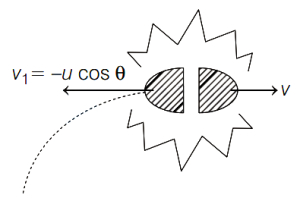
$A$ cannon shell fired breaks into two equal parts at its highest point. If one part retraces its path to the cannon with kinetic energy $E_1$ and the kinetic energy of the second part is $E_2$,then
A
$E_2=15 E_1$
B
$E_2=E_1$
C
$E_2=4 E_1$
D
$E_2=9 E_1$
Solution
(D) Let the mass of the shell be $2m$. At the highest point,the vertical component of velocity is zero,and the horizontal velocity is $u \cos \theta$.
Thus,the momentum of the shell just before the explosion is $P = (2m)(u \cos \theta)$.
After the explosion,the shell breaks into two equal parts of mass $m$ each.
One part retraces its path,meaning its velocity is $v_1 = -u \cos \theta$.
Let the velocity of the second part be $v_2$.
By the law of conservation of linear momentum:
$2m u \cos \theta = m v_1 + m v_2$
$2m u \cos \theta = m(-u \cos \theta) + m v_2$
$2m u \cos \theta = -m u \cos \theta + m v_2$
$m v_2 = 3m u \cos \theta \Rightarrow v_2 = 3u \cos \theta$.
The kinetic energy of the first part is $E_1 = \frac{1}{2} m v_1^2 = \frac{1}{2} m (-u \cos \theta)^2 = \frac{1}{2} m u^2 \cos^2 \theta$.
The kinetic energy of the second part is $E_2 = \frac{1}{2} m v_2^2 = \frac{1}{2} m (3u \cos \theta)^2 = \frac{1}{2} m (9 u^2 \cos^2 \theta) = 9 \left( \frac{1}{2} m u^2 \cos^2 \theta \right)$.
Therefore,$E_2 = 9 E_1$.
Thus,the momentum of the shell just before the explosion is $P = (2m)(u \cos \theta)$.
After the explosion,the shell breaks into two equal parts of mass $m$ each.
One part retraces its path,meaning its velocity is $v_1 = -u \cos \theta$.
Let the velocity of the second part be $v_2$.
By the law of conservation of linear momentum:
$2m u \cos \theta = m v_1 + m v_2$
$2m u \cos \theta = m(-u \cos \theta) + m v_2$
$2m u \cos \theta = -m u \cos \theta + m v_2$
$m v_2 = 3m u \cos \theta \Rightarrow v_2 = 3u \cos \theta$.
The kinetic energy of the first part is $E_1 = \frac{1}{2} m v_1^2 = \frac{1}{2} m (-u \cos \theta)^2 = \frac{1}{2} m u^2 \cos^2 \theta$.
The kinetic energy of the second part is $E_2 = \frac{1}{2} m v_2^2 = \frac{1}{2} m (3u \cos \theta)^2 = \frac{1}{2} m (9 u^2 \cos^2 \theta) = 9 \left( \frac{1}{2} m u^2 \cos^2 \theta \right)$.
Therefore,$E_2 = 9 E_1$.
0 likesView Solution
2
PhysicsEasyMCQTS EAMCET · 2014
Match the following (Take the relative strength of the strongest fundamental forces in nature as $1$):
The correct match is:
| $I$ (Fundamental forces in nature) | $II$ (Relative strength) |
|---|---|
| $(A)$ Strong nuclear force | $(e)$ $10^{-2}$ |
| $(B)$ Weak nuclear force | $(f)$ $1$ |
| $(C)$ Electromagnetic force | $(g)$ $10^{10}$ |
| $(D)$ Gravitational force | $(h)$ $10^{-13}$ |
| $(i)$ $10^{-39}$ |
The correct match is:
A
$A-f, B-i, C-e, D-h$
B
$A-f, B-h, C-e, D-h$
C
$A-f, B-h, C-e, D-i$
D
$A-f, B-e, C-h, D-i$
Solution
(C) The relative strengths of the four fundamental forces in nature,taking the strongest (strong nuclear force) as $1$,are as follows:
$(A)$ Strong nuclear force: Relative strength $= 1$ (matches $f$)
$(B)$ Weak nuclear force: Relative strength $\approx 10^{-13}$ (matches $h$)
$(C)$ Electromagnetic force: Relative strength $\approx 10^{-2}$ (matches $e$)
$(D)$ Gravitational force: Relative strength $\approx 10^{-39}$ (matches $i$)
Therefore,the correct matching is $A-f, B-h, C-e, D-i$.
$(A)$ Strong nuclear force: Relative strength $= 1$ (matches $f$)
$(B)$ Weak nuclear force: Relative strength $\approx 10^{-13}$ (matches $h$)
$(C)$ Electromagnetic force: Relative strength $\approx 10^{-2}$ (matches $e$)
$(D)$ Gravitational force: Relative strength $\approx 10^{-39}$ (matches $i$)
Therefore,the correct matching is $A-f, B-h, C-e, D-i$.
0 likesView Solution
3
PhysicsDifficultMCQTS EAMCET · 2014
The volume of one mole of the gas is changed from $V$ to $2V$ at constant pressure $p$. If $\gamma$ is the ratio of specific heats of the gas,what is the change in internal energy of the gas?
A
$\frac{R p V}{\gamma-1}$
B
$\frac{R}{\gamma-1}$
C
$p V$
D
$\frac{p V}{\gamma-1}$
Solution
(D) For an ideal gas,the internal energy $U$ is given by $U = \frac{n R T}{\gamma-1}$.
Since $n = 1$ mole,$U = \frac{R T}{\gamma-1}$.
From the ideal gas law,$p V = R T$,so $U = \frac{p V}{\gamma-1}$.
The change in internal energy $\Delta U$ is given by $\Delta U = U_f - U_i$.
Initial state: $p V_i = p V$,so $U_i = \frac{p V}{\gamma-1}$.
Final state: $p V_f = p(2V) = 2 p V$,so $U_f = \frac{2 p V}{\gamma-1}$.
Therefore,$\Delta U = \frac{2 p V}{\gamma-1} - \frac{p V}{\gamma-1} = \frac{p V}{\gamma-1}$.
Since $n = 1$ mole,$U = \frac{R T}{\gamma-1}$.
From the ideal gas law,$p V = R T$,so $U = \frac{p V}{\gamma-1}$.
The change in internal energy $\Delta U$ is given by $\Delta U = U_f - U_i$.
Initial state: $p V_i = p V$,so $U_i = \frac{p V}{\gamma-1}$.
Final state: $p V_f = p(2V) = 2 p V$,so $U_f = \frac{2 p V}{\gamma-1}$.
Therefore,$\Delta U = \frac{2 p V}{\gamma-1} - \frac{p V}{\gamma-1} = \frac{p V}{\gamma-1}$.
0 likesView Solution
4
PhysicsMediumMCQTS EAMCET · 2014
$A$ mass $M \text{ kg}$ is suspended by a weightless string. The horizontal force required to hold the mass at $60^{\circ}$ with the vertical is
A
$M g$
B
$M g \sqrt{3}$
C
$M g(\sqrt{3}+1)$
D
$\frac{M g}{\sqrt{3}}$
Solution
(B) Let $T$ be the tension in the string and $F$ be the horizontal force applied to hold the mass in equilibrium.
At equilibrium,the forces acting on the mass are balanced:
$1$. Vertical direction: $T \cos \theta = M g$ (where $\theta = 60^{\circ}$)
$2$. Horizontal direction: $F = T \sin \theta$
Dividing the horizontal force equation by the vertical force equation:
$\frac{F}{M g} = \frac{T \sin \theta}{T \cos \theta} = \tan \theta$
$F = M g \tan \theta$
Given $\theta = 60^{\circ}$,we have:
$F = M g \tan 60^{\circ} = M g \sqrt{3}$
At equilibrium,the forces acting on the mass are balanced:
$1$. Vertical direction: $T \cos \theta = M g$ (where $\theta = 60^{\circ}$)
$2$. Horizontal direction: $F = T \sin \theta$
Dividing the horizontal force equation by the vertical force equation:
$\frac{F}{M g} = \frac{T \sin \theta}{T \cos \theta} = \tan \theta$
$F = M g \tan \theta$
Given $\theta = 60^{\circ}$,we have:
$F = M g \tan 60^{\circ} = M g \sqrt{3}$
0 likesView Solution
5
PhysicsDifficultMCQTS EAMCET · 2014
Two wires of the same material and length but diameters in the ratio $1:2$ are stretched by the same force. The elastic potential energy per unit volume for the wires,when stretched by the same force,will be in the ratio: (in $:1$)
A
$16$
B
$1$
C
$2$
D
$4$
Solution
(A) The elastic potential energy per unit volume $(u)$ is given by the formula:
$u = \frac{1}{2} \times \text{stress} \times \text{strain} = \frac{1}{2} \times \frac{F}{A} \times \frac{F}{AY} = \frac{F^2}{2AY}$
Since the force $(F)$,Young's modulus $(Y)$,and length $(l)$ are the same for both wires,we have:
$u \propto \frac{1}{A} \propto \frac{1}{r^2} \propto \frac{1}{d^2}$
Wait,let us re-evaluate: $u = \frac{1}{2} \times \text{stress} \times \text{strain} = \frac{1}{2} \times \frac{F}{A} \times \frac{F}{AY} = \frac{F^2}{2A^2Y}$.
Since $A = \pi r^2 = \pi (d/2)^2$,we have $A \propto d^2$,so $A^2 \propto d^4$.
Thus,$u \propto \frac{1}{d^4}$.
Given the ratio of diameters $d_1 : d_2 = 1:2$,the ratio of energy per unit volume is:
$\frac{u_1}{u_2} = \left( \frac{d_2}{d_1} \right)^4 = \left( \frac{2}{1} \right)^4 = \frac{16}{1}$.
Therefore,the ratio is $16:1$.
$u = \frac{1}{2} \times \text{stress} \times \text{strain} = \frac{1}{2} \times \frac{F}{A} \times \frac{F}{AY} = \frac{F^2}{2AY}$
Since the force $(F)$,Young's modulus $(Y)$,and length $(l)$ are the same for both wires,we have:
$u \propto \frac{1}{A} \propto \frac{1}{r^2} \propto \frac{1}{d^2}$
Wait,let us re-evaluate: $u = \frac{1}{2} \times \text{stress} \times \text{strain} = \frac{1}{2} \times \frac{F}{A} \times \frac{F}{AY} = \frac{F^2}{2A^2Y}$.
Since $A = \pi r^2 = \pi (d/2)^2$,we have $A \propto d^2$,so $A^2 \propto d^4$.
Thus,$u \propto \frac{1}{d^4}$.
Given the ratio of diameters $d_1 : d_2 = 1:2$,the ratio of energy per unit volume is:
$\frac{u_1}{u_2} = \left( \frac{d_2}{d_1} \right)^4 = \left( \frac{2}{1} \right)^4 = \frac{16}{1}$.
Therefore,the ratio is $16:1$.
0 likesView Solution
6
PhysicsEasyMCQTS EAMCET · 2014
If $C$ is the velocity of light,$h$ is Planck's constant,and $G$ is the gravitational constant,and these are taken as fundamental quantities,then the dimensional formula of mass is:
A
$h^{-1/2} G^{1/2} C^0$
B
$h^{1/2} C^{1/2} G^{-1/2}$
C
$h^{-1/2} C^{1/2} G^{-1/2}$
D
$h^{-1/2} C^{-1/2} G^{-1/2}$
Solution
(B) Let the mass $M$ be expressed as $M = C^a h^b G^c$.
The dimensions are:
$C = [LT^{-1}]$
$h = [ML^2T^{-1}]$
$G = [M^{-1}L^3T^{-2}]$
Substituting these into the equation:
$[M^1L^0T^0] = [LT^{-1}]^a [ML^2T^{-1}]^b [M^{-1}L^3T^{-2}]^c$
$[M^1L^0T^0] = M^{b-c} L^{a+2b+3c} T^{-a-b-2c}$
Comparing the powers of $M, L, T$ on both sides:
$b - c = 1$ $(i)$
$a + 2b + 3c = 0$ (ii)
$-a - b - 2c = 0$ (iii)
Adding (ii) and (iii): $b + c = 0$,so $b = -c$.
Substituting $b = -c$ into $(i)$: $-c - c = 1 \implies -2c = 1 \implies c = -1/2$.
Then $b = 1/2$.
Substituting $b = 1/2$ and $c = -1/2$ into (iii): $-a - 1/2 - 2(-1/2) = 0 \implies -a - 1/2 + 1 = 0 \implies a = 1/2$.
Thus,$M = C^{1/2} h^{1/2} G^{-1/2}$.
The dimensions are:
$C = [LT^{-1}]$
$h = [ML^2T^{-1}]$
$G = [M^{-1}L^3T^{-2}]$
Substituting these into the equation:
$[M^1L^0T^0] = [LT^{-1}]^a [ML^2T^{-1}]^b [M^{-1}L^3T^{-2}]^c$
$[M^1L^0T^0] = M^{b-c} L^{a+2b+3c} T^{-a-b-2c}$
Comparing the powers of $M, L, T$ on both sides:
$b - c = 1$ $(i)$
$a + 2b + 3c = 0$ (ii)
$-a - b - 2c = 0$ (iii)
Adding (ii) and (iii): $b + c = 0$,so $b = -c$.
Substituting $b = -c$ into $(i)$: $-c - c = 1 \implies -2c = 1 \implies c = -1/2$.
Then $b = 1/2$.
Substituting $b = 1/2$ and $c = -1/2$ into (iii): $-a - 1/2 - 2(-1/2) = 0 \implies -a - 1/2 + 1 = 0 \implies a = 1/2$.
Thus,$M = C^{1/2} h^{1/2} G^{-1/2}$.
0 likesView Solution
7
PhysicsDifficultMCQTS EAMCET · 2014
$A$ satellite is revolving very close to a planet of density $\rho$. The period of revolution of the satellite is
A
$\sqrt{\frac{3 \pi \rho}{G}}$
B
$\sqrt{\frac{3 \pi}{2 \rho G}}$
C
$\sqrt{\frac{3 \pi}{\rho G}}$
D
$\sqrt{\frac{3 \pi G}{\rho}}$
Solution
(C) The period of revolution $T$ of a satellite at a distance $r = R_p + h$ from the center of a planet of mass $M_p$ is given by $T = 2 \pi \sqrt{\frac{r^3}{G M_p}}$.
Since the satellite is revolving very close to the planet,$h \approx 0$,so $r \approx R_p$.
The mass of the planet in terms of its density $\rho$ and radius $R_p$ is $M_p = \frac{4}{3} \pi R_p^3 \rho$.
Substituting $M_p$ into the period formula:
$T = 2 \pi \sqrt{\frac{R_p^3}{G (\frac{4}{3} \pi R_p^3 \rho)}}$.
Simplifying the expression:
$T = 2 \pi \sqrt{\frac{3}{4 \pi G \rho}} = \sqrt{\frac{4 \pi^2 \cdot 3}{4 \pi G \rho}} = \sqrt{\frac{3 \pi}{G \rho}}$.
Since the satellite is revolving very close to the planet,$h \approx 0$,so $r \approx R_p$.
The mass of the planet in terms of its density $\rho$ and radius $R_p$ is $M_p = \frac{4}{3} \pi R_p^3 \rho$.
Substituting $M_p$ into the period formula:
$T = 2 \pi \sqrt{\frac{R_p^3}{G (\frac{4}{3} \pi R_p^3 \rho)}}$.
Simplifying the expression:
$T = 2 \pi \sqrt{\frac{3}{4 \pi G \rho}} = \sqrt{\frac{4 \pi^2 \cdot 3}{4 \pi G \rho}} = \sqrt{\frac{3 \pi}{G \rho}}$.
0 likesView Solution
8
PhysicsDifficultMCQTS EAMCET · 2014
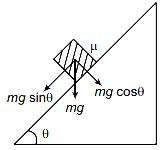
The force required to move a body up a rough inclined plane is double the force required to prevent the body from sliding down the plane. The coefficient of friction,when the angle of inclination of the plane is $60^{\circ}$ is
A
$\frac{1}{3}$
B
$\frac{1}{\sqrt{2}}$
C
$\frac{1}{\sqrt{3}}$
D
$\frac{1}{2}$
Solution
(C) For upward motion,the force required is $F_{\text{up}} = mg(\sin \theta + \mu \cos \theta)$.
For downward motion,the force required to prevent sliding is $F_{\text{down}} = mg(\sin \theta - \mu \cos \theta)$.
According to the problem,$F_{\text{up}} = 2 F_{\text{down}}$.
Substituting the expressions,we get $mg(\sin \theta + \mu \cos \theta) = 2mg(\sin \theta - \mu \cos \theta)$.
Dividing both sides by $mg$,we have $\sin \theta + \mu \cos \theta = 2 \sin \theta - 2 \mu \cos \theta$.
Rearranging the terms,$3 \mu \cos \theta = \sin \theta$,which simplifies to $\mu = \frac{1}{3} \tan \theta$.
Given $\theta = 60^{\circ}$,we have $\mu = \frac{1}{3} \tan 60^{\circ} = \frac{1}{3} \times \sqrt{3} = \frac{1}{\sqrt{3}}$.
For downward motion,the force required to prevent sliding is $F_{\text{down}} = mg(\sin \theta - \mu \cos \theta)$.
According to the problem,$F_{\text{up}} = 2 F_{\text{down}}$.
Substituting the expressions,we get $mg(\sin \theta + \mu \cos \theta) = 2mg(\sin \theta - \mu \cos \theta)$.
Dividing both sides by $mg$,we have $\sin \theta + \mu \cos \theta = 2 \sin \theta - 2 \mu \cos \theta$.
Rearranging the terms,$3 \mu \cos \theta = \sin \theta$,which simplifies to $\mu = \frac{1}{3} \tan \theta$.
Given $\theta = 60^{\circ}$,we have $\mu = \frac{1}{3} \tan 60^{\circ} = \frac{1}{3} \times \sqrt{3} = \frac{1}{\sqrt{3}}$.
0 likesView Solution
9
PhysicsMediumMCQTS EAMCET · 2014
When a big drop of water is formed from $n$ small drops of water,the energy loss is $3E$,where $E$ is the energy of the bigger drop. If $R$ is the radius of the bigger drop and $r$ is the radius of the smaller drop,then the number of smaller drops $(n)$ is:
A
$\frac{4R}{r^2}$
B
$\frac{4R}{r}$
C
$\frac{2R^2}{r}$
D
$\frac{4R^2}{r^2}$
Solution
(D) The energy of a drop is given by $U = T \times A$,where $T$ is surface tension and $A$ is surface area.
Energy of $n$ small drops: $U_i = n \times (4\pi r^2 T)$.
Energy of the big drop: $E = 4\pi R^2 T$.
Energy loss is given as $\Delta U = U_i - E = 3E$.
Substituting the values: $n(4\pi r^2 T) - 4\pi R^2 T = 3(4\pi R^2 T)$.
$n(4\pi r^2 T) = 4\pi R^2 T + 12\pi R^2 T$.
$n(4\pi r^2 T) = 16\pi R^2 T$.
$n = \frac{16\pi R^2 T}{4\pi r^2 T} = 4\frac{R^2}{r^2}$.
Energy of $n$ small drops: $U_i = n \times (4\pi r^2 T)$.
Energy of the big drop: $E = 4\pi R^2 T$.
Energy loss is given as $\Delta U = U_i - E = 3E$.
Substituting the values: $n(4\pi r^2 T) - 4\pi R^2 T = 3(4\pi R^2 T)$.
$n(4\pi r^2 T) = 4\pi R^2 T + 12\pi R^2 T$.
$n(4\pi r^2 T) = 16\pi R^2 T$.
$n = \frac{16\pi R^2 T}{4\pi r^2 T} = 4\frac{R^2}{r^2}$.
0 likesView Solution
10
PhysicsDifficultMCQTS EAMCET · 2014
$A$ person walks along a straight road from his house to a market $2.5 \,km$ away with a speed of $5 \,km/h$ and instantly turns back and reaches his house with a speed of $7.5 \,km/h$. The average speed of the person during the time interval $0$ to $50 \,min$ is (in $m/s$)
A
$4 \frac{2}{3}$
B
$\frac{5}{3}$
C
$\frac{5}{6}$
D
$\frac{1}{3}$
Solution
(B) Time taken to reach the market: $t_1 = \frac{\text{distance}}{\text{speed}} = \frac{2.5 \,km}{5 \,km/h} = 0.5 \,h = 30 \,min$.
Time taken to return to the house: $t_2 = \frac{\text{distance}}{\text{speed}} = \frac{2.5 \,km}{7.5 \,km/h} = \frac{1}{3} \,h = 20 \,min$.
Total time taken for the round trip is $30 \,min + 20 \,min = 50 \,min$.
Total distance covered = $2.5 \,km + 2.5 \,km = 5 \,km = 5000 \,m$.
Total time in seconds = $50 \,min \times 60 \,s/min = 3000 \,s$.
Average speed = $\frac{\text{Total distance}}{\text{Total time}} = \frac{5000 \,m}{3000 \,s} = \frac{5}{3} \,m/s$.
Time taken to return to the house: $t_2 = \frac{\text{distance}}{\text{speed}} = \frac{2.5 \,km}{7.5 \,km/h} = \frac{1}{3} \,h = 20 \,min$.
Total time taken for the round trip is $30 \,min + 20 \,min = 50 \,min$.
Total distance covered = $2.5 \,km + 2.5 \,km = 5 \,km = 5000 \,m$.
Total time in seconds = $50 \,min \times 60 \,s/min = 3000 \,s$.
Average speed = $\frac{\text{Total distance}}{\text{Total time}} = \frac{5000 \,m}{3000 \,s} = \frac{5}{3} \,m/s$.
0 likesView Solution
11
PhysicsDifficultMCQTS EAMCET · 2014
$A$ bus moving on a level road with a velocity $v$ can be stopped at a distance of $x$ by the application of a retarding force $F$. The load on the bus is increased by $25\%$ by boarding the passengers. Now,if the bus is moving with the same speed and if the same retarding force is applied,the distance travelled by the bus before it stops is
A
$1.25 x$
B
$x$
C
$5 x$
D
$2.5 x$
Solution
(A) According to the work-energy theorem,the work done by the retarding force is equal to the change in kinetic energy of the bus.
$W = \Delta K$
$F \cdot s = \frac{1}{2} m v^2$
Since the retarding force $F$ and the initial velocity $v$ are constant,we have:
$s = \frac{m v^2}{2 F} \implies s \propto m$
Let the initial mass be $m_1 = m$ and the initial stopping distance be $s_1 = x$.
The new mass after increasing by $25\%$ is $m_2 = m + 0.25m = 1.25m$.
Using the proportionality $s \propto m$:
$\frac{s_2}{s_1} = \frac{m_2}{m_1}$
$s_2 = s_1 \cdot \frac{1.25m}{m}$
$s_2 = 1.25 x$.
$W = \Delta K$
$F \cdot s = \frac{1}{2} m v^2$
Since the retarding force $F$ and the initial velocity $v$ are constant,we have:
$s = \frac{m v^2}{2 F} \implies s \propto m$
Let the initial mass be $m_1 = m$ and the initial stopping distance be $s_1 = x$.
The new mass after increasing by $25\%$ is $m_2 = m + 0.25m = 1.25m$.
Using the proportionality $s \propto m$:
$\frac{s_2}{s_1} = \frac{m_2}{m_1}$
$s_2 = s_1 \cdot \frac{1.25m}{m}$
$s_2 = 1.25 x$.
0 likesView Solution
12
PhysicsDifficultMCQTS EAMCET · 2014
The path of a projectile is given by the equation $y = ax - bx^2$,where $a$ and $b$ are constants,and $x$ and $y$ are the horizontal and vertical distances of the projectile from the point of projection,respectively. The maximum height attained by the projectile and the angle of projection are respectively:
A
$\frac{2a^2}{b}, \tan^{-1}(a)$
B
$\frac{b^2}{2a}, \tan^{-1}(b)$
C
$\frac{a^2}{b}, \tan^{-1}(2b)$
D
$\frac{a^2}{4b}, \tan^{-1}(a)$
Solution
(D) The given equation of the trajectory is $y = ax - bx^2$.
The standard equation of a projectile trajectory is $y = x \tan \theta - \frac{gx^2}{2u^2 \cos^2 \theta}$.
Comparing the coefficients of $x$ and $x^2$ in both equations:
$\tan \theta = a \implies \theta = \tan^{-1}(a)$.
Also,$b = \frac{g}{2u^2 \cos^2 \theta}$.
The maximum height $H$ is given by $H = \frac{u^2 \sin^2 \theta}{2g}$.
From $\tan \theta = a$,we have $\sin \theta = \frac{a}{\sqrt{1+a^2}}$ and $\cos \theta = \frac{1}{\sqrt{1+a^2}}$.
Substituting $u^2 = \frac{g}{2b \cos^2 \theta}$ into the height formula:
$H = \frac{g}{2b \cos^2 \theta} \cdot \frac{\sin^2 \theta}{2g} = \frac{\tan^2 \theta}{4b} = \frac{a^2}{4b}$.
Thus,the maximum height is $\frac{a^2}{4b}$ and the angle of projection is $\tan^{-1}(a)$.
The standard equation of a projectile trajectory is $y = x \tan \theta - \frac{gx^2}{2u^2 \cos^2 \theta}$.
Comparing the coefficients of $x$ and $x^2$ in both equations:
$\tan \theta = a \implies \theta = \tan^{-1}(a)$.
Also,$b = \frac{g}{2u^2 \cos^2 \theta}$.
The maximum height $H$ is given by $H = \frac{u^2 \sin^2 \theta}{2g}$.
From $\tan \theta = a$,we have $\sin \theta = \frac{a}{\sqrt{1+a^2}}$ and $\cos \theta = \frac{1}{\sqrt{1+a^2}}$.
Substituting $u^2 = \frac{g}{2b \cos^2 \theta}$ into the height formula:
$H = \frac{g}{2b \cos^2 \theta} \cdot \frac{\sin^2 \theta}{2g} = \frac{\tan^2 \theta}{4b} = \frac{a^2}{4b}$.
Thus,the maximum height is $\frac{a^2}{4b}$ and the angle of projection is $\tan^{-1}(a)$.
0 likesView Solution
13
PhysicsMediumMCQTS EAMCET · 2014
$A$ body is projected at an angle $\theta$ so that its range is maximum. If $T$ is the time of flight,then the value of maximum range is (acceleration due to gravity $= g$)
A
$\frac{g^2 T}{2}$
B
$\frac{g T}{2}$
C
$\frac{g T^2}{2}$
D
$\frac{g^2 T^2}{2}$
Solution
(C) The range of a projectile is given by $R = \frac{u^2 \sin 2\theta}{g}$.
For maximum range,the angle of projection must be $\theta = 45^{\circ}$.
Thus,$R_{\max} = \frac{u^2 \sin(90^{\circ})}{g} = \frac{u^2}{g} \quad \dots (i)$.
The time of flight $T$ is given by $T = \frac{2u \sin \theta}{g}$.
Substituting $\theta = 45^{\circ}$,we get $T = \frac{2u \sin 45^{\circ}}{g} = \frac{2u}{g \sqrt{2}} = \frac{u \sqrt{2}}{g}$.
From this,we find $u = \frac{Tg}{\sqrt{2}}$.
Substituting the value of $u$ into equation $(i)$:
$R_{\max} = \frac{1}{g} \left( \frac{Tg}{\sqrt{2}} \right)^2 = \frac{1}{g} \cdot \frac{T^2 g^2}{2} = \frac{g T^2}{2}$.
For maximum range,the angle of projection must be $\theta = 45^{\circ}$.
Thus,$R_{\max} = \frac{u^2 \sin(90^{\circ})}{g} = \frac{u^2}{g} \quad \dots (i)$.
The time of flight $T$ is given by $T = \frac{2u \sin \theta}{g}$.
Substituting $\theta = 45^{\circ}$,we get $T = \frac{2u \sin 45^{\circ}}{g} = \frac{2u}{g \sqrt{2}} = \frac{u \sqrt{2}}{g}$.
From this,we find $u = \frac{Tg}{\sqrt{2}}$.
Substituting the value of $u$ into equation $(i)$:
$R_{\max} = \frac{1}{g} \left( \frac{Tg}{\sqrt{2}} \right)^2 = \frac{1}{g} \cdot \frac{T^2 g^2}{2} = \frac{g T^2}{2}$.
0 likesView Solution
14
PhysicsDifficultMCQTS EAMCET · 2014
The ratio between kinetic and potential energies of a body executing simple harmonic motion,when it is at a distance of $\frac{1}{N}$ of its amplitude from the mean position is
A
$N^2+1$
B
$\frac{1}{N^2}$
C
$N^2$
D
$N^2-1$
Solution
(D) Let the amplitude of the simple harmonic motion be $a$. The displacement of the body from the mean position is $x = \frac{a}{N}$.
The kinetic energy $(KE)$ of the body is given by:
$KE = \frac{1}{2} m \omega^2 (a^2 - x^2) = \frac{1}{2} m \omega^2 \left(a^2 - \frac{a^2}{N^2}\right) = \frac{1}{2} m \omega^2 a^2 \left(1 - \frac{1}{N^2}\right) = \frac{1}{2} m \omega^2 a^2 \left(\frac{N^2 - 1}{N^2}\right) \quad (i)$
The potential energy $(PE)$ of the body is given by:
$PE = \frac{1}{2} m \omega^2 x^2 = \frac{1}{2} m \omega^2 \left(\frac{a}{N}\right)^2 = \frac{1}{2} m \omega^2 \frac{a^2}{N^2} \quad (ii)$
Taking the ratio of $KE$ to $PE$:
$\frac{KE}{PE} = \frac{\frac{1}{2} m \omega^2 a^2 \left(\frac{N^2 - 1}{N^2}\right)}{\frac{1}{2} m \omega^2 \frac{a^2}{N^2}} = \frac{N^2 - 1}{1} = N^2 - 1$
The kinetic energy $(KE)$ of the body is given by:
$KE = \frac{1}{2} m \omega^2 (a^2 - x^2) = \frac{1}{2} m \omega^2 \left(a^2 - \frac{a^2}{N^2}\right) = \frac{1}{2} m \omega^2 a^2 \left(1 - \frac{1}{N^2}\right) = \frac{1}{2} m \omega^2 a^2 \left(\frac{N^2 - 1}{N^2}\right) \quad (i)$
The potential energy $(PE)$ of the body is given by:
$PE = \frac{1}{2} m \omega^2 x^2 = \frac{1}{2} m \omega^2 \left(\frac{a}{N}\right)^2 = \frac{1}{2} m \omega^2 \frac{a^2}{N^2} \quad (ii)$
Taking the ratio of $KE$ to $PE$:
$\frac{KE}{PE} = \frac{\frac{1}{2} m \omega^2 a^2 \left(\frac{N^2 - 1}{N^2}\right)}{\frac{1}{2} m \omega^2 \frac{a^2}{N^2}} = \frac{N^2 - 1}{1} = N^2 - 1$
0 likesView Solution
15
PhysicsMediumMCQTS EAMCET · 2014
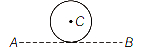
$A$ thin wire of length $l$ having linear mass density $\rho$ is bent into a circular loop with $C$ as its centre,as shown in the figure. The moment of inertia of the loop about the line $AB$ is
A
$\frac{5 \rho l^3}{16 \pi^2}$
B
$\frac{\rho l^3}{16 \pi^2}$
C
$\frac{\rho l^3}{8 \pi^2}$
D
$\frac{3 \rho l^3}{8 \pi^2}$
Solution
(D) The length of the wire is $l$. Let $R$ be the radius of the circular loop. Then,$2 \pi R = l$,which gives $R = \frac{l}{2 \pi}$.
The mass of the wire is $m = \rho l$.
The moment of inertia of a circular loop about its diameter is $I_{diam} = \frac{1}{2} m R^2$.
According to the parallel axis theorem,the moment of inertia about a tangent $AB$ is $I = I_{cm} + m R^2$,where $I_{cm} = I_{diam} = \frac{1}{2} m R^2$.
Therefore,$I = \frac{1}{2} m R^2 + m R^2 = \frac{3}{2} m R^2$.
Substituting $m = \rho l$ and $R = \frac{l}{2 \pi}$:
$I = \frac{3}{2} (\rho l) \left( \frac{l}{2 \pi} \right)^2 = \frac{3}{2} \rho l \left( \frac{l^2}{4 \pi^2} \right) = \frac{3 \rho l^3}{8 \pi^2}$.
The mass of the wire is $m = \rho l$.
The moment of inertia of a circular loop about its diameter is $I_{diam} = \frac{1}{2} m R^2$.
According to the parallel axis theorem,the moment of inertia about a tangent $AB$ is $I = I_{cm} + m R^2$,where $I_{cm} = I_{diam} = \frac{1}{2} m R^2$.
Therefore,$I = \frac{1}{2} m R^2 + m R^2 = \frac{3}{2} m R^2$.
Substituting $m = \rho l$ and $R = \frac{l}{2 \pi}$:
$I = \frac{3}{2} (\rho l) \left( \frac{l}{2 \pi} \right)^2 = \frac{3}{2} \rho l \left( \frac{l^2}{4 \pi^2} \right) = \frac{3 \rho l^3}{8 \pi^2}$.
0 likesView Solution
16
PhysicsDifficultMCQTS EAMCET · 2014
Steam at $100^{\circ} C$ is passed into $1 \ kg$ of water contained in a calorimeter of water equivalent $0.2 \ kg$ at $9^{\circ} C$ until the temperature of the calorimeter and water in it increases to $90^{\circ} C$. The mass of steam condensed in $kg$ is nearly (specific heat of water $= 1 \ cal/g^{\circ} C$,latent heat of vaporisation $= 540 \ cal/g$)
A
$0.81$
B
$0.18$
C
$0.27$
D
$0.54$
Solution
(B) According to the principle of calorimetry:
Heat lost by steam = Heat gained by water and calorimeter
Let $m$ be the mass of steam condensed in grams.
Heat lost by steam = $m \times L + m \times C_w \times (T_{steam} - T_{final})$
$= m \times 540 + m \times 1 \times (100 - 90) = 550m \ cal$
Heat gained by water and calorimeter = $(m_{water} + m_{eq}) \times C_w \times (T_{final} - T_{initial})$
$= (1000 \ g + 200 \ g) \times 1 \times (90 - 9) = 1200 \times 81 = 97200 \ cal$
Equating the two:
$550m = 97200$
$m = \frac{97200}{550} \approx 176.7 \ g$
Converting to $kg$,$m \approx 0.1767 \ kg$,which is approximately $0.18 \ kg$.
Heat lost by steam = Heat gained by water and calorimeter
Let $m$ be the mass of steam condensed in grams.
Heat lost by steam = $m \times L + m \times C_w \times (T_{steam} - T_{final})$
$= m \times 540 + m \times 1 \times (100 - 90) = 550m \ cal$
Heat gained by water and calorimeter = $(m_{water} + m_{eq}) \times C_w \times (T_{final} - T_{initial})$
$= (1000 \ g + 200 \ g) \times 1 \times (90 - 9) = 1200 \times 81 = 97200 \ cal$
Equating the two:
$550m = 97200$
$m = \frac{97200}{550} \approx 176.7 \ g$
Converting to $kg$,$m \approx 0.1767 \ kg$,which is approximately $0.18 \ kg$.
0 likesView Solution
17
PhysicsDifficultMCQTS EAMCET · 2014
$A$ very small hole in an electric furnace is used for heating metals. The hole nearly acts as a black body. The area of the hole is $200 \ mm^2$. To keep a metal at $727^{\circ} C$,the heat energy flowing through this hole per second,in joules,is (given $\sigma = 5.67 \times 10^{-8} \ W m^{-2} K^{-4}$):
A
$22.68$
B
$2.268$
C
$1.134$
D
$11.34$
Solution
(D) According to Stefan-Boltzmann law,the power $P$ radiated by a black body of surface area $A$ at absolute temperature $T$ is given by $P = \sigma A T^4$.
Given values:
$\sigma = 5.67 \times 10^{-8} \ W m^{-2} K^{-4}$
$T = 727^{\circ} C = 727 + 273 = 1000 \ K$
$A = 200 \ mm^2 = 200 \times 10^{-6} \ m^2$
Substituting these values into the formula:
$P = (5.67 \times 10^{-8}) \times (200 \times 10^{-6}) \times (1000)^4$
$P = 5.67 \times 10^{-8} \times 200 \times 10^{-6} \times 10^{12}$
$P = 5.67 \times 2 \times 10^2 \times 10^{-14} \times 10^{12}$
$P = 11.34 \times 10^2 \times 10^{-2}$
$P = 11.34 \ J/s$.
Given values:
$\sigma = 5.67 \times 10^{-8} \ W m^{-2} K^{-4}$
$T = 727^{\circ} C = 727 + 273 = 1000 \ K$
$A = 200 \ mm^2 = 200 \times 10^{-6} \ m^2$
Substituting these values into the formula:
$P = (5.67 \times 10^{-8}) \times (200 \times 10^{-6}) \times (1000)^4$
$P = 5.67 \times 10^{-8} \times 200 \times 10^{-6} \times 10^{12}$
$P = 5.67 \times 2 \times 10^2 \times 10^{-14} \times 10^{12}$
$P = 11.34 \times 10^2 \times 10^{-2}$
$P = 11.34 \ J/s$.
0 likesView Solution
18
PhysicsEasyMCQTS EAMCET · 2014
Five moles of hydrogen initially at $STP$ is compressed adiabatically so that its temperature becomes $673 \, K$. The increase in internal energy of the gas, in kilo joule is $(R=8.3 \, J/mol-K; \gamma=1.4$ for diatomic gas$)$
A
$80.5$
B
$21.55$
C
$41.50$
D
$65.55$
Solution
(C) The change in internal energy $dU$ for an ideal gas is given by the formula:
$dU = n C_v dT$
Since $C_v = \frac{R}{\gamma - 1}$, the formula becomes:
$dU = n \frac{R}{\gamma - 1} (T_2 - T_1)$
Given values:
$n = 5 \, mol$
$T_1 = 273 \, K$ (at $STP$)
$T_2 = 673 \, K$
$R = 8.3 \, J/mol-K$
$\gamma = 1.4$
Substituting these values into the equation:
$dU = 5 \times \frac{8.3}{1.4 - 1} \times (673 - 273)$
$dU = 5 \times \frac{8.3}{0.4} \times 400$
$dU = 5 \times 8.3 \times 1000$
$dU = 41500 \, J$
Converting to kilo joules:
$dU = 41.50 \, kJ$
$dU = n C_v dT$
Since $C_v = \frac{R}{\gamma - 1}$, the formula becomes:
$dU = n \frac{R}{\gamma - 1} (T_2 - T_1)$
Given values:
$n = 5 \, mol$
$T_1 = 273 \, K$ (at $STP$)
$T_2 = 673 \, K$
$R = 8.3 \, J/mol-K$
$\gamma = 1.4$
Substituting these values into the equation:
$dU = 5 \times \frac{8.3}{1.4 - 1} \times (673 - 273)$
$dU = 5 \times \frac{8.3}{0.4} \times 400$
$dU = 5 \times 8.3 \times 1000$
$dU = 41500 \, J$
Converting to kilo joules:
$dU = 41.50 \, kJ$
0 likesView Solution
19
PhysicsDifficultMCQTS EAMCET · 2014
If $C$ (the velocity of light),$h$ (Planck's constant),and $G$ (gravitational constant) are taken as fundamental quantities,then the dimensional formula of mass is
A
$h^{-1/2} G^{1/2} C^0$
B
$h^{1/2} C^{1/2} G^{-1/2}$
C
$h^{-1/2} C^{1/2} G^{-1/2}$
D
$h^{-1/2} C^{-1/2} G^{-1/2}$
Solution
(B) Let mass $M$ be expressed as $M = C^a h^b G^c$.
The dimensions are:
$C = [LT^{-1}]$
$h = [ML^2T^{-1}]$
$G = [M^{-1}L^3T^{-2}]$
Substituting these into the equation:
$[M^1L^0T^0] = [LT^{-1}]^a [ML^2T^{-1}]^b [M^{-1}L^3T^{-2}]^c$
$[M^1L^0T^0] = [M^{b-c} L^{a+2b+3c} T^{-a-b-2c}]$
Comparing the powers of $M, L, T$ on both sides:
$b - c = 1$ $(i)$
$a + 2b + 3c = 0$ (ii)
$-a - b - 2c = 0$ (iii)
Adding (ii) and (iii): $b + c = 0$,so $b = -c$.
Substituting $b = -c$ into $(i)$: $-c - c = 1 \Rightarrow -2c = 1 \Rightarrow c = -1/2$.
Then $b = 1/2$.
Substituting $b = 1/2$ and $c = -1/2$ into (iii): $-a - 1/2 - 2(-1/2) = 0 \Rightarrow -a - 1/2 + 1 = 0 \Rightarrow a = 1/2$.
Thus,$M = C^{1/2} h^{1/2} G^{-1/2}$.
The dimensions are:
$C = [LT^{-1}]$
$h = [ML^2T^{-1}]$
$G = [M^{-1}L^3T^{-2}]$
Substituting these into the equation:
$[M^1L^0T^0] = [LT^{-1}]^a [ML^2T^{-1}]^b [M^{-1}L^3T^{-2}]^c$
$[M^1L^0T^0] = [M^{b-c} L^{a+2b+3c} T^{-a-b-2c}]$
Comparing the powers of $M, L, T$ on both sides:
$b - c = 1$ $(i)$
$a + 2b + 3c = 0$ (ii)
$-a - b - 2c = 0$ (iii)
Adding (ii) and (iii): $b + c = 0$,so $b = -c$.
Substituting $b = -c$ into $(i)$: $-c - c = 1 \Rightarrow -2c = 1 \Rightarrow c = -1/2$.
Then $b = 1/2$.
Substituting $b = 1/2$ and $c = -1/2$ into (iii): $-a - 1/2 - 2(-1/2) = 0 \Rightarrow -a - 1/2 + 1 = 0 \Rightarrow a = 1/2$.
Thus,$M = C^{1/2} h^{1/2} G^{-1/2}$.
0 likesView Solution
20
PhysicsDifficultMCQTS EAMCET · 2014
$A$ closed pipe is suddenly opened and changed to an open pipe of the same length. The fundamental frequency of the resulting open pipe is less than that of the $3^{rd}$ harmonic of the earlier closed pipe by $55 \,Hz$. Then, the value of the fundamental frequency of the closed pipe is: (in $\,Hz$)
A
$165$
B
$110$
C
$55$
D
$220$
Solution
(C) Let the length of the pipe be $l$ and the speed of sound be $v$.
The fundamental frequency of a closed pipe is $f_c = \frac{v}{4l}$.
The $3^{rd}$ harmonic of the closed pipe is $f_{3,c} = 3 \times f_c = \frac{3v}{4l}$.
The fundamental frequency of the open pipe is $f_o = \frac{v}{2l}$.
According to the problem, the fundamental frequency of the open pipe is less than the $3^{rd}$ harmonic of the closed pipe by $55 \,Hz$:
$f_{3,c} - f_o = 55 \,Hz$
$\frac{3v}{4l} - \frac{v}{2l} = 55$
$\frac{3v - 2v}{4l} = 55$
$\frac{v}{4l} = 55 \,Hz$
Since the fundamental frequency of the closed pipe is $f_c = \frac{v}{4l}$, the value is $55 \,Hz$.
The fundamental frequency of a closed pipe is $f_c = \frac{v}{4l}$.
The $3^{rd}$ harmonic of the closed pipe is $f_{3,c} = 3 \times f_c = \frac{3v}{4l}$.
The fundamental frequency of the open pipe is $f_o = \frac{v}{2l}$.
According to the problem, the fundamental frequency of the open pipe is less than the $3^{rd}$ harmonic of the closed pipe by $55 \,Hz$:
$f_{3,c} - f_o = 55 \,Hz$
$\frac{3v}{4l} - \frac{v}{2l} = 55$
$\frac{3v - 2v}{4l} = 55$
$\frac{v}{4l} = 55 \,Hz$
Since the fundamental frequency of the closed pipe is $f_c = \frac{v}{4l}$, the value is $55 \,Hz$.
0 likesView Solution
21
PhysicsDifficultMCQTS EAMCET · 2014
$A$ wheel which is initially at rest is subjected to a constant angular acceleration about its axis. It rotates through an angle of $15^{\circ}$ in time $t \ s$. The increase in angle through which it rotates in the next $2t \ s$ is (in $^{\circ}$)
A
$90$
B
$120$
C
$30$
D
$45$
Solution
(B) Since the angular acceleration $\alpha$ is constant and the initial angular velocity $\omega_0 = 0$,the angle $\theta$ rotated in time $t$ is given by $\theta = \frac{1}{2} \alpha t^2$.
Given $\theta = 15^{\circ}$ for time $t$,we have $15^{\circ} = \frac{1}{2} \alpha t^2$ (Equation $1$).
Now,we need to find the angle rotated in the next $2t \ s$. The total time elapsed is $t + 2t = 3t \ s$.
The total angle $\theta_{total}$ rotated in time $3t$ is $\theta_{total} = \frac{1}{2} \alpha (3t)^2 = 9 \times (\frac{1}{2} \alpha t^2)$.
Substituting Equation $1$ into this,we get $\theta_{total} = 9 \times 15^{\circ} = 135^{\circ}$.
The increase in angle in the next $2t \ s$ is $\Delta \theta = \theta_{total} - \theta = 135^{\circ} - 15^{\circ} = 120^{\circ}$.
Given $\theta = 15^{\circ}$ for time $t$,we have $15^{\circ} = \frac{1}{2} \alpha t^2$ (Equation $1$).
Now,we need to find the angle rotated in the next $2t \ s$. The total time elapsed is $t + 2t = 3t \ s$.
The total angle $\theta_{total}$ rotated in time $3t$ is $\theta_{total} = \frac{1}{2} \alpha (3t)^2 = 9 \times (\frac{1}{2} \alpha t^2)$.
Substituting Equation $1$ into this,we get $\theta_{total} = 9 \times 15^{\circ} = 135^{\circ}$.
The increase in angle in the next $2t \ s$ is $\Delta \theta = \theta_{total} - \theta = 135^{\circ} - 15^{\circ} = 120^{\circ}$.
0 likesView Solution
22
PhysicsDifficultMCQTS EAMCET · 2014
$A$ cannon shell fired breaks into two equal parts at its highest point. One part retraces the path to the cannon with kinetic energy $E_1$ and the kinetic energy of the second part is $E_2$. The relation between $E_1$ and $E_2$ is:
A
$E_2 = 15 E_1$
B
$E_2 = E_1$
C
$E_2 = 4 E_1$
D
$E_2 = 9 E_1$
Solution
(D) Let the mass of the shell be $M$ and its velocity at the highest point be $v_h = u \cos \theta$. The momentum at the highest point is $P = M u \cos \theta$.
After breaking into two equal parts of mass $M/2$,one part retraces its path,meaning its velocity is $-u \cos \theta$. Let the velocity of the second part be $v_2$.
By conservation of linear momentum:
$M u \cos \theta = \frac{M}{2} (-u \cos \theta) + \frac{M}{2} v_2$
$u \cos \theta = -\frac{1}{2} u \cos \theta + \frac{1}{2} v_2$
$\frac{3}{2} u \cos \theta = \frac{1}{2} v_2 \implies v_2 = 3 u \cos \theta$.
The kinetic energy of the first part is $E_1 = \frac{1}{2} (M/2) (u \cos \theta)^2 = \frac{1}{4} M u^2 \cos^2 \theta$.
The kinetic energy of the second part is $E_2 = \frac{1}{2} (M/2) (3 u \cos \theta)^2 = \frac{1}{4} M (9 u^2 \cos^2 \theta) = \frac{9}{4} M u^2 \cos^2 \theta$.
Comparing the two,we get $E_2 = 9 E_1$.
After breaking into two equal parts of mass $M/2$,one part retraces its path,meaning its velocity is $-u \cos \theta$. Let the velocity of the second part be $v_2$.
By conservation of linear momentum:
$M u \cos \theta = \frac{M}{2} (-u \cos \theta) + \frac{M}{2} v_2$
$u \cos \theta = -\frac{1}{2} u \cos \theta + \frac{1}{2} v_2$
$\frac{3}{2} u \cos \theta = \frac{1}{2} v_2 \implies v_2 = 3 u \cos \theta$.
The kinetic energy of the first part is $E_1 = \frac{1}{2} (M/2) (u \cos \theta)^2 = \frac{1}{4} M u^2 \cos^2 \theta$.
The kinetic energy of the second part is $E_2 = \frac{1}{2} (M/2) (3 u \cos \theta)^2 = \frac{1}{4} M (9 u^2 \cos^2 \theta) = \frac{9}{4} M u^2 \cos^2 \theta$.
Comparing the two,we get $E_2 = 9 E_1$.
0 likesView Solution
23
PhysicsMediumMCQTS EAMCET · 2014
$A$ capacitor of $50 \mu F$ is connected to a power source $V = 220 \sin 50 t$ (where $V$ is in volt and $t$ is in second). Find the value of the $rms$ current (in ampere).
A
$\frac{\sqrt{2}}{0.55} \text{ A}$
B
$0.55 \text{ A}$
C
$\sqrt{2} \text{ A}$
D
$\frac{0.55}{\sqrt{2}} \text{ A}$
Solution
(D) Given: Capacitance $C = 50 \mu F = 50 \times 10^{-6} \text{ F}$ and voltage $V = 220 \sin 50 t \text{ V}$.
Comparing this with the standard equation $V = V_0 \sin \omega t$,we get peak voltage $V_0 = 220 \text{ V}$ and angular frequency $\omega = 50 \text{ rad/s}$.
The capacitive reactance $X_C$ is given by $X_C = \frac{1}{\omega C} = \frac{1}{50 \times 50 \times 10^{-6}} = \frac{1}{2500 \times 10^{-6}} = \frac{10^6}{2500} = 400 \Omega$.
The peak current $i_0$ is $i_0 = \frac{V_0}{X_C} = \frac{220}{400} = 0.55 \text{ A}$.
The $rms$ current $i_{rms}$ is given by $i_{rms} = \frac{i_0}{\sqrt{2}} = \frac{0.55}{\sqrt{2}} \text{ A}$.
Comparing this with the standard equation $V = V_0 \sin \omega t$,we get peak voltage $V_0 = 220 \text{ V}$ and angular frequency $\omega = 50 \text{ rad/s}$.
The capacitive reactance $X_C$ is given by $X_C = \frac{1}{\omega C} = \frac{1}{50 \times 50 \times 10^{-6}} = \frac{1}{2500 \times 10^{-6}} = \frac{10^6}{2500} = 400 \Omega$.
The peak current $i_0$ is $i_0 = \frac{V_0}{X_C} = \frac{220}{400} = 0.55 \text{ A}$.
The $rms$ current $i_{rms}$ is given by $i_{rms} = \frac{i_0}{\sqrt{2}} = \frac{0.55}{\sqrt{2}} \text{ A}$.
0 likesView Solution
24
PhysicsMediumMCQTS EAMCET · 2014
In a Young's double slit experiment, light of wavelength $5900 \text{ Å}$ is used. When the slits are $2 \text{ mm}$ apart, the fringe width is $1.2 \text{ mm}$. If the slit separation is increased to one and half times the previous value, then the fringe width will be (in $\text{ mm}$)
A
$0.9$
B
$0.8$
C
$1.8$
D
$1.6$
Solution
(B) In a Young's double slit experiment, the fringe width $\beta$ is given by the formula $\beta = \frac{\lambda D}{d}$, where $\lambda$ is the wavelength of light, $D$ is the distance between the slits and the screen, and $d$ is the distance between the slits.
From the formula, we can see that $\beta \propto \frac{1}{d}$ when $\lambda$ and $D$ are constant.
Given: Initial slit separation $d_1 = 2 \text{ mm}$, initial fringe width $\beta_1 = 1.2 \text{ mm}$.
New slit separation $d_2 = 1.5 \times d_1 = 1.5 \times 2 \text{ mm} = 3 \text{ mm}$.
Using the proportionality $\beta_1 d_1 = \beta_2 d_2$, we get:
$\beta_2 = \beta_1 \times \frac{d_1}{d_2} = 1.2 \text{ mm} \times \frac{2 \text{ mm}}{3 \text{ mm}} = 1.2 \times \frac{2}{3} \text{ mm} = 0.4 \times 2 \text{ mm} = 0.8 \text{ mm}$.
Therefore, the new fringe width is $0.8 \text{ mm}$.
From the formula, we can see that $\beta \propto \frac{1}{d}$ when $\lambda$ and $D$ are constant.
Given: Initial slit separation $d_1 = 2 \text{ mm}$, initial fringe width $\beta_1 = 1.2 \text{ mm}$.
New slit separation $d_2 = 1.5 \times d_1 = 1.5 \times 2 \text{ mm} = 3 \text{ mm}$.
Using the proportionality $\beta_1 d_1 = \beta_2 d_2$, we get:
$\beta_2 = \beta_1 \times \frac{d_1}{d_2} = 1.2 \text{ mm} \times \frac{2 \text{ mm}}{3 \text{ mm}} = 1.2 \times \frac{2}{3} \text{ mm} = 0.4 \times 2 \text{ mm} = 0.8 \text{ mm}$.
Therefore, the new fringe width is $0.8 \text{ mm}$.
0 likesView Solution
25
PhysicsDifficultMCQTS EAMCET · 2014
In a double-slit interference experiment, the fringe width obtained with light of wavelength $5900 \ \mathring{A}$ was $1.2 \ \text{mm}$ for parallel narrow slits placed $2 \ \text{mm}$ apart. In this arrangement, if the slit separation is increased by one-and-a-half times the previous value, then the fringe width is: (in $\text{mm}$)
A
$0.9$
B
$0.8$
C
$1.8$
D
$1.6$
Solution
(B) In Young's double-slit interference experiment, the fringe width $\beta$ is given by the formula:
$\beta = \frac{\lambda D}{d}$
where $\lambda$ is the wavelength, $D$ is the distance between the slits and the screen, and $d$ is the separation between the slits.
Given:
$\beta_1 = 1.2 \ \text{mm}$
$d_2 = 1.5 \times d_1$
Since $\beta \propto \frac{1}{d}$ (assuming $\lambda$ and $D$ remain constant),
$\frac{\beta_1}{\beta_2} = \frac{d_2}{d_1} = 1.5$
Substituting the values:
$\frac{1.2}{\beta_2} = 1.5$
$\beta_2 = \frac{1.2}{1.5} = 0.8 \ \text{mm}$
Thus, the new fringe width is $0.8 \ \text{mm}$.
$\beta = \frac{\lambda D}{d}$
where $\lambda$ is the wavelength, $D$ is the distance between the slits and the screen, and $d$ is the separation between the slits.
Given:
$\beta_1 = 1.2 \ \text{mm}$
$d_2 = 1.5 \times d_1$
Since $\beta \propto \frac{1}{d}$ (assuming $\lambda$ and $D$ remain constant),
$\frac{\beta_1}{\beta_2} = \frac{d_2}{d_1} = 1.5$
Substituting the values:
$\frac{1.2}{\beta_2} = 1.5$
$\beta_2 = \frac{1.2}{1.5} = 0.8 \ \text{mm}$
Thus, the new fringe width is $0.8 \ \text{mm}$.
0 likesView Solution
26
PhysicsDifficultMCQTS EAMCET · 2014
$A$ capacitor of $50 \mu F$ is connected to a power source $V = 220 \sin 50 t$ (where $V$ is in volts and $t$ is in seconds). The value of the rms current (in amperes) is:
A
$\frac{\sqrt{2}}{0.55} \text{ A}$
B
$0.55 \text{ A}$
C
$\sqrt{2} \text{ A}$
D
$\frac{0.55}{\sqrt{2}} \text{ A}$
Solution
(D) Given: Capacitance $C = 50 \mu F = 50 \times 10^{-6} \text{ F}$ and voltage $V = 220 \sin 50 t \text{ V}$.
Comparing with the standard equation $V = V_0 \sin \omega t$,we get peak voltage $V_0 = 220 \text{ V}$ and angular frequency $\omega = 50 \text{ rad/s}$.
The capacitive reactance $X_C$ is calculated as:
$X_C = \frac{1}{\omega C} = \frac{1}{50 \times 50 \times 10^{-6}} = \frac{1}{2500 \times 10^{-6}} = \frac{10^6}{2500} = 400 \Omega$.
The peak current $i_0$ is given by:
$i_0 = \frac{V_0}{X_C} = \frac{220}{400} = 0.55 \text{ A}$.
The rms current $i_{\text{rms}}$ is given by:
$i_{\text{rms}} = \frac{i_0}{\sqrt{2}} = \frac{0.55}{\sqrt{2}} \text{ A}$.
Comparing with the standard equation $V = V_0 \sin \omega t$,we get peak voltage $V_0 = 220 \text{ V}$ and angular frequency $\omega = 50 \text{ rad/s}$.
The capacitive reactance $X_C$ is calculated as:
$X_C = \frac{1}{\omega C} = \frac{1}{50 \times 50 \times 10^{-6}} = \frac{1}{2500 \times 10^{-6}} = \frac{10^6}{2500} = 400 \Omega$.
The peak current $i_0$ is given by:
$i_0 = \frac{V_0}{X_C} = \frac{220}{400} = 0.55 \text{ A}$.
The rms current $i_{\text{rms}}$ is given by:
$i_{\text{rms}} = \frac{i_0}{\sqrt{2}} = \frac{0.55}{\sqrt{2}} \text{ A}$.
0 likesView Solution
27
PhysicsDifficultMCQTS EAMCET · 2014
The radius of the first orbit of hydrogen is $r_{H}$,and the energy in the ground state is $-13.6 \text{ eV}$. Considering a $\mu^{-}$-particle with a mass $207 m_e$ revolving around a proton as in a hydrogen atom,the energy and radius of the proton and $\mu^{-}$-combination respectively in the first orbit are (assume the nucleus to be stationary):
A
$-13.6 \times 207 \text{ eV}, \frac{r_{H}}{207}$
B
$-207 \times 13.6 \text{ eV}, 207 r_{H}$
C
$-\frac{13.6}{207} \text{ eV}, \frac{r_{H}}{207}$
D
$-\frac{13.6}{207} \text{ eV}, 207 r_{H}$
Solution
(A) The total energy of the $n$-th orbit is given by $E_n = -\frac{m e^4}{8 \varepsilon_0^2 h^2 n^2}$.
Since $E_n \propto m$,the ratio of the energy of the $\mu^{-}$-system to the hydrogen atom is $\frac{E_{\mu}}{E_e} = \frac{m_{\mu}}{m_e} = 207$.
Thus,$E_{\mu} = 207 \times E_e = 207 \times (-13.6 \text{ eV}) = -13.6 \times 207 \text{ eV}$.
The radius of the $n$-th orbit is given by $r_n = \frac{\varepsilon_0 h^2 n^2}{\pi m e^2}$.
Since $r_n \propto \frac{1}{m}$,the ratio of the radius of the $\mu^{-}$-system to the hydrogen atom is $\frac{r_{\mu}}{r_H} = \frac{m_e}{m_{\mu}} = \frac{1}{207}$.
Thus,$r_{\mu} = \frac{r_H}{207}$.
Since $E_n \propto m$,the ratio of the energy of the $\mu^{-}$-system to the hydrogen atom is $\frac{E_{\mu}}{E_e} = \frac{m_{\mu}}{m_e} = 207$.
Thus,$E_{\mu} = 207 \times E_e = 207 \times (-13.6 \text{ eV}) = -13.6 \times 207 \text{ eV}$.
The radius of the $n$-th orbit is given by $r_n = \frac{\varepsilon_0 h^2 n^2}{\pi m e^2}$.
Since $r_n \propto \frac{1}{m}$,the ratio of the radius of the $\mu^{-}$-system to the hydrogen atom is $\frac{r_{\mu}}{r_H} = \frac{m_e}{m_{\mu}} = \frac{1}{207}$.
Thus,$r_{\mu} = \frac{r_H}{207}$.
0 likesView Solution
28
PhysicsDifficultMCQTS EAMCET · 2014
$A$ $TV$ transmitting antenna is $128 \ m$ tall. If the receiving antenna is at the ground level,the maximum distance between them for satisfactory communication in line-of-sight mode is (radius of the earth $R_e = 6.4 \times 10^6 \ m$):
A
$64 \times \sqrt{10} \ km$
B
$\frac{128}{\sqrt{10}} \ km$
C
$128 \times \sqrt{10} \ km$
D
$\frac{64}{\sqrt{10}} \ km$
Solution
(B) The maximum line-of-sight distance $d$ for a transmitting antenna of height $h_T$ and a receiving antenna at ground level is given by the formula: $d = \sqrt{2 R_e h_T}$.
Given:
$R_e = 6.4 \times 10^6 \ m$
$h_T = 128 \ m$
Substituting the values:
$d = \sqrt{2 \times (6.4 \times 10^6) \times 128}$
$d = \sqrt{12.8 \times 10^6 \times 128}$
$d = \sqrt{128 \times 10^5 \times 128}$
$d = 128 \times \sqrt{10^5} \ m$
$d = 128 \times \sqrt{10 \times 10^4} \ m$
$d = 128 \times 100 \sqrt{10} \ m$
$d = 12800 \sqrt{10} \ m$
Converting to kilometers $(1 \ km = 1000 \ m)$:
$d = \frac{12800 \sqrt{10}}{1000} \ km = 12.8 \sqrt{10} \ km$
Wait,checking the calculation again:
$d = \sqrt{2 \times 6.4 \times 10^6 \times 128} = \sqrt{12.8 \times 10^6 \times 128} = \sqrt{1638.4 \times 10^6} = \sqrt{16.384 \times 10^8} = 40477 \ m \approx 40.5 \ km$.
Re-evaluating the provided options: $128/\sqrt{10} \approx 128/3.16 \approx 40.5 \ km$. Thus,option $B$ is correct.
Given:
$R_e = 6.4 \times 10^6 \ m$
$h_T = 128 \ m$
Substituting the values:
$d = \sqrt{2 \times (6.4 \times 10^6) \times 128}$
$d = \sqrt{12.8 \times 10^6 \times 128}$
$d = \sqrt{128 \times 10^5 \times 128}$
$d = 128 \times \sqrt{10^5} \ m$
$d = 128 \times \sqrt{10 \times 10^4} \ m$
$d = 128 \times 100 \sqrt{10} \ m$
$d = 12800 \sqrt{10} \ m$
Converting to kilometers $(1 \ km = 1000 \ m)$:
$d = \frac{12800 \sqrt{10}}{1000} \ km = 12.8 \sqrt{10} \ km$
Wait,checking the calculation again:
$d = \sqrt{2 \times 6.4 \times 10^6 \times 128} = \sqrt{12.8 \times 10^6 \times 128} = \sqrt{1638.4 \times 10^6} = \sqrt{16.384 \times 10^8} = 40477 \ m \approx 40.5 \ km$.
Re-evaluating the provided options: $128/\sqrt{10} \approx 128/3.16 \approx 40.5 \ km$. Thus,option $B$ is correct.
0 likesView Solution
29
PhysicsDifficultMCQTS EAMCET · 2014
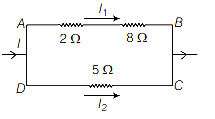
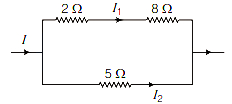
In the circuit shown, the heat produced in $5 \Omega$ resistance due to current $I_2$ is $50 \text{ J/s}$. Then, the heat generated per second in $2 \Omega$ resistance is (in $\text{ J/s}$)
A
$5$
B
$4$
C
$9$
D
$10$
Solution
(A) The heat produced per second is power, $P = I^2 R$. Given $P_2 = 50 \text{ J/s}$ for the $5 \Omega$ resistor.
$I_2^2 \times 5 = 50 \Rightarrow I_2^2 = 10 \Rightarrow I_2 = \sqrt{10} \text{ A}$.
The voltage across the parallel branches is $V = I_2 \times 5 = 5\sqrt{10} \text{ V}$.
The upper branch consists of $2 \Omega$ and $8 \Omega$ resistors in series, so the total resistance of the upper branch is $R_{upper} = 2 + 8 = 10 \Omega$.
The current in the upper branch is $I_1 = \frac{V}{R_{upper}} = \frac{5\sqrt{10}}{10} = \frac{\sqrt{10}}{2} \text{ A}$.
The heat generated per second in the $2 \Omega$ resistor is $P_1 = I_1^2 \times R_1$.
$P_1 = \left( \frac{\sqrt{10}}{2} \right)^2 \times 2 = \frac{10}{4} \times 2 = \frac{20}{4} = 5 \text{ J/s}$.
$I_2^2 \times 5 = 50 \Rightarrow I_2^2 = 10 \Rightarrow I_2 = \sqrt{10} \text{ A}$.
The voltage across the parallel branches is $V = I_2 \times 5 = 5\sqrt{10} \text{ V}$.
The upper branch consists of $2 \Omega$ and $8 \Omega$ resistors in series, so the total resistance of the upper branch is $R_{upper} = 2 + 8 = 10 \Omega$.
The current in the upper branch is $I_1 = \frac{V}{R_{upper}} = \frac{5\sqrt{10}}{10} = \frac{\sqrt{10}}{2} \text{ A}$.
The heat generated per second in the $2 \Omega$ resistor is $P_1 = I_1^2 \times R_1$.
$P_1 = \left( \frac{\sqrt{10}}{2} \right)^2 \times 2 = \frac{10}{4} \times 2 = \frac{20}{4} = 5 \text{ J/s}$.
0 likesView Solution
30
PhysicsDifficultMCQTS EAMCET · 2014
Wires $A$ and $B$ have resistivities $\rho_A$ and $\rho_B$,where $\rho_B = 2 \rho_A$,and have lengths $l_A$ and $l_B$. If the diameter of wire $B$ is twice that of $A$ and the two wires have the same resistance,then the ratio $\frac{l_B}{l_A}$ is:
A
$2$
B
$1$
C
$\frac{1}{2}$
D
$\frac{1}{4}$
Solution
(A) Given: $\rho_B = 2 \rho_A$ and $R_A = R_B = R$.
Let the radius of wire $A$ be $r_A = r$. Since the diameter of $B$ is twice that of $A$,the radius of wire $B$ is $r_B = 2r$.
The resistance of a wire is given by $R = \rho \frac{l}{A} = \rho \frac{l}{\pi r^2}$.
Since $R_A = R_B$,we have:
$\rho_A \frac{l_A}{\pi r_A^2} = \rho_B \frac{l_B}{\pi r_B^2}$
Substituting the given values:
$\rho_A \frac{l_A}{\pi r^2} = (2 \rho_A) \frac{l_B}{\pi (2r)^2}$
$\rho_A \frac{l_A}{r^2} = 2 \rho_A \frac{l_B}{4r^2}$
$l_A = \frac{2}{4} l_B$
$l_A = \frac{1}{2} l_B$
Therefore,$\frac{l_B}{l_A} = 2$.
Let the radius of wire $A$ be $r_A = r$. Since the diameter of $B$ is twice that of $A$,the radius of wire $B$ is $r_B = 2r$.
The resistance of a wire is given by $R = \rho \frac{l}{A} = \rho \frac{l}{\pi r^2}$.
Since $R_A = R_B$,we have:
$\rho_A \frac{l_A}{\pi r_A^2} = \rho_B \frac{l_B}{\pi r_B^2}$
Substituting the given values:
$\rho_A \frac{l_A}{\pi r^2} = (2 \rho_A) \frac{l_B}{\pi (2r)^2}$
$\rho_A \frac{l_A}{r^2} = 2 \rho_A \frac{l_B}{4r^2}$
$l_A = \frac{2}{4} l_B$
$l_A = \frac{1}{2} l_B$
Therefore,$\frac{l_B}{l_A} = 2$.
0 likesView Solution
31
PhysicsDifficultMCQTS EAMCET · 2014
The energy of a photon is equal to the kinetic energy of a proton. If $\lambda_1$ is the de-Broglie wavelength of the proton,$\lambda_2$ is the wavelength associated with the photon,and the energy of the photon is $E$,then $(\lambda_1 / \lambda_2)$ is proportional to
A
$E^4$
B
$E^{1/2}$
C
$E^2$
D
$E$
Solution
(B) Given that the energy of the photon $E$ is equal to the kinetic energy of the proton $K_p = E$.
For a proton,the de-Broglie wavelength $\lambda_1$ is given by $\lambda_1 = \frac{h}{p}$,where $p$ is the momentum of the proton.
Since $E = \frac{p^2}{2m}$,we have $p = \sqrt{2mE}$.
Thus,$\lambda_1 = \frac{h}{\sqrt{2mE}}$.
For a photon,the wavelength $\lambda_2$ is given by $\lambda_2 = \frac{hc}{E}$.
Now,calculating the ratio $\frac{\lambda_1}{\lambda_2}$:
$\frac{\lambda_1}{\lambda_2} = \frac{h / \sqrt{2mE}}{hc / E} = \frac{h}{\sqrt{2mE}} \cdot \frac{E}{hc} = \frac{E}{c \sqrt{2mE}} = \frac{\sqrt{E}}{c \sqrt{2m}}$.
Since $c$ and $m$ are constants,$\frac{\lambda_1}{\lambda_2} \propto \sqrt{E}$ or $E^{1/2}$.
For a proton,the de-Broglie wavelength $\lambda_1$ is given by $\lambda_1 = \frac{h}{p}$,where $p$ is the momentum of the proton.
Since $E = \frac{p^2}{2m}$,we have $p = \sqrt{2mE}$.
Thus,$\lambda_1 = \frac{h}{\sqrt{2mE}}$.
For a photon,the wavelength $\lambda_2$ is given by $\lambda_2 = \frac{hc}{E}$.
Now,calculating the ratio $\frac{\lambda_1}{\lambda_2}$:
$\frac{\lambda_1}{\lambda_2} = \frac{h / \sqrt{2mE}}{hc / E} = \frac{h}{\sqrt{2mE}} \cdot \frac{E}{hc} = \frac{E}{c \sqrt{2mE}} = \frac{\sqrt{E}}{c \sqrt{2m}}$.
Since $c$ and $m$ are constants,$\frac{\lambda_1}{\lambda_2} \propto \sqrt{E}$ or $E^{1/2}$.
0 likesView Solution
32
PhysicsDifficultMCQTS EAMCET · 2014
The electric field for an electromagnetic wave in free space is $E = i 30 \cos (k z - 5 \times 10^8 t)$,where the magnitude of $E$ is in $V/m$. The magnitude of the wave vector $k$ is (velocity of electromagnetic wave in free space $= 3 \times 10^8 \ m/s$).
A
$0.46 \ rad \ m^{-1}$
B
$3 \ rad \ m^{-1}$
C
$1.66 \ rad \ m^{-1}$
D
$0.83 \ rad \ m^{-1}$
Solution
(C) The given equation for the electric field is $E = i 30 \cos (k z - 5 \times 10^8 t)$.
Comparing this with the standard wave equation $E = E_0 \cos (k z - \omega t)$,we identify the angular frequency $\omega$ as $5 \times 10^8 \ rad/s$.
The relationship between the speed of light $c$,angular frequency $\omega$,and wave vector $k$ is given by $c = \frac{\omega}{k}$.
Rearranging to solve for $k$,we get $k = \frac{\omega}{c}$.
Substituting the given values: $k = \frac{5 \times 10^8 \ rad/s}{3 \times 10^8 \ m/s}$.
Thus,$k = \frac{5}{3} \approx 1.66 \ rad/m$.
Comparing this with the standard wave equation $E = E_0 \cos (k z - \omega t)$,we identify the angular frequency $\omega$ as $5 \times 10^8 \ rad/s$.
The relationship between the speed of light $c$,angular frequency $\omega$,and wave vector $k$ is given by $c = \frac{\omega}{k}$.
Rearranging to solve for $k$,we get $k = \frac{\omega}{c}$.
Substituting the given values: $k = \frac{5 \times 10^8 \ rad/s}{3 \times 10^8 \ m/s}$.
Thus,$k = \frac{5}{3} \approx 1.66 \ rad/m$.
0 likesView Solution
33
PhysicsMediumMCQTS EAMCET · 2014
$A$ charge $Q$ is divided into two charges $q$ and $Q-q$. The value of $q$ such that the force between them is maximum,is
A
$Q$
B
$\frac{3Q}{4}$
C
$\frac{Q}{2}$
D
$\frac{Q}{3}$
Solution
(C) According to Coulomb's law,the force $F$ between two charges $q$ and $Q-q$ separated by a distance $r$ is given by:
$F = \frac{1}{4 \pi \varepsilon_0} \cdot \frac{q(Q-q)}{r^2}$
To find the value of $q$ for which the force is maximum,we differentiate $F$ with respect to $q$ and set it to zero:
$\frac{dF}{dq} = \frac{1}{4 \pi \varepsilon_0 r^2} \cdot \frac{d}{dq}(Qq - q^2) = 0$
$Q - 2q = 0$
$2q = Q$
$q = \frac{Q}{2}$
Thus,the force is maximum when the charge $Q$ is divided into two equal parts,$q = \frac{Q}{2}$.
$F = \frac{1}{4 \pi \varepsilon_0} \cdot \frac{q(Q-q)}{r^2}$
To find the value of $q$ for which the force is maximum,we differentiate $F$ with respect to $q$ and set it to zero:
$\frac{dF}{dq} = \frac{1}{4 \pi \varepsilon_0 r^2} \cdot \frac{d}{dq}(Qq - q^2) = 0$
$Q - 2q = 0$
$2q = Q$
$q = \frac{Q}{2}$
Thus,the force is maximum when the charge $Q$ is divided into two equal parts,$q = \frac{Q}{2}$.
0 likesView Solution
34
PhysicsMediumMCQTS EAMCET · 2014
Two concentric hollow spherical shells have radii $r$ and $R$ $(R \gg r)$. $A$ charge $Q$ is distributed on them such that the surface charge densities are equal. The electric potential at the centre is
A
$\frac{Q(R+r)}{4 \pi \varepsilon_0(R^2+r^2)}$
B
$\frac{Q(R^2+r^2)}{4 \pi \varepsilon_0(R+r)}$
C
$\frac{Q}{4 \pi \varepsilon_0(R+r)}$
D
zero
Solution
(A) Let the surface charge density be $\sigma$. The total charge $Q$ is distributed on the two shells such that $\sigma_1 = \sigma_2 = \sigma$.
Total charge $Q = \sigma(4 \pi r^2) + \sigma(4 \pi R^2) = 4 \pi \sigma(r^2 + R^2)$.
Thus,$\sigma = \frac{Q}{4 \pi (r^2 + R^2)}$.
The electric potential at the centre of a spherical shell of radius $a$ with charge $q$ is $V = \frac{1}{4 \pi \varepsilon_0} \frac{q}{a}$.
For the two shells,the potential at the centre is the sum of the potentials due to each shell:
$V = \frac{1}{4 \pi \varepsilon_0} \left( \frac{q_1}{r} + \frac{q_2}{R} \right) = \frac{1}{4 \pi \varepsilon_0} \left( \frac{\sigma 4 \pi r^2}{r} + \frac{\sigma 4 \pi R^2}{R} \right)$.
$V = \frac{\sigma}{\varepsilon_0} (r + R)$.
Substituting the value of $\sigma$:
$V = \frac{Q}{4 \pi \varepsilon_0 (r^2 + R^2)} (r + R) = \frac{Q(R+r)}{4 \pi \varepsilon_0 (R^2+r^2)}$.
Total charge $Q = \sigma(4 \pi r^2) + \sigma(4 \pi R^2) = 4 \pi \sigma(r^2 + R^2)$.
Thus,$\sigma = \frac{Q}{4 \pi (r^2 + R^2)}$.
The electric potential at the centre of a spherical shell of radius $a$ with charge $q$ is $V = \frac{1}{4 \pi \varepsilon_0} \frac{q}{a}$.
For the two shells,the potential at the centre is the sum of the potentials due to each shell:
$V = \frac{1}{4 \pi \varepsilon_0} \left( \frac{q_1}{r} + \frac{q_2}{R} \right) = \frac{1}{4 \pi \varepsilon_0} \left( \frac{\sigma 4 \pi r^2}{r} + \frac{\sigma 4 \pi R^2}{R} \right)$.
$V = \frac{\sigma}{\varepsilon_0} (r + R)$.
Substituting the value of $\sigma$:
$V = \frac{Q}{4 \pi \varepsilon_0 (r^2 + R^2)} (r + R) = \frac{Q(R+r)}{4 \pi \varepsilon_0 (R^2+r^2)}$.
0 likesView Solution
35
PhysicsMediumMCQTS EAMCET · 2014
$A$ steady current flows in a long wire. It is bent into a circular loop of one turn and the magnetic field at the centre of the coil is $B$. If the same wire is bent into a circular loop of $n$ turns,the magnetic field at the centre of the coil is
A
$B/n$
B
$n B$
C
$n B^2$
D
$n^2 B$
Solution
(D) The magnetic field at the centre of a circular coil with $n$ turns carrying current $i$ and radius $r$ is given by $B = \frac{\mu_0 n i}{2 r}$.
Let the length of the wire be $L$. For a single turn $(n_1 = 1)$,the circumference is $2 \pi r_1 = L$,so $r_1 = \frac{L}{2 \pi}$.
The magnetic field is $B_1 = B = \frac{\mu_0 (1) i}{2 r_1} = \frac{\mu_0 i}{2 (L / 2 \pi)} = \frac{\mu_0 i \pi}{L}$.
When the same wire is bent into $n$ turns $(n_2 = n)$,the new circumference of each turn is $2 \pi r_2 = \frac{L}{n}$,so $r_2 = \frac{L}{2 \pi n}$.
The new magnetic field $B_2$ is $B_2 = \frac{\mu_0 n i}{2 r_2} = \frac{\mu_0 n i}{2 (L / 2 \pi n)} = \frac{\mu_0 n i \pi n}{L} = n^2 \left( \frac{\mu_0 i \pi}{L} \right)$.
Substituting $B$ for the term in the bracket,we get $B_2 = n^2 B$.
Let the length of the wire be $L$. For a single turn $(n_1 = 1)$,the circumference is $2 \pi r_1 = L$,so $r_1 = \frac{L}{2 \pi}$.
The magnetic field is $B_1 = B = \frac{\mu_0 (1) i}{2 r_1} = \frac{\mu_0 i}{2 (L / 2 \pi)} = \frac{\mu_0 i \pi}{L}$.
When the same wire is bent into $n$ turns $(n_2 = n)$,the new circumference of each turn is $2 \pi r_2 = \frac{L}{n}$,so $r_2 = \frac{L}{2 \pi n}$.
The new magnetic field $B_2$ is $B_2 = \frac{\mu_0 n i}{2 r_2} = \frac{\mu_0 n i}{2 (L / 2 \pi n)} = \frac{\mu_0 n i \pi n}{L} = n^2 \left( \frac{\mu_0 i \pi}{L} \right)$.
Substituting $B$ for the term in the bracket,we get $B_2 = n^2 B$.
0 likesView Solution
36
PhysicsEasyMCQTS EAMCET · 2014
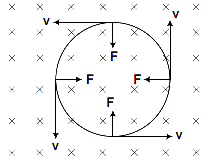
An electrically charged particle enters a uniform magnetic field in a direction perpendicular to the field with a velocity $v$. Then,it travels:
A
in a straight line without acceleration
B
with force in the direction of the field
C
in a circular path with a radius directly proportional to $v^2$
D
in a circular path with a radius directly proportional to its velocity
Solution
(D) When a charged particle with charge $q$ and mass $m$ enters a uniform magnetic field $B$ with velocity $v$ perpendicular to the field,it experiences a magnetic Lorentz force $F = q(v \times B)$.
Since the force is always perpendicular to the velocity,it acts as a centripetal force,causing the particle to move in a circular path.
The radius $r$ of this circular path is given by the formula:
$r = \frac{mv}{qB}$
From this expression,it is clear that the radius $r$ is directly proportional to the velocity $v$ $(r \propto v)$.
Therefore,the particle travels in a circular path with a radius directly proportional to its velocity.
Since the force is always perpendicular to the velocity,it acts as a centripetal force,causing the particle to move in a circular path.
The radius $r$ of this circular path is given by the formula:
$r = \frac{mv}{qB}$
From this expression,it is clear that the radius $r$ is directly proportional to the velocity $v$ $(r \propto v)$.
Therefore,the particle travels in a circular path with a radius directly proportional to its velocity.
0 likesView Solution
37
PhysicsDifficultMCQTS EAMCET · 2014
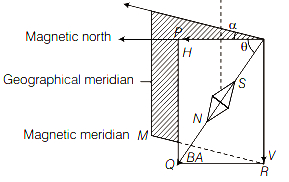
At a certain place,the angle of dip is $60^{\circ}$ and the horizontal component of the earth's magnetic field $(B_H)$ is $0.8 \times 10^{-4} \,T$. The earth's overall magnetic field is
A
$1.5 \times 10^{-4} \,T$
B
$1.6 \times 10^{-3} \,T$
C
$1.5 \times 10^{-3} \,T$
D
$1.6 \times 10^{-4} \,T$
Solution
(D) Given:
Horizontal component of earth's magnetic field,$B_H = 0.8 \times 10^{-4} \,T$
Angle of dip,$\theta = 60^{\circ}$
Let the earth's total magnetic field be $B_e$.
We know that the horizontal component of the earth's magnetic field is related to the total magnetic field by the formula:
$B_H = B_e \cos \theta$
Substituting the given values:
$0.8 \times 10^{-4} = B_e \cos 60^{\circ}$
Since $\cos 60^{\circ} = 0.5$ or $\frac{1}{2}$,we have:
$0.8 \times 10^{-4} = B_e \times 0.5$
Solving for $B_e$:
$B_e = \frac{0.8 \times 10^{-4}}{0.5}$
$B_e = 1.6 \times 10^{-4} \,T$
Thus,the earth's overall magnetic field is $1.6 \times 10^{-4} \,T$.
Horizontal component of earth's magnetic field,$B_H = 0.8 \times 10^{-4} \,T$
Angle of dip,$\theta = 60^{\circ}$
Let the earth's total magnetic field be $B_e$.
We know that the horizontal component of the earth's magnetic field is related to the total magnetic field by the formula:
$B_H = B_e \cos \theta$
Substituting the given values:
$0.8 \times 10^{-4} = B_e \cos 60^{\circ}$
Since $\cos 60^{\circ} = 0.5$ or $\frac{1}{2}$,we have:
$0.8 \times 10^{-4} = B_e \times 0.5$
Solving for $B_e$:
$B_e = \frac{0.8 \times 10^{-4}}{0.5}$
$B_e = 1.6 \times 10^{-4} \,T$
Thus,the earth's overall magnetic field is $1.6 \times 10^{-4} \,T$.
0 likesView Solution
38
PhysicsEasyMCQTS EAMCET · 2014
If the radius of a nucleus with mass number $125$ is $1.5 \text{ fermi}$, then the radius of a nucleus with mass number $64$ is: (in $\text{ fermi}$)
A
$0.48$
B
$0.96$
C
$1.92$
D
$1.2$
Solution
(D) The radius of a nucleus is given by the formula $R = R_0 A^{1/3}$, where $R_0$ is a constant and $A$ is the mass number.
Given:
$R_1 = 1.5 \text{ fermi}$, $A_1 = 125$
$A_2 = 64$
We need to find $R_2$.
Taking the ratio of the radii:
$\frac{R_1}{R_2} = \left( \frac{A_1}{A_2} \right)^{1/3}$
$\frac{1.5}{R_2} = \left( \frac{125}{64} \right)^{1/3}$
$\frac{1.5}{R_2} = \frac{5}{4}$
$R_2 = \frac{1.5 \times 4}{5} = 0.3 \times 4 = 1.2 \text{ fermi}$.
Given:
$R_1 = 1.5 \text{ fermi}$, $A_1 = 125$
$A_2 = 64$
We need to find $R_2$.
Taking the ratio of the radii:
$\frac{R_1}{R_2} = \left( \frac{A_1}{A_2} \right)^{1/3}$
$\frac{1.5}{R_2} = \left( \frac{125}{64} \right)^{1/3}$
$\frac{1.5}{R_2} = \frac{5}{4}$
$R_2 = \frac{1.5 \times 4}{5} = 0.3 \times 4 = 1.2 \text{ fermi}$.
0 likesView Solution
39
PhysicsDifficultMCQTS EAMCET · 2014
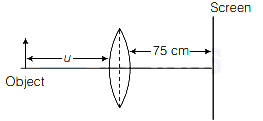
$A$ thin converging lens of focal length $f=25 \,cm$ forms the image of an object on a screen placed at a distance of $75 \,cm$ from the lens. The screen is moved closer to the lens by a distance of $25 \,cm$. The distance through which the object has to be shifted,so that its image on the screen is sharp again,is (in $\,cm$)
A
$37.5$
B
$16.25$
C
$12.5$
D
$13.5$
Solution
(C) According to the first condition,for a converging lens,the lens formula is $\frac{1}{f} = \frac{1}{v} - \frac{1}{u}$.
Given $f = 25 \,cm$ and $v = 75 \,cm$,we have:
$\frac{1}{25} = \frac{1}{75} - \frac{1}{u}$
$\frac{1}{u} = \frac{1}{75} - \frac{1}{25} = \frac{1-3}{75} = -\frac{2}{75}$
$u = -37.5 \,cm$.
So,the object is placed at a distance of $37.5 \,cm$ from the lens.
According to the second condition,the screen is moved closer to the lens by $25 \,cm$,so the new image distance is $v_1 = 75 \,cm - 25 \,cm = 50 \,cm$.
Using the lens formula again:
$\frac{1}{25} = \frac{1}{50} - \frac{1}{u_1}$
$\frac{1}{u_1} = \frac{1}{50} - \frac{1}{25} = \frac{1-2}{50} = -\frac{1}{50}$
$u_1 = -50 \,cm$.
So,the new object distance is $50 \,cm$.
The distance through which the object has to be shifted is $\Delta u = |u_1| - |u| = 50 \,cm - 37.5 \,cm = 12.5 \,cm$.
Given $f = 25 \,cm$ and $v = 75 \,cm$,we have:
$\frac{1}{25} = \frac{1}{75} - \frac{1}{u}$
$\frac{1}{u} = \frac{1}{75} - \frac{1}{25} = \frac{1-3}{75} = -\frac{2}{75}$
$u = -37.5 \,cm$.
So,the object is placed at a distance of $37.5 \,cm$ from the lens.
According to the second condition,the screen is moved closer to the lens by $25 \,cm$,so the new image distance is $v_1 = 75 \,cm - 25 \,cm = 50 \,cm$.
Using the lens formula again:
$\frac{1}{25} = \frac{1}{50} - \frac{1}{u_1}$
$\frac{1}{u_1} = \frac{1}{50} - \frac{1}{25} = \frac{1-2}{50} = -\frac{1}{50}$
$u_1 = -50 \,cm$.
So,the new object distance is $50 \,cm$.
The distance through which the object has to be shifted is $\Delta u = |u_1| - |u| = 50 \,cm - 37.5 \,cm = 12.5 \,cm$.
0 likesView Solution
40
PhysicsDifficultMCQTS EAMCET · 2014
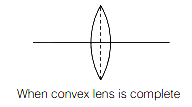
$A$ convex lens has its radii of curvature equal. The focal length of the lens is $f$. If it is divided vertically into two identical plano-convex lenses by cutting it,then the focal length of the plano-convex lens is ($\mu =$ the refractive index of the material of the lens).
A
$f$
B
$\frac{f}{2}$
C
$2 f$
D
$(\mu-1) f$
Solution
(C) For a biconvex lens with equal radii of curvature $R_1 = R$ and $R_2 = -R$,the Lens Maker's formula is given by:
$\frac{1}{f} = (\mu - 1) \left[ \frac{1}{R_1} - \frac{1}{R_2} \right]$
Substituting the values:
$\frac{1}{f} = (\mu - 1) \left[ \frac{1}{R} - \frac{1}{-R} \right] = (\mu - 1) \left[ \frac{2}{R} \right]$
Thus,$R = 2f(\mu - 1)$.
When the lens is cut vertically into two identical plano-convex lenses,each new lens has one surface with radius $R$ and the other surface as a plane (radius $\infty$).
Using the Lens Maker's formula for the new lens with focal length $f'$:
$\frac{1}{f'} = (\mu - 1) \left[ \frac{1}{R} - \frac{1}{\infty} \right]$
$\frac{1}{f'} = (\mu - 1) \left[ \frac{1}{R} \right]$
$f' = \frac{R}{\mu - 1}$
Substituting $R = 2f(\mu - 1)$:
$f' = \frac{2f(\mu - 1)}{\mu - 1} = 2f$.
$\frac{1}{f} = (\mu - 1) \left[ \frac{1}{R_1} - \frac{1}{R_2} \right]$
Substituting the values:
$\frac{1}{f} = (\mu - 1) \left[ \frac{1}{R} - \frac{1}{-R} \right] = (\mu - 1) \left[ \frac{2}{R} \right]$
Thus,$R = 2f(\mu - 1)$.
When the lens is cut vertically into two identical plano-convex lenses,each new lens has one surface with radius $R$ and the other surface as a plane (radius $\infty$).
Using the Lens Maker's formula for the new lens with focal length $f'$:
$\frac{1}{f'} = (\mu - 1) \left[ \frac{1}{R} - \frac{1}{\infty} \right]$
$\frac{1}{f'} = (\mu - 1) \left[ \frac{1}{R} \right]$
$f' = \frac{R}{\mu - 1}$
Substituting $R = 2f(\mu - 1)$:
$f' = \frac{2f(\mu - 1)}{\mu - 1} = 2f$.
0 likesView Solution
41
PhysicsMediumMCQTS EAMCET · 2014
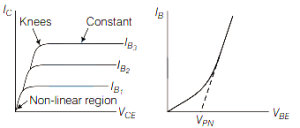
The output characteristics of an $n-p-n$ transistor represent,($I_C =$ collector current,$V_{CE} =$ potential difference between collector and emitter,$I_B =$ base current,$V_{BB} =$ voltage given to base,$V_{BE} =$ the potential difference between base and emitter)
A
changes in $I_C$ as $I_B$ and $V_{BB}$ are changed
B
changes in $I_C$ with changes in $V_{CE}$ ($I_B =$ constant)
C
changes in $I_B$ with changes in $V_{CE}$
D
change in $I_C$ as $V_{BE}$ is changed
Solution
(B) The output characteristics of a transistor are defined as the variation of the collector current $(I_C)$ with the collector-emitter voltage $(V_{CE})$ while keeping the base current $(I_B)$ constant.
This relationship is graphically represented by plotting $I_C$ on the y-axis and $V_{CE}$ on the x-axis for different fixed values of $I_B$.
This relationship is graphically represented by plotting $I_C$ on the y-axis and $V_{CE}$ on the x-axis for different fixed values of $I_B$.
0 likesView Solution
42
PhysicsDifficultMCQTS EAMCET · 2014
$A$ crystal of intrinsic silicon at room temperature has a carrier concentration of $1.6 \times 10^{16} / m^3$. If the donor concentration level is $4.8 \times 10^{20} / m^3$,then the concentration of holes in the semiconductor is
A
$53 \times 10^{12} / m^3$
B
$4 \times 10^{11} / m^3$
C
$4 \times 10^{12} / m^3$
D
$5.3 \times 10^{11} / m^3$
Solution
(D) Given:
Intrinsic carrier concentration $n_i = 1.6 \times 10^{16} / m^3$
Donor concentration $N_D = 4.8 \times 10^{20} / m^3$
In an $n$-type semiconductor,the electron concentration $n_e \approx N_D = 4.8 \times 10^{20} / m^3$.
According to the law of mass action for semiconductors,$n_i^2 = n_e \times n_h$,where $n_h$ is the hole concentration.
Substituting the values:
$(1.6 \times 10^{16})^2 = (4.8 \times 10^{20}) \times n_h$
$2.56 \times 10^{32} = 4.8 \times 10^{20} \times n_h$
$n_h = \frac{2.56 \times 10^{32}}{4.8 \times 10^{20}}$
$n_h = 0.533 \times 10^{12} / m^3 = 5.33 \times 10^{11} / m^3$.
Thus,the concentration of holes is approximately $5.3 \times 10^{11} / m^3$.
Intrinsic carrier concentration $n_i = 1.6 \times 10^{16} / m^3$
Donor concentration $N_D = 4.8 \times 10^{20} / m^3$
In an $n$-type semiconductor,the electron concentration $n_e \approx N_D = 4.8 \times 10^{20} / m^3$.
According to the law of mass action for semiconductors,$n_i^2 = n_e \times n_h$,where $n_h$ is the hole concentration.
Substituting the values:
$(1.6 \times 10^{16})^2 = (4.8 \times 10^{20}) \times n_h$
$2.56 \times 10^{32} = 4.8 \times 10^{20} \times n_h$
$n_h = \frac{2.56 \times 10^{32}}{4.8 \times 10^{20}}$
$n_h = 0.533 \times 10^{12} / m^3 = 5.33 \times 10^{11} / m^3$.
Thus,the concentration of holes is approximately $5.3 \times 10^{11} / m^3$.
0 likesView Solution
43
PhysicsDifficultMCQTS EAMCET · 2014
In a double slit interference experiment,the fringe width obtained with a light of wavelength $5900 \text{ Å}$ was $1.2 \text{ mm}$ for parallel narrow slits placed $2 \text{ mm}$ apart. In this arrangement,if the slit separation is increased by one-and-half times the previous value,then the fringe width is (in $ \text{ mm}$)
A
$0.9$
B
$0.8$
C
$1.8$
D
$1.6$
Solution
(B) The formula for fringe width in Young's double slit experiment is given by $\beta = \frac{\lambda D}{d}$.
Given:
Initial fringe width $\beta_1 = 1.2 \text{ mm}$.
Initial slit separation $d_1 = 2 \text{ mm}$.
The slit separation is increased by one-and-half times the previous value,so $d_2 = 1.5 d_1$.
Since $\beta \propto \frac{1}{d}$,we have $\frac{\beta_1}{\beta_2} = \frac{d_2}{d_1}$.
Substituting the values:
$\frac{1.2}{\beta_2} = 1.5$.
$\beta_2 = \frac{1.2}{1.5} = 0.8 \text{ mm}$.
Given:
Initial fringe width $\beta_1 = 1.2 \text{ mm}$.
Initial slit separation $d_1 = 2 \text{ mm}$.
The slit separation is increased by one-and-half times the previous value,so $d_2 = 1.5 d_1$.
Since $\beta \propto \frac{1}{d}$,we have $\frac{\beta_1}{\beta_2} = \frac{d_2}{d_1}$.
Substituting the values:
$\frac{1.2}{\beta_2} = 1.5$.
$\beta_2 = \frac{1.2}{1.5} = 0.8 \text{ mm}$.
0 likesView Solution
Vedclass Products
For Students
Vedclass Test Series
Mock tests in real TS EAMCET style covering Physics with performance analysis. 5-day free trial.
Start Free TrialFor Teachers
Exam Paper Generator
Generate Set A/B/C/D Physics papers from 7.5L+ questions in 2 minutes. 3 chapters free.
Try FreeFor Institutes
Online Exam Module
Run live TS EAMCET mock exams with unlimited students, 360° analytics & white-label branding.
See DemoFrequently Asked Questions
How many Physics questions are in TS EAMCET 2014?
There are 43 Physics questions from the TS EAMCET 2014 paper on Vedclass, each with a detailed step-by-step solution in English.
Are TS EAMCET 2014 Physics solutions available in English?
Yes. All solutions on this page are in English. You can also switch to English or Hindi using the language buttons above the questions.
Can I practice TS EAMCET 2014 Physics as a timed test?
Yes. Use the Vedclass Test Series to attempt a full TS EAMCET mock test covering Physics with time limits and instant score analysis.
Can teachers create Physics papers from TS EAMCET previous year questions?
Yes. The Vedclass Exam Paper Generator lets teachers mix TS EAMCET Physics questions and generate Set A/B/C/D papers in minutes.
For Teachers & Institutes
Build a Custom Physics Paper
Pick TS EAMCET 2014 Physics questions, set difficulty, and generate Set A/B/C/D in 2 minutes.