
PhysicsQ1–49 of 49 questions
Page 1 of 1 · English
1
PhysicsMediumMCQMHT CET · 2016
$A$ disc of radius $R$ and thickness $\frac{R}{6}$ has moment of inertia $I$ about an axis passing through its centre and perpendicular to its plane. The disc is melted and recast into a solid sphere. The moment of inertia of the sphere about its diameter is
A
$\frac{I}{5}$
B
$\frac{I}{6}$
C
$\frac{I}{32}$
D
$\frac{I}{64}$
Solution
(A) The moment of inertia of a disc about an axis passing through its centre and perpendicular to its plane is given by $I = \frac{1}{2} MR^2$ ... $(i)$
The volume of the disc is $V = \pi R^2 \times \text{thickness} = \pi R^2 \times \frac{R}{6} = \frac{\pi R^3}{6}$.
When the disc is recast into a solid sphere of radius $R_s$,the volume remains constant:
$\frac{\pi R^3}{6} = \frac{4}{3} \pi R_s^3$
$R_s^3 = \frac{R^3}{8} \implies R_s = \frac{R}{2}$ ... (ii)
The moment of inertia of a solid sphere about its diameter is $I_{\text{sphere}} = \frac{2}{5} MR_s^2$.
Substituting $R_s = \frac{R}{2}$ into the expression for $I_{\text{sphere}}$:
$I_{\text{sphere}} = \frac{2}{5} M \left(\frac{R}{2}\right)^2 = \frac{2}{5} \times \frac{1}{4} MR^2 = \frac{1}{5} \left(\frac{1}{2} MR^2\right)$.
Using equation $(i)$,we get $I_{\text{sphere}} = \frac{I}{5}$.
The volume of the disc is $V = \pi R^2 \times \text{thickness} = \pi R^2 \times \frac{R}{6} = \frac{\pi R^3}{6}$.
When the disc is recast into a solid sphere of radius $R_s$,the volume remains constant:
$\frac{\pi R^3}{6} = \frac{4}{3} \pi R_s^3$
$R_s^3 = \frac{R^3}{8} \implies R_s = \frac{R}{2}$ ... (ii)
The moment of inertia of a solid sphere about its diameter is $I_{\text{sphere}} = \frac{2}{5} MR_s^2$.
Substituting $R_s = \frac{R}{2}$ into the expression for $I_{\text{sphere}}$:
$I_{\text{sphere}} = \frac{2}{5} M \left(\frac{R}{2}\right)^2 = \frac{2}{5} \times \frac{1}{4} MR^2 = \frac{1}{5} \left(\frac{1}{2} MR^2\right)$.
Using equation $(i)$,we get $I_{\text{sphere}} = \frac{I}{5}$.
0 likesView Solution
2
PhysicsMediumMCQMHT CET · 2016
The value of gravitational acceleration $g'$ at a height $h$ above the earth's surface is $\frac{g}{4}$. Then,what is the value of $h$ in terms of the earth's radius $R$?
A
$h=R$
B
$h=\frac{R}{2}$
C
$h=\frac{R}{3}$
D
$h=\frac{R}{4}$
Solution
(A) The formula for gravitational acceleration at a height $h$ above the earth's surface is given by $g' = g \left( \frac{R}{R+h} \right)^2$.
Given that $g' = \frac{g}{4}$,we substitute this into the equation:
$\frac{g}{4} = g \left( \frac{R}{R+h} \right)^2$.
Dividing both sides by $g$,we get $\frac{1}{4} = \left( \frac{R}{R+h} \right)^2$.
Taking the square root of both sides,we obtain $\frac{1}{2} = \frac{R}{R+h}$.
Cross-multiplying gives $R + h = 2R$.
Therefore,$h = 2R - R = R$.
Given that $g' = \frac{g}{4}$,we substitute this into the equation:
$\frac{g}{4} = g \left( \frac{R}{R+h} \right)^2$.
Dividing both sides by $g$,we get $\frac{1}{4} = \left( \frac{R}{R+h} \right)^2$.
Taking the square root of both sides,we obtain $\frac{1}{2} = \frac{R}{R+h}$.
Cross-multiplying gives $R + h = 2R$.
Therefore,$h = 2R - R = R$.
0 likesView Solution
3
PhysicsMediumMCQMHT CET · 2016
Two particles of mass $m$ and $9m$ are separated by a distance $r$. At a point on the line joining them,the gravitational field is zero. What is the gravitational potential at that point? ($G$ is the universal gravitational constant)
A
$-\frac{4 G m}{r}$
B
$-\frac{8 G m}{r}$
C
$-\frac{16 G m}{r}$
D
$-\frac{32 G m}{r}$
Solution
(C) For the gravitational field to be zero,the intensities produced by both particles must be equal in magnitude and opposite in direction.
$\frac{G m}{r_1^2} = \frac{G(9 m)}{r_2^2}$
where $r_1$ is the distance from mass $m$ and $r_2$ is the distance from mass $9m$.
Since $r_1 + r_2 = r$,we have $\frac{r_2}{r_1} = \sqrt{9} = 3 \Rightarrow r_2 = 3 r_1$.
Therefore,$r_1 + 3 r_1 = r \Rightarrow 4 r_1 = r \Rightarrow r_1 = \frac{r}{4}$ and $r_2 = \frac{3r}{4}$.
The gravitational potential $V$ is given by $V = -\frac{G m}{r_1} - \frac{G(9 m)}{r_2}$.
Substituting the values: $V = -\frac{G m}{r/4} - \frac{9 G m}{3r/4} = -\frac{4 G m}{r} - \frac{36 G m}{3r} = -\frac{4 G m}{r} - \frac{12 G m}{r} = -\frac{16 G m}{r}$.
$\frac{G m}{r_1^2} = \frac{G(9 m)}{r_2^2}$
where $r_1$ is the distance from mass $m$ and $r_2$ is the distance from mass $9m$.
Since $r_1 + r_2 = r$,we have $\frac{r_2}{r_1} = \sqrt{9} = 3 \Rightarrow r_2 = 3 r_1$.
Therefore,$r_1 + 3 r_1 = r \Rightarrow 4 r_1 = r \Rightarrow r_1 = \frac{r}{4}$ and $r_2 = \frac{3r}{4}$.
The gravitational potential $V$ is given by $V = -\frac{G m}{r_1} - \frac{G(9 m)}{r_2}$.
Substituting the values: $V = -\frac{G m}{r/4} - \frac{9 G m}{3r/4} = -\frac{4 G m}{r} - \frac{36 G m}{3r} = -\frac{4 G m}{r} - \frac{12 G m}{r} = -\frac{16 G m}{r}$.
0 likesView Solution
4
PhysicsMediumMCQMHT CET · 2016
For a gas,$\frac{R}{C_{V}} = 0.4$,where $R$ is the universal gas constant and $C_{V}$ is the molar specific heat at constant volume. The gas is made up of molecules which are
A
polyatomic.
B
rigid diatomic.
C
non-rigid diatomic.
D
monatomic.
Solution
(B) Given,$\frac{R}{C_{V}} = 0.4$.
From Mayer's relation,$C_{P} - C_{V} = R$,so $C_{P} = C_{V} + R$.
Substituting $R = 0.4 C_{V}$,we get $C_{P} = C_{V} + 0.4 C_{V} = 1.4 C_{V}$.
The adiabatic index $\gamma$ is defined as $\gamma = \frac{C_{P}}{C_{V}}$.
Therefore,$\gamma = \frac{1.4 C_{V}}{C_{V}} = 1.4$.
For a rigid diatomic gas,the degrees of freedom $f = 5$.
The adiabatic index is $\gamma = 1 + \frac{2}{f} = 1 + \frac{2}{5} = 1 + 0.4 = 1.4$.
Thus,the gas is made up of rigid diatomic molecules.
From Mayer's relation,$C_{P} - C_{V} = R$,so $C_{P} = C_{V} + R$.
Substituting $R = 0.4 C_{V}$,we get $C_{P} = C_{V} + 0.4 C_{V} = 1.4 C_{V}$.
The adiabatic index $\gamma$ is defined as $\gamma = \frac{C_{P}}{C_{V}}$.
Therefore,$\gamma = \frac{1.4 C_{V}}{C_{V}} = 1.4$.
For a rigid diatomic gas,the degrees of freedom $f = 5$.
The adiabatic index is $\gamma = 1 + \frac{2}{f} = 1 + \frac{2}{5} = 1 + 0.4 = 1.4$.
Thus,the gas is made up of rigid diatomic molecules.
0 likesView Solution
5
PhysicsEasyMCQMHT CET · 2016
The pressure exerted by an ideal gas on the walls of a container is
A
$1/3$ of the kinetic energy per unit volume of a gas
B
$2/3$ of the kinetic energy per unit volume of a gas
C
$3/4$ of the kinetic energy per unit volume of a gas
D
$3/2$ of the kinetic energy per unit volume of a gas
Solution
(B) The pressure $P$ exerted by an ideal gas is given by the kinetic theory of gases as $P = \frac{1}{3} \rho v_{rms}^2$,where $\rho$ is the density and $v_{rms}$ is the root mean square velocity.
We know that the kinetic energy per unit volume $(u)$ is given by $u = \frac{1}{2} \rho v_{rms}^2$.
Therefore,$\rho v_{rms}^2 = 2u$.
Substituting this into the pressure equation: $P = \frac{1}{3} (2u) = \frac{2}{3} u$.
Thus,the pressure exerted by an ideal gas is $2/3$ of the kinetic energy per unit volume of the gas.
We know that the kinetic energy per unit volume $(u)$ is given by $u = \frac{1}{2} \rho v_{rms}^2$.
Therefore,$\rho v_{rms}^2 = 2u$.
Substituting this into the pressure equation: $P = \frac{1}{3} (2u) = \frac{2}{3} u$.
Thus,the pressure exerted by an ideal gas is $2/3$ of the kinetic energy per unit volume of the gas.
0 likesView Solution
6
PhysicsEasyMCQMHT CET · 2016
$A$ liquid drop having surface energy $E$ is spread into $512$ droplets of the same size. The final surface energy of the droplets is (in $E$)
A
$2$
B
$4$
C
$8$
D
$12$
Solution
(C) Let the radius of the original drop be $R$ and the radius of each small droplet be $r$.
Surface energy $E = S \times A$,where $S$ is the surface tension and $A$ is the surface area.
Initial surface area $A_1 = 4 \pi R^2$.
Volume of the large drop = Volume of $512$ small droplets:
$\frac{4}{3} \pi R^3 = 512 \times \frac{4}{3} \pi r^3$
$R^3 = 512 r^3 \implies R = 8r$.
Final surface area $A_2 = 512 \times (4 \pi r^2)$.
Substituting $r = R/8$:
$A_2 = 512 \times 4 \pi \left(\frac{R}{8}\right)^2 = 512 \times 4 \pi \times \frac{R^2}{64} = 8 \times (4 \pi R^2) = 8 A_1$.
Since surface energy is directly proportional to surface area $(E \propto A)$:
$E_2 = 8 E_1 = 8 E$.
Surface energy $E = S \times A$,where $S$ is the surface tension and $A$ is the surface area.
Initial surface area $A_1 = 4 \pi R^2$.
Volume of the large drop = Volume of $512$ small droplets:
$\frac{4}{3} \pi R^3 = 512 \times \frac{4}{3} \pi r^3$
$R^3 = 512 r^3 \implies R = 8r$.
Final surface area $A_2 = 512 \times (4 \pi r^2)$.
Substituting $r = R/8$:
$A_2 = 512 \times 4 \pi \left(\frac{R}{8}\right)^2 = 512 \times 4 \pi \times \frac{R^2}{64} = 8 \times (4 \pi R^2) = 8 A_1$.
Since surface energy is directly proportional to surface area $(E \propto A)$:
$E_2 = 8 E_1 = 8 E$.
0 likesView Solution
7
PhysicsMediumMCQMHT CET · 2016
In a capillary tube of radius $R$,a straight thin metal wire of radius $r$ $(R > r)$ is inserted symmetrically,and one end of the combination is dipped vertically in water such that the lower end of the combination is at the same level. The rise of water in the capillary tube is $[T =$ surface tension of water,$\rho =$ density of water,$g =$ gravitational acceleration$]$.
A
$\frac{T}{(R+r) \rho g}$
B
$\frac{2 T}{(R+r) \rho g}$
C
$\frac{2 T}{(R-r) \rho g}$
D
$\frac{(R-r) \rho g}{T}$
Solution
(C) The rise of water $h$ in a capillary tube is given by the formula $h = \frac{2T \cos \theta}{\rho g R_{eff}}$,where $R_{eff}$ is the effective radius of the meniscus.
In this case,the water rises in the annular space between the capillary tube of radius $R$ and the wire of radius $r$.
The effective radius for the annular space is the difference between the radii,$R_{eff} = R - r$.
Assuming the contact angle $\theta = 0$ for water and glass/metal,we have $\cos \theta = 1$.
Substituting these values into the formula,we get $h = \frac{2T}{\rho g (R - r)}$.
In this case,the water rises in the annular space between the capillary tube of radius $R$ and the wire of radius $r$.
The effective radius for the annular space is the difference between the radii,$R_{eff} = R - r$.
Assuming the contact angle $\theta = 0$ for water and glass/metal,we have $\cos \theta = 1$.
Substituting these values into the formula,we get $h = \frac{2T}{\rho g (R - r)}$.
0 likesView Solution
8
PhysicsMediumMCQMHT CET · 2016
Let a steel bar of length $l$,breadth $b$,and depth $d$ be loaded at the centre by a load $W$. Then the sag of bending of the beam is ($Y =$ Young's modulus of the material of steel).
A
$\frac{W l^3}{2 b d^3 Y}$
B
$\frac{W l^3}{4 b d^3 Y}$
C
$\frac{W l^3}{2 d b^3 Y}$
D
$\frac{W l^3}{4 d b^3 Y}$
Solution
(B) The sag (depression) $\delta$ of a beam supported at both ends and loaded at the centre is given by the formula: $\delta = \frac{W l^3}{48 Y I}$.
Here,$W$ is the load,$l$ is the length,$Y$ is Young's modulus,and $I$ is the geometrical moment of inertia.
For a rectangular cross-section of breadth $b$ and depth $d$,the moment of inertia is $I = \frac{b d^3}{12}$.
Substituting the value of $I$ into the formula for $\delta$:
$\delta = \frac{W l^3}{48 Y (\frac{b d^3}{12})}$
$\delta = \frac{W l^3}{48 Y} \times \frac{12}{b d^3}$
$\delta = \frac{W l^3}{4 b d^3 Y}$.
Here,$W$ is the load,$l$ is the length,$Y$ is Young's modulus,and $I$ is the geometrical moment of inertia.
For a rectangular cross-section of breadth $b$ and depth $d$,the moment of inertia is $I = \frac{b d^3}{12}$.
Substituting the value of $I$ into the formula for $\delta$:
$\delta = \frac{W l^3}{48 Y (\frac{b d^3}{12})}$
$\delta = \frac{W l^3}{48 Y} \times \frac{12}{b d^3}$
$\delta = \frac{W l^3}{4 b d^3 Y}$.
0 likesView Solution
9
PhysicsEasyMCQMHT CET · 2016
Two wires having the same length and material are stretched by the same force. Their diameters are in the ratio $1:3$. The ratio of strain energy per unit volume for these two wires (smaller to larger diameter),when stretched,is (in $:1$)
A
$3$
B
$9$
C
$27$
D
$81$
Solution
(D) The strain energy per unit volume $u$ is given by the formula $u = \frac{1}{2} \times \text{stress} \times \text{strain}$.
Since $\text{stress} = \frac{F}{A}$ and $\text{strain} = \frac{\text{stress}}{Y}$,we have $u = \frac{1}{2} \times \frac{\text{stress}^2}{Y} = \frac{1}{2} \times \frac{F^2}{A^2 Y}$.
Given that the wires have the same length,material ($Y$ is constant),and are stretched by the same force $F$,the energy density $u$ is inversely proportional to the square of the area of cross-section $A^2$.
Since $A = \pi r^2$,we have $A \propto d^2$ (where $d$ is the diameter),so $u \propto \frac{1}{(d^2)^2} = \frac{1}{d^4}$.
Therefore,the ratio of strain energy per unit volume for the smaller diameter wire $(d_S)$ to the larger diameter wire $(d_L)$ is $\frac{u_S}{u_L} = \left( \frac{d_L}{d_S} \right)^4$.
Given the ratio of diameters $d_S : d_L = 1 : 3$,we have $\frac{u_S}{u_L} = \left( \frac{3}{1} \right)^4 = 81 : 1$.
Since $\text{stress} = \frac{F}{A}$ and $\text{strain} = \frac{\text{stress}}{Y}$,we have $u = \frac{1}{2} \times \frac{\text{stress}^2}{Y} = \frac{1}{2} \times \frac{F^2}{A^2 Y}$.
Given that the wires have the same length,material ($Y$ is constant),and are stretched by the same force $F$,the energy density $u$ is inversely proportional to the square of the area of cross-section $A^2$.
Since $A = \pi r^2$,we have $A \propto d^2$ (where $d$ is the diameter),so $u \propto \frac{1}{(d^2)^2} = \frac{1}{d^4}$.
Therefore,the ratio of strain energy per unit volume for the smaller diameter wire $(d_S)$ to the larger diameter wire $(d_L)$ is $\frac{u_S}{u_L} = \left( \frac{d_L}{d_S} \right)^4$.
Given the ratio of diameters $d_S : d_L = 1 : 3$,we have $\frac{u_S}{u_L} = \left( \frac{3}{1} \right)^4 = 81 : 1$.
0 likesView Solution
10
PhysicsDifficultMCQMHT CET · 2016
$A$ particle moves along a circle of radius $r$ with constant tangential acceleration. If the velocity of the particle is $v$ at the end of the second revolution after the motion has started,then the tangential acceleration is
A
$\frac{v^2}{8 \pi r}$
B
$\frac{v^2}{6 \pi r}$
C
$\frac{v^2}{4 \pi r}$
D
$\frac{v^2}{10 \pi r}$
Solution
(A) The particle starts from rest,so the initial velocity $u = 0$.
The distance covered in one revolution is the circumference of the circle,which is $2 \pi r$.
The distance covered in two revolutions is $s = 2 \times 2 \pi r = 4 \pi r$.
Using the equation of motion $v^2 - u^2 = 2as$,where $a$ is the tangential acceleration:
$v^2 - 0^2 = 2 \times a \times (4 \pi r)$
$v^2 = 8 \pi r a$
Therefore,the tangential acceleration is $a = \frac{v^2}{8 \pi r}$.
The distance covered in one revolution is the circumference of the circle,which is $2 \pi r$.
The distance covered in two revolutions is $s = 2 \times 2 \pi r = 4 \pi r$.
Using the equation of motion $v^2 - u^2 = 2as$,where $a$ is the tangential acceleration:
$v^2 - 0^2 = 2 \times a \times (4 \pi r)$
$v^2 = 8 \pi r a$
Therefore,the tangential acceleration is $a = \frac{v^2}{8 \pi r}$.
0 likesView Solution
11
PhysicsMediumMCQMHT CET · 2016
In order to just complete the vertical circular motion,the ratio of kinetic energy of a particle at the highest point to that at the lowest point is
A
$5$
B
$2$
C
$0.5$
D
$0.2$
Solution
(D) The kinetic energy is given by $K.E. = \frac{1}{2}mv^2$.
For a particle to just complete a vertical circular motion,the minimum velocity at the lowest point is $v_l = \sqrt{5rg}$.
The minimum velocity at the highest point is $v_h = \sqrt{rg}$.
The kinetic energy at the highest point is $(K.E.)_h = \frac{1}{2}m(v_h)^2 = \frac{1}{2}m(rg)$.
The kinetic energy at the lowest point is $(K.E.)_l = \frac{1}{2}m(v_l)^2 = \frac{1}{2}m(5rg)$.
Therefore,the ratio of kinetic energy at the highest point to that at the lowest point is $\frac{(K.E.)_h}{(K.E.)_l} = \frac{\frac{1}{2}m(rg)}{\frac{1}{2}m(5rg)} = \frac{1}{5} = 0.2$.
For a particle to just complete a vertical circular motion,the minimum velocity at the lowest point is $v_l = \sqrt{5rg}$.
The minimum velocity at the highest point is $v_h = \sqrt{rg}$.
The kinetic energy at the highest point is $(K.E.)_h = \frac{1}{2}m(v_h)^2 = \frac{1}{2}m(rg)$.
The kinetic energy at the lowest point is $(K.E.)_l = \frac{1}{2}m(v_l)^2 = \frac{1}{2}m(5rg)$.
Therefore,the ratio of kinetic energy at the highest point to that at the lowest point is $\frac{(K.E.)_h}{(K.E.)_l} = \frac{\frac{1}{2}m(rg)}{\frac{1}{2}m(5rg)} = \frac{1}{5} = 0.2$.
0 likesView Solution
12
PhysicsMediumMCQMHT CET · 2016
For a particle moving in a vertical circle,the total energy at different positions along the path:
A
is conserved
B
increases
C
decreases
D
may increase or decrease
Solution
(A) In a vertical circular motion,the forces acting on the particle are gravity (a conservative force) and tension (which acts perpendicular to the displacement). Since the work done by tension is zero and gravity is a conservative force,the total mechanical energy (sum of kinetic and potential energy) of the particle remains constant throughout the motion. Therefore,the total energy is conserved.
0 likesView Solution
13
PhysicsEasyMCQMHT CET · 2016
Which of the following quantities does $NOT$ change due to the damping of oscillations?
A
Angular frequency
B
Time period
C
Initial phase
D
Amplitude
Solution
(C) The equation for a damped harmonic oscillator is given by $x(t) = A e^{-bt/2m} \cos(\omega' t + \delta)$,where $A$ is the initial amplitude,$b$ is the damping constant,$m$ is the mass,$\omega'$ is the damped angular frequency,and $\delta$ is the initial phase.
During damping,the amplitude $A e^{-bt/2m}$ decreases exponentially with time.
The damped angular frequency $\omega' = \sqrt{\frac{k}{m} - \frac{b^2}{4m^2}}$ is different from the natural frequency $\omega_0 = \sqrt{\frac{k}{m}}$,and the time period $T = \frac{2\pi}{\omega'}$ also changes.
The initial phase $\delta$ is determined by the initial conditions (position and velocity at $t = 0$) and remains constant regardless of the damping process.
During damping,the amplitude $A e^{-bt/2m}$ decreases exponentially with time.
The damped angular frequency $\omega' = \sqrt{\frac{k}{m} - \frac{b^2}{4m^2}}$ is different from the natural frequency $\omega_0 = \sqrt{\frac{k}{m}}$,and the time period $T = \frac{2\pi}{\omega'}$ also changes.
The initial phase $\delta$ is determined by the initial conditions (position and velocity at $t = 0$) and remains constant regardless of the damping process.
0 likesView Solution
14
PhysicsMediumMCQMHT CET · 2016
$A$ particle of mass $1 \ kg$ is moving in $SHM$ with a path length of $0.01 \ m$ and frequency of $50 \ Hz$. The maximum force in newton,acting on the particle is (in $\pi^2$)
A
$150$
B
$200$
C
$100$
D
$50$
Solution
(D) The path length of $SHM$ is equal to $2A$,where $A$ is the amplitude.
Given path length $= 0.01 \ m$,so $2A = 0.01 \ m$,which implies $A = 0.005 \ m$.
The frequency $f = 50 \ Hz$.
The maximum force $F_{max}$ acting on a particle in $SHM$ is given by $F_{max} = m \omega^2 A$.
Since $\omega = 2 \pi f$,we have $F_{max} = m (2 \pi f)^2 A = m (4 \pi^2 f^2) A$.
Substituting the values: $F_{max} = 1 \times 4 \times \pi^2 \times (50)^2 \times 0.005$.
$F_{max} = 4 \times \pi^2 \times 2500 \times 0.005$.
$F_{max} = 10000 \times \pi^2 \times 0.005 = 50 \pi^2 \ N$.
Given path length $= 0.01 \ m$,so $2A = 0.01 \ m$,which implies $A = 0.005 \ m$.
The frequency $f = 50 \ Hz$.
The maximum force $F_{max}$ acting on a particle in $SHM$ is given by $F_{max} = m \omega^2 A$.
Since $\omega = 2 \pi f$,we have $F_{max} = m (2 \pi f)^2 A = m (4 \pi^2 f^2) A$.
Substituting the values: $F_{max} = 1 \times 4 \times \pi^2 \times (50)^2 \times 0.005$.
$F_{max} = 4 \times \pi^2 \times 2500 \times 0.005$.
$F_{max} = 10000 \times \pi^2 \times 0.005 = 50 \pi^2 \ N$.
0 likesView Solution
15
PhysicsMediumMCQMHT CET · 2016
$A$ mass $m_1$ connected to a horizontal spring performs $S.H.M.$ with amplitude $A$. While mass $m_1$ is passing through the mean position,another mass $m_2$ is placed on it so that both the masses move together with amplitude $A_1$. The ratio of $\frac{A_1}{A}$ is:
A
$\left[\frac{m_1}{m_1 + m_2}\right]^{\frac{1}{2}}$
B
$\left[\frac{m_1 + m_2}{m_1}\right]^{\frac{1}{2}}$
C
$\left[\frac{m_2}{m_1 + m_2}\right]^{\frac{1}{2}}$
D
$\left[\frac{m_1 + m_2}{m_2}\right]^{\frac{1}{2}}$
Solution
(A) At the mean position,the potential energy is zero and the kinetic energy is maximum. The velocity $v$ of mass $m_1$ at the mean position is $v = A\omega = A\sqrt{\frac{k}{m_1}}$.
When mass $m_2$ is placed on $m_1$,the momentum is conserved because the spring force is zero at the mean position. Let $v'$ be the new velocity:
$m_1 v = (m_1 + m_2) v'$
$v' = \frac{m_1 v}{m_1 + m_2} = \frac{m_1 A \sqrt{k/m_1}}{m_1 + m_2} = A \sqrt{\frac{k m_1}{(m_1 + m_2)^2}}$.
The new energy of the system is $E' = \frac{1}{2} k A_1^2 = \frac{1}{2} (m_1 + m_2) (v')^2$.
Substituting $v'$:
$\frac{1}{2} k A_1^2 = \frac{1}{2} (m_1 + m_2) \left( A^2 \frac{k m_1}{(m_1 + m_2)^2} \right)$.
$A_1^2 = A^2 \frac{m_1}{m_1 + m_2}$.
Therefore,$\frac{A_1}{A} = \sqrt{\frac{m_1}{m_1 + m_2}}$.
When mass $m_2$ is placed on $m_1$,the momentum is conserved because the spring force is zero at the mean position. Let $v'$ be the new velocity:
$m_1 v = (m_1 + m_2) v'$
$v' = \frac{m_1 v}{m_1 + m_2} = \frac{m_1 A \sqrt{k/m_1}}{m_1 + m_2} = A \sqrt{\frac{k m_1}{(m_1 + m_2)^2}}$.
The new energy of the system is $E' = \frac{1}{2} k A_1^2 = \frac{1}{2} (m_1 + m_2) (v')^2$.
Substituting $v'$:
$\frac{1}{2} k A_1^2 = \frac{1}{2} (m_1 + m_2) \left( A^2 \frac{k m_1}{(m_1 + m_2)^2} \right)$.
$A_1^2 = A^2 \frac{m_1}{m_1 + m_2}$.
Therefore,$\frac{A_1}{A} = \sqrt{\frac{m_1}{m_1 + m_2}}$.
0 likesView Solution
16
PhysicsMediumMCQMHT CET · 2016
The bob of a simple pendulum performs $SHM$ with period $T$ in air and with period $T_1$ in water. The relation between $T$ and $T_1$ is (neglect friction due to water,density of the material of the bob is $\frac{9}{8} \times 10^3 \ kg/m^3$,density of water is $1 \ g/cc$):
A
$T_1 = 3T$
B
$T_1 = 2T$
C
$T_1 = T$
D
$T_1 = \frac{T}{2}$
Solution
(A) The time period of a simple pendulum is given by $T = 2\pi \sqrt{\frac{l}{g_{eff}}}$.
In air,the effective acceleration due to gravity is $g_{eff} = g$.
In water,the bob experiences an upward buoyant force. The effective acceleration is $g_{eff}' = g(1 - \frac{\rho}{\sigma})$,where $\rho$ is the density of water $(10^3 \ kg/m^3)$ and $\sigma$ is the density of the bob $(\frac{9}{8} \times 10^3 \ kg/m^3)$.
$g_{eff}' = g(1 - \frac{10^3}{\frac{9}{8} \times 10^3}) = g(1 - \frac{8}{9}) = g(\frac{1}{9})$.
Now,the time period in water is $T_1 = 2\pi \sqrt{\frac{l}{g_{eff}'}} = 2\pi \sqrt{\frac{l}{g/9}} = 2\pi \sqrt{\frac{9l}{g}}$.
$T_1 = 3 \times (2\pi \sqrt{\frac{l}{g}}) = 3T$.
In air,the effective acceleration due to gravity is $g_{eff} = g$.
In water,the bob experiences an upward buoyant force. The effective acceleration is $g_{eff}' = g(1 - \frac{\rho}{\sigma})$,where $\rho$ is the density of water $(10^3 \ kg/m^3)$ and $\sigma$ is the density of the bob $(\frac{9}{8} \times 10^3 \ kg/m^3)$.
$g_{eff}' = g(1 - \frac{10^3}{\frac{9}{8} \times 10^3}) = g(1 - \frac{8}{9}) = g(\frac{1}{9})$.
Now,the time period in water is $T_1 = 2\pi \sqrt{\frac{l}{g_{eff}'}} = 2\pi \sqrt{\frac{l}{g/9}} = 2\pi \sqrt{\frac{9l}{g}}$.
$T_1 = 3 \times (2\pi \sqrt{\frac{l}{g}}) = 3T$.
0 likesView Solution
17
PhysicsEasyMCQMHT CET · 2016
Let $M$ be the mass and $L$ be the length of a thin uniform rod. In the first case,the axis of rotation passes through the center and is perpendicular to the length of the rod. In the second case,the axis of rotation passes through one end and is perpendicular to the length of the rod. The ratio of the radius of gyration in the first case to the second case is
A
$1$
B
$\frac{1}{2}$
C
$\frac{1}{4}$
D
$\frac{1}{8}$
Solution
(B) The moment of inertia $(I)$ of a thin uniform rod rotating about an axis passing through its center and perpendicular to its length is given by $I_1 = \frac{ML^2}{12}$.
Since $I = MK^2$,where $K$ is the radius of gyration,we have $MK_1^2 = \frac{ML^2}{12}$,which gives $K_1 = \frac{L}{\sqrt{12}} = \frac{L}{2\sqrt{3}}$.
In the second case,the axis of rotation passes through one end and is perpendicular to the length of the rod. The moment of inertia is $I_2 = \frac{ML^2}{3}$.
Using $MK_2^2 = \frac{ML^2}{3}$,we get $K_2 = \frac{L}{\sqrt{3}}$.
The ratio of the radius of gyration in the first case to the second case is $\frac{K_1}{K_2} = \frac{L / (2\sqrt{3})}{L / \sqrt{3}} = \frac{1}{2}$.
Since $I = MK^2$,where $K$ is the radius of gyration,we have $MK_1^2 = \frac{ML^2}{12}$,which gives $K_1 = \frac{L}{\sqrt{12}} = \frac{L}{2\sqrt{3}}$.
In the second case,the axis of rotation passes through one end and is perpendicular to the length of the rod. The moment of inertia is $I_2 = \frac{ML^2}{3}$.
Using $MK_2^2 = \frac{ML^2}{3}$,we get $K_2 = \frac{L}{\sqrt{3}}$.
The ratio of the radius of gyration in the first case to the second case is $\frac{K_1}{K_2} = \frac{L / (2\sqrt{3})}{L / \sqrt{3}} = \frac{1}{2}$.
0 likesView Solution
18
PhysicsMediumMCQMHT CET · 2016
$A$ ring and a disc roll on a horizontal surface without slipping with the same linear velocity. If both have the same mass and the total kinetic energy of the ring is $4 \ J$,then the total kinetic energy of the disc is: (in $J$)
A
$3$
B
$4$
C
$5$
D
$6$
Solution
(A) The total kinetic energy $(K.E.)$ of a body rolling without slipping is given by $K.E. = \frac{1}{2}mv^2 + \frac{1}{2}I\omega^2$.
Since the objects roll without slipping,$v = R\omega$,so $\omega^2 = \frac{v^2}{R^2}$.
For a ring,the moment of inertia $I_{ring} = mR^2$. Thus,$K.E._{ring} = \frac{1}{2}mv^2 + \frac{1}{2}(mR^2)(\frac{v^2}{R^2}) = \frac{1}{2}mv^2 + \frac{1}{2}mv^2 = mv^2$.
Given $K.E._{ring} = 4 \ J$,we have $mv^2 = 4 \ J$.
For a disc,the moment of inertia $I_{disc} = \frac{1}{2}mR^2$. Thus,$K.E._{disc} = \frac{1}{2}mv^2 + \frac{1}{2}(\frac{1}{2}mR^2)(\frac{v^2}{R^2}) = \frac{1}{2}mv^2 + \frac{1}{4}mv^2 = \frac{3}{4}mv^2$.
Substituting $mv^2 = 4 \ J$,we get $K.E._{disc} = \frac{3}{4} \times 4 \ J = 3 \ J$.
Since the objects roll without slipping,$v = R\omega$,so $\omega^2 = \frac{v^2}{R^2}$.
For a ring,the moment of inertia $I_{ring} = mR^2$. Thus,$K.E._{ring} = \frac{1}{2}mv^2 + \frac{1}{2}(mR^2)(\frac{v^2}{R^2}) = \frac{1}{2}mv^2 + \frac{1}{2}mv^2 = mv^2$.
Given $K.E._{ring} = 4 \ J$,we have $mv^2 = 4 \ J$.
For a disc,the moment of inertia $I_{disc} = \frac{1}{2}mR^2$. Thus,$K.E._{disc} = \frac{1}{2}mv^2 + \frac{1}{2}(\frac{1}{2}mR^2)(\frac{v^2}{R^2}) = \frac{1}{2}mv^2 + \frac{1}{4}mv^2 = \frac{3}{4}mv^2$.
Substituting $mv^2 = 4 \ J$,we get $K.E._{disc} = \frac{3}{4} \times 4 \ J = 3 \ J$.
0 likesView Solution
19
PhysicsEasyMCQMHT CET · 2016
$A$ black rectangular surface of area $A$ emits energy $E$ per second at $27^{\circ} C$. If length and breadth are reduced to $1/3$ of their initial values and the temperature is raised to $327^{\circ} C$,then the energy emitted per second becomes:
A
$\frac{4 E}{9}$
B
$\frac{7 E}{9}$
C
$\frac{10 E}{9}$
D
$\frac{16 E}{9}$
Solution
(D) According to the Stefan-Boltzmann law,the energy emitted per second by a black body is given by $E = \sigma A T^4$.
Initially,$E = \sigma A T_1^4$,where $T_1 = 27 + 273 = 300 \ K$.
When the length and breadth are reduced to $1/3$ of their initial values,the new area $A' = (l/3) \times (b/3) = A/9$.
The new temperature $T_2 = 327 + 273 = 600 \ K$.
The new energy emitted is $E' = \sigma A' T_2^4$.
Taking the ratio: $\frac{E'}{E} = \frac{A'}{A} \times \left(\frac{T_2}{T_1}\right)^4$.
Substituting the values: $\frac{E'}{E} = \frac{1}{9} \times \left(\frac{600}{300}\right)^4$.
$\frac{E'}{E} = \frac{1}{9} \times (2)^4 = \frac{16}{9}$.
Therefore,$E' = \frac{16 E}{9}$.
Initially,$E = \sigma A T_1^4$,where $T_1 = 27 + 273 = 300 \ K$.
When the length and breadth are reduced to $1/3$ of their initial values,the new area $A' = (l/3) \times (b/3) = A/9$.
The new temperature $T_2 = 327 + 273 = 600 \ K$.
The new energy emitted is $E' = \sigma A' T_2^4$.
Taking the ratio: $\frac{E'}{E} = \frac{A'}{A} \times \left(\frac{T_2}{T_1}\right)^4$.
Substituting the values: $\frac{E'}{E} = \frac{1}{9} \times \left(\frac{600}{300}\right)^4$.
$\frac{E'}{E} = \frac{1}{9} \times (2)^4 = \frac{16}{9}$.
Therefore,$E' = \frac{16 E}{9}$.
0 likesView Solution
20
PhysicsMediumMCQMHT CET · 2016
$A$ progressive wave is represented by $y=12 \sin (5 t-4 x) \ cm$. On this wave,how far away are the two points having a phase difference of $90^{\circ}$?
A
$\frac{\pi}{2} \ cm$
B
$\frac{\pi}{4} \ cm$
C
$\frac{\pi}{8} \ cm$
D
$\frac{\pi}{16} \ cm$
Solution
(C) The given equation of the progressive wave is $y = 12 \sin(5t - 4x)$.
Comparing this with the standard wave equation $y = A \sin(\omega t - kx)$,we get the wave number $k = 4 \ rad/cm$.
The phase difference $\Delta \phi$ between two points separated by a distance $\Delta x$ is given by the relation $\Delta \phi = k \cdot \Delta x$.
We are given the phase difference $\Delta \phi = 90^{\circ} = \frac{\pi}{2} \ rad$.
Substituting the values,we have $\frac{\pi}{2} = 4 \cdot \Delta x$.
Therefore,$\Delta x = \frac{\pi}{2 \times 4} = \frac{\pi}{8} \ cm$.
Comparing this with the standard wave equation $y = A \sin(\omega t - kx)$,we get the wave number $k = 4 \ rad/cm$.
The phase difference $\Delta \phi$ between two points separated by a distance $\Delta x$ is given by the relation $\Delta \phi = k \cdot \Delta x$.
We are given the phase difference $\Delta \phi = 90^{\circ} = \frac{\pi}{2} \ rad$.
Substituting the values,we have $\frac{\pi}{2} = 4 \cdot \Delta x$.
Therefore,$\Delta x = \frac{\pi}{2 \times 4} = \frac{\pi}{8} \ cm$.
0 likesView Solution
21
PhysicsEasyMCQMHT CET · 2016
$A$ wire having tension $225 \ N$ produces six beats per second when it vibrates with a tuning fork. When the tension changes to $256 \ N$,it vibrates with the same fork,and the number of beats per second remains unchanged. The frequency of the fork is: (in $Hz$)
A
$186$
B
$225$
C
$256$
D
$280$
Solution
(A) The frequency of a vibrating wire is given by $f = \frac{1}{2L} \sqrt{\frac{T}{\mu}}$,which implies $f \propto \sqrt{T}$.
Let $f_1$ be the frequency at tension $T_1 = 225 \ N$ and $f_2$ be the frequency at tension $T_2 = 256 \ N$.
Since $f \propto \sqrt{T}$,we have $\frac{f_1}{f_2} = \sqrt{\frac{225}{256}} = \frac{15}{16}$,so $f_2 = \frac{16}{15} f_1$.
Given that the beat frequency is $6 \ Hz$ in both cases,let $x$ be the frequency of the tuning fork.
For the first case: $f_1 = x - 6$ (assuming $x > f_1$).
For the second case: $f_2 = x + 6$ (since $f_2 > f_1$,the frequency must increase past the fork frequency).
Substituting $f_1$ and $f_2$: $x + 6 = \frac{16}{15} (x - 6)$.
$15(x + 6) = 16(x - 6) \implies 15x + 90 = 16x - 96$.
$x = 90 + 96 = 186 \ Hz$.
Let $f_1$ be the frequency at tension $T_1 = 225 \ N$ and $f_2$ be the frequency at tension $T_2 = 256 \ N$.
Since $f \propto \sqrt{T}$,we have $\frac{f_1}{f_2} = \sqrt{\frac{225}{256}} = \frac{15}{16}$,so $f_2 = \frac{16}{15} f_1$.
Given that the beat frequency is $6 \ Hz$ in both cases,let $x$ be the frequency of the tuning fork.
For the first case: $f_1 = x - 6$ (assuming $x > f_1$).
For the second case: $f_2 = x + 6$ (since $f_2 > f_1$,the frequency must increase past the fork frequency).
Substituting $f_1$ and $f_2$: $x + 6 = \frac{16}{15} (x - 6)$.
$15(x + 6) = 16(x - 6) \implies 15x + 90 = 16x - 96$.
$x = 90 + 96 = 186 \ Hz$.
0 likesView Solution
22
PhysicsMediumMCQMHT CET · 2016
When the observer moves towards the stationary source with velocity $V_1$,the apparent frequency of the emitted note is $F_1$. When the observer moves away from the source with velocity $V_1$,the apparent frequency is $F_2$. If $V$ is the velocity of sound in air and $\frac{F_1}{F_2}=2$,then $\frac{V}{V_1}=?$
A
$2$
B
$3$
C
$4$
D
$5$
Solution
(B) The apparent frequency $F$ observed by an observer moving with velocity $v_o$ relative to a stationary source emitting frequency $f_0$ is given by $F = \left( \frac{V \pm v_o}{V} \right) f_0$.
When the observer moves towards the stationary source with velocity $V_1$,the apparent frequency is $F_1 = \left( \frac{V + V_1}{V} \right) f_0$ $(i)$.
When the observer moves away from the stationary source with velocity $V_1$,the apparent frequency is $F_2 = \left( \frac{V - V_1}{V} \right) f_0$ $(ii)$.
Dividing equation $(i)$ by $(ii)$,we get $\frac{F_1}{F_2} = \frac{V + V_1}{V - V_1}$.
Given $\frac{F_1}{F_2} = 2$,we have $2 = \frac{V + V_1}{V - V_1}$.
Cross-multiplying gives $2(V - V_1) = V + V_1$,which simplifies to $2V - 2V_1 = V + V_1$.
Rearranging the terms,we get $2V - V = 2V_1 + V_1$,which leads to $V = 3V_1$.
Therefore,$\frac{V}{V_1} = 3$.
When the observer moves towards the stationary source with velocity $V_1$,the apparent frequency is $F_1 = \left( \frac{V + V_1}{V} \right) f_0$ $(i)$.
When the observer moves away from the stationary source with velocity $V_1$,the apparent frequency is $F_2 = \left( \frac{V - V_1}{V} \right) f_0$ $(ii)$.
Dividing equation $(i)$ by $(ii)$,we get $\frac{F_1}{F_2} = \frac{V + V_1}{V - V_1}$.
Given $\frac{F_1}{F_2} = 2$,we have $2 = \frac{V + V_1}{V - V_1}$.
Cross-multiplying gives $2(V - V_1) = V + V_1$,which simplifies to $2V - 2V_1 = V + V_1$.
Rearranging the terms,we get $2V - V = 2V_1 + V_1$,which leads to $V = 3V_1$.
Therefore,$\frac{V}{V_1} = 3$.
0 likesView Solution
23
PhysicsMediumMCQMHT CET · 2016
If the end correction of an open pipe is $0.8 \ cm$,then the inner radius of that pipe will be
A
$\frac{1}{3} \ cm$
B
$\frac{2}{3} \ cm$
C
$\frac{3}{2} \ cm$
D
$0.2 \ cm$
Solution
(B) For an open organ pipe,the end correction $\Delta L$ is related to the inner radius $r$ by the formula $\Delta L = 0.6 \times r$ at each end. Since an open pipe has two ends,the total end correction is $\Delta L_{total} = 2 \times (0.6 \times r) = 1.2 \times r$.
Given that the total end correction $\Delta L = 0.8 \ cm$,we have:
$0.8 = 1.2 \times r$
$r = \frac{0.8}{1.2} \ cm$
$r = \frac{8}{12} \ cm = \frac{2}{3} \ cm$.
Given that the total end correction $\Delta L = 0.8 \ cm$,we have:
$0.8 = 1.2 \times r$
$r = \frac{0.8}{1.2} \ cm$
$r = \frac{8}{12} \ cm = \frac{2}{3} \ cm$.
0 likesView Solution
24
PhysicsMediumMCQMHT CET · 2016
When an open pipe is closed from one end,the third overtone of the closed pipe is higher in frequency by $150 \ Hz$ than the second overtone of an open pipe. The fundamental frequency of the open-ended pipe will be (in $Hz$)
A
$75$
B
$150$
C
$225$
D
$300$
Solution
(D) Let $f_0 = \frac{v}{2L}$ be the fundamental frequency of the open pipe.
Its second overtone is $3f_0 = \frac{3v}{2L}$.
Let $f_c = \frac{v}{4L}$ be the fundamental frequency of the closed pipe.
The frequencies of a closed pipe are given by $(2n-1)f_c$,where $n=1, 2, 3, \dots$.
The third overtone corresponds to $n=4$,so $(f_3)_{\text{closed}} = (2(4)-1)f_c = 7f_c = \frac{7v}{4L}$.
According to the problem,$(f_3)_{\text{closed}} - (3f_0) = 150 \ Hz$.
Substituting the expressions: $\frac{7v}{4L} - \frac{3v}{2L} = 150$.
$\frac{7v}{4L} - \frac{6v}{4L} = 150$.
$\frac{v}{4L} = 150$.
Since the fundamental frequency of the open pipe is $f_0 = \frac{v}{2L}$,we have $f_0 = 2 \times \frac{v}{4L} = 2 \times 150 = 300 \ Hz$.
Its second overtone is $3f_0 = \frac{3v}{2L}$.
Let $f_c = \frac{v}{4L}$ be the fundamental frequency of the closed pipe.
The frequencies of a closed pipe are given by $(2n-1)f_c$,where $n=1, 2, 3, \dots$.
The third overtone corresponds to $n=4$,so $(f_3)_{\text{closed}} = (2(4)-1)f_c = 7f_c = \frac{7v}{4L}$.
According to the problem,$(f_3)_{\text{closed}} - (3f_0) = 150 \ Hz$.
Substituting the expressions: $\frac{7v}{4L} - \frac{3v}{2L} = 150$.
$\frac{7v}{4L} - \frac{6v}{4L} = 150$.
$\frac{v}{4L} = 150$.
Since the fundamental frequency of the open pipe is $f_0 = \frac{v}{2L}$,we have $f_0 = 2 \times \frac{v}{4L} = 2 \times 150 = 300 \ Hz$.
0 likesView Solution
25
PhysicsEasyMCQMHT CET · 2016
Two strings $A$ and $B$ of the same material are stretched by the same tension. The radius of string $A$ is double the radius of string $B$. $A$ transverse wave travels on string $A$ with speed $V_A$ and on string $B$ with speed $V_B$. The ratio $\frac{V_A}{V_B}$ is:
A
$\frac{1}{4}$
B
$\frac{1}{2}$
C
$2$
D
$4$
Solution
(B) The velocity $V$ of a transverse wave travelling on a stretched string is given by the formula $V = \sqrt{\frac{T}{\mu}}$,where $T$ is the tension and $\mu$ is the linear mass density.
Since $\mu = \rho \cdot A = \rho \cdot \pi r^2$,where $\rho$ is the density of the material and $r$ is the radius of the string,we have $V = \sqrt{\frac{T}{\rho \cdot \pi r^2}}$.
Given that the material is the same ($\rho$ is constant) and the tension $T$ is the same,we find that $V \propto \frac{1}{r}$.
Therefore,the ratio of the speeds is $\frac{V_A}{V_B} = \frac{r_B}{r_A}$.
Given $r_A = 2r_B$,we substitute this into the ratio: $\frac{V_A}{V_B} = \frac{r_B}{2r_B} = \frac{1}{2}$.
Since $\mu = \rho \cdot A = \rho \cdot \pi r^2$,where $\rho$ is the density of the material and $r$ is the radius of the string,we have $V = \sqrt{\frac{T}{\rho \cdot \pi r^2}}$.
Given that the material is the same ($\rho$ is constant) and the tension $T$ is the same,we find that $V \propto \frac{1}{r}$.
Therefore,the ratio of the speeds is $\frac{V_A}{V_B} = \frac{r_B}{r_A}$.
Given $r_A = 2r_B$,we substitute this into the ratio: $\frac{V_A}{V_B} = \frac{r_B}{2r_B} = \frac{1}{2}$.
0 likesView Solution
26
PhysicsDifficultMCQMHT CET · 2016
Alternating current of peak value $(\frac{2}{\pi}) \ A$ flows through the primary coil of a transformer. The coefficient of mutual inductance between the primary and secondary coil is $1 \ H$. The peak e.m.f. induced in the secondary coil is (Frequency of a.c. $= 50 \ Hz$) (in $V$)
A
$400$
B
$200$
C
$300$
D
$100$
Solution
(B) Given: Peak current $I_{0} = \frac{2}{\pi} \ A$,frequency $f = 50 \ Hz$,and mutual inductance $M = 1 \ H$.
The angular frequency is $\omega = 2 \pi f = 2 \pi (50) = 100 \pi \ rad/s$.
The current in the primary coil is $I = I_{0} \sin(\omega t)$.
The induced e.m.f. in the secondary coil is $\mathcal{E} = M \frac{dI}{dt}$.
Differentiating the current with respect to time,$\frac{dI}{dt} = I_{0} \omega \cos(\omega t)$.
The peak value of the induced e.m.f. is $\mathcal{E}_{0} = M \cdot I_{0} \cdot \omega$.
Substituting the values: $\mathcal{E}_{0} = 1 \times (\frac{2}{\pi}) \times (100 \pi) = 200 \ V$.
The angular frequency is $\omega = 2 \pi f = 2 \pi (50) = 100 \pi \ rad/s$.
The current in the primary coil is $I = I_{0} \sin(\omega t)$.
The induced e.m.f. in the secondary coil is $\mathcal{E} = M \frac{dI}{dt}$.
Differentiating the current with respect to time,$\frac{dI}{dt} = I_{0} \omega \cos(\omega t)$.
The peak value of the induced e.m.f. is $\mathcal{E}_{0} = M \cdot I_{0} \cdot \omega$.
Substituting the values: $\mathcal{E}_{0} = 1 \times (\frac{2}{\pi}) \times (100 \pi) = 200 \ V$.
0 likesView Solution
27
PhysicsEasyMCQMHT CET · 2016
The $LC$ parallel resonant circuit:
A
has a very high impedance
B
has a very high current
C
acts as resistance of very low value
D
has zero impedance
Solution
(A) In an $LC$ parallel resonant circuit,at resonance,the inductive reactance $(X_L)$ is equal to the capacitive reactance $(X_C)$.
This leads to a condition where the total impedance of the circuit becomes very high (theoretically infinite in an ideal circuit).
Because the impedance is very high,the current drawn from the source is minimal.
Therefore,the $LC$ parallel resonant circuit acts as a high-impedance circuit at resonance.
This leads to a condition where the total impedance of the circuit becomes very high (theoretically infinite in an ideal circuit).
Because the impedance is very high,the current drawn from the source is minimal.
Therefore,the $LC$ parallel resonant circuit acts as a high-impedance circuit at resonance.
0 likesView Solution
28
PhysicsEasyMCQMHT CET · 2016
When an electron in a Hydrogen atom revolves in a stationary orbit,it
A
does not radiate light though its velocity changes.
B
does not radiate light and velocity remains unchanged.
C
radiates light but its velocity is unchanged.
D
radiates light with the change of energy.
Solution
(A) According to Bohr's postulates for the Hydrogen atom,an electron revolves around the nucleus in specific orbits called stationary orbits.
In these stationary orbits,the electron does not radiate energy,even though it is accelerating due to its circular motion (its velocity vector changes continuously).
Therefore,the electron does not radiate light while revolving in a stationary orbit.
In these stationary orbits,the electron does not radiate energy,even though it is accelerating due to its circular motion (its velocity vector changes continuously).
Therefore,the electron does not radiate light while revolving in a stationary orbit.
0 likesView Solution
29
PhysicsEasyMCQMHT CET · 2016
In Bohr's theory of the Hydrogen atom,an electron jumps from a higher orbit $n$ to a lower orbit $p$. The wavelength will be maximum for which transition?
A
$n=5$ to $p=4$
B
$n=4$ to $p=3$
C
$n=3$ to $p=2$
D
$n=2$ to $p=1$
Solution
(A) According to Bohr's theory,the wavelength $\lambda$ of the emitted radiation is given by the Rydberg formula: $\frac{1}{\lambda} = R \left( \frac{1}{p^2} - \frac{1}{n^2} \right)$.
Since $\Delta E = \frac{hc}{\lambda}$,the wavelength $\lambda$ is inversely proportional to the energy difference $\Delta E$ between the orbits.
To obtain the maximum wavelength,the energy difference $\Delta E$ must be minimum.
The energy difference between consecutive orbits decreases as the principal quantum number increases.
Comparing the energy gaps: $(E_5 - E_4) < (E_4 - E_3) < (E_3 - E_2) < (E_2 - E_1)$.
Therefore,the transition from $n=5$ to $p=4$ results in the smallest energy difference and consequently the maximum wavelength.
Since $\Delta E = \frac{hc}{\lambda}$,the wavelength $\lambda$ is inversely proportional to the energy difference $\Delta E$ between the orbits.
To obtain the maximum wavelength,the energy difference $\Delta E$ must be minimum.
The energy difference between consecutive orbits decreases as the principal quantum number increases.
Comparing the energy gaps: $(E_5 - E_4) < (E_4 - E_3) < (E_3 - E_2) < (E_2 - E_1)$.
Therefore,the transition from $n=5$ to $p=4$ results in the smallest energy difference and consequently the maximum wavelength.
0 likesView Solution
30
PhysicsMediumMCQMHT CET · 2016
Two identical parallel plate air capacitors are connected in series to a battery of emf $V$. If one of the capacitors is completely filled with a dielectric material of constant $K$,then the potential difference across the other capacitor will become:
A
$\frac{K V}{K+1}$
B
$\frac{V}{K+1}$
C
$\frac{(K-1) V}{K}$
D
$\frac{V}{K(K+1)}$
Solution
(A) Let the initial capacitance of each capacitor be $C$. When connected in series to a battery of emf $V$,the charge $q$ on both capacitors is the same.
Let $V_1$ be the potential difference across the air capacitor (capacitance $C$) and $V_2$ be the potential difference across the dielectric-filled capacitor (capacitance $KC$).
Since they are in series,$V_1 + V_2 = V$.
Using $q = CV$,we have $V_1 = \frac{q}{C}$ and $V_2 = \frac{q}{KC}$.
Substituting these into the sum equation: $\frac{q}{C} + \frac{q}{KC} = V$.
$\frac{q}{C} (1 + \frac{1}{K}) = V \Rightarrow \frac{q}{C} (\frac{K+1}{K}) = V$.
Therefore,the charge $q = \frac{CKV}{K+1}$.
The potential difference across the air capacitor is $V_1 = \frac{q}{C} = \frac{KV}{K+1}$.
Let $V_1$ be the potential difference across the air capacitor (capacitance $C$) and $V_2$ be the potential difference across the dielectric-filled capacitor (capacitance $KC$).
Since they are in series,$V_1 + V_2 = V$.
Using $q = CV$,we have $V_1 = \frac{q}{C}$ and $V_2 = \frac{q}{KC}$.
Substituting these into the sum equation: $\frac{q}{C} + \frac{q}{KC} = V$.
$\frac{q}{C} (1 + \frac{1}{K}) = V \Rightarrow \frac{q}{C} (\frac{K+1}{K}) = V$.
Therefore,the charge $q = \frac{CKV}{K+1}$.
The potential difference across the air capacitor is $V_1 = \frac{q}{C} = \frac{KV}{K+1}$.
0 likesView Solution
31
PhysicsMediumMCQMHT CET · 2016
The amount of work done in increasing the voltage across the plates of a capacitor from $5 V$ to $10 V$ is $W$. The work done in increasing it from $10 V$ to $15 V$ will be
A
$W$
B
$0.6 W$
C
$1.25 W$
D
$1.67 W$
Solution
(D) The energy stored in a capacitor is given by $U = \frac{1}{2} C V^2$.
The work done in increasing the potential from $V_i$ to $V_f$ is $\Delta U = \frac{1}{2} C (V_f^2 - V_i^2)$.
For the first case,$W = \frac{1}{2} C (10^2 - 5^2) = \frac{1}{2} C (100 - 25) = \frac{75}{2} C$.
For the second case,$W_2 = \frac{1}{2} C (15^2 - 10^2) = \frac{1}{2} C (225 - 100) = \frac{125}{2} C$.
Taking the ratio: $\frac{W_2}{W} = \frac{125/2 C}{75/2 C} = \frac{125}{75} = \frac{5}{3} \approx 1.67$.
Therefore,$W_2 = 1.67 W$.
The work done in increasing the potential from $V_i$ to $V_f$ is $\Delta U = \frac{1}{2} C (V_f^2 - V_i^2)$.
For the first case,$W = \frac{1}{2} C (10^2 - 5^2) = \frac{1}{2} C (100 - 25) = \frac{75}{2} C$.
For the second case,$W_2 = \frac{1}{2} C (15^2 - 10^2) = \frac{1}{2} C (225 - 100) = \frac{125}{2} C$.
Taking the ratio: $\frac{W_2}{W} = \frac{125/2 C}{75/2 C} = \frac{125}{75} = \frac{5}{3} \approx 1.67$.
Therefore,$W_2 = 1.67 W$.
0 likesView Solution
32
PhysicsEasyMCQMHT CET · 2016
Three parallel plate air capacitors are connected in parallel. Each capacitor has plate area $\frac{A}{3}$ and the separation between the plates is $d, 2d$ and $3d$ respectively. The equivalent capacity of the combination is ($\varepsilon_0 =$ absolute permittivity of free space).
A
$\frac{7 \varepsilon_0 A}{18 d}$
B
$\frac{11 \varepsilon_0 A}{18 d}$
C
$\frac{13 \varepsilon_0 A}{18 d}$
D
$\frac{17 \varepsilon_0 A}{18 d}$
Solution
(B) The capacitance of a parallel plate capacitor is given by $C = \frac{\varepsilon_0 A'}{d'}$,where $A'$ is the area and $d'$ is the separation.
Given that each capacitor has an area $A' = \frac{A}{3}$,the individual capacitances are:
$C_1 = \frac{\varepsilon_0 (A/3)}{d} = \frac{\varepsilon_0 A}{3d}$
$C_2 = \frac{\varepsilon_0 (A/3)}{2d} = \frac{\varepsilon_0 A}{6d}$
$C_3 = \frac{\varepsilon_0 (A/3)}{3d} = \frac{\varepsilon_0 A}{9d}$
Since the capacitors are connected in parallel,the equivalent capacitance $C_{eq}$ is the sum of the individual capacitances:
$C_{eq} = C_1 + C_2 + C_3$
$C_{eq} = \frac{\varepsilon_0 A}{3d} + \frac{\varepsilon_0 A}{6d} + \frac{\varepsilon_0 A}{9d}$
$C_{eq} = \frac{\varepsilon_0 A}{d} \left( \frac{1}{3} + \frac{1}{6} + \frac{1}{9} \right)$
Taking the least common multiple of $3, 6, 9$ which is $18$:
$C_{eq} = \frac{\varepsilon_0 A}{d} \left( \frac{6 + 3 + 2}{18} \right) = \frac{11 \varepsilon_0 A}{18d}$
Given that each capacitor has an area $A' = \frac{A}{3}$,the individual capacitances are:
$C_1 = \frac{\varepsilon_0 (A/3)}{d} = \frac{\varepsilon_0 A}{3d}$
$C_2 = \frac{\varepsilon_0 (A/3)}{2d} = \frac{\varepsilon_0 A}{6d}$
$C_3 = \frac{\varepsilon_0 (A/3)}{3d} = \frac{\varepsilon_0 A}{9d}$
Since the capacitors are connected in parallel,the equivalent capacitance $C_{eq}$ is the sum of the individual capacitances:
$C_{eq} = C_1 + C_2 + C_3$
$C_{eq} = \frac{\varepsilon_0 A}{3d} + \frac{\varepsilon_0 A}{6d} + \frac{\varepsilon_0 A}{9d}$
$C_{eq} = \frac{\varepsilon_0 A}{d} \left( \frac{1}{3} + \frac{1}{6} + \frac{1}{9} \right)$
Taking the least common multiple of $3, 6, 9$ which is $18$:
$C_{eq} = \frac{\varepsilon_0 A}{d} \left( \frac{6 + 3 + 2}{18} \right) = \frac{11 \varepsilon_0 A}{18d}$
0 likesView Solution
33
PhysicsEasyMCQMHT CET · 2016
The maximum frequency of transmitted radio waves above which the radio waves are no longer reflected back by the ionosphere is . . . . . . ($N=$ maximum electron density of the ionosphere, $g=$ acceleration due to gravity).
A
$9 \sqrt{N}$
B
$9 N^2$
C
$9 \sqrt{N}$
D
$9^2 N^2$
Solution
(C) The critical frequency $(f_c)$ of the ionosphere is the maximum frequency of radio waves that can be reflected back to the Earth by the ionospheric layers.
It is given by the formula $f_c = 9 \sqrt{N_{max}}$, where $N_{max}$ is the maximum electron density of the ionosphere in electrons per cubic meter $(m^{-3})$.
In this context, the constant $9$ is derived from physical constants, and the expression is $9 \sqrt{N}$.
It is given by the formula $f_c = 9 \sqrt{N_{max}}$, where $N_{max}$ is the maximum electron density of the ionosphere in electrons per cubic meter $(m^{-3})$.
In this context, the constant $9$ is derived from physical constants, and the expression is $9 \sqrt{N}$.
0 likesView Solution
34
PhysicsMediumMCQMHT CET · 2016
$A$ galvanometer of resistance $30 \Omega$ is connected to a battery of emf $2 \text{ V}$ with $1970 \Omega$ resistance in series. $A$ full-scale deflection of $20$ divisions is obtained in the galvanometer. To reduce the deflection to $10$ divisions,the total resistance in series required is: (in $Omega$)
A
$4030$
B
$4000$
C
$3970$
D
$2000$
Solution
(C) The current for full-scale deflection ($20$ divisions) is given by $I_1 = \frac{V}{R_g + R_1} = \frac{2}{30 + 1970} = \frac{2}{2000} = 1 \times 10^{-3} \text{ A} = 1 \text{ mA}$.
Since the deflection $\theta$ is directly proportional to the current $I$ $(\theta \propto I)$,to reduce the deflection from $20$ divisions to $10$ divisions,the current must be halved.
Thus,$I_2 = \frac{I_1}{2} = 0.5 \times 10^{-3} \text{ A}$.
Let the new total series resistance be $R_{total}$. Then $I_2 = \frac{V}{R_g + R_{total}}$.
$0.5 \times 10^{-3} = \frac{2}{30 + R_{total}}$.
$30 + R_{total} = \frac{2}{0.5 \times 10^{-3}} = 4000 \Omega$.
$R_{total} = 4000 - 30 = 3970 \Omega$.
Since the deflection $\theta$ is directly proportional to the current $I$ $(\theta \propto I)$,to reduce the deflection from $20$ divisions to $10$ divisions,the current must be halved.
Thus,$I_2 = \frac{I_1}{2} = 0.5 \times 10^{-3} \text{ A}$.
Let the new total series resistance be $R_{total}$. Then $I_2 = \frac{V}{R_g + R_{total}}$.
$0.5 \times 10^{-3} = \frac{2}{30 + R_{total}}$.
$30 + R_{total} = \frac{2}{0.5 \times 10^{-3}} = 4000 \Omega$.
$R_{total} = 4000 - 30 = 3970 \Omega$.
0 likesView Solution
35
PhysicsMediumMCQMHT CET · 2016
In a potentiometer experiment, the null point is obtained at a particular point for a cell on a potentiometer wire of length $L$. If the length of the potentiometer wire is increased without changing the cell or the driving source, the balancing length will:
A
increase
B
decrease
C
not change
D
becomes zero
Solution
(A) The potential drop across the potentiometer wire is $V = I \cdot R$, where $R = \rho \cdot \frac{L}{A}$. The potential gradient $k$ is given by $k = \frac{V}{L} = \frac{I \cdot \rho}{A}$.
When the length $L$ of the potentiometer wire is increased, the total resistance $R$ of the wire increases.
Since the driving source voltage and internal resistance remain constant, the current $I$ flowing through the potentiometer wire decreases.
Consequently, the potential gradient $k = \frac{V}{L}$ decreases.
The balancing length $l$ is given by the relation $E = k \cdot l$, where $E$ is the $EMF$ of the cell.
Since $E$ is constant and $k$ decreases, the balancing length $l = \frac{E}{k}$ must increase.
When the length $L$ of the potentiometer wire is increased, the total resistance $R$ of the wire increases.
Since the driving source voltage and internal resistance remain constant, the current $I$ flowing through the potentiometer wire decreases.
Consequently, the potential gradient $k = \frac{V}{L}$ decreases.
The balancing length $l$ is given by the relation $E = k \cdot l$, where $E$ is the $EMF$ of the cell.
Since $E$ is constant and $k$ decreases, the balancing length $l = \frac{E}{k}$ must increase.
0 likesView Solution
36
PhysicsMediumMCQMHT CET · 2016
An electron of mass $m$ has de-Broglie wavelength $\lambda$ when accelerated through potential difference $V$. When a proton of mass $M$ is accelerated through a potential difference of $9V$,the de-Broglie wavelength associated with it will be (Assume that wavelength is determined at low voltage).
A
$\frac{\lambda}{3} \sqrt{\frac{M}{m}}$
B
$\frac{\lambda}{3} \cdot \frac{M}{m}$
C
$\frac{\lambda}{3} \sqrt{\frac{m}{M}}$
D
$\frac{\lambda}{3} \cdot \frac{m}{M}$
Solution
(C) The de-Broglie wavelength $\lambda$ of a particle of mass $m$ and charge $q$ accelerated through a potential difference $V$ is given by $\lambda = \frac{h}{\sqrt{2mqV}}$.
For an electron: $\lambda = \frac{h}{\sqrt{2meV}}$.
For a proton of mass $M$ and charge $e$ accelerated through potential $9V$: $\lambda' = \frac{h}{\sqrt{2Me(9V)}} = \frac{h}{3\sqrt{2MeV}}$.
Dividing $\lambda'$ by $\lambda$: $\frac{\lambda'}{\lambda} = \frac{\frac{h}{3\sqrt{2MeV}}}{\frac{h}{\sqrt{2meV}}} = \frac{1}{3} \sqrt{\frac{m}{M}}$.
Therefore,$\lambda' = \frac{\lambda}{3} \sqrt{\frac{m}{M}}$.
For an electron: $\lambda = \frac{h}{\sqrt{2meV}}$.
For a proton of mass $M$ and charge $e$ accelerated through potential $9V$: $\lambda' = \frac{h}{\sqrt{2Me(9V)}} = \frac{h}{3\sqrt{2MeV}}$.
Dividing $\lambda'$ by $\lambda$: $\frac{\lambda'}{\lambda} = \frac{\frac{h}{3\sqrt{2MeV}}}{\frac{h}{\sqrt{2meV}}} = \frac{1}{3} \sqrt{\frac{m}{M}}$.
Therefore,$\lambda' = \frac{\lambda}{3} \sqrt{\frac{m}{M}}$.
0 likesView Solution
37
PhysicsMediumMCQMHT CET · 2016
When light of wavelength $\lambda$ is incident on a photosensitive surface,the stopping potential is $V$. When light of wavelength $3 \lambda$ is incident on the same surface,the stopping potential is $\frac{V}{6}$. Then the threshold wavelength for the surface is:
A
$2 \lambda$
B
$3 \lambda$
C
$4 \lambda$
D
$5 \lambda$
Solution
(D) The photoelectric equation is given by $eV_0 = hc \left( \frac{1}{\lambda} - \frac{1}{\lambda_0} \right)$,where $\lambda_0$ is the threshold wavelength.
For the first case: $eV = hc \left( \frac{1}{\lambda} - \frac{1}{\lambda_0} \right) \dots (i)$
For the second case: $e \left( \frac{V}{6} \right) = hc \left( \frac{1}{3\lambda} - \frac{1}{\lambda_0} \right) \dots (ii)$
Dividing equation $(i)$ by equation $(ii)$:
$6 = \frac{\frac{1}{\lambda} - \frac{1}{\lambda_0}}{\frac{1}{3\lambda} - \frac{1}{\lambda_0}} = \frac{\frac{\lambda_0 - \lambda}{\lambda \lambda_0}}{\frac{\lambda_0 - 3\lambda}{3\lambda \lambda_0}} = \frac{3(\lambda_0 - \lambda)}{\lambda_0 - 3\lambda}$
$6(\lambda_0 - 3\lambda) = 3\lambda_0 - 3\lambda$
$6\lambda_0 - 18\lambda = 3\lambda_0 - 3\lambda$
$3\lambda_0 = 15\lambda$
$\lambda_0 = 5\lambda$
For the first case: $eV = hc \left( \frac{1}{\lambda} - \frac{1}{\lambda_0} \right) \dots (i)$
For the second case: $e \left( \frac{V}{6} \right) = hc \left( \frac{1}{3\lambda} - \frac{1}{\lambda_0} \right) \dots (ii)$
Dividing equation $(i)$ by equation $(ii)$:
$6 = \frac{\frac{1}{\lambda} - \frac{1}{\lambda_0}}{\frac{1}{3\lambda} - \frac{1}{\lambda_0}} = \frac{\frac{\lambda_0 - \lambda}{\lambda \lambda_0}}{\frac{\lambda_0 - 3\lambda}{3\lambda \lambda_0}} = \frac{3(\lambda_0 - \lambda)}{\lambda_0 - 3\lambda}$
$6(\lambda_0 - 3\lambda) = 3\lambda_0 - 3\lambda$
$6\lambda_0 - 18\lambda = 3\lambda_0 - 3\lambda$
$3\lambda_0 = 15\lambda$
$\lambda_0 = 5\lambda$
0 likesView Solution
38
PhysicsMediumMCQMHT CET · 2016
Light of wavelength $\lambda$ which is less than threshold wavelength is incident on a photosensitive material. If incident wavelength is decreased so that emitted photoelectrons are moving with the same velocity,then stopping potential will:
A
increase
B
decrease
C
be zero
D
become exactly half
Solution
(A) According to the photoelectric equation: $\frac{hc}{\lambda} = \phi + eV_s$.
Here,$V_s$ is the stopping potential and $\phi$ is the work function.
The kinetic energy of the emitted photoelectrons is given by $K_{max} = eV_s = \frac{1}{2}mv^2$.
If the velocity $v$ of the emitted photoelectrons is kept constant,the kinetic energy $K_{max}$ remains constant.
However,as the incident wavelength $\lambda$ is decreased,the energy of the incident photon $E = \frac{hc}{\lambda}$ increases.
Since $E = \phi + K_{max}$,and $K_{max}$ is constant while $E$ increases,the work function $\phi$ of the material would effectively need to change or the stopping potential $V_s$ must increase to balance the equation if we consider the energy conservation principle for a fixed material.
Actually,for a fixed material,if $\lambda$ decreases,$K_{max}$ increases. If the problem states the velocity is kept constant,it implies an external adjustment or a misunderstanding of the physical constraints; however,based on the standard photoelectric equation $\frac{hc}{\lambda} = \phi + eV_s$,if $\lambda$ decreases,the energy of the incident photon increases,which leads to an increase in the stopping potential $V_s$.
Here,$V_s$ is the stopping potential and $\phi$ is the work function.
The kinetic energy of the emitted photoelectrons is given by $K_{max} = eV_s = \frac{1}{2}mv^2$.
If the velocity $v$ of the emitted photoelectrons is kept constant,the kinetic energy $K_{max}$ remains constant.
However,as the incident wavelength $\lambda$ is decreased,the energy of the incident photon $E = \frac{hc}{\lambda}$ increases.
Since $E = \phi + K_{max}$,and $K_{max}$ is constant while $E$ increases,the work function $\phi$ of the material would effectively need to change or the stopping potential $V_s$ must increase to balance the equation if we consider the energy conservation principle for a fixed material.
Actually,for a fixed material,if $\lambda$ decreases,$K_{max}$ increases. If the problem states the velocity is kept constant,it implies an external adjustment or a misunderstanding of the physical constraints; however,based on the standard photoelectric equation $\frac{hc}{\lambda} = \phi + eV_s$,if $\lambda$ decreases,the energy of the incident photon increases,which leads to an increase in the stopping potential $V_s$.
0 likesView Solution
39
PhysicsMediumMCQMHT CET · 2016
Magnetic flux passing through a coil is initially $4 \times 10^{-4} \ Wb$. It reduces to $10 \%$ of its original value in $t$ seconds. If the induced emf is $0.72 \ mV$,then $t$ in seconds is:
A
$0.3$
B
$0.4$
C
$0.5$
D
$0.6$
Solution
(C) Initial magnetic flux,$\phi_1 = 4 \times 10^{-4} \ Wb$.
Final magnetic flux,$\phi_2 = 10 \% \text{ of } \phi_1 = 0.1 \times 4 \times 10^{-4} = 4 \times 10^{-5} \ Wb$.
Induced emf,$\varepsilon = 0.72 \ mV = 0.72 \times 10^{-3} \ V = 72 \times 10^{-5} \ V$.
According to Faraday's law of induction,the magnitude of induced emf is given by $|\varepsilon| = |\frac{\Delta \phi}{\Delta t}|$.
Therefore,$\Delta t = \frac{|\phi_2 - \phi_1|}{|\varepsilon|}$.
$\Delta t = \frac{|4 \times 10^{-5} - 4 \times 10^{-4}|}{72 \times 10^{-5}}$.
$\Delta t = \frac{|0.4 \times 10^{-4} - 4 \times 10^{-4}|}{72 \times 10^{-5}} = \frac{3.6 \times 10^{-4}}{7.2 \times 10^{-4}}$.
$\Delta t = \frac{3.6}{7.2} = 0.5 \ s$.
Final magnetic flux,$\phi_2 = 10 \% \text{ of } \phi_1 = 0.1 \times 4 \times 10^{-4} = 4 \times 10^{-5} \ Wb$.
Induced emf,$\varepsilon = 0.72 \ mV = 0.72 \times 10^{-3} \ V = 72 \times 10^{-5} \ V$.
According to Faraday's law of induction,the magnitude of induced emf is given by $|\varepsilon| = |\frac{\Delta \phi}{\Delta t}|$.
Therefore,$\Delta t = \frac{|\phi_2 - \phi_1|}{|\varepsilon|}$.
$\Delta t = \frac{|4 \times 10^{-5} - 4 \times 10^{-4}|}{72 \times 10^{-5}}$.
$\Delta t = \frac{|0.4 \times 10^{-4} - 4 \times 10^{-4}|}{72 \times 10^{-5}} = \frac{3.6 \times 10^{-4}}{7.2 \times 10^{-4}}$.
$\Delta t = \frac{3.6}{7.2} = 0.5 \ s$.
0 likesView Solution
40
PhysicsMediumMCQMHT CET · 2016
Two particles $X$ and $Y$ having equal charges,are accelerated through the same potential difference. They enter a region of a uniform magnetic field and describe a circular path of radii $r_1$ and $r_2$ respectively. The ratio of the mass of $X$ to that of $Y$ is
A
$\frac{r_1}{r_2}$
B
$\sqrt{\frac{r_1}{r_2}}$
C
$\left[\frac{r_2}{r_1}\right]^2$
D
$\left[\frac{r_1}{r_2}\right]^2$
Solution
(D) When a particle of charge $q$ and mass $m$ is accelerated through a potential difference $V$,its kinetic energy is given by $\frac{1}{2}mv^2 = qV$,which implies $v = \sqrt{\frac{2qV}{m}}$.
When this particle enters a uniform magnetic field $B$ perpendicular to its velocity,it follows a circular path of radius $r = \frac{mv}{qB}$.
Substituting the expression for $v$,we get $r = \frac{m}{qB} \sqrt{\frac{2qV}{m}} = \frac{1}{B} \sqrt{\frac{2mV}{q}}$.
Since $q$,$V$,and $B$ are the same for both particles,$r \propto \sqrt{m}$,which means $r^2 \propto m$.
Therefore,the ratio of the masses is $\frac{m_X}{m_Y} = \left( \frac{r_1}{r_2} \right)^2$.
When this particle enters a uniform magnetic field $B$ perpendicular to its velocity,it follows a circular path of radius $r = \frac{mv}{qB}$.
Substituting the expression for $v$,we get $r = \frac{m}{qB} \sqrt{\frac{2qV}{m}} = \frac{1}{B} \sqrt{\frac{2mV}{q}}$.
Since $q$,$V$,and $B$ are the same for both particles,$r \propto \sqrt{m}$,which means $r^2 \propto m$.
Therefore,the ratio of the masses is $\frac{m_X}{m_Y} = \left( \frac{r_1}{r_2} \right)^2$.
0 likesView Solution
41
PhysicsEasyMCQMHT CET · 2016
The magnetic field $(B)$ inside a long solenoid having '$n$' turns per unit length and carrying current '$i$' when an iron core is kept in it,is ($\mu_0 =$ permeability of vacuum,$\chi =$ magnetic susceptibility).
A
$\mu_0 ni(1+\chi)$
B
$\mu_0 ni^2(1+\chi)$
C
$\mu_0 ni \chi$
D
$\mu_0 ni(1-\chi)$
Solution
(A) The magnetic field inside a long solenoid with an air core is given by $B_0 = \mu_0 ni$.
When a material with magnetic susceptibility $\chi$ is placed inside the solenoid,the relative permeability of the material is $\mu_r = 1 + \chi$.
The magnetic field inside the solenoid with the core becomes $B = \mu_r B_0$.
Substituting the values,we get $B = (1 + \chi) \mu_0 ni$.
Therefore,the correct option is $A$.
When a material with magnetic susceptibility $\chi$ is placed inside the solenoid,the relative permeability of the material is $\mu_r = 1 + \chi$.
The magnetic field inside the solenoid with the core becomes $B = \mu_r B_0$.
Substituting the values,we get $B = (1 + \chi) \mu_0 ni$.
Therefore,the correct option is $A$.
0 likesView Solution
42
PhysicsEasyMCQMHT CET · 2016
An iron rod is placed parallel to a magnetic field of intensity $2000 \text{ A/m}$. The magnetic flux through the rod is $6 \times 10^{-4} \text{ Wb}$ and its cross-sectional area is $3 \text{ cm}^2$. The magnetic permeability of the rod in $\text{Wb/(A} \cdot \text{m)}$ is:
A
$10^{-1}$
B
$10^{-4}$
C
$10^{-3}$
D
$10^{-2}$
Solution
(C) The magnetic permeability $\mu$ is defined as the ratio of magnetic induction $B$ to the magnetic field intensity $H$,given by $\mu = \frac{B}{H}$.
Since magnetic flux $\phi = B \cdot A$,we have $B = \frac{\phi}{A}$.
Substituting this into the permeability formula: $\mu = \frac{\phi}{A \cdot H}$.
Given values:
$\phi = 6 \times 10^{-4} \text{ Wb}$
$A = 3 \text{ cm}^2 = 3 \times 10^{-4} \text{ m}^2$
$H = 2000 \text{ A/m} = 2 \times 10^3 \text{ A/m}$
Calculating $\mu$:
$\mu = \frac{6 \times 10^{-4}}{(3 \times 10^{-4}) \times (2 \times 10^3)} = \frac{6 \times 10^{-4}}{6 \times 10^{-1}} = 10^{-3} \text{ Wb/(A} \cdot \text{m)}$.
Since magnetic flux $\phi = B \cdot A$,we have $B = \frac{\phi}{A}$.
Substituting this into the permeability formula: $\mu = \frac{\phi}{A \cdot H}$.
Given values:
$\phi = 6 \times 10^{-4} \text{ Wb}$
$A = 3 \text{ cm}^2 = 3 \times 10^{-4} \text{ m}^2$
$H = 2000 \text{ A/m} = 2 \times 10^3 \text{ A/m}$
Calculating $\mu$:
$\mu = \frac{6 \times 10^{-4}}{(3 \times 10^{-4}) \times (2 \times 10^3)} = \frac{6 \times 10^{-4}}{6 \times 10^{-1}} = 10^{-3} \text{ Wb/(A} \cdot \text{m)}$.
0 likesView Solution
43
PhysicsEasyMCQMHT CET · 2016
Resolving power of a telescope increases when
A
wavelength of light decreases.
B
wavelength of light increases.
C
focal length of eye-piece increases.
D
focal length of eye-piece decreases.
Solution
(A) The resolving power $(RP)$ of a telescope is defined as the reciprocal of the minimum angular separation between two objects that can be just distinguished by the telescope.
It is given by the formula:
$RP = \frac{D}{1.22 \lambda}$
where $D$ is the diameter of the objective lens and $\lambda$ is the wavelength of light used.
From the formula,it is clear that $RP \propto \frac{1}{\lambda}$.
Therefore,when the wavelength of light $(\lambda)$ decreases,the resolving power of the telescope increases.
It is given by the formula:
$RP = \frac{D}{1.22 \lambda}$
where $D$ is the diameter of the objective lens and $\lambda$ is the wavelength of light used.
From the formula,it is clear that $RP \propto \frac{1}{\lambda}$.
Therefore,when the wavelength of light $(\lambda)$ decreases,the resolving power of the telescope increases.
0 likesView Solution
44
PhysicsEasyMCQMHT CET · 2016
$A$ ray of light travelling through a rarer medium is incident at a very small angle $i$ on a glass slab,and after refraction,its velocity is reduced by $20 \%$. The angle of deviation is:
A
$\frac{i}{8}$
B
$\frac{i}{5}$
C
$\frac{i}{2}$
D
$\frac{4i}{5}$
Solution
(B) The refractive index $n$ is defined as the ratio of the speed of light in vacuum (or air) to the speed of light in the medium,$n = \frac{c}{v}$.
Given that the velocity is reduced by $20 \%$,the new velocity $v = c - 0.20c = 0.80c = \frac{4}{5}c$.
Thus,the refractive index $n = \frac{c}{v} = \frac{c}{0.8c} = \frac{1}{0.8} = 1.25$ or $\frac{5}{4}$.
According to Snell's Law for small angles,$n_1 \sin i = n_2 \sin r$. Since the incident medium is air $(n_1 = 1)$,we have $i = n r$,so $r = \frac{i}{n} = \frac{i}{1.25} = 0.8i = \frac{4i}{5}$.
The angle of deviation $\delta$ is given by $\delta = i - r$.
Substituting the value of $r$,we get $\delta = i - 0.8i = 0.2i = \frac{i}{5}$.
Given that the velocity is reduced by $20 \%$,the new velocity $v = c - 0.20c = 0.80c = \frac{4}{5}c$.
Thus,the refractive index $n = \frac{c}{v} = \frac{c}{0.8c} = \frac{1}{0.8} = 1.25$ or $\frac{5}{4}$.
According to Snell's Law for small angles,$n_1 \sin i = n_2 \sin r$. Since the incident medium is air $(n_1 = 1)$,we have $i = n r$,so $r = \frac{i}{n} = \frac{i}{1.25} = 0.8i = \frac{4i}{5}$.
The angle of deviation $\delta$ is given by $\delta = i - r$.
Substituting the value of $r$,we get $\delta = i - 0.8i = 0.2i = \frac{i}{5}$.
0 likesView Solution
45
PhysicsEasyMCQMHT CET · 2016
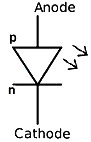
The schematic symbol of a light emitting diode $(LED)$ is:
A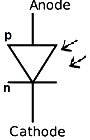
B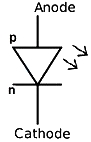
C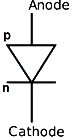
D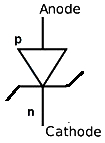
Solution
(B) light emitting diode $(LED)$ is a heavily doped $p-n$ junction diode which emits light when it is forward biased.
In the schematic symbol of an $LED$,the arrows point away from the diode,indicating the emission of light.
Option $A$ represents a photodiode (arrows pointing towards the diode).
Option $B$ represents an $LED$ (arrows pointing away from the diode).
Option $C$ represents a standard $p-n$ junction diode.
Option $D$ represents a Zener diode.
Therefore,the correct schematic symbol for an $LED$ is shown in option $B$.
In the schematic symbol of an $LED$,the arrows point away from the diode,indicating the emission of light.
Option $A$ represents a photodiode (arrows pointing towards the diode).
Option $B$ represents an $LED$ (arrows pointing away from the diode).
Option $C$ represents a standard $p-n$ junction diode.
Option $D$ represents a Zener diode.
Therefore,the correct schematic symbol for an $LED$ is shown in option $B$.
0 likesView Solution
46
PhysicsEasyMCQMHT CET · 2016
In an oscillator,for sustained oscillations,the Barkhausen criterion is $A \beta$ equal to (where $A =$ voltage gain without feedback,$\beta =$ feedback factor).
A
Zero
B
$1/2$
C
$1$
D
$2$
Solution
(C) The Barkhausen criterion states that for an oscillator to produce sustained oscillations,the loop gain of the feedback amplifier must be equal to unity.
Mathematically,this is expressed as $A \beta = 1$,where $A$ is the voltage gain of the amplifier without feedback and $\beta$ is the feedback factor.
Additionally,the total phase shift around the loop must be $0^\circ$ or an integer multiple of $360^\circ$.
Mathematically,this is expressed as $A \beta = 1$,where $A$ is the voltage gain of the amplifier without feedback and $\beta$ is the feedback factor.
Additionally,the total phase shift around the loop must be $0^\circ$ or an integer multiple of $360^\circ$.
0 likesView Solution
47
PhysicsEasyMCQMHT CET · 2016
From Brewster's law, except for polished metallic surfaces, the polarising angle
A
depends on wavelength and is different for different colours.
B
independent of wavelength and is different for different colours.
C
independent of wavelength and is same for different colours.
D
depends on wavelength and is same for different colours.
Solution
(A) Brewster's law states that the tangent of the polarizing angle $(i_p)$ is equal to the refractive index $(\mu)$ of the medium, i.e., $\tan(i_p) = \mu$.
Since the refractive index $(\mu)$ of a material depends on the wavelength $(\lambda)$ of light (due to dispersion), the polarizing angle $(i_p)$ also depends on the wavelength.
Because different colours have different wavelengths, the polarizing angle is different for different colours.
Since the refractive index $(\mu)$ of a material depends on the wavelength $(\lambda)$ of light (due to dispersion), the polarizing angle $(i_p)$ also depends on the wavelength.
Because different colours have different wavelengths, the polarizing angle is different for different colours.
0 likesView Solution
48
PhysicsMediumMCQMHT CET · 2016
Two coherent sources $P$ and $Q$ produce interference at point $A$ on the screen,where a dark band is formed between the $4^{\text{th}}$ bright band and the $5^{\text{th}}$ bright band. The wavelength of the light used is $6000 \text{ Å}$. The path difference between $PA$ and $QA$ is:
A
$1.4 \times 10^{-4} \text{ cm}$
B
$2.7 \times 10^{-4} \text{ cm}$
C
$4.5 \times 10^{-4} \text{ cm}$
D
$6.2 \times 10^{-4} \text{ cm}$
Solution
(B) For constructive interference (bright bands),the path difference is $\Delta x = n\lambda$,where $n = 0, 1, 2, \dots$
For destructive interference (dark bands),the path difference is $\Delta x = (n + \frac{1}{2})\lambda$,where $n = 0, 1, 2, \dots$
The $4^{\text{th}}$ bright band corresponds to $n = 4$ $(\Delta x = 4\lambda)$ and the $5^{\text{th}}$ bright band corresponds to $n = 5$ $(\Delta x = 5\lambda)$.
$A$ dark band formed between the $4^{\text{th}}$ and $5^{\text{th}}$ bright band corresponds to $n = 4$ in the dark band formula: $\Delta x = (4 + \frac{1}{2})\lambda = 4.5\lambda$.
Given $\lambda = 6000 \text{ Å} = 6000 \times 10^{-10} \text{ m} = 6 \times 10^{-7} \text{ m} = 6 \times 10^{-5} \text{ cm}$.
Path difference $\Delta x = 4.5 \times (6 \times 10^{-5} \text{ cm}) = 27 \times 10^{-5} \text{ cm} = 2.7 \times 10^{-4} \text{ cm}$.
For destructive interference (dark bands),the path difference is $\Delta x = (n + \frac{1}{2})\lambda$,where $n = 0, 1, 2, \dots$
The $4^{\text{th}}$ bright band corresponds to $n = 4$ $(\Delta x = 4\lambda)$ and the $5^{\text{th}}$ bright band corresponds to $n = 5$ $(\Delta x = 5\lambda)$.
$A$ dark band formed between the $4^{\text{th}}$ and $5^{\text{th}}$ bright band corresponds to $n = 4$ in the dark band formula: $\Delta x = (4 + \frac{1}{2})\lambda = 4.5\lambda$.
Given $\lambda = 6000 \text{ Å} = 6000 \times 10^{-10} \text{ m} = 6 \times 10^{-7} \text{ m} = 6 \times 10^{-5} \text{ cm}$.
Path difference $\Delta x = 4.5 \times (6 \times 10^{-5} \text{ cm}) = 27 \times 10^{-5} \text{ cm} = 2.7 \times 10^{-4} \text{ cm}$.
0 likesView Solution
49
PhysicsEasyMCQMHT CET · 2016
Interference fringes are produced on a screen by using two light sources of intensities $I$ and $9I$. The phase difference between the beams is $\frac{\pi}{2}$ at the point $P$ and $\pi$ at the point $Q$ on the screen. The difference between the resultant intensities at point $P$ and $Q$ is (in $I$)
A
$2$
B
$4$
C
$6$
D
$8$
Solution
(C) The resultant intensity $I_R$ for two interfering waves with intensities $I_1$ and $I_2$ and phase difference $\phi$ is given by $I_R = I_1 + I_2 + 2\sqrt{I_1 I_2} \cos \phi$.
Given $I_1 = I$ and $I_2 = 9I$.
At point $P$,the phase difference $\phi_P = \frac{\pi}{2}$.
$I_P = I + 9I + 2\sqrt{I \cdot 9I} \cos(\frac{\pi}{2}) = 10I + 6I(0) = 10I$.
At point $Q$,the phase difference $\phi_Q = \pi$.
$I_Q = I + 9I + 2\sqrt{I \cdot 9I} \cos(\pi) = 10I + 6I(-1) = 10I - 6I = 4I$.
The difference between the resultant intensities at points $P$ and $Q$ is $\Delta I = I_P - I_Q = 10I - 4I = 6I$.
Given $I_1 = I$ and $I_2 = 9I$.
At point $P$,the phase difference $\phi_P = \frac{\pi}{2}$.
$I_P = I + 9I + 2\sqrt{I \cdot 9I} \cos(\frac{\pi}{2}) = 10I + 6I(0) = 10I$.
At point $Q$,the phase difference $\phi_Q = \pi$.
$I_Q = I + 9I + 2\sqrt{I \cdot 9I} \cos(\pi) = 10I + 6I(-1) = 10I - 6I = 4I$.
The difference between the resultant intensities at points $P$ and $Q$ is $\Delta I = I_P - I_Q = 10I - 4I = 6I$.
0 likesView Solution
Vedclass Products
For Students
Vedclass Test Series
Mock tests in real MHT CET style covering Physics with performance analysis. 5-day free trial.
Start Free TrialFor Teachers
Exam Paper Generator
Generate Set A/B/C/D Physics papers from 7.5L+ questions in 2 minutes. 3 chapters free.
Try FreeFor Institutes
Online Exam Module
Run live MHT CET mock exams with unlimited students, 360° analytics & white-label branding.
See DemoFrequently Asked Questions
How many Physics questions are in MHT CET 2016?
There are 49 Physics questions from the MHT CET 2016 paper on Vedclass, each with a detailed step-by-step solution in English.
Are MHT CET 2016 Physics solutions available in English?
Yes. All solutions on this page are in English. You can also switch to English or Hindi using the language buttons above the questions.
Can I practice MHT CET 2016 Physics as a timed test?
Yes. Use the Vedclass Test Series to attempt a full MHT CET mock test covering Physics with time limits and instant score analysis.
Can teachers create Physics papers from MHT CET previous year questions?
Yes. The Vedclass Exam Paper Generator lets teachers mix MHT CET Physics questions and generate Set A/B/C/D papers in minutes.
For Teachers & Institutes
Build a Custom Physics Paper
Pick MHT CET 2016 Physics questions, set difficulty, and generate Set A/B/C/D in 2 minutes.