
MathematicsQ1–50 of 50 questions
Page 1 of 1 · English
1
MathematicsEasyMCQMHT CET · 2016
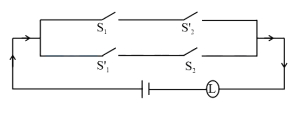
The symbolic form of the given switching circuit is equivalent to $..........$
A
$p \vee \sim q$
B
$p \wedge \sim q$
C
$p \leftrightarrow q$
D
$\sim(p \leftrightarrow q)$
Solution
(D) Let $S_1 \equiv p$ and $S_2 \equiv q$. Then $S_1' \equiv \sim p$ and $S_2' \equiv \sim q$.
The circuit consists of two parallel branches.
The first branch has switches $S_1$ and $S_2'$ in series,which corresponds to $(p \wedge \sim q)$.
The second branch has switches $S_1'$ and $S_2$ in series,which corresponds to $(\sim p \wedge q)$.
Since the branches are in parallel,the total expression is $(p \wedge \sim q) \vee (\sim p \wedge q)$.
This expression is equivalent to the exclusive $OR$ operation,which is $\sim(p \leftrightarrow q)$.
The circuit consists of two parallel branches.
The first branch has switches $S_1$ and $S_2'$ in series,which corresponds to $(p \wedge \sim q)$.
The second branch has switches $S_1'$ and $S_2$ in series,which corresponds to $(\sim p \wedge q)$.
Since the branches are in parallel,the total expression is $(p \wedge \sim q) \vee (\sim p \wedge q)$.
This expression is equivalent to the exclusive $OR$ operation,which is $\sim(p \leftrightarrow q)$.
0 likesView Solution
2
MathematicsEasyMCQMHT CET · 2016
Which of the following quantified statements is true?
A
The square of every real number is positive
B
There exists a real number whose square is negative
C
There exists a real number whose square is not positive
D
Every real number is rational
Solution
(C) For any real number $x$,the square $x^2$ is always greater than or equal to $0$ $(x^2 \geq 0)$.
Option $A$ is false because for $x=0$,$x^2=0$,which is not positive.
Option $B$ is false because the square of a real number cannot be negative.
Option $C$ is true because there exists a real number $x=0$ such that $x^2=0$,which is not positive.
Option $D$ is false because there exist irrational numbers like $\sqrt{2}$.
Option $A$ is false because for $x=0$,$x^2=0$,which is not positive.
Option $B$ is false because the square of a real number cannot be negative.
Option $C$ is true because there exists a real number $x=0$ such that $x^2=0$,which is not positive.
Option $D$ is false because there exist irrational numbers like $\sqrt{2}$.
0 likesView Solution
3
MathematicsEasyMCQMHT CET · 2016
If $p$: Every square is a rectangle and $q$: Every rhombus is a kite,then the truth values of $p \rightarrow q$ and $p \leftrightarrow q$ are $ . . . . . . $ and $ . . . . . . $ respectively.
A
$F, F$
B
$T, F$
C
$F, T$
D
$T, T$
Solution
(D) Step $1$: Determine the truth value of statement $p$. Every square is a rectangle is a true statement,so $p = T$.
Step $2$: Determine the truth value of statement $q$. Every rhombus is a kite is a true statement,so $q = T$.
Step $3$: Evaluate $p \rightarrow q$. Since $T \rightarrow T$ is $T$,the truth value is $T$.
Step $4$: Evaluate $p \leftrightarrow q$. Since $T \leftrightarrow T$ is $T$,the truth value is $T$.
Therefore,the truth values are $T, T$.
Step $2$: Determine the truth value of statement $q$. Every rhombus is a kite is a true statement,so $q = T$.
Step $3$: Evaluate $p \rightarrow q$. Since $T \rightarrow T$ is $T$,the truth value is $T$.
Step $4$: Evaluate $p \leftrightarrow q$. Since $T \leftrightarrow T$ is $T$,the truth value is $T$.
Therefore,the truth values are $T, T$.
0 likesView Solution
4
MathematicsEasyMCQMHT CET · 2016
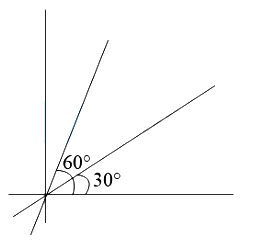
The joint equation of the lines passing through the origin and trisecting the first quadrant is
A
$\sqrt{3} x^2 - 4xy + \sqrt{3} y^2 = 0$
B
$x^2 - \sqrt{3} xy - y^2 = 0$
C
$3x^2 - y^2 = 0$
D
$x^2 + \sqrt{3} xy - y^2 = 0$
Solution
(A) The first quadrant is the region between the positive $x$-axis $(0^\circ)$ and the positive $y$-axis $(90^\circ)$.
Lines that trisect the first quadrant make angles of $30^\circ$ and $60^\circ$ with the positive $x$-axis.
The equations of these lines are $y = \tan(30^\circ)x$ and $y = \tan(60^\circ)x$.
$y = \frac{1}{\sqrt{3}}x \implies x - \sqrt{3}y = 0$
$y = \sqrt{3}x \implies \sqrt{3}x - y = 0$
The joint equation is $(x - \sqrt{3}y)(\sqrt{3}x - y) = 0$.
Expanding this: $\sqrt{3}x^2 - xy - 3xy + \sqrt{3}y^2 = 0$.
$\sqrt{3}x^2 - 4xy + \sqrt{3}y^2 = 0$.
Lines that trisect the first quadrant make angles of $30^\circ$ and $60^\circ$ with the positive $x$-axis.
The equations of these lines are $y = \tan(30^\circ)x$ and $y = \tan(60^\circ)x$.
$y = \frac{1}{\sqrt{3}}x \implies x - \sqrt{3}y = 0$
$y = \sqrt{3}x \implies \sqrt{3}x - y = 0$
The joint equation is $(x - \sqrt{3}y)(\sqrt{3}x - y) = 0$.
Expanding this: $\sqrt{3}x^2 - xy - 3xy + \sqrt{3}y^2 = 0$.
$\sqrt{3}x^2 - 4xy + \sqrt{3}y^2 = 0$.
0 likesView Solution
5
MathematicsDifficultMCQMHT CET · 2016
The joint equation of the bisectors of the angles between the lines $x=5$ and $y=3$ is
A
$(x-5)(y-3)=0$
B
$x^2-y^2-10x+6y+16=0$
C
$xy=0$
D
$xy-5x-3y+15=0$
Solution
(B) The lines $x=5$ (a vertical line) and $y=3$ (a horizontal line) intersect at the point $(5, 3)$.
Since these lines are perpendicular,the angle bisectors are lines passing through $(5, 3)$ that make angles of $45^{\circ}$ and $135^{\circ}$ with the $x$-axis.
The slopes of these bisectors are $m = \tan 45^{\circ} = 1$ and $m = \tan 135^{\circ} = -1$.
The equations of the bisectors are:
$y - 3 = 1(x - 5) \Rightarrow y - x + 2 = 0$
$y - 3 = -1(x - 5) \Rightarrow y + x - 8 = 0$
The joint equation is $(y - x + 2)(y + x - 8) = 0$.
Expanding this: $y^2 + xy - 8y - xy - x^2 + 8x + 2y + 2x - 16 = 0$.
Simplifying,we get $-x^2 + y^2 + 10x - 6y - 16 = 0$,or $x^2 - y^2 - 10x + 6y + 16 = 0$.
Since these lines are perpendicular,the angle bisectors are lines passing through $(5, 3)$ that make angles of $45^{\circ}$ and $135^{\circ}$ with the $x$-axis.
The slopes of these bisectors are $m = \tan 45^{\circ} = 1$ and $m = \tan 135^{\circ} = -1$.
The equations of the bisectors are:
$y - 3 = 1(x - 5) \Rightarrow y - x + 2 = 0$
$y - 3 = -1(x - 5) \Rightarrow y + x - 8 = 0$
The joint equation is $(y - x + 2)(y + x - 8) = 0$.
Expanding this: $y^2 + xy - 8y - xy - x^2 + 8x + 2y + 2x - 16 = 0$.
Simplifying,we get $-x^2 + y^2 + 10x - 6y - 16 = 0$,or $x^2 - y^2 - 10x + 6y + 16 = 0$.
0 likesView Solution
6
MathematicsEasyMCQMHT CET · 2016
Which of the following equations does not represent a pair of lines?
A
$x^2 - x = 0$
B
$xy - x = 0$
C
$y^2 - x + 1 = 0$
D
$xy + x + y + 1 = 0$
Solution
(C) general second-degree equation $ax^2 + 2hxy + by^2 + 2gx + 2fy + c = 0$ represents a pair of straight lines if the determinant $\Delta = \begin{vmatrix} a & h & g \\ h & b & f \\ g & f & c \end{vmatrix} = 0$.
For option $A$: $x^2 - x = 0 \implies x(x-1) = 0$,which represents lines $x=0$ and $x=1$.
For option $B$: $xy - x = 0 \implies x(y-1) = 0$,which represents lines $x=0$ and $y=1$.
For option $C$: $y^2 - x + 1 = 0$. This is a parabola,not a pair of lines,as it cannot be factored into two linear factors.
For option $D$: $xy + x + y + 1 = 0 \implies x(y+1) + 1(y+1) = 0 \implies (x+1)(y+1) = 0$,which represents lines $x=-1$ and $y=-1$.
Thus,the equation that does not represent a pair of lines is $y^2 - x + 1 = 0$.
For option $A$: $x^2 - x = 0 \implies x(x-1) = 0$,which represents lines $x=0$ and $x=1$.
For option $B$: $xy - x = 0 \implies x(y-1) = 0$,which represents lines $x=0$ and $y=1$.
For option $C$: $y^2 - x + 1 = 0$. This is a parabola,not a pair of lines,as it cannot be factored into two linear factors.
For option $D$: $xy + x + y + 1 = 0 \implies x(y+1) + 1(y+1) = 0 \implies (x+1)(y+1) = 0$,which represents lines $x=-1$ and $y=-1$.
Thus,the equation that does not represent a pair of lines is $y^2 - x + 1 = 0$.
0 likesView Solution
7
MathematicsEasyMCQMHT CET · 2016
In $\Delta ABC$,$(a-b)^2 \cos^2 \frac{C}{2} + (a+b)^2 \sin^2 \frac{C}{2} =$
A
$b^2$
B
$c^2$
C
$a^2$
D
$a^2+b^2+c^2$
Solution
(B) Let $X = (a-b)^2 \cos^2 \frac{C}{2} + (a+b)^2 \sin^2 \frac{C}{2}$
$= (a^2 + b^2 - 2ab) \cos^2 \frac{C}{2} + (a^2 + b^2 + 2ab) \sin^2 \frac{C}{2}$
$= (a^2 + b^2) (\cos^2 \frac{C}{2} + \sin^2 \frac{C}{2}) - 2ab (\cos^2 \frac{C}{2} - \sin^2 \frac{C}{2})$
$= (a^2 + b^2)(1) - 2ab \cos C$
$= a^2 + b^2 - 2ab \cos C$
$= c^2$ (by the Law of Cosines).
$= (a^2 + b^2 - 2ab) \cos^2 \frac{C}{2} + (a^2 + b^2 + 2ab) \sin^2 \frac{C}{2}$
$= (a^2 + b^2) (\cos^2 \frac{C}{2} + \sin^2 \frac{C}{2}) - 2ab (\cos^2 \frac{C}{2} - \sin^2 \frac{C}{2})$
$= (a^2 + b^2)(1) - 2ab \cos C$
$= a^2 + b^2 - 2ab \cos C$
$= c^2$ (by the Law of Cosines).
0 likesView Solution
8
MathematicsEasyMCQMHT CET · 2016
The general solution of the equation $\tan^2 x = 1$ is
A
$n \pi + \frac{\pi}{4}$
B
$n \pi - \frac{\pi}{4}$
C
$n \pi \pm \frac{\pi}{4}$
D
$2 n \pi \pm \frac{\pi}{4}$
Solution
(C) Given the equation $\tan^2 x = 1$.
Taking the square root on both sides,we get $\tan x = \pm 1$.
We know that $\tan x = \tan \alpha$ implies $x = n \pi + \alpha$.
For $\tan x = 1$,$x = n \pi + \frac{\pi}{4}$.
For $\tan x = -1$,$x = n \pi - \frac{\pi}{4}$.
Combining these two results,the general solution is $x = n \pi \pm \frac{\pi}{4}$,where $n \in \mathbb{Z}$.
Taking the square root on both sides,we get $\tan x = \pm 1$.
We know that $\tan x = \tan \alpha$ implies $x = n \pi + \alpha$.
For $\tan x = 1$,$x = n \pi + \frac{\pi}{4}$.
For $\tan x = -1$,$x = n \pi - \frac{\pi}{4}$.
Combining these two results,the general solution is $x = n \pi \pm \frac{\pi}{4}$,where $n \in \mathbb{Z}$.
0 likesView Solution
9
MathematicsMediumMCQMHT CET · 2016
The solutions of the equation $\sin 2x + \cos 2x = 0$,where $\pi < x < 2\pi$,are
A
$\frac{7\pi}{8}, \frac{11\pi}{8}$
B
$\frac{9\pi}{8}, \frac{13\pi}{8}$
C
$\frac{11\pi}{8}, \frac{15\pi}{8}$
D
$\frac{15\pi}{8}, \frac{19\pi}{8}$
Solution
(C) Given the equation $\sin 2x + \cos 2x = 0$.
Dividing by $\cos 2x$ (assuming $\cos 2x \neq 0$),we get $\tan 2x = -1$.
Since $\tan \theta = -1$ implies $\theta = n\pi - \frac{\pi}{4}$,we have $2x = n\pi - \frac{\pi}{4}$.
Thus,$x = \frac{n\pi}{2} - \frac{\pi}{8} = \frac{(4n - 1)\pi}{8}$.
For $\pi < x < 2\pi$:
If $n = 3$,$x = \frac{(12 - 1)\pi}{8} = \frac{11\pi}{8}$.
If $n = 4$,$x = \frac{(16 - 1)\pi}{8} = \frac{15\pi}{8}$.
Both values lie in the interval $(\pi, 2\pi)$.
Dividing by $\cos 2x$ (assuming $\cos 2x \neq 0$),we get $\tan 2x = -1$.
Since $\tan \theta = -1$ implies $\theta = n\pi - \frac{\pi}{4}$,we have $2x = n\pi - \frac{\pi}{4}$.
Thus,$x = \frac{n\pi}{2} - \frac{\pi}{8} = \frac{(4n - 1)\pi}{8}$.
For $\pi < x < 2\pi$:
If $n = 3$,$x = \frac{(12 - 1)\pi}{8} = \frac{11\pi}{8}$.
If $n = 4$,$x = \frac{(16 - 1)\pi}{8} = \frac{15\pi}{8}$.
Both values lie in the interval $(\pi, 2\pi)$.
0 likesView Solution
10
MathematicsMediumMCQMHT CET · 2016
The point on the curve $6y = x^3 + 2$ at which the $y$-coordinate is changing $8$ times as fast as the $x$-coordinate is:
A
$(4, 11)$
B
$(4, -11)$
C
$(-4, 11)$
D
$(-4, -11)$
Solution
(A) Given the curve equation $6y = x^3 + 2$.
Differentiating both sides with respect to $t$,we get $6 \frac{dy}{dt} = 3x^2 \frac{dx}{dt}$.
This simplifies to $2 \frac{dy}{dt} = x^2 \frac{dx}{dt}$.
We are given that the $y$-coordinate is changing $8$ times as fast as the $x$-coordinate,so $\frac{dy}{dt} = 8 \frac{dx}{dt}$.
Substituting this into the derivative equation: $2(8 \frac{dx}{dt}) = x^2 \frac{dx}{dt}$.
Assuming $\frac{dx}{dt} \neq 0$,we have $16 = x^2$,which gives $x = 4$ or $x = -4$.
If $x = 4$,then $6y = (4)^3 + 2 = 64 + 2 = 66$,so $y = 11$. The point is $(4, 11)$.
If $x = -4$,then $6y = (-4)^3 + 2 = -64 + 2 = -62$,so $y = -31/3$.
Comparing with the given options,the correct point is $(4, 11)$.
Differentiating both sides with respect to $t$,we get $6 \frac{dy}{dt} = 3x^2 \frac{dx}{dt}$.
This simplifies to $2 \frac{dy}{dt} = x^2 \frac{dx}{dt}$.
We are given that the $y$-coordinate is changing $8$ times as fast as the $x$-coordinate,so $\frac{dy}{dt} = 8 \frac{dx}{dt}$.
Substituting this into the derivative equation: $2(8 \frac{dx}{dt}) = x^2 \frac{dx}{dt}$.
Assuming $\frac{dx}{dt} \neq 0$,we have $16 = x^2$,which gives $x = 4$ or $x = -4$.
If $x = 4$,then $6y = (4)^3 + 2 = 64 + 2 = 66$,so $y = 11$. The point is $(4, 11)$.
If $x = -4$,then $6y = (-4)^3 + 2 = -64 + 2 = -62$,so $y = -31/3$.
Comparing with the given options,the correct point is $(4, 11)$.
0 likesView Solution
11
MathematicsMediumMCQMHT CET · 2016
The approximate value of $f(x)=x^3+5x^2-7x+9$ at $x=1.1$ is
A
$8.6$
B
$8.5$
C
$8.4$
D
$8.3$
Solution
(A) Using the linear approximation formula: $f(x+h) \approx f(x) + h f'(x)$.
Here,let $x=1$ and $h=0.1$.
First,calculate $f(1) = (1)^3 + 5(1)^2 - 7(1) + 9 = 1 + 5 - 7 + 9 = 8$.
Next,find the derivative $f'(x) = 3x^2 + 10x - 7$.
Calculate $f'(1) = 3(1)^2 + 10(1) - 7 = 3 + 10 - 7 = 6$.
Now,substitute these values into the formula:
$f(1.1) \approx f(1) + 0.1 \times f'(1)$
$f(1.1) \approx 8 + 0.1 \times 6$
$f(1.1) \approx 8 + 0.6 = 8.6$.
Here,let $x=1$ and $h=0.1$.
First,calculate $f(1) = (1)^3 + 5(1)^2 - 7(1) + 9 = 1 + 5 - 7 + 9 = 8$.
Next,find the derivative $f'(x) = 3x^2 + 10x - 7$.
Calculate $f'(1) = 3(1)^2 + 10(1) - 7 = 3 + 10 - 7 = 6$.
Now,substitute these values into the formula:
$f(1.1) \approx f(1) + 0.1 \times f'(1)$
$f(1.1) \approx 8 + 0.1 \times 6$
$f(1.1) \approx 8 + 0.6 = 8.6$.
0 likesView Solution
12
MathematicsMediumMCQMHT CET · 2016
If Rolle's theorem for a function $f(x)=e^x(\sin x-\cos x)$ is verified on $\left[\frac{\pi}{4}, \frac{5 \pi}{4}\right]$,then the value of $c$ is
A
$\frac{\pi}{3}$
B
$\frac{\pi}{2}$
C
$\frac{3 \pi}{4}$
D
$\pi$
Solution
(D) Given function is $f(x)=e^x(\sin x-\cos x)$.
First,we check the conditions of Rolle's theorem:
$1$. $f(x)$ is continuous on $\left[\frac{\pi}{4}, \frac{5 \pi}{4}\right]$ and differentiable on $\left(\frac{\pi}{4}, \frac{5 \pi}{4}\right)$.
$2$. $f\left(\frac{\pi}{4}\right) = e^{\pi/4}(\sin(\pi/4) - \cos(\pi/4)) = e^{\pi/4}(\frac{1}{\sqrt{2}} - \frac{1}{\sqrt{2}}) = 0$.
$3$. $f\left(\frac{5\pi}{4}\right) = e^{5\pi/4}(\sin(5\pi/4) - \cos(5\pi/4)) = e^{5\pi/4}(-\frac{1}{\sqrt{2}} - (-\frac{1}{\sqrt{2}})) = 0$.
Since $f\left(\frac{\pi}{4}\right) = f\left(\frac{5\pi}{4}\right) = 0$,Rolle's theorem is applicable.
Now,find $f'(x)$:
$f'(x) = e^x(\sin x - \cos x) + e^x(\cos x + \sin x) = 2e^x \sin x$.
Set $f'(c) = 0$ for $c \in \left(\frac{\pi}{4}, \frac{5 \pi}{4}\right)$:
$2e^c \sin c = 0$.
Since $e^c \neq 0$,we have $\sin c = 0$.
In the interval $\left(\frac{\pi}{4}, \frac{5 \pi}{4}\right)$,$\sin c = 0$ at $c = \pi$.
First,we check the conditions of Rolle's theorem:
$1$. $f(x)$ is continuous on $\left[\frac{\pi}{4}, \frac{5 \pi}{4}\right]$ and differentiable on $\left(\frac{\pi}{4}, \frac{5 \pi}{4}\right)$.
$2$. $f\left(\frac{\pi}{4}\right) = e^{\pi/4}(\sin(\pi/4) - \cos(\pi/4)) = e^{\pi/4}(\frac{1}{\sqrt{2}} - \frac{1}{\sqrt{2}}) = 0$.
$3$. $f\left(\frac{5\pi}{4}\right) = e^{5\pi/4}(\sin(5\pi/4) - \cos(5\pi/4)) = e^{5\pi/4}(-\frac{1}{\sqrt{2}} - (-\frac{1}{\sqrt{2}})) = 0$.
Since $f\left(\frac{\pi}{4}\right) = f\left(\frac{5\pi}{4}\right) = 0$,Rolle's theorem is applicable.
Now,find $f'(x)$:
$f'(x) = e^x(\sin x - \cos x) + e^x(\cos x + \sin x) = 2e^x \sin x$.
Set $f'(c) = 0$ for $c \in \left(\frac{\pi}{4}, \frac{5 \pi}{4}\right)$:
$2e^c \sin c = 0$.
Since $e^c \neq 0$,we have $\sin c = 0$.
In the interval $\left(\frac{\pi}{4}, \frac{5 \pi}{4}\right)$,$\sin c = 0$ at $c = \pi$.
0 likesView Solution
13
MathematicsEasyMCQMHT CET · 2016
The area of the region bounded by the curve $y=2x-x^2$ and the $x$-axis is
A
$\frac{2}{3} \text{ sq units}$
B
$\frac{4}{3} \text{ sq units}$
C
$\frac{5}{3} \text{ sq units}$
D
$\frac{8}{3} \text{ sq units}$
Solution
(B) To find the area bounded by the curve $y=2x-x^2$ and the $x$-axis,we first find the intersection points with the $x$-axis by setting $y=0$.
$2x-x^2=0 \Rightarrow x(2-x)=0$,which gives $x=0$ and $x=2$.
The area $A$ is given by the integral:
$A = \int_0^2 (2x-x^2) dx$
$A = [x^2 - \frac{x^3}{3}]_0^2$
$A = (2^2 - \frac{2^3}{3}) - (0^2 - \frac{0^3}{3})$
$A = 4 - \frac{8}{3} = \frac{12-8}{3} = \frac{4}{3} \text{ sq units}$.
$2x-x^2=0 \Rightarrow x(2-x)=0$,which gives $x=0$ and $x=2$.
The area $A$ is given by the integral:
$A = \int_0^2 (2x-x^2) dx$
$A = [x^2 - \frac{x^3}{3}]_0^2$
$A = (2^2 - \frac{2^3}{3}) - (0^2 - \frac{0^3}{3})$
$A = 4 - \frac{8}{3} = \frac{12-8}{3} = \frac{4}{3} \text{ sq units}$.
0 likesView Solution
14
MathematicsDifficultMCQMHT CET · 2016
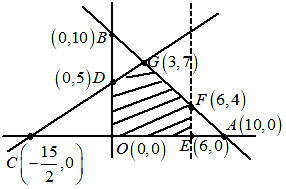
The objective function $z=x_1+x_2$,subject to $x_1+x_2 \leq 10, -2x_1+3x_2 \leq 15, x_1 \leq 6, x_1, x_2 \geq 0$,has a maximum value at:
A
at only one point
B
at only two points
C
at every point of the segment joining two points
D
at every point of the line joining two points
Solution
(C) The feasible region is determined by the constraints $x_1+x_2 \leq 10$,$-2x_1+3x_2 \leq 15$,$x_1 \leq 6$,and $x_1, x_2 \geq 0$. The corner points of the feasible region are $O(0,0)$,$E(6,0)$,$F(6,4)$,$G(3,7)$,and $D(0,5)$.
We evaluate the objective function $z=x_1+x_2$ at these corner points:
$z(O) = 0+0 = 0$
$z(E) = 6+0 = 6$
$z(F) = 6+4 = 10$
$z(G) = 3+7 = 10$
$z(D) = 0+5 = 5$
The maximum value of $z$ is $10$,which occurs at both corner points $F(6,4)$ and $G(3,7)$.
Since the objective function is maximized at two distinct corner points,it will have the same maximum value at every point on the line segment joining these two points.
We evaluate the objective function $z=x_1+x_2$ at these corner points:
$z(O) = 0+0 = 0$
$z(E) = 6+0 = 6$
$z(F) = 6+4 = 10$
$z(G) = 3+7 = 10$
$z(D) = 0+5 = 5$
The maximum value of $z$ is $10$,which occurs at both corner points $F(6,4)$ and $G(3,7)$.
Since the objective function is maximized at two distinct corner points,it will have the same maximum value at every point on the line segment joining these two points.
0 likesView Solution
15
MathematicsMediumMCQMHT CET · 2016
For what value of $k$ is the function $f(x) = \begin{cases} \frac{\text{log}(1+2x) \sin x^{\circ}}{x^2}, & x \neq 0 \\ k, & x = 0 \end{cases}$ continuous at $x = 0$?
A
$2$
B
$\frac{1}{2}$
C
$\frac{\pi}{90}$
D
$\frac{90}{\pi}$
Solution
(C) Since $f(x)$ is continuous at $x = 0$,we must have $\lim_{x \to 0} f(x) = f(0)$.
Therefore,$\lim_{x \to 0} \frac{\text{log}(1 + 2x) \cdot \sin x^{\circ}}{x^2} = k$.
We know that $\sin x^{\circ} = \sin(\frac{\pi x}{180})$.
So,$\lim_{x \to 0} \frac{\text{log}(1 + 2x)}{x} \cdot \frac{\sin(\frac{\pi x}{180})}{x} = k$.
Multiplying and dividing by $2$ and $\frac{\pi}{180}$ respectively:
$\lim_{x \to 0} \left( 2 \cdot \frac{\text{log}(1 + 2x)}{2x} \right) \cdot \left( \frac{\pi}{180} \cdot \frac{\sin(\frac{\pi x}{180})}{\frac{\pi x}{180}} \right) = k$.
Using the standard limits $\lim_{u \to 0} \frac{\text{log}(1+u)}{u} = 1$ and $\lim_{v \to 0} \frac{\sin v}{v} = 1$:
$2 \cdot 1 \cdot \frac{\pi}{180} \cdot 1 = k$.
Thus,$k = \frac{\pi}{90}$.
Therefore,$\lim_{x \to 0} \frac{\text{log}(1 + 2x) \cdot \sin x^{\circ}}{x^2} = k$.
We know that $\sin x^{\circ} = \sin(\frac{\pi x}{180})$.
So,$\lim_{x \to 0} \frac{\text{log}(1 + 2x)}{x} \cdot \frac{\sin(\frac{\pi x}{180})}{x} = k$.
Multiplying and dividing by $2$ and $\frac{\pi}{180}$ respectively:
$\lim_{x \to 0} \left( 2 \cdot \frac{\text{log}(1 + 2x)}{2x} \right) \cdot \left( \frac{\pi}{180} \cdot \frac{\sin(\frac{\pi x}{180})}{\frac{\pi x}{180}} \right) = k$.
Using the standard limits $\lim_{u \to 0} \frac{\text{log}(1+u)}{u} = 1$ and $\lim_{v \to 0} \frac{\sin v}{v} = 1$:
$2 \cdot 1 \cdot \frac{\pi}{180} \cdot 1 = k$.
Thus,$k = \frac{\pi}{90}$.
0 likesView Solution
16
MathematicsMediumMCQMHT CET · 2016
If the function $f(x)$ defined by $f(x) = \begin{cases} x \sin \frac{1}{x}, & x \neq 0 \\ k, & x = 0 \end{cases}$ is continuous at $x = 0$,then $k = . . . . . .$
A
$0$
B
$1$
C
$-1$
D
$\frac{1}{2}$
Solution
(A) Given the function $f(x) = \begin{cases} x \sin \frac{1}{x}, & x \neq 0 \\ k, & x = 0 \end{cases}$.
Since $f(x)$ is continuous at $x = 0$,the condition $\lim_{x \to 0} f(x) = f(0)$ must hold.
We calculate the limit: $\lim_{x \to 0} f(x) = \lim_{x \to 0} x \sin \frac{1}{x}$.
We know that for all $x \neq 0$,$-1 \leq \sin \frac{1}{x} \leq 1$.
Multiplying by $x$,we get $-|x| \leq x \sin \frac{1}{x} \leq |x|$.
By the Squeeze Theorem,as $x \to 0$,both $-|x|$ and $|x|$ approach $0$.
Therefore,$\lim_{x \to 0} x \sin \frac{1}{x} = 0$.
Since $f(0) = k$,we have $k = 0$.
Since $f(x)$ is continuous at $x = 0$,the condition $\lim_{x \to 0} f(x) = f(0)$ must hold.
We calculate the limit: $\lim_{x \to 0} f(x) = \lim_{x \to 0} x \sin \frac{1}{x}$.
We know that for all $x \neq 0$,$-1 \leq \sin \frac{1}{x} \leq 1$.
Multiplying by $x$,we get $-|x| \leq x \sin \frac{1}{x} \leq |x|$.
By the Squeeze Theorem,as $x \to 0$,both $-|x|$ and $|x|$ approach $0$.
Therefore,$\lim_{x \to 0} x \sin \frac{1}{x} = 0$.
Since $f(0) = k$,we have $k = 0$.
0 likesView Solution
17
MathematicsEasyMCQMHT CET · 2016
$\int_0^{\frac{\pi}{2}} \left( \frac{\sqrt[n]{\sec x}}{\sqrt[n]{\sec x} + \sqrt[n]{\operatorname{cosec} x}} \right) dx = $
A
$\frac{\pi}{2}$
B
$\frac{\pi}{3}$
C
$\frac{\pi}{4}$
D
$\frac{\pi}{6}$
Solution
(C) Let $I = \int_0^{\frac{\pi}{2}} \frac{(\sec x)^{1/n}}{(\sec x)^{1/n} + (\operatorname{cosec} x)^{1/n}} dx \dots (i)$
Using the property $\int_0^a f(x) dx = \int_0^a f(a-x) dx$:
$I = \int_0^{\frac{\pi}{2}} \frac{(\sec(\frac{\pi}{2}-x))^{1/n}}{(\sec(\frac{\pi}{2}-x))^{1/n} + (\operatorname{cosec}(\frac{\pi}{2}-x))^{1/n}} dx$
$I = \int_0^{\frac{\pi}{2}} \frac{(\operatorname{cosec} x)^{1/n}}{(\operatorname{cosec} x)^{1/n} + (\sec x)^{1/n}} dx \dots (ii)$
Adding $(i)$ and $(ii)$:
$2I = \int_0^{\frac{\pi}{2}} \frac{(\sec x)^{1/n} + (\operatorname{cosec} x)^{1/n}}{(\sec x)^{1/n} + (\operatorname{cosec} x)^{1/n}} dx$
$2I = \int_0^{\frac{\pi}{2}} 1 dx$
$2I = [x]_0^{\frac{\pi}{2}} = \frac{\pi}{2}$
$I = \frac{\pi}{4}$
Using the property $\int_0^a f(x) dx = \int_0^a f(a-x) dx$:
$I = \int_0^{\frac{\pi}{2}} \frac{(\sec(\frac{\pi}{2}-x))^{1/n}}{(\sec(\frac{\pi}{2}-x))^{1/n} + (\operatorname{cosec}(\frac{\pi}{2}-x))^{1/n}} dx$
$I = \int_0^{\frac{\pi}{2}} \frac{(\operatorname{cosec} x)^{1/n}}{(\operatorname{cosec} x)^{1/n} + (\sec x)^{1/n}} dx \dots (ii)$
Adding $(i)$ and $(ii)$:
$2I = \int_0^{\frac{\pi}{2}} \frac{(\sec x)^{1/n} + (\operatorname{cosec} x)^{1/n}}{(\sec x)^{1/n} + (\operatorname{cosec} x)^{1/n}} dx$
$2I = \int_0^{\frac{\pi}{2}} 1 dx$
$2I = [x]_0^{\frac{\pi}{2}} = \frac{\pi}{2}$
$I = \frac{\pi}{4}$
0 likesView Solution
18
MathematicsEasyMCQMHT CET · 2016
$\int_{-\frac{\pi}{2}}^{\frac{\pi}{2}} \log \left(\frac{2-\sin x}{2+\sin x}\right) d x=$
A
$1$
B
$3$
C
$2$
D
$0$
Solution
(D) Let $I = \int_{-\frac{\pi}{2}}^{\frac{\pi}{2}} \log \left(\frac{2-\sin x}{2+\sin x}\right) d x$.
Consider the function $f(x) = \log \left(\frac{2-\sin x}{2+\sin x}\right)$.
Now,check if the function is even or odd by evaluating $f(-x)$:
$f(-x) = \log \left(\frac{2-\sin(-x)}{2+\sin(-x)}\right) = \log \left(\frac{2+\sin x}{2-\sin x}\right)$.
Since $\log \left(\frac{a}{b}\right) = -\log \left(\frac{b}{a}\right)$,we have:
$f(-x) = -\log \left(\frac{2-\sin x}{2+\sin x}\right) = -f(x)$.
Since $f(-x) = -f(x)$,the function $f(x)$ is an odd function.
According to the property of definite integrals,if $f(x)$ is an odd function,then $\int_{-a}^{a} f(x) d x = 0$.
Therefore,$I = 0$.
Consider the function $f(x) = \log \left(\frac{2-\sin x}{2+\sin x}\right)$.
Now,check if the function is even or odd by evaluating $f(-x)$:
$f(-x) = \log \left(\frac{2-\sin(-x)}{2+\sin(-x)}\right) = \log \left(\frac{2+\sin x}{2-\sin x}\right)$.
Since $\log \left(\frac{a}{b}\right) = -\log \left(\frac{b}{a}\right)$,we have:
$f(-x) = -\log \left(\frac{2-\sin x}{2+\sin x}\right) = -f(x)$.
Since $f(-x) = -f(x)$,the function $f(x)$ is an odd function.
According to the property of definite integrals,if $f(x)$ is an odd function,then $\int_{-a}^{a} f(x) d x = 0$.
Therefore,$I = 0$.
0 likesView Solution
19
MathematicsEasyMCQMHT CET · 2016
The degree and order of the differential equation $\left[1+\left(\frac{dy}{dx}\right)^3\right]^{\frac{7}{3}}=7\left(\frac{d^2y}{dx^2}\right)$ respectively are
A
$3$ and $7$
B
$3$ and $2$
C
$7$ and $3$
D
$2$ and $3$
Solution
(B) The given differential equation is $\left[1+\left(\frac{dy}{dx}\right)^3\right]^{\frac{7}{3}}=7\left(\frac{d^2y}{dx^2}\right)$.
To find the degree,we must eliminate the fractional exponent by raising both sides to the power of $3$:
$\left[\left[1+\left(\frac{dy}{dx}\right)^3\right]^{\frac{7}{3}}\right]^3 = \left[7\left(\frac{d^2y}{dx^2}\right)\right]^3$
$\Rightarrow \left[1+\left(\frac{dy}{dx}\right)^3\right]^7 = 343\left(\frac{d^2y}{dx^2}\right)^3$.
The order of a differential equation is the highest derivative present,which is $\frac{d^2y}{dx^2}$,so the order is $2$.
The degree is the power of the highest derivative after the equation is made a polynomial in derivatives,which is $3$.
Thus,the degree is $3$ and the order is $2$.
To find the degree,we must eliminate the fractional exponent by raising both sides to the power of $3$:
$\left[\left[1+\left(\frac{dy}{dx}\right)^3\right]^{\frac{7}{3}}\right]^3 = \left[7\left(\frac{d^2y}{dx^2}\right)\right]^3$
$\Rightarrow \left[1+\left(\frac{dy}{dx}\right)^3\right]^7 = 343\left(\frac{d^2y}{dx^2}\right)^3$.
The order of a differential equation is the highest derivative present,which is $\frac{d^2y}{dx^2}$,so the order is $2$.
The degree is the power of the highest derivative after the equation is made a polynomial in derivatives,which is $3$.
Thus,the degree is $3$ and the order is $2$.
0 likesView Solution
20
MathematicsEasyMCQMHT CET · 2016
The differential equation of the family of circles touching the $y$-axis at the origin is
A
$(x^2+y^2) \frac{dy}{dx}-2xy=0$
B
$x^2-y^2+2xy \frac{dy}{dx}=0$
C
$(x^2-y^2) \frac{dy}{dx}-2xy=0$
D
$(x^2+y^2) \frac{dy}{dx}+2xy=0$
Solution
(B) Since the circle touches the $y$-axis at the origin,its center must lie on the $x$-axis. Let the center be $(a, 0)$ and the radius be $a$.
The equation of the circle is $(x-a)^2 + (y-0)^2 = a^2$.
Expanding this,we get $x^2 - 2ax + a^2 + y^2 = a^2$,which simplifies to $x^2 + y^2 - 2ax = 0$ ... $(i)$.
Differentiating equation $(i)$ with respect to $x$,we get $2x + 2y \frac{dy}{dx} - 2a = 0$,which implies $2a = 2x + 2y \frac{dy}{dx}$ ... $(ii)$.
Substituting the value of $2a$ from $(ii)$ into $(i)$,we get $x^2 + y^2 - x(2x + 2y \frac{dy}{dx}) = 0$.
This simplifies to $x^2 + y^2 - 2x^2 - 2xy \frac{dy}{dx} = 0$.
Thus,the differential equation is $y^2 - x^2 - 2xy \frac{dy}{dx} = 0$,or $x^2 - y^2 + 2xy \frac{dy}{dx} = 0$.
The equation of the circle is $(x-a)^2 + (y-0)^2 = a^2$.
Expanding this,we get $x^2 - 2ax + a^2 + y^2 = a^2$,which simplifies to $x^2 + y^2 - 2ax = 0$ ... $(i)$.
Differentiating equation $(i)$ with respect to $x$,we get $2x + 2y \frac{dy}{dx} - 2a = 0$,which implies $2a = 2x + 2y \frac{dy}{dx}$ ... $(ii)$.
Substituting the value of $2a$ from $(ii)$ into $(i)$,we get $x^2 + y^2 - x(2x + 2y \frac{dy}{dx}) = 0$.
This simplifies to $x^2 + y^2 - 2x^2 - 2xy \frac{dy}{dx} = 0$.
Thus,the differential equation is $y^2 - x^2 - 2xy \frac{dy}{dx} = 0$,or $x^2 - y^2 + 2xy \frac{dy}{dx} = 0$.
0 likesView Solution
21
MathematicsEasyMCQMHT CET · 2016
If $\sin x$ is the integrating factor of the linear differential equation $\frac{dy}{dx} + Py = Q$,then $P$ is
A
$\log \sin x$
B
$\cos x$
C
$\tan x$
D
$\cot x$
Solution
(D) The integrating factor $(I.F.)$ of the linear differential equation $\frac{dy}{dx} + Py = Q$ is given by $e^{\int P dx}$.
Given that the integrating factor is $\sin x$,we have:
$e^{\int P dx} = \sin x$
Taking the natural logarithm on both sides:
$\int P dx = \ln(\sin x)$
Differentiating both sides with respect to $x$:
$P = \frac{d}{dx}[\ln(\sin x)]$
Using the chain rule:
$P = \frac{1}{\sin x} \cdot \frac{d}{dx}(\sin x)$
$P = \frac{1}{\sin x} \cdot \cos x$
$P = \cot x$
Therefore,the correct option is $D$.
Given that the integrating factor is $\sin x$,we have:
$e^{\int P dx} = \sin x$
Taking the natural logarithm on both sides:
$\int P dx = \ln(\sin x)$
Differentiating both sides with respect to $x$:
$P = \frac{d}{dx}[\ln(\sin x)]$
Using the chain rule:
$P = \frac{1}{\sin x} \cdot \frac{d}{dx}(\sin x)$
$P = \frac{1}{\sin x} \cdot \cos x$
$P = \cot x$
Therefore,the correct option is $D$.
0 likesView Solution
22
MathematicsDifficultMCQMHT CET · 2016
The particular solution of the differential equation $y(1+\log x) \frac{dx}{dy} - x \log x = 0$ given that $y = e^2$ when $x = e$ is:
A
$y = ex \log x$
B
$ey = x \log x$
C
$xy = e \log x$
D
$y \log x = ex$
Solution
(A) Given the differential equation: $y(1+\log x) \frac{dx}{dy} - x \log x = 0$
Rearranging the terms to separate the variables:
$y(1+\log x) \frac{dx}{dy} = x \log x$
$\frac{1+\log x}{x \log x} dx = \frac{dy}{y}$
Integrating both sides:
$\int \frac{1+\log x}{x \log x} dx = \int \frac{dy}{y}$
Let $u = \log x$,then $du = \frac{1}{x} dx$. The integral becomes $\int \frac{1+u}{u} du = \int (\frac{1}{u} + 1) du = \log u + u$.
Substituting back $u = \log x$:
$\log(\log x) + \log x = \log y + C$
Alternatively,using substitution $v = x \log x$,$dv = (1 + \log x) dx$:
$\int \frac{dv}{v} = \int \frac{dy}{y}$
$\log(x \log x) = \log y + \log C$
$\log(x \log x) = \log(Cy)$
$x \log x = Cy$
Given $x = e$ and $y = e^2$:
$e \log e = C(e^2)$
$e(1) = Ce^2 \Rightarrow C = \frac{1}{e}$
Substituting $C$ back into the equation:
$x \log x = \frac{y}{e}$
$y = ex \log x$
Rearranging the terms to separate the variables:
$y(1+\log x) \frac{dx}{dy} = x \log x$
$\frac{1+\log x}{x \log x} dx = \frac{dy}{y}$
Integrating both sides:
$\int \frac{1+\log x}{x \log x} dx = \int \frac{dy}{y}$
Let $u = \log x$,then $du = \frac{1}{x} dx$. The integral becomes $\int \frac{1+u}{u} du = \int (\frac{1}{u} + 1) du = \log u + u$.
Substituting back $u = \log x$:
$\log(\log x) + \log x = \log y + C$
Alternatively,using substitution $v = x \log x$,$dv = (1 + \log x) dx$:
$\int \frac{dv}{v} = \int \frac{dy}{y}$
$\log(x \log x) = \log y + \log C$
$\log(x \log x) = \log(Cy)$
$x \log x = Cy$
Given $x = e$ and $y = e^2$:
$e \log e = C(e^2)$
$e(1) = Ce^2 \Rightarrow C = \frac{1}{e}$
Substituting $C$ back into the equation:
$x \log x = \frac{y}{e}$
$y = ex \log x$
0 likesView Solution
23
MathematicsEasyMCQMHT CET · 2016
If $y = e^{m \sin^{-1} x}$ and $(1 - x^2) (\frac{dy}{dx})^2 = A y^2$,then $A = . . . . . .$
A
$m$
B
$- m$
C
$m^2$
D
$- m^2$
Solution
(C) Given,$y = e^{m \sin^{-1} x}$.
Differentiating both sides with respect to $x$,we get:
$\frac{dy}{dx} = e^{m \sin^{-1} x} \cdot \frac{d}{dx}(m \sin^{-1} x) = y \cdot \frac{m}{\sqrt{1 - x^2}}$.
Squaring both sides,we get:
$(\frac{dy}{dx})^2 = \frac{m^2 y^2}{1 - x^2}$.
Multiplying both sides by $(1 - x^2)$,we obtain:
$(1 - x^2) (\frac{dy}{dx})^2 = m^2 y^2$.
Comparing this with the given equation $(1 - x^2) (\frac{dy}{dx})^2 = A y^2$,we find that $A = m^2$.
Differentiating both sides with respect to $x$,we get:
$\frac{dy}{dx} = e^{m \sin^{-1} x} \cdot \frac{d}{dx}(m \sin^{-1} x) = y \cdot \frac{m}{\sqrt{1 - x^2}}$.
Squaring both sides,we get:
$(\frac{dy}{dx})^2 = \frac{m^2 y^2}{1 - x^2}$.
Multiplying both sides by $(1 - x^2)$,we obtain:
$(1 - x^2) (\frac{dy}{dx})^2 = m^2 y^2$.
Comparing this with the given equation $(1 - x^2) (\frac{dy}{dx})^2 = A y^2$,we find that $A = m^2$.
0 likesView Solution
24
MathematicsEasyMCQMHT CET · 2016
If $\log _{10}\left(\frac{x^2-y^2}{x^2+y^2}\right)=2$,then $\frac{dy}{dx} = \dots$
A
$-\frac{99x}{101y}$
B
$\frac{99x}{101y}$
C
$-\frac{99y}{101x}$
D
$\frac{99y}{101x}$
Solution
(A) Given,$\log _{10}\left(\frac{x^2-y^2}{x^2+y^2}\right)=2$.
Applying the definition of logarithm,we get $\frac{x^2-y^2}{x^2+y^2} = 10^2 = 100$.
Cross-multiplying,we have $x^2 - y^2 = 100(x^2 + y^2)$.
$x^2 - y^2 = 100x^2 + 100y^2$.
Rearranging the terms,we get $x^2 - 100x^2 = 100y^2 + y^2$,which simplifies to $-99x^2 = 101y^2$.
Now,differentiate both sides with respect to $x$:
$\frac{d}{dx}(-99x^2) = \frac{d}{dx}(101y^2)$.
$-99(2x) = 101(2y) \frac{dy}{dx}$.
$-198x = 202y \frac{dy}{dx}$.
Therefore,$\frac{dy}{dx} = -\frac{198x}{202y} = -\frac{99x}{101y}$.
Applying the definition of logarithm,we get $\frac{x^2-y^2}{x^2+y^2} = 10^2 = 100$.
Cross-multiplying,we have $x^2 - y^2 = 100(x^2 + y^2)$.
$x^2 - y^2 = 100x^2 + 100y^2$.
Rearranging the terms,we get $x^2 - 100x^2 = 100y^2 + y^2$,which simplifies to $-99x^2 = 101y^2$.
Now,differentiate both sides with respect to $x$:
$\frac{d}{dx}(-99x^2) = \frac{d}{dx}(101y^2)$.
$-99(2x) = 101(2y) \frac{dy}{dx}$.
$-198x = 202y \frac{dy}{dx}$.
Therefore,$\frac{dy}{dx} = -\frac{198x}{202y} = -\frac{99x}{101y}$.
0 likesView Solution
25
MathematicsMediumMCQMHT CET · 2016
Derivative of $\log (\sec \theta+\tan \theta)$ with respect to $\sec \theta$ at $\theta=\frac{\pi}{4}$ is
A
$0$
B
$1$
C
$\frac{1}{\sqrt{2}}$
D
$\sqrt{2}$
Solution
(B) Let $y_1 = \log (\sec \theta + \tan \theta)$.
Then,$\frac{dy_1}{d\theta} = \frac{1}{\sec \theta + \tan \theta} \cdot (\sec \theta \tan \theta + \sec^2 \theta)$.
$\frac{dy_1}{d\theta} = \frac{\sec \theta (\tan \theta + \sec \theta)}{\sec \theta + \tan \theta} = \sec \theta$.
Let $y_2 = \sec \theta$.
Then,$\frac{dy_2}{d\theta} = \sec \theta \tan \theta$.
We need to find $\frac{dy_1}{dy_2} = \frac{dy_1/d\theta}{dy_2/d\theta} = \frac{\sec \theta}{\sec \theta \tan \theta} = \frac{1}{\tan \theta} = \cot \theta$.
At $\theta = \frac{\pi}{4}$,$\frac{dy_1}{dy_2} = \cot \frac{\pi}{4} = 1$.
Then,$\frac{dy_1}{d\theta} = \frac{1}{\sec \theta + \tan \theta} \cdot (\sec \theta \tan \theta + \sec^2 \theta)$.
$\frac{dy_1}{d\theta} = \frac{\sec \theta (\tan \theta + \sec \theta)}{\sec \theta + \tan \theta} = \sec \theta$.
Let $y_2 = \sec \theta$.
Then,$\frac{dy_2}{d\theta} = \sec \theta \tan \theta$.
We need to find $\frac{dy_1}{dy_2} = \frac{dy_1/d\theta}{dy_2/d\theta} = \frac{\sec \theta}{\sec \theta \tan \theta} = \frac{1}{\tan \theta} = \cot \theta$.
At $\theta = \frac{\pi}{4}$,$\frac{dy_1}{dy_2} = \cot \frac{\pi}{4} = 1$.
0 likesView Solution
26
MathematicsMediumMCQMHT CET · 2016
Differentiation of $\tan ^{-1}\left(\frac{x}{\sqrt{1-x^2}}\right)$ with respect to $\sin ^{-1}\left(3 x-4 x^3\right)$ is $....$
A
$\frac{1}{\sqrt{1-x^2}}$
B
$\frac{3}{\sqrt{1-x^2}}$
C
$3$
D
$\frac{1}{3}$
Solution
(D) Let $u = \tan ^{-1}\left(\frac{x}{\sqrt{1-x^2}}\right)$ and $v = \sin ^{-1}\left(3 x-4 x^3\right)$.
Substitute $x = \sin \theta$,where $\theta = \sin ^{-1} x$.
Then $u = \tan ^{-1}\left(\frac{\sin \theta}{\sqrt{1-\sin ^2 \theta}}\right) = \tan ^{-1}\left(\frac{\sin \theta}{\cos \theta}\right) = \tan ^{-1}(\tan \theta) = \theta$.
And $v = \sin ^{-1}(3 \sin \theta - 4 \sin ^3 \theta) = \sin ^{-1}(\sin 3 \theta) = 3 \theta$.
We need to find $\frac{du}{dv}$.
Since $u = \theta$ and $v = 3 \theta$,we have $\frac{du}{d\theta} = 1$ and $\frac{dv}{d\theta} = 3$.
Therefore,$\frac{du}{dv} = \frac{du/d\theta}{dv/d\theta} = \frac{1}{3}$.
Substitute $x = \sin \theta$,where $\theta = \sin ^{-1} x$.
Then $u = \tan ^{-1}\left(\frac{\sin \theta}{\sqrt{1-\sin ^2 \theta}}\right) = \tan ^{-1}\left(\frac{\sin \theta}{\cos \theta}\right) = \tan ^{-1}(\tan \theta) = \theta$.
And $v = \sin ^{-1}(3 \sin \theta - 4 \sin ^3 \theta) = \sin ^{-1}(\sin 3 \theta) = 3 \theta$.
We need to find $\frac{du}{dv}$.
Since $u = \theta$ and $v = 3 \theta$,we have $\frac{du}{d\theta} = 1$ and $\frac{dv}{d\theta} = 3$.
Therefore,$\frac{du}{dv} = \frac{du/d\theta}{dv/d\theta} = \frac{1}{3}$.
0 likesView Solution
27
MathematicsEasyMCQMHT CET · 2016
If $\int \frac{f(x)}{\log (\sin x)} d x=\log [\log \sin x]+c$,then $f(x)=$
A
$\cot x$
B
$\tan x$
C
$\sec x$
D
$\operatorname{cosec} x$
Solution
(A) Given the integral equation: $\int \frac{f(x)}{\log (\sin x)} d x = \log [\log \sin x] + c$.
To find $f(x)$,we differentiate both sides with respect to $x$:
$\frac{d}{d x} \left( \int \frac{f(x)}{\log (\sin x)} d x \right) = \frac{d}{d x} (\log [\log \sin x] + c)$.
Using the Fundamental Theorem of Calculus on the left side,we get:
$\frac{f(x)}{\log (\sin x)} = \frac{d}{d x} (\log [\log \sin x])$.
Applying the chain rule on the right side:
$\frac{d}{d x} (\log [\log \sin x]) = \frac{1}{\log \sin x} \cdot \frac{d}{d x} (\log \sin x)$.
Since $\frac{d}{d x} (\log \sin x) = \frac{1}{\sin x} \cdot \cos x = \cot x$,we have:
$\frac{f(x)}{\log \sin x} = \frac{1}{\log \sin x} \cdot \cot x$.
Comparing both sides,we obtain $f(x) = \cot x$.
To find $f(x)$,we differentiate both sides with respect to $x$:
$\frac{d}{d x} \left( \int \frac{f(x)}{\log (\sin x)} d x \right) = \frac{d}{d x} (\log [\log \sin x] + c)$.
Using the Fundamental Theorem of Calculus on the left side,we get:
$\frac{f(x)}{\log (\sin x)} = \frac{d}{d x} (\log [\log \sin x])$.
Applying the chain rule on the right side:
$\frac{d}{d x} (\log [\log \sin x]) = \frac{1}{\log \sin x} \cdot \frac{d}{d x} (\log \sin x)$.
Since $\frac{d}{d x} (\log \sin x) = \frac{1}{\sin x} \cdot \cos x = \cot x$,we have:
$\frac{f(x)}{\log \sin x} = \frac{1}{\log \sin x} \cdot \cot x$.
Comparing both sides,we obtain $f(x) = \cot x$.
0 likesView Solution
28
MathematicsMediumMCQMHT CET · 2016
$\int \left( \frac{(x^2+2) a^{(x+\tan^{-1} x)}}{x^2+1} \right) dx = $ . . . . . .
A
$\log a \cdot a^{x+\tan^{-1} x}+c$
B
$\frac{(x+\tan^{-1} x)}{\log a}+c$
C
$\frac{a^{x+\tan^{-1} x}}{\log a}+c$
D
$\log a \cdot (x+\tan^{-1} x)+c$
Solution
(C) Let $I = \int \frac{(x^2+2) a^{(x+\tan^{-1} x)}}{x^2+1} dx$.
We can rewrite the integrand as:
$I = \int \left( \frac{x^2+1+1}{x^2+1} \right) a^{(x+\tan^{-1} x)} dx = \int \left( 1 + \frac{1}{x^2+1} \right) a^{(x+\tan^{-1} x)} dx$.
Let $u = x + \tan^{-1} x$.
Then,$du = (1 + \frac{1}{1+x^2}) dx$.
Substituting these into the integral:
$I = \int a^u du$.
Using the standard integral formula $\int a^u du = \frac{a^u}{\ln a} + C$,we get:
$I = \frac{a^u}{\ln a} + C$.
Substituting back $u = x + \tan^{-1} x$:
$I = \frac{a^{x+\tan^{-1} x}}{\ln a} + C$.
We can rewrite the integrand as:
$I = \int \left( \frac{x^2+1+1}{x^2+1} \right) a^{(x+\tan^{-1} x)} dx = \int \left( 1 + \frac{1}{x^2+1} \right) a^{(x+\tan^{-1} x)} dx$.
Let $u = x + \tan^{-1} x$.
Then,$du = (1 + \frac{1}{1+x^2}) dx$.
Substituting these into the integral:
$I = \int a^u du$.
Using the standard integral formula $\int a^u du = \frac{a^u}{\ln a} + C$,we get:
$I = \frac{a^u}{\ln a} + C$.
Substituting back $u = x + \tan^{-1} x$:
$I = \frac{a^{x+\tan^{-1} x}}{\ln a} + C$.
0 likesView Solution
29
MathematicsMediumMCQMHT CET · 2016
If $\int \left( \frac{4 e^x - 25}{2 e^x - 5} \right) dx = Ax + B \log |2 e^x - 5| + C$,then:
A
$A = 5, B = 3$
B
$A = 5, B = -3$
C
$A = -5, B = 3$
D
$A = -5, B = -3$
Solution
(B) Let $I = \int \left( \frac{4 e^x - 25}{2 e^x - 5} \right) dx$.
We can rewrite the numerator as:
$4 e^x - 25 = 2(2 e^x - 5) - 15$.
So,$I = \int \left( \frac{2(2 e^x - 5) - 15}{2 e^x - 5} \right) dx$.
$I = \int \left( 2 - \frac{15}{2 e^x - 5} \right) dx$.
Wait,let us re-evaluate the expression:
$I = \int \left( \frac{2(2 e^x - 5) - 15}{2 e^x - 5} \right) dx = \int 2 dx - 15 \int \frac{1}{2 e^x - 5} dx$.
Alternatively,using the form $\frac{4 e^x - 25}{2 e^x - 5} = \frac{2(2 e^x - 5) - 15}{2 e^x - 5} = 2 - \frac{15}{2 e^x - 5}$.
Let us check the provided solution steps:
$I = \int \left( \frac{10 e^x - 25 - 6 e^x}{2 e^x - 5} \right) dx = \int \left( \frac{5(2 e^x - 5) - 6 e^x}{2 e^x - 5} \right) dx = \int 5 dx - 6 \int \frac{e^x}{2 e^x - 5} dx$.
Let $u = 2 e^x - 5$,then $du = 2 e^x dx$,so $e^x dx = \frac{du}{2}$.
$I = 5x - 6 \int \frac{1}{u} \cdot \frac{du}{2} = 5x - 3 \int \frac{1}{u} du = 5x - 3 \log |2 e^x - 5| + C$.
Comparing with $Ax + B \log |2 e^x - 5| + C$,we get $A = 5$ and $B = -3$.
We can rewrite the numerator as:
$4 e^x - 25 = 2(2 e^x - 5) - 15$.
So,$I = \int \left( \frac{2(2 e^x - 5) - 15}{2 e^x - 5} \right) dx$.
$I = \int \left( 2 - \frac{15}{2 e^x - 5} \right) dx$.
Wait,let us re-evaluate the expression:
$I = \int \left( \frac{2(2 e^x - 5) - 15}{2 e^x - 5} \right) dx = \int 2 dx - 15 \int \frac{1}{2 e^x - 5} dx$.
Alternatively,using the form $\frac{4 e^x - 25}{2 e^x - 5} = \frac{2(2 e^x - 5) - 15}{2 e^x - 5} = 2 - \frac{15}{2 e^x - 5}$.
Let us check the provided solution steps:
$I = \int \left( \frac{10 e^x - 25 - 6 e^x}{2 e^x - 5} \right) dx = \int \left( \frac{5(2 e^x - 5) - 6 e^x}{2 e^x - 5} \right) dx = \int 5 dx - 6 \int \frac{e^x}{2 e^x - 5} dx$.
Let $u = 2 e^x - 5$,then $du = 2 e^x dx$,so $e^x dx = \frac{du}{2}$.
$I = 5x - 6 \int \frac{1}{u} \cdot \frac{du}{2} = 5x - 3 \int \frac{1}{u} du = 5x - 3 \log |2 e^x - 5| + C$.
Comparing with $Ax + B \log |2 e^x - 5| + C$,we get $A = 5$ and $B = -3$.
0 likesView Solution
30
MathematicsEasyMCQMHT CET · 2016
$\int \frac{1}{\sqrt{8+2x-x^2}} dx =$
A
$\frac{1}{3} \sin^{-1}\left(\frac{x-1}{3}\right)+c$
B
$\sin^{-1}\left(\frac{x+1}{3}\right)+c$
C
$\frac{1}{3} \sin^{-1}\left(\frac{x+1}{3}\right)+c$
D
$\sin^{-1}\left(\frac{x-1}{3}\right)+c$
Solution
(D) Let $I = \int \frac{dx}{\sqrt{8+2x-x^2}}$.
First,complete the square for the quadratic expression inside the square root:
$8+2x-x^2 = -(x^2-2x-8) = -(x^2-2x+1-9) = -( (x-1)^2 - 9 ) = 9 - (x-1)^2$.
Now,substitute this back into the integral:
$I = \int \frac{dx}{\sqrt{9-(x-1)^2}} = \int \frac{dx}{\sqrt{3^2-(x-1)^2}}$.
Using the standard integral formula $\int \frac{dx}{\sqrt{a^2-x^2}} = \sin^{-1}\left(\frac{x}{a}\right)+c$,we get:
$I = \sin^{-1}\left(\frac{x-1}{3}\right)+c$.
First,complete the square for the quadratic expression inside the square root:
$8+2x-x^2 = -(x^2-2x-8) = -(x^2-2x+1-9) = -( (x-1)^2 - 9 ) = 9 - (x-1)^2$.
Now,substitute this back into the integral:
$I = \int \frac{dx}{\sqrt{9-(x-1)^2}} = \int \frac{dx}{\sqrt{3^2-(x-1)^2}}$.
Using the standard integral formula $\int \frac{dx}{\sqrt{a^2-x^2}} = \sin^{-1}\left(\frac{x}{a}\right)+c$,we get:
$I = \sin^{-1}\left(\frac{x-1}{3}\right)+c$.
0 likesView Solution
31
MathematicsMediumMCQMHT CET · 2016
If $2 \tan^{-1}(\cos x) = \tan^{-1}(2 \csc x)$,then $\sin x + \cos x = $
A
$2 \sqrt{2}$
B
$\sqrt{2}$
C
$\frac{1}{\sqrt{2}}$
D
$\frac{1}{2}$
Solution
(B) Given the equation: $2 \tan^{-1}(\cos x) = \tan^{-1}(2 \csc x)$.
Using the formula $2 \tan^{-1} \theta = \tan^{-1} \left( \frac{2 \theta}{1 - \theta^2} \right)$,we get:
$\tan^{-1} \left( \frac{2 \cos x}{1 - \cos^2 x} \right) = \tan^{-1} (2 \csc x)$.
Since $1 - \cos^2 x = \sin^2 x$,the equation becomes:
$\frac{2 \cos x}{\sin^2 x} = \frac{2}{\sin x}$.
Assuming $\sin x \neq 0$,we can simplify:
$\frac{\cos x}{\sin x} = 1 \Rightarrow \cot x = 1$.
Thus,$x = \frac{\pi}{4}$.
Now,calculate $\sin x + \cos x$:
$\sin \frac{\pi}{4} + \cos \frac{\pi}{4} = \frac{1}{\sqrt{2}} + \frac{1}{\sqrt{2}} = \frac{2}{\sqrt{2}} = \sqrt{2}$.
Using the formula $2 \tan^{-1} \theta = \tan^{-1} \left( \frac{2 \theta}{1 - \theta^2} \right)$,we get:
$\tan^{-1} \left( \frac{2 \cos x}{1 - \cos^2 x} \right) = \tan^{-1} (2 \csc x)$.
Since $1 - \cos^2 x = \sin^2 x$,the equation becomes:
$\frac{2 \cos x}{\sin^2 x} = \frac{2}{\sin x}$.
Assuming $\sin x \neq 0$,we can simplify:
$\frac{\cos x}{\sin x} = 1 \Rightarrow \cot x = 1$.
Thus,$x = \frac{\pi}{4}$.
Now,calculate $\sin x + \cos x$:
$\sin \frac{\pi}{4} + \cos \frac{\pi}{4} = \frac{1}{\sqrt{2}} + \frac{1}{\sqrt{2}} = \frac{2}{\sqrt{2}} = \sqrt{2}$.
0 likesView Solution
32
MathematicsEasyMCQMHT CET · 2016
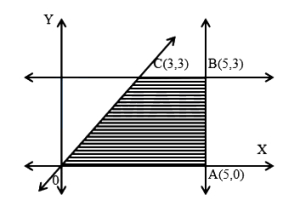
The shaded part of the given figure indicates the feasible region. Then the constraints are
A
$x, y \geq 0 ; x-y \geq 0 ; x \leq 5 ; y \leq 3$
B
$x, y \geq 0 ; x-y \geq 0 ; x \leq 5 ; y \geq 3$
C
$x, y \geq 0 ; x+y \geq 0 ; x \geq 5 ; y \leq 3$
D
$x, y \geq 0 ; x-y \geq 0 ; x \geq 5 ; y \leq 3$
Solution
(A) $1$. The shaded region is bounded by the lines $x=0$ ($Y$-axis),$y=0$ ($X$-axis),$x=5$,$y=3$,and the line passing through $(0,0)$ and $(3,3)$.
$2$. The line passing through $(0,0)$ and $(3,3)$ has the equation $y=x$,which can be written as $x-y=0$. Since the shaded region lies below this line,the constraint is $x-y \geq 0$.
$3$. The vertical line $x=5$ bounds the region on the right,so $x \leq 5$.
$4$. The horizontal line $y=3$ bounds the region on the top,so $y \leq 3$.
$5$. Since the region is in the first quadrant,$x \geq 0$ and $y \geq 0$.
$6$. Combining these,the constraints are $x, y \geq 0, x-y \geq 0, x \leq 5, y \leq 3$.
$2$. The line passing through $(0,0)$ and $(3,3)$ has the equation $y=x$,which can be written as $x-y=0$. Since the shaded region lies below this line,the constraint is $x-y \geq 0$.
$3$. The vertical line $x=5$ bounds the region on the right,so $x \leq 5$.
$4$. The horizontal line $y=3$ bounds the region on the top,so $y \leq 3$.
$5$. Since the region is in the first quadrant,$x \geq 0$ and $y \geq 0$.
$6$. Combining these,the constraints are $x, y \geq 0, x-y \geq 0, x \leq 5, y \leq 3$.
0 likesView Solution
33
MathematicsEasyMCQMHT CET · 2016
If $A=\begin{bmatrix} 1 & 1 & 0 \\ 2 & 1 & 5 \\ 1 & 2 & 1 \end{bmatrix}$,then $a_{11} A_{21} + a_{12} A_{22} + a_{13} A_{23} = \dots$
A
$1$
B
$0$
C
$-1$
D
$2$
Solution
(B) The sum of the product of elements of any row (or column) with their corresponding cofactors is equal to the determinant of the matrix,but the sum of the product of elements of any row (or column) with the cofactors of any other row (or column) is always $0$.
Here,we are calculating $a_{11} A_{21} + a_{12} A_{22} + a_{13} A_{23}$,which is the sum of the products of the elements of the first row with the cofactors of the second row.
By the property of determinants,this sum must be $0$.
Verification:
$a_{11} = 1, a_{12} = 1, a_{13} = 0$
$A_{21} = (-1)^{2+1} \begin{vmatrix} 1 & 0 \\ 2 & 1 \end{vmatrix} = -1(1-0) = -1$
$A_{22} = (-1)^{2+2} \begin{vmatrix} 1 & 0 \\ 1 & 1 \end{vmatrix} = 1(1-0) = 1$
$A_{23} = (-1)^{2+3} \begin{vmatrix} 1 & 1 \\ 1 & 2 \end{vmatrix} = -1(2-1) = -1$
$a_{11} A_{21} + a_{12} A_{22} + a_{13} A_{23} = 1(-1) + 1(1) + 0(-1) = -1 + 1 + 0 = 0$.
Here,we are calculating $a_{11} A_{21} + a_{12} A_{22} + a_{13} A_{23}$,which is the sum of the products of the elements of the first row with the cofactors of the second row.
By the property of determinants,this sum must be $0$.
Verification:
$a_{11} = 1, a_{12} = 1, a_{13} = 0$
$A_{21} = (-1)^{2+1} \begin{vmatrix} 1 & 0 \\ 2 & 1 \end{vmatrix} = -1(1-0) = -1$
$A_{22} = (-1)^{2+2} \begin{vmatrix} 1 & 0 \\ 1 & 1 \end{vmatrix} = 1(1-0) = 1$
$A_{23} = (-1)^{2+3} \begin{vmatrix} 1 & 1 \\ 1 & 2 \end{vmatrix} = -1(2-1) = -1$
$a_{11} A_{21} + a_{12} A_{22} + a_{13} A_{23} = 1(-1) + 1(1) + 0(-1) = -1 + 1 + 0 = 0$.
0 likesView Solution
34
MathematicsEasyMCQMHT CET · 2016
If $A = \begin{bmatrix} 2 & 3 \\ -3 & 2 \end{bmatrix}$ and $B = \begin{bmatrix} 0 & -1 \\ 1 & 0 \end{bmatrix}$,then $(B^{-1} A^{-1})^{-1} = $
A
$\begin{bmatrix} 3 & -2 \\ 2 & 3 \end{bmatrix}$
B
$\begin{bmatrix} 2 & 2 \\ -2 & 3 \end{bmatrix}$
C
$\begin{bmatrix} 2 & -3 \\ 2 & 2 \end{bmatrix}$
D
$\begin{bmatrix} 1 & -1 \\ -2 & 3 \end{bmatrix}$
Solution
(A) We use the property of matrix inversion: $(XY)^{-1} = Y^{-1} X^{-1}$.
Applying this to the given expression:
$(B^{-1} A^{-1})^{-1} = (A^{-1})^{-1} (B^{-1})^{-1}$
Since $(M^{-1})^{-1} = M$,we have:
$(B^{-1} A^{-1})^{-1} = A B$
Now,calculate the product $AB$:
$AB = \begin{bmatrix} 2 & 3 \\ -3 & 2 \end{bmatrix} \begin{bmatrix} 0 & -1 \\ 1 & 0 \end{bmatrix}$
$AB = \begin{bmatrix} (2)(0) + (3)(1) & (2)(-1) + (3)(0) \\ (-3)(0) + (2)(1) & (-3)(-1) + (2)(0) \end{bmatrix}$
$AB = \begin{bmatrix} 0 + 3 & -2 + 0 \\ 0 + 2 & 3 + 0 \end{bmatrix} = \begin{bmatrix} 3 & -2 \\ 2 & 3 \end{bmatrix}$
Applying this to the given expression:
$(B^{-1} A^{-1})^{-1} = (A^{-1})^{-1} (B^{-1})^{-1}$
Since $(M^{-1})^{-1} = M$,we have:
$(B^{-1} A^{-1})^{-1} = A B$
Now,calculate the product $AB$:
$AB = \begin{bmatrix} 2 & 3 \\ -3 & 2 \end{bmatrix} \begin{bmatrix} 0 & -1 \\ 1 & 0 \end{bmatrix}$
$AB = \begin{bmatrix} (2)(0) + (3)(1) & (2)(-1) + (3)(0) \\ (-3)(0) + (2)(1) & (-3)(-1) + (2)(0) \end{bmatrix}$
$AB = \begin{bmatrix} 0 + 3 & -2 + 0 \\ 0 + 2 & 3 + 0 \end{bmatrix} = \begin{bmatrix} 3 & -2 \\ 2 & 3 \end{bmatrix}$
0 likesView Solution
35
MathematicsEasyMCQMHT CET · 2016
If matrix $A = \begin{bmatrix} 1 & 2 \\ 4 & 3 \end{bmatrix}$ such that $AX = I$,then $X = \dots$
A
$\frac{1}{5} \begin{bmatrix} 1 & 3 \\ 2 & -1 \end{bmatrix}$
B
$\frac{1}{5} \begin{bmatrix} 4 & 2 \\ 4 & -1 \end{bmatrix}$
C
$\frac{1}{5} \begin{bmatrix} -3 & 2 \\ 4 & -1 \end{bmatrix}$
D
$\frac{1}{5} \begin{bmatrix} -1 & 2 \\ -1 & 4 \end{bmatrix}$
Solution
(C) Given $AX = I$,then $X = A^{-1}$.
First,calculate the determinant of $A$:
$|A| = (1 \times 3) - (2 \times 4) = 3 - 8 = -5$.
Next,find the adjoint of $A$ by swapping the diagonal elements and changing the signs of the off-diagonal elements:
$\text{adj } A = \begin{bmatrix} 3 & -2 \\ -4 & 1 \end{bmatrix}$.
Now,calculate $X = A^{-1} = \frac{1}{|A|} \text{adj } A$:
$X = \frac{1}{-5} \begin{bmatrix} 3 & -2 \\ -4 & 1 \end{bmatrix} = \frac{1}{5} \begin{bmatrix} -3 & 2 \\ 4 & -1 \end{bmatrix}$.
First,calculate the determinant of $A$:
$|A| = (1 \times 3) - (2 \times 4) = 3 - 8 = -5$.
Next,find the adjoint of $A$ by swapping the diagonal elements and changing the signs of the off-diagonal elements:
$\text{adj } A = \begin{bmatrix} 3 & -2 \\ -4 & 1 \end{bmatrix}$.
Now,calculate $X = A^{-1} = \frac{1}{|A|} \text{adj } A$:
$X = \frac{1}{-5} \begin{bmatrix} 3 & -2 \\ -4 & 1 \end{bmatrix} = \frac{1}{5} \begin{bmatrix} -3 & 2 \\ 4 & -1 \end{bmatrix}$.
0 likesView Solution
36
MathematicsMediumMCQMHT CET · 2016
The probability of guessing correctly at least $7$ out of $10$ answers in a "True" or "False" test is = $ . . . . . . $
A
$\frac{11}{64}$
B
$\frac{11}{32}$
C
$\frac{11}{16}$
D
$\frac{27}{32}$
Solution
(A) This is a binomial distribution problem where $n = 10$ and the probability of success $p = \frac{1}{2}$ (since it is a True/False test). The probability of failure is $q = 1 - p = \frac{1}{2}$.
We need to find $P(X \geq 7) = P(X=7) + P(X=8) + P(X=9) + P(X=10)$.
The formula for binomial probability is $P(X=k) = {}^{n}C_{k} p^{k} q^{n-k}$.
$P(X=7) = {}^{10}C_{7} (\frac{1}{2})^{7} (\frac{1}{2})^{3} = \frac{120}{1024}$.
$P(X=8) = {}^{10}C_{8} (\frac{1}{2})^{8} (\frac{1}{2})^{2} = \frac{45}{1024}$.
$P(X=9) = {}^{10}C_{9} (\frac{1}{2})^{9} (\frac{1}{2})^{1} = \frac{10}{1024}$.
$P(X=10) = {}^{10}C_{10} (\frac{1}{2})^{10} (\frac{1}{2})^{0} = \frac{1}{1024}$.
Summing these probabilities: $P(X \geq 7) = \frac{120 + 45 + 10 + 1}{1024} = \frac{176}{1024} = \frac{11}{64}$.
We need to find $P(X \geq 7) = P(X=7) + P(X=8) + P(X=9) + P(X=10)$.
The formula for binomial probability is $P(X=k) = {}^{n}C_{k} p^{k} q^{n-k}$.
$P(X=7) = {}^{10}C_{7} (\frac{1}{2})^{7} (\frac{1}{2})^{3} = \frac{120}{1024}$.
$P(X=8) = {}^{10}C_{8} (\frac{1}{2})^{8} (\frac{1}{2})^{2} = \frac{45}{1024}$.
$P(X=9) = {}^{10}C_{9} (\frac{1}{2})^{9} (\frac{1}{2})^{1} = \frac{10}{1024}$.
$P(X=10) = {}^{10}C_{10} (\frac{1}{2})^{10} (\frac{1}{2})^{0} = \frac{1}{1024}$.
Summing these probabilities: $P(X \geq 7) = \frac{120 + 45 + 10 + 1}{1024} = \frac{176}{1024} = \frac{11}{64}$.
0 likesView Solution
37
MathematicsMediumMCQMHT CET · 2016
If a random variable $X \sim B\left(n=5, p=\frac{1}{3}\right)$,then $P(2 < X < 4) = $
A
$\frac{80}{243}$
B
$\frac{40}{243}$
C
$\frac{40}{343}$
D
$\frac{80}{343}$
Solution
(B) Given that $X$ follows a binomial distribution $B(n, p)$ with $n=5$ and $p=\frac{1}{3}$.
Since $q = 1 - p$,we have $q = 1 - \frac{1}{3} = \frac{2}{3}$.
The probability mass function is given by $P(X=k) = { }^n C_k p^k q^{n-k}$.
We need to find $P(2 < X < 4)$,which is equivalent to $P(X=3)$.
Substituting the values into the formula:
$P(X=3) = { }^5 C_3 \left(\frac{1}{3}\right)^3 \left(\frac{2}{3}\right)^{5-3}$
$P(X=3) = \frac{5 \times 4}{2 \times 1} \times \left(\frac{1}{27}\right) \times \left(\frac{2}{3}\right)^2$
$P(X=3) = 10 \times \frac{1}{27} \times \frac{4}{9}$
$P(X=3) = \frac{40}{243}$
Since $q = 1 - p$,we have $q = 1 - \frac{1}{3} = \frac{2}{3}$.
The probability mass function is given by $P(X=k) = { }^n C_k p^k q^{n-k}$.
We need to find $P(2 < X < 4)$,which is equivalent to $P(X=3)$.
Substituting the values into the formula:
$P(X=3) = { }^5 C_3 \left(\frac{1}{3}\right)^3 \left(\frac{2}{3}\right)^{5-3}$
$P(X=3) = \frac{5 \times 4}{2 \times 1} \times \left(\frac{1}{27}\right) \times \left(\frac{2}{3}\right)^2$
$P(X=3) = 10 \times \frac{1}{27} \times \frac{4}{9}$
$P(X=3) = \frac{40}{243}$
0 likesView Solution
38
MathematicsDifficultMCQMHT CET · 2016
If the probability distribution of a random variable $X$ is given by the following table,then $F(0) =$ . . . . . .
| $x_i$ | $-2$ | $-1$ | $0$ | $1$ | $2$ |
| $P(X = x_i)$ | $0.2$ | $0.5$ | $0.15$ | $0.25$ | $0.1$ |
A
$P(X < 0)$
B
$P(X > 0)$
C
$1 - P(X > 0)$
D
$1 - P(X < 0)$
Solution
(C) The cumulative distribution function $F(x)$ is defined as $F(x) = P(X \leq x)$.
For $x = 0$,we have $F(0) = P(X \leq 0)$.
From the given probability distribution table:
$P(X \leq 0) = P(X = -2) + P(X = -1) + P(X = 0)$
$P(X \leq 0) = 0.2 + 0.5 + 0.15 = 0.85$.
Alternatively,we know that the sum of all probabilities is $1$,so $P(X \leq 0) + P(X > 0) = 1$.
Therefore,$F(0) = P(X \leq 0) = 1 - P(X > 0)$.
Thus,the correct option is $C$.
For $x = 0$,we have $F(0) = P(X \leq 0)$.
From the given probability distribution table:
$P(X \leq 0) = P(X = -2) + P(X = -1) + P(X = 0)$
$P(X \leq 0) = 0.2 + 0.5 + 0.15 = 0.85$.
Alternatively,we know that the sum of all probabilities is $1$,so $P(X \leq 0) + P(X > 0) = 1$.
Therefore,$F(0) = P(X \leq 0) = 1 - P(X > 0)$.
Thus,the correct option is $C$.
0 likesView Solution
39
MathematicsDifficultMCQMHT CET · 2016
If random variable $X$ is the waiting time in minutes for a bus and the probability density function of $X$ is given by $f(x) = \begin{cases} \frac{1}{5}, & 0 \leq x \leq 5 \\ 0, & \text{otherwise} \end{cases}$,then the probability of the waiting time being not more than $4$ minutes is = . . . . . . .
A
$0.3$
B
$0.8$
C
$0.2$
D
$0.5$
Solution
(B) The probability density function is given by $f(x) = \frac{1}{5}$ for $0 \leq x \leq 5$ and $0$ otherwise.
We need to find the probability that the waiting time $X$ is not more than $4$ minutes,which is $P(X \leq 4)$.
This is calculated by integrating the probability density function from the lower bound to $4$:
$P(X \leq 4) = \int_{0}^{4} f(x) \, dx$
$P(X \leq 4) = \int_{0}^{4} \frac{1}{5} \, dx$
$P(X \leq 4) = \left[ \frac{x}{5} \right]_{0}^{4}$
$P(X \leq 4) = \frac{4}{5} - \frac{0}{5} = \frac{4}{5} = 0.8$
Therefore,the probability is $0.8$.
We need to find the probability that the waiting time $X$ is not more than $4$ minutes,which is $P(X \leq 4)$.
This is calculated by integrating the probability density function from the lower bound to $4$:
$P(X \leq 4) = \int_{0}^{4} f(x) \, dx$
$P(X \leq 4) = \int_{0}^{4} \frac{1}{5} \, dx$
$P(X \leq 4) = \left[ \frac{x}{5} \right]_{0}^{4}$
$P(X \leq 4) = \frac{4}{5} - \frac{0}{5} = \frac{4}{5} = 0.8$
Therefore,the probability is $0.8$.
0 likesView Solution
40
MathematicsMediumMCQMHT CET · 2016
Let $X \sim B(n, p)$. If $E(X)=5$ and $\operatorname{Var}(X)=2.5$,then find $P(X < 1)$.
A
$\left(\frac{1}{2}\right)^{11}$
B
$\left(\frac{1}{2}\right)^{10}$
C
$\left(\frac{1}{2}\right)^{6}$
D
$\left(\frac{1}{2}\right)^{9}$
Solution
(B) Given that $X$ follows a binomial distribution $B(n, p)$.
For a binomial distribution,the mean $E(X) = np = 5$ and the variance $\operatorname{Var}(X) = npq = 2.5$.
Dividing the variance by the mean,we get $q = \frac{npq}{np} = \frac{2.5}{5} = 0.5 = \frac{1}{2}$.
Since $p + q = 1$,we have $p = 1 - 0.5 = 0.5 = \frac{1}{2}$.
Substituting $p = \frac{1}{2}$ into $np = 5$,we get $n \times \frac{1}{2} = 5$,which implies $n = 10$.
We need to find $P(X < 1)$,which is equivalent to $P(X = 0)$.
The probability mass function is given by $P(X = k) = {}^{n}C_{k} p^{k} q^{n-k}$.
For $k = 0$,$P(X = 0) = {}^{10}C_{0} \left(\frac{1}{2}\right)^{0} \left(\frac{1}{2}\right)^{10-0} = 1 \times 1 \times \left(\frac{1}{2}\right)^{10} = \left(\frac{1}{2}\right)^{10}$.
For a binomial distribution,the mean $E(X) = np = 5$ and the variance $\operatorname{Var}(X) = npq = 2.5$.
Dividing the variance by the mean,we get $q = \frac{npq}{np} = \frac{2.5}{5} = 0.5 = \frac{1}{2}$.
Since $p + q = 1$,we have $p = 1 - 0.5 = 0.5 = \frac{1}{2}$.
Substituting $p = \frac{1}{2}$ into $np = 5$,we get $n \times \frac{1}{2} = 5$,which implies $n = 10$.
We need to find $P(X < 1)$,which is equivalent to $P(X = 0)$.
The probability mass function is given by $P(X = k) = {}^{n}C_{k} p^{k} q^{n-k}$.
For $k = 0$,$P(X = 0) = {}^{10}C_{0} \left(\frac{1}{2}\right)^{0} \left(\frac{1}{2}\right)^{10-0} = 1 \times 1 \times \left(\frac{1}{2}\right)^{10} = \left(\frac{1}{2}\right)^{10}$.
0 likesView Solution
41
MathematicsEasyMCQMHT CET · 2016
Direction ratios of the line which is perpendicular to the lines with direction ratios $-1, 2, 2$ and $0, 2, 1$ are
A
$2, 1, -2$
B
$2, -1, 2$
C
$-2, 1, 2$
D
$1, 1, 2$
Solution
(B) Let the direction ratios of the required line be $a, b, c$.
Since the line is perpendicular to the lines with direction ratios $(-1, 2, 2)$ and $(0, 2, 1)$,we have the following equations:
$-a + 2b + 2c = 0$ $(i)$
$0a + 2b + c = 0$ (ii)
From (ii),we get $c = -2b$.
Substituting $c = -2b$ into $(i)$:
$-a + 2b + 2(-2b) = 0$
$-a + 2b - 4b = 0$
$-a - 2b = 0 \implies a = -2b$.
Now,we have $a = -2b$ and $c = -2b$.
If we let $b = 1$,then $a = -2$ and $c = -2$.
The direction ratios are $(-2, 1, -2)$,which is proportional to $(2, -1, 2)$.
Alternatively,using the cross product of the two direction vectors $\vec{n_1} = -\hat{i} + 2\hat{j} + 2\hat{k}$ and $\vec{n_2} = 0\hat{i} + 2\hat{j} + 1\hat{k}$:
$\vec{n_1} \times \vec{n_2} = \begin{vmatrix} \hat{i} & \hat{j} & \hat{k} \\ -1 & 2 & 2 \\ 0 & 2 & 1 \end{vmatrix} = \hat{i}(2 - 4) - \hat{j}(-1 - 0) + \hat{k}(-2 - 0) = -2\hat{i} + 1\hat{j} - 2\hat{k}$.
The direction ratios are proportional to $(-2, 1, -2)$,which is equivalent to $(2, -1, 2)$.
Since the line is perpendicular to the lines with direction ratios $(-1, 2, 2)$ and $(0, 2, 1)$,we have the following equations:
$-a + 2b + 2c = 0$ $(i)$
$0a + 2b + c = 0$ (ii)
From (ii),we get $c = -2b$.
Substituting $c = -2b$ into $(i)$:
$-a + 2b + 2(-2b) = 0$
$-a + 2b - 4b = 0$
$-a - 2b = 0 \implies a = -2b$.
Now,we have $a = -2b$ and $c = -2b$.
If we let $b = 1$,then $a = -2$ and $c = -2$.
The direction ratios are $(-2, 1, -2)$,which is proportional to $(2, -1, 2)$.
Alternatively,using the cross product of the two direction vectors $\vec{n_1} = -\hat{i} + 2\hat{j} + 2\hat{k}$ and $\vec{n_2} = 0\hat{i} + 2\hat{j} + 1\hat{k}$:
$\vec{n_1} \times \vec{n_2} = \begin{vmatrix} \hat{i} & \hat{j} & \hat{k} \\ -1 & 2 & 2 \\ 0 & 2 & 1 \end{vmatrix} = \hat{i}(2 - 4) - \hat{j}(-1 - 0) + \hat{k}(-2 - 0) = -2\hat{i} + 1\hat{j} - 2\hat{k}$.
The direction ratios are proportional to $(-2, 1, -2)$,which is equivalent to $(2, -1, 2)$.
0 likesView Solution
42
MathematicsEasyMCQMHT CET · 2016
Direction cosines of the line $\frac{x+2}{2} = \frac{2y-5}{3}, z = -1$ are $.......$
A
$\frac{4}{5}, \frac{3}{5}, 0$
B
$\frac{3}{5}, \frac{4}{5}, \frac{1}{5}$
C
$-\frac{3}{5}, \frac{4}{5}, 0$
D
$\frac{4}{5}, -\frac{2}{5}, \frac{1}{5}$
Solution
(A) The given equation of the line is $\frac{x+2}{2} = \frac{2y-5}{3}, z = -1$.
First,rewrite the line in standard symmetric form:
$\frac{x+2}{2} = \frac{y - 5/2}{3/2} = \frac{z+1}{0}$.
The direction ratios of the line are $(a, b, c) = (2, 3/2, 0)$.
To simplify,multiply by $2$: $(4, 3, 0)$.
The magnitude of the direction vector is $\sqrt{4^2 + 3^2 + 0^2} = \sqrt{16 + 9} = \sqrt{25} = 5$.
The direction cosines $(l, m, n)$ are given by $\left( \frac{a}{\sqrt{a^2+b^2+c^2}}, \frac{b}{\sqrt{a^2+b^2+c^2}}, \frac{c}{\sqrt{a^2+b^2+c^2}} \right)$.
Thus,the direction cosines are $\left( \frac{4}{5}, \frac{3}{5}, 0 \right)$.
First,rewrite the line in standard symmetric form:
$\frac{x+2}{2} = \frac{y - 5/2}{3/2} = \frac{z+1}{0}$.
The direction ratios of the line are $(a, b, c) = (2, 3/2, 0)$.
To simplify,multiply by $2$: $(4, 3, 0)$.
The magnitude of the direction vector is $\sqrt{4^2 + 3^2 + 0^2} = \sqrt{16 + 9} = \sqrt{25} = 5$.
The direction cosines $(l, m, n)$ are given by $\left( \frac{a}{\sqrt{a^2+b^2+c^2}}, \frac{b}{\sqrt{a^2+b^2+c^2}}, \frac{c}{\sqrt{a^2+b^2+c^2}} \right)$.
Thus,the direction cosines are $\left( \frac{4}{5}, \frac{3}{5}, 0 \right)$.
0 likesView Solution
43
MathematicsMediumMCQMHT CET · 2016
If $A$ and $B$ are the feet of the perpendiculars drawn from point $Q(a, b, c)$ to the planes $yz$ and $zx$ respectively,then the equation of the plane passing through the points $A, B$ and the origin $O(0, 0, 0)$ is $.........$
A
$\frac{x}{a}+\frac{y}{b}-\frac{z}{c}=0$
B
$\frac{x}{a}-\frac{y}{b}+\frac{z}{c}=0$
C
$\frac{x}{a}-\frac{y}{b}-\frac{z}{c}=0$
D
$\frac{x}{a}+\frac{y}{b}+\frac{z}{c}=0$
Solution
(A) The coordinates of point $Q$ are $(a, b, c)$.
The foot of the perpendicular from $Q(a, b, c)$ to the $yz$-plane $(x=0)$ is $A(0, b, c)$.
The foot of the perpendicular from $Q(a, b, c)$ to the $zx$-plane $(y=0)$ is $B(a, 0, c)$.
The origin is $O(0, 0, 0)$.
The equation of a plane passing through three points $(x_1, y_1, z_1)$,$(x_2, y_2, z_2)$,and $(x_3, y_3, z_3)$ is given by the determinant:
$\left|\begin{array}{ccc} x-x_1 & y-y_1 & z-z_1 \\ x_2-x_1 & y_2-y_1 & z_2-z_1 \\ x_3-x_1 & y_3-y_1 & z_3-z_1 \end{array}\right|=0$
Substituting $O(0, 0, 0)$,$A(0, b, c)$,and $B(a, 0, c)$:
$\left|\begin{array}{ccc} x & y & z \\ 0 & b & c \\ a & 0 & c \end{array}\right|=0$
Expanding the determinant along the first row:
$x(bc - 0) - y(0 - ac) + z(0 - ab) = 0$
$bcx + acy - abz = 0$
Dividing the entire equation by $abc$ $(abc \neq 0)$:
$\frac{bcx}{abc} + \frac{acy}{abc} - \frac{abz}{abc} = 0$
$\frac{x}{a} + \frac{y}{b} - \frac{z}{c} = 0$
The foot of the perpendicular from $Q(a, b, c)$ to the $yz$-plane $(x=0)$ is $A(0, b, c)$.
The foot of the perpendicular from $Q(a, b, c)$ to the $zx$-plane $(y=0)$ is $B(a, 0, c)$.
The origin is $O(0, 0, 0)$.
The equation of a plane passing through three points $(x_1, y_1, z_1)$,$(x_2, y_2, z_2)$,and $(x_3, y_3, z_3)$ is given by the determinant:
$\left|\begin{array}{ccc} x-x_1 & y-y_1 & z-z_1 \\ x_2-x_1 & y_2-y_1 & z_2-z_1 \\ x_3-x_1 & y_3-y_1 & z_3-z_1 \end{array}\right|=0$
Substituting $O(0, 0, 0)$,$A(0, b, c)$,and $B(a, 0, c)$:
$\left|\begin{array}{ccc} x & y & z \\ 0 & b & c \\ a & 0 & c \end{array}\right|=0$
Expanding the determinant along the first row:
$x(bc - 0) - y(0 - ac) + z(0 - ab) = 0$
$bcx + acy - abz = 0$
Dividing the entire equation by $abc$ $(abc \neq 0)$:
$\frac{bcx}{abc} + \frac{acy}{abc} - \frac{abz}{abc} = 0$
$\frac{x}{a} + \frac{y}{b} - \frac{z}{c} = 0$
0 likesView Solution
44
MathematicsEasyMCQMHT CET · 2016
The acute angle between the line $\bar{r}=(\hat{i}+2\hat{j}+\hat{k})+\lambda(\hat{i}+\hat{j}+\hat{k})$ and the plane $\bar{r} \cdot(2\hat{i}-\hat{j}+\hat{k})=5$ is
A
$\sin^{-1}\left(\frac{\sqrt{2}}{3}\right)$
B
$\sin^{-1}\left(\frac{2}{3}\right)$
C
$\sin^{-1}\left(\sqrt{\frac{2}{3}}\right)$
D
$\sin^{-1}\left(\frac{2}{\sqrt{3}}\right)$
Solution
(A) The angle $\theta$ between a line with direction vector $\bar{b}$ and a plane with normal vector $\bar{n}$ is given by $\sin \theta = \frac{|\bar{b} \cdot \bar{n}|}{|\bar{b}| |\bar{n}|}$.
Given the line $\bar{r}=(\hat{i}+2\hat{j}+\hat{k})+\lambda(\hat{i}+\hat{j}+\hat{k})$,the direction vector is $\bar{b} = \hat{i}+\hat{j}+\hat{k}$.
Given the plane $\bar{r} \cdot(2\hat{i}-\hat{j}+\hat{k})=5$,the normal vector is $\bar{n} = 2\hat{i}-\hat{j}+\hat{k}$.
Calculate the magnitudes: $|\bar{b}| = \sqrt{1^2+1^2+1^2} = \sqrt{3}$ and $|\bar{n}| = \sqrt{2^2+(-1)^2+1^2} = \sqrt{4+1+1} = \sqrt{6}$.
Calculate the dot product: $\bar{b} \cdot \bar{n} = (1)(2) + (1)(-1) + (1)(1) = 2 - 1 + 1 = 2$.
Substitute into the formula: $\sin \theta = \frac{|2|}{\sqrt{3} \cdot \sqrt{6}} = \frac{2}{\sqrt{18}} = \frac{2}{3\sqrt{2}} = \frac{\sqrt{2}}{3}$.
Therefore,$\theta = \sin^{-1}\left(\frac{\sqrt{2}}{3}\right)$.
Given the line $\bar{r}=(\hat{i}+2\hat{j}+\hat{k})+\lambda(\hat{i}+\hat{j}+\hat{k})$,the direction vector is $\bar{b} = \hat{i}+\hat{j}+\hat{k}$.
Given the plane $\bar{r} \cdot(2\hat{i}-\hat{j}+\hat{k})=5$,the normal vector is $\bar{n} = 2\hat{i}-\hat{j}+\hat{k}$.
Calculate the magnitudes: $|\bar{b}| = \sqrt{1^2+1^2+1^2} = \sqrt{3}$ and $|\bar{n}| = \sqrt{2^2+(-1)^2+1^2} = \sqrt{4+1+1} = \sqrt{6}$.
Calculate the dot product: $\bar{b} \cdot \bar{n} = (1)(2) + (1)(-1) + (1)(1) = 2 - 1 + 1 = 2$.
Substitute into the formula: $\sin \theta = \frac{|2|}{\sqrt{3} \cdot \sqrt{6}} = \frac{2}{\sqrt{18}} = \frac{2}{3\sqrt{2}} = \frac{\sqrt{2}}{3}$.
Therefore,$\theta = \sin^{-1}\left(\frac{\sqrt{2}}{3}\right)$.
0 likesView Solution
45
MathematicsEasyMCQMHT CET · 2016
$\frac{\tan ^{-1}(\sqrt{3})-\sec ^{-1}(-2)}{\operatorname{cosec}^{-1}(-\sqrt{2})+\cos ^{-1}\left(-\frac{1}{2}\right)}=$
A
$\frac{4}{5}$
B
$-\frac{4}{5}$
C
$\frac{3}{5}$
D
$0$
Solution
(B) We know the principal values of the inverse trigonometric functions:
$\tan ^{-1}(\sqrt{3}) = \frac{\pi}{3}$
$\sec ^{-1}(-2) = \pi - \sec ^{-1}(2) = \pi - \frac{\pi}{3} = \frac{2\pi}{3}$
$\operatorname{cosec}^{-1}(-\sqrt{2}) = -\operatorname{cosec}^{-1}(\sqrt{2}) = -\frac{\pi}{4}$
$\cos ^{-1}\left(-\frac{1}{2}\right) = \pi - \cos ^{-1}\left(\frac{1}{2}\right) = \pi - \frac{\pi}{3} = \frac{2\pi}{3}$
Substituting these values into the expression:
$\frac{\frac{\pi}{3} - \frac{2\pi}{3}}{-\frac{\pi}{4} + \frac{2\pi}{3}} = \frac{-\frac{\pi}{3}}{\frac{-3\pi + 8\pi}{12}} = \frac{-\frac{\pi}{3}}{\frac{5\pi}{12}} = -\frac{\pi}{3} \times \frac{12}{5\pi} = -\frac{4}{5}$
$\tan ^{-1}(\sqrt{3}) = \frac{\pi}{3}$
$\sec ^{-1}(-2) = \pi - \sec ^{-1}(2) = \pi - \frac{\pi}{3} = \frac{2\pi}{3}$
$\operatorname{cosec}^{-1}(-\sqrt{2}) = -\operatorname{cosec}^{-1}(\sqrt{2}) = -\frac{\pi}{4}$
$\cos ^{-1}\left(-\frac{1}{2}\right) = \pi - \cos ^{-1}\left(\frac{1}{2}\right) = \pi - \frac{\pi}{3} = \frac{2\pi}{3}$
Substituting these values into the expression:
$\frac{\frac{\pi}{3} - \frac{2\pi}{3}}{-\frac{\pi}{4} + \frac{2\pi}{3}} = \frac{-\frac{\pi}{3}}{\frac{-3\pi + 8\pi}{12}} = \frac{-\frac{\pi}{3}}{\frac{5\pi}{12}} = -\frac{\pi}{3} \times \frac{12}{5\pi} = -\frac{4}{5}$
0 likesView Solution
46
MathematicsMediumMCQMHT CET · 2016
If $G(\vec{g}), H(\vec{h})$ and $P(\vec{p})$ are the centroid,orthocenter,and circumcenter of a triangle respectively,and $x \vec{p} + y \vec{h} + z \vec{g} = 0$,then $(x, y, z) = $
A
$(1, 1, -2)$
B
$(2, 1, -3)$
C
$(1, 3, -4)$
D
$(2, 3, -5)$
Solution
(B) We know that in any triangle,the centroid $(G)$,orthocenter $(H)$,and circumcenter $(P)$ are collinear,forming the Euler line.
$G$ divides the line segment $PH$ internally in the ratio $1:2$.
Using the section formula for the position vector $\vec{g}$ of the centroid $G$:
$\vec{g} = \frac{1 \cdot \vec{h} + 2 \cdot \vec{p}}{1 + 2}$
$\vec{g} = \frac{\vec{h} + 2\vec{p}}{3}$
Multiplying both sides by $3$:
$3\vec{g} = \vec{h} + 2\vec{p}$
Rearranging the terms to the form $x\vec{p} + y\vec{h} + z\vec{g} = 0$:
$2\vec{p} + 1\vec{h} - 3\vec{g} = 0$
Comparing this with $x\vec{p} + y\vec{h} + z\vec{g} = 0$,we get $x = 2$,$y = 1$,and $z = -3$.
Thus,$(x, y, z) = (2, 1, -3)$.
$G$ divides the line segment $PH$ internally in the ratio $1:2$.
Using the section formula for the position vector $\vec{g}$ of the centroid $G$:
$\vec{g} = \frac{1 \cdot \vec{h} + 2 \cdot \vec{p}}{1 + 2}$
$\vec{g} = \frac{\vec{h} + 2\vec{p}}{3}$
Multiplying both sides by $3$:
$3\vec{g} = \vec{h} + 2\vec{p}$
Rearranging the terms to the form $x\vec{p} + y\vec{h} + z\vec{g} = 0$:
$2\vec{p} + 1\vec{h} - 3\vec{g} = 0$
Comparing this with $x\vec{p} + y\vec{h} + z\vec{g} = 0$,we get $x = 2$,$y = 1$,and $z = -3$.
Thus,$(x, y, z) = (2, 1, -3)$.
0 likesView Solution
47
MathematicsDifficultMCQMHT CET · 2016
If the line joining points $A$ and $B$ having position vectors $6 \vec{a}-4 \vec{b}+4 \vec{c}$ and $-4 \vec{c}$ respectively,and the line joining the points $C$ and $D$ having position vectors $-\vec{a}-2 \vec{b}-3 \vec{c}$ and $\vec{a}+2 \vec{b}-5 \vec{c}$ intersect,then their point of intersection is
A
$B$
B
$C$
C
$D$
D
$A$
Solution
(A) Let the point of intersection divide $AB$ in the ratio $\lambda : 1$ and $CD$ in the ratio $\mu : 1$.
The position vector of a point on $AB$ is $\vec{r} = \frac{\lambda(-4 \vec{c}) + 1(6 \vec{a}-4 \vec{b}+4 \vec{c})}{\lambda+1} = \frac{6 \vec{a}-4 \vec{b} + (4-4 \lambda) \vec{c}}{\lambda+1}$.
The position vector of a point on $CD$ is $\vec{r} = \frac{\mu(\vec{a}+2 \vec{b}-5 \vec{c}) + 1(-\vec{a}-2 \vec{b}-3 \vec{c})}{\mu+1} = \frac{(\mu-1) \vec{a} + (2 \mu-2) \vec{b} + (-5 \mu-3) \vec{c}}{\mu+1}$.
Equating the two expressions for $\vec{r}$:
$\frac{6 \vec{a}-4 \vec{b} + (4-4 \lambda) \vec{c}}{\lambda+1} = \frac{(\mu-1) \vec{a} + (2 \mu-2) \vec{b} + (-5 \mu-3) \vec{c}}{\mu+1}$.
Comparing coefficients of $\vec{a}$ and $\vec{b}$:
$\frac{6}{\lambda+1} = \frac{\mu-1}{\mu+1}$ and $\frac{-4}{\lambda+1} = \frac{2 \mu-2}{\mu+1}$.
Dividing the two equations: $\frac{6}{-4} = \frac{\mu-1}{2(\mu-1)} \Rightarrow -\frac{3}{2} = \frac{1}{2}$,which implies $\mu=1$.
Substituting $\mu=1$ into the first equation: $\frac{6}{\lambda+1} = 0$,which is impossible unless $\lambda \to \infty$.
However,checking the point $B$ (where $\lambda=0$): $\vec{r} = 6 \vec{a}-4 \vec{b}+4 \vec{c}$.
Checking the point $C$ (where $\mu=0$): $\vec{r} = -\vec{a}-2 \vec{b}-3 \vec{c}$.
Re-evaluating the intersection: The point $B$ corresponds to $\lambda=0$ on $AB$. If we set $\mu=1$ in the $CD$ line equation,we get $\vec{r} = \frac{0 \vec{a} + 0 \vec{b} - 8 \vec{c}}{2} = -4 \vec{c}$,which is exactly point $B$. Thus,the intersection is $B$.
The position vector of a point on $AB$ is $\vec{r} = \frac{\lambda(-4 \vec{c}) + 1(6 \vec{a}-4 \vec{b}+4 \vec{c})}{\lambda+1} = \frac{6 \vec{a}-4 \vec{b} + (4-4 \lambda) \vec{c}}{\lambda+1}$.
The position vector of a point on $CD$ is $\vec{r} = \frac{\mu(\vec{a}+2 \vec{b}-5 \vec{c}) + 1(-\vec{a}-2 \vec{b}-3 \vec{c})}{\mu+1} = \frac{(\mu-1) \vec{a} + (2 \mu-2) \vec{b} + (-5 \mu-3) \vec{c}}{\mu+1}$.
Equating the two expressions for $\vec{r}$:
$\frac{6 \vec{a}-4 \vec{b} + (4-4 \lambda) \vec{c}}{\lambda+1} = \frac{(\mu-1) \vec{a} + (2 \mu-2) \vec{b} + (-5 \mu-3) \vec{c}}{\mu+1}$.
Comparing coefficients of $\vec{a}$ and $\vec{b}$:
$\frac{6}{\lambda+1} = \frac{\mu-1}{\mu+1}$ and $\frac{-4}{\lambda+1} = \frac{2 \mu-2}{\mu+1}$.
Dividing the two equations: $\frac{6}{-4} = \frac{\mu-1}{2(\mu-1)} \Rightarrow -\frac{3}{2} = \frac{1}{2}$,which implies $\mu=1$.
Substituting $\mu=1$ into the first equation: $\frac{6}{\lambda+1} = 0$,which is impossible unless $\lambda \to \infty$.
However,checking the point $B$ (where $\lambda=0$): $\vec{r} = 6 \vec{a}-4 \vec{b}+4 \vec{c}$.
Checking the point $C$ (where $\mu=0$): $\vec{r} = -\vec{a}-2 \vec{b}-3 \vec{c}$.
Re-evaluating the intersection: The point $B$ corresponds to $\lambda=0$ on $AB$. If we set $\mu=1$ in the $CD$ line equation,we get $\vec{r} = \frac{0 \vec{a} + 0 \vec{b} - 8 \vec{c}}{2} = -4 \vec{c}$,which is exactly point $B$. Thus,the intersection is $B$.
0 likesView Solution
48
MathematicsMediumMCQMHT CET · 2016
$M$ and $N$ are the midpoints of the diagonals $AC$ and $BD$ respectively of quadrilateral $ABCD$,then $\overrightarrow{AB}+\overrightarrow{AD}+\overrightarrow{CB}+\overrightarrow{CD}=$
A
$2 \overrightarrow{MN}$
B
$2 \overrightarrow{NM}$
C
$4 \overrightarrow{MN}$
D
$4 \overrightarrow{NM}$
Solution
(C) Let the position vectors of vertices $A, B, C, D$ be $\vec{a}, \vec{b}, \vec{c}, \vec{d}$ respectively.
Since $M$ is the midpoint of diagonal $AC$,its position vector is $\vec{m} = \frac{\vec{a} + \vec{c}}{2}$.
Since $N$ is the midpoint of diagonal $BD$,its position vector is $\vec{n} = \frac{\vec{b} + \vec{d}}{2}$.
Now,consider the expression $\overrightarrow{AB} + \overrightarrow{AD} + \overrightarrow{CB} + \overrightarrow{CD}$:
$= (\vec{b} - \vec{a}) + (\vec{d} - \vec{a}) + (\vec{b} - \vec{c}) + (\vec{d} - \vec{c})$
$= 2\vec{b} + 2\vec{d} - 2\vec{a} - 2\vec{c}$
$= 2[(\vec{b} + \vec{d}) - (\vec{a} + \vec{c})]$
$= 4 \left[ \frac{\vec{b} + \vec{d}}{2} - \frac{\vec{a} + \vec{c}}{2} \right]$
$= 4(\vec{n} - \vec{m})$
$= 4 \overrightarrow{MN}$
Since $M$ is the midpoint of diagonal $AC$,its position vector is $\vec{m} = \frac{\vec{a} + \vec{c}}{2}$.
Since $N$ is the midpoint of diagonal $BD$,its position vector is $\vec{n} = \frac{\vec{b} + \vec{d}}{2}$.
Now,consider the expression $\overrightarrow{AB} + \overrightarrow{AD} + \overrightarrow{CB} + \overrightarrow{CD}$:
$= (\vec{b} - \vec{a}) + (\vec{d} - \vec{a}) + (\vec{b} - \vec{c}) + (\vec{d} - \vec{c})$
$= 2\vec{b} + 2\vec{d} - 2\vec{a} - 2\vec{c}$
$= 2[(\vec{b} + \vec{d}) - (\vec{a} + \vec{c})]$
$= 4 \left[ \frac{\vec{b} + \vec{d}}{2} - \frac{\vec{a} + \vec{c}}{2} \right]$
$= 4(\vec{n} - \vec{m})$
$= 4 \overrightarrow{MN}$
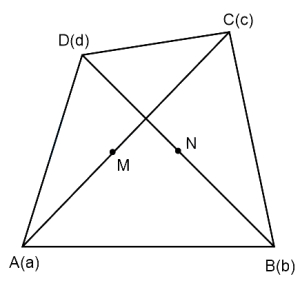
0 likesView Solution
49
MathematicsEasyMCQMHT CET · 2016
If $\vec{a} = \hat{i} + \hat{j} - 2 \hat{k}$,$\vec{b} = 2 \hat{i} - \hat{j} + \hat{k}$ and $\vec{c} = 3 \hat{i} - \hat{k}$. If $\vec{c} = m \vec{a} + n \vec{b}$ then $m + n = $
A
$0$
B
$1$
C
$2$
D
$-1$
Solution
(C) Given $\vec{c} = m \vec{a} + n \vec{b}$.
Substituting the vectors,we get:
$3 \hat{i} + 0 \hat{j} - \hat{k} = m(\hat{i} + \hat{j} - 2 \hat{k}) + n(2 \hat{i} - \hat{j} + \hat{k})$
$3 \hat{i} + 0 \hat{j} - \hat{k} = (m + 2n) \hat{i} + (m - n) \hat{j} + (-2m + n) \hat{k}$
Comparing the coefficients of $\hat{i}, \hat{j}, \text{ and } \hat{k}$ on both sides:
$m + 2n = 3 \quad (i)$
$m - n = 0 \quad (ii)$
$-2m + n = -1 \quad (iii)$
From equation $(ii)$,we have $m = n$.
Substituting $m = n$ into equation $(i)$:
$m + 2m = 3 \Rightarrow 3m = 3 \Rightarrow m = 1$.
Since $m = n$,we have $n = 1$.
Thus,$m + n = 1 + 1 = 2$.
Substituting the vectors,we get:
$3 \hat{i} + 0 \hat{j} - \hat{k} = m(\hat{i} + \hat{j} - 2 \hat{k}) + n(2 \hat{i} - \hat{j} + \hat{k})$
$3 \hat{i} + 0 \hat{j} - \hat{k} = (m + 2n) \hat{i} + (m - n) \hat{j} + (-2m + n) \hat{k}$
Comparing the coefficients of $\hat{i}, \hat{j}, \text{ and } \hat{k}$ on both sides:
$m + 2n = 3 \quad (i)$
$m - n = 0 \quad (ii)$
$-2m + n = -1 \quad (iii)$
From equation $(ii)$,we have $m = n$.
Substituting $m = n$ into equation $(i)$:
$m + 2m = 3 \Rightarrow 3m = 3 \Rightarrow m = 1$.
Since $m = n$,we have $n = 1$.
Thus,$m + n = 1 + 1 = 2$.
0 likesView Solution
50
MathematicsMediumMCQMHT CET · 2016
If $\vec{a}=\hat{i}+\hat{j}+\hat{k}$,$\vec{b}=2\hat{i}+\lambda\hat{j}+\hat{k}$,$\vec{c}=\hat{i}-\hat{j}+4\hat{k}$ and $\vec{a} \cdot (\vec{b} \times \vec{c}) = 10$,then $\lambda$ is equal to
A
$6$
B
$7$
C
$9$
D
$10$
Solution
(A) The scalar triple product $\vec{a} \cdot (\vec{b} \times \vec{c})$ is given by the determinant of the components of the vectors $\vec{a}$,$\vec{b}$,and $\vec{c}$.
$\vec{a} \cdot (\vec{b} \times \vec{c}) = \begin{vmatrix} 1 & 1 & 1 \\ 2 & \lambda & 1 \\ 1 & -1 & 4 \end{vmatrix} = 10$
Expanding the determinant along the first row:
$1(4\lambda - (-1)) - 1(8 - 1) + 1(-2 - \lambda) = 10$
$1(4\lambda + 1) - 1(7) + 1(-2 - \lambda) = 10$
$4\lambda + 1 - 7 - 2 - \lambda = 10$
$3\lambda - 8 = 10$
$3\lambda = 18$
$\lambda = 6$
$\vec{a} \cdot (\vec{b} \times \vec{c}) = \begin{vmatrix} 1 & 1 & 1 \\ 2 & \lambda & 1 \\ 1 & -1 & 4 \end{vmatrix} = 10$
Expanding the determinant along the first row:
$1(4\lambda - (-1)) - 1(8 - 1) + 1(-2 - \lambda) = 10$
$1(4\lambda + 1) - 1(7) + 1(-2 - \lambda) = 10$
$4\lambda + 1 - 7 - 2 - \lambda = 10$
$3\lambda - 8 = 10$
$3\lambda = 18$
$\lambda = 6$
0 likesView Solution
Vedclass Products
For Students
Vedclass Test Series
Mock tests in real MHT CET style covering Mathematics with performance analysis. 5-day free trial.
Start Free TrialFor Teachers
Exam Paper Generator
Generate Set A/B/C/D Mathematics papers from 7.5L+ questions in 2 minutes. 3 chapters free.
Try FreeFor Institutes
Online Exam Module
Run live MHT CET mock exams with unlimited students, 360° analytics & white-label branding.
See DemoFrequently Asked Questions
How many Mathematics questions are in MHT CET 2016?
There are 50 Mathematics questions from the MHT CET 2016 paper on Vedclass, each with a detailed step-by-step solution in English.
Are MHT CET 2016 Mathematics solutions available in English?
Yes. All solutions on this page are in English. You can also switch to English or Hindi using the language buttons above the questions.
Can I practice MHT CET 2016 Mathematics as a timed test?
Yes. Use the Vedclass Test Series to attempt a full MHT CET mock test covering Mathematics with time limits and instant score analysis.
Can teachers create Mathematics papers from MHT CET previous year questions?
Yes. The Vedclass Exam Paper Generator lets teachers mix MHT CET Mathematics questions and generate Set A/B/C/D papers in minutes.
For Teachers & Institutes
Build a Custom Mathematics Paper
Pick MHT CET 2016 Mathematics questions, set difficulty, and generate Set A/B/C/D in 2 minutes.