
ChemistryQ1–45 of 45 questions
Page 1 of 1 · English
1
ChemistryMediumMCQKVPY · 2010
The bond order in $O_2^{2-}$ is
A
$2$
B
$3$
C
$1.5$
D
$1$
Solution
(D)
Total number of electrons in $O_2^{2-} = 18$.
The molecular orbital electronic configuration of $O_2^{2-}$ is:
$\sigma 1s^2, \sigma^* 1s^2, \sigma 2s^2, \sigma^* 2s^2, \sigma 2p_z^2, \pi 2p_x^2 = \pi 2p_y^2, \pi^* 2p_x^2 = \pi^* 2p_y^2$.
Bond order is calculated using the formula: $BO = \frac{N_b - N_a}{2}$,where $N_b$ is the number of bonding electrons and $N_a$ is the number of antibonding electrons.
Here,$N_b = 10$ and $N_a = 8$.
Therefore,$BO = \frac{10 - 8}{2} = 1$.
Total number of electrons in $O_2^{2-} = 18$.
The molecular orbital electronic configuration of $O_2^{2-}$ is:
$\sigma 1s^2, \sigma^* 1s^2, \sigma 2s^2, \sigma^* 2s^2, \sigma 2p_z^2, \pi 2p_x^2 = \pi 2p_y^2, \pi^* 2p_x^2 = \pi^* 2p_y^2$.
Bond order is calculated using the formula: $BO = \frac{N_b - N_a}{2}$,where $N_b$ is the number of bonding electrons and $N_a$ is the number of antibonding electrons.
Here,$N_b = 10$ and $N_a = 8$.
Therefore,$BO = \frac{10 - 8}{2} = 1$.
0 likesView Solution
2
ChemistryMediumMCQKVPY · 2010
The energy of a photon of wavelength $(\lambda) = 1 \, m$ is (Planck's constant $= 6.626 \times 10^{-34} \, J \, s$,speed of light $= 3 \times 10^8 \, ms^{-1}$)
A
$1.988 \times 10^{-25} \, J$
B
$1.988 \times 10^{-28} \, J$
C
$1.988 \times 10^{-30} \, J$
D
$1.988 \times 10^{-23} \, J$
Solution
(A) The energy of a photon is given by the formula $E = \frac{hc}{\lambda}$.
Given values are:
Planck's constant $(h) = 6.626 \times 10^{-34} \, J \, s$
Speed of light $(c) = 3 \times 10^8 \, ms^{-1}$
Wavelength $(\lambda) = 1 \, m$
Substituting these values into the formula:
$E = \frac{6.626 \times 10^{-34} \, J \, s \times 3 \times 10^8 \, ms^{-1}}{1 \, m}$
$E = 19.878 \times 10^{-26} \, J$
$E = 1.988 \times 10^{-25} \, J$
Therefore,the correct option is $A$.
Given values are:
Planck's constant $(h) = 6.626 \times 10^{-34} \, J \, s$
Speed of light $(c) = 3 \times 10^8 \, ms^{-1}$
Wavelength $(\lambda) = 1 \, m$
Substituting these values into the formula:
$E = \frac{6.626 \times 10^{-34} \, J \, s \times 3 \times 10^8 \, ms^{-1}}{1 \, m}$
$E = 19.878 \times 10^{-26} \, J$
$E = 1.988 \times 10^{-25} \, J$
Therefore,the correct option is $A$.
0 likesView Solution
3
ChemistryMediumMCQKVPY · 2010
The shape of the molecule $ClF_3$ is
A
trigonal planar
B
pyramidal
C
$T$-shaped
D
$Y$-shaped
Solution
(C)
Central atom $Cl$ has $7$ valence electrons,out of which it forms $3$ bond pairs with fluorine and $2$ pairs of electrons remain non-bonded (lone pairs).
According to $VSEPR$ theory,the molecule has $sp^3d$ hybridization with a trigonal bipyramidal electron geometry.
To minimize repulsion,the two lone pairs occupy the equatorial positions,resulting in a $T$-shaped molecular geometry.
Central atom $Cl$ has $7$ valence electrons,out of which it forms $3$ bond pairs with fluorine and $2$ pairs of electrons remain non-bonded (lone pairs).
According to $VSEPR$ theory,the molecule has $sp^3d$ hybridization with a trigonal bipyramidal electron geometry.
To minimize repulsion,the two lone pairs occupy the equatorial positions,resulting in a $T$-shaped molecular geometry.
0 likesView Solution
4
ChemistryMediumMCQKVPY · 2010
Friedel-Crafts acylation is
A
$ \alpha $-acylation of a carbonyl compound
B
acylation of phenols to generate esters
C
acylation of aliphatic olefins
D
acylation of aromatic nucleus
Solution
(D) The correct answer is $ (D) $.
Friedel-Crafts acylation is an electrophilic aromatic substitution reaction. In this process,an acyl group $( RCO- )$ is introduced into an aromatic ring by reacting the aromatic compound with an acyl chloride or an acid anhydride in the presence of a Lewis acid catalyst,such as $ AlCl_3 $.
The reaction can be represented as:
$ C_6H_6 + CH_3COCl \xrightarrow{AlCl_3} C_6H_5COCH_3 + HCl $
Friedel-Crafts acylation is an electrophilic aromatic substitution reaction. In this process,an acyl group $( RCO- )$ is introduced into an aromatic ring by reacting the aromatic compound with an acyl chloride or an acid anhydride in the presence of a Lewis acid catalyst,such as $ AlCl_3 $.
The reaction can be represented as:
$ C_6H_6 + CH_3COCl \xrightarrow{AlCl_3} C_6H_5COCH_3 + HCl $
0 likesView Solution
5
ChemistryMediumMCQKVPY · 2010
The most stable conformation for $n$-butane is
A
B
C
D
Solution
(A) The most stable conformation for $n$-butane is the anti-staggered form,where the two bulky methyl groups are at a dihedral angle of $180^{\circ}$ to each other.
In this conformation,the steric repulsion between the methyl groups is minimized,making it the most stable conformer.
This structure is represented in option $(A)$.
In this conformation,the steric repulsion between the methyl groups is minimized,making it the most stable conformer.
This structure is represented in option $(A)$.
0 likesView Solution
6
ChemistryMCQKVPY · 2010
In the nuclear reaction,${ }_{90}^{234} Th \longrightarrow{ }_{91}^{234} Pa + X$,$X$ is:
A
${ }_{-1}^0 e$
B
${ }_1^0 e$
C
$H$
D
${ }_1^2 H$
Solution
(A) In the given nuclear reaction: ${ }_{90}^{234} Th \longrightarrow{ }_{91}^{234} Pa + X$.
According to the law of conservation of mass number: $234 = 234 + A$,which gives $A = 0$.
According to the law of conservation of atomic number: $90 = 91 + Z$,which gives $Z = -1$.
Thus,the particle $X$ is ${ }_{-1}^0 e$ (a beta particle).
Therefore,the correct option is $A$.
According to the law of conservation of mass number: $234 = 234 + A$,which gives $A = 0$.
According to the law of conservation of atomic number: $90 = 91 + Z$,which gives $Z = -1$.
Thus,the particle $X$ is ${ }_{-1}^0 e$ (a beta particle).
Therefore,the correct option is $A$.
0 likesView Solution
7
ChemistryMediumMCQKVPY · 2010
From equations $1$ and $2$,
$CO_2 \rightleftharpoons CO + \frac{1}{2} O_2 \, [K_{C_1} = 9.1 \times 10^{-12} \, \text{at} \, 1000^{\circ} C] \, \text{(Eq. } i\text{)}$
$H_2O \rightleftharpoons H_2 + \frac{1}{2} O_2 \, [K_{C_2} = 7.1 \times 10^{-12} \, \text{at} \, 1000^{\circ} C] \, \text{(Eq. } ii\text{)}$
The equilibrium constant for the reaction,$CO_2 + H_2 \rightleftharpoons CO + H_2O$ at the same temperature,is
$CO_2 \rightleftharpoons CO + \frac{1}{2} O_2 \, [K_{C_1} = 9.1 \times 10^{-12} \, \text{at} \, 1000^{\circ} C] \, \text{(Eq. } i\text{)}$
$H_2O \rightleftharpoons H_2 + \frac{1}{2} O_2 \, [K_{C_2} = 7.1 \times 10^{-12} \, \text{at} \, 1000^{\circ} C] \, \text{(Eq. } ii\text{)}$
The equilibrium constant for the reaction,$CO_2 + H_2 \rightleftharpoons CO + H_2O$ at the same temperature,is
A
$0.78$
B
$2.0$
C
$16.2$
D
$1.28$
Solution
(D) The given reactions are:
$(i) \, CO_2 \rightleftharpoons CO + \frac{1}{2} O_2, \, K_{C_1} = 9.1 \times 10^{-12}$
$(ii) \, H_2O \rightleftharpoons H_2 + \frac{1}{2} O_2, \, K_{C_2} = 7.1 \times 10^{-12}$
We want to find the equilibrium constant $K$ for the reaction:
$CO_2 + H_2 \rightleftharpoons CO + H_2O \quad (iii)$
To obtain reaction $(iii)$,we reverse reaction $(ii)$ and add it to reaction $(i)$:
Reverse of $(ii): \, H_2 + \frac{1}{2} O_2 \rightleftharpoons H_2O, \, K_{C_3} = \frac{1}{K_{C_2}} = \frac{1}{7.1 \times 10^{-12}}$
Adding $(i)$ and reversed $(ii)$:
$CO_2 + H_2 + \frac{1}{2} O_2 \rightleftharpoons CO + \frac{1}{2} O_2 + H_2O$
$CO_2 + H_2 \rightleftharpoons CO + H_2O$
The equilibrium constant $K$ is given by $K = K_{C_1} \times \frac{1}{K_{C_2}} = \frac{9.1 \times 10^{-12}}{7.1 \times 10^{-12}} = 1.28$.
$(i) \, CO_2 \rightleftharpoons CO + \frac{1}{2} O_2, \, K_{C_1} = 9.1 \times 10^{-12}$
$(ii) \, H_2O \rightleftharpoons H_2 + \frac{1}{2} O_2, \, K_{C_2} = 7.1 \times 10^{-12}$
We want to find the equilibrium constant $K$ for the reaction:
$CO_2 + H_2 \rightleftharpoons CO + H_2O \quad (iii)$
To obtain reaction $(iii)$,we reverse reaction $(ii)$ and add it to reaction $(i)$:
Reverse of $(ii): \, H_2 + \frac{1}{2} O_2 \rightleftharpoons H_2O, \, K_{C_3} = \frac{1}{K_{C_2}} = \frac{1}{7.1 \times 10^{-12}}$
Adding $(i)$ and reversed $(ii)$:
$CO_2 + H_2 + \frac{1}{2} O_2 \rightleftharpoons CO + \frac{1}{2} O_2 + H_2O$
$CO_2 + H_2 \rightleftharpoons CO + H_2O$
The equilibrium constant $K$ is given by $K = K_{C_1} \times \frac{1}{K_{C_2}} = \frac{9.1 \times 10^{-12}}{7.1 \times 10^{-12}} = 1.28$.
0 likesView Solution
8
ChemistryMediumMCQKVPY · 2010
The correct structure of $PCl_3F_2$ is
A
B
C
D
Solution
(A) The molecule $PCl_3F_2$ has a trigonal bipyramidal geometry.
According to Bent's rule,more electronegative atoms prefer to occupy the axial positions,while larger and less electronegative atoms prefer the equatorial positions to minimize repulsion.
In $PCl_3F_2$,the $F$ atoms are more electronegative than $Cl$ atoms.
Therefore,the $F$ atoms occupy the axial positions,and the $Cl$ atoms occupy the equatorial positions.
This corresponds to the structure shown in option $A$.
According to Bent's rule,more electronegative atoms prefer to occupy the axial positions,while larger and less electronegative atoms prefer the equatorial positions to minimize repulsion.
In $PCl_3F_2$,the $F$ atoms are more electronegative than $Cl$ atoms.
Therefore,the $F$ atoms occupy the axial positions,and the $Cl$ atoms occupy the equatorial positions.
This corresponds to the structure shown in option $A$.
0 likesView Solution
9
ChemistryMediumMCQKVPY · 2010
The enantiomeric pair among the following four structures is:
A
B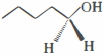
C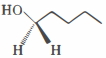
D
Solution
(B) Enantiomers are pairs of stereoisomers that are non-superimposable mirror images of each other. They must contain at least one chiral center.
$1$. Structure $I$ is $pentan-2-ol$ with the $-OH$ group on a wedge.
$2$. Structure $IV$ is $pentan-2-ol$ with the $-OH$ group on a dash (relative to the same carbon chain orientation).
$3$. Comparing $I$ and $IV$,they represent non-superimposable mirror images of each other,both possessing a chiral carbon atom at the $C-2$ position.
$4$. Structures $II$ and $III$ do not contain chiral centers,so they cannot be part of an enantiomeric pair.
Therefore,the correct enantiomeric pair is $I$ and $IV$.
$1$. Structure $I$ is $pentan-2-ol$ with the $-OH$ group on a wedge.
$2$. Structure $IV$ is $pentan-2-ol$ with the $-OH$ group on a dash (relative to the same carbon chain orientation).
$3$. Comparing $I$ and $IV$,they represent non-superimposable mirror images of each other,both possessing a chiral carbon atom at the $C-2$ position.
$4$. Structures $II$ and $III$ do not contain chiral centers,so they cannot be part of an enantiomeric pair.
Therefore,the correct enantiomeric pair is $I$ and $IV$.
0 likesView Solution
10
ChemistryDifficultMCQKVPY · 2010
The aromatic carbocation among the following is
A
Cyclopentadienyl cation
B
Cyclohexadienyl cation
C
Tropylium cation (cycloheptatrienyl cation)
D
Cyclooctatrienyl cation
Solution
(C) compound is aromatic if it satisfies the following conditions:
$1$. It must be cyclic.
$2$. It must be planar.
$3$. It must have a fully conjugated system of $\pi$ electrons.
$4$. It must follow $H$ückel's rule,i.e.,it must contain $(4n+2) \pi$ electrons,where $n = 0, 1, 2, ...$.
Let us analyze the given options:
- Option $(A)$: The cyclopentadienyl cation has $4 \pi$ electrons. It is anti-aromatic.
- Option $(B)$: The cyclohexadienyl cation is non-planar and non-aromatic.
- Option $(C)$: The tropylium cation (cycloheptatrienyl cation) has $6 \pi$ electrons $(n=1)$. It is cyclic,planar,and fully conjugated. Thus,it is aromatic.
- Option $(D)$: The cyclooctatrienyl cation is non-planar and non-aromatic.
Therefore,the correct option is $(C)$.
$1$. It must be cyclic.
$2$. It must be planar.
$3$. It must have a fully conjugated system of $\pi$ electrons.
$4$. It must follow $H$ückel's rule,i.e.,it must contain $(4n+2) \pi$ electrons,where $n = 0, 1, 2, ...$.
Let us analyze the given options:
- Option $(A)$: The cyclopentadienyl cation has $4 \pi$ electrons. It is anti-aromatic.
- Option $(B)$: The cyclohexadienyl cation is non-planar and non-aromatic.
- Option $(C)$: The tropylium cation (cycloheptatrienyl cation) has $6 \pi$ electrons $(n=1)$. It is cyclic,planar,and fully conjugated. Thus,it is aromatic.
- Option $(D)$: The cyclooctatrienyl cation is non-planar and non-aromatic.
Therefore,the correct option is $(C)$.
0 likesView Solution
11
ChemistryMediumMCQKVPY · 2010
Cyclohexene is reacted with bromine in $CCl_4$ in the dark. The product of the reaction is,
A
trans$-1,2-$dibromocyclohexane
B
cis$-1,2-$dibromocyclohexane
C
bromocyclohexane
D
$3-$bromocyclohexene
Solution
(A) The reaction of cyclohexene with bromine in $CCl_4$ in the dark is an electrophilic addition reaction.
Bromine adds across the double bond in an anti-addition manner,resulting in the formation of $trans-1,2-dibromocyclohexane$.
The reaction proceeds through a cyclic bromonium ion intermediate,which is then attacked by the bromide ion from the opposite side,leading to the trans-product.
Bromine adds across the double bond in an anti-addition manner,resulting in the formation of $trans-1,2-dibromocyclohexane$.
The reaction proceeds through a cyclic bromonium ion intermediate,which is then attacked by the bromide ion from the opposite side,leading to the trans-product.
0 likesView Solution
12
ChemistryMediumMCQKVPY · 2010
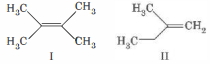
The number of possible enantiomeric pair$(s)$ produced from the bromination of $I$ and $II,$ respectively,are
A
$0, 1$
B
$1, 0$
C
$0, 2$
D
$1, 1$
Solution
(A) Bromination of compound $I$ ($2,3$-dimethylbut-$2$-ene) with $Br_2$ yields $2,3$-dibromo-$2,3$-dimethylbutane. This product is a $meso$ compound due to the presence of a plane of symmetry. Therefore,it does not form any enantiomeric pair.
Bromination of compound $II$ ($2$-methylbut-$1$-ene) with $Br_2$ (followed by addition) yields $1,2$-dibromo-$2$-methylbutane. The carbon atom at position $2$ becomes a chiral center $(C^*)$. This chiral compound exists as a pair of enantiomers ($d$ and $l$ forms),which are non-superimposable mirror images of each other. Thus,it produces $1$ enantiomeric pair.
Therefore,the number of enantiomeric pairs produced from $I$ and $II$ are $0$ and $1,$ respectively. The correct option is $(a).$
Bromination of compound $II$ ($2$-methylbut-$1$-ene) with $Br_2$ (followed by addition) yields $1,2$-dibromo-$2$-methylbutane. The carbon atom at position $2$ becomes a chiral center $(C^*)$. This chiral compound exists as a pair of enantiomers ($d$ and $l$ forms),which are non-superimposable mirror images of each other. Thus,it produces $1$ enantiomeric pair.
Therefore,the number of enantiomeric pairs produced from $I$ and $II$ are $0$ and $1,$ respectively. The correct option is $(a).$
0 likesView Solution
13
ChemistryMediumMCQKVPY · 2010
For the reaction $A \longrightarrow B$,$\Delta H^{\circ} = 7.5 \, kJ \, mol^{-1}$ and $\Delta S^{\circ} = 25 \, J \, K^{-1} \, mol^{-1}$. The value of $\Delta G^{\circ}$ and the temperature at which the reaction reaches equilibrium are,respectively:
A
$0 \, kJ \, mol^{-1}$ and $300 \, K$
B
$-2.5 \, kJ \, mol^{-1}$ and $400 \, K$
C
$2.5 \, kJ \, mol^{-1}$ and $200 \, K$
D
$0 \, kJ \, mol^{-1}$ and $300 \, K$
Solution
(A) At equilibrium,the change in Gibbs free energy is $\Delta G^{\circ} = 0 \, kJ \, mol^{-1}$.
Using the relation $\Delta G^{\circ} = \Delta H^{\circ} - T \Delta S^{\circ}$,at equilibrium,we have $0 = \Delta H^{\circ} - T \Delta S^{\circ}$.
Therefore,$T = \frac{\Delta H^{\circ}}{\Delta S^{\circ}}$.
Given $\Delta H^{\circ} = 7.5 \, kJ \, mol^{-1} = 7500 \, J \, mol^{-1}$ and $\Delta S^{\circ} = 25 \, J \, K^{-1} \, mol^{-1}$.
$T = \frac{7500 \, J \, mol^{-1}}{25 \, J \, K^{-1} \, mol^{-1}} = 300 \, K$.
Thus,the values are $0 \, kJ \, mol^{-1}$ and $300 \, K$.
Using the relation $\Delta G^{\circ} = \Delta H^{\circ} - T \Delta S^{\circ}$,at equilibrium,we have $0 = \Delta H^{\circ} - T \Delta S^{\circ}$.
Therefore,$T = \frac{\Delta H^{\circ}}{\Delta S^{\circ}}$.
Given $\Delta H^{\circ} = 7.5 \, kJ \, mol^{-1} = 7500 \, J \, mol^{-1}$ and $\Delta S^{\circ} = 25 \, J \, K^{-1} \, mol^{-1}$.
$T = \frac{7500 \, J \, mol^{-1}}{25 \, J \, K^{-1} \, mol^{-1}} = 300 \, K$.
Thus,the values are $0 \, kJ \, mol^{-1}$ and $300 \, K$.
0 likesView Solution
14
ChemistryDifficultMCQKVPY · 2010
The solubility product of $Mg(OH)_2$ is $1.0 \times 10^{-12}$. Concentrated aqueous $NaOH$ solution is added to a $0.01 \ M$ aqueous solution of $MgCl_2$. The $pH$ at which precipitation occurs is
A
$7.2$
B
$7.8$
C
$8.0$
D
$9.0$
Solution
(D) For the precipitation of $Mg(OH)_2$,the ionic product must exceed the solubility product $(K_{sp})$.
The equilibrium is: $Mg(OH)_2(s) \rightleftharpoons Mg^{2+}(aq) + 2OH^-(aq)$
$K_{sp} = [Mg^{2+}][OH^-]^2 = 1.0 \times 10^{-12}$
Given $[Mg^{2+}] = 0.01 \ M = 10^{-2} \ M$.
Substituting the values: $10^{-2} \times [OH^-]^2 = 10^{-12}$
$[OH^-]^2 = 10^{-10}$
$[OH^-] = 10^{-5} \ M$
$pOH = -\log[OH^-] = -\log(10^{-5}) = 5$
Since $pH + pOH = 14$ at $25^{\circ}C$,
$pH = 14 - 5 = 9$.
The equilibrium is: $Mg(OH)_2(s) \rightleftharpoons Mg^{2+}(aq) + 2OH^-(aq)$
$K_{sp} = [Mg^{2+}][OH^-]^2 = 1.0 \times 10^{-12}$
Given $[Mg^{2+}] = 0.01 \ M = 10^{-2} \ M$.
Substituting the values: $10^{-2} \times [OH^-]^2 = 10^{-12}$
$[OH^-]^2 = 10^{-10}$
$[OH^-] = 10^{-5} \ M$
$pOH = -\log[OH^-] = -\log(10^{-5}) = 5$
Since $pH + pOH = 14$ at $25^{\circ}C$,
$pH = 14 - 5 = 9$.
0 likesView Solution
15
ChemistryMediumMCQKVPY · 2010
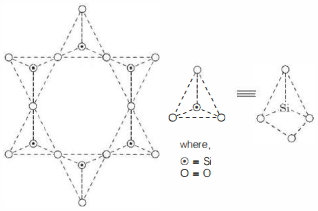
Identify the cyclic silicate ion given in the figure below:
A
$[Si_4O_{25}]^{24-}$
B
$[Si_6O_{18}]^{12-}$
C
$[Si_4O_{18}]^{12-}$
D
$[Si_6O_{24}]^{12-}$
Solution
(B) In cyclic silicates,two oxygen atoms of each $SiO_4^{4-}$ tetrahedron are shared to form a ring with the general formula $[SiO_3]_n^{2n-}$.
The figure shows a ring consisting of $6$ silicon atoms.
Substituting $n = 6$ into the general formula,we get $[SiO_3]_6^{2(6)-} = [Si_6O_{18}]^{12-}$.
Thus,the cyclic silicate ion is $[Si_6O_{18}]^{12-}$.
The figure shows a ring consisting of $6$ silicon atoms.
Substituting $n = 6$ into the general formula,we get $[SiO_3]_6^{2(6)-} = [Si_6O_{18}]^{12-}$.
Thus,the cyclic silicate ion is $[Si_6O_{18}]^{12-}$.
0 likesView Solution
16
ChemistryMediumMCQKVPY · 2010
Diborane is formed from the elements as shown in equation $(i)$:
$2 B_{(s)} + 3 H_{2(g)} \longrightarrow B_2H_{6(g)} \dots (i)$
Given that:
$H_2O_{(l)} \longrightarrow H_2O_{(g)}, \quad \Delta H_1^{\circ} = 44 \, kJ$
$2 B_{(s)} + \frac{3}{2} O_{2(g)} \longrightarrow B_2O_{3(s)}, \quad \Delta H_2^{\circ} = -1273 \, kJ$
$B_2H_{6(g)} + 3 O_{2(g)} \longrightarrow B_2O_{3(s)} + 3 H_2O_{(g)}, \quad \Delta H_3^{\circ} = -2035 \, kJ$
$H_{2(g)} + \frac{1}{2} O_{2(g)} \longrightarrow H_2O_{(l)}, \quad \Delta H_4^{\circ} = -286 \, kJ$
The $\Delta H^{\circ}$ for the reaction $(i)$ is $..... \, kJ$.
$2 B_{(s)} + 3 H_{2(g)} \longrightarrow B_2H_{6(g)} \dots (i)$
Given that:
$H_2O_{(l)} \longrightarrow H_2O_{(g)}, \quad \Delta H_1^{\circ} = 44 \, kJ$
$2 B_{(s)} + \frac{3}{2} O_{2(g)} \longrightarrow B_2O_{3(s)}, \quad \Delta H_2^{\circ} = -1273 \, kJ$
$B_2H_{6(g)} + 3 O_{2(g)} \longrightarrow B_2O_{3(s)} + 3 H_2O_{(g)}, \quad \Delta H_3^{\circ} = -2035 \, kJ$
$H_{2(g)} + \frac{1}{2} O_{2(g)} \longrightarrow H_2O_{(l)}, \quad \Delta H_4^{\circ} = -286 \, kJ$
The $\Delta H^{\circ}$ for the reaction $(i)$ is $..... \, kJ$.
A
$36$
B
$520$
C
$509$
D
$-3550$
Solution
(A) To find the enthalpy of formation of $B_2H_{6(g)}$,we use Hess's Law.
We need to obtain the reaction: $2 B_{(s)} + 3 H_{2(g)} \longrightarrow B_2H_{6(g)}$
Using the given equations:
$(ii) \quad 2 B_{(s)} + \frac{3}{2} O_{2(g)} \longrightarrow B_2O_{3(s)}, \quad \Delta H_2^{\circ} = -1273 \, kJ$
$(iv) \times 3 \quad 3 H_{2(g)} + \frac{3}{2} O_{2(g)}$ $\longrightarrow 3 H_2O_{(l)}, \quad 3 \times \Delta H_4^{\circ} = 3 \times (-286) = -858 \, kJ$
$(i) \times 3 \quad 3 H_2O_{(l)}$ $\longrightarrow 3 H_2O_{(g)}, \quad 3 \times \Delta H_1^{\circ} = 3 \times 44 = 132 \, kJ$
$-(iii) \quad B_2O_{3(s)} + 3 H_2O_{(g)}$ $\longrightarrow B_2H_{6(g)} + 3 O_{2(g)}, \quad -\Delta H_3^{\circ} = -(-2035) = 2035 \, kJ$
Summing these equations:
$2 B_{(s)} + 3 H_{2(g)} \longrightarrow B_2H_{6(g)}$
$\Delta H_r^{\circ} = -1273 - 858 + 132 + 2035 = 36 \, kJ$.
We need to obtain the reaction: $2 B_{(s)} + 3 H_{2(g)} \longrightarrow B_2H_{6(g)}$
Using the given equations:
$(ii) \quad 2 B_{(s)} + \frac{3}{2} O_{2(g)} \longrightarrow B_2O_{3(s)}, \quad \Delta H_2^{\circ} = -1273 \, kJ$
$(iv) \times 3 \quad 3 H_{2(g)} + \frac{3}{2} O_{2(g)}$ $\longrightarrow 3 H_2O_{(l)}, \quad 3 \times \Delta H_4^{\circ} = 3 \times (-286) = -858 \, kJ$
$(i) \times 3 \quad 3 H_2O_{(l)}$ $\longrightarrow 3 H_2O_{(g)}, \quad 3 \times \Delta H_1^{\circ} = 3 \times 44 = 132 \, kJ$
$-(iii) \quad B_2O_{3(s)} + 3 H_2O_{(g)}$ $\longrightarrow B_2H_{6(g)} + 3 O_{2(g)}, \quad -\Delta H_3^{\circ} = -(-2035) = 2035 \, kJ$
Summing these equations:
$2 B_{(s)} + 3 H_{2(g)} \longrightarrow B_2H_{6(g)}$
$\Delta H_r^{\circ} = -1273 - 858 + 132 + 2035 = 36 \, kJ$.
0 likesView Solution
17
ChemistryMediumMCQKVPY · 2010
The correct electronic configuration for the ground state of silicon (atomic number $= 14$) is
A
$1 s^2 2 s^2 2 p^6 3 s^2 3 p^2$
B
$1 s^2 2 s^2 2 p^6 3 p^4$
C
$1 s^2 2 s^2 2 p^4 3 s^2 3 p^4$
D
$1 s^2 2 s^2 2 p^6 3 s^1 3 p^5$
Solution
(A) The atomic number of silicon $(Si)$ is $14$.
Following the Aufbau principle,the electrons are filled in the order $1 s, 2 s, 2 p, 3 s, 3 p$.
The distribution of $14$ electrons is as follows: $1 s^2, 2 s^2, 2 p^6, 3 s^2, 3 p^2$.
Thus,the correct electronic configuration is $1 s^2 2 s^2 2 p^6 3 s^2 3 p^2$.
Following the Aufbau principle,the electrons are filled in the order $1 s, 2 s, 2 p, 3 s, 3 p$.
The distribution of $14$ electrons is as follows: $1 s^2, 2 s^2, 2 p^6, 3 s^2, 3 p^2$.
Thus,the correct electronic configuration is $1 s^2 2 s^2 2 p^6 3 s^2 3 p^2$.
0 likesView Solution
18
ChemistryMediumMCQKVPY · 2010
The molar mass of $CaCO_{3}$ is $100 \ g/mol$. The maximum amount of carbon dioxide that can be liberated on heating $25 \ g$ of $CaCO_{3}$ is $.... \ g$.
A
$11$
B
$5.5$
C
$22$
D
$2.2$
Solution
(A) The balanced chemical equation for the thermal decomposition of $CaCO_{3}$ is:
$CaCO_{3}(s) \stackrel{\Delta}{\longrightarrow} CaO(s) + CO_{2}(g)$
From the stoichiometry of the reaction,$1 \ mol$ of $CaCO_{3}$ produces $1 \ mol$ of $CO_{2}$.
The molar mass of $CaCO_{3} = 100 \ g/mol$.
The number of moles of $CaCO_{3}$ in $25 \ g$ is:
$n(CaCO_{3}) = \frac{25 \ g}{100 \ g/mol} = 0.25 \ mol$.
Since $1 \ mol$ of $CaCO_{3}$ yields $1 \ mol$ of $CO_{2}$,$0.25 \ mol$ of $CaCO_{3}$ will yield $0.25 \ mol$ of $CO_{2}$.
The molar mass of $CO_{2} = 12 + (2 \times 16) = 44 \ g/mol$.
The mass of $CO_{2}$ produced is:
$Mass = n \times M = 0.25 \ mol \times 44 \ g/mol = 11 \ g$.
$CaCO_{3}(s) \stackrel{\Delta}{\longrightarrow} CaO(s) + CO_{2}(g)$
From the stoichiometry of the reaction,$1 \ mol$ of $CaCO_{3}$ produces $1 \ mol$ of $CO_{2}$.
The molar mass of $CaCO_{3} = 100 \ g/mol$.
The number of moles of $CaCO_{3}$ in $25 \ g$ is:
$n(CaCO_{3}) = \frac{25 \ g}{100 \ g/mol} = 0.25 \ mol$.
Since $1 \ mol$ of $CaCO_{3}$ yields $1 \ mol$ of $CO_{2}$,$0.25 \ mol$ of $CaCO_{3}$ will yield $0.25 \ mol$ of $CO_{2}$.
The molar mass of $CO_{2} = 12 + (2 \times 16) = 44 \ g/mol$.
The mass of $CO_{2}$ produced is:
$Mass = n \times M = 0.25 \ mol \times 44 \ g/mol = 11 \ g$.
0 likesView Solution
19
ChemistryMediumMCQKVPY · 2010
The atomic radii of the elements across the second period of the periodic table:
A
decrease due to increase in atomic number
B
decrease due to increase in effective nuclear charge
C
decrease due to increase in atomic weights
D
increase due to increase in the effective nuclear charge
Solution
(B)
On moving across the second period of the periodic table,the atomic radii of the elements decrease due to an increase in effective nuclear charge.
The electrons in all shells are pulled closer to the nucleus,thereby making each individual shell smaller.
On moving across the second period of the periodic table,the atomic radii of the elements decrease due to an increase in effective nuclear charge.
The electrons in all shells are pulled closer to the nucleus,thereby making each individual shell smaller.
0 likesView Solution
20
ChemistryMediumMCQKVPY · 2010
Among $NH_3, BCl_3, Cl_2$ and $N_2$,the compound that does not satisfy the octet rule is
A
$NH_3$
B
$BCl_3$
C
$Cl_2$
D
$N_2$
Solution
(B) The correct answer is $B$.
According to the octet rule,atoms of different elements combine with each other to complete their respective octets (i.e.,$8$ electrons in their outermost shell,or $2$ electrons in the case of $H, Li,$ and $Be$ to attain a stable nearest noble gas configuration).
In $BCl_3$,the central Boron $(B)$ atom has only $6$ electrons in its valence shell after forming three covalent bonds with Chlorine atoms.
Since $6 < 8$,$BCl_3$ is an electron-deficient molecule and does not satisfy the octet rule.
According to the octet rule,atoms of different elements combine with each other to complete their respective octets (i.e.,$8$ electrons in their outermost shell,or $2$ electrons in the case of $H, Li,$ and $Be$ to attain a stable nearest noble gas configuration).
In $BCl_3$,the central Boron $(B)$ atom has only $6$ electrons in its valence shell after forming three covalent bonds with Chlorine atoms.
Since $6 < 8$,$BCl_3$ is an electron-deficient molecule and does not satisfy the octet rule.
0 likesView Solution
21
ChemistryMediumMCQKVPY · 2010
The number of covalent bonds in $C_4H_7Br$ is $.......$
A
$12$
B
$10$
C
$13$
D
$11$
Solution
(A) The chemical formula $C_4H_7Br$ represents a molecule such as $1$-bromobut-$2$-ene $(CH_3-CH=CH-CH_2Br)$.
To find the total number of covalent bonds,we count all single and multiple bonds in the structure:
$1$. $C-H$ bonds: There are $7$ $C-H$ bonds.
$2$. $C-C$ bonds: There are $2$ single $C-C$ bonds and $1$ double $C=C$ bond (total $3$ bonds).
$3$. $C-Br$ bond: There is $1$ $C-Br$ bond.
Total number of covalent bonds = $7 + 3 + 1 = 11$.
Wait,let us re-examine the provided image structure: The image shows a chain with $12$ numbered bonds. Counting them directly from the provided structure: $1$ $(H-C)$,$2$ $(C-H)$,$3,4$ $(C=C)$,$5,6$ $(C-C)$,$7$ $(C-H)$,$8$ $(C-H)$,$9$ $(C-C)$,$10$ $(C-H)$,$11$ $(C-H)$,$12$ $(C-Br)$.
Total count = $12$.
To find the total number of covalent bonds,we count all single and multiple bonds in the structure:
$1$. $C-H$ bonds: There are $7$ $C-H$ bonds.
$2$. $C-C$ bonds: There are $2$ single $C-C$ bonds and $1$ double $C=C$ bond (total $3$ bonds).
$3$. $C-Br$ bond: There is $1$ $C-Br$ bond.
Total number of covalent bonds = $7 + 3 + 1 = 11$.
Wait,let us re-examine the provided image structure: The image shows a chain with $12$ numbered bonds. Counting them directly from the provided structure: $1$ $(H-C)$,$2$ $(C-H)$,$3,4$ $(C=C)$,$5,6$ $(C-C)$,$7$ $(C-H)$,$8$ $(C-H)$,$9$ $(C-C)$,$10$ $(C-H)$,$11$ $(C-H)$,$12$ $(C-Br)$.
Total count = $12$.
0 likesView Solution
22
ChemistryMediumMCQKVPY · 2010
An aqueous solution of $HCl$ has a $pH$ of $2.0$. When water is added to increase the $pH$ to $5.0$,the hydrogen ion concentration
A
remains the same
B
decreases three-fold
C
increases three-fold
D
decreases thousand-fold
Solution
(D)
As we know,$pH = -\log [H^+]$.
Initial $pH = 2.0$,so initial $[H^+]_i = 10^{-2} \ M$.
Final $pH = 5.0$,so final $[H^+]_f = 10^{-5} \ M$.
The ratio of change is $\frac{[H^+]_f}{[H^+]_i} = \frac{10^{-5}}{10^{-2}} = 10^{-3}$.
Thus,the hydrogen ion concentration decreases by a factor of $1000$ (thousand-fold).
As we know,$pH = -\log [H^+]$.
Initial $pH = 2.0$,so initial $[H^+]_i = 10^{-2} \ M$.
Final $pH = 5.0$,so final $[H^+]_f = 10^{-5} \ M$.
The ratio of change is $\frac{[H^+]_f}{[H^+]_i} = \frac{10^{-5}}{10^{-2}} = 10^{-3}$.
Thus,the hydrogen ion concentration decreases by a factor of $1000$ (thousand-fold).
0 likesView Solution
23
ChemistryMediumMCQKVPY · 2010
Consider two sealed jars of equal volume. One contains $2 \ g$ of hydrogen at $200 \ K$ and the other contains $28 \ g$ of nitrogen at $400 \ K$. The gases in the two jars will have
A
the same pressure
B
the same average kinetic energy
C
the same number of molecules
D
the same average molecular speed
Solution
(C) For the $1^{st}$ jar:
Number of moles of $H_2 = \frac{2 \ g}{2 \ g/mol} = 1 \ mol$.
Number of molecules of $H_2 = 1 \times N_A = 6.022 \times 10^{23}$ molecules.
For the $2^{nd}$ jar:
Number of moles of $N_2 = \frac{28 \ g}{28 \ g/mol} = 1 \ mol$.
Number of molecules of $N_2 = 1 \times N_A = 6.022 \times 10^{23}$ molecules.
Since both jars contain $1 \ mol$ of gas,they contain the same number of molecules.
Number of moles of $H_2 = \frac{2 \ g}{2 \ g/mol} = 1 \ mol$.
Number of molecules of $H_2 = 1 \times N_A = 6.022 \times 10^{23}$ molecules.
For the $2^{nd}$ jar:
Number of moles of $N_2 = \frac{28 \ g}{28 \ g/mol} = 1 \ mol$.
Number of molecules of $N_2 = 1 \times N_A = 6.022 \times 10^{23}$ molecules.
Since both jars contain $1 \ mol$ of gas,they contain the same number of molecules.
0 likesView Solution
24
ChemistryMediumMCQKVPY · 2010
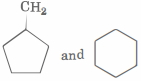
Identify the stereoisomeric pair from the following choices.
A
$CH_3CH_2CH_2OH$ and $CH_3CH_2OCH_3$
B
$CH_3CH_2CH_2Cl$ and $CH_3CHClCH_3$
C
$CH_3-CH=CH-CH_3$ (cis) and $CH_3-CH=CH-CH_3$ (trans)
D
Methylcyclopentane and cyclohexane
Solution
(C) . The types of isomers in the given options are as follows:
$(a)$ $CH_3CH_2CH_2OH$ and $CH_3CH_2OCH_3$: These are functional isomers.
$(b)$ $CH_3CH_2CH_2Cl$ and $CH_3CHClCH_3$: These are positional isomers.
$(c)$ The given structures represent $cis$ and $trans$ forms of but$-2-$ene. They are geometrical isomers,which are a type of stereoisomers.
$(d)$ Methylcyclopentane and cyclohexane: These are ring-chain isomers.
Thus,the correct option is $(c)$.
$(a)$ $CH_3CH_2CH_2OH$ and $CH_3CH_2OCH_3$: These are functional isomers.
$(b)$ $CH_3CH_2CH_2Cl$ and $CH_3CHClCH_3$: These are positional isomers.
$(c)$ The given structures represent $cis$ and $trans$ forms of but$-2-$ene. They are geometrical isomers,which are a type of stereoisomers.
$(d)$ Methylcyclopentane and cyclohexane: These are ring-chain isomers.
Thus,the correct option is $(c)$.
0 likesView Solution
25
ChemistryAdvancedKVPY · 2010
Copper in an alloy is estimated by dissolving in conc. nitric acid. In this process,copper is converted to cupric nitrate with the evolution of nitric oxide $(NO)$. The mixture when treated with potassium iodide forms cupric iodide,which is unstable and decomposes to cuprous iodide and iodine. The amount of copper in the alloy is estimated by titrating the liberated iodine with sodium thiosulphate. The reactions are:
$a \,Cu + b \,HNO_3 \rightarrow c \,Cu(NO_3)_2 + d \,NO + e \,H_2O$
$f \,CuI_2 \rightarrow g \,Cu_2I_2 + h \,I_2$
$i \,Na_2S_2O_3 + j \,I_2 \rightarrow k \,Na_2S_4O_6 + l \,NaI$
(Fill in the blanks)
$(a)$ The coefficients are: $a=\ldots, b=\ldots, c=\ldots, d=\ldots$ and $e=\ldots$.
$(b)$ The coefficients are: $f=\ldots, g=\ldots$ and $h=\ldots$.
$(c)$ The coefficients are: $i=\ldots, j=\ldots, k=\ldots$ and $l=\ldots$.
$(d)$ If $2.54 \,g$ of $I_2$ is evolved from a $2.0 \,g$ sample of the alloy,what is the percentage of copper in the alloy? (Atomic weights of iodine and copper are $127$ and $63.5$,respectively).
$a \,Cu + b \,HNO_3 \rightarrow c \,Cu(NO_3)_2 + d \,NO + e \,H_2O$
$f \,CuI_2 \rightarrow g \,Cu_2I_2 + h \,I_2$
$i \,Na_2S_2O_3 + j \,I_2 \rightarrow k \,Na_2S_4O_6 + l \,NaI$
(Fill in the blanks)
$(a)$ The coefficients are: $a=\ldots, b=\ldots, c=\ldots, d=\ldots$ and $e=\ldots$.
$(b)$ The coefficients are: $f=\ldots, g=\ldots$ and $h=\ldots$.
$(c)$ The coefficients are: $i=\ldots, j=\ldots, k=\ldots$ and $l=\ldots$.
$(d)$ If $2.54 \,g$ of $I_2$ is evolved from a $2.0 \,g$ sample of the alloy,what is the percentage of copper in the alloy? (Atomic weights of iodine and copper are $127$ and $63.5$,respectively).
Solution
(D) The balanced chemical equations are:
$(i)$ $3 \,Cu + 8 \,HNO_3 \rightarrow 3 \,Cu(NO_3)_2 + 2 \,NO + 4 \,H_2O$
$(ii)$ $2 \,CuI_2 \rightarrow Cu_2I_2 + I_2$
$(iii)$ $2 \,Na_2S_2O_3 + I_2 \rightarrow Na_2S_4O_6 + 2 \,NaI$
$(a)$ The coefficients are: $a=3, b=8, c=3, d=2, e=4$.
$(b)$ The coefficients are: $f=2, g=1, h=1$.
$(c)$ The coefficients are: $i=2, j=1, k=1, l=2$.
$(d)$ Moles of $I_2 = \frac{2.54 \,g}{254 \,g/mol} = 0.01 \,mol$.
From equation $(ii)$,$1 \,mol$ of $I_2$ is produced from $2 \,mol$ of $CuI_2$,which corresponds to $2 \,mol$ of $Cu$.
Therefore,moles of $Cu = 2 \times 0.01 \,mol = 0.02 \,mol$.
Mass of $Cu = 0.02 \,mol \times 63.5 \,g/mol = 1.27 \,g$.
Percentage of $Cu = \frac{1.27 \,g}{2.0 \,g} \times 100 = 63.5 \%$.
$(i)$ $3 \,Cu + 8 \,HNO_3 \rightarrow 3 \,Cu(NO_3)_2 + 2 \,NO + 4 \,H_2O$
$(ii)$ $2 \,CuI_2 \rightarrow Cu_2I_2 + I_2$
$(iii)$ $2 \,Na_2S_2O_3 + I_2 \rightarrow Na_2S_4O_6 + 2 \,NaI$
$(a)$ The coefficients are: $a=3, b=8, c=3, d=2, e=4$.
$(b)$ The coefficients are: $f=2, g=1, h=1$.
$(c)$ The coefficients are: $i=2, j=1, k=1, l=2$.
$(d)$ Moles of $I_2 = \frac{2.54 \,g}{254 \,g/mol} = 0.01 \,mol$.
From equation $(ii)$,$1 \,mol$ of $I_2$ is produced from $2 \,mol$ of $CuI_2$,which corresponds to $2 \,mol$ of $Cu$.
Therefore,moles of $Cu = 2 \times 0.01 \,mol = 0.02 \,mol$.
Mass of $Cu = 0.02 \,mol \times 63.5 \,g/mol = 1.27 \,g$.
Percentage of $Cu = \frac{1.27 \,g}{2.0 \,g} \times 100 = 63.5 \%$.
0 likesView Solution
26
ChemistryDifficultKVPY · 2010
Assume that a human body requires $2500 \, kcal$ of energy each day for metabolic activity and sucrose is the only source of energy,as per the equation $C_{12}H_{22}O_{11(s)} + 12 \, O_{2(g)} \longrightarrow 12 \, CO_{2(g)} + 11 \, H_2O_{(l)};$ $\Delta H = -5.6 \times 10^6 \, J$. (Fill in the blanks) $(a)$ The energy requirement of the human body per day is $.... \, kJ$. $(b)$ The mass of sucrose required to provide this energy is $........ \, g$ and the volume of $CO_2$ (at $STP$) produced is $......... \, litres.$
Solution
(A) Given $1 \, kcal = 4.184 \, kJ$. Therefore,$2500 \, kcal = 2500 \times 4.184 \, kJ = 10460 \, kJ$. The energy requirement is $10460 \, kJ$.
$(b)$ Molar mass of sucrose $(C_{12}H_{22}O_{11})$ = $(12 \times 12) + (22 \times 1) + (11 \times 16) = 342 \, g/mol$.
Energy released per mole of sucrose = $5.6 \times 10^6 \, J = 5600 \, kJ/mol$.
Moles of sucrose required = $\frac{10460 \, kJ}{5600 \, kJ/mol} \approx 1.8679 \, mol$.
Mass of sucrose = $1.8679 \, mol \times 342 \, g/mol \approx 638.82 \, g$.
From the equation,$1 \, mol$ of sucrose produces $12 \, mol$ of $CO_2$.
Moles of $CO_2$ produced = $1.8679 \times 12 = 22.4148 \, mol$.
Volume of $CO_2$ at $STP$ = $22.4148 \, mol \times 22.4 \, L/mol \approx 502.09 \, L$.
$(b)$ Molar mass of sucrose $(C_{12}H_{22}O_{11})$ = $(12 \times 12) + (22 \times 1) + (11 \times 16) = 342 \, g/mol$.
Energy released per mole of sucrose = $5.6 \times 10^6 \, J = 5600 \, kJ/mol$.
Moles of sucrose required = $\frac{10460 \, kJ}{5600 \, kJ/mol} \approx 1.8679 \, mol$.
Mass of sucrose = $1.8679 \, mol \times 342 \, g/mol \approx 638.82 \, g$.
From the equation,$1 \, mol$ of sucrose produces $12 \, mol$ of $CO_2$.
Moles of $CO_2$ produced = $1.8679 \times 12 = 22.4148 \, mol$.
Volume of $CO_2$ at $STP$ = $22.4148 \, mol \times 22.4 \, L/mol \approx 502.09 \, L$.
0 likesView Solution
27
ChemistryMCQKVPY · 2010
$I$ carried $1000\,kg$ of watermelon in summer by train. In the beginning,the water content was $99\%$. By the time $I$ reached the destination,the water content had dropped to $98\%$. The reduction in the weight of the watermelon was $.......\,kg$.
A
$10$
B
$50$
C
$100$
D
$500$
Solution
(D) Initially,the total weight of the watermelon is $1000\,kg$.
Since the water content is $99\%$,the weight of the solid part (non-water) is $1\% \text{ of } 1000\,kg = 0.01 \times 1000 = 10\,kg$.
Let the new total weight of the watermelon at the destination be $x\,kg$.
At the destination,the water content is $98\%$,which means the solid part is $2\% \text{ of } x$.
Since the weight of the solid part remains constant,we have:
$0.02 \times x = 10\,kg$.
$x = \frac{10}{0.02} = 500\,kg$.
The reduction in weight is $1000\,kg - 500\,kg = 500\,kg$.
Since the water content is $99\%$,the weight of the solid part (non-water) is $1\% \text{ of } 1000\,kg = 0.01 \times 1000 = 10\,kg$.
Let the new total weight of the watermelon at the destination be $x\,kg$.
At the destination,the water content is $98\%$,which means the solid part is $2\% \text{ of } x$.
Since the weight of the solid part remains constant,we have:
$0.02 \times x = 10\,kg$.
$x = \frac{10}{0.02} = 500\,kg$.
The reduction in weight is $1000\,kg - 500\,kg = 500\,kg$.
0 likesView Solution
28
ChemistryKVPY · 2010
$(a)$ Show that for every natural number $n$ relatively prime to $10$,there exists a natural number $m$ consisting only of digits $1$ such that $n$ divides $m$.
$(b)$ Hence or otherwise,show that every positive rational number can be expressed in the form $\frac{a}{10^b(10^c-1)}$ for some natural numbers $a, b, c$.
$(b)$ Hence or otherwise,show that every positive rational number can be expressed in the form $\frac{a}{10^b(10^c-1)}$ for some natural numbers $a, b, c$.
Solution
(D) Let $n$ be a natural number such that $\gcd(n, 10) = 1$. Consider the sequence of $n+1$ numbers $m_k = \sum_{i=0}^{k-1} 10^i = \frac{10^k-1}{9}$ for $k = 1, 2, \dots, n+1$. By the Pigeonhole Principle,at least two of these numbers,say $m_i$ and $m_j$ with $i < j$,must have the same remainder when divided by $n$. Thus,$n$ divides $m_j - m_i = 11\dots100\dots0 = 11\dots1 \times 10^i$. Since $\gcd(n, 10) = 1$,it follows that $\gcd(n, 10^i) = 1$,so $n$ must divide $m_{j-i}$,which consists only of digits $1$.
$(b)$ Let the rational number be $\frac{p}{q}$. We can write $q = 2^r \cdot 5^s \cdot t$,where $\gcd(t, 10) = 1$. From part $(a)$,there exists $m$ consisting only of $1$'s such that $t \mid m$. Let $m = \frac{10^c-1}{9}$. Then $9m = 10^c-1$. Since $t \mid m$,we have $t \mid (10^c-1)$. Let $10^c-1 = kt$. We can choose $b = \max(r, s)$. Then $10^b$ is divisible by $2^r$ and $5^s$. Thus,$10^b(10^c-1)$ is divisible by $2^r \cdot 5^s \cdot t = q$. Therefore,$\frac{p}{q} = \frac{p \cdot \frac{10^b(10^c-1)}{q}}{10^b(10^c-1)} = \frac{a}{10^b(10^c-1)}$ for some integer $a$.
$(b)$ Let the rational number be $\frac{p}{q}$. We can write $q = 2^r \cdot 5^s \cdot t$,where $\gcd(t, 10) = 1$. From part $(a)$,there exists $m$ consisting only of $1$'s such that $t \mid m$. Let $m = \frac{10^c-1}{9}$. Then $9m = 10^c-1$. Since $t \mid m$,we have $t \mid (10^c-1)$. Let $10^c-1 = kt$. We can choose $b = \max(r, s)$. Then $10^b$ is divisible by $2^r$ and $5^s$. Thus,$10^b(10^c-1)$ is divisible by $2^r \cdot 5^s \cdot t = q$. Therefore,$\frac{p}{q} = \frac{p \cdot \frac{10^b(10^c-1)}{q}}{10^b(10^c-1)} = \frac{a}{10^b(10^c-1)}$ for some integer $a$.
0 likesView Solution
29
ChemistryMediumMCQKVPY · 2010
The number of isomers of $[Co(dien)Cl_3]$ is
A
$2$
B
$3$
C
$4$
D
$5$
Solution
(A) The complex $[Co(dien)Cl_3]$ contains a tridentate ligand,diethylenetriamine $(dien)$.
This complex exists in two geometrical isomeric forms: $fac$ (facial) and $mer$ (meridional) isomers.
In the $fac$-isomer,the three donor nitrogen atoms of the $dien$ ligand and the three $Cl^-$ ions occupy the corners of the same face of the octahedron.
In the $mer$-isomer,the three donor nitrogen atoms of the $dien$ ligand and the three $Cl^-$ ions are arranged in a meridional plane.
Therefore,the total number of isomers is $2$.
This complex exists in two geometrical isomeric forms: $fac$ (facial) and $mer$ (meridional) isomers.
In the $fac$-isomer,the three donor nitrogen atoms of the $dien$ ligand and the three $Cl^-$ ions occupy the corners of the same face of the octahedron.
In the $mer$-isomer,the three donor nitrogen atoms of the $dien$ ligand and the three $Cl^-$ ions are arranged in a meridional plane.
Therefore,the total number of isomers is $2$.
0 likesView Solution
30
ChemistryMediumMCQKVPY · 2010
Among the following,the $\pi$-acid ligand is
A
$F^{-}$
B
$NH_{3}$
C
$CN^{-}$
D
$I^{-}$
Solution
(C)
$\pi$-acid ligands are those ligands that possess empty $\pi^*$ (anti-bonding) molecular orbitals,which can accept electron density from the filled $d$-orbitals of the central metal atom through back-bonding.
Among the given options,$CN^{-}$ acts as a $\pi$-acid ligand because it has empty $\pi^*$ orbitals available for back-donation from the metal.
$\pi$-acid ligands are those ligands that possess empty $\pi^*$ (anti-bonding) molecular orbitals,which can accept electron density from the filled $d$-orbitals of the central metal atom through back-bonding.
Among the given options,$CN^{-}$ acts as a $\pi$-acid ligand because it has empty $\pi^*$ orbitals available for back-donation from the metal.
0 likesView Solution
31
ChemistryEasyMCQKVPY · 2010
The concentration of a substance undergoing a chemical reaction becomes one-half of its original value after time,regardless of the initial concentration. The reaction is an example of a
A
$zero$ order reaction
B
$first$ order reaction
C
$second$ order reaction
D
$third$ order reaction
Solution
(B)
As given in the question,the concentration of a substance becomes one-half of its original value,which refers to the half-life period $(t_{1/2})$.
The half-life period is the time required to reduce the initial concentration to half of its value.
For a $zero$ order reaction,$t_{1/2} = \frac{[A]_0}{2k}$.
For a $first$ order reaction,$t_{1/2} = \frac{0.693}{k}$.
For a $second$ order reaction,$t_{1/2} = \frac{1}{k[A]_0}$.
For a $third$ order reaction,$t_{1/2} = \frac{1}{2k[A]_0^2}$.
Here,$[A]_0$ is the initial concentration.
Since the half-life of a $first$ order reaction is independent of the initial concentration,the correct option is $(b)$.
As given in the question,the concentration of a substance becomes one-half of its original value,which refers to the half-life period $(t_{1/2})$.
The half-life period is the time required to reduce the initial concentration to half of its value.
For a $zero$ order reaction,$t_{1/2} = \frac{[A]_0}{2k}$.
For a $first$ order reaction,$t_{1/2} = \frac{0.693}{k}$.
For a $second$ order reaction,$t_{1/2} = \frac{1}{k[A]_0}$.
For a $third$ order reaction,$t_{1/2} = \frac{1}{2k[A]_0^2}$.
Here,$[A]_0$ is the initial concentration.
Since the half-life of a $first$ order reaction is independent of the initial concentration,the correct option is $(b)$.
0 likesView Solution
32
ChemistryMediumMCQKVPY · 2010
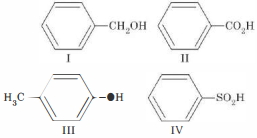
The order of acidity of compounds $I-IV$ is:
A
$I < III < II < IV$
B
$III < I < II < IV$
C
$IV < I < II < III$
D
$II < IV < III < I$
Solution
(A) The acidic strength of a compound is directly proportional to the stability of its conjugate base. More stable the conjugate base,stronger is the acid.
$I$: Benzyl alcohol $(C_6H_5CH_2OH)$ forms a conjugate base where the negative charge is on the oxygen atom and is not resonance-stabilized by the benzene ring.
$II$: Benzoic acid $(C_6H_5COOH)$ forms a carboxylate ion $(C_6H_5COO^-)$ which is resonance-stabilized by two oxygen atoms.
$III$: $p$-Cresol $(CH_3-C_6H_4-OH)$ forms a phenoxide ion which is resonance-stabilized,but the electron-donating $+I$ effect of the $-CH_3$ group destabilizes it compared to benzoic acid.
$IV$: Benzenesulfonic acid $(C_6H_5SO_3H)$ forms a sulfonate ion $(C_6H_5SO_3^-)$ where the negative charge is delocalized over three highly electronegative oxygen atoms,making it the most stable conjugate base.
Comparing the stability of conjugate bases:
$I$ (least stable) $< III < II < IV$ (most stable).
Therefore,the order of acidity is $I < III < II < IV$.
$I$: Benzyl alcohol $(C_6H_5CH_2OH)$ forms a conjugate base where the negative charge is on the oxygen atom and is not resonance-stabilized by the benzene ring.
$II$: Benzoic acid $(C_6H_5COOH)$ forms a carboxylate ion $(C_6H_5COO^-)$ which is resonance-stabilized by two oxygen atoms.
$III$: $p$-Cresol $(CH_3-C_6H_4-OH)$ forms a phenoxide ion which is resonance-stabilized,but the electron-donating $+I$ effect of the $-CH_3$ group destabilizes it compared to benzoic acid.
$IV$: Benzenesulfonic acid $(C_6H_5SO_3H)$ forms a sulfonate ion $(C_6H_5SO_3^-)$ where the negative charge is delocalized over three highly electronegative oxygen atoms,making it the most stable conjugate base.
Comparing the stability of conjugate bases:
$I$ (least stable) $< III < II < IV$ (most stable).
Therefore,the order of acidity is $I < III < II < IV$.
0 likesView Solution
33
ChemistryMediumMCQKVPY · 2010
$A$ concentrated solution of copper sulphate,which is dark blue in colour,is mixed at room temperature with a dilute solution of copper sulphate,which is light blue. For this process:
A
entropy change is positive,but enthalpy change is negative
B
entropy and enthalpy changes are both positive
C
entropy change is positive and enthalpy does not change
D
entropy change is negative and enthalpy change is positive
Solution
(C) The correct option is $(C)$.
When a concentrated solution of $CuSO_4$ is mixed with a dilute solution of $CuSO_4$,the process is essentially a dilution process.
During dilution,the randomness of the solute particles increases as they spread out in a larger volume,which leads to an increase in entropy $(\Delta S > 0)$.
Since the mixing of two solutions of the same solute at the same temperature involves negligible heat change (ideal mixing approximation),the enthalpy change $(\Delta H)$ is approximately zero.
When a concentrated solution of $CuSO_4$ is mixed with a dilute solution of $CuSO_4$,the process is essentially a dilution process.
During dilution,the randomness of the solute particles increases as they spread out in a larger volume,which leads to an increase in entropy $(\Delta S > 0)$.
Since the mixing of two solutions of the same solute at the same temperature involves negligible heat change (ideal mixing approximation),the enthalpy change $(\Delta H)$ is approximately zero.
0 likesView Solution
34
ChemistryMediumMCQKVPY · 2010
Increasing the temperature increases the rate of reaction,but does not increase the
A
number of collisions
B
activation energy
C
average energy of collisions
D
average velocity of the reactant molecules
Solution
(B)
Increasing the temperature increases the kinetic energy of the reactant molecules.
This leads to an increase in the number of collisions,the average energy of collisions,and the average velocity of the reactant molecules.
However,the activation energy $(E_a)$ is a characteristic property of the reaction pathway and is independent of temperature.
Therefore,increasing the temperature does not increase the activation energy.
Increasing the temperature increases the kinetic energy of the reactant molecules.
This leads to an increase in the number of collisions,the average energy of collisions,and the average velocity of the reactant molecules.
However,the activation energy $(E_a)$ is a characteristic property of the reaction pathway and is independent of temperature.
Therefore,increasing the temperature does not increase the activation energy.
0 likesView Solution
35
ChemistryMediumMCQKVPY · 2010
In metallic solids,the number of atoms for the face-centered and the body-centered cubic unit cells are,respectively:
A
$2, 4$
B
$2, 2$
C
$4, 2$
D
$4, 4$
Solution
(C) The correct option is $C$.
$A$ face-centered cubic $(fcc)$ unit cell contains atoms at all the corners and at the center of all faces of the cube.
Thus,the number of atoms in $fcc = (\frac{1}{8} \times 8) + (\frac{1}{2} \times 6) = 1 + 3 = 4$.
$A$ body-centered cubic $(bcc)$ unit cell has an atom at each of its corners and also one atom at its body center.
Thus,the number of atoms in $bcc = (\frac{1}{8} \times 8) + 1 = 1 + 1 = 2$.
$A$ face-centered cubic $(fcc)$ unit cell contains atoms at all the corners and at the center of all faces of the cube.
Thus,the number of atoms in $fcc = (\frac{1}{8} \times 8) + (\frac{1}{2} \times 6) = 1 + 3 = 4$.
$A$ body-centered cubic $(bcc)$ unit cell has an atom at each of its corners and also one atom at its body center.
Thus,the number of atoms in $bcc = (\frac{1}{8} \times 8) + 1 = 1 + 1 = 2$.
0 likesView Solution
36
ChemistryMediumMCQKVPY · 2010
For a first order reaction $R \longrightarrow P$,the rate constant is $k$. If the initial concentration of $R$ is $[R_0]$,the concentration of $R$ at any time $t$ is given by the expression:
A
$[R_0] e^{kt}$
B
$[R_0] e^{-kt}$
C
$[R_0](1 - e^{-kt})$
D
$[R_0] + e^{-kt}$
Solution
(B) For a first order reaction $R \longrightarrow P$,the rate law is given by: $\text{Rate} = -\frac{d[R]}{dt} = k[R]$.
Rearranging the terms,we get: $\frac{d[R]}{[R]} = -k dt$.
Integrating both sides: $\int \frac{d[R]}{[R]} = -\int k dt \Rightarrow \ln[R] = -kt + C$.
At $t = 0$,$[R] = [R_0]$,so $\ln[R_0] = C$.
Substituting $C$ back into the equation: $\ln[R] = -kt + \ln[R_0]$.
Rearranging: $\ln \frac{[R]}{[R_0]} = -kt$.
Taking the exponential of both sides: $\frac{[R]}{[R_0]} = e^{-kt}$.
Therefore,the concentration at time $t$ is: $[R] = [R_0] e^{-kt}$.
Rearranging the terms,we get: $\frac{d[R]}{[R]} = -k dt$.
Integrating both sides: $\int \frac{d[R]}{[R]} = -\int k dt \Rightarrow \ln[R] = -kt + C$.
At $t = 0$,$[R] = [R_0]$,so $\ln[R_0] = C$.
Substituting $C$ back into the equation: $\ln[R] = -kt + \ln[R_0]$.
Rearranging: $\ln \frac{[R]}{[R_0]} = -kt$.
Taking the exponential of both sides: $\frac{[R]}{[R_0]} = e^{-kt}$.
Therefore,the concentration at time $t$ is: $[R] = [R_0] e^{-kt}$.
0 likesView Solution
37
ChemistryMediumMCQKVPY · 2010
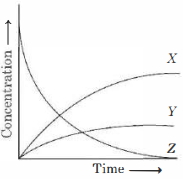
Consider the reaction,$2 NO_{2(g)} \rightarrow 2 NO_{(g)} + O_{2(g)}$. In the figure below,identify the curves $X, Y$ and $Z$ associated with the three species in the reaction.
A
$X = NO, Y = O_2, Z = NO_2$
B
$X = O_2, Y = NO, Z = NO_2$
C
$X = NO_2, Y = NO, Z = O_2$
D
$X = O_2, Y = NO_2, Z = NO$
Solution
(A) For the reaction,$2 NO_{2(g)} \longrightarrow 2 NO_{(g)} + O_{2(g)}$,the rate expression is given by:
$r = -\frac{1}{2} \frac{d[NO_2]}{dt} = +\frac{1}{2} \frac{d[NO]}{dt} = +\frac{d[O_2]}{dt}$.
$1$. Curve $Z$ represents the reactant $NO_2$ because its concentration decreases with time.
$2$. Curves $X$ and $Y$ represent the products $NO$ and $O_2$ because their concentrations increase with time.
$3$. From the stoichiometry,the rate of formation of $NO$ is twice the rate of formation of $O_2$ (i.e.,$\frac{d[NO]}{dt} = 2 \frac{d[O_2]}{dt}$).
$4$. Therefore,the concentration of $NO$ increases faster than $O_2$,meaning curve $X$ corresponds to $NO$ and curve $Y$ corresponds to $O_2$.
Thus,$X = NO, Y = O_2, Z = NO_2$.
$r = -\frac{1}{2} \frac{d[NO_2]}{dt} = +\frac{1}{2} \frac{d[NO]}{dt} = +\frac{d[O_2]}{dt}$.
$1$. Curve $Z$ represents the reactant $NO_2$ because its concentration decreases with time.
$2$. Curves $X$ and $Y$ represent the products $NO$ and $O_2$ because their concentrations increase with time.
$3$. From the stoichiometry,the rate of formation of $NO$ is twice the rate of formation of $O_2$ (i.e.,$\frac{d[NO]}{dt} = 2 \frac{d[O_2]}{dt}$).
$4$. Therefore,the concentration of $NO$ increases faster than $O_2$,meaning curve $X$ corresponds to $NO$ and curve $Y$ corresponds to $O_2$.
Thus,$X = NO, Y = O_2, Z = NO_2$.
0 likesView Solution
38
ChemistryDifficultMCQKVPY · 2010
$2.52 \ g$ of oxalic acid dihydrate was dissolved in $100 \ mL$ of water. $10 \ mL$ of this solution was diluted to $500 \ mL$. The normality of the final solution (in $N$) and the amount of oxalic acid (in $mg/mL$) in the solution are respectively
A
$0.16, 5.04$
B
$0.08, 3.60$
C
$0.008, 0.504$
D
$0.02, 10.08$
Solution
(C) The molar mass of oxalic acid dihydrate $(H_2C_2O_4 \cdot 2H_2O)$ is $126 \ g/mol$. The equivalent weight is $126/2 = 63 \ g/eq$.
Initial normality $(N_1)$ of the $100 \ mL$ solution: $N_1 = \frac{2.52 \ g}{63 \ g/eq \times 0.1 \ L} = 0.4 \ N$.
Using the dilution formula $N_1V_1 = N_2V_2$: $0.4 \ N \times 10 \ mL = N_2 \times 500 \ mL$.
$N_2 = \frac{0.4 \times 10}{500} = 0.008 \ N$.
Amount of oxalic acid in $mg/mL$ in the final solution:
Mass of oxalic acid in $10 \ mL$ aliquot $= \frac{2.52 \ g}{100 \ mL} \times 10 \ mL = 0.252 \ g = 252 \ mg$.
Concentration $= \frac{252 \ mg}{500 \ mL} = 0.504 \ mg/mL$.
Initial normality $(N_1)$ of the $100 \ mL$ solution: $N_1 = \frac{2.52 \ g}{63 \ g/eq \times 0.1 \ L} = 0.4 \ N$.
Using the dilution formula $N_1V_1 = N_2V_2$: $0.4 \ N \times 10 \ mL = N_2 \times 500 \ mL$.
$N_2 = \frac{0.4 \times 10}{500} = 0.008 \ N$.
Amount of oxalic acid in $mg/mL$ in the final solution:
Mass of oxalic acid in $10 \ mL$ aliquot $= \frac{2.52 \ g}{100 \ mL} \times 10 \ mL = 0.252 \ g = 252 \ mg$.
Concentration $= \frac{252 \ mg}{500 \ mL} = 0.504 \ mg/mL$.
0 likesView Solution
39
ChemistryDifficultMCQKVPY · 2010
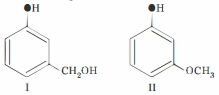
Two isomeric compounds $I$ and $II$ are heated with $HBr$. The products obtained are
A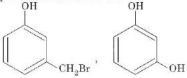
B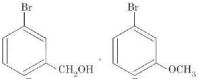
C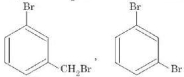
D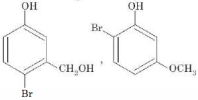
Solution
(A) In reaction $(I)$,the $OH$ group of the $CH_2OH$ side chain is protonated by $HBr$ to form a good leaving group $(H_2O^+)$. This leaves as water to form a resonance-stabilized benzylic carbocation,which is then attacked by $Br^-$ to yield $3-(bromomethyl)phenol$.
In reaction $(II)$,the ether oxygen is protonated by $HBr$. The $C-O$ bond cleavage occurs such that the methyl group is released as $CH_3Br$ because the $C-O$ bond involving the phenyl ring has partial double bond character due to resonance,making it stronger and harder to break. Thus,the reaction yields benzene-$1,3-diol$ (resorcinol) and $CH_3Br$.
In reaction $(II)$,the ether oxygen is protonated by $HBr$. The $C-O$ bond cleavage occurs such that the methyl group is released as $CH_3Br$ because the $C-O$ bond involving the phenyl ring has partial double bond character due to resonance,making it stronger and harder to break. Thus,the reaction yields benzene-$1,3-diol$ (resorcinol) and $CH_3Br$.
0 likesView Solution
40
ChemistryDifficultMCQKVPY · 2010
$A$ metal with an atomic radius of $141.4 \, pm$ crystallises in the face-centred cubic structure. The volume of the unit cell in $pm^3$ is $.... . \times 10^7$.
A
$2.74$
B
$2.19$
C
$6.40$
D
$9.20$
Solution
(C) The correct option is $C$.
Given, atomic radius of the metal, $r = 141.4 \, pm$.
For a face-centred cubic $(fcc)$ structure, the relationship between the edge length $a$ and the atomic radius $r$ is given by $r = \frac{a}{2\sqrt{2}}$.
Rearranging for $a$, we get $a = 2\sqrt{2}r$.
Substituting the values: $a = 2 \times 1.414 \times 141.4 = 400 \, pm$.
The volume of the unit cell is $V = a^3$.
$V = (400 \, pm)^3 = 64,000,000 \, pm^3 = 64 \times 10^6 \, pm^3$.
This can be expressed as $6.4 \times 10^7 \, pm^3$.
Given, atomic radius of the metal, $r = 141.4 \, pm$.
For a face-centred cubic $(fcc)$ structure, the relationship between the edge length $a$ and the atomic radius $r$ is given by $r = \frac{a}{2\sqrt{2}}$.
Rearranging for $a$, we get $a = 2\sqrt{2}r$.
Substituting the values: $a = 2 \times 1.414 \times 141.4 = 400 \, pm$.
The volume of the unit cell is $V = a^3$.
$V = (400 \, pm)^3 = 64,000,000 \, pm^3 = 64 \times 10^6 \, pm^3$.
This can be expressed as $6.4 \times 10^7 \, pm^3$.
0 likesView Solution
41
ChemistryDifficultMCQKVPY · 2010
$A$ solution containing $8.0 \, g$ of nicotine in $92 \, g$ of water freezes $0.925 \, ^{\circ}C$ below the normal freezing point of water. If the molal freezing point depression constant,$k_f = 1.85 \, ^{\circ}C \, kg \, mol^{-1}$,then the molar mass of nicotine is $...$
A
$16 \, g \, mol^{-1}$
B
$80 \, g \, mol^{-1}$
C
$320 \, g \, mol^{-1}$
D
$160 \, g \, mol^{-1}$
Solution
(D) The formula for molar mass $(M_2)$ using freezing point depression is: $M_2 = \frac{k_f \times w_2 \times 1000}{\Delta T_f \times w_1}$
Given: $w_2 = 8.0 \, g$,$w_1 = 92 \, g$,$\Delta T_f = 0.925 \, ^{\circ}C$,$k_f = 1.85 \, ^{\circ}C \, kg \, mol^{-1}$.
Substituting the values: $M_2 = \frac{1.85 \times 8.0 \times 1000}{0.925 \times 92} = \frac{14800}{85.1} \approx 173.9 \, g \, mol^{-1}$.
Rounding to the nearest provided option,the molar mass is $160 \, g \, mol^{-1}$.
Given: $w_2 = 8.0 \, g$,$w_1 = 92 \, g$,$\Delta T_f = 0.925 \, ^{\circ}C$,$k_f = 1.85 \, ^{\circ}C \, kg \, mol^{-1}$.
Substituting the values: $M_2 = \frac{1.85 \times 8.0 \times 1000}{0.925 \times 92} = \frac{14800}{85.1} \approx 173.9 \, g \, mol^{-1}$.
Rounding to the nearest provided option,the molar mass is $160 \, g \, mol^{-1}$.
0 likesView Solution
42
ChemistryMediumMCQKVPY · 2010
The crystal field stabilisation energy $(CFSE)$ and the spin-only magnetic moment in Bohr Magneton $(BM)$ for the complex $K_3[Fe(CN)_6]$ are,respectively
A
$0.0 \Delta_o$ and $\sqrt{35} BM$
B
$-2.0 \Delta_o$ and $\sqrt{3} BM$
C
$-0.4 \Delta_o$ and $\sqrt{24} BM$
D
$-2.4 \Delta_o$ and $0 BM$
Solution
(B) The oxidation state of $Fe$ in $K_3[Fe(CN)_6]$ is $+3$. Thus,the electronic configuration for $Fe^{3+}$ is $[Ar] 3d^5$.
Since $CN^-$ is a strong field ligand,it causes pairing of electrons in the $d$-orbitals.
The configuration in the crystal field is $t_{2g}^5 e_g^0$.
$CFSE = (-0.4 \times n(t_{2g}) + 0.6 \times n(e_g)) \Delta_o + mP$
$CFSE = (-0.4 \times 5 + 0.6 \times 0) \Delta_o + 2P = -2.0 \Delta_o + 2P$.
However,considering only the crystal field splitting energy contribution:
$CFSE = -0.4 \times 5 = -2.0 \Delta_o$.
Number of unpaired electrons $(n) = 1$.
Magnetic moment,$\mu = \sqrt{n(n+2)} = \sqrt{1(1+2)} = \sqrt{3} BM$.
Therefore,the correct option is $B$.
Since $CN^-$ is a strong field ligand,it causes pairing of electrons in the $d$-orbitals.
The configuration in the crystal field is $t_{2g}^5 e_g^0$.
$CFSE = (-0.4 \times n(t_{2g}) + 0.6 \times n(e_g)) \Delta_o + mP$
$CFSE = (-0.4 \times 5 + 0.6 \times 0) \Delta_o + 2P = -2.0 \Delta_o + 2P$.
However,considering only the crystal field splitting energy contribution:
$CFSE = -0.4 \times 5 = -2.0 \Delta_o$.
Number of unpaired electrons $(n) = 1$.
Magnetic moment,$\mu = \sqrt{n(n+2)} = \sqrt{1(1+2)} = \sqrt{3} BM$.
Therefore,the correct option is $B$.
0 likesView Solution
43
ChemistryMediumMCQKVPY · 2010
The boiling point of $0.01 \, M$ aqueous solutions of sucrose,$NaCl$ and $CaCl_2$ would be
A
the same
B
highest for sucrose solution
C
highest for $NaCl$ solution
D
highest for $CaCl_2$ solution
Solution
(D)
Boiling point elevation is a colligative property,which depends on the number of solute particles in the solution.
For the same molar concentration $(0.01 \, M)$,the solution with the highest van't Hoff factor $(i)$ will show the greatest elevation in boiling point.
$1$. Sucrose $(C_{12}H_{22}O_{11})$: Non-electrolyte,$i = 1$.
$2$. $NaCl$: Dissociates as $NaCl \rightarrow Na^{+} + Cl^{-}$,$i = 2$.
$3$. $CaCl_2$: Dissociates as $CaCl_2 \rightarrow Ca^{2+} + 2Cl^{-}$,$i = 3$.
Since $CaCl_2$ produces the maximum number of particles ($3$ ions per formula unit),it will have the highest boiling point.
Boiling point elevation is a colligative property,which depends on the number of solute particles in the solution.
For the same molar concentration $(0.01 \, M)$,the solution with the highest van't Hoff factor $(i)$ will show the greatest elevation in boiling point.
$1$. Sucrose $(C_{12}H_{22}O_{11})$: Non-electrolyte,$i = 1$.
$2$. $NaCl$: Dissociates as $NaCl \rightarrow Na^{+} + Cl^{-}$,$i = 2$.
$3$. $CaCl_2$: Dissociates as $CaCl_2 \rightarrow Ca^{2+} + 2Cl^{-}$,$i = 3$.
Since $CaCl_2$ produces the maximum number of particles ($3$ ions per formula unit),it will have the highest boiling point.
0 likesView Solution
44
ChemistryMediumMCQKVPY · 2010
The gas produced on heating $MnO_2$ with conc. $HCl$ is
A
$Cl_2$
B
$H_2$
C
$O_2$
D
$O_3$
Solution
(A) .
On heating $MnO_2$ with conc. $HCl$,$MnCl_2$ and $H_2O$ are produced along with the evolution of $Cl_2$ gas.
The balanced chemical equation is:
$MnO_2 + 4HCl \longrightarrow MnCl_2 + 2H_2O + Cl_2$
On heating $MnO_2$ with conc. $HCl$,$MnCl_2$ and $H_2O$ are produced along with the evolution of $Cl_2$ gas.
The balanced chemical equation is:
$MnO_2 + 4HCl \longrightarrow MnCl_2 + 2H_2O + Cl_2$
0 likesView Solution
45
ChemistryAdvancedKVPY · 2010
You have been given four bottles marked $A, B, C$ and $D$ each containing one of the organic compounds given below:
The following observations were made:
$(i)$ The compound in bottle $A$ did not dissolve in either $1 \ N \ NaOH$ or $1 \ N \ HCl$.
$(ii)$ The compound in bottle $B$ dissolved in $1 \ N \ NaOH$ but not in $1 \ N \ HCl$.
$(iii)$ The compound in bottle $C$ dissolved in both $1 \ N \ NaOH$ and $1 \ N \ HCl$.
$(iv)$ The compound in bottle $D$ did not dissolve in $1 \ N \ NaOH$ but dissolved in $1 \ N \ HCl$.
$(a)$ Indicate the compounds in: bottle $A = \dots$,bottle $B = \dots$,bottle $C = \dots$ and bottle $D = \dots$.
$(b)$ The compound with the highest solubility in distilled water is .......
| $I: C_6H_5CH_2NH_2$ | $II: C_6H_5CH_2COOH$ |
| $III: C_6H_5CH_2CH_3$ | $IV: C_6H_5CH_2CH(NH_2)COOH$ |
The following observations were made:
$(i)$ The compound in bottle $A$ did not dissolve in either $1 \ N \ NaOH$ or $1 \ N \ HCl$.
$(ii)$ The compound in bottle $B$ dissolved in $1 \ N \ NaOH$ but not in $1 \ N \ HCl$.
$(iii)$ The compound in bottle $C$ dissolved in both $1 \ N \ NaOH$ and $1 \ N \ HCl$.
$(iv)$ The compound in bottle $D$ did not dissolve in $1 \ N \ NaOH$ but dissolved in $1 \ N \ HCl$.
$(a)$ Indicate the compounds in: bottle $A = \dots$,bottle $B = \dots$,bottle $C = \dots$ and bottle $D = \dots$.
$(b)$ The compound with the highest solubility in distilled water is .......
Solution
(D) The solubility of organic compounds in $1 \ N \ NaOH$ (a base) and $1 \ N \ HCl$ (an acid) depends on their acidic or basic nature.
$(i)$ Compound $A$ is neutral as it does not react with either acid or base. Thus,$A = III$ $(C_6H_5CH_2CH_3)$.
$(ii)$ Compound $B$ is acidic as it dissolves in $NaOH$ but not $HCl$. Thus,$B = II$ $(C_6H_5CH_2COOH)$.
$(iii)$ Compound $C$ is amphoteric as it dissolves in both $NaOH$ and $HCl$. Thus,$C = IV$ $(C_6H_5CH_2CH(NH_2)COOH)$.
$(iv)$ Compound $D$ is basic as it dissolves in $HCl$ but not $NaOH$. Thus,$D = I$ $(C_6H_5CH_2NH_2)$.
$(b)$ The compound with the highest solubility in distilled water is $IV$ $(C_6H_5CH_2CH(NH_2)COOH)$ because it exists as a zwitterion $(C_6H_5CH_2CH(NH_3^+)COO^-)$ in water,which is highly polar.
$(i)$ Compound $A$ is neutral as it does not react with either acid or base. Thus,$A = III$ $(C_6H_5CH_2CH_3)$.
$(ii)$ Compound $B$ is acidic as it dissolves in $NaOH$ but not $HCl$. Thus,$B = II$ $(C_6H_5CH_2COOH)$.
$(iii)$ Compound $C$ is amphoteric as it dissolves in both $NaOH$ and $HCl$. Thus,$C = IV$ $(C_6H_5CH_2CH(NH_2)COOH)$.
$(iv)$ Compound $D$ is basic as it dissolves in $HCl$ but not $NaOH$. Thus,$D = I$ $(C_6H_5CH_2NH_2)$.
$(b)$ The compound with the highest solubility in distilled water is $IV$ $(C_6H_5CH_2CH(NH_2)COOH)$ because it exists as a zwitterion $(C_6H_5CH_2CH(NH_3^+)COO^-)$ in water,which is highly polar.
0 likesView Solution
Vedclass Products
For Students
Vedclass Test Series
Mock tests in real KVPY style covering Chemistry with performance analysis. 5-day free trial.
Start Free TrialFor Teachers
Exam Paper Generator
Generate Set A/B/C/D Chemistry papers from 7.5L+ questions in 2 minutes. 3 chapters free.
Try FreeFor Institutes
Online Exam Module
Run live KVPY mock exams with unlimited students, 360° analytics & white-label branding.
See DemoFrequently Asked Questions
How many Chemistry questions are in KVPY 2010?
There are 45 Chemistry questions from the KVPY 2010 paper on Vedclass, each with a detailed step-by-step solution in English.
Are KVPY 2010 Chemistry solutions available in English?
Yes. All solutions on this page are in English. You can also switch to English or Hindi using the language buttons above the questions.
Can I practice KVPY 2010 Chemistry as a timed test?
Yes. Use the Vedclass Test Series to attempt a full KVPY mock test covering Chemistry with time limits and instant score analysis.
Can teachers create Chemistry papers from KVPY previous year questions?
Yes. The Vedclass Exam Paper Generator lets teachers mix KVPY Chemistry questions and generate Set A/B/C/D papers in minutes.
For Teachers & Institutes
Build a Custom Chemistry Paper
Pick KVPY 2010 Chemistry questions, set difficulty, and generate Set A/B/C/D in 2 minutes.