
ChemistryQ1–46 of 46 questions
Page 1 of 1 · English
1
ChemistryMCQIIT JEE · 2013
In the Young's double slit experiment using a monochromatic light of wavelength $\lambda$,the path difference (in terms of an integer $n$) corresponding to any point having half the peak intensity is:
A
$(2n + 1)\frac{\lambda}{2}$
B
$(2n + 1)\frac{\lambda}{4}$
C
$(2n + 1)\frac{\lambda}{8}$
D
$(2n + 1)\frac{\lambda}{16}$
Solution
(B) The intensity at any point in the interference pattern is given by $I = I_0 + I_0 + 2I_0 \cos \phi = 2I_0(1 + \cos \phi)$,where $I_0$ is the intensity of each individual slit.
Peak intensity $I_{max}$ occurs when $\cos \phi = 1$,so $I_{max} = 4I_0$.
We are looking for the point where the intensity is half the peak intensity: $I = \frac{I_{max}}{2} = 2I_0$.
Equating the two expressions: $2I_0(1 + \cos \phi) = 2I_0 \Rightarrow 1 + \cos \phi = 1 \Rightarrow \cos \phi = 0$.
This implies the phase difference $\phi = (2n + 1)\frac{\pi}{2}$.
Since the phase difference $\phi = \frac{2\pi}{\lambda} \Delta x$,we have $\frac{2\pi}{\lambda} \Delta x = (2n + 1)\frac{\pi}{2}$.
Solving for path difference $\Delta x$: $\Delta x = (2n + 1)\frac{\lambda}{4}$.
Peak intensity $I_{max}$ occurs when $\cos \phi = 1$,so $I_{max} = 4I_0$.
We are looking for the point where the intensity is half the peak intensity: $I = \frac{I_{max}}{2} = 2I_0$.
Equating the two expressions: $2I_0(1 + \cos \phi) = 2I_0 \Rightarrow 1 + \cos \phi = 1 \Rightarrow \cos \phi = 0$.
This implies the phase difference $\phi = (2n + 1)\frac{\pi}{2}$.
Since the phase difference $\phi = \frac{2\pi}{\lambda} \Delta x$,we have $\frac{2\pi}{\lambda} \Delta x = (2n + 1)\frac{\pi}{2}$.
Solving for path difference $\Delta x$: $\Delta x = (2n + 1)\frac{\lambda}{4}$.
0 likesView Solution
2
ChemistryMCQIIT JEE · 2013
Two non-reactive monoatomic ideal gases have their atomic masses in the ratio $2 : 3$. The ratio of their partial pressures,when enclosed in a vessel kept at a constant temperature,is $4 : 3$. The ratio of their densities is :-
A
$1 : 4$
B
$1 : 2$
C
$6 : 9$
D
$8 : 9$
Solution
(D) The ideal gas equation is given by $PV = nRT$,where $n = \frac{m}{M}$.
Since $n = \frac{m}{M}$,we can write $P = \frac{m}{V} \frac{RT}{M} = \frac{\rho RT}{M}$,where $\rho$ is the density.
Thus,the ratio of partial pressures is given by $\frac{P_1}{P_2} = \frac{\rho_1 M_2}{\rho_2 M_1}$.
Given $\frac{M_1}{M_2} = \frac{2}{3}$ and $\frac{P_1}{P_2} = \frac{4}{3}$.
Substituting these values: $\frac{4}{3} = \frac{\rho_1}{\rho_2} \times \frac{3}{2}$.
Therefore,$\frac{\rho_1}{\rho_2} = \frac{4}{3} \times \frac{2}{3} = \frac{8}{9}$.
Since $n = \frac{m}{M}$,we can write $P = \frac{m}{V} \frac{RT}{M} = \frac{\rho RT}{M}$,where $\rho$ is the density.
Thus,the ratio of partial pressures is given by $\frac{P_1}{P_2} = \frac{\rho_1 M_2}{\rho_2 M_1}$.
Given $\frac{M_1}{M_2} = \frac{2}{3}$ and $\frac{P_1}{P_2} = \frac{4}{3}$.
Substituting these values: $\frac{4}{3} = \frac{\rho_1}{\rho_2} \times \frac{3}{2}$.
Therefore,$\frac{\rho_1}{\rho_2} = \frac{4}{3} \times \frac{2}{3} = \frac{8}{9}$.
0 likesView Solution
3
ChemistryMCQIIT JEE · 2013
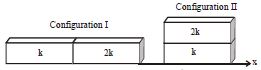
Two rectangular blocks,having identical dimensions,can be arranged either in configuration $I$ or in configuration $II$ as shown in the figure. One of the blocks has thermal conductivity $k$ and the other $2k$. The temperature difference between the ends along the $x-$ axis is the same in both the configurations. It takes $9 \ s$ to transport a certain amount of heat from the hot end to the cold end in the configuration $I$. The time to transport the same amount of heat in the configuration $II$ is .......... $\sec$.
A
$2.0$
B
$3.0$
C
$4.5$
D
$6.0$
Solution
(A) Let the length of each block be $\ell$ and the cross-sectional area be $A$. The thermal resistance of a block is given by $R = \frac{\ell}{K A}$.
For the block with conductivity $k$,$R_k = \frac{\ell}{k A}$. Let $R_k = 2R_0$,then the resistance of the block with conductivity $2k$ is $R_{2k} = \frac{\ell}{2k A} = R_0$.
In configuration $I$ (series): The total thermal resistance is $R_I = R_k + R_{2k} = 2R_0 + R_0 = 3R_0$. The heat flow rate is $H_I = \frac{\Delta T}{R_I} = \frac{\Delta T}{3R_0}$. The heat transported in time $t_I = 9 \ s$ is $Q = H_I \cdot t_I = \frac{\Delta T}{3R_0} \cdot 9 = \frac{3 \Delta T}{R_0}$.
In configuration $II$ (parallel): The total thermal resistance is $\frac{1}{R_{II}} = \frac{1}{R_k} + \frac{1}{R_{2k}} = \frac{1}{2R_0} + \frac{1}{R_0} = \frac{3}{2R_0}$,so $R_{II} = \frac{2R_0}{3}$. The heat flow rate is $H_{II} = \frac{\Delta T}{R_{II}} = \frac{3 \Delta T}{2R_0}$.
To transport the same amount of heat $Q$,the time $t_{II}$ is given by $Q = H_{II} \cdot t_{II} \Rightarrow \frac{3 \Delta T}{R_0} = \frac{3 \Delta T}{2R_0} \cdot t_{II}$.
Solving for $t_{II}$,we get $t_{II} = 2 \ s$.
For the block with conductivity $k$,$R_k = \frac{\ell}{k A}$. Let $R_k = 2R_0$,then the resistance of the block with conductivity $2k$ is $R_{2k} = \frac{\ell}{2k A} = R_0$.
In configuration $I$ (series): The total thermal resistance is $R_I = R_k + R_{2k} = 2R_0 + R_0 = 3R_0$. The heat flow rate is $H_I = \frac{\Delta T}{R_I} = \frac{\Delta T}{3R_0}$. The heat transported in time $t_I = 9 \ s$ is $Q = H_I \cdot t_I = \frac{\Delta T}{3R_0} \cdot 9 = \frac{3 \Delta T}{R_0}$.
In configuration $II$ (parallel): The total thermal resistance is $\frac{1}{R_{II}} = \frac{1}{R_k} + \frac{1}{R_{2k}} = \frac{1}{2R_0} + \frac{1}{R_0} = \frac{3}{2R_0}$,so $R_{II} = \frac{2R_0}{3}$. The heat flow rate is $H_{II} = \frac{\Delta T}{R_{II}} = \frac{3 \Delta T}{2R_0}$.
To transport the same amount of heat $Q$,the time $t_{II}$ is given by $Q = H_{II} \cdot t_{II} \Rightarrow \frac{3 \Delta T}{R_0} = \frac{3 \Delta T}{2R_0} \cdot t_{II}$.
Solving for $t_{II}$,we get $t_{II} = 2 \ s$.
0 likesView Solution
4
ChemistryMCQIIT JEE · 2013
In the Young's double slit experiment using a monochromatic light of wavelength $\lambda$,the path difference (in terms of an integer $n$) corresponding to any point having half the peak intensity is :-
A
$(2n + 1)\frac{\lambda}{2}$
B
$(2n + 1)\frac{\lambda}{4}$
C
$(2n + 1)\frac{\lambda}{8}$
D
$(2n + 1)\frac{\lambda}{16}$
Solution
(B) The intensity at any point in the interference pattern is given by $I = 4I_0 \cos^2(\frac{\phi}{2})$,where $I_0$ is the intensity of each slit and $4I_0$ is the peak intensity $(I_{max})$.
Given that the intensity at a point is half the peak intensity,we have $I = \frac{1}{2} I_{max} = \frac{1}{2} (4I_0) = 2I_0$.
Substituting this into the intensity formula: $2I_0 = 4I_0 \cos^2(\frac{\phi}{2})$.
This simplifies to $\cos^2(\frac{\phi}{2}) = \frac{1}{2}$,which means $\cos(\frac{\phi}{2}) = \pm \frac{1}{\sqrt{2}}$.
Thus,$\frac{\phi}{2} = (2n + 1)\frac{\pi}{4}$,where $n$ is an integer.
Since the phase difference $\phi = \frac{2\pi}{\lambda} \Delta x$,we substitute this into the equation:
$\frac{1}{2} \cdot \frac{2\pi}{\lambda} \cdot \Delta x = (2n + 1)\frac{\pi}{4}$.
Solving for the path difference $\Delta x$,we get $\Delta x = (2n + 1)\frac{\lambda}{4}$.
Given that the intensity at a point is half the peak intensity,we have $I = \frac{1}{2} I_{max} = \frac{1}{2} (4I_0) = 2I_0$.
Substituting this into the intensity formula: $2I_0 = 4I_0 \cos^2(\frac{\phi}{2})$.
This simplifies to $\cos^2(\frac{\phi}{2}) = \frac{1}{2}$,which means $\cos(\frac{\phi}{2}) = \pm \frac{1}{\sqrt{2}}$.
Thus,$\frac{\phi}{2} = (2n + 1)\frac{\pi}{4}$,where $n$ is an integer.
Since the phase difference $\phi = \frac{2\pi}{\lambda} \Delta x$,we substitute this into the equation:
$\frac{1}{2} \cdot \frac{2\pi}{\lambda} \cdot \Delta x = (2n + 1)\frac{\pi}{4}$.
Solving for the path difference $\Delta x$,we get $\Delta x = (2n + 1)\frac{\lambda}{4}$.
0 likesView Solution
5
ChemistryMCQIIT JEE · 2013
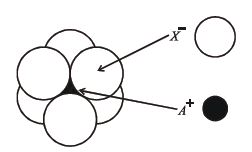
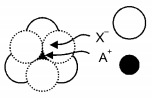
The arrangement of $X^{-}$ ions around $A^{+}$ ion in solid $AX$ is given in the figure. If the radius of $X^{-}$ is $250 \ pm$,the radius of $A^{+}$ is ............. $pm$.
A
$104$
B
$125$
C
$183$
D
$57$
Solution
(A) According to the given figure,$A^{+}$ is present in the octahedral void of $X^{-}$ ions.
The limiting radius ratio for an octahedral void is given by the formula: $r_{void} = 0.414 \times r_{sphere}$.
Here,$r_{A^{+}} = 0.414 \times r_{X^{-}}$.
Substituting the given value: $r_{A^{+}} = 0.414 \times 250 \ pm = 103.5 \ pm$.
Rounding to the nearest integer,we get $104 \ pm$.
Therefore,option $A$ is correct.
The limiting radius ratio for an octahedral void is given by the formula: $r_{void} = 0.414 \times r_{sphere}$.
Here,$r_{A^{+}} = 0.414 \times r_{X^{-}}$.
Substituting the given value: $r_{A^{+}} = 0.414 \times 250 \ pm = 103.5 \ pm$.
Rounding to the nearest integer,we get $104 \ pm$.
Therefore,option $A$ is correct.
0 likesView Solution
6
ChemistryMCQIIT JEE · 2013
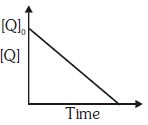
In the reaction: $P + Q \longrightarrow R + S$,the time taken for $75\%$ reaction of $P$ is twice the time taken for $50\%$ reaction of $P$. The concentration of $Q$ varies with reaction time as shown in the figure. The overall order of the reaction is:
A
$2$
B
$3$
C
$0$
D
$1$
Solution
(D) For reactant $P$:
Since $t_{75\%} = 2 \times t_{50\%}$,this is a characteristic of a first-order reaction.
Therefore,the order with respect to $P$ is $1$.
For reactant $Q$:
The linear variation of the concentration of $Q$ with time,as shown in the figure,indicates that the rate of reaction is independent of the concentration of $Q$.
Therefore,the order with respect to $Q$ is $0$.
Overall order of the reaction = (Order with respect to $P$) + (Order with respect to $Q$)
Overall order = $1 + 0 = 1$.
Correct Option is $(D)$.
Since $t_{75\%} = 2 \times t_{50\%}$,this is a characteristic of a first-order reaction.
Therefore,the order with respect to $P$ is $1$.
For reactant $Q$:
The linear variation of the concentration of $Q$ with time,as shown in the figure,indicates that the rate of reaction is independent of the concentration of $Q$.
Therefore,the order with respect to $Q$ is $0$.
Overall order of the reaction = (Order with respect to $P$) + (Order with respect to $Q$)
Overall order = $1 + 0 = 1$.
Correct Option is $(D)$.
0 likesView Solution
7
ChemistryDifficultMCQIIT JEE · 2013
The standard enthalpies of formation of $CO_{2(g)}$,$H_2O_{(\ell)}$ and glucose$_{(s)}$ at $25^{\circ} C$ are $-400 \ kJ/mol$,$-300 \ kJ/mol$ and $-1300 \ kJ/mol$,respectively. The standard enthalpy of combustion per gram of glucose at $25^{\circ} C$ is
A
$+2900 \ kJ/g$
B
$-2900 \ kJ/g$
C
$-16.11 \ kJ/g$
D
$+16.11 \ kJ/g$
Solution
(C) The combustion reaction for glucose is: $C_6H_{12}O_{6(s)} + 6O_{2(g)} \longrightarrow 6CO_{2(g)} + 6H_2O_{(\ell)}$
The standard enthalpy of combustion $(\Delta_{c}H^{\circ})$ is calculated as:
$\Delta_{c}H^{\circ} = [6 \times \Delta_{f}H^{\circ}(CO_2) + 6 \times \Delta_{f}H^{\circ}(H_2O)] - [\Delta_{f}H^{\circ}(C_6H_{12}O_6) + 6 \times \Delta_{f}H^{\circ}(O_2)]$
Substituting the given values:
$\Delta_{c}H^{\circ} = [6 \times (-400) + 6 \times (-300)] - [-1300 + 6 \times 0]$
$\Delta_{c}H^{\circ} = [-2400 - 1800] + 1300 = -4200 + 1300 = -2900 \ kJ/mol$
The molar mass of glucose $(C_6H_{12}O_6)$ is $180 \ g/mol$.
Enthalpy of combustion per gram $= \frac{-2900 \ kJ/mol}{180 \ g/mol} = -16.11 \ kJ/g$.
The standard enthalpy of combustion $(\Delta_{c}H^{\circ})$ is calculated as:
$\Delta_{c}H^{\circ} = [6 \times \Delta_{f}H^{\circ}(CO_2) + 6 \times \Delta_{f}H^{\circ}(H_2O)] - [\Delta_{f}H^{\circ}(C_6H_{12}O_6) + 6 \times \Delta_{f}H^{\circ}(O_2)]$
Substituting the given values:
$\Delta_{c}H^{\circ} = [6 \times (-400) + 6 \times (-300)] - [-1300 + 6 \times 0]$
$\Delta_{c}H^{\circ} = [-2400 - 1800] + 1300 = -4200 + 1300 = -2900 \ kJ/mol$
The molar mass of glucose $(C_6H_{12}O_6)$ is $180 \ g/mol$.
Enthalpy of combustion per gram $= \frac{-2900 \ kJ/mol}{180 \ g/mol} = -16.11 \ kJ/g$.
0 likesView Solution
8
ChemistryMCQIIT JEE · 2013
Sulfide ores are common for the metals:
A
$Ag, Cu$ and $Pb$
B
$Ag, Cu$ and $Sn$
C
$Ag, Mg$ and $Pb$
D
$Al, Cu$ and $Pb$
Solution
(A) The common ores for the given metals are as follows:
$Ag$: Argentite $(Ag_2S)$
$Cu$: Chalcopyrite $(CuFeS_2)$
$Pb$: Galena $(PbS)$
$Sn$: Cassiterite $(SnO_2)$
$Mg$: Carnallite $(KCl \cdot MgCl_2 \cdot 6H_2O)$
$Al$: Bauxite $(Al_2O_3 \cdot xH_2O)$
Among the given options,$Ag, Cu,$ and $Pb$ are commonly found as sulfide ores.
Therefore,the correct option is $(A)$.
$Ag$: Argentite $(Ag_2S)$
$Cu$: Chalcopyrite $(CuFeS_2)$
$Pb$: Galena $(PbS)$
$Sn$: Cassiterite $(SnO_2)$
$Mg$: Carnallite $(KCl \cdot MgCl_2 \cdot 6H_2O)$
$Al$: Bauxite $(Al_2O_3 \cdot xH_2O)$
Among the given options,$Ag, Cu,$ and $Pb$ are commonly found as sulfide ores.
Therefore,the correct option is $(A)$.
0 likesView Solution
9
ChemistryDifficultMCQIIT JEE · 2013
The initial rate of hydrolysis of methyl acetate $(1 \ M)$ by a weak acid $(HA, 1 \ M)$ is $1/100$th of that of a strong acid $(HX, 1 \ M)$ at $25^{\circ} C$. The $K_a$ of $HA$ is:
A
$1 \times 10^{-4}$
B
$1 \times 10^{-5}$
C
$1 \times 10^{-6}$
D
$1 \times 10^{-3}$
Solution
(A) The rate of acid-catalyzed hydrolysis of an ester is directly proportional to the concentration of $H^+$ ions,i.e.,$Rate \propto [H^+]$.
For a strong acid $(HX, 1 \ M)$,$[H^+]_{HX} = 1 \ M$.
Given that the rate with $HA$ is $1/100$th of the rate with $HX$,we have:
$\frac{Rate_{HA}}{Rate_{HX}} = \frac{[H^+]_{HA}}{[H^+]_{HX}} = \frac{1}{100}$
Since $[H^+]_{HX} = 1 \ M$,then $[H^+]_{HA} = 0.01 \ M$.
For the weak acid dissociation: $HA \rightleftharpoons H^+ + A^-$.
At equilibrium,$[H^+] = [A^-] = 0.01 \ M$ and $[HA] = 1 - 0.01 \approx 1 \ M$.
The acid dissociation constant $K_a$ is given by:
$K_a = \frac{[H^+][A^-]}{[HA]} = \frac{(0.01)(0.01)}{1} = 10^{-4}$.
For a strong acid $(HX, 1 \ M)$,$[H^+]_{HX} = 1 \ M$.
Given that the rate with $HA$ is $1/100$th of the rate with $HX$,we have:
$\frac{Rate_{HA}}{Rate_{HX}} = \frac{[H^+]_{HA}}{[H^+]_{HX}} = \frac{1}{100}$
Since $[H^+]_{HX} = 1 \ M$,then $[H^+]_{HA} = 0.01 \ M$.
For the weak acid dissociation: $HA \rightleftharpoons H^+ + A^-$.
At equilibrium,$[H^+] = [A^-] = 0.01 \ M$ and $[HA] = 1 - 0.01 \approx 1 \ M$.
The acid dissociation constant $K_a$ is given by:
$K_a = \frac{[H^+][A^-]}{[HA]} = \frac{(0.01)(0.01)}{1} = 10^{-4}$.
0 likesView Solution
10
ChemistryMediumMCQIIT JEE · 2013
The hyperconjugative stabilities of tert-butyl cation and $2-$butene,respectively,are due to
A
$\sigma \rightarrow p$ (empty) and $\sigma \rightarrow \pi^{\star}$ electron delocalisations.
B
$\sigma \rightarrow \sigma^{\star}$ and $\sigma \rightarrow \pi$ electron delocalisations.
C
$\sigma \rightarrow p$ (filled) and $\sigma \rightarrow \pi$ electron delocalisations.
D
$p$ (filled) $\rightarrow \sigma^{\star}$ and $\sigma \rightarrow \pi^{\star}$ electron delocalisations.
Solution
(A) In the tert-butyl cation,the carbon atom bearing the positive charge has one vacant $p$ orbital. Therefore,the stability is due to $\sigma \rightarrow p$ (empty) orbital delocalization,which is a form of hyperconjugation.
In $2-$butene,the stability is due to hyperconjugation involving the delocalization of electrons from a $\sigma$ bond ($C$-$H$) into the $\pi^{\star}$ antibonding molecular orbital of the double bond,represented as $\sigma \rightarrow \pi^{\star}$ delocalization.
In $2-$butene,the stability is due to hyperconjugation involving the delocalization of electrons from a $\sigma$ bond ($C$-$H$) into the $\pi^{\star}$ antibonding molecular orbital of the double bond,represented as $\sigma \rightarrow \pi^{\star}$ delocalization.
0 likesView Solution
11
ChemistryDifficultMCQIIT JEE · 2013
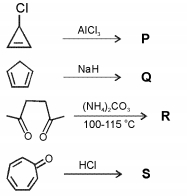
Among $P$,$Q$,$R$ and $S$,the aromatic compound$(s)$ is/are:
A
$A, B, C$
B
$A, C, D$
C
$B, C, D$
D
$A, B, C, D$
Solution
(D) $1$. $P$: Cyclopropenyl chloride reacts with $AlCl_3$ to form the cyclopropenyl cation,which is aromatic ($2\pi$ electrons,planar,cyclic,conjugated).
$2$. $Q$: Cyclopentadiene reacts with $NaH$ to form the cyclopentadienyl anion,which is aromatic ($6\pi$ electrons,planar,cyclic,conjugated).
$3$. $R$: The reaction of hexane$-2,5-$dione with $(NH_4)_2CO_3$ (Paal-Knorr synthesis) yields $2,5-$dimethylpyrrole,which is aromatic ($6\pi$ electrons,planar,cyclic,conjugated).
$4$. $S$: Tropone reacts with $HCl$ to form the hydroxy-tropylium cation,which is aromatic ($6\pi$ electrons,planar,cyclic,conjugated).
Thus,all $P$,$Q$,$R$,and $S$ are aromatic compounds.
$2$. $Q$: Cyclopentadiene reacts with $NaH$ to form the cyclopentadienyl anion,which is aromatic ($6\pi$ electrons,planar,cyclic,conjugated).
$3$. $R$: The reaction of hexane$-2,5-$dione with $(NH_4)_2CO_3$ (Paal-Knorr synthesis) yields $2,5-$dimethylpyrrole,which is aromatic ($6\pi$ electrons,planar,cyclic,conjugated).
$4$. $S$: Tropone reacts with $HCl$ to form the hydroxy-tropylium cation,which is aromatic ($6\pi$ electrons,planar,cyclic,conjugated).
Thus,all $P$,$Q$,$R$,and $S$ are aromatic compounds.
0 likesView Solution
12
ChemistryMediumMCQIIT JEE · 2013
The total number of lone pairs of electrons in melamine is
A
$6$
B
$7$
C
$8$
D
$9$
Solution
(A) Melamine is a heterocyclic organic compound with the formula $C_3H_6N_6$.
It consists of a $1,3,5$-triazine ring substituted with three amino groups at the $2, 4,$ and $6$ positions.
In the structure of melamine:
$1$. Each of the $3$ nitrogen atoms in the triazine ring has $1$ lone pair of electrons.
$2$. Each of the $3$ nitrogen atoms in the amino $(-NH_2)$ groups has $1$ lone pair of electrons.
Therefore,the total number of lone pairs of electrons in melamine is $3 + 3 = 6$.
It consists of a $1,3,5$-triazine ring substituted with three amino groups at the $2, 4,$ and $6$ positions.
In the structure of melamine:
$1$. Each of the $3$ nitrogen atoms in the triazine ring has $1$ lone pair of electrons.
$2$. Each of the $3$ nitrogen atoms in the amino $(-NH_2)$ groups has $1$ lone pair of electrons.
Therefore,the total number of lone pairs of electrons in melamine is $3 + 3 = 6$.
0 likesView Solution
13
ChemistryMediumMCQIIT JEE · 2013
The atomic masses of $He$ and $Ne$ are $4$ and $20 \ amu$,respectively. The value of the de Broglie wavelength of $He$ gas at $-73^{\circ} C$ is $M$ times that of the de Broglie wavelength of $Ne$ at $727^{\circ} C$. $M$ is
A
$3$
B
$4$
C
$5$
D
$6$
Solution
(C) The de Broglie wavelength is given by $\lambda = \frac{h}{\sqrt{2m(KE)}}$.
Since $KE = \frac{3}{2}kT$,we have $\lambda \propto \frac{1}{\sqrt{mT}}$.
For $He$ at $-73^{\circ} C$ $(200 \ K)$: $m_{He} = 4$,$T_{He} = 200 \ K$.
For $Ne$ at $727^{\circ} C$ $(1000 \ K)$: $m_{Ne} = 20$,$T_{Ne} = 1000 \ K$.
$\frac{\lambda_{He}}{\lambda_{Ne}} = \sqrt{\frac{m_{Ne} T_{Ne}}{m_{He} T_{He}}} = \sqrt{\frac{20 \times 1000}{4 \times 200}} = \sqrt{\frac{20000}{800}} = \sqrt{25} = 5$.
Thus,$M = 5$.
Since $KE = \frac{3}{2}kT$,we have $\lambda \propto \frac{1}{\sqrt{mT}}$.
For $He$ at $-73^{\circ} C$ $(200 \ K)$: $m_{He} = 4$,$T_{He} = 200 \ K$.
For $Ne$ at $727^{\circ} C$ $(1000 \ K)$: $m_{Ne} = 20$,$T_{Ne} = 1000 \ K$.
$\frac{\lambda_{He}}{\lambda_{Ne}} = \sqrt{\frac{m_{Ne} T_{Ne}}{m_{He} T_{He}}} = \sqrt{\frac{20 \times 1000}{4 \times 200}} = \sqrt{\frac{20000}{800}} = \sqrt{25} = 5$.
Thus,$M = 5$.
0 likesView Solution
14
ChemistryMCQIIT JEE · 2013
The value of $\cot \left(\sum_{n=1}^{23} \cot ^{-1}\left(1+\sum_{k=1}^n 2 k\right)\right)$ is
A
$\frac{23}{25}$
B
$\frac{25}{23}$
C
$\frac{23}{24}$
D
$\frac{24}{23}$
Solution
(B) We know that $\sum_{k=1}^n 2k = 2 \times \frac{n(n+1)}{2} = n(n+1)$.
So,the expression inside the summation becomes $\cot^{-1}(1 + n(n+1))$.
Using the identity $\cot^{-1}(x) = \tan^{-1}(\frac{1}{x})$ for $x > 0$,we have $\cot^{-1}(1 + n(n+1)) = \tan^{-1}(\frac{1}{1 + n(n+1)})$.
We can write $\frac{1}{1 + n(n+1)} = \frac{(n+1) - n}{1 + n(n+1)}$.
Using the formula $\tan^{-1}(x) - \tan^{-1}(y) = \tan^{-1}(\frac{x-y}{1+xy})$,we get $\tan^{-1}(n+1) - \tan^{-1}(n)$.
Now,the sum is $\sum_{n=1}^{23} (\tan^{-1}(n+1) - \tan^{-1}(n))$.
This is a telescoping sum: $(\tan^{-1}(2) - \tan^{-1}(1)) + (\tan^{-1}(3) - \tan^{-1}(2)) + \dots + (\tan^{-1}(24) - \tan^{-1}(23))$.
This simplifies to $\tan^{-1}(24) - \tan^{-1}(1)$.
Applying the formula again: $\tan^{-1}(\frac{24-1}{1+24\times 1}) = \tan^{-1}(\frac{23}{25})$.
Finally,we need to calculate $\cot(\tan^{-1}(\frac{23}{25})) = \cot(\cot^{-1}(\frac{25}{23})) = \frac{25}{23}$.
So,the expression inside the summation becomes $\cot^{-1}(1 + n(n+1))$.
Using the identity $\cot^{-1}(x) = \tan^{-1}(\frac{1}{x})$ for $x > 0$,we have $\cot^{-1}(1 + n(n+1)) = \tan^{-1}(\frac{1}{1 + n(n+1)})$.
We can write $\frac{1}{1 + n(n+1)} = \frac{(n+1) - n}{1 + n(n+1)}$.
Using the formula $\tan^{-1}(x) - \tan^{-1}(y) = \tan^{-1}(\frac{x-y}{1+xy})$,we get $\tan^{-1}(n+1) - \tan^{-1}(n)$.
Now,the sum is $\sum_{n=1}^{23} (\tan^{-1}(n+1) - \tan^{-1}(n))$.
This is a telescoping sum: $(\tan^{-1}(2) - \tan^{-1}(1)) + (\tan^{-1}(3) - \tan^{-1}(2)) + \dots + (\tan^{-1}(24) - \tan^{-1}(23))$.
This simplifies to $\tan^{-1}(24) - \tan^{-1}(1)$.
Applying the formula again: $\tan^{-1}(\frac{24-1}{1+24\times 1}) = \tan^{-1}(\frac{23}{25})$.
Finally,we need to calculate $\cot(\tan^{-1}(\frac{23}{25})) = \cot(\cot^{-1}(\frac{25}{23})) = \frac{25}{23}$.
0 likesView Solution
15
ChemistryMCQIIT JEE · 2013
$A$ curve passes through the point $\left(1, \frac{\pi}{6}\right)$. Let the slope of the curve at each point $(x, y)$ be $\frac{y}{x}+\sec \left(\frac{y}{x}\right)$,$x>0$. Then the equation of the curve is
A
$\sin \left(\frac{y}{x}\right)=\log x+\frac{1}{2}$
B
$\operatorname{cosec}\left(\frac{y}{x}\right)=\log x+2$
C
$\sec \left(\frac{2 y}{x}\right)=\log x+2$
D
$\cos \left(\frac{2 y}{x}\right)=\log x+\frac{1}{2}$
Solution
(A) The slope of the curve is given by $\frac{dy}{dx} = \frac{y}{x} + \sec\left(\frac{y}{x}\right)$.
This is a homogeneous differential equation. Let $v = \frac{y}{x}$,so $y = vx$ and $\frac{dy}{dx} = v + x\frac{dv}{dx}$.
Substituting these into the equation: $v + x\frac{dv}{dx} = v + \sec(v)$.
This simplifies to $x\frac{dv}{dx} = \sec(v)$,which can be rewritten as $\cos(v) dv = \frac{1}{x} dx$.
Integrating both sides: $\int \cos(v) dv = \int \frac{1}{x} dx$.
This gives $\sin(v) = \ln|x| + C$.
Substituting $v = \frac{y}{x}$ back,we get $\sin\left(\frac{y}{x}\right) = \ln|x| + C$.
The curve passes through $\left(1, \frac{\pi}{6}\right)$,so $\sin\left(\frac{\pi/6}{1}\right) = \ln(1) + C$.
Since $\sin(\pi/6) = 1/2$ and $\ln(1) = 0$,we find $C = 1/2$.
Thus,the equation of the curve is $\sin\left(\frac{y}{x}\right) = \ln x + \frac{1}{2}$.
This is a homogeneous differential equation. Let $v = \frac{y}{x}$,so $y = vx$ and $\frac{dy}{dx} = v + x\frac{dv}{dx}$.
Substituting these into the equation: $v + x\frac{dv}{dx} = v + \sec(v)$.
This simplifies to $x\frac{dv}{dx} = \sec(v)$,which can be rewritten as $\cos(v) dv = \frac{1}{x} dx$.
Integrating both sides: $\int \cos(v) dv = \int \frac{1}{x} dx$.
This gives $\sin(v) = \ln|x| + C$.
Substituting $v = \frac{y}{x}$ back,we get $\sin\left(\frac{y}{x}\right) = \ln|x| + C$.
The curve passes through $\left(1, \frac{\pi}{6}\right)$,so $\sin\left(\frac{\pi/6}{1}\right) = \ln(1) + C$.
Since $\sin(\pi/6) = 1/2$ and $\ln(1) = 0$,we find $C = 1/2$.
Thus,the equation of the curve is $\sin\left(\frac{y}{x}\right) = \ln x + \frac{1}{2}$.
0 likesView Solution
16
ChemistryDifficultMCQIIT JEE · 2013
The $K_{sp}$ of $Ag_2CrO_4$ is $1.1 \times 10^{-12}$ at $298 \ K$. The solubility (in $mol/L$) of $Ag_2CrO_4$ in a $0.1 \ M \ AgNO_3$ solution is
A
$(A) \ 1.1 \times 10^{-11}$
B
$(B) \ 1.1 \times 10^{-10}$
C
$(C) \ 1.1 \times 10^{-12}$
D
$(D) \ 1.1 \times 10^{-9}$
Solution
(B) The dissociation of $Ag_2CrO_4$ is given by: $Ag_2CrO_4(s) \rightleftharpoons 2Ag^{+}(aq) + CrO_4^{2-}(aq)$.
In the presence of $0.1 \ M \ AgNO_3$,the concentration of $Ag^{+}$ ions is dominated by the strong electrolyte $AgNO_3$,so $[Ag^{+}] \approx 0.1 \ M$.
Let $s$ be the solubility of $Ag_2CrO_4$ in $mol/L$. Then $[CrO_4^{2-}] = s$.
The solubility product expression is $K_{sp} = [Ag^{+}]^2 [CrO_4^{2-}]$.
Substituting the values: $1.1 \times 10^{-12} = (0.1)^2 \times s$.
$1.1 \times 10^{-12} = 0.01 \times s$.
$s = \frac{1.1 \times 10^{-12}}{0.01} = 1.1 \times 10^{-10} \ mol/L$.
In the presence of $0.1 \ M \ AgNO_3$,the concentration of $Ag^{+}$ ions is dominated by the strong electrolyte $AgNO_3$,so $[Ag^{+}] \approx 0.1 \ M$.
Let $s$ be the solubility of $Ag_2CrO_4$ in $mol/L$. Then $[CrO_4^{2-}] = s$.
The solubility product expression is $K_{sp} = [Ag^{+}]^2 [CrO_4^{2-}]$.
Substituting the values: $1.1 \times 10^{-12} = (0.1)^2 \times s$.
$1.1 \times 10^{-12} = 0.01 \times s$.
$s = \frac{1.1 \times 10^{-12}}{0.01} = 1.1 \times 10^{-10} \ mol/L$.
0 likesView Solution
17
ChemistryDifficultMCQIIT JEE · 2013
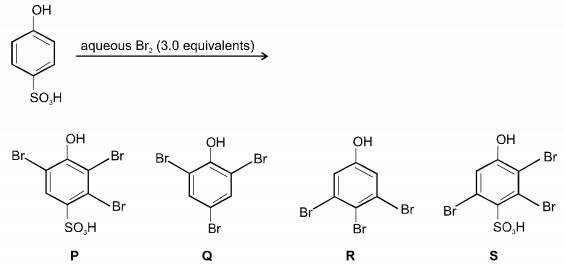
The major product$(s)$ of the following reaction is (are):
A
$P$
B
$Q$
C
$R$
D
$S$
Solution
(C) The reaction of $p$-hydroxybenzenesulfonic acid with aqueous $Br_2$ ($3.0$ equivalents) involves electrophilic aromatic substitution.
First,the highly activating $-OH$ group directs bromination to the ortho positions relative to itself.
Since the para position is already occupied by the $-SO_3H$ group,the two ortho positions are brominated.
Subsequently,the $-SO_3H$ group is a good leaving group in the presence of excess bromine and water,leading to its displacement by a third bromine atom.
This results in the formation of $2,4,6$-tribromophenol,which corresponds to structure $R$.
First,the highly activating $-OH$ group directs bromination to the ortho positions relative to itself.
Since the para position is already occupied by the $-SO_3H$ group,the two ortho positions are brominated.
Subsequently,the $-SO_3H$ group is a good leaving group in the presence of excess bromine and water,leading to its displacement by a third bromine atom.
This results in the formation of $2,4,6$-tribromophenol,which corresponds to structure $R$.
0 likesView Solution
18
ChemistryDifficultMCQIIT JEE · 2013
The correct statement$(s)$ about $O_3$ is (are)
$A$. $O-O$ bond lengths are equal.
$B$. Thermal decomposition of $O_3$ is endothermic.
$C$. $O_3$ is diamagnetic in nature.
$D$. $O_3$ has a bent structure.
$A$. $O-O$ bond lengths are equal.
$B$. Thermal decomposition of $O_3$ is endothermic.
$C$. $O_3$ is diamagnetic in nature.
$D$. $O_3$ has a bent structure.
A
$A, B, C$
B
$A, B, D$
C
$A, C, D$
D
$B, C, D$
Solution
(C) . Due to resonance,the two $O-O$ bond lengths in $O_3$ are equal $(1.28 \ \mathring{A})$. This statement is correct.
$B$. The formation of $O_3$ from $O_2$ is endothermic $(3O_2 \rightarrow 2O_3, \Delta H = +142 \ \text{kJ/mol})$. Therefore,the decomposition of $O_3$ into $O_2$ is exothermic. This statement is incorrect.
$C$. In $O_3$,all electrons are paired,making it diamagnetic. This statement is correct.
$D$. $O_3$ has a bent structure with a bond angle of approximately $117^\circ$. This statement is correct.
Thus,the correct statements are $A, C, D$.
$B$. The formation of $O_3$ from $O_2$ is endothermic $(3O_2 \rightarrow 2O_3, \Delta H = +142 \ \text{kJ/mol})$. Therefore,the decomposition of $O_3$ into $O_2$ is exothermic. This statement is incorrect.
$C$. In $O_3$,all electrons are paired,making it diamagnetic. This statement is correct.
$D$. $O_3$ has a bent structure with a bond angle of approximately $117^\circ$. This statement is correct.
Thus,the correct statements are $A, C, D$.
0 likesView Solution
19
ChemistryDifficultMCQIIT JEE · 2013
The thermal dissociation equilibrium of $CaCO_{3(s)}$ is studied under different conditions.
$CaCO_{3(s)} \rightleftharpoons CaO_{(s)} + CO_{2(g)}$
For this equilibrium,the correct statement$(s)$ is (are):
$(A)$ $\Delta H$ is dependent on $T$
$(B)$ $K$ is independent of the initial amount of $CaCO_{3}$
$(C)$ $K$ is dependent on the pressure of $CO_{2}$ at a given $T$
$(D)$ $\Delta H$ is independent of the catalyst,if any
$CaCO_{3(s)} \rightleftharpoons CaO_{(s)} + CO_{2(g)}$
For this equilibrium,the correct statement$(s)$ is (are):
$(A)$ $\Delta H$ is dependent on $T$
$(B)$ $K$ is independent of the initial amount of $CaCO_{3}$
$(C)$ $K$ is dependent on the pressure of $CO_{2}$ at a given $T$
$(D)$ $\Delta H$ is independent of the catalyst,if any
A
$(A, B, C)$
B
$(A, B, D)$
C
$(A, C, D)$
D
$(B, C, D)$
Solution
(B) According to Kirchhoff's law,$\Delta H_{T_2} - \Delta H_{T_1} = \int_{T_1}^{T_2} \Delta C_p \, dT$. Since the heat capacity change $\Delta C_p$ is generally non-zero,$\Delta H$ depends on temperature $T$.
$(B)$ The equilibrium constant $K$ for a heterogeneous reaction depends only on temperature and is independent of the initial amounts of solid reactants or products.
$(C)$ $K$ is a constant at a fixed temperature; it does not depend on the partial pressure of $CO_2$. The partial pressure of $CO_2$ at equilibrium is equal to $K_p$,which is fixed for a given $T$.
$(D)$ $A$ catalyst provides an alternative pathway with a lower activation energy but does not change the enthalpy of reaction $(\Delta H)$ or the equilibrium constant $(K)$.
$(B)$ The equilibrium constant $K$ for a heterogeneous reaction depends only on temperature and is independent of the initial amounts of solid reactants or products.
$(C)$ $K$ is a constant at a fixed temperature; it does not depend on the partial pressure of $CO_2$. The partial pressure of $CO_2$ at equilibrium is equal to $K_p$,which is fixed for a given $T$.
$(D)$ $A$ catalyst provides an alternative pathway with a lower activation energy but does not change the enthalpy of reaction $(\Delta H)$ or the equilibrium constant $(K)$.
0 likesView Solution
20
ChemistryDifficultMCQIIT JEE · 2013
$P$ and $Q$ are isomers of dicarboxylic acid $C_4H_4O_4$. Both decolorize $Br_2/H_2O$. On heating,$P$ forms a cyclic anhydride.
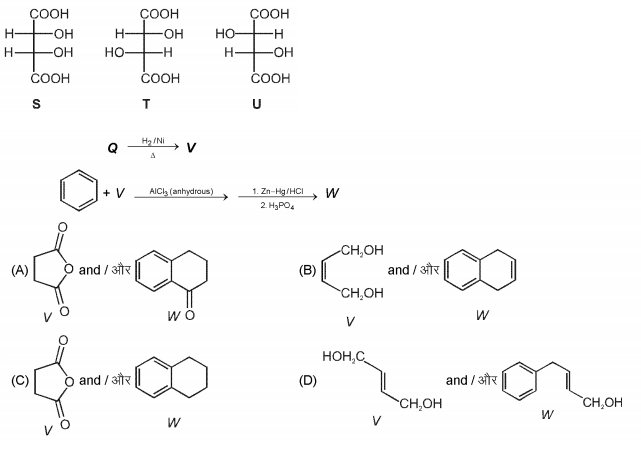
Upon treatment with dilute alkaline $KMnO_4$,$P$ as well as $Q$ could produce one or more than one from $S$,$T$,and $U$.
$1.$ Compounds formed from $P$ and $Q$ are,respectively:
$(A)$ Optically active $S$ and optically active pair $(T, U)$
$(B)$ Optically inactive $S$ and optically inactive pair $(T, U)$
$(C)$ Optically active pair $(T, U)$ and optically active $S$
$(D)$ Optically inactive pair $(T, U)$ and optically inactive $S$
$2.$ In the following reaction sequences,$V$ and $W$ are respectively:
Give the answer for question $1$ and $2$.
Upon treatment with dilute alkaline $KMnO_4$,$P$ as well as $Q$ could produce one or more than one from $S$,$T$,and $U$.
$1.$ Compounds formed from $P$ and $Q$ are,respectively:
$(A)$ Optically active $S$ and optically active pair $(T, U)$
$(B)$ Optically inactive $S$ and optically inactive pair $(T, U)$
$(C)$ Optically active pair $(T, U)$ and optically active $S$
$(D)$ Optically inactive pair $(T, U)$ and optically inactive $S$
$2.$ In the following reaction sequences,$V$ and $W$ are respectively:
Give the answer for question $1$ and $2$.
A
$(B, A)$
B
$(B, D)$
C
$(B, C)$
D
$(A, C)$
Solution
(A) $P$ is maleic acid (cis-butenedioic acid) and $Q$ is fumaric acid (trans-butenedioic acid).
$1.$ Syn-hydroxylation of $P$ (cis) with alkaline $KMnO_4$ yields meso-tartaric acid $(S)$,which is optically inactive.
Syn-hydroxylation of $Q$ (trans) with alkaline $KMnO_4$ yields a racemic mixture of $(+)$-tartaric acid and $(-)$-tartaric acid ($T$ and $U$),which is optically inactive.
Thus,$P$ forms optically inactive $S$ and $Q$ forms optically inactive pair $(T, U)$. The correct option for $1$ is $(B)$.
$2.$ $Q$ (fumaric acid) on hydrogenation gives succinic acid,which on heating forms succinic anhydride $(V)$.
Reaction of benzene with succinic anhydride $(V)$ in the presence of anhydrous $AlCl_3$ (Friedel-Crafts acylation) followed by Clemmensen reduction $(Zn-Hg/HCl)$ and cyclization with $H_3PO_4$ yields $\alpha$-tetralone $(W)$.
Thus,$V$ is succinic anhydride and $W$ is $\alpha$-tetralone. The correct option for $2$ is $(A)$.
Therefore,the answer is $(B, A)$.
$1.$ Syn-hydroxylation of $P$ (cis) with alkaline $KMnO_4$ yields meso-tartaric acid $(S)$,which is optically inactive.
Syn-hydroxylation of $Q$ (trans) with alkaline $KMnO_4$ yields a racemic mixture of $(+)$-tartaric acid and $(-)$-tartaric acid ($T$ and $U$),which is optically inactive.
Thus,$P$ forms optically inactive $S$ and $Q$ forms optically inactive pair $(T, U)$. The correct option for $1$ is $(B)$.
$2.$ $Q$ (fumaric acid) on hydrogenation gives succinic acid,which on heating forms succinic anhydride $(V)$.
Reaction of benzene with succinic anhydride $(V)$ in the presence of anhydrous $AlCl_3$ (Friedel-Crafts acylation) followed by Clemmensen reduction $(Zn-Hg/HCl)$ and cyclization with $H_3PO_4$ yields $\alpha$-tetralone $(W)$.
Thus,$V$ is succinic anhydride and $W$ is $\alpha$-tetralone. The correct option for $2$ is $(A)$.
Therefore,the answer is $(B, A)$.
0 likesView Solution
21
ChemistryAdvancedMCQIIT JEE · 2013
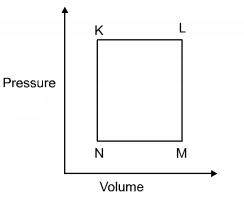
$A$ fixed mass '$m$' of a gas is subjected to a transformation of states from $K$ to $L$ to $M$ to $N$ and back to $K$ as shown in the figure.
$1.$ The succeeding operations that enable this transformation of states are:
$(A)$ Heating,cooling,heating,cooling
$(B)$ Cooling,heating,cooling,heating
$(C)$ Heating,cooling,cooling,heating
$(D)$ Cooling,heating,heating,cooling
$2.$ The pair of isochoric processes among the transformation of states is:
$(A)$ $K$ to $L$ and $L$ to $M$
$(B)$ $L$ to $M$ and $N$ to $K$
$(C)$ $L$ to $M$ and $M$ to $N$
$(D)$ $M$ to $N$ and $N$ to $K$
Give the answer for question $1$ and $2$.
$1.$ The succeeding operations that enable this transformation of states are:
$(A)$ Heating,cooling,heating,cooling
$(B)$ Cooling,heating,cooling,heating
$(C)$ Heating,cooling,cooling,heating
$(D)$ Cooling,heating,heating,cooling
$2.$ The pair of isochoric processes among the transformation of states is:
$(A)$ $K$ to $L$ and $L$ to $M$
$(B)$ $L$ to $M$ and $N$ to $K$
$(C)$ $L$ to $M$ and $M$ to $N$
$(D)$ $M$ to $N$ and $N$ to $K$
Give the answer for question $1$ and $2$.
A
$(B, D)$
B
$(C, B)$
C
$(B, C)$
D
$(A, C)$
Solution
(B) $1.$ In the $P-V$ diagram:
$K \rightarrow L$: Constant pressure $(P)$,volume $(V)$ increases. By Charles's Law $(V \propto T)$,$T$ increases (Heating).
$L \rightarrow M$: Constant volume $(V)$,pressure $(P)$ decreases. By Gay-Lussac's Law $(P \propto T)$,$T$ decreases (Cooling).
$M \rightarrow N$: Constant pressure $(P)$,volume $(V)$ decreases. By Charles's Law,$T$ decreases (Cooling).
$N \rightarrow K$: Constant volume $(V)$,pressure $(P)$ increases. By Gay-Lussac's Law,$T$ increases (Heating).
Thus,the sequence is Heating,Cooling,Cooling,Heating,which corresponds to option $(C)$.
$2.$ An isochoric process is one where volume remains constant. In the diagram,the vertical lines represent constant volume processes.
These are $L \rightarrow M$ and $N \rightarrow K$. This corresponds to option $(B)$.
Therefore,the correct answer is $(C, B)$.
$K \rightarrow L$: Constant pressure $(P)$,volume $(V)$ increases. By Charles's Law $(V \propto T)$,$T$ increases (Heating).
$L \rightarrow M$: Constant volume $(V)$,pressure $(P)$ decreases. By Gay-Lussac's Law $(P \propto T)$,$T$ decreases (Cooling).
$M \rightarrow N$: Constant pressure $(P)$,volume $(V)$ decreases. By Charles's Law,$T$ decreases (Cooling).
$N \rightarrow K$: Constant volume $(V)$,pressure $(P)$ increases. By Gay-Lussac's Law,$T$ increases (Heating).
Thus,the sequence is Heating,Cooling,Cooling,Heating,which corresponds to option $(C)$.
$2.$ An isochoric process is one where volume remains constant. In the diagram,the vertical lines represent constant volume processes.
These are $L \rightarrow M$ and $N \rightarrow K$. This corresponds to option $(B)$.
Therefore,the correct answer is $(C, B)$.
0 likesView Solution
22
ChemistryDifficultMCQIIT JEE · 2013
The unbalanced chemical reactions given in List-$I$ show missing reagent or condition $(?)$ which are provided in List-$II$. Match List-$I$ with List-$II$ and select the correct answer using the code given below the lists:
Codes: $P \quad Q \quad R \quad S$
| List-$I$ | List-$II$ |
| $P. \ PbO_2 + H_2SO_4 \xrightarrow{?} PbSO_4 + O_2 + \text{other product}$ | $1. \ NO$ |
| $Q. \ Na_2S_2O_3 + H_2O \xrightarrow{?} NaHSO_4 + \text{other product}$ | $2. \ I_2$ |
| $R. \ N_2H_4 \xrightarrow{?} N_2 + \text{other product}$ | $3. \ \text{Warm}$ |
| $S. \ XeF_2 \xrightarrow{?} Xe + \text{other product}$ | $4. \ Cl_2$ |
Codes: $P \quad Q \quad R \quad S$
A
$4 \quad 2 \quad 3 \quad 1$
B
$3 \quad 2 \quad 1 \quad 4$
C
$1 \quad 4 \quad 2 \quad 3$
D
$3 \quad 4 \quad 2 \quad 1$
Solution
(D) $(P) \ 2PbO_2 + 2H_2SO_4 \xrightarrow{\text{warm}} 2PbSO_4 + O_2 + 2H_2O$
$(Q) \ Na_2S_2O_3 + 5H_2O + 4Cl_2 \rightarrow 2NaHSO_4 + 8HCl$
$(R) \ N_2H_4 + 2I_2 \rightarrow N_2 + 4HI$
$(S) \ XeF_2 + 2NO \rightarrow Xe + 2NOF$
Matching the reagents/conditions:
$P \rightarrow 3$ (Warm)
$Q \rightarrow 4$ $(Cl_2)$
$R \rightarrow 2$ $(I_2)$
$S \rightarrow 1$ $(NO)$
Therefore,the correct sequence is $P-3, Q-4, R-2, S-1$. Hence,the correct answer is $(D)$.
$(Q) \ Na_2S_2O_3 + 5H_2O + 4Cl_2 \rightarrow 2NaHSO_4 + 8HCl$
$(R) \ N_2H_4 + 2I_2 \rightarrow N_2 + 4HI$
$(S) \ XeF_2 + 2NO \rightarrow Xe + 2NOF$
Matching the reagents/conditions:
$P \rightarrow 3$ (Warm)
$Q \rightarrow 4$ $(Cl_2)$
$R \rightarrow 2$ $(I_2)$
$S \rightarrow 1$ $(NO)$
Therefore,the correct sequence is $P-3, Q-4, R-2, S-1$. Hence,the correct answer is $(D)$.
0 likesView Solution
23
ChemistryMCQIIT JEE · 2013
$A$ curve passes through the point $\left(1, \frac{\pi}{6}\right)$. Let the slope of the curve at each point $(x, y)$ be $\frac{y}{x}+\sec \left(\frac{y}{x}\right)$,where $x>0$. Then,the equation of the curve is:
A
$\sin \left(\frac{y}{x}\right)=\log (x)+\frac{1}{2}$
B
$\operatorname{cosec}\left(\frac{y}{x}\right)=\log (x)+2$
C
$\sec \left(\frac{2 y}{x}\right)=\log (x)+2$
D
$\cos \left(\frac{2 y}{x}\right)=\log (x)+\frac{1}{2}$
Solution
(A) The given differential equation is $\frac{dy}{dx} = \frac{y}{x} + \sec \left(\frac{y}{x}\right)$.
This is a homogeneous differential equation. Let $y = vx$,so $\frac{dy}{dx} = v + x \frac{dv}{dx}$.
Substituting these into the equation: $v + x \frac{dv}{dx} = v + \sec(v)$.
This simplifies to $x \frac{dv}{dx} = \sec(v)$,which can be written as $\cos(v) dv = \frac{1}{x} dx$.
Integrating both sides: $\int \cos(v) dv = \int \frac{1}{x} dx$,which gives $\sin(v) = \log(x) + c$.
Substituting $v = \frac{y}{x}$ back,we get $\sin \left(\frac{y}{x}\right) = \log(x) + c$.
The curve passes through $\left(1, \frac{\pi}{6}\right)$,so $\sin \left(\frac{\pi/6}{1}\right) = \log(1) + c$.
Since $\sin \left(\frac{\pi}{6}\right) = \frac{1}{2}$ and $\log(1) = 0$,we have $c = \frac{1}{2}$.
Thus,the equation of the curve is $\sin \left(\frac{y}{x}\right) = \log(x) + \frac{1}{2}$.
This is a homogeneous differential equation. Let $y = vx$,so $\frac{dy}{dx} = v + x \frac{dv}{dx}$.
Substituting these into the equation: $v + x \frac{dv}{dx} = v + \sec(v)$.
This simplifies to $x \frac{dv}{dx} = \sec(v)$,which can be written as $\cos(v) dv = \frac{1}{x} dx$.
Integrating both sides: $\int \cos(v) dv = \int \frac{1}{x} dx$,which gives $\sin(v) = \log(x) + c$.
Substituting $v = \frac{y}{x}$ back,we get $\sin \left(\frac{y}{x}\right) = \log(x) + c$.
The curve passes through $\left(1, \frac{\pi}{6}\right)$,so $\sin \left(\frac{\pi/6}{1}\right) = \log(1) + c$.
Since $\sin \left(\frac{\pi}{6}\right) = \frac{1}{2}$ and $\log(1) = 0$,we have $c = \frac{1}{2}$.
Thus,the equation of the curve is $\sin \left(\frac{y}{x}\right) = \log(x) + \frac{1}{2}$.
0 likesView Solution
24
ChemistryMediumMCQIIT JEE · 2013
Sulfide ores are common for the metals
A
$Ag, Cu$ and $Pb$
B
$Ag, Cu$ and $Sn$
C
$Ag, Mg$ and $Pb$
D
$Al, Cu$ and $Pb$
Solution
(A) Silver,copper,and lead are commonly found in the Earth's crust as sulfide ores:
$Ag_2S$ (silver glance),
$CuFeS_2$ (copper pyrites),and
$PbS$ (galena).
$Ag_2S$ (silver glance),
$CuFeS_2$ (copper pyrites),and
$PbS$ (galena).
0 likesView Solution
25
ChemistryDifficultMCQIIT JEE · 2013
$KI$ in acetone undergoes $S_N2$ reaction with each $P, Q, R$ and $S$. The rates of the reaction vary as:
$P: CH_3-Cl$
$Q: (CH_3)_2CH-Cl$
$R: CH_2=CH-CH_2-Cl$
$S: C_6H_5-CO-CH_2-Cl$
$P: CH_3-Cl$
$Q: (CH_3)_2CH-Cl$
$R: CH_2=CH-CH_2-Cl$
$S: C_6H_5-CO-CH_2-Cl$
A
$P > Q > R > S$
B
$S > R > P > Q$
C
$P > R > Q > S$
D
$R > P > S > Q$
Solution
(B) The rate of $S_N2$ reaction depends on steric hindrance and the presence of electron-withdrawing groups at the $\alpha$-carbon.
$1$. $S$ $(C_6H_5-CO-CH_2-Cl)$: The carbonyl group $(C=O)$ is strongly electron-withdrawing due to the $-I$ and $-M$ effects,which stabilizes the transition state,making it highly reactive.
$2$. $R$ $(CH_2=CH-CH_2-Cl)$: This is an allylic halide. The transition state is stabilized by conjugation with the double bond,making it more reactive than primary alkyl halides.
$3$. $P$ $(CH_3-Cl)$: This is a primary alkyl halide with minimal steric hindrance.
$4$. $Q$ $((CH_3)_2CH-Cl)$: This is a secondary alkyl halide,which is the least reactive due to higher steric hindrance compared to the others.
Therefore,the order of reactivity is $S > R > P > Q$.
$1$. $S$ $(C_6H_5-CO-CH_2-Cl)$: The carbonyl group $(C=O)$ is strongly electron-withdrawing due to the $-I$ and $-M$ effects,which stabilizes the transition state,making it highly reactive.
$2$. $R$ $(CH_2=CH-CH_2-Cl)$: This is an allylic halide. The transition state is stabilized by conjugation with the double bond,making it more reactive than primary alkyl halides.
$3$. $P$ $(CH_3-Cl)$: This is a primary alkyl halide with minimal steric hindrance.
$4$. $Q$ $((CH_3)_2CH-Cl)$: This is a secondary alkyl halide,which is the least reactive due to higher steric hindrance compared to the others.
Therefore,the order of reactivity is $S > R > P > Q$.
0 likesView Solution
26
ChemistryMediumMCQIIT JEE · 2013
The compound that does $NOT$ liberate $CO_2$ on treatment with aqueous sodium bicarbonate solution is:
A
Benzoic acid
B
Benzenesulphonic acid
C
Salicylic acid
D
Carbolic acid (Phenol)
Solution
(D) Sodium bicarbonate $(NaHCO_3)$ reacts with acids that are stronger than carbonic acid $(H_2CO_3)$ to liberate $CO_2$ gas.
Benzoic acid,benzenesulphonic acid,and salicylic acid are stronger acids than $H_2CO_3$ and thus liberate $CO_2$.
Phenol (carbolic acid) is a weaker acid than $H_2CO_3$ and therefore does not react with $NaHCO_3$ to liberate $CO_2$.
Benzoic acid,benzenesulphonic acid,and salicylic acid are stronger acids than $H_2CO_3$ and thus liberate $CO_2$.
Phenol (carbolic acid) is a weaker acid than $H_2CO_3$ and therefore does not react with $NaHCO_3$ to liberate $CO_2$.
0 likesView Solution
27
ChemistryDifficultMCQIIT JEE · 2013
Consider the following complex ions,$P$,$Q$ and $R$.
$P = [FeF_6]^{3-}$,$Q = [V(H_2O)_6]^{2+}$ and $R = [Fe(H_2O)_6]^{2+}$.
The correct order of the complex ions,according to their spin-only magnetic moment values (in $B.M.$) is
$P = [FeF_6]^{3-}$,$Q = [V(H_2O)_6]^{2+}$ and $R = [Fe(H_2O)_6]^{2+}$.
The correct order of the complex ions,according to their spin-only magnetic moment values (in $B.M.$) is
A
$R < Q < P$
B
$Q < R < P$
C
$R < P < Q$
D
$Q < P < R$
Solution
(B) $P = [FeF_6]^{3-}$,oxidation number of $Fe = +3$,configuration: $3d^5$.
Since $F^-$ is a weak field ligand,no pairing occurs,resulting in $5$ unpaired electrons.
$Q = [V(H_2O)_6]^{2+}$,oxidation number of $V = +2$,configuration: $3d^3$.
It has $3$ unpaired electrons.
$R = [Fe(H_2O)_6]^{2+}$,oxidation number of $Fe = +2$,configuration: $3d^6$.
Since $H_2O$ is a weak field ligand,no pairing occurs,resulting in $4$ unpaired electrons.
The spin-only magnetic moment is given by $\mu = \sqrt{n(n+2)} \ B.M.$,where $n$ is the number of unpaired electrons.
Number of unpaired electrons: $Q(3) < R(4) < P(5)$.
Therefore,the order of magnetic moments is $Q < R < P$.
Thus,the correct option is $B$.
Since $F^-$ is a weak field ligand,no pairing occurs,resulting in $5$ unpaired electrons.
$Q = [V(H_2O)_6]^{2+}$,oxidation number of $V = +2$,configuration: $3d^3$.
It has $3$ unpaired electrons.
$R = [Fe(H_2O)_6]^{2+}$,oxidation number of $Fe = +2$,configuration: $3d^6$.
Since $H_2O$ is a weak field ligand,no pairing occurs,resulting in $4$ unpaired electrons.
The spin-only magnetic moment is given by $\mu = \sqrt{n(n+2)} \ B.M.$,where $n$ is the number of unpaired electrons.
Number of unpaired electrons: $Q(3) < R(4) < P(5)$.
Therefore,the order of magnetic moments is $Q < R < P$.
Thus,the correct option is $B$.
0 likesView Solution
28
ChemistryMediumMCQIIT JEE · 2013
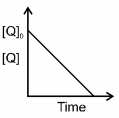
In the reaction,$P + Q \longrightarrow R + S$,the time taken for $75 \%$ reaction of $P$ is twice the time taken for $50 \%$ reaction of $P$. The concentration of $Q$ varies with reaction time as shown in the figure. The overall order of the reaction is
A
$2$
B
$3$
C
$0$
D
$1$
Solution
(D) For reactant $P$,the time taken for $75 \%$ completion $(t_{75 \%})$ is twice the time taken for $50 \%$ completion $(t_{50 \%})$,i.e.,$t_{75 \%} = 2 \times t_{50 \%}$.
This relationship is characteristic of a first-order reaction.
Therefore,the order of the reaction with respect to $P$ is $1$.
For reactant $Q$,the graph shows that the concentration $[Q]$ decreases linearly with time. $A$ linear decrease in concentration with time indicates that the rate of reaction is independent of the concentration of $Q$.
Therefore,the order of the reaction with respect to $Q$ is $0$.
The overall order of the reaction is the sum of the individual orders: $1 + 0 = 1$.
This relationship is characteristic of a first-order reaction.
Therefore,the order of the reaction with respect to $P$ is $1$.
For reactant $Q$,the graph shows that the concentration $[Q]$ decreases linearly with time. $A$ linear decrease in concentration with time indicates that the rate of reaction is independent of the concentration of $Q$.
Therefore,the order of the reaction with respect to $Q$ is $0$.
The overall order of the reaction is the sum of the individual orders: $1 + 0 = 1$.
0 likesView Solution
29
ChemistryMediumMCQIIT JEE · 2013
Concentrated nitric acid,upon long standing,turns yellow-brown due to the formation of
A
$NO$
B
$NO_2$
C
$N_2O$
D
$N_2O_4$
Solution
(B) Concentrated $HNO_3$ is light-sensitive and undergoes thermal decomposition upon long standing to produce nitrogen dioxide $(NO_2)$,which is a brown gas.
The decomposition reaction is:
$4HNO_3 \longrightarrow 2H_2O + 4NO_2 + O_2$
The dissolved $NO_2$ imparts a yellow-brown color to the acid.
The decomposition reaction is:
$4HNO_3 \longrightarrow 2H_2O + 4NO_2 + O_2$
The dissolved $NO_2$ imparts a yellow-brown color to the acid.
0 likesView Solution
30
ChemistryMediumMCQIIT JEE · 2013
The arrangement of $X^{-}$ ions around $A^{+}$ ion in solid $AX$ is given in the figure. If the radius of $X^{-}$ is $250 \ pm$, the radius of $A^{+}$ is: (in $pm$)
A
$104$
B
$125$
C
$183$
D
$57$
Solution
(A) The figure shows an $A^{+}$ ion surrounded by three $X^{-}$ ions in a triangular planar arrangement, which corresponds to a trigonal planar void.
For a trigonal planar void, the limiting radius ratio is given by:
$\frac{r_{A^{+}}}{r_{X^{-}}} = 0.155$
Given $r_{X^{-}} = 250 \ pm$, we calculate:
$r_{A^{+}} = 0.155 \times 250 \ pm = 38.75 \ pm$.
However, looking at the options provided and the geometry of the figure, it represents a coordination number of $3$. If we assume the question implies the minimum radius for stability in this geometry, the value is $38.75 \ pm$. Given the options, there might be a discrepancy in the provided figure or options. Re-evaluating the figure, it shows a central ion in a triangular hole. Based on standard chemistry problems of this type, if the intended geometry was octahedral, the ratio is $0.414$, giving $103.5 \ pm$, which is closest to $104 \ pm$.
For a trigonal planar void, the limiting radius ratio is given by:
$\frac{r_{A^{+}}}{r_{X^{-}}} = 0.155$
Given $r_{X^{-}} = 250 \ pm$, we calculate:
$r_{A^{+}} = 0.155 \times 250 \ pm = 38.75 \ pm$.
However, looking at the options provided and the geometry of the figure, it represents a coordination number of $3$. If we assume the question implies the minimum radius for stability in this geometry, the value is $38.75 \ pm$. Given the options, there might be a discrepancy in the provided figure or options. Re-evaluating the figure, it shows a central ion in a triangular hole. Based on standard chemistry problems of this type, if the intended geometry was octahedral, the ratio is $0.414$, giving $103.5 \ pm$, which is closest to $104 \ pm$.
0 likesView Solution
31
ChemistryAdvancedMCQIIT JEE · 2013
Upon treatment with ammoniacal $H_2S$,the metal ion that precipitates as a sulfide is
A
$Fe(III)$
B
$Al(III)$
C
$Mg(II)$
D
$Zn(II)$
Solution
(D) Ammoniacal $H_2S$ is the group reagent for the fourth group of cationic radicals in qualitative analysis.
$Fe^{3+}$ and $Al^{3+}$ belong to the third group and precipitate as hydroxides,$Fe(OH)_3$ and $Al(OH)_3$,in the presence of $NH_4OH$ and $NH_4Cl$.
$Mg^{2+}$ does not precipitate with $H_2S$ in the presence of $NH_4OH$.
$Zn^{2+}$ belongs to the fourth group and reacts with $H_2S$ in the presence of $NH_4OH$ to form a white precipitate of $ZnS$.
$Fe^{3+}$ and $Al^{3+}$ belong to the third group and precipitate as hydroxides,$Fe(OH)_3$ and $Al(OH)_3$,in the presence of $NH_4OH$ and $NH_4Cl$.
$Mg^{2+}$ does not precipitate with $H_2S$ in the presence of $NH_4OH$.
$Zn^{2+}$ belongs to the fourth group and reacts with $H_2S$ in the presence of $NH_4OH$ to form a white precipitate of $ZnS$.
0 likesView Solution
32
ChemistryMediumMCQIIT JEE · 2013
Methylene blue,from its aqueous solution,is adsorbed on activated charcoal at $25 \ ^{\circ}C$. For this process,the correct statement is
A
The adsorption requires activation at $25 \ ^{\circ}C$.
B
The adsorption is accompanied by a decrease in enthalpy.
C
The adsorption increases with increase of temperature.
D
The adsorption is irreversible.
Solution
(B) The adsorption of methylene blue on activated charcoal is a physical adsorption process (physisorption).
Physical adsorption is an exothermic process,which means it is accompanied by a decrease in enthalpy $(\Delta H < 0)$.
Physical adsorption is an exothermic process,which means it is accompanied by a decrease in enthalpy $(\Delta H < 0)$.
0 likesView Solution
33
ChemistryMediumMCQIIT JEE · 2013
Benzene and naphthalene form an ideal solution at room temperature. For this process,the true statement$(s)$ is (are)
$(A)$ $\Delta G$ is positive
$(B)$ $\Delta S_{\text{system}}$ is positive
$(C)$ $\Delta S_{\text{surroundings}} = 0$
$(D)$ $\Delta H = 0$
$(A)$ $\Delta G$ is positive
$(B)$ $\Delta S_{\text{system}}$ is positive
$(C)$ $\Delta S_{\text{surroundings}} = 0$
$(D)$ $\Delta H = 0$
A
$(A, B, C)$
B
$(A, B, D)$
C
$(A, C, D)$
D
$(B, C, D)$
Solution
(D) For the formation of an ideal solution:
$1$. $\Delta G < 0$ (The process is spontaneous).
$2$. $\Delta S_{\text{system}} > 0$ (Mixing increases the entropy of the system).
$3$. $\Delta H = 0$ (There is no enthalpy change upon mixing for an ideal solution).
$4$. $\Delta S_{\text{surroundings}} = -\frac{\Delta H}{T}$. Since $\Delta H = 0$,$\Delta S_{\text{surroundings}} = 0$.
Therefore,statements $(B)$,$(C)$,and $(D)$ are correct.
$1$. $\Delta G < 0$ (The process is spontaneous).
$2$. $\Delta S_{\text{system}} > 0$ (Mixing increases the entropy of the system).
$3$. $\Delta H = 0$ (There is no enthalpy change upon mixing for an ideal solution).
$4$. $\Delta S_{\text{surroundings}} = -\frac{\Delta H}{T}$. Since $\Delta H = 0$,$\Delta S_{\text{surroundings}} = 0$.
Therefore,statements $(B)$,$(C)$,and $(D)$ are correct.
0 likesView Solution
34
ChemistryDifficultMCQIIT JEE · 2013
The pair$(s)$ of coordination complexes/ions exhibiting the same kind of isomerism is(are)
$(A)$ $[Cr(NH_3)_5Cl]Cl_2$ and $[Cr(NH_3)_4Cl_2]Cl$
$(B)$ $[Co(NH_3)_4Cl_2]^+$ and $[Pt(NH_3)_2(H_2O)Cl]^+$
$(C)$ $[CoBr_2Cl_2]^{2-}$ and $[PtBr_2Cl_2]^{2-}$
$(D)$ $[Pt(NH_3)_3(NO_3)]Cl$ and $[Pt(NH_3)_3Cl]Br$
$(A)$ $[Cr(NH_3)_5Cl]Cl_2$ and $[Cr(NH_3)_4Cl_2]Cl$
$(B)$ $[Co(NH_3)_4Cl_2]^+$ and $[Pt(NH_3)_2(H_2O)Cl]^+$
$(C)$ $[CoBr_2Cl_2]^{2-}$ and $[PtBr_2Cl_2]^{2-}$
$(D)$ $[Pt(NH_3)_3(NO_3)]Cl$ and $[Pt(NH_3)_3Cl]Br$
A
$(B, D)$
B
$(B, C)$
C
$(A, D)$
D
$(C, D)$
Solution
(A) $[Cr(NH_3)_5Cl]Cl_2$ and $[Cr(NH_3)_4Cl_2]Cl$ exhibit ionisation isomerism.
$(B)$ $[Co(NH_3)_4Cl_2]^+$ (octahedral,$Ma_4b_2$ type) and $[Pt(NH_3)_2(H_2O)Cl]^+$ (square planar,$Ma_2bc$ type) both exhibit geometrical isomerism.
$(C)$ $[CoBr_2Cl_2]^{2-}$ (tetrahedral,$Ma_2b_2$ type) does not show geometrical isomerism,whereas $[PtBr_2Cl_2]^{2-}$ (square planar,$Ma_2b_2$ type) does.
$(D)$ $[Pt(NH_3)_3(NO_3)]Cl$ and $[Pt(NH_3)_3Cl]Br$ both exhibit ionisation isomerism.
Therefore,pairs $(B)$ and $(D)$ exhibit the same kind of isomerism.
$(B)$ $[Co(NH_3)_4Cl_2]^+$ (octahedral,$Ma_4b_2$ type) and $[Pt(NH_3)_2(H_2O)Cl]^+$ (square planar,$Ma_2bc$ type) both exhibit geometrical isomerism.
$(C)$ $[CoBr_2Cl_2]^{2-}$ (tetrahedral,$Ma_2b_2$ type) does not show geometrical isomerism,whereas $[PtBr_2Cl_2]^{2-}$ (square planar,$Ma_2b_2$ type) does.
$(D)$ $[Pt(NH_3)_3(NO_3)]Cl$ and $[Pt(NH_3)_3Cl]Br$ both exhibit ionisation isomerism.
Therefore,pairs $(B)$ and $(D)$ exhibit the same kind of isomerism.
0 likesView Solution
35
ChemistryDifficultMCQIIT JEE · 2013
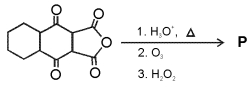
The total number of carboxylic acid groups in the product $P$ is
A
$1$
B
$2$
C
$3$
D
$4$
Solution
(B) The reaction proceeds as follows:
$1$. Hydrolysis of the anhydride group with $H_3O $ gives a dicarboxylic acid.
$2$. Heating $(\Delta)$ causes decarboxylation of the two carboxylic acid groups,resulting in a diketone.
$3$. Ozonolysis $(O_3/H_2O_2)$ of the remaining double bond cleaves the ring to form a product $P$ containing two carboxylic acid groups.
Thus,the total number of $-COOH$ groups in the final product $P$ is $2$.
$1$. Hydrolysis of the anhydride group with $H_3O $ gives a dicarboxylic acid.
$2$. Heating $(\Delta)$ causes decarboxylation of the two carboxylic acid groups,resulting in a diketone.
$3$. Ozonolysis $(O_3/H_2O_2)$ of the remaining double bond cleaves the ring to form a product $P$ containing two carboxylic acid groups.
Thus,the total number of $-COOH$ groups in the final product $P$ is $2$.
0 likesView Solution
36
ChemistryMediumMCQIIT JEE · 2013
$EDTA^{4-}$ is the ethylenediaminetetraacetate ion. The total number of $N-Co-O$ bond angles in the $[Co(EDTA)]^{-}$ complex ion is:
A
$4$
B
$8$
C
$2$
D
$6$
Solution
(B) $EDTA^{4-}$ is a hexadentate ligand that forms a complex with $Co^{3+}$ ion.
In the $[Co(EDTA)]^{-}$ complex,the $Co^{3+}$ ion is octahedrally coordinated by two nitrogen atoms and four oxygen atoms from the $EDTA^{4-}$ ligand.
To find the number of $N-Co-O$ bond angles,we look at the coordination geometry.
Each nitrogen atom is bonded to the cobalt center and is part of three five-membered chelate rings.
Specifically,each $N$ atom is involved in $N-Co-O$ angles with the oxygen atoms of the acetate groups.
By analyzing the structure,each of the two $N$ atoms forms $4$ such $N-Co-O$ angles (where the $O$ atom is one of the four coordinated oxygen atoms).
Therefore,the total number of $N-Co-O$ bond angles is $2 \times 4 = 8$.
In the $[Co(EDTA)]^{-}$ complex,the $Co^{3+}$ ion is octahedrally coordinated by two nitrogen atoms and four oxygen atoms from the $EDTA^{4-}$ ligand.
To find the number of $N-Co-O$ bond angles,we look at the coordination geometry.
Each nitrogen atom is bonded to the cobalt center and is part of three five-membered chelate rings.
Specifically,each $N$ atom is involved in $N-Co-O$ angles with the oxygen atoms of the acetate groups.
By analyzing the structure,each of the two $N$ atoms forms $4$ such $N-Co-O$ angles (where the $O$ atom is one of the four coordinated oxygen atoms).
Therefore,the total number of $N-Co-O$ bond angles is $2 \times 4 = 8$.
0 likesView Solution
37
ChemistryMediumMCQIIT JEE · 2013
$A$ tetrapeptide has a $-COOH$ group on alanine. This produces glycine $(Gly)$,valine $(Val)$,phenylalanine $(Phe)$,and alanine $(Ala)$ on complete hydrolysis. For this tetrapeptide,the number of possible sequences (primary structures) with the $-NH_2$ group attached to a chiral center is:
A
$4$
B
$5$
C
$6$
D
$7$
Solution
(A) The tetrapeptide has alanine $(Ala)$ at the $C$-terminal position because the $-COOH$ group is on alanine.
The remaining three amino acids are glycine $(Gly)$,valine $(Val)$,and phenylalanine $(Phe)$.
For the $-NH_2$ group to be attached to a chiral center,the $N$-terminal amino acid must be chiral.
Glycine is achiral (optically inactive),so it cannot be at the $N$-terminal position.
Therefore,the $N$-terminal position can be occupied by either valine $(Val)$ or phenylalanine $(Phe)$.
If $Val$ is at the $N$-terminal,the possible sequences are:
$Val-Phe-Gly-Ala$
$Val-Gly-Phe-Ala$
If $Phe$ is at the $N$-terminal,the possible sequences are:
$Phe-Val-Gly-Ala$
$Phe-Gly-Val-Ala$
Total number of possible sequences = $2 + 2 = 4$.
The remaining three amino acids are glycine $(Gly)$,valine $(Val)$,and phenylalanine $(Phe)$.
For the $-NH_2$ group to be attached to a chiral center,the $N$-terminal amino acid must be chiral.
Glycine is achiral (optically inactive),so it cannot be at the $N$-terminal position.
Therefore,the $N$-terminal position can be occupied by either valine $(Val)$ or phenylalanine $(Phe)$.
If $Val$ is at the $N$-terminal,the possible sequences are:
$Val-Phe-Gly-Ala$
$Val-Gly-Phe-Ala$
If $Phe$ is at the $N$-terminal,the possible sequences are:
$Phe-Val-Gly-Ala$
$Phe-Gly-Val-Ala$
Total number of possible sequences = $2 + 2 = 4$.
0 likesView Solution
38
ChemistryDifficultMCQIIT JEE · 2013
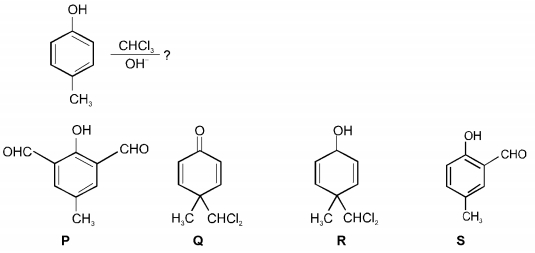
In the following Reimer-Tiemann reaction,the product$(s)$ formed is(are):
$p$-cresol + $CHCl_3$ + $OH^-$ $\rightarrow$ ?
$p$-cresol + $CHCl_3$ + $OH^-$ $\rightarrow$ ?
A
$B, D$
B
$B, C$
C
$A, C$
D
$A, D$
Solution
(A) The reaction is the Reimer-Tiemann reaction. $p$-cresol reacts with $CHCl_3$ and $OH^-$ to form an intermediate dichloromethyl cyclohexadienone derivative.
$1$. The phenoxide ion attacks the dichlorocarbene $(:CCl_2)$ generated from $CHCl_3$.
$2$. This leads to the formation of a cyclohexadienone intermediate ($Q$ and $R$ are related to these intermediates).
$3$. Hydrolysis and subsequent rearrangement lead to the formation of the major product $S$ ($2$-hydroxy$-5-$methylbenzaldehyde).
$4$. Some side products like $Q$ ($4$-methyl$-4-$dichloromethyl-cyclohexa$-2,5-$dienone) are also formed as minor products during the reaction process.
Thus,the major product is $S$ and the minor product is $Q$.
$1$. The phenoxide ion attacks the dichlorocarbene $(:CCl_2)$ generated from $CHCl_3$.
$2$. This leads to the formation of a cyclohexadienone intermediate ($Q$ and $R$ are related to these intermediates).
$3$. Hydrolysis and subsequent rearrangement lead to the formation of the major product $S$ ($2$-hydroxy$-5-$methylbenzaldehyde).
$4$. Some side products like $Q$ ($4$-methyl$-4-$dichloromethyl-cyclohexa$-2,5-$dienone) are also formed as minor products during the reaction process.
Thus,the major product is $S$ and the minor product is $Q$.
0 likesView Solution
39
ChemistryDifficultMCQIIT JEE · 2013
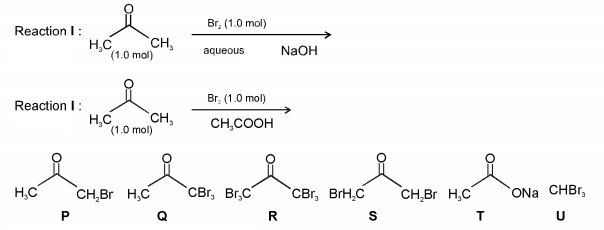
After completion of the reactions $(I)$ and $(II)$,the organic compound$(s)$ in the reaction mixtures is (are):
A
Reaction $I$: $T$,$U$,acetone and Reaction $II$: $P$
B
Reaction $I$: $U$,acetone and Reaction $II$: $Q$,acetone
C
Reaction $I$: $P$ and Reaction $II$: $P$
D
Reaction $I$: $R$,acetone and Reaction $II$: $S$,acetone
Solution
(A) In reaction $I$ (basic medium),the haloform reaction occurs. Since the rate of reaction increases with each $\alpha$-halogenation,$1.0 \ mol$ of acetone reacts with $1.0 \ mol$ of $Br_2$ to produce $CH_3COONa$ $(T)$,$CHBr_3$ $(U)$,and some unreacted acetone.
In reaction $II$ (acidic medium),monohalogenation takes place. $1.0 \ mol$ of acetone reacts with $1.0 \ mol$ of $Br_2$ to form $P$ $(CH_3COCH_2Br)$.
In reaction $II$ (acidic medium),monohalogenation takes place. $1.0 \ mol$ of acetone reacts with $1.0 \ mol$ of $Br_2$ to form $P$ $(CH_3COCH_2Br)$.
0 likesView Solution
40
ChemistryDifficultMCQIIT JEE · 2013
In the nuclear transmutation $_4^9 Be + X \longrightarrow _4^8 Be + Y$,the pair $(X, Y)$ is (are):
A
$(A) (\gamma, n)$
B
$(B) (p, D)$
C
$(C) (n, D)$
D
$(D) (\gamma, p)$
Solution
(A) The given nuclear reaction is $_4^9 Be + X \longrightarrow _4^8 Be + Y$.
For the reaction to be balanced,the sum of atomic numbers and mass numbers must be conserved on both sides.
Case $1$: If $X = \gamma$ (photon,$0^0\gamma$),then $_4^9 Be + _0^0\gamma \longrightarrow _4^8 Be + _0^1 n$. Here $Y = n$ (neutron).
Case $2$: If $X = p$ (proton,$_1^1 p$),then $_4^9 Be + _1^1 p \longrightarrow _4^8 Be + _1^2 D$. Here $Y = D$ (deuteron).
Thus,both $(A)$ and $(B)$ are valid pairs for $(X, Y)$.
For the reaction to be balanced,the sum of atomic numbers and mass numbers must be conserved on both sides.
Case $1$: If $X = \gamma$ (photon,$0^0\gamma$),then $_4^9 Be + _0^0\gamma \longrightarrow _4^8 Be + _0^1 n$. Here $Y = n$ (neutron).
Case $2$: If $X = p$ (proton,$_1^1 p$),then $_4^9 Be + _1^1 p \longrightarrow _4^8 Be + _1^2 D$. Here $Y = D$ (deuteron).
Thus,both $(A)$ and $(B)$ are valid pairs for $(X, Y)$.
0 likesView Solution
41
ChemistryMediumMCQIIT JEE · 2013
The carbon-based reduction method is $NOT$ used for the extraction of:
A
$A$. tin from $SnO_2$
B
$B$. iron from $Fe_2O_3$
C
$C$. aluminium from $Al_2O_3$
D
$D$. magnesium from $MgCO_3, CaCO_3$
Solution
(D) Carbon reduction is suitable for metals with moderate reactivity like $Sn$ and $Fe$.
$Al_2O_3$ (Aluminium oxide) and $Mg$ (Magnesium) are highly reactive metals.
Aluminium is extracted by the electrolytic reduction of molten $Al_2O_3$ in the presence of cryolite.
Magnesium is extracted by the electrolytic reduction of fused $MgCl_2$ or $MgO$.
Therefore,the carbon-based reduction method is $NOT$ used for $C$ and $D$.
$Al_2O_3$ (Aluminium oxide) and $Mg$ (Magnesium) are highly reactive metals.
Aluminium is extracted by the electrolytic reduction of molten $Al_2O_3$ in the presence of cryolite.
Magnesium is extracted by the electrolytic reduction of fused $MgCl_2$ or $MgO$.
Therefore,the carbon-based reduction method is $NOT$ used for $C$ and $D$.
0 likesView Solution
42
ChemistryDifficultIIT JEE · 2013
An aqueous solution of a mixture of two inorganic salts,when treated with dilute $HCl$,gave a precipitate $(P)$ and a filtrate $(Q)$. The precipitate $P$ was found to dissolve in hot water. The filtrate $(Q)$ remained unchanged when treated with $H_2S$ in a dilute mineral acid medium. However,it gave a precipitate $(R)$ with $H_2S$ in an ammoniacal medium. The precipitate $R$ gave a coloured solution $(S)$ when treated with $H_2O_2$ in an aqueous $NaOH$ medium.
$1.$ The precipitate $P$ contains
$(A)$ $Pb^{2+}$ $(B)$ $Hg_2^{2+}$ $(C)$ $Ag^{+}$ $(D)$ $Hg^{2+}$
$2.$ The coloured solution $S$ contains
$(A)$ $Fe_2(SO_4)_3$ $(B)$ $CuSO_4$ $(C)$ $ZnSO_4$ $(D)$ $Na_2CrO_4$
$1.$ The precipitate $P$ contains
$(A)$ $Pb^{2+}$ $(B)$ $Hg_2^{2+}$ $(C)$ $Ag^{+}$ $(D)$ $Hg^{2+}$
$2.$ The coloured solution $S$ contains
$(A)$ $Fe_2(SO_4)_3$ $(B)$ $CuSO_4$ $(C)$ $ZnSO_4$ $(D)$ $Na_2CrO_4$
Solution
(A, D) $1.$ The precipitate $P$ is $PbCl_2$,which is formed by the reaction of $Pb^{2+}$ with $HCl$. $PbCl_2$ is known to be soluble in hot water. Thus,$P$ contains $Pb^{2+}$.
$2.$ The filtrate $Q$ contains $Cr^{3+}$. When treated with $H_2S$ in an ammoniacal medium,it forms a green precipitate $R$ of $Cr(OH)_3$. When $Cr(OH)_3$ is treated with $H_2O_2$ in an aqueous $NaOH$ medium,it undergoes oxidation to form a yellow solution $S$ containing $Na_2CrO_4$ (sodium chromate).
Reaction: $2Cr(OH)_3 + 4NaOH + 3H_2O_2 \longrightarrow 2Na_2CrO_4 + 8H_2O$.
$2.$ The filtrate $Q$ contains $Cr^{3+}$. When treated with $H_2S$ in an ammoniacal medium,it forms a green precipitate $R$ of $Cr(OH)_3$. When $Cr(OH)_3$ is treated with $H_2O_2$ in an aqueous $NaOH$ medium,it undergoes oxidation to form a yellow solution $S$ containing $Na_2CrO_4$ (sodium chromate).
Reaction: $2Cr(OH)_3 + 4NaOH + 3H_2O_2 \longrightarrow 2Na_2CrO_4 + 8H_2O$.
0 likesView Solution
43
ChemistryDifficultMCQIIT JEE · 2013
The reactions of $Cl_2$ gas with cold-dilute and hot-concentrated $NaOH$ in water give sodium salts of two (different) oxoacids of chlorine,$P$ and $Q$,respectively. The $Cl_2$ gas reacts with $SO_2$ gas,in presence of charcoal,to give a product $R$. $R$ reacts with white phosphorus to give a compound $S$. On hydrolysis,$S$ gives an oxoacid of phosphorus $T$.
$1.$ $P$ and $Q$,respectively,are the sodium salts of
$(A)$ hypochlorous and chloric acids
$(B)$ hypochlorous and chlorous acids
$(C)$ chloric and perchloric acids
$(D)$ chloric and hypochlorous acids
$2.$ $R$,$S$ and $T$,respectively,are
$(A)$ $SO_2Cl_2, PCl_5$ and $H_3PO_4$
$(B)$ $SO_2Cl_2, PCl_3$ and $H_3PO_3$
$(C)$ $SOCl_2, PCl_3$ and $H_3PO_2$
$(D)$ $SOCl_2, PCl_5$ and $H_3PO_4$
Give the answer for question $1$ and $2$.
$1.$ $P$ and $Q$,respectively,are the sodium salts of
$(A)$ hypochlorous and chloric acids
$(B)$ hypochlorous and chlorous acids
$(C)$ chloric and perchloric acids
$(D)$ chloric and hypochlorous acids
$2.$ $R$,$S$ and $T$,respectively,are
$(A)$ $SO_2Cl_2, PCl_5$ and $H_3PO_4$
$(B)$ $SO_2Cl_2, PCl_3$ and $H_3PO_3$
$(C)$ $SOCl_2, PCl_3$ and $H_3PO_2$
$(D)$ $SOCl_2, PCl_5$ and $H_3PO_4$
Give the answer for question $1$ and $2$.
A
$(A, A)$
B
$(A, C)$
C
$(B, D)$
D
$(B, C)$
Solution
(A) $1.$ The reaction of $Cl_2$ with cold dilute $NaOH$ is: $Cl_2 + 2NaOH \rightarrow NaCl + NaOCl + H_2O$. Here,$NaOCl$ is the salt of hypochlorous acid $(P)$.
The reaction of $Cl_2$ with hot concentrated $NaOH$ is: $3Cl_2 + 6NaOH \rightarrow 5NaCl + NaClO_3 + 3H_2O$. Here,$NaClO_3$ is the salt of chloric acid $(Q)$.
$2.$ The reaction of $Cl_2$ with $SO_2$ in the presence of charcoal gives sulfuryl chloride: $SO_2 + Cl_2 \xrightarrow{\text{charcoal}} SO_2Cl_2 (R)$.
$SO_2Cl_2$ reacts with white phosphorus $(P_4)$ to give phosphorus pentachloride: $10SO_2Cl_2 + P_4 \rightarrow 4PCl_5 (S) + 10SO_2$.
Hydrolysis of $PCl_5$ gives phosphoric acid: $PCl_5 + 4H_2O \rightarrow H_3PO_4 (T) + 5HCl$.
The reaction of $Cl_2$ with hot concentrated $NaOH$ is: $3Cl_2 + 6NaOH \rightarrow 5NaCl + NaClO_3 + 3H_2O$. Here,$NaClO_3$ is the salt of chloric acid $(Q)$.
$2.$ The reaction of $Cl_2$ with $SO_2$ in the presence of charcoal gives sulfuryl chloride: $SO_2 + Cl_2 \xrightarrow{\text{charcoal}} SO_2Cl_2 (R)$.
$SO_2Cl_2$ reacts with white phosphorus $(P_4)$ to give phosphorus pentachloride: $10SO_2Cl_2 + P_4 \rightarrow 4PCl_5 (S) + 10SO_2$.
Hydrolysis of $PCl_5$ gives phosphoric acid: $PCl_5 + 4H_2O \rightarrow H_3PO_4 (T) + 5HCl$.
0 likesView Solution
44
ChemistryDifficultMCQIIT JEE · 2013
Match the chemical conversions in List-$I$ with the appropriate reagents in List-$II$ and select the correct answer using the code given below the lists:
List-$I$:
$P$. $tert$-butyl chloride $\rightarrow$ isobutylene
$Q$. Sodium $tert$-butoxide $\rightarrow$ $tert$-butyl ethyl ether
$R$. $1$-methylcyclopentene $\rightarrow$ $1$-methylcyclopentanol
$S$. $1$-methylcyclopentene $\rightarrow$ $2$-methylcyclopentanol (trans-isomer)
List-$II$:
$1$. $(i) \ Hg(OAc)_2; (ii) \ NaBH_4$
$2$. $NaOEt$
$3$. $EtBr$
$4$. $(i) \ BH_3; (ii) \ H_2O_2/NaOH$
Codes: $P \quad Q \quad R \quad S$
List-$I$:
$P$. $tert$-butyl chloride $\rightarrow$ isobutylene
$Q$. Sodium $tert$-butoxide $\rightarrow$ $tert$-butyl ethyl ether
$R$. $1$-methylcyclopentene $\rightarrow$ $1$-methylcyclopentanol
$S$. $1$-methylcyclopentene $\rightarrow$ $2$-methylcyclopentanol (trans-isomer)
List-$II$:
$1$. $(i) \ Hg(OAc)_2; (ii) \ NaBH_4$
$2$. $NaOEt$
$3$. $EtBr$
$4$. $(i) \ BH_3; (ii) \ H_2O_2/NaOH$
Codes: $P \quad Q \quad R \quad S$
A
$2 \quad 3 \quad 1 \quad 4$
B
$3 \quad 2 \quad 1 \quad 4$
C
$2 \quad 3 \quad 4 \quad 1$
D
$3 \quad 2 \quad 4 \quad 1$
Solution
(A) The correct matching is as follows:
$P$. $tert$-butyl chloride undergoes $E2$ elimination with $NaOEt$ to form isobutylene. Thus,$P-2$.
$Q$. Sodium $tert$-butoxide reacts with $EtBr$ via $S_N2$ mechanism to form $tert$-butyl ethyl ether. Thus,$Q-3$.
$R$. $1$-methylcyclopentene undergoes oxymercuration-demercuration with $(i) \ Hg(OAc)_2; (ii) \ NaBH_4$ to give $1$-methylcyclopentanol (Markovnikov addition). Thus,$R-1$.
$S$. $1$-methylcyclopentene undergoes hydroboration-oxidation with $(i) \ BH_3; (ii) \ H_2O_2/NaOH$ to give $2$-methylcyclopentanol (anti-Markovnikov addition,syn-addition). Thus,$S-4$.
Therefore,the correct sequence is $P-2, Q-3, R-1, S-4$.
$P$. $tert$-butyl chloride undergoes $E2$ elimination with $NaOEt$ to form isobutylene. Thus,$P-2$.
$Q$. Sodium $tert$-butoxide reacts with $EtBr$ via $S_N2$ mechanism to form $tert$-butyl ethyl ether. Thus,$Q-3$.
$R$. $1$-methylcyclopentene undergoes oxymercuration-demercuration with $(i) \ Hg(OAc)_2; (ii) \ NaBH_4$ to give $1$-methylcyclopentanol (Markovnikov addition). Thus,$R-1$.
$S$. $1$-methylcyclopentene undergoes hydroboration-oxidation with $(i) \ BH_3; (ii) \ H_2O_2/NaOH$ to give $2$-methylcyclopentanol (anti-Markovnikov addition,syn-addition). Thus,$S-4$.
Therefore,the correct sequence is $P-2, Q-3, R-1, S-4$.
0 likesView Solution
45
ChemistryAdvancedMCQIIT JEE · 2013
An aqueous solution of $X$ is added slowly to an aqueous solution of $Y$ as shown in List-$I$. The variation in conductivity of these reactions is given in List-$II$. Match List-$I$ with List-$II$ and select the correct answer using the code given below the lists :
Codes: $P \quad Q \quad R \quad S$
| List-$I$ | List-$II$ |
|---|---|
| $P$. $\underset{X}{(C_2H_5)_3N} + \underset{Y}{CH_3COOH}$ | $1$. Conductivity decreases and then increases |
| $Q$. $\underset{X}{KI (0.1 \ M)} + \underset{Y}{AgNO_3 (0.01 \ M)}$ | $2$. Conductivity decreases and then does not change much |
| $R$. $\underset{X}{CH_3COOH} + \underset{Y}{KOH}$ | $3$. Conductivity increases and then does not change much |
| $S$. $\underset{X}{NaOH} + \underset{Y}{HI}$ | $4$. Conductivity does not change much and then increases |
Codes: $P \quad Q \quad R \quad S$
A
$3 \quad 4 \quad 2 \quad 1$
B
$4 \quad 3 \quad 2 \quad 1$
C
$2 \quad 3 \quad 4 \quad 1$
D
$3 \quad 4 \quad 2 \quad 1$
Solution
(A) $(P)$ $(C_2H_5)_3N + CH_3COOH \longrightarrow (C_2H_5)_3NH^+ + CH_3COO^-$. Since both reactants are weak,the formation of ions leads to an increase in conductivity initially. After the equivalence point,the addition of excess weak acid does not significantly change the ion concentration,so it remains nearly constant. Thus,$P-3$.
$(Q)$ $KI + AgNO_3 \longrightarrow AgI(s) + KNO_3$. Here,$Ag^+$ ions are replaced by $K^+$ ions in the solution. Since the mobility of $K^+$ is comparable to $Ag^+$,the conductivity does not change much initially. After the equivalence point,excess $AgNO_3$ adds $Ag^+$ and $NO_3^-$ ions,causing conductivity to increase. Thus,$Q-4$.
$(R)$ $CH_3COOH + KOH \longrightarrow CH_3COOK + H_2O$. $OH^-$ ions (high mobility) are replaced by $CH_3COO^-$ ions (low mobility),causing conductivity to decrease. After the equivalence point,excess $KOH$ adds $K^+$ and $OH^-$ ions,but the effect is minimal due to the common ion effect or dilution. Thus,$R-2$.
$(S)$ $NaOH + HI \longrightarrow NaI + H_2O$. $H^+$ ions (very high mobility) are replaced by $Na^+$ ions (low mobility),causing conductivity to decrease. After the equivalence point,excess $HI$ adds $H^+$ and $I^-$ ions,causing conductivity to increase. Thus,$S-1$.
The correct matching is $P-3, Q-4, R-2, S-1$,which corresponds to option $(A)$.
$(Q)$ $KI + AgNO_3 \longrightarrow AgI(s) + KNO_3$. Here,$Ag^+$ ions are replaced by $K^+$ ions in the solution. Since the mobility of $K^+$ is comparable to $Ag^+$,the conductivity does not change much initially. After the equivalence point,excess $AgNO_3$ adds $Ag^+$ and $NO_3^-$ ions,causing conductivity to increase. Thus,$Q-4$.
$(R)$ $CH_3COOH + KOH \longrightarrow CH_3COOK + H_2O$. $OH^-$ ions (high mobility) are replaced by $CH_3COO^-$ ions (low mobility),causing conductivity to decrease. After the equivalence point,excess $KOH$ adds $K^+$ and $OH^-$ ions,but the effect is minimal due to the common ion effect or dilution. Thus,$R-2$.
$(S)$ $NaOH + HI \longrightarrow NaI + H_2O$. $H^+$ ions (very high mobility) are replaced by $Na^+$ ions (low mobility),causing conductivity to decrease. After the equivalence point,excess $HI$ adds $H^+$ and $I^-$ ions,causing conductivity to increase. Thus,$S-1$.
The correct matching is $P-3, Q-4, R-2, S-1$,which corresponds to option $(A)$.
0 likesView Solution
46
ChemistryAdvancedMCQIIT JEE · 2013
The standard reduction potential data at $25^{\circ} C$ is given below.
$E^{\circ}(Fe^{3+}, Fe^{2+}) = +0.77 \ V$
$E^{\circ}(Fe^{2+}, Fe) = -0.44 \ V$
$E^{\circ}(Cu^{2+}, Cu) = +0.34 \ V$
$E^{\circ}(Cu^{+}, Cu) = +0.52 \ V$
$E^{\circ}(O_{2(g)} + 4H^{+} + 4e^{-} \rightarrow 2H_{2}O) = +1.23 \ V$
$E^{\circ}(O_{2(g)} + 2H_{2}O + 4e^{-} \rightarrow 4OH^{-}) = +0.40 \ V$
$E^{\circ}(Cr^{3+}, Cr) = -0.74 \ V$
$E^{\circ}(Cr^{2+}, Cr) = -0.91 \ V$
Match $E^{\circ}$ of the redox pair in List-$I$ with the values given in List-$II$ and select the correct answer using the code given below the lists:
Codes: $P \quad Q \quad R \quad S$
$E^{\circ}(Fe^{3+}, Fe^{2+}) = +0.77 \ V$
$E^{\circ}(Fe^{2+}, Fe) = -0.44 \ V$
$E^{\circ}(Cu^{2+}, Cu) = +0.34 \ V$
$E^{\circ}(Cu^{+}, Cu) = +0.52 \ V$
$E^{\circ}(O_{2(g)} + 4H^{+} + 4e^{-} \rightarrow 2H_{2}O) = +1.23 \ V$
$E^{\circ}(O_{2(g)} + 2H_{2}O + 4e^{-} \rightarrow 4OH^{-}) = +0.40 \ V$
$E^{\circ}(Cr^{3+}, Cr) = -0.74 \ V$
$E^{\circ}(Cr^{2+}, Cr) = -0.91 \ V$
Match $E^{\circ}$ of the redox pair in List-$I$ with the values given in List-$II$ and select the correct answer using the code given below the lists:
| List-$I$ | List-$II$ |
| $P. \ E^{\circ}(Fe^{3+}, Fe)$ | $1. \ -0.18 \ V$ |
| $Q. \ E^{\circ}(4H_{2}O \rightleftharpoons 4H^{+} + 4OH^{-})$ | $2. \ -0.4 \ V$ |
| $R. \ E^{\circ}(Cu^{2+} + Cu \rightarrow 2Cu^{+})$ | $3. \ -0.04 \ V$ |
| $S. \ E^{\circ}(Cr^{3+}, Cr^{2+})$ | $4. \ -0.83 \ V$ |
Codes: $P \quad Q \quad R \quad S$
A
$4 \quad 1 \quad 2 \quad 3$
B
$2 \quad 3 \quad 4 \quad 1$
C
$1 \quad 2 \quad 3 \quad 4$
D
$3 \quad 4 \quad 1 \quad 2$
Solution
(D) $(P) \ E^{\circ}(Fe^{3+}, Fe) = \frac{1(0.77) + 2(-0.44)}{3} = \frac{0.77 - 0.88}{3} = \frac{-0.11}{3} = -0.0366 \ V \approx -0.04 \ V$
$(Q) \ E^{\circ}(4H_{2}O \rightleftharpoons 4H^{+} + 4OH^{-}) = 0.40 - 1.23 = -0.83 \ V$
$(R) \ E^{\circ}(Cu^{2+} + Cu \rightarrow 2Cu^{+}) = E^{\circ}(Cu^{2+}, Cu^{+}) - E^{\circ}(Cu^{+}, Cu)$
Using the relation $2E^{\circ}(Cu^{2+}, Cu) = E^{\circ}(Cu^{2+}, Cu^{+}) + E^{\circ}(Cu^{+}, Cu)$:
$2(0.34) = E^{\circ}(Cu^{2+}, Cu^{+}) + 0.52 \implies E^{\circ}(Cu^{2+}, Cu^{+}) = 0.68 - 0.52 = 0.16 \ V$
$E^{\circ}_{cell} = E^{\circ}(Cu^{2+}, Cu^{+}) - E^{\circ}(Cu^{+}, Cu) = 0.16 - 0.52 = -0.36 \ V \approx -0.4 \ V$
$(S) \ E^{\circ}(Cr^{3+}, Cr^{2+})$
$3E^{\circ}(Cr^{3+}, Cr) = E^{\circ}(Cr^{3+}, Cr^{2+}) + 2E^{\circ}(Cr^{2+}, Cr)$
$3(-0.74) = E^{\circ}(Cr^{3+}, Cr^{2+}) + 2(-0.91)$
$-2.22 = E^{\circ}(Cr^{3+}, Cr^{2+}) - 1.82$
$E^{\circ}(Cr^{3+}, Cr^{2+}) = -0.40 \ V$
Thus,the correct match is $P-3, Q-4, R-2, S-2$ (Note: The provided options suggest $P-3, Q-4, R-1, S-2$ based on standard approximations,but $R$ calculates to $-0.36 \ V$,closest to $-0.4 \ V$). Given the options,the correct choice is $(D)$.
$(Q) \ E^{\circ}(4H_{2}O \rightleftharpoons 4H^{+} + 4OH^{-}) = 0.40 - 1.23 = -0.83 \ V$
$(R) \ E^{\circ}(Cu^{2+} + Cu \rightarrow 2Cu^{+}) = E^{\circ}(Cu^{2+}, Cu^{+}) - E^{\circ}(Cu^{+}, Cu)$
Using the relation $2E^{\circ}(Cu^{2+}, Cu) = E^{\circ}(Cu^{2+}, Cu^{+}) + E^{\circ}(Cu^{+}, Cu)$:
$2(0.34) = E^{\circ}(Cu^{2+}, Cu^{+}) + 0.52 \implies E^{\circ}(Cu^{2+}, Cu^{+}) = 0.68 - 0.52 = 0.16 \ V$
$E^{\circ}_{cell} = E^{\circ}(Cu^{2+}, Cu^{+}) - E^{\circ}(Cu^{+}, Cu) = 0.16 - 0.52 = -0.36 \ V \approx -0.4 \ V$
$(S) \ E^{\circ}(Cr^{3+}, Cr^{2+})$
$3E^{\circ}(Cr^{3+}, Cr) = E^{\circ}(Cr^{3+}, Cr^{2+}) + 2E^{\circ}(Cr^{2+}, Cr)$
$3(-0.74) = E^{\circ}(Cr^{3+}, Cr^{2+}) + 2(-0.91)$
$-2.22 = E^{\circ}(Cr^{3+}, Cr^{2+}) - 1.82$
$E^{\circ}(Cr^{3+}, Cr^{2+}) = -0.40 \ V$
Thus,the correct match is $P-3, Q-4, R-2, S-2$ (Note: The provided options suggest $P-3, Q-4, R-1, S-2$ based on standard approximations,but $R$ calculates to $-0.36 \ V$,closest to $-0.4 \ V$). Given the options,the correct choice is $(D)$.
0 likesView Solution
Vedclass Products
For Students
Vedclass Test Series
Mock tests in real IIT JEE style covering Chemistry with performance analysis. 5-day free trial.
Start Free TrialFor Teachers
Exam Paper Generator
Generate Set A/B/C/D Chemistry papers from 7.5L+ questions in 2 minutes. 3 chapters free.
Try FreeFor Institutes
Online Exam Module
Run live IIT JEE mock exams with unlimited students, 360° analytics & white-label branding.
See DemoFrequently Asked Questions
How many Chemistry questions are in IIT JEE 2013?
There are 46 Chemistry questions from the IIT JEE 2013 paper on Vedclass, each with a detailed step-by-step solution in English.
Are IIT JEE 2013 Chemistry solutions available in English?
Yes. All solutions on this page are in English. You can also switch to English or Hindi using the language buttons above the questions.
Can I practice IIT JEE 2013 Chemistry as a timed test?
Yes. Use the Vedclass Test Series to attempt a full IIT JEE mock test covering Chemistry with time limits and instant score analysis.
Can teachers create Chemistry papers from IIT JEE previous year questions?
Yes. The Vedclass Exam Paper Generator lets teachers mix IIT JEE Chemistry questions and generate Set A/B/C/D papers in minutes.
For Teachers & Institutes
Build a Custom Chemistry Paper
Pick IIT JEE 2013 Chemistry questions, set difficulty, and generate Set A/B/C/D in 2 minutes.