
PhysicsQ1–38 of 38 questions
Page 1 of 1 · English
1
PhysicsMediumMCQIIT JEE · 2007
$A$ particle moves in the $x-y$ plane under the influence of a force $\vec{F}$ such that its linear momentum is $\vec{P}(t) = \hat{i} \cos(kt) - \hat{j} \sin(kt)$. If $k$ is a constant,the angle between $\vec{F}$ and $\vec{P}$ will be:
A
$\frac{\pi}{2}$
B
$\frac{\pi}{6}$
C
$\frac{\pi}{4}$
D
$\frac{\pi}{3}$
Solution
(A) Given linear momentum $\vec{P}(t) = \cos(kt) \hat{i} - \sin(kt) \hat{j}$.
Force $\vec{F}$ is the rate of change of momentum: $\vec{F} = \frac{d\vec{P}}{dt}$.
$\vec{F} = \frac{d}{dt} [\cos(kt) \hat{i} - \sin(kt) \hat{j}] = -k \sin(kt) \hat{i} - k \cos(kt) \hat{j}$.
To find the angle $\theta$ between $\vec{F}$ and $\vec{P}$,we use the dot product: $\vec{F} \cdot \vec{P} = |\vec{F}| |\vec{P}| \cos \theta$.
$\vec{F} \cdot \vec{P} = (-k \sin(kt))(\cos(kt)) + (-k \cos(kt))(-\sin(kt))$.
$\vec{F} \cdot \vec{P} = -k \sin(kt) \cos(kt) + k \sin(kt) \cos(kt) = 0$.
Since the dot product is $0$,$\cos \theta = 0$,which implies $\theta = \frac{\pi}{2}$.
Force $\vec{F}$ is the rate of change of momentum: $\vec{F} = \frac{d\vec{P}}{dt}$.
$\vec{F} = \frac{d}{dt} [\cos(kt) \hat{i} - \sin(kt) \hat{j}] = -k \sin(kt) \hat{i} - k \cos(kt) \hat{j}$.
To find the angle $\theta$ between $\vec{F}$ and $\vec{P}$,we use the dot product: $\vec{F} \cdot \vec{P} = |\vec{F}| |\vec{P}| \cos \theta$.
$\vec{F} \cdot \vec{P} = (-k \sin(kt))(\cos(kt)) + (-k \cos(kt))(-\sin(kt))$.
$\vec{F} \cdot \vec{P} = -k \sin(kt) \cos(kt) + k \sin(kt) \cos(kt) = 0$.
Since the dot product is $0$,$\cos \theta = 0$,which implies $\theta = \frac{\pi}{2}$.
0 likesView Solution
2
PhysicsDifficultMCQIIT JEE · 2007
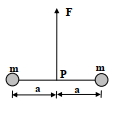
Two particles of mass $m$ each are tied at the ends of a light string of length $2a$. The whole system is kept on a frictionless horizontal surface with the string held tight so that each mass is at a distance $a$ from the center $P$ (as shown in the figure). Now,the mid-point of the string is pulled vertically upwards with a small but constant force $F$. As a result,the particles move towards each other on the surface. The magnitude of acceleration,when the separation between them becomes $2x$ is
A
$\frac{F}{2m} \frac{a}{\sqrt{a^2-x^2}}$
B
$\frac{F}{2m} \frac{x}{\sqrt{a^2-x^2}}$
C
$\frac{F}{2m} \frac{x}{a}$
D
$\frac{F}{2m} \frac{\sqrt{a^2-x^2}}{x}$
Solution
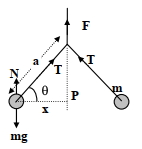
(B) Let the angle made by the string with the horizontal be $\theta$. The length of each half of the string is $a$. When the separation between the particles is $2x$,the horizontal distance of each particle from the center $P$ is $x$.
From the geometry,$\cos \theta = \frac{x}{a}$ and $\sin \theta = \frac{\sqrt{a^2-x^2}}{a}$.
Considering the vertical equilibrium of the midpoint of the string: $2T \sin \theta = F$,so $T = \frac{F}{2 \sin \theta}$.
The horizontal force on each particle is $T \cos \theta = ma$,where $a$ is the acceleration of the particle.
Substituting $T$: $ma = \left( \frac{F}{2 \sin \theta} \right) \cos \theta = \frac{F}{2} \cot \theta$.
Since $\cot \theta = \frac{\cos \theta}{\sin \theta} = \frac{x/a}{\sqrt{a^2-x^2}/a} = \frac{x}{\sqrt{a^2-x^2}}$,
we get $ma = \frac{F}{2} \left( \frac{x}{\sqrt{a^2-x^2}} \right)$,
which gives the acceleration $a = \frac{F}{2m} \left( \frac{x}{\sqrt{a^2-x^2}} \right)$.
From the geometry,$\cos \theta = \frac{x}{a}$ and $\sin \theta = \frac{\sqrt{a^2-x^2}}{a}$.
Considering the vertical equilibrium of the midpoint of the string: $2T \sin \theta = F$,so $T = \frac{F}{2 \sin \theta}$.
The horizontal force on each particle is $T \cos \theta = ma$,where $a$ is the acceleration of the particle.
Substituting $T$: $ma = \left( \frac{F}{2 \sin \theta} \right) \cos \theta = \frac{F}{2} \cot \theta$.
Since $\cot \theta = \frac{\cos \theta}{\sin \theta} = \frac{x/a}{\sqrt{a^2-x^2}/a} = \frac{x}{\sqrt{a^2-x^2}}$,
we get $ma = \frac{F}{2} \left( \frac{x}{\sqrt{a^2-x^2}} \right)$,
which gives the acceleration $a = \frac{F}{2m} \left( \frac{x}{\sqrt{a^2-x^2}} \right)$.
0 likesView Solution
3
PhysicsDifficultMCQIIT JEE · 2007
$STATEMENT-1$: $A$ block of mass $m$ starts moving on a rough horizontal surface with a velocity $v$. It stops due to friction between the block and the surface after moving through a certain distance. The surface is now tilted to an angle of $30^{\circ}$ with the horizontal and the same block is made to go up on the surface with the same initial velocity $v$. The decrease in the mechanical energy in the second situation is smaller than that in the first situation. because
$STATEMENT-2$: The coefficient of friction between the block and the surface decreases with the increase in the angle of inclination.
$STATEMENT-2$: The coefficient of friction between the block and the surface decreases with the increase in the angle of inclination.
A
$Statement-1$ is True,$Statement-2$ is True; $Statement-2$ is a correct explanation for $Statement-1$.
B
$Statement-1$ is True,$Statement-2$ is True; $Statement-2$ is $NOT$ a correct explanation for $Statement-1$.
C
$Statement-1$ is True,$Statement-2$ is False.
D
$Statement-1$ is False,$Statement-2$ is True.
Solution
(C) In the first case (horizontal surface),the work done by friction is $W_1 = -f_k d_1 = -\mu mg d_1$. The block stops when its initial kinetic energy is dissipated: $\frac{1}{2}mv^2 = \mu mg d_1$,so $d_1 = \frac{v^2}{2\mu g}$. The decrease in mechanical energy is $\Delta E_1 = \frac{1}{2}mv^2$.
In the second case (inclined surface),the work done by friction is $W_2 = -f_k d_2 = -\mu mg \cos(30^{\circ}) d_2$. The block stops when its initial mechanical energy is dissipated: $\frac{1}{2}mv^2 = \mu mg \cos(30^{\circ}) d_2 + mg d_2 \sin(30^{\circ})$. The decrease in mechanical energy is the work done by friction,$\Delta E_2 = \mu mg \cos(30^{\circ}) d_2$. Since $\cos(30^{\circ}) < 1$,the frictional force is smaller,and the distance $d_2$ is also different. However,the coefficient of friction $\mu$ is a property of the materials and does not change with the angle of inclination. Thus,$Statement-2$ is False. Since the energy dissipated by friction is $\Delta E = \int f_k dx$,and $f_k = \mu N$,where $N = mg \cos(\theta)$,the energy loss is indeed smaller in the second case. Thus,$Statement-1$ is True.
In the second case (inclined surface),the work done by friction is $W_2 = -f_k d_2 = -\mu mg \cos(30^{\circ}) d_2$. The block stops when its initial mechanical energy is dissipated: $\frac{1}{2}mv^2 = \mu mg \cos(30^{\circ}) d_2 + mg d_2 \sin(30^{\circ})$. The decrease in mechanical energy is the work done by friction,$\Delta E_2 = \mu mg \cos(30^{\circ}) d_2$. Since $\cos(30^{\circ}) < 1$,the frictional force is smaller,and the distance $d_2$ is also different. However,the coefficient of friction $\mu$ is a property of the materials and does not change with the angle of inclination. Thus,$Statement-2$ is False. Since the energy dissipated by friction is $\Delta E = \int f_k dx$,and $f_k = \mu N$,where $N = mg \cos(\theta)$,the energy loss is indeed smaller in the second case. Thus,$Statement-1$ is True.
0 likesView Solution
4
PhysicsDifficultMCQIIT JEE · 2007
$STATEMENT-1$: In an elastic collision between two bodies, the relative speed of the bodies after collision is equal to the relative speed before the collision. Because
$STATEMENT-2$: In an elastic collision, the linear momentum of the system is conserved.
$STATEMENT-2$: In an elastic collision, the linear momentum of the system is conserved.
A
$Statement-1$ is True, $Statement-2$ is True; $Statement-2$ is a correct explanation for $Statement-1$.
B
$Statement-1$ is True, $Statement-2$ is True; $Statement-2$ is $NOT$ a correct explanation for $Statement-1$.
C
$Statement-1$ is True, $Statement-2$ is False.
D
$Statement-1$ is False, $Statement-2$ is True.
Solution
(B) In an elastic collision, both linear momentum and kinetic energy are conserved.
Let two bodies of masses $m_1$ and $m_2$ have initial velocities $u_1$ and $u_2$, and final velocities $v_1$ and $v_2$.
Conservation of linear momentum: $m_1 u_1 + m_2 u_2 = m_1 v_1 + m_2 v_2$ => $m_1(u_1 - v_1) = m_2(v_2 - u_2)$ (Equation $1$).
Conservation of kinetic energy: $\frac{1}{2} m_1 u_1^2 + \frac{1}{2} m_2 u_2^2 = \frac{1}{2} m_1 v_1^2 + \frac{1}{2} m_2 v_2^2$ => $m_1(u_1^2 - v_1^2) = m_2(v_2^2 - u_2^2)$ (Equation $2$).
Dividing Equation $2$ by Equation $1$: $u_1 + v_1 = v_2 + u_2$ => $u_1 - u_2 = v_2 - v_1$.
This shows that the relative velocity of approach $(u_1 - u_2)$ equals the relative velocity of separation $(v_2 - v_1)$. Thus, $Statement-1$ is true.
$Statement-2$ is also true because linear momentum is always conserved in any collision (elastic or inelastic) in the absence of external forces. However, the conservation of momentum alone is not sufficient to derive the relative speed property; the conservation of kinetic energy is required. Therefore, $Statement-2$ is not the correct explanation for $Statement-1$.
Let two bodies of masses $m_1$ and $m_2$ have initial velocities $u_1$ and $u_2$, and final velocities $v_1$ and $v_2$.
Conservation of linear momentum: $m_1 u_1 + m_2 u_2 = m_1 v_1 + m_2 v_2$ => $m_1(u_1 - v_1) = m_2(v_2 - u_2)$ (Equation $1$).
Conservation of kinetic energy: $\frac{1}{2} m_1 u_1^2 + \frac{1}{2} m_2 u_2^2 = \frac{1}{2} m_1 v_1^2 + \frac{1}{2} m_2 v_2^2$ => $m_1(u_1^2 - v_1^2) = m_2(v_2^2 - u_2^2)$ (Equation $2$).
Dividing Equation $2$ by Equation $1$: $u_1 + v_1 = v_2 + u_2$ => $u_1 - u_2 = v_2 - v_1$.
This shows that the relative velocity of approach $(u_1 - u_2)$ equals the relative velocity of separation $(v_2 - v_1)$. Thus, $Statement-1$ is true.
$Statement-2$ is also true because linear momentum is always conserved in any collision (elastic or inelastic) in the absence of external forces. However, the conservation of momentum alone is not sufficient to derive the relative speed property; the conservation of kinetic energy is required. Therefore, $Statement-2$ is not the correct explanation for $Statement-1$.
0 likesView Solution
5
PhysicsAdvancedMCQIIT JEE · 2007
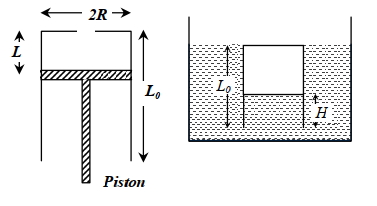
$A$ fixed thermally conducting cylinder has a radius $R$ and height $L_0$. The cylinder is open at its bottom and has a small hole at its top. $A$ piston of mass $M$ is held at a distance $L$ from the top surface,as shown in the figure. The atmospheric pressure is $P_0$.
$1.$ The piston is now pulled out slowly and held at a distance $2L$ from the top. The pressure in the cylinder between its top and the piston will then be
$(A) P_0$ $(B) \frac{P_0}{2}$ $(C) \frac{P_0}{2} + \frac{Mg}{\pi R^2}$ $(D) \frac{P_0}{2} - \frac{Mg}{\pi R^2}$
$2.$ While the piston is at a distance $2L$ from the top,the hole at the top is sealed. The piston is then released,to a position where it can stay in equilibrium. In this condition,the distance of the piston from the top is
$(A) \left(\frac{2P_0 \pi R^2}{\pi R^2 P_0 + Mg}\right)(2L)$ $(B) \left(\frac{P_0 \pi R^2 - Mg}{\pi R^2 P_0}\right)(2L)$ $(C) \left(\frac{P_0 \pi R^2 + Mg}{\pi R^2 P_0}\right)(2L)$ $(D) \left(\frac{P_0 \pi R^2}{\pi R^2 P_0 - Mg}\right)(2L)$
$3.$ The piston is taken completely out of the cylinder. The hole at the top is sealed. $A$ water tank is brought below the cylinder and put in a position so that the water surface in the tank is at the same level as the top of the cylinder as shown in the figure. The density of the water is $\rho$. In equilibrium,the height $H$ of the water column in the cylinder satisfies
$(A) \rho g(L_0 - H)^2 + P_0(L_0 - H) + L_0 P_0 = 0$
$(B) \rho g(L_0 - H)^2 - P_0(L_0 - H) - L_0 P_0 = 0$
$(C) \rho g(L_0 - H)^2 + P_0(L_0 - H) - L_0 P_0 = 0$
$(D) \rho g(L_0 - H)^2 - P_0(L_0 - H) + L_0 P_0 = 0$
Give the answer for questions $1, 2$ and $3$.
$1.$ The piston is now pulled out slowly and held at a distance $2L$ from the top. The pressure in the cylinder between its top and the piston will then be
$(A) P_0$ $(B) \frac{P_0}{2}$ $(C) \frac{P_0}{2} + \frac{Mg}{\pi R^2}$ $(D) \frac{P_0}{2} - \frac{Mg}{\pi R^2}$
$2.$ While the piston is at a distance $2L$ from the top,the hole at the top is sealed. The piston is then released,to a position where it can stay in equilibrium. In this condition,the distance of the piston from the top is
$(A) \left(\frac{2P_0 \pi R^2}{\pi R^2 P_0 + Mg}\right)(2L)$ $(B) \left(\frac{P_0 \pi R^2 - Mg}{\pi R^2 P_0}\right)(2L)$ $(C) \left(\frac{P_0 \pi R^2 + Mg}{\pi R^2 P_0}\right)(2L)$ $(D) \left(\frac{P_0 \pi R^2}{\pi R^2 P_0 - Mg}\right)(2L)$
$3.$ The piston is taken completely out of the cylinder. The hole at the top is sealed. $A$ water tank is brought below the cylinder and put in a position so that the water surface in the tank is at the same level as the top of the cylinder as shown in the figure. The density of the water is $\rho$. In equilibrium,the height $H$ of the water column in the cylinder satisfies
$(A) \rho g(L_0 - H)^2 + P_0(L_0 - H) + L_0 P_0 = 0$
$(B) \rho g(L_0 - H)^2 - P_0(L_0 - H) - L_0 P_0 = 0$
$(C) \rho g(L_0 - H)^2 + P_0(L_0 - H) - L_0 P_0 = 0$
$(D) \rho g(L_0 - H)^2 - P_0(L_0 - H) + L_0 P_0 = 0$
Give the answer for questions $1, 2$ and $3$.
A
$B, A, D$
B
$A, D, C$
C
$C, A, D$
D
$B, D, C$
Solution
(B,D,C) $1.$ Since the cylinder is thermally conducting and the process is slow,it is isothermal. Initial state: $P_1 = P_0$,$V_1 = \pi R^2 L$. Final state: $V_2 = \pi R^2 (2L)$. By Boyle's Law,$P_1 V_1 = P_2 V_2 \implies P_0 (\pi R^2 L) = P_2 (\pi R^2 2L) \implies P_2 = \frac{P_0}{2}$. Correct option is $(B)$.
$2.$ Let the new equilibrium distance be $x$. The pressure inside is $P$. Equilibrium condition: $P_0 \pi R^2 = P \pi R^2 + Mg \implies P = P_0 - \frac{Mg}{\pi R^2}$. Using isothermal process from the state at $2L$: $P_{initial} V_{initial} = P_{final} V_{final} \implies P_0 (\pi R^2 2L) = (P_0 - \frac{Mg}{\pi R^2}) (\pi R^2 x) \implies x = \frac{P_0 (2L)}{P_0 - \frac{Mg}{\pi R^2}} = \left(\frac{P_0 \pi R^2}{\pi R^2 P_0 - Mg}\right)(2L)$. Correct option is $(D)$.
$3.$ Initial state of air: $P_0, V_0 = \pi R^2 L_0$. Final state: $P, V = \pi R^2 (L_0 - H)$. By Boyle's Law: $P_0 (\pi R^2 L_0) = P (\pi R^2 (L_0 - H)) \implies P = \frac{P_0 L_0}{L_0 - H}$. From hydrostatic equilibrium: $P + \rho g (L_0 - H) = P_0 \implies \frac{P_0 L_0}{L_0 - H} + \rho g (L_0 - H) = P_0$. Multiplying by $(L_0 - H)$: $P_0 L_0 + \rho g (L_0 - H)^2 = P_0 (L_0 - H) \implies \rho g (L_0 - H)^2 - P_0 (L_0 - H) + P_0 L_0 = 0$. Correct option is $(C)$.
$2.$ Let the new equilibrium distance be $x$. The pressure inside is $P$. Equilibrium condition: $P_0 \pi R^2 = P \pi R^2 + Mg \implies P = P_0 - \frac{Mg}{\pi R^2}$. Using isothermal process from the state at $2L$: $P_{initial} V_{initial} = P_{final} V_{final} \implies P_0 (\pi R^2 2L) = (P_0 - \frac{Mg}{\pi R^2}) (\pi R^2 x) \implies x = \frac{P_0 (2L)}{P_0 - \frac{Mg}{\pi R^2}} = \left(\frac{P_0 \pi R^2}{\pi R^2 P_0 - Mg}\right)(2L)$. Correct option is $(D)$.
$3.$ Initial state of air: $P_0, V_0 = \pi R^2 L_0$. Final state: $P, V = \pi R^2 (L_0 - H)$. By Boyle's Law: $P_0 (\pi R^2 L_0) = P (\pi R^2 (L_0 - H)) \implies P = \frac{P_0 L_0}{L_0 - H}$. From hydrostatic equilibrium: $P + \rho g (L_0 - H) = P_0 \implies \frac{P_0 L_0}{L_0 - H} + \rho g (L_0 - H) = P_0$. Multiplying by $(L_0 - H)$: $P_0 L_0 + \rho g (L_0 - H)^2 = P_0 (L_0 - H) \implies \rho g (L_0 - H)^2 - P_0 (L_0 - H) + P_0 L_0 = 0$. Correct option is $(C)$.
0 likesView Solution
6
PhysicsAdvancedIIT JEE · 2007
Two discs $A$ and $B$ are mounted coaxially on a vertical axle. The discs have moments of inertia $I$ and $2I$ respectively about the common axis. Disc $A$ is imparted an initial angular velocity $2\omega$ using the entire potential energy of a spring compressed by a distance $x_1$. Disc $B$ is imparted an angular velocity $\omega$ by a spring having the same spring constant and compressed by a distance $x_2$. Both the discs rotate in the clockwise direction.
$1.$ The ratio of $x_1/x_2$ is
$(A)$ $2$ $(B)$ $1/2$ $(C)$ $\sqrt{2}$ $(D)$ $1/\sqrt{2}$
$2.$ When disc $B$ is brought in contact with disc $A$,they acquire a common angular velocity in time $t$. The average frictional torque on one disc by the other during this period is
$(A)$ $\frac{2I\omega}{3t}$ $(B)$ $\frac{9I\omega}{2t}$ $(C)$ $\frac{9I\omega}{4t}$ $(D)$ $\frac{3I\omega}{2t}$
$3.$ The loss of kinetic energy during the above process is
$(A)$ $\frac{I\omega^2}{2}$ $(B)$ $\frac{I\omega^2}{3}$ $(C)$ $\frac{I\omega^2}{4}$ $(D)$ $\frac{I\omega^2}{6}$
$1.$ The ratio of $x_1/x_2$ is
$(A)$ $2$ $(B)$ $1/2$ $(C)$ $\sqrt{2}$ $(D)$ $1/\sqrt{2}$
$2.$ When disc $B$ is brought in contact with disc $A$,they acquire a common angular velocity in time $t$. The average frictional torque on one disc by the other during this period is
$(A)$ $\frac{2I\omega}{3t}$ $(B)$ $\frac{9I\omega}{2t}$ $(C)$ $\frac{9I\omega}{4t}$ $(D)$ $\frac{3I\omega}{2t}$
$3.$ The loss of kinetic energy during the above process is
$(A)$ $\frac{I\omega^2}{2}$ $(B)$ $\frac{I\omega^2}{3}$ $(C)$ $\frac{I\omega^2}{4}$ $(D)$ $\frac{I\omega^2}{6}$
Solution
(C,A,B) $1.$ Potential energy of spring equals rotational kinetic energy: $\frac{1}{2}kx_1^2 = \frac{1}{2}I(2\omega)^2 = 2I\omega^2$ and $\frac{1}{2}kx_2^2 = \frac{1}{2}(2I)(\omega)^2 = I\omega^2$. Dividing the two equations: $\frac{x_1^2}{x_2^2} = \frac{2I\omega^2}{I\omega^2} = 2$,so $\frac{x_1}{x_2} = \sqrt{2}$.
$2.$ By conservation of angular momentum: $I(2\omega) + 2I(\omega) = (I + 2I)\omega'$,which gives $\omega' = \frac{4I\omega}{3I} = \frac{4\omega}{3}$. The change in angular momentum for disc $B$ is $\Delta L_B = I_B(\omega' - \omega) = 2I(\frac{4\omega}{3} - \omega) = 2I(\frac{\omega}{3}) = \frac{2I\omega}{3}$. Since $\tau_{avg} = \frac{\Delta L}{\Delta t}$,$\tau = \frac{2I\omega}{3t}$.
$3.$ Initial kinetic energy $K_i = \frac{1}{2}I(2\omega)^2 + \frac{1}{2}(2I)(\omega)^2 = 2I\omega^2 + I\omega^2 = 3I\omega^2$. Final kinetic energy $K_f = \frac{1}{2}(I + 2I)(\frac{4\omega}{3})^2 = \frac{1}{2}(3I)(\frac{16\omega^2}{9}) = \frac{8I\omega^2}{3}$. Loss $\Delta K = 3I\omega^2 - \frac{8I\omega^2}{3} = \frac{I\omega^2}{3}$.
$2.$ By conservation of angular momentum: $I(2\omega) + 2I(\omega) = (I + 2I)\omega'$,which gives $\omega' = \frac{4I\omega}{3I} = \frac{4\omega}{3}$. The change in angular momentum for disc $B$ is $\Delta L_B = I_B(\omega' - \omega) = 2I(\frac{4\omega}{3} - \omega) = 2I(\frac{\omega}{3}) = \frac{2I\omega}{3}$. Since $\tau_{avg} = \frac{\Delta L}{\Delta t}$,$\tau = \frac{2I\omega}{3t}$.
$3.$ Initial kinetic energy $K_i = \frac{1}{2}I(2\omega)^2 + \frac{1}{2}(2I)(\omega)^2 = 2I\omega^2 + I\omega^2 = 3I\omega^2$. Final kinetic energy $K_f = \frac{1}{2}(I + 2I)(\frac{4\omega}{3})^2 = \frac{1}{2}(3I)(\frac{16\omega^2}{9}) = \frac{8I\omega^2}{3}$. Loss $\Delta K = 3I\omega^2 - \frac{8I\omega^2}{3} = \frac{I\omega^2}{3}$.
0 likesView Solution
7
PhysicsAdvancedMCQIIT JEE · 2007
Some physical quantities are given in Column $I$ and some possible $SI$ units in which these quantities may be expressed are given in Column $II$. Match the physical quantities in Column $I$ with the units in Column $II$.
| Column $I$ | Column $II$ |
| $(A)$ $GM_e M_s$ ($G$: universal gravitational constant,$M_e$: mass of the earth,$M_s$: mass of the Sun) | $(p)$ $(\text{volt})(\text{coulomb})(\text{metre})$ |
| $(B)$ $\frac{3RT}{M}$ ($R$: universal gas constant,$T$: absolute temperature,$M$: molar mass) | $(q)$ $(\text{kg})(\text{m})^3(\text{s})^{-2}$ |
| $(C)$ $\frac{F^2}{q^2 B^2}$ ($F$: force,$q$: charge,$B$: magnetic field) | $(r)$ $(\text{m})^2(\text{s})^{-2}$ |
| $(D)$ $\frac{GM_e}{R_e}$ ($G$: universal gravitational constant,$M_e$: mass of the earth,$R_e$: radius of the earth) | $(s)$ $(\text{farad})(\text{volt})^2(\text{kg})^{-1}$ |
A
$A \rightarrow (q), B \rightarrow (r), C \rightarrow (r), D \rightarrow (r)$
B
$A \rightarrow (p), B \rightarrow (r), C \rightarrow (r), D \rightarrow (r)$
C
$A \rightarrow (q), B \rightarrow (r), C \rightarrow (s), D \rightarrow (r)$
D
$A \rightarrow (p), B \rightarrow (s), C \rightarrow (q), D \rightarrow (r)$
Solution
(A) $GM_e M_s$ has units of force $\times$ distance,which is energy. Energy is measured in Joules. $1 \text{ Joule} = 1 \text{ Volt} \times 1 \text{ Coulomb}$. Also,$G M_e M_s = (N \cdot m^2/kg^2) \cdot kg^2 = N \cdot m^2 = (kg \cdot m/s^2) \cdot m^2 = kg \cdot m^3 \cdot s^{-2}$. Thus,$(A) \rightarrow (p)$ and $(q)$.
$(B)$ $\frac{3RT}{M}$ is the square of the root-mean-square speed $(v_{rms}^2)$. Its unit is $(m/s)^2 = m^2 \cdot s^{-2}$. Thus,$(B) \rightarrow (r)$.
$(C)$ $\frac{F}{qB} = v$ (velocity). So,$\frac{F^2}{q^2 B^2} = v^2$. Its unit is $(m/s)^2 = m^2 \cdot s^{-2}$. Also,$\frac{1}{2} C V^2 = E$ (energy). So $V^2 = 2E/C$. Units: $J/F = (J/C) \cdot (J/V) = V \cdot V = V^2$. Thus,$(C) \rightarrow (r)$ and $(s)$.
$(D)$ $\frac{GM_e}{R_e}$ is gravitational potential,which is energy per unit mass. Units: $J/kg = (N \cdot m)/kg = (kg \cdot m/s^2 \cdot m)/kg = m^2 \cdot s^{-2}$. Thus,$(D) \rightarrow (r)$.
$(B)$ $\frac{3RT}{M}$ is the square of the root-mean-square speed $(v_{rms}^2)$. Its unit is $(m/s)^2 = m^2 \cdot s^{-2}$. Thus,$(B) \rightarrow (r)$.
$(C)$ $\frac{F}{qB} = v$ (velocity). So,$\frac{F^2}{q^2 B^2} = v^2$. Its unit is $(m/s)^2 = m^2 \cdot s^{-2}$. Also,$\frac{1}{2} C V^2 = E$ (energy). So $V^2 = 2E/C$. Units: $J/F = (J/C) \cdot (J/V) = V \cdot V = V^2$. Thus,$(C) \rightarrow (r)$ and $(s)$.
$(D)$ $\frac{GM_e}{R_e}$ is gravitational potential,which is energy per unit mass. Units: $J/kg = (N \cdot m)/kg = (kg \cdot m/s^2 \cdot m)/kg = m^2 \cdot s^{-2}$. Thus,$(D) \rightarrow (r)$.
0 likesView Solution
8
PhysicsDifficultMCQIIT JEE · 2007
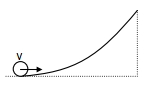
$A$ small object of uniform density rolls up a curved surface with an initial velocity $v$. It reaches up to a maximum height of $\frac{3 v^2}{4 g}$ with respect to the initial position. The object is
A
ring
B
solid sphere
C
hollow sphere
D
disc
Solution
(D) For an object rolling without slipping,the total initial kinetic energy is the sum of translational and rotational kinetic energy: $K_i = \frac{1}{2}mv^2 + \frac{1}{2}I\omega^2 = \frac{1}{2}mv^2(1 + \frac{k^2}{r^2})$.
At the maximum height $h$,the kinetic energy is converted into potential energy: $K_i = mgh$.
Equating the two: $\frac{1}{2}mv^2(1 + \frac{k^2}{r^2}) = mgh$.
Given $h = \frac{3v^2}{4g}$,we substitute this into the equation:
$\frac{1}{2}v^2(1 + \frac{k^2}{r^2}) = g(\frac{3v^2}{4g})$
$\frac{1}{2}(1 + \frac{k^2}{r^2}) = \frac{3}{4}$
$1 + \frac{k^2}{r^2} = \frac{3}{2}$
$\frac{k^2}{r^2} = \frac{1}{2}$.
Since the radius of gyration $k$ for a disc is given by $k^2 = \frac{1}{2}r^2$,the object is a disc.
At the maximum height $h$,the kinetic energy is converted into potential energy: $K_i = mgh$.
Equating the two: $\frac{1}{2}mv^2(1 + \frac{k^2}{r^2}) = mgh$.
Given $h = \frac{3v^2}{4g}$,we substitute this into the equation:
$\frac{1}{2}v^2(1 + \frac{k^2}{r^2}) = g(\frac{3v^2}{4g})$
$\frac{1}{2}(1 + \frac{k^2}{r^2}) = \frac{3}{4}$
$1 + \frac{k^2}{r^2} = \frac{3}{2}$
$\frac{k^2}{r^2} = \frac{1}{2}$.
Since the radius of gyration $k$ for a disc is given by $k^2 = \frac{1}{2}r^2$,the object is a disc.
0 likesView Solution
9
PhysicsAdvancedMCQIIT JEE · 2007
$A$ student performs an experiment to determine the Young's modulus of a wire, exactly $2 \,m$ long, by Searle's method. In a particular reading, the student measures the extension in the length of the wire to be $0.8 \,mm$ with an uncertainty of $\pm 0.05 \,mm$ at a load of exactly $1.0 \,kg$. The student also measures the diameter of the wire to be $0.4 \,mm$ with an uncertainty of $\pm 0.01 \,mm$. Take $g=9.8 \,m/s^2$ (exact). The Young's modulus obtained from the reading is
A
$(2.0 \pm 0.3) \times 10^{11} \,N/m^2$
B
$(2.0 \pm 0.2) \times 10^{11} \,N/m^2$
C
$(2.0 \pm 0.1) \times 10^{11} \,N/m^2$
D
$(2.0 \pm 0.05) \times 10^{11} \,N/m^2$
Solution
(B) The formula for Young's modulus is $Y = \frac{FL}{Ae} = \frac{4FL}{\pi D^2 e}$.
Given: $L = 2 \,m$, $F = 1.0 \times 9.8 \,N$, $e = 0.8 \times 10^{-3} \,m$, $\Delta e = 0.05 \times 10^{-3} \,m$, $D = 0.4 \times 10^{-3} \,m$, $\Delta D = 0.01 \times 10^{-3} \,m$.
First, calculate the value of $Y$:
$Y = \frac{4 \times 9.8 \times 2}{\pi \times (0.4 \times 10^{-3})^2 \times (0.8 \times 10^{-3})} = \frac{78.4}{\pi \times 0.16 \times 10^{-6} \times 0.8 \times 10^{-3}} \approx 1.95 \times 10^{11} \,N/m^2 \approx 2.0 \times 10^{11} \,N/m^2$.
Now, calculate the relative uncertainty $\frac{\Delta Y}{Y}$:
$\frac{\Delta Y}{Y} = \frac{\Delta F}{F} + \frac{\Delta L}{L} + 2\frac{\Delta D}{D} + \frac{\Delta e}{e}$.
Since $F$ and $L$ are exact, $\frac{\Delta F}{F} = 0$ and $\frac{\Delta L}{L} = 0$.
$\frac{\Delta Y}{Y} = 2 \left( \frac{0.01}{0.4} \right) + \left( \frac{0.05}{0.8} \right) = 2(0.025) + 0.0625 = 0.05 + 0.0625 = 0.1125$.
Absolute uncertainty $\Delta Y = 0.1125 \times Y = 0.1125 \times 1.95 \times 10^{11} \approx 0.22 \times 10^{11} \,N/m^2$.
Rounding to one decimal place, $\Delta Y \approx 0.2 \times 10^{11} \,N/m^2$.
Thus, $Y = (2.0 \pm 0.2) \times 10^{11} \,N/m^2$.
Given: $L = 2 \,m$, $F = 1.0 \times 9.8 \,N$, $e = 0.8 \times 10^{-3} \,m$, $\Delta e = 0.05 \times 10^{-3} \,m$, $D = 0.4 \times 10^{-3} \,m$, $\Delta D = 0.01 \times 10^{-3} \,m$.
First, calculate the value of $Y$:
$Y = \frac{4 \times 9.8 \times 2}{\pi \times (0.4 \times 10^{-3})^2 \times (0.8 \times 10^{-3})} = \frac{78.4}{\pi \times 0.16 \times 10^{-6} \times 0.8 \times 10^{-3}} \approx 1.95 \times 10^{11} \,N/m^2 \approx 2.0 \times 10^{11} \,N/m^2$.
Now, calculate the relative uncertainty $\frac{\Delta Y}{Y}$:
$\frac{\Delta Y}{Y} = \frac{\Delta F}{F} + \frac{\Delta L}{L} + 2\frac{\Delta D}{D} + \frac{\Delta e}{e}$.
Since $F$ and $L$ are exact, $\frac{\Delta F}{F} = 0$ and $\frac{\Delta L}{L} = 0$.
$\frac{\Delta Y}{Y} = 2 \left( \frac{0.01}{0.4} \right) + \left( \frac{0.05}{0.8} \right) = 2(0.025) + 0.0625 = 0.05 + 0.0625 = 0.1125$.
Absolute uncertainty $\Delta Y = 0.1125 \times Y = 0.1125 \times 1.95 \times 10^{11} \approx 0.22 \times 10^{11} \,N/m^2$.
Rounding to one decimal place, $\Delta Y \approx 0.2 \times 10^{11} \,N/m^2$.
Thus, $Y = (2.0 \pm 0.2) \times 10^{11} \,N/m^2$.
0 likesView Solution
10
PhysicsAdvancedMCQIIT JEE · 2007
In the experiment to determine the speed of sound using a resonance column, which of the following statements is correct?
A
The prongs of the tuning fork are kept in a vertical plane.
B
The prongs of the tuning fork are kept in a horizontal plane.
C
In one of the two resonances observed, the length of the resonating air column is close to the wavelength of sound in air.
D
In one of the two resonances observed, the length of the resonating air column is close to half of the wavelength of sound in air.
Solution
(A) In a resonance column experiment, the tuning fork is held above the open end of the tube. To ensure that the sound waves propagate effectively down the tube, the prongs of the tuning fork are kept in a vertical plane.
For a tube closed at one end, the resonance occurs when the length of the air column $L$ satisfies the condition $L + e = (2n - 1) \frac{\lambda}{4}$, where $e$ is the end correction and $n = 1, 2, 3, ...$.
The first resonance occurs at $L_1 + e = \frac{\lambda}{4}$ and the second resonance occurs at $L_2 + e = \frac{3\lambda}{4}$.
Subtracting these, we get $L_2 - L_1 = \frac{\lambda}{2}$.
Thus, the difference between the lengths of the two resonating air columns is equal to half the wavelength of sound in air.
For a tube closed at one end, the resonance occurs when the length of the air column $L$ satisfies the condition $L + e = (2n - 1) \frac{\lambda}{4}$, where $e$ is the end correction and $n = 1, 2, 3, ...$.
The first resonance occurs at $L_1 + e = \frac{\lambda}{4}$ and the second resonance occurs at $L_2 + e = \frac{3\lambda}{4}$.
Subtracting these, we get $L_2 - L_1 = \frac{\lambda}{2}$.
Thus, the difference between the lengths of the two resonating air columns is equal to half the wavelength of sound in air.
0 likesView Solution
11
PhysicsAdvancedMCQIIT JEE · 2007
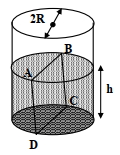
Water is filled up to a height $h$ in a beaker of radius $R$ as shown in the figure. The density of water is $\rho$,the surface tension of water is $T$ and the atmospheric pressure is $P_0$. Consider a vertical section $ABCD$ of the water column through a diameter of the beaker. The force on water on one side of this section by water on the other side of this section has magnitude
A
$\left|2 P_0 Rh+\pi R^2 \rho gh-2 RT\right|$
B
$\left|2 P_0 Rh+R \rho gh^2-2 RT\right|$
C
$\left|P_0 \pi R^2+R \rho g h^2-2 RT\right|$
D
$\left|P_0 \pi R^2+R \rho g h^2+2 RT\right|$
Solution
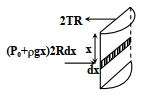
(B) Consider a vertical rectangular strip of height $dx$ at a depth $x$ from the free surface of the water. The width of this strip is the diameter of the beaker,which is $2R$.
The pressure at depth $x$ is $P(x) = P_0 + \rho g x$.
The force exerted by the pressure on this strip is $dF_p = P(x) \cdot (2R) dx = (P_0 + \rho g x) 2R dx$.
Integrating this from $x = 0$ to $x = h$,the total force due to pressure is $F_p = \int_0^h (P_0 + \rho g x) 2R dx = 2R [P_0 x + \frac{1}{2} \rho g x^2]_0^h = 2 P_0 R h + R \rho g h^2$.
Additionally,there is a force due to surface tension acting along the top edge of the section. The length of the section at the surface is $2R$,so the force due to surface tension is $F_T = T \cdot (2R) = 2RT$.
Since the surface tension force acts in the opposite direction to the pressure force,the net magnitude of the force is $F = |F_p - F_T| = |2 P_0 R h + R \rho g h^2 - 2 RT|$.
The pressure at depth $x$ is $P(x) = P_0 + \rho g x$.
The force exerted by the pressure on this strip is $dF_p = P(x) \cdot (2R) dx = (P_0 + \rho g x) 2R dx$.
Integrating this from $x = 0$ to $x = h$,the total force due to pressure is $F_p = \int_0^h (P_0 + \rho g x) 2R dx = 2R [P_0 x + \frac{1}{2} \rho g x^2]_0^h = 2 P_0 R h + R \rho g h^2$.
Additionally,there is a force due to surface tension acting along the top edge of the section. The length of the section at the surface is $2R$,so the force due to surface tension is $F_T = T \cdot (2R) = 2RT$.
Since the surface tension force acts in the opposite direction to the pressure force,the net magnitude of the force is $F = |F_p - F_T| = |2 P_0 R h + R \rho g h^2 - 2 RT|$.
0 likesView Solution
12
PhysicsDifficultMCQIIT JEE · 2007
$STATEMENT-1$ If there is no external torque on a body about its center of mass,then the velocity of the center of mass remains constant. because
$STATEMENT-2$ The linear momentum of an isolated system remains constant.
$STATEMENT-2$ The linear momentum of an isolated system remains constant.
A
Statement-$1$ is True,Statement-$2$ is True; Statement-$2$ is a correct explanation for Statement-$1$.
B
Statement-$1$ is True,Statement-$2$ is True; Statement-$2$ is $NOT$ a correct explanation for Statement-$1$.
C
Statement-$1$ is True,Statement-$2$ is False.
D
Statement-$1$ is False,Statement-$2$ is True.
Solution
(D) The velocity of the center of mass $(v_{cm})$ is related to the total external force $(F_{ext})$ by the equation $F_{ext} = M a_{cm} = M (dv_{cm}/dt)$.
If the total external force is zero,then $a_{cm} = 0$,which implies $v_{cm}$ is constant.
$STATEMENT-1$ states that there is no external torque. The absence of external torque implies that the angular momentum is conserved,but it does not necessarily imply that the total external force is zero.
For example,a couple acting on a body produces torque but zero net force. Thus,$v_{cm}$ may change if there is a net force,even if there is no net torque.
Therefore,$STATEMENT-1$ is False.
$STATEMENT-2$ is a fundamental principle of mechanics (Law of Conservation of Linear Momentum) and is True.
Thus,$STATEMENT-1$ is False and $STATEMENT-2$ is True.
If the total external force is zero,then $a_{cm} = 0$,which implies $v_{cm}$ is constant.
$STATEMENT-1$ states that there is no external torque. The absence of external torque implies that the angular momentum is conserved,but it does not necessarily imply that the total external force is zero.
For example,a couple acting on a body produces torque but zero net force. Thus,$v_{cm}$ may change if there is a net force,even if there is no net torque.
Therefore,$STATEMENT-1$ is False.
$STATEMENT-2$ is a fundamental principle of mechanics (Law of Conservation of Linear Momentum) and is True.
Thus,$STATEMENT-1$ is False and $STATEMENT-2$ is True.
0 likesView Solution
13
PhysicsDifficultMCQIIT JEE · 2007
$STATEMENT-1$: The total translational kinetic energy of all the molecules of a given mass of an ideal gas is $1.5$ times the product of its pressure and its volume. Because
$STATEMENT-2$: The molecules of a gas collide with each other and the velocities of the molecules change due to the collision.
$STATEMENT-2$: The molecules of a gas collide with each other and the velocities of the molecules change due to the collision.
A
$STATEMENT-1$ is True,$STATEMENT-2$ is True; $STATEMENT-2$ is a correct explanation for $STATEMENT-1$.
B
$STATEMENT-1$ is True,$STATEMENT-2$ is True; $STATEMENT-2$ is $NOT$ a correct explanation for $STATEMENT-1$.
C
$STATEMENT-1$ is True,$STATEMENT-2$ is False.
D
$STATEMENT-1$ is False,$STATEMENT-2$ is True.
Solution
(B) For an ideal gas,the total translational kinetic energy $(K)$ is given by the formula $K = \frac{3}{2} nRT$.
From the ideal gas equation,we know that $PV = nRT$.
Substituting $nRT$ with $PV$,we get $K = \frac{3}{2} PV = 1.5 PV$.
Thus,$STATEMENT-1$ is True.
$STATEMENT-2$ describes the nature of molecular collisions in a gas,which is a fundamental postulate of the Kinetic Theory of Gases,but it does not explain why the kinetic energy is related to $PV$ in the specific ratio of $1.5$. Therefore,$STATEMENT-2$ is True but is not the correct explanation for $STATEMENT-1$.
From the ideal gas equation,we know that $PV = nRT$.
Substituting $nRT$ with $PV$,we get $K = \frac{3}{2} PV = 1.5 PV$.
Thus,$STATEMENT-1$ is True.
$STATEMENT-2$ describes the nature of molecular collisions in a gas,which is a fundamental postulate of the Kinetic Theory of Gases,but it does not explain why the kinetic energy is related to $PV$ in the specific ratio of $1.5$. Therefore,$STATEMENT-2$ is True but is not the correct explanation for $STATEMENT-1$.
0 likesView Solution
14
PhysicsDifficultMCQIIT JEE · 2007
$STATEMENT-1$: $A$ cloth covers a table. Some dishes are kept on it. The cloth can be pulled out without dislodging the dishes from the table. Because
$STATEMENT-2$: For every action there is an equal and opposite reaction.
$STATEMENT-2$: For every action there is an equal and opposite reaction.
A
$Statement-1$ is True,$Statement-2$ is True; $Statement-2$ is a correct explanation for $Statement-1$.
B
$Statement-1$ is True,$Statement-2$ is True; $Statement-2$ is $NOT$ a correct explanation for $Statement-1$.
C
$Statement-1$ is True,$Statement-2$ is False.
D
$Statement-1$ is False,$Statement-2$ is True.
Solution
(B) $Statement-1$ is True because of the property of inertia. When the cloth is pulled out very quickly,the time interval for the force to act on the dishes is extremely small. Due to the inertia of rest,the dishes tend to remain in their position.
$Statement-2$ is a fundamental law of motion (Newton's Third Law),which is also True. However,the phenomenon of pulling the cloth without moving the dishes is explained by Newton's First Law (Inertia),not the Third Law.
Therefore,$Statement-2$ is not the correct explanation for $Statement-1$.
$Statement-2$ is a fundamental law of motion (Newton's Third Law),which is also True. However,the phenomenon of pulling the cloth without moving the dishes is explained by Newton's First Law (Inertia),not the Third Law.
Therefore,$Statement-2$ is not the correct explanation for $Statement-1$.
0 likesView Solution
15
PhysicsAdvancedMCQIIT JEE · 2007
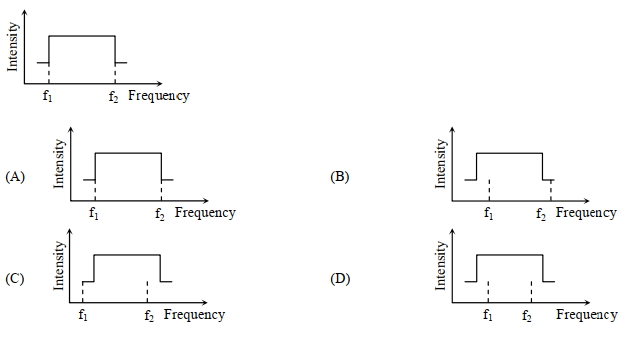
Two trains $A$ and $B$ are moving with speeds $20 \ m/s$ and $30 \ m/s$ respectively in the same direction on the same straight track,with $B$ ahead of $A$. The engines are at the front ends. The engine of train $A$ blows a long whistle. Assume that the sound of the whistle is composed of components varying in frequency from $f_1=800 \ Hz$ to $f_2=1120 \ Hz$,as shown in the figure. The spread in the frequency (highest frequency - lowest frequency) is thus $320 \ Hz$. The speed of sound in still air is $340 \ m/s$.
$1.$ The speed of sound of the whistle is
$(A)$ $340 \ m/s$ for passengers in $A$ and $310 \ m/s$ for passengers in $B$
$(B)$ $360 \ m/s$ for passengers in $A$ and $310 \ m/s$ for passengers in $B$
$(C)$ $310 \ m/s$ for passengers in $A$ and $360 \ m/s$ for passengers in $B$
$(D)$ $340 \ m/s$ for passengers in both the trains
$2.$ The distribution of the sound intensity of the whistle as observed by the passengers in train $A$ is best represented by
$3.$ The spread of frequency as observed by the passengers in train $B$ is
$(A)$ $310 \ Hz$ $(B)$ $330 \ Hz$ $(C)$ $350 \ Hz$ $(D)$ $290 \ Hz$
Give the answer for question $1, 2$ and $3$.
$1.$ The speed of sound of the whistle is
$(A)$ $340 \ m/s$ for passengers in $A$ and $310 \ m/s$ for passengers in $B$
$(B)$ $360 \ m/s$ for passengers in $A$ and $310 \ m/s$ for passengers in $B$
$(C)$ $310 \ m/s$ for passengers in $A$ and $360 \ m/s$ for passengers in $B$
$(D)$ $340 \ m/s$ for passengers in both the trains
$2.$ The distribution of the sound intensity of the whistle as observed by the passengers in train $A$ is best represented by
$3.$ The spread of frequency as observed by the passengers in train $B$ is
$(A)$ $310 \ Hz$ $(B)$ $330 \ Hz$ $(C)$ $350 \ Hz$ $(D)$ $290 \ Hz$
Give the answer for question $1, 2$ and $3$.
A
$D, A, C$
B
$B, A, A$
C
$C, A, D$
D
$A, A, B$
Solution
(D, A, A) $1.$ The speed of sound is relative to the medium (air). Since both trains are moving through the same air,the speed of sound relative to the passengers in train $A$ (moving at $20 \ m/s$) is $v_A = v_{sound} - v_A = 340 - 20 = 320 \ m/s$ (if moving away) or $360 \ m/s$ (if moving towards). However,for the whistle on train $A$ heard by passengers on train $A$,they are at rest relative to the source,so the speed of sound is $340 \ m/s$. For passengers in train $B$ (moving at $30 \ m/s$ away from $A$),the speed of sound relative to them is $v_B = 340 - 30 = 310 \ m/s$. Thus,option $D$ is correct.
$2.$ Since the passengers in train $A$ are at rest relative to the source (the engine of train $A$),they observe the same frequency range as emitted by the source. Thus,the intensity distribution remains unchanged,which is represented by graph $A$.
$3.$ The observed frequencies $f'_1$ and $f'_2$ for passengers in train $B$ are given by the Doppler effect formula: $f' = f \left( \frac{v - v_o}{v - v_s} \right)$. Here $v = 340 \ m/s$,$v_o = 30 \ m/s$ (moving away),$v_s = 20 \ m/s$ (moving away). So,$f' = f \left( \frac{340 - 30}{340 - 20} \right) = f \left( \frac{310}{320} \right) = f \left( \frac{31}{32} \right)$.
The new spread is $\Delta f' = f'_2 - f'_1 = (f_2 - f_1) \times \frac{31}{32} = 320 \times \frac{31}{32} = 310 \ Hz$. Thus,option $A$ is correct.
$2.$ Since the passengers in train $A$ are at rest relative to the source (the engine of train $A$),they observe the same frequency range as emitted by the source. Thus,the intensity distribution remains unchanged,which is represented by graph $A$.
$3.$ The observed frequencies $f'_1$ and $f'_2$ for passengers in train $B$ are given by the Doppler effect formula: $f' = f \left( \frac{v - v_o}{v - v_s} \right)$. Here $v = 340 \ m/s$,$v_o = 30 \ m/s$ (moving away),$v_s = 20 \ m/s$ (moving away). So,$f' = f \left( \frac{340 - 30}{340 - 20} \right) = f \left( \frac{310}{320} \right) = f \left( \frac{31}{32} \right)$.
The new spread is $\Delta f' = f'_2 - f'_1 = (f_2 - f_1) \times \frac{31}{32} = 320 \times \frac{31}{32} = 310 \ Hz$. Thus,option $A$ is correct.
0 likesView Solution
16
PhysicsAdvancedMCQIIT JEE · 2007
Column $I$ describes some situations in which a small object moves. Column $II$ describes some characteristics of these motions. Match the situation in Column $I$ with the characteristics in Column $II$.
| Column $I$ | Column $II$ |
| $(A)$ The object moves on the $x$-axis under a conservative force such that its speed $v = c_1 \sqrt{c_2 - x^2}$,where $c_1, c_2 > 0$. | $(p)$ The object executes simple harmonic motion. |
| $(B)$ The object moves on the $x$-axis such that its velocity $v = -kx$,where $k > 0$. | $(q)$ The object does not change its direction. |
| $(C)$ An object is attached to a spring in an elevator accelerating upwards with constant acceleration $a$. The motion is observed from the elevator. | $(r)$ The kinetic energy of the object keeps on decreasing. |
| $(D)$ The object is projected vertically upwards with speed $2 \sqrt{GM_e / R_e}$. | $(s)$ The object can change its direction only once. |
A
$A \rightarrow (p), B \rightarrow (q) \& (r), C \rightarrow (p), D \rightarrow (r) \& (q)$
B
$A \rightarrow (r), B \rightarrow (q) \& (r), C \rightarrow (p), D \rightarrow (p) \& (q)$
C
$A \rightarrow (q), B \rightarrow (r) \& (r), C \rightarrow (p), D \rightarrow (q) \& (r)$
D
$A \rightarrow (s), B \rightarrow (q) \& (s), C \rightarrow (p), D \rightarrow (s) \& (r)$
Solution
(A) Given $v = c_1 \sqrt{c_2 - x^2}$. This is the velocity equation of a simple harmonic oscillator $(v = \omega \sqrt{A^2 - x^2})$. Thus,$(A) \rightarrow (p)$.
$(B)$ Given $v = -kx$. As $x$ increases,$v$ becomes more negative. The object moves towards the origin and stops at $x=0$. It never changes direction. Since $v$ decreases as $x$ increases,kinetic energy decreases. Thus,$(B) \rightarrow (q) \& (r)$.
$(C)$ In an elevator accelerating upwards,the object experiences a pseudo force. The equilibrium position shifts,but the motion remains simple harmonic motion relative to the new equilibrium. Thus,$(C) \rightarrow (p)$.
$(D)$ The escape velocity is $\sqrt{2GM_e/R_e}$. The projection speed is $2 \sqrt{GM_e/R_e} = \sqrt{2} \times \text{escape velocity}$. Since the speed is greater than escape velocity,it will never return and will not change direction. As it moves away,its speed decreases,so kinetic energy decreases. Thus,$(D) \rightarrow (r) \& (q)$.
$(B)$ Given $v = -kx$. As $x$ increases,$v$ becomes more negative. The object moves towards the origin and stops at $x=0$. It never changes direction. Since $v$ decreases as $x$ increases,kinetic energy decreases. Thus,$(B) \rightarrow (q) \& (r)$.
$(C)$ In an elevator accelerating upwards,the object experiences a pseudo force. The equilibrium position shifts,but the motion remains simple harmonic motion relative to the new equilibrium. Thus,$(C) \rightarrow (p)$.
$(D)$ The escape velocity is $\sqrt{2GM_e/R_e}$. The projection speed is $2 \sqrt{GM_e/R_e} = \sqrt{2} \times \text{escape velocity}$. Since the speed is greater than escape velocity,it will never return and will not change direction. As it moves away,its speed decreases,so kinetic energy decreases. Thus,$(D) \rightarrow (r) \& (q)$.
0 likesView Solution
17
PhysicsAdvancedMCQIIT JEE · 2007
Column $I$ gives some devices and Column $II$ gives some processes on which the functioning of these devices depends. Match the devices in Column $I$ with the processes in Column $II$.
| Column $I$ | Column $II$ |
| $(A)$ Bimetallic strip | $(p)$ Radiation from a hot body |
| $(B)$ Steam engine | $(q)$ Energy conversion |
| $(C)$ Incandescent lamp | $(r)$ Melting |
| $(D)$ Electric fuse | $(s)$ Thermal expansion of solids |
A
$A \rightarrow (s), B \rightarrow (q), C \rightarrow (p), D \rightarrow (r)$
B
$A \rightarrow (p), B \rightarrow (q), C \rightarrow (s), D \rightarrow (r)$
C
$A \rightarrow (r), B \rightarrow (q), C \rightarrow (s), D \rightarrow (p)$
D
$A \rightarrow (q), B \rightarrow (r), C \rightarrow (p), D \rightarrow (s)$
Solution
$(A)$ Bimetallic strip works on the principle of thermal expansion of solids, where two different metals expand by different amounts when heated, causing the strip to bend. Thus, $A \rightarrow (s)$.
$(B)$ $A$ steam engine converts thermal energy (from steam) into mechanical work. Thus, $B \rightarrow (q)$.
$(C)$ An incandescent lamp works by heating a filament to a high temperature, causing it to emit light via radiation. Thus, $C \rightarrow (p)$.
$(D)$ An electric fuse is a safety device that melts when the current exceeds a specific limit, breaking the circuit. Thus, $D \rightarrow (r)$.
Therefore, the correct matching is $A \rightarrow (s), B \rightarrow (q), C \rightarrow (p), D \rightarrow (r)$.
$(B)$ $A$ steam engine converts thermal energy (from steam) into mechanical work. Thus, $B \rightarrow (q)$.
$(C)$ An incandescent lamp works by heating a filament to a high temperature, causing it to emit light via radiation. Thus, $C \rightarrow (p)$.
$(D)$ An electric fuse is a safety device that melts when the current exceeds a specific limit, breaking the circuit. Thus, $D \rightarrow (r)$.
Therefore, the correct matching is $A \rightarrow (s), B \rightarrow (q), C \rightarrow (p), D \rightarrow (r)$.
0 likesView Solution
18
PhysicsMediumMCQIIT JEE · 2007
An electron having de-Broglie wavelength $\lambda$ is incident on a target in an $X$-ray tube. The cut-off wavelength of the emitted $X$-ray is:
A
$\lambda_0 = \frac{2m^2c^2\lambda^3}{h^2}$
B
$\lambda_0 = \lambda$
C
$\lambda_0 = \frac{2mc\lambda^2}{h}$
D
$\lambda_0 = \frac{2h}{mc}$
Solution
(C) Let $K$ be the kinetic energy of the electron.
The de-Broglie wavelength of the electron is given by $\lambda = \frac{h}{p} = \frac{h}{\sqrt{2mK}}$.
Squaring both sides,we get $\lambda^2 = \frac{h^2}{2mK}$,which implies $K = \frac{h^2}{2m\lambda^2}$.
The cut-off wavelength $\lambda_0$ for continuous $X$-rays is determined by the maximum energy of the photon,which equals the kinetic energy of the incident electron: $E = \frac{hc}{\lambda_0} = K$.
Substituting the value of $K$,we get $\frac{hc}{\lambda_0} = \frac{h^2}{2m\lambda^2}$.
Solving for $\lambda_0$,we find $\lambda_0 = \frac{hc \cdot 2m\lambda^2}{h^2} = \frac{2mc\lambda^2}{h}$.
Therefore,option $(C)$ is correct.
The de-Broglie wavelength of the electron is given by $\lambda = \frac{h}{p} = \frac{h}{\sqrt{2mK}}$.
Squaring both sides,we get $\lambda^2 = \frac{h^2}{2mK}$,which implies $K = \frac{h^2}{2m\lambda^2}$.
The cut-off wavelength $\lambda_0$ for continuous $X$-rays is determined by the maximum energy of the photon,which equals the kinetic energy of the incident electron: $E = \frac{hc}{\lambda_0} = K$.
Substituting the value of $K$,we get $\frac{hc}{\lambda_0} = \frac{h^2}{2m\lambda^2}$.
Solving for $\lambda_0$,we find $\lambda_0 = \frac{hc \cdot 2m\lambda^2}{h^2} = \frac{2mc\lambda^2}{h}$.
Therefore,option $(C)$ is correct.
0 likesView Solution
19
PhysicsAdvancedMCQIIT JEE · 2007
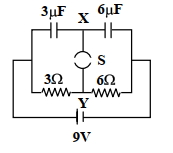
$A$ circuit is connected as shown in the figure with the switch $S$ open. When the switch is closed,the total amount of charge that flows from $Y$ to $X$ is
A
$0$
B
$54 \mu C$
C
$27 \mu C$
D
$81 \mu C$
Solution
(C) When the switch $S$ is open,the capacitors are in series with the $9 \ V$ battery. The equivalent capacitance is $C_{eq} = \frac{3 \mu F \times 6 \mu F}{3 \mu F + 6 \mu F} = 2 \mu F$. The charge on each capacitor is $q = C_{eq}V = 2 \mu F \times 9 \ V = 18 \mu C$. The potential at $X$ is $V_X = 9 \ V - \frac{18 \mu C}{3 \mu F} = 3 \ V$. The potential at $Y$ is $V_Y = 0 \ V$ (assuming the negative terminal is at $0 \ V$).
When the switch $S$ is closed,the circuit becomes two parallel branches. The left branch has a $3 \mu F$ capacitor in series with a $3 \ \Omega$ resistor,and the right branch has a $6 \mu F$ capacitor in series with a $6 \ \Omega$ resistor. The potential at $X$ becomes $9 \ V$ because it is connected to the positive terminal through the switch. The potential at $Y$ is $0 \ V$. The charge on the $3 \mu F$ capacitor is $q_1 = 3 \mu F \times 9 \ V = 27 \mu C$. The charge on the $6 \mu F$ capacitor is $q_2 = 6 \mu F \times 9 \ V = 54 \mu C$. The total charge at node $X$ before closing was $0$ (net charge on the plates connected to $X$). After closing,the charge on the plates connected to $X$ is $-(27 \mu C + 54 \mu C) = -81 \mu C$. The charge that flows from $Y$ to $X$ is the change in charge on the plates connected to $X$,which is $27 \mu C$.
When the switch $S$ is closed,the circuit becomes two parallel branches. The left branch has a $3 \mu F$ capacitor in series with a $3 \ \Omega$ resistor,and the right branch has a $6 \mu F$ capacitor in series with a $6 \ \Omega$ resistor. The potential at $X$ becomes $9 \ V$ because it is connected to the positive terminal through the switch. The potential at $Y$ is $0 \ V$. The charge on the $3 \mu F$ capacitor is $q_1 = 3 \mu F \times 9 \ V = 27 \mu C$. The charge on the $6 \mu F$ capacitor is $q_2 = 6 \mu F \times 9 \ V = 54 \mu C$. The total charge at node $X$ before closing was $0$ (net charge on the plates connected to $X$). After closing,the charge on the plates connected to $X$ is $-(27 \mu C + 54 \mu C) = -81 \mu C$. The charge that flows from $Y$ to $X$ is the change in charge on the plates connected to $X$,which is $27 \mu C$.
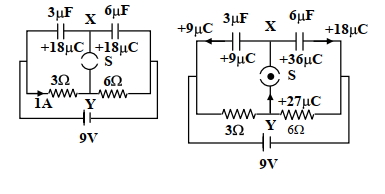
1 likesView Solution
20
PhysicsAdvancedMCQIIT JEE · 2007
$A$ long,hollow conducting cylinder is kept coaxially inside another long,hollow conducting cylinder of larger radius. Both the cylinders are initially electrically neutral.
A
$A$ potential difference appears between the two cylinders when a charge density is given to the inner cylinder.
B
$A$ potential difference appears between the two cylinders when a charge density is given to the outer cylinder.
C
No potential difference appears between the two cylinders when a uniform line charge is kept along the axis of the cylinders.
D
No potential difference appears between the two cylinders when same charge density is given to both the cylinders.
Solution
(A) For a charged conducting cylinder of radius $R$ and linear charge density $\lambda$,the electric field $E$ at a distance $r > R$ is given by $E = \frac{\lambda}{2 \pi \varepsilon_0 r}$.
When a charge is given to the inner cylinder,an electric field exists in the region between the two cylinders,resulting in a potential difference $V = \int_{R_1}^{R_2} E \, dr$.
If a charge is given to the outer cylinder,the electric field inside the cavity of the outer cylinder is zero due to the properties of a hollow conductor (Gauss's Law). Thus,no potential difference exists between the cylinders.
If the same charge density $\lambda$ is given to both,the inner cylinder creates a field,but the outer cylinder does not contribute to the field in the region between them. Therefore,a potential difference will still exist due to the inner cylinder.
Thus,option $A$ is correct because charging the inner cylinder creates a radial electric field between the cylinders,leading to a potential difference.
When a charge is given to the inner cylinder,an electric field exists in the region between the two cylinders,resulting in a potential difference $V = \int_{R_1}^{R_2} E \, dr$.
If a charge is given to the outer cylinder,the electric field inside the cavity of the outer cylinder is zero due to the properties of a hollow conductor (Gauss's Law). Thus,no potential difference exists between the cylinders.
If the same charge density $\lambda$ is given to both,the inner cylinder creates a field,but the outer cylinder does not contribute to the field in the region between them. Therefore,a potential difference will still exist due to the inner cylinder.
Thus,option $A$ is correct because charging the inner cylinder creates a radial electric field between the cylinders,leading to a potential difference.
0 likesView Solution
21
PhysicsAdvancedMCQIIT JEE · 2007
In the options given below, let $E$ denote the rest mass energy of a nucleus and $n$ a neutron. The correct option is:
A
$E({}_{92}^{236}U) > E({}_{53}^{137}I) + E({}_{39}^{97}Y) + 2E(n)$
B
$E({}_{92}^{236}U) < E({}_{53}^{137}I) + E({}_{39}^{97}Y) + 2E(n)$
C
$E({}_{92}^{236}U) < E({}_{56}^{140}Ba) + E({}_{36}^{94}Kr) + 2E(n)$
D
$E({}_{92}^{236}U) = E({}_{56}^{140}Ba) + E({}_{36}^{94}Kr) + 2E(n)$
Solution
(A) Nuclear fission is an exothermic process where a heavy nucleus splits into lighter fragments, releasing energy.
According to the law of conservation of energy, the total energy of the system remains constant.
In the fission reaction, the rest mass energy of the parent nucleus is converted into the rest mass energy of the products plus the kinetic energy ($Q$-value) released.
Therefore, $E_{\text{initial}} = E_{\text{final}} + Q$.
Since $Q > 0$ for a spontaneous fission process, it follows that $E_{\text{initial}} > E_{\text{final}}$.
Thus, the rest mass energy of ${}_{92}^{236}U$ must be greater than the sum of the rest mass energies of the fission fragments and the emitted neutrons.
Option $A$ correctly represents this inequality.
According to the law of conservation of energy, the total energy of the system remains constant.
In the fission reaction, the rest mass energy of the parent nucleus is converted into the rest mass energy of the products plus the kinetic energy ($Q$-value) released.
Therefore, $E_{\text{initial}} = E_{\text{final}} + Q$.
Since $Q > 0$ for a spontaneous fission process, it follows that $E_{\text{initial}} > E_{\text{final}}$.
Thus, the rest mass energy of ${}_{92}^{236}U$ must be greater than the sum of the rest mass energies of the fission fragments and the emitted neutrons.
Option $A$ correctly represents this inequality.
0 likesView Solution
22
PhysicsAdvancedMCQIIT JEE · 2007
In an experiment to determine the focal length $(f)$ of a concave mirror by the $u-v$ method,a student places the object pin $A$ on the principal axis at a distance $x$ from the pole $P$. The student looks at the pin and its inverted image from a distance keeping his/her eye in line with $PA$. When the student shifts his/her eye towards left,the image appears to the right of the object pin. Then,
A
$x < f$
B
$f < x < 2 f$
C
$x = 2 f$
D
$x > 2 f$
Solution
(B) The phenomenon described is known as parallax. When the eye is moved to the left,if the image appears to move to the right relative to the object,it indicates that the image is located behind the object pin (further from the mirror).
For a concave mirror,an inverted image is formed when the object is placed beyond the focal point $f$.
If the object is placed between $f$ and $2f$,the image is formed beyond $2f$.
Since the image is formed at a distance greater than the object distance,the image will appear to shift in the opposite direction to the eye's movement relative to the object.
Therefore,the object must be placed in the region $f < x < 2f$.
For a concave mirror,an inverted image is formed when the object is placed beyond the focal point $f$.
If the object is placed between $f$ and $2f$,the image is formed beyond $2f$.
Since the image is formed at a distance greater than the object distance,the image will appear to shift in the opposite direction to the eye's movement relative to the object.
Therefore,the object must be placed in the region $f < x < 2f$.
0 likesView Solution
23
PhysicsAdvancedMCQIIT JEE · 2007
The largest wavelength in the ultraviolet region of the hydrogen spectrum is $122 \ nm$. The smallest wavelength in the infrared region of the hydrogen spectrum (to the nearest integer) is (in $nm$)
A
$802$
B
$823$
C
$1882$
D
$1648$
Solution
(B) The Rydberg formula for the hydrogen atom $(Z=1)$ is given by $\frac{1}{\lambda} = R \left( \frac{1}{n_f^2} - \frac{1}{n_i^2} \right)$.
The ultraviolet region corresponds to the Lyman series $(n_f = 1)$. The largest wavelength corresponds to the minimum energy transition,which is from $n_i = 2$ to $n_f = 1$.
Given $\lambda_{max, UV} = 122 \ nm$,we have $\frac{1}{122} = R \left( \frac{1}{1^2} - \frac{1}{2^2} \right) = R \left( 1 - \frac{1}{4} \right) = \frac{3R}{4}$.
Thus,$\frac{1}{R} = 122 \times \frac{3}{4} = 91.5 \ nm$.
The infrared region includes the Paschen series $(n_f = 3)$,Brackett series $(n_f = 4)$,and Pfund series $(n_f = 5)$. The smallest wavelength in the entire infrared region corresponds to the maximum energy transition,which is the limit of the Paschen series ($n_f = 3$ to $n_i = \infty$).
$\frac{1}{\lambda_{min, IR}} = R \left( \frac{1}{3^2} - \frac{1}{\infty^2} \right) = \frac{R}{9}$.
$\lambda_{min, IR} = \frac{9}{R} = 9 \times 91.5 = 823.5 \ nm$.
Rounding to the nearest integer,we get $823 \ nm$. Therefore,option $(B)$ is correct.
The ultraviolet region corresponds to the Lyman series $(n_f = 1)$. The largest wavelength corresponds to the minimum energy transition,which is from $n_i = 2$ to $n_f = 1$.
Given $\lambda_{max, UV} = 122 \ nm$,we have $\frac{1}{122} = R \left( \frac{1}{1^2} - \frac{1}{2^2} \right) = R \left( 1 - \frac{1}{4} \right) = \frac{3R}{4}$.
Thus,$\frac{1}{R} = 122 \times \frac{3}{4} = 91.5 \ nm$.
The infrared region includes the Paschen series $(n_f = 3)$,Brackett series $(n_f = 4)$,and Pfund series $(n_f = 5)$. The smallest wavelength in the entire infrared region corresponds to the maximum energy transition,which is the limit of the Paschen series ($n_f = 3$ to $n_i = \infty$).
$\frac{1}{\lambda_{min, IR}} = R \left( \frac{1}{3^2} - \frac{1}{\infty^2} \right) = \frac{R}{9}$.
$\lambda_{min, IR} = \frac{9}{R} = 9 \times 91.5 = 823.5 \ nm$.
Rounding to the nearest integer,we get $823 \ nm$. Therefore,option $(B)$ is correct.
0 likesView Solution
24
PhysicsMediumMCQIIT JEE · 2007
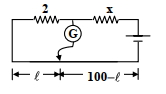
$A$ resistance of $2 \Omega$ is connected across one gap of a metre-bridge (the length of the wire is $100 \text{ cm}$) and an unknown resistance,greater than $2 \Omega$,is connected across the other gap. When these resistances are interchanged,the balance point shifts by $20 \text{ cm}$. Neglecting any corrections,the unknown resistance is (in $Omega$)
A
$3$
B
$4$
C
$5$
D
$6$
Solution
(A) Let the unknown resistance be $x$. According to the meter bridge principle,for the first case:
$\frac{2}{x} = \frac{\ell}{100 - \ell}$ ...............$(I)$
When the resistances are interchanged,the new balance point is $\ell' = \ell + 20$ (since $x > 2$,the balance point shifts towards the larger resistance). Thus,for the second case:
$\frac{x}{2} = \frac{\ell + 20}{100 - (\ell + 20)} = \frac{\ell + 20}{80 - \ell}$ ...............$(II)$
From $(I)$,$\frac{\ell}{100 - \ell} = \frac{2}{x} \implies \ell x = 200 - 2\ell \implies \ell(x + 2) = 200 \implies \ell = \frac{200}{x + 2}$.
From $(II)$,$\frac{x}{2} = \frac{\ell + 20}{80 - \ell} \implies 80x - \ell x = 2\ell + 40 \implies 80x - 40 = \ell(x + 2)$.
Substituting $\ell(x + 2) = 200$ into the equation $80x - 40 = \ell(x + 2)$:
$80x - 40 = 200$
$80x = 240$
$x = 3 \Omega$.
$\frac{2}{x} = \frac{\ell}{100 - \ell}$ ...............$(I)$
When the resistances are interchanged,the new balance point is $\ell' = \ell + 20$ (since $x > 2$,the balance point shifts towards the larger resistance). Thus,for the second case:
$\frac{x}{2} = \frac{\ell + 20}{100 - (\ell + 20)} = \frac{\ell + 20}{80 - \ell}$ ...............$(II)$
From $(I)$,$\frac{\ell}{100 - \ell} = \frac{2}{x} \implies \ell x = 200 - 2\ell \implies \ell(x + 2) = 200 \implies \ell = \frac{200}{x + 2}$.
From $(II)$,$\frac{x}{2} = \frac{\ell + 20}{80 - \ell} \implies 80x - \ell x = 2\ell + 40 \implies 80x - 40 = \ell(x + 2)$.
Substituting $\ell(x + 2) = 200$ into the equation $80x - 40 = \ell(x + 2)$:
$80x - 40 = 200$
$80x = 240$
$x = 3 \Omega$.
0 likesView Solution
25
PhysicsDifficultMCQIIT JEE · 2007
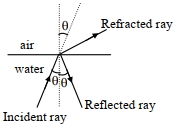
$A$ ray of light travelling in water is incident on its surface open to air. The angle of incidence is $\theta$,which is less than the critical angle. Then there will be
A
only a reflected ray and no refracted ray
B
only a refracted ray and no reflected ray
C
a reflected ray and a refracted ray and the angle between them would be less than $180^{\circ}-2 \theta$
D
a reflected ray and a refracted ray and the angle between them would be greater than $180^{\circ}-2 \theta$
Solution
(C) When a light ray travels from a denser medium (water) to a rarer medium (air) and the angle of incidence $\theta$ is less than the critical angle,partial reflection and partial refraction occur.
$1$. The reflected ray makes an angle $\theta$ with the normal in the water medium.
$2$. The refracted ray makes an angle $r$ with the normal in the air medium. According to Snell's law,$n_w \sin \theta = n_a \sin r$. Since $n_w > n_a$,it follows that $\sin r > \sin \theta$,so $r > \theta$.
$3$. The angle between the reflected ray and the refracted ray is $\phi = 180^{\circ} - (\theta + r)$.
$4$. Since $r > \theta$,we have $\theta + r > 2\theta$.
$5$. Therefore,$180^{\circ} - (\theta + r) < 180^{\circ} - 2\theta$.
$6$. Thus,the angle between the reflected and refracted rays is less than $180^{\circ} - 2\theta$.
$1$. The reflected ray makes an angle $\theta$ with the normal in the water medium.
$2$. The refracted ray makes an angle $r$ with the normal in the air medium. According to Snell's law,$n_w \sin \theta = n_a \sin r$. Since $n_w > n_a$,it follows that $\sin r > \sin \theta$,so $r > \theta$.
$3$. The angle between the reflected ray and the refracted ray is $\phi = 180^{\circ} - (\theta + r)$.
$4$. Since $r > \theta$,we have $\theta + r > 2\theta$.
$5$. Therefore,$180^{\circ} - (\theta + r) < 180^{\circ} - 2\theta$.
$6$. Thus,the angle between the reflected and refracted rays is less than $180^{\circ} - 2\theta$.
0 likesView Solution
26
PhysicsMediumMCQIIT JEE · 2007
Consider a neutral conducting sphere. $A$ positive point charge is placed outside the sphere. The net charge on the sphere is then,
A
negative and distributed uniformly over the surface of the sphere
B
negative and appears only at the point on the sphere closest to the point charge
C
negative and distributed non-uniformly over the entire surface of the sphere
D
zero
Solution
(D) neutral conducting sphere contains an equal number of positive and negative charges,resulting in a net charge of $0$.
When a positive point charge is placed outside the sphere,it induces a redistribution of charges within the conductor.
The negative charges are attracted towards the side of the sphere closest to the positive point charge,while the positive charges are repelled to the far side.
However,this process is purely an internal redistribution of existing charges.
Since no charge is added to or removed from the isolated conducting sphere,the total net charge on the sphere remains $0$.
When a positive point charge is placed outside the sphere,it induces a redistribution of charges within the conductor.
The negative charges are attracted towards the side of the sphere closest to the positive point charge,while the positive charges are repelled to the far side.
However,this process is purely an internal redistribution of existing charges.
Since no charge is added to or removed from the isolated conducting sphere,the total net charge on the sphere remains $0$.
0 likesView Solution
27
PhysicsMediumMCQIIT JEE · 2007
$STATEMENT-1$: The formula connecting $u, v$ and $f$ for a spherical mirror is valid only for mirrors whose sizes are very small compared to their radii of curvature. because
$STATEMENT-2$: Laws of reflection are strictly valid for plane surfaces, but not for large spherical surfaces.
$STATEMENT-2$: Laws of reflection are strictly valid for plane surfaces, but not for large spherical surfaces.
A
$Statement-1$ is True, $Statement-2$ is True; $Statement-2$ is a correct explanation for $Statement-1$.
B
$Statement-1$ is True, $Statement-2$ is True; $Statement-2$ is $NOT$ a correct explanation for $Statement-1$.
C
$Statement-1$ is True, $Statement-2$ is False.
D
$Statement-1$ is False, $Statement-2$ is True.
Solution
(C) $Statement-1$ is True. The mirror formula $\frac{1}{f} = \frac{1}{v} + \frac{1}{u}$ is derived using the paraxial approximation, which assumes that the rays are close to the principal axis and the aperture of the mirror is small compared to the radius of curvature $(R)$.
$Statement-2$ is False. The laws of reflection (angle of incidence equals angle of reflection) are fundamental and hold true for any reflecting surface, whether plane or spherical, regardless of size. The deviation in large spherical mirrors is due to spherical aberration, not a violation of the laws of reflection.
$Statement-2$ is False. The laws of reflection (angle of incidence equals angle of reflection) are fundamental and hold true for any reflecting surface, whether plane or spherical, regardless of size. The deviation in large spherical mirrors is due to spherical aberration, not a violation of the laws of reflection.
0 likesView Solution
28
PhysicsDifficultMCQIIT JEE · 2007
$STATEMENT-1$: If the accelerating potential in an $X$-ray tube is increased, the wavelengths of the characteristic $X$-rays do not change. because
$STATEMENT-2$: When an electron beam strikes the target in an $X$-ray tube, part of the kinetic energy is converted into $X$-ray energy.
$STATEMENT-2$: When an electron beam strikes the target in an $X$-ray tube, part of the kinetic energy is converted into $X$-ray energy.
A
$Statement-1$ is True, $Statement-2$ is True; $Statement-2$ is a correct explanation for $Statement-1$.
B
$Statement-1$ is True, $Statement-2$ is True; $Statement-2$ is $NOT$ a correct explanation for $Statement-1$.
C
$Statement-1$ is True, $Statement-2$ is False.
D
$Statement-1$ is False, $Statement-2$ is True.
Solution
(B) The characteristic $X$-rays are produced due to electronic transitions between the inner shells of the target atoms. The energy of these transitions depends only on the atomic number $(Z)$ of the target material, not on the accelerating potential of the electrons. Thus, $Statement-1$ is True.
When an electron beam strikes the target, it loses kinetic energy, which is emitted as $X$-ray photons (Bremsstrahlung and characteristic). This is a general physical process occurring in the tube. Thus, $Statement-2$ is True.
However, $Statement-2$ describes the general production of $X$-rays, whereas $Statement-1$ refers specifically to the independence of characteristic $X$-ray wavelengths from the accelerating potential. Therefore, $Statement-2$ is not the specific explanation for $Statement-1$.
When an electron beam strikes the target, it loses kinetic energy, which is emitted as $X$-ray photons (Bremsstrahlung and characteristic). This is a general physical process occurring in the tube. Thus, $Statement-2$ is True.
However, $Statement-2$ describes the general production of $X$-rays, whereas $Statement-1$ refers specifically to the independence of characteristic $X$-ray wavelengths from the accelerating potential. Therefore, $Statement-2$ is not the specific explanation for $Statement-1$.
0 likesView Solution
29
PhysicsAdvancedMCQIIT JEE · 2007
Some laws/processes are given in Column $I$. Match these with the physical phenomena given in Column $II$.
| Column $I$ | Column $II$ |
| $(A)$ Transition between two atomic energy levels | $(p)$ Characteristic $X$-rays |
| $(B)$ Electron emission from a material | $(q)$ Photoelectric effect |
| $(C)$ Mosley's law | $(r)$ Hydrogen spectrum |
| $(D)$ Change of photon energy into kinetic energy of electrons | $(s)$ $\beta$-decay |
A
$A \rightarrow (q) \& (s), B \rightarrow (q) \& (p), C \rightarrow (p), D \rightarrow (s)$
B
$A \rightarrow (p) \& (r), B \rightarrow (q) \& (s), C \rightarrow (p), D \rightarrow (q)$
C
$A \rightarrow (s) \& (r), B \rightarrow (p) \& (s), C \rightarrow (p), D \rightarrow (s)$
D
$A \rightarrow (p) \& (q), B \rightarrow (q) \& (r), C \rightarrow (p), D \rightarrow (q)$
Solution
$(A)$ Transition between two atomic energy levels results in the emission of photons, which corresponds to the Hydrogen spectrum $(r)$ and Characteristic $X$-rays $(p)$.
$(B)$ Electron emission from a material can occur via the Photoelectric effect $(q)$ or $\beta$-decay $(s)$.
$(C)$ Mosley's law relates the frequency of Characteristic $X$-rays $(p)$ to the atomic number of the target material.
$(D)$ The change of photon energy into the kinetic energy of electrons is the fundamental principle of the Photoelectric effect $(q)$.
Therefore, the correct matching is: $A \rightarrow (p) \& (r), B \rightarrow (q) \& (s), C \rightarrow (p), D \rightarrow (q)$.
$(B)$ Electron emission from a material can occur via the Photoelectric effect $(q)$ or $\beta$-decay $(s)$.
$(C)$ Mosley's law relates the frequency of Characteristic $X$-rays $(p)$ to the atomic number of the target material.
$(D)$ The change of photon energy into the kinetic energy of electrons is the fundamental principle of the Photoelectric effect $(q)$.
Therefore, the correct matching is: $A \rightarrow (p) \& (r), B \rightarrow (q) \& (s), C \rightarrow (p), D \rightarrow (q)$.
0 likesView Solution
30
PhysicsAdvancedMCQIIT JEE · 2007
Column $I$ gives certain situations in which a straight metallic wire of resistance $R$ is used and Column $II$ gives some resulting effects. Match the statements in Column $I$ with the statements in Column $II$.
| Column $I$ | Column $II$ |
| $(A)$ $A$ charged capacitor is connected to the ends of the wire | $(p)$ $A$ constant current flows through the wire |
| $(B)$ The wire is moved perpendicular to its length with a constant velocity in a uniform magnetic field perpendicular to the plane of motion | $(q)$ Thermal energy is generated in the wire |
| $(C)$ The wire is placed in a constant electric field that has a direction along the length of the wire | $(r)$ $A$ constant potential difference develops between the ends of the wire |
| $(D)$ $A$ battery of constant emf is connected to the ends of the wire | $(s)$ Charges of constant magnitude appear at the ends of the wire |
A
$A \rightarrow (q), B \rightarrow (r, s), C \rightarrow (r, s), D \rightarrow (p, q, r)$
B
$A \rightarrow (r), B \rightarrow (r, s), C \rightarrow (r, s), D \rightarrow (p, s, q)$
C
$A \rightarrow (r), B \rightarrow (s, q), C \rightarrow (r, s), D \rightarrow (p, s, r)$
D
$A \rightarrow (s), B \rightarrow (q, s), C \rightarrow (s, s), D \rightarrow (p, q, r)$
Solution
$(A)$ When a charged capacitor is connected to a wire, it discharges through the resistance $R$, generating thermal energy $(q)$.
$(B)$ Motional $EMF$ $e = Blv$ is induced. This creates a potential difference $(r)$ and charge separation $(s)$ at the ends. Since the wire is in a circuit, current flows, generating thermal energy $(q)$.
$(C)$ In a uniform electric field $E$, a potential difference $V = El$ develops $(r)$ and charges appear at the ends $(s)$.
$(D)$ $A$ battery provides constant $EMF$, leading to constant current $(p)$, thermal energy $(q)$, and a constant potential difference $(r)$ across the wire.
$(B)$ Motional $EMF$ $e = Blv$ is induced. This creates a potential difference $(r)$ and charge separation $(s)$ at the ends. Since the wire is in a circuit, current flows, generating thermal energy $(q)$.
$(C)$ In a uniform electric field $E$, a potential difference $V = El$ develops $(r)$ and charges appear at the ends $(s)$.
$(D)$ $A$ battery provides constant $EMF$, leading to constant current $(p)$, thermal energy $(q)$, and a constant potential difference $(r)$ across the wire.
0 likesView Solution
31
PhysicsDifficultMCQIIT JEE · 2007
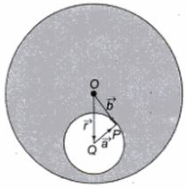
$A$ spherical portion has been removed from a solid sphere having a charge distributed uniformly in its volume as shown in the figure. The electric field inside the emptied space is

A
zero everywhere
B
non-zero and uniform
C
non-uniform
D
zero only at its center
Solution
(B) Consider a solid sphere of charge density $\rho$ with a spherical cavity. The electric field at any point $P$ inside the cavity can be found using the principle of superposition. We can treat the system as a large solid sphere of charge density $\rho$ and a smaller sphere of charge density $-\rho$ that fills the cavity.
The electric field at a point $P$ inside a uniformly charged sphere at a distance $\vec{r}$ from its center is given by $\vec{E} = \frac{\rho \vec{r}}{3 \epsilon_0}$.
Let $\vec{b}$ be the position vector of point $P$ from the center of the large sphere $(O)$ and $\vec{a}$ be the position vector of point $P$ from the center of the cavity $(Q)$. The net electric field at $P$ is the sum of the fields due to the large sphere and the negative charge of the cavity:
$\vec{E}_{net} = \vec{E}_{large} + \vec{E}_{cavity} = \frac{\rho \vec{b}}{3 \epsilon_0} + \frac{-\rho \vec{a}}{3 \epsilon_0} = \frac{\rho}{3 \epsilon_0} (\vec{b} - \vec{a})$.
From the geometry,$\vec{b} - \vec{a} = \vec{r}$,where $\vec{r}$ is the constant vector from the center of the large sphere to the center of the cavity. Thus,$\vec{E}_{net} = \frac{\rho \vec{r}}{3 \epsilon_0}$.
Since $\rho$,$\vec{r}$,and $\epsilon_0$ are constants,the electric field inside the cavity is non-zero and uniform.
The electric field at a point $P$ inside a uniformly charged sphere at a distance $\vec{r}$ from its center is given by $\vec{E} = \frac{\rho \vec{r}}{3 \epsilon_0}$.
Let $\vec{b}$ be the position vector of point $P$ from the center of the large sphere $(O)$ and $\vec{a}$ be the position vector of point $P$ from the center of the cavity $(Q)$. The net electric field at $P$ is the sum of the fields due to the large sphere and the negative charge of the cavity:
$\vec{E}_{net} = \vec{E}_{large} + \vec{E}_{cavity} = \frac{\rho \vec{b}}{3 \epsilon_0} + \frac{-\rho \vec{a}}{3 \epsilon_0} = \frac{\rho}{3 \epsilon_0} (\vec{b} - \vec{a})$.
From the geometry,$\vec{b} - \vec{a} = \vec{r}$,where $\vec{r}$ is the constant vector from the center of the large sphere to the center of the cavity. Thus,$\vec{E}_{net} = \frac{\rho \vec{r}}{3 \epsilon_0}$.
Since $\rho$,$\vec{r}$,and $\epsilon_0$ are constants,the electric field inside the cavity is non-zero and uniform.
0 likesView Solution
32
PhysicsAdvancedMCQIIT JEE · 2007
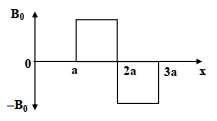
$A$ magnetic field $\overrightarrow{B} = B_0 \hat{j}$ exists in the region $a < x < 2a$ and $\overrightarrow{B} = -B_0 \hat{j}$ in the region $2a < x < 3a$,where $B_0$ is a positive constant. $A$ positive point charge moving with a velocity $\overrightarrow{v} = v_0 \hat{i}$,where $v_0$ is a positive constant,enters the magnetic field at $x = a$. The trajectory of the charge in this region can be like,
A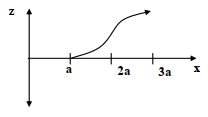
B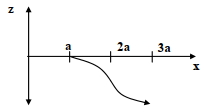
C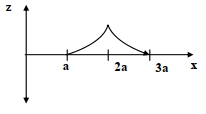
D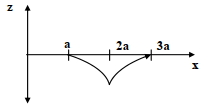
Solution
(A) The force on a moving charge in a magnetic field is given by $\overrightarrow{F} = q(\overrightarrow{v} \times \overrightarrow{B})$.
For the region $a < x < 2a$,$\overrightarrow{v} = v_0 \hat{i}$ and $\overrightarrow{B} = B_0 \hat{j}$.
Thus,$\overrightarrow{F} = q(v_0 \hat{i} \times B_0 \hat{j}) = q v_0 B_0 \hat{k}$.
Since the force is in the $+\hat{k}$ direction,the path will be concave upward.
For the region $2a < x < 3a$,$\overrightarrow{v}$ has a component in the $\hat{k}$ direction,but the magnetic field is $\overrightarrow{B} = -B_0 \hat{j}$.
The force $\overrightarrow{F} = q(\overrightarrow{v} \times -B_0 \hat{j})$ will now have a component in the $-\hat{k}$ direction.
Thus,the path will be concave downward in this region.
Comparing this with the given options,the trajectory shown in Option $A$ matches this behavior.
For the region $a < x < 2a$,$\overrightarrow{v} = v_0 \hat{i}$ and $\overrightarrow{B} = B_0 \hat{j}$.
Thus,$\overrightarrow{F} = q(v_0 \hat{i} \times B_0 \hat{j}) = q v_0 B_0 \hat{k}$.
Since the force is in the $+\hat{k}$ direction,the path will be concave upward.
For the region $2a < x < 3a$,$\overrightarrow{v}$ has a component in the $\hat{k}$ direction,but the magnetic field is $\overrightarrow{B} = -B_0 \hat{j}$.
The force $\overrightarrow{F} = q(\overrightarrow{v} \times -B_0 \hat{j})$ will now have a component in the $-\hat{k}$ direction.
Thus,the path will be concave downward in this region.
Comparing this with the given options,the trajectory shown in Option $A$ matches this behavior.
0 likesView Solution
33
PhysicsAdvancedMCQIIT JEE · 2007
Electrons with de-Broglie wavelength $\lambda$ fall on the target in an $X$-ray tube. The cut-off wavelength of the emitted $X$-rays is
A
$\lambda_0 = \frac{2 mc \lambda^2}{h}$
B
$\lambda_0 = \frac{2h}{mc}$
C
$\lambda_0 = \frac{2 m^2 c^2 \lambda^3}{h^2}$
D
$\lambda_0 = \lambda$
Solution
(A) The de-Broglie wavelength $\lambda$ of an electron with kinetic energy $E$ is given by $\lambda = \frac{h}{\sqrt{2mE}}$.
Squaring both sides,we get $\lambda^2 = \frac{h^2}{2mE}$.
Rearranging for kinetic energy $E$,we find $E = \frac{h^2}{2m\lambda^2}$.
The cut-off wavelength $\lambda_0$ of the emitted $X$-rays corresponds to the maximum energy of the photons,which is equal to the kinetic energy of the incident electrons: $E = \frac{hc}{\lambda_0}$.
Substituting the expression for $E$,we have $\frac{hc}{\lambda_0} = \frac{h^2}{2m\lambda^2}$.
Solving for $\lambda_0$,we get $\lambda_0 = \frac{2mc\lambda^2}{h}$.
Squaring both sides,we get $\lambda^2 = \frac{h^2}{2mE}$.
Rearranging for kinetic energy $E$,we find $E = \frac{h^2}{2m\lambda^2}$.
The cut-off wavelength $\lambda_0$ of the emitted $X$-rays corresponds to the maximum energy of the photons,which is equal to the kinetic energy of the incident electrons: $E = \frac{hc}{\lambda_0}$.
Substituting the expression for $E$,we have $\frac{hc}{\lambda_0} = \frac{h^2}{2m\lambda^2}$.
Solving for $\lambda_0$,we get $\lambda_0 = \frac{2mc\lambda^2}{h}$.
0 likesView Solution
34
PhysicsAdvancedMCQIIT JEE · 2007
Positive and negative point charges of equal magnitude are kept at $(0, 0, a/2)$ and $(0, 0, -a/2)$,respectively. The work done by the electric field when another positive point charge is moved from $(-a, 0, 0)$ to $(0, a, 0)$ is
A
positive
B
negative
C
zero
D
depends on the path connecting the initial and final positions
Solution
(C) The given arrangement of charges is an electric dipole placed along the $z$-axis,with the positive charge at $(0, 0, a/2)$ and the negative charge at $(0, 0, -a/2)$.
The electric potential $V$ at any point $(x, y, z)$ due to an electric dipole is given by $V = \frac{1}{4\pi\epsilon_0} \frac{\vec{p} \cdot \vec{r}}{r^3}$.
For a dipole centered at the origin,the equatorial plane is the $xy$-plane $(z = 0)$.
At any point on the $xy$-plane,the distance from the positive charge is equal to the distance from the negative charge,so the potential $V$ is zero everywhere on the $xy$-plane.
The initial position is $(-a, 0, 0)$,which lies on the $xy$-plane,so $V_i = 0$.
The final position is $(0, a, 0)$,which also lies on the $xy$-plane,so $V_f = 0$.
The work done by the electric field $W_e$ is given by $W_e = -\Delta U = -q_0(V_f - V_i)$,where $q_0$ is the test charge.
Since $V_f = V_i = 0$,the work done $W_e = -q_0(0 - 0) = 0$.
The electric potential $V$ at any point $(x, y, z)$ due to an electric dipole is given by $V = \frac{1}{4\pi\epsilon_0} \frac{\vec{p} \cdot \vec{r}}{r^3}$.
For a dipole centered at the origin,the equatorial plane is the $xy$-plane $(z = 0)$.
At any point on the $xy$-plane,the distance from the positive charge is equal to the distance from the negative charge,so the potential $V$ is zero everywhere on the $xy$-plane.
The initial position is $(-a, 0, 0)$,which lies on the $xy$-plane,so $V_i = 0$.
The final position is $(0, a, 0)$,which also lies on the $xy$-plane,so $V_f = 0$.
The work done by the electric field $W_e$ is given by $W_e = -\Delta U = -q_0(V_f - V_i)$,where $q_0$ is the test charge.
Since $V_f = V_i = 0$,the work done $W_e = -q_0(0 - 0) = 0$.
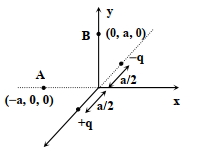
0 likesView Solution
35
PhysicsDifficultMCQIIT JEE · 2007
$STATEMENT-1$ $A$ vertical iron rod has a coil of wire wound over it at the bottom end. An alternating current flows in the coil. The rod goes through a conducting ring as shown in the figure. The ring can float at a certain height above the coil. Because
$STATEMENT-2$ In the above situation,a current is induced in the ring which interacts with the radial component of the magnetic field to produce an average force in the upward direction.
$STATEMENT-2$ In the above situation,a current is induced in the ring which interacts with the radial component of the magnetic field to produce an average force in the upward direction.
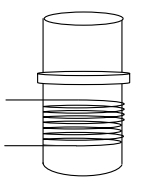
A
Statement-$1$ is True,Statement-$2$ is True; Statement-$2$ is a correct explanation for Statement-$1$.
B
Statement-$1$ is True,Statement-$2$ is True; Statement-$2$ is $NOT$ a correct explanation for Statement-$1$.
C
Statement-$1$ is True,Statement-$2$ is False.
D
Statement-$1$ is False,Statement-$2$ is True.
Solution
(A) Statement-$1$ is True: When an alternating current flows through the coil,it creates a time-varying magnetic field. This magnetic field induces an electromotive force $(EMF)$ and consequently an induced current in the conducting ring according to Faraday's Law of Induction.
Statement-$2$ is True: The magnetic field lines produced by the coil are not purely vertical; they have a radial component as they emerge from the iron rod. The induced current in the ring interacts with this radial component of the magnetic field. According to the Lorentz force law $(F = I(L \times B))$,this interaction produces an upward force on the ring. Since the current in the coil is alternating,the induced current in the ring also alternates,but the force remains directed upwards on average,allowing the ring to levitate at a stable position where this upward magnetic force balances the downward gravitational force.
Therefore,Statement-$2$ is the correct explanation for Statement-$1$.
Statement-$2$ is True: The magnetic field lines produced by the coil are not purely vertical; they have a radial component as they emerge from the iron rod. The induced current in the ring interacts with this radial component of the magnetic field. According to the Lorentz force law $(F = I(L \times B))$,this interaction produces an upward force on the ring. Since the current in the coil is alternating,the induced current in the ring also alternates,but the force remains directed upwards on average,allowing the ring to levitate at a stable position where this upward magnetic force balances the downward gravitational force.
Therefore,Statement-$2$ is the correct explanation for Statement-$1$.
0 likesView Solution
36
PhysicsAdvancedIIT JEE · 2007
The figure shows a surface $XY$ separating two transparent media,medium-$1$ and medium-$2$. The lines $ab$ and $cd$ represent wavefronts of a light wave travelling in medium-$1$ and incident on $XY$. The lines $ef$ and $gh$ represent wavefronts of the light wave in medium-$2$ after refraction.
$1.$ Light travels as a
$(A)$ parallel beam in each medium
$(B)$ convergent beam in each medium
$(C)$ divergent beam in each medium
$(D)$ divergent beam in one medium and convergent beam in the other medium.
$2.$ The phases of the light wave at $c, d, e$ and $f$ are $\phi_{c}, \phi_{d}, \phi_{e}$ and $\phi_{f}$ respectively. It is given that $\phi_{c} \neq \phi_{f}$.
$(A)$ $\phi_{c}$ cannot be equal to $\phi_{d}$
$(B)$ $\phi_{a}$ can be equal to $\phi_{e}$
$(C)$ $(\phi_{d}-\phi_{c})$ is equal to $(\phi_{f}-\phi_{e})$
$(D)$ $(\phi_{d}-\phi_{c})$ is not equal to $(\phi_{f}-\phi_{e})$
$3.$ Speed of the light is
$(A)$ the same in medium-$1$ and medium-$2$
$(B)$ larger in medium-$1$ than in medium-$2$
$(C)$ larger in medium-$2$ than in medium-$1$
$(D)$ different at $b$ and $d$
Give the answer for questions $1, 2$ and $3$.
$1.$ Light travels as a
$(A)$ parallel beam in each medium
$(B)$ convergent beam in each medium
$(C)$ divergent beam in each medium
$(D)$ divergent beam in one medium and convergent beam in the other medium.
$2.$ The phases of the light wave at $c, d, e$ and $f$ are $\phi_{c}, \phi_{d}, \phi_{e}$ and $\phi_{f}$ respectively. It is given that $\phi_{c} \neq \phi_{f}$.
$(A)$ $\phi_{c}$ cannot be equal to $\phi_{d}$
$(B)$ $\phi_{a}$ can be equal to $\phi_{e}$
$(C)$ $(\phi_{d}-\phi_{c})$ is equal to $(\phi_{f}-\phi_{e})$
$(D)$ $(\phi_{d}-\phi_{c})$ is not equal to $(\phi_{f}-\phi_{e})$
$3.$ Speed of the light is
$(A)$ the same in medium-$1$ and medium-$2$
$(B)$ larger in medium-$1$ than in medium-$2$
$(C)$ larger in medium-$2$ than in medium-$1$
$(D)$ different at $b$ and $d$
Give the answer for questions $1, 2$ and $3$.
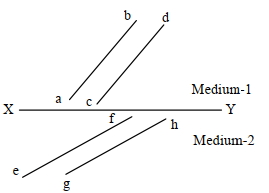
Solution
(A,C,C) $1.$ Since the wavefronts are parallel straight lines,the light rays (which are perpendicular to the wavefronts) are parallel. Thus,light travels as a parallel beam in each medium. Correct option is $(A)$.
$2.$ For a plane wavefront,the phase difference between two points depends on the path difference. Since the wavefronts are parallel,the distance between any two points on the same wavefront is constant. The phase difference between two points on the same wavefront is zero. Thus,$(\phi_{d}-\phi_{c}) = 0$ and $(\phi_{f}-\phi_{e}) = 0$. Therefore,$(\phi_{d}-\phi_{c}) = (\phi_{f}-\phi_{e})$. However,the question asks for the correct statement. Given $\phi_{c} \neq \phi_{f}$,the phase difference between points on different wavefronts is non-zero. The correct relation is that the phase difference between points on the same wavefront is zero. Looking at the options,$(C)$ is the only one that holds true as both sides are zero. Correct option is $(C)$.
$3.$ The distance between successive wavefronts represents the wavelength $\lambda$. From the figure,the distance between $ab$ and $cd$ (wavelength in medium-$1$,$\lambda_1$) is smaller than the distance between $ef$ and $gh$ (wavelength in medium-$2$,$\lambda_2$). Since $v = f\lambda$ and frequency $f$ remains constant during refraction,$v \propto \lambda$. Thus,$v_2 > v_1$. The speed is larger in medium-$2$ than in medium-$1$. Correct option is $(C)$.
$2.$ For a plane wavefront,the phase difference between two points depends on the path difference. Since the wavefronts are parallel,the distance between any two points on the same wavefront is constant. The phase difference between two points on the same wavefront is zero. Thus,$(\phi_{d}-\phi_{c}) = 0$ and $(\phi_{f}-\phi_{e}) = 0$. Therefore,$(\phi_{d}-\phi_{c}) = (\phi_{f}-\phi_{e})$. However,the question asks for the correct statement. Given $\phi_{c} \neq \phi_{f}$,the phase difference between points on different wavefronts is non-zero. The correct relation is that the phase difference between points on the same wavefront is zero. Looking at the options,$(C)$ is the only one that holds true as both sides are zero. Correct option is $(C)$.
$3.$ The distance between successive wavefronts represents the wavelength $\lambda$. From the figure,the distance between $ab$ and $cd$ (wavelength in medium-$1$,$\lambda_1$) is smaller than the distance between $ef$ and $gh$ (wavelength in medium-$2$,$\lambda_2$). Since $v = f\lambda$ and frequency $f$ remains constant during refraction,$v \propto \lambda$. Thus,$v_2 > v_1$. The speed is larger in medium-$2$ than in medium-$1$. Correct option is $(C)$.
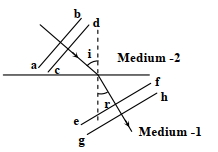
0 likesView Solution
37
PhysicsAdvancedMCQIIT JEE · 2007
Two wires each carrying a steady current $I$ are shown in four configurations in Column $I$. Some of the resulting effects are described in Column $II$. Match the statements in Column $I$ with the statements in Column $II$.
| Column $I$ | Column $II$ |
| $(A)$ Two parallel wires with current in the same direction,$P$ is the midpoint. | $(p)$ The magnetic fields $(B)$ at $P$ due to the currents in the wires are in the same direction. |
| $(B)$ Two coaxial circular loops with current in the same direction,$P$ is the midpoint on the axis. | $(q)$ The magnetic fields $(B)$ at $P$ due to the currents in the wires are in opposite directions. |
| $(C)$ Two coplanar circular loops with current in opposite directions,$P$ is the midpoint. | $(r)$ There is no magnetic field at $P$. |
| $(D)$ Two concentric coplanar circular loops with current in the same direction,$P$ is the common center. | $(s)$ The wires repel each other. |
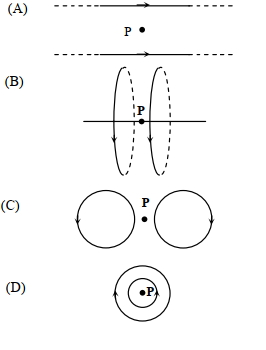
A
$A \rightarrow (s) \& (r), B \rightarrow (p), C \rightarrow (q) \& (r), D \rightarrow (r)$
B
$A \rightarrow (q) \& (r), B \rightarrow (p), C \rightarrow (q) \& (r), D \rightarrow (q)$
C
$A \rightarrow (s) \& (r), B \rightarrow (s), C \rightarrow (q) \& (r), D \rightarrow (p)$
D
$A \rightarrow (q) \& (r), B \rightarrow (s), C \rightarrow (q) \& (r), D \rightarrow (r)$
Solution
(A) Two parallel wires carrying current in the same direction attract each other $(s)$. At the midpoint $P$,the magnetic field due to the top wire is directed into the page,and the magnetic field due to the bottom wire is directed out of the page. Thus,they cancel out,resulting in zero magnetic field $(r)$.
$(B)$ Two coaxial loops with current in the same direction produce magnetic fields in the same direction $(p)$ at the midpoint on the axis.
$(C)$ Two coplanar loops with current in opposite directions (one clockwise,one counter-clockwise) produce magnetic fields in the same direction at the midpoint $P$ (both into the page). Wait,looking at the diagram: for $(C)$,the currents are in opposite directions,so at the midpoint,the fields add up. Actually,the fields are in the same direction $(p)$. Let's re-evaluate: $(C)$ shows currents in opposite directions,so at the midpoint,the fields are in the same direction. The correct match is $(p)$.
$(D)$ Two concentric loops with current in the same direction produce magnetic fields in the same direction at the center. However,if the currents are in opposite directions,they would cancel. Given the diagram,the fields at the center are in the same direction,so they add up. The correct option is $(A)$.
$(B)$ Two coaxial loops with current in the same direction produce magnetic fields in the same direction $(p)$ at the midpoint on the axis.
$(C)$ Two coplanar loops with current in opposite directions (one clockwise,one counter-clockwise) produce magnetic fields in the same direction at the midpoint $P$ (both into the page). Wait,looking at the diagram: for $(C)$,the currents are in opposite directions,so at the midpoint,the fields add up. Actually,the fields are in the same direction $(p)$. Let's re-evaluate: $(C)$ shows currents in opposite directions,so at the midpoint,the fields are in the same direction. The correct match is $(p)$.
$(D)$ Two concentric loops with current in the same direction produce magnetic fields in the same direction at the center. However,if the currents are in opposite directions,they would cancel. Given the diagram,the fields at the center are in the same direction,so they add up. The correct option is $(A)$.
0 likesView Solution
38
PhysicsDifficultMCQIIT JEE · 2007
$A$ positron is emitted from ${}^{23}Na_{11}$. The ratio of the atomic mass and atomic number of the resulting nuclide is
A
$22 / 10$
B
$22 / 11$
C
$23 / 10$
D
$23 / 12$
Solution
(C) During positron emission from a nucleus,a proton is converted into a neutron $(p \rightarrow n + e^+ + \nu_e)$.
As a result,the atomic number $(Z)$ decreases by $1$,while the atomic mass $(A)$ remains constant.
For the parent nucleus ${}^{23}Na_{11}$,the atomic mass $A = 23$ and atomic number $Z = 11$.
After the emission of a positron,the new atomic number $Z' = 11 - 1 = 10$,and the atomic mass $A' = 23$.
The ratio of the atomic mass to the atomic number of the resulting nuclide is $\frac{A'}{Z'} = \frac{23}{10}$.
Therefore,option $(C)$ is correct.
As a result,the atomic number $(Z)$ decreases by $1$,while the atomic mass $(A)$ remains constant.
For the parent nucleus ${}^{23}Na_{11}$,the atomic mass $A = 23$ and atomic number $Z = 11$.
After the emission of a positron,the new atomic number $Z' = 11 - 1 = 10$,and the atomic mass $A' = 23$.
The ratio of the atomic mass to the atomic number of the resulting nuclide is $\frac{A'}{Z'} = \frac{23}{10}$.
Therefore,option $(C)$ is correct.
0 likesView Solution
Vedclass Products
For Students
Vedclass Test Series
Mock tests in real IIT JEE style covering Physics with performance analysis. 5-day free trial.
Start Free TrialFor Teachers
Exam Paper Generator
Generate Set A/B/C/D Physics papers from 7.5L+ questions in 2 minutes. 3 chapters free.
Try FreeFor Institutes
Online Exam Module
Run live IIT JEE mock exams with unlimited students, 360° analytics & white-label branding.
See DemoFrequently Asked Questions
How many Physics questions are in IIT JEE 2007?
There are 38 Physics questions from the IIT JEE 2007 paper on Vedclass, each with a detailed step-by-step solution in English.
Are IIT JEE 2007 Physics solutions available in English?
Yes. All solutions on this page are in English. You can also switch to English or Hindi using the language buttons above the questions.
Can I practice IIT JEE 2007 Physics as a timed test?
Yes. Use the Vedclass Test Series to attempt a full IIT JEE mock test covering Physics with time limits and instant score analysis.
Can teachers create Physics papers from IIT JEE previous year questions?
Yes. The Vedclass Exam Paper Generator lets teachers mix IIT JEE Physics questions and generate Set A/B/C/D papers in minutes.
For Teachers & Institutes
Build a Custom Physics Paper
Pick IIT JEE 2007 Physics questions, set difficulty, and generate Set A/B/C/D in 2 minutes.