
MathematicsQ1–28 of 28 questions
Page 1 of 1 · English
1
MathematicsDifficultMCQIIT JEE · 1989
If $a$ and $b$ are real numbers between $0$ and $1$ such that the points $z_1 = a + i$,$z_2 = 1 + bi$,and $z_3 = 0$ form an equilateral triangle,then
A
$a = b = 2 + \sqrt{3}$
B
$a = b = 2 - \sqrt{3}$
C
$a = 2 - \sqrt{3}, b = 2 + \sqrt{3}$
D
None of these
Solution
(B) Since the triangle with vertices $z_1 = a + i$,$z_2 = 1 + bi$,and $z_3 = 0$ is equilateral,we have the condition $z_1^2 + z_2^2 + z_3^2 = z_1 z_2 + z_2 z_3 + z_3 z_1$.
Substituting the values,we get $(a + i)^2 + (1 + bi)^2 + 0 = (a + i)(1 + bi)$.
Expanding both sides: $(a^2 - 1 + 2ai) + (1 - b^2 + 2bi) = a + abi + i - b$.
Simplifying: $(a^2 - b^2) + 2i(a + b) = (a - b) + i(1 + ab)$.
Equating real and imaginary parts:
$a^2 - b^2 = a - b$ ... $(i)$
$2(a + b) = 1 + ab$ ... $(ii)$
From $(i)$,$(a - b)(a + b) = (a - b)$,which implies $(a - b)(a + b - 1) = 0$.
So,either $a = b$ or $a + b = 1$.
Case $1$: If $a = b$,then from $(ii)$,$2(2a) = 1 + a^2$,so $a^2 - 4a + 1 = 0$.
Solving for $a$,$a = \frac{4 \pm \sqrt{16 - 4}}{2} = 2 \pm \sqrt{3}$.
Since $0 < a < 1$,we must have $a = b = 2 - \sqrt{3}$.
Case $2$: If $a + b = 1$,then $b = 1 - a$. Substituting into $(ii)$,$2(1) = 1 + a(1 - a)$,which gives $a^2 - a + 1 = 0$. This equation has no real roots.
Thus,the only solution is $a = b = 2 - \sqrt{3}$.
Substituting the values,we get $(a + i)^2 + (1 + bi)^2 + 0 = (a + i)(1 + bi)$.
Expanding both sides: $(a^2 - 1 + 2ai) + (1 - b^2 + 2bi) = a + abi + i - b$.
Simplifying: $(a^2 - b^2) + 2i(a + b) = (a - b) + i(1 + ab)$.
Equating real and imaginary parts:
$a^2 - b^2 = a - b$ ... $(i)$
$2(a + b) = 1 + ab$ ... $(ii)$
From $(i)$,$(a - b)(a + b) = (a - b)$,which implies $(a - b)(a + b - 1) = 0$.
So,either $a = b$ or $a + b = 1$.
Case $1$: If $a = b$,then from $(ii)$,$2(2a) = 1 + a^2$,so $a^2 - 4a + 1 = 0$.
Solving for $a$,$a = \frac{4 \pm \sqrt{16 - 4}}{2} = 2 \pm \sqrt{3}$.
Since $0 < a < 1$,we must have $a = b = 2 - \sqrt{3}$.
Case $2$: If $a + b = 1$,then $b = 1 - a$. Substituting into $(ii)$,$2(1) = 1 + a(1 - a)$,which gives $a^2 - a + 1 = 0$. This equation has no real roots.
Thus,the only solution is $a = b = 2 - \sqrt{3}$.
0 likesView Solution
2
MathematicsMediumMCQIIT JEE · 1989
If $\alpha, \beta, \gamma$ are the cube roots of $p$ $(p < 0)$,then for any $x, y$ and $z$,$\frac{x\alpha + y\beta + z\gamma}{x\beta + y\gamma + z\alpha} = $
A
$\frac{1}{2}(-1 + i\sqrt{3})$
B
$\frac{1}{2}(1 + i\sqrt{3})$
C
$\frac{1}{2}(1 - i\sqrt{3})$
D
None of these
Solution
(D) Let $p = -q$ where $q > 0$. The cube roots of $p$ are $\alpha = -q^{1/3}$,$\beta = -q^{1/3}\omega$,and $\gamma = -q^{1/3}\omega^2$,where $\omega = \frac{-1 + i\sqrt{3}}{2}$ is the complex cube root of unity.
Substituting these into the expression:
$\frac{x(-q^{1/3}) + y(-q^{1/3}\omega) + z(-q^{1/3}\omega^2)}{x(-q^{1/3}\omega) + y(-q^{1/3}\omega^2) + z(-q^{1/3}\omega^3)} = \frac{-(x + y\omega + z\omega^2)}{-\omega(x + y\omega + z\omega^2)} = \frac{1}{\omega} = \omega^2$.
Since $\omega^2 = \frac{-1 - i\sqrt{3}}{2}$,none of the given options match.
Substituting these into the expression:
$\frac{x(-q^{1/3}) + y(-q^{1/3}\omega) + z(-q^{1/3}\omega^2)}{x(-q^{1/3}\omega) + y(-q^{1/3}\omega^2) + z(-q^{1/3}\omega^3)} = \frac{-(x + y\omega + z\omega^2)}{-\omega(x + y\omega + z\omega^2)} = \frac{1}{\omega} = \omega^2$.
Since $\omega^2 = \frac{-1 - i\sqrt{3}}{2}$,none of the given options match.
0 likesView Solution
3
MathematicsMediumMCQIIT JEE · 1989
The number of real solutions of the equation $|x|^2 - 3|x| + 2 = 0$ is
A
$1$
B
$2$
C
$3$
D
$4$
Solution
(D) Given the equation $|x|^2 - 3|x| + 2 = 0$.
Let $|x| = t$,where $t \ge 0$.
The equation becomes $t^2 - 3t + 2 = 0$.
Factoring the quadratic equation: $(t - 1)(t - 2) = 0$.
This gives $t = 1$ or $t = 2$.
Since $t = |x|$,we have $|x| = 1$ or $|x| = 2$.
For $|x| = 1$,the solutions are $x = 1$ and $x = -1$.
For $|x| = 2$,the solutions are $x = 2$ and $x = -2$.
Thus,the real solutions are $x \in \{1, -1, 2, -2\}$.
The total number of real solutions is $4$.
Let $|x| = t$,where $t \ge 0$.
The equation becomes $t^2 - 3t + 2 = 0$.
Factoring the quadratic equation: $(t - 1)(t - 2) = 0$.
This gives $t = 1$ or $t = 2$.
Since $t = |x|$,we have $|x| = 1$ or $|x| = 2$.
For $|x| = 1$,the solutions are $x = 1$ and $x = -1$.
For $|x| = 2$,the solutions are $x = 2$ and $x = -2$.
Thus,the real solutions are $x \in \{1, -1, 2, -2\}$.
The total number of real solutions is $4$.
0 likesView Solution
4
MathematicsDifficultMCQIIT JEE · 1989
The equation $x^{(3/4)(\log_2 x)^2 + (\log_2 x) - 5/4} = \sqrt{2}$ has
A
At least one real solution
B
Exactly three real solutions
C
Exactly one irrational solution
D
All the above
Solution
(D) For the given equation to be meaningful,we must have $x > 0$. Taking the logarithm base $2$ on both sides:
$(\frac{3}{4}(\log_2 x)^2 + \log_2 x - \frac{5}{4}) \log_2 x = \log_2 \sqrt{2} = \frac{1}{2}$.
Let $t = \log_2 x$. Then the equation becomes:
$(\frac{3}{4}t^2 + t - \frac{5}{4}) t = \frac{1}{2}$.
Multiplying by $4$:
$(3t^2 + 4t - 5) t = 2 \Rightarrow 3t^3 + 4t^2 - 5t - 2 = 0$.
By testing roots,we find $(t - 1)$ is a factor:
$(t - 1)(3t^2 + 7t + 2) = 0 \Rightarrow (t - 1)(3t + 1)(t + 2) = 0$.
Thus,$t = 1, -2, -1/3$.
Since $t = \log_2 x$,we have $x = 2^1 = 2$,$x = 2^{-2} = 1/4$,and $x = 2^{-1/3} = 1/\sqrt[3]{2}$.
All three solutions are real,and $1/\sqrt[3]{2}$ is irrational. Therefore,all statements $(A)$,$(B)$,and $(C)$ are correct.
$(\frac{3}{4}(\log_2 x)^2 + \log_2 x - \frac{5}{4}) \log_2 x = \log_2 \sqrt{2} = \frac{1}{2}$.
Let $t = \log_2 x$. Then the equation becomes:
$(\frac{3}{4}t^2 + t - \frac{5}{4}) t = \frac{1}{2}$.
Multiplying by $4$:
$(3t^2 + 4t - 5) t = 2 \Rightarrow 3t^3 + 4t^2 - 5t - 2 = 0$.
By testing roots,we find $(t - 1)$ is a factor:
$(t - 1)(3t^2 + 7t + 2) = 0 \Rightarrow (t - 1)(3t + 1)(t + 2) = 0$.
Thus,$t = 1, -2, -1/3$.
Since $t = \log_2 x$,we have $x = 2^1 = 2$,$x = 2^{-2} = 1/4$,and $x = 2^{-1/3} = 1/\sqrt[3]{2}$.
All three solutions are real,and $1/\sqrt[3]{2}$ is irrational. Therefore,all statements $(A)$,$(B)$,and $(C)$ are correct.
0 likesView Solution
5
MathematicsMediumMCQIIT JEE · 1989
Let $a, b, c$ be real numbers with $a \ne 0$. If $\alpha$ is a root of $a^2x^2 + bx + c = 0$,$\beta$ is a root of $a^2x^2 - bx - c = 0$,and $0 < \alpha < \beta$,then the equation $a^2x^2 + 2bx + 2c = 0$ has a root $\gamma$ that always satisfies:
A
$\gamma = \frac{\alpha + \beta}{2}$
B
$\gamma = \alpha + \frac{\beta}{2}$
C
$\gamma = \alpha$
D
$\alpha < \gamma < \beta$
Solution
(D) Given that $\alpha$ is a root of $a^2x^2 + bx + c = 0$,we have $a^2\alpha^2 + b\alpha + c = 0$,which implies $b\alpha + c = -a^2\alpha^2$.
Given that $\beta$ is a root of $a^2x^2 - bx - c = 0$,we have $a^2\beta^2 - b\beta - c = 0$,which implies $b\beta + c = a^2\beta^2$.
Let $f(x) = a^2x^2 + 2bx + 2c$.
Evaluating $f(x)$ at $\alpha$: $f(\alpha) = a^2\alpha^2 + 2(b\alpha + c) = a^2\alpha^2 + 2(-a^2\alpha^2) = -a^2\alpha^2$. Since $a \ne 0$ and $\alpha > 0$,$f(\alpha) < 0$.
Evaluating $f(x)$ at $\beta$: $f(\beta) = a^2\beta^2 + 2(b\beta + c) = a^2\beta^2 + 2(a^2\beta^2) = 3a^2\beta^2$. Since $a \ne 0$ and $\beta > 0$,$f(\beta) > 0$.
Since $f(\alpha) < 0$ and $f(\beta) > 0$,by the Intermediate Value Theorem,there exists a root $\gamma$ of $f(x) = 0$ such that $\alpha < \gamma < \beta$.
Given that $\beta$ is a root of $a^2x^2 - bx - c = 0$,we have $a^2\beta^2 - b\beta - c = 0$,which implies $b\beta + c = a^2\beta^2$.
Let $f(x) = a^2x^2 + 2bx + 2c$.
Evaluating $f(x)$ at $\alpha$: $f(\alpha) = a^2\alpha^2 + 2(b\alpha + c) = a^2\alpha^2 + 2(-a^2\alpha^2) = -a^2\alpha^2$. Since $a \ne 0$ and $\alpha > 0$,$f(\alpha) < 0$.
Evaluating $f(x)$ at $\beta$: $f(\beta) = a^2\beta^2 + 2(b\beta + c) = a^2\beta^2 + 2(a^2\beta^2) = 3a^2\beta^2$. Since $a \ne 0$ and $\beta > 0$,$f(\beta) > 0$.
Since $f(\alpha) < 0$ and $f(\beta) > 0$,by the Intermediate Value Theorem,there exists a root $\gamma$ of $f(x) = 0$ such that $\alpha < \gamma < \beta$.
0 likesView Solution
6
MathematicsMediumMCQIIT JEE · 1989
$A$ five-digit number divisible by $3$ has to be formed using the numerals $0, 1, 2, 3, 4,$ and $5$ without repetition. The total number of ways in which this can be done is:
A
$216$
B
$240$
C
$600$
D
$3125$
Solution
(A) number is divisible by $3$ if the sum of its digits is divisible by $3$. The sum of all given digits ${0, 1, 2, 3, 4, 5}$ is $15$. To form a $5$-digit number,we must exclude one digit such that the sum of the remaining $5$ digits is divisible by $3$.
Case $1$: Exclude $0$. The remaining digits are ${1, 2, 3, 4, 5}$. The sum is $15$,which is divisible by $3$. The number of $5$-digit numbers is $5! = 120$.
Case $2$: Exclude $3$. The remaining digits are ${0, 1, 2, 4, 5}$. The sum is $12$,which is divisible by $3$. The number of $5$-digit numbers is $5! - 4! = 120 - 24 = 96$ (subtracting cases where $0$ is in the first position).
Total ways = $120 + 96 = 216$.
Case $1$: Exclude $0$. The remaining digits are ${1, 2, 3, 4, 5}$. The sum is $15$,which is divisible by $3$. The number of $5$-digit numbers is $5! = 120$.
Case $2$: Exclude $3$. The remaining digits are ${0, 1, 2, 4, 5}$. The sum is $12$,which is divisible by $3$. The number of $5$-digit numbers is $5! - 4! = 120 - 24 = 96$ (subtracting cases where $0$ is in the first position).
Total ways = $120 + 96 = 216$.
0 likesView Solution
7
MathematicsDifficultMCQIIT JEE · 1989
The general solution of $\sin x - 3\sin 2x + \sin 3x = \cos x - 3\cos 2x + \cos 3x$ is
A
$n\pi + \frac{\pi}{8}$
B
$\frac{n\pi}{2} + \frac{\pi}{8}$
C
$(-1)^n \frac{n\pi}{2} + \frac{\pi}{8}$
D
$2n\pi + \cos^{-1} \frac{3}{2}$
Solution
(B) Given equation: $\sin x - 3\sin 2x + \sin 3x = \cos x - 3\cos 2x + \cos 3x$
Rearranging terms: $(\sin 3x + \sin x) - 3\sin 2x = (\cos 3x + \cos x) - 3\cos 2x$
Using sum-to-product formulas: $2\sin 2x \cos x - 3\sin 2x = 2\cos 2x \cos x - 3\cos 2x$
$\sin 2x(2\cos x - 3) = \cos 2x(2\cos x - 3)$
$(\sin 2x - \cos 2x)(2\cos x - 3) = 0$
Since $2\cos x - 3 \neq 0$ (as $\cos x$ cannot be $1.5$),we have $\sin 2x = \cos 2x$
$\tan 2x = 1$
$2x = n\pi + \frac{\pi}{4}$
$x = \frac{n\pi}{2} + \frac{\pi}{8}$
Rearranging terms: $(\sin 3x + \sin x) - 3\sin 2x = (\cos 3x + \cos x) - 3\cos 2x$
Using sum-to-product formulas: $2\sin 2x \cos x - 3\sin 2x = 2\cos 2x \cos x - 3\cos 2x$
$\sin 2x(2\cos x - 3) = \cos 2x(2\cos x - 3)$
$(\sin 2x - \cos 2x)(2\cos x - 3) = 0$
Since $2\cos x - 3 \neq 0$ (as $\cos x$ cannot be $1.5$),we have $\sin 2x = \cos 2x$
$\tan 2x = 1$
$2x = n\pi + \frac{\pi}{4}$
$x = \frac{n\pi}{2} + \frac{\pi}{8}$
0 likesView Solution
8
MathematicsEasyMCQIIT JEE · 1989
The new coordinates of a point $(4, 5)$,when the origin is shifted to the point $(1, -2)$ are
A
$(5, 3)$
B
$(3, 5)$
C
$(3, 7)$
D
None of these
Solution
(C) We know that if the origin is shifted to $(h, k)$,then the new coordinates $(x', y')$ are given by $(x - h, y - k)$.
Given the original point $(x, y) = (4, 5)$ and the new origin $(h, k) = (1, -2)$.
Substituting these values,we get:
$x' = 4 - 1 = 3$
$y' = 5 - (-2) = 5 + 2 = 7$
Therefore,the new coordinates are $(3, 7)$.
Given the original point $(x, y) = (4, 5)$ and the new origin $(h, k) = (1, -2)$.
Substituting these values,we get:
$x' = 4 - 1 = 3$
$y' = 5 - (-2) = 5 + 2 = 7$
Therefore,the new coordinates are $(3, 7)$.
0 likesView Solution
9
MathematicsEasyMCQIIT JEE · 1989
If $A$ and $B$ are two fixed points and $P$ is a variable point such that $PA + PB = 4$,then the locus of $P$ is a/an
A
Parabola
B
Ellipse
C
Hyperbola
D
None of these
Solution
(B) The definition of an ellipse is the locus of a point such that the sum of its distances from two fixed points (foci) is a constant,provided that the constant is greater than the distance between the two fixed points.
Given $PA + PB = 4$,where $4$ is the constant sum.
If the distance $AB < 4$,the locus of $P$ is an ellipse.
If $AB = 4$,the locus is the line segment $AB$.
If $AB > 4$,the locus is an empty set.
Assuming $AB < 4$,the locus is an ellipse.
Given $PA + PB = 4$,where $4$ is the constant sum.
If the distance $AB < 4$,the locus of $P$ is an ellipse.
If $AB = 4$,the locus is the line segment $AB$.
If $AB > 4$,the locus is an empty set.
Assuming $AB < 4$,the locus is an ellipse.
0 likesView Solution
10
MathematicsMediumMCQIIT JEE · 1989
The lines $2x - 3y = 5$ and $3x - 4y = 7$ are the diameters of a circle of area $154$ square units. The equation of the circle is
A
$x^2 + y^2 + 2x - 2y = 62$
B
$x^2 + y^2 - 2x + 2y = 47$
C
$x^2 + y^2 + 2x - 2y = 47$
D
$x^2 + y^2 - 2x + 2y = 62$
Solution
(B) The center of the circle is the point of intersection of the diameters $2x - 3y = 5$ and $3x - 4y = 7$.
Solving these equations: $2x - 3y = 5$ (multiplied by $3$) $\Rightarrow 6x - 9y = 15$ and $3x - 4y = 7$ (multiplied by $2$) $\Rightarrow 6x - 8y = 14$.
Subtracting the first from the second: $(6x - 8y) - (6x - 9y) = 14 - 15 \Rightarrow y = -1$.
Substituting $y = -1$ into $2x - 3y = 5$: $2x - 3(-1) = 5$ $\Rightarrow 2x + 3 = 5$ $\Rightarrow 2x = 2$ $\Rightarrow x = 1$.
So,the center $(h, k) = (1, -1)$.
Given area $= 154$,we have $\pi r^2 = 154$ $\Rightarrow \frac{22}{7} r^2 = 154$ $\Rightarrow r^2 = 154 \times \frac{7}{22} = 49$ $\Rightarrow r = 7$.
The equation of the circle is $(x - h)^2 + (y - k)^2 = r^2$.
$(x - 1)^2 + (y + 1)^2 = 7^2$.
$x^2 - 2x + 1 + y^2 + 2y + 1 = 49$.
$x^2 + y^2 - 2x + 2y + 2 = 49$.
$x^2 + y^2 - 2x + 2y = 47$.
Solving these equations: $2x - 3y = 5$ (multiplied by $3$) $\Rightarrow 6x - 9y = 15$ and $3x - 4y = 7$ (multiplied by $2$) $\Rightarrow 6x - 8y = 14$.
Subtracting the first from the second: $(6x - 8y) - (6x - 9y) = 14 - 15 \Rightarrow y = -1$.
Substituting $y = -1$ into $2x - 3y = 5$: $2x - 3(-1) = 5$ $\Rightarrow 2x + 3 = 5$ $\Rightarrow 2x = 2$ $\Rightarrow x = 1$.
So,the center $(h, k) = (1, -1)$.
Given area $= 154$,we have $\pi r^2 = 154$ $\Rightarrow \frac{22}{7} r^2 = 154$ $\Rightarrow r^2 = 154 \times \frac{7}{22} = 49$ $\Rightarrow r = 7$.
The equation of the circle is $(x - h)^2 + (y - k)^2 = r^2$.
$(x - 1)^2 + (y + 1)^2 = 7^2$.
$x^2 - 2x + 1 + y^2 + 2y + 1 = 49$.
$x^2 + y^2 - 2x + 2y + 2 = 49$.
$x^2 + y^2 - 2x + 2y = 47$.
0 likesView Solution
11
MathematicsEasyMCQIIT JEE · 1989
The equation of a diameter of the circle $x^2 + y^2 - 6x + 2y = 0$ passing through the origin is:
A
$x + 3y = 0$
B
$x - 3y = 0$
C
$3x + y = 0$
D
$3x - y = 0$
Solution
(A) The given equation of the circle is $x^2 + y^2 - 6x + 2y = 0$.
Comparing this with the general equation $x^2 + y^2 + 2gx + 2fy + c = 0$,we get $2g = -6 \implies g = -3$ and $2f = 2 \implies f = 1$.
The center of the circle is $(-g, -f) = (3, -1)$.
$A$ diameter of the circle always passes through its center.
We need the equation of a line passing through the origin $(0, 0)$ and the center $(3, -1)$.
The slope $m$ of the line is $\frac{y_2 - y_1}{x_2 - x_1} = \frac{-1 - 0}{3 - 0} = -\frac{1}{3}$.
The equation of the line is $y - 0 = -\frac{1}{3}(x - 0)$,which simplifies to $3y = -x$ or $x + 3y = 0$.
Comparing this with the general equation $x^2 + y^2 + 2gx + 2fy + c = 0$,we get $2g = -6 \implies g = -3$ and $2f = 2 \implies f = 1$.
The center of the circle is $(-g, -f) = (3, -1)$.
$A$ diameter of the circle always passes through its center.
We need the equation of a line passing through the origin $(0, 0)$ and the center $(3, -1)$.
The slope $m$ of the line is $\frac{y_2 - y_1}{x_2 - x_1} = \frac{-1 - 0}{3 - 0} = -\frac{1}{3}$.
The equation of the line is $y - 0 = -\frac{1}{3}(x - 0)$,which simplifies to $3y = -x$ or $x + 3y = 0$.
0 likesView Solution
12
MathematicsMediumMCQIIT JEE · 1989
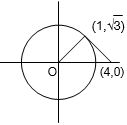
The area of the triangle formed by the tangent and the normal drawn at $(1, \sqrt{3})$ to the circle $x^2 + y^2 = 4$ and the positive $x$-axis is:
A
$2\sqrt{3}$
B
$\sqrt{3}$
C
$4\sqrt{3}$
D
None of these
Solution
(A) The equation of the circle is $x^2 + y^2 = 4$. The point of contact is $P(1, \sqrt{3})$.
The equation of the tangent at $(x_1, y_1)$ is $xx_1 + yy_1 = r^2$. Substituting the values,we get $x(1) + y(\sqrt{3}) = 4$,which simplifies to $x + \sqrt{3}y = 4$.
The tangent intersects the $x$-axis at $y = 0$,so $x = 4$. The point is $A(4, 0)$.
The normal at $(1, \sqrt{3})$ passes through the center $(0, 0)$ and the point $(1, \sqrt{3})$. Its equation is $y = \sqrt{3}x$.
The normal intersects the $x$-axis at the origin $O(0, 0)$.
The triangle is formed by the vertices $O(0, 0)$,$P(1, \sqrt{3})$,and $A(4, 0)$.
The area of the triangle with vertices $(x_1, y_1), (x_2, y_2), (x_3, y_3)$ is given by $\frac{1}{2} |x_1(y_2 - y_3) + x_2(y_3 - y_1) + x_3(y_1 - y_2)|$.
Area $= \frac{1}{2} |0(\sqrt{3} - 0) + 1(0 - 0) + 4(0 - \sqrt{3})| = \frac{1}{2} |-4\sqrt{3}| = 2\sqrt{3}$ square units.
The equation of the tangent at $(x_1, y_1)$ is $xx_1 + yy_1 = r^2$. Substituting the values,we get $x(1) + y(\sqrt{3}) = 4$,which simplifies to $x + \sqrt{3}y = 4$.
The tangent intersects the $x$-axis at $y = 0$,so $x = 4$. The point is $A(4, 0)$.
The normal at $(1, \sqrt{3})$ passes through the center $(0, 0)$ and the point $(1, \sqrt{3})$. Its equation is $y = \sqrt{3}x$.
The normal intersects the $x$-axis at the origin $O(0, 0)$.
The triangle is formed by the vertices $O(0, 0)$,$P(1, \sqrt{3})$,and $A(4, 0)$.
The area of the triangle with vertices $(x_1, y_1), (x_2, y_2), (x_3, y_3)$ is given by $\frac{1}{2} |x_1(y_2 - y_3) + x_2(y_3 - y_1) + x_3(y_1 - y_2)|$.
Area $= \frac{1}{2} |0(\sqrt{3} - 0) + 1(0 - 0) + 4(0 - \sqrt{3})| = \frac{1}{2} |-4\sqrt{3}| = 2\sqrt{3}$ square units.
0 likesView Solution
13
MathematicsDifficultMCQIIT JEE · 1989
If two circles $(x - 1)^2 + (y - 3)^2 = r^2$ and $x^2 + y^2 - 8x + 2y + 8 = 0$ intersect in two distinct points,then
A
$2 < r < 8$
B
$r = 2$
C
$r < 2$
D
$r > 2$
Solution
(A) The first circle is $(x - 1)^2 + (y - 3)^2 = r^2$,with center $C_1 = (1, 3)$ and radius $r_1 = r$.
The second circle is $x^2 + y^2 - 8x + 2y + 8 = 0$. Rewriting in standard form: $(x^2 - 8x + 16) + (y^2 + 2y + 1) = -8 + 16 + 1$,which is $(x - 4)^2 + (y + 1)^2 = 9 = 3^2$. Thus,center $C_2 = (4, -1)$ and radius $r_2 = 3$.
The distance between the centers $d = \sqrt{(4 - 1)^2 + (-1 - 3)^2} = \sqrt{3^2 + (-4)^2} = \sqrt{9 + 16} = 5$.
For two circles to intersect at two distinct points,the condition is $|r_1 - r_2| < d < r_1 + r_2$.
$1$) $r_1 + r_2 > d$ $\Rightarrow r + 3 > 5$ $\Rightarrow r > 2$.
$2$) $|r_1 - r_2| < d$ $\Rightarrow |r - 3| < 5$ $\Rightarrow -5 < r - 3 < 5$ $\Rightarrow -2 < r < 8$. Since $r$ must be positive,$0 < r < 8$.
Combining $r > 2$ and $r < 8$,we get $2 < r < 8$.
The second circle is $x^2 + y^2 - 8x + 2y + 8 = 0$. Rewriting in standard form: $(x^2 - 8x + 16) + (y^2 + 2y + 1) = -8 + 16 + 1$,which is $(x - 4)^2 + (y + 1)^2 = 9 = 3^2$. Thus,center $C_2 = (4, -1)$ and radius $r_2 = 3$.
The distance between the centers $d = \sqrt{(4 - 1)^2 + (-1 - 3)^2} = \sqrt{3^2 + (-4)^2} = \sqrt{9 + 16} = 5$.
For two circles to intersect at two distinct points,the condition is $|r_1 - r_2| < d < r_1 + r_2$.
$1$) $r_1 + r_2 > d$ $\Rightarrow r + 3 > 5$ $\Rightarrow r > 2$.
$2$) $|r_1 - r_2| < d$ $\Rightarrow |r - 3| < 5$ $\Rightarrow -5 < r - 3 < 5$ $\Rightarrow -2 < r < 8$. Since $r$ must be positive,$0 < r < 8$.
Combining $r > 2$ and $r < 8$,we get $2 < r < 8$.
0 likesView Solution
14
MathematicsEasyMCQIIT JEE · 1989
$\mathop {\lim }\limits_{h \to 0} \frac{{{{(a + h)}^2}\sin (a + h) - {a^2}\sin a}}{h} = $
A
$a\cos a + {a^2}\sin a$
B
$a\sin a + {a^2}\cos a$
C
$2a\sin a + {a^2}\cos a$
D
$2a\cos a + {a^2}\sin a$
Solution
(C) The given limit is of the form $\mathop {\lim }\limits_{h \to 0} \frac{f(a+h) - f(a)}{h}$,which is the definition of the derivative $f'(a)$ for the function $f(x) = x^2 \sin x$.
First,find the derivative of $f(x) = x^2 \sin x$ with respect to $x$ using the product rule:
$f'(x) = \frac{d}{dx}(x^2) \sin x + x^2 \frac{d}{dx}(\sin x)$
$f'(x) = 2x \sin x + x^2 \cos x$
Evaluating at $x = a$ gives:
$f'(a) = 2a \sin a + a^2 \cos a$
Alternatively,applying $L$-Hospital's rule with respect to $h$:
$\mathop {\lim }\limits_{h \to 0} \frac{\frac{d}{dh}((a+h)^2 \sin(a+h) - a^2 \sin a)}{1}$
$= \mathop {\lim }\limits_{h \to 0} (2(a+h) \sin(a+h) + (a+h)^2 \cos(a+h))$
$= 2a \sin a + a^2 \cos a$
First,find the derivative of $f(x) = x^2 \sin x$ with respect to $x$ using the product rule:
$f'(x) = \frac{d}{dx}(x^2) \sin x + x^2 \frac{d}{dx}(\sin x)$
$f'(x) = 2x \sin x + x^2 \cos x$
Evaluating at $x = a$ gives:
$f'(a) = 2a \sin a + a^2 \cos a$
Alternatively,applying $L$-Hospital's rule with respect to $h$:
$\mathop {\lim }\limits_{h \to 0} \frac{\frac{d}{dh}((a+h)^2 \sin(a+h) - a^2 \sin a)}{1}$
$= \mathop {\lim }\limits_{h \to 0} (2(a+h) \sin(a+h) + (a+h)^2 \cos(a+h))$
$= 2a \sin a + a^2 \cos a$
0 likesView Solution
15
MathematicsMediumMCQIIT JEE · 1989
If the probability of $X$ to fail in the examination is $0.3$ and that for $Y$ is $0.2$,then the probability that either $X$ or $Y$ fail in the examination is
A
$0.5$
B
$0.44$
C
$0.6$
D
None of these
Solution
(B) Given,$P(X) = 0.3$ and $P(Y) = 0.2$.
Since the events are independent,the probability that both $X$ and $Y$ fail is $P(X \cap Y) = P(X) \times P(Y) = 0.3 \times 0.2 = 0.06$.
The probability that either $X$ or $Y$ fails is given by the addition theorem of probability:
$P(X \cup Y) = P(X) + P(Y) - P(X \cap Y)$
Substituting the values:
$P(X \cup Y) = 0.3 + 0.2 - 0.06 = 0.44$.
Since the events are independent,the probability that both $X$ and $Y$ fail is $P(X \cap Y) = P(X) \times P(Y) = 0.3 \times 0.2 = 0.06$.
The probability that either $X$ or $Y$ fails is given by the addition theorem of probability:
$P(X \cup Y) = P(X) + P(Y) - P(X \cap Y)$
Substituting the values:
$P(X \cup Y) = 0.3 + 0.2 - 0.06 = 0.44$.
0 likesView Solution
16
MathematicsDifficultMCQIIT JEE · 1989
If the roots of the equation $x^2 + px + q = 0$ are $\alpha$ and $\beta$,and the roots of the equation $x^2 - xr + s = 0$ are $\alpha^4$ and $\beta^4$,then the roots of the equation $x^2 - 4qx + 2q^2 - r = 0$ will be
A
Both negative
B
Both positive
C
Both real
D
One negative and one positive
Solution
(C) Given the roots of $x^2 + px + q = 0$ are $\alpha$ and $\beta$,we have $\alpha + \beta = -p$ and $\alpha\beta = q$.
Given the roots of $x^2 - xr + s = 0$ are $\alpha^4$ and $\beta^4$,we have $\alpha^4 + \beta^4 = r$ and $\alpha^4\beta^4 = s$.
Consider the equation $x^2 - 4qx + 2q^2 - r = 0$. The discriminant $D$ is given by:
$D = (-4q)^2 - 4(1)(2q^2 - r) = 16q^2 - 8q^2 + 4r = 8q^2 + 4r$.
Substituting $q = \alpha\beta$ and $r = \alpha^4 + \beta^4$:
$D = 8(\alpha\beta)^2 + 4(\alpha^4 + \beta^4) = 4(2\alpha^2\beta^2 + \alpha^4 + \beta^4) = 4(\alpha^2 + \beta^2)^2$.
Since $(\alpha^2 + \beta^2)^2 \ge 0$,it follows that $D \ge 0$.
Therefore,the roots of the equation $x^2 - 4qx + 2q^2 - r = 0$ are always real.
Given the roots of $x^2 - xr + s = 0$ are $\alpha^4$ and $\beta^4$,we have $\alpha^4 + \beta^4 = r$ and $\alpha^4\beta^4 = s$.
Consider the equation $x^2 - 4qx + 2q^2 - r = 0$. The discriminant $D$ is given by:
$D = (-4q)^2 - 4(1)(2q^2 - r) = 16q^2 - 8q^2 + 4r = 8q^2 + 4r$.
Substituting $q = \alpha\beta$ and $r = \alpha^4 + \beta^4$:
$D = 8(\alpha\beta)^2 + 4(\alpha^4 + \beta^4) = 4(2\alpha^2\beta^2 + \alpha^4 + \beta^4) = 4(\alpha^2 + \beta^2)^2$.
Since $(\alpha^2 + \beta^2)^2 \ge 0$,it follows that $D \ge 0$.
Therefore,the roots of the equation $x^2 - 4qx + 2q^2 - r = 0$ are always real.
0 likesView Solution
17
MathematicsDifficultMCQIIT JEE · 1989
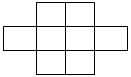
Six '$X$'s have to be placed in the squares of the figure such that each row contains at least one '$X$'. In how many different ways can this be done?
A
$28$
B
$27$
C
$26$
D
None of these
Solution
(C) The figure consists of $8$ squares arranged in three rows: top row ($2$ squares),middle row ($4$ squares),and bottom row ($2$ squares).
We need to place $6$ '$X$'s in these $8$ squares.
The total number of ways to place $6$ '$X$'s in $8$ squares is $^8C_6 = \frac{8 \times 7}{2 \times 1} = 28$.
We must ensure each row contains at least one '$X$'.
Let $R_1, R_2, R_3$ be the top,middle,and bottom rows respectively.
Total squares = $2 + 4 + 2 = 8$.
If the top row $(R_1)$ has no '$X$',then all $6$ '$X$'s must be placed in the remaining $8 - 2 = 6$ squares. This can be done in $^6C_6 = 1$ way.
If the bottom row $(R_3)$ has no '$X$',then all $6$ '$X$'s must be placed in the remaining $8 - 2 = 6$ squares. This can be done in $^6C_6 = 1$ way.
Note that it is impossible for both the top and bottom rows to have no '$X$' simultaneously,as that would require placing $6$ '$X$'s in only $4$ squares,which is impossible.
Thus,the number of invalid ways is $1 + 1 = 2$.
The required number of ways is $28 - 2 = 26$.
We need to place $6$ '$X$'s in these $8$ squares.
The total number of ways to place $6$ '$X$'s in $8$ squares is $^8C_6 = \frac{8 \times 7}{2 \times 1} = 28$.
We must ensure each row contains at least one '$X$'.
Let $R_1, R_2, R_3$ be the top,middle,and bottom rows respectively.
Total squares = $2 + 4 + 2 = 8$.
If the top row $(R_1)$ has no '$X$',then all $6$ '$X$'s must be placed in the remaining $8 - 2 = 6$ squares. This can be done in $^6C_6 = 1$ way.
If the bottom row $(R_3)$ has no '$X$',then all $6$ '$X$'s must be placed in the remaining $8 - 2 = 6$ squares. This can be done in $^6C_6 = 1$ way.
Note that it is impossible for both the top and bottom rows to have no '$X$' simultaneously,as that would require placing $6$ '$X$'s in only $4$ squares,which is impossible.
Thus,the number of invalid ways is $1 + 1 = 2$.
The required number of ways is $28 - 2 = 26$.
0 likesView Solution
18
MathematicsMediumMCQIIT JEE · 1989
If $a, b, c$ are coplanar vectors,then
A
$\left| \begin{array}{ccc} a & b & c \\ b & c & a \\ c & a & b \end{array} \right| = 0$
B
$\left| \begin{array}{ccc} a & b & c \\ a \cdot a & a \cdot b & a \cdot c \\ b \cdot a & b \cdot b & b \cdot c \end{array} \right| = 0$
C
$\left| \begin{array}{ccc} a & b & c \\ c \cdot a & c \cdot b & c \cdot c \\ b \cdot a & b \cdot c & b \cdot b \end{array} \right| = 0$
D
$\left| \begin{array}{ccc} a & b & c \\ a \cdot b & a \cdot a & a \cdot c \\ c \cdot a & c \cdot c & c \cdot b \end{array} \right| = 0$
Solution
(B) Since $a, b,$ and $c$ are coplanar,there exist scalars $x, y, z$ (not all zero) such that $xa + yb + zc = 0$ $(i)$.
Taking the dot product of $(i)$ with $a$,we get $x(a \cdot a) + y(a \cdot b) + z(a \cdot c) = 0$ $(ii)$.
Taking the dot product of $(i)$ with $b$,we get $x(b \cdot a) + y(b \cdot b) + z(b \cdot c) = 0$ $(iii)$.
Since $x, y, z$ are not all zero,the system of equations $(i), (ii),$ and $(iii)$ has a non-trivial solution.
Therefore,the determinant of the coefficients must be zero:
$\left| \begin{array}{ccc} a & b & c \\ a \cdot a & a \cdot b & a \cdot c \\ b \cdot a & b \cdot b & b \cdot c \end{array} \right| = 0$.
Taking the dot product of $(i)$ with $a$,we get $x(a \cdot a) + y(a \cdot b) + z(a \cdot c) = 0$ $(ii)$.
Taking the dot product of $(i)$ with $b$,we get $x(b \cdot a) + y(b \cdot b) + z(b \cdot c) = 0$ $(iii)$.
Since $x, y, z$ are not all zero,the system of equations $(i), (ii),$ and $(iii)$ has a non-trivial solution.
Therefore,the determinant of the coefficients must be zero:
$\left| \begin{array}{ccc} a & b & c \\ a \cdot a & a \cdot b & a \cdot c \\ b \cdot a & b \cdot b & b \cdot c \end{array} \right| = 0$.
0 likesView Solution
19
MathematicsEasyMCQIIT JEE · 1989
If $a \neq 0, b \neq 0$ and $|a + b| = |a - b|,$ then the vectors $a$ and $b$ are
A
Parallel to each other
B
Perpendicular to each other
C
Inclined at an angle of $60^{\circ}$
D
Neither perpendicular nor parallel
Solution
(B) Given that $|a + b| = |a - b|$.
Squaring both sides,we get $|a + b|^2 = |a - b|^2$.
Using the property $|x|^2 = x \cdot x$,we have $(a + b) \cdot (a + b) = (a - b) \cdot (a - b)$.
Expanding the dot product,we get $a \cdot a + 2(a \cdot b) + b \cdot b = a \cdot a - 2(a \cdot b) + b \cdot b$.
Subtracting $a \cdot a + b \cdot b$ from both sides,we get $2(a \cdot b) = -2(a \cdot b)$.
This implies $4(a \cdot b) = 0$,which means $a \cdot b = 0$.
Since the dot product of two non-zero vectors is zero,the vectors $a$ and $b$ are perpendicular to each other.
Squaring both sides,we get $|a + b|^2 = |a - b|^2$.
Using the property $|x|^2 = x \cdot x$,we have $(a + b) \cdot (a + b) = (a - b) \cdot (a - b)$.
Expanding the dot product,we get $a \cdot a + 2(a \cdot b) + b \cdot b = a \cdot a - 2(a \cdot b) + b \cdot b$.
Subtracting $a \cdot a + b \cdot b$ from both sides,we get $2(a \cdot b) = -2(a \cdot b)$.
This implies $4(a \cdot b) = 0$,which means $a \cdot b = 0$.
Since the dot product of two non-zero vectors is zero,the vectors $a$ and $b$ are perpendicular to each other.
0 likesView Solution
20
MathematicsEasyMCQIIT JEE · 1989
If $a = 4i + 6j$ and $b = 3j + 4k$,then the component of $a$ along $b$ is
A
$\frac{18}{10\sqrt{3}}(3j + 4k)$
B
$\frac{18}{25}(3j + 4k)$
C
$\frac{18}{\sqrt{3}}(3j + 4k)$
D
$(3j + 4k)$
Solution
(B) The component of vector $a$ along $b$ is given by the formula: $\text{proj}_{b} a = \frac{(a \cdot b)b}{|b|^2}$.
Given $a = 4i + 6j$ and $b = 3j + 4k$.
First,calculate the dot product $a \cdot b = (4i + 6j) \cdot (0i + 3j + 4k) = (4 \times 0) + (6 \times 3) + (0 \times 4) = 0 + 18 + 0 = 18$.
Next,calculate the square of the magnitude of $b$: $|b|^2 = 3^2 + 4^2 = 9 + 16 = 25$.
Substituting these values into the formula: $\text{proj}_{b} a = \frac{18}{25}(3j + 4k)$.
Given $a = 4i + 6j$ and $b = 3j + 4k$.
First,calculate the dot product $a \cdot b = (4i + 6j) \cdot (0i + 3j + 4k) = (4 \times 0) + (6 \times 3) + (0 \times 4) = 0 + 18 + 0 = 18$.
Next,calculate the square of the magnitude of $b$: $|b|^2 = 3^2 + 4^2 = 9 + 16 = 25$.
Substituting these values into the formula: $\text{proj}_{b} a = \frac{18}{25}(3j + 4k)$.
0 likesView Solution
21
MathematicsMediumMCQIIT JEE · 1989
If $a$ and $b$ are two vectors such that $a \cdot b = 0$ and $a \times b = 0$,then:
A
$a$ is parallel to $b$
B
$a$ is perpendicular to $b$
C
Either $a$ or $b$ is a null vector
D
None of these
Solution
(C) Given that $a \cdot b = 0$. This implies that either $a = 0$,$b = 0$,or $a \perp b$.
Also,given that $a \times b = 0$. This implies that either $a = 0$,$b = 0$,or $a \parallel b$.
For both conditions to be satisfied simultaneously,$a$ and $b$ cannot be both perpendicular and parallel unless at least one of them is a null vector (zero vector).
Therefore,either $a = 0$ or $b = 0$.
Also,given that $a \times b = 0$. This implies that either $a = 0$,$b = 0$,or $a \parallel b$.
For both conditions to be satisfied simultaneously,$a$ and $b$ cannot be both perpendicular and parallel unless at least one of them is a null vector (zero vector).
Therefore,either $a = 0$ or $b = 0$.
0 likesView Solution
22
MathematicsEasyMCQIIT JEE · 1989
The unit vector perpendicular to the vectors $6i + 2j + 3k$ and $3i - 6j - 2k$ is
A
$\frac{2i - 3j + 6k}{7}$
B
$\frac{2i - 3j - 6k}{7}$
C
$\frac{2i + 3j - 6k}{7}$
D
$\frac{2i + 3j + 6k}{7}$
Solution
(C) Let $\vec{a} = 6i + 2j + 3k$ and $\vec{b} = 3i - 6j - 2k$.
The vector perpendicular to both $\vec{a}$ and $\vec{b}$ is given by $\vec{a} \times \vec{b}$.
$\vec{a} \times \vec{b} = \begin{vmatrix} i & j & k \\ 6 & 2 & 3 \\ 3 & -6 & -2 \end{vmatrix} = i(-4 - (-18)) - j(-12 - 9) + k(-36 - 6) = 14i + 21j - 42k$.
The magnitude of this vector is $|\vec{a} \times \vec{b}| = \sqrt{14^2 + 21^2 + (-42)^2} = \sqrt{196 + 441 + 1764} = \sqrt{2401} = 49$.
The unit vector perpendicular to both is $\pm \frac{\vec{a} \times \vec{b}}{|\vec{a} \times \vec{b}|} = \pm \frac{14i + 21j - 42k}{49} = \pm \frac{2i + 3j - 6k}{7}$.
Comparing with the given options,the correct unit vector is $\frac{2i + 3j - 6k}{7}$.
The vector perpendicular to both $\vec{a}$ and $\vec{b}$ is given by $\vec{a} \times \vec{b}$.
$\vec{a} \times \vec{b} = \begin{vmatrix} i & j & k \\ 6 & 2 & 3 \\ 3 & -6 & -2 \end{vmatrix} = i(-4 - (-18)) - j(-12 - 9) + k(-36 - 6) = 14i + 21j - 42k$.
The magnitude of this vector is $|\vec{a} \times \vec{b}| = \sqrt{14^2 + 21^2 + (-42)^2} = \sqrt{196 + 441 + 1764} = \sqrt{2401} = 49$.
The unit vector perpendicular to both is $\pm \frac{\vec{a} \times \vec{b}}{|\vec{a} \times \vec{b}|} = \pm \frac{14i + 21j - 42k}{49} = \pm \frac{2i + 3j - 6k}{7}$.
Comparing with the given options,the correct unit vector is $\frac{2i + 3j - 6k}{7}$.
0 likesView Solution
23
MathematicsEasyMCQIIT JEE · 1989
The volume of the parallelepiped whose edges are represented by $-12i + \alpha k$,$3j - k$,and $2i + j - 15k$ is $546$. Then $\alpha = $
A
$3$
B
$2$
C
$-3$
D
$-2$
Solution
(C) The volume of a parallelepiped with edges represented by vectors $\vec{a}$,$\vec{b}$,and $\vec{c}$ is given by the absolute value of the scalar triple product $|\vec{a} \cdot (\vec{b} \times \vec{c})|$,which is equal to the determinant of the matrix formed by the components of the vectors.
Given vectors are $\vec{a} = -12i + 0j + \alpha k$,$\vec{b} = 0i + 3j - 1k$,and $\vec{c} = 2i + 1j - 15k$.
The volume is given by:
$|\det(\vec{a}, \vec{b}, \vec{c})| = 546$
$\left| \begin{matrix} -12 & 0 & \alpha \\ 0 & 3 & -1 \\ 2 & 1 & -15 \end{matrix} \right| = \pm 546$
Expanding the determinant along the first row:
$-12(3(-15) - (-1)(1)) - 0(...) + \alpha(0(1) - 3(2)) = \pm 546$
$-12(-45 + 1) + \alpha(-6) = \pm 546$
$-12(-44) - 6\alpha = \pm 546$
$528 - 6\alpha = \pm 546$
Case $1$: $528 - 6\alpha = 546 \Rightarrow -6\alpha = 18 \Rightarrow \alpha = -3$
Case $2$: $528 - 6\alpha = -546 \Rightarrow -6\alpha = -1074 \Rightarrow \alpha = 179$
Comparing with the given options,the correct value is $\alpha = -3$.
Given vectors are $\vec{a} = -12i + 0j + \alpha k$,$\vec{b} = 0i + 3j - 1k$,and $\vec{c} = 2i + 1j - 15k$.
The volume is given by:
$|\det(\vec{a}, \vec{b}, \vec{c})| = 546$
$\left| \begin{matrix} -12 & 0 & \alpha \\ 0 & 3 & -1 \\ 2 & 1 & -15 \end{matrix} \right| = \pm 546$
Expanding the determinant along the first row:
$-12(3(-15) - (-1)(1)) - 0(...) + \alpha(0(1) - 3(2)) = \pm 546$
$-12(-45 + 1) + \alpha(-6) = \pm 546$
$-12(-44) - 6\alpha = \pm 546$
$528 - 6\alpha = \pm 546$
Case $1$: $528 - 6\alpha = 546 \Rightarrow -6\alpha = 18 \Rightarrow \alpha = -3$
Case $2$: $528 - 6\alpha = -546 \Rightarrow -6\alpha = -1074 \Rightarrow \alpha = 179$
Comparing with the given options,the correct value is $\alpha = -3$.
0 likesView Solution
24
MathematicsDifficultMCQIIT JEE · 1989
If $x = \sec \theta - \cos \theta$ and $y = \sec^n \theta - \cos^n \theta$,then:
A
$(x^2 + 4) \left( \frac{dy}{dx} \right)^2 = n^2(y^2 + 4)$
B
$(x^2 + 4) \left( \frac{dy}{dx} \right)^2 = x^2(y^2 + 4)$
C
$(x^2 + 4) \left( \frac{dy}{dx} \right)^2 = (y^2 + 4)$
D
None of these
Solution
(A) Given $x = \sec \theta - \cos \theta$ and $y = \sec^n \theta - \cos^n \theta$.
First,find the derivatives with respect to $\theta$:
$\frac{dx}{d\theta} = \sec \theta \tan \theta + \sin \theta = \tan \theta (\sec \theta + \cos \theta)$.
$\frac{dy}{d\theta} = n \sec^{n-1} \theta (\sec \theta \tan \theta) + n \cos^{n-1} \theta \sin \theta = n \tan \theta (\sec^n \theta + \cos^n \theta)$.
Now,$\frac{dy}{dx} = \frac{dy/d\theta}{dx/d\theta} = \frac{n \tan \theta (\sec^n \theta + \cos^n \theta)}{\tan \theta (\sec \theta + \cos \theta)} = \frac{n(\sec^n \theta + \cos^n \theta)}{\sec \theta + \cos \theta}$.
Squaring both sides:
$\left( \frac{dy}{dx} \right)^2 = \frac{n^2(\sec^n \theta + \cos^n \theta)^2}{(\sec \theta + \cos \theta)^2}$.
Using the identity $(a+b)^2 = (a-b)^2 + 4ab$:
$(\sec^n \theta + \cos^n \theta)^2 = (\sec^n \theta - \cos^n \theta)^2 + 4 \sec^n \theta \cos^n \theta = y^2 + 4$.
Similarly,$(\sec \theta + \cos \theta)^2 = (\sec \theta - \cos \theta)^2 + 4 \sec \theta \cos \theta = x^2 + 4$.
Thus,$\left( \frac{dy}{dx} \right)^2 = \frac{n^2(y^2 + 4)}{x^2 + 4}$,which implies $(x^2 + 4) \left( \frac{dy}{dx} \right)^2 = n^2(y^2 + 4)$.
First,find the derivatives with respect to $\theta$:
$\frac{dx}{d\theta} = \sec \theta \tan \theta + \sin \theta = \tan \theta (\sec \theta + \cos \theta)$.
$\frac{dy}{d\theta} = n \sec^{n-1} \theta (\sec \theta \tan \theta) + n \cos^{n-1} \theta \sin \theta = n \tan \theta (\sec^n \theta + \cos^n \theta)$.
Now,$\frac{dy}{dx} = \frac{dy/d\theta}{dx/d\theta} = \frac{n \tan \theta (\sec^n \theta + \cos^n \theta)}{\tan \theta (\sec \theta + \cos \theta)} = \frac{n(\sec^n \theta + \cos^n \theta)}{\sec \theta + \cos \theta}$.
Squaring both sides:
$\left( \frac{dy}{dx} \right)^2 = \frac{n^2(\sec^n \theta + \cos^n \theta)^2}{(\sec \theta + \cos \theta)^2}$.
Using the identity $(a+b)^2 = (a-b)^2 + 4ab$:
$(\sec^n \theta + \cos^n \theta)^2 = (\sec^n \theta - \cos^n \theta)^2 + 4 \sec^n \theta \cos^n \theta = y^2 + 4$.
Similarly,$(\sec \theta + \cos \theta)^2 = (\sec \theta - \cos \theta)^2 + 4 \sec \theta \cos \theta = x^2 + 4$.
Thus,$\left( \frac{dy}{dx} \right)^2 = \frac{n^2(y^2 + 4)}{x^2 + 4}$,which implies $(x^2 + 4) \left( \frac{dy}{dx} \right)^2 = n^2(y^2 + 4)$.
0 likesView Solution
25
MathematicsDifficultMCQIIT JEE · 1989
$\int_{-2}^{2} |1 - x^2| \, dx = $
A
$2$
B
$4$
C
$6$
D
$8$
Solution
(B) The function $f(x) = |1 - x^2|$ changes its sign at $x = -1$ and $x = 1$.
We can split the integral as:
$\int_{-2}^{2} |1 - x^2| \, dx = \int_{-2}^{-1} |1 - x^2| \, dx + \int_{-1}^{1} |1 - x^2| \, dx + \int_{1}^{2} |1 - x^2| \, dx$
In the interval $[-2, -1]$,$1 - x^2 \le 0$,so $|1 - x^2| = -(1 - x^2) = x^2 - 1$.
In the interval $[-1, 1]$,$1 - x^2 \ge 0$,so $|1 - x^2| = 1 - x^2$.
In the interval $[1, 2]$,$1 - x^2 \le 0$,so $|1 - x^2| = -(1 - x^2) = x^2 - 1$.
Thus,the integral becomes:
$\int_{-2}^{-1} (x^2 - 1) \, dx + \int_{-1}^{1} (1 - x^2) \, dx + \int_{1}^{2} (x^2 - 1) \, dx$
$= [\frac{x^3}{3} - x]_{-2}^{-1} + [x - \frac{x^3}{3}]_{-1}^{1} + [\frac{x^3}{3} - x]_{1}^{2}$
$= ((\frac{-1}{3} + 1) - (\frac{-8}{3} + 2)) + ((1 - \frac{1}{3}) - (-1 + \frac{1}{3})) + ((\frac{8}{3} - 2) - (\frac{1}{3} - 1))$
$= (\frac{2}{3} - (-\frac{2}{3})) + (\frac{2}{3} - (-\frac{2}{3})) + (\frac{2}{3} - (-\frac{2}{3}))$
$= \frac{4}{3} + \frac{4}{3} + \frac{4}{3} = \frac{12}{3} = 4.$
We can split the integral as:
$\int_{-2}^{2} |1 - x^2| \, dx = \int_{-2}^{-1} |1 - x^2| \, dx + \int_{-1}^{1} |1 - x^2| \, dx + \int_{1}^{2} |1 - x^2| \, dx$
In the interval $[-2, -1]$,$1 - x^2 \le 0$,so $|1 - x^2| = -(1 - x^2) = x^2 - 1$.
In the interval $[-1, 1]$,$1 - x^2 \ge 0$,so $|1 - x^2| = 1 - x^2$.
In the interval $[1, 2]$,$1 - x^2 \le 0$,so $|1 - x^2| = -(1 - x^2) = x^2 - 1$.
Thus,the integral becomes:
$\int_{-2}^{-1} (x^2 - 1) \, dx + \int_{-1}^{1} (1 - x^2) \, dx + \int_{1}^{2} (x^2 - 1) \, dx$
$= [\frac{x^3}{3} - x]_{-2}^{-1} + [x - \frac{x^3}{3}]_{-1}^{1} + [\frac{x^3}{3} - x]_{1}^{2}$
$= ((\frac{-1}{3} + 1) - (\frac{-8}{3} + 2)) + ((1 - \frac{1}{3}) - (-1 + \frac{1}{3})) + ((\frac{8}{3} - 2) - (\frac{1}{3} - 1))$
$= (\frac{2}{3} - (-\frac{2}{3})) + (\frac{2}{3} - (-\frac{2}{3})) + (\frac{2}{3} - (-\frac{2}{3}))$
$= \frac{4}{3} + \frac{4}{3} + \frac{4}{3} = \frac{12}{3} = 4.$
0 likesView Solution
26
MathematicsMediumMCQIIT JEE · 1989
If $E$ and $F$ are independent events such that $0 < P(E) < 1$ and $0 < P(F) < 1,$ then
A
$E$ and $F^c$ (the complement of the event $F$) are independent
B
$E^c$ and $F^c$ are independent
C
$P(E/F) + P(E^c/F^c) = 1$
D
All of the above
Solution
(D) Given that $E$ and $F$ are independent events,we have $P(E \cap F) = P(E) \cdot P(F)$.
$(a)$ $P(E \cap F^c) = P(E) - P(E \cap F) = P(E) - P(E)P(F) = P(E)(1 - P(F)) = P(E)P(F^c)$. Thus,$E$ and $F^c$ are independent.
$(b)$ $P(E^c \cap F^c) = 1 - P(E \cup F) = 1 - [P(E) + P(F) - P(E \cap F)] = 1 - P(E) - P(F) + P(E)P(F) = (1 - P(E))(1 - P(F)) = P(E^c)P(F^c)$. Thus,$E^c$ and $F^c$ are independent.
$(c)$ Since $E$ and $F$ are independent,$P(E/F) = P(E)$. Similarly,$P(E^c/F^c) = P(E^c)$. Therefore,$P(E/F) + P(E^c/F^c) = P(E) + P(E^c) = 1$.
Since all statements are correct,the answer is $(d)$.
$(a)$ $P(E \cap F^c) = P(E) - P(E \cap F) = P(E) - P(E)P(F) = P(E)(1 - P(F)) = P(E)P(F^c)$. Thus,$E$ and $F^c$ are independent.
$(b)$ $P(E^c \cap F^c) = 1 - P(E \cup F) = 1 - [P(E) + P(F) - P(E \cap F)] = 1 - P(E) - P(F) + P(E)P(F) = (1 - P(E))(1 - P(F)) = P(E^c)P(F^c)$. Thus,$E^c$ and $F^c$ are independent.
$(c)$ Since $E$ and $F$ are independent,$P(E/F) = P(E)$. Similarly,$P(E^c/F^c) = P(E^c)$. Therefore,$P(E/F) + P(E^c/F^c) = P(E) + P(E^c) = 1$.
Since all statements are correct,the answer is $(d)$.
0 likesView Solution
27
MathematicsMediumMCQIIT JEE · 1989
If $f$ and $g$ are continuous functions on $[0, a]$ satisfying $f(x) = f(a - x)$ and $g(x) + g(a - x) = 2$,then $\int_0^a f(x)g(x) dx = $
A
$\int_0^a f(x) dx$
B
$\int_a^0 f(x) dx$
C
$2\int_0^a f(x) dx$
D
None of these
Solution
(A) Let $I = \int_0^a f(x)g(x) dx$.
Using the property $\int_0^a h(x) dx = \int_0^a h(a - x) dx$,we have:
$I = \int_0^a f(a - x)g(a - x) dx$.
Given $f(x) = f(a - x)$ and $g(a - x) = 2 - g(x)$,we substitute these into the integral:
$I = \int_0^a f(x)[2 - g(x)] dx$.
$I = 2\int_0^a f(x) dx - \int_0^a f(x)g(x) dx$.
$I = 2\int_0^a f(x) dx - I$.
$2I = 2\int_0^a f(x) dx$.
$I = \int_0^a f(x) dx$.
Using the property $\int_0^a h(x) dx = \int_0^a h(a - x) dx$,we have:
$I = \int_0^a f(a - x)g(a - x) dx$.
Given $f(x) = f(a - x)$ and $g(a - x) = 2 - g(x)$,we substitute these into the integral:
$I = \int_0^a f(x)[2 - g(x)] dx$.
$I = 2\int_0^a f(x) dx - \int_0^a f(x)g(x) dx$.
$I = 2\int_0^a f(x) dx - I$.
$2I = 2\int_0^a f(x) dx$.
$I = \int_0^a f(x) dx$.
0 likesView Solution
28
MathematicsDifficultMCQIIT JEE · 1989
$A$ pair of fair dice is rolled together till a sum of either $5$ or $7$ is obtained. Then the probability that $5$ comes before $7$ is
A
$\frac{1}{5}$
B
$\frac{2}{5}$
C
$\frac{4}{5}$
D
None of these
Solution
(B) Let $A$ be the event that a sum of $5$ occurs,$B$ be the event that a sum of $7$ occurs,and $C$ be the event that neither a sum of $5$ nor a sum of $7$ occurs.
For a pair of dice,the total number of outcomes is $36$.
The outcomes for sum $5$ are $(1,4), (2,3), (3,2), (4,1)$,so $P(A) = \frac{4}{36} = \frac{1}{9}$.
The outcomes for sum $7$ are $(1,6), (2,5), (3,4), (4,3), (5,2), (6,1)$,so $P(B) = \frac{6}{36} = \frac{1}{6}$.
The probability of neither $5$ nor $7$ is $P(C) = 1 - (P(A) + P(B)) = 1 - (\frac{1}{9} + \frac{1}{6}) = 1 - (\frac{2+3}{18}) = 1 - \frac{5}{18} = \frac{13}{18}$.
The probability that $A$ occurs before $B$ is given by the sum of the infinite geometric series:
$P = P(A) + P(C)P(A) + P(C)^2 P(A) + \dots = \frac{P(A)}{1 - P(C)}$.
Substituting the values: $P = \frac{\frac{1}{9}}{1 - \frac{13}{18}} = \frac{\frac{1}{9}}{\frac{5}{18}} = \frac{1}{9} \times \frac{18}{5} = \frac{2}{5}$.
Thus,the correct option is $B$.
For a pair of dice,the total number of outcomes is $36$.
The outcomes for sum $5$ are $(1,4), (2,3), (3,2), (4,1)$,so $P(A) = \frac{4}{36} = \frac{1}{9}$.
The outcomes for sum $7$ are $(1,6), (2,5), (3,4), (4,3), (5,2), (6,1)$,so $P(B) = \frac{6}{36} = \frac{1}{6}$.
The probability of neither $5$ nor $7$ is $P(C) = 1 - (P(A) + P(B)) = 1 - (\frac{1}{9} + \frac{1}{6}) = 1 - (\frac{2+3}{18}) = 1 - \frac{5}{18} = \frac{13}{18}$.
The probability that $A$ occurs before $B$ is given by the sum of the infinite geometric series:
$P = P(A) + P(C)P(A) + P(C)^2 P(A) + \dots = \frac{P(A)}{1 - P(C)}$.
Substituting the values: $P = \frac{\frac{1}{9}}{1 - \frac{13}{18}} = \frac{\frac{1}{9}}{\frac{5}{18}} = \frac{1}{9} \times \frac{18}{5} = \frac{2}{5}$.
Thus,the correct option is $B$.
0 likesView Solution
Vedclass Products
For Students
Vedclass Test Series
Mock tests in real IIT JEE style covering Mathematics with performance analysis. 5-day free trial.
Start Free TrialFor Teachers
Exam Paper Generator
Generate Set A/B/C/D Mathematics papers from 7.5L+ questions in 2 minutes. 3 chapters free.
Try FreeFor Institutes
Online Exam Module
Run live IIT JEE mock exams with unlimited students, 360° analytics & white-label branding.
See DemoFrequently Asked Questions
How many Mathematics questions are in IIT JEE 1989?
There are 28 Mathematics questions from the IIT JEE 1989 paper on Vedclass, each with a detailed step-by-step solution in English.
Are IIT JEE 1989 Mathematics solutions available in English?
Yes. All solutions on this page are in English. You can also switch to English or Hindi using the language buttons above the questions.
Can I practice IIT JEE 1989 Mathematics as a timed test?
Yes. Use the Vedclass Test Series to attempt a full IIT JEE mock test covering Mathematics with time limits and instant score analysis.
Can teachers create Mathematics papers from IIT JEE previous year questions?
Yes. The Vedclass Exam Paper Generator lets teachers mix IIT JEE Mathematics questions and generate Set A/B/C/D papers in minutes.
For Teachers & Institutes
Build a Custom Mathematics Paper
Pick IIT JEE 1989 Mathematics questions, set difficulty, and generate Set A/B/C/D in 2 minutes.