
PhysicsQ1–11 of 11 questions
Page 1 of 1 · English
1
PhysicsDifficultMCQIIT JEE · 1989
Imagine a light planet revolving around a very massive star in a circular orbit of radius $R$ with a period of revolution $T$. If the gravitational force of attraction between the planet and the star is proportional to $R^{-5/2}$,then ${T^2}$ is proportional to:
A
$R^3$
B
$R^{7/2}$
C
$R^{5/2}$
D
$R^{3/2}$
Solution
(B) The centripetal force required for the circular motion of the planet is provided by the gravitational force of attraction.
The gravitational force is given as $F_g \propto R^{-5/2}$.
The centripetal force is given by $F_c = m \omega^2 R = m \left( \frac{2\pi}{T} \right)^2 R = \frac{4\pi^2 m R}{T^2}$.
Equating the two forces: $\frac{m R}{T^2} \propto R^{-5/2}$.
Rearranging for $T^2$: $\frac{1}{T^2} \propto \frac{R^{-5/2}}{R} = R^{-7/2}$.
Therefore,$T^2 \propto R^{7/2}$.
The gravitational force is given as $F_g \propto R^{-5/2}$.
The centripetal force is given by $F_c = m \omega^2 R = m \left( \frac{2\pi}{T} \right)^2 R = \frac{4\pi^2 m R}{T^2}$.
Equating the two forces: $\frac{m R}{T^2} \propto R^{-5/2}$.
Rearranging for $T^2$: $\frac{1}{T^2} \propto \frac{R^{-5/2}}{R} = R^{-7/2}$.
Therefore,$T^2 \propto R^{7/2}$.
0 likesView Solution
2
PhysicsMediumMCQIIT JEE · 1989
Two rods of different materials having coefficients of linear expansion $\alpha_1, \alpha_2$ and Young's moduli $Y_1$ and $Y_2$ respectively are fixed between two rigid massive walls. The rods are heated such that they undergo the same increase in temperature. There is no bending of rods. If $\alpha_1 : \alpha_2 = 2 : 3$,and the thermal stresses developed in the two rods are equal,then the ratio $Y_1 : Y_2$ is equal to:
A
$2:3$
B
$1:1$
C
$3:2$
D
$4:9$
Solution
(C) The thermal stress $\sigma$ developed in a rod fixed between two rigid walls when heated by a temperature change $\Delta \theta$ is given by the formula:
$\sigma = Y \alpha \Delta \theta$
where $Y$ is the Young's modulus and $\alpha$ is the coefficient of linear expansion.
Given that the thermal stresses are equal $(\sigma_1 = \sigma_2)$ and the increase in temperature $\Delta \theta$ is the same for both rods,we have:
$Y_1 \alpha_1 \Delta \theta = Y_2 \alpha_2 \Delta \theta$
$Y_1 \alpha_1 = Y_2 \alpha_2$
Rearranging the terms to find the ratio $Y_1 : Y_2$:
$\frac{Y_1}{Y_2} = \frac{\alpha_2}{\alpha_1}$
Given $\alpha_1 : \alpha_2 = 2 : 3$,we have $\frac{\alpha_1}{\alpha_2} = \frac{2}{3}$,which implies $\frac{\alpha_2}{\alpha_1} = \frac{3}{2}$.
Therefore,$\frac{Y_1}{Y_2} = \frac{3}{2}$ or $Y_1 : Y_2 = 3 : 2$.
$\sigma = Y \alpha \Delta \theta$
where $Y$ is the Young's modulus and $\alpha$ is the coefficient of linear expansion.
Given that the thermal stresses are equal $(\sigma_1 = \sigma_2)$ and the increase in temperature $\Delta \theta$ is the same for both rods,we have:
$Y_1 \alpha_1 \Delta \theta = Y_2 \alpha_2 \Delta \theta$
$Y_1 \alpha_1 = Y_2 \alpha_2$
Rearranging the terms to find the ratio $Y_1 : Y_2$:
$\frac{Y_1}{Y_2} = \frac{\alpha_2}{\alpha_1}$
Given $\alpha_1 : \alpha_2 = 2 : 3$,we have $\frac{\alpha_1}{\alpha_2} = \frac{2}{3}$,which implies $\frac{\alpha_2}{\alpha_1} = \frac{3}{2}$.
Therefore,$\frac{Y_1}{Y_2} = \frac{3}{2}$ or $Y_1 : Y_2 = 3 : 2$.
0 likesView Solution
3
PhysicsMediumMCQIIT JEE · 1989
$A$ linear harmonic oscillator of force constant $2 \times 10^6 \, N/m$ and amplitude $0.01 \, m$ has a total mechanical energy of $160 \, J$. Its
A
Maximum potential energy is $100 \, J$
B
Maximum $K$.$E$. is $100 \, J$
C
Maximum $P$.$E$. is $160 \, J$
D
Both $(b)$ and $(c)$
Solution
(D) The total mechanical energy of the oscillator is given as $E = 160 \, J$.
For a linear harmonic oscillator,the energy associated with the harmonic oscillation (the kinetic energy part) is given by $E_{osc} = \frac{1}{2} k A^2$.
Substituting the given values: $E_{osc} = \frac{1}{2} \times (2 \times 10^6) \times (0.01)^2 = 10^6 \times 10^{-4} = 100 \, J$.
This $100 \, J$ represents the maximum kinetic energy $(K_{max})$ of the oscillator.
Since the total energy is $160 \, J$ and the oscillatory part is $100 \, J$,there must be an additional constant potential energy $U_0 = 160 - 100 = 60 \, J$.
The potential energy varies as $U(x) = U_0 + \frac{1}{2} k x^2$.
The maximum potential energy occurs at the extreme positions $(x = \pm A)$,which is $U_{max} = U_0 + \frac{1}{2} k A^2 = 60 + 100 = 160 \, J$.
Thus,both statements $(b)$ and $(c)$ are correct.
For a linear harmonic oscillator,the energy associated with the harmonic oscillation (the kinetic energy part) is given by $E_{osc} = \frac{1}{2} k A^2$.
Substituting the given values: $E_{osc} = \frac{1}{2} \times (2 \times 10^6) \times (0.01)^2 = 10^6 \times 10^{-4} = 100 \, J$.
This $100 \, J$ represents the maximum kinetic energy $(K_{max})$ of the oscillator.
Since the total energy is $160 \, J$ and the oscillatory part is $100 \, J$,there must be an additional constant potential energy $U_0 = 160 - 100 = 60 \, J$.
The potential energy varies as $U(x) = U_0 + \frac{1}{2} k x^2$.
The maximum potential energy occurs at the extreme positions $(x = \pm A)$,which is $U_{max} = U_0 + \frac{1}{2} k A^2 = 60 + 100 = 160 \, J$.
Thus,both statements $(b)$ and $(c)$ are correct.
0 likesView Solution
4
PhysicsDifficultMCQIIT JEE · 1989
$A$ solid conducting sphere having a charge $Q$ is surrounded by an uncharged concentric conducting hollow spherical shell. Let the potential difference between the surface of the solid sphere and that of the outer surface of the hollow shell be $V$. If the shell is now given a charge of $-3Q$,the new potential difference between the same two surfaces is......$V$
A
$1$
B
$2$
C
$4$
D
$-2$
Solution
(A) Let the radius of the solid sphere be $a$ and the radius of the hollow shell be $b$.
Initially,the solid sphere has charge $Q$ and the shell has charge $0$.
The potential at the surface of the solid sphere is $V_{\text{sphere}} = \frac{1}{4\pi\varepsilon_0} \frac{Q}{a} + \frac{1}{4\pi\varepsilon_0} \frac{0}{b} = \frac{1}{4\pi\varepsilon_0} \frac{Q}{a}$.
The potential at the surface of the hollow shell is $V_{\text{shell}} = \frac{1}{4\pi\varepsilon_0} \frac{Q}{b} + \frac{1}{4\pi\varepsilon_0} \frac{0}{b} = \frac{1}{4\pi\varepsilon_0} \frac{Q}{b}$.
The initial potential difference is $V = V_{\text{sphere}} - V_{\text{shell}} = \frac{Q}{4\pi\varepsilon_0} \left( \frac{1}{a} - \frac{1}{b} \right)$.
Now,the shell is given a charge of $-3Q$.
The new potential at the surface of the solid sphere is $V'_{\text{sphere}} = \frac{1}{4\pi\varepsilon_0} \frac{Q}{a} + \frac{1}{4\pi\varepsilon_0} \frac{-3Q}{b}$.
The new potential at the surface of the hollow shell is $V'_{\text{shell}} = \frac{1}{4\pi\varepsilon_0} \frac{Q}{b} + \frac{1}{4\pi\varepsilon_0} \frac{-3Q}{b} = \frac{1}{4\pi\varepsilon_0} \left( -\frac{2Q}{b} \right)$.
The new potential difference is $V' = V'_{\text{sphere}} - V'_{\text{shell}} = \frac{1}{4\pi\varepsilon_0} \left( \frac{Q}{a} - \frac{3Q}{b} - (-\frac{2Q}{b}) \right) = \frac{1}{4\pi\varepsilon_0} \left( \frac{Q}{a} - \frac{Q}{b} \right) = V$.
Initially,the solid sphere has charge $Q$ and the shell has charge $0$.
The potential at the surface of the solid sphere is $V_{\text{sphere}} = \frac{1}{4\pi\varepsilon_0} \frac{Q}{a} + \frac{1}{4\pi\varepsilon_0} \frac{0}{b} = \frac{1}{4\pi\varepsilon_0} \frac{Q}{a}$.
The potential at the surface of the hollow shell is $V_{\text{shell}} = \frac{1}{4\pi\varepsilon_0} \frac{Q}{b} + \frac{1}{4\pi\varepsilon_0} \frac{0}{b} = \frac{1}{4\pi\varepsilon_0} \frac{Q}{b}$.
The initial potential difference is $V = V_{\text{sphere}} - V_{\text{shell}} = \frac{Q}{4\pi\varepsilon_0} \left( \frac{1}{a} - \frac{1}{b} \right)$.
Now,the shell is given a charge of $-3Q$.
The new potential at the surface of the solid sphere is $V'_{\text{sphere}} = \frac{1}{4\pi\varepsilon_0} \frac{Q}{a} + \frac{1}{4\pi\varepsilon_0} \frac{-3Q}{b}$.
The new potential at the surface of the hollow shell is $V'_{\text{shell}} = \frac{1}{4\pi\varepsilon_0} \frac{Q}{b} + \frac{1}{4\pi\varepsilon_0} \frac{-3Q}{b} = \frac{1}{4\pi\varepsilon_0} \left( -\frac{2Q}{b} \right)$.
The new potential difference is $V' = V'_{\text{sphere}} - V'_{\text{shell}} = \frac{1}{4\pi\varepsilon_0} \left( \frac{Q}{a} - \frac{3Q}{b} - (-\frac{2Q}{b}) \right) = \frac{1}{4\pi\varepsilon_0} \left( \frac{Q}{a} - \frac{Q}{b} \right) = V$.
0 likesView Solution
5
PhysicsDifficultMCQIIT JEE · 1989
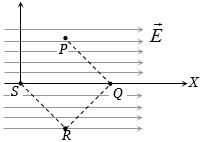
$A$ point charge $q$ moves from point $P$ to point $S$ along the path $PQRS$ (as shown in the figure) in a uniform electric field $E$ pointing parallel to the positive direction of the $X$-axis. The coordinates of the points $P, Q, R,$ and $S$ are $(a, b, 0), (2a, 0, 0), (a, -b, 0),$ and $(0, 0, 0)$ respectively. The work done by the field in the above process is given by the expression:
A
$qEa$
B
$-qEa$
C
$qEa\sqrt{2}$
D
$qE\sqrt{(2a)^2 + b^2}$
Solution
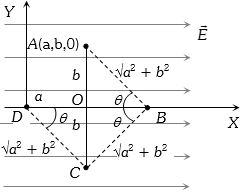
(B) The electric field is a conservative field,so the work done by the electric field depends only on the initial and final positions,not on the path taken.
Work done $W = \vec{F} \cdot \vec{d} = q\vec{E} \cdot \vec{d}$,where $\vec{d}$ is the displacement vector.
The initial position is $P(a, b, 0)$ and the final position is $S(0, 0, 0)$.
The displacement vector $\vec{d} = \vec{S} - \vec{P} = (0 - a)\hat{i} + (0 - b)\hat{j} + (0 - 0)\hat{k} = -a\hat{i} - b\hat{j}$.
The electric field is $\vec{E} = E\hat{i}$.
Work done $W = q(E\hat{i}) \cdot (-a\hat{i} - b\hat{j}) = qE(-a) = -qEa$.
Work done $W = \vec{F} \cdot \vec{d} = q\vec{E} \cdot \vec{d}$,where $\vec{d}$ is the displacement vector.
The initial position is $P(a, b, 0)$ and the final position is $S(0, 0, 0)$.
The displacement vector $\vec{d} = \vec{S} - \vec{P} = (0 - a)\hat{i} + (0 - b)\hat{j} + (0 - 0)\hat{k} = -a\hat{i} - b\hat{j}$.
The electric field is $\vec{E} = E\hat{i}$.
Work done $W = q(E\hat{i}) \cdot (-a\hat{i} - b\hat{j}) = qE(-a) = -qEa$.
0 likesView Solution
6
PhysicsMediumMCQIIT JEE · 1989
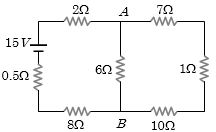
The current from the battery in the circuit diagram shown is .............. $A$.
A
$1$
B
$2$
C
$1.5$
D
$3$
Solution
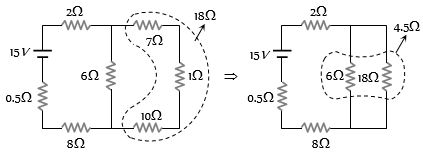
(A) First,simplify the right side of the circuit. The resistors $7\,\Omega$,$1\,\Omega$,and $10\,\Omega$ are in series,so their equivalent resistance is $R_s = 7 + 1 + 10 = 18\,\Omega$.
This $18\,\Omega$ resistor is in parallel with the $6\,\Omega$ resistor. Their equivalent resistance $R_p$ is given by $\frac{1}{R_p} = \frac{1}{6} + \frac{1}{18} = \frac{3+1}{18} = \frac{4}{18}$,so $R_p = \frac{18}{4} = 4.5\,\Omega$.
Now,the total resistance of the circuit is $R_{total} = 2\,\Omega + 0.5\,\Omega + 4.5\,\Omega + 8\,\Omega = 15\,\Omega$.
The current from the battery is $i = \frac{V}{R_{total}} = \frac{15\,V}{15\,\Omega} = 1\,A$.
This $18\,\Omega$ resistor is in parallel with the $6\,\Omega$ resistor. Their equivalent resistance $R_p$ is given by $\frac{1}{R_p} = \frac{1}{6} + \frac{1}{18} = \frac{3+1}{18} = \frac{4}{18}$,so $R_p = \frac{18}{4} = 4.5\,\Omega$.
Now,the total resistance of the circuit is $R_{total} = 2\,\Omega + 0.5\,\Omega + 4.5\,\Omega + 8\,\Omega = 15\,\Omega$.
The current from the battery is $i = \frac{V}{R_{total}} = \frac{15\,V}{15\,\Omega} = 1\,A$.
0 likesView Solution
7
PhysicsEasyMCQIIT JEE · 1989
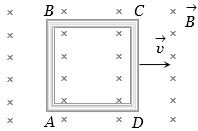
$A$ conducting square loop of side $L$ and resistance $R$ moves in its plane with a uniform velocity $v$ perpendicular to one of its sides. $A$ magnetic induction $B$ constant in time and space,pointing perpendicular and into the plane of the loop exists everywhere. The current induced in the loop is
A
$\frac{BLv}{R}$ clockwise
B
$\frac{BLv}{R}$ anticlockwise
C
$\frac{2BLv}{R}$ anticlockwise
D
Zero
Solution
(D) The magnetic flux $\phi$ linked with the loop is given by $\phi = B \cdot A$,where $A = L^2$ is the area of the square loop.
Since the magnetic field $B$ is uniform in time and space,and the loop moves within this field,the area $A$ enclosed by the loop remains constant.
According to Faraday's law of electromagnetic induction,the induced electromotive force $(EMF)$ is given by $\varepsilon = -\frac{d\phi}{dt}$.
Since $\phi = B \cdot L^2$ is constant,$\frac{d\phi}{dt} = 0$.
Therefore,the induced $EMF$ $\varepsilon = 0$.
Consequently,the induced current $I = \frac{\varepsilon}{R} = 0$.
Since the magnetic field $B$ is uniform in time and space,and the loop moves within this field,the area $A$ enclosed by the loop remains constant.
According to Faraday's law of electromagnetic induction,the induced electromotive force $(EMF)$ is given by $\varepsilon = -\frac{d\phi}{dt}$.
Since $\phi = B \cdot L^2$ is constant,$\frac{d\phi}{dt} = 0$.
Therefore,the induced $EMF$ $\varepsilon = 0$.
Consequently,the induced current $I = \frac{\varepsilon}{R} = 0$.
0 likesView Solution
8
PhysicsMediumMCQIIT JEE · 1989
If the decay or disintegration constant of a radioactive substance is $\lambda$,then its half-life and mean life are respectively $(log_e 2 = ln 2)$.
A
$\frac{1}{\lambda}$ and $\frac{log_e 2}{\lambda}$
B
$\frac{log_e 2}{\lambda}$ and $\frac{1}{\lambda}$
C
$\lambda log_e 2$ and $\frac{1}{\lambda}$
D
$\frac{\lambda}{log_e 2}$ and $\frac{1}{\lambda}$
Solution
(B) The half-life $(T_{1/2})$ of a radioactive substance is defined as the time required for half of the radioactive nuclei to decay.
It is given by the formula: $T_{1/2} = \frac{ln 2}{\lambda} = \frac{log_e 2}{\lambda}$.
The mean life or average life $(\tau)$ is defined as the reciprocal of the decay constant.
It is given by the formula: $\tau = \frac{1}{\lambda}$.
Therefore,the half-life and mean life are $\frac{log_e 2}{\lambda}$ and $\frac{1}{\lambda}$ respectively.
It is given by the formula: $T_{1/2} = \frac{ln 2}{\lambda} = \frac{log_e 2}{\lambda}$.
The mean life or average life $(\tau)$ is defined as the reciprocal of the decay constant.
It is given by the formula: $\tau = \frac{1}{\lambda}$.
Therefore,the half-life and mean life are $\frac{log_e 2}{\lambda}$ and $\frac{1}{\lambda}$ respectively.
0 likesView Solution
9
PhysicsMediumMCQIIT JEE · 1989
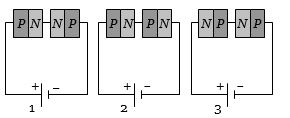
Two $PN$-junctions can be connected in series by three different methods as shown in the figure. If the potential difference across the junctions is the same,then the correct connections will be:
A
In the circuit $(1)$ and $(2)$
B
In the circuit $(2)$ and $(3)$
C
In the circuit $(1)$ and $(3)$
D
Only in the circuit $(1)$
Solution
(B) In circuit $(1)$,the $N$-region of the first diode is connected to the $N$-region of the second diode. This configuration does not allow for a proper series biasing of the junctions.
In circuit $(2)$,the $P$-region of the first diode is connected to the $N$-region of the second diode. The external battery is connected such that both diodes are forward-biased (or both reverse-biased depending on polarity),allowing for an equal potential drop across both junctions.
In circuit $(3)$,the $P$-region of the first diode is connected to the $N$-region of the second diode. Similar to circuit $(2)$,this configuration allows for a symmetric series connection where the potential difference is distributed equally across the junctions.
Therefore,circuits $(2)$ and $(3)$ are the correct connections.
In circuit $(2)$,the $P$-region of the first diode is connected to the $N$-region of the second diode. The external battery is connected such that both diodes are forward-biased (or both reverse-biased depending on polarity),allowing for an equal potential drop across both junctions.
In circuit $(3)$,the $P$-region of the first diode is connected to the $N$-region of the second diode. Similar to circuit $(2)$,this configuration allows for a symmetric series connection where the potential difference is distributed equally across the junctions.
Therefore,circuits $(2)$ and $(3)$ are the correct connections.
0 likesView Solution
10
PhysicsMediumMCQIIT JEE · 1989
An astronomical telescope has an angular magnification of magnitude $5$ for distant objects. The separation between the objective and the eyepiece is $36 \, cm$ and the final image is formed at infinity. The focal length $f_o$ of the objective and the focal length $f_e$ of the eyepiece are:
A
$f_o = 45 \, cm$ and $f_e = -9 \, cm$
B
$f_o = 7.2 \, cm$ and $f_e = 5 \, cm$
C
$f_o = 50 \, cm$ and $f_e = 10 \, cm$
D
$f_o = 30 \, cm$ and $f_e = 6 \, cm$
Solution
(D) For an astronomical telescope with the final image at infinity (normal adjustment),the angular magnification is given by $|m| = \frac{f_o}{f_e} = 5$.
This implies $f_o = 5f_e$ ... $(i)$.
The length of the telescope tube is the sum of the focal lengths of the objective and the eyepiece: $L = f_o + f_e = 36 \, cm$ ... $(ii)$.
Substituting $(i)$ into $(ii)$,we get $5f_e + f_e = 36 \, cm$,which simplifies to $6f_e = 36 \, cm$.
Thus,$f_e = 6 \, cm$.
Substituting $f_e$ back into $(i)$,we get $f_o = 5 \times 6 \, cm = 30 \, cm$.
Therefore,the focal lengths are $f_o = 30 \, cm$ and $f_e = 6 \, cm$.
This implies $f_o = 5f_e$ ... $(i)$.
The length of the telescope tube is the sum of the focal lengths of the objective and the eyepiece: $L = f_o + f_e = 36 \, cm$ ... $(ii)$.
Substituting $(i)$ into $(ii)$,we get $5f_e + f_e = 36 \, cm$,which simplifies to $6f_e = 36 \, cm$.
Thus,$f_e = 6 \, cm$.
Substituting $f_e$ back into $(i)$,we get $f_o = 5 \times 6 \, cm = 30 \, cm$.
Therefore,the focal lengths are $f_o = 30 \, cm$ and $f_e = 6 \, cm$.
0 likesView Solution
11
PhysicsMediumMCQIIT JEE · 1989
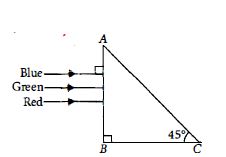
$A$ beam of light consisting of red,green and blue colours is incident on a right-angled prism. The refractive index of the material of the prism for the above red,green and blue wavelengths are $1.39, 1.44$ and $1.47$ respectively.
The prism will
The prism will
A
separate the red colour part from the green and blue colours
B
separate the blue colour part from the red and green colours
C
separate all the three colours from one another
D
not separate the three colours at all
Solution
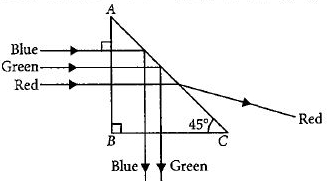
(A) As the beam of light is incident normally on the face $AB$ of the right-angled prism $ABC$,no refraction occurs at face $AB$. The light passes straight and strikes the face $AC$ at an angle of incidence $i = 45^{\circ}$.
For total internal reflection to take place at face $AC$,the condition is $i > i_c$,where $i_c$ is the critical angle.
We know that $\sin i_c = \frac{1}{\mu}$. Therefore,the condition for total internal reflection is $\sin i > \frac{1}{\mu}$,or $\mu > \frac{1}{\sin i}$.
Given $i = 45^{\circ}$,we have $\sin 45^{\circ} = \frac{1}{\sqrt{2}} \approx 0.707$. Thus,the condition becomes $\mu > \sqrt{2} \approx 1.414$.
Comparing the refractive indices:
For red: $\mu_{\text{red}} = 1.39 < 1.414$.
For green: $\mu_{\text{green}} = 1.44 > 1.414$.
For blue: $\mu_{\text{blue}} = 1.47 > 1.414$.
Since $\mu_{\text{red}} < 1.414$,the red light will be refracted out of the prism through face $AC$. Since $\mu_{\text{green}}$ and $\mu_{\text{blue}}$ are both greater than $1.414$,both green and blue light will undergo total internal reflection at face $AC$.
Therefore,the prism will separate the red colour from the green and blue colours.
For total internal reflection to take place at face $AC$,the condition is $i > i_c$,where $i_c$ is the critical angle.
We know that $\sin i_c = \frac{1}{\mu}$. Therefore,the condition for total internal reflection is $\sin i > \frac{1}{\mu}$,or $\mu > \frac{1}{\sin i}$.
Given $i = 45^{\circ}$,we have $\sin 45^{\circ} = \frac{1}{\sqrt{2}} \approx 0.707$. Thus,the condition becomes $\mu > \sqrt{2} \approx 1.414$.
Comparing the refractive indices:
For red: $\mu_{\text{red}} = 1.39 < 1.414$.
For green: $\mu_{\text{green}} = 1.44 > 1.414$.
For blue: $\mu_{\text{blue}} = 1.47 > 1.414$.
Since $\mu_{\text{red}} < 1.414$,the red light will be refracted out of the prism through face $AC$. Since $\mu_{\text{green}}$ and $\mu_{\text{blue}}$ are both greater than $1.414$,both green and blue light will undergo total internal reflection at face $AC$.
Therefore,the prism will separate the red colour from the green and blue colours.
0 likesView Solution
Vedclass Products
For Students
Vedclass Test Series
Mock tests in real IIT JEE style covering Physics with performance analysis. 5-day free trial.
Start Free TrialFor Teachers
Exam Paper Generator
Generate Set A/B/C/D Physics papers from 7.5L+ questions in 2 minutes. 3 chapters free.
Try FreeFor Institutes
Online Exam Module
Run live IIT JEE mock exams with unlimited students, 360° analytics & white-label branding.
See DemoFrequently Asked Questions
How many Physics questions are in IIT JEE 1989?
There are 11 Physics questions from the IIT JEE 1989 paper on Vedclass, each with a detailed step-by-step solution in English.
Are IIT JEE 1989 Physics solutions available in English?
Yes. All solutions on this page are in English. You can also switch to English or Hindi using the language buttons above the questions.
Can I practice IIT JEE 1989 Physics as a timed test?
Yes. Use the Vedclass Test Series to attempt a full IIT JEE mock test covering Physics with time limits and instant score analysis.
Can teachers create Physics papers from IIT JEE previous year questions?
Yes. The Vedclass Exam Paper Generator lets teachers mix IIT JEE Physics questions and generate Set A/B/C/D papers in minutes.
For Teachers & Institutes
Build a Custom Physics Paper
Pick IIT JEE 1989 Physics questions, set difficulty, and generate Set A/B/C/D in 2 minutes.