
PhysicsQ1–15 of 15 questions
Page 1 of 1 · English
1
PhysicsMediumMCQIIT JEE · 1982
$A$ particle moves towards east with velocity $5\, m/s$. After $10\, s$,its direction changes towards north with the same velocity. The average acceleration of the particle is
A
Zero
B
$\frac{1}{\sqrt{2}}\,m/s^2$ in North-West direction
C
$\frac{1}{\sqrt{2}}\,m/s^2$ in North-East direction
D
$\frac{1}{\sqrt{2}}\,m/s^2$ in South-West direction
Solution
(B) Initial velocity $\vec{v}_i = 5\hat{i}\,m/s$.
Final velocity $\vec{v}_f = 5\hat{j}\,m/s$.
Change in velocity $\Delta \vec{v} = \vec{v}_f - \vec{v}_i = 5\hat{j} - 5\hat{i}$.
Magnitude of change in velocity $|\Delta \vec{v}| = \sqrt{(-5)^2 + 5^2} = \sqrt{25 + 25} = \sqrt{50} = 5\sqrt{2}\,m/s$.
The direction of $\Delta \vec{v}$ is North-West (since it points in the direction of $-\hat{i} + \hat{j}$).
Average acceleration $\vec{a}_{avg} = \frac{\Delta \vec{v}}{\Delta t} = \frac{5\sqrt{2}}{10} = \frac{\sqrt{2}}{2} = \frac{1}{\sqrt{2}}\,m/s^2$.
Thus,the average acceleration is $\frac{1}{\sqrt{2}}\,m/s^2$ in the North-West direction.
Final velocity $\vec{v}_f = 5\hat{j}\,m/s$.
Change in velocity $\Delta \vec{v} = \vec{v}_f - \vec{v}_i = 5\hat{j} - 5\hat{i}$.
Magnitude of change in velocity $|\Delta \vec{v}| = \sqrt{(-5)^2 + 5^2} = \sqrt{25 + 25} = \sqrt{50} = 5\sqrt{2}\,m/s$.
The direction of $\Delta \vec{v}$ is North-West (since it points in the direction of $-\hat{i} + \hat{j}$).
Average acceleration $\vec{a}_{avg} = \frac{\Delta \vec{v}}{\Delta t} = \frac{5\sqrt{2}}{10} = \frac{\sqrt{2}}{2} = \frac{1}{\sqrt{2}}\,m/s^2$.
Thus,the average acceleration is $\frac{1}{\sqrt{2}}\,m/s^2$ in the North-West direction.
0 likesView Solution
2
PhysicsEasyMCQIIT JEE · 1982
The dimensional formula for the modulus of rigidity is
A
$M L^2 T^{-2}$
B
$M L^{-1} T^{-3}$
C
$M L^{-2} T^{-2}$
D
$M L^{-1} T^{-2}$
Solution
(D) The modulus of rigidity $(\eta)$ is defined as the ratio of shear stress to shear strain.
Shear stress is defined as force per unit area,so its dimensional formula is $[F]/[A] = [MLT^{-2}]/[L^2] = [ML^{-1}T^{-2}]$.
Shear strain is a dimensionless quantity because it is the ratio of two lengths.
Therefore,the dimensional formula for the modulus of rigidity is the same as that of stress,which is $[ML^{-1}T^{-2}]$.
Thus,the correct option is $D$.
Shear stress is defined as force per unit area,so its dimensional formula is $[F]/[A] = [MLT^{-2}]/[L^2] = [ML^{-1}T^{-2}]$.
Shear strain is a dimensionless quantity because it is the ratio of two lengths.
Therefore,the dimensional formula for the modulus of rigidity is the same as that of stress,which is $[ML^{-1}T^{-2}]$.
Thus,the correct option is $D$.
0 likesView Solution
3
PhysicsDifficultMCQIIT JEE · 1982
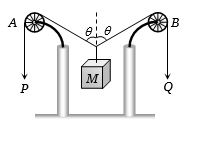
In the arrangement shown in the figure,the ends $P$ and $Q$ of an unstretchable string move downwards with a uniform speed $U$. Pulleys $A$ and $B$ are fixed. The mass $M$ moves upwards with a speed:
A
$2U \cos \theta$
B
$U \cos \theta$
C
$\frac{2U}{\cos \theta}$
D
$\frac{U}{\cos \theta}$
Solution
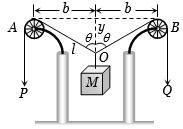
(D) Let $l$ be the length of the string from the pulley to the mass $M$. From the geometry of the figure,we have the relation $l^2 = b^2 + y^2$,where $b$ is the horizontal distance from the pulley to the vertical axis of the mass,and $y$ is the vertical distance of the mass from the line joining the pulleys.
Since the string is unstretchable and the ends $P$ and $Q$ move downwards with speed $U$,the length $l$ of the string segment decreases at a rate of $U$. Thus,$\frac{dl}{dt} = -U$.
Differentiating the relation $l^2 = b^2 + y^2$ with respect to time $t$,we get:
$2l \frac{dl}{dt} = 2b \frac{db}{dt} + 2y \frac{dy}{dt}$.
Since the pulleys are fixed,the horizontal distance $b$ remains constant,so $\frac{db}{dt} = 0$.
Substituting $\frac{dl}{dt} = -U$ and $\frac{db}{dt} = 0$ into the equation:
$2l(-U) = 2y \frac{dy}{dt}$.
Solving for the vertical speed of the mass $v_y = \frac{dy}{dt}$:
$\frac{dy}{dt} = -\frac{l}{y} U$.
From the triangle formed,$\cos \theta = \frac{y}{l}$,so $\frac{l}{y} = \frac{1}{\cos \theta}$.
Therefore,the speed of the mass $M$ is $v = |\frac{dy}{dt}| = \frac{U}{\cos \theta}$.
Since the string is unstretchable and the ends $P$ and $Q$ move downwards with speed $U$,the length $l$ of the string segment decreases at a rate of $U$. Thus,$\frac{dl}{dt} = -U$.
Differentiating the relation $l^2 = b^2 + y^2$ with respect to time $t$,we get:
$2l \frac{dl}{dt} = 2b \frac{db}{dt} + 2y \frac{dy}{dt}$.
Since the pulleys are fixed,the horizontal distance $b$ remains constant,so $\frac{db}{dt} = 0$.
Substituting $\frac{dl}{dt} = -U$ and $\frac{db}{dt} = 0$ into the equation:
$2l(-U) = 2y \frac{dy}{dt}$.
Solving for the vertical speed of the mass $v_y = \frac{dy}{dt}$:
$\frac{dy}{dt} = -\frac{l}{y} U$.
From the triangle formed,$\cos \theta = \frac{y}{l}$,so $\frac{l}{y} = \frac{1}{\cos \theta}$.
Therefore,the speed of the mass $M$ is $v = |\frac{dy}{dt}| = \frac{U}{\cos \theta}$.
0 likesView Solution
4
PhysicsMediumMCQIIT JEE · 1982
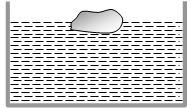
$A$ body floats in a liquid contained in a beaker. The whole system,as shown,falls freely under gravity. The upthrust on the body due to the liquid is
A
Zero
B
Equal to the weight of the liquid displaced
C
Equal to the weight of the body in air
D
Equal to the weight of the immersed portion of the body
Solution
(A) The upthrust (buoyant force) on a body submerged in a liquid is given by the formula:
$F_B = V \rho_{\text{liquid}} (g - a)$
where $V$ is the volume of the liquid displaced,$\rho_{\text{liquid}}$ is the density of the liquid,$g$ is the acceleration due to gravity,and $a$ is the downward acceleration of the system.
In the case of free fall,the entire system (beaker and liquid) accelerates downwards with an acceleration equal to the acceleration due to gravity,i.e.,$a = g$.
Substituting $a = g$ into the formula:
$F_B = V \rho_{\text{liquid}} (g - g) = V \rho_{\text{liquid}} (0) = 0$.
Therefore,the upthrust on the body is zero.
$F_B = V \rho_{\text{liquid}} (g - a)$
where $V$ is the volume of the liquid displaced,$\rho_{\text{liquid}}$ is the density of the liquid,$g$ is the acceleration due to gravity,and $a$ is the downward acceleration of the system.
In the case of free fall,the entire system (beaker and liquid) accelerates downwards with an acceleration equal to the acceleration due to gravity,i.e.,$a = g$.
Substituting $a = g$ into the formula:
$F_B = V \rho_{\text{liquid}} (g - g) = V \rho_{\text{liquid}} (0) = 0$.
Therefore,the upthrust on the body is zero.
0 likesView Solution
5
PhysicsMediumMCQIIT JEE · 1982
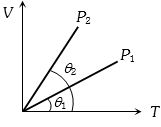
The figure shows the volume $V$ versus temperature $T$ graphs for a certain mass of a perfect gas at two constant pressures of $P_1$ and $P_2$. What inference can you draw from the graphs?
A
$P_1 > P_2$
B
$P_1 < P_2$
C
$P_1 = P_2$
D
No inference can be drawn due to insufficient information
Solution
(A) From the ideal gas equation,$PV = \mu RT$,we have $V = (\frac{\mu R}{P})T$.
The slope of the $V-T$ graph is given by $m = \tan \theta = \frac{V}{T} = \frac{\mu R}{P}$.
Since the slope is inversely proportional to pressure $(m \propto \frac{1}{P})$,a smaller slope corresponds to a higher pressure.
From the graph,it is clear that $\theta_1 < \theta_2$,which implies $\tan \theta_1 < \tan \theta_2$.
Therefore,$(\frac{V}{T})_1 < (\frac{V}{T})_2$.
Since $(\frac{V}{T}) \propto \frac{1}{P}$,we have $(\frac{1}{P})_1 < (\frac{1}{P})_2$,which leads to $P_1 > P_2$.
The slope of the $V-T$ graph is given by $m = \tan \theta = \frac{V}{T} = \frac{\mu R}{P}$.
Since the slope is inversely proportional to pressure $(m \propto \frac{1}{P})$,a smaller slope corresponds to a higher pressure.
From the graph,it is clear that $\theta_1 < \theta_2$,which implies $\tan \theta_1 < \tan \theta_2$.
Therefore,$(\frac{V}{T})_1 < (\frac{V}{T})_2$.
Since $(\frac{V}{T}) \propto \frac{1}{P}$,we have $(\frac{1}{P})_1 < (\frac{1}{P})_2$,which leads to $P_1 > P_2$.
0 likesView Solution
6
PhysicsMediumMCQIIT JEE · 1982
$A$ wave equation which gives the displacement along the $Y$ direction is given by the equation $y = 10^4 \sin(60t + 2x)$,where $x$ and $y$ are in metres and $t$ is time in seconds. This represents a wave:
A
Travelling with a velocity of $30 \, m/s$ in the negative $X$ direction
B
Of wavelength $\pi \, m$
C
Of frequency $30/\pi \, Hz$
D
All of the above
Solution
(D) Comparing the given equation $y = 10^4 \sin(60t + 2x)$ with the standard wave equation $y = a \sin(\omega t + kx)$:
$1$. Since the sign between $\omega t$ and $kx$ is positive,the wave is travelling in the negative $X$-direction.
$2$. The angular frequency is $\omega = 60 \, rad/s$. The frequency $f$ is given by $f = \frac{\omega}{2\pi} = \frac{60}{2\pi} = \frac{30}{\pi} \, Hz$.
$3$. The wave number is $k = 2 \, m^{-1}$. The wavelength $\lambda$ is given by $k = \frac{2\pi}{\lambda} \implies \lambda = \frac{2\pi}{k} = \frac{2\pi}{2} = \pi \, m$.
$4$. The wave velocity $v$ is given by $v = \frac{\omega}{k} = \frac{60}{2} = 30 \, m/s$.
Since all the statements are correct,the correct option is $(d)$.
$1$. Since the sign between $\omega t$ and $kx$ is positive,the wave is travelling in the negative $X$-direction.
$2$. The angular frequency is $\omega = 60 \, rad/s$. The frequency $f$ is given by $f = \frac{\omega}{2\pi} = \frac{60}{2\pi} = \frac{30}{\pi} \, Hz$.
$3$. The wave number is $k = 2 \, m^{-1}$. The wavelength $\lambda$ is given by $k = \frac{2\pi}{\lambda} \implies \lambda = \frac{2\pi}{k} = \frac{2\pi}{2} = \pi \, m$.
$4$. The wave velocity $v$ is given by $v = \frac{\omega}{k} = \frac{60}{2} = 30 \, m/s$.
Since all the statements are correct,the correct option is $(d)$.
0 likesView Solution
7
PhysicsEasyMCQIIT JEE · 1982
Two particles which are initially at rest,move towards each other under the action of their internal attraction. If their speeds are $v$ and $2v$ at any instant,then the speed of centre of mass of the system will be
A
$0$
B
$v$
C
$1.5v$
D
$3v$
Solution
(A) The system consists of two particles moving under the influence of their mutual internal attraction.
According to the law of conservation of momentum,if the net external force acting on a system is zero,the velocity of the centre of mass remains constant.
Initially,both particles are at rest,which means the initial velocity of the centre of mass is $v_{CM, initial} = 0$.
Since there is no external force acting on the system,the velocity of the centre of mass remains constant at $0$ at any instant.
Therefore,the speed of the centre of mass of the system is $0$.
According to the law of conservation of momentum,if the net external force acting on a system is zero,the velocity of the centre of mass remains constant.
Initially,both particles are at rest,which means the initial velocity of the centre of mass is $v_{CM, initial} = 0$.
Since there is no external force acting on the system,the velocity of the centre of mass remains constant at $0$ at any instant.
Therefore,the speed of the centre of mass of the system is $0$.
0 likesView Solution
8
PhysicsMediumMCQIIT JEE · 1982
The dimensional formula of magnetic flux is:
A
$[M L^2 T^{-2} A^{-1}]$
B
$[M L^0 T^{-2} A^{-2}]$
C
$[M^0 L^{-2} T^{-2} A^{-3}]$
D
$[M L^2 T^{-2} A^3]$
Solution
(A) Magnetic flux $\phi$ is defined as the product of magnetic field $B$ and area $A$,i.e.,$\phi = B \cdot A$.
From the Lorentz force formula,$F = B I L$,we can write $B = \frac{F}{I L}$.
Substituting the dimensions of force $[F] = [M L T^{-2}]$,current $[I] = [A]$,and length $[L] = [L]$,we get the dimensions of $B$ as $[B] = \frac{[M L T^{-2}]}{[A] [L]} = [M T^{-2} A^{-1}]$.
Now,the dimensions of magnetic flux $\phi$ are $[B] \times [A] = [M T^{-2} A^{-1}] \times [L^2] = [M L^2 T^{-2} A^{-1}]$.
From the Lorentz force formula,$F = B I L$,we can write $B = \frac{F}{I L}$.
Substituting the dimensions of force $[F] = [M L T^{-2}]$,current $[I] = [A]$,and length $[L] = [L]$,we get the dimensions of $B$ as $[B] = \frac{[M L T^{-2}]}{[A] [L]} = [M T^{-2} A^{-1}]$.
Now,the dimensions of magnetic flux $\phi$ are $[B] \times [A] = [M T^{-2} A^{-1}] \times [L^2] = [M L^2 T^{-2} A^{-1}]$.
0 likesView Solution
9
PhysicsMediumMCQIIT JEE · 1982
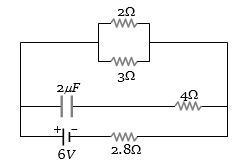
In the figure shown,the capacity of the capacitor $C$ is $2\,\mu F$. The current in the $2\,\Omega$ resistor is ............... $A$.
A
$9$
B
$0.9$
C
$\frac{1}{9}$
D
$\frac{1}{0.9}$
Solution
(B) In a steady state,the capacitor acts as an open circuit,so no current flows through the branch containing the capacitor.
The circuit simplifies to a $6\,V$ battery connected in series with a $2.8\,\Omega$ resistor and a parallel combination of $2\,\Omega$ and $3\,\Omega$ resistors.
The equivalent resistance of the parallel combination is $R_p = \frac{2 \times 3}{2 + 3} = \frac{6}{5} = 1.2\,\Omega$.
The total resistance of the circuit is $R_{eq} = 2.8 + 1.2 = 4.0\,\Omega$.
The total current supplied by the battery is $I = \frac{V}{R_{eq}} = \frac{6}{4} = 1.5\,A$.
Using the current divider rule,the current through the $2\,\Omega$ resistor is $I_{2\Omega} = I \times \frac{3}{2 + 3} = 1.5 \times \frac{3}{5} = 0.9\,A$.
The circuit simplifies to a $6\,V$ battery connected in series with a $2.8\,\Omega$ resistor and a parallel combination of $2\,\Omega$ and $3\,\Omega$ resistors.
The equivalent resistance of the parallel combination is $R_p = \frac{2 \times 3}{2 + 3} = \frac{6}{5} = 1.2\,\Omega$.
The total resistance of the circuit is $R_{eq} = 2.8 + 1.2 = 4.0\,\Omega$.
The total current supplied by the battery is $I = \frac{V}{R_{eq}} = \frac{6}{4} = 1.5\,A$.
Using the current divider rule,the current through the $2\,\Omega$ resistor is $I_{2\Omega} = I \times \frac{3}{2 + 3} = 1.5 \times \frac{3}{5} = 0.9\,A$.
0 likesView Solution
10
PhysicsEasyMCQIIT JEE · 1982
$A$ magnetic needle is kept in a non-uniform magnetic field. It experiences
A
$A$ force and a torque
B
$A$ force but not a torque
C
$A$ torque but not a force
D
Neither a torque nor a force
Solution
(A) magnetic needle acts as a magnetic dipole.
In a non-uniform magnetic field,the magnetic force acting on the two poles of the needle will be different in both magnitude and direction.
Because the magnetic field is non-uniform,the net force on the dipole is non-zero,resulting in a translational force.
Additionally,because the forces on the two poles are not collinear and have different magnitudes,they create a net torque,causing the needle to rotate.
Therefore,the magnetic needle experiences both a force and a torque.
In a non-uniform magnetic field,the magnetic force acting on the two poles of the needle will be different in both magnitude and direction.
Because the magnetic field is non-uniform,the net force on the dipole is non-zero,resulting in a translational force.
Additionally,because the forces on the two poles are not collinear and have different magnitudes,they create a net torque,causing the needle to rotate.
Therefore,the magnetic needle experiences both a force and a torque.
0 likesView Solution
11
PhysicsMediumMCQIIT JEE · 1982
The threshold wavelength for photoelectric emission from a material is $5200 \, \mathring{A}$. Photo-electrons will be emitted when this material is illuminated with monochromatic radiation from a
A
$50 \, \text{W}$ infrared lamp
B
$1 \, \text{W}$ ultraviolet lamp
C
$50 \, \text{W}$ ultraviolet lamp
D
Both $(b)$ and $(c)$
Solution
(D) For photoelectric emission to occur, the wavelength of the incident radiation $(\lambda)$ must be less than or equal to the threshold wavelength $(\lambda_0)$ of the material.
Given: $\lambda_0 = 5200 \, \mathring{A}$.
Photoelectric emission occurs if $\lambda \le 5200 \, \mathring{A}$.
Ultraviolet $(UV)$ radiation typically has a wavelength range of $100 \, \mathring{A}$ to $4000 \, \mathring{A}$, which is less than $5200 \, \mathring{A}$.
Infrared $(IR)$ radiation has a wavelength greater than $7000 \, \mathring{A}$, which is greater than $5200 \, \mathring{A}$.
Therefore, both the $1 \, \text{W}$ ultraviolet lamp and the $50 \, \text{W}$ ultraviolet lamp will cause photoelectric emission, regardless of their power, as long as the wavelength is in the $UV$ range.
Given: $\lambda_0 = 5200 \, \mathring{A}$.
Photoelectric emission occurs if $\lambda \le 5200 \, \mathring{A}$.
Ultraviolet $(UV)$ radiation typically has a wavelength range of $100 \, \mathring{A}$ to $4000 \, \mathring{A}$, which is less than $5200 \, \mathring{A}$.
Infrared $(IR)$ radiation has a wavelength greater than $7000 \, \mathring{A}$, which is greater than $5200 \, \mathring{A}$.
Therefore, both the $1 \, \text{W}$ ultraviolet lamp and the $50 \, \text{W}$ ultraviolet lamp will cause photoelectric emission, regardless of their power, as long as the wavelength is in the $UV$ range.
0 likesView Solution
12
PhysicsEasyMCQIIT JEE · 1982
The shortest wavelength of $X$-rays emitted from an $X$-ray tube depends on the
A
Current in the tube
B
Voltage applied to the tube
C
Nature of gas in the tube
D
Atomic number of target material
Solution
(B) The energy of an $X$-ray photon is given by $E = h\nu = \frac{hc}{\lambda}$.
For the shortest wavelength (cutoff wavelength),the entire kinetic energy of the electron is converted into a single photon: $eV = \frac{hc}{\lambda_{\min}}$.
Rearranging for $\lambda_{\min}$,we get $\lambda_{\min} = \frac{hc}{eV}$.
Since $h$,$c$,and $e$ are constants,$\lambda_{\min} \propto \frac{1}{V}$.
Therefore,the shortest wavelength depends only on the accelerating voltage $V$ applied to the tube.
For the shortest wavelength (cutoff wavelength),the entire kinetic energy of the electron is converted into a single photon: $eV = \frac{hc}{\lambda_{\min}}$.
Rearranging for $\lambda_{\min}$,we get $\lambda_{\min} = \frac{hc}{eV}$.
Since $h$,$c$,and $e$ are constants,$\lambda_{\min} \propto \frac{1}{V}$.
Therefore,the shortest wavelength depends only on the accelerating voltage $V$ applied to the tube.
0 likesView Solution
13
PhysicsEasyMCQIIT JEE · 1982
If ${\varepsilon _0}$ and ${\mu _0}$ are respectively the electric permittivity and the magnetic permeability of free space,and ${\varepsilon}$ and ${\mu}$ are the corresponding quantities in a medium,the refractive index of the medium is:
A
$\sqrt {\frac{{\mu \varepsilon }}{{{\mu _0}{\varepsilon _0}}}} $
B
$\frac{{\mu \varepsilon }}{{{\mu _0}{\varepsilon _0}}}$
C
$\sqrt {\frac{{{\mu _0}{\varepsilon _0}}}{{\mu \varepsilon }}} $
D
$\sqrt {\frac{{\mu {\mu _0}}}{{\varepsilon \,{\varepsilon _0}}}} $
Solution
(A) The speed of light in free space is given by $c = \frac{1}{\sqrt{\mu_0 \varepsilon_0}}$.
The speed of light in a medium is given by $v = \frac{1}{\sqrt{\mu \varepsilon}}$.
The refractive index $n$ of a medium is defined as the ratio of the speed of light in vacuum to the speed of light in the medium:
$n = \frac{c}{v} = \frac{1/\sqrt{\mu_0 \varepsilon_0}}{1/\sqrt{\mu \varepsilon}} = \sqrt{\frac{\mu \varepsilon}{\mu_0 \varepsilon_0}}$.
The speed of light in a medium is given by $v = \frac{1}{\sqrt{\mu \varepsilon}}$.
The refractive index $n$ of a medium is defined as the ratio of the speed of light in vacuum to the speed of light in the medium:
$n = \frac{c}{v} = \frac{1/\sqrt{\mu_0 \varepsilon_0}}{1/\sqrt{\mu \varepsilon}} = \sqrt{\frac{\mu \varepsilon}{\mu_0 \varepsilon_0}}$.
0 likesView Solution
14
PhysicsMediumMCQIIT JEE · 1982
An eye specialist prescribes spectacles having a combination of a convex lens of focal length $40\, cm$ in contact with a concave lens of focal length $25\, cm$. The power of this lens combination in diopters is
A
$+ 1.5$
B
$- 1.5$
C
$+ 6.67$
D
$- 6.67$
Solution
(B) The power $P$ of a lens is given by $P = \frac{100}{f(cm)}\, D$.
For the convex lens,the focal length $f_1 = +40\, cm$.
Therefore,the power $P_1 = \frac{100}{40} = +2.5\, D$.
For the concave lens,the focal length $f_2 = -25\, cm$.
Therefore,the power $P_2 = \frac{100}{-25} = -4.0\, D$.
The power of the combination of lenses in contact is given by $P = P_1 + P_2$.
$P = 2.5\, D + (-4.0\, D) = -1.5\, D$.
For the convex lens,the focal length $f_1 = +40\, cm$.
Therefore,the power $P_1 = \frac{100}{40} = +2.5\, D$.
For the concave lens,the focal length $f_2 = -25\, cm$.
Therefore,the power $P_2 = \frac{100}{-25} = -4.0\, D$.
The power of the combination of lenses in contact is given by $P = P_1 + P_2$.
$P = 2.5\, D + (-4.0\, D) = -1.5\, D$.
0 likesView Solution
15
PhysicsMediumMCQIIT JEE · 1982
In the Young's double slit experiment,the ratio of intensities of bright and dark fringes is $9$. This means that
A
The intensities of individual sources are $5$ and $4$ units respectively
B
The intensities of individual sources are $4$ and $1$ units respectively
C
The ratio of their amplitudes is $2$
D
Both $(b)$ and $(c)$
Solution
(D) The ratio of maximum intensity to minimum intensity is given by $\frac{I_{\max}}{I_{\min}} = 9$.
We know that $\frac{I_{\max}}{I_{\min}} = \left( \frac{a_1 + a_2}{a_1 - a_2} \right)^2 = 9$.
Taking the square root on both sides,we get $\frac{a_1 + a_2}{a_1 - a_2} = 3$.
Solving for the ratio of amplitudes: $a_1 + a_2 = 3a_1 - 3a_2 \Rightarrow 4a_2 = 2a_1 \Rightarrow \frac{a_1}{a_2} = 2$.
Since intensity $I \propto a^2$,the ratio of intensities of individual sources is $\frac{I_1}{I_2} = \left( \frac{a_1}{a_2} \right)^2 = 2^2 = 4$,which means $I_1 : I_2 = 4 : 1$.
Thus,both statements $(b)$ and $(c)$ are correct.
We know that $\frac{I_{\max}}{I_{\min}} = \left( \frac{a_1 + a_2}{a_1 - a_2} \right)^2 = 9$.
Taking the square root on both sides,we get $\frac{a_1 + a_2}{a_1 - a_2} = 3$.
Solving for the ratio of amplitudes: $a_1 + a_2 = 3a_1 - 3a_2 \Rightarrow 4a_2 = 2a_1 \Rightarrow \frac{a_1}{a_2} = 2$.
Since intensity $I \propto a^2$,the ratio of intensities of individual sources is $\frac{I_1}{I_2} = \left( \frac{a_1}{a_2} \right)^2 = 2^2 = 4$,which means $I_1 : I_2 = 4 : 1$.
Thus,both statements $(b)$ and $(c)$ are correct.
0 likesView Solution
Vedclass Products
For Students
Vedclass Test Series
Mock tests in real IIT JEE style covering Physics with performance analysis. 5-day free trial.
Start Free TrialFor Teachers
Exam Paper Generator
Generate Set A/B/C/D Physics papers from 7.5L+ questions in 2 minutes. 3 chapters free.
Try FreeFor Institutes
Online Exam Module
Run live IIT JEE mock exams with unlimited students, 360° analytics & white-label branding.
See DemoFrequently Asked Questions
How many Physics questions are in IIT JEE 1982?
There are 15 Physics questions from the IIT JEE 1982 paper on Vedclass, each with a detailed step-by-step solution in English.
Are IIT JEE 1982 Physics solutions available in English?
Yes. All solutions on this page are in English. You can also switch to English or Hindi using the language buttons above the questions.
Can I practice IIT JEE 1982 Physics as a timed test?
Yes. Use the Vedclass Test Series to attempt a full IIT JEE mock test covering Physics with time limits and instant score analysis.
Can teachers create Physics papers from IIT JEE previous year questions?
Yes. The Vedclass Exam Paper Generator lets teachers mix IIT JEE Physics questions and generate Set A/B/C/D papers in minutes.
For Teachers & Institutes
Build a Custom Physics Paper
Pick IIT JEE 1982 Physics questions, set difficulty, and generate Set A/B/C/D in 2 minutes.