
ChemistryQ1–22 of 22 questions
Page 1 of 1 · English
1
ChemistryEasyMCQIIT JEE · 1982
Who discovered the neutron?
A
James Chadwick
B
William Crookes
C
$J$.$J$. Thomson
D
Rutherford
Solution
(A) The neutron was discovered by $James \ Chadwick$ in $1932$. The reaction is represented as: $_4^9Be + _2^4He \rightarrow _6^{12}C + _0^1n$.
2 likesView Solution
2
ChemistryMediumMCQIIT JEE · 1982
$CO$ has the same number of electrons as which of the following ions? Or,which ion is isoelectronic with $CO$?
A
$N_2^{+}$
B
$CN^{-}$
C
$O_2^{+}$
D
$O_2^{-}$
Solution
(B) $CO$ and $CN^{-}$ are isoelectronic species.
Total electrons in $CO = 6 + 8 = 14$.
Total electrons in $CN^{-} = 6 + 7 + 1 = 14$.
Since both have $14$ electrons,they are isoelectronic.
Total electrons in $CO = 6 + 8 = 14$.
Total electrons in $CN^{-} = 6 + 7 + 1 = 14$.
Since both have $14$ electrons,they are isoelectronic.
0 likesView Solution
3
ChemistryMediumMCQIIT JEE · 1982
Carbon tetrachloride has no net dipole moment because of
A
Its planar structure
B
Its regular tetrahedral structure
C
Similar sizes of carbon and chlorine atoms
D
Similar electron affinities of carbon and chlorine
Solution
(B) $CCl_4$ has no net dipole moment because of its regular tetrahedral structure.
In a regular tetrahedral geometry,the four $C-Cl$ bond dipoles are oriented at an angle of $109.5^{\circ}$ to each other,which results in the cancellation of individual bond moments,leading to a net dipole moment of zero.
In a regular tetrahedral geometry,the four $C-Cl$ bond dipoles are oriented at an angle of $109.5^{\circ}$ to each other,which results in the cancellation of individual bond moments,leading to a net dipole moment of zero.
0 likesView Solution
4
ChemistryEasyMCQIIT JEE · 1982
Which molecule is linear?
A
$NO_2$
B
$ClO_2$
C
$CO_2$
D
$H_2S$
Solution
(C) $CO_2$ has $sp$ hybridization and a linear geometry with a bond angle of $180^{\circ}$. The central carbon atom is bonded to two oxygen atoms with no lone pairs,resulting in a linear shape.
0 likesView Solution
5
ChemistryEasyMCQIIT JEE · 1982
$A$ helium atom is two times heavier than a hydrogen molecule. At $298 \ K$,the average kinetic energy of helium is:
A
Two times that of a hydrogen molecule
B
Same as that of a hydrogen molecule
C
Four times that of a hydrogen molecule
D
Half that of a hydrogen molecule
Solution
(B) The average kinetic energy $(KE)$ of an ideal gas is given by the formula $KE = \frac{3}{2} k_B T$,where $k_B$ is the Boltzmann constant and $T$ is the absolute temperature.
Since the average kinetic energy depends only on the temperature $(T)$ and not on the mass of the gas particles,both helium $(He)$ and hydrogen $(H_2)$ will have the same average kinetic energy at the same temperature of $298 \ K$.
Therefore,the correct option is $B$.
Since the average kinetic energy depends only on the temperature $(T)$ and not on the mass of the gas particles,both helium $(He)$ and hydrogen $(H_2)$ will have the same average kinetic energy at the same temperature of $298 \ K$.
Therefore,the correct option is $B$.
0 likesView Solution
6
ChemistryDifficultMCQIIT JEE · 1982
$A$ precipitate of $CaF_{2}$ $(K_{sp} = 1.7 \times 10^{-10})$ will be obtained when equal volumes of the following are mixed:
A
$10^{-4} \ M \ Ca^{2+}$ and $10^{-4} \ M \ F^{-}$
B
$10^{-2} \ M \ Ca^{2+}$ and $10^{-3} \ M \ F^{-}$
C
$10^{-5} \ M \ Ca^{2+}$ and $10^{-4} \ M \ F^{-}$
D
$10^{-3} \ M \ Ca^{2+}$ and $10^{-4} \ M \ F^{-}$
Solution
(B) precipitate forms when the ionic product $(Q_{sp})$ exceeds the solubility product $(K_{sp})$.
When equal volumes are mixed,the concentration of each ion is halved.
For option $B$:
$[Ca^{2+}]_{new} = \frac{10^{-2}}{2} = 5 \times 10^{-3} \ M$
$[F^{-}]_{new} = \frac{10^{-3}}{2} = 5 \times 10^{-4} \ M$
$Q_{sp} = [Ca^{2+}] [F^{-}]^2 = (5 \times 10^{-3}) \times (5 \times 10^{-4})^2 = 5 \times 10^{-3} \times 25 \times 10^{-8} = 1.25 \times 10^{-9}$.
Since $1.25 \times 10^{-9} > 1.7 \times 10^{-10}$,a precipitate will be obtained.
When equal volumes are mixed,the concentration of each ion is halved.
For option $B$:
$[Ca^{2+}]_{new} = \frac{10^{-2}}{2} = 5 \times 10^{-3} \ M$
$[F^{-}]_{new} = \frac{10^{-3}}{2} = 5 \times 10^{-4} \ M$
$Q_{sp} = [Ca^{2+}] [F^{-}]^2 = (5 \times 10^{-3}) \times (5 \times 10^{-4})^2 = 5 \times 10^{-3} \times 25 \times 10^{-8} = 1.25 \times 10^{-9}$.
Since $1.25 \times 10^{-9} > 1.7 \times 10^{-10}$,a precipitate will be obtained.
0 likesView Solution
7
ChemistryEasyMCQIIT JEE · 1982
The oxidation number of carbon in $CH_2O$ is
A
$-2$
B
$+2$
C
$0$
D
$+4$
Solution
(C) Let the oxidation number of carbon be $x$.
In $CH_2O$,the oxidation number of hydrogen $(H)$ is $+1$ and oxygen $(O)$ is $-2$.
The sum of oxidation numbers in a neutral molecule is $0$.
$x + 2(+1) + (-2) = 0$
$x + 2 - 2 = 0$
$x = 0$
Therefore,the oxidation number of carbon is $0$.
In $CH_2O$,the oxidation number of hydrogen $(H)$ is $+1$ and oxygen $(O)$ is $-2$.
The sum of oxidation numbers in a neutral molecule is $0$.
$x + 2(+1) + (-2) = 0$
$x + 2 - 2 = 0$
$x = 0$
Therefore,the oxidation number of carbon is $0$.
0 likesView Solution
8
ChemistryEasyMCQIIT JEE · 1982
Which element has the maximum first ionization potential?
A
$C$
B
$N$
C
$B$
D
$O$
Solution
(B) The electronic configurations of the given elements are:
$B (Z=5): 1s^2 2s^2 2p^1$
$C (Z=6): 1s^2 2s^2 2p^2$
$N (Z=7): 1s^2 2s^2 2p^3$
$O (Z=8): 1s^2 2s^2 2p^4$
Nitrogen $(N)$ has a stable half-filled $p$-orbital configuration $(2p^3)$,which requires more energy to remove an electron compared to the others.
Therefore,$N$ has the maximum first ionization potential.
$B (Z=5): 1s^2 2s^2 2p^1$
$C (Z=6): 1s^2 2s^2 2p^2$
$N (Z=7): 1s^2 2s^2 2p^3$
$O (Z=8): 1s^2 2s^2 2p^4$
Nitrogen $(N)$ has a stable half-filled $p$-orbital configuration $(2p^3)$,which requires more energy to remove an electron compared to the others.
Therefore,$N$ has the maximum first ionization potential.
0 likesView Solution
9
ChemistryDifficultMCQIIT JEE · 1982
Maximum number of isomers of $C_4H_8$ are
A
$2$
B
$3$
C
$4$
D
$6$
Solution
(D) The molecular formula $C_4H_8$ has a degree of unsaturation of $1$. This indicates the presence of either one double bond or one ring.
The possible isomers are:
$1.$ $CH_2=CH-CH_2-CH_3$ ($1$-Butene)
$2.$ $cis-CH_3-CH=CH-CH_3$ (cis$-2-$Butene)
$3.$ $trans-CH_3-CH=CH-CH_3$ (trans$-2-$Butene)
$4.$ $CH_2=C(CH_3)_2$ ($2$-Methylpropene)
$5.$ Cyclobutane (four-membered ring)
$6.$ Methylcyclopropane (three-membered ring)
Thus,there are a total of $6$ isomers.
The possible isomers are:
$1.$ $CH_2=CH-CH_2-CH_3$ ($1$-Butene)
$2.$ $cis-CH_3-CH=CH-CH_3$ (cis$-2-$Butene)
$3.$ $trans-CH_3-CH=CH-CH_3$ (trans$-2-$Butene)
$4.$ $CH_2=C(CH_3)_2$ ($2$-Methylpropene)
$5.$ Cyclobutane (four-membered ring)
$6.$ Methylcyclopropane (three-membered ring)
Thus,there are a total of $6$ isomers.
0 likesView Solution
10
ChemistryMediumMCQIIT JEE · 1982
Which of the following compounds has the maximum boiling point?
A
$n-$hexane
B
$n-$pentane
C
$2,2-$dimethylpropane
D
$2-$methylbutane
Solution
(A) The boiling point of alkanes depends on the surface area of the molecule.
As the branching increases,the surface area decreases,which leads to weaker van der Waals forces of attraction.
$n-$hexane $(C_6H_{14})$ is a straight-chain alkane with the largest surface area among the given options,resulting in the strongest van der Waals forces.
Therefore,$n-$hexane has the highest boiling point.
As the branching increases,the surface area decreases,which leads to weaker van der Waals forces of attraction.
$n-$hexane $(C_6H_{14})$ is a straight-chain alkane with the largest surface area among the given options,resulting in the strongest van der Waals forces.
Therefore,$n-$hexane has the highest boiling point.
0 likesView Solution
11
ChemistryMCQIIT JEE · 1982
$A$ gas formed by the action of alcoholic $KOH$ on ethyl iodide,decolourises alkaline $KMnO_4$. The gas is
A
$C_2H_6$
B
$CH_4$
C
$C_2H_2$
D
$C_2H_4$
Solution
(D) The reaction of ethyl iodide $(C_2H_5I)$ with alcoholic $KOH$ is a dehydrohalogenation reaction,which produces ethene $(C_2H_4)$.
$C_2H_5I + alc. KOH \to C_2H_4 + KI + H_2O$
Ethene is an alkene,which decolourises alkaline $KMnO_4$ (Baeyer's reagent) due to the presence of a double bond.
$C_2H_5I + alc. KOH \to C_2H_4 + KI + H_2O$
Ethene is an alkene,which decolourises alkaline $KMnO_4$ (Baeyer's reagent) due to the presence of a double bond.
0 likesView Solution
12
ChemistryMediumMCQIIT JEE · 1982
$A$ gas formed by the action of alcoholic $KOH$ on ethyl iodide,decolorises alkaline $KMnO_4$ solution. The gas is
A
$CH_4$
B
$C_2H_6$
C
$C_2H_4$
D
$C_2H_2$
Solution
(C) When ethyl iodide $(CH_3-CH_2-I)$ reacts with alcoholic $KOH$,it undergoes dehydrohalogenation to form ethene $(C_2H_4)$.
Ethene is an unsaturated hydrocarbon that decolorizes alkaline $KMnO_4$ solution (Baeyer's reagent).
The reaction is: $CH_3-CH_2-I + KOH (\text{alc.}) \rightarrow CH_2=CH_2 + KI + H_2O$.
Ethene is an unsaturated hydrocarbon that decolorizes alkaline $KMnO_4$ solution (Baeyer's reagent).
The reaction is: $CH_3-CH_2-I + KOH (\text{alc.}) \rightarrow CH_2=CH_2 + KI + H_2O$.
0 likesView Solution
13
ChemistryMediumMCQIIT JEE · 1982
Amongst the following,the compound that can be most readily sulphonated is
A
Benzene
B
Nitrobenzene
C
Toluene
D
Chlorobenzene
Solution
(C) Sulphonation is an electrophilic aromatic substitution reaction.
The rate of reaction depends on the electron density of the benzene ring.
Electron-donating groups (like $-CH_3$ in Toluene) increase the electron density of the ring,making it more reactive towards electrophilic attack.
Electron-withdrawing groups (like $-NO_2$ in Nitrobenzene) decrease the electron density,making it less reactive.
Therefore,Toluene is the most reactive among the given compounds towards electrophilic sulphonation.
The rate of reaction depends on the electron density of the benzene ring.
Electron-donating groups (like $-CH_3$ in Toluene) increase the electron density of the ring,making it more reactive towards electrophilic attack.
Electron-withdrawing groups (like $-NO_2$ in Nitrobenzene) decrease the electron density,making it less reactive.
Therefore,Toluene is the most reactive among the given compounds towards electrophilic sulphonation.
0 likesView Solution
14
ChemistryMCQIIT JEE · 1982
If $A$ and $B$ are two events such that $P(A) \neq 0$ and $P(B) \neq 1$,then $P\left( \frac{\bar{A}}{\bar{B}} \right) = .....$
A
$1 - P\left( \frac{A}{B} \right)$
B
$1 - P\left( \frac{\bar{A}}{B} \right)$
C
$\frac{1 - P(A \cup B)}{P(\bar{B})}$
D
$\frac{P(\bar{A})}{P(\bar{B})}$
Solution
(C) By the definition of conditional probability,we have:
$P\left( \frac{\bar{A}}{\bar{B}} \right) = \frac{P(\bar{A} \cap \bar{B})}{P(\bar{B})}$
Using De Morgan's Law,we know that $\bar{A} \cap \bar{B} = \overline{A \cup B}$.
Therefore,$P(\bar{A} \cap \bar{B}) = P(\overline{A \cup B}) = 1 - P(A \cup B)$.
Substituting this into the formula,we get:
$P\left( \frac{\bar{A}}{\bar{B}} \right) = \frac{1 - P(A \cup B)}{P(\bar{B})}$.
$P\left( \frac{\bar{A}}{\bar{B}} \right) = \frac{P(\bar{A} \cap \bar{B})}{P(\bar{B})}$
Using De Morgan's Law,we know that $\bar{A} \cap \bar{B} = \overline{A \cup B}$.
Therefore,$P(\bar{A} \cap \bar{B}) = P(\overline{A \cup B}) = 1 - P(A \cup B)$.
Substituting this into the formula,we get:
$P\left( \frac{\bar{A}}{\bar{B}} \right) = \frac{1 - P(A \cup B)}{P(\bar{B})}$.
0 likesView Solution
15
ChemistryMCQIIT JEE · 1982
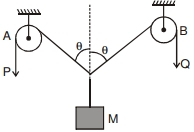
In the arrangement shown in the figure,the ends $P$ and $Q$ of an unstretchable string move downwards with a uniform speed $U$. Pulleys $A$ and $B$ are fixed. The mass $M$ moves upwards with a speed:
A
$2U \cos \theta$
B
$U \cos \theta$
C
$\frac{U}{\cos \theta}$
D
$\frac{2U}{\cos \theta}$
Solution
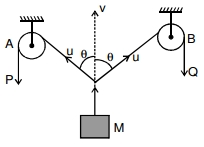
(C) Let the velocity of mass $M$ be $v$ in the upward direction.
Consider the segment of the string passing over pulley $A$. The velocity of the string along the segment connected to $M$ is $v$. The component of this velocity along the direction of the string towards pulley $A$ must be equal to the speed $U$ at which the end $P$ is pulled.
Therefore,$v \cos \theta = U$.
Solving for $v$,we get $v = \frac{U}{\cos \theta}$.
Thus,the mass $M$ moves upwards with a speed of $\frac{U}{\cos \theta}$.
Consider the segment of the string passing over pulley $A$. The velocity of the string along the segment connected to $M$ is $v$. The component of this velocity along the direction of the string towards pulley $A$ must be equal to the speed $U$ at which the end $P$ is pulled.
Therefore,$v \cos \theta = U$.
Solving for $v$,we get $v = \frac{U}{\cos \theta}$.
Thus,the mass $M$ moves upwards with a speed of $\frac{U}{\cos \theta}$.
0 likesView Solution
16
ChemistryMCQIIT JEE · 1982
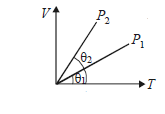
The figure shows the volume $V$ versus temperature $T$ graphs for a certain mass of a perfect gas at two constant pressures of $P_1$ and $P_2$. What inference can you draw from the graphs?
A
$P_1 < P_2$
B
$P_1 > P_2$
C
$P_1 = P_2$
D
No inference can be drawn due to insufficient information.
Solution
(B) From the ideal gas equation,$PV = \mu RT$,we can write $\frac{V}{T} = \frac{\mu R}{P}$.
The slope of the $V-T$ graph is given by $\tan \theta = \frac{V}{T} = \frac{\mu R}{P}$.
Since $\theta_1 < \theta_2$,it follows that $\tan \theta_1 < \tan \theta_2$.
Substituting the expression for the slope,we get $\frac{\mu R}{P_1} < \frac{\mu R}{P_2}$.
This implies $\frac{1}{P_1} < \frac{1}{P_2}$,which further simplifies to $P_1 > P_2$.
The slope of the $V-T$ graph is given by $\tan \theta = \frac{V}{T} = \frac{\mu R}{P}$.
Since $\theta_1 < \theta_2$,it follows that $\tan \theta_1 < \tan \theta_2$.
Substituting the expression for the slope,we get $\frac{\mu R}{P_1} < \frac{\mu R}{P_2}$.
This implies $\frac{1}{P_1} < \frac{1}{P_2}$,which further simplifies to $P_1 > P_2$.
0 likesView Solution
17
ChemistryDifficultMCQIIT JEE · 1982
The ion that cannot be precipitated by both $HCl$ and $H_2S$ is
A
$Pb^{2+}$
B
$Cu^{+}$
C
$Ag^{+}$
D
$Sn^{2+}$
Solution
(B) In qualitative inorganic analysis,$Pb^{2+}$,$Ag^{+}$,and $Sn^{2+}$ are precipitated as chlorides in Group $I$ or $II$ analysis using $HCl$.
$Cu^{+}$ (cuprous ion) is generally unstable in aqueous solution and disproportionates into $Cu^{2+}$ and $Cu^0$.
However,among the given options,$Cu^{+}$ is not a standard cation encountered in the systematic group analysis scheme for precipitation by $HCl$ or $H_2S$ in the same manner as the others,as it is not stable in aqueous solution.
Therefore,$Cu^{+}$ is the ion that does not follow the standard precipitation behavior of the other listed ions.
$Cu^{+}$ (cuprous ion) is generally unstable in aqueous solution and disproportionates into $Cu^{2+}$ and $Cu^0$.
However,among the given options,$Cu^{+}$ is not a standard cation encountered in the systematic group analysis scheme for precipitation by $HCl$ or $H_2S$ in the same manner as the others,as it is not stable in aqueous solution.
Therefore,$Cu^{+}$ is the ion that does not follow the standard precipitation behavior of the other listed ions.
0 likesView Solution
18
ChemistryMediumMCQIIT JEE · 1982
Which of the following is not an ore?
A
Bauxite
B
Malachite
C
Zinc blende
D
Pig iron
Solution
(D) Pig iron is the most impure form of iron and contains the highest proportion of carbon $(2.5 - 4\%)$. It is a manufactured product,not a naturally occurring mineral or ore.
Malachite is an ore of copper with the formula $Cu(OH)_2 \cdot CuCO_3$.
Zinc blende is an ore of zinc with the formula $ZnS$.
Bauxite is an ore of aluminium with the formula $Al_2O_3 \cdot 2H_2O$.
Malachite is an ore of copper with the formula $Cu(OH)_2 \cdot CuCO_3$.
Zinc blende is an ore of zinc with the formula $ZnS$.
Bauxite is an ore of aluminium with the formula $Al_2O_3 \cdot 2H_2O$.
0 likesView Solution
19
ChemistryMediumMCQIIT JEE · 1982
In the manufacture of iron,limestone is added to the blast furnace. The calcium ion ends up in the form of:
A
Slag
B
Gangue
C
Calcium metal
D
$CaCO_3$
Solution
(A) In the blast furnace,limestone $(CaCO_3)$ decomposes to form calcium oxide $(CaO)$.
$CaCO_3 \to CaO + CO_2$
$CaO$ acts as a flux and reacts with the silica $(SiO_2)$ impurity (gangue) present in the iron ore to form calcium silicate $(CaSiO_3)$,which is known as slag.
$CaO + SiO_2 \to CaSiO_3$ (Slag)
$CaCO_3 \to CaO + CO_2$
$CaO$ acts as a flux and reacts with the silica $(SiO_2)$ impurity (gangue) present in the iron ore to form calcium silicate $(CaSiO_3)$,which is known as slag.
$CaO + SiO_2 \to CaSiO_3$ (Slag)
0 likesView Solution
20
ChemistryMediumMCQIIT JEE · 1982
Iron is rendered passive by the action of
A
Conc. $H_2SO_4$
B
Conc. $H_3PO_4$
C
Conc. $HCl$
D
Conc. $HNO_3$
Solution
(D) Iron becomes passive when treated with concentrated $HNO_3$ due to the formation of a thin,protective,and non-porous oxide film $(Fe_2O_3)$ on its surface.
This layer prevents further reaction of the metal with the acid.
Other oxidizing agents like $K_2Cr_2O_7$,$KMnO_4$,chloric acid,and chromic acid also render iron passive.
Passive iron can be made active again by scratching the surface mechanically or by chemical reduction.
This layer prevents further reaction of the metal with the acid.
Other oxidizing agents like $K_2Cr_2O_7$,$KMnO_4$,chloric acid,and chromic acid also render iron passive.
Passive iron can be made active again by scratching the surface mechanically or by chemical reduction.
0 likesView Solution
21
ChemistryDifficultMCQIIT JEE · 1982
At low temperature,phenol reacts with $Br_2$ in $CS_2$ to form:
A
$m$-bromophenol
B
$o$- and $p$-bromophenol
C
$p$-bromophenol
D
$2, 4, 6$-tribromophenol
Solution
(B) When phenol reacts with $Br_2$ in a non-polar solvent like $CS_2$ at low temperature,the ionization of phenol is suppressed. The benzene ring is only slightly activated,leading to mono-substitution,which yields a mixture of $o$-bromophenol and $p$-bromophenol.
In contrast,when phenol reacts with $Br_2$ water,it ionizes to form the phenoxide ion. The negative charge on the oxygen atom strongly activates the benzene ring,resulting in the formation of $2, 4, 6$-tribromophenol.
In contrast,when phenol reacts with $Br_2$ water,it ionizes to form the phenoxide ion. The negative charge on the oxygen atom strongly activates the benzene ring,resulting in the formation of $2, 4, 6$-tribromophenol.
0 likesView Solution
22
ChemistryMediumMCQIIT JEE · 1982
When acetaldehyde is heated with Fehling solution,it gives a red precipitate of:
A
$Cu$
B
$CuO$
C
$Cu_2O$
D
$Cu(OH)_2$
Solution
(C) Acetaldehyde $(CH_3CHO)$ is an aliphatic aldehyde that reduces Fehling solution to a red precipitate of cuprous oxide $(Cu_2O)$.
The chemical reaction is:
$CH_3CHO + 2Cu^{2+} + 5OH^- \to CH_3COO^- + Cu_2O \text{ (Red ppt.)} + 3H_2O$
The chemical reaction is:
$CH_3CHO + 2Cu^{2+} + 5OH^- \to CH_3COO^- + Cu_2O \text{ (Red ppt.)} + 3H_2O$
0 likesView Solution
Vedclass Products
For Students
Vedclass Test Series
Mock tests in real IIT JEE style covering Chemistry with performance analysis. 5-day free trial.
Start Free TrialFor Teachers
Exam Paper Generator
Generate Set A/B/C/D Chemistry papers from 7.5L+ questions in 2 minutes. 3 chapters free.
Try FreeFor Institutes
Online Exam Module
Run live IIT JEE mock exams with unlimited students, 360° analytics & white-label branding.
See DemoFrequently Asked Questions
How many Chemistry questions are in IIT JEE 1982?
There are 22 Chemistry questions from the IIT JEE 1982 paper on Vedclass, each with a detailed step-by-step solution in English.
Are IIT JEE 1982 Chemistry solutions available in English?
Yes. All solutions on this page are in English. You can also switch to English or Hindi using the language buttons above the questions.
Can I practice IIT JEE 1982 Chemistry as a timed test?
Yes. Use the Vedclass Test Series to attempt a full IIT JEE mock test covering Chemistry with time limits and instant score analysis.
Can teachers create Chemistry papers from IIT JEE previous year questions?
Yes. The Vedclass Exam Paper Generator lets teachers mix IIT JEE Chemistry questions and generate Set A/B/C/D papers in minutes.
For Teachers & Institutes
Build a Custom Chemistry Paper
Pick IIT JEE 1982 Chemistry questions, set difficulty, and generate Set A/B/C/D in 2 minutes.