
PhysicsQ1–15 of 15 questions
Page 1 of 1 · English
1
PhysicsEasyMCQIIT JEE · 1981
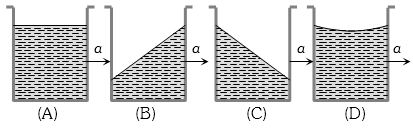
$A$ vessel containing water is given a constant acceleration $a$ towards the right,along a straight horizontal path. Which of the following diagrams represents the surface of the liquid?
A
$A$
B
$B$
C
$C$
D
$D$
Solution
(C) When a vessel containing liquid is accelerated horizontally with an acceleration $a$,the effective acceleration experienced by the liquid in the frame of the vessel is the vector sum of the gravitational acceleration $g$ (downwards) and the pseudo-acceleration $-a$ (backwards).
The free surface of the liquid must be perpendicular to the net effective acceleration vector. The angle $\theta$ that the surface makes with the horizontal is given by $\tan \theta = \frac{a}{g}$.
Since the acceleration $a$ is towards the right,the pseudo-force acts towards the left. Consequently,the liquid level rises on the left side and falls on the right side of the vessel. This corresponds to the surface profile shown in diagram $C$.
The free surface of the liquid must be perpendicular to the net effective acceleration vector. The angle $\theta$ that the surface makes with the horizontal is given by $\tan \theta = \frac{a}{g}$.
Since the acceleration $a$ is towards the right,the pseudo-force acts towards the left. Consequently,the liquid level rises on the left side and falls on the right side of the vessel. This corresponds to the surface profile shown in diagram $C$.
0 likesView Solution
2
PhysicsEasyMCQIIT JEE · 1981
Which of the following is correct when a person walks on a rough surface?
A
The frictional force exerted by the surface keeps him moving.
B
The force which the man exerts on the floor keeps him moving.
C
The reaction of the force which the man exerts on the floor keeps him moving.
D
None of the above.
Solution
(C) According to Newton's $3^{rd}$ law of motion,when a person walks,they push the ground backward with their foot.
In response,the ground exerts an equal and opposite reaction force on the person.
The vertical component of this reaction force balances the person's weight,preventing vertical motion.
The horizontal component of this reaction force (which is the static friction force) acts in the forward direction and pushes the person forward.
Therefore,the reaction force exerted by the floor on the person is responsible for their forward motion.
Hence,option $C$ is correct.
In response,the ground exerts an equal and opposite reaction force on the person.
The vertical component of this reaction force balances the person's weight,preventing vertical motion.
The horizontal component of this reaction force (which is the static friction force) acts in the forward direction and pushes the person forward.
Therefore,the reaction force exerted by the floor on the person is responsible for their forward motion.
Hence,option $C$ is correct.
0 likesView Solution
3
PhysicsEasyMCQIIT JEE · 1981
If the radius of the earth were to shrink by $1\%$ while its mass remains the same,the acceleration due to gravity on the earth's surface would
A
Decrease by $2\%$
B
Remain unchanged
C
Increase by $2\%$
D
Increase by $1\%$
Solution
(C) The acceleration due to gravity $g$ on the surface of the earth is given by the formula $g = \frac{GM}{R^2}$,where $G$ is the gravitational constant,$M$ is the mass of the earth,and $R$ is its radius.
Since the mass $M$ remains constant,we have $g \propto \frac{1}{R^2}$.
Taking the logarithmic differentiation,we get $\frac{\Delta g}{g} = -2 \frac{\Delta R}{R}$.
Given that the radius shrinks by $1\%$,we have $\frac{\Delta R}{R} = -0.01$.
Substituting this value,$\frac{\Delta g}{g} = -2 \times (-0.01) = 0.02$.
Therefore,the acceleration due to gravity increases by $2\%$.
Since the mass $M$ remains constant,we have $g \propto \frac{1}{R^2}$.
Taking the logarithmic differentiation,we get $\frac{\Delta g}{g} = -2 \frac{\Delta R}{R}$.
Given that the radius shrinks by $1\%$,we have $\frac{\Delta R}{R} = -0.01$.
Substituting this value,$\frac{\Delta g}{g} = -2 \times (-0.01) = 0.02$.
Therefore,the acceleration due to gravity increases by $2\%$.
0 likesView Solution
4
PhysicsDifficultMCQIIT JEE · 1981
$A$ lead bullet at $27^{\circ}C$ just melts when stopped by an obstacle. Assuming that $25\%$ of the heat produced is absorbed by the obstacle,find the velocity of the bullet at the time of striking in $m/s$. (Melting point of lead $= 327^{\circ}C$,specific heat of lead $= 0.03 \, cal/g^{\circ}C$,latent heat of fusion of lead $= 6 \, cal/g$,and $J = 4.2 \, J/cal$)
A
$410$
B
$1230$
C
$307.5$
D
None of the above
Solution
(A) Let the mass of the bullet be $m \, g$. The total heat required for the bullet to reach its melting point and melt is given by $Q_1 = mc\Delta\theta + mL$.
Substituting the values: $Q_1 = m \times 0.03 \times (327 - 27) + m \times 6 = m \times 0.03 \times 300 + 6m = 9m + 6m = 15m \, cal$.
Converting this to Joules: $Q_1 = 15m \times 4.2 = 63m \, J$.
The kinetic energy of the bullet is $K.E. = \frac{1}{2} M v^2$,where $M$ is the mass in kg $(M = m \times 10^{-3} \, kg)$.
Since $25\%$ of the heat is absorbed by the obstacle,$75\%$ of the kinetic energy is absorbed by the bullet to melt it.
Thus,$0.75 \times (\frac{1}{2} \times m \times 10^{-3} \times v^2) = 63m$.
Simplifying: $\frac{0.75}{2} \times 10^{-3} \times v^2 = 63$.
$0.375 \times 10^{-3} \times v^2 = 63$.
$v^2 = \frac{63}{0.375 \times 10^{-3}} = \frac{63000}{0.375} = 168000$.
$v = \sqrt{168000} \approx 409.87 \, m/s \approx 410 \, m/s$.
Substituting the values: $Q_1 = m \times 0.03 \times (327 - 27) + m \times 6 = m \times 0.03 \times 300 + 6m = 9m + 6m = 15m \, cal$.
Converting this to Joules: $Q_1 = 15m \times 4.2 = 63m \, J$.
The kinetic energy of the bullet is $K.E. = \frac{1}{2} M v^2$,where $M$ is the mass in kg $(M = m \times 10^{-3} \, kg)$.
Since $25\%$ of the heat is absorbed by the obstacle,$75\%$ of the kinetic energy is absorbed by the bullet to melt it.
Thus,$0.75 \times (\frac{1}{2} \times m \times 10^{-3} \times v^2) = 63m$.
Simplifying: $\frac{0.75}{2} \times 10^{-3} \times v^2 = 63$.
$0.375 \times 10^{-3} \times v^2 = 63$.
$v^2 = \frac{63}{0.375 \times 10^{-3}} = \frac{63000}{0.375} = 168000$.
$v = \sqrt{168000} \approx 409.87 \, m/s \approx 410 \, m/s$.
0 likesView Solution
5
PhysicsEasyMCQIIT JEE · 1981
Which of the following statements is true?
A
Absolute zero degree temperature is not zero energy temperature.
B
Two different gases at the same temperature and pressure have equal root mean square velocities.
C
The root mean square speed of the molecules of different ideal gases,maintained at the same temperature,are the same.
D
Given a sample of $1 \, cc$ of hydrogen and $1 \, cc$ of oxygen both at $NTP$,the oxygen sample has a larger number of molecules.
Solution
(A) The kinetic energy $(K.E.)$ of an ideal gas is given by $K.E. = \frac{3}{2} k_B T$. If $T = 0 \, K$,the kinetic energy becomes zero,but the potential energy of the molecules may not be zero. Thus,absolute zero temperature is not zero energy temperature. Hence,option $A$ is correct.
$(B)$ The root mean square $(RMS)$ velocity is given by $v_{rms} = \sqrt{\frac{3RT}{M}}$. Since it depends on the molar mass $(M)$,two different gases at the same temperature will have different $RMS$ velocities. Thus,option $B$ is incorrect.
$(C)$ Similar to option $B$,the $RMS$ speed depends on the molar mass. Therefore,molecules of different ideal gases at the same temperature will have different $RMS$ speeds. Thus,option $C$ is incorrect.
$(D)$ According to Avogadro's law,at the same temperature and pressure,equal volumes of all gases contain an equal number of molecules. Since both samples have $1 \, cc$ volume at $NTP$,they contain the same number of molecules. Thus,option $D$ is incorrect.
$(B)$ The root mean square $(RMS)$ velocity is given by $v_{rms} = \sqrt{\frac{3RT}{M}}$. Since it depends on the molar mass $(M)$,two different gases at the same temperature will have different $RMS$ velocities. Thus,option $B$ is incorrect.
$(C)$ Similar to option $B$,the $RMS$ speed depends on the molar mass. Therefore,molecules of different ideal gases at the same temperature will have different $RMS$ speeds. Thus,option $C$ is incorrect.
$(D)$ According to Avogadro's law,at the same temperature and pressure,equal volumes of all gases contain an equal number of molecules. Since both samples have $1 \, cc$ volume at $NTP$,they contain the same number of molecules. Thus,option $D$ is incorrect.
0 likesView Solution
6
PhysicsMediumMCQIIT JEE · 1981
$A$ slab consists of two parallel layers of copper and brass of the same thickness and having thermal conductivities in the ratio $1 : 4$. If the free face of brass is at $100^\circ C$ and that of copper at $0^\circ C$,the temperature of the interface is ........ $^\circ C$.
A
$80$
B
$20$
C
$60$
D
$40$
Solution
(A) Let the thickness of each layer be $d$. Let $K_c$ be the thermal conductivity of copper and $K_b$ be the thermal conductivity of brass. Given $K_c : K_b = 1 : 4$,so $K_b = 4K_c$.
In a steady state,the rate of heat flow through the copper layer must equal the rate of heat flow through the brass layer.
Let $\theta$ be the temperature of the interface.
Rate of heat flow $H = \frac{KA(\Delta T)}{d}$.
For copper: $H_c = \frac{K_c A(\theta - 0)}{d}$.
For brass: $H_b = \frac{K_b A(100 - \theta)}{d}$.
Since $H_c = H_b$,we have $\frac{K_c A \theta}{d} = \frac{4K_c A(100 - \theta)}{d}$.
Canceling common terms $K_c, A, d$: $\theta = 4(100 - \theta)$.
$\theta = 400 - 4\theta$.
$5\theta = 400$.
$\theta = 80^\circ C$.
In a steady state,the rate of heat flow through the copper layer must equal the rate of heat flow through the brass layer.
Let $\theta$ be the temperature of the interface.
Rate of heat flow $H = \frac{KA(\Delta T)}{d}$.
For copper: $H_c = \frac{K_c A(\theta - 0)}{d}$.
For brass: $H_b = \frac{K_b A(100 - \theta)}{d}$.
Since $H_c = H_b$,we have $\frac{K_c A \theta}{d} = \frac{4K_c A(100 - \theta)}{d}$.
Canceling common terms $K_c, A, d$: $\theta = 4(100 - \theta)$.
$\theta = 400 - 4\theta$.
$5\theta = 400$.
$\theta = 80^\circ C$.
0 likesView Solution
7
PhysicsDifficultMCQIIT JEE · 1981
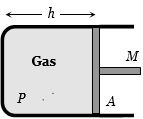
$A$ cylindrical piston of mass $M$ slides smoothly inside a long cylinder closed at one end,enclosing a certain mass of gas. The cylinder is kept with its axis horizontal. If the piston is disturbed from its equilibrium position,it oscillates simple harmonically. The period of oscillation will be
A
$T = 2\pi \sqrt {\frac{{Mh}}{{PA}}} $
B
$T = 2\pi \sqrt {\frac{{MA}}{{Ph}}} $
C
$T = 2\pi \sqrt {\frac{M}{{PAh}}} $
D
$T = 2\pi \sqrt {MPhA} $
Solution
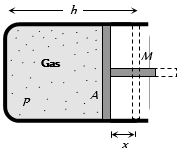
(A) Let the piston be displaced through a small distance $x$ towards the left. The volume of the gas decreases,and its pressure increases. Let $\Delta P$ be the increase in pressure and $\Delta V$ be the decrease in volume. Assuming the process is isothermal,we have $P_1V_1 = P_2V_2$.
$PV = (P + \Delta P)(V - \Delta V)$
$PV = PV - P\Delta V + \Delta P V - \Delta P \Delta V$
Neglecting the small term $\Delta P \Delta V$,we get $P \Delta V = \Delta P V$.
Since $\Delta V = A x$ and $V = A h$,we have $P(Ax) = \Delta P(Ah)$.
$\Delta P = \frac{Px}{h}$.
This excess pressure creates a restoring force $F$ on the piston of mass $M$:
$F = -(\Delta P)A = -\left(\frac{PA}{h}\right)x$.
Comparing this with the equation for simple harmonic motion $F = -kx$,we identify the force constant $k = \frac{PA}{h}$.
The angular frequency is $\omega = \sqrt{\frac{k}{M}} = \sqrt{\frac{PA}{Mh}}$.
The time period $T$ is given by $T = \frac{2\pi}{\omega} = 2\pi \sqrt{\frac{Mh}{PA}}$.
$PV = (P + \Delta P)(V - \Delta V)$
$PV = PV - P\Delta V + \Delta P V - \Delta P \Delta V$
Neglecting the small term $\Delta P \Delta V$,we get $P \Delta V = \Delta P V$.
Since $\Delta V = A x$ and $V = A h$,we have $P(Ax) = \Delta P(Ah)$.
$\Delta P = \frac{Px}{h}$.
This excess pressure creates a restoring force $F$ on the piston of mass $M$:
$F = -(\Delta P)A = -\left(\frac{PA}{h}\right)x$.
Comparing this with the equation for simple harmonic motion $F = -kx$,we identify the force constant $k = \frac{PA}{h}$.
The angular frequency is $\omega = \sqrt{\frac{k}{M}} = \sqrt{\frac{PA}{Mh}}$.
The time period $T$ is given by $T = \frac{2\pi}{\omega} = 2\pi \sqrt{\frac{Mh}{PA}}$.
0 likesView Solution
8
PhysicsMediumMCQIIT JEE · 1981
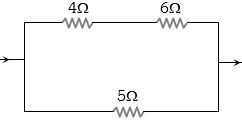
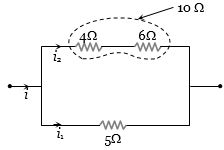
In the circuit shown in the figure, the heat produced in the $5\, \Omega$ resistance is $10\, \text{cal/sec}$. The heat produced in the $4\, \Omega$ resistance is ................ $\text{cal/sec}$.
A
$1$
B
$2$
C
$3$
D
$4$
Solution
(B) The circuit consists of two parallel branches. The upper branch has a total resistance of $R_2 = 4\, \Omega + 6\, \Omega = 10\, \Omega$. The lower branch has a resistance of $R_1 = 5\, \Omega$.
Since the branches are in parallel, the potential difference $V$ across both branches is the same.
The current in the branches is inversely proportional to their resistance: $\frac{i_1}{i_2} = \frac{R_2}{R_1} = \frac{10}{5} = \frac{2}{1}$.
The heat produced per second (power) is given by $P = i^2 R$.
For the $5\, \Omega$ resistor, $P_5 = i_1^2 \times 5 = 10\, \text{cal/s}$.
For the $4\, \Omega$ resistor, the current is $i_2$. The power dissipated in the upper branch is $P_{\text{upper}} = i_2^2 \times R_2 = i_2^2 \times 10$.
Using the ratio $\frac{i_1}{i_2} = 2$, we have $i_1 = 2i_2$. Substituting this into the power equation for the $5\, \Omega$ resistor: $(2i_2)^2 \times 5 = 10 \Rightarrow 20i_2^2 = 10 \Rightarrow i_2^2 = 0.5$.
The power dissipated in the $4\, \Omega$ resistor is $P_4 = i_2^2 \times 4 = 0.5 \times 4 = 2\, \text{cal/s}$.
Since the branches are in parallel, the potential difference $V$ across both branches is the same.
The current in the branches is inversely proportional to their resistance: $\frac{i_1}{i_2} = \frac{R_2}{R_1} = \frac{10}{5} = \frac{2}{1}$.
The heat produced per second (power) is given by $P = i^2 R$.
For the $5\, \Omega$ resistor, $P_5 = i_1^2 \times 5 = 10\, \text{cal/s}$.
For the $4\, \Omega$ resistor, the current is $i_2$. The power dissipated in the upper branch is $P_{\text{upper}} = i_2^2 \times R_2 = i_2^2 \times 10$.
Using the ratio $\frac{i_1}{i_2} = 2$, we have $i_1 = 2i_2$. Substituting this into the power equation for the $5\, \Omega$ resistor: $(2i_2)^2 \times 5 = 10 \Rightarrow 20i_2^2 = 10 \Rightarrow i_2^2 = 0.5$.
The power dissipated in the $4\, \Omega$ resistor is $P_4 = i_2^2 \times 4 = 0.5 \times 4 = 2\, \text{cal/s}$.
0 likesView Solution
9
PhysicsEasyMCQIIT JEE · 1981
Two rails of a railway track,insulated from each other and the ground,are connected to a millivoltmeter. What is the reading of the voltmeter when a train travels with a speed of $180 \ km/hr$ along the track? Given that the vertical component of the Earth's magnetic field is $0.2 \times 10^{-4} \ Wb/m^2$ and the rails are separated by $1 \ m$.
A
$10^{-2} \ V$
B
$10^{-4} \ V$
C
$10^{-3} \ V$
D
$1 \ V$
Solution
(C) The induced electromotive force $(e)$ produced in the axle of the train as it moves through the Earth's magnetic field is given by the formula: $e = B_v \cdot v \cdot l$
Here,$B_v = 0.2 \times 10^{-4} \ Wb/m^2$ is the vertical component of the Earth's magnetic field.
The speed of the train $v = 180 \ km/hr = 180 \times \frac{5}{18} \ m/s = 50 \ m/s$.
The distance between the rails (length of the axle) $l = 1 \ m$.
Substituting these values into the formula:
$e = (0.2 \times 10^{-4}) \times 50 \times 1$
$e = 10 \times 10^{-4} \ V$
$e = 10^{-3} \ V$.
Here,$B_v = 0.2 \times 10^{-4} \ Wb/m^2$ is the vertical component of the Earth's magnetic field.
The speed of the train $v = 180 \ km/hr = 180 \times \frac{5}{18} \ m/s = 50 \ m/s$.
The distance between the rails (length of the axle) $l = 1 \ m$.
Substituting these values into the formula:
$e = (0.2 \times 10^{-4}) \times 50 \times 1$
$e = 10 \times 10^{-4} \ V$
$e = 10^{-3} \ V$.
0 likesView Solution
10
PhysicsMediumMCQIIT JEE · 1981
An $\alpha$-particle of $5 \; MeV$ energy strikes a stationary uranium nucleus at a scattering angle of $180^o$. The distance of closest approach of the $\alpha$-particle to the nucleus will be of the order of:
A
$1 \; \mathring{A}$
B
$10^{-10} \; cm$
C
$10^{-12} \; cm$
D
$10^{-15} \; cm$
Solution
(C) At the distance of closest approach,the initial kinetic energy of the $\alpha$-particle is entirely converted into electrostatic potential energy.
$K.E. = P.E.$
$5 \; MeV = \frac{1}{4\pi\epsilon_0} \cdot \frac{(Ze)(2e)}{r_0}$
Given:
$K.E. = 5 \times 10^6 \times 1.6 \times 10^{-19} \; J = 8 \times 10^{-13} \; J$
$Z = 92$ (for Uranium)
$e = 1.6 \times 10^{-19} \; C$
$\frac{1}{4\pi\epsilon_0} = 9 \times 10^9 \; N \cdot m^2/C^2$
Substituting the values:
$8 \times 10^{-13} = \frac{9 \times 10^9 \times 92 \times 2 \times (1.6 \times 10^{-19})^2}{r_0}$
Solving for $r_0$:
$r_0 = \frac{9 \times 10^9 \times 184 \times 2.56 \times 10^{-38}}{8 \times 10^{-13}}$
$r_0 \approx 5.3 \times 10^{-14} \; m = 5.3 \times 10^{-12} \; cm$
Thus,the order of magnitude is $10^{-12} \; cm$.
$K.E. = P.E.$
$5 \; MeV = \frac{1}{4\pi\epsilon_0} \cdot \frac{(Ze)(2e)}{r_0}$
Given:
$K.E. = 5 \times 10^6 \times 1.6 \times 10^{-19} \; J = 8 \times 10^{-13} \; J$
$Z = 92$ (for Uranium)
$e = 1.6 \times 10^{-19} \; C$
$\frac{1}{4\pi\epsilon_0} = 9 \times 10^9 \; N \cdot m^2/C^2$
Substituting the values:
$8 \times 10^{-13} = \frac{9 \times 10^9 \times 92 \times 2 \times (1.6 \times 10^{-19})^2}{r_0}$
Solving for $r_0$:
$r_0 = \frac{9 \times 10^9 \times 184 \times 2.56 \times 10^{-38}}{8 \times 10^{-13}}$
$r_0 \approx 5.3 \times 10^{-14} \; m = 5.3 \times 10^{-12} \; cm$
Thus,the order of magnitude is $10^{-12} \; cm$.
0 likesView Solution
11
PhysicsDifficultMCQIIT JEE · 1981
The half-life of radioactive Radon is $3.8 \ days$. The time at the end of which $1/20^{th}$ of the Radon sample will remain undecayed is ........... $days$ (Given $\log_{10} e = 0.4343$).
A
$3.8$
B
$16.5$
C
$33$
D
$76$
Solution
(B) The radioactive decay law is given by $N = N_0 e^{-\lambda t}$,where $N/N_0 = 1/20$.
The decay constant $\lambda$ is related to the half-life $T_{1/2}$ by $\lambda = \frac{\ln 2}{T_{1/2}} = \frac{0.6931}{3.8 \ days}$.
Substituting the values into the decay equation: $\frac{1}{20} = e^{-\lambda t}$,which implies $20 = e^{\lambda t}$.
Taking the natural logarithm on both sides: $\ln 20 = \lambda t$.
Converting to base $10$ logarithm: $2.303 \log_{10} 20 = \lambda t$.
Given $\log_{10} 20 = \log_{10} (2 \times 10) = 0.3010 + 1 = 1.3010$.
Substituting $\lambda = \frac{0.6931}{3.8}$ and $\log_{10} e = 0.4343$,we use the relation $\ln x = 2.303 \log_{10} x$ or $\lambda = \frac{0.6931}{T_{1/2}}$.
$t = \frac{\ln 20}{\lambda} = \frac{2.303 \times 1.3010 \times 3.8}{0.6931} \approx 16.43 \ days$.
Rounding to the nearest provided option,$t \approx 16.5 \ days$.
The decay constant $\lambda$ is related to the half-life $T_{1/2}$ by $\lambda = \frac{\ln 2}{T_{1/2}} = \frac{0.6931}{3.8 \ days}$.
Substituting the values into the decay equation: $\frac{1}{20} = e^{-\lambda t}$,which implies $20 = e^{\lambda t}$.
Taking the natural logarithm on both sides: $\ln 20 = \lambda t$.
Converting to base $10$ logarithm: $2.303 \log_{10} 20 = \lambda t$.
Given $\log_{10} 20 = \log_{10} (2 \times 10) = 0.3010 + 1 = 1.3010$.
Substituting $\lambda = \frac{0.6931}{3.8}$ and $\log_{10} e = 0.4343$,we use the relation $\ln x = 2.303 \log_{10} x$ or $\lambda = \frac{0.6931}{T_{1/2}}$.
$t = \frac{\ln 20}{\lambda} = \frac{2.303 \times 1.3010 \times 3.8}{0.6931} \approx 16.43 \ days$.
Rounding to the nearest provided option,$t \approx 16.5 \ days$.
0 likesView Solution
12
PhysicsDifficultMCQIIT JEE · 1981
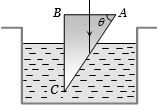
$A$ glass prism $(\mu = 1.5)$ is dipped in water $(_a\mu_w = 4/3)$ as shown in the figure. $A$ light ray is incident normally on the surface $AB$. It reaches the surface $BC$ after being totally internally reflected at the surface $AC$,if:
A
$sin \theta \ge 8/9$
B
$2/3 < sin \theta < 8/9$
C
$sin \theta \le 2/3$
D
It is not possible
Solution
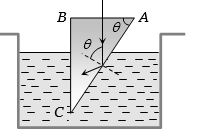
(A) For total internal reflection $(TIR)$ to occur at the surface $AC$,the angle of incidence $i$ at the surface $AC$ must be greater than the critical angle $C$ between glass and water.
From the geometry of the prism,the light ray incident normally on $AB$ strikes $AC$ at an angle of incidence $i = \theta$.
For $TIR$ at $AC$,we require $i > C$,which implies $\sin i > \sin C$.
Substituting $i = \theta$,we get $\sin \theta > \sin C$.
The critical angle $C$ is given by $\sin C = \frac{\mu_w}{\mu_g}$,where $\mu_w = 4/3$ and $\mu_g = 1.5 = 3/2$.
Thus,$\sin C = \frac{4/3}{3/2} = \frac{4}{3} \times \frac{2}{3} = \frac{8}{9}$.
Therefore,for $TIR$ to occur,$\sin \theta > 8/9$. Given the options,the condition is $\sin \theta \ge 8/9$.
From the geometry of the prism,the light ray incident normally on $AB$ strikes $AC$ at an angle of incidence $i = \theta$.
For $TIR$ at $AC$,we require $i > C$,which implies $\sin i > \sin C$.
Substituting $i = \theta$,we get $\sin \theta > \sin C$.
The critical angle $C$ is given by $\sin C = \frac{\mu_w}{\mu_g}$,where $\mu_w = 4/3$ and $\mu_g = 1.5 = 3/2$.
Thus,$\sin C = \frac{4/3}{3/2} = \frac{4}{3} \times \frac{2}{3} = \frac{8}{9}$.
Therefore,for $TIR$ to occur,$\sin \theta > 8/9$. Given the options,the condition is $\sin \theta \ge 8/9$.
0 likesView Solution
13
PhysicsEasyMCQIIT JEE · 1981
In Young's double-slit experiment,if the distance between the slits is reduced to half and the distance between the slit and the screen is doubled,then the fringe width
A
Will not change
B
Will become half
C
Will be doubled
D
Will become four times
Solution
(D) The formula for fringe width in Young's double-slit experiment is given by $\beta = \frac{\lambda D}{d}$,where $\lambda$ is the wavelength of light,$D$ is the distance between the slit and the screen,and $d$ is the distance between the slits.
Given that the new distance between the slits is $d' = \frac{d}{2}$ and the new distance between the slit and the screen is $D' = 2D$.
The new fringe width $\beta'$ will be $\beta' = \frac{\lambda D'}{d'} = \frac{\lambda (2D)}{(d/2)} = 4 \left( \frac{\lambda D}{d} \right) = 4\beta$.
Therefore,the fringe width will become four times the original value.
Given that the new distance between the slits is $d' = \frac{d}{2}$ and the new distance between the slit and the screen is $D' = 2D$.
The new fringe width $\beta'$ will be $\beta' = \frac{\lambda D'}{d'} = \frac{\lambda (2D)}{(d/2)} = 4 \left( \frac{\lambda D}{d} \right) = 4\beta$.
Therefore,the fringe width will become four times the original value.
0 likesView Solution
14
PhysicsDifficultMCQIIT JEE · 1981
$A$ charge of total amount $Q$ is distributed over two concentric hollow spheres of radii $r$ and $R$ $(R > r)$ such that the surface charge densities on the two spheres are equal. The electric potential at the common centre is
A
$\frac{1}{4\pi \varepsilon_0} \frac{(R - r)Q}{(R^2 + r^2)}$
B
$\frac{1}{4\pi \varepsilon_0} \frac{(R + r)Q}{2(R^3 + r^3)}$
C
$\frac{1}{4\pi \varepsilon_0} \frac{(R + r)Q}{(R^2 + r^2)}$
D
$\frac{1}{4\pi \varepsilon_0} \frac{(R - r)Q}{2(R^2 + r^2)}$
Solution
(C) Let $q_1$ and $q_2$ be the charges on the spheres of radii $r$ and $R$ respectively.
Given $q_1 + q_2 = Q$.
Since surface charge densities are equal,$\sigma_1 = \sigma_2$.
$\frac{q_1}{4\pi r^2} = \frac{q_2}{4\pi R^2} \implies \frac{q_1}{r^2} = \frac{q_2}{R^2}$.
Using componendo and dividendo,$\frac{q_1}{r^2} = \frac{q_2}{R^2} = \frac{q_1 + q_2}{r^2 + R^2} = \frac{Q}{r^2 + R^2}$.
Thus,$q_1 = \frac{Q r^2}{R^2 + r^2}$ and $q_2 = \frac{Q R^2}{R^2 + r^2}$.
The electric potential at the common centre is $V = \frac{1}{4\pi \varepsilon_0} \left( \frac{q_1}{r} + \frac{q_2}{R} \right)$.
Substituting the values of $q_1$ and $q_2$:
$V = \frac{1}{4\pi \varepsilon_0} \left( \frac{Q r^2}{r(R^2 + r^2)} + \frac{Q R^2}{R(R^2 + r^2)} \right) = \frac{1}{4\pi \varepsilon_0} \left( \frac{Q r + Q R}{R^2 + r^2} \right)$.
$V = \frac{1}{4\pi \varepsilon_0} \frac{(R + r)Q}{R^2 + r^2}$.
Given $q_1 + q_2 = Q$.
Since surface charge densities are equal,$\sigma_1 = \sigma_2$.
$\frac{q_1}{4\pi r^2} = \frac{q_2}{4\pi R^2} \implies \frac{q_1}{r^2} = \frac{q_2}{R^2}$.
Using componendo and dividendo,$\frac{q_1}{r^2} = \frac{q_2}{R^2} = \frac{q_1 + q_2}{r^2 + R^2} = \frac{Q}{r^2 + R^2}$.
Thus,$q_1 = \frac{Q r^2}{R^2 + r^2}$ and $q_2 = \frac{Q R^2}{R^2 + r^2}$.
The electric potential at the common centre is $V = \frac{1}{4\pi \varepsilon_0} \left( \frac{q_1}{r} + \frac{q_2}{R} \right)$.
Substituting the values of $q_1$ and $q_2$:
$V = \frac{1}{4\pi \varepsilon_0} \left( \frac{Q r^2}{r(R^2 + r^2)} + \frac{Q R^2}{R(R^2 + r^2)} \right) = \frac{1}{4\pi \varepsilon_0} \left( \frac{Q r + Q R}{R^2 + r^2} \right)$.
$V = \frac{1}{4\pi \varepsilon_0} \frac{(R + r)Q}{R^2 + r^2}$.
0 likesView Solution
15
PhysicsDifficultMCQIIT JEE · 1981
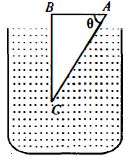
$A$ glass prism of refractive index $1.5$ is immersed in water (refractive index $\frac{4}{3}$) as shown in the figure. $A$ light beam incident normally on the face $AB$ is totally internally reflected at the face $AC$ to reach the face $BC$,if:
A
$\sin \theta > \frac{5}{9}$
B
$\sin \theta > \frac{2}{3}$
C
$\sin \theta > \frac{8}{9}$
D
$\sin \theta > \frac{1}{3}$
Solution
(C) $1$. The light beam is incident normally on face $AB$,so it enters the prism without deviation and strikes face $AC$.
$2$. Let the angle of incidence at face $AC$ be $i$. From the geometry of the prism,the angle between the normal to face $AC$ and the incident ray is equal to the angle $\theta$ of the prism at $A$. Thus,$i = \theta$.
$3$. For total internal reflection $(TIR)$ to occur at face $AC$,the angle of incidence must be greater than the critical angle $C$ for the glass-water interface.
$4$. The condition for $TIR$ is $i > C$,which implies $\sin i > \sin C$.
$5$. Since $i = \theta$,we have $\sin \theta > \sin C$.
$6$. The critical angle $C$ is given by $\sin C = \frac{\mu_{\text{water}}}{\mu_{\text{glass}}} = \frac{4/3}{3/2} = \frac{4}{3} \times \frac{2}{3} = \frac{8}{9}$.
$7$. Therefore,the condition for total internal reflection is $\sin \theta > \frac{8}{9}$.
$2$. Let the angle of incidence at face $AC$ be $i$. From the geometry of the prism,the angle between the normal to face $AC$ and the incident ray is equal to the angle $\theta$ of the prism at $A$. Thus,$i = \theta$.
$3$. For total internal reflection $(TIR)$ to occur at face $AC$,the angle of incidence must be greater than the critical angle $C$ for the glass-water interface.
$4$. The condition for $TIR$ is $i > C$,which implies $\sin i > \sin C$.
$5$. Since $i = \theta$,we have $\sin \theta > \sin C$.
$6$. The critical angle $C$ is given by $\sin C = \frac{\mu_{\text{water}}}{\mu_{\text{glass}}} = \frac{4/3}{3/2} = \frac{4}{3} \times \frac{2}{3} = \frac{8}{9}$.
$7$. Therefore,the condition for total internal reflection is $\sin \theta > \frac{8}{9}$.
0 likesView Solution
Vedclass Products
For Students
Vedclass Test Series
Mock tests in real IIT JEE style covering Physics with performance analysis. 5-day free trial.
Start Free TrialFor Teachers
Exam Paper Generator
Generate Set A/B/C/D Physics papers from 7.5L+ questions in 2 minutes. 3 chapters free.
Try FreeFor Institutes
Online Exam Module
Run live IIT JEE mock exams with unlimited students, 360° analytics & white-label branding.
See DemoFrequently Asked Questions
How many Physics questions are in IIT JEE 1981?
There are 15 Physics questions from the IIT JEE 1981 paper on Vedclass, each with a detailed step-by-step solution in English.
Are IIT JEE 1981 Physics solutions available in English?
Yes. All solutions on this page are in English. You can also switch to English or Hindi using the language buttons above the questions.
Can I practice IIT JEE 1981 Physics as a timed test?
Yes. Use the Vedclass Test Series to attempt a full IIT JEE mock test covering Physics with time limits and instant score analysis.
Can teachers create Physics papers from IIT JEE previous year questions?
Yes. The Vedclass Exam Paper Generator lets teachers mix IIT JEE Physics questions and generate Set A/B/C/D papers in minutes.
For Teachers & Institutes
Build a Custom Physics Paper
Pick IIT JEE 1981 Physics questions, set difficulty, and generate Set A/B/C/D in 2 minutes.