
MathematicsQ1–24 of 24 questions
Page 1 of 1 · English
1
MathematicsMediumMCQIIT JEE · 1981
The points $z_1, z_2, z_3, z_4$ in the complex plane are the vertices of a parallelogram taken in order,if and only if
A
$z_1 + z_4 = z_2 + z_3$
B
$z_1 + z_3 = z_2 + z_4$
C
$z_1 + z_2 = z_3 + z_4$
D
None of these
Solution
(B) In a parallelogram $ABCD$,the diagonals $AC$ and $BD$ bisect each other at the same midpoint.
The midpoint of diagonal $AC$ is given by $\frac{z_1 + z_3}{2}$.
The midpoint of diagonal $BD$ is given by $\frac{z_2 + z_4}{2}$.
Since the diagonals bisect each other,we have $\frac{z_1 + z_3}{2} = \frac{z_2 + z_4}{2}$.
Therefore,$z_1 + z_3 = z_2 + z_4$.
The midpoint of diagonal $AC$ is given by $\frac{z_1 + z_3}{2}$.
The midpoint of diagonal $BD$ is given by $\frac{z_2 + z_4}{2}$.
Since the diagonals bisect each other,we have $\frac{z_1 + z_3}{2} = \frac{z_2 + z_4}{2}$.
Therefore,$z_1 + z_3 = z_2 + z_4$.
0 likesView Solution
2
MathematicsDifficultMCQIIT JEE · 1981
Let the complex numbers $z_1, z_2$ and $z_3$ be the vertices of an equilateral triangle. Let $z_0$ be the circumcentre of the triangle,then $z_1^2 + z_2^2 + z_3^2 = $
A
$z_0^2$
B
$-z_0^2$
C
$3z_0^2$
D
$-3z_0^2$
Solution
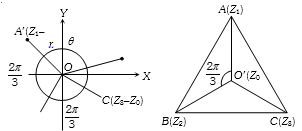
(C) Let $r$ be the circumradius of the equilateral triangle and $\omega$ be the cube root of unity. Let $ABC$ be the equilateral triangle with $z_1, z_2$ and $z_3$ as its vertices $A, B$ and $C$ respectively,with circumcentre $O'(z_0)$.
The vectors $O'A, O'B, O'C$ are equal in magnitude and separated by an angle of $\frac{2\pi}{3}$.
Then,we can write:
$z_1 - z_0 = r e^{i\theta}$
$z_2 - z_0 = r e^{i(\theta + \frac{2\pi}{3})} = r \omega e^{i\theta}$
$z_3 - z_0 = r e^{i(\theta + \frac{4\pi}{3})} = r \omega^2 e^{i\theta}$
Thus,$z_1 = z_0 + r e^{i\theta}$,$z_2 = z_0 + r \omega e^{i\theta}$,and $z_3 = z_0 + r \omega^2 e^{i\theta}$.
Squaring and adding these gives:
$z_1^2 + z_2^2 + z_3^2 = (z_0 + r e^{i\theta})^2 + (z_0 + r \omega e^{i\theta})^2 + (z_0 + r \omega^2 e^{i\theta})^2$
$= 3z_0^2 + 2 z_0 r e^{i\theta} (1 + \omega + \omega^2) + r^2 e^{i2\theta} (1 + \omega^2 + \omega^4)$
Since $1 + \omega + \omega^2 = 0$ and $1 + \omega^2 + \omega^4 = 1 + \omega^2 + \omega = 0$,we get:
$z_1^2 + z_2^2 + z_3^2 = 3z_0^2$.
The vectors $O'A, O'B, O'C$ are equal in magnitude and separated by an angle of $\frac{2\pi}{3}$.
Then,we can write:
$z_1 - z_0 = r e^{i\theta}$
$z_2 - z_0 = r e^{i(\theta + \frac{2\pi}{3})} = r \omega e^{i\theta}$
$z_3 - z_0 = r e^{i(\theta + \frac{4\pi}{3})} = r \omega^2 e^{i\theta}$
Thus,$z_1 = z_0 + r e^{i\theta}$,$z_2 = z_0 + r \omega e^{i\theta}$,and $z_3 = z_0 + r \omega^2 e^{i\theta}$.
Squaring and adding these gives:
$z_1^2 + z_2^2 + z_3^2 = (z_0 + r e^{i\theta})^2 + (z_0 + r \omega e^{i\theta})^2 + (z_0 + r \omega^2 e^{i\theta})^2$
$= 3z_0^2 + 2 z_0 r e^{i\theta} (1 + \omega + \omega^2) + r^2 e^{i2\theta} (1 + \omega^2 + \omega^4)$
Since $1 + \omega + \omega^2 = 0$ and $1 + \omega^2 + \omega^4 = 1 + \omega^2 + \omega = 0$,we get:
$z_1^2 + z_2^2 + z_3^2 = 3z_0^2$.
0 likesView Solution
3
MathematicsEasyMCQIIT JEE · 1981
If $2 + i\sqrt{3}$ is a root of the equation $x^2 + px + q = 0$,where $p$ and $q$ are real,then $(p, q) = $
A
$(-4, 7)$
B
$(4, -7)$
C
$(4, 7)$
D
$(-4, -7)$
Solution
(A) Since the coefficients $p$ and $q$ are real,the complex roots must occur in conjugate pairs.
Given one root is $x_1 = 2 + i\sqrt{3}$,the other root must be $x_2 = 2 - i\sqrt{3}$.
Using the properties of quadratic equations,the sum of the roots is $x_1 + x_2 = (2 + i\sqrt{3}) + (2 - i\sqrt{3}) = 4$.
From the equation $x^2 + px + q = 0$,the sum of the roots is $-p$. Therefore,$-p = 4$,which implies $p = -4$.
The product of the roots is $x_1 \times x_2 = (2 + i\sqrt{3})(2 - i\sqrt{3}) = 2^2 - (i\sqrt{3})^2 = 4 - (-3) = 7$.
From the equation $x^2 + px + q = 0$,the product of the roots is $q$. Therefore,$q = 7$.
Thus,$(p, q) = (-4, 7)$.
Given one root is $x_1 = 2 + i\sqrt{3}$,the other root must be $x_2 = 2 - i\sqrt{3}$.
Using the properties of quadratic equations,the sum of the roots is $x_1 + x_2 = (2 + i\sqrt{3}) + (2 - i\sqrt{3}) = 4$.
From the equation $x^2 + px + q = 0$,the sum of the roots is $-p$. Therefore,$-p = 4$,which implies $p = -4$.
The product of the roots is $x_1 \times x_2 = (2 + i\sqrt{3})(2 - i\sqrt{3}) = 2^2 - (i\sqrt{3})^2 = 4 - (-3) = 7$.
From the equation $x^2 + px + q = 0$,the product of the roots is $q$. Therefore,$q = 7$.
Thus,$(p, q) = (-4, 7)$.
1 likesView Solution
4
MathematicsDifficultMCQIIT JEE · 1981
Five balls of different colours are to be placed in three boxes of different sizes. Each box can hold all five balls. In how many ways can we place the balls so that no box remains empty?
A
$50$
B
$100$
C
$150$
D
$200$
Solution
(C) Let the boxes be marked as $A, B, C$. We have to ensure that no box remains empty and all five balls are placed.
There are two possible distributions of $5$ balls into $3$ boxes such that no box is empty:
$(i)$ Two boxes contain $1$ ball each and the $3^{rd}$ box contains $3$ balls.
The number of ways to choose the balls is $^5C_1 \times ^4C_1 \times ^3C_3 = 5 \times 4 \times 1 = 20$.
Since the box containing $3$ balls can be any of the $3$ boxes,the total ways for this case is $20 \times 3 = 60$.
$(ii)$ Two boxes contain $2$ balls each and the $3^{rd}$ box contains $1$ ball.
The number of ways to choose the balls is $^5C_2 \times ^3C_2 \times ^1C_1 = 10 \times 3 \times 1 = 30$.
Since the box containing $1$ ball can be any of the $3$ boxes,the total ways for this case is $30 \times 3 = 90$.
Therefore,the total number of ways is $60 + 90 = 150$.
There are two possible distributions of $5$ balls into $3$ boxes such that no box is empty:
$(i)$ Two boxes contain $1$ ball each and the $3^{rd}$ box contains $3$ balls.
The number of ways to choose the balls is $^5C_1 \times ^4C_1 \times ^3C_3 = 5 \times 4 \times 1 = 20$.
Since the box containing $3$ balls can be any of the $3$ boxes,the total ways for this case is $20 \times 3 = 60$.
$(ii)$ Two boxes contain $2$ balls each and the $3^{rd}$ box contains $1$ ball.
The number of ways to choose the balls is $^5C_2 \times ^3C_2 \times ^1C_1 = 10 \times 3 \times 1 = 30$.
Since the box containing $1$ ball can be any of the $3$ boxes,the total ways for this case is $30 \times 3 = 90$.
Therefore,the total number of ways is $60 + 90 = 150$.
0 likesView Solution
5
MathematicsMediumMCQIIT JEE · 1981
If $\sin \theta + \cos \theta = 1$,then the general value of $\theta$ is
A
$2n\pi$
B
$n\pi + (-1)^n \frac{\pi}{4} - \frac{\pi}{4}$
C
$2n\pi + \frac{\pi}{2}$
D
None of these
Solution
(B) Given $\sin \theta + \cos \theta = 1$.
Dividing both sides by $\sqrt{1^2 + 1^2} = \sqrt{2}$,we get:
$\frac{1}{\sqrt{2}} \sin \theta + \frac{1}{\sqrt{2}} \cos \theta = \frac{1}{\sqrt{2}}$
$\sin \theta \cos \frac{\pi}{4} + \cos \theta \sin \frac{\pi}{4} = \sin \frac{\pi}{4}$
$\sin \left( \theta + \frac{\pi}{4} \right) = \sin \frac{\pi}{4}$
The general solution for $\sin x = \sin \alpha$ is $x = n\pi + (-1)^n \alpha$.
Therefore,$\theta + \frac{\pi}{4} = n\pi + (-1)^n \frac{\pi}{4}$
$\theta = n\pi + (-1)^n \frac{\pi}{4} - \frac{\pi}{4}$.
Dividing both sides by $\sqrt{1^2 + 1^2} = \sqrt{2}$,we get:
$\frac{1}{\sqrt{2}} \sin \theta + \frac{1}{\sqrt{2}} \cos \theta = \frac{1}{\sqrt{2}}$
$\sin \theta \cos \frac{\pi}{4} + \cos \theta \sin \frac{\pi}{4} = \sin \frac{\pi}{4}$
$\sin \left( \theta + \frac{\pi}{4} \right) = \sin \frac{\pi}{4}$
The general solution for $\sin x = \sin \alpha$ is $x = n\pi + (-1)^n \alpha$.
Therefore,$\theta + \frac{\pi}{4} = n\pi + (-1)^n \frac{\pi}{4}$
$\theta = n\pi + (-1)^n \frac{\pi}{4} - \frac{\pi}{4}$.
0 likesView Solution
6
MathematicsMediumMCQIIT JEE · 1981
If in a triangle the angles are in $A.P.$ and $b:c = \sqrt{3}:\sqrt{2}$,then $\angle A$ is equal to .....$^o$.
A
$30$
B
$60$
C
$15$
D
$75$
Solution
(D) Let the angles of the triangle be $A-d, A, A+d$. Since the sum of angles in a triangle is $180^o$,we have $(A-d) + A + (A+d) = 180^o$,which implies $3A = 180^o$,so $A = 60^o$.
Given $b:c = \sin B : \sin C = \sqrt{3} : \sqrt{2}$.
Since $B = A = 60^o$ is not necessarily true (the angles are $A-d, A, A+d$),let the angles be $B-d, B, B+d$. Then $B = 60^o$.
Using the sine rule,$\frac{\sin B}{\sin C} = \frac{b}{c} = \frac{\sqrt{3}}{\sqrt{2}}$.
Substituting $B = 60^o$,we get $\frac{\sin 60^o}{\sin C} = \frac{\sqrt{3}/2}{\sin C} = \frac{\sqrt{3}}{\sqrt{2}}$.
This simplifies to $\sin C = \frac{\sqrt{2}}{2} = \frac{1}{\sqrt{2}}$,so $C = 45^o$.
Since $A+B+C = 180^o$,we have $A + 60^o + 45^o = 180^o$,which gives $A = 75^o$.
Given $b:c = \sin B : \sin C = \sqrt{3} : \sqrt{2}$.
Since $B = A = 60^o$ is not necessarily true (the angles are $A-d, A, A+d$),let the angles be $B-d, B, B+d$. Then $B = 60^o$.
Using the sine rule,$\frac{\sin B}{\sin C} = \frac{b}{c} = \frac{\sqrt{3}}{\sqrt{2}}$.
Substituting $B = 60^o$,we get $\frac{\sin 60^o}{\sin C} = \frac{\sqrt{3}/2}{\sin C} = \frac{\sqrt{3}}{\sqrt{2}}$.
This simplifies to $\sin C = \frac{\sqrt{2}}{2} = \frac{1}{\sqrt{2}}$,so $C = 45^o$.
Since $A+B+C = 180^o$,we have $A + 60^o + 45^o = 180^o$,which gives $A = 75^o$.
0 likesView Solution
7
MathematicsEasyMCQIIT JEE · 1981
The points $(1, 3)$ and $(5, 1)$ are the opposite vertices of a rectangle. The other two vertices lie on the line $y = 2x + c$. Then the value of $c$ is:
A
$4$
B
$-4$
C
$2$
D
$-2$
Solution
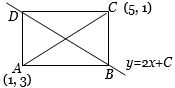
(B) Let $ABCD$ be a rectangle with opposite vertices $A(1, 3)$ and $C(5, 1)$.
Since the diagonals of a rectangle bisect each other,the intersection point of the diagonals is the midpoint of $AC$.
Midpoint of $AC = \left(\frac{1+5}{2}, \frac{3+1}{2}\right) = (3, 2)$.
The other two vertices $B$ and $D$ lie on the line $y = 2x + c$. Since the diagonal $BD$ passes through the intersection point of the diagonals,the point $(3, 2)$ must lie on the line $y = 2x + c$.
Substituting $x = 3$ and $y = 2$ into the equation:
$2 = 2(3) + c$
$2 = 6 + c$
$c = 2 - 6 = -4$.
Thus,the value of $c$ is $-4$.
Since the diagonals of a rectangle bisect each other,the intersection point of the diagonals is the midpoint of $AC$.
Midpoint of $AC = \left(\frac{1+5}{2}, \frac{3+1}{2}\right) = (3, 2)$.
The other two vertices $B$ and $D$ lie on the line $y = 2x + c$. Since the diagonal $BD$ passes through the intersection point of the diagonals,the point $(3, 2)$ must lie on the line $y = 2x + c$.
Substituting $x = 3$ and $y = 2$ into the equation:
$2 = 2(3) + c$
$2 = 6 + c$
$c = 2 - 6 = -4$.
Thus,the value of $c$ is $-4$.
0 likesView Solution
8
MathematicsMediumMCQIIT JEE · 1981
The area enclosed within the curve $|x| + |y| = 1$ is
A
$1/2$
B
$1$
C
$2$
D
$4$
Solution
(C) The equation $|x| + |y| = 1$ represents a square with vertices at $(1, 0)$,$(0, 1)$,$(-1, 0)$,and $(0, -1)$.
The distance between consecutive vertices (e.g.,$(1, 0)$ and $(0, 1)$) is the side length $s = \sqrt{(1-0)^2 + (0-1)^2} = \sqrt{1^2 + (-1)^2} = \sqrt{2}$.
The area of a square is given by $s^2$.
Therefore,the area $= (\sqrt{2})^2 = 2$ square units.
Alternatively,the area of the square formed by $|x| + |y| = a$ is $2a^2$. Here $a = 1$,so the area is $2(1)^2 = 2$.
The distance between consecutive vertices (e.g.,$(1, 0)$ and $(0, 1)$) is the side length $s = \sqrt{(1-0)^2 + (0-1)^2} = \sqrt{1^2 + (-1)^2} = \sqrt{2}$.
The area of a square is given by $s^2$.
Therefore,the area $= (\sqrt{2})^2 = 2$ square units.
Alternatively,the area of the square formed by $|x| + |y| = a$ is $2a^2$. Here $a = 1$,so the area is $2(1)^2 = 2$.
0 likesView Solution
9
MathematicsDifficultMCQIIT JEE · 1981
Tangents are drawn from the point $(4, 3)$ to the circle $x^2 + y^2 = 9$. The area of the triangle formed by them and the line joining their points of contact is
A
$\frac{24}{25}$
B
$\frac{64}{25}$
C
$\frac{192}{25}$
D
$\frac{192}{5}$
Solution
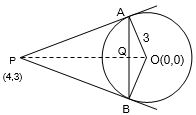
(C) Let the point be $P(4, 3)$ and the circle be $x^2 + y^2 = 9$. The radius $r = 3$.
The equation of the chord of contact $AB$ is $T = 0$,which is $4x + 3y = 9$.
The distance from the origin $O(0, 0)$ to the chord $AB$ is $OQ = \frac{|4(0) + 3(0) - 9|}{\sqrt{4^2 + 3^2}} = \frac{9}{5}$.
In $\triangle OAQ$,$AQ = \sqrt{OA^2 - OQ^2} = \sqrt{3^2 - (\frac{9}{5})^2} = \sqrt{9 - \frac{81}{25}} = \sqrt{\frac{225 - 81}{25}} = \sqrt{\frac{144}{25}} = \frac{12}{5}$.
The length of the chord of contact $AB = 2 \times AQ = 2 \times \frac{12}{5} = \frac{24}{5}$.
The distance $PQ$ is the distance from $P(4, 3)$ to the line $4x + 3y - 9 = 0$,which is $PQ = \frac{|4(4) + 3(3) - 9|}{\sqrt{4^2 + 3^2}} = \frac{|16 + 9 - 9|}{5} = \frac{16}{5}$.
The area of $\triangle PAB = \frac{1}{2} \times \text{base} \times \text{height} = \frac{1}{2} \times AB \times PQ = \frac{1}{2} \times \frac{24}{5} \times \frac{16}{5} = \frac{192}{25}$.
The equation of the chord of contact $AB$ is $T = 0$,which is $4x + 3y = 9$.
The distance from the origin $O(0, 0)$ to the chord $AB$ is $OQ = \frac{|4(0) + 3(0) - 9|}{\sqrt{4^2 + 3^2}} = \frac{9}{5}$.
In $\triangle OAQ$,$AQ = \sqrt{OA^2 - OQ^2} = \sqrt{3^2 - (\frac{9}{5})^2} = \sqrt{9 - \frac{81}{25}} = \sqrt{\frac{225 - 81}{25}} = \sqrt{\frac{144}{25}} = \frac{12}{5}$.
The length of the chord of contact $AB = 2 \times AQ = 2 \times \frac{12}{5} = \frac{24}{5}$.
The distance $PQ$ is the distance from $P(4, 3)$ to the line $4x + 3y - 9 = 0$,which is $PQ = \frac{|4(4) + 3(3) - 9|}{\sqrt{4^2 + 3^2}} = \frac{|16 + 9 - 9|}{5} = \frac{16}{5}$.
The area of $\triangle PAB = \frac{1}{2} \times \text{base} \times \text{height} = \frac{1}{2} \times AB \times PQ = \frac{1}{2} \times \frac{24}{5} \times \frac{16}{5} = \frac{192}{25}$.
0 likesView Solution
10
MathematicsDifficultMCQIIT JEE · 1981
Two tangents $PQ$ and $PR$ are drawn to the circle $x^2 + y^2 - 2x - 4y - 20 = 0$ from the point $P(16, 7)$. If the centre of the circle is $C$,then the area of quadrilateral $PQCR$ is ............ $sq. \text{ units}$.
A
$75$
B
$150$
C
$15$
D
None of these
Solution
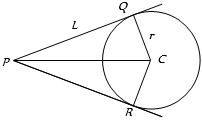
(A) The area of the quadrilateral $PQCR$ is the sum of the areas of two congruent right-angled triangles,$\Delta PQC$ and $\Delta PRC$.
Area $(PQCR) = 2 \times \text{Area}(\Delta PQC) = 2 \times (\frac{1}{2} \times PQ \times QC) = PQ \times r$.
Here,$r$ is the radius of the circle and $PQ$ is the length of the tangent from point $P$.
The equation of the circle is $x^2 + y^2 - 2x - 4y - 20 = 0$.
The centre $C$ is $(1, 2)$ and the radius $r = \sqrt{g^2 + f^2 - c} = \sqrt{(-1)^2 + (-2)^2 - (-20)} = \sqrt{1 + 4 + 20} = \sqrt{25} = 5$.
The length of the tangent $L = PQ = \sqrt{S_1}$,where $S_1$ is the value of the circle equation at point $P(16, 7)$.
$PQ = \sqrt{16^2 + 7^2 - 2(16) - 4(7) - 20} = \sqrt{256 + 49 - 32 - 28 - 20} = \sqrt{225} = 15$.
Therefore,the area of quadrilateral $PQCR = PQ \times r = 15 \times 5 = 75 \text{ sq. units}$.
Area $(PQCR) = 2 \times \text{Area}(\Delta PQC) = 2 \times (\frac{1}{2} \times PQ \times QC) = PQ \times r$.
Here,$r$ is the radius of the circle and $PQ$ is the length of the tangent from point $P$.
The equation of the circle is $x^2 + y^2 - 2x - 4y - 20 = 0$.
The centre $C$ is $(1, 2)$ and the radius $r = \sqrt{g^2 + f^2 - c} = \sqrt{(-1)^2 + (-2)^2 - (-20)} = \sqrt{1 + 4 + 20} = \sqrt{25} = 5$.
The length of the tangent $L = PQ = \sqrt{S_1}$,where $S_1$ is the value of the circle equation at point $P(16, 7)$.
$PQ = \sqrt{16^2 + 7^2 - 2(16) - 4(7) - 20} = \sqrt{256 + 49 - 32 - 28 - 20} = \sqrt{225} = 15$.
Therefore,the area of quadrilateral $PQCR = PQ \times r = 15 \times 5 = 75 \text{ sq. units}$.
0 likesView Solution
11
MathematicsDifficultMCQIIT JEE · 1981
The equation $\frac{x^2}{1 - r} - \frac{y^2}{1 + r} = 1$ for $r > 1$ represents:
A
An ellipse
B
$A$ hyperbola
C
$A$ circle
D
An imaginary ellipse
Solution
(D) Given the equation: $\frac{x^2}{1 - r} - \frac{y^2}{1 + r} = 1$ where $r > 1$.
Since $r > 1$,let $r - 1 = p$,where $p > 0$. Then $1 - r = -p$.
Substituting this into the equation,we get: $\frac{x^2}{-p} - \frac{y^2}{1 + r} = 1$.
Multiplying by $-1$,we get: $\frac{x^2}{p} + \frac{y^2}{1 + r} = -1$.
Since the sum of two squares divided by positive constants equals a negative value $(-1)$,there are no real values of $(x, y)$ that satisfy this equation.
Therefore,the equation represents an imaginary ellipse.
Since $r > 1$,let $r - 1 = p$,where $p > 0$. Then $1 - r = -p$.
Substituting this into the equation,we get: $\frac{x^2}{-p} - \frac{y^2}{1 + r} = 1$.
Multiplying by $-1$,we get: $\frac{x^2}{p} + \frac{y^2}{1 + r} = -1$.
Since the sum of two squares divided by positive constants equals a negative value $(-1)$,there are no real values of $(x, y)$ that satisfy this equation.
Therefore,the equation represents an imaginary ellipse.
0 likesView Solution
12
MathematicsDifficultMCQIIT JEE · 1981
If ${A_1}, {A_2}, {A_3}, \dots, {A_{30}}$ are $30$ sets each having $5$ elements and ${B_1}, {B_2}, \dots, {B_n}$ are $n$ sets each having $3$ elements. Let $\bigcup_{i=1}^{30} {A_i} = \bigcup_{j=1}^n {B_j} = S$ and each element of $S$ belongs to exactly $10$ of the $A_i$'s and exactly $9$ of the $B_j$'s,then $n$ is equal to:
A
$15$
B
$3$
C
$45$
D
None of these
0 likesView Solution
13
MathematicsDifficultMCQIIT JEE · 1981
If $p{\lambda ^4} + q{\lambda ^3} + r{\lambda ^2} + s\lambda + t = \left| {\begin{array}{*{20}{c}}{{\lambda ^2} + 3\lambda }&{\lambda - 1}&{\lambda + 3}\\{\lambda + 1}&{2 - \lambda }&{\lambda - 4}\\{\lambda - 3}&{\lambda + 4}&{3\lambda }\end{array}} \right|$,the value of $t$ is
A
$16$
B
$18$
C
$17$
D
$19$
Solution
(B) Given the identity $p{\lambda ^4} + q{\lambda ^3} + r{\lambda ^2} + s\lambda + t = \left| {\begin{array}{*{20}{c}}{{\lambda ^2} + 3\lambda }&{\lambda - 1}&{\lambda + 3}\\{\lambda + 1}&{2 - \lambda }&{\lambda - 4}\\{\lambda - 3}&{\lambda + 4}&{3\lambda }\end{array}} \right|$.
Since this is an identity in $\lambda$,it holds true for all values of $\lambda$.
To find the value of $t$,we substitute $\lambda = 0$ into the equation:
$t = \left| {\begin{array}{*{20}{c}}0&{ - 1}&3\\1&2&{ - 4}\\{ - 3}&4&0\end{array}} \right|$.
Expanding the determinant along the first row:
$t = 0(0 - (-16)) - (-1)(0 - 12) + 3(4 - (-6))$
$t = 0 + 1(-12) + 3(10)$
$t = -12 + 30 = 18$.
Thus,the value of $t$ is $18$.
Since this is an identity in $\lambda$,it holds true for all values of $\lambda$.
To find the value of $t$,we substitute $\lambda = 0$ into the equation:
$t = \left| {\begin{array}{*{20}{c}}0&{ - 1}&3\\1&2&{ - 4}\\{ - 3}&4&0\end{array}} \right|$.
Expanding the determinant along the first row:
$t = 0(0 - (-16)) - (-1)(0 - 12) + 3(4 - (-6))$
$t = 0 + 1(-12) + 3(10)$
$t = -12 + 30 = 18$.
Thus,the value of $t$ is $18$.
0 likesView Solution
14
MathematicsEasyMCQIIT JEE · 1981
$\cos \left[ 2\cos^{-1}\frac{1}{5} + \sin^{-1}\frac{1}{5} \right] = $
A
$\frac{2\sqrt{6}}{5}$
B
$-\frac{2\sqrt{6}}{5}$
C
$\frac{1}{5}$
D
$-\frac{1}{5}$
Solution
(B) We know that $\cos^{-1}x + \sin^{-1}x = \frac{\pi}{2}$ for $x \in [-1, 1]$.
Given expression: $\cos \left[ \cos^{-1}\frac{1}{5} + \cos^{-1}\frac{1}{5} + \sin^{-1}\frac{1}{5} \right]$.
Using the property,this simplifies to: $\cos \left[ \frac{\pi}{2} + \cos^{-1}\frac{1}{5} \right]$.
Since $\cos(\frac{\pi}{2} + \theta) = -\sin\theta$,we have: $-\sin \left( \cos^{-1}\frac{1}{5} \right)$.
Let $\cos^{-1}\frac{1}{5} = \alpha$,then $\cos\alpha = \frac{1}{5}$.
Then $\sin\alpha = \sqrt{1 - \cos^2\alpha} = \sqrt{1 - (\frac{1}{5})^2} = \sqrt{1 - \frac{1}{25}} = \sqrt{\frac{24}{25}} = \frac{2\sqrt{6}}{5}$.
Thus,the expression equals $-\frac{2\sqrt{6}}{5}$.
Given expression: $\cos \left[ \cos^{-1}\frac{1}{5} + \cos^{-1}\frac{1}{5} + \sin^{-1}\frac{1}{5} \right]$.
Using the property,this simplifies to: $\cos \left[ \frac{\pi}{2} + \cos^{-1}\frac{1}{5} \right]$.
Since $\cos(\frac{\pi}{2} + \theta) = -\sin\theta$,we have: $-\sin \left( \cos^{-1}\frac{1}{5} \right)$.
Let $\cos^{-1}\frac{1}{5} = \alpha$,then $\cos\alpha = \frac{1}{5}$.
Then $\sin\alpha = \sqrt{1 - \cos^2\alpha} = \sqrt{1 - (\frac{1}{5})^2} = \sqrt{1 - \frac{1}{25}} = \sqrt{\frac{24}{25}} = \frac{2\sqrt{6}}{5}$.
Thus,the expression equals $-\frac{2\sqrt{6}}{5}$.
0 likesView Solution
15
MathematicsEasyMCQIIT JEE · 1981
$a \cdot [(b + c) \times (a + b + c)]$ is equal to
A
$[a \, b \, c]$
B
$2[a \, b \, c]$
C
$3[a \, b \, c]$
D
$0$
Solution
(D) We are given the expression $a \cdot [(b + c) \times (a + b + c)]$.
Using the distributive property of the cross product,we expand the term inside the square brackets:
$(b + c) \times (a + b + c) = (b \times a) + (b \times b) + (b \times c) + (c \times a) + (c \times b) + (c \times c)$.
Since the cross product of any vector with itself is zero ($b \times b = 0$ and $c \times c = 0$),the expression simplifies to:
$(b \times a) + (b \times c) + (c \times a) + (c \times b)$.
Now,taking the dot product with $a$:
$a \cdot [(b \times a) + (b \times c) + (c \times a) + (c \times b)] = a \cdot (b \times a) + a \cdot (b \times c) + a \cdot (c \times a) + a \cdot (c \times b)$.
This can be written in terms of scalar triple products:
$[a \, b \, a] + [a \, b \, c] + [a \, c \, a] + [a \, c \, b]$.
In a scalar triple product,if any two vectors are identical,the value is $0$. Thus,$[a \, b \, a] = 0$ and $[a \, c \, a] = 0$.
Also,$[a \, c \, b] = -[a \, b \, c]$.
Substituting these values:
$0 + [a \, b \, c] + 0 - [a \, b \, c] = 0$.
Using the distributive property of the cross product,we expand the term inside the square brackets:
$(b + c) \times (a + b + c) = (b \times a) + (b \times b) + (b \times c) + (c \times a) + (c \times b) + (c \times c)$.
Since the cross product of any vector with itself is zero ($b \times b = 0$ and $c \times c = 0$),the expression simplifies to:
$(b \times a) + (b \times c) + (c \times a) + (c \times b)$.
Now,taking the dot product with $a$:
$a \cdot [(b \times a) + (b \times c) + (c \times a) + (c \times b)] = a \cdot (b \times a) + a \cdot (b \times c) + a \cdot (c \times a) + a \cdot (c \times b)$.
This can be written in terms of scalar triple products:
$[a \, b \, a] + [a \, b \, c] + [a \, c \, a] + [a \, c \, b]$.
In a scalar triple product,if any two vectors are identical,the value is $0$. Thus,$[a \, b \, a] = 0$ and $[a \, c \, a] = 0$.
Also,$[a \, c \, b] = -[a \, b \, c]$.
Substituting these values:
$0 + [a \, b \, c] + 0 - [a \, b \, c] = 0$.
0 likesView Solution
16
MathematicsMediumMCQIIT JEE · 1981
Let $f(x) = \begin{cases} \frac{x^3 + x^2 - 16x + 20}{(x - 2)^2}, & \text{if } x \neq 2 \\ k, & \text{if } x = 2 \end{cases}$. If $f(x)$ is continuous for all $x$,then $k =$
A
$7$
B
$-7$
C
$\pm 7$
D
None of these
Solution
(A) For $f(x)$ to be continuous at $x = 2$,we must have $\lim_{x \to 2} f(x) = f(2) = k$.
First,we evaluate the limit: $\lim_{x \to 2} \frac{x^3 + x^2 - 16x + 20}{(x - 2)^2}$.
Since substituting $x = 2$ gives the indeterminate form $\frac{0}{0}$,we factor the numerator.
By synthetic division or polynomial division,$x^3 + x^2 - 16x + 20 = (x - 2)^2(x + 5)$.
Thus,$\lim_{x \to 2} \frac{(x - 2)^2(x + 5)}{(x - 2)^2} = \lim_{x \to 2} (x + 5) = 2 + 5 = 7$.
Therefore,$k = 7$.
First,we evaluate the limit: $\lim_{x \to 2} \frac{x^3 + x^2 - 16x + 20}{(x - 2)^2}$.
Since substituting $x = 2$ gives the indeterminate form $\frac{0}{0}$,we factor the numerator.
By synthetic division or polynomial division,$x^3 + x^2 - 16x + 20 = (x - 2)^2(x + 5)$.
Thus,$\lim_{x \to 2} \frac{(x - 2)^2(x + 5)}{(x - 2)^2} = \lim_{x \to 2} (x + 5) = 2 + 5 = 7$.
Therefore,$k = 7$.
0 likesView Solution
17
MathematicsMediumMCQIIT JEE · 1981
If $f(x + y) = f(x)f(y)$ for all $x$ and $y$ and $f(5) = 2$,$f'(0) = 3$,then $f'(5)$ will be
A
$2$
B
$4$
C
$6$
D
$8$
Solution
(C) Given the functional equation $f(x + y) = f(x)f(y)$.
Setting $y = 0$,we get $f(x + 0) = f(x)f(0)$,which implies $f(x) = f(x)f(0)$. Since $f(5) = 2$,$f(x)$ is not identically zero,so $f(0) = 1$.
By the definition of the derivative,$f'(x) = \lim_{h \to 0} \frac{f(x + h) - f(x)}{h}$.
Substituting $f(x + h) = f(x)f(h)$,we get $f'(x) = \lim_{h \to 0} \frac{f(x)f(h) - f(x)}{h} = f(x) \lim_{h \to 0} \frac{f(h) - 1}{h}$.
Since $f(0) = 1$,this is $f'(x) = f(x) \lim_{h \to 0} \frac{f(h) - f(0)}{h} = f(x)f'(0)$.
Given $f(5) = 2$ and $f'(0) = 3$,we have $f'(5) = f(5)f'(0) = 2 \times 3 = 6$.
Setting $y = 0$,we get $f(x + 0) = f(x)f(0)$,which implies $f(x) = f(x)f(0)$. Since $f(5) = 2$,$f(x)$ is not identically zero,so $f(0) = 1$.
By the definition of the derivative,$f'(x) = \lim_{h \to 0} \frac{f(x + h) - f(x)}{h}$.
Substituting $f(x + h) = f(x)f(h)$,we get $f'(x) = \lim_{h \to 0} \frac{f(x)f(h) - f(x)}{h} = f(x) \lim_{h \to 0} \frac{f(h) - 1}{h}$.
Since $f(0) = 1$,this is $f'(x) = f(x) \lim_{h \to 0} \frac{f(h) - f(0)}{h} = f(x)f'(0)$.
Given $f(5) = 2$ and $f'(0) = 3$,we have $f'(5) = f(5)f'(0) = 2 \times 3 = 6$.
0 likesView Solution
18
MathematicsMediumMCQIIT JEE · 1981
The value of $\int_0^1 (1 + e^{-x^2}) \,dx$ is:
A
$ - 1$
B
$2$
C
$1 + e^{-1}$
D
None of these
Solution
(D) We are given the integral $I = \int_0^1 (1 + e^{-x^2}) \,dx$.
By the linearity property of definite integrals,we can split this into two parts:
$I = \int_0^1 1 \,dx + \int_0^1 e^{-x^2} \,dx$.
The first part is $\int_0^1 1 \,dx = [x]_0^1 = 1 - 0 = 1$.
The second part is $\int_0^1 e^{-x^2} \,dx$.
The function $e^{-x^2}$ does not have an elementary antiderivative. Therefore,the integral $\int_0^1 e^{-x^2} \,dx$ cannot be expressed in terms of simple algebraic or transcendental functions.
Thus,the value of the integral is $1 + \int_0^1 e^{-x^2} \,dx$.
Comparing this with the given options,none of the options $A, B,$ or $C$ match this result.
Therefore,the correct option is $D$.
By the linearity property of definite integrals,we can split this into two parts:
$I = \int_0^1 1 \,dx + \int_0^1 e^{-x^2} \,dx$.
The first part is $\int_0^1 1 \,dx = [x]_0^1 = 1 - 0 = 1$.
The second part is $\int_0^1 e^{-x^2} \,dx$.
The function $e^{-x^2}$ does not have an elementary antiderivative. Therefore,the integral $\int_0^1 e^{-x^2} \,dx$ cannot be expressed in terms of simple algebraic or transcendental functions.
Thus,the value of the integral is $1 + \int_0^1 e^{-x^2} \,dx$.
Comparing this with the given options,none of the options $A, B,$ or $C$ match this result.
Therefore,the correct option is $D$.
0 likesView Solution
19
MathematicsMediumMCQIIT JEE · 1981
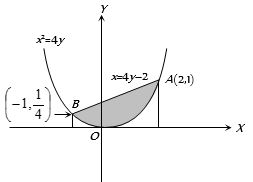
The area bounded by the curve ${x^2} = 4y$ and the straight line $x = 4y - 2$ is
A
$\frac{8}{9} \, \text{sq. unit}$
B
$\frac{9}{8} \, \text{sq. unit}$
C
$\frac{4}{3} \, \text{sq. unit}$
D
None of these
Solution
(B) To find the area bounded by the curve ${x^2} = 4y$ and the line $x = 4y - 2$,we first find their points of intersection.
From the line equation,$4y = x + 2$. Substituting this into the parabola equation ${x^2} = 4y$,we get:
${x^2} = x + 2$
${x^2} - x - 2 = 0$
$(x - 2)(x + 1) = 0$
So,$x = 2$ and $x = -1$.
When $x = 2$,$4y = 4 \implies y = 1$. Point $A(2, 1)$.
When $x = -1$,$4y = 1 \implies y = \frac{1}{4}$. Point $B(-1, \frac{1}{4})$.
The required area is the integral of the upper curve minus the lower curve from $x = -1$ to $x = 2$:
$\text{Area} = \int_{-1}^{2} \left( \frac{x+2}{4} - \frac{x^2}{4} \right) dx$
$= \frac{1}{4} \int_{-1}^{2} (x + 2 - x^2) dx$
$= \frac{1}{4} \left[ \frac{x^2}{2} + 2x - \frac{x^3}{3} \right]_{-1}^{2}$
$= \frac{1}{4} \left[ \left( \frac{4}{2} + 4 - \frac{8}{3} \right) - \left( \frac{1}{2} - 2 + \frac{1}{3} \right) \right]$
$= \frac{1}{4} \left[ \left( 6 - \frac{8}{3} \right) - \left( \frac{3 - 12 + 2}{6} \right) \right]$
$= \frac{1}{4} \left[ \frac{10}{3} - \left( -\frac{7}{6} \right) \right]$
$= \frac{1}{4} \left[ \frac{20 + 7}{6} \right] = \frac{1}{4} \times \frac{27}{6} = \frac{27}{24} = \frac{9}{8} \, \text{sq. unit}$.
From the line equation,$4y = x + 2$. Substituting this into the parabola equation ${x^2} = 4y$,we get:
${x^2} = x + 2$
${x^2} - x - 2 = 0$
$(x - 2)(x + 1) = 0$
So,$x = 2$ and $x = -1$.
When $x = 2$,$4y = 4 \implies y = 1$. Point $A(2, 1)$.
When $x = -1$,$4y = 1 \implies y = \frac{1}{4}$. Point $B(-1, \frac{1}{4})$.
The required area is the integral of the upper curve minus the lower curve from $x = -1$ to $x = 2$:
$\text{Area} = \int_{-1}^{2} \left( \frac{x+2}{4} - \frac{x^2}{4} \right) dx$
$= \frac{1}{4} \int_{-1}^{2} (x + 2 - x^2) dx$
$= \frac{1}{4} \left[ \frac{x^2}{2} + 2x - \frac{x^3}{3} \right]_{-1}^{2}$
$= \frac{1}{4} \left[ \left( \frac{4}{2} + 4 - \frac{8}{3} \right) - \left( \frac{1}{2} - 2 + \frac{1}{3} \right) \right]$
$= \frac{1}{4} \left[ \left( 6 - \frac{8}{3} \right) - \left( \frac{3 - 12 + 2}{6} \right) \right]$
$= \frac{1}{4} \left[ \frac{10}{3} - \left( -\frac{7}{6} \right) \right]$
$= \frac{1}{4} \left[ \frac{20 + 7}{6} \right] = \frac{1}{4} \times \frac{27}{6} = \frac{27}{24} = \frac{9}{8} \, \text{sq. unit}$.
0 likesView Solution
20
MathematicsDifficultMCQIIT JEE · 1981
Let $a, b, c$ be non-zero real numbers such that $\int_0^1 {(1 + \cos^8 x)(ax^2 + bx + c) \, dx} = \int_0^2 {(1 + \cos^8 x)(ax^2 + bx + c) \, dx}$. Then the quadratic equation $ax^2 + bx + c = 0$ has:
A
No root in $(0, 2)$
B
At least one root in $(0, 2)$
C
$A$ double root in $(0, 2)$
D
None of these
Solution
(B) Let $f(x) = (ax^2 + bx + c)(1 + \cos^8 x)$.
Given $\int_0^1 f(x) \, dx = \int_0^2 f(x) \, dx$.
This implies $\int_0^2 f(x) \, dx - \int_0^1 f(x) \, dx = 0$,which simplifies to $\int_1^2 f(x) \, dx = 0$.
Since $f(x)$ is a continuous function and the integral over the interval $(1, 2)$ is zero,$f(x)$ must change sign in the interval $(1, 2)$ unless $f(x) = 0$ for all $x \in (1, 2)$.
Since $a, b, c$ are non-zero,$ax^2 + bx + c$ is not identically zero. Also,$(1 + \cos^8 x) \ge 1 > 0$ for all $x$.
Thus,$f(x)$ must take both positive and negative values in $(1, 2)$.
By the Intermediate Value Theorem,there exists at least one $x_0 \in (1, 2)$ such that $f(x_0) = 0$.
Since $(1 + \cos^8 x) \neq 0$,we must have $ax_0^2 + bx_0 + c = 0$.
Therefore,the quadratic equation $ax^2 + bx + c = 0$ has at least one root in $(1, 2)$,which is contained in $(0, 2)$.
Given $\int_0^1 f(x) \, dx = \int_0^2 f(x) \, dx$.
This implies $\int_0^2 f(x) \, dx - \int_0^1 f(x) \, dx = 0$,which simplifies to $\int_1^2 f(x) \, dx = 0$.
Since $f(x)$ is a continuous function and the integral over the interval $(1, 2)$ is zero,$f(x)$ must change sign in the interval $(1, 2)$ unless $f(x) = 0$ for all $x \in (1, 2)$.
Since $a, b, c$ are non-zero,$ax^2 + bx + c$ is not identically zero. Also,$(1 + \cos^8 x) \ge 1 > 0$ for all $x$.
Thus,$f(x)$ must take both positive and negative values in $(1, 2)$.
By the Intermediate Value Theorem,there exists at least one $x_0 \in (1, 2)$ such that $f(x_0) = 0$.
Since $(1 + \cos^8 x) \neq 0$,we must have $ax_0^2 + bx_0 + c = 0$.
Therefore,the quadratic equation $ax^2 + bx + c = 0$ has at least one root in $(1, 2)$,which is contained in $(0, 2)$.
0 likesView Solution
21
MathematicsEasyMCQIIT JEE · 1981
For a biased die,the probabilities for different faces to turn up are given below:
The die is tossed and you are told that either face $1$ or $2$ has turned up. Then the probability that it is face $1$ is:
| $Face$ | $1$ | $2$ | $3$ | $4$ | $5$ | $6$ |
| $Probability$ | $0.1$ | $0.32$ | $0.21$ | $0.15$ | $0.05$ | $0.17$ |
The die is tossed and you are told that either face $1$ or $2$ has turned up. Then the probability that it is face $1$ is:
A
$\frac{5}{21}$
B
$\frac{5}{22}$
C
$\frac{4}{21}$
D
$\text{None of these}$
Solution
(A) Let $E_1$ be the event that face $1$ turns up and $E_2$ be the event that face $2$ turns up.
Given probabilities are $P(E_1) = 0.1$ and $P(E_2) = 0.32$.
We are given that either face $1$ or $2$ has turned up. Let this event be $A = E_1 \cup E_2$.
Since $E_1$ and $E_2$ are mutually exclusive,$P(A) = P(E_1) + P(E_2) = 0.1 + 0.32 = 0.42$.
We need to find the conditional probability $P(E_1 | A)$,which is the probability that face $1$ has turned up given that either $1$ or $2$ has turned up.
$P(E_1 | A) = \frac{P(E_1 \cap A)}{P(A)} = \frac{P(E_1)}{P(A)} = \frac{0.1}{0.42}$.
Simplifying the fraction: $\frac{0.1}{0.42} = \frac{10}{42} = \frac{5}{21}$.
Given probabilities are $P(E_1) = 0.1$ and $P(E_2) = 0.32$.
We are given that either face $1$ or $2$ has turned up. Let this event be $A = E_1 \cup E_2$.
Since $E_1$ and $E_2$ are mutually exclusive,$P(A) = P(E_1) + P(E_2) = 0.1 + 0.32 = 0.42$.
We need to find the conditional probability $P(E_1 | A)$,which is the probability that face $1$ has turned up given that either $1$ or $2$ has turned up.
$P(E_1 | A) = \frac{P(E_1 \cap A)}{P(A)} = \frac{P(E_1)}{P(A)} = \frac{0.1}{0.42}$.
Simplifying the fraction: $\frac{0.1}{0.42} = \frac{10}{42} = \frac{5}{21}$.
0 likesView Solution
22
MathematicsDifficultMCQIIT JEE · 1981
If $a, b, c$ are positive real numbers and the value of $\theta = \tan^{-1}\sqrt{\frac{a(a+b+c)}{bc}} + \tan^{-1}\sqrt{\frac{b(a+b+c)}{ca}} + \tan^{-1}\sqrt{\frac{c(a+b+c)}{ab}}$,then $\tan \theta$ is equal to
A
$0$
B
$1$
C
$\frac{a+b+c}{abc}$
D
None of these
Solution
(A) Let $s^2 = \frac{a+b+c}{abc}$. Then the expression becomes $\theta = \tan^{-1}\sqrt{a^2 s^2} + \tan^{-1}\sqrt{b^2 s^2} + \tan^{-1}\sqrt{c^2 s^2}$.
Since $a, b, c$ are positive,$\theta = \tan^{-1}(as) + \tan^{-1}(bs) + \tan^{-1}(cs)$.
Using the formula $\tan^{-1} x + \tan^{-1} y + \tan^{-1} z = \tan^{-1}\left(\frac{x+y+z-xyz}{1-(xy+yz+zx)}\right)$:
$\tan \theta = \frac{as+bs+cs - (as)(bs)(cs)}{1 - (asbs + bscs + csas)} = \frac{s(a+b+c) - s^3(abc)}{1 - s^2(ab+bc+ca)}$.
Substitute $s^2 = \frac{a+b+c}{abc}$,which implies $s^2(abc) = a+b+c$:
$\tan \theta = \frac{s(a+b+c) - s(s^2 abc)}{1 - s^2(ab+bc+ca)} = \frac{s(a+b+c) - s(a+b+c)}{1 - s^2(ab+bc+ca)} = \frac{0}{1 - s^2(ab+bc+ca)} = 0$.
Alternatively,let $a=b=c=1$. Then $\theta = \tan^{-1}\sqrt{3} + \tan^{-1}\sqrt{3} + \tan^{-1}\sqrt{3} = 3 \times 60^\circ = 180^\circ = \pi$. Thus,$\tan \theta = \tan \pi = 0$.
Since $a, b, c$ are positive,$\theta = \tan^{-1}(as) + \tan^{-1}(bs) + \tan^{-1}(cs)$.
Using the formula $\tan^{-1} x + \tan^{-1} y + \tan^{-1} z = \tan^{-1}\left(\frac{x+y+z-xyz}{1-(xy+yz+zx)}\right)$:
$\tan \theta = \frac{as+bs+cs - (as)(bs)(cs)}{1 - (asbs + bscs + csas)} = \frac{s(a+b+c) - s^3(abc)}{1 - s^2(ab+bc+ca)}$.
Substitute $s^2 = \frac{a+b+c}{abc}$,which implies $s^2(abc) = a+b+c$:
$\tan \theta = \frac{s(a+b+c) - s(s^2 abc)}{1 - s^2(ab+bc+ca)} = \frac{s(a+b+c) - s(a+b+c)}{1 - s^2(ab+bc+ca)} = \frac{0}{1 - s^2(ab+bc+ca)} = 0$.
Alternatively,let $a=b=c=1$. Then $\theta = \tan^{-1}\sqrt{3} + \tan^{-1}\sqrt{3} + \tan^{-1}\sqrt{3} = 3 \times 60^\circ = 180^\circ = \pi$. Thus,$\tan \theta = \tan \pi = 0$.
0 likesView Solution
23
MathematicsMediumMCQIIT JEE · 1981
If the moduli of the vectors $a, b, c$ are $3, 4, 5$ respectively and $a$ and $b + c$,$b$ and $c + a$,$c$ and $a + b$ are mutually perpendicular,then the modulus of $a + b + c$ is
A
$\sqrt{12}$
B
$12$
C
$5\sqrt{2}$
D
$50$
Solution
(C) Given that $|a| = 3, |b| = 4, |c| = 5$.
Since $a$ and $(b + c)$ are perpendicular,$a \cdot (b + c) = 0 \implies a \cdot b + a \cdot c = 0$ .....$(i)$
Since $b$ and $(c + a)$ are perpendicular,$b \cdot (c + a) = 0 \implies b \cdot c + b \cdot a = 0$ .....$(ii)$
Since $c$ and $(a + b)$ are perpendicular,$c \cdot (a + b) = 0 \implies c \cdot a + c \cdot b = 0$ .....$(iii)$
Adding equations $(i), (ii),$ and $(iii)$,we get:
$2(a \cdot b + b \cdot c + c \cdot a) = 0 \implies a \cdot b + b \cdot c + c \cdot a = 0$.
Now,the modulus of $a + b + c$ is given by:
$|a + b + c|^2 = |a|^2 + |b|^2 + |c|^2 + 2(a \cdot b + b \cdot c + c \cdot a)$
$|a + b + c|^2 = 3^2 + 4^2 + 5^2 + 2(0)$
$|a + b + c|^2 = 9 + 16 + 25 = 50$
$|a + b + c| = \sqrt{50} = 5\sqrt{2}$.
Since $a$ and $(b + c)$ are perpendicular,$a \cdot (b + c) = 0 \implies a \cdot b + a \cdot c = 0$ .....$(i)$
Since $b$ and $(c + a)$ are perpendicular,$b \cdot (c + a) = 0 \implies b \cdot c + b \cdot a = 0$ .....$(ii)$
Since $c$ and $(a + b)$ are perpendicular,$c \cdot (a + b) = 0 \implies c \cdot a + c \cdot b = 0$ .....$(iii)$
Adding equations $(i), (ii),$ and $(iii)$,we get:
$2(a \cdot b + b \cdot c + c \cdot a) = 0 \implies a \cdot b + b \cdot c + c \cdot a = 0$.
Now,the modulus of $a + b + c$ is given by:
$|a + b + c|^2 = |a|^2 + |b|^2 + |c|^2 + 2(a \cdot b + b \cdot c + c \cdot a)$
$|a + b + c|^2 = 3^2 + 4^2 + 5^2 + 2(0)$
$|a + b + c|^2 = 9 + 16 + 25 = 50$
$|a + b + c| = \sqrt{50} = 5\sqrt{2}$.
0 likesView Solution
24
MathematicsMediumMCQIIT JEE · 1981
If $y = a \log |x| + b x^2 + x$ has its extremum values at $x = -1$ and $x = 2$,then
A
$a = 2, b = -1$
B
$a = 2, b = -\frac{1}{2}$
C
$a = -2, b = \frac{1}{2}$
D
None of these
Solution
(B) Given $y = a \log |x| + b x^2 + x$.
Since $\frac{d}{dx} \log |x| = \frac{1}{x}$ for all $x \neq 0$,we differentiate $y$ with respect to $x$:
$\frac{dy}{dx} = \frac{a}{x} + 2bx + 1$.
Since the function has extremum values at $x = -1$ and $x = 2$,the derivative must be zero at these points.
For $x = -1$: $\frac{a}{-1} + 2b(-1) + 1 = 0 \implies -a - 2b + 1 = 0 \implies a + 2b = 1$ (Equation $1$).
For $x = 2$: $\frac{a}{2} + 2b(2) + 1 = 0 \implies \frac{a}{2} + 4b + 1 = 0 \implies a + 8b = -2$ (Equation $2$).
Subtracting Equation $1$ from Equation $2$: $(a + 8b) - (a + 2b) = -2 - 1 \implies 6b = -3 \implies b = -\frac{1}{2}$.
Substituting $b = -\frac{1}{2}$ into Equation $1$: $a + 2(-\frac{1}{2}) = 1 \implies a - 1 = 1 \implies a = 2$.
Thus,$a = 2$ and $b = -\frac{1}{2}$.
Since $\frac{d}{dx} \log |x| = \frac{1}{x}$ for all $x \neq 0$,we differentiate $y$ with respect to $x$:
$\frac{dy}{dx} = \frac{a}{x} + 2bx + 1$.
Since the function has extremum values at $x = -1$ and $x = 2$,the derivative must be zero at these points.
For $x = -1$: $\frac{a}{-1} + 2b(-1) + 1 = 0 \implies -a - 2b + 1 = 0 \implies a + 2b = 1$ (Equation $1$).
For $x = 2$: $\frac{a}{2} + 2b(2) + 1 = 0 \implies \frac{a}{2} + 4b + 1 = 0 \implies a + 8b = -2$ (Equation $2$).
Subtracting Equation $1$ from Equation $2$: $(a + 8b) - (a + 2b) = -2 - 1 \implies 6b = -3 \implies b = -\frac{1}{2}$.
Substituting $b = -\frac{1}{2}$ into Equation $1$: $a + 2(-\frac{1}{2}) = 1 \implies a - 1 = 1 \implies a = 2$.
Thus,$a = 2$ and $b = -\frac{1}{2}$.
0 likesView Solution
Vedclass Products
For Students
Vedclass Test Series
Mock tests in real IIT JEE style covering Mathematics with performance analysis. 5-day free trial.
Start Free TrialFor Teachers
Exam Paper Generator
Generate Set A/B/C/D Mathematics papers from 7.5L+ questions in 2 minutes. 3 chapters free.
Try FreeFor Institutes
Online Exam Module
Run live IIT JEE mock exams with unlimited students, 360° analytics & white-label branding.
See DemoFrequently Asked Questions
How many Mathematics questions are in IIT JEE 1981?
There are 24 Mathematics questions from the IIT JEE 1981 paper on Vedclass, each with a detailed step-by-step solution in English.
Are IIT JEE 1981 Mathematics solutions available in English?
Yes. All solutions on this page are in English. You can also switch to English or Hindi using the language buttons above the questions.
Can I practice IIT JEE 1981 Mathematics as a timed test?
Yes. Use the Vedclass Test Series to attempt a full IIT JEE mock test covering Mathematics with time limits and instant score analysis.
Can teachers create Mathematics papers from IIT JEE previous year questions?
Yes. The Vedclass Exam Paper Generator lets teachers mix IIT JEE Mathematics questions and generate Set A/B/C/D papers in minutes.
For Teachers & Institutes
Build a Custom Mathematics Paper
Pick IIT JEE 1981 Mathematics questions, set difficulty, and generate Set A/B/C/D in 2 minutes.