
PhysicsQ1–28 of 28 questions
Page 1 of 1 · English
1
PhysicsEasyMCQGUJCET · 2015
An inclined plane of length $5.60 \ m$ making an angle of $45^{\circ}$ with the horizontal is placed in a uniform electric field $E = 100 \ V \ m^{-1}$. $A$ particle of mass $1 \ kg$ and charge $10^{-2} \ C$ is allowed to slide down from rest from the maximum height of the slope. If the coefficient of friction is $0.1$,the time taken by the particle to reach the bottom is . . . . . . .
A
$1 \ s$
B
$1.41 \ s$
C
$2 \ s$
D
None of these.
Solution
(B) Given: $\theta = 45^{\circ}$,$d = 5.60 \ m$,$E = 100 \ V \ m^{-1}$,$m = 1 \ kg$,$\mu = 0.1$,$q = 10^{-2} \ C$,$v_0 = 0$.
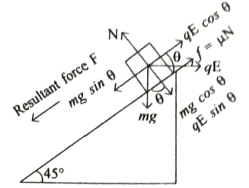
From the free body diagram,the normal force $N$ is:
$N = mg \cos 45^{\circ} + qE \sin 45^{\circ}$
$N = (1 \times 10 \times \frac{1}{\sqrt{2}}) + (10^{-2} \times 100 \times \frac{1}{\sqrt{2}})$
$N = \frac{10}{\sqrt{2}} + \frac{1}{\sqrt{2}} = \frac{11}{\sqrt{2}} \approx 7.778 \ N$
The net force $F$ acting down the incline is:
$F = mg \sin 45^{\circ} - qE \cos 45^{\circ} - \mu N$
$F = (1 \times 10 \times \frac{1}{\sqrt{2}}) - (10^{-2} \times 100 \times \frac{1}{\sqrt{2}}) - (0.1 \times 7.778)$
$F = \frac{10}{\sqrt{2}} - \frac{1}{\sqrt{2}} - 0.7778 = \frac{9}{\sqrt{2}} - 0.7778 \approx 6.364 - 0.778 = 5.586 \ N$
Acceleration $a = \frac{F}{m} = \frac{5.586}{1} = 5.586 \ m \ s^{-2}$.
Using $d = v_0 t + \frac{1}{2} a t^2$:
$5.60 = 0 + \frac{1}{2} \times 5.586 \times t^2$
$t^2 = \frac{2 \times 5.60}{5.586} \approx 2$
$t = \sqrt{2} \approx 1.41 \ s$.
From the free body diagram,the normal force $N$ is:
$N = mg \cos 45^{\circ} + qE \sin 45^{\circ}$
$N = (1 \times 10 \times \frac{1}{\sqrt{2}}) + (10^{-2} \times 100 \times \frac{1}{\sqrt{2}})$
$N = \frac{10}{\sqrt{2}} + \frac{1}{\sqrt{2}} = \frac{11}{\sqrt{2}} \approx 7.778 \ N$
The net force $F$ acting down the incline is:
$F = mg \sin 45^{\circ} - qE \cos 45^{\circ} - \mu N$
$F = (1 \times 10 \times \frac{1}{\sqrt{2}}) - (10^{-2} \times 100 \times \frac{1}{\sqrt{2}}) - (0.1 \times 7.778)$
$F = \frac{10}{\sqrt{2}} - \frac{1}{\sqrt{2}} - 0.7778 = \frac{9}{\sqrt{2}} - 0.7778 \approx 6.364 - 0.778 = 5.586 \ N$
Acceleration $a = \frac{F}{m} = \frac{5.586}{1} = 5.586 \ m \ s^{-2}$.
Using $d = v_0 t + \frac{1}{2} a t^2$:
$5.60 = 0 + \frac{1}{2} \times 5.586 \times t^2$
$t^2 = \frac{2 \times 5.60}{5.586} \approx 2$
$t = \sqrt{2} \approx 1.41 \ s$.
0 likesView Solution
2
PhysicsEasyMCQGUJCET · 2015
An alternating voltage given as $V = 100 \sqrt{2} \sin(100t) \text{ V}$ is applied to a capacitor of $1 \mu\text{F}$. The current reading of the ammeter will be equal to . . . . . . $\text{mA}$.
A
$10$
B
$20$
C
$40$
D
$80$
Solution
(A) The given alternating voltage is $V = 100 \sqrt{2} \sin(100t) \text{ V}$.
Comparing this with the standard form $V = V_m \sin(\omega t)$,we get the peak voltage $V_m = 100 \sqrt{2} \text{ V}$ and angular frequency $\omega = 100 \text{ rad/s}$.
The capacitive reactance is given by $X_C = \frac{1}{\omega C}$.
Substituting the values,$X_C = \frac{1}{100 \times 1 \times 10^{-6}} = \frac{1}{10^{-4}} = 10^4 \text{ } \Omega$.
The root mean square $(RMS)$ voltage is $V_{\text{rms}} = \frac{V_m}{\sqrt{2}} = \frac{100 \sqrt{2}}{\sqrt{2}} = 100 \text{ V}$.
The $RMS$ current $I_{\text{rms}}$ is given by $I_{\text{rms}} = \frac{V_{\text{rms}}}{X_C}$.
$I_{\text{rms}} = \frac{100}{10^4} = 10^{-2} \text{ A}$.
Converting to milliamperes,$I_{\text{rms}} = 10^{-2} \times 10^3 \text{ mA} = 10 \text{ mA}$.
Comparing this with the standard form $V = V_m \sin(\omega t)$,we get the peak voltage $V_m = 100 \sqrt{2} \text{ V}$ and angular frequency $\omega = 100 \text{ rad/s}$.
The capacitive reactance is given by $X_C = \frac{1}{\omega C}$.
Substituting the values,$X_C = \frac{1}{100 \times 1 \times 10^{-6}} = \frac{1}{10^{-4}} = 10^4 \text{ } \Omega$.
The root mean square $(RMS)$ voltage is $V_{\text{rms}} = \frac{V_m}{\sqrt{2}} = \frac{100 \sqrt{2}}{\sqrt{2}} = 100 \text{ V}$.
The $RMS$ current $I_{\text{rms}}$ is given by $I_{\text{rms}} = \frac{V_{\text{rms}}}{X_C}$.
$I_{\text{rms}} = \frac{100}{10^4} = 10^{-2} \text{ A}$.
Converting to milliamperes,$I_{\text{rms}} = 10^{-2} \times 10^3 \text{ mA} = 10 \text{ mA}$.
0 likesView Solution
3
PhysicsEasyMCQGUJCET · 2015
In an $AC$ circuit having only a capacitor,the current . . . . . . .
A
lags behind the voltage by $\frac{\pi}{2}$ in phase.
B
leads the voltage by $\frac{\pi}{2}$ in phase.
C
leads the voltage by $\pi$ in phase.
D
lags behind the voltage by $\pi$ in phase.
Solution
(B) In a purely capacitive $AC$ circuit,the voltage $V$ is given by $V = V_m \sin(\omega t)$ and the current $I$ is given by $I = I_m \sin(\omega t + \frac{\pi}{2})$.
This shows that the current leads the voltage by a phase angle of $\frac{\pi}{2}$ radians.
Therefore,the correct option is $B$.
This shows that the current leads the voltage by a phase angle of $\frac{\pi}{2}$ radians.
Therefore,the correct option is $B$.
0 likesView Solution
4
PhysicsEasyMCQGUJCET · 2015
$A$ current of $\frac{25}{\pi} \text{ Hz}$ frequency is passing through an $AC$ circuit having a series combination of $R=100 \ \Omega$ and $L=2 \text{ H}$. The phase difference between voltage and current is . . . . . . . (in $^{\circ}$)
A
$90$
B
$60$
C
$30$
D
$45$
Solution
(D) For an $RL$ series circuit,the phase difference $\phi$ between voltage and current is given by the formula: $\tan \phi = \frac{X_L}{R} = \frac{\omega L}{R}$.
Given: Frequency $\nu = \frac{25}{\pi} \text{ Hz}$,Resistance $R = 100 \ \Omega$,Inductance $L = 2 \text{ H}$.
Since $\omega = 2 \pi \nu$,we have:
$\tan \phi = \frac{2 \pi \nu L}{R}$
$\tan \phi = \frac{2 \pi \times (\frac{25}{\pi}) \times 2}{100}$
$\tan \phi = \frac{2 \times 25 \times 2}{100} = \frac{100}{100} = 1$.
Therefore,$\phi = \tan^{-1}(1) = 45^{\circ}$.
Given: Frequency $\nu = \frac{25}{\pi} \text{ Hz}$,Resistance $R = 100 \ \Omega$,Inductance $L = 2 \text{ H}$.
Since $\omega = 2 \pi \nu$,we have:
$\tan \phi = \frac{2 \pi \nu L}{R}$
$\tan \phi = \frac{2 \pi \times (\frac{25}{\pi}) \times 2}{100}$
$\tan \phi = \frac{2 \times 25 \times 2}{100} = \frac{100}{100} = 1$.
Therefore,$\phi = \tan^{-1}(1) = 45^{\circ}$.
0 likesView Solution
5
PhysicsEasyMCQGUJCET · 2015
The distance of the closest approach of an alpha particle fired at a nucleus with kinetic energy $K$ is $r_{0}$. The distance of the closest approach when the $\alpha$-particle is fired at the same nucleus with kinetic energy $2K$ will be . . . . . . .
A
$4 r_{0}$
B
$\frac{r_{0}}{2}$
C
$\frac{r_{0}}{4}$
D
$2 r_{0}$
Solution
(B) The distance of the closest approach $r_{0}$ for an alpha particle of kinetic energy $K$ is given by the formula:
$r_{0} = \frac{1}{4 \pi \varepsilon_{0}} \cdot \frac{2Ze^{2}}{K}$
From this expression,we can see that the distance of the closest approach is inversely proportional to the kinetic energy:
$r_{0} \propto \frac{1}{K}$
Let $r_{01} = r_{0}$ when kinetic energy $K_{1} = K$.
When the kinetic energy is increased to $K_{2} = 2K$,let the new distance be $r_{02}$.
Using the proportionality $r_{01} K_{1} = r_{02} K_{2}$,we get:
$r_{0} \cdot K = r_{02} \cdot (2K)$
$r_{02} = \frac{r_{0} \cdot K}{2K} = \frac{r_{0}}{2}$
Therefore,the new distance of the closest approach is $\frac{r_{0}}{2}$.
$r_{0} = \frac{1}{4 \pi \varepsilon_{0}} \cdot \frac{2Ze^{2}}{K}$
From this expression,we can see that the distance of the closest approach is inversely proportional to the kinetic energy:
$r_{0} \propto \frac{1}{K}$
Let $r_{01} = r_{0}$ when kinetic energy $K_{1} = K$.
When the kinetic energy is increased to $K_{2} = 2K$,let the new distance be $r_{02}$.
Using the proportionality $r_{01} K_{1} = r_{02} K_{2}$,we get:
$r_{0} \cdot K = r_{02} \cdot (2K)$
$r_{02} = \frac{r_{0} \cdot K}{2K} = \frac{r_{0}}{2}$
Therefore,the new distance of the closest approach is $\frac{r_{0}}{2}$.
0 likesView Solution
6
PhysicsEasyMCQGUJCET · 2015
The number of spectral lines in a hydrogen atom is . . . . . . .
A
$8$
B
$6$
C
$15$
D
$\infty$
Solution
(D) In a hydrogen atom, an electron can exist in any of the infinite number of energy levels $(n = 1, 2, 3, \dots, \infty)$.
When an electron transitions from a higher energy level to a lower energy level, it emits a photon corresponding to a spectral line.
Since there are an infinite number of possible energy levels, there are an infinite number of possible transitions between these levels.
Therefore, the total number of spectral lines in a hydrogen atom is infinite $(\infty)$.
When an electron transitions from a higher energy level to a lower energy level, it emits a photon corresponding to a spectral line.
Since there are an infinite number of possible energy levels, there are an infinite number of possible transitions between these levels.
Therefore, the total number of spectral lines in a hydrogen atom is infinite $(\infty)$.
0 likesView Solution
7
PhysicsEasyMCQGUJCET · 2015
Match the following two columns:
| Column-$I$ | Column-$II$ |
| $(A)$ Electrical resistance | $(P)$ $M^1 L^3 T^{-3} A^{-2}$ |
| $(B)$ Electrical potential | $(Q)$ $M^1 L^2 T^{-3} A^{-2}$ |
| $(C)$ Specific resistance | $(R)$ $M^1 L^2 T^{-3} A^{-1}$ |
| $(D)$ Specific conductance | $(S)$ None of these |
A
$A-Q, B-S, C-R, D-P$
B
$A-Q, B-R, C-P, D-S$
C
$A-P, B-Q, C-S, D-R$
D
$A-P, B-R, C-Q, D-S$
Solution
(B) The dimensional formulas are derived as follows:
$(A)$ Electrical resistance $(R)$: $R = V/I$. Potential $(V)$ is $M^1 L^2 T^{-3} A^{-1}$ and Current $(I)$ is $A^1$. Thus, $R = [M^1 L^2 T^{-3} A^{-1}] / [A^1] = M^1 L^2 T^{-3} A^{-2}$. This matches $(Q)$.
$(B)$ Electrical potential $(V)$: $V = W/q$. Work $(W)$ is $M^1 L^2 T^{-2}$ and Charge $(q)$ is $A^1 T^1$. Thus, $V = [M^1 L^2 T^{-2}] / [A^1 T^1] = M^1 L^2 T^{-3} A^{-1}$. This matches $(R)$.
$(C)$ Specific resistance (Resistivity, $\rho$): $\rho = R \cdot A / l$. Dimensions are $[M^1 L^2 T^{-3} A^{-2}] \cdot [L^2] / [L] = M^1 L^3 T^{-3} A^{-2}$. This matches $(P)$.
$(D)$ Specific conductance ($\sigma$): $\sigma = 1 / \rho$. Dimensions are $[M^{-1} L^{-3} T^3 A^2]$. This is not listed in the options, so it matches $(S)$.
Therefore, the correct matching is $A-Q, B-R, C-P, D-S$.
$(A)$ Electrical resistance $(R)$: $R = V/I$. Potential $(V)$ is $M^1 L^2 T^{-3} A^{-1}$ and Current $(I)$ is $A^1$. Thus, $R = [M^1 L^2 T^{-3} A^{-1}] / [A^1] = M^1 L^2 T^{-3} A^{-2}$. This matches $(Q)$.
$(B)$ Electrical potential $(V)$: $V = W/q$. Work $(W)$ is $M^1 L^2 T^{-2}$ and Charge $(q)$ is $A^1 T^1$. Thus, $V = [M^1 L^2 T^{-2}] / [A^1 T^1] = M^1 L^2 T^{-3} A^{-1}$. This matches $(R)$.
$(C)$ Specific resistance (Resistivity, $\rho$): $\rho = R \cdot A / l$. Dimensions are $[M^1 L^2 T^{-3} A^{-2}] \cdot [L^2] / [L] = M^1 L^3 T^{-3} A^{-2}$. This matches $(P)$.
$(D)$ Specific conductance ($\sigma$): $\sigma = 1 / \rho$. Dimensions are $[M^{-1} L^{-3} T^3 A^2]$. This is not listed in the options, so it matches $(S)$.
Therefore, the correct matching is $A-Q, B-R, C-P, D-S$.
0 likesView Solution
8
PhysicsEasyMCQGUJCET · 2015
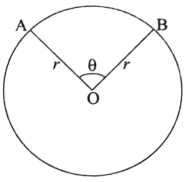
$A$ and $B$ are two points on a uniform ring of radius $r$. The resistance of the ring is $R$. $\angle AOB = \theta$ as shown in the figure. The equivalent resistance between points $A$ and $B$ is . . . . . . .
A
$\frac{R \theta}{2 \pi}$
B
$\frac{R (2 \pi - \theta)}{4 \pi}$
C
$R \left(1 - \frac{\theta}{2 \pi}\right)$
D
$\frac{R \theta (2 \pi - \theta)}{4 \pi^2}$
Solution
(D) Let the total resistance of the ring be $R$. The total length of the ring is $2 \pi r$. The resistance per unit length is $\lambda = \frac{R}{2 \pi r}$.
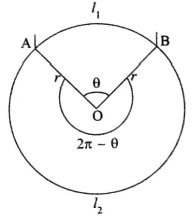
The length of the minor arc $AB$ is $l_1 = r \theta$. The resistance of this part is $R_1 = \lambda l_1 = \left(\frac{R}{2 \pi r}\right) (r \theta) = \frac{R \theta}{2 \pi}$.
The length of the major arc $AB$ is $l_2 = r(2 \pi - \theta)$. The resistance of this part is $R_2 = \lambda l_2 = \left(\frac{R}{2 \pi r}\right) (r(2 \pi - \theta)) = \frac{R(2 \pi - \theta)}{2 \pi}$.
Since the two arcs are connected in parallel between points $A$ and $B$,the equivalent resistance $R_{AB}$ is given by:
$R_{AB} = \frac{R_1 R_2}{R_1 + R_2}$
$R_{AB} = \frac{\left(\frac{R \theta}{2 \pi}\right) \left(\frac{R(2 \pi - \theta)}{2 \pi}\right)}{\frac{R \theta}{2 \pi} + \frac{R(2 \pi - \theta)}{2 \pi}}$
$R_{AB} = \frac{\frac{R^2 \theta (2 \pi - \theta)}{4 \pi^2}}{\frac{R}{2 \pi} (\theta + 2 \pi - \theta)}$
$R_{AB} = \frac{\frac{R^2 \theta (2 \pi - \theta)}{4 \pi^2}}{\frac{R}{2 \pi} (2 \pi)}$
$R_{AB} = \frac{R^2 \theta (2 \pi - \theta)}{4 \pi^2} \cdot \frac{1}{R} = \frac{R \theta (2 \pi - \theta)}{4 \pi^2}$
The length of the minor arc $AB$ is $l_1 = r \theta$. The resistance of this part is $R_1 = \lambda l_1 = \left(\frac{R}{2 \pi r}\right) (r \theta) = \frac{R \theta}{2 \pi}$.
The length of the major arc $AB$ is $l_2 = r(2 \pi - \theta)$. The resistance of this part is $R_2 = \lambda l_2 = \left(\frac{R}{2 \pi r}\right) (r(2 \pi - \theta)) = \frac{R(2 \pi - \theta)}{2 \pi}$.
Since the two arcs are connected in parallel between points $A$ and $B$,the equivalent resistance $R_{AB}$ is given by:
$R_{AB} = \frac{R_1 R_2}{R_1 + R_2}$
$R_{AB} = \frac{\left(\frac{R \theta}{2 \pi}\right) \left(\frac{R(2 \pi - \theta)}{2 \pi}\right)}{\frac{R \theta}{2 \pi} + \frac{R(2 \pi - \theta)}{2 \pi}}$
$R_{AB} = \frac{\frac{R^2 \theta (2 \pi - \theta)}{4 \pi^2}}{\frac{R}{2 \pi} (\theta + 2 \pi - \theta)}$
$R_{AB} = \frac{\frac{R^2 \theta (2 \pi - \theta)}{4 \pi^2}}{\frac{R}{2 \pi} (2 \pi)}$
$R_{AB} = \frac{R^2 \theta (2 \pi - \theta)}{4 \pi^2} \cdot \frac{1}{R} = \frac{R \theta (2 \pi - \theta)}{4 \pi^2}$
0 likesView Solution
9
PhysicsEasyMCQGUJCET · 2015
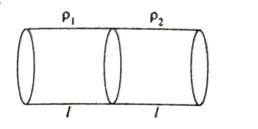
Two wires of equal length and equal diameter and having resistivities $\rho_1$ and $\rho_2$ are connected in series. The equivalent resistivity of the combination is . . . . . . .
A
$\rho_1+\rho_2$
B
$\frac{\rho_1+\rho_2}{2}$
C
$\frac{\rho_1 \rho_2}{\rho_1+\rho_2}$
D
$\sqrt{\rho_1 \rho_2}$
Solution
(B) When two wires are connected in series,the total resistance $R$ is the sum of individual resistances $R_1$ and $R_2$.
$R = R_1 + R_2$
Using the formula $R = \frac{\rho L}{A}$,where $\rho$ is resistivity,$L$ is length,and $A$ is the cross-sectional area:
$\frac{\rho(2l)}{A} = \frac{\rho_1 l}{A} + \frac{\rho_2 l}{A}$
Dividing both sides by $\frac{l}{A}$:
$2\rho = \rho_1 + \rho_2$
$\therefore \rho = \frac{\rho_1 + \rho_2}{2}$
$R = R_1 + R_2$
Using the formula $R = \frac{\rho L}{A}$,where $\rho$ is resistivity,$L$ is length,and $A$ is the cross-sectional area:
$\frac{\rho(2l)}{A} = \frac{\rho_1 l}{A} + \frac{\rho_2 l}{A}$
Dividing both sides by $\frac{l}{A}$:
$2\rho = \rho_1 + \rho_2$
$\therefore \rho = \frac{\rho_1 + \rho_2}{2}$
0 likesView Solution
10
PhysicsEasyMCQGUJCET · 2015
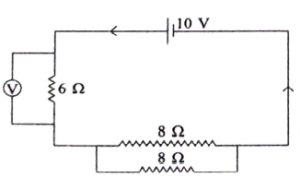
$A$ voltmeter of very high resistance is connected in the circuit as shown in the figure. The voltage shown by this voltmeter will be . . . . . . . (in $V$)
A
$6$
B
$5$
C
$2.5$
D
$3$
Solution
(A) The two $8 \ \Omega$ resistors are connected in parallel to each other.
Their equivalent resistance $R_{eq}$ is given by:
$R_{eq} = \frac{8 \times 8}{8 + 8} = \frac{64}{16} = 4 \ \Omega$
The total resistance of the circuit is:
$R_{total} = 6 \ \Omega + 4 \ \Omega = 10 \ \Omega$
The current $I$ flowing through the circuit is:
$I = \frac{V_{source}}{R_{total}} = \frac{10 \ V}{10 \ \Omega} = 1 \ A$
The voltmeter is connected across the $6 \ \Omega$ resistor. Since the voltmeter has a very high resistance,it does not draw significant current,and the voltage across the $6 \ \Omega$ resistor is:
$V = I \times R = 1 \ A \times 6 \ \Omega = 6 \ V$
Their equivalent resistance $R_{eq}$ is given by:
$R_{eq} = \frac{8 \times 8}{8 + 8} = \frac{64}{16} = 4 \ \Omega$
The total resistance of the circuit is:
$R_{total} = 6 \ \Omega + 4 \ \Omega = 10 \ \Omega$
The current $I$ flowing through the circuit is:
$I = \frac{V_{source}}{R_{total}} = \frac{10 \ V}{10 \ \Omega} = 1 \ A$
The voltmeter is connected across the $6 \ \Omega$ resistor. Since the voltmeter has a very high resistance,it does not draw significant current,and the voltage across the $6 \ \Omega$ resistor is:
$V = I \times R = 1 \ A \times 6 \ \Omega = 6 \ V$
0 likesView Solution
11
PhysicsEasyMCQGUJCET · 2015
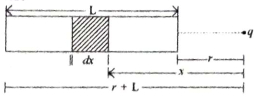
$A$ point charge $q$ is situated at a distance $r$ on the axis from one end of a thin conducting rod of length $L$ having a charge $Q$ (uniformly distributed along its length). The magnitude of the electric force between the two is . . . . . . .
A
$\frac{2 k Q q}{r(r+ L )}$
B
$\frac{k Q q}{r^2}$
C
$\frac{k Q q}{r(r- L )}$
D
$\frac{k Q q}{r(r+ L )}$
Solution
(D) As shown in the figure,consider an elementary charge $dq$ having length $dx$ at a distance $x$ from the point charge $q$. The linear charge density is $\lambda = \frac{Q}{L}$.
Then,$dq = \lambda dx = \frac{Q}{L} dx$.
By Coulomb's law,the force $dF$ between the elementary charge $dq$ and the point charge $q$ is:
$dF = \frac{k q dq}{x^2} = \frac{k q Q dx}{L x^2}$.
To find the total force $F$,integrate $dF$ from $x = r$ to $x = r + L$:
$F = \int_r^{r+L} \frac{k Q q}{L x^2} dx = \frac{k Q q}{L} \int_r^{r+L} x^{-2} dx$.
$F = \frac{k Q q}{L} \left[ -\frac{1}{x} \right]_r^{r+L} = \frac{k Q q}{L} \left( -\frac{1}{r+L} - (-\frac{1}{r}) \right)$.
$F = \frac{k Q q}{L} \left( \frac{1}{r} - \frac{1}{r+L} \right) = \frac{k Q q}{L} \left( \frac{r+L-r}{r(r+L)} \right)$.
$F = \frac{k Q q}{L} \left( \frac{L}{r(r+L)} \right) = \frac{k Q q}{r(r+L)}$.
Then,$dq = \lambda dx = \frac{Q}{L} dx$.
By Coulomb's law,the force $dF$ between the elementary charge $dq$ and the point charge $q$ is:
$dF = \frac{k q dq}{x^2} = \frac{k q Q dx}{L x^2}$.
To find the total force $F$,integrate $dF$ from $x = r$ to $x = r + L$:
$F = \int_r^{r+L} \frac{k Q q}{L x^2} dx = \frac{k Q q}{L} \int_r^{r+L} x^{-2} dx$.
$F = \frac{k Q q}{L} \left[ -\frac{1}{x} \right]_r^{r+L} = \frac{k Q q}{L} \left( -\frac{1}{r+L} - (-\frac{1}{r}) \right)$.
$F = \frac{k Q q}{L} \left( \frac{1}{r} - \frac{1}{r+L} \right) = \frac{k Q q}{L} \left( \frac{r+L-r}{r(r+L)} \right)$.
$F = \frac{k Q q}{L} \left( \frac{L}{r(r+L)} \right) = \frac{k Q q}{r(r+L)}$.
0 likesView Solution
12
PhysicsEasyMCQGUJCET · 2015
When $10^{19}$ electrons are removed from a neutral metal plate through some process,the charge on it becomes . . . . . . .
A
-$1.6$ $C$
B
+$1.6$ $C$
C
$10^{19} C$
D
$10^{-19} C$
Solution
(B) The correct option is $B$.
According to the quantization of charge,the total charge $Q$ on a body is given by the formula $Q = n \times e$,where $n$ is the number of electrons transferred and $e$ is the elementary charge $(e \approx 1.6 \times 10^{-19} \ C)$.
Given:
$n = 10^{19}$
$e = 1.6 \times 10^{-19} \ C$
Calculation:
$Q = 10^{19} \times 1.6 \times 10^{-19} \ C$
$Q = 1.6 \times 10^{(19-19)} \ C$
$Q = 1.6 \times 10^0 \ C$
$Q = 1.6 \ C$
Since electrons (which are negatively charged) are removed from the neutral plate,the plate develops a deficiency of electrons,resulting in a net positive charge.
Therefore,the charge on the plate becomes $+1.6 \ C$.
According to the quantization of charge,the total charge $Q$ on a body is given by the formula $Q = n \times e$,where $n$ is the number of electrons transferred and $e$ is the elementary charge $(e \approx 1.6 \times 10^{-19} \ C)$.
Given:
$n = 10^{19}$
$e = 1.6 \times 10^{-19} \ C$
Calculation:
$Q = 10^{19} \times 1.6 \times 10^{-19} \ C$
$Q = 1.6 \times 10^{(19-19)} \ C$
$Q = 1.6 \times 10^0 \ C$
$Q = 1.6 \ C$
Since electrons (which are negatively charged) are removed from the neutral plate,the plate develops a deficiency of electrons,resulting in a net positive charge.
Therefore,the charge on the plate becomes $+1.6 \ C$.
0 likesView Solution
13
PhysicsEasyMCQGUJCET · 2015
$A$ rod of $10 \ cm$ length is moving perpendicular to a uniform magnetic field of intensity $5 \times 10^{-4} \ Wb/m^2$. If the acceleration of the rod is $5 \ m/s^2$, then the rate of increase of induced $emf$ is . . . . . . .
A
$2.5 \times 10^{-4} \ V/s$
B
$25 \times 10^{-4} \ V/s$
C
$20 \times 10^{-4} \ V/s$
D
$20 \times 10^{-4} \ V/s^{-1}$
Solution
(A) The induced $emf$ $(\varepsilon)$ in a rod of length $l$ moving with velocity $v$ in a magnetic field $B$ is given by $\varepsilon = B l v$.
To find the rate of increase of induced $emf$, we differentiate with respect to time $t$:
$\frac{d\varepsilon}{dt} = B l \frac{dv}{dt}$.
Since $\frac{dv}{dt} = a$ (acceleration), we have $\frac{d\varepsilon}{dt} = B l a$.
Given: $B = 5 \times 10^{-4} \ Wb/m^2$, $l = 10 \ cm = 0.1 \ m$, $a = 5 \ m/s^2$.
Substituting the values:
$\frac{d\varepsilon}{dt} = (5 \times 10^{-4}) \times (0.1) \times (5) = 25 \times 10^{-4} \times 0.1 = 2.5 \times 10^{-4} \ V/s$.
To find the rate of increase of induced $emf$, we differentiate with respect to time $t$:
$\frac{d\varepsilon}{dt} = B l \frac{dv}{dt}$.
Since $\frac{dv}{dt} = a$ (acceleration), we have $\frac{d\varepsilon}{dt} = B l a$.
Given: $B = 5 \times 10^{-4} \ Wb/m^2$, $l = 10 \ cm = 0.1 \ m$, $a = 5 \ m/s^2$.
Substituting the values:
$\frac{d\varepsilon}{dt} = (5 \times 10^{-4}) \times (0.1) \times (5) = 25 \times 10^{-4} \times 0.1 = 2.5 \times 10^{-4} \ V/s$.
0 likesView Solution
14
PhysicsEasyMCQGUJCET · 2015
The network shown in the figure is a part of a circuit. (The battery has negligible internal resistance). At a certain instant,the current is $2 \ A$ and it is decreasing at the rate of $10^2 \ A \ s^{-1}$. What is the potential difference between the points $B$ and $A$ (in $V$)?

A
$8.0$
B
$8.5$
C
$10$
D
$15$
Solution
(B) Given: Current $I = 2 \ A$,rate of change of current $\frac{dI}{dt} = -10^2 \ A \ s^{-1}$ (since it is decreasing),resistance $R = 2 \ \Omega$,$EMF$ $\varepsilon = 12 \ V$,and inductance $L = 5 \ mH = 5 \times 10^{-3} \ H$.
Applying Kirchhoff's voltage law from point $A$ to $B$:
$V_A - IR + \varepsilon - L \frac{dI}{dt} = V_B$
$V_B - V_A = -IR + \varepsilon - L \frac{dI}{dt}$
Substituting the values:
$V_B - V_A = -(2 \times 2) + 12 - (5 \times 10^{-3} \times (-10^2))$
$V_B - V_A = -4 + 12 + 0.5$
$V_B - V_A = 8.5 \ V$
Applying Kirchhoff's voltage law from point $A$ to $B$:
$V_A - IR + \varepsilon - L \frac{dI}{dt} = V_B$
$V_B - V_A = -IR + \varepsilon - L \frac{dI}{dt}$
Substituting the values:
$V_B - V_A = -(2 \times 2) + 12 - (5 \times 10^{-3} \times (-10^2))$
$V_B - V_A = -4 + 12 + 0.5$
$V_B - V_A = 8.5 \ V$
0 likesView Solution
15
PhysicsEasyMCQGUJCET · 2015
If the wavelength of light is $4000 \text{ Å}$, then the number of waves in $1 \text{ mm}$ length will be . . . . . . -
A
$25$
B
$2500$
C
$250$
D
$25000$
Solution
(B) The number of waves $N$ in a given length $L$ is calculated by the formula: $N = \frac{L}{\lambda}$.
Given:
Length $L = 1 \text{ mm} = 10^{-3} \text{ m}$.
Wavelength $\lambda = 4000 \text{ Å} = 4000 \times 10^{-10} \text{ m} = 4 \times 10^{-7} \text{ m}$.
Substituting the values:
$N = \frac{10^{-3}}{4 \times 10^{-7}}$
$N = \frac{1}{4} \times 10^{-3 - (-7)}$
$N = 0.25 \times 10^4$
$N = 2500$.
Therefore, the number of waves is $2500$.
Given:
Length $L = 1 \text{ mm} = 10^{-3} \text{ m}$.
Wavelength $\lambda = 4000 \text{ Å} = 4000 \times 10^{-10} \text{ m} = 4 \times 10^{-7} \text{ m}$.
Substituting the values:
$N = \frac{10^{-3}}{4 \times 10^{-7}}$
$N = \frac{1}{4} \times 10^{-3 - (-7)}$
$N = 0.25 \times 10^4$
$N = 2500$.
Therefore, the number of waves is $2500$.
0 likesView Solution
16
PhysicsEasyMCQGUJCET · 2015
The frequencies of $X-$rays,$\gamma-$rays and ultraviolet rays are respectively $p, q$ and $r$. Then which of the following is correct?
A
$p < q, q > r$
B
$p > q, q > r$
C
$p < q, q < r$
D
$p > q, q < r$
Solution
(A) The electromagnetic spectrum in increasing order of frequency is: Radio waves < Microwaves < Infrared < Visible < Ultraviolet < $X-$rays < $\gamma-$rays.
Given frequencies are:
$p$ (frequency of $X-$rays)
$q$ (frequency of $\gamma-$rays)
$r$ (frequency of ultraviolet rays)
Comparing their positions in the spectrum:
$1$. $\gamma-$rays have the highest frequency,so $q > p$.
$2$. $X-$rays have a higher frequency than ultraviolet rays,so $p > r$.
Combining these,we get $q > p > r$.
Looking at the options provided,we evaluate the relations:
For $p < q$ and $q > r$,this is consistent with $q > p$ and $q > r$.
Thus,the correct relation is $p < q$ and $q > r$.
Given frequencies are:
$p$ (frequency of $X-$rays)
$q$ (frequency of $\gamma-$rays)
$r$ (frequency of ultraviolet rays)
Comparing their positions in the spectrum:
$1$. $\gamma-$rays have the highest frequency,so $q > p$.
$2$. $X-$rays have a higher frequency than ultraviolet rays,so $p > r$.
Combining these,we get $q > p > r$.
Looking at the options provided,we evaluate the relations:
For $p < q$ and $q > r$,this is consistent with $q > p$ and $q > r$.
Thus,the correct relation is $p < q$ and $q > r$.
0 likesView Solution
17
PhysicsEasyMCQGUJCET · 2015
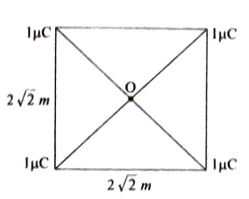
Charges of $1 \mu C$ are placed at each of the four corners of a square of side $2 \sqrt{2} \text{ m}$. The potential at the point of intersection of the diagonals is . . . . . . .
A
$18 \times 10^3 \text{ V}$
B
$1800 \text{ V}$
C
$18 \sqrt{2} \times 10^3 \text{ V}$
D
None of these.
Solution
(A) The length of the diagonal of a square with side $a$ is $a \sqrt{2}$.
Given side $a = 2 \sqrt{2} \text{ m}$,the diagonal length is $d = (2 \sqrt{2}) \times \sqrt{2} = 4 \text{ m}$.
The distance $r$ of each vertex from the center (intersection of diagonals) is half the diagonal length:
$r = \frac{d}{2} = \frac{4}{2} = 2 \text{ m}$.
The electric potential $V$ at the center due to four identical charges $q = 1 \mu C = 10^{-6} \text{ C}$ at distance $r$ is given by:
$V = 4 \times \frac{k q}{r}$,where $k = 9 \times 10^9 \text{ N m}^2/\text{C}^2$.
Substituting the values:
$V = 4 \times \frac{9 \times 10^9 \times 10^{-6}}{2}$
$V = 2 \times 9 \times 10^3 = 18 \times 10^3 \text{ V}$.
Given side $a = 2 \sqrt{2} \text{ m}$,the diagonal length is $d = (2 \sqrt{2}) \times \sqrt{2} = 4 \text{ m}$.
The distance $r$ of each vertex from the center (intersection of diagonals) is half the diagonal length:
$r = \frac{d}{2} = \frac{4}{2} = 2 \text{ m}$.
The electric potential $V$ at the center due to four identical charges $q = 1 \mu C = 10^{-6} \text{ C}$ at distance $r$ is given by:
$V = 4 \times \frac{k q}{r}$,where $k = 9 \times 10^9 \text{ N m}^2/\text{C}^2$.
Substituting the values:
$V = 4 \times \frac{9 \times 10^9 \times 10^{-6}}{2}$
$V = 2 \times 9 \times 10^3 = 18 \times 10^3 \text{ V}$.
0 likesView Solution
18
PhysicsEasyMCQGUJCET · 2015
One moving electron when comes closer to another stationary electron,then its kinetic energy and potential energy respectively . . . . . . and . . . . . . .
A
Increases,Decreases
B
Increases,Increases
C
Decreases,Increases
D
Decreases,Decreases
Solution
(C) The correct option is $C$.
When a moving electron approaches another stationary electron,the electrostatic force of repulsion between them acts in the direction opposite to the motion of the moving electron.
This repulsive force does negative work on the moving electron,which causes its kinetic energy to decrease.
According to the law of conservation of energy,the total energy of the system remains constant.
Since the kinetic energy of the moving electron decreases,its potential energy must increase as the distance between the two electrons decreases.
When a moving electron approaches another stationary electron,the electrostatic force of repulsion between them acts in the direction opposite to the motion of the moving electron.
This repulsive force does negative work on the moving electron,which causes its kinetic energy to decrease.
According to the law of conservation of energy,the total energy of the system remains constant.
Since the kinetic energy of the moving electron decreases,its potential energy must increase as the distance between the two electrons decreases.
0 likesView Solution
19
PhysicsEasyMCQGUJCET · 2015
$27$ identical drops of mercury are charged simultaneously with the same potential of $10 \ V$. Assuming the drops to be spherical,if all the charged drops are made to combine to form one large drop,then its potential will be . . . . . . volt.
A
$90$
B
$40$
C
$160$
D
$10$
Solution
(A) Let the radius of each small drop be $r$ and the charge on each be $q$. The potential of a small drop is given by $V = \frac{kq}{r} = 10 \ V$.
When $n = 27$ drops combine to form a large drop of radius $R$,the volume remains conserved: $\frac{4}{3}\pi R^3 = n \cdot \frac{4}{3}\pi r^3$,which implies $R = n^{1/3}r$.
For $n = 27$,$R = (27)^{1/3}r = 3r$.
The total charge on the large drop is $Q = nq = 27q$.
The potential of the large drop is $V^{\prime} = \frac{kQ}{R} = \frac{k(nq)}{n^{1/3}r} = n^{2/3} \left(\frac{kq}{r}\right) = n^{2/3}V$.
Substituting the values: $V^{\prime} = (27)^{2/3} \times 10 = (3^3)^{2/3} \times 10 = 3^2 \times 10 = 9 \times 10 = 90 \ V$.
When $n = 27$ drops combine to form a large drop of radius $R$,the volume remains conserved: $\frac{4}{3}\pi R^3 = n \cdot \frac{4}{3}\pi r^3$,which implies $R = n^{1/3}r$.
For $n = 27$,$R = (27)^{1/3}r = 3r$.
The total charge on the large drop is $Q = nq = 27q$.
The potential of the large drop is $V^{\prime} = \frac{kQ}{R} = \frac{k(nq)}{n^{1/3}r} = n^{2/3} \left(\frac{kq}{r}\right) = n^{2/3}V$.
Substituting the values: $V^{\prime} = (27)^{2/3} \times 10 = (3^3)^{2/3} \times 10 = 3^2 \times 10 = 9 \times 10 = 90 \ V$.
0 likesView Solution
20
PhysicsEasyMCQGUJCET · 2015
At a place on Earth,the vertical component of Earth's magnetic field is $\sqrt{3}$ times its horizontal component. The angle of dip at this place is . . . . . . . (in $^{\circ}$)
A
$30$
B
$60$
C
$45$
D
$0$
Solution
(B) The angle of dip $(I)$ is defined by the relationship between the vertical component $(Z_E)$ and the horizontal component $(H_E)$ of the Earth's magnetic field as:
$\tan I = \frac{Z_E}{H_E}$
Given that the vertical component is $\sqrt{3}$ times the horizontal component:
$Z_E = \sqrt{3} H_E$
Substituting this into the formula:
$\tan I = \frac{\sqrt{3} H_E}{H_E} = \sqrt{3}$
Since $\tan 60^{\circ} = \sqrt{3}$,we have:
$I = 60^{\circ}$
$\tan I = \frac{Z_E}{H_E}$
Given that the vertical component is $\sqrt{3}$ times the horizontal component:
$Z_E = \sqrt{3} H_E$
Substituting this into the formula:
$\tan I = \frac{\sqrt{3} H_E}{H_E} = \sqrt{3}$
Since $\tan 60^{\circ} = \sqrt{3}$,we have:
$I = 60^{\circ}$
0 likesView Solution
21
PhysicsEasyMCQGUJCET · 2015
$A$ galvanometer of resistance $50 \ \Omega$ is connected to a battery of $8 \ V$ along with a resistance of $3950 \ \Omega$ in series. $A$ full-scale deflection of $30$ divisions is obtained in the galvanometer. In order to reduce this deflection to $15$ divisions,the resistance in series should be . . . . . . $\Omega$.
A
$7900$
B
$1950$
C
$2000$
D
$7950$
Solution
(D) The current $I$ flowing through the galvanometer is proportional to the deflection $\phi$ in divisions,i.e.,$I \propto \phi$.
Using Ohm's law,$I = \frac{V}{R + G}$,where $V = 8 \ V$,$G = 50 \ \Omega$,and $R$ is the series resistance.
For the first case: $I_1 = \frac{V}{R_1 + G}$ with $\phi_1 = 30$ divisions and $R_1 = 3950 \ \Omega$.
For the second case: $I_2 = \frac{V}{R_2 + G}$ with $\phi_2 = 15$ divisions.
Taking the ratio: $\frac{I_1}{I_2} = \frac{\phi_1}{\phi_2} \implies \frac{R_2 + G}{R_1 + G} = \frac{30}{15} = 2$.
Substituting the values: $\frac{R_2 + 50}{3950 + 50} = 2$.
$\frac{R_2 + 50}{4000} = 2$.
$R_2 + 50 = 8000$.
$R_2 = 7950 \ \Omega$.
Using Ohm's law,$I = \frac{V}{R + G}$,where $V = 8 \ V$,$G = 50 \ \Omega$,and $R$ is the series resistance.
For the first case: $I_1 = \frac{V}{R_1 + G}$ with $\phi_1 = 30$ divisions and $R_1 = 3950 \ \Omega$.
For the second case: $I_2 = \frac{V}{R_2 + G}$ with $\phi_2 = 15$ divisions.
Taking the ratio: $\frac{I_1}{I_2} = \frac{\phi_1}{\phi_2} \implies \frac{R_2 + G}{R_1 + G} = \frac{30}{15} = 2$.
Substituting the values: $\frac{R_2 + 50}{3950 + 50} = 2$.
$\frac{R_2 + 50}{4000} = 2$.
$R_2 + 50 = 8000$.
$R_2 = 7950 \ \Omega$.
0 likesView Solution
22
PhysicsEasyMCQGUJCET · 2015
Equal currents are passing through two very long and straight parallel wires in the same direction. They will . . . . . . .
A
repel each other
B
attract each other
C
lean towards each other
D
neither attract nor repel each other
Solution
(B) When two long parallel wires carry currents in the same direction,each wire produces a magnetic field at the location of the other wire.
According to the right-hand rule,the magnetic field produced by one wire exerts a Lorentz force on the current-carrying second wire.
For currents in the same direction,the force between the wires is attractive.
Therefore,the wires will attract each other.
According to the right-hand rule,the magnetic field produced by one wire exerts a Lorentz force on the current-carrying second wire.
For currents in the same direction,the force between the wires is attractive.
Therefore,the wires will attract each other.
0 likesView Solution
23
PhysicsEasyMCQGUJCET · 2015
The energy released by the fission of one uranium atom is $200 \text{ MeV}$. The number of fissions per second required to produce $6.4 \text{ W}$ power is $\qquad$ .
A
$10^{11}$
B
$2 \times 10^{11}$
C
$10^{10}$
D
$2 \times 10^{10}$
Solution
(B) The power $P$ produced is given by the product of the number of fissions per second $(n)$ and the energy released per fission $(E)$.
$P = n \times E$
Given:
$P = 6.4 \text{ W} = 6.4 \text{ J/s}$
$E = 200 \text{ MeV} = 200 \times 10^6 \times 1.6 \times 10^{-19} \text{ J} = 3.2 \times 10^{-11} \text{ J}$
Rearranging for $n$:
$n = \frac{P}{E}$
$n = \frac{6.4}{3.2 \times 10^{-11}}$
$n = 2 \times 10^{11} \text{ fissions/second}$
Thus,the correct option is $B$.
$P = n \times E$
Given:
$P = 6.4 \text{ W} = 6.4 \text{ J/s}$
$E = 200 \text{ MeV} = 200 \times 10^6 \times 1.6 \times 10^{-19} \text{ J} = 3.2 \times 10^{-11} \text{ J}$
Rearranging for $n$:
$n = \frac{P}{E}$
$n = \frac{6.4}{3.2 \times 10^{-11}}$
$n = 2 \times 10^{11} \text{ fissions/second}$
Thus,the correct option is $B$.
0 likesView Solution
24
PhysicsEasyMCQGUJCET · 2015
Light waves travel from an optically rarer medium to an optically denser medium. Its velocity decreases because of a change in . . . . . . .
A
wavelength
B
frequency
C
amplitude
D
phase
Solution
(A) The correct answer is $A$.
The velocity of a wave is given by the relation $v = \nu \lambda$,where $\nu$ is the frequency and $\lambda$ is the wavelength.
When light travels from one medium to another,its frequency $\nu$ remains constant because it depends on the source of the light.
Since $v = \nu \lambda$ and $\nu$ is constant,the velocity $v$ is directly proportional to the wavelength $\lambda$ $(v \propto \lambda)$.
Therefore,when the velocity of light decreases upon entering a denser medium,the wavelength must also decrease.
The velocity of a wave is given by the relation $v = \nu \lambda$,where $\nu$ is the frequency and $\lambda$ is the wavelength.
When light travels from one medium to another,its frequency $\nu$ remains constant because it depends on the source of the light.
Since $v = \nu \lambda$ and $\nu$ is constant,the velocity $v$ is directly proportional to the wavelength $\lambda$ $(v \propto \lambda)$.
Therefore,when the velocity of light decreases upon entering a denser medium,the wavelength must also decrease.
0 likesView Solution
25
PhysicsEasyMCQGUJCET · 2015
$A$ ray of light passes from a medium $A$ having refractive index $1.6$ to the medium $B$ having refractive index $1.5$. The value of the critical angle of medium $A$ is . . . . . . .
A
$\sin^{-1} \sqrt{\frac{16}{15}}$
B
$\sin^{-1} \left(\frac{16}{15}\right)$
C
$\sin^{-1} \left(\frac{1}{2}\right)$
D
$\sin^{-1} \left(\frac{15}{16}\right)$
Solution
(D) The critical angle $i_c$ for a ray of light passing from a denser medium (refractive index $n_1$) to a rarer medium (refractive index $n_2$) is given by the formula:
$\sin i_c = \frac{n_2}{n_1}$
Given:
$n_1 = 1.6$ (Refractive index of medium $A$)
$n_2 = 1.5$ (Refractive index of medium $B$)
Substituting the values:
$\sin i_c = \frac{1.5}{1.6}$
$\sin i_c = \frac{15}{16}$
Therefore,the critical angle is:
$i_c = \sin^{-1} \left(\frac{15}{16}\right)$
Thus,the correct option is $D$.
$\sin i_c = \frac{n_2}{n_1}$
Given:
$n_1 = 1.6$ (Refractive index of medium $A$)
$n_2 = 1.5$ (Refractive index of medium $B$)
Substituting the values:
$\sin i_c = \frac{1.5}{1.6}$
$\sin i_c = \frac{15}{16}$
Therefore,the critical angle is:
$i_c = \sin^{-1} \left(\frac{15}{16}\right)$
Thus,the correct option is $D$.
0 likesView Solution
26
PhysicsEasyMCQGUJCET · 2015
The angle of minimum deviation for a prism of refractive index $1.5$ is equal to the angle of the prism. The angle of the prism is . . . . . . . $(\sin 48^{\circ} 36^{\prime} = 0.75)$
A
$80^{\circ}$
B
$41^{\circ} 24^{\prime}$
C
$60^{\circ}$
D
$82.8^{\circ}$
Solution
(D) The refractive index $n$ of a prism is given by the formula: $n = \frac{\sin((A + D_m)/2)}{\sin(A/2)}$.
Given that the angle of minimum deviation $D_m$ is equal to the angle of the prism $A$,we substitute $D_m = A$ into the formula:
$1.5 = \frac{\sin((A + A)/2)}{\sin(A/2)}$
$1.5 = \frac{\sin(A)}{\sin(A/2)}$
Using the trigonometric identity $\sin(A) = 2 \sin(A/2) \cos(A/2)$,we get:
$1.5 = \frac{2 \sin(A/2) \cos(A/2)}{\sin(A/2)}$
$1.5 = 2 \cos(A/2)$
$\cos(A/2) = 1.5 / 2 = 0.75$
Since $\sin(48^{\circ} 36^{\prime}) = 0.75$,we know that $\cos(90^{\circ} - 48^{\circ} 36^{\prime}) = 0.75$,which is $\cos(41^{\circ} 24^{\prime}) = 0.75$.
Therefore,$A/2 = 41^{\circ} 24^{\prime} = 41.4^{\circ}$.
Thus,$A = 2 \times 41.4^{\circ} = 82.8^{\circ}$.
Given that the angle of minimum deviation $D_m$ is equal to the angle of the prism $A$,we substitute $D_m = A$ into the formula:
$1.5 = \frac{\sin((A + A)/2)}{\sin(A/2)}$
$1.5 = \frac{\sin(A)}{\sin(A/2)}$
Using the trigonometric identity $\sin(A) = 2 \sin(A/2) \cos(A/2)$,we get:
$1.5 = \frac{2 \sin(A/2) \cos(A/2)}{\sin(A/2)}$
$1.5 = 2 \cos(A/2)$
$\cos(A/2) = 1.5 / 2 = 0.75$
Since $\sin(48^{\circ} 36^{\prime}) = 0.75$,we know that $\cos(90^{\circ} - 48^{\circ} 36^{\prime}) = 0.75$,which is $\cos(41^{\circ} 24^{\prime}) = 0.75$.
Therefore,$A/2 = 41^{\circ} 24^{\prime} = 41.4^{\circ}$.
Thus,$A = 2 \times 41.4^{\circ} = 82.8^{\circ}$.
0 likesView Solution
27
PhysicsEasyMCQGUJCET · 2015
$A$ plane polarized light is incident normally on a tourmaline plate. Its $\vec{E}$ vectors make an angle of $60^{\circ}$ with the optic axis of the plate. Find the percentage difference between initial and final intensities. (in $\%$)
A
$50$
B
$25$
C
$75$
D
$90$
Solution
(C) Let the initial intensity of the light be $I_{0}$.
According to Malus's Law,the final intensity $I$ of the light after passing through the tourmaline plate is given by:
$I = I_{0} \cos^{2} \theta$
Given that the angle $\theta = 60^{\circ}$,we have:
$I = I_{0} \cos^{2} 60^{\circ} = I_{0} \left(\frac{1}{2}\right)^{2} = \frac{I_{0}}{4}$
The percentage difference between the initial and final intensities is calculated as:
$\text{Percentage Difference} = \left(\frac{I_{0} - I}{I_{0}}\right) \times 100$
Substituting the value of $I$:
$\text{Percentage Difference} = \left(\frac{I_{0} - \frac{I_{0}}{4}}{I_{0}}\right) \times 100 = \left(\frac{\frac{3I_{0}}{4}}{I_{0}}\right) \times 100 = \frac{3}{4} \times 100 = 75 \%$
According to Malus's Law,the final intensity $I$ of the light after passing through the tourmaline plate is given by:
$I = I_{0} \cos^{2} \theta$
Given that the angle $\theta = 60^{\circ}$,we have:
$I = I_{0} \cos^{2} 60^{\circ} = I_{0} \left(\frac{1}{2}\right)^{2} = \frac{I_{0}}{4}$
The percentage difference between the initial and final intensities is calculated as:
$\text{Percentage Difference} = \left(\frac{I_{0} - I}{I_{0}}\right) \times 100$
Substituting the value of $I$:
$\text{Percentage Difference} = \left(\frac{I_{0} - \frac{I_{0}}{4}}{I_{0}}\right) \times 100 = \left(\frac{\frac{3I_{0}}{4}}{I_{0}}\right) \times 100 = \frac{3}{4} \times 100 = 75 \%$
0 likesView Solution
28
PhysicsEasyMCQGUJCET · 2015
Light of wavelength $\lambda$ is incident on a slit of width $a$. The resulting diffraction pattern is observed on a screen placed at a distance $D$. If the linear width of the central maximum is equal to the width of the slit,then $D = $ . . . . . . .
A
$\frac{2 \lambda^{2}}{a}$
B
$\frac{a^{2}}{2 \lambda}$
C
$\frac{a}{\lambda}$
D
$\frac{2 \lambda}{a}$
Solution
(B) The linear width of the central maximum in a single-slit diffraction pattern is given by $\beta = \frac{2 \lambda D}{a}$.
According to the problem,the linear width of the central maximum is equal to the width of the slit,so $\beta = a$.
Equating the two expressions:
$a = \frac{2 \lambda D}{a}$
Solving for $D$:
$D = \frac{a^{2}}{2 \lambda}$
According to the problem,the linear width of the central maximum is equal to the width of the slit,so $\beta = a$.
Equating the two expressions:
$a = \frac{2 \lambda D}{a}$
Solving for $D$:
$D = \frac{a^{2}}{2 \lambda}$
0 likesView Solution
Vedclass Products
For Students
Vedclass Test Series
Mock tests in real GUJCET style covering Physics with performance analysis. 5-day free trial.
Start Free TrialFor Teachers
Exam Paper Generator
Generate Set A/B/C/D Physics papers from 7.5L+ questions in 2 minutes. 3 chapters free.
Try FreeFor Institutes
Online Exam Module
Run live GUJCET mock exams with unlimited students, 360° analytics & white-label branding.
See DemoFrequently Asked Questions
How many Physics questions are in GUJCET 2015?
There are 28 Physics questions from the GUJCET 2015 paper on Vedclass, each with a detailed step-by-step solution in English.
Are GUJCET 2015 Physics solutions available in English?
Yes. All solutions on this page are in English. You can also switch to English or Hindi using the language buttons above the questions.
Can I practice GUJCET 2015 Physics as a timed test?
Yes. Use the Vedclass Test Series to attempt a full GUJCET mock test covering Physics with time limits and instant score analysis.
Can teachers create Physics papers from GUJCET previous year questions?
Yes. The Vedclass Exam Paper Generator lets teachers mix GUJCET Physics questions and generate Set A/B/C/D papers in minutes.
For Teachers & Institutes
Build a Custom Physics Paper
Pick GUJCET 2015 Physics questions, set difficulty, and generate Set A/B/C/D in 2 minutes.